New EU Media “Freedom Law” Allows for Journalist Arrests if Justified by “Public Interest”
By Cindy Harper | Reclaim The Net | August 11, 2025
The European Union’s “European Media Freedom Act” became binding law across all member states on August 8, but behind its name lies a set of provisions that could restrict the very freedoms it claims to safeguard.
We obtained a copy of the act for you here.
Alongside language about protecting reporters, the regulation authorizes arrests, sanctions, and surveillance of journalists whenever authorities say it serves an “overriding reason in the general interest.”
Ursula von der Leyen, President of the European Commission, hailed the legislation’s arrival on social media, saying, “A free and independent press is an essential pillar of our democracy. With our European Media Freedom Act, we want to improve their protection. This allows journalists to continue their important work safely and without disruption or intimidation.”
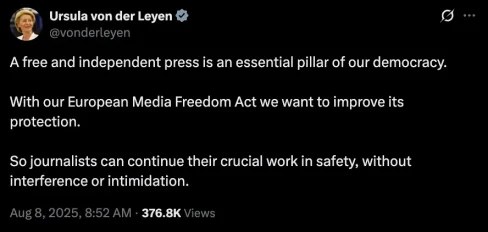
Although the law outlines protections such as prohibiting spyware or coercion to expose sources, those assurances are undercut by built-in loopholes.
Governments can bypass them if their actions are allowed under national or EU law and deemed proportionate to a vaguely defined “general interest.”
That permission extends to intrusive surveillance technologies in cases tied to crimes carrying a maximum prison term of three years or more, a list that ranges from terrorism and human trafficking to offenses labeled as “racism and xenophobia.”
The legislation also orders each country to maintain registers of media owners and addresses. It targets so-called “disinformation,” accusing some media outlets of manipulating the single market to spread falsehoods.
Large online platforms are portrayed as choke points for access to news, blamed for fueling polarization.
To confront this, the EU wants tighter cooperation between national regulators, overseen by a European Media Services Board made up of member state regulators and a Commission representative. Although labeled independent, the board’s secretariat is run by the Commission, giving it an inside track on the decision-making process.
Another element of the act involves pushing “trustworthy media” and reinforcing state broadcasters through transparent appointment processes and stable public funding.
Annual gatherings between EU officials, internet companies, media representatives, and NGOs are encouraged to assess how disinformation initiatives are being carried out.
Despite being sold as a shield for press freedom, the structure of the act gives Brussels and national authorities the ability to decide which voices remain active and which can be silenced. By allowing arrests, surveillance, and tighter state involvement in the media landscape, it risks turning from a safeguard into a tool for control.
Fanatical Zionists Have No Bottom
By Brad Pearce | The Libertarian Institute | August 11, 2025
We’re reaching the point in Israel’s Gaza genocide where “everyone was always against this.” Now that starvation may be irreversible in much of the population, more and more voices which have denied genocide for almost two years are, in some form or another, speaking out—including France and Britain saying they will recognize a Palestinian state if the situation doesn’t improve.
However, the most fanatical of the Zionists continue to deny that starvation exists in Gaza at all and even say bizarre things such as the starving children in Gaza really have congenital disorders (who are going untreated because Israel has bombed all of the hospitals and prevented the entry of medication or sanitary products). This isn’t just random Twitter accounts; the official account of Israel “fact-checked” a claim of a forty-one year-old man dying of starvation by saying he actually died of untreated diabetes (they blocked insulin from entering and the condition can also be caused by starvation). They are giving the facts we see with our own eyes the vicious and tired name of “blood libel.” Israel’s strongest supporters—many of them Christian Zionists who have no actual connection to Israel or Judaism besides their deranged theology—have embraced pure evil and feel no shame expressing this for the entire world to see.
From the start, Israel’s shills—or “Hasbarists” as they are commonly known, from the Hebrew word for “public diplomacy”—have been sharing craven propaganda making wild claims about mutilation and unproven sexual assault on October 7. They claim the United Nations refugee organization is Hamas, and that Gaza is actually wealthy and Palestinians are the most pampered people on Earth. Despite a stream of incredible journalism from within Israel itself, showing that the Israeli Defense Forces (IDF) did order a Hannibal Directive and kill unknown numbers of Israelis on 10/7, the Hasbarists stuck closely to their narrative, never letting contradictions or decency get in their way. For a time they did well sticking to a simple argument of, “Hamas is Israel’s enemy and some civilian deaths are inevitable in war.” However, it has become impossible to credibly deny that Israel is pursuing exterminationist goals.
A big turn in public opinion in the West came when an Israeli airstrike hit the only Catholic Church in Gaza. By the standards of Israel’s crimes this is quite minor, but of course Catholics have a very strong global advocate in the Pope. Prime Minister Benjamin Netanyahu acknowledged Israel’s fault and apologized, and the matter soon could have been forgotten. However, once again, the most shameless of the Hasbarists could not drop it, and claimed the Vatican was spreading Hamas propaganda, despite Netanyahu’s apology. Joel Berry, the craven editor of the Babylon Bee, claimed on Twitter that there are only two hundred Catholics in Gaza and they all support Hamas. The deranged Christian Zionist pastor Greg Locke went as far as to tell his more than 200,000 followers that “Hamas and the Vatican are in bed together” for the purpose of separating Israel and “Biblical” Christians. Between the airstrike and the rhetoric, many more American conservatives came around to demanding some degree of sanity and restraint from Israel and its supporters, with the tepid view that Israel has made the situation in Gaza too bad for too long.
What has set the worst Zionist fanatics off the most, as well as their collapsing support, is the imminent mass starvation, which famine expert Alex de Waal has described as “minutely engineered.” That the starvation in Gaza isn’t deliberate but is an unfortunate consequence of warfare making food delivery unsafe would be a passable lie (besides that Israel keeps killing aid-seekers), but many are going with the claim that starvation isn’t real. One Twitter user thought it would be funny to post a picture of Stephen Hawking and say it was a Palestinian child, because this is a joke to them. Meanwhile, following the recent mass shooting in New York—which strangely enough may have been over football concussions but was initially blamed on Palestine activism—Laura Loomer tweeted:
Her follower isn’t hedging his satement with “Hamas,” but outright says it’s a sign of mental illness to “humanize” Palestinians, who are human. De-humanization has always been a key part of genocidal propaganda.
It’s perplexing that Israel’s propagandists have become so unhinged, to the extent that one wonders who they are even speaking to. The “West” has at once turned, if not against Israel, against its current actions. Silence would be better than bad propaganda at this point, and they seem to be primarily reassuring each other while presenting enormous amount of evidence that they are genocidal maniacs. However, on an episode of the popular podcast Radio War Nerd in June, the hosts interviewed the Israeli Ori Goldberg about the situation in the country, and he shared a different view: committing genocide makes you stupid. According to Goldberg, taking part in or accepting genocide requires such strict black and white thinking that one loses the ability to rationally assess any information, and this spreads to all areas of life, making Israel currently a nation of zombies. This goes far towards explaining why the Hasbarists are endlessly making painfully stupid and unconvincing arguments where silence would serve them better.
Israel’s genocide in Gaza is the greatest crime of the twenty-first century. It is a closely planned and conducted on an industrial scale. It has already reached the point of no-return for many Gazans who cannot be re-fed without close medical care that it is not possible to provide at this scale. Meanwhile, as the first genocide of the modern social media age where both the victims and perpetrators have smart phones, we are witnessing this first hand in a way that was previously unimaginable. We can see the courage and dignity of the Palestinians as they are being slaughtered and the shameless depravity of the Zionist fanatics who support exterminationist policies. Israel’s genocide in Gaza is pure evil, and its remaining supporters do not consider this a “painful necessity” to protect their people, but are instead gleeful to be a part of it: their only annoyance is that so many others refuse to share in their crimes.
Germany’s leading newspaper calls murdered Al Jazeera reporter ‘terrorist posing as journalist’

The Cradle | August 11, 2025
German newspaper Bild has parroted the Israeli army’s claims that slain Al Jazeera journalist Anas al-Sharif was “terrorist disguised as a journalist,” hours after the prominent reporter was targeted and killed in a strike on Gaza City.
Bild is Germany’s highest-circulation newspaper. It had approximately 6.93 million readers per issue in 2023 – and sells around 1.02 million copies a day.
The article cited documents published by Israel claiming Sharif was a member of the Qassam Brigades’ Jabalia battalion.
“The IDF attacked terrorist Anas al-Sharif in the Gaza City area. The terrorist was operating under the guise of an Al Jazeera journalist. The terrorist Anas al-Sharif served as a cell leader in Hamas and promoted rocket fire against citizens of the State of Israel and IDF,” the Israeli army said.
The army points to previously published, unverified documents, including salary documentations, personnel spreadsheets, and a list of training courses, which it says “unequivocally” prove Sharif’s involvement with Hamas.
The documents claim Sharif was recruited into Hamas at the age of 17, despite membership in the group officially requiring a minimum age of 18 years.
Another inconsistency is that joining the Qassam Brigades takes years of training.
Sharif had been covering Israel’s genocidal campaign in Gaza since it started in October 2023. He was given the 2024 Human Rights Defender award by Amnesty International Australia for his coverage.
Tel Aviv had been inciting against him for months.
A headline by The Telegraph on Monday also referred to Sharif as a “journalist accused of leading a Hamas terror cell.” Israeli news site i24’s headline called him a “Hamas-affiliated Al Jazeera journalist” who was “eliminated.”
The documents cited by Israel also listed Hosam Shabat, an Al Jazeera reporter accused of Hamas ties, who was killed in an Israeli strike in March.
Several other journalists are listed as either members of Hamas or the Palestinian Islamic Jihad (PIJ) movement.
“I, Anas al-Sharif, am a journalist with no political affiliations. My only mission is to report the truth from the ground – as it is, without bias. At a time when a deadly famine is ravaging Gaza, speaking the truth has become, in the eyes of the occupation, a threat,” Sharif wrote weeks before his assassination.
Since the start of the war, 238 Palestinian journalists have been targeted and killed by the Israeli army.
Ditching Gazprom Costs Moldova $1.16Bln Annually – Shoigu
Sputnik – 11.08.2025
In his article Moldova at a Crossroads for Sputnik, Russian Security Council Secretary Sergei Shoigu called Chisinau’s refusal to buy gas directly from Gazprom “a shot in the foot”, since the Moldovan budget loses more than 1 billion euros ($1.16 billion) a year from this.
“The refusal of the ‘yellow’ government to buy natural gas directly from Gazprom (although the republic still receives the same Russian gas from Europe) can hardly be called anything other than a shot in the foot. As a result, Moldova is forced to buy energy resources on the European market at inflated prices, which makes the budget annually lose more than 1 billion euros,” Shoigu said.
Since 2021, Moldova has had a government formed by the Party of Action and Solidarity (PAS), created by the incumbent president of the country, Maia Sandu. Next parliamentary elections in Moldova are scheduled for September 28, 2025.
The National Agency for Energy Regulation of Moldova previously reported that it had revoked Moldovagaz’s license to supply gas to local consumers. These rights will be transferred to the state-owned company Energocom by September 1. The decision was made in connection with Chisinau’s obligations to the EU to separate the gas infrastructure as part of the implementation of the Third Energy Package. The deprivation of Moldovagaz’s license to supply gas cannot be considered otherwise than the final stage of depriving Gazprom of its investment target; the Russian company will continue to protect its legal rights and interests by all available means, Gazprom said in turn. The Russian company owns 50% of Moldovagaz.
Europe’s Sad Trajectory: From Peace and Welfare to War and Scarcity
By Ricardo Martins – New Eastern Outlook – August 11, 2025
Once a beacon of peace and prosperity, the European Union is now marching into a new era of militarization and scarcity. Behind the rhetoric of security lies a project increasingly shaped by U.S. pressure, defense spending, and a quiet betrayal of its citizens.
For seven decades, the European project was presented as a beacon of peace, prosperity, and social welfare. Conceived in the ashes of the Second World War, the European Union (EU) emerged as a mechanism to bind former enemies through trade, shared institutions, and the promise that economic interdependence would prevent future wars. For much of its history, this narrative held true: the EU embodied the idea that Europe could reinvent itself as a moral community, anchored in social rights and collective security.
Today, that image is eroded. Europe is rearming at a scale unseen since the Cold War. The EU’s once-proud welfare model is being quietly sacrificed on the altar of militarization, as member states contemplate devoting up to 5% of GDP to defense spending. This transformation is not being driven by a sovereign European strategic vision, but rather by external pressure, primarily from the United States, whose military-industrial complex stands to benefit most.
From Peace Project to War Economy
The metamorphosis of the EU into what critics call a “war and scarcity” project is evident in both policy and rhetoric. European leaders, rather than articulating an independent security doctrine, appear increasingly subordinated to Washington’s priorities. The newly appointed NATO Secretary General and former Dutch Prime Minister, Mark Rutte, has become the face of this transformation.
During the so-called “Trump Summit” in The Hague, Rutte orchestrated an event less about strategy and more about appeasing U.S. President Donald Trump. Red carpets and ceremonial dinners replaced substantive debate. The summit, critics note, projected unity only by avoiding difficult questions, such as the long-term consequences of escalating the conflict in Ukraine or the feasibility of a 5% defense spending target.
Rutte even echoed unverified intelligence claims that Russia might attack a NATO member, offering no evidence, an act that some European observers described as “dangerous theatre.”
When NATO’s chief becomes a conduit for speculative threats to spread fear and make the militarization project palatable to the population, the alliance risks losing credibility and reinforcing the perception that Europe is less a sovereign actor and more a vassal of U.S. power.
The Costs of Militarization
The push toward 5% GDP in defense spending has profound implications for European societies. Bulgarian member of the European Parliament Petar Volgin, in an interview, warned that such a policy would neither enhance security nor foster stability. History shows that the accumulation of weapons often escalates risk rather than prevents conflict. Volgin invoked Anton Chekhov’s famous maxim: if a pistol hangs on the wall in the first act, it will inevitably be fired by the final one.
Beyond strategic risks, the economic trade-offs are stark. Channeling public resources into armaments will drain investments from social sectors like health, education, and welfare, which are the very foundations of the European social model. “This will turn Europe into a militarized monster devoid of social compassion,” Volgin warned.
Citizens, facing cuts in services and rising costs, will pay the price for a strategy that ultimately benefits the U.S. arms industry far more than European security, following Trump’s ruling.
Russophobia and the War Logic
Underlying this shift is what can be described as institutionalized Russophobia. Russophobia has become not just public opinion but a structured ideology shaping policy, media narratives, and diplomatic strategies.
While the focus is on Russian military action in Ukraine, the EU’s strategic response is viewed through the lens of historical Russophobia, which often replaces pragmatism with emotion and prejudice.
For centuries, Russia has been both part of and apart from Europe, contributing profoundly to its literature, music, and intellectual heritage, yet frequently treated as an alien civilization.
The military conflict in Ukraine provided an opportunistic moment for European elites to turn latent Russophobia into policy. Rather than pursuing a balanced security framework that might eventually integrate Russia into a stable European order, the EU doubled down on confrontation, sanctions, and militarization.
This approach carries a profound irony: a union born from the determination to overcome the hatreds of the past is now entrenching new fault lines on the continent. Calls for diplomacy, dialogue, or a broader European peace project, one that is social and moral, not merely military, have been marginalized or dismissed as naïve.
Democratic Disconnection and Strategic Drift
Perhaps the most troubling aspect of Europe’s new trajectory is the widening gap between its political class and its citizens. Surveys conducted in the first year of the Ukraine war showed that over 70% of Europeans preferred a negotiated peace to the indefinite prolongation of conflict. Yet, in the European Parliament, 80% of MEPs rejected amendments calling for diplomacy and only 5% voted in favor.
This dissonance reflects a structural malaise: the EU’s foreign and security policy is increasingly shaped not by democratic debate, but by lobbyists, bureaucratic inertia, and transatlantic pressures.
The shift from a welfare-oriented project to a war-driven agenda has happened without meaningful public consent. As Clare Daly and Mick Wallace, former Irish MEPs, have argued, the EU’s “liberal mask has slipped,” revealing a political architecture that prioritizes geopolitics over people.
War and Scarcity: A Vicious Cycle
The economic consequences of this transformation are already visible. Sanctions on Russia, while politically symbolic, have contributed to energy crises, inflation, and industrial slowdown, particularly in countries like Germany and Italy. Simultaneously, EU states are paying far higher prices for American LNG and U.S.-manufactured weapons, effectively transferring wealth across the Atlantic while their own populations face rising costs and stagnating wages.
This is the essence of Europe’s scarcity turn: by embracing a war economy, the EU sacrifices its social welfare model, undermines economic resilience, and fuels domestic discontent and the far-right parties. Instead of projecting stability, it imports volatility: economic, political, and social.
The Question of Purpose
The European Union now stands at a decisive moment in its evolution. If its purpose is to be a subordinate military bloc within a U.S.-led “Greater West,” it may achieve that at the cost of its original identity as a peace and welfare project.
However, if it seeks to reclaim strategic autonomy and moral credibility – deteriorated by its failure to condemn the genocide in Gaza -, it must confront uncomfortable questions: Can Europe imagine security beyond the logic of militarization and vassalage? Is Europe merely buying time, waiting for a non‑Trump administration, while reinforcing its subservience? Will it rebuild a peace project that addresses social justice and democratic legitimacy, not only deterrence? And can it rediscover the moral ambition that once made it a beacon for a conflict‑scarred world?
For now, the EU’s sad trajectory seems clear: a union that once promised prosperity and peace is becoming a fortress of fear and social uncertainty, defined by war spending, scarcity, and subservience. Its citizens were promised a shared future. What they are receiving instead is a militarized present, and an uncertain tomorrow.
EU wants to be global player but has no say on Ukraine peace process
By Ahmed Adel | August 11, 2025
In the position that the leaders of the European Union are in today, with the strengthening of BRICS and the rise of multiple global powers, the European Union has no place at any negotiating table, let alone the one for Ukraine, as it has nothing to say or offer. The EU is a group of ideologically insane politicians who are making disastrous moves in the service of their ideology, reducing the bloc from one of the most powerful and important economies to one of stagnation and recession threats.
Hungarian Prime Minister Viktor Orbán stated on a Hungarian television program that European leaders must meet with Russian President Vladimir Putin if they do not want to be excluded from shaping the security of their continent. According to him, Europe is currently “asleep” and not taking the necessary steps.
“The EU should not sit at home like an offended child,” and “if there is a problem, you have to negotiate,” Orbán said.
He also added that a Russian-European summit should be held urgently, preferably before the Russian-American summit.
The Hungarian Prime Minister emphasized that Europe must engage in negotiations with Moscow if it does not want to be excluded from all relevant geopolitical discussions, a stance he has consistently reiterated.
When Washington instigates issues with other great powers, such as China and Russia, it benefits by forcing Western partners to renounce their financial, trade, and other interests with these countries and direct them towards the US, which, incidentally, sells them weapons and imposes tariffs. In contrast, the EU should take the lead in normalizing relations with all countries worldwide, starting with Russia, and then improve ties with China and others, rather than following American policy.
Instead, Europe insists on the same policy of globalist hegemony that prevailed during the Biden administration, and they want nothing more than the defeat of Russia. Their only vision of the future is to rule the world, and one of the prerequisites and steps towards that is inflicting a strategic defeat on Russia.
They believe that by increasing pressure, a Russian strategic defeat can be achieved, unaware that this is complete nonsense. This delusional belief has meant that the EU remains on the margins in relation to historical trends and real movements, and at the same time, it lacks both economic and political stability, as well as military strength.
The main prerequisite for concluding peace or a ceasefire is that Ukraine, or at least what remains of it, can never again pose a threat to Russia. This means that Ukraine can never and under no circumstances become part of NATO, nor can it have foreign troops deployed in its country or any offensive assets. Only the US can guarantee and provide such conditions.
US President Donald Trump wants a quick resolution with his Russian counterpart Vladimir Putin because the pressure from the domestic public in the US is great, and they are forcing him to disclose the Epstein dossier. This pressure is so great that Trump is seeking an event that will divert the public’s attention from that topic and shift it to another one.
In addition to the internal panic that forces him to shift his focus elsewhere, Trump is also adopting a more realistic approach to the Ukraine problem than the EU. He is not approaching it from an ideological position, but rather by looking at things somewhat more realistically. This is, of course, not even close to a fundamentally realistic view, but it is still more realistic than the prevailing view in Brussels.
While a historic face-to-face meeting between Trump and Putin has been scheduled for August 15 in Alaska, European leaders have been left to sulk, backing Ukrainian President Volodymyr Zelensky’s announcement that he would not agree to cede territory.
Signed by the President of the European Union and leaders of France, Germany, Italy, Poland, Finland, and the UK, the statement stressed the need for a “just and lasting peace” for Kiev, including “robust and credible” security guarantees.
“Ukraine has the freedom of choice over its own destiny. Meaningful negotiations can only take place in the context of a ceasefire or reduction of hostilities,” the statement said. “The path to peace in Ukraine cannot be decided without Ukraine. We remain committed to the principle that international borders must not be changed by force.”
Although Zelensky may very well be invited to Alaska, it will not be because of the Europeans, but rather because Trump and Putin permitted it. The EU has been proven to be an economic, military, and diplomatic dwarf in the 2020s, and it is difficult to see how it will regain the position of power it enjoyed in previous decades, especially with the rise of alternative powers.
Ahmed Adel, Cairo-based geopolitics and political economy researcher.
Foreign investors disappear from US Treasury auctions, as China borrows at the lowest rates ever
Inside China Business | August 10, 2025
A staggering $11 trillion in US government debt needs to be borrowed or refinanced over the next 12 months.
Treasury Department officials are faced with painful choices, whether to borrow at very high rates, locked in for ten years or longer? Or instead borrow for one year or less, but at massive volumes?
Foreign governments and pension funds are also showing far less interest in absorbing new US government bonds, and are demanding ever-higher yields to compensate for inflation and policy risk.
China’s government, however, can borrow at far below half the rate Washington pays, across all maturities. And Chinese companies are paying the lowest interest rates in their history to access new capital. That represents a long-term structural advantage to Chinese policymakers and industry.
Closing scene, Hong Kong South China Morning Post, China cuts US Treasury holdings for third month amid trade war, debt ceiling fears https://www.scmp.com/economy/china-ec…
Zerohedge, Yields Spike After Very Ugly, Tailing 30Y Auction Sparks Steepening Fears https://www.zerohedge.com/markets/yie…
ZH, Very Ugly, Tailing 10Y Auction Sees Slide In Foreign Demand, Plunge In Bid To Cover https://www.zerohedge.com/markets/ver…
ZH, Ugly, Tailing 3Y Auction Sees Worst Foreign Demand Since 2023 https://www.zerohedge.com/markets/ugl…
Managing Risk in the Face of Historic U.S. Debt Refinancing https://www.tradingcentral.com/market…
What Is Happening with Mortgage Interest Rates? https://www.schwab.com/learn/story/wh…
How the Federal Reserve Actually Affects Mortgage Rates https://www.cnet.com/personal-finance…
Wall Street Journal, Trump and Bessent Bring New Style to Managing America’s Debt https://www.wsj.com/finance/investing…
Banking on the Belt and Road: Insights from a new global dataset of 13,427 Chinese development projects https://docs.aiddata.org/ad4/pdfs/Ban…
China 10-Year Government Bond Yield https://tradingeconomics.com/china/go…
What do falling Chinese yields tell us? https://www.dws.com/insights/cio-view…
X, Corporate borrowing costs in the US have never been lower than China’s today https://x.com/UnHedgedChatter/status/…
The Future of Food
corbettreport – August 10, 2025
Use these links to watch it somewhere else!
WATCH ON:  /
/  /
/  /
/  /
/  /
/  or DOWNLOAD THE MP4
Palestinian Activist Recorded His Own Murder, Israel Still Released His Killer
By Kyle Anzalone | The Libertarian Institute | August 10, 2025
A Palestinian activist featured in the Oscar-winning documentary “No Other Land” recorded his murder by an Israeli settler. The killer was freed by an Israeli court, arguing there was a lack of evidence.
On Sunday, the Israeli human rights organization B’Tselem released a video record by Awda Hadalin of the moment he was shot and killed by Yinon Levi. There are two additional videos that show Levi point his gun and shoot Hadalin before he falls to the ground.
Director of “No Other Land,” Yuval Abraham, said the three videos leave no doubt that Levi murdered Hadalin. “There is no room for doubt. Yinon Levi killed Uda Hadalin in front of the cameras, and an entire system of Jewish superiority turned him from a perpetrator into a victim and punished the village residents instead of punishing him,” he wrote on X.
The day after the killing, an Israeli court accepted Levi’s assertion he was acting in “self-defense” and granted him house arrest. There is no evidence in the video that Levi was in danger.
He was then released from house arrest after a judge ruled the evidence backed his self-defense claim.
Israel refused to give Hadalin’s body to his family to allow for a funeral for over a week. Tel Aviv attempted to force the family to agree to limit his funeral to 15 people before giving his body to relatives. After ten days, the Israeli High Court ordered the release of Hadalin’s body.
Several members of Hadalin’s family and mourners were arrested by Israeli occupation forces. Additionally, the American-Italian nurse who attempted to provide life-saving care to Hadalin was arrested and then deported. “They don’t want people to feel comfortable helping Palestinians,” they told The Intercept.
‘Heartbreaking’: UK paramedic recounts horrors inside Gaza hospitals
Press TV – August 10, 2025
A British paramedic has described “heartbreaking” scenes inside Gaza’s overwhelmed hospitals, where children arrive with life-threatening injuries and entire families are wiped out by Israel’s genocidal war.
Sam Sears, who spent three weeks in Gaza with the UK-based medical charity UK-Med, said the field hospitals were a “conveyor belt of carnage,” packed with patients suffering blast, shrapnel, and gunshot wounds.
Just a few days into his deployment, Sears was sent into a mass casualty incident where two children, aged nine and 11, were killed from blast injuries.
“It was particularly heartbreaking putting a child in a body bag, seeing their face for the last time, then moving them out [of] the way so we could treat more people,” said Sears.
The veteran medic — who has served in Ukraine, Rwanda, Turkey, and Sierra Leone — said Gaza was far worse than anything he had experienced before.
He treated children who had lost entire families, teenagers with life-changing wounds, and newborns suffering severe malnutrition.
He recalled one boy, about eight years old, who was “lifeless behind the eyes” after an explosion killed his whole family.
Sears returned to the UK on July 31 but said the images of Gaza’s children will haunt him forever.
“The people of Gaza don’t get to leave,” he said. “They have no escape from the hunger, the fear, the trauma. They need more than our sympathy — they need our action.”
He called for a sustained ceasefire, not a fragile truce, to end Israel’s hostilities permanently, protect civilians and health workers, and allow unrestricted delivery of food, fuel, and medical supplies into the besieged territory.
UN rapporteur calls on European football body to expel Israel from competitions

Press TV – August 10, 2025
The UN special rapporteur for human rights in the occupied Palestinian territories has called on the European football governing body (UEFA) to expel Israel from competitions over its war crimes and crimes against humanity in the besieged Gaza Strip.
Francesca Albanese’s call came following UEFA’s farewell to a former Palestinian player, Suleiman al-Obeid, whom it called the “Palestinian Pelé.”
“Let’s make sport apartheid and genocide free. One ball, one kick at a time,” Francesca Albanese said on her X account on Sunday.
“Time to expel its killers from competitions, @UEFA,” the UN rapporteur said.
Al-Obaid, a former Palestine national team player, was killed earlier this month in an Israeli strike targeting civilians waiting for humanitarian aid in southern Gaza.

Suleiman Ahmed Zaid al-Obaid, the former captain of the Palestinian national football team (Photo via social media)
He left behind his wife and five children.
Obaid is seen as one of the brightest stars in Palestinian football history. He played 24 official matches for the national team.
He also represented the national team during the 2012 Asian Football Confederation (AFC) Challenge Cup qualification and 2014 World Cup qualifying games.
Obeid’s death has sparked widespread outrage across the world, with people urging the international community and the football fraternity in particular to break their silence over the ongoing genocide.
Palestinian footballers have been directly targeted in Israel’s assault on Gaza.
In a statement released on July 29, 2025, the Palestinian Olympic Committee (POC) reported that in July alone, the Israeli regime killed 40 Palestinian athletes in Gaza and the occupied West Bank.
More than 800 athletes have been killed in Gaza since the start of Israel’s genocidal war on Oct. 7, 2023, as the sports community continues to suffer under bombardment, famine, and the collapse of infrastructure.
Last month, the International Federation of Muaythai Associations (IFMA) announced an urgent policy change regarding Israeli representation at its events.
This came following the killing of a young Palestinian teenager athlete and peace ambassador, Ammar Hamayel, by Israeli forces in the occupied West Bank.
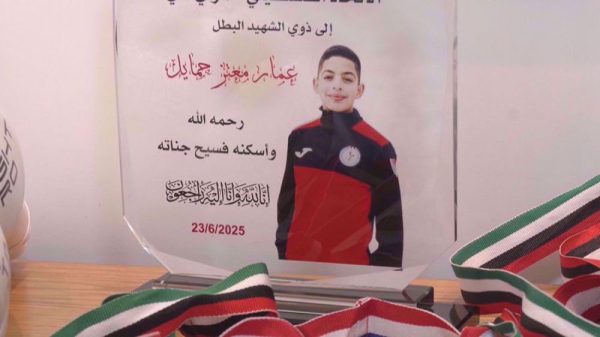
Hamayel, 13 years old, was a Thai boxing champion, dreaming of representing Palestine on the world stage. But like many other Palestinian children, his dream was silenced by Israeli bullets.
The IFMA back then said in a statement that the decision represents a peaceful yet firm protest against actions that “endanger children and violate the core values of global sport”.
In May, Spain was reportedly spearheading a coordinated initiative aimed at persuading the European Union to eliminate Israel from all continental sports competitions over its genocidal war on Palestinians in the besieged Gaza Strip.
Calls to exclude Israel from international sports events have indeed increased recently due to its relentless aggression against Gaza.
Zionism won’t stop, the Arab world must collapse

By Lorenzo Maria Pacini | Strategic Culture Foundation | August 10, 2025
Four weeks after the signing of the Abraham Accords—signed on September 15, 2020, with U.S. mediation and involving the United Arab Emirates and Bahrain—Israeli urban planning authorities have authorized the construction of 4,948 new homes in the occupied territories of the West Bank. No significant public statements, no troop movements: just bureaucratic approvals marking a further step in the expansion of Israel’s presence. This advance, shrouded in the rhetoric of ‘peace’, took place in silence, reflecting a well-established approach: proceed with normalization when the region is compliant and intensify colonization when international attention wanes.
This logic is rooted in the expansionist model of Zionism: where possible, military force is used; where this is not convenient or feasible, soft penetration is used in the form of security agreements, economic cooperation, and intelligence alliances. This dual strategy—based on physical conquest and hegemonic consolidation—has been in place since 1967 and today extends unchecked from the Jordan River to the Atlantic Ocean.
Let us be clear: the Zionist project, in all its aspects, will not stop. The Arab world represents an obstacle to the construction of Greater Israel and the manifestation of Zionist hegemony.
The “Greater Israel” project manifests itself on two levels: on the one hand, the annexation of Palestinian territories, and on the other, geopolitical control of the region through indirect means. And, if we want to extend our projections, we must consider that Greater Israel is the starting point, not the end point.
This is a vision rooted in Zionist ideology, which envisages Jewish domination over the entire “Biblical Land of Israel.” When direct occupation is not sustainable, Tel Aviv prefers maneuvers of influence and destabilization that undermine the sovereignty of neighboring Arab states. The two dimensions—territorial and imperial—are interdependent.
This strategy has deep roots. Ze’ev Jabotinsky, the father of revisionist Zionism, wanted control over all of Mandatory Palestine and beyond, arguing that colonization should take place even against the will of the local populations. David Ben-Gurion, while publicly accepting the partition in 1937, saw that compromise only as an initial phase towards subsequent expansion, confirming the intention to extend the borders to the whole of Palestine once the Israeli military apparatus had been strengthened, as indeed happened. At first, Israel’s military power was insufficient for large-scale operations, so the “periphery doctrine” was developed, through which Israel cultivated alliances with non-Arab states and marginalized minorities (the Shah’s Iran, Turkey, Iraqi Kurds, Sudanese Christians), indirectly weakening its Arab rivals. This strategy, now adapted, is also visible in recent relations with the Druze communities in southern Syria.
Normalization means influence
Israeli penetration into the Arab world has reached an unprecedented level. The Abraham Accords have opened the door to large-scale economic, military, and technological cooperation. The historic treaties with Egypt and Jordan were only the beginning, with the United Arab Emirates subsequently becoming a prominent trading partner. The same is true in the Maghreb: Morocco, for example, has purchased weapons and signed industrial agreements in the drone sector, becoming a production hub for Israeli UAV systems. All this has created a geopolitical corridor linking Israel to the Gulf and North Africa, expanding its access to strategic routes, intelligence spaces, and crucial markets.
As economic relations intensify, colonization continues. Raze everything to the ground, indiscriminately; drive out the Palestinians, no questions asked; conquer the lands they consider “divine right.” Infrastructure is designed to isolate Palestinian communities in unconnected enclaves, making the formation of an autonomous state impossible.
Israel has also consolidated its presence in Syria (in the Quneitra region, near Damascus and Deraa), taking advantage of the chaos following the fall of Assad and the seizure of power by the jihadist group HTS led by Ahmad al-Sharaa (formerly known as al-Julani). In Lebanon, it maintains control of key areas such as the Shebaa Farms and the Kfar Shuba hills, as well as military positions along the Blue Line.
Expansion is masked by integration. Today, the Israeli occupation is no longer manifested solely through weapons, but is supported and fueled by diplomatic agreements and trade flows. “Normalization” has not stopped the occupation: it has made it more effective. Each new agreement with Arab countries increases Israel’s ability to extend colonization and strengthen military control. Plans are already underway to double the number of settlers in the Golan Heights and increase the military presence along sensitive areas. The consequences are being felt: Egypt is building a wall on the border with Gaza to manage possible flows of displaced persons; Jordan sees its water resources threatened; Syria and Lebanon are under increasing pressure to normalize relations with Israel.
The Greater Israel project is advancing: on the one hand, it is swallowing up territories; on the other, it is influencing the sovereign choices of Arab states. Together, they represent two sides of the same strategy: annexation and subordination.
And all this, let’s be clear, will not stop at Palestine.
Zionism is viscerally anti-Christian and anti-Islamic. Anything that does not adhere to Zionist Judaism must be eliminated.
From an Islamic perspective, criticism of Zionism is based on several levels. First of all, Zionism, in its state form, has led to the confiscation and occupation of Muslim holy sites—primarily Al-Aqsa in Jerusalem—with a progressive erosion of access to and management of sacred places. This is not only a political violation, but also a spiritual one, as Islamic sovereignty over Jerusalem is considered a religious duty, rooted in the Quran and prophetic tradition. The Zionist rejection of Arab sovereignty – expressed in the marginalization of Islamic religious institutions in the occupied territories – is a denial of the Umma, the unity of the community of believers, and of its legitimacy to safeguard the places of Islam.
Similarly, Christianity, especially in its Eastern expressions, has also suffered from an exclusionary Zionist approach. The Zionist theological imagination, which demands a Jewish “territorial redemption” of Palestine, excludes the historical and cultural presence of indigenous Christian communities, reducing them to tolerated or suspect minorities. Talmudic hatred of Christians is well known. For many Palestinian and Middle Eastern Christians, Zionism represents a form of nationalist secularization that empties the Holy Land of its universal value, transforming it into an exclusive ethnic-religious property.
In its quest to create an exclusive Jewish state, Zionism has promoted dynamics of exclusion and delegitimization of the other Abrahamic religions historically present in Palestine. This makes it ideologically antithetical to any pluralistic and shared vision of the holy places and communities that have coexisted there for centuries.
We should not be surprised if we soon see conflicts arise between the powers of the Arab world or, by extension, in other Islamic countries, such as in Asia, precisely because of their geopolitical and geoeconomic relations with the Zionist entity.
Because, ultimately, this is the plan: in Greater Israel, there can only be Israeli Zionism. Christianity and Islam must first be exploited, then banned. At any cost.
Featured Video
No Vote, No Representation, No State: Democracy, Israeli Style
or go to
Aletho News Archives – Video-Images
From the Archives
Sanctions, War and the Policy of Dual Containment
By SASAN FAYAZMANESH | March 17, 2008
It is now nearly three decades since the Unites States adopted the policy of dual containment of Iran and Iraq. While much has been written about the containment of Iraq, there has been very little in-depth analysis of this policy when it comes to Iran. In a book that is going to be released on March 31, 2008, entitled The United States and Iran: Sanctions, Wars and the Policy of Dual Containment (Routledge), I attempt to address this shortcoming by investigating when and why the US policy of containment of Iran came about, how it evolved, and where it stands today.[1] To the extent that Israel has been involved in US policy making, the study will also include the role that Israel has played in the containment of Iran. Also, since the fate of Iran has been inextricably linked to that of Iraq, occasionally the investigation will overlap with the containment of Iraq.
The policy of dual containment of Iran and Iraq originated during the Carter Administration, but it was not until the Clinton Administration that the expression “dual containment” became popular. … continue
Blog Roll
 Aletho News
- No Vote, No Representation, No State: Democracy, Israeli Style
- Zionist Bought Senate Blocks Information About American Citizens Killed By Israel
- While Gaza dominates the UN, these are the people keeping it alive
- New Report: “Scholasticide and Genocide in Gaza: Assessment, Testimonies and Legal Analysis”
- ‘THAAD Delusion’: Iran war exposes US missile shield limits – The Atlantic
- Moscow issues warning to NATO over Russian exclave
- Yes, the Iran war has destroyed Trump’s presidency
- The fallacy of US delusions about Iran’s economic collapse
- Hezbollah denies Syria cell link, warns of Israeli plan to sow discord
- The legacy of US sanctions, war, and occupation in Iraq
- If Americans Knew
- Mamdani releases plan to combat antisemitism and hate crimes in New York City
- Iran’s Revolutionary Guards Publish Letter to the American People
- DMFI launches $1 million ad campaign supporting Virginia’s Elaine Luria
- US Senate blocks resolution seeking report on Americans killed by Israel
- Israeli Attacks Kill Ten Palestinians in Gaza
- Massacre at Minab: The School That Became a Grave
- Israeli media: The IDF Shows It Doesn’t Turn a Blind Eye; It Actively Emboldens Settler Havoc
- As settlers ravage West Bank, Israeli forces kill 10 in Gaza – Daily Update
- New Report: “Scholasticide and Genocide in Gaza: Assessment, Testimonies and Legal Analysis”
- Ex-Biden officials are desperate for a Gaza scapegoat
- No Tricks Zone
- Green Energy Debacle: German Expert Professor Fritz Vahrenholt Warns Of Severe Economic And Social Consequences
- Two More Paleo Reconstructions Affirm Meters-Higher Sea Levels Across Ireland, Brazil 7000-6000 Years Ago
- New Study: Earth And Venus Surface Warmth Largely Explained By Convection And Lapse Rate, Not CO2 Or Radiation
- 2025 Nature Paper Claiming Worsening Global Drought Gets RETRACTED …Heavily Flawed
- New Study: ‘Global Drought Shows No Detectable Recent Acceleration Under Climate Warming’
- Economic Masterminds: German Socialists Suggest Taxing Productivity Gains Stemming From Using AI
- The South China Sea Has Not Been Cooperating With The Climate Change Narrative
- Energy Crisis: Germany Enters Heating Season With Historically Low Gas Reserve Fill Levels
- New Study: The Antarctic Ice Sheet Gained Mass From 2020-2024 Due To Staggering Snow And Ice Accumulation
- Study: Ocean Heating Rates From Thousands Of Years Ago ‘Dwarf’ Modern Ocean Heating Rates

