Russia’s Laser Weapon Supremacy: Short Guide
Sputnik – 27.07.2025
While the US and its European pals can only dream about developing laser weaponry, Russia is already light years ahead of them.
Unlike kinetic weapons, lasers do not use ammo and do not require reloading, only a power source, Russian military analyst Alexander Artamonov explained to Sputnik.
Lasers can also display a better rate of fire and would be much harder to evade than, for example, a missile.
“It is more efficient in terms of cost and the rate of fire, depending on the nature of the target you want to hit, and in terms of the time it takes to hit the target,” Artamonov remarked.
Nowadays, Russia, the United States and China run laser weapon programs. When it comes to actual working laser weapons, only Russia can present tangible proof.
Peresvet is a Russian mobile laser system designed to ‘blind’ enemy optical and optical-electronic surveillance systems, including drones, reconnaissance aircraft and even satellites. It has already been adopted by the Russian Armed Forces.
“Peresvet lasers are currently deployed not only in the Moscow region but on the front line as well,” Artamonov said, referring to the Ukrainian conflict zone.
Meanwhile, the US simply lacks the technology and know-how – like, for example, a sufficiently powerful and compact power source – to achieve comparable results.
“They conducted tests in the Indian Ocean. The US lasers perform poorly in water mist – under adverse weather conditions, that is,” Artamonov said.
Simply put, Russia’s Western rivals cannot field actual laser weapons whereas Russia is already developing more advanced and deadly military lasers.
The AMIA case: The untold story
By Raphael Machado | Strategic Culture Foundation | July 27, 2025
On the morning of July 18, 1994, a bomb exploded at the headquarters of the Argentine Israelite Mutual Association (AMIA) in downtown Buenos Aires, leveling the building and killing 85 people, with over 300 injured.
The attack occurred two years after the bombing of the Israeli embassy in Argentina, which left 22 dead and 242 wounded. Both attacks took place during the presidency of Carlos Menem, a government that was pivotal for Argentina as it marked a transition to neoliberalism, featuring mass privatizations and a partial dollarization of the economy.
But on the geopolitical front, the Menem administration is more remembered for the apparent “secret war” that unfolded within the country, involving intelligence agencies and subversive groups from various nations.
The most widely accepted version of the AMIA case goes as follows: To retaliate against the cancellation of a nuclear technology transfer agreement between Argentina and Iran, the Iranian government (then under President Akbar Rafsanjani) orchestrated an act of revenge, with operatives from the Lebanese Hezbollah carrying it out.
This narrative, elevated to “official truth,” was supported by intelligence reports from the U.S. and Israel. It led to Argentina designating Hezbollah as a terrorist organization and the rupture of previously friendly relations between Argentina and Iran.
But what if this popular version is wrong?
Recently, a former aide to Judge Juan José Galeano—who oversaw the investigation and trial from 1994 to 2005—revealed details that cast doubt on the established narrative. According to Claudio Lifschitz, Galeano’s former assistant and a former Argentine security official, no concrete evidence linking the Iranian government to the attack was ever found. On the contrary, Lifschitz claims that the evidence increasingly pointed toward elements within Argentina’s intelligence service, SIDE.
Lifschitz first entered the public eye in this case when he released a video recording of a meeting between Galeano and Carlos Telleldín, in which the judge allegedly offered money to the supposed supplier of the van used in the attack—in exchange for confessing that he had sold it to Mohsen Rabbani, the cultural attaché at the Iranian Embassy in Buenos Aires. According to Lifschitz, one of the key pieces of evidence that could exonerate Iran is the fact that SIDE had illegally wiretapped—without a court order—the Iranian Embassy and the Iranian Cultural Center in Buenos Aires, amassing thousands of hours of recordings without a single indication that any Iranians frequenting these places had prior knowledge of the attack.
The real mastermind, Lifschitz alleges, was Jaime Stiuso, deputy chief of SIDE’s counterintelligence division (Section 85) and the officer in charge of intelligence investigations for the AMIA case. According to Lifschitz, Telleldín had actually sold the van used in the attack to a SIDE agent. Furthermore, Stiuso—who had close ties to Mossad and the CIA—was allegedly responsible for constructing the accusation made by prosecutor Alberto Nisman that then-President Cristina Kirchner had sought to cover up Iranian involvement in the case.
The former Argentine intelligence agent claims he heard directly from Stiuso that Mossad was the real force behind the attacks—though it remains difficult to verify whether this conversation actually took place.
The case remains relevant today because it is being leveraged by Javier Milei’s government to justify closer ties with Israel, to the point where the Argentine president has labeled Iran as an “enemy state of Argentina.”
Tehran’s new war plan: Build an anti-NATO
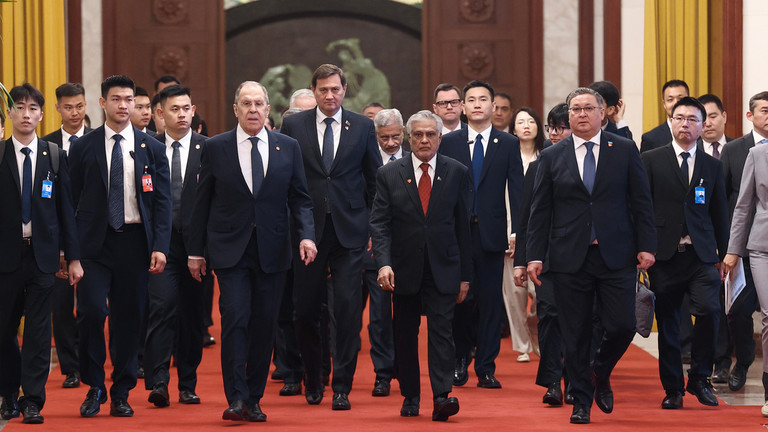
Russian FM Sergey Lavrov attends a meeting with foreign ministers of the Shanghai Cooperation Organization in Beijing, China. © Sputnik / Russian Foreign Ministry
By Farhad Ibragimov | RT | July 27, 2025
What if the next global security pact wasn’t forged in Brussels or Washington – but in Beijing, with Iran at the table?
This is no longer a theoretical question. At the mid-July meeting of the Shanghai Cooperation Organization (SCO) Council of Foreign Ministers in China, Iran made it clear: Tehran now views the SCO not just as a regional forum, but as a potential counterweight to NATO. In doing so, it signaled a profound strategic pivot – away from an outdated Western-dominated system and toward an emerging Eurasian order.
The summit highlighted the increasing resilience of multilateral Eurasian cooperation in the face of growing global turbulence. Russia was represented by Foreign Minister Sergey Lavrov, who also met with Chinese leader Xi Jinping – an encounter that underscored the strength of the Moscow-Beijing axis. On the sidelines, Lavrov held bilateral meetings with the foreign ministers of China, Pakistan, India, and notably, Iran. His talks with Iranian Foreign Minister Abbas Araghchi focused on diplomatic solutions to the nuclear issue and emphasized deepening strategic coordination.
The Iranian side used the platform with purpose. Araghchi expressed his appreciation for the SCO’s solidarity amid Israeli aggression and stressed that Iran views the organization not as symbolic, but as a practical mechanism for regional unity and global positioning.
A platform that works – despite the skeptics
India’s full participation also contradicted predictions in Western circles that geopolitical tensions would paralyze the SCO. Instead, New Delhi reaffirmed its commitment to the platform. The implication is clear: unlike NATO, where unity depends on compliance with a central authority, the SCO has proven flexible enough to accommodate diverse interests while building consensus.
For Russia, the SCO remains a cornerstone of its Eurasian strategy. Moscow serves as a balancing force – linking China with South and Central Asia, and now, with an assertive Iran. Russia’s approach is pragmatic, multi-vector, and geared toward creating a new geopolitical equilibrium.
Iran’s strategic breakout
The heart of the summit was Abbas Araghchi’s speech – an assertive and legally grounded critique of Israeli and American actions. He cited Article 2, Section 4 of the UN Charter, denounced attacks on Iran’s IAEA-monitored nuclear facilities, and invoked Resolution 487 of the UN Security Council. His message: Western aggression has no legal cover, and no amount of narrative control can change that.
But beyond condemnation, Araghchi delivered a concrete roadmap to strengthen the SCO as a vehicle for collective security and sovereignty:
-
A collective security body to respond to external aggression, sabotage, and terrorism
-
A permanent coordination mechanism for documenting and countering subversive acts
-
A Center for Sanctions Resistance, to shield member economies from unilateral Western measures
-
A Shanghai Security Forum for defense and intelligence coordination
-
Enhanced cultural and media cooperation to counter cognitive and information warfare
These are not rhetorical gestures – they are blueprints for institutional transformation. Iran is operationalizing a new security doctrine built on multipolarity, mutual defense, and resistance to hybrid threats.
SCO vs. NATO: Two models, two futures
While NATO is structured around a rigid hierarchy dominated by Washington, the SCO embodies a post-hegemonic vision: sovereignty, equality, and civilizational plurality. Its member states represent over 40% of the global population, possess vast industrial capacities, and share a collective desire to break the unipolar mold.
Tehran’s bet is clear: the SCO offers not just a geopolitical shelter, but a platform for advancing a new global logic – one rooted in strategic autonomy, not dependency.
The sophistication and clarity of Araghchi’s initiatives suggest that Tehran is preparing for the long game. Behind closed doors, the summit likely featured discussions – formal and informal – about deepening SCO institutionalism, perhaps even rethinking the organization’s mandate.
Araghchi made that vision explicit: “The SCO is gradually strengthening its position on the world stage… It must adopt a more active, independent, and structured role.” That’s diplomatic code for institutional realignment.
The West responds – predictably
The Western response was immediate. Within days of Iran’s proposals, the EU imposed new sanctions on eight individuals and one Iranian organization – citing vague claims of “serious human rights violations.” Israel, by contrast, faced no new penalties.
It is geopolitical signaling. Tehran’s push to turn the SCO into an action-oriented bloc is seen in Brussels and Washington as a direct threat to the current order. The more coherent and proactive the SCO becomes, the harsher the pressure will grow.
But that pressure proves Iran’s point. The rules-based order is no longer rules-based – it is power-based. For countries like Iran, the only path to sovereignty is through multilateral defiance and integration on their own terms.
The stakes ahead
Iran is not improvising. It is positioning itself as a co-architect of a post-Western security order. Its vision for the SCO goes beyond survival – it is about shaping an international system where no single bloc can dominate through sanctions, information warfare, or coercive diplomacy.
This strategy has implications far beyond Tehran. If the SCO embraces Iran’s proposals and begins to institutionalize them, we could be witnessing the early formation of the 21st-century’s first true alternative to NATO.
The West may dismiss this as fantasy – but in Eurasia, the future is already being drafted. And this time, it’s not happening in English.
Farhad Ibragimov – lecturer at the Faculty of Economics at RUDN University, visiting lecturer at the Institute of Social Sciences of the Russian Presidential Academy of National Economy and Public Administration
US should be ashamed of its groundless accusations against China: Chinese envoy
Xinhua | July 26, 2025
The United States should be ashamed of its repeated groundless accusations against China at the UN Security Council this week, said a Chinese envoy on Friday.
Geng Shuang, China’s deputy permanent representative to the United Nations, rejected the U.S. representative’s accusation against China for the so-called export of dual-use materials to Russia.
“China did not start the Ukraine crisis, nor is it a party to it. China has never provided lethal weapons to any party to the conflict and has always strictly controlled the export of dual-use materials, including drones,” Geng told the Security Council. “We urge the United States to stop shifting blame over the Ukraine issue and creating confrontation, and instead, to make concrete efforts to promote ceasefire and peace talks.”
On Tuesday, the U.S. representative took advantage of an open debate of the council to attack and accuse China over the South China Sea issue. On Thursday, when the council held an open meeting on cooperation between the UN and the Organization of Islamic Cooperation, the U.S. representative, once again, started provocation by slandering and smearing China on Xinjiang-related issues.
“Within a single week, the United States has made groundless accusations against China at the Security Council multiple times. This has proved that what the United States cares about is not maintaining international peace and security or promoting the political settlement of wars and conflicts, but rather using this council to attack and suppress other countries and engage in political manipulation to serve its own agenda,” said Geng.
“As a permanent member of the Security Council, the United States should be ashamed of and disgraced by its own words and deeds,” he said. “China urges the United States to change course at an early date and engage constructively in the work of the Security Council.”
On the issue of Ukraine, China has been calling for a ceasefire and is committed to promoting peace talks, Geng said, adding that China’s efforts have been widely recognized by the international community.
“For the United States, I would like to say that the international community needs solidarity and cooperation instead of division and confrontation in the face of so many hotspot conflicts and a complex international situation,” he said.
Tucker Carlson & Darryl Cooper: Jeffrey Epstein and the culture of corruption
If Americans Knew | July 25, 2025
Tucker Carlson and podcaster Darryl Cooper discuss the Jeffrey Epstein case and its roots in a convoluted culture of corruption at the top of our political system. These are excerpts from an almost three-hour interview streamed live on July 17, 2025.
See the full interview: iakn.org/rottenDC
Wall Street Journal article: iakn.org/WSJEpsteinCalendar
Glen Greenwald video on Epstein’s ties to Israeli intelligence: iakn.org/EpsteinMossad
Darryl Cooper is the creator of The Martyr Made Podcast, and is the co-host of The Unraveling w/Jocko Willink, and Provoked w/Scott Horton. He lives with his family on his farm in Idaho.
UK Reveals New Details of Upcoming Pandemic Exercise Similar to Event 201 That Preceded COVID
The Defender | July 25, 2025
The U.K. this month released new details for a sweeping pandemic response exercise — the largest in its history — to take place over multiple days between September and November 2025.
Exercise Pegasus, the first of its kind in nearly a decade, aims to span all regions and government departments in the U.K., and will involve opening a “resilience academy” to train over 4,000 people from public and private sectors annually in emergency roles, Minister for Intergovernmental Relations Pat McFadden told Parliament on July 8.
The response plan also includes developing a national “vulnerability map” to highlight populations most at risk in a crisis. The tool, which uses data on age, disability, ethnicity and whether the person is receiving care, can share that data instantly across government departments.
Comedian and political commentator Russell Brand, quoting Jon Fleetwood on Substack, pointed out that news on the U.K. government tracking tool comes as, in the U.S., the Department of Defense “prepares AI-driven simulations for pandemics caused by ‘natural or man-made infectious agents,’” while funding researchers who want to “infect humans with aerosolized influenza under the guise of improving disease models.”
Britain’s Exercise Pegasus was developed in response to the July 2024 recommendations made by the UK Covid-19 Inquiry, an ongoing public investigation into the handling of the pandemic.
The U.K. is also testing its ability to instantaneously reach its citizens by sending an alert to 87 million cellphones at once. McFadden said it will be the second time the test has been used on a nationwide basis since its launch in 2023.
“These changes will improve our resilience and preparedness and help to safeguard our citizens,” McFadden said in a January 2025 press release announcing the U.K.’s rough proposals.
However, others say the plans are less about safeguarding citizens and more about controlling them.
“The timing has sparked concerns that governments and international agencies may be coordinating future lockdown scenarios under the guise of preparedness, raising the specter of another orchestrated pandemic event,” Fleetwood wrote on Substack.
In May, U.K. Prime Minister Keir Starmer signed an international pandemic treaty, designed to help the World Health Organization (WHO) “co-ordinate the international response to any future pandemics,” according to The Telegraph.
The U.K. is also legally obligated to “develop, strengthen and maintain the core capacities” tied to the WHO because it “failed to reject the 2024 amendments to the International Health Regulations,” said independent journalist James Roguski.
These core capacities include “surveillance,” “rapidly determining the control measures required to prevent domestic and international spread,” and “addressing misinformation and disinformation.”
“Sounds to me like control,” Brand said. “Control of observation and the control to implement the use of medicines. Do you remember last time? How they shamed, how they blamed, how they shot down protests, how they condemned people that were opposed to vaccines?”
The newly enacted amendments allow the WHO “to order global lockdowns, travel restrictions, or any other measures it sees fit to respond to nebulous ‘potential public health risks,’” the U.S. Department of Health and Human Services (HHS) said in a July 18 press release announcing its rejection of the regulations.
In a video released July 18, U.S. Health Secretary Robert F. Kennedy Jr. said:
“The new regulations employ extremely broad language that gives the WHO unprecedented power. They require countries to establish systems of risk communications so that the WHO can implement unified public messaging globally. That opens the door to the kind of narrative management and propaganda and censorship that we saw during the COVID pandemic.”
In early 2021, before Kennedy led the HHS, he was deplatformed on numerous social media sites for criticizing regulatory corruption and authoritarian public health policies.
Kennedy described the efforts of Microsoft founder Bill Gates, who in 2019 helped organize an exercise of four simulations of a worldwide coronavirus pandemic. At Gates’ direction, Kennedy said, participants primarily focused on planning industry-centric, fearmongering, police-state strategies for managing an imaginary global coronavirus contagion culminating in mass censorship of social media.
The exercise, referred to as Event 201, included representatives from the World Bank, the World Economic Forum, Johns Hopkins Center for Health Security, the Centers for Disease Control and Prevention, various media powerhouses, the Chinese government, a former CIA/National Security Agency director, vaccine maker Johnson & Johnson, the finance and biosecurity industries and Edelman, the world’s leading corporate PR firm.
However, when the COVID-19 pandemic hit, Gates claimed the simulation didn’t occur. Despite videos of the event, he told BBC on April 12, 2020, “Now here we are. We didn’t simulate this, we didn’t practice, so both the health policies and economic policies, we find ourselves in uncharted territory.”
One segment of Gates’ Event 201 script focused on the manipulation and control of public opinion. The presumption among participants was that such a crisis would provide an opportunity to promote new vaccines and tighten controls by a surveillance and censorship state.
“There is nothing intrinsically wrong with preparedness, or rehearsals,” said Dr. David Bell, a public health physician and biotech consultant. The problem is that, in order to achieve this, governments “have to undermine the basic tenets of democracy such as free speech and movement.”
Related articles in The Defender
- ‘Defining Moment in Human History’: U.S. Rejects WHO’s International Health Regulation Amendments
- Before COVID, Gates Planned Social Media Censorship of Vaccine Safety Advocates With Pharma, CDC, Media, China and CIA
- Trump Orders U.S. to Withdraw From World Health Organization
- ‘We Will Not Comply’ with Pandemic Treaty, 26 Republican Governors Tell WHO
This article was originally published by The Defender — Children’s Health Defense’s News & Views Website under Creative Commons license CC BY-NC-ND 4.0. Please consider subscribing to The Defender or donating to Children’s Health Defense.
The UK’s Online “Safety” Act Is Already Causing Protests To Be Hidden
By Cindy Harper | Reclaim The Net | July 26, 2025
British users attempting to view videos of anti-mass migration protests on X found themselves blocked on Friday, coinciding with the day the UK’s sweeping Online Safety Act took effect.
Enacted by the previous Conservative government, and continued by the current Labour government, the legislation is already being condemned for facilitating online censorship under the veil of child protection.
Although sold to the public as a safeguard against minors encountering explicit content, the enforcement mechanisms are now being used to restrict access to politically charged material.
The protests in question were sparked by outrage over an incident in Epping, where a migrant allegedly sexually assaulted a 14-year-old girl while living in a taxpayer-funded hotel. Demonstrations followed swiftly, but footage of these events is now being filtered from UK audiences.
Users attempting to access the protest content were met with a message stating, “Due to local laws, we are temporarily restricting access to this content until X estimates your age.”
The restricted material reportedly included scenes of arrests and clashes during the protests, not the kind of content the law claimed to target.
To meet the law’s requirements, X has implemented various age estimation strategies.
These techniques, originally framed as tools to shield minors from graphic material, are now being used to restrict access to politically relevant video.
With companies facing penalties of up to £18 million ($24M) or 10 percent of their global revenue, platforms are expected to err heavily on the side of caution.
The result is a system that punishes openness and silences dissent under threat of financial ruin.
Elon Musk, who owns X, did not refer directly to the blocked protest videos, but spoke bluntly about the law’s broader intent. “… purpose is suppression of the people,” he posted on Saturday.
The Free Speech Union, which had repeatedly warned about the law’s implications, responded quickly. “If you have a standard X account in the UK – presumably the majority of British users – it appears that you may not be able to see any protest footage that contains violence. We’re aware of one censored post that shows an arrest being made,” the organization stated. “We warned repeatedly about how censorious this piece of legislation would be.”
A petition to repeal the Online Safety Act has now gathered more than 160,000 signatures, surpassing the threshold that requires Parliament to consider it for debate.
At the same time, searches for virtual private networks (VPNs), which allow users to access the internet as if they were located in another country, surged by over 700 percent in the UK.
Rather than safeguarding young users, it is granting extraordinary power to censor politically inconvenient material and narrowing the digital space available for public dissent.
Voices from the Terror List: Palestine Action Members Speak Out After UK Ban
By Kit Klarenberg | MintPress News | July 25, 2025
On July 1, British Home Secretary Yvette Cooper announced that Palestine Action (PA), a crusading campaign effort, would be proscribed as a terrorist group. Describing the movement as “dangerous,” she charged that its “orchestration and enaction of aggressive and intimidatory attacks against businesses, institutions and the public” had “crossed the thresholds established in the Terrorism Act 2000.” As a result, PA is now the country’s first protest group to be formally branded a terrorist entity, placing it in the same league as al-Qaida and ISIS.
Based on Cooper’s characterization, a typical consumer of mainstream media might conclude PA posed a grave threat to Britain’s public safety and national security. However, other comments by Cooper appeared to undermine her incendiary headline charges. In justifying PA’s proscription, the Home Secretary cited recent actions conducted by the movement. These included “attacks” on factories owned by defense contractors Thales in 2022 and Instro Precision in 2024, each causing more than £1 million in damages.
As hundreds of lawyers and multiple U.N. experts argued in the week before the proscription took effect, the move set an extremely dangerous precedent not only in Britain but for Palestine solidarity efforts worldwide. The group did not engage in activities that could plausibly be categorized as “terrorism”—a highly contentious concept, popularized by Israel for political reasons—in other Western jurisdictions. Average citizens were not in Palestine Action’s crosshairs, and not once did the group’s activism harm a human being.
Instead, PA engaged in multifaceted civil disobedience, targeting firms closely tied to Israel’s slaughter of Palestinians, most prominently the Israeli-owned defense giant Elbit Systems. Entities providing services to those targets—such as companies leasing commercial space to Elbit—were also in the group’s crosshairs. These actions proved devastatingly effective, hitting Elbit’s bottom line at home and abroad. PA’s disruption also brought unwelcome mainstream attention to Elbit’s operations, spotlighting the firm in ways it clearly sought to avoid.
In proscribing Palestine Action, the British government may have been motivated, in part, by a desire to avoid awkward questions and inconvenient disclosures. In one of the group’s final actions, on June 19, several members broke into Royal Air Force base Brize Norton and defaced two military planes parked there. The site is a key hub for refueling and repairing British jets that have conducted hundreds of reconnaissance flights over Gaza since the genocide began in October 2023.
These routine surveillance flights are just one component of London’s active involvement in the genocide, which authorities systematically seek to conceal from public view. Another is the presence of the SAS conducting “counterterrorism” operations in Gaza, which has been covered up via direct state decree. However, the origins of Palestine Action’s proscription stretch back much further. The story behind the ban is a sordid and largely hidden one marked by long-running, opaque collusion between British and Israeli authorities and the global arms industry.
The Legal and Political Fallout
As a result of PA’s proscription, it is now a criminal offense to be a member of, or to express “support” for, the group, punishable by up to 14 years in prison. However, an Actionist who wishes to remain anonymous predicts many will deliberately breach the proscription order, knowing they’ll face legal consequences, to increase pressure on authorities. Already, dozens of British citizens — including an 83-year-old priest — have been arrested for peacefully displaying signs declaring, “I oppose genocide. I support Palestine Action.”

“Things are going to happen, without doubt. The group may be proscribed, but you can’t proscribe ideas, whether that’s opposition to the Holocaust in Gaza, sympathy with Israel’s innocent victims, or a desire to disrupt the network of genocide in Britain to which Elbit and its subsidiaries and suppliers are so central,” the Actionist tells MintPress News. “Still, the chilling effect on Palestine solidarity is obvious, and no doubt deliberate.”
The mass arrest of peaceful demonstrators for simply expressing sympathy for Palestine Action highlights a deeply troubling aspect of British “counterterror” legislation. The term “support” isn’t even clearly defined, and according to legal precedents, can extend far beyond practical or tangible assistance, to “intellectual” support, including “agreement with and approval” or “speaking in favor” of a proscribed group. In December 2024, UN experts expressed immense disquiet over this “vague and overbroad” interpretation, warning that it could “unjustifiably criminalize legitimate expression.”
“The proscription of Palestine Action is unprecedented. It’s the first time Britain has banned as ‘terrorist’ a protest group which has never used guns or bombs,” Asa Winstanley of Electronic Intifada tells MintPress News. “It seems like a massive overreach, and therefore it’s not surprising there’s been lots of civil disobedience in response.”
Surprisingly, even The Times, typically a reliable megaphone for Britain’s intelligence, military and security apparatus, published an editorial on July 7 intensely critical of “the heavy-handed branding of Palestine Action as terrorists,” dubbing the proscription “absurd.” While describing the group as “a malign force” and “antisocial menace,” the outlet argued that activists’ damage to commercial and private property could be “prosecuted into submission” under existing criminal law and the use of “lighter-touch measures” given the level of threat posed by Palestine Action.
Notably absent from The Times editorial was any consideration of the fact that criminal proceedings against Palestine Action frequently ended in failure. In several cases, Actionists who caused mass disruption or damage to Elbit sites walked free even on relatively minor charges, because the company declined to provide police or prosecutors with witnesses or other evidence.
Elbit is extremely wary of advertising the central role its arsenal plays in the killing of Palestinians. The company’s marketing brochures typically omit mention of its Israeli ownership, instead emphasizing the supposed economic and social benefits its operations deliver to British communities. A January 2023 puff piece on UAV Systems, an Elbit subsidiary repeatedly targeted by Palestine Action, even referred to the company as a “little company making repurposed Norton motorbike engines.”
In cases where Elbit did provide evidence, Actionists used the opportunity to turn the tables and place the company and the Israeli state on trial. In November 2022, five of the group’s activists who vandalized Elbit’s London HQ were acquitted. In defending their actions, several of the accused testified to witnessing first-hand atrocities committed by Israeli occupation forces in Gaza and the West Bank. While Elbit argued Palestine Action’s buckets of red paint were “improvised weapons,” the jury was not persuaded.
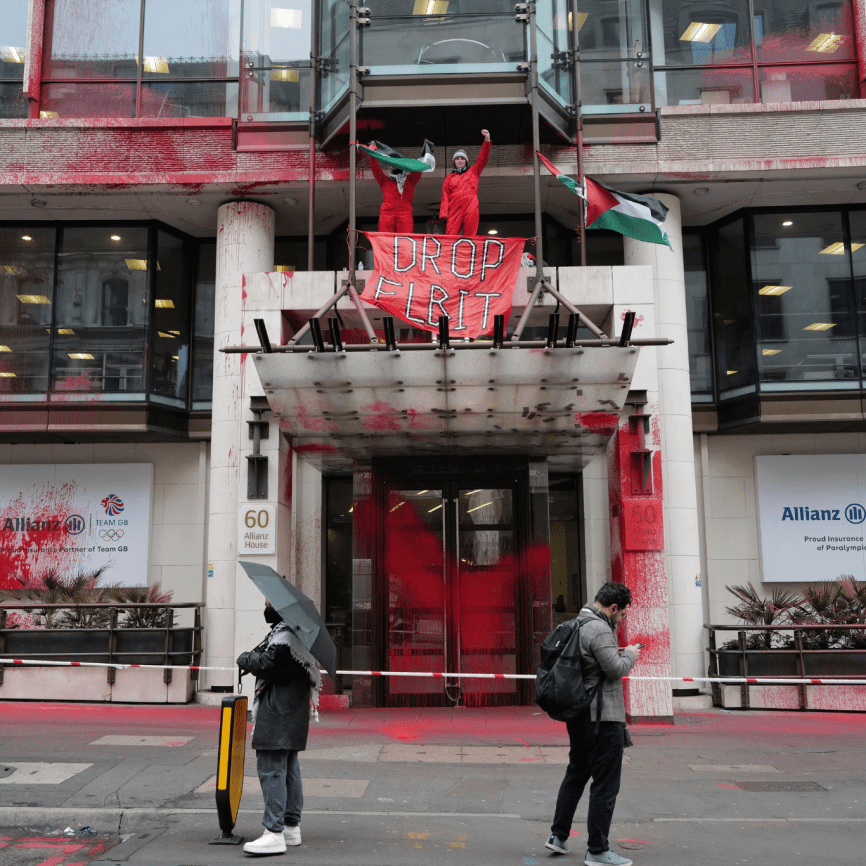
Palestine Action members target Allianz offices in London, demanding it stop insuring Israeli arms maker, Elbit Systems. Joao Daniel Pereira | AP
Judicial Battles and Public Defiance
Fast forward to today, and the anonymous Actionist is under no illusions that the British legal system alone will be enough to reverse Palestine Action’s proscription. “It has to be fought amongst the public, on the streets and in the courts,” they tell MintPress News. The group has applied for a judicial review in an effort to overturn its ban. This follows an application for interim relief to delay the proscription, which was denied after Yvette Cooper’s announcement.
Despite submitting an extensive witness statement outlining the serious implications that Actionists—and ordinary British citizens—could face if the ban took immediate effect, a panel of three judges took less than 90 minutes to reject the request. The justices acknowledged that there would be “serious consequences” from the government’s ban, including the risk that individuals could “unwittingly commit” criminal offenses and that those associated with the group might face “social stigma and other more serious consequences at university or at work.”
Palestine Action had warned the ban would create confusion and chaos. Police responses to pro-PA protests across Britain have varied wildly. Some resulted in no arrests, while in Wales, protesters were not only arrested under terror legislation but also had their homes raided. Videos of interactions between Palestine solidarity protesters and police suggest officers themselves are unsure about what is now lawful. In Scotland, four people were arrested for wearing T-shirts that didn’t even mention the group.
Speaking to MintPress News, the anonymous Actionist expressed frustration over the court’s decision. “A UN Special Rapporteur supported us, warning the proscription breached international standards, but apparently British judges know better. It just shows how corrupt the entire system is. Every part of it is rotten,” they lament. “The government, almost unanimously supported by parliament, rammed through the conscription without warning or any public debate whatsoever, after falsely briefing the media we might be funded by Iran. Who will they target like this next?”
As Declassified UK has documented, nearly every major British outlet ran with the Home Office’s Iran narrative, without offering PA a rebuttal. In a particularly revealing twist, the pro-Israel lobby group We Believe In Israel—which does not disclose its funding sources—openly took credit for the government’s decision. In an X post, the organization called the proscription its “victory,” claiming it was the direct result of months of “sustained research, strategic advocacy, and evidence-based reporting” contained in a report it had published earlier in the year.
Collusion and Israeli Influence
Again, the anonymous Actionist is unsurprised that British policy—if not legislation—is effectively being written by Israeli lobby groups. Yvette Cooper, Foreign Secretary David Lammy, Chancellor Rachel Reeves and Prime Minister Keir Starmer were all named as supporters of Labour Friends of Israel, before the list was scrubbed from the internet ahead of the 2024 general election. LFI, which praised the proscription, maintains a close relationship with Tel Aviv’s London embassy, which is widely believed to be infested with Mossad agents—a connection the group works to obscure.
In recent months, PA and independent journalists have uncovered compelling evidence that the Home Office has been in secret contact with Elbit representatives and Israel’s London embassy almost since the group’s founding in 2020. The full scope of this collusion is still unknown and may never come to light. However, documents released under Freedom of Information laws raise serious concerns about whether this concealed relationship influenced both the prosecution of Actionists and the decision to proscribe the group.
For example, in March 2022, then-Home Secretary Priti Patel met privately with Elbit UK CEO Martin Fausset to reassure the firm—and, by extension, its Israeli handlers—that the British government was taking “criminal protest acts against Elbit Systems UK” seriously. At the time, officials acknowledged that Palestine Action’s activities did “not meet the threshold for proscription” under British law. Before that meeting, no PA members had been successfully prosecuted. In the months that followed, legal actions against the group escalated dramatically.
Still, many Actionists continued to walk free. In December 2023, six members—including co-founders Huda Ammori and Richard Barnard—were acquitted of nine charges by a jury. The following month, internal correspondence revealed Elbit UK’s security director wrote to British officials expressing concern that “a re-trial is not a certainty” and suggesting it was “very much in the public interest” for the trial to be reheard.
Mere days later, a retrial was announced—for 2027. That would mark six years since the alleged offenses took place. One Actionist called the drawn-out process a “form of psychological warfare on defendants,” saying it prevents them from making long-term plans or securing employment. Meanwhile, other PA members are imprisoned awaiting trial, some already incarcerated for extended periods. There are disturbing signs that their detention and prosecution are being coordinated with Israeli authorities.
Among the most alarming revelations are heavily redacted emails showing that, in September 2024, the British Attorney General’s Office shared contact details for the Crown Prosecution Service and counterterrorism units with the Israeli embassy. The timing raises suspicions of Israeli interference in the prosecution of PA members who, earlier that month, broke into Elbit’s Filton factory and destroyed quadcopters—weapons routinely used to maim and kill Palestinians in Gaza.

Source | Kit Klarenberg | The Grayzone
In all, 18 Actionists involved are currently remanded in prison, their pre-trial detention period running to 182 days, well in excess of standard limits for non-terror-related cases. Their contact with the outside world has also been severely restricted, in violation of international legal norms. On July 15, another five PA members were arrested and charged in connection with Filton.
If the Israeli government played any role in these prosecutions, it would represent a flagrant breach of Crown Prosecution Service guidelines, which prohibit “undue pressure or influence from any source.”
In May, British prosecutors announced they would consider “terrorism connections” in the case of 10 Actionists who targeted Instro Precision, an Elbit supplier, in June 2024. While the charges—aggravated burglary, criminal damage and violent disorder—do not qualify as terrorism under British law, prosecutors say those connections may factor into sentencing. If upheld, that designation could lead to significantly harsher penalties than standard criminal charges would normally carry.
Legal Challenges Mount
On July 21, London’s High Court heard arguments from lawyers representing Huda Ammori, seeking permission to challenge Palestine Action’s proscription. In addition to citing devastating figures related to the genocide in Gaza and Elbit’s direct involvement, the legal team also emphasized the legal uncertainty now faced by activists and journalists as a result of the ban.
In response, government lawyers argued that the Proscribed Organisations Appeal Commission—not a judicial review—was the appropriate forum to challenge the designation. At the hearing’s conclusion, the judge stated a full ruling would be issued on July 30.
Earlier, on June 24, Jewish News revealed that British authorities had hesitated to proscribe PA out of concern that a judicial review “could overturn” the decision. That concern reportedly contributed to initial “reticence” from the Home Office. Even if the review is authorized, it could take months for a ruling to be reached.
In the meantime, journalist and legal scholar Leila Hatoum offered a stark assessment of the situation. She told MintPress News that the British state’s targeting of the group “for standing against genocide and oppression” was “nothing short of tyranny.” She added that the ban not only threatens basic rights—particularly freedom of speech and freedom of the press—but also violates international law.
The Convention on the Prevention and Punishment of the Crime of Genocide, which was adopted by the UN in 1948, notes it is the duty of all nations and peoples to act to stop a genocide. By legally pursuing those who are seeking to prevent Israel’s ongoing apartheid, occupation and genocide against the Palestinians in Gaza, especially members and supporters of Palestine Action, the UK has positioned itself against the international law, and alongside the forces of darkness. The country has failed humanity.”
A Legacy of Resistance
Despite this bleak outlook—and the possibility that the group could remain proscribed regardless of any court challenge—Palestine Action’s example remains an inspiration to people across Britain and beyond. A volunteer group of ordinary citizens, spanning every age, ethnicity, faith and gender, without financial or institutional backing, posed such a threat to entrenched power that the British government, for the first time in history, resorted to a legal “nuclear option” to neutralize them.
Civil disobedience aimed at disrupting military operations has a long and established history. Since the early 1980s, the Christian pacifist Plowshares movement has carried out sabotage against U.S. military bases and nuclear installations. In 2003, five activists were prosecuted for damaging American bombers at a British base to prevent their use in the Iraq War. One of the defendants was represented by none other than Keir Starmer, who argued successfully that although their actions were technically illegal, they were justified as an effort to prevent war crimes.
Palestine Action represents the first group to maintain this legacy during an active, ongoing genocide, but ever since its launch, it has achieved major victories. In January 2022, Elbit sold off one of its component factories, and a British government prosecutor acknowledged that PA’s sustained actions against the site “forced the closure.” Two additional Elbit sites targeted by the group have since been shut down. Governments around the world, including Brazil and even Britain, have canceled lucrative contracts with the company.
Had the British state not acted so forcefully, it is likely that Palestine Action’s momentum would have continued building, possibly forcing Elbit out of the UK entirely. Yet despite the risk of arrest or prison, solidarity with Palestine and overt support for Palestine Action show no sign of fading. As Israel’s favorability plummets to historic lows across the West, there are countless individuals around the world ready to follow PA’s example, risking their liberty to stop the ongoing genocide.
After all, it is not just a moral duty. It is a legal one.
Israeli officers admit spoiling aid from 1,000 trucks at southern Gaza’s Kerem Shalom crossing
MEMO | July 26, 2025
Israeli officers have admitted Friday to spoiling food, water and medical supplies that were packed in more than 1,000 aid trucks at the Kerem Shalom crossing that were left to rot after their distribution into the Gaza Strip was blocked, Anadolu reports.
According to the Israeli public broadcaster KAN, the aid trucks were carrying tens of thousands of humanitarian parcels. They had been left for weeks under the sun at the crossing without being distributed, until they spoiled.
The Gaza Ministry of Health announced Friday that the death toll from hunger and malnutrition since October 2023 has reached 122 Palestinians, including 83 children.
One Israeli officer told KAN: “We buried everything in the ground, and some of the supplies we burned,” without specifying the timing of the incident.
He added: “Even now, thousands of parcels are sitting in the sun. If they’re not allowed into Gaza, we’ll have to destroy them too.”
Military sources told KAN that “only 100 to 150 trucks are allowed to enter the Palestinian side of the crossing per day, and most of them are not unloaded due to the breakdown of the distribution mechanism.”
Another Israeli officer said: “The mechanism isn’t functioning. Trucks are halted, the roads are unusable, and coordination isn’t happening.”
He added: “We have here the largest grain storage in the world, and if the current goods aren’t taken soon, we will destroy and bury them.”
Famine has worsened dramatically inside Gaza. Circulating images and videos show Palestinians whose bodies appear skeletal due to extreme starvation, in addition to suffering from nausea, exhaustion and loss of consciousness.
On Tuesday, the World Food Program warned that one-third of Gaza’s population had gone several days without eating due to the continued Israeli blockade.
Since March 2, Israel has backtracked on implementing a ceasefire and prisoner exchange deal with Hamas and has kept Gaza’s crossings shut, leaving hundreds of aid trucks stranded at the borders.
Rejecting international calls for a ceasefire, the Israeli army has pursued a brutal offensive on Gaza since Oct. 7, 2023, killing more than 59,600 Palestinians, most of them women and children. Deaths by starvation have climbed in recent days due to a months-long blockade and poor distribution of aid by the controversial Gaza Humanitarian Foundation.
Last November, the International Criminal Court issued arrest warrants for Israeli Prime Minister Benjamin Netanyahu and his former Defense Minister Yoav Gallant for war crimes and crimes against humanity in Gaza.
Israel also faces a genocide case at the International Court of Justice for its war on the enclave.
Officer exits Australian army after showing more loyalty to ‘Israel’
Al Mayadeen | July 26, 2025
An Australian army officer has left the Australian Defence Force (ADF) after the Australian Security Intelligence Organisation (ASIO) stripped him of his security clearance, citing concerns over his loyalty to “Israel”. The case, first reported by The Guardian, has raised broader questions about foreign influence, undisclosed training, and security integrity within Australia’s military ranks.
The officer, anonymized as “HWMW” in tribunal documents, was removed from active service after the Administrative Review Tribunal (ART) upheld ASIO’s findings earlier this year. Initially placed in the inactive reserve, The Guardian reports that he has now formally exited the ADF.
ASIO flagged serious loyalty concerns during interviews, where the officer declared he did not consider “Israel” a foreign government. He also admitted he would share classified Australian military information with the Israeli occupation forces (IOF) if asked.
These revelations led ASIO to conclude that he lacked the “appropriate character and trustworthiness” necessary to hold any security clearance.
Further investigations revealed the officer had failed to disclose participation in training programs conducted in “Israel” in 2016 and 2019. Despite serving 19 years in the ADF, he concealed courses involving self-defense, firearms training, and security techniques.
These sessions were linked to his volunteer role in a Sydney-based Community Security Group (CSG), which provides intelligence and protection services to the Jewish community. He was affiliated with the CSG between 2014 and 2023. When questioned, he claimed the omission was not a lie but “not a complete disclosure.” He further admitted that such CSG programs could serve as “natural recruiting pools” for Mossad, “Israel’s” intelligence service.
Political reactions
Greens Senator David Shoebridge, the party’s defence spokesperson, sharply criticized the government’s response. In Senate estimates, Shoebridge questioned whether the defence department had conducted a broader review of ADF personnel with ties to similar CSG training.
He expressed frustration over the lack of answers, stating: “This should have been a simple exercise. Having discovered an ADF member undertook secret training associated with a foreign government, then the exit should have been rapid.” Shoebridge also criticized what he described as Australia’s inconsistent stance on foreign affiliations, pointing to a double standard in the acceptance of loyalty to the US and its allies.
ASIO Director General Mike Burgess emphasized that while community security groups serve a legitimate and important purpose, transparency is key.
“There is nothing wrong with the community security groups,” Burgess said, but noted that foreign training, even for community protection, must be declared. “Training done overseas in Israel might present an opportunity,” he added.
The defense department has reiterated that all holders of security clearances undergo regular evaluations, including reviews of foreign connections and external loyalties. Individuals are required to report any affiliations that might compromise their suitability.
FT hit job on Zelensky is a clue as to Trump’s thinking
By Martin Jay | Strategic Culture Foundation | July 25, 2025
It’s finally happened. After months of pundits wondering when would the moment come when western media would finally take a clear and decisive stand against Ukraine’s venal president, it has finally happened – and by the most ardent pro-EU broadsheet to note. The all-out hit piece on Zelensky recently by the Financial Times should indicate that something is about to happen in Ukraine and it will probably involve the president either having his own Ceausescu moment or simply fleeing the country. How long has he got?
Legacy media always likes to be on the right side of history and for the FT to come out like this with the piece that they’ve written must be ominous. It was published at the same time as the British conservative political chronicle The Spectator did much the same thing. Timing seems to be worth noting given that a few days beforehand unconfirmed ‘reports’ on social media were claiming that Trump had indicated to Zelensky that he needs to step down with even suggestions of who would take his role. It also comes amidst a series of reports which show that Zelensky’s panicking has reached an all-time high with the recent arrest of the of the anti-corruption activist Shabunin. Interestingly, that same day, ex-Minister Oleksandr Kubrakov was also targeted. In both raids at their homes, armed men showed no warrants and blocked lawyers from attending the searches, it is claimed. The arrest of the anti-graft campaigner is significant as is the take of the FT itself: The article says: “A crackdown on the country’s most famous anti-corruption crusader can’t be happening without at least the silent approval from President Zelenskyy, if not active permission,” it explains.
The significance and timing of the FT piece should not be underestimated. It’s not simply that on the battlefield itself that the Russians are advancing and that it becomes more openly accepted that the Ukrainians simply don’t have the men to fight this war, but more about Zelensky himself who is beginning to be portrayed as a dictator now clinging onto power and using all of the vestiges of martial law to crack down on even the faintest trace of dissent. Ukraine is now a totalitarian state with the level of Zelensky’s paranoia now starting to become widely known and discussed. The FT, one of those media giants which largely supported Zelensky and which barely considered elements of his brutal measures worth even reporting, such as the appalling murder of U.S. blogger Gonzalo Lira, is now reporting on even campaigners merely being roughed up by Zelensky’s henchmen – a considerable U-turn and worth noting is the detail it goes into with its zeal. Indeed, it has been the FT which has chosen not to cover a number of stories since the beginning of the war which many would argue created a positive aura around Zelensky which can be noted even as recently as in May when a key opponent of Zelensky was assassinated in broad daylight by a gunman in front of the victim’s children’s school in Madrid. In this case, the murder of Andriy Portnov was covered, but he was portrayed as a criminal “wanted in Kiev for treason”.
The FT’s support of Zelensky is over, we can assume.
It noted that “Shabunin and Kubrakov labelled the recent raids as politically motivated, adding that the SBU had presented no court-issued warrants and would not allow time for their lawyers to be present for the searches”.
Vitaliy Shabunin even is quoted in the article as explaining what the stunt was supposed to achieve. He told the paper, “Zelenskyy is using my case to send a message to two groups that could pose a threat to him. The message is this: if I can go after Shabunin publicly — under the scrutiny of the media and despite public support — then I can go after any one of you”.
The FT goes even further in its analysis of the situation and could even be assessed of being a catalyst to a revolution in the making.
“This is a straight-up, Russian-style scenario of dividing society, which could lead to protests in the streets”, Oleksandra Ustinova MP was quoted in the piece as saying.
The author suggests that the West has little interest any more in keeping up any pretence up that Ukraine is some sort of western democratic country which has had to give up on some of its democratic tenets. This apathy, it claims, is responsible for Zelensky now pushing his authoritarian, brutal control to new levels.
A western diplomat in Kiev who has worked closely with Ukraine’s civil society said the cases of Shabunin and Kubrakov “aren’t isolated events”.
“There’s a sense inside Ukraine’s presidential office that the west and especially the U.S. has shifted its focus,” the diplomat said. “That rule of law and good governance no longer matter as much.” With U.S. attention elsewhere, Zelensky is testing how far he can go, the FT claims, but doesn’t say that this is because he is in his last days and believes he can stay in power if he cracks down even further against those who could potentially pose a threat to him or even question his strategy. The recent dispatch of anti-aircraft missiles from Trump is not expected to do anything as the gesture represents way too little, way too late for it to have any impact. The corner that Trump is backing himself into with this 50-day deadline with Putin is more likely going to result in the man child in the Oval office looking for an easy victim which can distract voters away from the real story of him having to back down from the outlandish threats he has made to Putin.
Europe’s addiction to sanctions is terminal
By Samuel Geddes | Al Mayadeen | July 26, 2025
It has been said there are two kinds of European countries: small countries and those that have not yet realized they are small. As of mid-2025, it appears most of the continent has yet to reach this realization.
More than three years into the grinding attritional war between Russia and Ukraine, the European Union, having finally secured President Trump’s support for its maximum pressure campaign against Moscow, announced its most severe round of sanctions to date. In this 18th round, the EU expanded its blacklist of Russia’s so-called ‘shadow-fleet,’ used to export energy, to 444 vessels, denying operators access to European ports as well as insurance services. EU-member states were also prohibited from any dealings with a further 22 Russian banks, bringing the total to 44, to strangle Moscow’s financial channels to the outside world.
Alongside expanded export bans on ‘dual-use’ technologies, Brussels sanctioned entities in China, Türkiye, and 11 other countries for assisting Russia to circumvent sanctions and further lowered the price-cap on Urals crude oil, aiming to choke off the entry of Russian energy, in any form, from entering the bloc.
Besides the impressive hubris involved in declaring that Europe, as an importing region, will dictate the price it and other customers will pay for Russian energy, last weeks’ measures serve only to make permanent the long-term damage to its own economic viability, while Russia simply pivots to other buyers.
Parallel to the drafting of the latest sanctions salvo, the EU’s two largest members, Germany and France, alongside the UK, also pursued a maximum hostility campaign against another crucial energy exporter. Rather than condemning the 12-day war launched against Iran by “Israel”, European leaders, German Chancellor Merz in particular, chose to give the game away entirely, announcing their support for Israeli aggression because it was doing their “dirty work” (undermining the Islamic Republic) for them.
Upon the beginning of a ceasefire, the French and British foreign ministers, as if taunting Tehran after its nuclear facilities and scientists had been attacked, threatened to initiate the “snapback” mechanism of the defunct nuclear agreement, the JCPOA, if Tehran retaliated. The “snapback” mechanism would enable any of the signatory countries in the JCPOA to unilaterally trigger the reimposition of UN sanctions against Iran, which had been lifted under its terms post-2015. As the JCPOA itself will expire by October, the window for European states to trigger the snapback is closing.
Talks between Iran and the E3 were announced this week to take place in Istanbul over exactly this issue. Given Europe’s enthusiasm for compensating for its shrinking global clout with economic warfare, as well as pursuing American [Israeli] geopolitical goals ahead of its own, the likelihood of all three states foregoing the chance to “punish” Tehran for adhering to the agreement they signed on to seems a fading possibility.
If Europe ultimately follows through on its snapback threat, it will in a matter of months have destroyed any possible rapprochement with two states who could realistically have helped it out of its self-inflicted economic blood-loss. While no doubt damaging to both Moscow and Tehran, it will have solidified in the minds of both the necessity of forming economic routes and institutions outside the control of Western states.
The International North-South Economic Corridor, connecting Russia to the Indian Ocean via Iran, is the most prominent example of such cooperation. Since its effective launch in 2022 at the onset of operations in Ukraine, cargo traffic in energy, food, and other raw materials along the route has risen year-on-year, nearly hitting 27 million tons in 2024. As well as bilateral trade, the route’s growth has been fueled by intensified exchange between Russia and India. The latter is largely ignoring economic sanctions on Moscow, with two-way trade expected to approach $100 billion by 2030. The INSTC also crucially grants land-locked Central Asian states much-needed maritime access, magnifying regional buy-in.
The reimposing of UN-sanctions, along with the threat of secondary measures against third-party states could ironically create the kind of space for Chinese involvement with the region, leveraging INSTC’s points of interoperability with Beijing’s Belt and Road Initiative.
Whatever course it takes, the leaders of Europe still seem not to have realized either the declining impact of their actions, nor the long-term negative consequences they will have for the continent. The last five centuries of economic history undoubtedly belonged to Europe, but Brussels’ seemingly terminal lack of vision writes it out of the coming chapter being authored in Asia.
Featured Video
No Vote, No Representation, No State: Democracy, Israeli Style
or go to
Aletho News Archives – Video-Images
From the Archives
Sanctions, War and the Policy of Dual Containment
By SASAN FAYAZMANESH | March 17, 2008
It is now nearly three decades since the Unites States adopted the policy of dual containment of Iran and Iraq. While much has been written about the containment of Iraq, there has been very little in-depth analysis of this policy when it comes to Iran. In a book that is going to be released on March 31, 2008, entitled The United States and Iran: Sanctions, Wars and the Policy of Dual Containment (Routledge), I attempt to address this shortcoming by investigating when and why the US policy of containment of Iran came about, how it evolved, and where it stands today.[1] To the extent that Israel has been involved in US policy making, the study will also include the role that Israel has played in the containment of Iran. Also, since the fate of Iran has been inextricably linked to that of Iraq, occasionally the investigation will overlap with the containment of Iraq.
The policy of dual containment of Iran and Iraq originated during the Carter Administration, but it was not until the Clinton Administration that the expression “dual containment” became popular. … continue
Blog Roll
 Aletho News
- Europe’s Establishment Is Embracing War – and Losing Voters
- NATO chief advocates war of aggression
- No Vote, No Representation, No State: Democracy, Israeli Style
- Zionist Bought Senate Blocks Information About American Citizens Killed By Israel
- While Gaza dominates the UN, these are the people keeping it alive
- New Report: “Scholasticide and Genocide in Gaza: Assessment, Testimonies and Legal Analysis”
- ‘THAAD Delusion’: Iran war exposes US missile shield limits – The Atlantic
- Moscow issues warning to NATO over Russian exclave
- Yes, the Iran war has destroyed Trump’s presidency
- The fallacy of US delusions about Iran’s economic collapse
- If Americans Knew
- Mamdani releases plan to combat antisemitism and hate crimes in New York City
- Iran’s Revolutionary Guards Publish Letter to the American People
- DMFI launches $1 million ad campaign supporting Virginia’s Elaine Luria
- US Senate blocks resolution seeking report on Americans killed by Israel
- Israeli Attacks Kill Ten Palestinians in Gaza
- Massacre at Minab: The School That Became a Grave
- Israeli media: The IDF Shows It Doesn’t Turn a Blind Eye; It Actively Emboldens Settler Havoc
- As settlers ravage West Bank, Israeli forces kill 10 in Gaza – Daily Update
- New Report: “Scholasticide and Genocide in Gaza: Assessment, Testimonies and Legal Analysis”
- Ex-Biden officials are desperate for a Gaza scapegoat
- No Tricks Zone
- Green Energy Debacle: German Expert Professor Fritz Vahrenholt Warns Of Severe Economic And Social Consequences
- Two More Paleo Reconstructions Affirm Meters-Higher Sea Levels Across Ireland, Brazil 7000-6000 Years Ago
- New Study: Earth And Venus Surface Warmth Largely Explained By Convection And Lapse Rate, Not CO2 Or Radiation
- 2025 Nature Paper Claiming Worsening Global Drought Gets RETRACTED …Heavily Flawed
- New Study: ‘Global Drought Shows No Detectable Recent Acceleration Under Climate Warming’
- Economic Masterminds: German Socialists Suggest Taxing Productivity Gains Stemming From Using AI
- The South China Sea Has Not Been Cooperating With The Climate Change Narrative
- Energy Crisis: Germany Enters Heating Season With Historically Low Gas Reserve Fill Levels
- New Study: The Antarctic Ice Sheet Gained Mass From 2020-2024 Due To Staggering Snow And Ice Accumulation
- Study: Ocean Heating Rates From Thousands Of Years Ago ‘Dwarf’ Modern Ocean Heating Rates

