Kremlin weighs in on unrest in Armenia
RT | June 29, 2025
Political turmoil in Armenia is an internal matter, Kremlin spokesman Dmitry Peskov has said, following the arrests of senior clerics and a Russian-Armenian businessman accused of plotting to overthrow Prime Minister Nikol Pashinyan’s government.
Earlier this month, the Armenian authorities took into custody Archbishop Bagrat Galstanyan, the leader of the Sacred Struggle opposition movement, and Archbishop Mikael Adjapahyan. They are both accused of plotting a coup. The arrests sparked a public outcry and protests, which devolved into clashes with police.
The archbishops are key members of the Armenian Apostolic Church (AAC), which was the main driver of protests against Pashinyan. The unrest was sparked by the prime minister’s decision to return several border villages to Azerbaijan. While Pashinyan portrayed the land transfer as necessary to normalize relations with the neighboring state, many in Armenia saw it as a betrayal of national interests.
The authorities also arrested Samvel Karapetyan, a Russian-Armenian billionaire and supporter of the AAC, on charges of calling for the overthrow of the government.
In an interview with Russian journalist Pavel Zarubin, Peskov said Moscow is closely monitoring the situation but will not interfere.
“This is, of course, an internal matter for Armenia,” he stated. “We are, of course, interested in the preservation of law and order in Armenia, so that Armenia is a prosperous, stable country, friendly to Russia.”
Peskov noted that Russia has a large Armenian diaspora, many of whom “are watching these events with pain,” adding: “Many, of course, do not accept how this is happening.”
Russia and Armenia have historically had close cultural and religious ties. In recent months, however, Yerevan has distanced itself from the Collective Security Treaty Organization (CSTO), which comprises many former Soviet republics. Armenia has accused Russia of failing to provide adequate support during its stand-off with Azerbaijan – in particular, over the region of Nagorno-Karabakh.
Russia has argued that Armenia never recognized Nagorno-Karabakh as its own territory, meaning the CSTO could not consider Azerbaijan’s military operation in the enclave as aggression against an alliance member. President Vladimir Putin has also said that Russia has on numerous occasions floated a territorial compromise that could have settled the conflict between the two states, and that Armenia rejected the initiative.
Iran asks UN Security Council to recognize Israel, US as ‘initiators’ of aggression

Iranian Foreign Minister Abbas Araghchi
Press TV – June 29, 2025
Iranian Foreign Minister Abbas Araghchi has called on the United Nations Security Council to recognize the Israeli regime and the United States as the “initiators” of the recent 12-day aggression against the Islamic Republic.
“We solemnly request that the Security Council recognize the Israeli regime and the United States as the initiators of the act of aggression and their subsequent responsibility, therefore including compensation and reparation,” Araghchi said in a letter to UN Secretary General Antonio Guterres on Sunday.
“The Security Council should also hold the aggressors accountable and prevent the recurrence of such heinous and serious crimes to enable it to maintain international peace and security,” he added.
He emphasized that political and military leaders, who order an act of aggression, “are also individually liable for the international crime of aggression under customary international law.”
The top Iranian diplomat described the act of aggression as a “brazen assault” on the very foundations of international law, warning that tolerating it and its legal consequences seriously undermines the credibility of the United Nations system.
It also “poses a real threat to the rule of law at the international level and engenders lawlessness in the future of international relations in our region as well as the international community at large,” Araghchi pointed out.
In the early hours of June 13, the Israeli regime launched an all-out aggression on Iranian soil by targeting various military and nuclear sites, claiming the lives of dozens of top military commanders and nuclear scientists as well as ordinary civilians.
On June 22, the United States joined the Israeli regime in the assault and bombed three Iranian nuclear sites in a grave violation of the United Nations Charter, international law, and the Nuclear Non-Proliferation Treaty (NPT).
A day later, Iran launched a wave of missiles at al-Udeid air base in Qatar—the largest American military base in West Asia—in retaliation for the aggression.
As the Iranian armed forces pounded Israel and its military and industrial infrastructure, using many new-generation missiles that precisely hit the designated targets, the embattled regime was forced to unilaterally declare a truce deal on June 24.
In a letter to the United Nations secretary general and president of the Security Council on June 13, Araghchi said the Israeli regime’s act of aggression against the country amounts to a “declaration of war.”
“These oppressive acts are not only constitute a severe violation of sovereignty and territorial integrity of Iran as an independent member of the United Nations, but as per international law and international humanitarian law, including the Geneva Conventions, are among acts of aggression and war crimes,” he said back then.
From the War of the Cities to True Promise 3: Iran’s ballistic program and the path to networked deterrence
By Abbas Al-Zein | The Cradle | June 28, 2025
Under a regional sky long dominated by US and Israeli air and intelligence superiority, Iran made a fateful decision decades ago. It would not attempt to match its adversaries tank-for-tank or plane-for-plane, but would instead build an asymmetric deterrent from scratch.
Rather than chase the mirage of classical military parity, Tehran developed an indigenous ballistic missile arsenal that is now the largest and most formidable in West Asia. This was no short-term, tactical gambit. Iran’s missile doctrine was forged in an existential struggle, refined over war and siege, and ultimately transformed into a cornerstone of national defense policy.
The War of the Cities: Birth under siege (1980–1988)
The first phase of Iran’s missile journey began in the crucible of the devastating Iran–Iraq War, specifically during the infamous “War of the Cities.” As the Baathist government in Baghdad launched Soviet-supplied Scud-B missiles deep into Iranian urban centers, it did so under the protective umbrella of western intelligence and funding from Arab states of the Persian Gulf. The intent was clear: to break Iranian civilian morale through systematic terror from the sky.
Caught without a missile deterrent of its own, besieged diplomatically, and encircled by western-aligned forces, Iran turned to whatever resources it could muster. It secured limited quantities of Scud-B missiles from Libya, Syria, and North Korea. These early acquisitions, modest as they were, formed the embryonic core of a deterrent force placed under the direct command of the Islamic Revolutionary Guard Corps (IRGC).
But these were more than mere missiles. They were weapons of national dignity in a war for survival for the nascent Islamic Republic. Iran’s leadership came to view missile capability not simply as a tactical asset, but as a psychological and political necessity.
Military historian Pierre Razoux notes in The Iran-Iraq War (2014) that it was during this phase that Iran’s leadership came to the unshakable conclusion: without a retaliatory missile force, no psychological or strategic deterrence was possible.
The Iranian response was neither ad hoc nor passive. Alongside importing missiles, Iranian engineers began dismantling, studying, and maintaining the systems. They built smuggling networks, circumvented embargoes, and reverse-engineered technology.
North Korea emerged as a critical partner, acting as a conduit for Soviet missile know-how. A 2010 RAND Corporation report titled Iran’s Ballistic Missile Capabilities: A Net Assessment noted that Iran had become capable not only of replicating but also of redesigning and expanding missile technology independently. Between 2000 and 2010, Iran pivoted from mass production to innovation, prioritizing accuracy, range, and operational readiness.
The foundations of Iran’s ballistic doctrine were thus laid: sovereignty through technological independence, and defense through deterrence.
From imitation to innovation (1989–2009)
With the Imposed War over, Iran’s military establishment—spearheaded by the IRGC—began restructuring its defense priorities. The goal was no longer just to have missiles but to produce them independently and on a large scale.
At the heart of this transformation was the late martyred Brigadier General Hassan Tehrani Moghaddam, a strategic thinker and technical mastermind hailed as the ‘father of Iran’s missile program.’ He understood that deterrence was not about launching missiles, but about mastering their lifecycle: production, concealment, deployment, and precision.
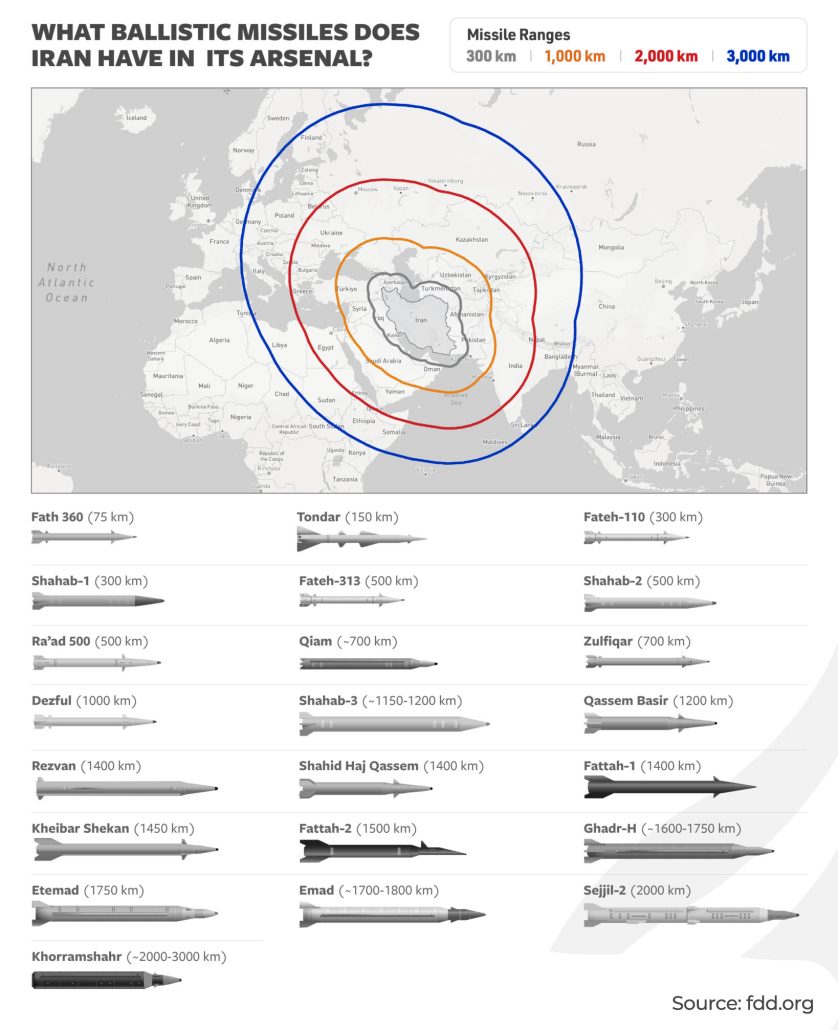
Under his leadership, Iran transitioned from a user to a manufacturer. The Shahab-1 and Shahab-2 were enhanced variants of the Scud-B and Scud-C. But the real breakthrough came in 2003 with the Shahab-3, boasting a range exceeding 1,300 kilometers—a capability that placed US bases in the Persian Gulf and occupied Palestine within striking distance. The Shahab lineage would later give way to the Ghadr class, with better range and multiple warhead capabilities.
The most significant leap, however, came with the adoption of solid-fuel propulsion. The Sejjil missile (2,000–2,500 km range), unveiled by the end of the 2000s, was Iran’s first medium-to-long-range system not reliant on Scud technology. It signaled a new era of technological self-sufficiency and rapid-launch capability.
During this phase, Iran undertook sweeping strategic steps: adopting solid-fuel for easier storage and rapid deployment, establishing underground and mobile launch facilities to avoid detection, building decentralized manufacturing to reduce vulnerability to strikes, and integrating missile research into academic institutions to develop a domestic cadre of experts.
A 2010 report by the International Institute for Strategic Studies (IISS) titled Iran’s Ballistic Missile Capabilities: A Net Assessment noted that by this stage, Iran had moved beyond simply replicating foreign missile systems and had begun designing its own through local R&D and systematic redesign, including the establishment of underground manufacturing. From 2000 to 2010, Iran’s program pivoted decisively from quantity to quality, enhancing range, precision, and operational readiness.
When Moghaddam was killed in a suspicious explosion at the “Defenders of the Sky” base in November 2011, Iran declared it a national loss. While Israel neither confirmed nor denied responsibility, the Yediot Aharonot newspaper reported that “some assessments” indicated that the blast was “the result of a military operation based on intelligence information.”
Nevertheless, his legacy endured. He had not merely built a weapons system; he had established a sustainable missile doctrine rooted in adaptability and local expertise. His death marked the end of one era, but it also catalyzed the birth of Iran’s next missile generation.
Smart missiles and precision strikes (2010–2020)
By the 2010s, Iran’s goal had shifted from mass deterrence to precision deterrence. Engineers focused on guidance systems using inertial navigation paired with domestic GPS and anti-jamming technologies. The result was a suite of short- and medium-range guided missiles with enhanced tactical utility.
This generation included the Zolfaghar (750 km), the highly precise and compact Fateh-313 designed for preemptive strikes, and the Qiam—Iran’s first finless missile, engineered for stealth and maneuverability.
Iran also entered the low-altitude cruise missile domain, developing systems such as the Soumar (with a range of over 2,000 km) and Hoveizeh (with a range of 1,350 km), both capable of evading conventional radar and penetrating advanced air defenses.
These weapons were not theoretical. In June 2017, Iran launched six medium-range missiles from its territory targeting ISIS command centers in Deir Ezzor, Syria—its first operational cross-border use since the 1980s.
In January 2020, in direct retaliation for the US assassination of IRGC Quds Force General Qassem Soleimani, Iran struck the Ain al-Asad base in Iraq with Qiam and Fateh missiles. Satellite imagery showed sub-five-meter accuracy, hitting aircraft hangars and troop shelters. The New York Times described it as one of the most accurate missile strikes on a US facility in modern history.
This decade marked Iran’s shift from “deterrent” missiles to “executive” missiles—systems where political power was expressed through precision. It was no longer about maximum range, but maximum effect. The missile became a scalpel, not a hammer, paving the way for Iran’s most advanced deterrent doctrine yet.
The rise of networked deterrence (2021–2023)
By the 2020s, Iranian missiles were no longer stand-alone assets. They had become the final phase of a broader, integrated offensive system. Missiles now worked in tandem with kamikaze drones, electronic warfare units, cyber surveillance, and decentralized command structures. This was networked deterrence: a synchronized, multi-domain approach designed to penetrate and paralyze advanced air defense systems.
Under this doctrine, Iran developed new missiles tailored for layered operations. The Kheibar Shekan hypersonic missile (1,450 km, 500 kg warhead), most recently deployed in a multi-warhead configuration during Operation True Promise III against the occupation state, exemplifies this evolution.
Other critical systems include the Khorramshahr-4 (over 2,000 km), Raad-500 (solid-fuel, rapid launch), Zolfaghar Basir (optically guided, 1,000+ km), and Haj Qassem (1,400 km, 500 kg warhead)—all integral to Iran’s expanding offensive architecture.
By 2023, Iran fielded around 30 missile systems with ranges spanning 200 to 2,500 km. These systems, guided by jam-resistant platforms and launched from mobile or underground sites, were designed to render preemptive strikes both difficult and strategically ineffective.
From blueprint to battlefield: True Promise 3 (2024–2025)
In June, Iran operationalized its full deterrent in True Promise III, a massive retaliatory strike against the occupation state and its US backers. Triggered by Israeli aggression and building on limited predecessors, the operation was a turning point. It marked the battlefield culmination of four decades of Iranian missile doctrine.
What distinguished True Promise III was not just the firepower but the integration. Iran coordinated ballistic strikes, drone swarms, and electronic attacks into a single operational framework. For the first time, the world witnessed the seamless fusion of Iran’s missile and drone capabilities in a real war scenario.
The outcome upended assumptions in Washington and Tel Aviv. The missiles that struck deep into Israeli territory were not just instruments of reprisal. They were shields for the program itself—offensive deterrents capable of defending Iran’s retaliatory power by disabling enemy assets before they could act. The strike was not just a response; it was a preemption of the enemy’s preemption.
None of this can be divorced from Iran’s nuclear posture. The ballistic and nuclear programs may appear distinct, but they operate on the same doctrinal axis. The nuclear program symbolizes sovereignty; the missile program enforces it. Together, they dismantled the western fantasy that Israel could neutralize Iran’s deterrent capacities in a single blow.
That era is over. Iran’s missile shield is no longer just a threat. It is a reality, already in motion.
Strategic Misfire: Iran Torches Israel’s Attack
By Svetlana Ekimenko – Sputnik – 29.06.2025
Israel’s attack on Iran failed to achieve any of its objectives, said Iranian government spokeswoman Fatemeh Mohajerani in remarks to Al Mayadeen.
Israel’s operation Rising Lion to target Iran’s military and nuclear facilities amounted to a “strategic miscalculation” that only reinforced Iran’s resolve, stated Fatemeh Mohajerani.
Military Response
Claims that Israel weakened Iran’s defense capabilities are “for domestic consumption,” underscored the spokeswoman.
Iran’s defense system remains strong, self-sufficient, and built for both symmetrical and asymmetrical threats, she noted, adding:
“Our response was measured, legal, and effective – and it sent the message we intended.”
Nuclear Program Moving Forward
Iran remains committed to advancing its peaceful nuclear program via advanced tech development.
Mohajerani deplored the fact that the IAEA and its director general, Rafael Grossi, failed to “denounce the cowardly strikes.”
Iran’s parliament, she confirmed, has backed a bill to scale down cooperation with the nuclear watchdog.
Message to the West
Western silence or passive approval of Israel’s actions makes it “complicit in war crimes,” according to the Iranian government spokeswoman.
This conflict proves that “militarism and reckless policies do not bring security. They only deepen instability,” concluded Fatemeh Mohajerani.
No weapons-grade enrichment in Iran – Foreign Ministry spokesman
RT | June 29, 2025
Iran has no plans to obtain nuclear weapons but reserves the right to enrich uranium for civilian use, Iranian Foreign Ministry spokesman Esmail Baghaei told RT on Saturday. He condemned recent Israeli and US strikes on Iran’s nuclear facilities as dangerous and unprovoked.
Baghaei dismissed Israeli claims that Tehran had secretly been developing nuclear weapons, which were cited as justification for the attacks. Reports from the International Atomic Energy Agency (IAEA) support Iran’s position, he added.“I think Iran has made it clear for the past two or three decades that it is not seeking nuclear weapons,” Baghaei said. “There has never been weapons-grade enrichment in Iran. Please, you can go through the reports by the IAEA and show me one single clue or evidence of Iran’s nuclear program deviating from peaceful purposes.”
“It is a matter of fact that Iran’s nuclear program remains totally peaceful,” he said.
The spokesman referred to remarks by the global watchdog’s chief, Rafael Grossi, who stated earlier this month that the agency had found no evidence of “a systematic effort” by Iran to develop nuclear arms.
Baghaei also voiced frustration with the IAEA for not strongly condemning the strikes. “What is expected from the IAEA and its Board of Governors is to remain loyal to their responsibilities and mandates by condemning, unambiguously, the US and Israeli regime’s attacks on our nuclear facilities,” he said.
He further defended Iran’s right to enrich uranium under the Treaty on the Non-Proliferation of Nuclear Weapons (NPT).
“The US is offering a very dangerous interpretation of the NPT – that developing states have no right to use nuclear energy for peaceful purposes. It is not acceptable for any responsible, decent member of the NPT,” Baghaei said.
Earlier this week, Iran’s parliament passed a bill to suspend cooperation with the IAEA, accusing the agency of providing “a pretext” for the attacks.
Prof. Ted Postol on Why No Bomb on Earth Can Destroy Iran’s Nuclear Program!
Dialogue Works | June 28, 2025
Decarbonization myth frays as hydrocarbon use grows
By Vijay Jayaraj | BizPacReview | June 20, 2025
One cannot peruse the morning headlines or scroll through the digital ether without being assailed by the global media’s solemn decree: Society is gracefully, unequivocally and inexorably decoupling from the deathly embrace of fossil fuels.
Many in the “enlightened” professional classes, forgoing independent scrutiny of the issue, regurgitate the declaration with the vigorous conviction of newly converted acolytes. What we have today is a digital amphitheater flooded with hashtags and half-truths, where perception cosplays as accomplishment and misinformation marches under the banner of inevitability.
Take China for example: Online posts about the country’s undeniable dependence on coal is glossed over or misrepresented. Popular reporting has Beijing showing great interest in “net zero” as evidenced by the installation of record amounts of solar and wind energy generators. Cherry-picked are the ebbs and flows of fossil fuel use and investments in “renewable” technology to argue that Chinese hydrocarbon use is waning.
However, the energy sector in China cares little about these fantasies. Beijing began building 94.5 gigawatts (GW) of new coal-powered capacity in 2024, in addition to resuming 3.3 GW of suspended projects. This is the highest level of construction in the past 10 years!
As recently as May, China deployed the world’s largest fleet of driverless mining trucks to fast-track efficient operations, partially to overcome the challenging conditions of harsh winter weather at the Yimin coal mine in northeastern Inner Mongolia.
Indeed, both China and India are pouring colossal sums into wind turbines and solar panels. Yet, let us not, for a moment, confuse this fervent activity with the zealous repudiation of fossil fuels seen in some European countries. The Asian nations are not renouncing fossil fuels but rather grabbing every energy source as would hoarders before an expected crisis.
Speaking at the Heartland International Conference in 2023, I dubbed this the “twin strategy” – a clever diplomatic pas de deux – where Beijing and Delhi strike photogenic “green” poses for the Western press while quietly constructing new coal-fired plants and excavating and importing ever more fuel for them.
The result? Applause from climate summiteers and megawatts from smokestacks – a brilliant balancing act of virtue signaling and strategic realism. The West calls it hypocrisy; China and India call it another day at the office.
Climate doomsayers must advance a narrative of Asian complicity in the increasingly fraying “green” agenda to help keep alive the myth of a decarbonizing world, which for most sensible people has become about as believable as the Easter Bunny.
India’s target for achieving net zero is set for a distant 2070 – 100 years after the first Earth Day, whose observance by then will be about as relevant as tossing virgins into volcanoes. More lasting will be the country’s commitment to economic growth through the use of coal, oil and natural gas – a path to having the highest rate of increase in energy demand going forward.
The case is similar in dozens of other countries across Asia, Latin America, the Middle East and Africa, where new discoveries of energy reserves and an appetite for economic progress have the oil and gas industries booming.
Approximately 120 oil and gas discoveries were made globally in 2024, with significant drilling expected in Suriname, Cyprus, Libya and South Africa. About 85% of these discoveries occurred in offshore regions, the bigger ones being in Kuwait and Namibia.
Rystad Energy predicts deepwater drilling to hit a 12-year high in 2026. Once the poster child of climate repentance, the British multinational oil and gas company BP is abandoning plans to reduce production in favor of drilling deeper in the Gulf of Mexico. Norway’s Equinor announced early this year that “renewables” would take a back seat, as the country’s offshore oil fields roar back to life.
The climate commentariat, already breathless from their creative contortions to recast reality, now finds itself rattled by President Trump’s funding cuts that turned off the tap to the climate-industrial complex.
Meanwhile, the digital battleground remains an arena for the ongoing tug-of-war between the realities of economics and physics and fanciful rhetoric about an energy transition. The growth in consumption of fossil fuels continues apace, nonetheless.
Vijay Jayaraj is a research associate at the CO2 Coalition, Arlington, Va., and holds a master’s degree in environmental sciences from the University of East Anglia, U.K.He resides in Bengaluru, India.
Copyright © 2025. All Rights Reserved. BizPacReview
‘Every American Wearing a Wearable’ Is Not a Vision We Share
By Children’s Health Defense EMR & Wireless Team | The Defender | June 26, 2025
During recent congressional testimony, U.S. Health and Human Services Secretary Robert F. Kennedy Jr. stated:
“We’re about to launch one of the biggest advertising campaigns in HHS history to encourage Americans to use wearables … my vision is that every American is wearing a wearable within four years.”
Kennedy was responding to a question about whether consumers should continue to have access to wearables. He explained that wearables allow users to constantly track in real-time how food and lifestyle choices affect their health metrics. He also claimed that wearables are key to the Make America Healthy Again (MAHA) agenda.
We agree that people should be able to monitor their health in innovative ways using the technology they choose. But we do not think the federal government should try to push wearables on every American.
A wearable is an electronic device — such as a smartwatch, fitness tracker or smart ring — worn on the body. It’s made up of dozens of sensors and wireless technologies that continuously collect, monitor and transmit biometric and other sensitive data.
“We do not share this vision,” said Miriam Eckenfels, director of the Children’s Health Defense (CHD) Electromagnetic Radiation (EMR) & Wireless Program. “Quite the contrary, we oppose governmental pressure to incentivize the widespread use of wearables. They pose serious health risks, especially to children, and they threaten privacy.”
Wireless technologies, including wearables, have clear and well-documented harms. These devices continuously emit radiofrequency (RF) radiation in direct contact with the body for long periods of time.
They also have multiple transmitters/receivers (Bluetooth, Wi-Fi and cellular), operating on several different radio bands. Cumulative and long-term exposures have known significant risks.
RF radiation exposure is associated with a wide range of adverse health effects, including “increased cancer risk, cellular stress, increase in harmful free radicals, genetic damages, structural and functional changes of the reproductive system, learning and memory deficits, neurological disorders, and negative impacts on general well-being.”
A systematic review commissioned by the World Health Organization (WHO) last month concluded that there is “high certainty” evidence that cellphone radiation exposure causes two types of cancer in animals.
Higher-frequency millimeter wave (MMW) transmissions used in 5G cellular networks are also known to produce eye damage and skin burns. An industry study by the Institute of Electrical and Electronics Engineers (IEEE) concluded that overexposure to MMW is expected to produce burns “like those produced when a person touches hot objects or flames.”
Children, pregnant women at even greater risk
Children have smaller bodies, developing nervous systems, more conductive tissue and longer lifetimes of exposure compared to adults, putting them at even greater risk of harm from radiation exposure. Their cells are dividing and growing at a higher rate, so DNA damage is magnified.
Other vulnerable populations include pregnant women, and people with implanted devices, chronic health conditions and Electromagnetic Radiation Syndrome (EMR-S).
The U.S. Food and Drug Administration (FDA) has issued official guidance cautioning that individuals with pacemakers and other implanted medical devices should keep wearables like smartwatches at a distance due to potential interference and malfunction. Manufacturers like Apple also include guidelines and warnings for wearables.
This highlights a broader point: wearables are not safe or suitable for “every American.”
In 2021, CHD won a landmark case against the Federal Communications Commission (FCC), in which the U.S. Court of Appeals for the District of Columbia Circuit ruled that the FCC had failed to consider extensive evidence of harm from wireless radiation.
The court found that the FCC did not consider peer-reviewed scientific research on the harmful effects of wireless radiation exposure on children, the brain and nervous system, male fertility and people with EMR-S.
The ruling specifically cited the agency’s failure to address studies showing oxidative stress, DNA damage, and the health risks from modulation and cumulative exposure.
The court also ordered the agency to explain how its limits are protective. Yet almost four years later, the FCC has still not complied.
This ruling validated years of scientific evidence about the harms of wireless technology and confirmed that the public, including wearable users, continues to be actively misguided by industry and government agencies alike.
Biometric data collection raises privacy concerns
Wireless technologies also have extensive and well-documented privacy impacts. They continuously collect biometric data, including heart rate, quality of sleep, blood pressure, cholesterol levels, oxygen levels, calorie burn, sweat gland emissions, hormone levels, body temperature, emotional responses, movement and precise geolocation.
This biometric data is transmitted over the internet and can be used to create an intimate profile of the user’s physical and psychological states. This intimate profile can be made available to employers, medical providers, private corporations, artificial intelligence systems, insurance companies and government entities.
This surveillance infrastructure may lay the groundwork for psychological targeting, predictive modeling, social control and unprecedented intrusions into personal freedom.
These risks cannot be left out of any discussion of so-called “digital health.”
“We are eager to learn more about Secretary Kennedy’s full intent regarding wearables,” said Eckenfels. “The growing push for widespread adoption of wearables, which exposes users to constant RF radiation in direct contact with the body, is concerning and fundamentally at odds with the values of informed consent, privacy and bodily autonomy that CHD defends.”
Eckenfels added:
“The public deserves radical transparency about wearables’ health and privacy risks. Their use must remain a personal choice and not a public health objective. We do not share — indeed, we oppose — a vision where everyone is subject to constant wireless exposure in direct contact with the body and biometric tracking.
“What amounts to technocratic surveillance should not be normalized, encouraged and promoted at the federal level.”
This article was originally published by The Defender — Children’s Health Defense’s News & Views Website under Creative Commons license CC BY-NC-ND 4.0. Please consider subscribing to The Defender or donating to Children’s Health Defense.
Vance Unwittingly Reminds Us of the Jose Padilla Case
By Jacob G. Hornberger – FFF – June 27, 2025
In mocking California Senator Alex Padilla by referring to him as “Jose,” Vice President Vance has unwittingly reminded us of the Jose Padilla case. The Padilla case showed us how government officials use “crises” to destroy the civil liberties of the people.
The 9/11 attacks motivated U.S. officials to declare a “war on terrorism,” which turned out to be a bigger racket than their Cold War racket had been. Not only did the attacks fortify and reinforce the national-security state governmental structure that had come into existence to ostensibly protect us from the Reds, they also firmly established that the national-security establishment was not bound by the Bill of Rights.
Soon after the attacks, the Pentagon and the CIA set up a terrorist prison camp and torture center at their imperial base located in Guantanamo Bay, Cuba. Why Cuba? Because the Pentagon and the CIA were hoping that they would have full and complete control over the base — that is, that they would not be restrained by constitutional niceties and not be interfered with by the U.S Supreme Court and the federal judiciary. At the risk of belaboring the obvious, it was an interesting mindset given the oath that national-security state officials take to support and defend the Constitution.
Things didn’t work out as planned, however, because the U.S. Supreme Court ruled that it had judicial jurisdiction over Gitmo. That motivated the Pentagon and the CIA to establish a separate and independent judicial system at Gitmo for prosecuting accused terrorists, one that was totally different from the federal judicial system that had been established under the Constitution.
For example, while the federal judicial system guaranteed the right of trial by jury, the Pentagon-CIA judicial system employed kangaroo military tribunals. Moreover, under the federal judicial system, officials were prohibited from torturing people into confessing to crimes. At Gitmo, torture became a regular feature of life at Gitmo.
How would it be decided which system would be used with respect to each accused terrorist? U.S. officials had the discretionary power to decide which system would be used. The difference would be night and day. For example, in the constitutional system, an accused had the right to a speedy trial. In the Gitmo system, there are accused terrorists who are still waiting for a trial after some 20 years.
Given the widespread fear among the populace of “the terrorists,” many Americans were fine with this new dual judicial system, notwithstanding the fact that it was not authorized by the Constitution. What mattered to them was that the Pentagon and the CIA were supposedly keeping them safe from “the terrorists,” just as they had supposedly kept them safe from the Reds.
Equally important, people were convinced that the Gitmo system was going to be limited to foreigners. Therefore, the violation of the civil liberties that our American ancestors had enshrined in the Bill of Rights was considered no big deal. Never mind that our ancestors intended that the Bill of Rights apply to everyone, including foreigners.
But the notion that the destruction of civil liberties would be limited to foreigners was always misguided. After all, a terrorist is a terrorist. Why would an American terrorist be any different from a foreign terrorist? And don’t forget: This was not only a foreign war on terrorism but rather a global war on terrorism.
Then along came Jose Padilla and things became clear. Padilla was initially charged with terrorism in U.S. District Court. That was the standard procedure. After all, terrorism is a federal criminal offense. That’s why there are criminal prosecutions for terrorism in federal district court.
But don’t forget: The Pentagon and the CIA now had their own judicial system for trying terrorism cases — the system they established in Cuba. U.S officials could now choose which judicial system to employ against terrorist suspects — the federal system or the Gitmo system.
Before too long, the Pentagon and the CIA yanked Padilla out of the federal system and placed him into military custody, where they proceeded to brutally torture him. They never actually sent him to Guantanamo but they could have.
Padilla was an American citizen. Deferring to the Pentagon and the CIA, the federal courts upheld his transfer out of the federal-court system and into the clutches of the Pentagon and the CIA.
Given the right “national emergency” in the future, there is no doubt that U.S. officials will employ that judicial ruling against every American who they label a “terrorist.”
Kudos to Vice President Vance for unwittingly reminding us of how federal officials used the “national emergency” of the 9/11 attacks to destroy the civil liberties of the American people.
UK arrests 4 in crackdown on Palestine Action over RAF incursion
Al Mayadeen | June 28, 2025
UK counterterrorism authorities have arrested four individuals in connection with a break-in at RAF Brize Norton, reportedly carried out by members of Palestine Action. The incident, which took place last Friday, involved activists entering the Royal Air Force base in Oxfordshire and spray painting on two military aircraft in protest against Britain’s support for “Israel” and its ongoing genocide in Gaza.
South East Counter Terrorism Police confirmed the arrests, stating that a 29-year-old woman without a fixed address, along with two men aged 36 and 24, were detained on “terrorism-related grounds”. A fourth suspect, a 41-year-old woman, was arrested on suspicion of “assisting an offender.”
Authorities said the three were being held under suspicion of committing, preparing, or instigating acts of terrorism, as defined under Section 41 of the Terrorism Act 2000.
Government crackdown on pro-Palestine activism
 Following the arrests, Home Secretary Yvette Cooper announced her intention to designate Palestine Action as a proscribed organization under the UK’s Terrorism Act. If implemented, the designation would make it illegal to support, join, or promote the group, an escalation that has drawn concern from human rights advocates and civil liberties organizations.
On the same day, hundreds gathered in Trafalgar Square to express solidarity with the group, warning against the criminalization of activism aimed at opposing the UK’s complicity in supplying weapons to “Israel”.
In response, Palestine Action issued a statement via X, condemning the government’s treatment of the protest. “Despite us not being proscribed, the state is treating red paint on warplanes as an act of terrorism,” the group stated. It further revealed that the arrested activists were being held in solitary confinement without charge for several days.
Authorities moved quickly to suppress related demonstrations, dispersing planned rallies outside Parliament and pushing protesters into Trafalgar Square. Several arrests were made, with the Metropolitan Police citing public order risks. Meanwhile, counter-terrorism police have launched a broader security review across UK military installations.
Wider context
Palestine Action, founded in 2020 by British-Palestinian activist Huda Ammori and co-founder Richard Barnard, is known for its confrontational yet non-lethal tactics aimed at arms companies tied to “Israel’s” military-industrial complex. Previous campaigns have led to the temporary shutdown of Elbit Systems-linked factories in Oldham and Tamworth, as well as disrupted contracts with Israeli weapons suppliers.
Legal experts have raised doubts about whether Palestine Action meets the statutory requirements for proscription under the Terrorism Act 2000, which include posing a real threat to national security or British citizens. Critics argue that the group’s actions, while disruptive, remain rooted in civil disobedience rather than terrorism.
The proposed ban has renewed scrutiny of UK-“Israel” cooperation, with campaigners pointing to past evidence of coordination between British counterterrorism units and the Israeli embassy. Concerns are growing that this measure could set a precedent for further repression of pro-Palestine activism.
Families of detained activists face deepening uncertainty, as support efforts, ranging from legal aid to court appearances, could be criminalized. Foreign nationals involved in the group may also face deportation or visa revocation if the ban is enacted.
Featured Video

Can the U.S. Afford to Annihilate Iran?
or go to
Aletho News Archives – Video-Images
From the Archives
Sanctions, War and the Policy of Dual Containment
By SASAN FAYAZMANESH | March 17, 2008
It is now nearly three decades since the Unites States adopted the policy of dual containment of Iran and Iraq. While much has been written about the containment of Iraq, there has been very little in-depth analysis of this policy when it comes to Iran. In a book that is going to be released on March 31, 2008, entitled The United States and Iran: Sanctions, Wars and the Policy of Dual Containment (Routledge), I attempt to address this shortcoming by investigating when and why the US policy of containment of Iran came about, how it evolved, and where it stands today.[1] To the extent that Israel has been involved in US policy making, the study will also include the role that Israel has played in the containment of Iran. Also, since the fate of Iran has been inextricably linked to that of Iraq, occasionally the investigation will overlap with the containment of Iraq.
The policy of dual containment of Iran and Iraq originated during the Carter Administration, but it was not until the Clinton Administration that the expression “dual containment” became popular. … continue
Blog Roll
 Aletho News
- Can the U.S. Afford to Annihilate Iran? /Seyed M. Marandi
- Elmo Sold mRNA Jabs to Your Toddler. Now They Are “Off-Label.”
- British state targets Palestine Action with yet another crooked trial
- Americans are paying the price to preserve Israel’s nuclear hegemony
- Resistance factions are necessary to ensure a permanent US Iraq withdrawal
- How Israel destabilizes the Middle East: Denying sovereignty and the right to exist
- Europe’s Establishment Is Embracing War – and Losing Voters
- NATO chief advocates war of aggression
- No Vote, No Representation, No State: Democracy, Israeli Style
- Zionist Bought Senate Blocks Information About American Citizens Killed By Israel
- If Americans Knew
- Israeli Soldiers Abduct At Least 22 Across Occupied West Bank
- Eight Palestinians Killed in Israeli Attacks on Gaza
- Israeli former leaders and security chiefs threaten legal action over ‘Jewish terrorism’
- Israel map in LA Times ad includes all land from the river to the sea
- Inside Lebanon’s 200-page dossier on Israeli war crimes
- Flydubai, genocide, settler violence, Trump abuse of power to deport – Daily Update
- Counting Antisemitic Incidents: What the ADL Audit Reveals — and Obscures
- Mamdani releases plan to combat antisemitism and hate crimes in New York City
- Iran’s Revolutionary Guards Publish Letter to the American People
- DMFI launches $1 million ad campaign supporting Virginia’s Elaine Luria
- No Tricks Zone
- Green Energy Debacle: German Expert Professor Fritz Vahrenholt Warns Of Severe Economic And Social Consequences
- Two More Paleo Reconstructions Affirm Meters-Higher Sea Levels Across Ireland, Brazil 7000-6000 Years Ago
- New Study: Earth And Venus Surface Warmth Largely Explained By Convection And Lapse Rate, Not CO2 Or Radiation
- 2025 Nature Paper Claiming Worsening Global Drought Gets RETRACTED …Heavily Flawed
- New Study: ‘Global Drought Shows No Detectable Recent Acceleration Under Climate Warming’
- Economic Masterminds: German Socialists Suggest Taxing Productivity Gains Stemming From Using AI
- The South China Sea Has Not Been Cooperating With The Climate Change Narrative
- Energy Crisis: Germany Enters Heating Season With Historically Low Gas Reserve Fill Levels
- New Study: The Antarctic Ice Sheet Gained Mass From 2020-2024 Due To Staggering Snow And Ice Accumulation
- Study: Ocean Heating Rates From Thousands Of Years Ago ‘Dwarf’ Modern Ocean Heating Rates

