NEW STUDY LINKS COVID VACCINE TO FERTILITY DECLINE, MISCARRIAGE RISKS
By Jefferey Jaxen | May 9, 2025
If you trust the U.S. Center for Disease Control and Prevention’s (CDC) website which states there is “no Evidence That COVID-19 Vaccines Affect Fertility,” you may be missing the bigger story.
A new study using data for the number of live births for women aged 18-39 years taken from the Institute of Health Information and Statistics in the Czech Republic found from January 2021–March 2023 the following:
“During the entire study period, SCs [successful conceptions] per 1,000 women were considerably lower for women who were vaccinated, compared to those that were unvaccinated, before SC. Furthermore, SC rates for the vaccinated group were generally much lower than expected based on their proportion of the total population.”
The table below taken from the study shows that the fertility, meaning one’s ability to have a child, of unvaccinated women (clear bar) during the study period was well above vaccinated women (shaded bar) at every single time interval.
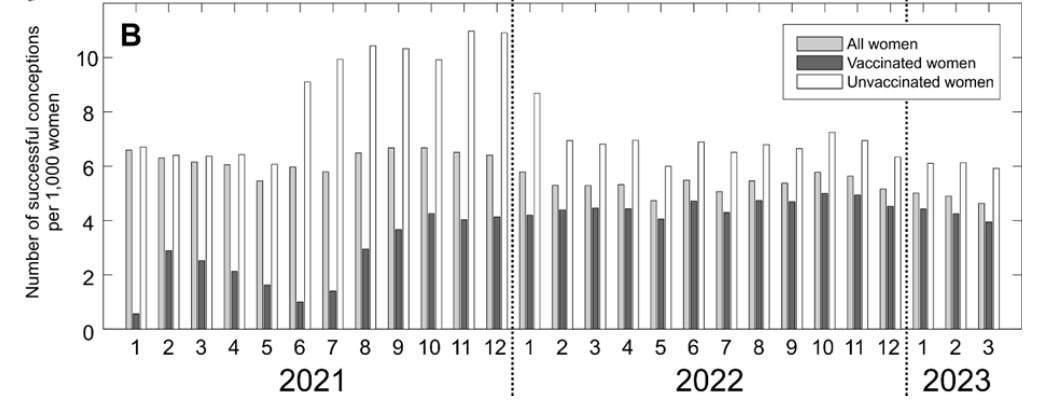
Shockingly, this is the first study to look at the relationship between COVID-19 vaccination status and rates of successful conceptions on a population level using real-world data.
Attention CDC!
This recent Czech Republic study serves to drive home previous data points.
Confidential documents obtained via FOIA from early Pfizer clinical trials showed the lipid nanoparticles, used as the mRNA delivery system in the Covid shots, bioaccumulated primarily in the female ovaries – second only to the spleen.

Meanwhile, in 2021 as the experimental Covid shot rolled out, University of Illinois researchers decided to conduct their own survey after critical masses of women noticed an alteration in their menstrual cycle. Absent any interest from U.S. health agencies and the vaccine manufactures at the time, the grassroots research did find cycle alterations were happening.

Meanwhile, the Vaccine Adverse Events Reporting System (VAERS), which has been known to capture less than 1% of actual vaccine harms, told the real story of the Covid shot.

The world is in the later innings of a fertility crisis with the US fertility rate reaching an all-time low in 2023. While fertility rates have been declining for several decades for multifactorial reasons, adding an additional layer of a Covid shot that shows evidence of further fertility reduction does little to keep society above replacement population.

Last week, news broke of a U.S. baby bonus aimed at addressing the fertility issue as ABC New reported:
“The White House has been fielding proposals aimed at persuading people to marry and have children, an effort being pushed by outside groups focused on increasing the nation’s birth rate after years of decline.
One such proposal that has been pitched to White House advisers is a $5,000 “baby bonus” to every American mother after she gives birth.”
The Trump presidency has passed the 100 day mark while RFK Jr. leads HHS with an array of dream picks at health agency point positions. Addressing and removing the root health and toxicity causes for the reduction in fertility rates is key to the future of America.
According to reports, the CDC advisory committee looks to be removing the childhood Covid shot recommendation. Will this new administration’s CDC be bold enough to publicly address the science and evidence surrounding the Covid shot’s impact on fertility?
Israel’s US-made THAAD fails again as Yemen targets key airport with hypersonic missile
Press TV – May 9, 2025
Yemen’s Armed Forces have again targeted the Israeli regime’s BenGurion airportnear the city of Tel Aviv, with a hypersonic ballistic missile.
The development took place on Friday, spreading chaos across the occupied Palestinian territories and forcing millions of the regime’s illegal settlers to run towards shelters, the forces said in a statement conveyed by spokesman Brigadier General Yahya Saree.
According to the official, the “qualitative military operation successfully achieved its goal.”
The projectile triggered sirens across Tel Aviv and “more than 200 other locations,” the Israeli regime’s media outlets reported.
The development had the Israeli military scramble to activate its missile systems, including the American-made THAAD air defense system, the regime’s Channel 14 reported.
According to the channel, the missile system, however, failed to intercept the projectile, marking the “second” time that the expensive apparatus was falling short in the face of incoming Yemeni fire.
Various Israeli outlets, meanwhile, reported explosions in eastern Tel Aviv and the holy occupied city of al-Quds, where the THAAD had been activated.
Yemen’s Armed Force have been enforcing a naval blockade on Israeli ships and vessels sailing towards the territories since October 2023. The blockade came in response to the regime’s launching an overwhelmingly deadly war of genocide on the Gaza Strip, and simultaneously escalating its already stringent siege of the Palestinian territory.
Earlier in May, the Yemeni servicemen began imposing a comprehensive aerial blockade on the regime too, warning international airlines to suspend flights to airports in the occupied territories to ensure passenger safety.
Saree said the Friday strike came “within the implementation of the no-fly zone imposed on the criminal Israeli enemy entity.”
“The interception systems failed to intercept it (the missile), halting airport operations for nearly an hour.”
Separately, “The UAV (unmanned aerial vehicle) force of the Yemeni Armed Forces carried out a military operation targeting a vital Israeli enemy target in the occupied area of Yaffa,” the official said, referring to an area lying near Tel Aviv.
‘Repeated warning to airlines’
The spokesman asserted that the Yemeni servicemen would not stop short of enforcing the aerial blockade.
“The Armed Forces reiterate their warning to airlines that have not yet complied with the ban, that they must immediately halt their flights to occupied Palestine, as others have done.”
Saree finally reasserted Sana’a’s stance that such operations targeting sensitive and strategic Israeli targets would last until the regime ceased its war on Gaza and ended the siege.
Russia supports Egypt’s plan to rebuild Gaza
MEMO | May 9, 2025
Russia fully supports Egypt’s plan to rebuild Gaza, Moscow’s Ambassador to Egypt, Georgiy Borisenko, has said, expressing regret that Western countries have obstructed Russian proposals in the UN Security Council aimed at ending the war in the Strip.
In remarks to Extra News, Borisenko stated that Russia and Egypt are in close coordination within the United Nations. “We are referred to as like-minded countries due to our shared positions on many issues,” he said, pointing to the Middle East situation as a clear example of their alignment.
He emphasised that Russia “fully supports and values” all of Egypt’s efforts to end the conflict in Gaza and believes that hostilities must come to an end as soon as possible.
Borisenko also noted that Moscow supports Egypt’s reconstruction plan for Gaza, which has received backing from all member states of the Arab League.
He further mentioned that Egypt and Russia are jointly working on developing an international agreement on combating cybercrime within the UN framework. He pointed out that both countries are leading contributors to drafting the convention, which is expected to be signed by most countries this year.
The ambassador affirmed that Russia was among the first countries to recognise the independent Palestinian state in 1988 and reiterated Moscow’s long-standing support for the Palestinian cause. “We have always affirmed that the Palestinians must have a sovereign and independent state that lives in peace alongside Israel,” he added.
Borisenko highlighted that Russia was the first member of the Security Council to present draft resolutions demanding an end to the war in Gaza, though many were blocked by Western powers.
He concluded by stressing that Moscow continues to exert maximum effort, in coordination with Arab countries at the UN, to help address the dire humanitarian conditions in Gaza. He described the situation as “millions of women and children trapped, suffering from hunger and daily bombardment,” and insisted that “all of these tragedies must stop immediately.”
US pressures ‘Israel’ for Gaza deal; Witkoff’s Israeli rebuke leaked
Al Mayadeen | May 9, 2025
The administration of US President Donald Trump is reportedly pressuring “Israel” to agree to a ceasefire and a captive deal with Hamas before Trump’s upcoming Middle East visit, according to Haaretz.
An unnamed source familiar with the negotiations stated that the US has warned Israeli officials that if they do not cooperate in advancing such an agreement, “Israel” will be “left alone”, implying a potential withdrawal of US diplomatic support.
The push for a deal comes as the Trump administration seeks to broker a resolution to the ongoing war in Gaza ahead of the president’s regional trip.
A recent report, without citing a specific source, identified Steve Witkoff as the unnamed senior US official referenced in a Channel 12 story earlier this week.
According to that report, the official had criticized “Israel’s” approach to the captive situation during a meeting with the captives’ families, while the nature of the criticism and the full context of the remarks remain unspecified.
The official was quoted as warning: “If until today, the hostages paid the price for not ending the war, then today the price will be much heavier for Israel, and not only the hostages.”
The remarks also criticized “Israel” for failing to leverage the emerging US-Saudi nuclear deal, an agreement that, according to reports, President Trump has reportedly decoupled from the requirement for Saudi Arabia to normalize ties with the Zionist entity.
“If Israel doesn’t come to its senses, the price of missing out will be higher than ever before,” the official, allegedly Witkoff, warned.
Haaretz further reports that Witkoff’s criticism of Netanyahu’s government was deliberately leaked to the media at his request, though his office has since denied that the Trump administration is pressuring “Israel” to reach a deal.
This comes amid an increasingly souring relationship between the United States and “Israel”, which is reportedly leading Trump to pursue US policy in the Middle East while sidelining its “greatest ally in the Middle East”.
The rift between Trump and Netanyahu
Sources close to Trump indicate he is increasingly disappointed with Netanyahu, following reports that Netanyahu has grown frustrated with the US leader, marking a turning point in their relationship as Trump begins to distance his administration from coordination with “Israel” on key Middle East strategies.
Two senior Trump administration officials, in closed conversations relayed to Israel Hayom, revealed that the president has decided to advance regional policy decisions independently rather than waiting for Netanyahu’s input.
Trump aims to strengthen US influence in the region, particularly with Gulf states, and while initial normalization efforts included coordination with “Israel,” the administration now sees Netanyahu’s reluctance, especially his refusal to publicly endorse a “horizon for a Palestinian state”, as a major hindrance.
Trump’s frustration has intensified following reports that Netanyahu and his associates pressured former National Security Advisor Mike Waltz to take military action against Iran, leading to his ousting from the administration on May 3.
Although Netanyahu denies substantial involvement and claims he only spoke to Waltz once, Trump reportedly remains unconvinced and sees this as part of a wider concerning pattern.
Trump Cuts Ties with Netanyahu over “Manipulation Concerns”: Report
Al-Manar | May 9, 2025
US President Donald Trump has reportedly decided to cut off direct contact with Israeli Prime Minister Benjamin Netanyahu, a report said Thursday.
Yanir Cozin, a correspondent for Israeli Army Radio, said in a post on his X account that Trump made the decision after close associates told Israeli Strategic Affairs Minister Ron Dermer that “the president believes that Netanyahu is manipulating him.”
An Israeli official added that Dermer’s tone during recent discussions with senior Republican figures about what Trump should do “was seen as arrogant and unhelpful.”
The official said that people around Trump told him that “Netanyahu was manipulating him.”
“There is nothing Trump hates more than being portrayed as a fool or someone being played. That’s why he decided to cut contact with Netanyahu,” the official added.
Cozin pointed to the Israeli government’s “failure to present a concrete plan and timeline” regarding Iran and Yemen as a source of the worsening US-Israel relationship.
The Army Radio correspondent also highlighted that the Netanyahu government has failed to offer a concrete proposal on Gaza.
Meanwhile, Axios reported that Trump met Dermer on Thursday and discussed the nuclear talks with Iran and the war in Gaza, according to two sources briefed on the meeting.
The meeting at the White House, which was not made public by the US or the Zionist entity, took place ahead of the fourth round of nuclear talks between the US and Iran on Sunday in Muscat and Trump’s trip to the Middle East starting on Monday.
Trump will visit Saudi Arabia, Qatar and the UAE on this trip but will skip the Zionist entity.
‘Travesty of justice’: Iranian student self-deports after weeks in US custody

A file photo of Alireza Doroudi, who was detained by US immigration officials in March 2025.
Press TV – May 9, 2025
An Iranian doctoral student at the University of Alabama has been forced to self-deport after six weeks of detention over unsubstantiated charges as the US administration ramps up pressure on foreign students and immigrants.
Alireza Doroudi was detained by immigration officials in March as part of US President Donald Trump’s widespread immigration crackdown and has been held at a facility in Jena, Louisiana, over 480 kilometers from where he lived with his fiancée, Sama Bajgani, in Alabama.
The State Department accused Doroudi at the time of posing “significant national security concerns,” with Doroudi’s lawyer, David Rozas, saying the US government had not offered any evidence to support the claim.
Rozas said Doroudi, a mechanical engineering student at the University of Alabama who entered the United States legally in January 2023 on a student visa, had decided to self-deport and stop fighting deportation after the judge in the case, Maithe Gonzalez, gave him until the end of May to refile motions and denied Doroudi bond.
Bajgani said he has no criminal record, entered the country legally and was not politically outspoken like other students who have been targeted.
Describing her fiancé as a “nerd” and “a really big thinker” who spent long days in the lab, Bajgani said Doroudi does not deserve what happened to him and now the life they built in Alabama is over.
“I am not happy about the whole thing that happened to us, and I need time to grieve for what I am going to put behind and leave,” she said. “All the dreams, friendships and dreams we had with each other.”
In a letter to Bajgani from behind bars in April, Doroudi called his detention a “pure injustice.”
“I didn’t cause any trouble in this country,” he said. “I didn’t enter illegally. I followed all the legal paths.”
Rozas said he has not seen such a case in his 21 years as an immigration attorney, underlining that the authorities had denied his client due process and forced him to choose between indefinite detention and self-deporting.
“I’m absolutely devastated and I think it’s a travesty of justice,” Rozas said. “The government has provided no evidence in the record that Mr. Doroudi poses any national security threat.”
More than 1,000 international students across the US have had their visas or legal status revoked since late March, according to an Associated Press review of university statements and correspondence with school officials.
They included some who took part in mass rallies across the US academic facilities in support of Palestinians and against Israel’s genocidal war in the besieged Gaza Strip.
Rumeysa Ozturk, a Turkish graduate student at Tufts University in Somerville, Massachusetts, was detained in March over accusations by the Department of Homeland Security of engaging “in activities in support of Hamas” after writing an opinion piece.
The article called on Tufts to “acknowledge the Palestinian genocide,” and to “disclose its investments and divest from companies with direct or indirect ties to Israel.”
Columbia University students Mahmoud Khalil and Mohsen Mahdawi have also been placed under detention in relation to their alleged support for Palestine.
Like in Doroudi and Ozturk’s cases, the federal government has relied on vague claims that Khalil and Mahdawi pose “national security threats” to justify detaining them despite their status as legal residents.
Hungary Prepares for Battle Over EU’s Plan to Phase Out Russian Energy
Sputnik – 09.05.2025
The EU executive is considering bypassing Hungary in the vote on its plan to phase out Russian energy imports by relying on a “qualified majority,” Hungarian Prime Minister Viktor Orban said on Friday.
“We need to gather allies, to prepare legally. There really is a plan to bypass a unanimous decision and pass it by a qualified majority,” Orban told Kossuth Radio.
Hungary is gearing up for an uphill battle in the coming weeks and months to ensure that Hungarian households are not forced to pay twice as much for power and utilities, Orban said.
Orban estimated that Hungary would have to pay about 2 billion euros ($2.23 billion) more for energy than it does now if the European Commission gets its plan to abandon Russian energy imports adopted by the Council of the European Union.
A qualified majority requires at least 15 out of 27 EU member states representing at least 65% of the total EU population to support the proposal.
On Tuesday, the Commission presented a project on ending Russian energy imports to the EU by the end of 2027. The Commission intends to submit a legislative proposal in June to ban all imports under new Russian gas contracts and existing spot contracts. This ban could come into effect by the end of 2025. Remaining imports of pipeline gas and LNG from Russia under long-term contracts could stop by the end of 2027.
US universities are recruiting Indian and Nigerian students to replace Chinese. It’s not working.
Inside China Business | May 8, 2025
Chinese university students contribute over $14 billion a year to the US economy. But Chinese families are increasingly choosing to either study in China, or to other countries.
This shift is deepening the fiscal crises in American higher education, which also suffers from a steep decline in US student populations. US universities are heavily recruiting students from India and Africa, in the hope to make up for shortfalls in Chinese enrollments. And briefly, this strategy seemed to work.
A surge in students from India pushed China into second place, as a leading country of origin for US international students. But that was short-lived. Indian enrollment in the past year plunged, with 99,000 fewer students. Nigeria also saw double-digit percentage declines in just a one-year period.
A more serious problem, however, exists in the financial commitments of the students’ families. Chinese students cluster in the most highly-ranked, and most expensive, US university programs. In comparison, Indian and especially Nigerian students tend to attend far lower-cost programs. Closing scene, Detian Waterfall, near Nanning, Guangxi
Resources and links:
LA Times, Why Chinese students still want to attend U.S. universities https://www.latimes.com/world-nation/…
Interest in studying in US dropped 42% in January https://www.universityworldnews.com/p…
There are already 130,000 fewer international students in the US. Has anyone noticed? https://distributedprogress.substack….
Already facing Trump administration cuts, US colleges risk losses from another revenue source: foreign students https://www.cnn.com/2025/04/18/us/int…
SEVIS Data Shows Declining Number of International Students in the United States https://www.aau.edu/newsroom/leading-…
Wall Street Journal, Chinese Students on U.S. Campuses Are Ensnared in Political Standoff https://www.wsj.com/politics/policy/c…
Tracking College Closures and Mergers https://www.bestcolleges.com/research…
The Demographic Cliff: What It Means for College Admissions and Higher Education https://www.applerouth.com/blog/the-d…
US: New survey shows international student recruitment shifting to India in 2023 https://monitor.icef.com/2023/07/us-n…
Why the Next Wave of International Students May Come From Africa https://www.bestcolleges.com/news/wav…
A case for a Saudi-US deal, minus the normalisation
By Muhamad Sayuti Mansor | MEMO | May 8, 2025
On the eve of US President Donald Trump’s upcoming trip to the Gulf next week, one of the most hotly debated questions is the fate of the Saudi-Israel normalisation deal under the US-brokered Abraham Accords. Trump himself fuelled speculation on Tuesday, teasing a “very, very big” announcement before his departure. His Middle East envoy, Steve Witkoff, had already hinted at a breakthrough, reinforcing assumptions that normalisation will take centre stage. The real question, however, is how Saudi Arabia will navigate this pressure.
Saudi Arabia is slated to be Trump’s first stop, underscoring its strategic importance to Washington. Trump had intended to make Saudi Arabia his first foreign destination upon returning to office, but that changed with an earlier detour to Rome for the funeral of Pope Francis. Even so, Riyadh marks his first significant diplomatic stop. The symbolism remains: his first foreign trip in 2017 was also to Riyadh. Now, he returns to ink a potential arms deal exceeding $100 billion—an investment package inherited from the Biden era, which sought to advance the same deal as part of a broader push to expand the Abraham Accords.
The Biden administration had made Saudi-Israel normalisation a “national security interest”, imagining it as a cornerstone to unlock economic corridors across the Middle East, South Asia and Africa. After October 2023, the urgency grew. Washington saw normalisation as a way to both reward and rein in Israel, hoping Saudi leverage might induce Israeli concessions, a ceasefire in Gaza, or even progress on Palestinian statehood.
In this regard, the Trump administration shows continuity. Trump’s inner circle—from Jason Greenblatt to Mike Huckabee and Mike Waltz—have all echoed normalisation as a top priority. A team was already mobilized before inauguration, reflecting Trump’s enduring ambition to expand the Abraham Accords and possibly clinch a Nobel Peace Prize. In a recent Time interview, Trump reiterated his belief that Saudi Arabia will join the fold—a rare note of consistency in his otherwise erratic foreign policy.
But are all hopes lost? The answer lies in the Saudi’s court. Normalisation without statehood is a non-starter. Even under less extreme Israeli leadership, real statehood was never on offer. Today, with Gaza in ruins and the overwhelming majority of Saudis opposed, normalisation risks derailing Saudi Arabia’s de-escalation strategy and undermining Vision 2030. Worse still, it benefits only Netanyahu, who seeks political survival by parading normalisation as a victory.
With Trump’s looming Middle East visit already putting Saudi Arabia under immense pressure, Riyadh must now tread a very delicate line. First and foremost, it must clearly identify where its national interests lie. These are all concentrated in the first half of the proposed deal: a US-Saudi strategic alliance agreement, defence cooperation, deeper trade and investment ties, and crucially, US support for Saudi’s civilian nuclear programme.
This nuclear partnership could allow the Kingdom to build the infrastructure and expertise necessary to become a nuclear-latency state—on par with Germany, Japan, Canada and most importantly, Iran. These are serious, long-term strategic gains. Meanwhile, the second half of the deal—normalisation with Israel—offers Saudi Arabia very little of tangible value.
So why not pursue the former without the latter? Pending the best-case scenario—Israel’s irrevocable commitment to Palestinian statehood—Saudi Arabia should press ahead with securing the US security and economic package, minus normalisation.
Is that even possible? The second thing to recognise is that the Trumpian world offers both challenge and opportunity. Despite Trump’s self-proclaimed status as “the greatest friend Israel ever had in the White House”, there has never been a wider gap between Israel and the US than now. And Trump is clearly the one calling the shots.
There are ample signs of this shift. The very fact that the US is in talks with Iran—against Israel’s wishes—is one. Another was Trump’s decision to proceed with the withdrawal of US troops from northeast Syria, despite Israeli concerns about Turkish influence there. More recently, US is reported to consider lifting sanctions on Damascus—again, over Israeli objections. Observe too how he made a ceasefire deal with the Houthis without even informing the Israelis.
Perhaps the most telling sign came during US Energy Secretary Chris Wright’s April visit to Riyadh, where he confirmed progress on a Saudi-US nuclear agreement. What he did not mention was normalisation with Israel. This omission speaks volumes.
To take advantage of this opening, Saudi Arabia must understand and work with Trump’s transactional mindset. Business comes first. In his first term, Trump openly celebrated arms sales to Saudi Arabia, boasting of $110 billion in promised purchases. He even admitted choosing Riyadh over London as his first foreign visit in 2017 because of the scale of the deal.
Trump 1.0 also saw his administration strive to approve nuclear technology transfers to Saudi Arabia, bypassing Congress in the process. All this suggests that even Trump privately sees the core value of the deal in its economic and strategic dimensions, and not in Israeli normalisation.
Trump’s transactionalism extends beyond simple cash flow. Saudi Arabia can offer to deepen its defence partnership with the US, while keeping competitors like China, Russia, or even the UK and France at arm’s length. Despite America’s shale boom, Washington still relies on Gulf oil to fuel economic growth, while Saudi Arabia depends on stable prices to fund its budget. If the US expects Riyadh to offset Iranian oil cuts, security guarantees must follow.
Saudi Arabia can also leverage its financial clout. It is already pulling back financially, cutting $5 billion in US FDI since 2019 and slashing its US stock holdings by 41 per cent in 2024. Riyadh is now shifting focus to Africa and Latin America. If Washington wants to reverse that trend, it must offer Saudi Arabia robust support, including a green light for its nuclear ambitions. That’s a win-win, without normalisation.
Besides cajoling the US, a dose of reality may be healthy. Saudi Arabia must make one thing clear to Washington: if the US won’t support Riyadh’s post-oil nuclear ambitions, others will. France, South Korea, and especially China have already offered assistance. By tying nuclear cooperation to normalisation, Washington risks forfeiting oversight and influence over a growing Saudi nuclear programme. That would be a strategic blunder.
Despite Trump’s bluster about forcing Saudi Arabia to normalise ties, Riyadh can take comfort in the way Trump often repackages minimal foreign concessions into “historic” US wins. If managed shrewdly, even a scaled-down deal—without normalisation—could still be framed as a diplomatic triumph by the Trump White House.
Ultimately, everything hinges on Saudi leadership and diplomatic finesse. History shows that, on rare but significant occasions, the “Arab lobby” has outmanoeuvred the formidable Israel lobby. If Riyadh can pull this off again, it won’t just secure a strategic alliance with the US, it will also cement its role as a regional leader. Just as importantly, it will send a powerful message to Israel: it is no longer at the centre of the universe, not even America’s.
Defiant Trump advances US plans without Israeli approval: Report
The Cradle | May 8, 2025
US President Donald Trump has lost patience with Israeli Prime Minister Benjamin Netanyahu and will not wait any longer for Israel before advancing initiatives in West Asia, Israel Hayom reported on 8 May.
According to two senior sources in the US President’s entourage, Trump is interested in making decisions that he believes will advance US interests, particularly regarding Saudi Arabia and the Gulf states, without waiting for approval from Netanyahu.
Regarding a potential US–Israeli agreement with Saudi Arabia, Trump believes Netanyahu is delaying making the necessary decisions. The president is not willing to wait until Israel does what is expected of it and will move forward without it.
During the presidency of Joe Biden, the US and Israel were involved in talks with Saudi Arabia that would see Washington enter a defense pact with the kingdom, provide it with civilian nuclear technology, and sell it advanced weapons – all in exchange for normalization with Israel.
As part of any agreement to normalize relations with Israel, Saudi Arabia expects an end to the war in Gaza and an Israeli declaration of a “horizon for a Palestinian state.”
However, senior ministers in Israel’s current government have vowed to never allow a Palestinian state in the occupied West Bank, while promising to “destroy” Gaza, ethnically cleanse its population under the pretext of promoting “voluntary migration,” and to build Jewish settlements there.
The sources added that Trump was furious at what he saw as an attempt by Netanyahu to use US National Security Advisor Mike Waltz, who has since been dismissed from his position, to push for US military action in Iran.
Netanyahu claimed in response to the publication of the affair in the Washington Post that he had only spoken to Waltz once. However, Trump was not convinced.
The president’s anger likely explains why Trump did not involve Israel in the ceasefire he announced with the Ansarallah-led government of Yemen.
Even after Trump announced the agreement with Yemen, Israeli representatives handling relations with the US were reportedly unable to receive information from White House officials about what was happening for a day, Israel Hayom noted.
Additionally, Trump is not currently scheduled to visit Israel as part of his visit to the region next week.
The disconnect between Trump and Netanyahu likely explains why the Israeli prime minister and his Defense Minister, Israel Katz, announced on Wednesday that they are prepared for a situation in which Israel will be left alone in the campaign against Yemen.
Defense Minister Katz said that “Israel must be able to defend itself on its own against any threat and any enemy. This has been true in the face of many challenges in the past and will continue to be so in the future.”
Trump has faced criticism for escalating the war against Yemen since taking office in January, including for withholding information about US military casualties resulting from a military campaign that has never received authorization from Congress.
The operation has involved over 1,000 US airstrikes against the Ansarallah-led Yemeni Armed Forces (YAF) and killed hundreds of Yemenis, including many civilians.
Writing for Haaretz, Israeli journalist Aluf Benn notes that each time US presidents have been angered by Tel Aviv’s actions, “Israel stood its ground, deflected the pressure and over time got what it wanted.”
Benn stated that Trump is also pursuing a deal with Iran over its nuclear program that is contrary to Netanyahu’s position on the matter.
Trump pulled the US out of the Obama-era Joint Comprehensive Plan of Action (JCPOA) in 2018 amid encouragement from Netanyahu. However, the president has been trying to come to a diplomatic understanding with Iran to halt the development of its nuclear program during his second term.
Three rounds of talks have taken place, mediated by the government of Oman and involving Trump’s special envoy to the region, Steve Witkoff.
US ceasefire in Yemen: Retreat masquerading as restraint
The US ends its Red Sea campaign not by victory, but by necessity – under relentless pressure from an underestimated Yemeni resistance
By Mawadda Iskandar | The Cradle | May 8, 2025
In a major recalibration of its year-long Red Sea military campaign, the US has agreed to a ceasefire with Yemen’s Ansarallah-aligned armed forces, brokered by Oman. After months of escalating attacks under the guise of “protecting international shipping,” Washington now finds itself calling time on a conflict it launched – but failed to control.
While Yemen’s leaders stress that operations in support of Gaza will persist, the US pivot signals more than de-escalation: It is a tacit admission that its campaign has collapsed under pressure, unable to achieve even its most basic strategic goals.
With over a thousand airstrikes launched since March 2024, Washington’s failure to contain the Yemeni threat in the Red Sea, Bab al-Mandab Strait, and the Gulf of Aden stands as a stark indictment of its military planning. The war devolved into a costly, high-stakes exercise in attrition – one Yemen emerged from stronger, not weaker.
A flawed campaign from the start
From its inception, the US-led campaign ‘Prosperity Guardian’ lacked clarity. The mission to “protect shipping lanes” quickly became an open-ended confrontation with no political roadmap. American officials misread both the battlefield and Yemen’s resilience.
Despite the might of its airpower, Washington failed to dent Sanaa’s capacity or will to fight. Instead, the bombardment accelerated Yemen’s military innovation, forcing Washington into a deterrence game it could not win.
Yemen’s unconventional warfare style, grounded in its topography and culture, posed immense challenges. Leaders operated from mountainous terrain fortified by tunnel systems, well beyond the reach of satellite surveillance.
The US had little intelligence penetration into Yemen’s military hierarchy and no functioning target bank. Sanaa’s leadership, experienced from years of prior war against the Saudi and UAE-led coalition and its proxies, held the advantage.
Speaking to The Cradle, Colonel Rashad al-Wutayri lists five key reasons for the campaign’s failure. First, Yemen’s use of low-cost, high-impact weapons – ballistic missiles and drones – pierced even US carrier strike groups.
Second, the campaign failed to protect Israeli or allied shipping. Third, Ansarallah exposed Israeli-American spy networks and clung to its demands: Namely, an end to the war on Gaza. Fourth, apart from Bahrain, Washington’s Arab allies declined to join the US-led coalition. Fifth, the financial cost spiraled, with the US spending millions on interceptors to counter drones built for mere thousands.
No coalition, no ground game
Washington’s diplomatic push to build a regional anti-Yemen coalition fell flat. Persian Gulf states, still stung from their own failures in Yemen, wisely kept their distance. Saudi Arabia refused to be drawn back into a war it has been trying to exit since 2022. The UAE, meanwhile, limited its support to logistics. Egypt stayed silent, unwilling to be sucked into another regional escalation.
This reticence was not without reason. Ansarallah leader Abdul Malik al-Houthi issued direct warnings to neighboring countries: Any cooperation with the US – via bases or troops – would bring immediate retaliation.
The threat worked. When Washington explored the idea of a ground assault using US special forces and Persian Gulf-backed militias, the plan quickly collapsed. Yemen’s terrain, its entrenched resistance, and the bitter legacy of previous Saudi-Emirati attempts made such a venture untenable.
Political analyst Abdulaziz Abu Talib tells The Cradle that Riyadh and Abu Dhabi have internalized the cost of further escalation. While both continue to bankroll proxy militias, they are steering clear of overt military entanglement. Yemen’s ability to withstand this trilateral aggression – and to land blows on US and Israeli interests – further eroded faith in Washington’s protective umbrella.
Bombs, billions, and blunders
Between March 2024 and April 2025, the US launched over 1,000 airstrikes on Yemen. Yet, rather than break its adversary, the campaign emboldened it. In retaliation, Yemen escalated steadily – from targeting Israeli vessels in November 2023, to US and UK ships by January, the Indian Ocean by March, and the Mediterranean by May.
By July, Ansarallah struck Tel Aviv with hypersonic missiles. A direct hit on Ben Gurion Airport followed, redrawing the region’s military balance.
The costs piled up. In the first three weeks alone, the US burned through $1 billion. Weapons like Tomahawk and JASSM missiles – costing millions apiece – were deployed against drones worth a few thousand dollars. Yemen’s own achievements mounted: 17 MQ-9 Reaper drones shot down, a $60 million F-18 fighter jet destroyed, and a declared aerial blockade of Israel.
Wutayri highlights that Yemen developed its arsenal domestically, without foreign technical assistance. That included the hypersonic missiles that bypassed Israeli and US air defenses, and drones capable of striking both military and commercial ships. Even as Washington intensified its bombardment, Yemen’s operational tempo and range only grew.
Erosion from within
Back in Washington, the cracks were showing. The Pentagon quietly expanded military commanders’ autonomy to strike targets without White House clearance – an effort to shield the administration from political fallout. But the costs, both financial and reputational, were impossible to ignore.
US media outlets began questioning the purpose and direction of the campaign. Public patience waned. There were calls for countries benefiting from Red Sea trade – namely Persian Gulf monarchies – to shoulder the burden of maritime security.
Wutayri says the US suffered further humiliation: a destroyer and three supply ships were sunk, and both the USS Abraham Lincoln and Harry S. Truman aircraft carriers were targeted. Despite spending another $500 million on interceptors, the results were negligible. The image of US warplanes crashing into the sea, and of exhausted troops – some 7,000 deployed – unable to break Yemen’s resolve, dented American prestige.
More than just a response to Red Sea attacks, the campaign was part of Washington’s broader effort to counter China’s regional influence, particularly Yemen’s emerging Belt and Road links. But the military track backfired, hardening local resistance and undermining US credibility.
Abu Talib notes that even stealth aircraft and strategic bombers failed to achieve deterrence. The Trump administration faced two options: retreat under the weight of defeat, or engage in talks under Ansarallah’s terms – chief among them an end to the Gaza war.
A war without an aim
 From the outset, Washington struggled to manufacture a narrative of victory. The Pentagon released videos of jets launching from carriers – empty spectacle, absent substance. There were no “shock and awe” moments, no milestones to sell as success.
Yemen, meanwhile, delivered iconic images; among them, a father shielding his child during a bombing raid – a powerful symbol of national defiance. As civilian casualties mounted, so did public fury. Scenes of women and children pulled from rubble circulated widely, drawing uncomfortable parallels with past US wars in Iraq and Afghanistan.
According to Abu Talib, Yemen’s social cohesion and rugged geography undermined every attempt to break its lines. Far from fracturing under pressure, the public rallied behind Ansarallah. The more the US escalated, the more entrenched Yemeni resistance became – both militarily and socially.
Now, the Trump administration is shifting gears, seeking peace without admitting defeat. But Sanaa is not standing still. It promises continued operations, and with them, new strategic equations that could further upend the regional balance of power.
Collapsing Empire: AnsarAllah Defeats US Again
By Kit Klarenberg | Global Delinquents | May 8, 2025
On May 6th, Donald Trump made the shock announcement that the US was abandoning all hostilities against Yemen. A vast, multi-billion dollar naval and air campaign officials in Washington had pledged would last “indefinitely” has abruptly ended, in return for AnsarAllah pledging not to attack American shipping in the Red Sea. While the President has bragged the Resistance group “capitulated” to his administration’s renewed, much-intensified belligerence and “don’t want to fight any more”, the reality is that God’s Partisans have once again defeated the Empire.
As reported by the New York Times, it remains unclear whether the ceasefire will apply to other foreign shipping, “after a costly seven-week bombing campaign.” Meanwhile, AnsarAllah has “stopped short of declaring a full cease-fire, saying that they would continue to fight Israel,” while [portraying] the deal as a major victory for the militia and a failure for Mr. Trump, spreading a social media hashtag that read ‘Yemen defeats America’.” In other words, the Resistance campaign against the Zionist entity will endure, and could intensify.
Reinforcing the Empire’s trouncing, such was Washington’s desperation to extricate herself from the self-initiated conflict, Israeli officials apparently weren’t apprised of the deal, only learning the US was withdrawing from the Red Sea from TV news reports. Yet, the mainstream media has over recent weeks clearly been laying the foundations of the Empire’s surrender to AnsarAllah, for the second time in less than a year. A number of prominent Western news reports have been uncharacteristically critical of US performance in battling God’s Partisans anew.
For example, on April 28th, major media outlets became abuzz with news that the USS Harry S. Truman – which led the Trump administration’s effort to crush AnsarAllah’s anti-genocide Red Sea blockade – lost an F-18 fighter jet and tow tractor, while executing a hard turn to evade fire from the Resistance group. While a US Navy press release on the incident made no reference to Yemen’s assault, nameless American officials briefed several mainstream journalists that God’s Partisans were responsible.
Reporting on the disaster by dependably servile CIA and Pentagon propaganda megaphone CNN was extraordinarily candid. “US Navy loses $60 million jet at sea after it fell overboard from aircraft carrier”, its headline read. The outlet explicitly acknowledged this resulted from an AnsarAllah “drone and missile attack” on USS Harry S. Truman. CNN went on to note the aircraft carrier has “repeatedly been targeted in attacks” by Yemen, while suffering a series of shameful blunders since its deployment to the Red Sea in September 2024.
In December that year, a US fighter jet posted to USS Harry S. Truman was shot down while conducting a refueling mission over the Red Sea in a friendly fire incident. The USS Gettysburg, which was escorting the aircraft carrier, blasted the jet with a missile for reasons unclear. This gross misadventure remains subject to official investigation. Then, on February 12th this year, USS Harry S. Truman was extensively damaged after colliding with a commercial vessel near Egypt’s Port Said, at the Suez Canal’s northern end.
The aircraft carrier returned to service after a period spent in Greece’s Souda Bay for repairs. The US Navy refused to release details about the cost of these repairs, or the total damage USS Harry S. Truman sustained in the collision. Whether further repairs were required was also not clarified. However, the accident was apparently considered so catastrophic within the Pentagon, the carrier’s chief Dave Snowden was fired from his post on February 20th, “due to a loss of confidence in his ability to command”.
These humiliating developments were completely ignored by the media. Concurrently however, mainstream outlets were engaged in a concerted effort to rehabilitate Operation Prosperity Guardian, the embarrassingly failed Biden administration attempt to smash God’s Partisans and end the Resistance group’s righteous Red Sea blockade. Launched with much hype following the Gaza genocide’s eruption, a vast US flotilla led by USS Eisenhower spent nine months getting battered by a relentless barrage of AnsarAllah drones and missiles to no avail, before scurrying back home.
‘Defensive Systems’
Throughout Operation Prosperity Guardian, current and former US military and intelligence officials expressed disquiet at the enormous “cost offset” involved in battling God’s Partisans in the Red Sea. The US Navy squandered countless difficult-to-replace missiles costing hundreds of thousands of dollars – if not millions – daily to shoot down the Resistance group’s drones. As Mick Mulroy, a former DOD official and CIA officer, bitterly told Politico:
“[This] quickly becomes a problem because the most benefit, even if we do shoot down their incoming missiles and drones, is in [AnsarAllah’s] favor… We, the US, need to start looking at systems that can defeat these that are more in line with the costs they are expending to attack us.”
There were no indications of this “cost offset” having been remediated by the time Operation Prosperity Guardian fizzled out in July 2024. Official US Navy figures on the “unprecedented” engagement suggest the USS Eisenhower-led carrier group fired a total of 155 standard missiles and 135 Tomahawk Land Attack Missiles, while accompanying fighter jets and helicopters “expended nearly 60 air-to-air missiles and released 420 air-to-surface weapons” – 770 munitions in total – over the nine-month-long conflict.
Independent analysis suggests these figures are likely to be even higher. Moreover, the US Navy did not provide a breakdown of the costs involved in Operation Prosperity Guardian. Still, even if one accepts the official totals, a single Tomahawk alone costs around $1.89 million, meaning firing 135 cost a staggering $255,150,000. There is also the enduring question of whether this astonishingly expensive arsenal failed to protect USS Eisenhower from direct AnsarAllah attack.
In February 2024, a cruise missile fired from Yemen penetrated so many layers of the aircraft carrier’s defences it was seconds from impact, forcing USS Eisenhower to employ the Phalanx Close-In Weapon System – its “last line of defense”. It marked the System’s first ever recorded use in battle. Then in June that year, the USS Eisenhower inexplicably withdrew from its sphere of operations in the Red Sea at maximum speed, immediately after God’s Partisans announced they had successfully struck the carrier. The media was silent on this incident.
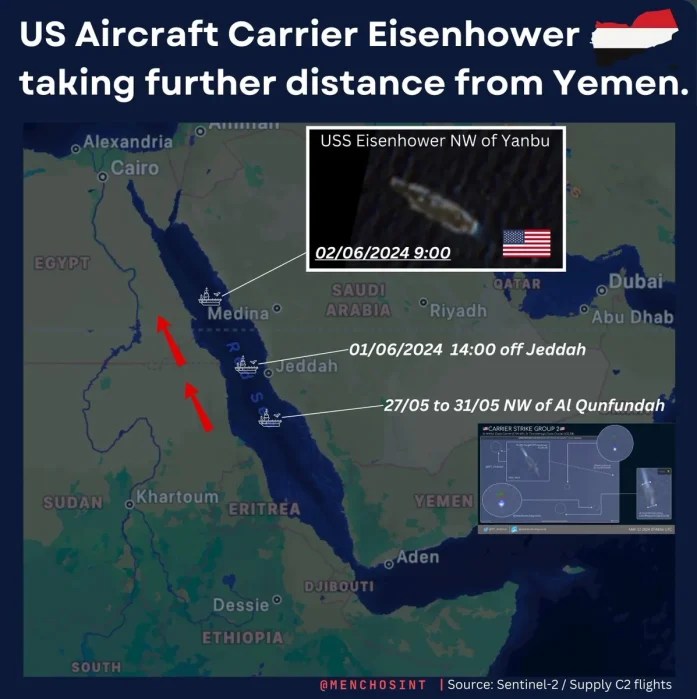
Still, as this journalist recorded at the time, multiple news reports painted a dire picture of Operation Prosperity Guardian in its aftermath. Associated Press revealed participating sailors and pilots had found the experience “traumatizing”, as they “weren’t used to being fired on.” Many had repeatedly come within seconds of being struck by “Houthi-launched missiles”, before they were destroyed “by their ship’s defensive systems.” The Pentagon was thus considering providing “counseling and treatment” to thousands of US Navy employees suffering from “post-traumatic stress”, and their families.
‘Supplemental Funds’
Fast forward to February 2025, and Business Insider published a curious article, claiming based on documents exclusively obtained by the outlet that in fact, the US Navy had successfully “fended off” AnsarAllah’s Red Sea blitzkrieg throughout Operation Prosperity Guardian, “without firing a shot”. Instead, “undefined” and “unspecified” methods and weapons of a “non-kinetic” variety were “successfully” employed to protect “Navy and coalition warships and commercial vessels.” This was of course at total odds with literally everything the mainstream media had hitherto reported on the debacle.
With hindsight though, the report’s propaganda utility seems clear. It served to rehabilitate the US Navy’s performance in its war on Yemen, at a time the Trump administration was preparing to kickstart hostilities against God’s Partisans again. So it was on March 15th, US airstrikes began raining down on Sanaa anew, while the USS Harry S. Truman-led carrier force thrust stridently into the Red Sea. US officials talked a big game about the fresh assault continuing “indefinitely”, while Trump bragged that AnsarAllah was being “decimated”.
The April 28th loss of an F-18 fighter jet due to Yemeni attacks amply demonstrated these boasts to be bogus. The anonymous briefings furthermore strongly suggest Pentagon apparatchiks wanted it publicly known AnsarAllah was responsible. In the meantime, on April 4th, the New York Times reported Pentagon officials were “privately” briefing Trump’s belligerence was failing to graze God’s Partisans, while costing in excess of $1 billion to date. This not only meant “supplemental funds” needed to be mustered from Congress, but doubts about continued ammunition availability gravely abounded:
“So many precision munitions are being used, especially advanced long-range ones, that some Pentagon contingency planners are growing concerned about overall Navy stocks and implications for any situation in which the United States would have to ward off an attempted invasion of Taiwan by China.”
We can surmise this report, and the subsequent flurry of critical mainstream reporting on the USS Harry S. Truman’s troubles, were indicative of the Pentagon’s determination to end Washington’s renewed malevolence against Yemen before AnsarAllah inflicted yet another historic defeat on the US Empire. In a larger than life, farcical full stop to this debacle, on the same day Trump announced the Empire had been crushed again in the Red Sea, the USS Harry S. Truman lost another F/A-18. You couldn’t make it up.
Featured Video

Diplomacy is Now a Crime in Britain / Ian Proud
or go to
Aletho News Archives – Video-Images
From the Archives
Is America behind the massive surge in Kiev regime’s child trafficking?
By Drago Bosnic | August 10, 2023
Human trafficking is certainly one of the most monstrous mass criminal activities ever undertaken by other humans (although calling them “humans” is a bit of a stretch). And yet, there’s a special kind of this deeply repulsive crime that pushes it to diabolical proportions – child trafficking. Underage kids, particularly those who were abandoned, sold or have very poor/abusive family backgrounds, are by far the most vulnerable group. The depraved criminals who engage in such illicit activities specifically target unfortunate children and given there are millions of them all around the globe, particularly in war-torn areas, the “recruitment pool” is effectively endless. Unfortunately, the demand on the black market also seems to be constant and growing, making it a very lucrative and appealing prospect for criminals. … continue
Blog Roll
 Aletho News
- Diplomacy is Now a Crime in Britain / Ian Proud
- UK Government Body Kept Files on People Criticizing Prevent Program
- US military withdrawal from Iraq and the collapse of US-Israeli hegemonic project in West Asia
- What does Europe want – a war with Russia?
- She Followed the Actual Data on COVID Vaccines and Masks — Her Career Took a Huge Hit
- Florida AG Sues Pfizer, Bourla Over Deceptive Marketing of COVID Vaccines
- Von der Leyen gifts her spin doctor a job for life
- 10K More U.S. Troops Deploy as Trump Weighs New Iran Strikes /Suliaman Ahmed
- Iranian crew declared Dena training vessel ‘unarmed’ to US warship before deadly torpedo strike: Report
- Iran’s NPT debate moves beyond parliament
- If Americans Knew
- Israel is squeezing the life out of Palestinians – Daily Update
- The Israeli Right Portrays Islam as Murderous. It Serves a Political Purpose
- Jordan Has Had Enough: King Abdullah’s Scathing Warning to Israel
- Israeli Colonizers (i.e. Settlers) Kill Palestinian Man Near Salfit
- New Google Maps images reveal massive scale of devastation in Gaza
- Jewish supremacy, anti-Palestinian bigotry on display in Israel – Daily Update
- Israeli Soldiers Abduct At Least 22 Across Occupied West Bank
- Eight Palestinians Killed in Israeli Attacks on Gaza
- Israeli former leaders and security chiefs threaten legal action over ‘Jewish terrorism’
- Israel map in LA Times ad includes all land from the river to the sea
- No Tricks Zone
- Green Energy Debacle: German Expert Professor Fritz Vahrenholt Warns Of Severe Economic And Social Consequences
- Two More Paleo Reconstructions Affirm Meters-Higher Sea Levels Across Ireland, Brazil 7000-6000 Years Ago
- New Study: Earth And Venus Surface Warmth Largely Explained By Convection And Lapse Rate, Not CO2 Or Radiation
- 2025 Nature Paper Claiming Worsening Global Drought Gets RETRACTED …Heavily Flawed
- New Study: ‘Global Drought Shows No Detectable Recent Acceleration Under Climate Warming’
- Economic Masterminds: German Socialists Suggest Taxing Productivity Gains Stemming From Using AI
- The South China Sea Has Not Been Cooperating With The Climate Change Narrative
- Energy Crisis: Germany Enters Heating Season With Historically Low Gas Reserve Fill Levels
- New Study: The Antarctic Ice Sheet Gained Mass From 2020-2024 Due To Staggering Snow And Ice Accumulation
- Study: Ocean Heating Rates From Thousands Of Years Ago ‘Dwarf’ Modern Ocean Heating Rates

