Geography

The Middle East
By William Schryver – imetatronink – March 21, 2025
So the US is sending Carrier Strike Group One (CVN-70 USS Carl Vinson) to the Middle East, leaving CSG-5 (CVN-73 USS George Washington) to “hold the fort” in the western Pacific from the semi-safe environs of its quasi-permanent berth in Yokosuka, Japan.
All the Washington does is sail back and forth between San Diego and Yokosuka every so often to give the impression it’s doing something meaningful. Otherwise I’ve seen no indication for several years that it is anything more than a training and parade vessel.
In any case, the Vinson is headed to the Arabian Sea, and perhaps points beyond. (That remains to be seen.)
Meanwhile the deployment of CSG-8 (CVN-75 USS Trembling Puppy) has been extended, even as it remains bottled up in the northern reaches of the Red Sea, launching air strikes on Yemen from ~1000 km away, with USAF refueling tankers at the ready as needed.
The Yemeni have launched a few modest packages of antiquated drones and antiship cruise missiles in the general direction of the Trembling Puppy – all of which have been relatively easy pickings for the cruiser and destroyers and combat air patrol.
But, keep in mind, even though these old and slow Yemeni drones and missiles have little chance of scoring a hit from 1000 km away, the carrier strike group ships and planes still have to shoot at every one of them!
So every Yemeni strike package of a couple dozen missiles will deplete CSG-8’s munitions magazines by AT LEAST a corresponding number of air defense missiles, and quite possibly TWICE as many, according to standard practice of firing two interceptors at each threat.
CSG-8’s magazine depth has already been substantially depleted over the course of the past two weeks — and remember, the US Navy cannot replenish its vertical launch systems at sea.
And, of course, if military operations against Iran are the ultimate objective, then at some point the Trembling Puppy and its entourage are going to have to leave the cozy waters between Jeddah and the Gulf of Suez, and run the gauntlet of the Gate of Lamentation (Bab el-Mandeb).
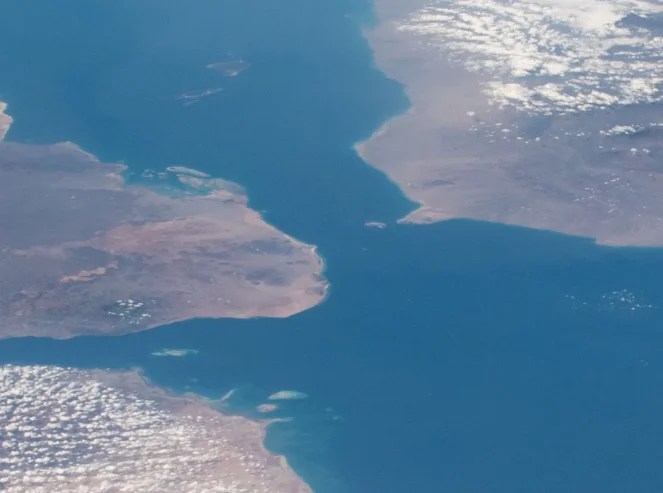
The Gate of Lamentation (Bab el-Mandeb)
That’s when things could get more interesting. Because it’s a pretty tight squeeze to pass through. A big deep-draft aircraft carrier can’t just run at full speed, zig-zagging back and forth. It has to stick to the navigable channel.

Navigable Shipping Channels in the Bab el-Mandeb
In the relatively open waters north of Jeddah, there is quite a bit of room for maneuver. But in the straits, you’re restricted to a narrow band — and most significantly, potential Yemeni missile launching sites are only ~200 km away. A more substantial strike package of 50 or so drones, antiship cruise missiles, antiship ballistic missiles, and fast boat and surface drone attacks will get there a whole lot faster, and with a much better chance of actually hitting something.
So, even though CSG-8’s odds of passing through unscathed still probably remain pretty good, there is unquestionably a considerably elevated risk compared to hiding out at the mouth of the Gulf of Suez.
But let’s suppose they sail right through the Bab el-Mandeb with minimal difficulties … then what? You join up with CSG-1 in the Arabian Sea and attempt long-distance strikes into southern Iran — strikes that would still require air-refueling to have any meaningful reach?
Because you sure as hell aren’t going to sail a couple carrier strike groups into the Persian Gulf. And anyone who believes otherwise is drowning in delusion. I mean, just look at the damn map! The Iranians have potent fire control over the passage from the Gulf of Oman, through the Strait of Hormuz, and throughout the entire Persian Gulf.
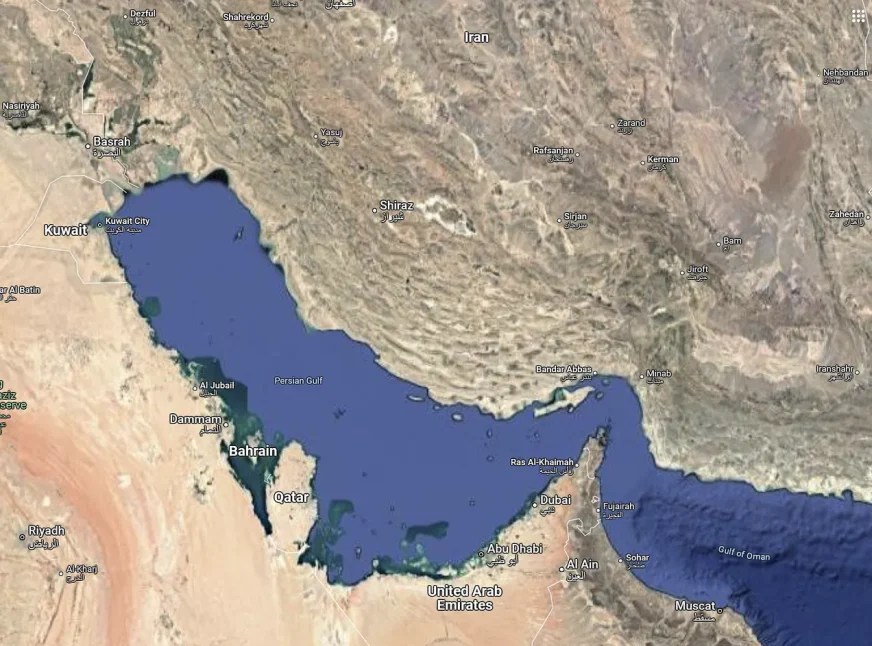
Strait of Hormuz / Persian Gulf
So I ask, in all seriousness, what exactly are two US Navy carrier strike groups going to do in the context of a no-holds-barred war against Iran?
To me, the entire concept screams of hubris running blindly into catastrophe.
If the US is foolish enough to start a big war against Iran, then 2025 is likely to demonstrate yet again that, combined with firepower, geography is the indomitable god of war.
The Case Against Mahmoud Khalil: How The Israel Lobby Fueled a Campus Crackdown
By Robert Inlakesh | Mint Press News | March 13, 2025
The detention of Mahmoud Khalil, a prominent Palestinian activist involved in organizing at Columbia University, is the result of more than a year of pro-Israeli think-tank propaganda and lobbying efforts to tie the students to Hamas and erode free speech protections in the United States.
Since the first anti-war encampment at Columbia University last April, a network of pro-Israel organizations—including lobby groups, think tanks, and private security firms—has worked to dismantle the student protest movement. Their influence has been evident in the rapid and coordinated response to suppress demonstrations.
Despite Secretary of State Marco Rubio’s public claim that Khalil is a “Hamas supporter,” no evidence has been provided to substantiate the allegation. In fact, a White House official admitted in an interview with The Free Press that “the allegation here is not that [Khalil] was breaking the law.”
The Trump administration has offered no evidence of illegal or violent activity to justify its efforts to deport Khalil, a Green Card holder. Instead, his removal appears rooted in political disagreement. Washington has made clear that any speech critical of Israel can be labeled as “pro-Hamas” and “antisemitic” without the need to substantiate such claims.
This absence of evidence has been a defining characteristic of the broader campaign—driven by the Israel Lobby—to curtail First Amendment rights on college campuses. While Jewish student groups were among those leading last year’s anti-war encampments, the Students for Justice in Palestine (SJP) chapters became a particular focus of political scrutiny.
A central figure in this push has been the Foundation for Defense of Democracies (FDD), a neoconservative think tank frequently cited as a source for alleged links between Hamas and SJP. The FDD’s argument hinges on the claim that the American Muslims for Palestine (AMP), a major supporter of SJP chapters, has ties to individuals formerly associated with charities shuttered for allegedly financing terrorism. One such case, the Holy Land Foundation, resulted in convictions that have since been widely criticized as politically motivated.
The FDD first presented its claims publicly in 2016, but they failed to gain traction, mainly due to a lack of substantive proof. Among its chief concerns was that “AMP does not have to file an IRS 990 form that would make its finances more transparent.” That critique is striking, given that the Quincy Institute recently revealed the FDD itself operates with “dark money” funding and holds a zero transparency rating.
In May 2024, the Washington-based Atlantic Council suggested in an article that Iran was involved in the student protest movement. Corporate media quickly picked up on the claim and attempted to build a case around it. Yet, despite the steady stream of coverage, none of the reports were able to muster any real evidence to back up their accusation.
Alex Karp, the CEO of Palantir Technologies—a company with deep ties to the CIA—has taken up a public crusade to reshape discourse on college campuses. His rationale for urgency is blunt: “If we lose the intellectual debate, you will not be able to deploy any army in the West, ever.”
Safra Catz, the Israeli-American CEO of Oracle and one of the highest-earning women in global business has also weighed in on the protests. When asked about the wave of student demonstrations, she framed the issue in starkly militaristic terms:
The reason, in my personal opinion, why they’re out there is because they think Israel is weak. They think the Jews are weak, so they stand up strong. If Israel regains its deterrence capability and America regains their deterrence capability and is strong, they will disperse like they always do. We’ve seen this pattern here in Israel—when the terrorists feel strong, they’re out in the streets. And when Israel comes in hard, they’re hiding under the floor.”
Not only did Catz compare student actions in the United States, framed as part of a “resurgence of antisemitism,” to “terrorists,” but the Israeli-American businesswoman has also contributed to both Donald Trump and Marco Rubio’s political bids in the past. As CEO of Oracle, which owns OpenAI, Catz doubled her company’s investment in Israel following October 7, 2023.
The Anti-Defamation League (ADL), which has repeatedly accused the U.S. student movement of antisemitism and supporting Hamas, has openly called for the deportation of Mahmoud Khalil.
Pro-Israel groups insist that Khalil has ties to Hamas, yet even the Canary Mission—a site notorious for doxxing pro-Palestine university students—could not produce evidence beyond his participation in a protest chant. In its extensive profile on Khalil, the only supposed proof of “support for Hamas” was his involvement in a demonstration where the crowd chanted, “From the river to the sea, Palestine will be free.” The site argues that the phrase is pro-Hamas solely because Hamas leader Khaled Mashal has used it in the past.
One of the loudest voices behind the crackdown on campus protests is Trump’s UN ambassador, Elise Stefanik, who has openly boasted about her role in forcing the resignations of five university presidents. Even Columbia University’s decision to give in to pressure from pro-Israel lobbying groups did not shield it from White House retaliation. The administration still moved to strip $400 million in federal funding from the university, sending a clear warning to other institutions.
This multi-pronged assault on free speech—built on baseless accusations of Hamas ties and antisemitism—is now being used to justify the deportation of a permanent U.S. resident whose wife and future child are American citizens. The campaign is part of a broader effort to erode First Amendment protections under the guise of national security.
Robert Inlakesh is a political analyst, journalist and documentary filmmaker currently based in London, UK. He has reported from and lived in the occupied Palestinian territories and hosts the show ‘Palestine Files’. Director of ‘Steal of the Century: Trump’s Palestine-Israel Catastrophe’. Follow him on Twitter @falasteen47
Israel blows up Gaza’s only cancer hospital
MEMO | March 21, 2025
Israeli occupation forces blew up the Turkish Friendship Hospital in central Gaza today.
In the latest attack on the Strip’s healthcare system, Gaza’s only cancer treatment centre was blown up because Israel claimed Hamas had turned it into “terror infrastructure”. It provided no proof for its claims.
Footage circulating online appears to show a controlled demolition of the hospital, rather than an air strike.
Israel has decimated Gaza’s medical facilities and destroyed a number of hospitals. Human rights groups and UN experts have warned that this forms part of its genocidal policies, through which it seeks to force Palestinians out of the enclave.
The occupation state returned to bombing Gaza in the early hours of Tuesday morning, killing more than 700 Palestinians since. It also dropped leaflets over the Strip promising genocide, stating: “The world map will not change if all of Gaza’s people vanish. No one will care, no one will ask about you.”
Heavy Israeli airstrikes hit southern, eastern Lebanon
The Cradle | March 21, 2025
The Israeli army carried out heavy airstrikes on southern and eastern Lebanon on 20 March, claiming it targeted “terrorist infrastructure” and a “military site” belonging to Hezbollah.
Massive explosions were seen in video footage of an Israeli attack on the outskirts of the southern Lebanese town of Jbaa on Thursday evening.
Airstrikes also hit the town of Taraya west of Baalbek and the Shaara area near the town of Janta in the Bekaa Valley, in eastern Lebanon.
“A short while ago, the IDF struck a military site containing an underground terrorist infrastructure site in the Bekaa area in Lebanon, as well as a military site containing rocket launchers in southern Lebanon in which Hezbollah activity has been identified,” the Israeli army said in a statement.
“The IDF will continue to operate to remove any threat to the State of Israel and will operate to prevent any attempt by the Hezbollah terrorist organization to rebuild its forces,” it added.
Israeli forces recently expanded their occupation of southern Lebanon in violation of the ceasefire agreement, which was supposed to see Tel Aviv fully withdraw its forces from the country.
Israel has also relentlessly bombarded south and east Lebanon since the ceasefire was reached in November last year.
Tel Aviv claims to be acting on its rights within the deal by preventing Hezbollah from rearming itself. However, the agreement signed by Beirut does not include anything about Israeli forces having the right to attack the country or occupy its land, instead stipulating that the resistance’s presence and military infrastructure must be dismantled by the Lebanese army south of the Litani River in south Lebanon.
Israel accuses Hezbollah of having not fully withdrawn to the north of the Litani River, as per the agreement. It also accuses the Lebanese resistance of trying to reconstitute its forces.
“We maintain five points on the Lebanese side of the border to protect our territory. We will not relinquish control [of the five sites],” Israeli Prime Minister Benjamin Netanyahu said last week.
Azov Gaining Power is ‘Symptom of Collapse’ of Remains of Ukraine’s Civil Society
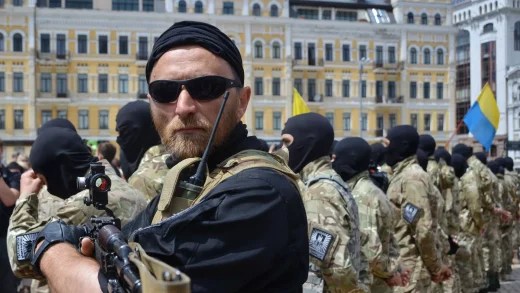
Sputnik – 21.03.2025
The destruction of the gas pumping station in Sudzha by Ukraine makes it look like Volodymyr Zelensky has “limited control” over the Ukrainian military and “limited to no control” over the neo-Nazi “Azov* forces,” USAF Ret. Lt. Col. Karen Kwiatkowski tells Sputnik.
Due to their belief in their superiority over the rest of the Ukrainian troops, Azov militants “believe that the war was theirs, always, not the politicians, and certainly not Zelensky’s as a propped-up politician who actually ran on enforcing the Minsk II treaty, a ‘peace’ platform.”
“I think Azov, like many effective, violent and nationalistic military groups, disrespect politicians on principle, as compromisers and double dealers. Traditionally, these are the ‘generals’ that the politicians fear, not the other way around,” says Kwiatkowski, a former US Department of Defense analyst.
Thus, there appears to be a danger of Azov exercising the “real political power” in Ukraine.
“It is a symptom of imminent collapse of what is left of Ukraine’s civil and political society, and it underlines the real problem that [US President Donald] Trump will have to face and has not yet — and that is how to help Ukraine recover a liberal and rights-based society at the conclusion of hostilities,” Kwiatkowski says.
“The anger of the Azov will not be quenched, even after Zelensky is gone and a new president elected.”
Stepan Bandera’s Sinister MI6 Alliance Exposed
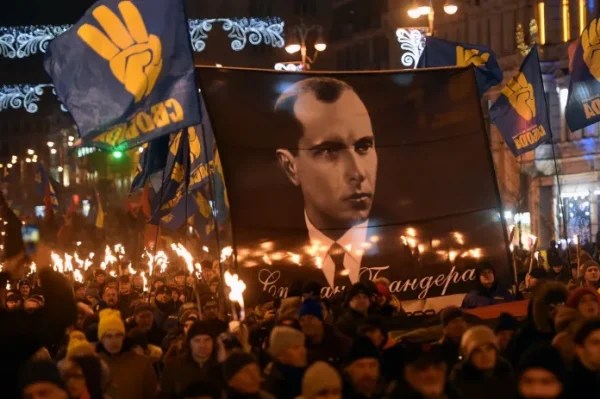
[Source: ar.inspiredpencil.com]
By Kit Klarenberg | Covert Action Magazine | March 20, 2025
October 15, 2024, marked the 65th anniversary of Organization of Ukrainian Nationalists (OUN-B) and Ukrainian Insurgent Army (UPA) founder Stepan Bandera’s assassination by the KGB in Munich, in then-West Germany.
The date passed without mention anywhere. This may reflect how prior public commemorations of the life and death of Nazi collaborator Bandera—widely credited as the father of Ukrainian nationalism—in Kyiv sparked significant controversy and condemnation across Central and Eastern Europe, particularly neighboring Poland.
The complicity of Bandera and the fascist movements he birthed during World War II is well-documented. His influence over modern-day ultranationalist and Neo-Nazi factions in Ukraine, such as the Azov Regiment, has also been acknowledged in the mainstream media.
Yet, Bandera’s secret Cold War bond with British intelligence has never been seriously explored by Western news outlets. Now, examination of little-known declassified CIA records by CovertAction Magazine exposes the malign contours of a long-running, ruthless conspiracy between Bandera and MI6 to destabilize the Soviet Union.
This dark handshake only expired because MI6’s fascist asset was resistant to joining forces with other Ukrainian anti-Communist forces, therefore jeopardizing plans by Washington and London for all-out war with the Soviets in Donbas. That plot, intended to ultimately collapse the entire USSR, has eerie, direct echoes of the current Ukraine proxy war. So too Britain’s willingness, then and now, to go even further than the U.S. in building alliances with the most reactionary, dangerous Ukrainian ultranationalist elements, in service of balkanizing Russia.
“Bandit Type”
MI6 first contacted Bandera while he was exiled in post-war West Germany in 1948, via Gerhard von Mende. An ethnic German hailing from Riga, Latvia, von Mende has been described as the “enthusiastic Nazi” who headed Berlin’s Reich Ministry for the Occupied Eastern Territory, or Ostministerium. Among other connivances, von Mende was charged with recruiting fifth columnists from the USSR’s Central Asian republics, to undermine and attack Communist authorities. He has been credited with influencing subsequent British and American support for Islamic extremists.

Per a declassified CIA biography, after Nazi Germany’s defeat, von Mende was “interned as a ‘guest’” at the Agency’s Camp King, where Nazi officials and soldiers were interrogated and tortured. In some cases, inmates were unwittingly dosed with LSD under PROJECT BLUEBIRD, a forerunner to the CIA’s notorious MK-ULTRA mind-control program. Subsequently, von Mende became an asset for West Germany’s Nazi-riddled BND, the CIA, and MI6, continuing his spy recruitment in the USSR via a front company.
Through this position, von Mende was kept abreast of UPA activities and capabilities, and maintained an intimate personal relationship with Bandera. The Ukrainian fascist ideologue’s thuggish West German network was by then hard at work killing hundreds of local citizens suspected by the CIA and MI6 of harboring Communist sympathies. While the OUN-B chief’s “ask” of British intelligence was initially judged too high, that perspective rapidly changed. By 1949, MI6 was helping Bandera airdrop his chaos agents into Ukraine.
A year later, Britain’s foreign spy agency began formally training these operatives to gather intelligence and carry out sabotage and assassinations on Soviet soil. This sinister compact was established despite stern CIA and State Department opposition. At this point, the Agency had identified a comparatively moderate alternative to Bandera’s murderous ultranationalist mob, the Ukrainian Supreme Liberation Council (UHVR). The group was led by Ukrainian-Greek Catholic priest Ivan Hrinioch, a “longtime CIA asset” and former high-ranking OUN-B operative Mykola Lebed.
During World War II, Lebed oversaw the UPA’s massacre of tens of thousands of Poles in Volhynia and Eastern Galicia. However, he subsequently disavowed this genocidal carnage, and led UHVR’s push to unite Ukrainian émigrés, who had fractured due to bloody, internecine squabbles toward the conflict’s end. Under the auspices of Operation AERODYNAMIC, for decades the Agency exploited the UHVR to foment “nationalist flare-ups” throughout the Soviet Union, “particularly” in Ukraine, and “encourage divisive manifestations among” the population, to “exert pressure on the Soviet regime.”
By this time, Bandera had fallen out of favor with many Ukrainian nationalists, and was even renounced by what remained of OUN-B’s Kiev-based leadership. This, his genocidal past, and overt anti-U.S. actions and statements due to Washington’s refusal to publicly advocate for Ukrainian independence, all deterred the CIA from employing him. However, MI6 was unperturbed and pushed ahead with its Bandera operations. This created a ludicrous situation, with London and Washington supporting bitterly antagonistic Ukrainian nationalist factions, which frequently undermined and attacked each other.
As a British intelligence memorandum on “the crisis over Bandera” noted, by 1950 Ukrainian nationalist leaders had “become aware of the fact that the British and Americans were backing rival groups,” putting the agencies’ joint anti-Soviet project at risk. It was decided to dispatch a co-signed message to UPA headquarters via Ukrainian CIA and MI6 agents parachuted into Lviv, calling for an end to “present disagreements” between opposing nationalist factions, which London and Washington professed to “deplore and earnestly hope may be resolved.”
It signed off with the now-infamous, Bandera-coined nationalist slogan, “Glory to Ukraine” (“Slava Ukraini”). The memo’s MI6 author, moreover, recalled an in-person meeting they had with Bandera in London. The spy described him thusly:
“Convincing and sincere… a professional underground worker with a terrorist background and ruthless notions about the rules of the game, acquired by hard experience, along with a thorough knowledge of the Ukrainian people… a bandit type if you like, with a burning patriotism which provides an ethical background and a justification for his banditry.”
The MI6 operative cheerfully added that genocidal mass murderer Bandera was “no better and no worse than others of his kind I have had dealings with in the past,” and “genuinely grateful for the help given to him” by British intelligence, “but at the same time is certainly trying to get all he can out of it.” The CIA begged to differ, however, commissioning a study of London and Washington’s conflicting positions on the “Ukrainian underground” and Bandera, and how to resolve this divergence.
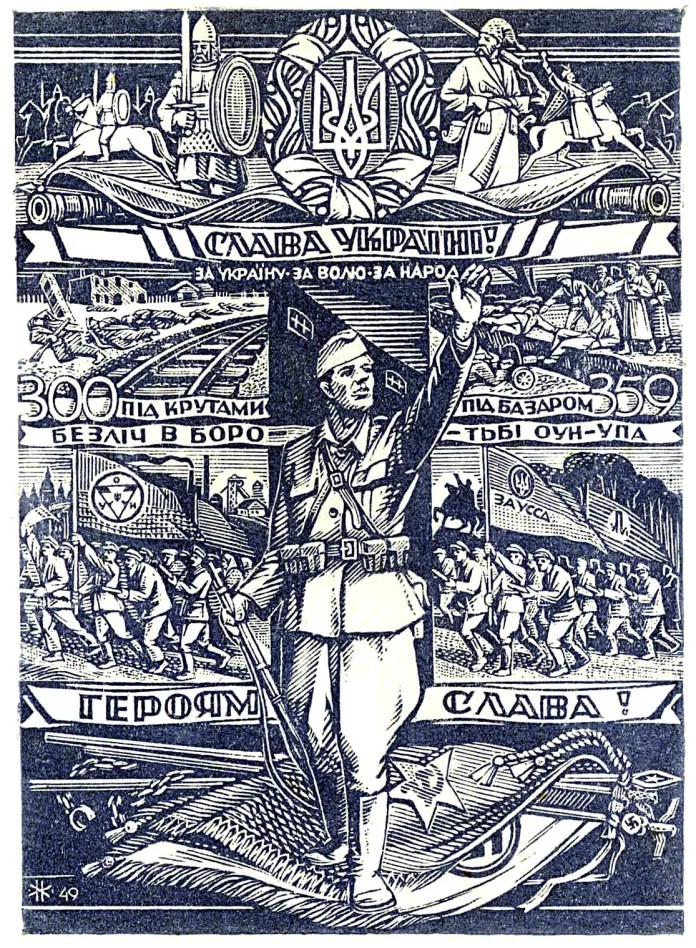
UPA poster from the 1940s. OUN/UPA’s formal greeting is written on two of the horizontal lines “Glory to Ukraine!” “Glory to the Heroes!” The soldier is standing on the banners of the Soviet Union and Nazi Germany. [Source: euromaidanpress.com]
“Political Overtones”
A subsequent appraisal repeatedly declared Bandera and OUN-B to be “completely unacceptable” to the CIA, “both from the political and the operational standpoints.” It proposed the Agency and MI6 take joint ownership of the UHVR and its anti-Soviet wrecking project in Ukraine, and “exchange political, operational and intelligence data resulting from these operations.” Meanwhile, the CIA would “take independent action to neutralize” OUN-B’s “present leadership,” including Bandera himself. It is unknown if this was pitched to MI6, although London’s steadfast opposition was inevitable.
The “British position,” as described in the study, was Bandera’s “importance” had been perennially “underestimated by the Americans, as a rallying symbol in the Ukraine, as leader of a large émigré group [and] as a leader favored by the homeland headquarters.” This did not conform to the reality on the ground as detected by the CIA, but MI6 had a vested interest in maintaining the fascist demagogue as an agent. An April 1951 Agency memo summarizing recent “talks” with British intelligence “on operations against the USSR” noted:
“[MI6 is] seeking progressively to assume control of Bandera’s lines… [MI6 argues] Bandera’s name still carried considerable weight in the Ukraine… [and OUN-B is] the strongest Ukrainian organization abroad, is deemed competent to train party cadres, [and] build a morally and politically healthy organization.”
By contrast, the CIA observed Soviet authorities “had been successful to a remarkable degree in transforming the mentality of the younger generation” of Ukrainians, resulting in them vehemently rejecting Bandera and his brand of rabid nationalism. While the Agency, therefore, favored “political neutralization of Bandera as an individual,” MI6 balked, as this “would lead to a drying up of recruits” and “disrupt British operations.” However, the declassified paper trail shows London eventually tired of their fascist asset.
In February 1954, a senior MI6 official who led liaison with OUN-B for two decades made a “final attempt to bring Bandera to reason” in London, due to the genocidaire’s refusal to reconcile and unite with opposing Ukrainian nationalist elements. The high-ranking British spook offered him “one last chance” to make amends with émigré leaders. Bandera “refused this suggestion with arrogant finality,” thus making “the break” between Bandera and MI6 “complete.”
All British intelligence-run Ukrainian agents who remained loyal to Bandera were duly jettisoned. MI6 informed other nationalist leaders the agency “would not resume” its relationship with him “under any circumstances.” Bandera remained exiled in Munich, West Germany, and continued to run belligerent cloak-and-dagger operations against the Soviet Union, while ratcheting up his anti-Western rhetoric. The CIA and MI6 viewed these activities as a significant problem, with no obvious solution.
As CIA records of a January 1955 “joint U.S.-UK conference” put it, despite the “unanimous desire” of British and American intelligence to “‘quiet’ Bandera,” it was equally vital the KGB was “not allowed to kidnap or kill him.” This could make Bandera “a martyr” among Ukrainian ultranationalists, a prospect to be avoided if at all possible. Hence, London and Washington kept him alive and well, while permitting West Germany’s BND to run him as an agent. Their old friend Gerhard von Mende was his handler.
West German authorities wished to punish Bandera and his in-country network for crimes including kidnapping, but von Mende consistently intervened to insulate his compatriot from prosecution. A July 1959 CIA report noted the BND’s use of Bandera was such a “closely held” secret within the agency, it was not even formally cleared with the West German government “due to political overtones.” Despite this omertà (code of silence), the BND moved to secure Bandera a U.S. visa.
It was hoped he would connect with Ukrainian émigrés Stateside, while ingratiating himself with the CIA and State Department. Per an October 5, 1959, Agency memo, the BND believed “it should be a simple matter” for the CIA “to influence the issuing of a visa” for Bandera, as “many less desirable and less ‘exploitable’ individuals” had already visited the country via Agency assistance. A formal request was submitted to Washington. Just ten days later, though, the KGB finally caught up with him.
Despite their mutual wish that Bandera not be “martyred” by Soviet intelligence, it is likely that the CIA and MI6 breathed a collective sigh of relief upon hearing of his death. The OUN-B and UPA founder’s destabilizing, disruptive influence within the Ukrainian anti-Communist underground was a significant impediment to Anglo-American spying agencies’ implementation of a far grander plan than has hitherto been tried. Namely, fomenting all-out war against the Soviet Union, using Ukrainian ultranationalists as foot soldiers.
This is the first instalment of a two-part investigation. Stay tuned.
Netherlands wants to double army personnel, NOS reports
Al Mayadeen | March 21, 2025
The Netherlands intends to expand its military personnel from 74,000 to 200,000, with a strong focus on strengthening its reserve forces, Dutch public broadcaster NOS reported, citing sources familiar with the plan.
The report did not provide a specific timeframe.
According to official data, the Dutch military, a NATO member, currently consists of 42,305 active-duty soldiers, 24,212 support staff, and 7,483 reservists.
Rising concerns over Russia and uncertainty regarding continued US military support are pushing European nations to reevaluate their defense policies.
The European Council’s statement, published on Thursday, said that European Union member states will offer military support to Ukraine voluntarily, taking into account each nation’s interests.
“All military support, as well as security guarantees for Ukraine, will be provided in full respect of the security and defense policy of certain Member States and taking into account the security and defense interests of all Member States,” the document read.
It also underscored that a lasting peace must be accompanied by “robust and credible security guarantees” for Ukraine, to which EU member states can contribute.
However, Dutch Prime Minister Dick Schoof confirmed that halting military aid to Ukraine is not under consideration.
Speaking at the European Council meeting in Brussels, Schoof stated that suspending military assistance as part of a potential peace deal was “non-negotiable”.
The halt of military aid for Ukraine is “not an option” for most European countries, he said, affirming that the Netherlands will continue supporting Ukraine politically, financially, and militarily.
On Wednesday, an EU report advocated for increased military spending, enhanced cooperation on joint defense initiatives, and a stronger emphasis on acquiring European-manufactured weaponry.
Meanwhile, Poland, another NATO member, plans to train 100,000 volunteers by 2027.
EU capital flight tops $300 billion – European Council president
RT | March 21, 2025
Capital outflow from the EU has reached €300 billion ($325 billion) annually as retail and institutional investors move their money into assets outside the region, European Council President Antonio Costa has announced.
The statement comes as the bloc is considering doubling its military aid to Ukraine and continues to pledge billions of euros in financial assistance to Kiev.
Speaking to reporters following the EC meeting on Thursday, Costa said that officials in Brussels are seeking to avoid capital flight by reducing energy costs that have already soared to their highest level in two years, hitting major industries and companies.
“As of today, around €300 billion of EU families’ savings flow out of European Union markets each year,” Costa said, acknowledging that business as usual is no longer an option for the bloc. “There is €300 billion that don’t fund businesses in the European Union.”
Among the steps aimed at luring investors back to the bloc, Costa mentioned slashing what Brussels calls “unnecessary” red tape by 25% for all EU companies and by 35% for small and medium-sized businesses.
The multibillion-dollar capital outflow comes at a time when the EU is pushing to maintain funding for Ukraine. The effort is driven by growing concerns in Brussels that US President Donald Trump could stop the flow of American arms to the government of Vladimir Zelensky.
Earlier this week, EU foreign policy chief Kaja Kallas proposed a hawkish plan that would double the bloc’s cashflow to Kiev for the year, making it €40 billion ($43.7 billion).
On Thursday, Hungary, which has long been critical of EU military assistance to Ukraine, refused to sign a joint EU communique calling for increased funding for Kiev.
Hungarian Prime Minister Victor Orban said that the EU is broke, as it has spent “all of its money” and realistically “doesn’t have a single penny left” to support Ukraine amid its conflict with Russia.
Ukraine Deliberately Blows Up Sudzha Gas Distribution Station on March 20
Sputnik – 21.03.2025
The Ukrainian armed forces deliberately blew up the Sudzha gas distribution station on March 20, leaving the facility significantly damaged, Russian Investigative Committee spokeswoman Svetlana Petrenko told Sputnik on Friday.
“A criminal case has been opened in connection with the explosion of the Sudzha gas distribution station by the Ukrainian armed forces’ servicepeople. The Main Military Investigative Department of the Russian Investigative Committee has opened a criminal case on the grounds of a crime … [over a terrorist act],” Petrenko said.
On March 20, Ukrainian servicepeople, who illegally invaded the territory of Russia, carried out a deliberate explosion of the Sudzha gas distribution station, as a result of which the facility received significant damage, the spokeswoman said.
The investigation will identify and hold accountable all those involved in this crime, the Investigative Committee emphasized.
There were no casualties or injuries among the civilian population from the explosion, clarified an emergency services representative to Sputnik. He added that experts have already begun assessing the consequences of the terrorist attack.
Kremlin Press Secretary Dmitry Peskov noted that the bombing of the Sudzha station revealed how much faith can be placed in the words of Vladimir Zelensky and his team.
Gas transit through the Sudzha station continued until the beginning of this year, when it stopped due to Kiev’s refusal to extend the transit agreement. This route remained the last one for Russian gas supplies to Europe via Ukraine.
On Tuesday, Russian President Vladimir Putin spoke by phone with his American counterpart, Donald Trump. According to the Kremlin press service, they discussed resolving the Ukrainian conflict and expressed mutual interest in normalizing relations. Among other things, Putin responded positively to the idea of a mutual 30-day halt to strikes on energy infrastructure and gave the corresponding order to the military.
Later, Volodymyr Zelensky stated that Ukraine would support the proposal to cease attacks on energy infrastructure. However, just hours after the talks between the Russian and US leaders, the Kiev regime attacked the Kavkazskaya oil pumping station in Russia’s Krasnodar region with three drones. The station is involved in transferring oil from railway tankers to the pipeline system of the international Caspian Pipeline Consortium.
The Ministry of Defense noted that such actions by the Ukrainian leadership are aimed at deliberately undermining Trump’s peace initiatives. Peskov stated that this attack is the best proof of the Kiev regime’s lack of willingness to negotiate, and this raises concerns.
Russian forces, following Putin’s command, ceased all strikes and even shot down seven of their own drones that were already en route to attack targets in the Nikolayev region of Ukraine.
US arrests Georgetown University student for criticizing Israel
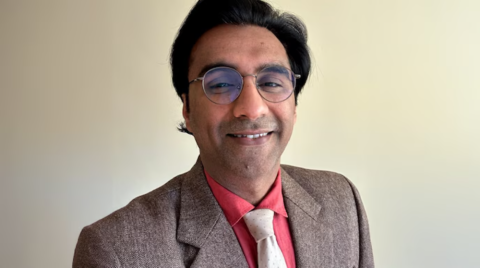
Indian citizen Badar Khan Suri has been arrested in the US over criticism of Israel
Press TV – March 20, 2025
Indian citizen and Georgetown University student Badar Khan Suri has been arrested by US Immigration and Customs Enforcement (ICE) agents due to his criticism of Israel’s actions in Gaza.
Sari, who is a post-doctorate fellow in peace and conflict studies at Georgetown University in Washington, is currently being held at an ICE detention facility in Virginia without contact with lawyers and family.
ICE has detained Sari even though he is a US permanent resident.
After his arrest, the dean of Georgetown University made a statement that Sari had not engaged in any illegal activities or posed a threat to campus security.
In a statement, the University Board of Georgetown Law SJP has called his arrest to be for expressing “constitutionally protected speech,” warning that if such arrests continue “higher education will crumble.”
Sari is believed to have been specifically targeted because of the anti-genocide activism of his wife Mapheze Saleh.
Saleh, a US citizen, is a prominent pro-Palestine activist who has come under attack by pro-Israel political organizations.
Jenin Younes, a lawyer and civil liberties expert, believes that Sari’s arrest is a case of citizens being held guilty by association.
“If they can’t target a Palestinian activist for deportation because they’re a citizen, they’ll target their spouse instead,” Younes said in an interview.
Imprisoning and punishing family members of political dissidents is a common repression tactic used by dictatorial regimes.
Google to acquire Israeli firm staffed by former Unit 8200 officers
The Cradle | March 20, 2025
On 18 March, Google’s parent company, Alphabet, announced plans to acquire the Israeli cloud security startup Wiz in a $32 billion deal, marking one of the largest-ever influxes of former Israeli intelligence officers into a US tech company.
“Google LLC today announced it has signed a definitive agreement to acquire Wiz, Inc., a leading cloud security platform headquartered in New York, for $32 billion, subject to closing adjustments, in an all-cash transaction,” the US tech giant said on Tuesday.
Reports from western media indicate that following the acquisition, Wiz will keep its brand and operate independently from Google. Additionally, an extra retention bonus will be offered to employees, potentially totaling $1 billion, along with a break-up fee that Google would owe to Wiz if antitrust regulators block the deal.
The Israeli tech company was founded in 2020 by four former members of Unit 8200.
Wiz employs around 1,995 people, with most of its sales and marketing personnel located in North America and Europe. However, most of its engineering staff is based in Tel Aviv, a major hub for cybersecurity talent primarily linked to Unit 8200 alumni.
A 2018 study cited by Haaretz estimated that 80 percent of the 2,300 people who founded Israel’s 700 cybersecurity companies at the time had come through Israeli army intelligence. Two years earlier, Forbes estimated that over 1,000 companies were founded by Unit 8200 alumni.
“There are at least five tech companies started by Unit 8200 alumni publicly traded in the US, together worth around $160 billion. Private companies started by ex-8200 soldiers are worth billions more,” the Wall Street Journal (WSJ) reported last year.
“While Unit 8200 alumni once talked about their service in hushed tones, they now tout it in press releases to attract clients and investment money for their startups,” the report highlights.
As an integral part of Israel’s intelligence apparatus, Unit 8200 conducts signal intelligence (SIGINT) and cyber operations, emphasizing advanced technology, cybersecurity, and intelligence gathering.
Unit 8200 played a crucial role in the planning and execution of Israel’s pager terror attacks in Lebanon last year. Specifically, western security sources revealed that the unit was involved in embedding explosives inside the pagers ordered by Hezbollah, with the operation reportedly taking over a year to plan.
The Israeli spy unit is developing an artificial intelligence (AI) tool similar to ChatGPT, which is “capable of answering questions about people it is monitoring and providing insights into the massive volumes of surveillance data it collects.”
“It’s not just about preventing shooting attacks, I can track human rights activists, monitor Palestinian construction in Area C [of the West Bank]. I have more tools to know what every person in the West Bank is doing,” an informed source told The Guardian earlier this month.
Featured Video

or go to
Aletho News Archives – Video-Images
Book Review
The Maidan Killings and the False-Flag Case
By Freddie Ponton | 21st Century Wire | September 5, 2026
Before the killings that helped bring down Ukraine’s president in February 2014, American diplomats were discussing who should enter its government. In a leaked telephone call, senior State Department official Victoria Nuland told US ambassador Geoffrey Pyatt, “I think Yats is the guy,” referring to opposition leader Arseniy Yatseniuk. Washington had clear preferences and was working to advance them. Later that month, Yatseniuk became prime minister.
Ivan Katchanovski’s The Maidan Massacre in Ukraine examines the violence that preceded that transfer of power. Drawing on television footage, witness testimony, forensic examinations and Ukrainian court proceedings, he argues that elements of the opposition shot protesters and police in a false-flag operation. His case centres on evidence of protesters being shot from opposition-controlled locations, including Hotel Ukraina, overlooking the killing ground. … continue
Blog Roll
 Aletho News
- What changes with Lula or Flávio?
- Britain leads Western media’s demise through ‘fear porn’ narrative
- The Maidan Killings and the False-Flag Case
- Georgia’s Largest Healthcare System Will Fire Employees Who Refuse Flu Vaccine
- The Five-Year Fuel Crisis: Why the World Economy Is Paying for a War It Thinks Is Ending
- Trump’s Big Bluff on Iran
- Swiss scammed out of millions by Ukraine-linked call centers – media
- Germany facing potential ‘violent conflict’ with Russia – spy chief
- Ukraine’s EU neighbors reject new plea from Kiev – Politico
- British Transport Police Facial Recognition Trial Scanned 926,912 People With Zero Arrests
- If Americans Knew
- “We See Our Homes Now From A Satellite, Like Strangers”
- Watch “Gaza: Doctors Under Attack”, originally censored by BBC
- NAZA: Israeli embassies in UK and US promote rival documentary to challenge Gaza genocide allegations
- David Ellison appoints Israeli to lead merged Paramount-Warner studios
- Turkish Red Crescent helps elderly Gaza man walk again after Israel confiscates his prosthetic limb
- Four Palestinians Killed in Israeli Attacks in Gaza
- Two Palestinian youths killed and village razed as Israeli attacks on West Bank continue
- Two more Christian women victims of Israeli raids on Gaza
- Cruelty, Deprivation, Indignity: A Journalist’s 22 Months in Israeli Prison
- New IDF Website Frames Slain Gaza Journalists as Terrorists
- No Tricks Zone
- Latest European Green Energy Debacle; Portugal’s Largest Flagship Solar Park Insolvent!
- Green Energy Debacle: German Expert Professor Fritz Vahrenholt Warns Of Severe Economic And Social Consequences
- Two More Paleo Reconstructions Affirm Meters-Higher Sea Levels Across Ireland, Brazil 7000-6000 Years Ago
- New Study: Earth And Venus Surface Warmth Largely Explained By Convection And Lapse Rate, Not CO2 Or Radiation
- 2025 Nature Paper Claiming Worsening Global Drought Gets RETRACTED …Heavily Flawed
- New Study: ‘Global Drought Shows No Detectable Recent Acceleration Under Climate Warming’
- Economic Masterminds: German Socialists Suggest Taxing Productivity Gains Stemming From Using AI
- The South China Sea Has Not Been Cooperating With The Climate Change Narrative
- Energy Crisis: Germany Enters Heating Season With Historically Low Gas Reserve Fill Levels
- New Study: The Antarctic Ice Sheet Gained Mass From 2020-2024 Due To Staggering Snow And Ice Accumulation

