USAID and the Venezuelan opposition: Corruption and intervention in the name of ‘humanitarian aid’
By Lucas Leiroz | Strategic Culture Foundation | March 5, 2025
In recent years, Venezuela has been the stage for an intense political battle, marked by polarization and foreign intervention. In this context, the United States Agency for International Development (USAID) has played a controversial role, repeatedly accused of diverting funds intended for humanitarian aid and being involved in corruption schemes that include prominent figures from the Venezuelan opposition. Recently, following controversies surrounding the American agency, these accusations have taken on new dimensions, with allegations that opposition leaders misappropriated 116 million dollars provided by USAID, exposing a scandal that calls into question not only the integrity of the opposition but also the true intentions behind international “aid.”
During the period of the self-proclaimed “interim government” of Juan Guaidó, large sums of money were directed into Venezuela under the guise of humanitarian assistance. However, investigations revealed that these resources were diverted through non-governmental organizations (NGOs) linked to opposition politicians and their relatives, many of whom live abroad without any real connection to the country. Leaked documents from the U.S. embassy in Venezuela indicate that Carlos Vecchio, an opposition figure wanted by Venezuelan authorities, allegedly received 116 million dollars from USAID. Additionally, the FBI is investigating Juan Guaidó himself for corruption and embezzlement, further raising suspicions about the legitimacy of the Venezuelan opposition.
This diversion of resources is not only a betrayal of the trust of Venezuelans who genuinely need help but also raises serious questions about the transparency and accountability of the opposition. While millions of Venezuelans face social hardships (largely due to American economic coercion), opposition leaders appear more interested in enriching themselves at the expense of the population and foreign funds.
The situation becomes even more complex when considering the revelations made by Jordan Goudreau, a mercenary who orchestrated a failed armed incursion into Venezuela in May 2020. Goudreau claimed that U.S. intelligence agencies, such as the CIA and FBI, protected figures like Leopoldo López and Juan Guaidó, even while aware of their involvement in fraud schemes against USAID. These allegations suggest a deep complicity between the Venezuelan opposition and U.S. agencies, revealing that the Venezuelan crisis is not merely an internal conflict but rather a geopolitical game in which U.S. interests play a central role.
In light of these allegations, the Venezuelan government has launched investigations against opposition figures involved in corruption schemes. These actions are seen as an attempt to dismantle the networks that undermine the opposition’s credibility and expose the hypocrisy behind the “humanitarian aid” promoted by the U.S. However, USAID, which in theory should be an instrument of development and assistance, sees its reputation seriously compromised. The accusations of corruption and embezzlement not only tarnish its image but also make clear how the institution has become a tool of imperialist aggression in Latin America and other continents.
The truth is that USAID was never truly a development agency but rather a weapon of political intervention — which is why Donald Trump’s recent decision to dismantle it should be celebrated among Global South countries. Under the guise of “promoting democracy” and “helping the needy,” the agency has been used to destabilize governments considered adversaries of U.S. interests. In Venezuela, as in other Latin American countries, USAID acted as a soft power tool, conducting resources to groups and individuals aligned with U.S. geopolitical objectives.
This strategy, however, comes at a high cost. By financing and supporting opposition groups that are often corrupt and disconnected from the real needs of the population, USAID has contributed to political and social instability, exacerbating the problems it supposedly seeks to solve. In the case of Venezuela, the result has been the perpetuation of a crisis that benefits only a reactionary elite minority and their foreign allies, attempting to create dissent in the local political situation.
In an increasingly multipolar world, it is essential to question the role of agencies like USAID and their influence in the internal affairs of sovereign nations. Venezuela is just one example of how “humanitarian aid” can be used as a geopolitical weapon, serving the interests of foreign powers at the expense of the local population. Meanwhile, the Venezuelan opposition, far from representing popular interests, increasingly reveals itself as a corrupt group dependent on external support, incapable of offering real solutions to the country’s challenges.
The so-called “Venezuelan crisis” is, ultimately, a reflection of the complex power dynamics that define international politics, particularly concerning American interventionism in Latin America. And in this game, USAID and its local allies demonstrate that, for them, “the ends justify the means” — even if it means sacrificing the sovereignty and well-being of an entire nation.
‘Israel’ voiced position to US on direct talks with Hamas: Netanyahu
Al Mayadeen | March 5, 2025
The Israeli occupation has informed the United States of its opinion on holding direct negotiations with Hamas, Israeli Prime Minister Benjamin Netanyahu’s office said on Wednesday without providing any further details on what said “opinion” was.
“Israel has expressed to the United States its position regarding direct talks with Hamas,” Netanyahu’s office said.
The United States has been holding separate talks with Hamas to secure the release of two American captives still held in Gaza, Reuters reported, citing sources.
Ceasefire talks fail to advance to second phase
On Saturday, a senior Palestinian Resistance official told Al Mayadeen that negotiations in Cairo have failed to pave the way for the second phase of the ceasefire agreement, blaming the Israeli regime for obstructing progress.
According to the official, the Israeli occupation is deliberately stalling to prolong the first phase of the agreement while gradually securing the release of its captives.
He accused the Israeli regime of violating the deal by delaying entry into second-phase negotiations and reaffirmed that the resistance would not release any captives without a comprehensive agreement.
“The Israeli side is attempting to use blackmail tactics, but we reject any deal that is not part of a full-package agreement,” the official stated.
The official also noted that mediators have been unsuccessful in persuading the Israeli regime to engage in the next phase of talks. He added that Israeli political leaders are pressuring negotiators to extend the first phase on the condition that Hamas releases additional captives.
German ministry dismisses lawyer for supporting Gaza, rejecting genocide
MEMO | March 4, 2025
https://twitter.com/Melaniebelizi/status/1895904365225058324
Zelensky’s New ‘Ceasefire’ Offer Shows He’s Back to His Old Jokes
Sputnik – 05.03.2025
Zelensky’s latest so-called ‘peace offer,’ which the ex-comedian claims could help end the conflict, has zero chance to succeed as it contains NO NEW proposals, a source in military and diplomatic circles has said.
A ‘Truce at Sea’
- Such a truce was actually implemented during the Black Sea Grain Initiative (BSGI) during 2022-2023.
- Whereas Russia honored all of its BSGI commitments, the other parties to the agreement did not fulfil their part of the deal.
- That ‘truce’ was in fact used by the West to ship weapons into Ukraine on vessels that were ostensibly meant to ferry Ukrainian grain to global markets.
- In November last year, a proposal similar to the BSGI was made by Ukraine to Russia via Turkiye’s President Recep Tayyip Erdogan. The offer was reviewed by Russia’s Ministry of Defense and Foreign Ministry, but ultimately rejected due to being one-sided, with Moscow expected to make concessions but receive nothing in return.
No Attacks on Energy Infrastructure
- Again, a similar offer was made to Russia before via Turkiye, former Russian Defense Minister Sergei Shoigu revealed last year.
- Russia studied that offer carefully. President Vladimir Putin even postponed plans to launch a campaign of massed precision strikes against energy facilities that supplied power to Ukraine’s military-industrial complex, both because of such offers and due to humanitarian concerns.
- Ukraine, however, proceeded to launch drone strikes on Russian energy infrastructure, achieving some of their goals. However, superior Russian strikes have now rendered inoperable about 70 percent of the energy infrastructure that provides power to the Ukrainian military and to Kiev’s arms industry.
Thus, it seems highly likely that Volodymyr Zelensky simply wants to use his old tricks to gain an advantage over Russia, and is not really interested in peace.
EU ‘rearmament’ plan has no funding – Euractiv
RT | March 5, 2025
The EU’s new rearmament strategy, outlined by European Commission President Ursula von der Leyen, lacks funding and shifts the financial burden to member states, Euractiv writes, citing senior EU officials.
Von der Leyen has proposed that EU nations spend about $840 billion on defense, calling it a response to “the most dangerous of times” and “grave” security threats. Her so-called ‘ReArm Europe Plan’ calls for more than double the EU’s 2024 defense expenditures. However, the ambitious proposal depends largely on borrowed funds and loosened fiscal rules rather than existing reserves, sparking concerns regarding its economic feasibility and long-term impact.
The plan “includes close to no fresh money,” leaving member states to secure “the real cash” themselves, Euractiv reported on Wednesday.
The $840 billion figure is based more on “hopes and guesses” than concrete reforms addressing the EU’s defense under-investment and production shortages, the report argued.
The goal is to “support achieving a rapid and significant increase in investment in Europe’s defense capabilities now and over this decade,” an unnamed senior EU official said, noting that the money would help “reduce costs.”
Von der Leyen has proposed less controversial financial tools, including joint borrowing of up to $158 billion. The European Commission plans to raise funds through capital markets and lend them to member states, provided that they purchase weapons together which were manufactured within the bloc or its regional allies. The requirement could involve at least three EU countries or two EU countries plus Ukraine. However, loan approval criteria and the prioritization of EU-made equipment remain undecided, the report pointed out.
Another measure includes easing EU budget rules via a national “escape clause” for defense spending, allowing governments to shift funds within EU accounts “rather than coming up with fresh money,” according to Euractiv.
While increased deficits could generate nearly $700 billion, it’s uncertain if the measure applies to all countries or only those meeting NATO’s 2% GDP target. Another senior EU official told Euractiv that over time, governments must offset spending by raising taxes or cutting costs.
Von der Leyen’s push for increased defense spending comes amid growing pressure from Washington. US President Donald Trump has distanced himself from supporting Ukraine while urging the EU to take greater responsibility for its defense.
The shift intensified this week, with news agencies’ reports on Monday suggesting that Trump had ordered a pause in military aid to Kiev. The US president has repeatedly accused Ukrainian leader Vladimir Zelensky of refusing to negotiate peace with Russia and exploiting US support for his own gain.
EU leaders will discuss von der Leyen’s proposals at a special summit on Thursday. According to a senior EU official, the measures should work “very fast and very efficiently” and require only a majority vote for adoption.
Some experts, however, warn that increasing military spending could strain national budgets already under pressure.
How Does Trump Resume Shipments of Arms to the Regime that Started the War?
By Jacob G. Hornberger | FFF | March 5, 2025
Imagine if war had broken out between the United States and Soviet Russia during the Cuban Missile Crisis. Let’s assume that two American cities — New York and Washington, D.C., and two Russian cities —Moscow and St. Petersburg — were destroyed by nuclear missiles before a peace agreement was entered into.
Who would the U.S. mainstream press, the U.S. national-security establishment, and U.S. public officials today be saying started the war?
There is no doubt that the official narrative would be that it was Russia that started the war when it installed its nuclear missiles in Cuba and then refused to remove them. If Russia had not installed those missiles, their argument would be, the U.S. government would not have had to attack and invade Cuba in order to remove them.
But what if someone were to point out that Cuba had the legitimate authority under international law to invite the Russians to install nuclear missiles in Cuba? After all, even though Cuba is only 90 miles away from the United States, it is a sovereign and independent country. As such, it had the authority to install whatever missiles it wanted in its own country.
Nonetheless, even conceding the legalities of the situation, the official U.S. narrative would have been that as a practical matter, Russia started the war by provoking it with its installation of nuclear missiles pointed at the United States from only 90 miles away and its refusal to remove them.
Undoubtedly, it is this type of reasoning that President Trump had in mind when he recently declared that Ukraine, under the presidency of Volodymyr Zelensky, started the Ukraine-Russia war.
But to be more exact, it was the U.S. national-security establishment, in complicity with Zelensky, that started the war by provoking Russia into invading Ukraine, just as it would have been Russia that started the war by provoking the United States into invading Cuba back in 1963.
Provoking war is what U.S. officials were doing when they were violating U.S. promises not to move the old Cold War dinosaur NATO eastward toward Russia after the end of the Cold War. Knowing full well that Russia was objecting to the violation of those U.S. promises, the Pentagon, the CIA, and the NSA used NATO to absorb former members of the Warsaw Pact, which enabled U.S. and German tanks, missiles, armaments, and troops to get ever closer to Russia’s border.
It was President Biden and the U.S. national-security establishment, operating in complicity with Zelensky, that pulled the final trigger to start the war by suggesting that NATO intended to absorb Ukraine, which would enable U.S. and German missiles, tanks, troops, bases, and weapons to be placed on Russia’s border. They knew that Russia would react with an invasion, just as the U.S. would have invaded Cuba had Russia not removed its nuclear missiles from that nation.
What many Americans do not want to confront is the fact that a Russian invasion of Ukraine was precisely what the U.S. national-security establishment wanted, given that this would convert Russia into a renewed Cold War enemy, would avoid a critical examination of the 20-year-long U.S. war in Afghanistan, would “degrade” Russia by having hundreds of thousands of Russian soldiers killed, injured, or maimed, and, it was hoped, would result in the removal of Russian president Vladimir Putin from power and his replacement with a pro-U.S. stooge.
The fact is that Zelensky was not forced to participate in this political game. He chose to do so. He chose to sacrifice his country and his countrymen in order to please U.S. officials by having Ukraine join NATO, the old Cold War dinosaur. If he had chosen differently and declared no intention of having Ukraine join NATO, there would have been no deadly and destructive Russian invasion of his country.
Trump obviously gets this. Even though the U.S. mainstream press and the national-security establishment continue to mindlessly repeat the same tiresome official narrative, their mindsets are quite irrelevant. What is relevant is Trump’s mindset, which clearly sees Zelensky, especially with his NATO machinations, as having started the war.
Today, there are many people, including Zelensky, who are exhorting Trump to cancel his suspension of U.S. arms to Ukraine. But how can Trump do that, given his conviction that Ukraine was the one that started the war? How could he possibly justify to himself helping a regime that started the war to kill soldiers in a regime that did not start the war?
Something is smelling really bad among the peace brokers of Ukraine
By Martin Jay | Strategic Culture Foundation | March 5, 2025
You don’t have to be a genius to work out that if you exclude Russia and just look at the three groups who are vying for war, or whining for peace, that no one is being very honest about their intentions. Previously, I tackled head on how Trump is not being very honest when he talks of peace as he has the means to enforce it at the drop of a hat, but chooses to drag his feet and hold out for deals. This is not simply Trump Basic who we all know well – where’s the deal? – but also Trump playing out a longer game with Russia, looking at where the sweet spot could be. Trump’s tour de force is always to create a crisis and then position himself to be the only person on the planet who is capable or willing to resolve it. His personality is always paramount to everything.
And so the stunt in the White House needs to be seen in the correct context. Zelensky was not honest in coming to the White House in the first place as it was believed that he was to meet Trump and JD Vance to sign a mineral deal which he agreed to and retracted from signing a number of times leading up to the visit. This became apparent when he met with Trump behind close doors and so the Plan B was to lower Zelensky into a trap and make him look ungrateful, arrogant and entirely impossible to work with. But what’s the real story behind Zelensky’s decision? Again, we see the puppet Zelensky having his strings pulled by others. Is it a coincidence that just days earlier British PM Keir Starmer arrives in the White House where, just a matter of hours earlier he announces in the British parliament that defence spending will be increased, in line with Trump’s demands for European members of NATO? Was it merely that Starmer needed to show some goodwill to Trump even to get the meeting, or was Starmer preparing for choppier waters to come, when Trump would finally hear the rumours? According to some reports, Zelensky has sold all the mineral rights already to the UK, so he was playing a game with Trump all along.
But there are more lies and games to come.
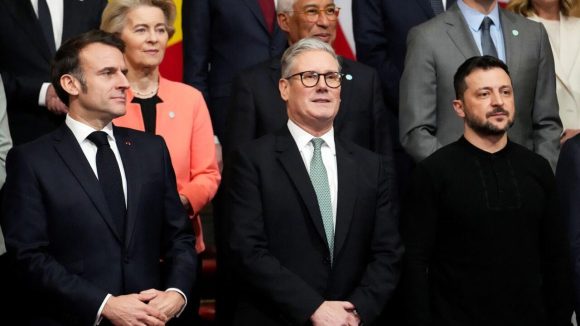
If we look at Zelensky’s European partners can we honestly say they are being honest with the public which elected them? While Macron announces a no-fly zone rule, Starmer tells his own people that Britain will send its own troops to Ukraine. Has the world gone mad, or are these leaders actually serious about their intentions? How many of UK soldiers, airmen and sailors could Starmer actually send out of a total of barely 150,000 in uniform? In reality, probably only a third at best. And presumably this move would be without the support of the U.S., who would keep out of it? If that isn’t the craziest batshit idea, there is more madness to follow. Zelensky, since arriving in the UK for the emergency meeting of mostly EU leaders who support him – including Erdogan of Turkey – has started saying some very odd things to the press, while he picks up these huge checks for military support. He keeps talking about getting a peace deal with Russia.
As Starmer prepares to send British troops to Ukraine, he continues to jail people for posting nasty messages in Facebook, in particular when they slur his own party members – an irony that only Joe Stalin would appreciate, as it’s straight from the dictators’ handbook. Starmer preaches about supporting a free and democratic Ukraine while persecuting anyone who doesn’t agree with his views or uses social media to complain about the state of Britain. In reality it’s one despot supporting another and it’s hard to see how many days this could last with body bags coming back to the UK while pensioners get plain clothed policeman come to their houses and threaten them with imprisonment – or even more cuts to the poor. Of course the body bags will be hidden by a tawdry deal struck between the government and the British press, just as so many ‘no-go zones’ were agreed beforehand. But citizen journalism will call them out as the families won’t stay quiet. Starmer and Macron seem to think that just as Churchill pulled a few stunts to draw the U.S. into the Second World War, that European soldiers on Ukrainian soil will override any agreement that the U.S. and Russia could pull off. The move by Starmer is so idiotic that it leaves many wondering whether he is being controlled by Mossad or the Obamas, comes from the same camp which so fabulously made so many poor predictions from the beginning – namely Russian sanctions.
There is only one conclusion to it, although it leaves Trump and Putin with two options, neither particularly edifying. One, to let the Europeans go ahead with their stunt and watch the collapse of NATO as a credible organization worthy of its funding; or two, to pull the rug out from under the feet of Zelensky and force presidential elections, where of course Trump will install his own puppet to replace the incumbent one. The huge mistake Starmer is making is that he is assuming British troops need not be sent to the front line, but can encircle Kiev to show political support for Zelensky. Yet, each day Russian troops will gain ground and move closer to the Ukrainian capital. For Trump to attempt regime change will be harder of course with a strong contingent of European soldiers on the ground as the State Department and all its dirty tricks doesn’t normally encounter such resistance. Is Zelensky’s ‘we want peace’ mantra a trick so that time can be bought to re-arm? Likely. Monty Python would have had a lot of fun with these clowns. Blessed are the peace brokers.
‘Neocons Should Be Unhappy’ as Trump Calls Out NATO, Pushes for Peace – Analyst
By Oleg Burunov – Sputnik – 05.03.2025
US President Donald Trump pledged to go ahead with his campaign of “swift and unrelenting action” in reorienting the country’s economy, immigration and foreign policy in his address to Congress.
“It seems he [Trump] wants more and more peace, urging Zelensky to conclude a ceasefire agreement and sign the US-Ukraine minerals deal,”Lt. Col. Karen Kwiatkowski, a retired US AirForce official and former analyst for the US Department of Defense, told Sputnik.
Kwiatkowski stressed that Trump didn’t talk about Europe or NATO other than noting that they depend on the US and use American money, “and yet they seem not to want peace.”
She noted that peace means prosperity for the working people and younger generations rather than those not working and the government.
“It makes sense after watching his speech that he is most popular among the under 40 demographic in the United States according to current polling,” the ex-Pentagon analyst pointed out.
Former DoD officer David Pyne, in turn, said in an interview with Sputnik that “Trump had no reservations about ending all US military assistance to Ukraine” in order “to pressure the Zelensky regime to accept a cease-fire and the peace deal the US is working to negotiate with Russia.”
78% of Americans support Trump’s effort to negotiate an end to the conflict, Pyne stressed. “Even while Democrat leaders continue to support feeding Ukrainian soldiers into the meat grinder.”
Trump will continue to transform the US relationship with Russia “from one of adversaries to a new historic era of strategic partnership,” the analyst believed.
CIA confirms suspension of intelligence sharing with Ukraine
RT | March 5, 2025
Washington has brought all intelligence sharing with Ukraine to a halt, CIA Director John Ratcliffe confirmed to Fox Business on Wednesday. The development came just a day after several American media outlets reported that the US had suspended military assistance, including both the purchase of new weapons and shipments already in progress.
When asked by host Maria Bartiromo whether the US had “cut off” its cooperation with Ukraine, Ratcliffe said that US President Donald Trump had “asked for a pause” to see if Kiev was ready to work toward resolving the conflict with Russia.
“President Trump had a real question whether… Zelensky was committed to a peace process,” Ratcliffe said, claiming that the halt to assistance and information sharing contributed to Zelensky publicly stating that he was “ready for peace.”
On Tuesday, the Ukrainian leader said that Kiev was ready for an immediate POW release and a temporary ceasefire with a “ban on missiles, long-ranged drones, bombs on energy and other civilian infrastructure.” Last week, Trump told reporters that Zelensky needed to be ready for an immediate ceasefire before he could be welcomed back to the US following their Oval Office debacle on Friday.
”On the military front and on the intelligence front, the pause… allowed that to happen,” Ratcliffe said, adding that he expected the US to resume cooperating with Ukraine soon.
The halt to intelligence sharing was “selective,” Sky News reported on Wednesday, citing a Ukrainian source. However, the move made it difficult for Ukraine to launch attacks against targets deep inside Russia, the source said.
Washington reportedly also barred its allies from sharing with Ukraine, Financial Times reported on Wednesday, citing sources familiar with the matter. Recipients with assets inside Ukraine itself were likely to continue to pass on relevant information, the paper said, but Kiev would likely miss out on time-sensitive and high-value intelligence it needed to strike moveable Russian targets.
Trump and Zelensky had a heated verbal exchange on Friday, when the US president accused the Ukrainian leader of ingratitude and “gambling with World War III” by refusing to work towards a halt to hostilities.
Several US outlets, including Bloomberg, the New York Times, and CNN, reported that Trump had paused military aid after the fall out. According to the NYT, the president’s order affected more than $1 billion in “arms and ammunition in the pipeline and on order.”
Moscow commented on the reports by saying that if the US were to suspend supplies altogether it would “probably be the best contribution to the cause of peace.”
Hamas: We will not be part of post-war Gaza on condition of national consensus
Palestinian Information Center – March 4, 2025
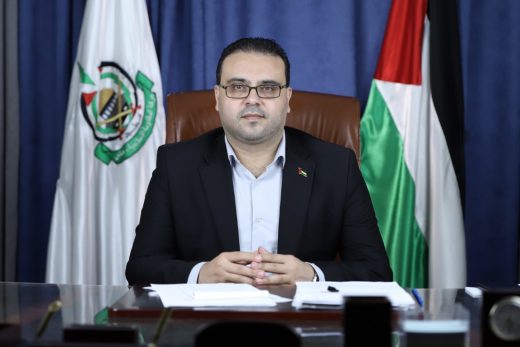
GAZA – The Hamas Movement said it will not be part of any administrative arrangements in the post-war Gaza Strip on condition of a national consensus.
“It is not necessary for Hamas to be part of the administrative arrangements in Gaza. It is not interested in that, and does not want to be in these arrangements at all,” Hamas spokesperson Hazem Qassem told Anadolu agency.
“Any arrangements for Gaza’s future after the [Israeli] aggression must be based on national consensus, and we will facilitate this. Hamas will not allow any external force to interfere,” he added.
Qassem said these arrangements must lead to “launching a serious and genuine reconstruction process to save our people in Gaza from the catastrophe they have endured” due to Israel’s war.
The comments come as Arab leaders prepare to meet in Cairo to formulate a unified Arab stance on the Palestinian issue and present a counterproposal to US plans for the displacement of Gaza’s population
Egypt unveils Gaza reconstruction plan ahead of emergency Arab summit
Al Mayadeen | March 4, 2025
On Tuesday, Egypt’s Al-Qahera Al-Ikhbariya channel published Egypt’s plan for rebuilding Gaza, which will be presented to Arab leaders at the emergency summit hosted in Cairo on Tuesday.
Egyptian Foreign Minister Badr Abdelatty previously stated that the plan was designed to ensure the Palestinian people’s dignity and rights, and would be presented on March 4.
According to Abdelatty, Egypt’s alternative reconstruction plan will not be solely Egyptian or Arab but will include international support and funding to ensure its effective implementation.
“We will hold intensive talks with major donor countries once the plan is adopted at the upcoming Arab Summit,” he stated during a press conference with European Union Commissioner for the Mediterranean Dubravka Suica.
Into Egypt’s plan
The plan, which is based on preserving the rights and dignity of the Palestinian people, includes the formation of a Gaza Administration Committee to oversee the governance of the territory during a six-month transitional period. This committee will be independent, composed of non-partisan technocrats, and will operate under the Palestinian government.
According to the plan, the committee will be established throughout the current phase and pave the way for the full return of the administration, which would manage the next phase under Palestinian decision-making.
The plan also states that Egypt and Jordan will train Palestinian police forces in preparation for their deployment in Gaza. It calls for mobilizing political and financial support to back Egyptian-Jordanian efforts in training Palestinian security personnel.
Additionally, the plan suggests that the UN Security Council consider an international presence in the Palestinian territories, including the West Bank and Gaza, and issue a resolution to deploy international peacekeeping forces as part of a comprehensive framework for establishing a Palestinian state.
On stabilizing the ceasefire
The reconstruction statement also condemned the killing and targeting of civilians, as well as the high levels of violence and humanitarian suffering caused by “Israel’s” war on Gaza, claiming that the two-state solution is the most viable resolution under international law and consensus, emphasizing that Gaza is an inseparable part of Palestinian territory.
Egypt stressed the importance of safeguarding Palestinian rights and ensuring their continued presence on their land without displacement, calling on the international community to unite on a humanitarian basis above all else to address the catastrophic consequences of the war.
Any attempt to strip the Palestinian people of their hope for statehood or seize their land would only further fuel the struggle and instability, it also warned.
Additionally, the plan also underscored the need to maintain the ceasefire in Gaza, ensure the sustainability of the current truce, and secure the release of prisoners and detainees. It noted that successful reconstruction requires transitional governance arrangements and security measures that uphold the prospects of a two-state solution.
Furthermore, it urged the international community to support Egypt, Qatar, and the United States in stabilizing the ceasefire agreement, warning that a collapse of the truce would severely hinder humanitarian efforts and the reconstruction process.
The plan emphasized the importance of a gradual approach that ensures the Palestinian people’s right to remain on their land while also safeguarding their legitimate aspirations for an independent state with territorial continuity between Gaza and the West Bank. It called for handling Gaza’s situation through a political and legal framework that aligns with international legitimacy and UN Security Council resolutions.
The plan also stressed the need to begin planning for the early recovery phase in a way that guarantees Palestinian ownership of the process. It underscored the importance of continued efforts by the Palestinian Authority to take further steps in strengthening and developing Palestinian institutions and governance structures.
Featured Video

Houthis Don’t Have to Conquer Saudi Arabia to Make It Pay
or go to
Aletho News Archives – Video-Images
From the Archives
A Lesser “Grade” of Human
By Michael Hoffman | Revelation of the Method | January 3, 2024
Will the more than 100 Iranians killed by terrorist bombs today be mourned in the West as victims of terrorism? Certainly not. Allied doctrine has it that the killing of Israeli or American civilians is a crime of cosmic proportions, while shedding the blood of “enemy” women and children is perfectly acceptable; indeed commendable.
The West does not memorialize the hundreds of thousands of civilians bombed by the U.S. in Serbia, Iraq, Afghanistan and every major German city 1943-1945. America’s fire-bombing of the city of Tokyo by General Curtis LeMay in March 1945 was followed by Harry Truman’s atomic incineration of Hiroshima and Nagasaki in August of that year. Truman never had a moment of doubt or regret over the murder of more than a 100,000 Asian children, mothers and non-combatant boys and men. It was business as usual for the “noble” Allies during the “Good War.”
In the West human rights signifies passionate concern only for civilians designated as truly human: Israelis first, then Americans and British, followed by their satraps.
This inhumanity is the legacy of Talmudic ideology, beginning with tractate Sanhedrin 57a from 400 A.D., concerning liability for capital punishment: “If a Jew murders a gentile, he is exempt.”
This teaching of contempt was reiterated in the dogma of Chabad Lubavitch founder Rabbi Shneur Zalman in the 18th century. … continue
Blog Roll
 Aletho News
- Houthis Don’t Have to Conquer Saudi Arabia to Make It Pay
- MOE: Nearly 22,000 Students and Education Workers Killed
- Guterres in Islamabad: Genocide, cowardice, and the cage of Imran Khan
- Johnson, Marandi say Yemen holds upper hand over Saudi Arabia
- False flags won’t save aggressors, Iran FM spokesman says
- The Makkah Pact Enters Into Force: The End of American Dominance or Its New Form?
- NATO’s top generals gather in Kiev
- EU’s continuing expansion – greater threat to Russia
- US Senator Murphy says Pentagon denied him entry to US base in Qatar
- Israel expands “incitement” charge to target Palestinian education and memory
- If Americans Knew
- Three Years of Genocide: How America’s Israel-First Media Filtered Out the Truth
- Israeli war chief briefs ministers on potential war against Palestinian Authority
- New Report: Israel Killed nearly 21,000 Palestinian Students and Education Workers in Past Three Years
- Israel’s flailing chatbot army
- Five Palestinians Killed, Others Injured by Israeli Fire in Gaza
- Israel is rewriting the Palestinian curriculum in East Jerusalem to erase Palestinian identity
- Three years of genocide: Israel turned prisons into killing grounds and torture sites
- Three years of genocide. Words fail. Daily Update
- ‘I’d rather die than go back’: A Palestinian teen’s 10-month nightmare in Israeli jail
- How Jared Kushner’s firm’s investment in an Israeli company could be a major conflict of interest
- No Tricks Zone
- US September “Heat” Was No Record…Many Records Set Decades Ago
- Latest European Green Energy Debacle; Portugal’s Largest Flagship Solar Park Insolvent!
- Green Energy Debacle: German Expert Professor Fritz Vahrenholt Warns Of Severe Economic And Social Consequences
- Two More Paleo Reconstructions Affirm Meters-Higher Sea Levels Across Ireland, Brazil 7000-6000 Years Ago
- New Study: Earth And Venus Surface Warmth Largely Explained By Convection And Lapse Rate, Not CO2 Or Radiation
- 2025 Nature Paper Claiming Worsening Global Drought Gets RETRACTED …Heavily Flawed
- New Study: ‘Global Drought Shows No Detectable Recent Acceleration Under Climate Warming’
- Economic Masterminds: German Socialists Suggest Taxing Productivity Gains Stemming From Using AI
- The South China Sea Has Not Been Cooperating With The Climate Change Narrative
- Energy Crisis: Germany Enters Heating Season With Historically Low Gas Reserve Fill Levels

