Russian Federal Security Service (FSB) says three Ukrainian navy vessels, violated its border on Sunday morning, and are heading for Kerch Strait that lies between Crimea and mainland Russia.
“This morning at around 7 a.m. Moscow time, three vessels belonging to Ukrainian armed forces violated the United Nations Convention on the Law of the Sea… to cross the Russian border,” read a statement from Russia’s federal security agency FSB, which is responsible for maintaining the country’s borders.
It said that the ships are sailing towards the Crimea Bridge, but have made no application to pass under it.
The vessels are undertaking dangerous maneuvers, and are not obeying lawful instructions from the Russian authorities.
Adding that they are taking “all necessary security measures” FSB also made public a series of photos of the Ukrainian vessels being escorted by larger Russian patrol ships.
“The purpose of these provocative actions by the Ukrainian navy is to create a conflict situation in the region,” said a statement from the FSB headquarters in Moscow.
The Ukrainian side, which does not recognize Crimea as Russian territory, or the status of its territorial waters, also accused the border forces of a “provocation” during what it said was a planned and routine vessel transfer between the Black Sea and the Azov Sea, which the Kerch Strait separates.
Accusing Moscow of “openly aggressive actions,” the Ukrainian Navy said through its Facebook page that one of the Russian ships rammed its tugboat that accompanied the two armored artillery boats, inflicting significant damage on the vessel.
While tensions between the two navies have run high since Crimea voted to leave Ukraine and join Russia in 2014, they have particularly escalated this year.
The Russian Nord fishing vessel was detained by Ukrainian border guards in March, while the Mekhanik Pogodin oil tanker has been held in the Ukrainian port of Kherson since August, as a result of Kiev-imposed sanctions against Moscow.
Russia has accused Ukraine of “marine terrorism” and in return, its vessels have been subjected to more regular inspections while moving through the Kerch Strait.
In September, Moscow accused another military ship belonging to Ukraine of violating its marine exclusive economic zone, and escorted them out of its waters.
November 25, 2018
Posted by aletho |
Aletho News | Russia, Ukraine |
Leave a comment
The Trump administration is making a determined effort to engage with Turkey, which used to be the anchor sheet of American regional strategies in the Middle East for several decades. Without a robust partnership with Turkey, US policies remain ineffectual on several regional fronts – ranging from the Black Sea and Eastern Mediterranean to post-conflict Syria, Iran oil sanctions and Gulf security — and even Khashoggi affair.
Turkey has a long list of grievances – real, feigned or imaginary. But President Trump senses that Turkish president Erdogan prioritizes two core issues – demand that a) Washington should extradite his arch political rival Islamist preacher Fetullah Gulen (who he alleges plotted the failed coup against him in 2016); and, b) that the so-called Halkbank case in a Manhattan court should be wound up.
Trump has lately signaled that he is acting on both issues. Gulen is a tough call for Trump insofar as he has been an “asset” of the CIA. The Halkbank file may be relatively easy to handle.

(Fetullah Gulen’s ‘retreat center’ in Pennsylvania)
In turn, Erdogan is holding the trump card in the Khashoggi affair, which has potential to undermine the US’ grand Middle East strategies. A top Saudi establishment commentator Abdulrahman Al-Rashed wrote in the Saudi daily Asharq Al-Awsat, “Turkey has been using the (Khashoggi) crime to push Trump to make concessions to release a convicted Turkish banker or hand over an opposition figure in exchange of stopping its campaign against Saudi Arabia.” Clearly, Trump expects Erdogan to stop fueling the Khashoggi affair.
Erdogan has now let it be known that he is open to meeting with the Saudi Crown Prince Mohammed bin Salman on the sidelines of the G20 summit in Argentina on November 30.
However, the Turkish-American engagement has a much bigger backdrop — Syrian conflict. How far the tango over Khashoggi helped US to address the Syrian situation is hard to tell, but American diplomacy has a way of juggling several balls. In particular, the Pentagon’s alliance with Syrian Kurdish groups worries Turkey and Erdogan has been threatening to move against them.
Now, the US has come up with an innovative idea to work with Turkish military apropos any terrorist threats from Syria. Two days ago, US defence Secretary James Mattis unveiled the idea with disarming simplicity during an interaction with the media:
“Turkey is a NATO ally and they have legitimate concerns about terror threats… from Assad’s Syria… And Turkey has a lot of reasons for concerns, being the NATO country with a border right along Syria. And we don’t dismiss any of their concerns. We are putting in OPs up in northern Syria, this is the change now, okay? We are putting in observation posts in several locations up along the Syria border — northern Syria border because we want to be the people who call the Turks and warn them if we see something coming out of an area that we’re operating in. This is closely collaborated – we are consulting closely with Turkey, military and State Department. Both were consulting with them.”
“We are going to track any threat that we can spot going up into Turkey. That means we will be talking to Turkish military across the border. They will be very clearly marked locations day and night so that the Turks know where they’re at.”
Meanwhile, Voice of America also reported on November 22 that “a large military convoy from an Arab country was deployed last week to the eastern Syrian province of Deir el-Zour” in the region under US control.
Prima facie, the US is pre-empting any excuse by Turkey to attack the Kurdish groups by offering a CBM. But the bottom line is that the US is marking as its exclusive preserve a vast swathe of territory in Syria’s northeastern region — roughly one-third of entire Syria — which is rich in hydrocarbon reserves and water resources, and it expects Turkey to respect the ground reality.
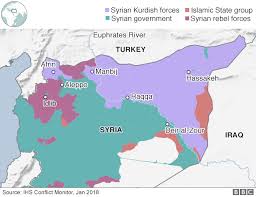
(Who controls what in Syria.)
Without doubt, an entity is being carved out of Syria that is beyond the reach of Damascus, with the Arab Forces providing the “steel frame” for internal security and acting as deterrent against any Turkish attacks against the Kurdish militia, while the US monitors the border region with Turkey.
Mattis claimed that Turkey is on board. But Turkey strongly supports Syria’s unity. Turkish Defence Minister Hulusi Akar has openly voiced disquiet over the US move to set up observation posts on Turkish-Syrian border. Akar disclosed that Turkey conveyed its “discomfort” to the Pentagon:
“We have stated that the observation points to be established by the US troops on the Syrian border will have a very negative impact… and in the course of our discussions we expressed that it could lead to a perception that US soldiers are somehow protecting terrorist YPG (Syrian Kurdish) members and shield them.”
Equally, could an Arab force’s – most likely Saudi and Emirati troops – deployment (just when the war is ending) have been without prior consultation between Washington and Ankara? The point is, Turkey has troubled relations with both Saudi Arabia and the UAE and will resent their deployment of troops to its border regions with Syria.
In sum, the US’ newfound role as the gatekeeper of the Turkish-Syrian border means the Pentagon is creating new facts on the ground, which signals a long-term US occupation of northern Syria. There are serious implications for Syria’s unity and territorial integrity. Indeed, the last thing that Turkey wants is an independent entity along its border with Syria where the Kurds enjoy autonomy. Turkey has a congruence of interests with Russia and Iran in this regard.
November 24, 2018
Posted by aletho |
Aletho News | Middle East, Sanctions against Iran, Syria, Turkiye, United States |
Leave a comment
Washington’s rhetoric regarding Iran paints the picture of an evil nation hellbent on destroying the world. In reality, it appears that Tehran would prefer dialogue with its rivals, which is unacceptable to the US.
Tuesday’s White House Statement from President Trump on “Standing with Saudi Arabia” was an outright condemnation of Iran and a total free pass for Saudi Arabia.
Iran is to blame for almost every issue in the Middle East, including the war in Yemen, according to the statement. The US-made and supplied bombs raining down on Yemeni school buses, with some 85,000 children dying in the process, is simply because of Iran. Not only is Iran responsible for the bloodshed in Yemen, Tehran has further helped “dictator Bashar Assad” in Syria kill “millions of his own citizens.” The official death toll of the Syrian war is under one million, and certainly the various jihadist groups, including Islamic State (IS), share responsibility for that figure.
“The Iranians” have also killed many Americans and other innocent people throughout the Middle East. Iran not only shouts “Death to America” and “Death to Israel” but it is also considered “the world’s leading sponsor of terror.”
It is curious enough that firstly, in a statement about Saudi Arabia, the term “world’s leading sponsor of terror” is not gifted to the prime sponsors of Al-Qaeda and IS. Secondly, the fact that Trump himself put that term in inverted commas seems to suggest that even he doesn’t quite believe that one to be true.
Remember, Saudi Arabia is the country that Trump, before becoming president, once accused of masterminding the 9/11 attacks. I wasn’t aware of this until reading the statement, but according to the White House, Saudi Arabia would gladly withdraw from Yemen if the Iranians would agree to leave. That’s right, Iran’s non-presence in Yemen must be removed in order for Saudi Arabia to cease blowing up children, hospitals, factories, food trucks, schools, agricultural land, strategic ports, and relinquish its complete stranglehold over the country.
If you were naive enough to take the White House statement at face value, you would surely think that Iran has much to answer for. Iran is, after all, public enemy number one and has been for some time. Conversely, Saudi Arabia has been a longstanding ally of the United States, a faithfully serving client state, and it should be protected at all costs especially if there is to be any hope at pushing back against Iran as it yells “Death to America” and “Death to Israel.”
But what if Iran was, despite all of its flaws, not interested in fighting a war with Saudi Arabia? What if we dug a little bit deeper and asked ourselves: is there another way of dealing with the “threat” that Iran poses?
In January this year, Iran’s Foreign Minister Mohammad Javad Zarif wrote an article that was published in the Financial Times which laid out the country’s proposed framework for bringing stability to the Middle East. The article was widely ignored by the rest of the world, even though its implications were potentially life-saving.
“The objective of a strong region — as opposed to a quest for hegemony and the exclusion of other actors — is rooted in recognising the need to respect the interest of all stakeholders,” Zarif wrote. “Any domineering effort by one country is not only inappropriate but essentially impossible: those who insist on following that path create instability. The arms race in our region is an instance of this kind of destructive rivalry: siphoning vital resources into the coffers of arms manufacturers has contributed nothing to achieving peace and security. Militarism has only served to fuel disastrous adventurism.”
Zarif states that the usual modes of forming alliances have become “obsolete” and suggests that security networking to address issues is a much better practice. He proposes that instead of ignoring conflicts of interests, the countries in the region should accept their differences.
“The rules of this new order are straightforward: common standards, most significantly the purposes and principles of the UN Charter, such as sovereign equality of states; refraining from the threat or use of force; peaceful resolution of conflicts; respect for the territorial integrity of states; non-intervention in the domestic affairs of states; and respect for self-determination within states,” Zarif adds.
Zarif recommends opening up dialogue and blames a “dialogue deficit” for instability throughout the region. Such a dialogue, he argues, could help other nations understand that all parties have “similar concerns, fears, aspirations and hopes.” His eventual vision is that these countries will eventually adopt a “non-aggression pact.”
Now, Zarif did not explicitly state who he was talking about in this proposed path to peace and stability. But what if his intention was to work with Saudi Arabia, is this not something that should be talked about, particularly by the US commander-in-chief when releasing statements stoking the fire of an already volatile region while pitting two major regional players against each other?
In October last year, Zarif was quoted as saying that Tehran is willing and ready for rapprochement with the Kingdom of Saudi Arabia, adding that he does not believe the two countries should have the type of relationship they have right now.
In December last year, Iran’s president Hassan Rouhani further intimated that Tehran is willing to resume ties with Saudi Arabia if it halted its military campaign in Yemen and severed its ties with Israel.
“We don’t have any problem with the country that is our neighbor and unfortunately speaks a lot and speaks irrationally. Saudi Arabia, as our neighbor, should stop bombing Yemen from tomorrow, stop bowing to Israel, stand straight and rely on its nation,” Rouhani said.
In March this year, Zarif then took his ambiguous article one step further and openly said that Iran is willing to resolve its differences with Saudi Arabia’s as part of Tehran’s desire for stability in the region. As Zarif notes, this is not the first time Iran has reached out to the kingdom, yet the Saudis continue to reject Iran’s proposed dialogue.
In August of this year, Zarif further stated that Iran wants to restore relations with Saudi Arabia as well as the United Arab Emirates (UAE) and Bahrain. Surprisingly, Saudi Arabia had just allowed the entry of an Iranian diplomat to head Iran’s interests in the Kingdom, a rare move since diplomatic ties had been cut almost two years prior.
Just last month, Zarif again called for Saudi Arabia’s cooperation to push back against the “repeated insults” made by the US president at the time.
“This is the reward of the illusion that security could be achieved through external support,” Zarif said. “We extend our hands to our neighbours, saying: let’s build a strong region to stop this arrogant pride.”
I could be wrong, but in its totality, it does appear that Iran is proposing a framework where Middle Eastern countries settle their disputes between themselves without outside interference, whereby the US would be left out completely. Such a suggestion is in itself a form of hubris so unacceptable to Washington that the proposal itself makes the country ripe for a targeted regime change operation. Despite this, Iran has been quite open about its blueprint for a new outlook to the Middle East.
“We don’t need foreigners to guarantee the security of our region,” Iran’s president said earlier this year.
“When it comes to regional security arrangements, we are ready to talk to our neighbours and friends, without the presence of foreigners,” he added. “We are, have been and always will be good neighbours.” Yes – even Saudi Arabia.
In August, UN experts went even further and said that Iran might be willing to play a “constructive role” in ending the war in Yemen, something Iran has said it has been wanting to do for years by working with Saudi Arabia.
Conversely, the Saudis and their US counterparts are not so willing to take the Iranians up on their offer.The Saudis always want to “fight the Iranians to the last American,” according to former Secretary of Defence Robert Gates. The Saudis have even openly abandoned the Palestinian cause in an attempt to cosy up to Israel and create a US-backed alliance that can confront Iran in the region. The Saudi Crown Prince also compared Iran’s supreme leader to Adolf Hitler, a brazen statement for a man who executes journalists and unarmed children with complete impunity. The kingdom continues to openly work with Al-Qaeda linked groups to prolong the fighting in Yemen, all because its anti-Iran hysteria cannot falter from its position.
A détente between Riyadh and Tehran appears to be a far cry away from happening any time soon, but we cannot continue to pretend we haven’t noticed the opportunity that continues to present itself, particularly from the Iranian side. Whether an Iran-Saudi relationship is a positive step or a disastrous one is an important question to ask; but we should at least consider it as an option if it can avoid a potential and unnecessary war between two regional powers, as well as its potential to diffuse an already devastating war which continues to kill thousands of people completely needlessly.
November 23, 2018
Posted by aletho |
Aletho News | Iran, Middle East, Saudi Arabia, United States |
Leave a comment
North Korea has destroyed 10 observation posts in the demilitarised zone bordering the South in compliance with an agreement reached between Seoul and Pyongyang in September, the South Korean Defence Ministry said in a statement.
Representatives from the defence ministries of the two countries agreed during the inter-Korean summit on 19 September to eliminate 11 observation posts, situated in the demilitarised zone, each by late November. The South Korean Defence Ministry then announced that the two parties had agreed to keep one observation post each.
“The North Korean party eliminated today, November 20, at 3:00 p.m. [6:00 GMT] 10 observation posts by means of explosions as it was agreed,” the ministry said on its Facebook page.
The ministry added that it had been notified about the planned operation by the North Korean side in advance.
Relations between Seoul and Pyongyang began to improve after a historic summit between South Korean President Moon Jae-in and North Korean leader Kim Jong-un in April after more than a year of fears of a war over North Korea’s nuclear weapons programme. The latest inter-Korean summit took place in September and yielded a number of agreements covering such areas as defence, but also culture and sports.
November 20, 2018
Posted by aletho |
Aletho News | Korea |
Leave a comment
After prolonged hibernation, the Astana Process on Syrian peace is kinetic, with the troika of ‘guarantor’ states – Russia, Turkey and Iran – set to hold a round of talks in the Kazakh capital on November 28-29. Delegations of the Syrian government and the opposition are also expected to attend. A renewed effort is commencing to create traction for the UN-sponsored negotiations in Geneva.
Much water has flown down the Euphrates since the 9th round of the Astana Process took place in May. Six months is a long time in politics – especially in Middle East politics. But, paradoxically, while Middle Eastern politics is in turmoil, the prospects for peace in Syria may have improved. The setting for tomorrow’s meet – it’s unclear at what level the event will take place – has become largely favorable. At least 10 major reasons can be attributed.
One, Syria is witnessing a period of relative calm. There has been no major fighting for months. Two, Syrian-Jordanian border had reopened and nothing of a feared flare-up happened in the Golan Heights. Three, the Russian-Turkish understanding on Idlib is holding. Four, Israel has been effectively ‘defanged’ (thanks to deployment of Russian S-300 ABM system to Syria). Five, Russia and Iran intend to retain their military footprints in Syria for a foreseeable future, while on the contrary, the US lacks the political will or the military capability to impact the strategic calculations of Moscow, Tehran, Damascus or Ankara.
Six, importantly, Turkey has become an implicit ally of Russia and Iran and is inching closer and closer to a political deal that leaves President Bashar Al-Assad in power. Seven, Russia, Turkey, and Iran are in the lead in shaping the Syria policy, with clear strategic goals and, even more so, the means to achieve them.
Eight, on the other hand, a growing determination on the part of Russia, Iran, and Turkey is discernible to freeze out the United States from any role in shaping Syria’s geo-strategic future. Although the three countries would have tactical differences between them, broadly, Turkey will accommodate Russia and Iran so long as it has a free hand to check the Kurdish forces threatening its security. Significantly, the announcement on the rebooting of the Astana Process comes after the visit by Russian President Vladimir Putin to Turkey on November 19.
Nine, the crisis in Turkish-American relations not only persists but may even deepen in the period ahead. Finally, the Trump administration’s calculations that its re-imposition of sanctions against Iran will either force Iran out of Syria or, better yet, produce a veritable collapse of the Iranian government are turning out to be a mere pipe dream. In fact, the opposite has happened.
Iran is intensifying its coordination with Russia and Turkey, and is creating firewalls to protect its strategic gains in Syria. Again, it is clear by now that the US cannot count on the new government in Baghdad to act against Iranian interests.
On the other hand, the dangerous situation that has arisen on Israel’s border with Gaza (which was precipitated entirely by Israeli hardliners) and the ensuing mayhem in Israel’s domestic politics will seriously delimit Benjamin Netanyahu’s energy and resources to act as ‘spoiler’ in Syria. Moscow has openly snubbed Netanyahu lately by refusing him to schedule his visit.
Similarly, the widening cracks in the US-Saudi alliance in the downstream of the Khashoggi murder all but means an overall Saudi disengagement from the Syrian conflict. The UAE has already begun mending fences with the Syrian government, which would only have been possible with Saudi approval. (See my blog UAE, Saudi sense convergence with Syria.)
Suffice to say, the so-called Syrian opposition is finding itself rudderless. Their erstwhile mentors – US, Turkey, Saudi Arabia, UAE – have either reached a dead end or have turned to new priorities in their self-interests accepting the defeat in the Syrian conflict.
Meanwhile, the appointment of Norwegian diplomat Geir Pederson as the UN Secretary-General’s new special envoy for Syria becomes a positive factor. Russia has warmly noted that “we know him as an experienced and unbiased diplomat.” Pederson’s predecessor Staffan de Mistura was widely perceived as a sidekick of the US. Clearly, the Astana Process is not wasting time by kickstarting the work on a Syrian settlement even as Perdersen moves in.
November 20, 2018
Posted by aletho |
Aletho News | Israel, Middle East, Saudi Arabia, Syria, Turkiye, United States |
Leave a comment
A new template is forming in the geopolitics of the Asia-Pacific – Russo-Japanese concord. The two regional powers with a troubled history are moving in the direction of concluding a peace treaty that could formally end their World War 2 hostilities and open a new page in their relations.
The negotiations are being handled at the highest level of leadership and, therefore, every single meeting between Russian President Vladimir Putin and Japanese Prime Minister Shinzo Abe is invested with high importance. Both statesmen are known to be ardent supporters of a robust partnership between their countries.
The conclusion of a peace treaty is a pre-requisite to put the relationship on a higher trajectory and to realize its full potential. But both nations are also riding a wave of nationalism and when territorial concessions are involved, feelings run high.
Abe also has tryst with destiny insofar as he hopes to garner the historical legacy of getting back from Russia, the territories, which the former Soviet Union had occupied in the final period of World War 2 when Japan was staring at defeat.
Putin understands that an obdurate Russian stance on Kuril islands is impossible for any Japanese leader to accept. On the other hand, he also cannot ignore the Russian public opinion against territorial concessions. Besides, what complicates matters is that Japan is the US’ number one ally in Northeast Asia and Russia is apprehensive that any formula to settle the territorial dispute – which will have to be based on the joint declaration issued by Japan and the Soviet Union in 1956 (which re-established diplomatic relations and stipulated the return of two of the Kuril islands Habomai and Shikotan after the conclusion of a peace treaty) may lead to an American military presence in a region where Russia has several highly sensitive bases.
Last September, Putin had made a novel offer of signing a peace treaty unconditionally by end-2018, but Abe found it unacceptable. Having said that, Abe acknowledged that Putin’s words showed a desire for peace treaty.
When they met last week in November 14, Abe reportedly came up with a proposal that Japan would not allow U.S. military bases on two islands off Hokkaido even if Russia returns them based on a 1956 joint declaration. (Ostensibly, Abe hopes to dispel Russian concern over the potential presence of US bases on Habomai and Shikotan islands.)
The Kremlin spokesman refused to comment but in a nuanced response made it a point to “confirm that Tokyo’s alliance obligations (with the US) are important as far as peace treaty talks go.”
It is hard to tell whether the ongoing Putin-Abe diplomacy is also a tango being staged by the two statesmen who have a shared interest in expediting a peace treaty, but who are also having to negotiate with each other and safeguard national interests as well as carry their respective domestic audiences along at the same time.
It is entirely conceivable that the two statesmen may even have set a timeline. In fact, Putin and Abe are meeting again in Argentina during the G20 in end-November. Tass reported today that Abe will also be visiting Russia in January. The accelerating diplomacy could well have something to do with Putin’s proposed visit to Japan in June to attend the G20 at Osaka. Don’t be surprised if Abe hopes to meet Putin on a full-fledged state visit in June.
Quite obviously, Russo-Japanese relations are deepening and what seemed an intractable territorial dispute may lend itself to resolution. One possibility could be that Japan regains sovereignty over the Habomai Islands and Shikotan, and the two islands might be turned into special economic zones.
Clearly, the US is the elephant in the room. Under the framework of the Japan-US Security Treaty, American troops in Japan can be stationed on Habomai and Shikotan if the two are handed over to Japan. Therefore, Abe’s proposal (that such a thing will not happen) also implies his willingness to maintain a diplomatic distance from the US.
Indeed, it could not have escaped Putin’s attention that there are incipient trends in Abe’s policies lately suggesting a degree of ‘detachment’ from the US – as apparent, for instance, from Abe’s moves to actively improve relations with China and sequestering it from the deterioration of Sino-American relations. The fact of the matter is that Japan is increasingly uncertain about the US intentions.
Having said that, Japan is still dependent on the security treaty with the US. Trust the US to interfere with the conclusion of a Japan-Russia Peace Treaty, given the long-term implications it would have for the American military presence in Northeast Asia.
On the other hand, a peace treaty would completely transform Russo-Japanese relations, which would also impact the Russia-Japan-China triangle. To be sure, a full-bodied partnership with Russia will vastly expand the strategic space for Japan to recalibrate its relations with both the US and China.
All signs are that Abe is working on a grand design. For a start, he has to contend with domestic opinion. Abe’s big re-election as head of the Liberal Democratic Party in September (with 82% support) has put him on track to become Japan’s longest serving prime minister and to pursue his vision of Japan over the next three years in power (in what will be his last term in office), as well as to focus on the kind of legacy he will leave behind. Read a fine piece here by Japanese scholar Tomohiko Satake at the National Institute of Defence Studies, Tokyo – Should Japan continue to support the US-led international order?
November 19, 2018
Posted by aletho |
Aletho News | Japan, Kuril islands, Russia, United States |
Leave a comment
Iranian Interior Minister Abdolreza Rahmani Fazli highlighted the insecurity of borders between the Islamic Republic and Pakistan, and voiced Tehran’s readiness to carry out counterterrorism operations on Pakistani soil.
Rahmani Fazli remarks were during a press conference on Saturday, as part of efforts to free 14 abducted borders guards by Takfiri terrorists.
The Iranian minister said following the efforts by various security and diplomatic organizations, the Foreign Ministry in particular, the terrorists handed over five of the 14 Iranian border guards to the Pakistani side.
“We are pursuing (the issue) so that all of the beloved ones taken hostage by the criminals, would return to us,” he said.
Iran expects that the Pakistani government to boost security cooperation along the common borders, the minister stressed.
If Pakistan cannot act against the terrorists for any reason, Iran is ready to carry out operations on Pakistani soil, where the terrorists are present, with Islamabad’s permission, Rahmani Fazli added.
Speaking to reporters at a press conference in the northern city of Qazvin on Thursday, IRGC Commander Major General Jafari also said the abducted border guards will be freed but it will take time.
Iranian Foreign Minister Mohammad Javad Zarif and Commander of the IRGC Ground Force Brigadier General Mohammad Pakpour recently traveled to Pakistan as part of efforts to secure their release.
Pakistani-based terrorists kidnapped 14 Iranian forces at a border post in Mirjaveh region in Sistan and Balouchestan province on October 15.
November 17, 2018
Posted by aletho |
Aletho News | Iran, Pakistan |
Leave a comment
MOSCOW – Moscow has no reasons to doubt the ability of Saudi authorities to conduct a proper investigation of the killing of opposition journalist Jamal Khashoggi and warns against politicizing this tragedy, a source in the Russian Foreign Ministry told Sputnik on Friday.
“Moscow notes the course taken from the beginning by the Saudi side to conduct the most thorough and objective investigation of the incident, including the interaction with the Turkish authorities,” the source said.
The Foreign Ministry official stressed further that Russia sees ‘no reason to question the ability of the Saudi authorities to deal with this high-profile case at the proper professional level.’
Addressing the politicisation of the issue, he stressed that Moscow was convinced that it was ‘inadmissible’, as such cases needed to be ‘resolved exclusively within the legal framework.’
The official’s statement comes after Saudi Prosecutor General’s Office announced on Thursday the completion of the investigation of Khashoggi’s murder saying that 21 people had been detained in connection with the case, with 11 of them charged. Prosecutors are demanding the death penalty for five of the defenders.
November 16, 2018
Posted by aletho |
Aletho News | Russia, Saudi Arabia, Turkiye |
Leave a comment
North Korea’s state media says the country’s leader Kim Jong-un has witnessed the test of an ultramodern tactical weapon in his first publicized visit to a weapons test site since the country’s test-launch of an ICBM last November.
Kim visited the testing ground of the Academy of Defense Science, the center of weapons development in North Korea, and “supervised a newly developed ultramodern tactical weapon test,” official Korean Central News Agency said in a Friday report.
“After seeing the power of the tactical weapon, Supreme Leader Kim Jong-un was so excited to say that another great work was done by the defense scientists and munitions industrial workers to increase the defense capability of the country,” the KCNA reported.
The type of the new weapon has not been identified, but the test does not seem to be in violation of the voluntary moratorium Pyongyang imposed on tests of nuclear and long-range ballistic missiles this year.
The new test, however, can further complicate the already stalled negotiations between North Korea and the US over the denuclearization of the Korean Peninsula.
The South Korean daily newspaper Chosun Ilbo on Friday quoted anonymous government sources as saying that North Korea had tested multiple-rocket launchers this month.
Kim last publicly attended a weapons test last November, when his country launched its Hwasong-15 ICBM, which was widely considered powerful enough to reach the continental United States.
Kim initiated a rapprochement with South Korea in January. And the US started diplomatically engaging North Korea only later.
The two Koreas have since been advancing their relations. But the US’s failure to reciprocate North Korean moves has plagued diplomatic engagement between Washington and Pyongyang.
North Korean authorities have complained about continued US and international sanctions on their country, calling those measures a “source of mistrust.”
North Korea’s Foreign Minister Ri Yong-ho said at the United Nations General Assembly late September that “there is no way we will unilaterally disarm ourselves first.”
November 16, 2018
Posted by aletho |
Aletho News | Korea |
Leave a comment

A boy stands next to a house destroyed by an air strike in the old quarter of Sanaa, Yemen. © Reuters / Khaled Abdullah
A newly proposed bill in the US Senate would suspend the sale of weapons to Saudi Arabia and block refueling of Saudi warplanes bombing Yemen, as punishment for the death of a Washington Post columnist.
A group of senators on the Foreign Relations Committee, led by Bob Menendez (D-New Jersey) and Lindsey Graham (R-South Carolina) introduced the “Saudi Arabia Accountability and Yemen Act of 2018.” It was sponsored by three Democrats and two Republicans.
Menendez, who is the top Democrat on the committee, said that sanctions against 17 Saudi nationals introduced earlier on Thursday by the Trump administration were “not enough” to ensure a credible investigation of the murder of journalist Jamal Khashoggi, and pressure Riyadh into ending the war in Yemen.
“This legislation is an important way to hold Saudi Arabia accountable for various acts in Yemen as well as the death of Jamal Khashoggi,” said Graham.
“We are putting teeth behind these demands with regular oversight, sanctions and suspension of weapons sales and refueling support,” Menendez said.
The US currently supplies Saudi Arabia with billions of dollars’ worth of tanks, airplanes and ammunition, and offers in-flight refueling and other logistical support to the Saudi-led coalition operating in Yemen. Riyadh has waged war on its southern neighbor since March 2015, to overthrow the Houthi-led government, which Saudi Arabia accuses of being a proxy of Iran.
The bill introduced by Menendez and Graham would also impose US sanctions on anyone blocking humanitarian aid deliveries to Yemen, but also on anyone providing support to the Houthis.
Khashoggi, a Saudi journalist who lived in Turkey and was an outspoken critic of the Crown Prince Mohammed bin Salman, was last seen entering the Saudi consulate in Istanbul on October 2. Turkey quickly accused the Saudis of murdering Khashoggi, which Riyadh spent weeks denying until it eventually blamed it on a “fight” inside the consulate.
Earlier on Thursday, the Senate voted 77-21 to kill a proposal by Rand Paul (R-Kentucky) to block US arms sales to Bahrain, another member of the Saudi coalition. Menendez led the opposition to Paul’s proposal, arguing that Bahrain is a “critical ally” of the US and hosts the US Navy’s Fifth Fleet, and that the sale of multiple rocket launchers and missile systems had nothing to do with the war in Yemen.
November 15, 2018
Posted by aletho |
Aletho News | Bahrain, Saudi Arabia, United States, Yemen |
Leave a comment
Iraqi MP Ahmad Al-Assadi, senior leader of the Iraqi Construction Alliance, revealed on Friday parliamentarian moves to pressure the Iraqi government to evict US forces from the country.
Al-Assadi said that the previous Iraqi parliament had started the calls, but now the new parliament was calling for a clear timetable for the US withdrawal from Iraq, Arabi21 reported. He added that US forces had entered the country at the request of the Iraqi government for training purposes and assistance in fighting Daesh.
Yet Al-Assadi stressed that: “After the big victory against these gangs [Daesh], the Iraqi government has the right to evaluate the need for American forces to remain on Iraqi soil”. He also said that the calls for US forces to leave would be doubled during the next parliamentary term, noting that the parliament was likely to accept the existence of advisors and trainers based only on the need specified by the authorities.
Regarding the position of the government, Al-Assadi said: “The government has the right to estimate its need for advisors and trainers. The parliamentary discussions, which called for revealing the number, places and need for the American forces were not closed”.
He stressed however that the parliament is entitled to make the final decision regarding whether US forces remain in Iraq or are asked to withdraw.
November 10, 2018
Posted by aletho |
Aletho News | Iraq, United States |
Leave a comment
Undoubtedly, 2018 saw one of the most hotly contested Midterm contests in living memory. As the final returns trickled in this morning, it seems that ‘check and balances’ have returned to Washington, sort of.
The results are now in. As many pollsters had predicted, the Democratic Party succeeded in flipping the House, regaining control after eight years on the outer rim. In the upper chamber, the Republicans were able to expand their Senate majority lead. What will it mean going forward?
After sifting through the remains of this heated Midterm battle, here are the key domestic takeaway points thus far:
♦ Democratic win in the House dealt a major blow to President Trump’s legislative agenda going forward, although their majority is very thin with less than a 30 seat advantage – meaning they will still struggle to pass measures on even a basic majority. In a nutshell: expect lots of gridlock.
♦ The Republican result in the Senate means that Trump will have a clearer path to confirming any political and Cabinet appointees, as well as any Supreme Court Justices, should any more vacant seats become available during the remainder of the current term.
For months the Democrats were hyping a “blue tsunami” which was downgraded to a ripple, largely in thanks to Trump himself. Nearly all of the seats which president Trump stumped for on his nationwide whistle-stop tour went red, while nearly all GOP runners who opposed Trump ended up losing their bids – indicating a marked increase in the Trump factor. This result will be duly noted looking forward into the 2020 GOP races. This also bodes well for Trump erecting a full GOP tent in his reelection bid.
The Democrats lost in their marquee Senate effort, a race which attracted more national attention than any other race, between GOP incumbent Ted Cruz and his bilingual skateboarding challenger, Beto O’Rourke. Cruz’s narrow victory did little to abate the shock realization that Texas, a perennial lock for Republicans, is how split evenly right down the middle.
Also, the ‘curse of Kavanaugh’ appeared to be in play as Missouri’s Democrat Senator Claire McCaskill lost to Republican Josh Hawley in that key race. Last month, McCaskill had voted against the confirmation of Supreme Court Justice Brett Kavanaugh.
If legacy figure Nancy Pelosi is elected as Democrat Speaker of the House, then expect Democrats to push for impeachment proceeding against President Trump. Whether that effort will prevail or not depends on how many Rhino Republicans they can recruit into the anti-Trump ranks. It remains to be seen how the Rhino factor will look in a year, but expect newly elected Mitt Romney to assume the crown of John McCain in leading the Never Trump vanguard as well as pushing for weapons and war around the globe.
One thing is certain: if gaff-prone Pelosi reigns again, it will provide the GOP with endless soundbites from which to lambast Democrats in their 2020 election adverts.
Get ready for a tumultuous two years in US domestic politics.
November 7, 2018
Posted by aletho |
Aletho News | United States |
Leave a comment

 Aletho News