India has historic role in Moscow format on Afghanistan
By M. K. BHADRAKUMAR | Indian Punchline | November 6, 2018
Many a slip between the cup and the lip may be possible when it comes to the Afghan peacemaking, but with the caveat added, prospects for the second Moscow conference on Afghanistan slated for coming Friday have significantly improved with the expected participation by officials of Afghanistan’s High Peace Council (HPC), a government body responsible for reconciliation efforts with the militants, and a five-member Taliban delegation led by Sher Mohammad Abbas Stanakzai, head of the Taliban’s political council in Qatar attending the event.
This is a signal diplomatic victory for Russia. One may say that an Afghan ‘Astana Process’ (similar to the one on Syria) is taking off.
The Kabul government has done some tight rope walking, given the immense US pressure on it to dissociate from the Moscow event. Afghanistan will now be formally represented by the HPC instead of the foreign ministry. The ‘formula’ is a ‘win-win’ – Kabul has acceded to Moscow’s request without annoying the Americans.
But this is just as well because the foreign ministry in Kabul is virtually defunct and the Ashraf Ghani government has become all but relevant. And it also accommodates the Taliban’s steadfast refusal to sit at a table with the ‘puppet’ government in Kabul.
Among the regional states, Iran, China, Pakistan, Tajikistan, Uzbekistan and Turkmenistan have apparently confirmed their participation. Delhi seems to be agonizing over a decision. It has hitherto maintained that it will attend only if Afghanistan takes part. The big question is whether Delhi will now take a pragmatic decision, since the HPC is after all a government body.
The decision to sit across a table facing the Taliban representatives may cause some heartburn for the hardliners in the Indian establishment, but then, this is how all insurgencies end.
Of course, for a variety of reasons, it will be extremely short sighted on the part of the Modi government to boycott the Moscow event. One, a truly regional process involving all the major protagonists is taking shape, finally, in the search for an Afghan settlement. India’s interests lie in partaking of it.
Two, the Moscow format is in friendly and trusted hands, because Russia is a close friend and strategic partner and it will never be party to anything that hurts India’s core interests. Moscow’s approach to the fight against terrorism is similar to Delhi’s – unwavering, principled, uncompromising. Indeed, in the joint statement issued after the recent Modi-Putin summit in Delhi, India specifically voiced its support for the Moscow format on Afghanistan.
Three, the forthcoming conference provides a useful occasion for India to interact with the Taliban who are definitely going to be in the power structure in some form or the other in a near future in Afghanistan. Early birds catch the worm, as they say.
Four, it is in India’s interests to contribute to any regional consensus regarding Afghanistan. By now, it is abundantly clear that the US says nice things about India’s role in Afghanistan but does nothing to bring India to the high table.
Five, the Moscow format provides a unique opportunity for India to harmonise with Pakistan and China. Quite obviously, the Moscow format is at its core SCO+2 (Iran and Turkmenistan).
Finally, this pivotal moment is somewhat like the last train leaving the station. It is better to be on board than left stranded on the platform with nowhere to go.
Importantly, the decision-makers in Delhi must be able to anticipate the outcome of the Moscow conference. In a nutshell, an intra-Afghan dialogue is commencing with the regional states acting as facilitators.
In the final analysis, this process is only going to supplement whatever efforts are under way by the Americans to get the Taliban to the negotiating table. Clearly, it isn’t the Russian intention to undercut the peace talks.
Having said that, the HPC is a composite body representing the plural Afghan society and the Americans can never hope to bring about an intra-Afghan dialogue, having been an interventionist power since 2001.
The bottom line is that India has always believed in the raison d’etre of an intra-Afghan dialogue as the pathway leading to a settlement. Any settlement that is imposed on the Afghans by external parties will be unworkable. Therefore, as a stakeholder in the stability, unity and independence of Afghanistan, India must whole-heartedly welcome the dialogue commencing at the Moscow conference.
Tehran Voices Protest to Denmark Envoy Over Statements on Iran’s Secret Service
Sputnik – 31.10.2018
Earlier, Tehran refuted Danish Security and Intelligence Service (PET)’s allegations that Iranian intelligence officers were plotting an assassination of an Iranian separatist group official on the Danish soil.
Iran’s Foreign Ministry summoned Denmark’s envoy in Teheran, who lodged a formal protest regarding announcements about an Iranian Secret Service operation in the Nordic state, the ministry’s official representative Bahram Ghasemi said.
“This morning, Denmark’s envoy to Tehran had a meeting with the head of the First Department for Northern Europe, during which the ambassador has heard a protest regarding precipitated political reaction of several Danish politicians and media in connection to the detention of a person with Norwegian and Iranian citizenships on suspicion of plotting a manslaughter in Denmark,” Ghasemi noted.
On Tuesday, Danish media reported, citing the country’s Foreign Minister Anders Samuelsen, that Copenhagen had recalled the Danish ambassador to Iran for consultations following the accusations.
Earlier, Danish police announced the arrest of a Norwegian citizen with an Iranian background in connection with an alleged Iranian Intelligence attack on an individual in Denmark. At the same time, Norwegian police confirmed they were assisting Danish law enforcement on the issue.
Tehran, in its turn, rejected statements made by the head of the PET about the illegal activities of Iranian intelligence services in Denmark.
US takes leap of faith toward Taliban
By M. K. BHADRAKUMAR | Indian Punchline | October 31, 2018
According to reports, the Taliban disclosed on Tuesday that five former Guantanamo inmates from their leadership hierarchy have joined their political office in Qatar. This dramatic development signals that the talks between the Taliban and the US are getting under way seriously in search of an Afghan settlement.
The five former Guantanamo inmates were top figures in the Taliban regime in the 1990s and close confidantes of late Mullah Omar – former interior minister Mullah Khairullah Khairkhwa, former army chief Muhammad Fazil, former governor of Balkh and Laghman Noorullah Noori, Taliban’s deputy intelligence chief Abdul Haq Wasiq and Taliban’s communication chief Nabi Omari.
They were released from Guantanamo Bay by the Barack Obama administration after 12 years of incarceration in 2014 in exchange for US Army Sgt. Bowe Bergdahl, who was held hostage by the Taliban for nearly five years. The five Taliban leaders were shifted from Guantanamo Bay to Qatar where they have been in protective custody of local authorities. If they are indeed joining the Taliban’s political office in Doha, it can only be with the approval of the Qatari authorities and the acquiescence of the US.
The stunning part is that these five Taliban leaders once carried the stigma in the US eyes of having been closely associated with the al-Qaeda. Indeed, Washington had all along anticipated that a time would come when the hardcore Taliban leadership would need to be constructively engaged. That alone explains why the (Afghan) Taliban was thoughtfully excluded from the US State Department’s list of Foreign Terrorist Organizations. Washington took the plea that the Afghan Taliban is an insurgency with control over vast swaths of territory and aspirations to govern the country. It conveniently left the door open to negotiate with them and reconcile them, hopefully, when the time came.
Evidently, the Trump administration assesses that that time has come. The induction of the dreaded 5 Taliban leaders with al-Qaeda links to mainstream peace talks follows the recent visit of the new US special representative Zalmay Khalilzad to Pakistan and Qatar. Khalilzad is a diplomat in a hurry and is raring to negotiate peace even if it involves interlocutors who might have been closely associated with the al-Qaeda in the 1990s.

(Guantanomo Bay detention camp)
Indeed, it shows Khalilzad’s cold realism and pragmatism as a veteran diplomat, while on the other hand also the sense of urgency within the Trump administration that a settlement must be negotiated as quickly as possible.
There is no evidence that the Kabul government has been consulted or is party to this development in Qatar. Khalilzad will be proceeding on a ‘need-to-know’ basis, since Afghan polity is hopelessly fragmented and it must be a bitter pill for the Kabul elite to accept that the five Guantanamo Bay inmates are back in political circulation as top protagonists.
On the contrary, Khalilzad is working in close consultation with Islamabad. The release of the former No 2 in Taliban hierarchy Mullah Baradar by Pakistan last week (at Khalilzad’s instance) synchronizes with the development in Qatar. Clearly, Pakistan is positioning Mullah Baradar also in anticipation of the commencement of the fateful talks in Qatar in a very near future.

(Mullah Baradar)
Time is running out, because Afghanistan is due to hold presidential election in April 2019. The US is intensely conscious that another puppet government elected through a farcical election charade and post-election gerrymandering will lack legitimacy and even spell doom for the country. The sensible thing will be to bring the Taliban to the forecourt and get them involved in the upcoming political contestation.
How that is going to be possible in the limited time ahead remains to be seen. In all respects, a tricky and dangerous transition looms ahead – ominously reminiscent of the UN-sponsored transition in 1992 from communist rule to the Mujahideen, which collapsed in spectacular failure.
Once the Qatar talks begin in right earnest, the last ounce of legitimacy left in the Kabul set-up will drain away. The pressure will increase on filling the power vacuum that will inevitably arise. However, compared to 1992, the good part is that while the Afghan Mujahideen were split into rival groups, with some such as the Jamiat way out of the orbit of Pakistani control, that is not the case with the Taliban. Pakistan is in a position to shepherd them in the right direction.
But Pakistan will expect the US to reciprocate by taking into consideration its sensitivities and interests – especially, the revival of the old full-bodied relationship between the two countries. Read an opinion piece, here, in today’s Dawn newspaper underscoring the criticality of Washington and Islamabad moving in tandem in search of a ‘joint solution’ through the coming 6-month period in order for Khalilzad’s talks to be fruitful and productive.
Canada seems to prefer state of ‘war’ in Korea, not peace
By Yves Engler · October 28, 2018
Who prefers military might over peaceful discussion to settle a long festering international dispute? Canada, it seems.
It may surprise some that a Canadian general is undercutting inter-Korean rapprochement while Global Affairs Canada seeks to maintain its 70-year old war footing, but that is what the Liberal government is doing.
At the start of the month Canadian Lieutenant General Wayne Eyre told a Washington audience that the North Koreans were “experts at separating allies” and that a bid for a formal end to the Korean war represented a “slippery slope” for the 28,500 US troops there. “So what could an end-of-war declaration mean? Even if there is no legal basis for it, emotionally people would start to question the presence and the continued existence of the United Nations Command,” said Eyre at the Carnegie Institute for International Peace.“And it’s a slippery slope then to question the presence of U.S. forces on the peninsula.”
The first non-US general to hold the post since the command was created to fight the Korean War in 1950, Eyre became deputy commander of the UNC at the end of July. He joined 14 other Canadian officers with UNC.
Responsible for overseeing the 1953 armistice agreement, UNC has undercut Korean rapprochement. At the start of the month the Financial Times reported, “the US-spearheaded United Nations Command has in recent weeks sparked controversy in host nation South Korea with a series of moves that have highlighted the chasm between Seoul’s pro-engagement attitude to Pyongyang and Washington’s hard line.” In August, for instance, the UN force blocked a train carrying South Korean officials from crossing the Demilitarized Zone as part of an initiative to improve relations by modernizing cross-border railways.
As it prepares to concede operational control over its forces to Seoul in coming years, Washington is pushing to “revitalize” UNC, which is led by a US General who simultaneously commands US troops in Korea. According to the Financial Times, the UN force “serves to bolster and enhance the US’s position in north-east Asia at a time when China is rising.” To “revitalize” UNC the US is pressing the 16 countries that deployed soldiers during the Korean War to increase their military contribution going forward, a position argued at a Vancouver gathering in January on promoting sanctions against the North.
In other words, Ottawa and Washington would prefer the existing state of affairs in Korea because it offers an excuse for keeping tens of thousands of troops near China.
As part of reducing tensions, ridding the peninsula of nuclear weapons and possibly reunifying their country, the two Korean governments have sought a formal end to the Korean War. It’s an initial step in an agreement the Korean leaders signed in April and last month they asked the UN to circulate a peace declaration calling for an official end to hostilities. But, Canadian foreign minister Chrystia Freeland has responded gingerly to these efforts. In response to Seoul and Pyongyang’s joint announcement to seek a formal end to the Korean War in April Freeland said, “we all need to be careful and not assume anything.”
Two Global Affairs Canada statements released last month on the “North Korea nuclear crisis” studiously ignored the Koreas’ push for an official end to hostilities. Instead they called for “sanctions that exert pressure on North Korea to abandon its weapons of mass destruction and ballistic missile programs completely, verifiably and irreversibly.” The second statement said UN Security Council sanctions “must … remain in place until Pyongyang takes concrete actions in respect of its international obligations.”
Global Affairs’ position flies in the face of South Korea, Russia, China and other nations that have brought up easing UN sanctions on North Korea. Washington, on the other hand, is seeking to tighten sanctions.
Partly to bolster the campaign to isolate North Korea a Vancouver Island based submarine was sent across the big pond at the start of the year. In April Ottawa also sent a CP-140 Aurora surveillance aircraft and 40 military personnel to a US base in Japan from which British, Australian and US forces monitor the North’s efforts to evade UN sanctions. A September Global Affairs Canada statement titled “Canada renews deployment in support of multinational initiative to enforce UN Security Council sanctions on North Korea” noted: “A Canadian Armed Forces maritime patrol aircraft will return to the region to help counter North Korea’s maritime smuggling, in particular its use of ship-to-ship transfers of refined petroleum products. In addition, Her Majesty’s Canadian Ship (HMCS) Calgary, on operations in the area as part of Canada’s continued presence in the region, was named to contribute to this effort.”
Rather than undermine Korean rapprochement, Ottawa should call for an official end to the 70-year old war and direct the Canadians in UNC to support said position. Canada should welcome peace in Korea even if it may trouble those seeking to maintain 30,000 US troops to “contain” China.
Putin: Russia Reserves Right to Help Damascus Contain Terror Threat in Idlib

© Sputnik / Mikhail Klimentyev
Sputnik – 27.10.2018
ISTANBUL – Russian President Vladimir Putin said on Saturday his country will take active steps if terrorists use the Idlib demilitarized zone as a cover to launch attacks on the rest of Syria.
“Should radicals … launch armed provocations from the Idlib zone, Russia reserves the right to give active assistance to the Syrian government in liquidating this source of terrorist threat,” the Russian President vowed during a summit on Syria in Istanbul.
He also proposed an initiative to hold an international conference to solve the problem of Syrian refugees.
“We offered partners to support the Russian initiative of convening an international conference on Syrian refugees. We understand what is linked to this issue, we understand the problems, but if we don’t work together, we won’t achieve any results,” Putin said following the quadrilateral talks on the Syrian settlement.
According to the Russian president, the parties agreed to broaden the concept of “humanitarian aid” and to understand it as “supply of medical equipment, medicines, restoration of infrastructure and water supply.”
Addressing the upcoming setup of the Syrian constitutional committee, Putin said that constitutional reform would strengthen statehood and unite the Syrian society.
“First of all, it is necessary to ensure the launch of the activities of the constitutional committee in Geneva, which is intended to consider the fundamental issues of the future state system of Syria. At the same time, decisions taken at the Syrian National Dialogue Congress in Sochi should be taken into account,” he said after talks with the leaders of Turkey, France, and Germany in Istanbul.
He stressed that such a committee should be recognized as legitimate by all parties in Syria and be respected.
“Only in this case, this structure will be efficient and effective, it will be able to prepare and implement a mature constitutional reform that will strengthen Syrian statehood and unite Syrian society. So, the work on forming a committee must be serious, painstaking, and it needs to be done fundamentally. Russia, as a guarantor of the Astana process, will actively participate in it,” the Russian leader continued.
Russia hopes that by the end of the year, the Constitutional Committee of Syria will be approved and will work, Putin said, stressing that the work on the creation of the committee should be conducted with respect to the legitimate government of the Syrian Arab Republic, otherwise it would be counterproductive.
There is progress in the creation of a constitutional committee of Syria, but patience is needed, the Russian president added.
“You said that 9 months after the decision in Sochi we didn’t achieve a specific result. I want to remind you that before the start of the Astana process, the parties didn’t meet at all for a year. This process simply stalled,” Putin recalled.
According to the president, “nothing happened at all” over that period. Then, as he noted, the Astana process was initiated, and “the wheel began to spin on and on.”
“Yes, the agreements reached are not being implemented as quickly as we would like, but there is still some progress. We managed to persuade the Syrian government to submit its part of the list for the formation of a constitutional committee. This is not an easy process, yes, there must be people who are trusted by all parties involved in the conflict. But we need patience and respect for all participants in the process. Only on this path will we succeed,” he said.
The Russian leader also underlined that only the Syrian people can decide for themselves.
“Our principled position is that the fate of our own country, including the choice of personalities on the political scene, should be determined by the Syrian people themselves,” he said after talks with the leaders of Turkey, France and Germany in Istanbul.
He noted that certain conditions must be created for this, one of which is the launch of the political process to form a constitutional committee and the beginning of its work. Participants of the summit in Istanbul did not discuss any personalities regarding the Syrian leader, since this is counterproductive, the president added.
On Saturday, Putin, as well as French President Emmanuel Macron, German Chancellor Angela Merkel and Turkish President Recep Tayyip Erdogan made a joint statement in Istanbul following a meeting dedicated to the Syrian crisis and other international problems.
In January this year, the Syrian National Dialogue Congress was held in Sochi. Its main result was the decision to establish a constitutional commission that will work in Geneva.
Russian S-300s Supplied to Syria Were ‘Modernized’ – Reports
Sputnik – 19.10.2018
Moscow has delivered advanced S-300 air defense missiles to Syria to protect the country’s troops deployed in the war-torn Arab country in the wake of last month’s downing of a Russian reconnaissance plane during an Israeli airstrike in Latakia.
The three battalion sets of S-300PM-2 air defense missile handed over to Syria by Russia are more advanced compared to their conventional counterparts, the newspaper Izvestiya wrote, citing Defense Ministry sources in Moscow.
The S-300PM-2 system is equipped with a more advanced radar station, an improved target illumination and guidance station (firing radar) and a mobile command post.
Launchers have also been upgraded enabling the use of more advanced, powerful and long-range missiles, compared to the “classic” S-300.
Unlike conventional S-300s, the modernized air defense system can fire medium-range tactical ballistic missiles, while retaining its ability to destroy aerial targets up to 250 kilometers (155 miles) away.
The S-300PM-2 also boasts improved anti-jamming capability allowing it to operate in conditions of electronic warfare.
Contrary to media reports, the S-300PM-2 currently deployed in Syria will not be operated by Iranians because the only specialists who can operate this system are in Russia, the source told the newspaper.
Iranians have never operated such systems because the S-300PMU-2 supplied to Iran is an export version with a simplified circuit and control modes compared to the S-300PM-2.
The source noted that the automatic control system on the export PMU-2 version does not allow it to interact with Russian air defense systems that have been transferred to the Syrian armed forces.
Earlier this month, debka.com cited US and Israeli intelligence sources as claiming that the S-300PM-2 batteries deployed in Syria would be operated by Iranian teams. They also insisted that Russia had originally planned to entrust the system’s operation to Iranians, that’s why it had allegedly given the Syrians a version of the S-300PMU-2 it had supplied to Iran in 2016.
In early October, Russia donated to Syria three battalion sets of S-300 missile systems of eight launchers each of which had been repaired in Russia where they had been used before being replaced by the more advanced S-400 system.
The Russian Defense Ministry then said that it would take three months to train Syrian specialists to operate the missile system.
Russia announced the supply of S-300 air defense missiles to Syria after a Russian Il-20 reconnaissance plane was mistakenly shot down by Syrian air defenses during an Israeli air raid on September 17.
The S-300PM-2 system entered service with the Russian army in the 2010s.
In December 2015, the first regiment S-300PM-2 took over combat duty to protect the airspace of the country’s central industrial region.
The regiment was later re-equipped with the most modern domestic anti-aircraft system, the S-400 Triumph, and, according to the source, some of the S-300PM-2s were sent to Syria.
Syrian President Assad grants amnesty to army deserters
RT | October 9, 2018
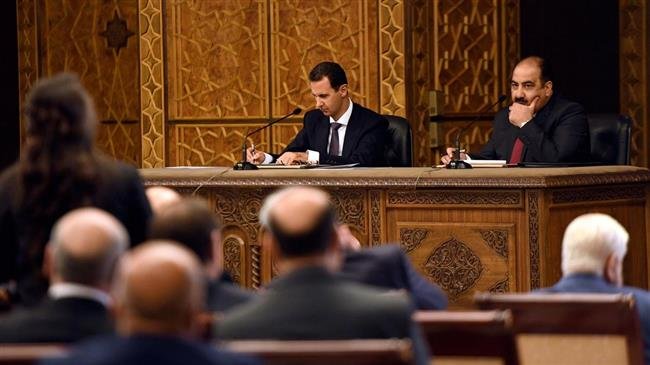
Syrian President Bashar Assad has granted general amnesty to army deserters both within Syria and those outside the country.
A decree published by state media on Tuesday says the amnesty doesn’t include “criminals” and those on the run unless they turn themselves in to authorities. Deserters in Syria have four months to do so; those abroad have six months.
The amnesty could help boost the return of refugees, some of whom have not been able to go back home because they were blacklisted, AP reported.
Government forces have managed over the past year to capture wide areas once held by insurgents, including in southern Syria and the eastern suburbs of the capital, Damascus. The flashpoint is now Syria’s northwestern province of Idlib.
Pro-Russia party wins Latvia elections
Press TV – October 7, 2018
Latvia’s pro-Russia Harmony Party has won the country’s general elections, and will have to negotiate with other parties to form a coalition government.
Harmony won the Saturday parliamentary elections with 19.91 percent of the votes, followed by KPV LV and New Conservative Party, with 14.06 percent with 13.6 percent, respectively.
Turnout in the elections was 54.59 percent, according to the election website.
The pro-European Union (EU), pro-NATO liberal For Development/For! Party came fourth with 12.04 percent.
The rightwing National Alliance gained 11.03 percent. The Greens and Farmers Union — which currently holds the posts of both president and prime minister — won 9.96 percent.
The New Unity took 6.67 percent as the last party crossing the five-percent threshold needed to enter parliament.
The current parliament will keep working until November while parties discuss a new coalition.
No Harmony — until now
Latvia’s political parties had until now always tried to form coalition governments without Harmony in the blend.
The party will now hold 24 seats in the 100-seat parliament. KPV LV and the New Conservatives will jointly hold 31 seats.
The top three parties can muster the 55 seats needed to form a coalition government.
“No coalition combination is possible without Harmony,” the party’s chairman Nils Ushakovs told local media.
50,000 Syrians returned home from Lebanon this year – official
RT | September 26, 2018
Fifty thousand Syrians have returned home from Lebanon so far in 2018, a top Lebanese official said Tuesday.
The number could reach 200,000 in a year’s time if it continues at this rate, according to Abbas Ibrahim, head of Lebanon’s General Security agency. It had organized the return of 25,000 Syrians in coordination with Damascus, and another 25,000 had made their own way home, Reuters reports.
Lebanon is hosting 976,000 registered Syrian refugees, according to UN refugee agency UNHCR.
The government says the total number of Syrians in the country is around 1.5 million.
Trump Says He Accepts Maduro’s Meeting Invitation
teleSUR | September 26, 2018
Less than a day after Venezuelan President Nicolas Maduro invited U.S. President Donald Trump to a meeting based on mutual respect, the U.S. leader said Wednesday he would be open to meeting his Venezuelan counterpart.
Maduro said he hoped to arrange a face-to-face meeting with Trump. The White House responded to a similar request last year by saying such a meeting would happen when the country returned to democracy.
“I’m even willing to talk to President Trump, I think President Trump and I can speak, we understand each other, hopefully one day … the miracle of a face-to-face conversation will take place, between President Donald Trump of the United States and Nicolas Maduro de Venezuela,” the Venezuelan leader said during his speech in Caracas Tuesday.
“I would certainly be open to it, I’m willing to meet with anybody,” Trump said on Wednesday as he arrived at United Nations headquarters after answering a question by a reporter about Maduro’s invitation to meet. “We’re going to take care of Venezuela, if he’s here and he wants to meet, it was not on my mind, it was not on my plate, but if I can help people that’s what I’m here for.”
The comments come just a day after the United States imposed new sanctions on President Maduro’s wife and several of his top allies on Tuesday as Trump also appeared to back a military coup against Maduro in comments he made to reporters Tuesday shortly after his speech at the UNGA.
The latest sanctions are further extending on the already-brutal economic war Washington has been waging against the socialist country with the help of its right-wing allies in the region in an effort to oust the government of President Nicolas Maduro.
“All options are on the table, everyone,” Trump told reporters Wednesday. “The strong ones and the less than strong ones and you know what I mean by strong. Every option is on the table with respect to Venezuela.”
FBI, DOJ To Defy Trump Order; Redactions Planned As Top ‘Deep State’ Dems Demand Insubordination
By Tyler Durden – Zero Hedge – 09/19/2018
Despite President Trump’s Monday order for the “immediate declassification” of sensitive materials related to the Russia investigation, “without redaction,” the agencies involved are planning to do so anyway, according to Bloomberg, citing three people familiar with the matter.

The Justice Department, FBI and Office of the Director of National Intelligence are going through a methodical review and can’t offer a timeline for finishing, said the people, who weren’t authorized to speak publicly about the sensitive matter. –Bloomberg
Trump ordered the DOJ to release the text messages of former FBI Director James Comey, his deputy Andrew McCabe, now-fired special agent Peter Strzok, former FBI attorney Lisa Page and twice-demoted DOJ official Bruce Ohr.
Also ordered released are specific pages from the FBI’s FISA surveillance warrant application on former Trump campaign aide Carter Page, as well as interviews with Ohr.
The DOJ and the FBI are expected to submit proposed redactions to the Office of the Director of National Intelligence – which will prepare a package for Trump to sign off on.
“When the president issues such an order, it triggers a declassification review process that is conducted by various agencies within the intelligence community, in conjunction with the White House counsel, to seek to ensure the safety of America’s national security interests,” a Justice Department spokesman said in a statement. “The department and the Federal Bureau of Investigation are already working with the Director of National Intelligence to comply with the president’s order.”
The agencies are likely to cite national security concerns over revealing classified “sources and methods” pertaining to the Russia investigation – which will put them in direct conflict with Trump’s order. Trump, as president, has the power to override the agencies and declassify material on his own.
Trump’s order to release the documents comes after months of requests from GOP lawmakers, while the DOJ has repeatedly denied their requests for more transparency.
The FBI’s spy…

According to Bloomberg, the DOJ is interpreting Trump’s request to include information about the use of confidential informant (spy) Stephan Halper during the early stages of the Trump-Russia investigation. After taking in over $400,000 from the Obama Pentagon under the auspices of a research contract, Halper befriended and spied on members of the Trump campaign, including aides Carter Page and George Papadopoulos.
Showdown?
Top Congressional Democrats Nancy Pelosi, Chuck Schumer, Adam Schiff and Mark Warner penned a joint letter to ODNI Director Dan Coates, Deputy AG Rod Rosenstein and FBI Director Christopher Wray demanding that the agencies defy President Trump.
Showdown? In letter, Pelosi/Schumer/Schiff/Warner order intel agencies to ignore presidential order on declassification until consulting with Congress. https://t.co/x7JDUJd4t0 pic.twitter.com/o64PC7EEFQ
— Byron York (@ByronYork) September 19, 2018
In the letter, the lawmakers “express profound alarm” at the decision to “intervene in an ongoing law enforcement investigation that may implicate the President himself or those around him.”
“Any decision by your offices to share this material with the President or his lawyers will violate longstanding Department of Justice polices, as well as assurances you have provided to us.”
The letter then demands that the agencies brief the Gang of Eight before releasing the materials “to anyone at the White House.”
In short, prepare for fireworks…
Serial numbers of missile that downed MH17 show it was produced in 1986, owned by Ukraine – Russia
RT | September 17, 2018
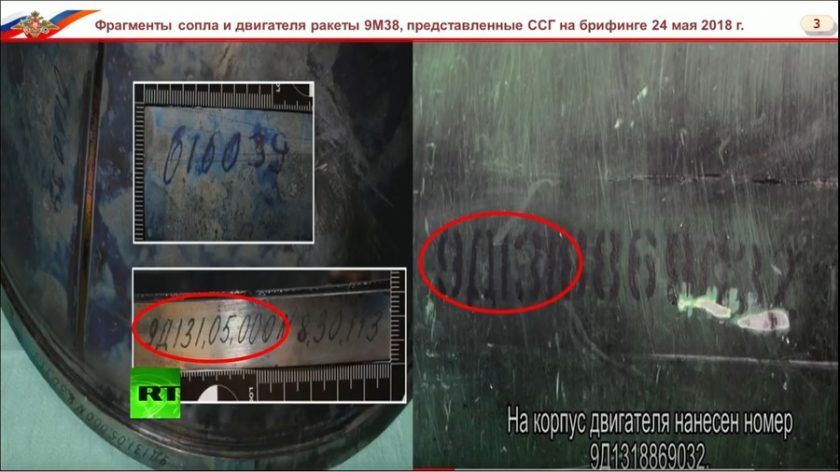
The serial numbers found on debris of the Buk missile which downed Malaysian Airlines Flight MH17 over eastern Ukraine show it was produced in 1986, the Russian military said. The projectile was owned by Ukraine, they added.
There are two serial numbers found on fragments of the missile, which shot down the passenger airliner in June 2014 according to an international team of investigators led by the Netherlands. The numbers were marked on the engine and the nozzle of the missile.
The Russian military on Monday said they had traced them to a missile which had the producer serial number 8868720.
Speaking to journalists, Gen. Nikolay Parshin showed a document trail of the Buk missile. According to the documents, some of which have been declassified for the presentation, it was produced at a military plant in Dolgoprudny in the Moscow region in 1986.
Serial number on engine and nozzle of the missile.
The missile was shipped from the plant on December 29, 1986 and delivered to military unit 20152 located in what is now Ukraine. It is now called 223rd anti-aircraft defense regiment of the Ukrainian armed forces, the report said. The unit took part in Kiev’s crackdown on rebels in eastern Ukraine in June 2014, the general said.
The evidence disproves the accusations by Ukraine and some other parties, which claim that a missile fired by a launcher, secretly delivered from Russia, was responsible for the downing of MH17, the Ministry of Defense report said. All the materials have been sent to the Dutch investigators, the Russian military added.

Missile shipment records found in Russia.
The Russian military also challenges video footage used by the UK-based group Bellingcat, which calls itself a citizen journalism organization, to back its allegations about the delivery of the Buk launcher from Russia. The Defense Ministry showed a video clip with some of the footage, highlighting inconsistencies, which it said proved that the footage had been manipulated to place images of the launcher into background which were not in the original.
The Bellingcat investigation was featured in the latest update by Dutch prosecutors involved in the MH17 investigation, prompting them to directly accuse Russia of providing the launcher and the missile. The Russian military said it decided after this to study the purported trail of photo and video evidence showing the path of the launcher in detail. The Russian video showed an example of how an Abrams tank can be shown to be carried by a trailer in the streets of Ukraine in the same way.

Analysis of Bellingcat footage by Russian experts.
The third part of the presentation was what the Russian officials called a record of intercepted communications of Ukrainian officials discussing, in 2016, the risk of flying through restricted airspace over Ukraine. Among a barrage of complaints one phrase says unless the restrictions are respected “we’ll f***ing f**k up another Malaysian Boeing”.
The Russian military say the complaints came from Col. Ruslan Grinchak, who serves in a brigade responsible for radar control in Ukrainian airspace. His unit tracked the MH17 flight in 2014, so he may have information which is not publicly available about the disaster, and his outburst may have been factual rather than hyperbolic, they suggested.
Gen. Igor Konashenkov, who hosted the briefing, said that Ukraine failed to provide radar data from its stations to the Dutch investigators. He also suggested that archive documents from the Ukrainian unit, which received the Buk missile back in 1986, would be of use to the probe, unless Kiev claims that they are no longer available. He stressed rules are in place which mean that such documents should still be stored in Ukraine.
The Russian military said they had no evidence to disprove a scenario, involving the Ukrainian rebels capturing the missile from the Ukrainian army, but pointed out that Ukrainian officials publicly denied anything like this had ever happened.
Malaysian Airlines flight MH17 was shot down over eastern Ukraine on July 17, 2014, falling in the rebel-held part of the country. The crash claimed the lives of 283 passengers and 15 crew members, most of them Dutch nationals. Russia was blamed by Western media in the first days after the tragedy, even before any evidence had been collected on the ground.
The Joint Investigation Team, which is lead by the Netherlands, includes Ukraine, but not Russia. Moscow believes that the investigation is biased, failing to obtain all necessary evidence from Ukraine and relying on questionable sources while ignoring evidence provided by Russia, which doesn’t fit the theory favored by Kiev. For instance, Moscow said a theory was never tested that the airliner could have been downed by a fighter jet spotted by Russian radar stations near flight MH17. The theory was later proven false by the discovery of debris from the Buk rocket.
Featured Video
Seyed M. Marandi: Toward Total War in the Middle East
or go to
Aletho News Archives – Video-Images
From the Archives
The Geopolitics behind the War in Yemen (I)
By Mahdi Darius NAZEMROAYA | Strategic Culture Foundation | 30.03.2015
The United States and the Kingdom of Saudi Arabia became very uneasy when the Yemenese or Yemenite movement of the Houthi or Ansarallah (meaning the supporters of God in Arabic) gained control of Yemen’s capital, Sanaa/Sana, in September 2014. The US-supported Yemenite President Abd-Rabbuh Manṣour Al-Hadi was humiliatingly forced to share power with the Houthis and the coalition of northern Yemenese tribes that had helped them enter Sana. Al-Hadi declared that negotiations for a Yemeni national unity government would take place and his allies the US and Saudi Arabia tried to use a new national dialogue and mediated talks to co-opt and pacify the Houthis.
The truth has been turned on its head about the war in Yemen. The war and ousting of President Abd-Rabbuh Manṣour Al-Hadi in Yemen are not the results of «Houthi coup» in Yemen. It is the opposite. Al-Hadi was ousted, because with Saudi and US support he tried to backtrack on the power sharing agreements he had made and return Yemen to authoritarian rule. The ousting of President Al-Hadi by the Houthis and their political allies was an unexpected reaction to the takeover Al-Hadi was planning with Washington and the House of Saudi. … continue
Blog Roll
 Aletho News
- HE SAVED LIVES. NOW HE FACES PRISON.
- Israeli lobby seeks to bind US fate to ‘Israel’: Araghchi
- Pakistan-Iran talks secure LNG shipment to Islamabad through Hormuz
- Black Sea grain crisis puts global wheat supplies under pressure
- IRGC air defenses destroy another US MQ-1 drone over Strait of Hormuz
- Imran Khan’s entire immediate family detained in Pakistan ahead of mass protest demanding his release
- EU nation detains former presidential frontrunner
- Leaked: Britain’s Sham Conviction Of Hashim Thaci
- Seyed M. Marandi: U.S. Strike Imminent – Toward Total War in the Middle East
- Russia Voted Under Fire. Washington Is Loading the Tankers.
- If Americans Knew
- Israeli Attacks in Gaza Kill at Least Seven Palestinians Over Three Days, including Woman and Child
- Trump’s militarization of Washington DC as he pursues Israel’s war against Iran
- Why Israel Fears This Searing New Documentary
- Huckabee aide solicited cash gifts from Israelis
- This isn’t sci-fi, AI is already killing people
- ‘The Most Brutal Thing’: Investigation Reveals Execution of Elderly Woman in Rafah
- Inside Israel’s ‘soft’ ethnic cleansing plan for Gaza through the eyes of its victims
- New online database tracks pro-Israel political donations in the United States
- Israeli president pardons soldier convicted for killing wounded Palestinian
- Singer Ed Sheeran says his ‘heart broken’ by Gaza devastation, addresses Macklemore controversy
- No Tricks Zone
- 2025 Nature Paper Claiming Worsening Global Drought Gets RETRACTED …Heavily Flawed
- New Study: ‘Global Drought Shows No Detectable Recent Acceleration Under Climate Warming’
- Economic Masterminds: German Socialists Suggest Taxing Productivity Gains Stemming From Using AI
- The South China Sea Has Not Been Cooperating With The Climate Change Narrative
- Energy Crisis: Germany Enters Heating Season With Historically Low Gas Reserve Fill Levels
- New Study: The Antarctic Ice Sheet Gained Mass From 2020-2024 Due To Staggering Snow And Ice Accumulation
- Study: Ocean Heating Rates From Thousands Of Years Ago ‘Dwarf’ Modern Ocean Heating Rates
- Climate Extremists Target, Attack Large-Scale Power Grid Infrastructure In Germany!
- New Study: Antarctic Ice Melt Has Contributed Less Than 1 Centimeter To Sea Level Rise In The Last 30 Years
- Fear Of Debate: Alarmist German Climate Scientist Calls On Mainstream Media To Discredit Skeptic Voices
 Aletho News