What Do The Winners In Syria Want?
ORIENTAL REVIEW – 17/08/2018
After the liberation of the provinces of Daraa and Quneitra, the Syrian civil war entered a new phase. The available land that was up for grabs by any new liberator — without the need for negotiations with outside actors — was shrinking (one section of the desert under ISIL control does not count – it will soon be cleared out). Only Idlib is left, which is controlled (albeit only in spots and to a limited extent) by Turkey, as well as the environs of al-Tanf and the Kurdish regions located within the American protectorate. And their liberation must be preceded by diplomatic agreements with the protector states.
Decentralization without the Kurds
Negotiations with Turkey took place in Sochi at the very end of July. Those were conducted by Russia and Iran, because Damascus and Ankara have officially severed their diplomatic ties. The Syrian authorities emphasize that the territory of Idlib will eventually be returned to Damascus’s jurisdiction.
No one’s arguing with that. Turkey is not planning on an eternal occupation of Syrian territory, because any benefits from that would be completely outweighed by the financial, PR, and potential military costs Ankara would incur. At some point, the Turkish troops will be forced to quit Syria. But Erdogan has no desire to pull out for free and is demanding a number of conditions be met in return.
These conditions are obvious yet at the same time contradictory. On one hand, Ankara wants to maintain its leverage over post-war Syria, so it is pressing for the local communities (some of which in northwestern and western Syria hold pro-Turkish sentiments) to be granted more rights and powers. On the other hand, the Turks do not want those rights and powers to be extended to the Syrian Kurds, whom Erdogan currently views as one of te biggest threats to Turkey’s national security.
At present it is not possible to meet Turkey’s demands – the constitutional committee is just now getting down to work, and no one understands how to exclude the Kurds from the decentralization process anyway. And ultimately the Iranians are not particularly eager to yield any zones of influence to the Turks — it is clear to everyone that for the foreseeable future, Tehran and Ankara will very likely be competing for the upper hand in the Middle East. In turn, the Turkish authorities are threatening that if Moscow and Tehran give Damascus the green light to conduct a military operation in Idlib without taking Ankara’s interests into account, then Turkey will abandon its attempts to find a resolution under the auspices of the Astana negotiations and could potentially resume military and political assistance to the militants, which might even include sending aid in the form of the Turkish army.
The weak link
As a result, a compromise was apparently reached in Sochi. Damascus, Tehran, and Moscow agreed to temporarily postpone the offensive in Idlib and give Turkey some latitude to handle the threats posed by certain terrorist groups in the region (for example, Hay’at Tahrir al-Sham, which is the latest reincarnation of the al-Nusra Front). In order to do battle against them, the Turks have already established a coalition of militants under Ankara’s control.
However, this compromise is not likely to last long. First of all, because Turkey has thus far been conspicuously unable to cope with the situation (as can be seen, for example, in the regular drone attacks on the Hmeimim air base that originate in Idlib), and there is no guarantee that the situation will change. Second, Damascus is already engaged in a dialog with the Kurds (who have finally become firmly convinced that the Americans will continue to sell them out to the Turks) over the idea of reconciling in exchange for the promise of decentralization. In this, the interests of Damascus and Ankara are partially aligned – the Kurds will not be granted any broad autonomy – but the Syrian authorities are prepared to concede some extremely limited autonomy. And if the Turks object, then – faced with the choice between compromising with the Kurds vs. satisfying the Turks, the Syrians are likely to choose the Kurds.
The Kurds will be chosen because — and this is the third reason — Turkey is the weakest link in the Syrian “triumvirate.” The end of the civil war is not far off, and if Iran and Russia are seeing their own positions strengthening as that day draws nearer, Turkey, on the other hand, is growing weaker. This is being expedited by the rapidly unraveling relationship between Erdogan and the West, as a result of which the Turkish president has been left in a state of semi-isolation, and he cannot afford to damage his relations with Moscow and Tehran as well. Therefore, it is possible that once the desert enclave and the concentration of troops near Idlib have been cleared out in the autumn, the Syrian army will find some pretext for an offensive in the rebel province, and Turkey will remain on the sidelines. The best Ankara can hope for is to have some minor concessions granted.
Syria without Iran?
As for the US — it played no role in the talks in Sochi. “We are sorry that our American colleagues chose to absent themselves from the work aimed at achieving a long-term political settlement in Syria,” noted Alexander Lavrentiev, Russia’s special envoy to Syria. “We remain confident that mutually acceptable solutions can only be worked out through an open dialog.”
However those can also be worked out through a “closed” dialog, which is something that is held regularly (including during the meeting between Putin and Trump). Washington’s position is easy to understand. Donald Trump is ready to pull American troops out of the environs of al-Tanf (in southern Syria), because now that Syrian troops have liberated Deir ez-Zor and the province of Daraa, that base of operations is no longer needed. Trump is also prepared to entertain the possibility of abandoning support for the Syrian Kurds, because they are ill-suited for their role as a force to hold Iran in check and are also creating a host of problems with the Turks.
The only question is — what does Washington want in return? Some media outlets have been circulating the idea that the US and its partner Israel are demanding Iran’s complete withdrawal from Syria. But everyone is well aware that this is unrealistic — the losers cannot order the winner to admit defeat. So it will most likely be an issue of the Iranians having to accept responsibility for pulling their troops and military bases out of the area near the Golan Heights, and Russia having to be responsible for ensuring that Tehran abides by this condition.
So far the negotiations seem to be in their early stages, and one of the key obstacles is the uncertainty of the US and Israel that the Russians will be able to shoulder the responsibility for Iran’s compliance with its obligations once the US troops have been gone from Syria for one, two, or three years. The West believes that Russia’s continued presence in Syria will be on shaky ground, since Iran regards the country as its own domain and will push for outside forces to leave, even friendly ones.
Moscow partially shares this concern (despite being on friendly terms with Tehran), and that is precisely why it is trying to do all it can to use diplomacy to resolve the issue with the Turks themselves, while also pulling Europe into the process of returning the Syrian refugees and restoring the country’s infrastructure. After all, the more outside actors there are in Syria, the less chance that the Iranian leaders in that country will become an undesirable dominating force (which would inevitably happen otherwise). And it makes it even more likely that the process of national reconciliation — which will take more than just a year or two — will culminate in not just an end to the civil confrontation, but also in the long-term peaceful coexistence of the varied peoples and religious sects within Syria.
Riding on Qatari wings, multipolarity arrives in the Middle East
The unscheduled arrival of Sheikh Tamim bin Hamad al-Thani, Qatar’s emir, in the Turkish capital Ankara throws a new light on regional links
By M.K. Bhadrakumar | Asia Times | August 16, 2018
Trust Turkey’s Recep Erdogan to have had a game plan when he challenged the Trump administration and promised that the latter will regret its “unilateralist” policies.
Some pundits thought Russia and China have been inciting him and are lurking in the shadows to escort Erdogan to a brave new world.
Others fancied that the Eurasian integration processes would now take a great leap forward as Turkey embraced Russia, while a few forecast that Turkey would now sell itself cheap for Chinese money.
And then, there is the ubiquitous prediction in such situations that whoever defied the lone super power would come a cropper and Turkey’s fate is going to be miserable.
All these apocalyptic predictions overlooked the fact that Turkey may have a ‘third way’ forward – by strengthening even further its strategic autonomy and optimally exploiting its foreign policy options.
This path opened dramatically on Wednesday with the unscheduled arrival of Sheikh Tamim bin Hamad al-Thani, Qatar’s emir, in the Turkish capital Ankara.
Economic projects, investments, deposits
Qatar’s royal court has announced in a statement that Al-Thani “issued directives that will see the State of Qatar to provide a host of economic projects, investments and deposits” worth $15 billion to support the Turkish economy.
A government source in Ankara told Reuters that the investments would be channeled into Turkish banks and financial markets. Al-Thani confirmed the direct investment plans in Turkey, which he described as having a “productive, strong and solid economy.” He tweeted: “We are together with Turkey and our brothers there, who stand by Qatar and problems of the Ummah.”
Erdogan responded, saying his meeting with al-Thani was “very productive and positive.” Erdogan thanked the emir and Qatari people for standing with Turkey. “Our relations with friendly and brotherly country Qatar will continue to strengthen in many areas,” he tweeted.
At its most obvious level, we may locate the historic Qatari gesture toward Turkey in the matrix of the strong convergence that has accrued in their relationship in recent years in the backdrop of the emergent power dynamic in the Middle East. The axis works on many planes.
On the ideological plane, importantly, the ruling elites in both countries share a unique affinity toward Islamism and in visualizing the Muslim Brotherhood as the vehicle for the democratic transformation of the region. As a result, both have been targeted by Saudi Arabia and the UAE – and Egypt.
Joint military exercises
Until the retreat of Qatar from the Syrian killing fields in recent years, it was collaborating closely with Turkey in the failed project to overthrow the Assad regime. Of course, both countries are strong supporters of Hamas, too.
Turkey keeps a military base in Qatar, which may seem symbolic in comparison with the Western bases, but turned out to be an important lifeline for Doha for pushing back at Saudi Arabia and the UAE in the past couple of years. Turkey and Qatar are also planning to hold joint military exercises this year.
Riyadh and Abu Dhabi resent Erdogan’s projection of power through Qatar into the GCC territory, which they regard as their playpen. The Turks in turn suspect that Emiratis had a hand in the failed coup attempt against Erdogan in July 2016.
Meanwhile, there is great complementarity in the economic sphere between Turkey and Qatar. Turkey has a dynamic export industry and an economy that has registered impressive growth in the last decade, while Qatar has a huge surplus of capital for investment.
One consideration for Doha will be that the Turkish construction industry, which is affected by the present financial crisis in Turkey, is involved in preparing the infrastructure for the FIFA World Cup 2022, which Qatar is hosting.
Fundamentally, therefore, the planned Qatari investment in the Turkish economy holds big resonance for the geopolitics of the Middle East. No doubt, it proclaims the adulthood of the Turkish-Qatari axis. Regional states ranging from Iran to Israel will carefully take note that Al-Thani has come to Erdogan’s help at a critical moment.
Some spice in a heady brew
Yet, the Qatar-Turkey axis will not project itself as a strategic defiance of the United States – although the Qatari emir is well aware of Erdogan’s face-off with the Trump administration. Nonetheless, what adds some spice to this heady brew is that the Trump administration has been unabashedly partial toward the Saudi-Emirati line-up in the Gulf region.
A recent American report even claimed that former US Secretary of State Rex Tillerson lost his job because he stood in the way of a Saudi-Emirati plan to attack Qatar.
At any rate, the apt description for the Turkish-Qatari axis is that it is a manifestation of the arrival of multipolarity in the politics of the Middle East. Both Turkey and Qatar have good relations with Iran.
Although US Central Command is headquartered in Doha, Al-Thani also has a warm relationship Russian President Vladimir Putin.
In the power dynamic of the Middle East, the trend toward multipolarity is poised to accelerate. As time passes, conceivably, even Saudi Arabia and the UAE will see the attraction in strengthening their strategic autonomy.
It will be a fallacy, therefore, to continue viewing the Middle East through the Cold War prism, as most US analysts do, as an area of contestation between the big powers – as if the regional states don’t have a mind of their own or multiple options in developing their policies.
Simply put, Turkey or Iran may lean toward Russia, but can never forge a strategic alliance with Moscow. With a view to pushing back at US pressure, they may lean decidedly toward Moscow from time to time, but they have no intentions of surrendering their strategic autonomy.
But to caricature these countries as passive participants in Russia’s Eurasian integration processes will be delusional.
Russia understands this complicated reality, which is not surprising, given Moscow’s historical memory of its highly problematic relationships with Turkey and Iran through centuries in its imperial history. Thus, the Russian policy is not unduly demanding and is willing to accept their nationalist mindset.
On the other hand, the failure of the US policies lies in Washington’s inability to accept equal relationships and its obsession, ‘You’re either with us, or are against us.’
Make no mistake, the European capitals watch with exasperation the Trump administration’s handling of Erdogan – although he is by no means an easy customer to handle. The point is, European countries are closer to Russia in their appreciation of the complexities of the Middle East. Nor are European countries inclined to view Turkey through the Israeli prism.
Therefore, a concerted Western strategy toward Erdogan under US leadership will remain elusive. Germany’s decision to lift its sanctions against Turkey can be seen in this light. Equally, Erdogan is due to pay a state visit to Germany in September.
Taliban cross the Rubicon
By M K Bhadrakumar | Indian Punchline | August 12, 2018
The Uzbekistan Foreign Ministry announced in a terse statement on Saturday that a Taliban delegation led by the head of its political office in Doha, Sher Mohammad Abbas Stanakzai visited Tashkent last week and the two sides “exchanged views on prospects of the peace process in Afghanistan.”
The Taliban has been somewhat more forthcoming with details. A press statement said that the 5-day visit (August 6-11) took place on the basis of a “formal invitation” from Tashkent and talks were held with Foreign Minister Abdul Aziz Kamilov and the Special Representative of the President of Uzbekistan for Afghanistan Ismatulla Irgashev. The press release added that the two sides “discussed current and future national projects such as security for railroad and power lines,” apart from exchanging views “about the withdrawal of foreign forces and how to achieve peace in Afghanistan.”
The Uzbeks have had direct dealings in the past with the Taliban. Kamilov himself is known to have visited Afghanistan and negotiated with the Taliban government in the late 1990s. Irgashev, too, is a familiar face to the Taliban, having served as deputy foreign minister under Kamilov. But this is the first time that a Taliban delegation has been invited to visit Tashkent for formal talks at the Uzbek Foreign Ministry.
This is an extraordinary development. It significantly enhances Taliban’s regional profile and standing and is precedent setting.
The relations between Tashkent and the Afghan government led by Ashraf Ghani have been exceptionally warm of late. The bilateral exchanges intensified in the past year with Uzbek companies picking up lucrative contracts in northern Afghanistan. The US has actively encouraged such collaboration. Most certainly, Washington promoted the Tashkent Conference on Afghanistan on March 27, which was attended among others by Russian Foreign Minister Sergey Lavrov and the US Undersecretary of State Thomas Shannon. The event was intended to marshal some degree of regional consensus behind an “Afghan-led, Afghan controlled” peace process without any preconditions regarding the presence of US troops in Afghanistan.
As a gesture of gratitude, President Donald Trump rewarded Uzbek President Shavkat Mirziyoyev with an invitation to visit the White House on May 16, the first-ever visit of that kind. Indeed, things have been going splendidly well in the US-Afghan-Uzbek triangle. During a visit to Kabul on July 9 Kamilov discussed with Ghani several big investment projects such as a free trade zone spread over 3000 hectares on the Uzbek-Afghan border, a $500 million railway project to connect Mazar-i-Sharif with Herat (linking northern and western Afghanistan), establishment of 6 textile factories in Afghanistan by Uzbek companies and so on.
However, the Uzbeks have a reputation for making their foreign policy moves very cautiously and therefore, the meeting in Tashkent last week should not be seen as signifying a shift in the Uzbek policies toward Afghanistan.To be sure, Tashkent has closely coordinated with Kabul and Washington. Interestingly, Kamilov also had made a phone call to Lavrov on July 31. The crisply worded readout from the Russian Foreign Ministry merely said that the two ministers “exchanged opinions on topical bilateral matters and cooperation between Russia and Uzbekistan on the international agenda.” Quite obviously, consistent with the Uzbek style of diplomacy, Tashkent touched base with Moscow before the Taliban arrived.
Ostensibly, therefore, Tashkent is following up on the offer made by Mirzoyiev after the Tashkent conference in March when he had said: “We stand ready to create all necessary conditions, at any stage of the peace process, to arrange direct talks between the government of Afghanistan and Taliban movement.” Clearly, Washington has encouraged Tashkent to be a peace broker between the Afghan government and the Taliban. Following the first-ever direct talks between the Taliban and US officials at Doha last month, a second round is expected in September. The meeting at Tashkent comes in between.
However, it is highly improbable that the Taliban will accept Ghani as its interlocutor. Tashkent must be quite aware of the strong undercurrents in regional politics as well. Therefore, trust Tashkent to have made its own calculations in self-interest, too.
The point is, there is dire necessity today for Tashkent to maintain a direct line to the Taliban. The security situation in the Amu Darya region bordering Uzbekistan is steadily deteriorating. The growing presence of Islamist State-Khorasan (ISK) in northern Afghanistan worries Uzbekistan, since its ranks have a preponderance of fighters drawn from the radical Islamic Movement of Uzbekistan, which is sworn to establish an Islamic Caliphate in Central Asia.
Meanwhile, Ghani’s ill-advised standoff with the ethnic Uzbek leader in Amu Darya, Rashid Dostum (who was forced into exile in Turkey for a year and was prevented from returning. Dostum’s prolonged absence seriously destabilized the northern region, which also worked to the advantage of the ISK. Ghani finally made peace with Dostum and beseeched him to return – and eventually went overboard by giving him a grand ceremonial welcome on arrival in Kabul last month. But the ground realities in northern Afghanistan have changed phenomenally. The old stability that Dostum provided has disappeared.
There was a time in the 1990s when the Uzbek leadership of late president Islam Karimov had regarded Dostum as its Praetorian guard in the Amu Darya region. He used to be lionized and lavishly funded by the Uzbek intelligence during his regal visits to Tashkent. But Tashkent summarily dumped him once the US moved into Afghanistan in 2001 and co-opted him as their warlord. (The US too subsequently dumped him.)
In sum, Dostum is today a freewheeling entity available to the highest bidder and is no more the uncrowned king of the Amu Darya. And yet, he is still locked in a blood feud with the Taliban dating back to 2001 when in a bloody massacre he slaughtered a few thousands Taliban fighters who had surrendered in the northern provinces following the US intervention and were assured of safe passage to Pakistan.
Tashkent seems disinterested in Dostum. On the other hand, the Taliban have emerged today as the most promising counterweight to the ISK in the Amu Darya region. In such murky situations, Tashkent never loses clarity of purpose. Realism always prevails. Conceivably, Tashkent is beginning to see the Taliban as the most meaningful Afghan interlocutor for today and tomorrow – and, perhaps, forever.
Of course, for Taliban, this is like hitting the jackpot. The invitation from the foreign minister of an important neighboring country to hold direct talks is a novel experience. It is a game changer, no doubt. The Taliban have crossed the Rubicon in their long search for gaining international legitimacy.
Venezuelan Opposition Calls for New Presidential Vote After Maduro Drone Attack
Sputnik – August 8, 2018
Venezuela’s opposition leader Julio Borges has called on Caracas to hold a new presidential vote to elect a new leader who will, in turn, form a new government that will bring order to the country after the recent assassination attempt on President Nicolas Maduro.
“There is a clear confusion with what happened over the weekend, but it has been demonstrated, once again, the disconnection and detachment that exists between the Venezuelan people and those who are in power today … The only way to stop the violence, anarchy, and chaos that exists in Venezuela is to allow the people to choose a different government through free elections,” Borges said Tuesday in a statement distributed by the Justice First.
He added that the Venezuelan population was confused and did not believe the government’s version of who was responsible for the assassination attempt.
On Tuesday, Maduro accused Borges, who is a former president of the country’s National Assembly and co-founder of Venezuela’s main opposition party Justice First, of being linked to the recent drone attack that attempted to kill the Venezuelan president.
On Saturday, a military parade in the Venezuelan capital of Caracas attended by Maduro was interrupted by what the authorities said was an attempt on the life of the president. Venezuela’s Information Minister Jorge Rodriguez has said several drones detonated close to where the president was giving a speech. The president was unharmed, but seven soldiers sustained injuries.
Maduro blamed the attack on Venezuelan right-wing opposition, Colombia, and individuals living in the United States. Both Washington and Bogota have denied any involvement in the incident.
Color Revolution in the Caucasus rattles Russian leaders
Armenia’s new Prime Minister has targeted Moscow’s confidantes in a corruption crackdown and angered the Kremlin by making overtures to NATO
By M.K. Bhadrakumar | Asia Times | August 8, 2018
No two “color revolutions” have been the same, although the anatomy may bear similarity. This explains why Russia continues to face a problem in calibrating its response to emerging revolutionary tides in its backyard.
Russia fumbled in Georgia (2003) and Ukraine (2004 and 2014), but digested the ‘color revolutions’ in Kyrgyzstan in 2005 and 2010. Of course, circumstances were different: Kyrgyzstan is a landlocked country.
The Moscow elite’s eternal dilemma has been that, when the defining moment came, the West invariably injected geopolitics into color revolutions in the post-Soviet space in a concerted strategy to encircle Russia with an arc of hostile states.
In this complex backdrop of historical uncertainty, Russia is unsure whether it made an error of judgment apropos the “Velvet Revolution” in Armenia, which shot a 42-year-old former journalist and previously uninspiring opposition politician, Nikol Pashinyan, to power. After a meteoric three-week rise he became prime minister in May.
The Velvet Revolution bore traits of a color revolution – although traces of outside interference were indistinguishable. Even as Pashinyan rode the revolutionary wave, Moscow chose not to cast aspersions on his stated agenda, that cleaning up the Augean stables in his country was his sole objective and his mission had no foreign-policy overtones.
Moscow’s approach probably ended up helping him climb the ladders of power, with the entrenched ruling party in Armenia meekly stepping aside to make way for him as the new prime minister.
Pashinyan pledges loyalty
Moscow appeared to accept at face value Pashinyan’s pledges of fealty. President Vladimir Putin was the first foreign leader to congratulate Pashinyan on May 8 when the ruling party elected him as the new head of government in a parliamentary vote.
Putin said: “I hope that your performance as the head of government will contribute to efforts to further strengthen friendly, allied relations between our countries, partnership within the Commonwealth of Independent States, the Eurasian Economic Union and the Collective Security Treaty Organization.”
Pashinyan nicely played along. Indeed, his first face-to-face with Putin in Sochi, only six days later on the sidelines of the summit meeting of the Eurasian Economic Union (EEU), had an effusive tone.
Pashinyan thanked Putin for what he called Moscow’s “balanced position” during the color revolution and reassured the Kremlin of the immutability of the Armenian-Russian “strategic alliance”.
In the presence of reporters, he told Putin that “the strategic alliance relations between Armenia and Russia” required “no discussion” and “there is a consensus on this issue in Armenia. I think that nobody in our country has or will cast doubt on the strategic importance of Armenian-Russian relations.”
Russia maintains a military base in Armenia.
Putin wished him success and said he hoped that bilateral ties “will develop just as steadily as they have up to now.” Putin added that Russia “views Armenia as our closest partner and ally in the region” on both economic and security issues.”
Moscow confidantes targeted
One week into the Velvet Revolution, it all seemed as if the Russian-Armenian alliance couldn’t be in better shape. But then, the sky began getting overcast and a stillness began descending in the air.
On May 10, Pashinyan began what appeared as a shake-up of the administration. It quickly snowballed into a veritable purge aimed at systemic change. He also launched a crackdown on public corruption, which has since made him a cult figure.
In a matter of three months his administration caught up with the two ex-presidents, Robert Kocharyan and Serzh Sargsyan, and the influential mayor of Yerevan Taron Margaryan, who were all Moscow’s confidantes in Yerevan.
Then, on July 27, Pashinyan struck hard by implicating the incumbent Secretary-General of the Collective Security Treaty Organization (CSTO) Yuri Khachaturov on charges dating back to his past assignment as Chief of the General Staff of Armenia under Sargsyan. The general is presently based in Moscow as the head of the Russia-led alliance.
That was when Moscow sat up.
On July 31, Foreign Minister Sergei Lavrov said Moscow was “concerned” that Armenia’s new leadership was making politically motivated moves against former leaders. Lavrov said: “The events of the last few days… contradict the recent declarations of the new Armenian leadership that it was not planning to pursue its predecessors on political grounds.”
Lavrov added: “Moscow, as an ally of Yerevan, has always had an interest in the stability of the Armenian state, and therefore what is happening there must be of concern to us.”
He disclosed that Moscow had repeatedly raised its concerns with Yerevan and expected a “constructive” response. These remarks amount to a rebuke.
NATO outreach spurs Russian warning
Meanwhile, what probably rung alarm bells in Moscow was that Pashinyan also began making overtures to the North Atlantic Treaty Organization (NATO). On the sidelines of the alliance’s summit on July 12 in Brussels, to which he was invited, Pashinyan said: “It would be very useful if NATO will send a strong message to Azerbaijan that any attempt to solve the Nagorno-Karabakh conflict using force will meet a strong reaction from the international community.”
In effect, he invited the Western alliance to get involved in the Southern Caucasus, which Russia traditionally regards as its sphere of influence.
While in Brussels, Pashinyan met the leaders of Germany, France, Canada among others, apart from a having a brief conversation with US President Donald Trump. Importantly, he began stressing the centrality of NATO as a forum for Armenia’s interactions with Georgia.
On August 2, the influential Moscow daily Kommersant wrote that Pashinyan’s moves had “driven a wedge into Moscow’s relations with Yerevan and may set the two countries at loggerheads even more”. The daily noted, citing Russian security officials, that the charges laid against CSTO Secretary General Khachaturov caused “outrage” in Moscow, because it “deals a blow to the image of the Russian-led military and political bloc”. It hinted at Western interference.
Equally, Moscow has taken exception to Armenia’s participation in the NATO exercises currently underway in Georgia. (Armenia is a member of the CSTO.)
In a hard-hitting statement on Friday, Russian Foreign Ministry spokesperson Maria Zakharova said the NATO exercise in Georgia aimed to “project power pressure, chiefly over South Ossetia, Abkhazia and Russia” and can only result in an “escalation of tensions.” Zakharova regretted that “Georgia’s neighboring countries are involved in these drills on various pretexts.”
On Monday, Russian Prime Minister Dmitry Medvedev said Georgia’s accession to NATO may trigger “a terrible conflict” and lead to catastrophic consequences. He closely echoed Putin’s stern warning last month: “We will respond proportionally to aggressive moves that pose a direct threat to Russia. Our [NATO] counterparts who bet on rising tensions, are trying to bring, say, Ukraine and Georgia into the alliance’s military orbit but they should think about the possible consequences of such an irresponsible policy.”
Clearly, Moscow’s preference would have been that Pashinyan pragmatically keeps Armenia in Russia’s orbit – and NATO out of the Caucasus. But the Velvet Revolution has mutated and Moscow’s dismal experience is that in such defining moments, environmental pressures cause changes to the genetic structure of color revolutions, resulting in variant DNA forms.
Yemen’s Houthis ready to unilaterally halt attacks in Red Sea – official
RT | July 31, 2018
Yemen’s Houthi group said on Tuesday it is ready to unilaterally halt attacks in the Red Sea to support peace efforts.
Saudi Arabia earlier suspended oil exports through a strategic Red Sea channel following an attack on crude tankers last week.
Yemen, where a Saudi-led coalition has been battling the Houthi movement in a three-year-old war, borders the Bab al-Mandeb strait, which is one of the world’s most important trade routes for oil tankers.
“The unilateral halt in naval military operations will be for a limited time period and could be extended and include all fronts if this move is reciprocated by the leadership of the coalition,” said the head of the Houthi supreme revolutionary committee, Mohammed Ali al-Houthi.
It was not clear whether the group would halt its attacks immediately or how long the cessation would last, Reuters said.
Kurds reach deal with Damascus to end Syria conflict
Press TV – July 28, 2018
An alliance of Kurdish and Arab militants in Syria says it has come to an agreement with the Syrian government to develop negotiations to end violence in Syria.
The announcement was made after the so-called Syrian Democratic Council (SDC), the political wing of the Syrian Democratic Forces (SDF), sent a delegation to Damascus for talks with Syrian officials earlier this week. The SDF, itself, is a US-backed coalition of mainly Kurdish militants.
The SDC said in a statement Saturday that it had agreed with the government of the Syrian President Bashar al-Assad to form committees that would “chart a roadmap to a democratic, decentralized Syria.”
The SDC delegation visited Damascus for the first time after President Assad said that he was “opening doors” for negotiations with Syrian Kurds that he said had “apparently become wary” of their unpredictable ally – the United States.
The Kurds then expressed readiness to hand over control of the Eastern Euphrates to the government after Washington withheld its support for the Kurdish militants in the northern Syrian cities of Manbij and Afrin.
The SDC’s co-chair Riad Darar said on Friday the talks with Damascus were aimed at “working towards a settlement for northern Syria,” as it was time to “solve our problems ourselves.”
The group, which is being supported by Washington, has already managed to form an autonomous administration in northern Syria during the country’s seven-year conflict.
Washington’s conflicting plans in Syria, however, have now prompted the Kurdish militants to turn to the government in Damascus.
Their presence in the area near the Turkish border has been a source of tension between the US and Turkey.
Ankara, which considers the Syrian Kurdish militants as an extension of Kurdistan Workers’ Party (PKK) terrorists, has even threatened to “destroy all terror nests,” near the Syrian border.
It has vowed not to allow Kurdish groups to dominate Turkish border with Syria.
Refugees gather in Shebaa for return to Syria
On Saturday, hundreds of Syrian refugees residing in Hasbaya’s Shebaa and western Bekaa gathered in a schoolyard in Shebaa, waiting for buses departing to Syria, provided by the Syrian government.
The state-run National News Agency estimated that nearly 900 refugees assembled at Shebaa High School at 9 a.m., while General Security was present on site checking the names of the departees.
The buses are set to stop at the Masnaa border point before crossing into Syria. The group marks the fourth to depart from Lebanon.
Several groups had previously departed, particularly from the northeastern town of Arsal in initiatives organized by General Security.
Kurdish delegation in Damascus for peace talks
Press TV – July 27, 2018
An alliance of Kurdish and Arab militants in Syria has sent a delegation to the Syrian capital for talks with Syrian government officials.
The so-called Syrian Democratic Council (SDC), which is linked to the Syrian Democratic Forces (SDF) — a US-backed coalition of mainly Kurdish militants holding a grip on northeastern Syria — sent the delegation to Damascus on Wednesday, according to SDC co-chair Riad Darar.
The delegation, led by executive head of SDC Ilham Ahmed, was expected to discuss matters of service provision in the areas controlled by the Kurdish group, but “the talks might widen to political and security matters,” Darar told Reuters on Friday.
“This is certainly the first visit that happened,” he added.
The militants are allied with the United States and French troops deployed to Syria under the pretext of fighting Daesh.
Chief among their demands is having an autonomous region within the Syrian borders. Darar, however, said that the outcome of the meetings is not yet clear, and that he did not know which Syrian officials will be meeting with the Kurdish delegation.
He also did not clarify how long the delegation will stay in Damascus.
Their Kurdish militant group, once called by President Bashar al-Assad as “traitors” to the nation, announced last month that it was ready for “unconditional” peace talks with the government amid the Syrian army’s major gains against the foreign-backed terrorist groups.
Assad said back in May that he was “opening doors” for negotiations with the SDF, who have apparently become wary of their unpredictable “ally”, the United States.
In an interview with Russia’s RT television network, Assad said, “we started now opening doors for negotiations, because the majority of them are Syrians, supposedly they like their country, they don’t like to be puppets to any foreigners. If not, we’re going to resort… to liberating those areas by force.”
According to Syrian media, the Kurds had expressed readiness to hand over control of the Eastern Euphrates to the government after Washington withheld its support for the Kurdish militants in the northern Syrian cities of Manbij and Afrin.
The presence of the Kurdish militants in the area have been a source of tension between the US and Turkey. Last month, the two sides reached a deal about the withdrawal of the Kurds from Manbij.
The Kurds have stressed that that they do not seek independence, but say they want a political deal to safeguard an autonomous administration which is now under their control in the north.
US blocks IOC proposal to allow sports equipment exports to North Korea
RT | July 26, 2018
The US has blocked a request by the International Olympic Committee (IOC) to the United Nations Security Council Committee to exclude sports equipment from the list of items prohibited for export to North Korea.
“The United States was the only one to object against approving the IOC president’s request by the UN Security Council Committee,” TASS reported, citing sources familiar with the situation.
IOC head Thomas Bach initiated the request, asking the UN Security Council Committee to allow export of sports gear to the country, which has been under sanctions since 2006 over its nuclear program and missile tests.
The IOC chief stressed that modern sports equipment would help North Korean athletes prepare fully for global sports events, including the Olympic Games.
The 2018 Winter Olympics in South Korea saw a remarkable breakthrough in the strained relations between the two Koreas, with their athletes marching together under a joint Korean flag at the opening ceremony.
A United Korean women’s hockey team took part in the Olympic tournament, marking a thaw in relations between the two neighboring states after decades of mutual hostility.
Back then the IOC chief hailed North Korea’s decision to send delegation to the Olympics, adding that it was “powerful message of peace” to the world.
Two Politicians from President-Elect’s Party Killed in Mexico – Reports
Sputnik – 21.07.2018
MEXICO CITY – Two politicians from the young Morena party founded by Mexico’s leftist president-elect were killed on Friday, local media reported.
Eliseo Delgado Sanchez, the newly-elected mayor of Buenavista in Michoacan state, was shot dead on the steps of the town hall, the Excelsior news website reported. Earlier on Friday, gunmen reportedly opened fire on the car of Zenon Cocula Fierro, a city councillor in Tlaquepaque in Jalisco state.
Mexican authorities estimated last week that a total of 523 politicians and government officials were assassinated in the country during the recent election campaign.
According to the report of the Mexican authorities, covering the period from September 8 to July 1, as many as 152 politicians were killed, including 48 preparing to become candidates for elective posts, and 371 government officials at different levels.
On average, there were 1.7 assassinations of politicians and officials per day. The total number of attempts reached 1,200.
On the Election Day, July 1, as many as 138 attacks and seven murders of politicians in 26 states of the country were registered.
The presidential election was won by the left-wing candidate Andres Manuel Lopez Obrador. He will take office on December 1. Lopez Obrador has already promised to change the vector of the fight against crime that swept the Latin American country amid the war with drug cartels, from forceful to social.
Ex-CIA Chief, US Officials Slam Trump-Putin Presser as ‘Treason,’ ‘Weakness’

Sputnik – 16.07.2018
The US President and his Russian counterpart met in Helsinki to discuss a wide array of issues, including bilateral relations between the two countries, their cooperation in Syria and alleged Russian meddling in the 2016 US presidential election.
Former CIA Director John Brennan slammed US President Trump’s “performance” during the press conference after his meeting with Putin in Helsinki as “treasonous” on his Twitter. He also claimed that Trump is “in the pocket” of Russian President Vladimir Putin and said that he had exceeded the “threshold of high crimes and misdemeanors.”
He also expressed skepticism as to why the two presidents discussed matters in private, stating that Trump lacks credibility and is probably hiding something from his advisers.
Brennan also called on Trump’s team to resign in protest against his “performance” in Helsinki on July 16, saying that no “good American patriot” would stay with Trump after that.
“He criticized American citizens, Secretary Clinton, and others as opposed to really taking advantage of a world stage with all the world’s eyes upon them to point out how unacceptable Russia’s behavior and interference in our election […] But he just shirked those responsibilities,” Brennan said.
A number of other US officials have also scolded the US president’s press conference in Helsinki. US Senator John McCain added to the wave of accusations that Trump’s performance at the press conference with Putin was “a tragic mistake.” He also slammed the US president for failing “to defend America.”
“Not only did President Trump fail to speak the truth about an adversary; but speaking for America to the world, our president failed to defend all that makes us who we are — a republic of free people dedicated to the cause of liberty at home and abroad,” McCain wrote on his website.
Former US Ambassador to Moscow Michael McFaul, a strong Kremlin critic banned from Russia over harming bilateral ties, mocked Trump’s statements in which he said that the US has been to blame for deteriorating relations between America and Russia. McFaul suggested that Trump should have blamed Moscow instead.
“For President Trump to just insinuate as he just did in his initial remarks today, well bygones — let’s forget about all that stuff and move on because I want a great relationship with you, Putin. That’s just not serving America’s national interest, in my view,” former envoy said.
Democrat Senator Jeff Merkley suggested in an interview with BuzzFeed News that Moscow is “likely” to have compromising material on Trump, claiming that it is a “standard strategy of Russia” for important visitors to the country. He further speculated that Moscow might have the so called “pee tape” allegedly depicting Trump ordering two prostitutes to urinate on a bed in at the Moscow Ritz-Carlton, where Obama’s family once stayed.
US Senator Lindsey Graham slammed Trumps speech at the press conference by saying that it was a “missed opportunity” to hold Russia accountable for the alleged meddling in the 2016 election. He further claimed that the speech will be seen as a sign of weakness in Kremlin, going on to suggest that Trump should check the soccer ball that Putin gave him during the conference to see if it is wired.
US Republican Senator Bob Corker said in a comment regarding the Helsinki summit that he wants the US to improve relations with Russia, but added that Trump should have been more forceful when he addressed issues with Putin.
US House Minority Leader Nancy Pelosi criticized Trump for not confronting Putin in regards to alleged Russian meddling in the presidential election, days after the Justice Department accused 12 Russian intelligence officers of involvement in the interference.
US President Donald Trump and his Russian counterpart Vladimir Putin met in Helsinki on July 16 and discussed an array of international issues, including the countries’ bilateral relations. The two presidents called the meeting highly “successful” and “productive,” saying that it was just the first step.
Trump and Putin agreed to enhance their cooperation in Syria, particularly regarding the delivery of humanitarian aid and securing the Israeli-Syrian border. Both presidents also pledged to continue the ongoing cooperation between their armed forces in Syria and on preventing terrorist attacks.
The two leaders also discussed the alleged Russian meddling in the US presidential elections. During the press conference, Putin assured that Moscow had not colluded with Trump’s election campaign and would never intervene in the US electoral process.
Trump said that Russia had “zero reasons” to meddle in the elections and said that his victory was due to his “brilliant” campaign. The US president also scolded the Democratic Party and Hillary Clinton for fueling special counsel Mueller’s investigation into the alleged meddling, saying that it has negatively affected US-Russian relations.
Have Mueller and Rosenstein Finally Gone Too Far?
By Thomas L. Knapp | The Garrison Center | July 15, 2018
Friday the 13th is presumably always someone’s unlucky day. Just whose may not be obvious at the time, but I suspect that “Russiagate” special counsel Robert Mueller and Deputy US Attorney General Rod Rosenstein already regret picking Friday, July 13 to announce the indictments of 12 Russian intelligence officers on charges relating to an embarrassing 2016 leak of Democratic National Committee emails. They should.
Legally, the indictments are of almost no value. Those indicted will never be extradited to the US for trial, and the case that an external “hack” — as opposed to an internal DNC leak — even occurred is weak at best, if for no other reason than that the DNC denied the FBI access to its servers, instead commissioning a private “cybersecurity analysis” to reach the conclusion it wanted reached before hectoring government investigators to join that conclusion.
Diplomatically, on the other hand, the indictments and the timing of the announcement were a veritable pipe bomb, thrown into preparations for a scheduled Helsinki summit between US President Donald Trump and Russian President Vladimir Putin.
House Republicans, already incensed with Rosenstein over his attempts to stonewall their probe into the Democratic Party’s use of the FBI as a proprietary political hit squad, are planning a renewed effort to impeach him. If he goes down, Mueller likely does as well. And at this point, it would take a heck of an actor to argue with a straight face that the effort is unjustified.
Their timing was clearly intentional. Their intent was transparently political. Mueller and Rosenstein were attempting to hijack the Trump-Putin summit for the purpose of depriving Trump of any possible “wins” that might come out of it.
They secured and and announced the indictments “with intent to influence the measures or conduct of any foreign government or of any officer or agent thereof, in relation to any disputes or controversies with the United States, or to defeat the measures of the United States.”
That language is from 1799’s Logan Act (18 U.S.C § 953). Its constitutionality is suspect and no one has ever been indicted under it in the 219 years since its passage. Rosenstein and Mueller aren’t likely to be the first two, and may not even technically have violated its letter. But I’d be hard put to name a more obvious, intentional, or flagrant act in violation of its spirit.
Rosenstein and Mueller are attempting to conduct foreign policy by special prosecutor, a way of doing things found nowhere in the US Constitution. Impeachment or firing should be the least of their worries. I’m guessing that there are laws other than the Logan Act that could, and should, be invoked to have them fitted for orange coveralls and leg irons pending an appointment with a judge.
That they even have defenders is proof positive that some of Trump’s most prominent opponents consider “rule of law” a quaint and empty concept — a useful slogan, nothing more — even as they continually, casually, and hypocritically invoke it whenever they think doing so might politically disadvantage him.
Thomas L. Knapp (Twitter: @thomaslknapp) is director and senior news analyst at the William Lloyd Garrison Center for Libertarian Advocacy Journalism (thegarrisoncenter.org).
Featured Video
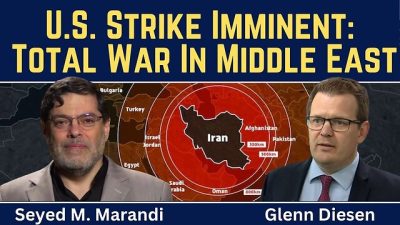
Seyed M. Marandi: Toward Total War in the Middle East
or go to
Aletho News Archives – Video-Images
From the Archives
The Geopolitics behind the War in Yemen (I)
By Mahdi Darius NAZEMROAYA | Strategic Culture Foundation | 30.03.2015
The United States and the Kingdom of Saudi Arabia became very uneasy when the Yemenese or Yemenite movement of the Houthi or Ansarallah (meaning the supporters of God in Arabic) gained control of Yemen’s capital, Sanaa/Sana, in September 2014. The US-supported Yemenite President Abd-Rabbuh Manṣour Al-Hadi was humiliatingly forced to share power with the Houthis and the coalition of northern Yemenese tribes that had helped them enter Sana. Al-Hadi declared that negotiations for a Yemeni national unity government would take place and his allies the US and Saudi Arabia tried to use a new national dialogue and mediated talks to co-opt and pacify the Houthis.
The truth has been turned on its head about the war in Yemen. The war and ousting of President Abd-Rabbuh Manṣour Al-Hadi in Yemen are not the results of «Houthi coup» in Yemen. It is the opposite. Al-Hadi was ousted, because with Saudi and US support he tried to backtrack on the power sharing agreements he had made and return Yemen to authoritarian rule. The ousting of President Al-Hadi by the Houthis and their political allies was an unexpected reaction to the takeover Al-Hadi was planning with Washington and the House of Saudi. … continue
Blog Roll
 Aletho News
- HE SAVED LIVES. NOW HE FACES PRISON.
- Israeli lobby seeks to bind US fate to ‘Israel’: Araghchi
- Pakistan-Iran talks secure LNG shipment to Islamabad through Hormuz
- Black Sea grain crisis puts global wheat supplies under pressure
- IRGC air defenses destroy another US MQ-1 drone over Strait of Hormuz
- Imran Khan’s entire immediate family detained in Pakistan ahead of mass protest demanding his release
- EU nation detains former presidential frontrunner
- Leaked: Britain’s Sham Conviction Of Hashim Thaci
- Seyed M. Marandi: U.S. Strike Imminent – Toward Total War in the Middle East
- Russia Voted Under Fire. Washington Is Loading the Tankers.
- If Americans Knew
- Israeli Attacks in Gaza Kill at Least Seven Palestinians Over Three Days, including Woman and Child
- Trump’s militarization of Washington DC as he pursues Israel’s war against Iran
- Why Israel Fears This Searing New Documentary
- Huckabee aide solicited cash gifts from Israelis
- This isn’t sci-fi, AI is already killing people
- ‘The Most Brutal Thing’: Investigation Reveals Execution of Elderly Woman in Rafah
- Inside Israel’s ‘soft’ ethnic cleansing plan for Gaza through the eyes of its victims
- New online database tracks pro-Israel political donations in the United States
- Israeli president pardons soldier convicted for killing wounded Palestinian
- Singer Ed Sheeran says his ‘heart broken’ by Gaza devastation, addresses Macklemore controversy
- No Tricks Zone
- 2025 Nature Paper Claiming Worsening Global Drought Gets RETRACTED …Heavily Flawed
- New Study: ‘Global Drought Shows No Detectable Recent Acceleration Under Climate Warming’
- Economic Masterminds: German Socialists Suggest Taxing Productivity Gains Stemming From Using AI
- The South China Sea Has Not Been Cooperating With The Climate Change Narrative
- Energy Crisis: Germany Enters Heating Season With Historically Low Gas Reserve Fill Levels
- New Study: The Antarctic Ice Sheet Gained Mass From 2020-2024 Due To Staggering Snow And Ice Accumulation
- Study: Ocean Heating Rates From Thousands Of Years Ago ‘Dwarf’ Modern Ocean Heating Rates
- Climate Extremists Target, Attack Large-Scale Power Grid Infrastructure In Germany!
- New Study: Antarctic Ice Melt Has Contributed Less Than 1 Centimeter To Sea Level Rise In The Last 30 Years
- Fear Of Debate: Alarmist German Climate Scientist Calls On Mainstream Media To Discredit Skeptic Voices
 Aletho News