NATO’s Dead?
If so, who killed it: Obama, Putin, Or Trump?
By Andrew Korbyko – InfoRoss – 06.07.2018
NATO, as the world knew it, is dead, and the organization’s demise is attributable to the combination of President Putin’s deft diplomacy in advancing the Russian-Turkish rapprochement and his American counterpart’s revolutionary reconceptualization of the very essence of the alliance, both of which wouldn’t have been possible had it not been for Obama.
NATO, as it was previously conceived of for decades, is dead, and while it might be reborn in a different format sometime in the future, its previous model has exhausted its purpose and is entering into the dustbin of history. The organization still officially exists, but everything about it is changing to the point where it might soon become unrecognizable. The consistently anti-Russian driving force behind the bloc has been decisively neutralized by President Putin’s deft diplomacy in winning over its second-largest military member, Turkey, as Russia’s newest strategic partner, while Trump’s revolutionary reconceptualization of the alliance as an equal collection of states combating the asymmetrical security challenges of terrorism and illegal migration will fundamentally transform what it means to be a NATO member.
The Shadow Of Obama
Before going through the post-mortem in detail, it’s worthwhile to describe how Obama’s shadow hangs heavy in the sense that he orchestrated the three greatest mistakes that inadvertently led to NATO’s demise. The 2011 NATO War on Libya has the chance of being seen in hindsight as the final flash of a fast- fading star, with its “shock-and-awe” destruction of the former Jamahiriya going down in history as perhaps the last real instance of the bloc’s members working in coordination with one another to conventionally wage war against a targeted state. The self-congratulatory pomp that followed this brief military campaign has since been proven to have been premature because of the country’s ongoing civil war and role as a transit state for facilitating the flood of hundreds of thousands of migrants into Europe, which sparked its own crisis that has since led to the rise of EuroRealist populists in the continent.
In addition, the Libyan model of Hybrid War destabilization was also applied to Syria, albeit minus the final conventional warfare form, and this exacerbated the Migrant Crisis to the point of no return in guaranteeing the inevitable rise of right-wing politicians in Europe. Taken together, the Wars on Libya and Syria, waged in different manners but nevertheless following the same neo-imperialist regime change form, generated unprecedented humanitarian blowback to the point of triggering far-reaching political changes in NATO’s EU members, making many of them reconsider the official anti-Russian purpose of the bloc when it could be better put to use in defending the organization’s southern shores from swarms of migrants. For as “constructive” of an idea as this may have been, it led to deep divisions within the EU itself between the pro-migrant Western countries, the anti-migrant Central & Eastern European ones, and the anti-Russian Baltic States, Poland, and Romania.
While these intra-NATO disagreements were percolating, Obama made another massive mistake in giving the greenlight for the failed pro-American coup attempt against Turkish President Erdogan in the summer of 2016, and the blowback from this sloppy operation was almost instantaneous in making the bloc’s second-largest military deeply suspicious of US intentions from then on out. Although Turkey had hitherto been mostly focused on facilitating American strategic objectives in the Mideast (which for the most part were disadvantageous to Russia’s long-term regional vision), its unchanging geopolitical position as an irreplaceable part of NATO’s anti-Russian “containment” policy was thought to have retained a consistent function that had been taken completely for granted up until that point. That was a huge error, as will be seen, because President Putin’s deft diplomacy succeeded in its judo-like maneuver to flip Turkey from an enemy into a partner.
Putin’s Judo
Taking advantage of President Erdogan’s understandable distrust of what he had presumed was his country’s closest ally, President Putin reached out to extend his support for the embattled Turkish leader in demonstrating which of the two Great Powers really had Ankara’s best interests in mind. It shouldn’t be forgotten that unconfirmed reports also alleged that Russian intelligence might have tipped President Erdogan off right before a fighter jet flown by one of the coup conspirators was set to bomb his residence, therefore saving his life and sealing a new bond of friendship between both countries. It might never be known whether that actually happened or not, but in any case, the Russian-Turkish rapprochement that followed soon thereafter was swift and even saw Moscow passively accepting Ankara’s limited “Euphrates Shield” incursion into northern Syria later that summer, something that would have been utterly unthinkable just a few months prior.
The revival of the Turkish Stream pipeline project and a related agreement on nuclear energy cooperation served as physical testimonies to the strength of the Russian-Turkish Strategic Partnership, which went one dramatic step much further in officially including a military dimension per Ankara’s desire to buy Moscow’s state-of-the-art S-400 air & missile defense system despite Washington’s threats to sanction it if the deal goes through. In the course of less than two years, President Putin’s deft diplomacy flipped the tables on the previous US-Turkish Strategic Partnership by replacing America with Russia and totally changing the overall dynamics of Mideast geopolitics. The de-facto removal of NATO’s second-largest military force from the organization, which is essentially the true state of affairs at the moment given Ankara’s planned S-400 military cooperation with Moscow and Washington’s CAATSA sanction threats, dealt a heavy blow to the bloc from which it has yet to recover.
Decades’ worth of strategic planning that went into using Turkey as a bulwark against the spread of Russian influence towards the Mediterranean are now worthless after Ankara has for all intents and purposes turned its back on the bloc out of protest of the US’ role in the failed summer 2016 coup attempt. The organization can no longer count on the cornerstone of its Mideast, Black Sea, and Eastern Mediterranean policies, and this has inevitably led to the alliance having to reinvent itself. As it happened, this took place concurrent with the rapid politicization of the Migrant Crisis and its resultant intra-NATO/-EU disputes about how best to respond to this civilizational challenge, further exacerbating divisions within the West and making Turkey’s “defection” (brought about through President Putin’s masterful diplomacy) all the more impactful of a destabilizing move for the already confused alliance.
Trump’s Turnaround
The last and most powerful factor that contributed to the death of NATO was Trump himself, who decided to turn everything around and reorient the bloc from its official anti-Russian purpose by transforming it into something entirely different. It’s true that some of the anti-Russian functions will still remain because of the Baltic States, Poland, and Romania’s membership as “frontline states”, but Trump’s vision is to use NATO as a platform for responding more to asymmetrical security threats such as terrorism and illegal immigration instead of conventional ones like Russia was portrayed as being since the organization’s inception. Words are one thing, but transforming them through action is another, and it’s here where Trump is “walking the walk” much more than “talking the talk” like his predecessors did in visibly pressuring his “allies” to contribute their required 2% of GDP towards defense like they were always supposed to do to begin with.
Trump, being the successful businessman that he is, can’t fathom why the US should subsidize the EU’s “socialist welfare states” especially given that the “foreboding challenge” of a “Soviet invasion” no longer makes that necessary like it may have once. Seeing world affairs from an economic perspective and therefore perceiving the EU to be America’s rival in this respect, Trump knows that the best way to “level the playing field” and “get a better deal” is to put pressure on America’s military underlings by compelling them to pay more for defense in order to advance their interests in a reconceptualized NATO, with this being coordinated alongside the US’ campaign to get the EU to lift its anti-American tariffs. The knock-on effect of this “double whammy” could hit the Europeans’ economic growth and possibly compel them into “cutting a deal’ of some sort for relief, one which can only be speculated upon at this time but which would undoubtedly strengthen American influence.
Far from representing the “united” West that NATO did during the Old Cold War and the brief period of unipolarity that followed, the New Cold War has seen the bloc weakened from within because of the blowback caused by Obama’s disastrous Wars on Libya & Syria as well as the failed pro-American coup attempt against President Erdogan in summer 2016.
President Putin skillfully exploited the latter in rapidly turning Turkey into a close partner and convincing it that its future interests are best served by keeping the bloc at arm’s length, while Trump dealt the deathblow against the alliance for his own reasons mainly having to do with a different view on contemporary security challenges and his economically driven vision of foreign affairs. While the shell of NATO still exists, its functional capacities are now divided into different regional blocs mostly constituting the new anti-migrant European Intervention Force in Western Europe and the remaining anti-Russian forces in the East, though Turkey’s de-facto “defection” means that the organization will never be the same as before.
As Many as 20% of Refugees Return Home in Syria’s Province of Hama – Governor
Sputnik – 08.07.2018
About 20 percent of refugees have returned from temporary housing to their homes in the province of Hama after the liberation of the region from militants, Hama governor Mohammad Abdullah Hazzouri told reporters.
“Across the province of Hama about 20 percent of residents have returned to their homes from temporary accommodation facilities. We can assist many of them ourselves. But there are settlements where the scope of destruction is really large and we will need the government’s support,” the governor said.
Thus, in Mardes, one of the province’s cities, the rehabilitation of infrastructure is well under way, with local people returning to their homes.
As soon as Mardes was liberated from militants, local authorities have rebuilt the city’s school and a medical center, which was opened a week ago and has already received hundreds of patients.
In late June, the Russian center for Syrian reconciliation stated that the situation in the Syrian provinces of Hama and Homs was improving.
Damascus continues to restore populated areas and infrastructure destroyed during years of war. Particularly, the Syrian government with the assistance of Russia makes every effort to ensure the return of the Syrian refugees to their homes.
Ceasefire agreement reached with leaders of armed groups in Syria’s Deraa province – Russian MoD
RT | July 7, 2018
A ceasefire agreement has been reached with leaders of armed groups in Syria’s Deraa province, Russia’s Defense Ministry has said. The leaders also agreed to surrender weaponry, according to the ministerial statement.
“Following negotiations mediated by the Russian Center for Reconciliation of Opposing Sides in Syria in the province of Deraa, agreements on [the] following issues have been reached: ceasefire, the start of heavy and medium weapons’ handover in all the settlements controlled by the armed groups,” the statement read.
The parties have also agreed on a number of other issues, including the settlement of the militants’ status. In cases where militants do not wish to settle their status, procedures have been agreed for their evacuation to Idlib province along with their families.
It has also been agreed to resume the work of Syrian government bodies on the territories controlled by armed groups, and on the return of Syrian refugees to their homes from the Jordanian border.
The talks in the southwestern province of Deraa, bordering with Jordan, started several days ago following a successful two-week offensive by the Syrian army, which was backed by Russia.
The Reconciliation Center for Syria was established by Russia in 2016. Its purpose is to facilitate talks between warring parties.
Damascus calls on citizens forced by war to leave Syria to return home
RT | July 3, 2018
The Syrian government has called on citizens, forced by war and terrorist attacks to leave the country, to return home after the liberation of most areas which were under terrorists’ control.
The situation has changed after the liberation of many areas from terrorists either by military operations by the Syrian Arab Army or due to reconciliation activities, a representative of the Foreign and Expatriates Ministry told SANA on Tuesday.
Many internally-displaced people have returned to their liberated villages and areas, the official said.
The government has affirmed its responsibility for citizens’ security and safety and providing their needs, according to the statement.
Damascus also stressed the need for humanitarian organizations and the international community to shoulder its responsibilities and render assistance for the voluntary return of Syrian citizens to their country.
Russian Envoy Bashes UN Top Political Official’s Report on Iran Nuclear Deal
Sputnik – 28.06.2018
Russia’s UN envoy Vassily Nebenzia on Wednesday lashed out at the UN under-secretary for political affairs for giving an “unbalanced” assessment of how Iran lived up to its nuclear commitments.
UN’s top political official Rosemary DiCarlo told the Security Council on Wednesday the Joint Comprehensive Plan of Action (JCPOA) was “at a crossroads” despite Iran’s “continued adherence” to its nuclear pledges.
“The report is openly imbalanced in nature and resembles more an unfounded series of accusations against Iran rather than an attempt to paint an objective picture of the situation,” Nebenzia said at a briefing.
He said DiCarlo’s approach was all the more incomprehensible since neither of the examples of alleged violations by Tehran was confirmed due to insufficient information.
“The report is a clear evidence of an unqualified compliance of Iran with commitments under the JCPOA which is consistently confirmed not just by IAE but by the UN secretariat as well, which – as the document tells us – has no verified proof of the opposite,” he stressed.
Russia insists, the diplomat added, that the UN should not reference information from open sources or unverified data provided by individual countries, especially when it was not provided to the Security Council.
The JCPOA was signed in 2015 by Iran, the European Union and the P5+1 group of countries comprising the United States, Russia, China, France and the United Kingdom plus Germany. Under the pact, Tehran agreed to scale down its nuclear program in return for sanctions easing.
Colombian President-elect will not recognise Venezuela’s government, says to withdraw from UNASUR
Venezuelanalysis | June 21, 2018
Colombian President-elect Ivan Duque has vowed to not send an ambassador to Caracas upon assuming the presidency, claiming not to recognise the Venezuelan government in heated statements less than two weeks after his electoral victory.
“We can’t accept having links with a government which we consider to be illegitimate,” declared the winner of the June 17 election. Duque obtained 54 percent of the vote amid a 53 percent participation.
The president-elect, who will take power on August 7, also characterized Venezuelan President Nicolas Maduro as a “dictator,” alleging the existence of government-sponsored “drug trafficking structures.”
Similarly, Duque criticised Venezuela’s recent May 20 elections, which he considers to have been “openly manipulated.”
Venezuela’s May 20 presidential elections were declared free and fair by numerous international accompaniment missions who observed the process in the Caribbean nation.
By contrast, Colombia’s recent balloting has drawn significant criticism, with Colombia’s Immediate Reception for the Electoral Transparency Unit (URIEL) registering 1,239 complaints on the day of voting, 51 percent of which referred to “pressure and threats” to voters.
Duque is considered a hard-line politician of the right wing Democratic Centre center who is extremely close to party head and ex-Colombian President Alvaro Uribe, both in his rejection to the Colombian peace process and in the aggressive tone taken in relation to Caracas.
However, unlike Uribe, who stated days after his presidency was over that an invasion to Venezuela had been on the table, Duque has calmed concerns over a possible military encounter between NATO member Colombia and Venezuela, saying that he will not “assume a warlike attitude towards Venezuela.”
Nonetheless, the new Colombian president has threatened to denounce his Venezuelan counterpart at the UN Security Council. Duque has also promised to withdraw from regional body UNASUR for its “complicity” with Venezuela.
The tense relations between Colombia and Venezuela since 1999 have not stopped the abundant, migration between the two populations. It is estimated that more than five million Colombians entered Venezuela fleeing the civil war and government persecution. Likewise, recent data suggests that more than one million Venezuelans have crossed into Colombia in the past two years.
Venezuela To Not Participate in Guyana-led Process at ICJ
teleSUR | June 18, 2018
Venezuela expressed its decision to not participate in the procedure that the government of Guyana introduced before the International Court of Justice (ICJ) in relation to the territorial dispute over the Essequibo, its Foreign Ministry said in a statement Monday.
“The Venezuelan delegation has informed the president of the court, through a letter signed by the President of the Republic, Nicolás Maduro Moros, of its sovereign decision not to participate in the procedure that Guyana intends to initiate, since the Court manifestly lacks jurisdiction over an action unilaterally proposed by the neighboring country, which does not have the consent of Venezuela, “the statement said.
The decision was made after a meeting took place at The Hague between the Venezuelan delegation led by Vice President Delcy Rodríguez, accompanied by Foreign Minister Jorge Arreaza, along with President of the ICJ Abdulqawi Ahmed Yusuf.
Venezuela has claimed the region part of its territory for hundreds of years, but an agreement signed in 1966 by the United Kingdom, which was Guyana’s then-colonizer, granted authority of the area to Guyana. Upon receiving independence, Guyana continued to claim the region, sparking a diplomatic conflict over the territory.
The dispute reemerged when Exxon Mobil Co. found massive oil reserves in the territory, and threw its weight behind Guyana, awarding contracts to begin drilling.
Iranian President Suggests Pullout of Advisors, Foreign Military From Syria
Sputnik – 13.06.2018
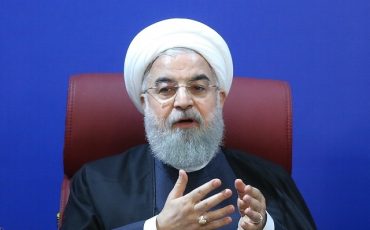 Iranian President Hassan Rouhani has discussed the situation in Syria, as well as prospects of Iran deal with his French counterpart Emmanuel Macron in a telephone call, the official website of the Iranian president reported.
Hassan Rouhani noted that Tehran had sent its military advisers to the Arab republic at the request request of its legitimate government in order to help Damascus fight terrorism. He expressed hope that no “foreign military presence” would be needed after the terrorist threat had been eradicated.
Israel accuses Iran of sending the country’s troops to Syria in order to attack it from Syrian territory. Tel Aviv has already conducted several airstrikes against Syrian bases under a pretext of Iranian Revolutionary Guards being stationed there. Tehran and Damascus deny these accusations.
The two presidents also discussed the current state of the JCPOA. Rouhani praised the stance that Europe took to keep the deal alive after the US withdrawal, but noted that, so far, statements had not been “accompanied by practical and tangible measures and solutions.”
“If Iran cannot benefit from the privileges of this agreement, remaining in it will not be possible,” the Iranian president said.
Emmanuel Macron confirmed commitment to the JCPOA and assured Rouhani that France is working on “a series of measures and practical solutions” to make the deal work.
The US withdrew from the Iran nuclear deal in May 2018, with President Donald Trump claiming the deal was “flawed” at its core. Other parties to the agreement have confirmed their readiness to stick with the deal and work out solutions against possible US sanctions.
Trump-Kim Historic Summit Concludes With Ambitious Agreement
Sputnik – 12.06.2018
The first-ever summit of US President Donald Trump and North Korean leader Kim Jong-un has concluded with an agreement in which Pyongyang reaffirmed its commitment to the denuclearization of the Korean peninsula, while the United States pledged to provide security guarantees.
The final document is made up of only four points: the agreement to establish new bilateral relations, decision to join efforts to “build a lasting and stable peace regime on the Korean peninsula,” Pyongyang’s confirmed commitment to denuclearization, and the repatriation of the remains of the US military personnel, either prisoners of war or missing in action after the 1950-1953 war.
In response to Kim’s confirmation of denuclearization intentions, Trump has promised to provide security guarantees to Pyongyang.
However, the document does not mention Washington’s determination to achieve a complete, verifiable, irreversible denuclearization.
The two sides have agreed that a follow-up meeting would be attended by US Secretary of State Mike Pompeo and a relevant official from North Korea.
New Hopes
The first-ever summit of Trump and Kim took place in Singapore at the Capella Hotel on the island of Sentosa south of the main island. Trump said after the talks that the denuclearization process would begin soon, while Kim said the signing of the agreement signified a new beginning in the bilateral relations and promised “a major change” in the future.
Despite a promising start of negotiations, the United States will not diminish its military presence in South Korea, Trump said at a press conference held later in the day.
At the same time, the United States will suspend military exercises on the Korean peninsula as long as the talks with North Korea are progressing, Trump said. The US president noted that the suspension would help Washington save “a tremendous amount of money.”
Trump added that the sanctions against North Korea would remain in place as long as nuclear weapons remain in the picture. Nevertheless, Trump said that, as a concession to Pyongyang, he had halted plans for 300 new sanctions.
Neighbors Welcome Results
North Korea’s neighbors have welcomed the potential progress in the resolution of the crisis.
Russia is not only welcoming the potential progress but is ready to provide assistance in the form of political support or specific proposals, Russian Deputy Foreign Minister Sergey Ryabkov told Sputnik.
Ryabkov expressed hope that the movement forward on the Korean issue would unblock the possibility for economic cooperation on the Korean peninsula.
Russian Foreign Minister Sergey Lavrov said that the very fact of the meeting was possible, but noted that the Russian side has not seen any documents yet.
China, in turn, said that the results of the Trump-Kim meeting were an important step toward denuclearization and lasting peace on the peninsula.
Japanese Chief Cabinet Secretary Yoshihide Suga has refrained from an assessment of the summit but expressed hope that North Korea would change its policy in the future.
The Japanese official stressed that Tokyo appreciated the efforts made by Trump, but would like to learn about the details of the summit from the US side.
US Foreign Minister Taro Kono has said that the full dismantlement of nuclear facilities in North Korea may take decades, but the destruction of nuclear weapons and relevant facilities would not take long.
South Korean presidential adviser Moon Jung-in has expressed a similar opinion in an interview to the Nikkei newspaper, arguing that the settlement of all issues related to North Korean missile and nuclear programs as well as the dismantlement of relevant facilities would take a decade.
According to Moon, North Korea may demand political, economic and military guarantees in exchange for denuclearization.
International Community
The Trump-Kim joint statement is a clear sign that the complete denuclearization of the Korean peninsula is achievable, EU foreign policy chief Federica Mogherini said.
“The ultimate goal, shared by the entire international community and as expressed by the United Nations Security Council, remains the complete, verifiable and irreversible denuclearization of the Korean Peninsula. The Joint Statement signed by the U.S. and DPRK leaders today gives a clear signal that this goal can be achieved,” Mogherini said in a statement.
UK Foreign Secretary Boris Johnson welcomed the results of the summit and called the talks between Trump and Kim “constructive.”
Iraq receives dozens of advanced T-90 battle tanks from Russia
Press TV – Jun 7, 2018
The Iraqi military has received dozens of more advanced T-90 battle tanks from Russia under a major deal struck between Moscow and Baghdad last year.
The Iraqi Defense Ministry, in a statement released on Thursday, announced that it had taken delivery of 39 tanks, adding that the armored fighting vehicles had been distributed between two battalions of an army brigade.
The statement said that Iraqi military personnel had already been trained by Russian experts on how to operate the battle tanks.
Iraqi Army Chief of Staff General Othman al-Ghanimi said on February 19 that his country’s army had received 36 Russian-made T-90 battle tanks.
The T-90 is a third-generation Russian battle tank built upon the time-proven Soviet T-72 design.
It is among the best-selling tanks in the world, and known for its firepower, enhanced protection and mobility.
The T-90 features a smoothbore 2A46M 125mm main gun, which can fire both armor-piercing shells and anti-tank missiles.
The advanced tank also features sophisticated armor, ensuring all-round protection of the crew and critical systems, including explosive reactive armor and active infrared jammers to defend it from inbound rocket-propelled grenades, anti-tank missiles and other projectiles.
Indian, Algerian and Azerbaijani militaries have purchased hundreds of T-90 battle tanks in past years. Kuwait, Vietnam and Egypt have also expressed strong interest in buying the tank.
The Iraqi military plans to reinforce its fleet of M1A1 Abrams main battle tanks with T-90s. A large number of American M1A1 Abrams tanks have been damaged in the fight against Daesh Takfiri terrorists.
Russia pushes back at US on North Korea
By M.K. Bhadrakumar | Asia Times | June 4, 2018
The visit by the Russian Foreign Minister Sergey Lavrov to Pyongyang on May 31 was a poignant moment for both countries. This was a rare meeting between a senior Russian official and a member of the Kim dynasty. Yet, Russia has been the oldest friend and mentor of the ruling family in Pyongyang.
Kim’s family escaped from Japanese-occupied Korea to the Soviet Union in 1920 when the revered founder of North Korea, Kim Il Sung, was only eight years old. He grew up in Russia, joined the Red Army and fought the Japanese in Manchuria. When World War II ended, Kim returned to his country and with some Soviet backing, went on to lead North Korea’s Communist Party and lay the foundations of the new state north of the 38th parallel.
Make no mistake, it was not a coincidence that Kim received Lavrov on the same day his deputy Vice-Chairman Kim Yong-chol met US President Donald Trump at the White House. Kim told Lavrov in front of TV cameras: “I highly value the fact that Putin’s administration strictly opposes the US’ hegemony. You strictly oppose, and we are always ready to conduct negotiations and a profound exchange of opinions with the Russian side on this issue.” Russia’s Cold War ally is picking up the threads with ease.
Unsurprisingly, Lavrov gave whole-hearted backing for the North Korean stance on the vexatious issue of denuclearization. In Lavrov’s words: “We assume that a complete resolution cannot be achieved until all the sanctions are lifted. It is up to the negotiators to make this happen, but in any case, it would be impossible to achieve this in a single round. The same applies to denuclearization. For this reason, this should be a step-by-step process with reciprocal moves at each of the stages.”
Denuclearization not a stand-alone issue
Lavrov called for a “judicious approach” not to rush things and cautioned against any “rash actions”, bearing in mind the need for “careful consideration and coordination of all elements of a package decision.” The carefully-chosen expression “package decision” implies that denuclearization is not a stand-alone issue.
He underscored: “Russia and North Korea hold a common view… We know that this is an extremely complicated problem and that the goal of denuclearization is inseparably connected with the eventual restoration of peace, stability and a system of interaction, cooperation and equal and indivisible security in Northeast Asia.” Simply put, Lavrov asserted Russia’s role in the current process as a stakeholder in the stability and security of its region. Interestingly, Lavrov flagged the need at some point to revive the format of six-party talks (involving the two Koreas, US, China, Japan and Russia.)
The Russian Foreign Minister also discussed substantive issues of bilateral cooperation in the economic sphere in anticipation of a post-sanctions future. In particular, he brought up the languishing 10-year-old idea of linking the Trans-Siberian and Trans-Korean railway systems to connect Moscow with Seoul via Pyongyang and to build a parallel gas pipeline.
Meeting between Putin and Kim soon?
Meanwhile, the speaker of the upper house of the Russian parliament, Valentina Matviyenko, is expected to visit North Korea soon. Most importantly, a meeting between Putin and Kim is on the cards. Reports speculate that the meeting may take place as early as next week during Putin’s state visit to China following the Shanghai Cooperation Organization summit in Qingdao (June 9-10).
The Russian Deputy Foreign Minister Igor Morgulov who accompanied Lavrov to Pyongyang was in Beijing on May 29 and would have discussed the forthcoming trip with Chinese officials. While in Beijing, Morgulov made some highly critical remarks about US policies in the Asia-Pacific, which reflected the thrust of Lavrov’s mission:
“I am referring… to the idea of the Indo-Pacific region, which the United States and Japan are actively advocating. Essentially, it is designed to divide the regional countries into friends and foes… Both Russia and China hold a diametrically opposite view. They are against creating blocs and believe that an effective and system-wide response to security challenges in the Asia Pacific must include a comprehensive military and political détente and uniform rules of the game… This architecture must be based on the universal principles of indivisible security and the supremacy of international law, as well as non-use of force or threat of force.”
Beijing has welcomed “Russia’s positive role” and said high-level exchanges between Russia and North Korea are “conducive to promoting the political settlement process of Korean Peninsula issue and upholding the peace and stability of the peninsula and Northeast Asia.” Russia is airing opinions supportive of North Korean concerns and vital interests, which Beijing shares but for obvious reasons is not in a position to voice openly.
Process will be a long haul
Clearly, Lavrov’s mission is making it more difficult for Washington to pressure the North Korean leadership or dictate the dynamics of the current process. Moscow is signaling that it will not remain a passive bystander (as in the negotiations over the Iran nuclear issue). And, it has taken a common position with Beijing that the denuclearization of North Korea impacts on the regional security matrix in Northeast Asia. Given this developing situation, the final outcome is almost certainly going to be a long haul.
Simply put, the US’ containment strategy against Russia and China has created a complex regional security environment in Northeast Asia. On one side there is talk of a new US military base in Poland and additional deployment of 30,000 NATO troops to Central Europe on Russia’s western fringe, while on the other side US Secretary of Defence James Mattis promised at the Shangri-La Dialogue in Singapore on the weekend to step up military pressure on China in the South China Sea, and Trump is beating the drums of a trade war with Beijing.
However, somewhat incredibly, in this milieu of growing big-power tensions, Washington still expects Moscow and Beijing to remain docile as Trump and his team go about denuclearizing North Korea and reset the regional security calculus. This expectation is plainly unrealistic. Moscow has signaled that as a stakeholder, it will push back and will not allow a replay of what happened over the Iran nuclear deal.
Significantly, Lavrov disclosed that the North Korean leadership is “fully aware” of developments relating to the US’ exit from the Iran nuclear deal, and “will determine its position taking into consideration all these factors.”
Russia censures Iran, expects Israel to help restore ties with US
Vladimir Putin surprised many at the event known as Russia’s Davos with his comments on the Iran nuclear deal and Russia’s relations with the US
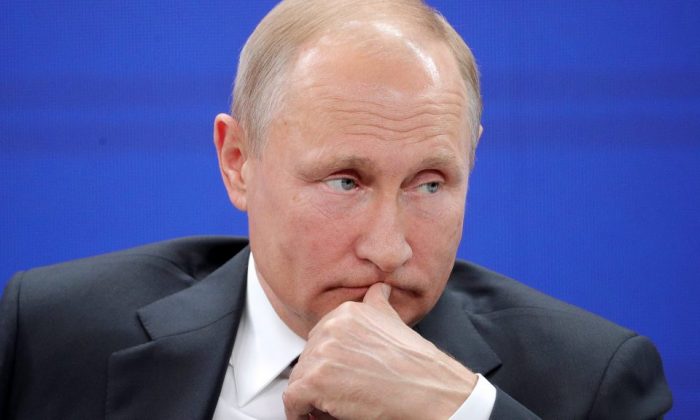
Russian President Vladimir Putin at the St Petersburg International Economic Forum on May 25, 2018. Photo: Reuters/Sergei Bobylev/TASS
By M.K. Bhadrakumar | Asian Times | June 1, 2018
The annual meeting of the St Petersburg International Economic Forum – dubbed as “Russia’s Davos” – on May 25, which traditionally promotes foreign investment in the Russian economy, ended this time around as a major political event signaling a renewed bid by President Vladimir Putin for détente with the West.
In wide-ranging remarks at the forum, Putin made an explicit overture to Washington for dialogue. The US decision to quit the Iran nuclear deal was the leitmotif of the Q&A at St Petersburg – which are generally choreographed by the Kremlin in advance – and Putin seized the opportunity to articulate a highly nuanced position on the topic with an eye on the overall Russian-American relationship.
Unsurprisingly, Putin criticized the US’ rejection of the Iran nuclear deal as a unilateralist move which would have negative consequences. But then, Putin also expressed understanding for President Donald Trump’s domestic compulsion in taking such a decision.
Putin also proposed that the US and Iran, which had negotiated the 2015 pact directly, could resume their negotiations to settle the differences: “Even now, the US President is not closing the door on talks. He is saying that he is not happy about many of the terms of the deal. But in general, he is not ruling out an agreement with Iran. But it can only be a two-way street. Therefore, there is no need for unnecessary pressure if we want to preserve something. Doors must be left open for negotiation and for the final outcome. I think there are still grounds for hope.”
Putin probably sees Russia as a facilitator-cum-moderator between the US and Iran, but at any rate, he has deflected the focus from the EU’s approach, which single-mindedly focuses on the downstream impact of US sanctions against Iran. It is smart thinking on Putin’s part to signal that Moscow does not propose to wade into any transatlantic rift over the Iran issue. He probably doubts if the rift is real enough for outsiders to exploit.
Putin and the Iran nuclear deal
But the really intriguing part was that Putin also brought into the matrix the “good, trust-based relations between us (Russia and Israel).” Significantly, the interpolation occurred while Putin was arguing that the preservation of the Iran nuclear deal was also in Israel’s interests.
Neither Moscow nor Tel Aviv has divulged the details of the recent meeting between Putin and Israeli Prime Minister Netanyahu in Moscow in early May. But Israeli sources have since divulged in bits and pieces that a major understanding might have been reached as regards the imperative need for an holistic approach toward the whole situation surrounding the “Iran question,” including Iran’s presence in Syria, which Israel indeed sees as existential threat.
Interestingly, three days after Putin spoke at St Petersburg, an influential Moscow think tank came up with a commentary regarding the emergent trends in the Syrian situation. Basically, the commentary stressed that Russian policy was switching tack and giving primacy to the search for political settlement and reconstruction of Syria. But it went on to discuss the rising tensions between Iran and Israel in Syria and blamed Iran for using Syria for the “export” of its policy of Resistance against Israel.
Hinting at growing resentment within the Sunni majority in Syria against Iran’s activities, the commentary contextualized Putin’s recent call for the withdrawal of all foreign forces from Syrian soil. It openly rapped the Iranians on the knuckle: “Iran’s operations in Syria go far beyond fighting terrorists and are hardly welcomed by anyone within the region and beyond. This heightens tensions in Israel’s relations with its bitter rivals … Serving as a platform for fighting the ‘Zionist’ enemy is something Syria needs the least.”
Indeed, these are extraordinary statements for an establishment think tank known to be close to the Kremlin. The key elements were: a) Russia holds Iran as responsible for ratcheting up tensions with Israel; b) Russia thoroughly disapproves of Syria being turned into a turf for Iran’s policy of “Resistance” against Israel; and, c) Moscow expects the Assad regime to distance itself from Iran’s anti-Israeli activities.
The patent shift in the Russian stance implies Moscow’s acknowledgment that the fate of the Iran nuclear deal is also linked to Iran’s regional policies. Arguably, this Russian stance harmonizes with what Trump and Netanyahu have been saying all along. Perhaps, Russia hopes to cajole Tehran to walk toward the negotiating table where Trump is waiting. Perhaps, Putin also calculates that such a helpful stance cannot but have positive fallout on US-Russia relations as a whole. Time will tell.
The bottom line is that the close ties between Russia and Israel are sailing into full view. Interestingly, Israel just obliged a famous Russian oligarch who is perceived as close to Putin, by granting him citizenship, which would enable him to visit Britain – although London refuses to renew his residence permit. The influential Kremlin-linked Russian oligarch now de facto becomes the wealthiest Israeli citizen, too.
Suffice to say, it all does seem a cozy condominium between Putin and Netanyahu. The big question will be how far Netanyahu can help Putin to bring about a Russian-American “thaw” under this complex set of circumstances.
Featured Video
Seyed M. Marandi: Toward Total War in the Middle East
or go to
Aletho News Archives – Video-Images
From the Archives
The Geopolitics behind the War in Yemen (I)
By Mahdi Darius NAZEMROAYA | Strategic Culture Foundation | 30.03.2015
The United States and the Kingdom of Saudi Arabia became very uneasy when the Yemenese or Yemenite movement of the Houthi or Ansarallah (meaning the supporters of God in Arabic) gained control of Yemen’s capital, Sanaa/Sana, in September 2014. The US-supported Yemenite President Abd-Rabbuh Manṣour Al-Hadi was humiliatingly forced to share power with the Houthis and the coalition of northern Yemenese tribes that had helped them enter Sana. Al-Hadi declared that negotiations for a Yemeni national unity government would take place and his allies the US and Saudi Arabia tried to use a new national dialogue and mediated talks to co-opt and pacify the Houthis.
The truth has been turned on its head about the war in Yemen. The war and ousting of President Abd-Rabbuh Manṣour Al-Hadi in Yemen are not the results of «Houthi coup» in Yemen. It is the opposite. Al-Hadi was ousted, because with Saudi and US support he tried to backtrack on the power sharing agreements he had made and return Yemen to authoritarian rule. The ousting of President Al-Hadi by the Houthis and their political allies was an unexpected reaction to the takeover Al-Hadi was planning with Washington and the House of Saudi. … continue
Blog Roll
 Aletho News
- HE SAVED LIVES. NOW HE FACES PRISON.
- Israeli lobby seeks to bind US fate to ‘Israel’: Araghchi
- Pakistan-Iran talks secure LNG shipment to Islamabad through Hormuz
- Black Sea grain crisis puts global wheat supplies under pressure
- IRGC air defenses destroy another US MQ-1 drone over Strait of Hormuz
- Imran Khan’s entire immediate family detained in Pakistan ahead of mass protest demanding his release
- EU nation detains former presidential frontrunner
- Leaked: Britain’s Sham Conviction Of Hashim Thaci
- Seyed M. Marandi: U.S. Strike Imminent – Toward Total War in the Middle East
- Russia Voted Under Fire. Washington Is Loading the Tankers.
- If Americans Knew
- Israeli Attacks in Gaza Kill at Least Seven Palestinians Over Three Days, including Woman and Child
- Trump’s militarization of Washington DC as he pursues Israel’s war against Iran
- Why Israel Fears This Searing New Documentary
- Huckabee aide solicited cash gifts from Israelis
- This isn’t sci-fi, AI is already killing people
- ‘The Most Brutal Thing’: Investigation Reveals Execution of Elderly Woman in Rafah
- Inside Israel’s ‘soft’ ethnic cleansing plan for Gaza through the eyes of its victims
- New online database tracks pro-Israel political donations in the United States
- Israeli president pardons soldier convicted for killing wounded Palestinian
- Singer Ed Sheeran says his ‘heart broken’ by Gaza devastation, addresses Macklemore controversy
- No Tricks Zone
- 2025 Nature Paper Claiming Worsening Global Drought Gets RETRACTED …Heavily Flawed
- New Study: ‘Global Drought Shows No Detectable Recent Acceleration Under Climate Warming’
- Economic Masterminds: German Socialists Suggest Taxing Productivity Gains Stemming From Using AI
- The South China Sea Has Not Been Cooperating With The Climate Change Narrative
- Energy Crisis: Germany Enters Heating Season With Historically Low Gas Reserve Fill Levels
- New Study: The Antarctic Ice Sheet Gained Mass From 2020-2024 Due To Staggering Snow And Ice Accumulation
- Study: Ocean Heating Rates From Thousands Of Years Ago ‘Dwarf’ Modern Ocean Heating Rates
- Climate Extremists Target, Attack Large-Scale Power Grid Infrastructure In Germany!
- New Study: Antarctic Ice Melt Has Contributed Less Than 1 Centimeter To Sea Level Rise In The Last 30 Years
- Fear Of Debate: Alarmist German Climate Scientist Calls On Mainstream Media To Discredit Skeptic Voices
 Aletho News