South Korean President Moons Bolton
By Ray McGovern | Consortium News | May 26, 2018
Thanks no doubt to his bellicose national security adviser John Bolton, President Donald Trump has now lost control of the movement toward peace between the two Koreas. Trump has put himself in a corner; he must now either reject — or, better, fire — Bolton, or face the prospect of wide war in the Far East, including the Chinese, with whom a mutual defense treaty with North Korea is still on the books.
The visuals of the surprise meeting late yesterday (local time) between the top leaders of South Korea and North
Korea pretty much tell the story. South Korea’s President Moon Jae-in drove into the North Korean side of the demilitarized zone (DMZ), and Seoul quickly released a one-minute video of what, by all appearances, was an extremely warm encounter with Kim Jung-un. It amounted to a smiling, thumbing of two noses at Bolton and the rest of the “crazies” who follow his advice, such as Vice President Mike Pence who echoed Bolton’s insane evocation of the “Libya model” for North Korea, which caused Pyongyang to go ballistic. Their angry response was the reason Trump cited for cancelling the June 12 summit with Kim.
But Trump almost immediately afterward began to waffle. At their meeting on Friday the two Korean leaders made it clear their main purpose was to make “the successful holding of the North Korea-U.S. Summit” happen. Moon is expected to announce the outcome of his talks with Kim Sunday morning (Korean time).
Why is Trump Waffling?
One cannot rule out the possibility that Secretary of State Mike Pompeo has some cojones beneath his girth. He has a personal, as well as a diplomatic stake in whether or not Bolton succeeds in wrecking the summit. (Trump, after all, deputized Pompeo, while he was still CIA director, to set it up.) It’s also possible some non-crazy advisers are warning Trump about Bolton’s next “March of Folly.” Other advisers may be appealing to Trump’s legendary vanity by dangling the prospect that he may blow his only shot at a Nobel Peace Prize.
The two Korean leaders have made abundantly clear their determination to continue on the path of reconciliation despite the artificial divide created by the U.S. 70 years ago. Now, a lot depends on the unpredictable Trump. If enough people talk sense to him and help him see the dangerous consequences of letting himself be led by Bolton, peace on the Korean peninsula may be within reach.
It is no longer a fantasy to suggest that the DMZ could evaporate just as unexpectedly and quickly as that other artifact of the Cold War did — the Berlin Wall almost four decades ago.
Ray McGovern works with Tell the Word, a publishing arm of the ecumenical Church of the Savior in inner-city Washington, D.C.. A Fordham alumnus, he spent 27 years as a CIA analyst, from the Kennedy administration to the first Bush administration. He holds a certificate in theological studies from Georgetown and is a graduate of Harvard Business School’s Advanced Management Program.
Maduro re-elected Venezuelan president; rival candidate challenges results
Press TV – May 21, 2018
Nicolas Maduro has been re-elected for a second term in office as Venezuela’s president in an election rejected as “illegitimate” by his main rival, who has also demanded that a repeat vote be held later this year.
With more than 90 percent of the ballots cast in Sunday’s presidential election counted, the National Election Council announced that incumbent Maduro had won another six-year term after securing 67.7 percent of the vote.
Maduro’s main challenger Henri Falcon came in second with 21.2 percent, followed by the president’s other rival, Javier Bertucci, who gained some 10 percent, said the Council’s head, Tibisay Lucena.
With the country’s mainstream opposition having boycotted the vote, the turnout was 46.1 percent, according to the board, which means 8.6 million out of the 20.5 million eligible voters took part in the election.
The ballots were recorded electronically, making the voting quick and easy. The presence of government troops around polling stations also ensured the safety of voters.
Some 150 international observers from 30 countries and international organizations were present in the Latin American country to monitor the process.
Maduro hails ‘historic’ win
When the results were released, Maduro’s supporters gathered outside his Miraflores presidential palace in downtown Caracas, celebrating his re-election with fireworks.
Maduro, surrounded by thousands of his supporters, also hailed his “popular victory,” saying, “This was a historic day! The day of a heroic victory! The day of a beautiful victory – of a truly popular victory.”
“Never before has a presidential candidate taken 68 percent of the popular vote,” he told the cheering crowd.
“The whole of Venezuela has triumphed! Democracy has triumphed! Peace has triumphed! Constitutionality has triumphed [These were] elections that were constitutional, legitimate and legal,” he said. “We have a president of the people! A working president!”
The president also called on the defeated challengers to join him for negotiations about the future of the country.
He said “permanent dialog” is needed with the entire opposition so that Venezuela could set aside political disputes.
Vote ‘lacks legitimacy’
However, before the official results were announced, Falcon said he would not recognize the vote for what he called irregularities, including widespread vote buying in favor of Maduro.
“As far as we are concerned there has been no election. There must be new elections in Venezuela,” he told reporters. “The process undoubtedly lacks legitimacy and as such we do not recognize it.”
Falcon, who broke with an opposition boycott to run for the election, also called for a fresh election to be held in November or December.
Several of Venezuela’s Latin American neighbors as well as the European Union also joined voices with Maduro’s challenger and said they would not recognize the results of the election.
They alleged that the conditions did not exist for the election to be free and fair.
However, former Spanish prime minister Jose Luis Rodriguez Zapatero, who is in Venezuela as an international observer, said he has no “doubt about the voting process.”
“It is an advanced automatic voting system. I come here to keep peace, coordinate and promote dialogue so as to improve the democratic mechanism here. What I need to do here is to see whether people can cast their ballots at their own discretion. Now we all see how people vote, don’t we?” he added.
The US also said it would not recognize the election and would actively consider oil sanctions on the country.
Washington has already imposed sanctions against Venezuela and blamed, together with its allies in the region and elsewhere, Maduro’s government for the country’s acute economic crisis.
On Saturday, the US ramped up pressure on Caracas by imposing new sanctions against the government’s top officials.
Maduro’s government, however, said the US was using new sanctions to sabotage the election.
It called Washington’s move as part of “a systematic campaign of aggression” by President Donald Trump’s administration and said they had no legal base.
Mexico: Mayoral Candidate of AMLO’s Party Murdered
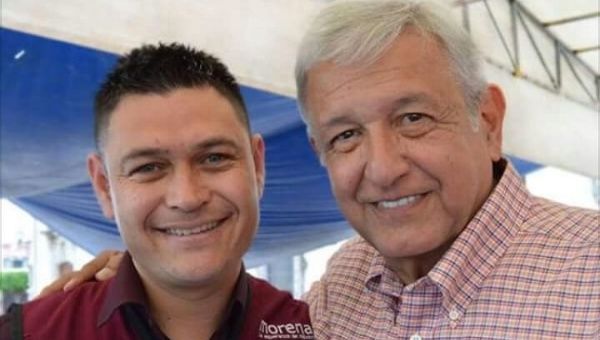
Jose Remedios Aguirre Sanchez (L) with presidential hopeful Andres Manuel Lopez Obrador. | Photo: Twitter @AvseFernando
teleSUR | May 11, 2018
Electoral campaigns in Mexico suffered another casualty on Friday with the murder of Jose Remedios Aguirre Sanchez, a mayoral candidate from the same coalition as presidential hopeful Andres Manuel Lopez Obrador, commonly known as AMLO.
The 35-year-old candidate was shot dead at close range in the Ecological Park of the Apaseo el Alto. Two other people were reportedly injured. The perpetrators escaped in a white convertible Ford Mustang with a U.S. license plate, according to witnesses.
Aguirre was competing in the race for mayor in the municipality of Apaseo el Alto, in Guanajuato, with the Movement of National Regeneration (Morena) party.
Before entering the race for Apaseo el Alto’s mayor, Aguirre had served as the director of public security in the same municipality between 2012 and 2015.
Since September when electoral campaigns began around the country, over 90 candidates, politicians and officials have been violently murdered.
Aguirre was a member of the progressive Morena party that is backing the coalition of Andrez Manuel Lopez Obrador, one of the top picks for Mexico’s presidency.
Russia rejects Hague court order to compensate Ukrainian companies as illegitimate
RT | May 11, 2018
Russia has rejected the Permanent Court of Arbitration’s order to compensate Ukrainian companies for losses, allegedly stemming from the 2014 Crimea reunification, saying that the issue was outside the jurisdiction of The Hague.
The Russian Justice Ministry made the statement after the Permanent Court of Arbitration in The Hague ruled in favor of 18 Ukrainian companies that sought compensation from the Russian government over damages allegedly inflicted as a result of the 2014 reunification of the Crimean Republic and the Russian Federation.
The court did not disclose other details of the lawsuit, but the Justice Ministry told Russian news agency RBC that the Ukrainian plaintiffs want about $140 million plus interest.
“The Russian Federation does not recognize the above mentioned decision because the court of arbitration is outside the jurisdiction allowing it to look into this case,” reads the Justice Ministry’s statement.
Vladimir Putin’s press secretary Dmitry Peskov told reporters that Moscow did not consider itself a party in the process and therefore had no intention to comply with the ruling. “Russia was not represented in this court in any way, we have not sent our representative to this process and this is why we do not consider ourselves a party in this trial,” he said.
Russia has already faced huge compensation claims in The Hague Arbitration Court. It happened after the 2014 decision which called on Russia to pay about $50 billion to shareholders in Yukos Oil Company, dissolved after its founder and key owner, Mikhail Khodorkovsky, was jailed over embezzlement and major tax evasion.
The 2014 ruling led to temporary freeze of some Russian assets abroad, including a plot of land on which a new Orthodox cathedral in Paris is located and Moscow’s stake in the Euronews TV channel.
Moscow appealed the decision, also claiming the judgement did not fall within the jurisdiction of the arbitration court. In mid-2016 Russia won the appeal and by late 2017 former Yukos shareholders completely withdrew their claims and the freezes on the Russian property were lifted.
Read more:
Ex-Yukos shareholders give up fight for Russian assets in France
Severance of Iran-Morocco ties: Algiers responds to Rabat’s “baseless” allegations
MEMO | May 7, 2018
Algerian authorities rejected Wednesday as “completely baseless” Morocco’s allegations in the aftermath of the cut of diplomatic relations with Iran, over the alleged Teheran’s support of the Polisario Front implicating “indirectly Algeria, reports Sahara Press Service.
“Morocco’s ambassador to Algiers was received Wednesday by the secretary general of the Ministry of Foreign Affairs who expressed “Algerian authorities’ rejection of the completely baseless statements, made by its Foreign Minister while announcing the breakdown of diplomatic relations between Morocco and the Islamic Republic of Iran, and which indirectly implicate Algeria,” said the spokesman of the Ministry of Foreign Affairs Abdelaziz Benali Cherif.
The Foreign Affairs’ spokesperson responded to the allegations made, the day before, by Morocco’s minister of Foreign Affairs and International Cooperation, Nasser Bourita, who announced at a news conference in Rabat that Morocco had decided to cut diplomatic relations with Iran over its “support” to the Polisario Front, the legitimate and only representative of Western Sahara people.
The Polisario Front, which dubbed “big lie” Morocco’s allegations of military relations between the Polisario and Iran, defied Rabat to produce evidence for its “false allegations.”
Polisario Front’s coordinator with MINURSO (UN Mission for the Referendum in Western Sahara), M’hamed Khadad, said Rabat acted out of political opportunism to “circumvent the resumption of direct political negotiations called for by the United Nations” for the settlement of Western Sahara conflict through a referendum on Saharawi people’s self-determination.
Khadad denied any military relations with Iran, saying “the Polisario Front has never had military relations, has never received arms and has never had military contacts with Iran or Hezbollah”.
Iranian authorities said the accusations are “completely baseless, far from reality and wrong.
“They stressed that “one of the most fundamental principles of the Islamic Republic of Iran’s foreign policy in its relations with other governments and countries in the world has been and continue to be deep respect for their sovereignty and security as well as non-interference in the domestic affairs of other states.”
Lebanese Hezbollah also rejected Morocco’s accusations, saying it was regrettable that Rabat had given in to foreign “pressure.
“The Lebanese political party invited “Morocco to look for a more convincing argument to sever its ties with Iran.”
READ ALSO:
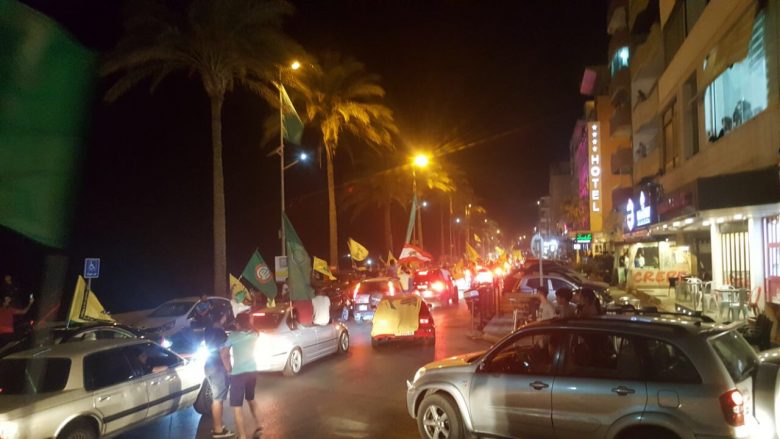
Hezbollah, Allies Make Sweeping Gains in Lebanon General Elections
Al-Manar | May 7, 2018
Hezbollah, Amal movement and other allies secure major achievements in Lebanon parliamentary elections on Sunday, according to initial results reported by local media.
Mutual lists between Hezbollah and Amal, dubbed “Loyalty and Hope” swept in Lebanon’s two southern districts and Bekaa District 2 (Baalbeck-Hermel).
The allies secured all 18 seats in South Districts 2 and 3, while securing 8 out of ten seats in Bekaa District 2.
Elsewhere in South District 1 (Sidon-Jizzine), the list which was supported by Hezbollah and Amal gained 2 seats out of 5.
The allied lists also secured all four Shiite seats in Mount Lebanon District 3 (Baabda) and Beirut District 2.
Elsewhere in Western Bekaa, Hezbollah and allies secured 3 out of 6 seats.
Meanwhile in Zahle Hezbollah secured the Shiite seat in the Bekaist district.
In general, out of the 27 Shiite seats in the Lebanese parliament, Hezbollah and Amal secured at least 26 seats according to initial results.
Official results are to be announced by the interior ministry later on Monday.
US family sues Pyongyang for torturing son to death despite lack of evidence
RT | April 27, 2018
The parents of Otto Warmbier have sued North Korea on the day the key peninsular summit, accusing the nation of torturing their son to death. Earlier medical reports said no signs of torture were found during autopsy.
Otto Warmbier was arrested during a tourist trip to North Korea in December 2015 and detained in prison. His health deteriorated while in custody, and he was released home in a coma, before dying days later. Cindy and Fred Warmbier filed a civil suit at Washington District Court on Thursday, alleging that their son was tortured and killed by the North Korean government.
“North Korea, which is a rogue regime, took Otto hostage for its own wrongful ends, and brutally tortured and murdered him,” they said in the suit, which was filed on the same day that North and South Korea held a key diplomatic summit in the demilitarized zone, seeking to defuse tension and pave the way to a peaceful accord.
In the lawsuit, the Warmbiers allege that their son was targeted on the basis of a false accusation in retaliation for the US government’s decision to impose additional sanctions on North Korea, which was announced at the time. They say Otto was forced to make a false confession, over which he was sentenced to a lengthy prison term. The suit alleges that the young man was subjected to torture, which resulted in his ultimate death. It asks for unquantified damages as well as punitive fines.
Last year, a coroner disputed the claims by the Warmbier family that their son was tortured by the North Koreans. The post-mortem report contradicted a claim that the family made in a Fox and Friends interview that “someone had taken a pair of pliers and rearranged his bottom teeth.”
“There was no evidence of trauma to the teeth,” the coroner, Dr Lakshmi Kode Sammarco, told reporters after the interview. “We were surprised at that statement.”
She said the team that did the most-mortem looked hard for any evidence of torture, but could not find anything definitive. The team didn’t do a full autopsy on Otto’s body at the request from the family.
Warmbier’s alleged crime in North Korea was attempting to steal a propaganda banner from a locked room as a trophy. While this may seem as a petty crime for a foreigner, under North Korea’s law it is a serious offense – the same way that insulting the king is in Thailand, for example.
He was one of around a dozen US citizens arrested in North Korea for various crimes. The punishment for others varied a lot, from deportation in the case of Sandra Suh, who was accused of using her status as an aid worker to produce anti-Pyongyang propaganda; to lengthy imprisonment for Pastor Kenneth Bae, who spent over two years behind bars for violating a ban on preaching before being released in 2014. The imprisonment of Canadian Pastor Hyeon Soo Lim for similar activities was even longer, lasting over three years, but he too was released despite being sentenced to life. The record shows that Pyongyang is not in the habit of kidnapping and torturing to death foreign tourists and prefers to release them to score points on the diplomatic front.
Takeaways from Korean summit
By M K Bhadrakumar | Indian Punchline | April 27, 2018
From the Indian perspective, the Korea summit at Panmunjom today heralding the ‘end of the Korean war’ is a poignant occasion. The Kashmir issue, which is almost of the same vintage, now remains as the only other decades-old flashpoint in international security since World War II. Arguably, the Korean problem is far more complicated than the Kashmir issue. The Kashmir issue is a bilateral issue whereas in the Korean problem, there are overlapping templates at the bilateral, regional and international level. Both are ‘nuclear flashpoints’.
But the Korean War (1950-1953) was far more catastrophic than all the wars India and Pakistan ever fought over Kashmir. The military casualties (dead, wounded or missing) exceeded 1 million while the civilian casualties are estimated to be several millions.
The key passages of the Panmunjom Declaration jointly issued by the leaders of South and North Korea – Moon Jae-in and Kim Jong Un – read as follows:
- The two leaders solemnly declared before the 80 million Korean people and the whole world that there will be no more war on the Korean Peninsula and thus a new era of peace has begun.
- South and North Korea confirmed the common goal of realising, through complete denuclearisation, a nuclear-free Korean peninsula. South and North Korea shared the view that the measures being initiated by North Korea are very meaningful and crucial for the denuclearisation of he Korean peninsula and agreed to carry out their respective roles and responsibilities in this regard. South and North Korea agreed to actively seek the support and cooperation of the international community for the denuclearisation of the Korean Peninsula.
A signed joint statement was issued after several hours of talks between Moon and Kim (including one-on-one discussion as they strolled through the gardens and sat privately against the leafy backdrop with a serene atmosphere, deep in conversation, animatedly, but out of earshot). The joint statement is largely aspirational and doesn’t spell out concrete steps. But it flags the general idea that “the South and North have confirmed their common goal of realizing a nuclear-free Korean peninsula.” The highlights are:
- They will hold talks on formally establishing a peace treaty
- Agreed to “urgently resolve” humanitarian issues of divided families
- The two sides will work together to “ease the sharp military tensions on the Korean peninsula” and defense ministers will meet in May
- Starting May 1, all propaganda activities, including loudspeakers and leaflets, will be halted.
- Moon will visit Pyongyang in the autumn. They agreed to establish an inter-Korean joint liaison office in Kaeseong.
Kim noted, “We hope we will not repeat our mistake of the past. I hope this will be an opportunity for the two Korean peoples to move freely from North to South. We need to take responsibility for our own history.”
Of course, there are still huge strategic and political divisions between North Korea on one side and South Korea and the United States on the other side. But this is a good start, since there has been a concrete commitment by Kim on denuclearization.
All the key players in the region have welcomed the agreement, including China and Japan. Russia’s Foreign Ministry says it is ready to facilitate cooperation between North and South Korea, in railways, gas and electrical energy.
China has taken care not to distract from the meeting at Panmunjom. The Chinese coverage of PM Modi’s meeting with President Xi Jinping at Wuhan has been noticeably restrained. China’s foreign ministry spokesman Lu Kang has been quoted as saying,
- “Today, the leaders of South and North Korea held their summit successfully. (They) announced a joint declaration on their common understanding of inter-Korean relations, easing military tension on the Korean Peninsula, denuclearizing the peninsula and a permanent peace.
- The positive outcome of the summit is helpful for inter-Korean reconciliation and cooperation, peace and stability on the peninsula and the political resolution of Korean Peninsula issues.”
Trump’s first reaction to the Panmunjom meeting has come when he tweeted, “After a furious year of missile launches and Nuclear testing, a historic meeting between North and South Korea is now taking place. Good things are happening, but only time will tell!”
South Korea is showering all praise on President Trump and giving him credit for what happened today at Panmunjom. It is a wise strategy, since South Korea is essentially creating a positive momentum for Trump’s forthcoming summit with Kim and flattering the US president’s vanities at the same time. Put differently, South Korean president Moon is ensuring that Trump gets the Nobel Prize for Peace this year – and getting Trump to believe he earned it. But the real winner is Moon himself in taking a great leap forward in his life’s mission of inter-Korean reconciliation.
Full text of the Panmunjom Declaration for Peace, Prosperity and Unification of the Korean Peninsula is here.
Dubai firm commissioned Qatar-smearing film from American who made fake news for Iraq war
RT | April 28, 2018
When Gulf states cut ties with Doha in 2017 over its alleged support of terrorism, tensions were aided by a Dubai firm that hired a man to create an anti-Qatar video. That same man also led a US propaganda project in Iraq.
Charles Andreae is the owner of the firm Andreae & Associates, which was contracted in August 2017 to produce a six-part film linking Qatar with global terrorism, the Bureau of Investigative Journalism has revealed. The Dubai-based strategic communications firm Lapis Communications, which is owned by an Afghan-Australian entrepreneur, gave Andreae more than $500,000 to produce the video.
The brief given to Andreae’s firm was to produce “six multimedia products focused on an investigation into the role of the state of Qatar and the state’s connection to global terrorism.” It was commissioned as Saudi Arabia and the United Arab Emirates were intensifying an international campaign against Qatar over its alleged links to terrorism.
News of the contract emerged in a recently filed lobbying declaration with the US Department of Justice. American companies such as Andreae & Associates are required by law to disclose information on lobbying and PR work for foreign clients.
The film, titled ‘Qatar: A Dangerous Alliance,’ included conservative pundits discussing Qatar’s links to Islamist groups, as well as bits of news and archive footage. Copies of the video were distributed at an event at the Hudson Institute think tank in October. Among the keynote speakers at that event were US President Donald Trump’s former chief strategist Steve Bannon, former defense secretary Leon Panetta, and former CIA director David Petraeus. So far, the documentary has been viewed more than 700,000 times on YouTube and is also available on Amazon.
In addition to Andreae’s involvement in making the film, he also registered as a lobbyist with the US Senate on Qatar-US relations on behalf of Lapis in January. But Andreae’s questionable actions didn’t begin with Qatar.
Andreae was also responsible for running the Washington end of a Pentagon propaganda contract in Iraq, which he did when he was working for the British public relations firm Bell Pottinger. Although the campaign details were known in 2016, Andreae’s involvement was only confirmed to the Bureau by Bell Pottinger co-founder Tim Bell last week.
That project, which has a $500 million contract with the Pentagon, consisted of running secret operations during the Iraq War. Bell Pottinger answered to the US commander in Iraq and created fake local news reports and smeared Iran. It also put together Al-Qaeda propaganda videos, planted them in people’s homes, and tracked who viewed them.
Neither Andreae & Associates nor Lapis Communications has responded to RT’s request for comment.
Read more:
Japan not satisfied with N. Korea’s nuke test halt, wants ‘complete & irreversible’ denuclearization
RT | April 21, 2018
While South Korea has welcomed Kim Jong-un’s announcement of the suspension of nuclear and ballistic tests, Tokyo, which strongly supports Washington’s “maximum pressure” approach, voiced an extremely cautious optimism.
Japan, the United States and South Korea have been relentlessly striving for a complete denuclearization of the Korean peninsula, meaning of course only Pyongyang’s nukes and not the US strategic bombers and aircraft carriers. Following months of productive talks with Seoul, Kim Jong-un announced a halt to any further nuclear and intercontinental ballistic missile tests, saying that North Korea’s strategic deterrence program has reached its goal.
“North Korea’s decision is meaningful progress for the denuclearization of the Korean Peninsula, which the world wishes for,” the South Korean President’s office said in a statement. “It will contribute to creating a very positive environment for the success of the upcoming inter-Korean and North-US summits.”
Japan, however, was a bit more cautious with its assessment of the development. “This announcement is a forward motion that I’d like to welcome,” Japanese Prime Minister Shinzo Abe said.
“I want to welcome these positive moves, but I wonder if this will lead to the complete, verifiable and irreversible dismantlement of its nuclear arsenal, weapons of mass destruction and missiles,” Abe said. “I’d like to keep a close eye on the developments.”
Japan’s Defense Minister was even more skeptical in his remarks. “We can’t be satisfied,” Itsunori Onodera, was quoted as saying by the Japan Times, noting that Kim did not mention the “abandonment of short-range and medium-range ballistic missiles.”
Donald Trump has, meanwhile, welcomed the news, calling it a big progress and telling his Twitter followers that he is “looking forward” to the upcoming US-North Korea summit, which is being planned sometime after the intra-Korean meeting on April 27.
International Lawyers: Strike Against Syria Would Be Illegal
Consortium News | April 11, 2018
In this statement released Wednesday, a group of international law experts warn that a U.S. military strike on Syria would be illegal if not in self-defense or with U.N. Security Council authorization.
We are practitioners and professors of international law. Under international law, military strikes by the United States of America and its allies against the Syrian Arab Republic, unless conducted in self-defense or with United Nations Security Council approval, are illegal and constitute acts of aggression.
The unlawful killing of any human being without legal justification, under every legal system, is murder. And an act of violence committed by one government against another government, without lawful justification, amounts to the crime of aggression: the supreme international crime which carries with it the evil of every other international crime, as noted by the International Military Tribunal at Nuremberg in 1946.
The use of military force by a state can be used in self-defense after an armed attack by another state, or, with the approval of the United Nations Security Council. At present, neither instance would apply to a U.S. strike against Syria.
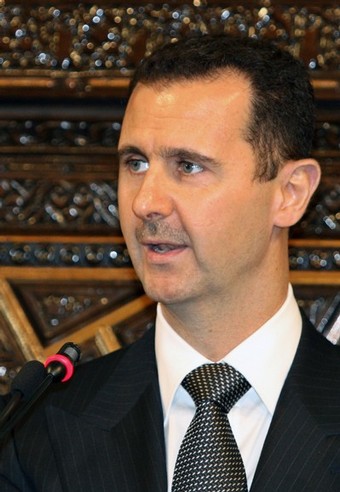
Syrian President Bashar al-Assad
We understand the urge to act to protect innocent civilians. We strongly condemn any and all violence against civilians, whoever the perpetrators. But responding to unlawful violence with more unlawful violence, bypassing existing legal mechanisms, is a road to a lawless world. It is a road that leads to Hell.
Accordingly, we urge the United States and its allies to refrain from illegal conduct against Syria. We must point out that for the last several years, as is now common knowledge, the United States has armed rebels/insurgents to overthrow the current government of Syria. This is illegal under international law.
In 1986, in The Nicaragua Case, the International Court of Justice reprimanded the United States for arming and supporting contra militias and combatants, and for mining Nicaragua’s harbors, as acts which violated the U.N. Charter and international law. Perhaps the Syrian crisis would look differently today if the United States and its allies had consistently respected law for the last several years. They have not.
We take pains to note what should be obvious: our demand that the United States and its allies immediately comport themselves with their international legal obligations is not a justification, excuse, or some type of free pass on the investigation and accountability for international legal violations committed by other actors who may be involved in this sad affair. But our point is a simple one: the only way to resolve the Syrian crisis is through commitment to well-settled principles of international legal norms.
We urge the United States to abide by its commitment to the rule of international law and to seek to resolve its disputes through peaceful means. These means include recourse to the use of established and legitimate institutions designed to maintain international peace and security, such as the U.N. Security Council or the International Court of Justice. Unilateral action is a sign of weakness; recourse to the law is a sign of strength. The United States must walk back from becoming the very monster it now seeks to destroy.
Inder Comar, Executive Director, Just Atonement Inc.
Dr. Ryan Alford, Associate Professor,
Bora Laskin, Faculty of Law, Lakehead University
Marjorie Cohn, Professor Emerita, Thomas Jefferson School of Law
Jeanne Mirer, President, International Association of Democratic Lawyers
Dr. Curtis F.J. Doebbler, Research Professor of Law, University of Makeni, UN Representative of International-Lawyers.org
Abdeen Jabara, Civil Rights Attorney and Co-Founder of the American-Arab Anti-Discrimination Committee
Ramsey Clark, 66th Attorney-General of the United States
Russia Stood Alone. China Didn’t Help Vote Down Trump’s Syria UN Resolution
By Marko Marjanović | Checkpoint Asia | April 11, 2018
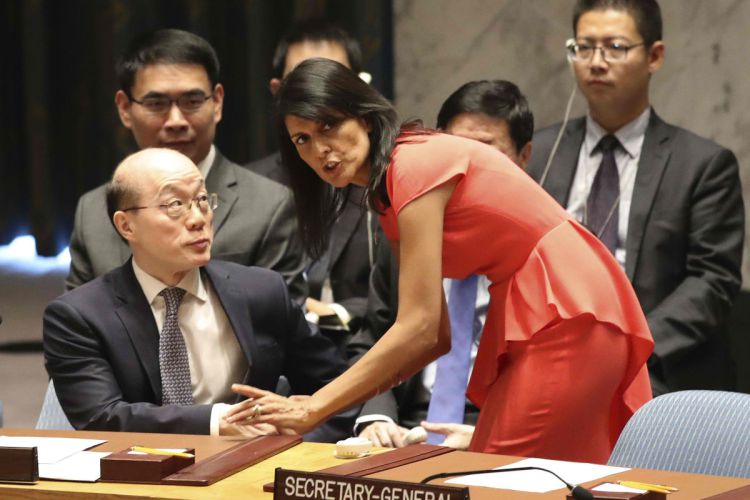
Russia’s proposed UN Security Council resolution envisaging a speedy and realistic investigation into Douma incident was voted down by a triple veto. US, UK and France all voted against it.
However an earlier US-proposed resolution, which proposed an investigation mechanism that couldn’t possibly work and would have opened an avenue for the American use of force had to be vetoed by Russia alone. Bolivia was the only other nation to vote against it as China merely abstained.
China did so albeit it had previously called for restraint and for no side to resort to force which should have naturally made it predisposed to oppose the American resolution. Likewise the Chinese did so albeit the newly-appointed Chinese defense minister was in Moscow talking up ties between the two armed forces and countries.
It has long been Chinese philosophy not to stick its neck out at the UN. Beijing rarely vetoes anything that does not concern its immediate interests and never alone. Additionally China has its own, more immediate American problems right now with Trump threatening a trade war and is presumably reluctant to provoke the US president into further enmity. Finally it is clear that in Beijing’s strategic calculation China benefits with the US and Russia at each other’s throats.
With US distracted by hostility towards Moscow it can not afford to at the same time act too aggressively against China, while the US pressure on Russia means Moscow has little choice but at least ensure the friendship of China.
Nonetheless, things are looking pretty grim for Russia right now (let’s not kid ourselves, in the Middle East the Empire holds escalation dominance) and a little support, no matter how symbolic, could have gone a long way towards securing long-term Russian appreciation. An opportunity missed for Beijing.
Featured Video
Seyed M. Marandi: Toward Total War in the Middle East
or go to
Aletho News Archives – Video-Images
From the Archives
The Geopolitics behind the War in Yemen (I)
By Mahdi Darius NAZEMROAYA | Strategic Culture Foundation | 30.03.2015
The United States and the Kingdom of Saudi Arabia became very uneasy when the Yemenese or Yemenite movement of the Houthi or Ansarallah (meaning the supporters of God in Arabic) gained control of Yemen’s capital, Sanaa/Sana, in September 2014. The US-supported Yemenite President Abd-Rabbuh Manṣour Al-Hadi was humiliatingly forced to share power with the Houthis and the coalition of northern Yemenese tribes that had helped them enter Sana. Al-Hadi declared that negotiations for a Yemeni national unity government would take place and his allies the US and Saudi Arabia tried to use a new national dialogue and mediated talks to co-opt and pacify the Houthis.
The truth has been turned on its head about the war in Yemen. The war and ousting of President Abd-Rabbuh Manṣour Al-Hadi in Yemen are not the results of «Houthi coup» in Yemen. It is the opposite. Al-Hadi was ousted, because with Saudi and US support he tried to backtrack on the power sharing agreements he had made and return Yemen to authoritarian rule. The ousting of President Al-Hadi by the Houthis and their political allies was an unexpected reaction to the takeover Al-Hadi was planning with Washington and the House of Saudi. … continue
Blog Roll
 Aletho News
- US lawmaker admits American people footing bill for Trump’s failed aggression against Iran
- Pfizer Gave $500,000 to Groups That Lobbied to End Religious Exemption in Massachusetts
- HE SAVED LIVES. NOW HE FACES PRISON.
- Israeli lobby seeks to bind US fate to ‘Israel’: Araghchi
- Pakistan-Iran talks secure LNG shipment to Islamabad through Hormuz
- Black Sea grain crisis puts global wheat supplies under pressure
- IRGC air defenses destroy another US MQ-1 drone over Strait of Hormuz
- Imran Khan’s entire immediate family detained in Pakistan ahead of mass protest demanding his release
- EU nation detains former presidential frontrunner
- Leaked: Britain’s Sham Conviction Of Hashim Thaci
- If Americans Knew
- Israeli Attacks in Gaza Kill at Least Seven Palestinians Over Three Days, including Woman and Child
- Trump’s militarization of Washington DC as he pursues Israel’s war against Iran
- Why Israel Fears This Searing New Documentary
- Huckabee aide solicited cash gifts from Israelis
- This isn’t sci-fi, AI is already killing people
- ‘The Most Brutal Thing’: Investigation Reveals Execution of Elderly Woman in Rafah
- Inside Israel’s ‘soft’ ethnic cleansing plan for Gaza through the eyes of its victims
- New online database tracks pro-Israel political donations in the United States
- Israeli president pardons soldier convicted for killing wounded Palestinian
- Singer Ed Sheeran says his ‘heart broken’ by Gaza devastation, addresses Macklemore controversy
- No Tricks Zone
- 2025 Nature Paper Claiming Worsening Global Drought Gets RETRACTED …Heavily Flawed
- New Study: ‘Global Drought Shows No Detectable Recent Acceleration Under Climate Warming’
- Economic Masterminds: German Socialists Suggest Taxing Productivity Gains Stemming From Using AI
- The South China Sea Has Not Been Cooperating With The Climate Change Narrative
- Energy Crisis: Germany Enters Heating Season With Historically Low Gas Reserve Fill Levels
- New Study: The Antarctic Ice Sheet Gained Mass From 2020-2024 Due To Staggering Snow And Ice Accumulation
- Study: Ocean Heating Rates From Thousands Of Years Ago ‘Dwarf’ Modern Ocean Heating Rates
- Climate Extremists Target, Attack Large-Scale Power Grid Infrastructure In Germany!
- New Study: Antarctic Ice Melt Has Contributed Less Than 1 Centimeter To Sea Level Rise In The Last 30 Years
- Fear Of Debate: Alarmist German Climate Scientist Calls On Mainstream Media To Discredit Skeptic Voices
 Aletho News