Cambodia PM accuses US of lying about aid suspension
Press TV – March 3, 2018
Cambodia’s prime minister has slammed the US administration for being dishonest about the “suspension” of aid to the Southeast Asian nation, saying Washington’s aid cut had actually taken place in 2016.
The White House announced Tuesday that it was suspending or curtailing several Treasury, USAID and military aid programs aimed at supporting Cambodia’s military, taxation department and local authorities, claiming that they were all responsible for the country’s recent political instability.
Reacting to the announcement, Prime Minister Hun Sen said Washington’s ambassador to Phnom Penh, William Heidt, was lying and insisted that US aid to Cambodia’s tax department was slashed back in 2016, Reuters reported.
“We, the 16 million people, didn’t receive American aid in the tax sector. This aid was already finished in 2016,” said the prime minister during a speech to thousands of garment workers in the country’s southern province of Preah Sihanouk.
He then added, “Please, US Ambassador, answer this one question: why did you announce cutting aid while there is no aid? Do you intend to distort the reputation of Cambodia?”
The US Embassy in Phnom Penh, however, refused to comment about the prime minister’s remarks.
According to the report, Washington’s decision to partially suspend its aid to Cambodia came amid an ongoing government crackdown on the nation’s political opposition, Hun Sen’s critics, as well as opposition lawmakers and non-governmental organizations months prior to a July general election.
Hun Sen, who the report describes as “a close ally of China,” has often criticized Washington publicly, specifically for dropping bombs on Cambodia during the Vietnam War, which concluded in 1975.
He has also accused the leader of the main opposition Cambodia National Rescue Party (CNRP), who was detained and jailed last year, of conspiring with Washington to topple him.
Meanwhile, the White House has said the US had spent over $1 billion worth of aid for Cambodia and that its assistance to the country for health, agriculture and mine-clearing will continue.
Russia postpones strategic talks with US
Press TV – March 2, 2018
Moscow has postponed planned talks with Washington on strategic stability originally set for later this month, after a US delegation refused to attend a Geneva meeting on cybersecurity earlier in the week, Russian envoy to Washington has announced.
Ambassador Anatoly Antonov told Russian TASS news agency on Thursday that the last-minute pullout from talks in Geneva by the US delegation on February 27 reflected an “unfriendly step… that gave the impression of having been pre-planned and leading to the further degradation of bilateral relations.”
“We have expressed indignation to the Department of State that the American side has wrecked Russian-American expert consultations on global information security,” Antonov said, noting that Moscow and Washington had agreed to hold the talks in Geneva on February 27-28.
However, he insisted, “The Americans refused to participate in the event just on its first day under the pretext of absolutely ungrounded accusations against Russia.”
“As a result of those US actions, the Russian side has found it impossible to hold Russian-American consultations on bilateral issues and strategic stability topics planned for March 6-7 in Vienna, which is why we have postponed them,” Antonov said.
The development came after the US accused long-time rival Russia of openly breaching Cold War-era treaties by developing what President Vladimir Putin referred to on Thursday as a new generation of “invincible” hypersonic weapons and submarines.
Reacting to Putin’s speech on Thursday, US State Department spokeswoman Heather Nauert said, “It was certainly unfortunate to have watched the video animation that depicted a nuclear attack on the United States. We don’t regard that as the behavior of a responsible international player.”
Antonov, however, rejected the remarks by Nauert in a separate statement he posted on Facebook.
“I will underline once again that Russia has not violated a single arms control and non-proliferation agreement while developing its nuclear potential,” said the Russian envoy.
He further said, “It appears that the State Department does not know the substance of the matter very well.”
Antonov went on to also emphasized that none of the weapons mentioned in Putin’s state of the nation address were covered by the treaties signed by the US and the former Soviet Union.
South Korea’s Moon informs Trump of plan to send special envoy to North Korea
Press TV – March 1, 2018
South Korean President Moon Jae-in has told his American counterpart Donald Trump that he intends to send a special envoy to Pyongyang in response to an invitation by Kim Jong-un, the North’s leader, following the recent Olympic-driven detente between the two Koreas.
“In response to the visit by North Korea’s special envoy Kim Yo Jong, … Moon conveyed to Trump his plans to dispatch a special envoy to the North soon,” Seoul’s presidential office said in a statement on Thursday, following their phone conversation.
It added that Moon and Trump further “agreed to continue their efforts to maintain the momentum for South-North dialogue so it may lead to the denuclearization of the Korean Peninsula.”
The development came after Pyongyang, in a rare move, participated in the 2018 Winter Olympics held in South Korea, providing an opportunity for the two neighbors to resolve long-running hostilities. The two sides have exchanged diplomatic and high-level visits, and there is hope that relations could improve effectively.
The two neighbors have been separated by a heavily-militarized border since the three-year Korean War came to an end in 1953. The conflict ended with an armistice rather than a formal peace treaty and left many families separated on the two sides.
The situation on the Korean Peninsula has been tense due to Pyongyang’s development of its nuclear and missile programs.
Moon has sought to use the Pyeongchang Winter Olympics, which concluded on Sunday, to open dialogue between Washington and Pyongyang in the hopes of easing a nuclear standoff that has caused global security fears.
The South Korean leader said earlier this week that Washington needed to “lower the threshold for talks” with Pyongyang.
Furthermore, senior North Korean officials visiting the South for the Winter Olympics said on Sunday that Pyongyang was open to talks with Washington.
However, the US has ruled out any possibility of negotiations before the North, which last year conducted multiple missile and nuclear tests, takes steps towards denuclearization.
The US and its allies in the West and in Asia engineered tough UN sanctions on North Korea last year when Pyongyang test-fired two missiles in July and then carried out its most powerful nuclear test in August.
However, many said the sanctions would not deter North Korea from pursuing its nuclear and missile program, which Pyongyang insists is part of its defense policy against the US. Critics have repeatedly warned that sanctions would more affect North Korean people rather than its military and the government.
The Breach of the UNSC Ceasefire in Syria: a Way Out of This Situation
By Peter KORZUN | Strategic Culture Foundation | 01.03.2018
The UN’s authority has been undermined by the fact that UN Security Council Resolution 2401 demanding a 30-day truce in Syria, which was unanimously endorsed on Feb. 24, has not been honored. On Feb. 26, UN Secretary-General António Guterres said the document needed to take effect without delay, but combat operations continue. Why has this happened and what can be done to enforce the mandate?
It’s important to note that the ceasefire didn’t apply to extremist groups, such as Islamic State (IS) and Hayat Tahrir al-Sham or HTS (Jabhat al-Nusra), which are closely affiliated with Al Qaeda. HTS is the dominant fighting force in Ghouta. Another militant group there is Harakat Ahrar al-Sham al-Islamiyya, which has close ties to IS, as both are pursuing the same goal of establishing a Sharia-based state in Syria. The Syrian military is not in violation of the resolution as it continues to fight these extremist groups in Eastern Ghouta. The resolution can be enforced only if all parties agree to stop shooting. That hasn’t been achieved and that’s the root of the problem.
Before the vote, Russia had warned that the extremist groups cared little about UNSC mandates and might continue fighting. That’s what happened. The cease-fire is being broken by Jaysh al-Islam, Faylaq al- Rahman, and HTS. Jaish al-Islam, Jabhat al-Nusra, Ahrar al-Sham, Feylaq al-Rahman, and Fadjr al-Umma have established a joint command and control center in Eastern Ghouta. As they are all allied with HTS, this justifies the use of force against all of them.
The goal of the extremists is to undermine the truce and provoke retaliatory strikes on Syrian forces, while the US is using the continued fighting as a pretext for putting the blame on Damascus.
The possibility that the US will use force against Syria – which is exactly what the extremists want them to do – is real. Then the tail will be wagging the dog.
Moscow has already expressed its grave concerns about these events. In a meeting with his Portuguese counterpart, Augusto Santos Silva, on Feb. 26, Russian Foreign Minister Sergei Lavrov warned that more disinformation about the alleged use of chemical weapons by Syrian government forces could be disseminated in order to undermine the truce.
Meanwhile, Moscow is not sitting idly by and watching the events. On Feb. 25, Russian President Vladimir Putin held an urgent discussion of the situation with his German and French counterparts. Russia can use its influence to mediate between Turkey, Syria, and the Kurds in Afrin. It has already made it clear that it will do its best to keep Israel and Iran from clashing. A new round of escalation in Syria should be avoided at all costs, and the West needs to be putting pressure on the extremist groups in order to foil their aspirations, instead of using the events in Eastern Ghouta as a pretext for whipping up tensions.
Besides, it’s not all doom and gloom in Syria. There have been no truce violations in the provinces of Aleppo, Latakia, or Idlib since the resolution was passed. Iranian officials have also voiced their support of the UN resolution.
Looking for scapegoats is not the way to solve the problem. Those who are making threats to attack Syria are providing the terrorists with grist for their mill. Allowing extremist groups to continue fighting with impunity will only fan the hostilities. The de-escalation process has brought concrete results beyond what anyone had expected. Now those achievements are under threat.
The way to solve the problem is to join efforts and pressure the terrorist groups in Eastern Ghouta into compliance. The experience gained from the de-escalation zones could be utilized. An internationally authorized corridor could be opened to allow the militants leave the area, so as to avoid further civilian casualties. They could go to Idlib, where their “comrades-in arms” still control relatively large swathes of terrain. In that event they would be covered by the existing de-escalation accords. This would be a much better outcome than the fierce fighting being waged now in Ghouta that is causing horrendous civilian casualties.
The US should stop making threats to use force. Syria is not violating the resolution. The final goal in Ghouta is to get the terrorists out so the hostilities will end. A US attack on Syria would grossly violate the resolution it voted in favor of, while also benefiting Al-Nusra and other jihadist groups. This is the time for the US to start talking with Russia and making an effort to align their positions, instead of playing into the hands of militant groups that were excluded from the UN-brokered peace process.
US Warns Iraq Against Buying Russian S-400 Air Defenses
By Marko Marjanović | Russia Insider | February 26, 2018
Iraq is interested in getting the Russian S-400 air defenses. Earlier this week an Iraqi delegation traveled to Moscow to discuss buying it. The Russian defense industry has confirmed Iraqi interest and the Russian ambassador to Baghdad confirms Russia would be happy to sell.
So albeit nothing concrete has happened yet the US is already warning Iraq not to go through with the purchase (27min, 52s):
During a press briefing State Department’s Heather Nauert has explained the US has informed Baghdad getting Russian air defenses would go against America’s Countering America’s Adversaries Through Sanctions Act of 2017 which imposed sanctions on Iran, North Korea and Russia — which would mean Iraq would be facing US sanctions for doing business with Russia.
QUESTION: Okay. Let me ask you about Iraq. It’s getting – you’ve described the terrible things that Russia is doing in Syria, whether Russia’s activity in Iraq would be deny – benign. Iraq recently received Russian tanks, T-90 tanks, and it’s reportedly considering the purchase of the S-400 air defense system. What is your comment on that and would those transactions make Iraq susceptible to CAATSA sanctions?
MS NAUERT: Well, first of all, we are communicating with governments all around the world, such as Iraq and others, about the CAATSA law, and making those governments aware of how they could run afoul of the CAATSA law and the potential repercussions as a result. So we made it clear to all of those – all of – many of the countries that we work with – information about our new law. So let me – I just want to be clear about that.
Secondly, I don’t know if this deal that you speak of is a done deal or not, so I’m not going to get ahead of what that may be, but I can just tell you that we make it clear with our partners and allies.QUESTION: So it sounds like, from what you’re saying, if this S-400 deal were to go ahead and be concluded, they could be in violation of CAATSA?MS NAUERT: Look, that’s a hypothetical, but we have made it clear to countries around the world this is our law, this is what will cause your country, your government to run afoul of the law, and countries then need to make a choice.
Iraq has traditionally got its arms imports from Moscow and has recently concluded a $4.7 billion weapons deal with Russia that included purchases of T-90 tanks and BMP-3 vehicles. Before the unexpected rise of ISIS in 2014 Baghdad was in talks to purchase the Russian S-300 air defenses.
China and India, as well as traditional US clients Turkey, Saudi Arabia, Egypt and Qatar have already ordered the missiles or are interested in doing so.
Russia vetoes anti-Iran UNSC resolution
Press TV – February 26, 2018
A UK-drafted resolution aimed at pressuring Iran over alleged weapons supplies to Yemeni fighters has failed at the UN Security Council.
On Monday, the resolution gained 11 favorable votes at the 15-member Security Council but was halted by Russia’s veto.
“We cannot concur with uncorroborated conclusions and evidence which requires verification and discussions within the sanctions committee,” Russian Ambassador Vassily Nebenzia told the council.
Earlier in the month, Britain circulated a draft resolution that would renew sanctions on Yemen for another year and also “condemns” Iran for allegedly breaching the 2015 arms embargo on the country by “failing to take the necessary measures to prevent the direct or indirect supply, sale or transfer” of short-range ballistic missiles, UAVs and other military equipment to Yemen’s Houthi Ansarullah movement.
The Houthi movement has been defending Yemen against a bloody Saudi-led military campaign, which was launched in 2015 with the help of the US and the UK to reinstall the country’s former Riyadh-friendly government.
The draft resolution, backed by France and the US, called for unspecified measures in response to the UN report about Iran’s alleged role in Yemen, stressing that the UNSC will take “additional measures to address these violations,” and that “any activity related to the use of ballistic missiles in Yemen” is a criteria for sanctions.
A group of UN experts monitoring the sanctions on Yemen reported to the Security Council in January that it had “identified missile remnants, related military equipment and military unmanned aerial vehicles that are of Iranian origin and were brought into Yemen after the imposition of the targeted arms embargo.”
The UN experts, however, said they were unable to identify the supplier.
Both Tehran and Sana’a have repeatedly rejected the allegations as a fabricated scenario, and said the armed forces of Yemen have strengthened their missile power on their own.
After the veto, the UNSC unanimously adopted a Russian-drafted measure to extend for one year the sanctions regime against Yemen.
Russia, Pakistan edge closer in new cold war conditions
By M K Bhadrakumar | Indian Punchline | February 22, 2018
Afghanistan, no doubt, was what brought Pakistani Foreign Minister Khawaja Asif to Moscow on a ‘working visit’ on February 20. This was Asif’s second meeting with Foreign Minister Sergey Lavrov in the past 5-month period. They last met in New York on the sidelines of the UNGA session in September.
The Russian Ministry took pains to highlight Asif’s visit. A ‘working visit’ cuts out protocol frills and gets straight to transacting business. Yet, Moscow made an exception and issued a glowing ‘curtain-raiser’ to hail Asif’s arrival. There must have been strong reasons to do so. The regional backdrop is indeed tumultuous. The new Cold War is slouching toward the Hindu Kush and Central Asian steppes and Pakistan’s geography is regaining the criticality in strategic terms reminiscent of the 1980s.
The Russian statements have become highly critical of the US regional strategies in the Afghanistan-Pakistan region. Moscow has concluded that the US is determined to keep an open-ended military presence in the region. On the other hand, Russia is being kept at arm’s length from the Afghan problem. Instead, Washington is directly engaging the Central Asian states, bypassing Russia, including at the military level. Clearly, Washington is working hard to undermine Moscow’s leadership role in the region in the fight against terrorism and to challenge Russia’s notion of being the provider of security to the former Soviet republics neighboring Afghanistan.
Given the experience in Syria (where the US is covertly encouraging the ISIS and al-Qaeda affiliates to make the going tough for the Russians and to create new facts on the ground that weaken Syria’s unity), Moscow is increasingly wary of US intentions vis-à-vis the ISIS in Afghanistan. To be sure, the growing presence of ISIS in the northern and eastern regions of Afghanistan facing the Central Asian region deeply worries Russia. Moscow has repeatedly hinted that the US could be facilitating the transfer of ISIS fighters from Syria and Iraq to Afghanistan. But the Americans move on, ignoring the Russian barbs. The pattern in Syria is repeating.
Lavrov brought up the US-ISIS nexus in the discussions with Asif. The Russian side has floated the idea that the Regional Anti-Terrorist Structure of the Shanghai Cooperation Organization can be put to use “to develop practical measures to curtail ISIS influence in Afghanistan and prevent it from spreading to Central Asia.”
From Lavrov’s remarks following the talks with Asif, it appears that the SCO summit, which is scheduled to be held in Qingdao (China) in July, may make some moves/initiatives on the Afghan problem. Last year Russia injected a new lease of life into the SCO-Afghanistan Contact Group. China will be hosting the next meeting of the Contact Group. The fact is that with the admission of Pakistan and India as full members, SCO now represents all key neighbors of Afghanistan.
At the media briefing after the talks with Asif, Lavrov outlined that Russia and Pakistan have common ground in regard of the Afghan situation. The Pakistani Foreign Ministry readout stated that the two ministers “agreed to closely coordinate in all Afghanistan-related processes for a regional solution of the Afghan conflict.”
Indeed, the articulations from both sides regarding the talks in Moscow on Tuesday suggest that Russia and Pakistan intend to work closely together to coordinate their approaches to the Afghan situation. Russia has promised to step up military support for Pakistan’s counter-terrorist operations. Significantly, as per a decision taken earlier, a new commission on military-technical cooperation between the two countries is being set up. Of course, this is happening at a time when the Pakistani military is preparing to face any cuts in US military aid.
To be sure, the talks in Moscow took place in the new cold war conditions. The critical difference today, compared to the eighties, would be that, as the Russian Foreign Ministry curtain-raiser put it,
- “Today, Pakistan has become an important foreign policy partner of Russia. Both countries cooperate productively at international organisations, in particular at the UN and its agencies. Cooperation between Moscow and Islamabad is based on coinciding or similar positions on most issues facing the international community, including terrorism and religious extremism.”
- “Opportunities for joint work expanded considerably after Pakistan joined the SCO as a fully-fledged member in June 2017…”
- “The fight against terrorism is a key area of cooperation… The situation in Afghanistan arouses common concern. We are particularly concerned about the growing influence of the ISIS terrorist group in Afghanistan and its efforts to consolidate its positions in the country’s north and east. We advocate a regional approach towards resolving the situation in the Islamic Republic of Afghanistan. We expect participants in the Moscow format of consultations on the Afghan issue and the SCO-Afghanistan Contact Group to work productively.”
The pronounced convergence over Afghanistan can be expected to create synergy for an all-round expansion and deepening of the Russia-Pakistan relationship. Lavrov gave an upbeat account of the relationship as it stands today. Russia’s interest lies in boosting Pakistan’s grit and capacity to withstand US pressure. Interestingly, Lavrov and Asif also discussed Syria where the US has lately switched to an offensive mode against Russia. (See my blog US-Russia rivalry surges in Syria.) Again, Asif voiced Pakistan’s opposition to the sanctions against Russia.
Ex-CIA operative says US has long meddled in elections, but it’s OK since they are ‘god cops’
RT | February 18, 2018
In an article published in the New York Times on Saturday, former CIA officers and several researchers, who have been studying covert US intelligence operations for years, say that the while methods allegedly used by Russians to meddle into the US elections might slightly differ from the old school CIA operations overseas, there is nothing in the allegations against Russians that Americans haven’t done themselves.
“If you ask an intelligence officer, did the Russians break the rules or do something bizarre, the answer is no, not at all,” retired CIA veteran Steven Hall told NYT’s Scott Shane.
Hall, who left his job as CIA Chief of Russian Operations in 2015 after 30 years of service, noted that the US has never shunned attempting to meddle in other countries’ elections.
Saying that the CIA had “absolutely” engaged in such operations in the past, Hall added that he hopes “we keep doing it.”
Thirteen Russian nationals and three entities were indicted on Friday as part of the special FBI counsel Robert Mueller’s lingering probe into alleged Russian interference in the 2016 US presidential elections, and collusion between Moscow and US President Donald Trump’s campaign. As proof to support either of the two allegations is still scant, the Russians listed in the indictment were accused of waging “information warfare against the United States of America,” including by sowing discord on social media with “divisive” posts on Facebook and Twitter.
While the social media boom is a recent phenomenon, the US intelligence has a long record of weaponizing information, albeit in a more conventional form, Loch Johnson, a scholar at the University of Georgia, who has been investigating the CIA since the 1970s, told the Times.
“We’ve used posters, pamphlets, mailers, banners — you name it. We’ve planted false information in foreign newspapers. We’ve used what the British call ‘King George’s cavalry’: suitcases of cash,” Johnson said, recounting that in the late 1980s he was told by CIA operatives that they used to plant reports that fit the US agenda or bluntly fake news in foreign newspapers by the dozen. The number of such daily “insertions” ran in as many as 70 to 80 publications, he recounted.
But when the US does it, it’s for the greater good, the scholar and the CIA officers claim.
Likening the American operations to what Russia is accused of, “is like saying cops and bad guys are the same because they both have guns — the motivation matters,” Hall said. Because, just like the bloody wars the US is waging around the world, it is being done for the sake of democracy.
Contrary to the supposed Russian onslaught on the American democracy, which, according to Deputy Attorney General Rod Rosenstein, did not affect the outcome of the presidential elections, some US meddling did lead to actual changes of power across Latin America, Eastern Europe and the Middle East.
According to a survey by Researcher Dov Levin of Carnegie Mellon University’s Institute for Politics and Strategy, the US meddled in elections at least 81 times from 1946 to 2000, including in Yugoslavia in the 2000 against Slobodan Milosevic.
The number, however, does not include the military coups orchestrated by the US, or regime changes as a result of the US interventions, some of which had precious little to do with democracy, such as the rise of Chilean dictator Augusto Pinochet after the violent overthrow of President Salvador Allende in 1973. With the collapse of the Soviet Union and the end of the Cold War, the US did not give up on its interventionist policy. The most recent examples include the US-led NATO intervention in Libya that brought down strongman Muammar Gaddafi, but failed to deliver a semblance of democracy. The war-ravaged country is being torn between three different power centers seven years after the military incursion.
The US role in the coup in Ukraine, which paved way for bloodshed in the country’s east, has been widely reported. Last year, former US Vice President Joe Biden admitted in his memoir that he demanded former Ukrainian President Viktor Yanukovich resign in 2014, telling him that his “time was over.”
Biden also boasted that he played a part in the firing of a Ukrainian prosecutor during a meeting with Ukrainian President Petro Poroshenko and former Ukrainian Prime Minister Arseny Yatsenyuk in March 2016.
Read more:
Israeli Parliament Votes Against Bill Recognizing Genocide of Armenians
Sputnik – February 15, 2018
The Knesset on Wednesday voted against a draft law implying the recognition of the genocide of Armenians in the Ottoman Empire, Israeli media reported Wednesday.
According to the Jerusalem Post newspaper, the legislative body rejected the bill proposed by the Yesh Atid party.
The media outlet added that Yesh Atid chairman Yair Lapid stressed that Israel should recognize the genocide of Armenians, as the Jewish people had also survived a similar calamity, the Holocaust.
According to different estimates, over million of Armenians were killed or starved to death by the Ottoman Empire during and after World War I.
urkey has repeatedly denied accusations of committing mass murder of Armenians, claiming that the victims of the tragedy were both Turks and Armenians.
Armenia insists on the recognition of the Armenian genocide by the Ottoman Empire by the international community. The Armenian genocide has already been recognized by Russia and numerous EU countries, as well as the European Parliament.
NDP could break elite consensus against Palestinian rights
By Yves Engler · February 15, 2018
The anti-Palestinian consensus among Canada’s three main political parties is crumbling and NDP members could bury it this weekend.
After taking an all-expense paid trip to the American Israel Public Affairs Committee’s conference in Washington and participating in a Jewish National Fund event in Israel 14 months ago, the NDP’s foreign critic has begun challenging Canada’s contribution to Palestinian dispossession. Hélène Laverdière has repeatedly criticized the Trudeau government’s silence on Donald Trump’s decision to move the US Embassy to Jerusalem. In response she tweeted, “a devastating day for those who believe in peace, justice and security in the Middle East. Where is Canada’s voice in protest of Trump’s decision on #Jerusalem? I urge Canada to condemn this decision in the strongest of terms.”
The party’s foreign critic also asked the federal government to condemn Israel’s detention of 16-year-old Ahed Tamimi and hundreds of other Palestinian children who are usually tortured by Israeli forces. Similarly, Laverdière has pressed Ottawa to properly label products from illegal Israeli settlements and submitted a petition to Parliament calling “upon the Government of Canada to demand that Israel immediately and completely cease all settlement activities in the occupied Palestinian territory, including East Jerusalem.”
Two weeks ago I received an email on behalf of party leader Jagmeet Singh titled “all people deserve the same human rights”, which listed the party’s recent support for Palestinian rights. It noted, “the NDP shares your concerns about Palestine. NDP Leader Jagmeet Singh and his team of New Democrats have a consistent record of defending Palestinian rights as well as raising concerns over Islamophobia.”
A series of factors are likely driving Laverdière’s shift. She probably never backed former NDP leader Tom – “I am an ardent supporter of Israel in all situations and in all circumstances” – Mulcair’s position. Additionally, last year’s NDP leadership race unleashed ever bolder expressions of support for the Palestinian cause.
Amidst the campaign, Laverdière was criticized for speaking at AIPAC’s 2016 conference in Washington and participating in an event put on by the explicitly racist Jewish National Fund. In August the NDP Socialist Caucus called for her resignation as foreign critic and it has submitted a motion to this weekend’s convention calling for her to be removed from that position.
Ottawa’s high-profile abstention at the UN General Assembly after Donald Trump announced that he would move the US Embassy to Jerusalem has given the NDP an opportunity to distinguish itself from the Trudeau government. And media coverage of subsequent Palestinian resistance, most notably Ahed Tamimi’s courageous slaps, has provided additional opportunities to highlight the Liberal’s extreme anti-Palestinianism.
The NDP leadership is also trying to head off members’ calls to boycott Israel (according to a 2017 Ekos poll, 84% of NDP members were open to sanctioning Israel). At least five resolutions (among more than ten concerning Palestine/Israel) submitted to the convention call for some type of boycott of Israel. The NDP Socialist Caucus has called on the party to “actively campaign” in support of the (just nominated for the Nobel Peace Prize) Boycott, Divestment and Sanctions‘ movement’s demands.
With probably more backing than any of the 100+ resolutions submitted, 30 riding associations and youth committees endorsed “Palestine Resolution”, which calls for “banning settlement products from Canadian markets, and using other forms of diplomatic and economic pressure to end the occupation.” Of course, party leaders fear the media response to any type of boycott resolution being adopted.
Whatever the reason for Laverdière’s shift away from anti-Palestinianism, it remains insufficient. As I’ve detailed, the NDP continues to provide various forms of support to Israel and the party has an odious anti-Palestinian history. In the mid-1970s the party opposed Palestinian Liberation Organization participation in two UN conferences in Toronto and Vancouver and party leader Ed Broadbent called the PLO “terrorists and murderers whose aim is the destruction of the state of Israel.”
That year NDP icon Tommy Douglas also told the Histadrut labour federation: “The main enmity against Israel is that she has been an affront to those nations who do not treat their people and their workers as well as Israel has treated hers.” (Douglas’ 1975 speech was made while Israel occupied the West Bank, Gaza Strip, Golan Heights and Sinai, after it repeatedly invaded its neighbours and ethnically cleansed 750,000 Palestinians from their homeland.)
A progressive party worth its salt campaigns on an international issue in equal measure to its government/society’s contribution to that injustice.
Over the past century Canada has played no small part in Palestinians’ dispossession. Hundreds of Canadians provided military force to realize the crassly anti-Palestinian Balfour Declaration and this country’s diplomats played a central role in the UN’s decision to give the Zionist movement most of Palestine in 1947.
Today, Ottawa regularly votes against Palestinian rights at the UN and subsidizes dozens of charities that channel tens of millions of dollars to projects supporting Israel’s powerful military, racist institutions and illegal settlements. Additionally, Canada’s two-decade-old free trade agreement with Israel allows settlement products to enter Canada duty-free and over the past decade Ottawa has delivered over $100 million in aid to the Palestinian Authority in an explicit bid to advance Israel’s interests by building a security apparatus to protect the corrupt Palestinian Authority from popular disgust over its compliance in the face of ongoing Israeli settlement building.
Hopefully, in the years to come the NDP can help Canada make up for its sad anti-Palestinian history. Perhaps this weekend the party will finally bury official Canada’s anti-Palestinian consensus.
NDP marches with USA on Venezuela
By Yves Engler · February 13, 2018
Has it become NDP policy to support US-backed coups in Latin America?
The Canadian social democratic party’s foreign critic Hélène Laverdière has certainly remained silent regarding US leaders musing about a military coup or invasion of Venezuela and has openly supported asphyxiating the left-wing government through other means.
At the start of the month US Secretary of State Rex Tillerson called for the military to oust President Nicolás Maduro. “In the history of Venezuela and South American countries, it is often times that the military is the agent of change when things are so bad and the leadership can no longer serve the people,” Tillerson said in a speech, which included a quip about Maduro being sent to Cuba.
I found no criticism of Tillerson’s speech by Laverdière. The 15-year Foreign Affairs diplomat also stayed mum when Donald Trump threatened to invade Venezuela in the summer. “We have many options for Venezuela including a possible military option if necessary,” the US President said.
Laverdière has also failed to challenge Canadian sanctions on Venezuela, which followed a similar move by the US. In a move that probably violated the UN and OAS charters, in September the elected president, vice president and 38 other Venezuelan officials had their assets in Canada frozen and Canadians were barred from having financial relations with these individuals. Two months later 19 Venezuelan officials were sanctioned under the just adopted Magnitsky Act, which Laverdière and the NDP backed.
Nor did I find any criticism of Canada’s role in the so-called Lima Group of anti-Venezuelan foreign ministers. Laverdière remained silent when foreign minister Chrystia Freeland organized a meeting of the Lima Group in Toronto four months ago.
She also ignored Canada’s role in directly financing an often-unsavoury Venezuelan opposition. A specialist in social media and political transition, outgoing Canadian ambassador Ben Rowswell told the Ottawa Citizen in August: “We established quite a significant internet presence inside Venezuela, so that we could then engage tens of thousands of Venezuelan citizens in a conversation on human rights. We became one of the most vocal embassies in speaking out on human rights issues and encouraging Venezuelans to speak out.”
The NDP foreign critic also stayed mum when the federal government expelled Venezuelan diplomats’ from Canada in December.
Instead, Laverdière has repeatedly found cause to criticize Venezuela and call on Ottawa to do more to undermine Maduro’s government. She publicized and spoke to the weirdly themed “Demonstration for human and democratic rights in Venezuela in solidarity with Ukraine and Syria” and called Venezuela’s vice-president “a drug lord” from whom “the American government has seized billions of dollars of his assets for drug trafficking.”
Amidst opposition protests in the summer, Laverdière told CBC, “we would like to see the [Canadian] government be more active in … calling for the release of political prisoners, the holding of elections and respecting the National Assembly.”
Laverdière’s statement ignored the death and destruction caused by opposition protesters and the opposition’s effort to hamstring the government after it won control of the National Assembly in 2015.
At a foreign affairs committee meeting in June Laverdière responded to an anti-Venezuela screed by saying “I share many of his concerns.” Amongst a series of outrageous claims against the leftist government, Peter Kent told the committee: “As so many dictators have done over the centuries, Chávez blamed Venezuela’s small but dynamic Jewish community for stealing the wealth of the country. His henchmen endorsed the Holocaust.”
In June 2016 Laverdière put out a press release bemoaning “the erosion of democracy” and the need for Ottawa to “defend democracy in Venezuela”. In it Laverdière said, “the OAS Secretary General Luis Almagro has invoked the Inter-American Democratic Charter regarding Venezuela, and Canada, as a member of the OAS, should support his efforts.” But, the former Uruguayan Foreign Minister’s actions as head of the OAS were highly controversial. They even prompted Almagro’s past boss, former Uruguayan president José Mujica, to condemn his bias against the Venezuelan government.
Amidst three months of violent right wing protests at the start of 2014, then NDP Americas critic Laverdière presented a position to the House of Commons titled “Human Rights in Venezuela” and sponsored a House of Commons resolution (slightly re-worded and reintroduced two days later by then foreign critic Paul Dewar) asking, ” the Government of Canada to urge Venezuelan authorities to proactively de-escalate the conflict, protect the human rights and democratic freedoms of Venezuelan citizens, release all those detained during the protests, immediately cease all government interference with peaceful protesters, and ensure that those people who perpetrated the violence be brought to justice and bear the full weight of the law.”
After the opposition once again cried foul when they lost the 2013 presidential election, Laverdière accused the Stephen Harper government of being soft on Venezuela (only elections the right wing wins are fair, in the eyes of large swaths of the opposition and Laverdière). “Canada’s silence is striking,” she told Ipolitics. “They had views on President Chávez, but now they don’t seem to actually care what’s happening in the country.”
In what may be the first ever resolution to an NDP convention calling for the removal of a party critic, the NDP Socialist Caucus has submitted a motion to next weekend’s convention titled “Hands Off Venezuela, Remove Hélène Laverdière as NDP Foreign Affairs Critic.” It notes: “Be It Resolved that the NDP actively oppose foreign interference in Venezuela, defend Venezuela’s right to self-determination, reject alignment with U.S. policy in Europe, the Middle East, Africa and beyond, and request the immediate removal of MP Hélène Laverdière as NDP Foreign Affairs Critic.”
NDP members who oppose imperialism need to challenge Laverdière’s support for Washington and Ottawa’s efforts to topple Venezuela’s elected government.
US feels uneasy about inter-Korean amity
By M K Bhadrakumar | Indian Punchline | February 11, 2018
The North Korean leader Kim Jong-un has upset all doomsday predictions that once the Winter Olympics Games are over, the tensions on the Korean peninsula would reappear. Kim’s invitation to South Korean President Moon Jae-in to Pyongyang can be regarded as a ‘game changer’. Moon has been non-committal, saying conditions need to be created first. The important thing is that Moon neither accepted Kim’s invitation nor declined. As a senior South Korean official put it, Moon has “practically accepted” the invitation. Thereby hangs a tale.
Left to himself Moon may want to visit Pyongyang. But a number of factors come into play. First and foremost, North Korea should refrain from missile tests, especially nuclear tests. Kim’s invitation to Moon implies that Pyongyang intends to hold back on missile and nuclear tests even after the Winter Games are over. On the contrary, if the joint US-South Korean military drills resume, all bets are off.
Therefore, Moon faces the daunting challenge of persuading the Trump administration to defer military drills. Now, that is not going to be easy. The US insists that North Korea should unilaterally suspend its missile and nuclear tests and does not accept any linkage with the US-South Korean military drills. Indeed, the sensible thing to do is to follow the suggestion by China and Russia on ‘double suspension’ – ie., US and South Korea suspending military drills and North Korea reciprocally suspending missile and nuclear tests.
China can be expected to play a major role here in bridge-building. Xinhua news agency reported that during the visit by Chinese State Councilor Yang Jiechi to Washington on February 8-9, he “exchanged ideas on the nuclear issue on the Korean peninsula.” Yang was received by President Trump and he also had meetings with Secretary of State Rex Tillerson, National Security Advisor HR McMaster and the president’s senior advisor and son-in-law Jared Kushner. Xinhua cited Yang as calling for “global support for the inter-Korean rapport in a bid to maintain the tension-easing momentum on the peninsula.” Yang said Beijing hopes to keep “communication and coordination” with Washington with a view to seek a solution to the North Korean issue.
Significantly, Chinese president Xi Jinping also deputed a special envoy to meet Moon in the weekend. Accordingly, on Saturday Han Zheng, a member of the Standing Committee of the Political Bureau of the Communist Party of China Central Committee, met Moon. (Moon received Han before hosting a lunch for the high-ranking North Korean delegation led by Kim Yong Nam, president of the Presidium of the Supreme People’s Assembly on Saturday.) Xinhua reported Han as voicing support for the “conciliation and cooperation” between North and South Korea and expressing hope that “relevant parties would meet each other half way and make joint efforts to further ease tensions”
While things look hazy as of now and it is difficult to foresee how things may work out, the odds are that Moon will visit Pyongyang eventually. Put differently, South Korea may not be in a tearing hurry to resume the military drills with the US anytime soon. According to reports, Moon already had a testy exchange with the Japanese Prime Minister on the matter. They sparred, with Moon bluntly rejecting Abe’s call to resume the US-South Korean military drills without delay.
Meanwhile, the popular opinion in South Korea is visibly changing. It turned out to be a brilliant maneuver on the part of the North Korean leader to depute his younger sister Kim Yo Jong as part of the high-level delegation to attend the opening ceremony of the Winter Olympics. She is the first member of the ruling family in Pyongyang to visit the South since the Korean War broke out in 1950, and South Koreans were enthralled. Clearly, North Korea’s participation in the Olympics has already broken the momentum of the US’ pressure campaign. Some sanctions against North Korea are already suspended temporarily until the Winter Olympics ends. The big question is whether the US’ pressure campaign can be resumed in the changed climate between the two Koreas.
Moon is walking on eggshells. Surely, he won’t want to miss the window of opportunity for a peace engagement with Kim. But then, it is far too risky to go to Pyongyang unconditionally. By going out on a limb, not only would Moon be angering the Trump administration, but the reality is that Kim has not given any signals so far that he is willing to discuss denuclearization. Equally, it could be that Kim is simply buying time for his country’s nuclear weapon program. Above all, US backing is vital for Moon to negotiate with Kim.
However, Washington is not exactly pleased about the recent improvement in inter-Korean ties. There are already signs of discord in the US-South Korean alliance. Read a dispatch by Associated Press – Pence’s bid to isolate North Korea at Olympics falls flat.
Featured Video
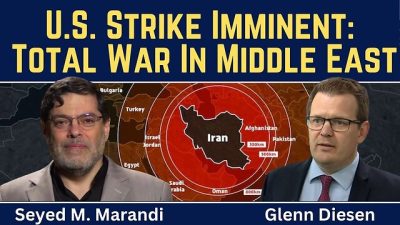
Seyed M. Marandi: Toward Total War in the Middle East
or go to
Aletho News Archives – Video-Images
From the Archives
The Geopolitics behind the War in Yemen (I)
By Mahdi Darius NAZEMROAYA | Strategic Culture Foundation | 30.03.2015
The United States and the Kingdom of Saudi Arabia became very uneasy when the Yemenese or Yemenite movement of the Houthi or Ansarallah (meaning the supporters of God in Arabic) gained control of Yemen’s capital, Sanaa/Sana, in September 2014. The US-supported Yemenite President Abd-Rabbuh Manṣour Al-Hadi was humiliatingly forced to share power with the Houthis and the coalition of northern Yemenese tribes that had helped them enter Sana. Al-Hadi declared that negotiations for a Yemeni national unity government would take place and his allies the US and Saudi Arabia tried to use a new national dialogue and mediated talks to co-opt and pacify the Houthis.
The truth has been turned on its head about the war in Yemen. The war and ousting of President Abd-Rabbuh Manṣour Al-Hadi in Yemen are not the results of «Houthi coup» in Yemen. It is the opposite. Al-Hadi was ousted, because with Saudi and US support he tried to backtrack on the power sharing agreements he had made and return Yemen to authoritarian rule. The ousting of President Al-Hadi by the Houthis and their political allies was an unexpected reaction to the takeover Al-Hadi was planning with Washington and the House of Saudi. … continue
Blog Roll
 Aletho News
- Finland’s Stubb tells European leaders to calm down
- Defeating Russia on battlefield impossible – Fico
- Finland’s Gender Clinic Reversal
- Massachusetts Wants Mental Health Visits, Why Does Government Use ‘Health’ to Enter Our Homes & Families?
- US lawmaker admits American people footing bill for Trump’s failed aggression against Iran
- Pfizer Gave $500,000 to Groups That Lobbied to End Religious Exemption in Massachusetts
- HE SAVED LIVES. NOW HE FACES PRISON.
- Israeli lobby seeks to bind US fate to ‘Israel’: Araghchi
- Pakistan-Iran talks secure LNG shipment to Islamabad through Hormuz
- Black Sea grain crisis puts global wheat supplies under pressure
- If Americans Knew
- Israeli Attacks in Gaza Kill at Least Seven Palestinians Over Three Days, including Woman and Child
- Trump’s militarization of Washington DC as he pursues Israel’s war against Iran
- Why Israel Fears This Searing New Documentary
- Huckabee aide solicited cash gifts from Israelis
- This isn’t sci-fi, AI is already killing people
- ‘The Most Brutal Thing’: Investigation Reveals Execution of Elderly Woman in Rafah
- Inside Israel’s ‘soft’ ethnic cleansing plan for Gaza through the eyes of its victims
- New online database tracks pro-Israel political donations in the United States
- Israeli president pardons soldier convicted for killing wounded Palestinian
- Singer Ed Sheeran says his ‘heart broken’ by Gaza devastation, addresses Macklemore controversy
- No Tricks Zone
- 2025 Nature Paper Claiming Worsening Global Drought Gets RETRACTED …Heavily Flawed
- New Study: ‘Global Drought Shows No Detectable Recent Acceleration Under Climate Warming’
- Economic Masterminds: German Socialists Suggest Taxing Productivity Gains Stemming From Using AI
- The South China Sea Has Not Been Cooperating With The Climate Change Narrative
- Energy Crisis: Germany Enters Heating Season With Historically Low Gas Reserve Fill Levels
- New Study: The Antarctic Ice Sheet Gained Mass From 2020-2024 Due To Staggering Snow And Ice Accumulation
- Study: Ocean Heating Rates From Thousands Of Years Ago ‘Dwarf’ Modern Ocean Heating Rates
- Climate Extremists Target, Attack Large-Scale Power Grid Infrastructure In Germany!
- New Study: Antarctic Ice Melt Has Contributed Less Than 1 Centimeter To Sea Level Rise In The Last 30 Years
- Fear Of Debate: Alarmist German Climate Scientist Calls On Mainstream Media To Discredit Skeptic Voices
 Aletho News