Venezuelan Opposition Protests Proposed UN Electoral Observer Mission
Venezuelanalysis | March 13, 2018
Caracas – Supporters of Venezuela’s Democratic Unity Roundtable (MUD) opposition coalition marched on the headquarters of the United Nations in Caracas Monday to protest the possibility of the international body sending an observer mission to monitor the country’s upcoming May 20 elections.
In a letter addressed to UN Secretary-General Antonio Guterres, the opposition alleged that an observer mission would “give a veneer of legality to an [electoral] process that lacks it.”
Last month, the Venezuelan electoral authorities formally invited the UN to send an observer mission to monitor the upcoming elections as part of an agreement negotiated between the government and the MUD, which the latter ultimately refused to sign. The UN is yet to confirm whether it will send a delegation in May.
Following the breakdown of internationally-mediated talks, the main opposition coalition announced it would boycott the presidential elections – which were then set for April 22 – claiming the date and electoral guarantees were inadequate to ensure a free and fair contest.
However on March 1, several smaller opposition parties led by former Lara Governor Henri Falcon broke ranks with the MUD and signed a deal with the ruling United Socialist Party and its leftist allies moving the presidential election to May 20 and hold municipal and state legislative elections on the same day. Although the agreement featured various safeguards previously demanded by the MUD during talks – including observers from the UN and other international bodies, equal access to media, and an ample window for voter registration – the anti-government coalition dismissed the deal as a “farce” and vowed to go ahead with its boycott.
Turnout in Monday’s demonstration was, nonetheless, small in number, particularly in comparison to the mass protests organized by the MUD to demand early presidential elections last year, which frequently concluded in deadly acts of violence perpetrated by hardline anti-government groups.
The march was organized by the newly formed “Free Venezuela Broad Front” (FAVL), which includes the parties of the MUD alongside the Fedecameras business lobby, representatives of the Catholic and evangelical churches, several university student and professor organizations, as well as a group of ex-government loyalists led by former Interior Minister Miguel Rodriguez Torres.
Taking to Twitter Saturday, President Nicolas Maduro criticized the call for electoral boycott and rejection of UN observers from sections of the opposition.
“Why so much contradiction? What do they [the MUD] want? I want the secretary-general to send a strong commission of observers,” he declared.
Meanwhile, Maduro’s principal rival, Henri Falcon, was in New York Tuesday, where he was reportedly meeting with UN officials.
Himself a former Chavista, Falcon was expelled from the MUD last month after he registered his candidacy in violation of the coalition’s boycott.
While center-right pollster Datanalisis has reported that over 70 percent of Venezuelans intend to vote in the upcoming elections, Falcon and other opposition leaders remain concerned about low turnout among their ranks.
On Tuesday, a spokesperson for the opposition’s new Broad Front denied the organization was promoting abstention.
“We are not partisans of a policy of abstention. Of course, we think that as things are now, one cannot vote, because we want to vote to truly choose and not give the appearance of legality in the country that doesn’t exist,” explained Ramon Guillermo Aveledo, who was secretary general of the MUD between 2009 and 2014, during an interview with Globovision Tuesday.
However, the former MUD leader did not indicate that the FAVL would encourage its supporters to vote for Falcon.
On the contrary, he suggested that the opposition candidate could abandon his presidential bid.
“I don’t at all rule out that Falcon renounces his candidacy, withdraws from the process when he confirms what we, his friends, have told him… that it’s not a real election,” Aveledo added.
The FAVL has called for nationwide protests against the May 20 elections for this coming Saturday.
US in Afghanistan to Influence Russia, Iran, China – Russian Foreign Ministry
Sputnik – March 14, 2108
The United States retains its presence in Afghanistan to exert influence on neighboring countries and regional rivals – namely, Russia, Iran and China, Russian Foreign Ministry’s Second Asian Department Director Zamir Kabulov told Sputnik in an interview.
“In our opinion, the United States is in Afghanistan primarily with the aim of controlling and influencing the political processes in its neighboring countries, and also demonstrating its power to its regional competitors, primarily China, Russia and Iran. The United States is clearly trying to achieve destabilization of Central Asia and later transfer it to Russia in order to subsequently present itself as the only defender against potential and emerging threats in the region,” Kabulov said.
According to the diplomat, Russia and other countries neighboring with Afghanistan have questions about the true goals and time frame of the US military presence in the Central Asian country.
“If the United States and its NATO allies intend to continue their destructive policy in Afghanistan, this will mean that the West is heading toward the revival of the Cold War era in this part of the world. We closely monitor the developments and are ready to respond in cooperation with our partners and other like-minded people,” Kabulov noted.
The diplomat pointed out that Washington still failed to understand that the Afghan conflict could not be resolved solely by military means, stressing that it was impossible to defeat the Taliban by force.
Moscow is puzzled by the attempts of the United States and NATO to persuade Afghanistan to replace Russian weapons and military equipment, such move leads to reduction of Afghan’s military potential, Zamir Kabulov told Sputnik in an interview.
“The course taken by the United States and NATO to persuade Kabul to replace Russia-made small arms and aircraft is surprising, as it will inevitably lead to a decrease in the combat capabilities of the Afghan armed forces and further deterioration of the situation,” Kabulov said.
The diplomat reminded that a bilateral intergovernmental agreement on Russia’s defense industry assistance to Afghanistan had entered into force in November 2016, adding that the document created the legal framework for Russian assistance in arming and equipping the Afghan security forces.
“At the moment, negotiations are underway on repairs and supplies of spare parts for the Afghan Air Force’s helicopters for various purposes, produced in Russia (the Soviet Union),” Kabulov added.
Afghanistan Parliamentary Election
The parliamentary election in Afghanistan is unlikely to take place in July in the current circumstances, Kabulov said.
“I do not think that the parliamentary elections in Afghanistan will be held in July this year as scheduled. The Taliban continue to control about half of the country’s territory, engage in hostilities, organize and carry out terrorist attacks in large cities, and, apparently, are not going to make compromises and reconciliation with the Afghan government,” Kabulov said.
Afghanistan’s Independent Election Commission (IEC) is also unlikely to accomplish all the necessary procedures before the date set for the vote, given that the commission has announced earlier that the registration of voters will complete only by early August, the diplomat noted.
Furthermore, disagreements between the presidential administration and its political opposition regarding the parameters of the upcoming elections still remain unresolved, the official noted.
“In my opinion, if elections are conducted in the current circumstances, their results will not improve the political situation in the country and confidence in the current government, will not force the armed opposition to cooperate with the government,” Kabulov added.
The diplomat also noted that the Daesh terror group posed a serious threat to holding the election.
“The Daesh jihadists pose a serious threat to the security of the conduct of elections, especially in the north and a number of eastern provinces of Afghanistan. Some polling stations in the provinces of Helmand, Uruzgan, Kunduz, Badakhshan, Faryab and Ghazni are the most problematic in terms of security, according to the IEC data. I think that, in fact, the list of problematic areas in terms of organization of voting is much longer,” Kabulov said.
Afghanistan Reconciliation Talks
Russia considers the so-called Moscow format of talks an optimal platform for the promotion of national reconciliation in Afghanistan, Zamir Kabulov noted.
“Unfortunately, the existence of a large number of international formats on the Afghan issue has not significantly contributed to the involvement of the Taliban in peace negotiations. In this regard, we consider the Moscow format of consultations launched by us in early 2017 as the optimal platform for substantive negotiations to promote national reconciliation and establish a constructive dialogue between the government of Afghanistan and the Taliban movement,” Kabulov said.
Kabulov also noted that Moscow considered the format of talks in the Afghan capital as one approach toward achieving a collective solution to the problems surrounding Afghan settlement.
“A signal of international support for the resolution of the intra-Afghan conflict through political dialogue with the government of Afghanistan has been sent to the Taliban. The Taliban ignored the recent meeting of the ‘Kabul process’ in the Afghan capital, insisting on direct talks with the United States,” the diplomat added.
In February 2017, Russia, China, Pakistan, Iran, India and Afghanistan came together in Moscow for talks to promote the national reconciliation process in Afghanistan through regional cooperation with Kabul in the leading role. Apart from the aforementioned states, the latest round in April gathered five Central Asian countries: Kazakhstan, Kyrgyzstan, Tajikistan, Turkmenistan and Uzbekistan. The United States refused to take part in the meeting.
Afghanistan has long suffered political, social and security-related instability because of the simmering insurgency, including that of the Taliban, but also because of the actions of the Daesh terror group.
The United States has been in Afghanistan for almost 17 years following the 9/11 attacks. Before his election, Trump slammed sending US troops and resources to the Central Asian country.
North Korean Leader Wants Peace With US, Establish Diplomatic Ties – Reports
Sputnik – March 12, 2018
North Korea’s leader Kim Jong Un expressed willingness to sign a peace agreement with the United States as well as to establish diplomatic relations between the two countries, South Korean media reported Monday, citing a source at the South Korean presidential administration.
Kim spoke about the intention to normalize relations with Washington during a meeting with a South Korean delegation in Pyongyang, the Dong-A Ilbo newspaper reported.
The North Korean leader’s final goal is to sign a peace agreement with the United States and establish diplomatic ties, possibly including the opening of a US embassy in Pyongyang, according to the newspaper.
On Thursday, US President Donald Trump accepted the invitation to meet with Kim by the end of May following months of heightened tensions and exchanges of frequent military threats between the two leaders.Donald Trump said later that he expected “tremendous success” in solving the North Korean issue, saying that he expected Pyongyang to cease its ballistic missile and nuclear tests as well as denulearize.
USA-North Korea: Who is now advising the US president on Korean matters?
By Konstantin Asmolov – New Eastern Outlook – 10.03.2018
We have already written more than once on the US president’s views on the Korean question: outlining the general approach, summarizing the arguments, emphasizing what a difficult choice he is faced with and looking at how an attempt at dialogue, initiated, it appears, by Joseph Yun, the United States’ Special Representative for North Korea Policy, failed because the necessary preconditions were not met.
The difficulty of the choice has resulted in a large number of different opinions. The USA is prepared to talk with the DPRK if the latter completely abandons its nuclear program before the talks begin. In these circumstances, Donald Trump has assured Moon Jae-in that the USA will never start a war with North Korea without South Korea’s agreement, even though he has ambiguously hinted at the possibility of doing so if sanctions fail.
The lack of a clear policy is frequently blamed on the fact that there is no experienced North Korea specialist in the Trump Administration. Most academics do not like the new president and do not want to advise him- they would rather just wait and see him get himself in a mess that he can’t get out of. Non specialist political experts keep repeating, year after year, that the regime is facing imminent collapse. It is also well known that Donald Trump does not particularly trust the US Intelligence Service and Department of State.
So, let us have a look at some recent rumors and resignations. First, the decision not to appoint the political analyst Victor Cha, who is well known as a harsh critic of Pyongyang, as ambassador to South Korea. Victor Cha is an ethnic Korean and a Protestant, who was the Director for Asian Affairs in the White House’s National Security Council during George W. Bush’s administration, and was part of the US delegation for the six-party talks on the North Korean nuclear problem. He currently teaches at Georgetown University and works as an advisor for CSIS (the Centre for Strategic and International Studies).
His opinions are typical of those held by Pyongyang’s opponents- he wrote in 2011 that the North Korean regime was nearing its end, and after the death of Kim Jong-il the DPRK would last only a few weeks, or at most months, before it had its own version of an “Arab Spring”. And his book, “The Impossible State: North Korea, Past and Future” was seen, even in the USA, as representing an extreme and politically motivated view, which verged on a deliberate refusal to understand the situation in the DPRK.
The decision not to appoint Victor Cha was, in effect, taken as long ago as August 2017. On December 10 a request for his agrément was sent, but the Washington Post, citing the White House, reported that the appointment had been withdrawn. That newspaper blamed differences of opinion, on at least two points, between Victor Cha and the Trump Administration. Firstly, Victor Cha expressed concern about the Trump Administration’s intention to withdraw from a trade agreement with Seoul which the USA did not benefit from.
Secondly, he spoke out against a so-called “bloody nose” strike- a precision attack on the DPRK’s nuclear facilities and other strategic targets, avoiding any civilian casualties (or keeping them to a minimum). Presumably such a strike would not trigger a full-scale war- Kim jong-un is not a mindless bloody tyrant, after all-, and North Korea would accept the blow to its pride and not respond to an attack on a limited scale by triggering a nuclear war. If that assumption is correct then it is possible to play with North Korea’s patience, and then, after a series of strikes, convince Pyongyang of its vulnerability and persuade it make concessions, including giving up its nuclear weapons.
However, according to media reports, in December 2017 Victor Cha “expressed concern about a plan to warn Pyongyang with a narrow rocket strike”, and already, after his resignation, he published an article warning about the grave risks of such an attack and arguing that it would solve nothing and would only push the regime into taking more extreme steps.
As a result the US diplomatic embassy in South Korea is currently headed by a temporary appointee, Mark Napper, and experts have expressed concern about how the lack of an ambassador may disrupt the continuity of communications between Seoul and Washington, even though the US administration has promised to find a new candidate without delay.
And then the next resignation: the retirement “for personal reasons” of Joseph Yun. Born in South Korea, as a child he immigrated with his parents to the USA at an early age and started his diplomatic career in 1985. During his career he has served as the military attaché to the US embassy in Seoul, the US ambassador in Malaysia, and, most recently, a US Deputy Assistant Secretary of State, and, at the same time, Special representative for North Korea policy. In the latter capacity, among other achievements, he arranged the release of the American student Otto Warmbier and was considered Washington’s main policy former ideologue in its relations with Pyongyang.
Rex Tillerson accepted Joseph Yun’s resignation with regret, and Heather Nauert, the spokesperson for the US Department of State, announced that the US’s special representative for North Korean policy will, as before, be on the staff of the Department for East Asia and Pacific Affairs. However, experts in both South Korea and Russia have noted that Joseph Yun was a supporter of any dialogue, even at the most superficial level, with Pyongyang, and his departure increases the risk of conflict. According to a number of sources, Mr. Yun was the only more-or-less high-profile state official with whom Moscow was able to find points of agreement. “We are aware, and he himself made no secret of this, that he was pretty much on his own, surrounded by “hawks” in the US administration, but his presence gave us hope that the calls for dialogue might be heard. It is a pity he has gone. It is to be expected that the USA’s policy towards Pyongyang will become even more aggressive and intransigent.”
Heather Nauert’s comment on the resignation was as follows: “We are sorry to see him retire, but our diplomatic efforts regarding North Korea will continue based on our maximum pressure campaign to isolate the DPRK.” In theory, that could mean that Joseph Yun, unlike Heather Nauert and the rest of the gang, did not see the “Olympic thaw” as a gesture of despair and a sign that the regime was near collapse, nor did he adhere to the idea that the best response to the DPRK’s outstretched hand is to tighten the pressure so that North Korea will finally collapse.
And, as South Korean media have pointed out, he is not the only experienced American diplomat to resign over a difference of opinion with the Trump administration. Recently, Tom Shannon, the U.S. State Department’s third-ranking official, announced that he was stepping down. Michael Ratney, the US Special Envoy for Syria, has made a similar decision. And if reports from the generally anti-Trump media are to be believed, then Donald Trump has asked the White House Chief of Staff John Kelly to dismiss his son-in-law, Jared Kushner, and his daughter, Ivanka. Those last reports are probably false, but the question of who is now advising Donald Trump is becoming more and more pressing. For example, it is clear that Peter Navarro, who is well-known for his strongly anti-Chinese views, has an influence on the USA’s policies towards China. One of his books is called “Death by China: How America Lost Its Manufacturing Base”.
Of course, Donald Trump is not a person who relies on other peoples’ opinions when he makes decisions, but his personal experience as a businessman and politician have not provided him with the high level of judgement required to understand the situation in North East Asia. We have already written about some of the problems this has caused, and, given the “difficult choice” he is faced with, all he can do at the moment is hope that the “maximum pressure” approach will work, or threaten the world with “Plan B”. And that means that, following Joseph Yun’s resignation, a successful resolution to the Korean problem has become rather less likely.
Konstantin Asmolov, PhD in History, Leading Research Fellow at the Center for Korean Studies of the Institute of Far Eastern Studies of the Russian Academy of Sciences.
The Healthcare Bait-and-Switch: From the Clintons to Obama and Back Again
By Glen Ford | Black Agenda Report | March 8, 2018
On the campaign trail in January of 2016, Hillary Clinton told Iowa voters that Bernie Sanders’ single payer health care proposal was an idea whose time would never come. “People who have health emergencies can’t wait for us to have a theoretical debate about some better idea that will never, ever come to pass ,” said the presumed shoo-in for president. Two years later, one-third of Democrats in the Senate have endorsed Sanders’ Medicare for All Act and half the Democrats in the U.S. House have signed on to Rep. John Conyers’ Expanded and Improved Medicare for All Act, HR 676 . Polls show 75 percent of Democrats favor “expanding Medicare to provide health insurance to every American,” and 31 percent of the public at-large wants health care to be the first problem the Democrats tackled if they win the White House in 2020.
Predictably, however, Hillary Clinton’s favorite think tank is still trying to make sure single payer health care never happens. The lavishly funded Center for American Progress (CAP) last week unveiled their counterfeit, sound-alike health care plan, dubbed Medicare Extra for All, whose sole purpose is to distract and confuse a public that is demonstrably “ready” for single payer. The CAP scheme, like Obamacare, keeps the private insurance corporations at the center of the money-stream, doesn’t cover everyone, charges fees, co-pays and premiums, doesn’t save much money, and would fail to provide millions with adequate coverage. “CAP’s plan maintains the current tiered system in which some people have private health insurance, those with the greatest needs have public health insurance, some people will have inadequate coverage and others will have no coverage at all,” writes Dr. Margaret Flowers , of Health Over Profit. “By offering a solution that sounds good to the uninformed — ‘Medicare Extra for All’ –but continues to benefit their Wall Street donors,” said Flowers, “Democrats hope to fool people or buy enough support to undermine efforts for NIMA,” or National Improved Medicare for All, the comprehensive single payer plan supported by the activists like Flowers.
National Improved Medicare for All would save half a trillion dollars a year on administrative costs and another $100 billion on reduced drug costs, according to Flowers. “The CAP plan maintains the complicated multi-payer system that we have today,” she said. “At best, it will only achieve 16% of the administrative savings of a single payer system and it will have less power to reign in the high costs of care.”
The CAP scheme would leave the link between employment and health coverage intact, keeping workers ultimately dependent on the whims of their bosses for healthcare coverage. “When people who have private health insurance lose their job or move, they risk losing their health insurance,” said Flowers. “NIMA creates a health system that covers everyone no matter where they are in the United States and its territories.”
The Obama-Scam, Repackaged
The Center for American Progress is running the same bait-and-switch con that Barack Obama played in the set-up to his Affordable Care Act. Bruce Dixon and I were introduced to Obama’s healthcare scam in June of 2003 when we engaged the then candidate for the U.S. Senate in a month-long telephone and email conversation, at The Black Commentator . At the time, Obama was trailing the field of candidates and in need of every Black vote in Illinois. Dixon and I had just learned that Obama had joined the Democratic Leadership Council (DLC), the corporate money-bag operation for the right wing of the party founded by white southern Democrats including Bill Clinton and Al Gore. On top of that, he’d recently removed his 2002 (mildly) anti-war speech from his campaign website, apparently to get in line with George Bush’s triumphal “Mission Accomplished ” speech, the previous month. Obama denied that he’d become a member of the DLC, and claimed his website was undergoing “routine” updating. (Years later, when the war was clearly lost, Obama’s team would resurrect “The Speech” as proof of his early anti-war credentials.)
Dixon and I decided that the best way to determine if Obama should be in the DLC or not, would be to put him to a three-question “bright line” test on the issues of war, health care and U.S. membership in the NAFTA, the North American Free Trade Agreement. If the candidate answered all three questions correctly, then he should not be a member of the DLC. If he failed, then the DLC was where he belonged, and voters should make their decisions, accordingly.
We presented our bright line questions to Obama in the June 19, 2003 , Cover Story of the publication:
1. Do you favor the withdrawal of the United States from NAFTA? Will you in the Senate introduce or sponsor legislation toward that end?
2. Do you favor the adoption of a single payer system of universal health care to extend the availability of quality health care to all persons in this country? Will you in the Senate introduce or sponsor legislation toward that end?
3. Would you have voted against the October 10 congressional resolution allowing the president to use unilateral force against Iraq?
Note that we specified “a single payer system of universal health care.”
Obama used weasel-language to fudge his answers to the Iraq War and NAFTA questions. On health care, he wrote:
“I favor universal health care for all Americans, and intend to introduce or sponsor legislation toward that end in the U.S. Senate, just as I have at the state level. My campaign is also developing a series of interim proposals – such as an expansion of the successful SCHIP program – so that we can immediately provide more coverage to uninsured children and their families.”
Obama left out the words “single payer.” Only after he became president, six years later, would it become clear that his definition of “universal” health care meant only that all Americans would be required to enroll in an insurance program – just as states require that all drivers be insured.
Despite his use of weasel-wording in all three answers, we at The Black Commentator gave Obama a passing grade. “BC is not seeking to martyr Barack Obama on a left-leaning cross,” we wrote.
(Our actual motive in 2003 was fear of being labeled “crabs in a barrel” for undermining the prospects of such an attractive, progressive-sounding, young Black up-and-coming politician—a failure of political nerve for which I will forever be ashamed.)
A year and a half later, in the week before Obama was sworn into the Senate, he told me that the country was not “ready” for single payer. But, if he really believed that, he would not have spent the next four years misleading the people through his calculated misuse of the term “universal.”
“Universal” was Obama’s bait-and-switch to confuse the public, much of which continued to wishfully assumed that he favored some kind of single payer plan. Once he got in office—and after announcing that “all entitlements, including Social Security, Medicaid and Medicare, would be “on the table” for cutting under his administration—Obama banished single payer advocates like Rep. Conyers from the White House and quite publicly allowed the for-profit healthcare corporations to write his Affordable Care Act, with its “universal” mandate that added many of millions of new “customers” for the industry.
The Democratic Leadership Council disbanded near the end of Obama’s first term in office. Faux-progressives claimed a victory. “One of the things that’s happening right now in Democratic politics is that progressives are winning the battle for the party,” said Progressive Congress president Darcy Burner. “The corporate-focused DLC type of politics isn’t working inside the Democratic party.”
That was nonsense. The DLC went out of business because it had won its battle for corporate hegemony in the party. By 2011, Obama had revealed himself as a full-blooded austerity (and war) president, and was still seeking his “Grand Bargain” with the Republicans. The “progressives” were defenestrated (thrown out of the White House windows) and humiliated in his first year, and were not to rise again until Bernie Sanders, the nominally non-Democrat, made his bid for the White House in 2016—with single payer healthcare at the tip of his spear.
Sanders’ version of single payer is “highly flawed ,” said Health Over Profit’s Margaret Flowers, who is also co-director of Popular Resistance , but, “the fact that the Democrats are proposing something that sounds like NIMA means we are gaining power.” The legislation “calls for a four-year transition period, during which the newly improved Medicare would first insure all children and adults 55 or older, then expand gradually to cover all adults,” writes the Huffington Post .
The Sanders bill’s endorsers in the Senate include a number of obvious Trojan Horses, such as Cory Booker, a deeply reactionary politician who could have been the “first Obama” had he won prominent office just a few years sooner (see The Black Commentator, April 4, 2002, “Fruit of the Poisoned Tree .”) He was among 13 Democrats that voted against creating a reserve fund to allow Americans to import cheaper drugs from Canada, lamely claiming that it didn’t address consumer protection issues. Booker and others are joining the pro-single payer bandwagon to weaken it from the inside, while his allies in the Clinton camp and their Center for American Progress scheme to extend the life of for-profit healthcare under the Medicare brand.
Meanwhile, Donald Trump is the greatest negative motivator for single payer. He last month proposed new rules that would allow sale of short-term insurance policies that omit “essential health benefits”—what Sen. Ron Wyden calls “junk insurance”—to allow the market to work its miracles. But the people are learning that the market will kill you.
BAR executive editor Glen Ford can be contacted at Glen.Ford@BlackAgendaReport.com
Why Russia’s New Strategic Capabilities Come As a Shock to US Intelligence Community
By Philip M. GIRALDI | Strategic Culture Foundation | 08.03.2018
The United States of America spends something like $80 billion annually on intelligence gathering and analysis. When the CIA was founded by the National Security Act in 1947 the intention was to create a mechanism that would warn about an imminent threat. The memory of Pearl Harbor in 1941, when Japan attacked the U.S. naval base was still fresh, and the legislation was popularized by the slogan “no more Pearl Harbors.”
In spite of the dedication of considerable resources and manpower, there have been some major intelligence failures in the past seventy years, starting with the inability to anticipate the breakout of the Korean War and including the embrace of false intelligence on Saddam Hussein’s alleged weapons of mass destruction. But the most recent failure is perhaps more consequential than either Korea or Iraq.
On March 1st, Russian President Vladimir Putin spoke before his country’s Federal Assembly plus a large group of both local and foreign journalists, outlining his plans for the economy and also dealing with other domestic issues should he be reelected later this month. The final third of the presentation was on national defense and, in its substance, was clearly directed at a global audience, particularly the United States.
He explained:
“During all these years since the unilateral U.S. withdrawal from the ABM Treaty [in 2001] we have been working intensively on advanced equipment and arms, which allowed us to make a breakthrough in developing new models of strategic weapons.”
He was referring to the RS-28 Sarmat ballistic missile, which has almost unlimited range and ultra-high speed, enabling it to employ trajectories including strikes coming over the South Pole that can defeat existing American Anti-Ballistic Defense systems. Russia has also produced and deployed a hypersonic glider weapon system Avangard.
But the real game changer is the Russian ability to negate America’s ability to project power through its navy. The already deployed air-launched Kinzhal anti-ship missile has a range of 2000 kilometers and a hyper-sonic speed that makes it nearly impossible to intercept. The development has made America’s thirteen aircraft carrier groups obsolete. President Putin made clear that Russia now has an overwhelming military advantage in cruise and ballistic missiles that are capable of penetrating U.S. defenses.
The new reality may or may not impel policymakers in Washington to approach Moscow and seek a new round of negotiations for arms control, but the real shock deriving from the Putin announcement is the failure of the intelligence community to anticipate the developments and advise their significance. Some of the new systems were hardly secret, with development of the Sarmat, for example, known to western governments for a number of years.
There will no doubt be a blame game in Washington over the inability to learn of Russia’s arms programs, but the questions that probably will not be asked relate to the intelligence agencies themselves and their capabilities, or lack thereof. It is no secret that organizations like the Central Intelligence Agency (CIA) have seen their basic missions change since 2001. An organization that used to pride itself on its ability to conduct classic espionage operations involving recruiting and running spies suddenly heard from policymakers that those skills were no longer in demand. Many officers who were made redundant or forced to retire were precisely those individuals who had cut their teeth on running operations directed against the old Soviet Union. They had the language and cultural skills necessary to collect information on Russia. With their departure, those capabilities also largely vanished.
Instead of spying, American intelligence agencies working mostly against what was broadly described as “terrorism,” used technology to locate potential targets and kill them. The CIA’s Clandestine Services, once the haven of its spies, became under President Barack Obama, a largely paramilitary operation focused on military solutions rather than espionage. This process was accelerated under Obama’s CIA Director John Brennan, who worked assiduously to reduce the influence of the former spies within the Agency. Brennan reportedly had once wanted to become a spy but was kicked out of the training program as “unsuitable.”
So, has America learned that its intelligence agencies are doing all the wrong things and that the national defense strategy is unsustainable because the Russian-American relationship is now on a new footing? Possibly, but it is perhaps more likely that Washington will avoid asking the hard questions.
‘Truly Unprecedented’: High Level Inter-Korean Talks See Promising Start
Sputnik – 06.03.2018
On Monday, a South Korean delegation flew to Pyongyang to take part in a welcome banquet held by North Korean leader Kim Jong-un prior to talks expected to focus on bubbling tensions on the peninsula and the rocky relationship between North Korea and the US.
The South Korean delegation includes Chun Eui-yong, Seoul’s National Security Office director and Suh Hoona, the head of South Korea’s intelligence agency.
Speaking to Sputnik Radio’s Loud & Clear, Simone Chun, a fellow at the Korea Policy Institute and member of the Korean Peace Network, broke down the meeting and discussed what could blossom from it.
“We will have to wait and see, but so far it looks like even President [Donald] Trump is looking forward to talking to North Korea,” Chun told show hosts Brian Becker and John Kiriakou. “So if that is true, that probably sounds like we’re going to have brighter news than we’ve had in the last seven or eight years.”
“There were amazing pictures of the Korean delegate… they went to North Korea on a South Korean military aircraft… and the most interesting thing, truly unprecedented, is that they actually met with Kim Jong-un within three hours — that is truly something that has never happened before,” she added, before saying that “if all goes well I think we’re going to have some major breakthrough.”
Though Chun is hopeful that the talks will end on good terms, she admitted to Becker that at the end of the day nothing can be settled unless the US also signs off.
“It’s just a reality in international politics that without the US, nothing can be done. I think it’s very important to go step by step,” she said. “These guys are really truly experienced… they aren’t just inexperienced bureaucrats, they have years of experience in dealing with North Korea so I think that we really have a dream team.”
Chun believes that Pyongyang will likely use the talks as a way to “learn more about the Trump administration’s motives.”
“The most important thing is to end or reduce US hostility to North Korea… the bottom line is that if the United States can end its hostility toward North Korea, a foundational progress can be made.”
Pyongyang Seeks to ‘Write New History’ of Korean Unification – State Media
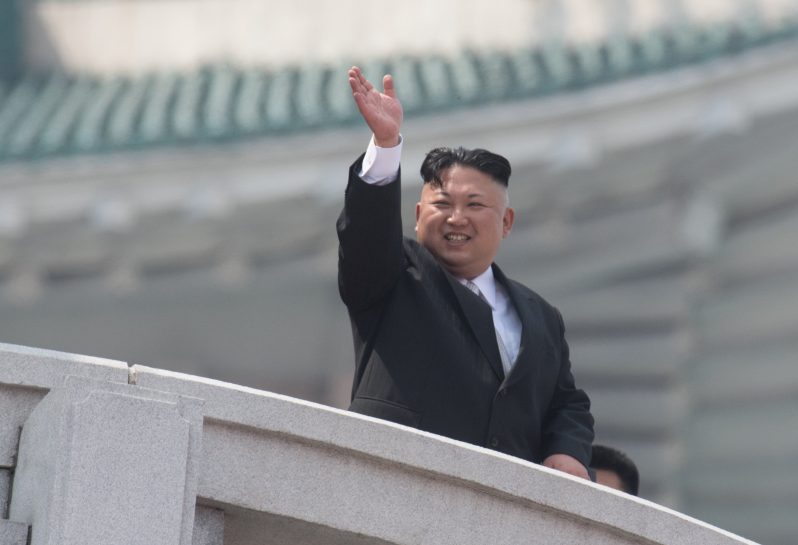
Sputnik – 06.03.2018
Shortly after Kim Jong-un hosted a high-level delegation of South Korean officials for dinner in Pyongyang on Monday, North Korean state media said the country’s leader intends to advance inter-Korean relations and make the story of Korean history a story of unification.
Kim “repeatedly clarified that it is our consistent and principled stand and his firm will to vigorously advance the North-South relations and write a new history of national reunification by the concerted efforts of our nation to be proud in the world,” according to North Korea’s Korea Central News Agency (KCNA).
The Yonhap news agency has reported that the main goal of South Korean President Moon Jae-in’s envoy to Pyongyang is to enable US-North Korea talks. Chung Eui-young, the head of South Korean national security, and Suh Hoon, Seoul’s spy chief, are among those who met with Kim.
Moon’s delegation hand-delivered a letter from the South Korean president addressing Kim. “Hearing the intention of President Moon Jae-in for a summit from the special envoy of the south side, he exchanged views and made a satisfactory agreement,” KCNA said. Further, the Pyongyang’s leader “gave the important instruction to the relevant field to rapidly take practical steps for it.”
“He [Kim] also made an exchange of in-depth views on the issues for easing the acute military tensions on the Korean Peninsula and activating the versatile dialogue, contact, cooperation and exchange,” KCNA added.
The United States and South Korea are in close contact regarding the inter-Korean talks that are currently underway, State Department spokesperson Katina Adams told Sputnik on Monday. “We are in contact with the Republic of Korea about our unified response to North Korea,” said Adams said.
Washington and Seoul will work together “through the maximum pressure of the campaign to ensure that North-South progress is accompanied by advances towards denuclearization.”
KCNA reports that the meeting was held in “a compatriotic and sincere atmosphere.”
Nuclear genie pops out of Saudi bottle
By M K Bhadrakumar | Indian Punchline | March 3, 2018
The United States invaded and destroyed Iraq in 2003 on the false ground that Saddam Hussein secretly nurtured a nuclear program, but fifteen years later, Washington is actively discussing how to cater to Saudi Arabia’s nuclear ambitions. It is a sign of our times that the nuclear genie is out of the Saudi bottle and the US may have to get used to the idea.
Saudi Arabia has opened bids from foreign companies to build two nuclear reactors. Riyadh wants eventually to install up to 17.6 gigawatts of atomic capacity by 2032 – or up to 17 reactors. Tens of billions of dollars worth business is involved. Companies from the US, France, Russia, China and South Korea have shown interest – including Westinghouse. There is pressure on the Trump administration to restart talks with Riyadh on a civil nuclear cooperation pact so that Westinghouse can pick up the lucrative business. The nuclear commerce with Saudi Arabia fits in with President Trump’s America First, as it could create thousands of jobs in the US economy.
But there is a serious catch. The Saudis will not accept any restrictions on uranium enrichment technology. Washington’s policy, on the other hand, is to sign a peaceful nuclear cooperation pact – known as a 123 agreement – that blocks steps in fuel production with potential bomb-making uses. Now, Riyadh maintains that it is not interested in diverting nuclear technology to military use, but it wants nonetheless to tap its own uranium resources for “self-sufficiency in producing nuclear fuel”. Indeed, Saudis have a point here. It is Saudi Arabia’s prerogative to have access to nuclear enrichment technology – like any NPT member country.
But then, Saudi Arabia happens to be a Muslim country in the Middle East and the West so far ensured that there is nothing like an “islamic bomb”. What happens if some day, a gust of Arab Spring blows through the Arabian Peninsula and an authentic Islamic regime takes shape there? Again, the Saudis already have a past history of funding Pakistan’s clandestine nuclear weapon program. The two countries are close allies. General Raheel Sharif, former Pakistani army chief, heads the Saudi-led Islamic Military Alliance, which was formed last year. Pakistan’s present army chief Gen. Qamar Javed Bajwa is frequently in and out of Saudi Arabia. In February, following Bajwa’s last hushed visit, Pakistan announced the deployment of a few thousand troops to Saudi Arabia under a bilateral security cooperation agreement for unspecified purposes.
Conceivably, Saudis intend to develop nuclear weapons some day. The Saudi compulsions are similar to Pakistan’s – nuclear weapons provide deterrent capability. Lest it be forgotten, Saudi Arabia already has a “delivery system” – missiles capable of delivering nuclear weapons. Its armed forces even have a designated Saudi Strategic Missile Force, which handles long-range missiles. Actually, these missiles don’t make sense unless they’re armed with nuclear weapons. What makes all this a combustible mix is that the present Crown Prince Mohammed bin Salman is a hot head, as the bloody war in Yemen testifies. The rift with Qatar underscores that MbS is bent on establishing Saudi hegemony in the region.
Logically speaking, the US could offer to Saudi Arabia something like the Joint Comprehensive Plan of Action (JCPOA), the multilateral agreement of July 2015 that restricts Iran’s nuclear program. The Saudis cannot complain because they had previously complained that the JCPOA was a generous deal for Iran – except that it means:
- No indigenous reprocessing, with all spent reactor fuel to be shipped out of the country;
- Severe restrictions on any uranium enrichment, in terms of both the level of enrichment and the amount of material enriched;
- A highly intrusive IAEA inspection regime, in which international inspectors have continual and full access to nuclear facilities, including the right to inspect military bases or other places if they had any reason to suspect nuclear-related activities.
Of course, it entails the Trump administration admitting that JCPOA was a brilliant achievement in nuclear non-proliferation. That will be not only a bitter pill to swallow for President Trump but his (and Israel’s) entire strategy to reimpose sanctions against Iran would unravel.
The alternative will be to give Saudi Arabia a free hand to acquire mastery over the nuclear fuel cycle but the US Congress is almost certain to shoot it down. On the other hand, if the US and Saudi Arabia cannot agree on a 123 agreement, Westinghouse loses the multi-billion dollar business. Russia’s Rosatem has already sought a contract to construct 2 nuclear power plants in Saudi Arabia. In the prevailing new Cold War climate with the Trump administration castigating Russia as a “revisionist power” and an “existentialist threat”, a coordinated effort by the international community to circumscribe Saudi Arabia’s nuclear ambitions (on the lines that the Obama administration could mobilise) is too much to expect today. Which, in turn, creates space for Saudi Arabia to outmaneuver the Trump administration. Riyadh is aware of it. (Asharq Al-Awsat )
This is going to be one hell of a trapeze act for the Trump administration. If Trump destroys the JCPOA in these circumstances, and Iran retaliates by resuming uranium reprocessing, this becomes an entirely new ball game. Other Middle Eastern countries are watching – Turkey and Egypt, in particular. And they would be wondering, ‘If Saudi Arabia can have reprocessing technology, why not us?’ Israel’s “nuclear superiority” is steadily getting eroded, too. Read a fascinating piece Coming soon – a Nuclear Middle East.
South Korea ‘to send high-level delegation to North’
Press TV – March 4, 2018
South Korea has announced a decision to send a high-level political delegation to the North, raising hopes for a diplomatic solution to the decades-long conflict on the Korean Peninsula.
The South Korean presidential office announced on Sunday that a special 10-member government delegation was to visit North Korea on Monday.
“The special delegates will have extensive discussions over issues including creating conditions for North-US talks to denuclearize the Korean Peninsula and improving inter-Korea ties,” Blue House spokesman Yoon Young-chan told reporters.
The 10-member group comprises five top delegates, including top national security adviser Chung Eui-yong and intelligence chief Suh Hoon. It will fly to the North’s capital, Pyongyang, on Monday afternoon before returning on Tuesday, Yoon said.
The delegation will then fly to the US to brief officials in Washington, he added.
The move comes just weeks after the North’s leader Kim Jong-un sent a delegation to the South that included his younger sister, Kim Yo-jong.
During her stay, Kim Yo-jong personally delivered to South Korean President Moon Jae-in an invitation from her brother for a summit meeting in Pyongyang.
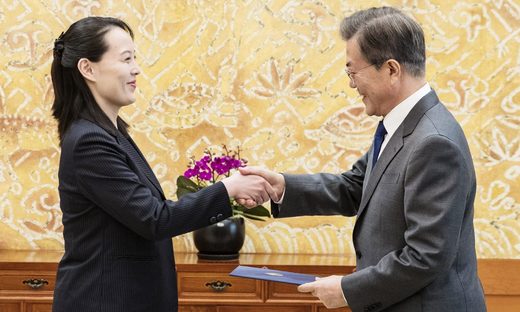
Peace advocate
President Moon, 65, who hails from the Democratic Party, rose to power last year vowing to ameliorate the broken ties between the two Koreas.
Last week, Moon advised US leaders to stop setting preconditions to hold talks with North Korea and make greater efforts for peace and stability. Washington needs to “lower the threshold for talks” with Pyongyang, he said.
On Saturday, a Foreign Ministry spokesman in Pyongyang called on the US to drop any precondition for talks.
“The US is taking preposterous action by continuing to trumpet an insistence that it will not have dialog unless a right condition is met,” the unnamed spokesman was quoted as saying by the state-run KCNA news agency.
The US, which has imposed many sanctions on Pyongyang, has said that North Korea should denuclearize in order for negotiations to begin.
Late last month, the US imposed the “toughest ever” sanctions on North Korea.
The sanctions were imposed shortly after athletes from the North and South marched together in a show of unity at the PyeongChang Winter Olympics, which ended February 25.
North Korea, for its part, says its nuclear arsenal is a deterrent against potential US aggression.
The US has substantial military presence in the region and has repeatedly threatened the North with military action.
Trump And Kim’s Tug-Of-War Over President Moon
By Andrew KORYBKO – Oriental Review – 03/03/2018
North Korea is reportedly willing to engage in talks with South Korea and the US.
The message was apparently conveyed after a high-level North Korean official met with the South Korean President, Moon Jae-In, who had previously campaigned on a promise to revive the so-called “Sunshine Policy” of some of his predecessors in actively seeking a rapprochement with Pyongyang. The course of developments in the 9 months since his election, especially regarding US actions towards North Korea and its preplanned calculated responses to it, made it almost impossible to advance this idea, but the recently concluded Pyeongchang Winter Olympics proved to be the perfect opportunity for breathing new life into this stalemated but nevertheless promising vision.
China and Russia previously proposed what they called the “Double Freeze” whereby the US and South Korea would indefinitely halt their joint military drills with one another in exchange for North Korea doing the same with its missile and nuclear tests. Washington took the first step in announcing the postponement of its planned exercises with Seoul, which created an amicable atmosphere for Pyongyang to do its part in making the Olympic Games a diplomatic success for everyone and infusing fresh optimism into the “Double Freeze” proposal. As could have been expected, however, the US recently said that it would be resuming its military games with South Korea and even deploying attack drones to the peninsula, which drew sharp condemnation from North Korea who accused America of endangering the incipient peace process.
Even so, this hasn’t yet resulted in any characteristically ostentatious moves from Pyongyang, which can be interpreted in one of two ways. The first is how Trump and his team are likely perceiving this, which is that North Korea is indicating its receptivity to talks from a position of weakness, especially after the US’ new sanctions against the country. The second, though, is more probable, and it’s that North Korea doesn’t want to be seen as being the first one to break the “Double Freeze” , especially since it’s betting that its recent “charm offensive” during the Olympics was enough to convince President Moon of Kim Jong-Un’s sincerity in holding talks with him.
Basically, the North Koreans are trying to deepen the divide between the US and their military allies in South Korea in an attempt to embolden Seoul to flex its independence and proactively take the initiative to further the positive gains achieved during the “Olympic Peace” and “Double Freeze”. Pyongyang has gone to great lengths to “humble itself” before the eyes of the world in presenting its peaceful intentions, which it’s hoping was successful in creating space for President Moon to once more try his hand at reviving the “Sunshine Policy”. Kim will try to encourage him, Trump will try to deter him, but what everything essentially comes down to is which of the two ultimately comes out on top in this tug-of-war over President Moon.
The post presented is the partial transcript of the CONTEXT COUNTDOWN radio program on Sputnik News, aired on Friday Mar 2, 2018.
Yemen: Peace On The Horizon
By Andrew KORYBKO – Oriental Review – 02/03/2018
The Houthis and the former President of South Yemen introduced somewhat similar peace proposals for ending the War on Yemen.
The first move in this direction was made during last week’s Valdai Conference on Russia’s role in the Mideast, when Ali Naser Mohamad, who presided over the People’s Democratic Republic of Yemen from 1980-1986, issued an 8-point plan for resolving the conflict in which his most unique suggestion was to “initiate a dialogue between all the political forces on the establishment of a two-region federal state.” This was clearly in reference to the Southern Transitional Council’s (STC) seizure of Aden, their former capital, from Hadi’s government at the end of January after the internationally recognized leader refused to reform his Cabinet and reportedly ordered that force be used against the protesting Southerners.
Federalization has long been thought of as a “compromise” between wartime allies Saudi Arabia and the UAE, the first of which began the war in order to reinstall Hadi as Yemen’s President while the latter is thought of having a favorable approach towards the Southern separatists.
As for the Houthis’ proposal, it interestingly mirrored most of what the former South Yemeni leader proposed, albeit with its own nuances. Both sides want an end to the war, new elections, and UNSC support, though they seem to differ over some technicalities. Whereas the South wants a federal solution, the Houthis importantly suggest that all contested issues be decided by a referendum, with the implication being that it would be a nationwide one where the more populous North would have the electoral power to reject any regional-centric proposal put forth by the South. The issues of South Yemen’s autonomy and the country’s corresponding constitutional reform to legalize this desired status seem to be the primary difference between each party’s peace proposals.
In the stalemated military situation that defines the present day, neither side is able to enforce their will on the other, but the most important observation is that the political will for peace invariably exists in the territories that used to comprise the independent countries of North and South Yemen.
Extrapolating from this, it can be deduced that each of their populations are completely exasperated by this war, especially the majority of the country that resides in the North and has been forced to endure the insufferable humanitarian consequences of the coalition’s war against the Houthis for over three years now. Likewise, presuming that the former South Yemeni President was speaking in a semi-official capacity and “testing the waters” at Valdai, the conclusion can be reached that the STC is “moderating” its independence aspirations and willing to settle for federalization, at least at this stage, which of course appeals to the Saudis and the Houthis for different reasons and makes it easier to begin a dialogue on ending the war.
In the coming future, all sides will likely readjust their positions somewhat as they politically jockey with one another in preparing for inevitable peace talks, and it’s here where Russia could play a strategic role in facilitating this by mediating or possibly even hosting this dialogue whenever it ultimately happens.
Featured Video
Seyed M. Marandi: Toward Total War in the Middle East
or go to
Aletho News Archives – Video-Images
From the Archives
The Geopolitics behind the War in Yemen (I)
By Mahdi Darius NAZEMROAYA | Strategic Culture Foundation | 30.03.2015
The United States and the Kingdom of Saudi Arabia became very uneasy when the Yemenese or Yemenite movement of the Houthi or Ansarallah (meaning the supporters of God in Arabic) gained control of Yemen’s capital, Sanaa/Sana, in September 2014. The US-supported Yemenite President Abd-Rabbuh Manṣour Al-Hadi was humiliatingly forced to share power with the Houthis and the coalition of northern Yemenese tribes that had helped them enter Sana. Al-Hadi declared that negotiations for a Yemeni national unity government would take place and his allies the US and Saudi Arabia tried to use a new national dialogue and mediated talks to co-opt and pacify the Houthis.
The truth has been turned on its head about the war in Yemen. The war and ousting of President Abd-Rabbuh Manṣour Al-Hadi in Yemen are not the results of «Houthi coup» in Yemen. It is the opposite. Al-Hadi was ousted, because with Saudi and US support he tried to backtrack on the power sharing agreements he had made and return Yemen to authoritarian rule. The ousting of President Al-Hadi by the Houthis and their political allies was an unexpected reaction to the takeover Al-Hadi was planning with Washington and the House of Saudi. … continue
Blog Roll
 Aletho News
- Defeating Russia on battlefield impossible – Fico
- Finland’s Gender Clinic Reversal
- Massachusetts Wants Mental Health Visits, Why Does Government Use ‘Health’ to Enter Our Homes & Families?
- US lawmaker admits American people footing bill for Trump’s failed aggression against Iran
- Pfizer Gave $500,000 to Groups That Lobbied to End Religious Exemption in Massachusetts
- HE SAVED LIVES. NOW HE FACES PRISON.
- Israeli lobby seeks to bind US fate to ‘Israel’: Araghchi
- Pakistan-Iran talks secure LNG shipment to Islamabad through Hormuz
- Black Sea grain crisis puts global wheat supplies under pressure
- IRGC air defenses destroy another US MQ-1 drone over Strait of Hormuz
- If Americans Knew
- Israeli Attacks in Gaza Kill at Least Seven Palestinians Over Three Days, including Woman and Child
- Trump’s militarization of Washington DC as he pursues Israel’s war against Iran
- Why Israel Fears This Searing New Documentary
- Huckabee aide solicited cash gifts from Israelis
- This isn’t sci-fi, AI is already killing people
- ‘The Most Brutal Thing’: Investigation Reveals Execution of Elderly Woman in Rafah
- Inside Israel’s ‘soft’ ethnic cleansing plan for Gaza through the eyes of its victims
- New online database tracks pro-Israel political donations in the United States
- Israeli president pardons soldier convicted for killing wounded Palestinian
- Singer Ed Sheeran says his ‘heart broken’ by Gaza devastation, addresses Macklemore controversy
- No Tricks Zone
- 2025 Nature Paper Claiming Worsening Global Drought Gets RETRACTED …Heavily Flawed
- New Study: ‘Global Drought Shows No Detectable Recent Acceleration Under Climate Warming’
- Economic Masterminds: German Socialists Suggest Taxing Productivity Gains Stemming From Using AI
- The South China Sea Has Not Been Cooperating With The Climate Change Narrative
- Energy Crisis: Germany Enters Heating Season With Historically Low Gas Reserve Fill Levels
- New Study: The Antarctic Ice Sheet Gained Mass From 2020-2024 Due To Staggering Snow And Ice Accumulation
- Study: Ocean Heating Rates From Thousands Of Years Ago ‘Dwarf’ Modern Ocean Heating Rates
- Climate Extremists Target, Attack Large-Scale Power Grid Infrastructure In Germany!
- New Study: Antarctic Ice Melt Has Contributed Less Than 1 Centimeter To Sea Level Rise In The Last 30 Years
- Fear Of Debate: Alarmist German Climate Scientist Calls On Mainstream Media To Discredit Skeptic Voices
 Aletho News