Tuareg Rebels Sign Historic Peace Deal With Malian Government
Tuareg rebels and the Malian government have vowed to honor a peace deal devolving more power to northern communities
teleSUR | June 21, 2015
A coalition of Tuareg-led rebels signed a historic peace deal with the Malian government Saturday, after securing more autonomy from Bamako.
“Hand in hand, let us make Mali better, more brotherly, more united than ever,” said President Ibrahim Boubacar Keita in an official ceremony in the Malian capital. Cheers erupted in the ceremony when the peace deal was signed by Sidi Brahim Ould Sidati, a representative of the predominantly Tuareg militia alliance, the Coordination of Azawad Movements (CMA).
Under the peace deal, the Malian government agreed to allow the formation of democratically elected regional councils in the country’s war-torn north, and dropped arrest warrants for a number of militant leaders. The deal is a far cry from long-standing Tuareg demands for an independent state in the northern desert, but has already been hailed as a major step forward in resolving long standing tensions between the ethnic group and the central government.
A spokesperson for United Nations Secretary-General Ban Ki-moon welcomed the deal, but urged both sides to ensure its implementation.
“The ultimate responsibility for peace lies with Mali and the Malians,” they stated.
For decades Mali’s Tuareg minority has complained of marginalization, and accused the government of neglecting them and the country’s far north. The Malian ethnic group has repeatedly revolted against the government, with the latest insurrection taking place amid a 2012 coup in Bamako. For nearly 10 months vast swathes of the north were wrestled from government control.
A French-led military intervention was launched in 2013 amid allegations the uprising had been hijacked by al-Qaida linked militants, leading to the return of government rule in the fractured north. Since then, the region has been mired in instability, with many Tuareg remaining frustrated with the central government.
A version of the peace deal was rejected by Tauregs earlier this year.
One CMA spokesperson, Mahamadou Djeri Maiga, told AFP the peace deal was just the start of a long road towards ensuring the agreement with the government is honored. “We are for peace, but what we want is that the agreement is actually implemented on the ground,” he said.
West must avoid unfulfillable demands in Iran nuclear talks: Putin
Press TV – June 19, 2015
Russian President Vladimir Putin has warned Western countries against making “unfulfillable” demands during nuclear negotiations with Iran.
Speaking at the St. Petersburg International Economic Forum (SPIEF 2015) on Friday, Putin said that Iran and the P5+1 group of counties are able to reach an agreement over Tehran’s nuclear program in the near future, cautioning the West against putting excessive, unfeasible demands on the Middle Eastern country.
The Russian leader also anticipated that it would take almost six months to implement a possible nuclear accord between Tehran and the six world powers.
“I think the signing should take place in the near future… the process of implementing these agreements will begin afterwards. It will require about six months,” the Sputnik news agency quoted him as saying.
The Russian president further stressed that the only counterproductive issue that jeopardizes Iran’s prospective nuclear deal is a deliberate effort on the part of Washington to undermine any such agreement.
“It is no less important [than signing the agreement on Tehran’s nuclear program] that the United States treat this positively, [that they] support it, [that] the Congress support it,” Putin noted, adding that it is Washington’s responsibility to settle the internal disputes over Tehran’s nuclear deal.
“This is not our problem… We cannot solve Washington’s problems,” he added.
Earlier in the day, Russian Deputy Foreign Minister Sergei Ryabkov also said that it is possible for Iran and the P5+1 group to secure a final deal before the deadline.
“There are less problems in [this] round [of talks], and reaching the agreement before June 30 is possible,” he stated.
Representatives from Iran and the P5+1 – the United States, the UK, France, China and Russia plus Germany – are currently holding talks in the Austrian capital city of Vienna to finalize the text of a possible deal over Tehran’s nuclear program.
Meanwhile, reports also said that Iranian Foreign Minister Mohammad Javad Zarif is set to head to Luxemburg on Monday to hold talks with his European counterparts and European Union foreign policy chief Federica Mogherini.
The two sides seek to reach a comprehensive final deal based on a mutual understanding on the key parameters agreed upon in the Swiss city of Lausanne on April 2.
Russia and China support Sudanese demand for UNAMID withdrawal from Darfur
MEMO | June 13, 2015
A Sudanese diplomat revealed on Friday that Russia and China are supporting the demand for the UN-African Union Mission in Darfur (UNAMID) to be withdrawn from the area, Quds Press has reported.
According to Sudanese Radio, Foreign Minister Ibrahim Ghandour met with the Russian and Chinese ambassadors in Khartoum separately. After discussing the latest developments in the issue he told the ambassadors that the Sudanese, US and African committee had reached “positive understandings” regarding the UNAMID exit from Darfur.
Ghandour criticised the statement about Sudan presented by UN Secretary General Ban Ki-moon to the Security Council on Thursday. He said that Ban’s report sought to confuse the issue by mentioning irrelevant incidents and conflicts that have little bearing on international peace and security.
Ban, added Ghandour, also referred to the battle with the Justice and Equality movement, without referring to the fact that these rebel forces entered from a neighbouring country which has provided all types of assistance to them, in violation of international law. Positive developments like the general amnesty declared by the president of Sudan, who welcomes anyone to join the peace process and negotiations, were omitted by the UN chief, he added.
Egypt’s Sisi cancels South Africa visit amid calls for his arrest
MEMO | June 11, 2015
Egyptian President Abdel Fattah Al-Sisi on Thursday cancelled a trip to South Africa to attend the African Union Summit after a group of lawyers filed an official legal request for his arrest.
The Egyptian president was supposed to arrive Friday in Johannesburg to lead his country’s delegation in the African summit titled “Enabling African Women,” which will take place on June 14 and 15.
“We believe Al-Sisi committed war crimes and crimes against humanity for the horrendous killings that resulted from the (2013) coup in Egypt,” attorney Yousha Tayoub, a member of the South African Muslim Lawyers Association, told Anadolu Agency on Wednesday.
A well-informed African diplomatic source told Anadolu Agency that Al-Sisi would not participate. The source, who spoke on condition of anonymity, added that Egypt had officially informed the host country that Al-Sisi would not participate in the summit, and that PM Ibrahim Mehleb will lead the Egyptian delegation instead.
A former military commander, Al-Sisi is widely seen as the architect of the 2013 coup against President Mohamed Morsi, Egypt’s first freely elected president and a Muslim Brotherhood leader.
At the time, the South African government had vocally criticized Morsi’s ouster and the subsequent crackdown on political dissent waged by Egypt’s army-backed government.
Ukraine plans to seize Russian foreign property to compensate for ‘lost’ Crimea
RT | June 2, 2015
Kiev will nationalize Russian overseas property as compensation for the losses over Crimea’s reunification with Russia, Ukraine’s Deputy Minister of Justice Natalia Sevostyanova said. The decision is now up to the European Court of Human Rights.
Ukraine will be able to use this effective instrument if the European Court of Human Rights rules in favor of Kiev, Sevostyanova told “Channel 5,” Ukraine’s National News (UNN) reported on Tuesday.
“There will be a stage of satisfaction, when we’ll determine the amount by which the compensation will be directly paid to… The tool of property seizure is very effective abroad. Russia currently has a lot of such property in other countries,” Sevostyanova said.
More than 400 Ukrainian companies and 18 gas fields have been nationalized in Crimea, according to Ukraine’s Ministry of Justice.
Crimea rejoined Russia in March 2014 after a referendum where the majority of people voted for secession from Ukraine and for joining Russia. Ukraine then called the result of the referendum Russia’s “illegal annexation” of the peninsula and filed its first lawsuit against Moscow to the European Court of Human Rights. Kiev estimated its losses at over 1 trillion hryvnia ($47 billion). Later, the country filed another lawsuit, related to the Donbass, over Moscow’s alleged involvement in the military conflict in southeastern Ukraine.
From Reagan to Obama: Forced Disappearances in Honduras
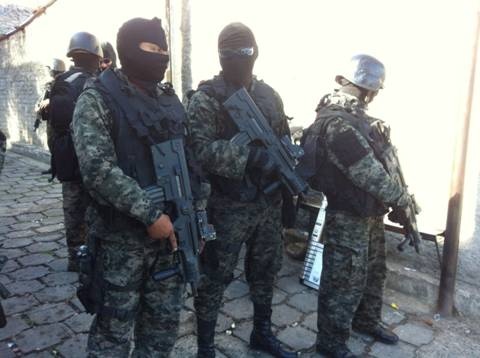
Honduran military police on patrol in Tegucigalpa, Honduras. (Photo: Karen Spring)
teleSUR | May 25, 2015
The 1980s saw widespread political violence and countless forced disappearances in many countries in Latin America, and Honduras was no exception.
Hundreds of political opponents of the 1980s U.S.-backed regime were kidnapped, tortured, and assassinated by the CIA-trained secret army unit Battalion 316, while at the same time Honduras served as a military base and training ground for U.S. counterinsurgency strategy in the region, especially in neighboring El Salvador and Nicaragua.
With the Reagan Administration turning a blind eye to the brutality of Battalion 316, intentionally downplaying or denying its violence in order to continue backing Honduras financially and using the country as a key U.S. military outpost, the details of this death squad’s operations did not become clear until years later. A historic expose published in the Baltimore Sun in 1995, which included interviews with ex-Battalion 316 torturers and details from declassified U.S. government documents, revealed the full extent of the secret unit’s atrocities and its close links to Washington.
However, torture and disappearances aren’t just a tragic reality of the past in Honduras. Human rights defenders have drawn disturbing parallels between Battalion 316 and the present day situation in Honduras, saying the current level of human rights abuses and political repression is just as bad, if not worse than the era of forced disappearances in the 1980s.
In the wake of the 2009 U.S.-backed coup ousting democratically elected President Manuel Zelaya, forced disappearance, torture, and targeted assassinations re-emerged as state terror tactics to intimidate and repress a broad-based resistance. Conspicuous and even conscious links to 1980s tactics since the 2009 coup, as well as ongoing U.S. complicity, show a continuity of state sponsored terror, with new elements for the post-coup context.
Cold War Anti-Communism, Battalion 316, and Spreading Terror with U.S. Support
As U.S. President Ronald Reagan took office in January 1980, the Sandinista revolutionary government was in power in Nicaragua and revolutionary forces were struggling for political control in El Salvador. Honduras was undergoing its so-called transition to democracy with a return to civilian rule. The U.S., already supporting the Guatemalan military’s bloody counterinsurgency efforts for over a decade, played a key role in backing the counter-revolutionary factions of the political struggles gripping the region in civil war, namely Salvadoran government forces and the Nicaraguan Contras.
While Honduras did not have a mass revolutionary guerrilla movement like its neighboring Central American countries, political opposition was criminalized to contain the threat of an armed, popular uprising. Much of this violent work was carried out through forced disappearances by the death squad Battalion 316, the special unit of the Honduran military responsible for political torture and assassinations, with the collaboration of other military branches, special forces, and police.
According to the Honduran human rights organization COFADEH, formed in the 1980s by family members of the disappeared, Battalion 316 was responsible over 180 forced disappearances between 1980 and 1988, and many more were kidnapped and tortured.
Forced disappearance refers to the practice of secretly abducting and murdering victims, making them disappear from society without a trace. Bodies of the disappeared are often carefully hidden, or rendered unrecognizable, to instil fear without the identity of the victim or the perpetrator becoming known..
Battalion 316’s terror was simultaneously covert and public, carried out by disguised agents at times in broad daylight, intended to instill fear and make an example of their victims. Suspected political dissidents were kidnapped, detained in secret jails, and tortured. Sometimes remains of victims were found in ditches. According to the Baltimore Sun expose, torture techniques included electric shock, suffocation, freezing temperatures, and psychological torture as part of interrogation, which sometimes involved CIA agents. Berta Oliva, director of the Committee of Relatives of the Disappeared in Honduras (COFADEH), has said that at least one prisoner was skinned alive in a clandestine Battalion 316 jail.
While the numbers of people disappeared in Honduras was considerably less than in many other Latin American countries during the same period, the hundreds killed and disappeared created a broader fear and terror campaign that had the intended outcome of disempowering the Honduran left.
According to Adrienne Pine, Professor of Anthropology at American University, it’s hard to overstate Battalion 316’s impact.
“The highly publicized disappearance, torture and murder of just under 200 activists, students, journalists and professors in the early 1980s created an atmosphere of terror, effectively crushing any possibility for civic or democratic engagement in Honduras,” she told teleSUR. “As such, it laid the groundwork for the implementation of U.S.-led neoliberal economic policies, of which the Honduran military itself was a primary beneficiary.”
Battalion 316, led in its most brutal years from 1982-1984 by School of the Americas and Argentine-trained head of the Honduran armed forces General Gustavo Alvarez Martinez, was a right-wing project designed to aid the Cold War fight against the alleged threat of communism in the region. Many Battalion agents were graduates of the U.S. School of the Americas (renamed in 2001 to the Western Hemisphere Institute for Security Cooperation) military training center for U.S. allies in Latin America, specializing in Cold War counterinsurgency training. The Battalion itself was trained and financed by the CIA. Meanwhile, Honduras received tens of millions of dollars in U.S. funding throughout the decade, reaching its height of US$77.4 million in 1984.
The secret military unit also received training in Chile under dictator General Augusto Pinochet, as well as from Argentine counterinsurgency forces, at the time deep in their own dirty war against leftist dissidents that claimed some 30,000 victims in Argentina by early the 1980s.
U.S. Ambassador under the Reagan Administration, John Negroponte, is documented to have met frequently with Battalion 316 leader Alvarez Martinez. However, the violence and human rights abuses perpetrated by Alvarez Martinez’s forces are conspicuously absent from the hundreds of cables of records of their correspondence. In 1983, the U.S. awarded Alvarez Martinez the Legion of Merit for “encouraging the success of democratic processes in Honduras,” exposing the true face of U.S. hypocrisy.
U.S. denial of the violent situation in Honduras enabled the ongoing use of the country as a strategic U.S. military base from which to execute counterinsurgency strategy in the region, while the supposed threat of an armed insurgency in Honduras justified the existence of Battalion 316 and its terror.
State Terror Returns: Post-Coup Fear Tactics and Forced Disappearances
After the 2009 military coup against democratically elected President Manuel Zelaya, the ousted president said in an exclusive interview with Democracy Now! that Battalion 316 was “already operating” in Honduras under a different name and using “torture to create fear.”
“There was a tremendous resurgence (after the coup) of death squad activity and assassinations of human rights defenders, trade unionists, campesinos, activists of the resistance of all sorts including journalists, lawyers,” Dana Frank, professor of History at the University of California Santa Cruz, told teleSUR. “It was very rare in the 20 years before the coup for these kinds of assassinations to happen … but it shot up dramatically after the coup.”
The post-coup links to Battalion 316 terror were palpable, both in the vast increase in human rights abuses, including torture, assassinations, and forced disappearances, as well as the direct connections of Battalion 316 personnel offering their expertise to the coup regime.
Former head of the Battalion 316, School of the Americas graduate Billy Joya, became a prominent coup regime spokesperson, advisor, and aide to de facto president Roberto Micheletti. According to COFADEH, many other retired Battalion 316 agents also became government advisors.
Pine, author of “Working Hard, Drinking Hard: On Violence and Survival in Honduras,” said that the numbers of state-sponsored disappearances, tortures, and extrajudicial killings since the coup have far exceeded those of the 1980s.
With striking similarity to the fear campaign of the 1980s, COFADEH documented in 2010, along with dozens of other death threats and assassinations, that a former Battalion 316 agent publicly threatened resistance activist Candelario Reyes with forced disappearance and death, saying that killing such a “communist dog” would make the “best example” for other resistance activists.
“You can see the continuity with some of these individuals including the references to the 80s that are conscious references,” said Frank. “It’s terror, it’s deliberately spreading terror.”
Harkening back to 1980s terror was a deliberate strategy to instil fear in perceived political threats. In 2012, COFADEH human rights defender Dina Meza received a series of threats of death and sexual violence by text message signed with the initials CAM, standing for Comando Alvarez Martinez, early 1980s head of Battalion 316 responsible for grave human rights abuses. According to Amnesty International, CAM was used as a pseudonym in numerous death threats against journalists and activists in the wake of the coup.
According to Frank, an expert on human rights and U.S. foreign policy in Honduras, the clearest and most alarming examples of post-coup strategies that follow the model of Battalion 316 are the TIGRES special units of the police force and FUSINA inter-agency task forces that bring together military, police, military police, prosecutors, and other government officials under military control.
FUSINA was initially headed by School of the Americas graduate Colonel German Alfaro, former commander of Battalion 15, the military unit in the Aguan Valley region implicated in dozens of post-coup murders of campesino activists. Trained by the FBI, DEA, and U.S. Marines, FUSINA is not only troubling for its conglomeration of agency functions under a military mandate, but also for its U.S.-enhanced intelligence capacities.
COFADEH denounced TIGRES as a “crude resurrection” of Battalion 316’s political disappearances, murder, and “criminal behaviour.”
These new constellations of state and military power, designed and deployed to create fear and contain political dissent, have again had a deep social and political impact in Honduras.
“A combination of the ‘soft power’ of USAID and NED-funded (so-called pro-democracy) programs on the one hand, and death squads within the police, the military, and now the military police have succeeded in destroying the post-coup resistance movement,” explained Pine. “This is what makes possible the neoliberal plunder of the country currently underway.”
A Different Pretext for Familiar Terror Tactics
But while there are clear continuities between the 1980s and post-coup strategies, there are also important differences.
Despite the fact that the armed left was a very small faction in Honduras, particularly in comparison to the revolutionary uprising in neighboring countries, Battalion 316’s violence was committed in the name of counterinsurgency. As Frank explains, the broad based nature of the post-coup popular resistance means that the victims of extrajudicial killings and forced disappearances have been from a more diverse cross-section of society than the 1980s campaign against suspected revolutionary leftists.
Now, with the pretext of an alleged communist armed struggle no longer relevant, post-coup repression, including use of these historical counterinsurgency tactics, and U.S.-backing of a violent regime is framed in different terms.
“The pretext now is drug trafficking,” said Frank. “The drug war has been the frame within which the United States government has legitimated support for repression by state security forces in Honduras and increased funding for them.”
And while the U.S. goal of maintaining a regional base of power amidst the threat of emerging or consolidating leftist alternatives remains much the same, the political context in the region has significantly changed.
“The larger context is the many democratically elected center and center-left governments all over Latin America that the United States is threatened by because they aren’t going to pay obeisance to United States power,” said Frank. “The United States wanted to lock down its power in Honduras so that it can maintain what has long been the most captive nation in Latin America.”
In the process, the U.S. also promotes the interests of transnational corporations that are making a killing from state-sponsored death squads that suppress resistance and pave the way for capitalist exploitation of land, labor, and indigenous and campesino resources.
“With the consolidation of neoliberal corporate capital, Honduran and U.S. politicians are more beholden to their sponsors than they were three decades ago,” explained Pine. “Hondurans today suffer not just from the terror of death squads but from the ravages of three decades of the implementation of neoliberal policy made possible by death squads, which makes them that much more vulnerable.”
COFADEH: Seeking Justice, Truth, and Respect for Human Rights
Bertha Oliva, director of COFADEH, lost her husband Tomas Nativi to forced disappearance by Battalion 316. Nativi was taken from their home by masked agents in 1981 and has never been seen again.
Over the year after Nativi’s disappearance, Oliva came to realize that she was not alone, and others had similar experiences of family members being disappeared. In 1982, 12 of these families came together to form COFADEH with the clear objective of bringing back alive family members who had been disappeared. In the majority of cases throughout the 1980s while Battalion 316 was operating, COFADEH did not succeed in their goal.
After the 1980s, COFADEH broadened its scope as an organization not only committed to seeking justice for the families of the disappeared and truth for Honduran society, but also representing and defending victims of human rights abuses, documenting cases, and providing training to raise awareness about human rights.
The creation of COFADEH was, in its own words, a “concrete action” in the face of the inactivity of the state to ensure “the right of victims to live and to have due process, among other rights that have been violated.”
COFADEH has continued to play a key role in documenting and denouncing human rights abuses and demanding justice, particularly once again in the years since the coup.
A Nuclear Weapons Ban Emerging?
By ROBERT F. DODGE | CounterPunch | May 26, 2015
Every moment of every day, all of humanity is held hostage by the nuclear nine. The nine nuclear nations are made up of the P5 permanent members of the United Nations Security Council and their illegitimate nuclear wannabes Israel, North Korea, India and Pakistan, spawned by the mythological theory of deterrence. This theory has fueled the nuclear arms race since its inception wherein if one nation has one nuclear weapon, its adversary needs two and so on to the point that the world now has 15,700 nuclear weapons wired for immediate use and planetary destruction with no end in sight. This inaction continues despite the 45-year legal commitment of the nuclear nations to work toward complete nuclear abolition. In fact just the opposite is happening with the U.S. proposing to spend $1 Trillion on nuclear weapons “modernization” over the next 30 years, fueling the “deterrent” response of every other nuclear state to do likewise.
This critical state of affairs comes as the 189 signatory nations to the Treaty on the Non-Proliferation of Nuclear Weapons (NPT) concluded the month long Review Conference at the U.N. in New York. The conference was officially a failure due to the refusal of the nuclear weapons states to present or even support real steps toward disarmament. The nuclear gang demonstrates an unwillingness to recognize the peril that the planet faces at the end of their nuclear gun; they continue to gamble on the future of humanity. Presenting a charade of concern, they blamed each other and bogged down in discussions over a glossary of terms while the hand of the nuclear Armageddon clock continues to move ever forward.
The nuclear weapons states have chosen to live in a vacuum, one void of leadership. They hoard suicidal nuclear weapons stockpiles and ignore recent scientific evidence of the humanitarian impact of nuclear weapons that we now realize makes these weapons even more dangerous than we thought before. They fail to recognize that this evidence must be the basis for prohibiting and eliminating them.
Fortunately there is one powerful and positive response coming out of the NPT Review Conference. The Non-Nuclear Weapons States, representing a majority of people living on the planet, frustrated and threatened by the nuclear nations, have come together and demanded a legal ban on nuclear weapons like the ban on every other weapon of mass destruction from chemical to biologic and landmines. Their voices are rising up. Following a pledge by Austria in December 2014 to fill the legal gap necessary to ban these weapons, 107 nations have joined them at the U.N. this month. That commitment means finding a legal instrument that would prohibit and eliminate nuclear weapons. Such a ban will make these weapons illegal and will stigmatize any nation that continues to have these weapons as being outside of international law.
Costa Rica’s closing NPT remarks noted, ”Democracy has not come to the NPT but Democracy has come to nuclear weapons disarmament.” The nuclear weapons states have failed to demonstrate any leadership toward total disarmament and in fact have no intention of doing so. They must now step aside and allow the majority of the nations to come together and work collectively for their future and the future of humanity. John Loretz of the International Campaign to Abolish Nuclear Weapons said, “The nuclear-armed states are on the wrong side of history, the wrong side of morality, and the wrong side of the future. The ban treaty is coming, and then they will be indisputably on the wrong side of the law. And they have no one to blame but themselves.”
“History honors only the brave,” declared Costa Rica. “Now is the time to work for what is to come, the world we want and deserve.”
Ray Acheson of Women’s International League for Peace and Freedom says, “Those who reject nuclear weapons must have the courage of their convictions to move ahead without the nuclear-armed states, to take back ground from the violent few who purport to run the world, and build a new reality of human security and global justice.”
Robert F. Dodge, M.D., is a practicing family physician, writes for PeaceVoice, and serves on the boards of the Nuclear Age Peace Foundation, Beyond War, Physicians for Social Responsibility Los Angeles, and Citizens for Peaceful Resolutions.
Tehran-Moscow talks on S-300 successful: Iran official
Press TV – May 26, 2015
A senior Iranian official has described as “successful” negotiations on the delivery of Russia’s S-300 surface-to-air missile system to Iran.
“Negotiations on the delivery of the S-300 [missile system] to Iran has been successful”, Iran’s Deputy Foreign Minister for Arab and African Affairs Hossein Amir-Abdollahian said on Monday during a press conference after a meeting with Russian Deputy Foreign Minister Mikhail Bogdanov in the Russian capital, Moscow.
Amir-Abdollahian also stressed that all issues surrounding the delivery of the system to Iran are progressing well.
He further noted that the delivery of S-300 to Iran will happen at the soonest opportunity possible.
On April 13, Russian President Vladimir Putin signed a presidential decree paving the way for the long-overdue delivery of the missile system to Iran.
Russian President Vladimir Putin
The decision to deliver the missile system came after Iran and the P5+1 group of countries – the five permanent members of the UN Security Council plus Germany – reached a mutual understanding on Tehran’s nuclear program in the Swiss city of Lausanne on April 2.
Moscow had banned the delivery of the S-300 system to Tehran in 2010 under the pretext that the agreement it signed with Iran in 2007 was covered by the fourth round of the Security Council sanctions against Iran over its nuclear program. The resolution bars hi-tech weapons sales to the Islamic Republic.
The Russian president defended Moscow’s decision on S-300 supply to Iran, saying the system is meant for deterrence amid ongoing developments in war-torn Yemen.
The UN says since March, nearly 2,000 people have been killed and 7,330 others injured due to the conflict in Yemen. However, according to Yemen’s Freedom House Foundation, the Saudi airstrikes have claimed the lives of about 4,000 Yemeni people.
Israeli Prime Minister Benjamin Netanyahu criticized Russia over its decision to lift the ban on the delivery of S-300 missile system to Iran, saying Tel Aviv sees the plan with “utmost gravity.”
Canada bars Russian delegation from international meeting in Ottawa discussing weapons of mass destruction proliferation
New Cold War | May 23, 2015
The government of Canada has barred a delegation from Russia from attending a meeting in Ottawa May 26-28 purportedly devoted to restricting the proliferation of weapons of mass destruction. The meeting in question is the Operational Experts Group of the Proliferation Security Initiative.
From Wikipedia:
The Proliferation Security Initiative (PSI) is a global effort that aims to stop trafficking of weapons of mass destruction (WMD), their delivery systems, and related materials to and from states and non-state actors of proliferation concern. Launched by United States President George W. Bush in May 2003 at a meeting in Kraków, Poland, the PSI has now grown to include the endorsement of 103 nations around the world, including Russia, Canada, the United Kingdom, Australia, France, Germany, Italy, Japan, the Netherlands, Poland, Singapore, New Zealand, Republic of Korea and Norway. Despite the support of over half of the Members of the United Nations, a number of countries have expressed opposition to the initiative, including India, China and Indonesia.
Commentary by the Information and Press Department concerning Canada’s refusal of entry to Russian delegation for PSI working group meeting
The Canadian authorities’ decision to deny visas to a Russian delegation at the Proliferation Security Initiative Operational Experts Group meeting was an openly unfriendly move that contradicts the normal practice of multilateral events.
It is regrettable that Ottawa, which has been fanning anti-Russian hysterics for domestic political considerations, has acted contrary to common sense, expropriating the right to decide who can attend an important multilateral event that happens to be held on its territory.
We would like to remind the international community that Russia, being a key partner in the fight against the proliferation of weapons of mass destruction and a full member of the PSI, is not seeking any favours from Canada.
Non-proliferation is a highly important aspect of international cooperation. Squaring political accounts in a narrow-minded manner, which has recently become a favourite hobby for Stephen Harper’s government, is inappropriate and counterproductive.
U.S. Secretary of State John Kerry v. His Subordinate Victoria Nuland, Regarding Ukraine
By Eric ZUESSE | Oriental Review | May 22, 2015
U.S. Secretary of State John Kerry, on May 12th, responding to Ukrainian President Petro Poroshenko’s assertions that Ukraine will retake Crimea and will conquer Donbass:
“I have not had a chance – I have not read the speech. I haven’t seen any context. I have simply heard about it in the course of today. But if indeed President Poroshenko is advocating an engagement in a forceful effort at this time, we would strongly urge him to think twice not to engage in that kind of activity, that that would put Minsk in serious jeopardy. And we would be very, very concerned about what the consequences of that kind of action at this time may be.”
U.S. Assistant Secretary of State for European & Eurasian Affairs, Victoria Nuland, as communicated by the U.S. State Department’s Press Office on May 15th, reiterating Poroshenko’s view:
“Assistant Secretary Nuland’s ongoing visit to Kyiv and her discussions with Prime Minister [Arseniy] Yatseniuk and President [Petro] Poroshenko reaffirm the United States’ full and unbreakable support for Ukraine’s government, sovereignty, and territorial integrity. We continue to stand shoulder to shoulder with the people of Ukraine and reiterate our deep commitment to a single Ukrainian nation, including Crimea, and all the other regions of Ukraine.”
Will John Kerry reprimand his subordinate for her contradicting what he, her boss, had said three days earlier? If not, then will President Barack Obama fire his Secretary of State John Kerry? If not, then will Victoria Nuland be fired? If not, then who is to trust anything that comes from the U.S. State Department, when the Secretary of State can be contradicted three days later by his subordinate, and both remain in their respective jobs?
Republicans are already preparing to weaken Kerry over this. The far-right news-site Frontpage Mag headlined on May 21st, John Kerry’s Seven Hours of Weakness in Russia, and condemned the “attempt by Kerry to re-set the ‘re-set’ button [on U.S. policy toward Russia] first pushed by his predecessor, Hillary Clinton.” The special subject of their ire: “The promise of ‘rolling back’ the mild sanctions regime the West imposed on Russia on account of Putin’s annexation of Crimea and support of separatist rebels was bandied about, if only Russia would behave in the future.” But winning changes in behavior is what international diplomacy is supposed to be all about — otherwise the State Department wouldn’t even be needed, and only the Pentagon would handle America’s foreign relations.
If Victoria Nuland stays in her job, then John Kerry will be neutered even if he’s not fired.
The only person with the power to fire Nuland is actually U.S. President Barack Obama. Perhaps the request for him to do that is already on his desk. If it’s not, then Kerry’s job is in jeopardy, because his diplomatic efforts can be obliterated by a subordinate and that subordinate will suffer no penalty for doing this. Nobody then would respect anything that the U.S. Secretary of State says, because it wouldn’t necessarily represent the President’s policies. If the Secretary of State isn’t backed up by the President, then the Secretary of State has no real power at all.
Russian security doctrine to be adjusted after Arab Spring, Ukraine turmoil – official
RT | May 06, 2015
The head of Russia’s Security Council has promised that the authorities will adjust the nation’s security doctrine after learning the lessons of the latest political crises in the Middle East and Ukraine.
“In order to update the basic concepts of national securitythe council has ordered to begin the work on making corrections to the main strategic plans – the National Security Strategy of the Russian Federation to year 2020 and the Informational Security Strategy,” Nikolai Patrushev said in an article published Wednesday in the Defense Ministry’s daily newspaper, Krasnaya Zvezda (Red Star).
He added that the necessity of such actions has arisen after the so-called Arab Spring (a wave of violent mass protests that led to overthrowing of governments and leaders in several Middle East countries in 2011-12), the wars in Syria and Iraq and also the situation in and around Ukraine.
Patrushev said that these events demonstrated the tendency for security threats to shift from the military sphere into the informational space. “As leading nations of the world fight for their interests they typically use ‘non-direct action,’ the population’s protest potential, radical and extremist groups and also private military contractors,” Patrushev wrote.
He also noted the increasing aggressiveness of the United States and NATO toward Russia, embodied in the beefing up of military potential near Russian borders and the continuing deployment of the global missile defense system.
The Security Council is Russia’s top consultative body on national security, and Nikolai Patrushev has headed the council since 2008. Before that, he was the director of the Federal Security Service for nine years.
In October 2014, Patrushev openly accused the United States of playing a role in the current turmoil in Ukraine and the military conflicts in Georgia and the Caucasus, saying these were direct results of the anti-Russian policy of the US administration. He also revealed in a press interview that intelligence analysts established that American special services were executing an anti-Russian program that dates back to the 1970s, and is based on Zbigniew Brzezinski’s “strategy of weak spots,” the policy of turning the opponent’s potential problems into full-scale crises.
In September 2014, President Vladimir Putin tasked senior military and state officials with developing an updated military doctrine that would meet the needs of changing global politics and modern military challenges and the new dangers and threats, in particular those manifested in the so-called Arab Spring, the civil war in Syria and the ongoing crisis in Ukraine.
An updated version of the doctrine was adopted in late December.
Read More:
‘Clearly anti-Russian’ – Moscow blasts latest US national security strategy
Putin lifts ban on delivery of S-300 missile systems to Iran
RT | April 13, 2015
The Russian president has repealed the ban prohibiting the delivery of S-300 missile air defense systems to Iran, according to the Kremlin’s press service. The ban was introduced by former President Dmitry Medvedev in 2010.
“[The presidential] decree lifts the ban on transit through Russian territory, including airlift, and the export from the Russian Federation to the Islamic Republic of Iran, and also the transfer to the Islamic Republic of Iran outside the territory of the Russian Federation, both by sea and by air, of air defense missile systems S-300,” says the information note accompanying the document, RIA Novosti reported.
The decree enters into force upon the president’s signature.
The contract for supplying S-300 missile systems to Iran was signed in 2007 and implied the delivery of five S-300 squadrons worth $800 million. But in 2010 the contract was put on hold due to the UN imposing sanctions on Iran.
Tehran answered with filing a nearly $4 billion lawsuit against Russia’s Rosoboronexport arms dealer company to a Geneva arbitration tribunal.
The question of S-300 supply to Tehran remained unsettled for years.
After years of negotiation, in February 2015, Moscow offered Tehran the chance to buy its latest Antey-2500 anti-aircraft and ballistic missile system, instead of the older S-300 system. Iran replied that it would consider the offer.
The last time Russia supplied S-300 systems abroad was in 2010, when 15 squadrons were delivered to China.
Since then production of S-300 systems has been suspended as the main producer of the Russian air defenses, concern Almaz-Antey, has launched production of the next generation systems, S-400. China has become the first country allowed to buy S-400 systems, Rosoboronexport chief Anatoly Isaykin told the Russian media.
As of today, S-300 systems have been operable in a number of countries, including Algeria, Azerbaijan, Belarus, Cyprus, Kazakhstan and Vietnam. There is a valid contract to deliver S-300 systems to Syria, but it was put on hold after the beginning of the civil war in the country.
Featured Video

Trita Parsi: Middle East Unraveling — Are We on the Path to World War?
or go to
Aletho News Archives – Video-Images
New Book
Trans agenda is ‘normalization of sadism’ – US author

RT | September 23, 2026
The US Democratic Party has embraced a transgender agenda that amounts to “the normalization of sadism,” author A.J. Rice has said, warning that radical trans policies would return if the party is allowed to regain power.
Speaking to RT’s America First host Scotty Nell Hughes about his new book, ‘The Curse of the Bearded Lady: How the Trans Mafia Whacked American Sanity’, Rice argued that activists have gained significant influence in schools, medicine, and corporate America while people who questioned the agenda have faced pressure to stay silent.
The author described the “trans mafia” as the sprawling network of people and institutions that have helped the movement gain influence. He singled out parts of academia, wealthy backers, and corporations, and stated that providers of transition-related treatment also have a financial incentive to keep young people in their care indefinitely.
Rice argued that the consequences of these policies ultimately fall on children who are being drawn toward gender-affirming medical treatments and on girls who are expected to share locker rooms or compete in sports with biological males.
He noted that while voters rejected the Democrats’ approach to gender in 2024, the party, which has been “captured by madness,” has since only doubled down and is seeking what is effectively “the normalization of sadism.” … Full report
Blog Roll
 Aletho News
- Integrity Initiative: UK-funded network framed dissent as Russian disinformation for years
- ‘We don’t seek permission to defend our country’: Snippets from President Pezeshkian’s UNGA address
- NATO chief wants Europeans to fight American wars [for Israel]
- German chemicals giant reveals details of downsizing
- Refaat Al-Areer Was The Canary In The Coal Mine In Israel’s War On The Truth
- Israeli election committee bars candidate from Knesset race over Gaza war opposition
- French-Lebanese man files war crimes complaint over Israeli attacks
- Mahan Air Flight Lands in China Despite US Threat against Iranian Airlines
- US eyes $10bn fund to rebuild war-battered Gulf infrastructure
- Trump meets Rodríguez near Maduro’s prison as Venezuela’s oil flows to US
- If Americans Knew
- Caught on Tape: AIPAC CEO Boasted of Controlling Trump’s National Security Officials
- Why Hamas Attacked Israel in October 2023 – Israeli professor Ilan Pappé
- They see them, then kill them: Israeli quadcopters track, deliberately target civilians in Gaza
- Winter could turn Gaza’s treacherous, war-damaged buildings into deathtraps
- Majority of Democratic Voters Want to Prosecute Both Biden and Trump Administration Officials Over Gaza
- As Gaza languishes, world leaders gather at the UN – Daily Update
- Sanctions are collective punishment: immoral and self-defeating
- Phosphorus Munitions Fired by Israel Burn Groves, Orchards in Southern Lebanon
- Israel Carries Out New Ceasefire Violations Across Gaza
- AI – Emphasis on the ‘I’: Israel Is Funding AI Chatbot Propaganda
- No Tricks Zone
- New Study: Earth And Venus Surface Warmth Largely Explained By Convection And Lapse Rate, Not CO2 Or Radiation
- 2025 Nature Paper Claiming Worsening Global Drought Gets RETRACTED …Heavily Flawed
- New Study: ‘Global Drought Shows No Detectable Recent Acceleration Under Climate Warming’
- Economic Masterminds: German Socialists Suggest Taxing Productivity Gains Stemming From Using AI
- The South China Sea Has Not Been Cooperating With The Climate Change Narrative
- Energy Crisis: Germany Enters Heating Season With Historically Low Gas Reserve Fill Levels
- New Study: The Antarctic Ice Sheet Gained Mass From 2020-2024 Due To Staggering Snow And Ice Accumulation
- Study: Ocean Heating Rates From Thousands Of Years Ago ‘Dwarf’ Modern Ocean Heating Rates
- Climate Extremists Target, Attack Large-Scale Power Grid Infrastructure In Germany!
- New Study: Antarctic Ice Melt Has Contributed Less Than 1 Centimeter To Sea Level Rise In The Last 30 Years

