Tehran-Moscow talks on S-300 successful: Iran official
Press TV – May 26, 2015
A senior Iranian official has described as “successful” negotiations on the delivery of Russia’s S-300 surface-to-air missile system to Iran.
“Negotiations on the delivery of the S-300 [missile system] to Iran has been successful”, Iran’s Deputy Foreign Minister for Arab and African Affairs Hossein Amir-Abdollahian said on Monday during a press conference after a meeting with Russian Deputy Foreign Minister Mikhail Bogdanov in the Russian capital, Moscow.
Amir-Abdollahian also stressed that all issues surrounding the delivery of the system to Iran are progressing well.
He further noted that the delivery of S-300 to Iran will happen at the soonest opportunity possible.
On April 13, Russian President Vladimir Putin signed a presidential decree paving the way for the long-overdue delivery of the missile system to Iran.
Russian President Vladimir Putin
The decision to deliver the missile system came after Iran and the P5+1 group of countries – the five permanent members of the UN Security Council plus Germany – reached a mutual understanding on Tehran’s nuclear program in the Swiss city of Lausanne on April 2.
Moscow had banned the delivery of the S-300 system to Tehran in 2010 under the pretext that the agreement it signed with Iran in 2007 was covered by the fourth round of the Security Council sanctions against Iran over its nuclear program. The resolution bars hi-tech weapons sales to the Islamic Republic.
The Russian president defended Moscow’s decision on S-300 supply to Iran, saying the system is meant for deterrence amid ongoing developments in war-torn Yemen.
The UN says since March, nearly 2,000 people have been killed and 7,330 others injured due to the conflict in Yemen. However, according to Yemen’s Freedom House Foundation, the Saudi airstrikes have claimed the lives of about 4,000 Yemeni people.
Israeli Prime Minister Benjamin Netanyahu criticized Russia over its decision to lift the ban on the delivery of S-300 missile system to Iran, saying Tel Aviv sees the plan with “utmost gravity.”
Canada bars Russian delegation from international meeting in Ottawa discussing weapons of mass destruction proliferation
New Cold War | May 23, 2015
The government of Canada has barred a delegation from Russia from attending a meeting in Ottawa May 26-28 purportedly devoted to restricting the proliferation of weapons of mass destruction. The meeting in question is the Operational Experts Group of the Proliferation Security Initiative.
From Wikipedia:
The Proliferation Security Initiative (PSI) is a global effort that aims to stop trafficking of weapons of mass destruction (WMD), their delivery systems, and related materials to and from states and non-state actors of proliferation concern. Launched by United States President George W. Bush in May 2003 at a meeting in Kraków, Poland, the PSI has now grown to include the endorsement of 103 nations around the world, including Russia, Canada, the United Kingdom, Australia, France, Germany, Italy, Japan, the Netherlands, Poland, Singapore, New Zealand, Republic of Korea and Norway. Despite the support of over half of the Members of the United Nations, a number of countries have expressed opposition to the initiative, including India, China and Indonesia.
Commentary by the Information and Press Department concerning Canada’s refusal of entry to Russian delegation for PSI working group meeting
The Canadian authorities’ decision to deny visas to a Russian delegation at the Proliferation Security Initiative Operational Experts Group meeting was an openly unfriendly move that contradicts the normal practice of multilateral events.
It is regrettable that Ottawa, which has been fanning anti-Russian hysterics for domestic political considerations, has acted contrary to common sense, expropriating the right to decide who can attend an important multilateral event that happens to be held on its territory.
We would like to remind the international community that Russia, being a key partner in the fight against the proliferation of weapons of mass destruction and a full member of the PSI, is not seeking any favours from Canada.
Non-proliferation is a highly important aspect of international cooperation. Squaring political accounts in a narrow-minded manner, which has recently become a favourite hobby for Stephen Harper’s government, is inappropriate and counterproductive.
U.S. Secretary of State John Kerry v. His Subordinate Victoria Nuland, Regarding Ukraine
By Eric ZUESSE | Oriental Review | May 22, 2015
U.S. Secretary of State John Kerry, on May 12th, responding to Ukrainian President Petro Poroshenko’s assertions that Ukraine will retake Crimea and will conquer Donbass:
“I have not had a chance – I have not read the speech. I haven’t seen any context. I have simply heard about it in the course of today. But if indeed President Poroshenko is advocating an engagement in a forceful effort at this time, we would strongly urge him to think twice not to engage in that kind of activity, that that would put Minsk in serious jeopardy. And we would be very, very concerned about what the consequences of that kind of action at this time may be.”
U.S. Assistant Secretary of State for European & Eurasian Affairs, Victoria Nuland, as communicated by the U.S. State Department’s Press Office on May 15th, reiterating Poroshenko’s view:
“Assistant Secretary Nuland’s ongoing visit to Kyiv and her discussions with Prime Minister [Arseniy] Yatseniuk and President [Petro] Poroshenko reaffirm the United States’ full and unbreakable support for Ukraine’s government, sovereignty, and territorial integrity. We continue to stand shoulder to shoulder with the people of Ukraine and reiterate our deep commitment to a single Ukrainian nation, including Crimea, and all the other regions of Ukraine.”
Will John Kerry reprimand his subordinate for her contradicting what he, her boss, had said three days earlier? If not, then will President Barack Obama fire his Secretary of State John Kerry? If not, then will Victoria Nuland be fired? If not, then who is to trust anything that comes from the U.S. State Department, when the Secretary of State can be contradicted three days later by his subordinate, and both remain in their respective jobs?
Republicans are already preparing to weaken Kerry over this. The far-right news-site Frontpage Mag headlined on May 21st, John Kerry’s Seven Hours of Weakness in Russia, and condemned the “attempt by Kerry to re-set the ‘re-set’ button [on U.S. policy toward Russia] first pushed by his predecessor, Hillary Clinton.” The special subject of their ire: “The promise of ‘rolling back’ the mild sanctions regime the West imposed on Russia on account of Putin’s annexation of Crimea and support of separatist rebels was bandied about, if only Russia would behave in the future.” But winning changes in behavior is what international diplomacy is supposed to be all about — otherwise the State Department wouldn’t even be needed, and only the Pentagon would handle America’s foreign relations.
If Victoria Nuland stays in her job, then John Kerry will be neutered even if he’s not fired.
The only person with the power to fire Nuland is actually U.S. President Barack Obama. Perhaps the request for him to do that is already on his desk. If it’s not, then Kerry’s job is in jeopardy, because his diplomatic efforts can be obliterated by a subordinate and that subordinate will suffer no penalty for doing this. Nobody then would respect anything that the U.S. Secretary of State says, because it wouldn’t necessarily represent the President’s policies. If the Secretary of State isn’t backed up by the President, then the Secretary of State has no real power at all.
Russian security doctrine to be adjusted after Arab Spring, Ukraine turmoil – official
RT | May 06, 2015
The head of Russia’s Security Council has promised that the authorities will adjust the nation’s security doctrine after learning the lessons of the latest political crises in the Middle East and Ukraine.
“In order to update the basic concepts of national securitythe council has ordered to begin the work on making corrections to the main strategic plans – the National Security Strategy of the Russian Federation to year 2020 and the Informational Security Strategy,” Nikolai Patrushev said in an article published Wednesday in the Defense Ministry’s daily newspaper, Krasnaya Zvezda (Red Star).
He added that the necessity of such actions has arisen after the so-called Arab Spring (a wave of violent mass protests that led to overthrowing of governments and leaders in several Middle East countries in 2011-12), the wars in Syria and Iraq and also the situation in and around Ukraine.
Patrushev said that these events demonstrated the tendency for security threats to shift from the military sphere into the informational space. “As leading nations of the world fight for their interests they typically use ‘non-direct action,’ the population’s protest potential, radical and extremist groups and also private military contractors,” Patrushev wrote.
He also noted the increasing aggressiveness of the United States and NATO toward Russia, embodied in the beefing up of military potential near Russian borders and the continuing deployment of the global missile defense system.
The Security Council is Russia’s top consultative body on national security, and Nikolai Patrushev has headed the council since 2008. Before that, he was the director of the Federal Security Service for nine years.
In October 2014, Patrushev openly accused the United States of playing a role in the current turmoil in Ukraine and the military conflicts in Georgia and the Caucasus, saying these were direct results of the anti-Russian policy of the US administration. He also revealed in a press interview that intelligence analysts established that American special services were executing an anti-Russian program that dates back to the 1970s, and is based on Zbigniew Brzezinski’s “strategy of weak spots,” the policy of turning the opponent’s potential problems into full-scale crises.
In September 2014, President Vladimir Putin tasked senior military and state officials with developing an updated military doctrine that would meet the needs of changing global politics and modern military challenges and the new dangers and threats, in particular those manifested in the so-called Arab Spring, the civil war in Syria and the ongoing crisis in Ukraine.
An updated version of the doctrine was adopted in late December.
Read More:
‘Clearly anti-Russian’ – Moscow blasts latest US national security strategy
Putin lifts ban on delivery of S-300 missile systems to Iran
RT | April 13, 2015
The Russian president has repealed the ban prohibiting the delivery of S-300 missile air defense systems to Iran, according to the Kremlin’s press service. The ban was introduced by former President Dmitry Medvedev in 2010.
“[The presidential] decree lifts the ban on transit through Russian territory, including airlift, and the export from the Russian Federation to the Islamic Republic of Iran, and also the transfer to the Islamic Republic of Iran outside the territory of the Russian Federation, both by sea and by air, of air defense missile systems S-300,” says the information note accompanying the document, RIA Novosti reported.
The decree enters into force upon the president’s signature.
The contract for supplying S-300 missile systems to Iran was signed in 2007 and implied the delivery of five S-300 squadrons worth $800 million. But in 2010 the contract was put on hold due to the UN imposing sanctions on Iran.
Tehran answered with filing a nearly $4 billion lawsuit against Russia’s Rosoboronexport arms dealer company to a Geneva arbitration tribunal.
The question of S-300 supply to Tehran remained unsettled for years.
After years of negotiation, in February 2015, Moscow offered Tehran the chance to buy its latest Antey-2500 anti-aircraft and ballistic missile system, instead of the older S-300 system. Iran replied that it would consider the offer.
The last time Russia supplied S-300 systems abroad was in 2010, when 15 squadrons were delivered to China.
Since then production of S-300 systems has been suspended as the main producer of the Russian air defenses, concern Almaz-Antey, has launched production of the next generation systems, S-400. China has become the first country allowed to buy S-400 systems, Rosoboronexport chief Anatoly Isaykin told the Russian media.
As of today, S-300 systems have been operable in a number of countries, including Algeria, Azerbaijan, Belarus, Cyprus, Kazakhstan and Vietnam. There is a valid contract to deliver S-300 systems to Syria, but it was put on hold after the beginning of the civil war in the country.
Obama’s Fateful Indecision
By Robert Parry | Consortium News | April 6, 2015
The foreign policy quandary facing President Barack Obama is that America’s traditional allies in the Middle East – Israel and Saudi Arabia – along with Official Washington’s powerful neocons have effectively sided with Al-Qaeda and the Islamic State out of a belief that Iran represents a greater threat to Israeli and Saudi interests.
But what that means for U.S. interests is potentially catastrophic. If the Islamic State continues its penetration toward Damascus in league with Al-Qaeda’s Nusra Front and topples the Syrian government, the resulting slaughter of Christians, Shiites and other religious minorities – as well as the risk of a major new terrorist base in the heart of the Middle East – could force the United States into a hopeless new war that could drain the U.S. Treasury and drive the nation into a chaotic and dangerous decline.
To avoid this calamity, Obama would have to throw U.S. support fully behind the embattled regime of Syrian President Bashar al-Assad, precipitate a break with Israel and Saudi Arabia, and withstand a chorus of condemnations from influential neocon pundits, Republican politicians and hawkish Democrats. Influenced by Israeli propaganda, all have pushed for ousting Assad in a “regime change.”
But the world has already had a grim peek at what an Islamic State/Al-Qaeda victory would look like. The Islamic State has reveled in its ability to provoke Western outrage through acts of shocking brutality, such as beheadings, incinerations, stonings, burning of ancient books and destruction of religious sites that the group deems offensive to its fundamentalist version of Islam.
Over the Easter holiday, there were reports of the Islamic State destroying a Christian Church in northeastern Syria and taking scores of Christians as prisoners. An Islamic State victory in Syria would likely mean atrocities on a massive scale. And, there are signs that Al-Qaeda might bring the Islamic State back into the fold if it achieves this success, which would let Al-Qaeda resume its plotting for its own outrages through terrorist attacks on European and U.S. targets.
Though Al-Qaeda’s Nusra Front and the Islamic State have been estranged in recent months, the groups were reported to be collaborating in an assault on the Palestinian refugee camp of Yarmouk, south of Damascus. United Nations spokesman Chris Gunness told the Associated Press, “The situation in the camp is beyond inhumane.”
The AP also reported that “Palestinian officials and Syrian activists say the Islamic State militants fighting in Yarmouk were working with rivals from the al-Qaida affiliate in Syria, the Nusra Front. The two groups have fought bloody battles against each other in other parts of Syria, but appear to be cooperating in the attack on Yarmouk.”
Syria has become a frontline in the sectarian conflict between Sunni and Shiite Islam, with Saudi Arabia a longtime funder of the Sunni fundamentalist Wahhabism, which gave rise to Al-Qaeda under the direction of Saudi Osama bin Laden. Fifteen of the 19 hijackers in the 9/11 attacks were Saudi nationals, and elements of the Saudi royal family and other Persian Gulf sheikdoms have been identified as Al-Qaeda’s financiers. [See Consortiumnews.com’s “The Secret Saudi Ties to Terrorism.”]
The Israeli-Saudi Alliance
In seeking “regime change” in Syria, Saudi Arabia has been joined by Israel whose leaders have cited Syria as the “keystone” in the pro-Iranian Shiite “strategic arc” from Tehran through Damascus to Beirut. In making that point in September 2013, Israeli Ambassador to the United States Michael Oren told the Jerusalem Post that Israel favored the Sunni extremists over Assad and the Shiites.
“We always wanted Bashar Assad to go, we always preferred the bad guys who weren’t backed by Iran to the bad guys who were backed by Iran.” He said this was the case even if the “bad guys” were affiliated with Al-Qaeda.
In June 2014, Oren expanded on this Israeli position. Then, speaking as a former ambassador, Oren said Israel would even prefer a victory by the Islamic State. “From Israel’s perspective, if there’s got to be an evil that’s got to prevail, let the Sunni evil prevail,” Oren said.
On March 3, in the speech to a cheering U.S. Congress, Israeli Prime Minister Benjamin Netanyahu also argued that the danger from Iran was much greater than from the Islamic State (or ISIS). Netanyahu dismissed ISIS as a relatively minor annoyance with its “butcher knives, captured weapons and YouTube” when compared to Iran, which he accused of “gobbling up the nations” of the Middle East.
He claimed “Iran now dominates four Arab capitals, Baghdad, Damascus, Beirut and Sanaa. And if Iran’s aggression is left unchecked, more will surely follow. … We must all stand together to stop Iran’s march of conquest, subjugation and terror.”
Netanyahu’s rhetoric was clearly hyperbole – Iran’s troops have not invaded any country for centuries; Iran did come to the aid of the Shiite-dominated government of Iraq in its fight with the Islamic State, but the “regime change” in Baghdad was implemented not by Iran but by President George W. Bush and the U.S. military; and it’s preposterous to say that Iran “dominates” Damascus, Beirut and Sanaa – though Iran is allied with elements in Syria, Lebanon and Yemen.
But hyperbole or not, Netanyahu’s claims became marching orders for the American neocons, the Republican Party and much of the Democratic Party. Republicans and some Democrats denounced President Obama’s support for international negotiations with Iran over its nuclear program while some prominent neocons were granted space on the op-ed pages of the Washington Post and New York Times to advocate bombing Iran. [See Consortiumnews.com’s “NYT Publishes Call to Bomb Iran.”]
Meanwhile, Saudi Arabia – with U.S. logistical and intelligence help – began bombing the Houthi rebels in Yemen who have been fighting a long civil war and had captured several major cities. The Houthis, who practice an offshoot of Shiite Islam called Zaydism, deny that they are proxies of Iran although some analysts say the Iranians have given some money and possibly some weapons to the Houthis.
However, by attacking the Houthis, the Saudis have helped Al-Qaeda in the Arabian Peninsula regain its footing, including creating an opportunity to free scores of Al-Qaeda militants in a prison break and expanding Al-Qaeda’s territory in the east.
Obama’s Choice
Increasingly, the choice facing Obama is whether to protect the old alliances with Israel and Saudi Arabia – and risk victories by Al-Qaeda and the Islamic State – or expand on the diplomatic opening from the framework agreement on Iran’s nuclear program to side with Shiite forces as the primary bulwark against Al-Qaeda and the Islamic State.
For such a seismic shift in U.S. foreign policy, President Obama could use the help of Russian President Vladimir Putin, who assisted in brokering agreements in 2013 in which Syria’s Assad surrendered Syria’s chemical weapons and in which Iranian leaders signed an interim agreement on their nuclear program that laid the groundwork for the April 2 framework deal.
In 2013, those moves by Putin infuriated Official Washington’s neoconservatives who were quick to identify Ukraine as a possible flashpoint between the United States and Russia. With Putin and Obama both distracted by other responsibilities, neocon Assistant Secretary of State for European Affairs Victoria Nuland teamed up with neocon National Endowment for Democracy President Carl Gershman and neocon Sen. John McCain to help fund and coordinate the Feb. 22, 2014 coup that ousted elected President Viktor Yanukovych. The resulting civil war and Russian intervention in Crimea drove a deep wedge between Obama and Putin.
The mainstream U.S. news media got fully behind the demonization of Putin, making a rapprochement over Ukraine nearly impossible. Though German Chancellor Angela Merkel sought to broker a settlement of the conflict in February – known as Minsk-2 – the right-wing government in charge in Kiev, reflecting Nuland’s hard-line position, sabotaged the deal by inserting a poison pill that effectively required the ethnic Russian rebels in eastern Ukraine to surrender before Kiev would conduct elections under its control. [See Consortiumnews.com’s “Ukraine’s Poison Pill for Peace Talks.”]
The Kiev regime is also incorporating some of its neo-Nazi militias into the regular army while putting neo-Nazi extremists into key military advisory positions. Though the U.S. media has put on blinders so as not to notice the Swastikas and SS symbols festooning the Azov and other battalions, the reality has been that the neo-Nazis and other far-right extremists have been the fiercest fighters in killing ethnic Russians in eastern Ukraine. [See Consortiumnews.com’s “Wretched US Journalism on Ukraine.”]
On Saturday, German Economic News reported that the Ukrainian army appointed right-wing extremist Dimitri Jarosch as an official adviser to the army leadership as the Kiev regime – now bolstered by U.S. military equipment and training and receiving billions of dollars in Western aid – prepares for renewed fighting with eastern Ukraine.
The problem with Obama has been that – although he himself may be a “closet realist” willing to work with adversarial countries like Iran and Russia – he has not consistently challenged the neocons and their junior partners, the liberal interventionists. The liberals are particularly susceptible to propaganda campaigns involving non-governmental organizations that claim to promote “human rights” or “democracy” but have their salaries paid by the congressionally financed and neocon-run National Endowment for Democracy or by self-interested billionaires like financier George Soros.
The effectiveness of these NGOs in using social media and other forums to demonize targeted governments, as happened in Ukraine during the winter of 2013-14, makes it hard for honest journalists and serious analysts to put these crises in perspective without endangering their careers and reputations. Over the past year, anyone who questioned the demonization of Putin was denounced as a “Putin apologist” or a “Putin bootlicker.” Thus, many people not wanting to face such slurs either went along with the propagandistic “group think” or kept quiet.
Obama is one person who knows better but hasn’t been willing to contest Official Washington’s narratives portraying Putin or Assad or the Iranians or the Houthis as the devils incarnate. Obama has generally gone with the flow, joining the condemnations, but then resisting at key moments and refusing to implement some of the most extreme neocon ideas – such as bombing the Syrian army or shipping lethal weapons to Ukraine’s right-wing regime or forsaking negotiations and bombing Iran.
Pandering to Israel and Saudi Arabia
In other words, Obama has invested huge amounts of time and energy in trying to maintain positive relations with Netanyahu and the Saudi royals while not fully joining in their regional war against Iran and other Shiite-related governments and movements. Obama understands the enormous risk of allowing Al-Qaeda or the Islamic State to gain firm control of a major Middle Eastern country.
Of course, if that happens in, say, Syria, Obama would be blamed for not overthrowing the Assad regime earlier, as if there actually was a “moderate opposition” that could have withstood the pressure of the Sunni extremists. Though the neocons and liberal interventionists have pretended that this “moderate” force existed, it was always marginal when it came to applying real power.
Whether one likes it or not, the only real force that can stop an Al-Qaeda or Islamic State victory is the Syrian army and the Assad regime. But Obama chose to play the game of demanding that “Assad must go” – to appease the neocons and liberal interventionists – while recognizing that the notion of a “moderate” alternative was never realistic.
As Obama told the New York Times Thomas L. Friedman in August 2014, the idea that the U.S. arming the “moderate” rebels would have made a difference has “always been a fantasy.” [See Consortiumnews.com’s “Behind Obama’s Chaotic Foreign Policy.”]
But Obama may be running out of time in his halfway strategy of half-heartedly addressing the real danger that lies ahead if the Islamic State and/or Al-Qaeda ride the support of Saudi Arabia and Israel to a victory in Syria or Iraq or Yemen.
If the United States has to recommit a major military force in the Middle East, the war would have little hope of succeeding but it would drain American resources – and eviscerate what’s left of the constitutional principles that founded the American Republic.
~
Investigative reporter Robert Parry broke many of the Iran-Contra stories for The Associated Press and Newsweek in the 1980s. You can buy his latest book, America’s Stolen Narrative, either in print here or as an e-book (from Amazon and barnesandnoble.com).
Moscow calls for additional weapons withdrawal in E. Ukraine
RT | April 4, 2015
Russia supports the proposed withdrawal of weapons of less than 100-millimeter caliber from the front line in eastern Ukraine, said Russian Foreign Minister Sergey Lavrov.
“The possibility of withdrawing weapons of less than 100-millimeter caliber is under discussion now, and we are supporting it,” Lavrov told a media conference during his visit to Slovakia on Saturday.
“We will try to help the sides to reach an agreement, which would increase mutual confidence,” he added.
Kiev made a similar statement last week, saying arms not covered by the Minsk agreements, such as tanks and 80-millimeter mortars and other weapons of up to 100-millimeter caliber could be pulled back.
The leaders of France, Germany, Russia and Ukraine brokered the latest Ukraine peace deal, dubbed the Minsk-2 agreement, in the Belarusian capital on February 12. It was agreed the sides in the conflict would pull heavy weapons back from the frontline and establish a security zone separating them. According to the document, the zone separating the warring parties must be at least 50 kilometers wide for artillery over 100-millimeter caliber, 70 kilometers for regular multiple rocket launchers and 100 kilometers for heavier long-range weapons.
A final resolution of the Ukrainian crisis will be possible if the conflicting parties are kept to their commitments under the Minsk-2 deal, Lavrov believes.
“It’s important to keep telling them that, to make sure they comply with the agreements,” he said.
International monitors have said the truce is generally holding, but there are still sporadic incidents of violence.
Lavrov noted such incidents happen on both sides, and that it’s necessary to “enforce monitoring of the situation in Ukraine.”
The monitoring mission of the Organization for Security and Co-operation in Europe (OSCE) discovered military equipment belonging to both warring sides in an area near Shirokyno, according to the mission’s report on Friday. Shirokyno is near the front line, and under the Minsk-2 agreements weapons have to be pulled back from this area.
The OSCE Special Monitoring Mission (SMM) “observed one Ukrainian Armed Forces armored personnel carrier near Shirokyno that is under government control, and 15 DPR [Donetsk People’s Republic] main battle tanks in areas around Shirokyno under ‘DPR’ control. In addition, to the north of Zaichenko (DPR-controlled), the SMM observed two destroyed main battle tanks,” the report said.
A Ukrainian military spokesman Andrey Lysenko told reporters on Saturday that three Kiev military men were killed and two more wounded in eastern Ukraine when a bomb exploded near Avdeevka.
The self-proclaimed Donetsk People’s Republic spokesman, Eduard Basurin, told Interfax on Saturday that the Ukrainian military has violated the ceasefire many times in the past 24 hours, mainly in the Donetsk airport area. He said that from the 27 violations, 12 were monitored at the airport. The Ukrainian military used cannon artillery, tank weapons, 82-millimeter and 120-millimeter caliber mortars, he added.
During his visit to Slovakia on Saturday, Lavrov once again expressed hope that the law, recently passed by Kiev granting the self-proclaimed Republics of Donetsk and Lugansk special self-rule status, will receive a proper response from the international community.
On March 17, the Verkhovna Rada (Ukrainian parliament), passed a law granting the self-proclaimed Republics of Donetsk and Lugansk special self-rule status. However, it has postponed the introduction of the new status until the regions hold new elections under Ukrainian laws. Ukrainian MPs said the two republics will be recognized as ‘temporary occupied territories’ and voted this status should remain until the Ukrainian military fully restores control.
The leaders of the Donetsk and Lugansk Republics have slammed the decisions as “shameful” and blamed Kiev for not having negotiated the law with them.
The law “contravenes the Minsk agreements,” Lavrov said on Saturday. Moscow hopes “this will not provoke the undermining of these important accords,” he added.
What the Public Now Deserves to Know About the Mass Murder Incident by Passenger Jet
By Doug E. Steil | Aletho News | March 28, 2015
 Adverse side effects related to taking anti-depressant pharmaceutical drugs are well known. Numerous mass murders in conjunction with suicides were attributable to people who were under the influence of these drugs, which are being over-prescribed due to industry marketing pressure. (At least one in four women in the US are purportedly taking psychiatric medication.)
Nonetheless, according to Federal Aviation Authority regulations, pilots are not permitted to fly under the influence of such medication due to the harmful and potentially dangerous effects they can cause, including abnormal, self destructive, and violent behavior. This is simply a basic issue of public safety.
Today information has emerged that the co-pilot of Lufthansa’s German Wings subsidiary, Andreas Günther Lubitz, who had intentionally caused this crash in an act of mass murder, thereby killing 149 people in addition to himself, was suffering from severe depression and had prescriptions for various medications. He was under treatment and had been seen by neurologists and psychiatrists. They had written sickness notes that were subsequently found, according to which he was to have been on sick leave during the past week.
According to German law confidentiality between doctor and patient is not absolute but subject to exceptions, in which case there is a mandatory duty to inform authorities, including in instances when there is an overriding public interest, such as potentially impending danger of inflicted harm to others by the patient.
It ought to be assumed that they were aware of Lubitz’s occupation as an airline pilot. They had an obligation to notify appropriate authorities to ensure that Lubitz would not be permitted to fly and thereby pose a threat to passengers due to his mental condition and the effects of any medication they prescribed. Though the matter is still under investigation, it appears that the University Clinic in Dusseldorf, where he was undergoing “treatment”, may have acted as an accessory to mass murder by having willfully neglected their notification duty.
If it turns out that this was the case the physicians may be subject to criminal prosecution, and in any case the Dusseldorf University Clinic would need to prepare for a substantial class action civil suit for negligence, as will Lufthansa, for its own negligent behavior, namely having hired Lubitz while knowing of his past mental instability and then continuing to employ him under the special conditions of seeking continual medical supervision. In a press conference two days ago Lufthansa’s CEO thus misled the public in claiming that the co-pilot had been “100% fit to fly”.
The German media, many of which have protected the perpetrator’s privacy by refusing to publish his surname or obscuring the details of his face in published images, have been stalling on seeking answers to the key question: “How could this have happened?” Other media have also been stalling on getting to the heart of the matter, namely causes and proximate culpability. However, the general public does have a right to know the answers to these four questions now:
* Were the treating physicians, including at the Dusseldorf University Clinic, aware that Lubitz was working as an airline pilot?
* Did he ever suggest to physicians, however cryptically, to carry out some spectacular event for the sake of infamy, as he confided to a stewardess?
* Exactly which medications did the physicians prescribe to him in what doses and ingestion frequency during his “treatments”, especially most recently?
* Are pilots in Europe (and specifically at Lufthansa and affiliate airlines) strictly forbidden to fly under the influence of anti-depressant medication?
Court dismisses Kirchner ‘cover-up’ charges
Press TV – March 27, 2015
An Argentinean appeals court has dismissed charges against the country’s president and foreign minister over an alleged cover-up said to have taken place with regards to a 1994 bombing.
 On Thursday, the Federal Chamber voted 2-1 to reject the allegations leveled by late special prosecutor Alberto Nisman.
In July 1994, a car bomb exploded at the building of the Argentine Israelite Mutual Association, also known as AMIA, in the capital, Buenos Aires. Eighty-five people died and some 300 were injured.
The Israeli regime accuses Tehran of masterminding the terrorist attack. The Islamic Republic of Iran has strongly denied any involvement in the incident.
The prosecutor had accused a number of high-ranking Argentinean officials, including President Fernandez de Kirchner, Foreign Minister Héctor Timerman, and lawmaker Andrés “Cuervo” Larroqu of trying to “protect Iranians” in the case.
The government has staunchly denied the allegations and insisted that “there is no evidence whatsoever, not even circumstantial in nature,” that Fernandez de Kirchner or her aides committed any crimes.
On February 26, Federal Judge Daniel Rafecas said likewise that there were no elements to justify the continuation of an investigation into an alleged political effort by Kirchner to cover up the role claimed to have been played by Iran in the bombing.
The documents against Kirchner failed to meet “the minimal conditions needed to launch a formal court investigation,” the judge had said.
Nisman was found dead in the bathroom of his apartment in Buenos Aires on January 18. The initial police report said he had died of a self-inflicted gunshot wound.
Nisman’s death came hours before he was to testify in a congressional hearing about the AMIA attack.
The Buenos Aires Herald quoted Kirchner as saying on January 22 that the “real move against the government was the prosecutor’s death…. They used him while he was alive and then they needed him dead. It is that sad and terrible.”
Prosecutor German Moldes can still file another appeal against the ruling by the Federal Chamber.
Iran’s Zarif urges immediate end to Saudi attacks on Yemen
The Iranian foreign minister has called on Saudi Arabia to immediately cease its military aggression against Yemen.
“We demand an immediate stop to the Saudi military operations in Yemen,” Mohammad Javad Zarif said in an interview with Iran’s Arabic-language al-Alam news network on Thursday.
Zarif said the military operations constitute a violation of Yemen’s sovereignty and will only lead to bloodshed.
“We will spare no effort to contain the crisis in Yemen,” Zarif said.
He pointed out that the act of aggression will benefit no country, adding that the military campaign will further escalate the tensions in the region.
The Iranian foreign minister also urged the regional and western countries to avoid playing into the hands of terrorists such as al-Qaeda and ISIL in Yemen.
Strikes will fuel flames
Earlier in the day, Iranian Foreign Ministry Spokeswoman Marziyeh Afkham also strongly condemned the Saudi military campaign against members of the Ansarullah movement in neighboring Yemen, stressing that the move will create an insecure atmosphere in the Middle East.
“Resorting to military actions against Yemen, which is already engaged in internal conflict and fighting terrorism, will further complicate the situation, spread the extent of the crisis and squander opportunities to peacefully resolve internal disputes in Yemen,” Afkham said.
She also called for the immediate implementation of agreements struck between Yemeni factions, and a quick cessation of Saudi air strikes and operations against Yemen and its nation.
Afkham further noted that the ongoing onslaught against Yemen will have no outcome other than the spread of terrorism and extremism, and will undermine security in the Middle East.
Saudi strikes to backfire
Chairman of the National Security and Foreign Policy Committee of Iran’s Parliament Alaeddin Boroujerdi also denounced the Saudi attacks against Yemen, stating that such an action would eventually backfire.
“The fact that Saudi Arabia has waged a new war in the region attests to its disregard and irresponsibility towards issues in the Muslim world. The outcomes of this crisis will boomerang on Saudi Arabia as war is not confined to the borders of one particular region,” Boroujerdi pointed out.
He also criticized the United States for fomenting instability in the Middle East, stating that Saudi Arabia and its Persian Gulf allies have had Washington’s carte blanche in order to launch attacks against Yemen.
The ongoing Saudi air strikes on Yemen have so far claimed the lives of 13 civilians with more deaths feared, according to Yemeni sources.
“Thirteen civilians, including women and children, were killed in the Saudi raids overnight,” a civil defense source said on Thursday.
According to witnesses, residents are helping civil defense authorities in the search for any more victims under the rubble of houses damaged in the air raids.
Following the attacks, forces loyal to fugitive Yemeni President Abd Rabbuh Mansur Hadi seized control of the international airport in the southern port city of Aden.
Troops of the 39th Armored Brigade, who are allied to the Houthi Ansarullah movement, had earlier seized the facility.
The Al Arabiya News Channel reported on Thursday that Saudi Arabia has deployed “100 fighter jets, 150,000 soldiers and other navy units” for the military campaign in Yemen.
Meanwhile, Yemeni sources say parachutists of Saudi forces have already landed in Aden, located approximately 420 kilometers (260 miles) south of the capital, Sana’a.
Ukraine’s Oligarchs Turn on Each Other
By Robert Parry | Consortium News | March 24, 2015
In the never-never land of how the mainstream U.S. press covers the Ukraine crisis, the appointment last year of thuggish oligarch Igor Kolomoisky to govern one of the country’s eastern provinces was pitched as a democratic “reform” because he was supposedly too rich to bribe, without noting that his wealth had come from plundering the country’s economy.
In other words, the new U.S.-backed “democratic” regime, after overthrowing democratically elected President Viktor Yanukovych because he was “corrupt,” was rewarding one of Ukraine’s top thieves by letting him lord over his own province, Dnipropetrovsk Oblast, with the help of his personal army.
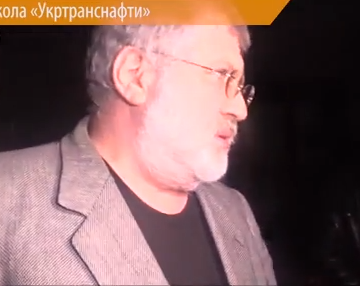
Ukrainian oligarch Igor Kolomoisky confronting journalists after he led an armed team in a raid at the government-owned energy company in Kiev on March 19, 2015.
(Screen shot from YouTube)
Last year, Kolomoisky’s brutal militias, which include neo-Nazi brigades, were praised for their fierce fighting against ethnic Russians from the east who were resisting the removal of their president. But now Kolomoisky, whose financial empire is crumbling as Ukraine’s economy founders, has turned his hired guns against the Ukrainian government led by another oligarch, President Petro Poroshenko.
On Thursday night, Kolomoisky and his armed men went to Kiev after the government tried to wrest control of the state-owned energy company UkrTransNafta from one of his associates. Kolomoisky and his men raided the company offices to seize and apparently destroy records. As he left the building, he cursed out journalists who had arrived to ask what was going on. He ranted about “Russian saboteurs.”
It was a revealing display of how the corrupt Ukrainian political-economic system works and the nature of the “reformers” whom the U.S. State Department has pushed into positions of power. According to BusinessInsider, the Kiev government tried to smooth Kolomoisky’s ruffled feathers by announcing “that the new company chairman [at UkrTransNafta] would not be carrying out any investigations of its finances.”
Yet, it remained unclear whether Kolomoisky would be satisfied with what amounts to an offer to let any past thievery go unpunished. But if this promised amnesty wasn’t enough, Kolomoisky appeared ready to use his private army to discourage any accountability.
On Monday, Valentyn Nalyvaychenko, chief of the State Security Service, accused Dnipropetrovsk officials of financing armed gangs and threatening investigators, Bloomberg News reported, while noting that Ukraine has sunk to 142nd place out of 175 countries in Transparency International’s Corruptions Perception Index, the worst in Europe.
The see-no-evil approach to how the current Ukrainian authorities do business relates as well to Ukraine’s new Finance Minister Natalie Jaresko, who appears to have enriched herself at the expense of a $150 million U.S.-taxpayer-financed investment fund for Ukraine.
Jaresko, a former U.S. diplomat who received overnight Ukrainian citizenship in December to become Finance Minister, had been in charge of the Western NIS Enterprise Fund (WNISEF), which became the center of insider-dealing and conflicts of interest, although the U.S. Agency for International Development showed little desire to examine the ethical problems – even after Jaresko’s ex-husband tried to blow the whistle. [See Consortiumnews.com’s “Ukraine Finance Minister’s American ‘Values.’”]
Passing Out the Billions
Jaresko will be in charge of dispensing the $17.5 billion that the International Monetary Fund is allocating to Ukraine, along with billions of dollar more expected from U.S. and European governments.
Regarding Kolomoisky’s claim about “Russian saboteurs,” the government said that was not the case, explaining that the clash resulted from the parliament’s vote last week to reduce Kolomoisky’s authority to run the company from his position as a minority owner. As part of the shakeup, Kolomoisky’s protégé Oleksandr Lazorko was fired as chairman, but he refused to leave and barricaded himself in his office, setting the stage for Kolomoisky’s arrival with armed men.
On Tuesday, the New York Times reported on the dispute but also flashed back to its earlier propagandistic praise of the 52-year-old oligarch, recalling that “Mr. Kolomoisky was one of several oligarchs, considered too rich to bribe, who were appointed to leadership positions in a bid to stabilize Ukraine.”
Kolomoisky also is believed to have purchased influence inside the U.S. government through his behind-the-scenes manipulation of Ukraine’s largest private gas firm, Burisma Holdings. Last year, the shadowy Cyprus-based company appointed Vice President Joe Biden’s son, Hunter Biden, to its board of directors. Burisma also lined up well-connected lobbyists, some with ties to Secretary of State John Kerry, including Kerry’s former Senate chief of staff David Leiter, according to lobbying disclosures.
As Time magazine reported, “Leiter’s involvement in the firm rounds out a power-packed team of politically-connected Americans that also includes a second new board member, Devon Archer, a Democratic bundler and former adviser to John Kerry’s 2004 presidential campaign. Both Archer and Hunter Biden have worked as business partners with Kerry’s son-in-law, Christopher Heinz, the founding partner of Rosemont Capital, a private-equity company.”
According to investigative journalism in Ukraine, the ownership of Burisma has been traced to Privat Bank, which is controlled by Kolomoisky.
So, it appears that Ukraine’s oligarchs who continue to wield enormous power inside the corrupt country are now circling each other over what’s left of the economic spoils and positioning themselves for a share of the international bailouts to come.
As for “democratic reform,” only in the upside-down world of the State Department’s Orwellian “information war” against Russia over Ukraine would imposing a corrupt and brutal oligarch like Kolomoisky as the unelected governor of a defenseless population be considered a positive.
~
Investigative reporter Robert Parry broke many of the Iran-Contra stories for The Associated Press and Newsweek in the 1980s. You can buy his latest book, America’s Stolen Narrative, either in print here or as an e-book (from Amazon and barnesandnoble.com).
Tunisia museum attack: Who’s behind it, what are their goals?
RT | March 19, 2015
Groups like IS, which could be behind the Bardo Museum shootings, have a long history of collaborating with the West and may have attacked tourists just to maintain their anti-Western façade, says independent political analyst Dan Glazebrook.
RT: Do you think that the Western tourists were targeted on purpose?
Dan Glazebrook: Yeah, I think so. The thing is with ISIS and these groups – they have a long history of collaborating with the West. It’s fundamental to their appeal that they kind of try to present themselves as anti-Western. If you look over the last several years, they’ve been singing from the same song-sheet – whether it’s on Libya, the fight against Gaddafi; Syria, the fight against Assad. We’ve had revelations about fighters’ passage to Syria to go and fight against Assad being facilitated by MI5, by British intelligence. This all came out in the hearings in Mozambique last year. So these guys are on the same page, they are helping to fulfill the West strategic aims of destabilization in the area. … The thousands and thousands people they’ve killed, the vast majority of them have been other Muslims and non-white people. From time to time they have to kill some Europeans and some Westerners in order to maintain this façade of somehow being opposed to the West, whilst they continue to carry out and facilitate the West’s strategic aims.
RT: A large number of Islamic State fighters reportedly come from Tunisia. Why is that?
DG: It was estimated at one point that the actual majority of foreign fighters in Syria were of Tunisian origin, over 3,000… They’ve also fought in Libya; they’ve fought in terrorist campaigns in Algeria. There are many different reasons; part of it is a kind of extremist backlash against the extremist secularism of the previous President [Zine El Abidine] Ben Ali and his predecessor [Habib Bourguiba]. But I think a lot of it is just simply to do with the economics and finances. There is very high unemployment in Tunisia. It is rumored that you can get up to $27,000 a year for going to fight for ISIS… Billions of dollars were put into these sectarian militias to build up these groups by Saudi Arabia and the USA as a bulwark against the resistance axis of Syria, Iran, and Hezbollah. These billions of dollars are still slushing around.
‘Attack might be publicizing Ansar al-Sharia’s merger with ISIS’
Brian Levin, director of the Center for the Study of Hate and Extremism, also commented on the Tunis museum attack.
RT: No one has claimed responsibility for the attack yet. Who in your view is most likely to be behind it?
Brian Levin: The most likely would probably be Ansar al-Sharia which is a radical Salafist terrorist group which started in Tunisia shortly after the Tunisian revolution in January, 2011. It was formed three months later by a fellow named Abu Ayadh. That is the most likely suspect, although, ISIS affiliates are present in neighboring Libya as well.
RT: Do you think the attackers were pursuing any particular goal with this terrible assault?
BL: Yes, I would think that if it is Ansar al-Sharia or if Ansar al-Sharia is using this to publicize some kind of merger with ISIS – this would be the time and the place to do it. Tunisia, as I said, in an area where ISIS has been exporting its brand of radicalism. That is one thing – Tunisia is Western friendly and it has got a strong economy.
RT: Earlier, a warning for tourists had been issued calling on them not to visit certain areas. Is this kind of attack in Tunisia a rare event and just how dangerous is the country for travelers?
BL: There have been advisories put out about travel to Tunisia. Its biggest industries are in fact tourism and minerals. It is a democratic society and it is Western friendly. Its economy is strong [but] it relies on these exports and tourism. And an attack like this could really hurt the economy in a place where there is fragility with respect to the economic situation. Remember again, Tunisia was the success story of the Arab Spring. This is the time and the place where groups like ISIS and Ansar al-Sharia are trying to make radicalism an imprint there and in the neighboring countries as well.
RT: The EU foreign policy chief Federica Mogherini has said that IS was behind the attack. Do you believe that that is likely?
BL: It could be in a sense to the extent that these actors had the same goal… Ansar Al-Sharia is allying itself with the al-Qaeda affiliates in North Africa. The fact of the matter is it very well could be ISIS. ISIS does have an imprint in North Africa. One of the things that ISIS had wanted to do even when it was just AQI [al-Qaeda in Iraq] back in 2004, they wanted to export their terrorism to places like Jordan, and now has an imprint in places like Libya which neighbors Tunisia.
Read more 17 tourists, 2 locals slain in Tunis museum attack
Featured Video

Ivermectin and iodine
or go to
Aletho News Archives – Video-Images
Book Review
UAE tortured, killed journalist for opposing Israel normalization
The Cradle | October 31, 2026
UAE security officers detained, tortured, and killed Emirati poet and news editor Habib al-Sayegh in August 2019, shortly after he published a column opposing UAE normalization with Israel, according to a newly published book.
“Princes and Thieves,” a book by investigative journalist Matthew Cole published on 25 October, alleges that UAE security officers raided Sayegh’s Abu Dhabi home shortly after the publication of the column, hooded him in front of his wife and took him to a detention facility where he was tortured to death.
His interrogators reportedly pulled out several of his teeth with pliers and beat him repeatedly with a sharp metal object.
On 11 August 2019, Sayegh criticized the UAE’s plan to normalize relations with Israel as part of the Abraham Accords in his weekly column for Khaleej newspaper. The column was titled “Israel Is Our Real Enemy and A Dangerous Project.”
Sayegh described Israel as “a real and natural enemy” while questioning “who authorized the normalizers to speak on behalf of everyone?”
Nine days after the column was published, Emirati state media announced his death, without stating a cause. … continue
Blog Roll
 Aletho News
- Ivermectin and iodine
- Congratulations climate skeptics — you are a ‘Hybrid weapon of war’ and a growing public health threat
- ‘The Arab Vote’: How Israeli Racism Has Ruined Their Elections
- Israel forces Palestinians in Gaza to choose between assassination alone or death with their families: Report
- US Approves Sale of 500 Patriot Missiles to Ukraine, Deliveries May Take Years
- German Imperialism: An Urgent Explainer
- Backed by AAP, West Virginia Proposal Would Allow Dental Hygienists to Give HPV Vaccine to 9-Year-Olds
- Poland Is the Symptom and Europe Is the Patient
- UAE security forces tortured, killed journalist for opposing Israel normalization: Report
- They Compared the Spice to the Drug. The Spice Won — Again. (Part 2)
- If Americans Knew
- DAILY UPDATE: Latest essential news on Palestine, Israel, & region
- 1,300 will gather in Palo Alto on Nov. 1 for Z3 Conference on Zionism
- DAILY UPDATE: Latest essential news on Palestine, Israel, & region
- The Long Arm of AIPAC
- Genocidal intent behind Hebron assault, rights group says
- This week, Israel killed 8-year-old who survived bombing that wiped out her family
- DAILY UPDATE: Latest essential news on Palestine, Israel, & region
- Israeli soldier poses at damaged Lebanon church, sparking anger
- New Report. Manufacturing the Great Replacement: Is Israel behind one of the largest racist influence campaigns ever documented?
- ‘Arab voice doesn’t count’: Jewish Israeli blocs reject Palestinian support
- No Tricks Zone
- Germany’s Green Energy Transition Becoming Increasingly Expensive…Another 6 Trillion Euros!
- Sudden Stratospheric Warming, Powerful El Niño Combination May Lead To Extreme Europe Cold, Energy Crisis!
- Two New Studies Find Thwaites Glacier Melt Cannot Be Driven By Human Activity Or A Warming Ocean
- E-Cars Reduce CO2 Emissions By Only 41% Compared To Internal Combustion Engine Vehicles
- Predictions Made By Renowned Climate Professor Over Past Decades Have Been Proven To Be Poor
- New Study Suggests Large Regions Of The Pacific Ocean Have Been Cooling For The Last 80 Years
- Germany’s Green Energy Debacle: High Energy Costs Force Kahla Porzellan to Close After 182 Years!
- New Study: 50 Years Of The Most Aggressive ‘Net Zero’ Policies Can Only Affect The Global Climate By 0.03°C
- US September “Heat” Was No Record…Many Records Set Decades Ago
- Latest European Green Energy Debacle; Portugal’s Largest Flagship Solar Park Insolvent!

