US removes Iran and Hezbollah from list of terror threats
MEMO | March 18, 2015
An annual security report submitted recently to the US Senate by James Clapper, director of National Intelligence, removed both Iran and Hezbollah from the list of terrorism threats to the United States for the first time in years.
The unclassified version of the “Worldwide Threat Assessment of the US Intelligence Communities” dated 26 February, noted Iran’s efforts to fight “Sunni extremists”, including elements affiliated with the Islamic State group who were perceived to constitute the “preeminent terrorist threat to American interests worldwide”.
Last year’s report described the global terrorist activity of Lebanon’s Shia Hezbollah group to have increased in recent years to “a level we have not seen since the 1990s”, however this year’s report mentioned the group only once saying it faces a threat from ISIS and Al-Nusra Front near Lebanon’s orders.
Meanwhile, despite removing Tehran from the list, the report described it as source of cyber-attacks and a regional threat to the United States because of its support for Syrian regime President Bashar Al-Assad and its hostile policies against Israel.
Obama’s War in Western Hemisphere and Venezuela’s National Liberation Struggle
By James Petras | March 15, 2015
Why did Obama declare a ‘national emergency’, claim that Venezuela represents a threat to US national security and foreign policy, assume executive prerogatives and decree sanctions against top Venezuelan officials in charge of national security, at this time?
Venezuela’s Support of Latin America Integration is Obama’s Great Fear
To answer this question it is essential to begin by addressing Obama’s specious and unsubstantiated charges of a Venezuelan ‘threat to national security and foreign policy’.
First, the White House presents no evidence … because there is nothing to present! There are no Venezuelan missiles, fighter planes, warships, Special Forces, secret agents or military bases poised to attack US domestic facilities or its overseas installations.
In contrast, the US has warships in the Caribbean, seven military bases just across the border in Colombia manned by over two thousand US Special Forces, and Air Force bases in Central America. Washington has financed proxy political and military operations intervening in Venezuela with intent of overthrowing the legally constituted and elected government.
Obama’s claims resemble a ploy that totalitarian and imperialist rulers frequently use: Accusing their imminent victims of the crimes they are preparing to perpetrate against them. No country or leader, friend or foe, has supported Obama’s accusations against Venezuela.
Obama’s charge that Venezuela represents a ‘threat’ to US foreign policy requires clarification: First, which elements of US foreign policy are threatened? Venezuela has successfully proposed and supported several regional integration organizations, which are voluntarily supported by their fellow Latin American and Caribbean members. These regional organizations, in large part, replace US-dominated structures, which served Washington’s imperial interests. In other words, Venezuela supports alternative diplomatic and economic organizations, which its members believe will better serve their economic and political interests, than those promoted by the Obama regime. Petrocaribe, a Central American and Caribbean association of countries supported by Venezuela, addresses the development needs of their members better than US-dominated organizations like the Organization of American States or the so-called ‘Caribbean Initiative’. The same is true of Venezuela’s support of CELAC (Community of Latin American and Caribbean States) and UNASUR (Union of South American Nations). These are Latin American organizations which exclude the dominating presence of the US and Canada and are designed to promote greater regional independence.
Obama’s charge that Venezuela represents a threat to US foreign policy is an accusation directed at all governments who have freely chosen to abandon US-centered organizations and who reject US hegemony.
In other words, what arouses Obama’s ire and motivates his aggressive threats toward Venezuela is Caracas’s political leadership in challenging US imperialist foreign policy.
Venezuela does not have military bases in the rest of Latin America nor has it invaded, occupied, or sponsored military coups in other Latin American countries – as Obama and his predecessors have done.
Venezuela condemned the US invasion of Haiti, the US-supported military coups in Honduras (2009), Venezuela (2002, 2014, 2015), Bolivia (2008), and Ecuador (2010).
Clearly, Obama’s ‘emergency’ decree and sanctions against Venezuela are directed at maintaining unchallenged US imperial supremacy in Latin America and degrading Venezuela’s independent, democratic foreign policy.
To properly understand Obama’s policy toward Venezuela, we have to analyze why he has chosen overt, unilateral bellicose threats at this time?
Obama’s War Threat Results from Political Failure
The principal reasons why Obama has directly intervened in Venezuelan politics is that his other policy options designed to oust the Maduro government have failed.
In 2013, Obama’s relied on US financing of an opposition presidential candidate, Henrique Capriles, to oust the incumbent Chavista government. President Maduro defeated Obama’s choice and derailed Washington’s ‘via electoral’ to regime change.
Subsequently, Obama attempted to boycott and discredit the Venezuelan voting process via an international smear campaign. The White House boycott lasted 6 months and received no support in Latin America, or from the European Union, since scores of international election observers, ranging from former President James Carter to representatives of the Organization of American States certified the outcome.
In 2014, the Obama regime backed violent large-scale riots, which left 43 persons dead and scores wounded, (most victims were pro-government civilians and law enforcement officers) and millions of dollars in damages to public and private property, including power plants and clinics. Scores of vandals and rightwing terrorists were arrested, including Harvard-educated terrorist Leopoldo Lopez. However, the Maduro government released most of the saboteurs in a gesture of reconciliation.
Obama, on his part, escalated the terror campaign of internal violence. He recycled his operatives and, in February 2015, backed a new coup. Several US embassy personnel (the US had at least 100 stationed in their embassy), turned out to be intelligence operatives using diplomatic cover to infiltrate and recruit a dozen Venezuelan military officials to plot the overthrow of the elected government and assassinate President Maduro by bombing the presidential palace.
President Maduro and his national security team discovered the coup plot and arrested both the military and political leaders, including the Mayor of Caracas.
Obama, now furious for having lost major internal assets and proxies, turned to his last resort: the threat of a direct US military intervention.
The Multiple Purposes of Obama’s ‘National Emergency’
Obama’s declaration of a national security emergency has psychological, political and military objectives. His bellicose posture was designed to bolster the spirit of his jailed and demoralized operatives and let them know that they still have US support. To that end, Obama demanded that President Maduro free the terrorist leaders. Washington’s sanctions were primarily directed against the Venezuelan security officials who upheld the constitution and arrested Obama’s hired thugs. The terrorists in their prison cells can console themselves with the thought that, while they serve ‘hard time’ for being US shock troops and puppets, their prosecutors will be denied visas by President Obama and can no longer visit Disneyland or shop in Miami. Such are the consequences of the current US ‘sanctions’ in the eyes of a highly critical Latin America.
The second goal of Obama’s threat is to test the response of the Venezuelan and Latin American governments. The Pentagon and CIA seek to gauge how Venezuela’s military, intelligence, and civilian leaders will deal with this new challenge in order to identify the weak links in the chain of command, i.e. those officials who will run for cover, cower or seek to conciliate, by giving in to Obama’s demands.
It should be remembered that during the US-backed April 2002 coup, many self-styled ‘Chavista revolutionaries’ went into hiding, some holing up in embassies. In addition, several military officials defected and a dozen politicians curried favor with the coup leaders, until the tide turned and over a million ordinary Venezuelans, including slum dwellers, marched to surround the Presidential Palace and, with the backing of loyalist paratroopers, ousted the golpistas (coup-makers) and freed their President Chavez. Only then did the fair-weather Chavistas come out from under their beds to celebrate the restoration of Hugo Chavez and the return of democracy.
In other words, Obama’s bellicose posture is part of a ‘war of nerves’, to test the resistance, determination and loyalty of the government officials, when their positions are threatened, US bank accounts are frozen, their visas denied and access to ‘Disneyland’ cut.
Obama is putting the Venezuelan government on notice: a warning this time, an invasion next time.
The White House’s openly thuggish rhetoric is also intended to test the degree of opposition in Latin America – and the kind of support Washington can expect in Latin America and elsewhere.
And Cuba responded forcefully with unconditional support for Venezuela. Ecuador, Bolivia, Nicaragua, and Argentina repudiated Obama’s imperial threats. The European Union did not adopt the US sanctions although the European Parliament did echo Obama’s demand to free the jailed terrorists. Initially Brazil, Uruguay, Chile and Mexico neither backed the US nor the Venezuelan government. The Uruguayan Vice President Raul Sendic was the only official in Latin America to deny US intervention. However, on March 16 at an emergency meeting of UNASUR in Quito Ecuador, the foreign ministers of Argentina, Bolivia, Chile, Colombia, Ecuador, Guyana, Peru, Surinam, Uruguay, and Venezuela unanimously denounced US sanctions and military intervention
President Maduro Stands Firm: They Shall Not Pass
Most important, President Maduro stood firm. He declared a national emergency and asked for special powers. He called for two weeks of nationwide military exercises involving 100,000 soldiers beginning March 14. He made it clear to the Pentagon and the White House that a US invasion would meet resistance. That confronting millions of Venezuelan freedom fighters would not be a ‘cake walk’ – that there would be US casualties, body bags and new US widows and orphans to mourn Obama’s imperial schemes.
Conclusion
Obama is neither preparing an immediate invasion nor giving up on ‘regime change’ because his coup operatives failed in two consecutive years. His militarist posture is designed to polarize Latin America: to divide and weaken the regional organizations; to separate the so-called ‘moderates’ in Mercosur (Brazil/Uruguay/Paraguay) from Venezuela and Argentina. Despite his failures thus far, Obama will press ahead to activate opposition to Venezuelan security policies among the Chilean, Peruvian, Mexican, and Colombian neo-liberal regimes.
Washington is building pressure externally and preparing for a new round of violent unrest internally to provoke a robust government response.
In other words – Obama’s military invasion will follow the well-rehearsed scenario of ‘humanitarian intervention’ orchestrated in Yugoslavia, Libya and Syria – with such disastrous consequences on the people of those countries. Obama, at this time, lacks international political support from Europe and Latin America that would provide the fig leaf of a multilateral coalition and has lost his key internal operatives. He cannot risk a bloody unilateral US invasion and prolonged war in the immediate future.
However, he is inexorably moving in that direction. Obama has seized executive prerogatives to attack Venezuela. He has alerted and mobilized US combat forces in the region. He understands that his current teams of operatives in Venezuela have demonstrated that they are incapable of winning elections or seizing power without major US military backing. Obama is now engaged in a psychological as well as physical war of nerves: to run down the Venezuelan economy, to intimidate the faint-hearted, and exhaust and weaken the militants through constant threats and widening sanctions over time.
The Venezuelan government of Nicolas Maduro has accepted the challenge. He is mobilizing the people and the armed forces: his democratically elected regime will not surrender. The national resistance will be fighting in their own country for their own future. They will be fighting an invading imperial power. They represent millions, and they have a ‘world to lose’ if the ‘squalidos’ (the domestic fifth column) should ever take power: if not their lives, their livelihoods, their dignity and their legacy as a free and independent people.
Epilogue
President Maduro has sought and secured Russian military support and solidarity in the form of arms, advisors, and an agreement to engage in joint military maneuvers to meet the challenges of Obama’s war of attrition. President Putin has addressed a public letter of support to the Venezuelan government in response to Obama’s threats.
Obama is engaged in a two-pronged economic and military strategy, which will converge with a US military invasion.
The overt military threats issued in early March 2015 are designed to force the Maduro government to divert large-scale financial resources away from meeting the economic crisis to building emergency military defense. Through escalating military and economic threats, the White House hopes to diminish government subsidies for the import of basic foodstuffs and other essential commodities during an internal campaign of hoarding and artificial shortages committed by economic saboteurs. Obama is counting on his Venezuelan proxies and the local and international mass media to blame the government for the economic deterioration and to mobilize the big protests of irate consumers. White House strategists hope a massive crowd will serve as a cover for terrorists and snipers to engage in violent acts against public authorities, provoking the police and armed forces to respond in a re-play of the ‘coup’ in Kiev. At that point, Washington will seek to secure some form of support from Europe or Latin America (via the OAS) to intervene with troops in what the State Department will dub as ‘peace mediators in a humanitarian crisis’.
The success of sending the US Marines into Venezuela on a peace mission will depend on how effective Special Forces and Pentagon operatives in the US Embassy have been in securing reliable collaborators among the Venezuelan military and political forces ready to betray their country. Once the collaborators seize a piece of territory, Obama can mount the charade that US Marines are there by invitation… of the democratic forces.
Under conditions of explicit military threat, Maduro must change ‘the rules of the game’. Under emergency conditions, hoarding is no longer just a misdemeanor: it becomes a capital crime. Politicians meeting and consulting with representatives of the invading country should lose their immunity and be summarily jailed. Above all, the government must take total control over the distribution of basic goods; establishing rationing to ensure popular access; nursing scarce financial resources by limiting or imposing a moratorium on debt payments; diminishing or selling assets in the US (CITGO) to avoid confiscation or their being made illiquid (“frozen”) by some new Obama decree. On the external front, Venezuela must deepen military and economic ties with its neighbors and independent nations to withstand the US military and economic offensive. If Obama escalates the military measures against Venezuela, the parliamentary elections scheduled for September should be temporarily suspended until normality is re-established.
Indigenous Languages Gaining Space in Ecuador
teleSUR | March 12, 2015
Ecuador is working to rescue and promote the use of indigenous languages.
As reparation for historical injustices and as a means to strengthen the nation’s intercultural identity, the Ecuadorean government and citizens are prioritizing the recuperation of the country’s 14 indigenous languages.
Human migration and societies stigmatization of their tounge are two factors which have led to the near disappearance of some languages in recent years. Studies have shown that in 1950 14 percent of the population spoke an indigenous language, with that number plummeting to be 3.7 percent in 1990.
Director of the Center for Economic and Social Rights Eduardo Pichilingue told teleSUR English, “I think that language is fundamental for creating a group, so that it has identity. I work with the Waorani indigenous group, the Waorani thankfully have a relatively healthy language still, they were contacted not too long ago, this makes the change in their language not as drastic as in other nationalities.”
Giving a space to those previously excluded and ignored indigenous voices is the Ecuador Educational Coordination of Popular Radio. With the objective of democratizing communication, it allows Kichwa-speaking producers to design their own programs, and report on both national and international events.
“On behalf of the government I think there has been an effort above all else to strengthen processes of cultural exchange. I believe the government is working hard in communication processes between people and nationalities. 18 community radios have been implemented at a national level to strengthen processes of communication between people from distinct nationalities,” said Sandy Chavez, the Coordinator of Networks at CORAPE.
She went on to say, “From us as an institution, a great success has been incorporating producers, young people who did not speak Kichwa, into our educational initiative and transmit in the Kichwa language. So our first success has been that these young people are not embarrassed to speak in the language, but that they are part of this initiative to rescue indigenous languages, and this has been the first.”
A country with more than 10 indigenous nationalities, the 2008 constitution of Ecuador declares it a plurinational and intercultural state. The Foreign Ministry has expressed that it is willing to foster diplomatic relationships with these distinct nationalities within Ecuador, as a way to strengthen national identity as the country continues working to save and further the use of indigenous languages.
Colombia to Stop Bombing FARC Camps for One Month
teleSUR | March 10, 2015
The Colombian military will stop bombing FARC (Revolutionary Armed Forces of Colombia) camps for one month, President Juan Manuel Santos announced Tuesday.
The President emphasized that this is a temporary measure to try to de-escalate the more than 50 year conflict in the country, however he did not rule out the possibility of extending the one month deadline.
The FARC – the country’s largest guerrilla group – declared a unilateral ceasefire in December 2014, which it has so far honored, but the Colombian government has been slow to reciprocate.
Santos’ decision is an attempt to support ongoing peace talks, however he was specific in saying the bombing of camps would stop and did not mention ground troop deployment.
“To promote the de-escalation of the conflict, I decided to order the defense minister (Juan Carlos Pinzón) and the commanders of the forces to cease the bombing of the FARC camp for a month,” said the president.
“After that time we will further review the implementation of the unilateral termination by the FARC and, according to its results, decide whether to continue with the measure or not. In any case we will not waive the bombing if we see an imminent threat of a population,” he added.
The FARC and the Colombian government have been undergoing peace talks in Havana, Cuba since November of 2012 in an attempt to find a solution to the decades long conflict that has killed and displaced millions of Colombians.
A Perspective on the Rise of ISIS
By Ruben Rosenberg Colorni | NEWS JUNKIE POST | March 10, 2015
One of the most popular pieces of “information” that is being circulated on the internet and newspapers in my own country of birth, Italy, is an announcement of the imminent arrival of ISIS fighters on our shores. According to United States intelligence agencies, which are not exactly impartial or neutral sources, throngs of Islamic terrorists are about to be shipped to our boot-shaped Mediterranean country from Libya. Panic. Fear. Insecurity. These are the words that are being thrown around like stale bread to the birds. Few column inches in the Italian national press, and elsewhere for that matter, have been devoted to any analysis of the validity of the threats or their inherent origins. Alas, this is a well-known technique: capitalize on those points that suit the needs of international interests and national politicians, and omit the information that really matters. It’s a dirty trick that causes entire populations to be plagued by short-term memory loss.
Sponsoring proxy armies
ISIS was founded in 1999 by a shadowy figure, Abu Musab al-Zarqawi. He has been reported killed and resurrected numerous times, as has been its successor. Let us not dwell on the first 12 years of ISIS, when it was a spinoff of al-Qaeda in Iraq. Instead, let us fast forward to 2011, when the NATO powers, led by France and the UK, engaged in an aerial offensive against Libya to topple Gaddafi and replace him with a pro-West government. This approach has been standard geopolitical operating procedure for the US and its Western-European allies for decades in places such as Nicaragua, Bolivia, Ecuador, Mexico, Brazil, Vietnam, Iran, Yemen, Afghanistan, Chile and many more, where despotic regimes have been installed after Western-engineered coups. Often, the major powers do not get directly involved or send their own troops to die on foreign lands, because this would have severe repercussions on the standing of politicians in the public opinion. The praxis is to sponsor, fund and arm ruthless bands of “rebels” to fight against an established government. These groups are first funded to serve geopolitical interests, and when they are unwilling to do so any longer, they become an excuse to invade. Once in power, in fact, these groups tend to believe that they can stand on their own two feet without the support of their previous benefactors and often turn against them. Power beckons, and history indeed repeats itself. This is precisely the case with ISIS.
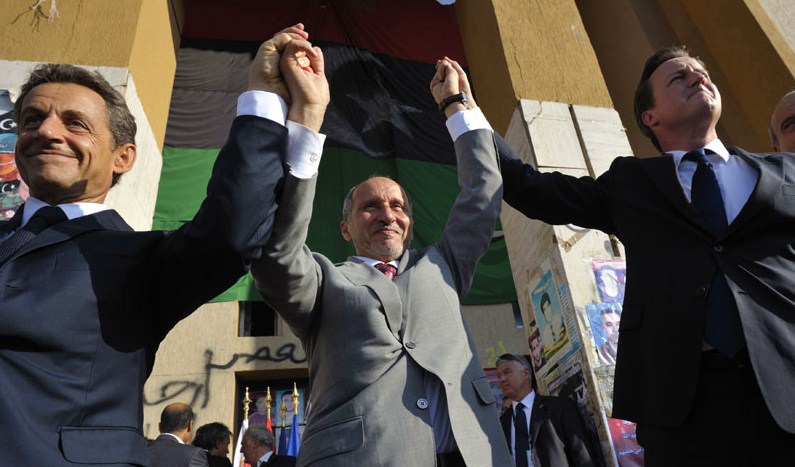
Libya: using the pretext of the Arab Spring
The meteoric rise of ISIS to power is not a coincidence or byproduct of innocent geopolitical mistakes. ISIS was initially created, for the sake of foreign-policy interests, to remove uncooperative governments like those in Libya, and then Syria which arguably became the pivotal point for the rise of ISIS. Until 2011 Libya was largely secular, sovereign, and fairly prosperous; now this country lies in ruins and is portrayed as having been invaded by a horde of foreign “Islamists”. The reality, however, is that France, Italy, the UK, and the US sponsored a small group of discontents to fight Gaddafi in 2011. They called themselves the Shabab, and they later constituted the “Libyan Transitional Council” which is now in government. The Libyan rebels were portrayed to the Western public as being “freedom fighters” who sought greater government accountability and increased liberties. In reality, it almost immediately became apparent that Islamic extremists had taken the leadership of the movement; the western powers were certainly aware of this.
Numerous reports warned that many of the fighters were affiliated with Al-Qaeda, another organization originally made powerful by the US to fight against the Soviet Union in Afghanistan. From the start, the global left had denounced these pseudo-revolutionaries as being violent as well as extreme in their religious zeal: in short, bad news for everybody. Nobody heeded their calls. The demonization of Gaddafi continued in the mainstream Western media, and the glorification and support for the rebels grew to the point when NATO’s governments felt secure that their public would support bombing Libya. So they did. Let us also remember that the Libyan army was sufficiently well trained and disciplined to have almost neutralized the opposition, and it would have done so if NATO had not intervened. In short, if Gaddafi’s government existed today, ISIS might not.
It was not made widely public that many of Libya’s rebels were not Libyans but Iraqis from Al-Qaeda in Iraq. This organization cleverly re-branded itself to confuse the public, and it became ISIS. Abdel Hakim-Belhadj was the commander of the Libyan Islamic Fighting Group that helped NATO to depose Gaddafi. It is almost unknown that Hakim-Belhadj was in fact an al-Qaeda lieutenant, turned double agent after being in the care of the CIA, and released back into operation. “The US was fully aware of and facilitating the delivery of weapons to the Al Qaeda-dominated rebel militias throughout the 2011 rebellion”, as stated by The Citizen’s Commission on Benghazi’s interim report. Far from the US being able to claim ignorance, this program was run and administered by Hillary Clinton, then the Secretary of State.
With NATO’s air support, the Libyan rebels captured Gaddafi (he was murdered by the rebels in a horror show that the mainstream media did not hesitate to broadcast). With Gaddafi gone, Hakim-Belhadj was rewarded by NATO and Washington with the title of Governor of Tripoli. With this position, he ensured the recruitment of Jihadists into Libya and the smuggling of hundreds of them to Syria through Turkey. This would create the backbone of what would eventually, and ironically, be named the “Free Syrian Army”. There is no equivocation on the fact that the very same members of the Libyan Islamic Fighting Group were flying the Al-Qaeda and ISIS flags following the murder of Gaddafi. This happened “before and during the time they were shipped on to fight in Syria against Bashar al Assad’s government forces – on behalf of those very same NATO-allied agencies” as reported by the 21st Century Wire.
Syria: toppling Assad
One year later, the Free Syrian Army arguably brought us to the brink of World War III by using chemical weapons against Syrian civilians, and they attempted to frame Assad for it. They are the same fighters who were using weapons shipped by Saudi Arabia and Qatar, with logistic support from the CIA operating in Jordan, and they were also funded by the Saudis, Qataris and Americans. All of this, despite their benefactors’ knowledge that the weapons were falling in the hands of the Jihadists rather than the secular opposition. With help from the CIA, these governments and that of Turkey sharply increased their support for the Syrian rebels throughout 2013, expanding exponentially an airlift of arms and equipment for the uprising against Assad.
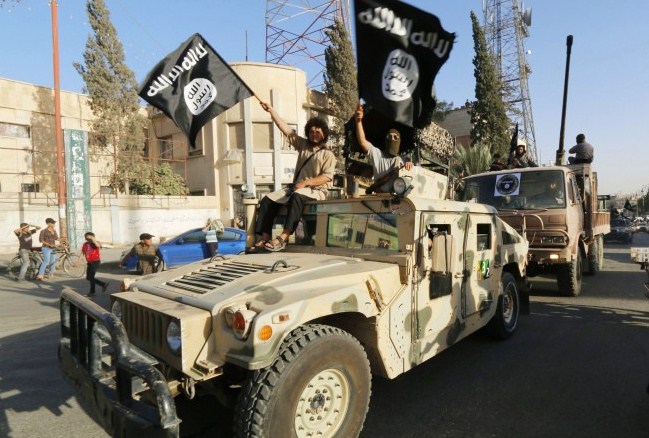
With the Jihadization of Damascus having failed, ISIS was born, led by the infamous al-Baghdadi, who was being sponsored just a few months before by the US to fight against Assad. This was achieved through missions coordinated by the likes of John McCain, who to this day maintains that he “knows these people very well” and they “are not terrorists”. The cognitive dissonance does not register in the minds of the majority of the western public. It is not understood that the people who are being paid by the US and NATO in Syria to get rid of Assad are the same people that we must supposedly fight in Libya. Politicians lie, the media parrots, and the populace believes. The infamous “Caliph” al-Baghdadi is now the new bogeyman, the new Bin Laden, the new scapegoat upon which the neocons of the world can capitalize. With Jeb Bush poised to be the leading US Republican candidate for the presidency, the parallels with his brother George W. Bush and his crusade against Al-Qaeda to justify the invasions of Afghanistan and Iraq are simply too sinister to ignore. It hardly matters whether one believes that ISIS is under direct control of the US or not. The point is that ISIS has achieved its primary role: that of creating an atmosphere of fear that can be exploited and manipulated to justify military and political interventions abroad.
We have to wonder about the goal of ISIS in bombing in Libya. If ISIS really wants to attack Rome, it can easily do so with home-grown members rather than risk the laborious task of smuggling fighters from Libya. Could it be to influence the US elections in favor of a neoconservative? Or to pretend to be fighting ISIS while bombing the pro-Gaddafi militias that have re-taken most of the southern regions of Libya? Whatever the reason, it appears that the support from the US to the supposed enemies of the US is allegedly not waning. The Pentagon is set to send 1,000 troops to aid the Syrian rebels, and in June 2014 Obama requested $500 million from the US Congress to train and arm the group that potentially includes ISIS combatants. This comes amidst claims from an alleged Islamic State commander in Pakistan that the US is directly funding ISIS fighters on the ground there, and from the Iraqi parliament that their army has downed two British military planes that were carrying weapons and explosives to be allegedly air-dropped on ISIS-controlled areas. Saudi Arabia, Qatar, Turkey, and the NATO powers are not the only ones who have at least indirectly supported ISIS; Israel too has also thrown its lot with these unsavory characters. For 18 months the Israeli “Defense” Forces provided medical and technical help to opposition groups fighting inside Syria, as observed by the UN peacekeeping missions in the Golan Heights.
If a hand strikes you, do you blame the hand that hit you or the mind that commanded it? The situation with ISIS is similar, and so the real question to be asked is the following: Who is the greatest enemy to our security here, ISIS or the US? For those willing to see, the truth is in plain sight.
Part II: Iran Responds to GOP Letter
Mission of the Islamic Republic of Iran to UN – March 9, 2015
On March 9, Iran’s U.N. mission circulated the following press release detailing Foreign Minister Mohammad Javad Zarif’s reaction to the GOP letter on a nuclear deal.
 Asked about the open letter of 47 US Senators to Iranian leaders, the Iranian Foreign Minister, Dr. Javad Zarif, responded that “in our view, this letter has no legal value and is mostly a propaganda ploy. It is very interesting that while negotiations are still in progress and while no agreement has been reached, some political pressure groups are so afraid even of the prospect of an agreement that they resort to unconventional methods, unprecedented in diplomatic history. This indicates that like Netanyahu, who considers peace as an existential threat, some are opposed to any agreement, regardless of its content.”
Zarif expressed astonishment that some members of US Congress find it appropriate to write to leaders of another country against their own President and administration. He pointed out that from reading the open letter, it seems that the authors not only do not understand international law, but are not fully cognizant of the nuances of their own Constitution when it comes to presidential powers in the conduct of foreign policy.
Foreign Minister Zarif added that “I should bring one important point to the attention of the authors and that is, the world is not the United States, and the conduct of inter-state relations is governed by international law, and not by US domestic law. The authors may not fully understand that in international law, governments represent the entirety of their respective states, are responsible for the conduct of foreign affairs, are required to fulfill the obligations they undertake with other states and may not invoke their internal law as justification for failure to perform their international obligations.”
The Iranian Foreign Minister added that “change of administration does not in any way relieve the next administration from international obligations undertaken by its predecessor in a possible agreement about Iran’s peaceful nuclear program.” He continued “I wish to enlighten the authors that if the next administration revokes any agreement with ‘the stroke of a pen,’ as they boast, it will have simply committed a blatant violation of international law.” He emphasized that if the current negotiation with P5+1 [Britain, China, France, Germany Russia and the United States] results in a Joint Comprehensive Plan of Action, it will not be a bilateral agreement between Iran and the US, but rather one that will be concluded with the participation of five other countries, including all permanent members of the Security Council, and will also be endorsed by a Security Council resolution.
Zarif expressed the hope that his comments “may enrich the knowledge of the authors to recognize that according to international law, Congress may not ‘modify the terms of the agreement at any time’ as they claim, and if Congress adopts any measure to impede its implementation, it will have committed a material breach of US obligations.”
The Foreign Minister also informed the authors that the majority of US international agreements in recent decades are in fact what the signatories describe as “mere executive agreements” and not treaties ratified by the Senate. He reminded them that “their letter in fact undermines the credibility of thousands of such ‘mere executive agreements’ that have been or will be entered into by the US with various other governments.”
Zarif concluded by stating that “the Islamic Republic of Iran has entered these negotiations in good faith and with the political will to reach an agreement, and it is imperative for our counterparts to prove similar good faith and political will in order to make an agreement possible.”
Photo credit: Robin Wright
Colombia, FARC rebels reach agreement over land mines removal
Press TV – March 8, 2015
The Colombian government and the FARC rebels have reached a deal to remove the country’s land mines and discarded explosives, which have killed thousands of people in rural areas in the past 25 years.
The government and rebels from the Revolutionary Armed Forces of Colombia “have agreed to ask (Norwegian People’s Aid) to lead and coordinate a cleanup and decontamination operation for mines in rural areas,” both sides said in a statement after they ended the latest round of peace talks in the Cuban capital Havana on Saturday.
Cuba and Norway are guarantors of Colombia’s peace negotiations.
“Our goal is to put an end to the conflict… so the demining proposal is a first step, but a giant one toward peace,” top government mediator Humberto de la Calle said.
Land mines killed or wounded 11,043 people, including 4,226 civilians, between 1990 and 2015, the Colombian government says.
FARC representatives said on Saturday that progress is also being made on the issue of a bilateral ceasefire.
“The technical sub-commission, which handles such overwhelmingly important topics as a definitive bilateral ceasefire and the mutual agreement to disarm, has begun to move forward at a good pace,” said Ivan Marquez, the FARC lead negotiator.
The peace talks between the Colombian government and the rebels began in November 2012 in Havana.
The negotiations have produced partial agreements on several issues, but have not resulted in a final deal.
FARC is Latin America’s oldest rebel group and has been fighting the government since 1964.
Bogota estimates that 220,000 people have been killed and more than 4.5 million others have been displaced due to Latin America’s longest insurgency.
Turkish Governor Confirms ISIL Commander Being Treated in Local Hospital
Sputnik News | 06.03.2015
An Islamic State commander injured in a bomb attack in northern Syria is being treated in a Turkish hospital in the border province of Antakya.
Emrah C., a Turkish national, was admitted to Pamukkale University Hospital on Feb. 28, according to a statement released by Denizli province Governor’s office.
The statement also confirmed the Turkish ISIL commander has full rights to health services benefits in the country.
“Judicial procedures regarding his injury were carried out when he crossed into Turkey from Syria. His treatment is still underway in Denizli in accordance with the right to receive medical attention, just like a normal citizen,” the statement said.
Turkey has been heavily criticized for allowing foreign fighters to pass through its territory to neighboring Syria and Iraq to join the Islamic State. It has also been facing backlash for its reluctance to join US-led coalition efforts to fight the militant group, indicating an ideological link between some Turkish officials and the ISIL.
Last September, Turkish daily Aydinlik reported that the AKP (Justice and Development Party) government opened a 75 bed-capacity hospital in the southeastern Turkish province Gaziantep to treat jihadists injured while fighting in Syria.
African Union blames US, UK, Norway for South Sudan civil war – leak
RT | March 6, 2015
By supporting South Sudan’s independence from Sudan, the US, UK and Norway have created conditions for the civil war, which broke out in the world’s youngest country in 2013, leaked documents from an inquiry by the African Union allege.
In 2005, the US, UK, Norway and the East African trading bloc, IGAD, pushed through a peace deal, which legitimized the South Sudanese rebels, and paved the way for the country’s independence in 2011.
According to a draft of the African Union inquiry obtained by Reuters, the actions of the Western powers helped establish “a politically unchallenged armed power in South Sudan” that acted with impunity and legitimized “rule of the gun.”
At least 10,000 people were killed and another 1.5 million have been displaced since July 2013 when the fighting between the forces loyal to South Sudanese President Salva Kiir, and the militants led by his sacked deputy Riek Machar began.
The findings of the inquiry were to be presented to the African Union’s Peace and Security Council in late January, but it was decided the document will be shelved.
According to a Reuters source, it was done due to concerns the publication may disrupt the talks on forming a transitional government in South Sudan, which are currently underway between Kiir and Machar.
The inquiry suggested that South Sudan’s president and his rival should “be barred from participation in the transitional executive,” and the oil producer should be effectively placed under African Union control for a period of five years.
The investigation, led by former Nigerian President Olusegun Obasanjo, said that Kiir and Machar are responsible for the political crisis in December 2013 and “the organized massacres and the large-scale violence that followed.”
Officials from the US, UK and Norway said that they won’t comment on the document, which they haven’t seen.
“I think that the investigation that the African Union has started and the commission’s position, it needs to be made public,” Borge Brende, Norway’s Foreign Minister, told NRK broadcaster.
The call to make the inquiry public is supported by Washington, London and the UN Security Council.
Iran repeats offer to IAEA to inspect Marivan site
Press TV – March 6, 2015
Iran has once again announced its readiness to allow the inspectors of the International Atomic Energy Organization (IAEA) to visit a site in the country’s western region of Marivan.
Reza Najafi, Iran’s envoy to the IAEA, said in a Thursday statement that Tehran has already asked the agency to visit the site to clear allegations of large-scale experiments on explosives.
According to the statement, the international body rejected the offer.
Najafi said the agency cannot cover up its mistake regarding false accusations against Iran by simply rejecting the Islamic Republic’s offer.
He said Iran has repeatedly dismissed the accusations as baseless and fabricated.
A 2011 IAEA report claimed that it had information indicating large-scale high-explosive experiments at the site, which is located more than 700 kilometers west of the Iranian capital, Tehran.
On November 20, 2014, Najafi said Iran will, on a “voluntarily basis,” give the Vienna-based IAEA access to the Marivan site.
Iran-IAEA cooperation
Iran has been cooperating with the IAEA as part of efforts to provide more transparency on the country’s peaceful nuclear program on a voluntary basis.
A team from the United Nations nuclear watchdog, headed by Tero Varjoranta, IAEA’s deputy director general and head of the Department of Safeguards, is due in Tehran later in the month for technical talks.
The last technical meeting between the two sides was held in November.
Iran says it has granted the IAEA access to the sites that the agency claims need to be investigated in order to clarify outstanding issues.
The Islamic Republic has time and again emphasized its readiness for full cooperation with the IAEA.
Separately, Iran and the P5+1 group – Russia, China, France, Britain, the United States and Germany – are negotiating to narrow their differences over the Islamic Republic’s nuclear energy program ahead of a July 1 deadline for a comprehensive agreement.
United States is not “entitled to be displeased” with Cyprus – FM
By Ioannis Kasoulides • FAMAGUSTA GAZETTE • March 4, 2015
CYPRUS – FOREIGN MINISTER Ioannis Kasoulides has hit back at the US government, after officials in Washington expressed displeasure at a recent trip to Moscow by President Nicos Anastasiades.
“The [US] discontent focused on the fact that they believe that Putin’s government should be isolated by the 28 EU Member States and all other members of the North Atlantic Alliance”, Kasoulides was quoted as telling CyBC, by Russian agency Sputnik.
But he added that the United States is not “entitled to be displeased,” as Washington does not seem to be concerned by the aggressive policy of Turkey toward Cyprus, at the same time blaming Moscow for the crisis in Ukraine.
Washington rebuked Anastasiades on Monday after his widely publicised trip to Russia last week.
The US signaled how angry it is with Cyprus when Marie Harf, the Deputy Spokesperson for the US Department of State said this is not the time for “business as usual with Russia”.
She made the unusually sharp remark after being asked to comment on the recent visit of Anastasiades to Moscow and St Petersburg.
The visit came amid strong Russia-West tensions over Ukraine, the worst since the Cold War.
US fails to take Cuba off list of state sponsors of terrorism
Press TV – February 28, 2015
The United States and Cuba have held another round of talks to reestablish diplomatic relations and explore the possibility of opening embassies in Washington and Havana.
However, the Friday talks left a serious issue unresolved as Washington has failed to remove Cuba from its list of “state sponsors of terrorism” so far.
The US said it was still reviewing Cuba’s place on the list maintaining that the issue is separate from the talks and won’t affect the reestablishment of diplomatic relations.
However, the head of the Cuban delegation, Josefina Vidal, said that the removal from the terror list was a “very important issue” and a priority for Havana.
“It would be difficult to explain that Cuba and the US have re-established normal diplomatic relations while Cuba is kept on that list that we believe we have never belonged to,” Vidal said.
The US State Department says the process is more complicated than it seems. If President Barack Obama wants to remove Cuba from the list, he must forward that to Congress and it cannot take effect for 45 days according to the law.
Following the talks, the head of the US delegation expressed optimism that the two countries could re-open embassies before a regional summit in April.
On December 17, Obama announced that Washington will start talks with Cuba to normalize diplomatic relations, marking the most significant shift in US foreign policy towards the communist country in over 50 years.
Several Republican lawmakers have criticized Obama for trying to restore relations with Cuba because they say it could provide the Caribbean nation with legitimacy and money while it continues with its alleged human rights violations.
Featured Video

Ivermectin and iodine
or go to
Aletho News Archives – Video-Images
Book Review
UAE tortured, killed journalist for opposing Israel normalization
The Cradle | October 31, 2026
UAE security officers detained, tortured, and killed Emirati poet and news editor Habib al-Sayegh in August 2019, shortly after he published a column opposing UAE normalization with Israel, according to a newly published book.
“Princes and Thieves,” a book by investigative journalist Matthew Cole published on 25 October, alleges that UAE security officers raided Sayegh’s Abu Dhabi home shortly after the publication of the column, hooded him in front of his wife and took him to a detention facility where he was tortured to death.
His interrogators reportedly pulled out several of his teeth with pliers and beat him repeatedly with a sharp metal object.
On 11 August 2019, Sayegh criticized the UAE’s plan to normalize relations with Israel as part of the Abraham Accords in his weekly column for Khaleej newspaper. The column was titled “Israel Is Our Real Enemy and A Dangerous Project.”
Sayegh described Israel as “a real and natural enemy” while questioning “who authorized the normalizers to speak on behalf of everyone?”
Nine days after the column was published, Emirati state media announced his death, without stating a cause. … continue
Blog Roll
 Aletho News
- Ivermectin and iodine
- Congratulations climate skeptics — you are a ‘Hybrid weapon of war’ and a growing public health threat
- ‘The Arab Vote’: How Israeli Racism Has Ruined Their Elections
- Israel forces Palestinians in Gaza to choose between assassination alone or death with their families: Report
- US Approves Sale of 500 Patriot Missiles to Ukraine, Deliveries May Take Years
- German Imperialism: An Urgent Explainer
- Backed by AAP, West Virginia Proposal Would Allow Dental Hygienists to Give HPV Vaccine to 9-Year-Olds
- Poland Is the Symptom and Europe Is the Patient
- UAE security forces tortured, killed journalist for opposing Israel normalization: Report
- They Compared the Spice to the Drug. The Spice Won — Again. (Part 2)
- If Americans Knew
- An error has occurred; the feed is probably down. Try again later.
- No Tricks Zone
- Germany’s Green Energy Transition Becoming Increasingly Expensive…Another 6 Trillion Euros!
- Sudden Stratospheric Warming, Powerful El Niño Combination May Lead To Extreme Europe Cold, Energy Crisis!
- Two New Studies Find Thwaites Glacier Melt Cannot Be Driven By Human Activity Or A Warming Ocean
- E-Cars Reduce CO2 Emissions By Only 41% Compared To Internal Combustion Engine Vehicles
- Predictions Made By Renowned Climate Professor Over Past Decades Have Been Proven To Be Poor
- New Study Suggests Large Regions Of The Pacific Ocean Have Been Cooling For The Last 80 Years
- Germany’s Green Energy Debacle: High Energy Costs Force Kahla Porzellan to Close After 182 Years!
- New Study: 50 Years Of The Most Aggressive ‘Net Zero’ Policies Can Only Affect The Global Climate By 0.03°C
- US September “Heat” Was No Record…Many Records Set Decades Ago
- Latest European Green Energy Debacle; Portugal’s Largest Flagship Solar Park Insolvent!

