US imposes sanctions on Hezbollah, citing Syria role, Africa influence
Press TV – June 12, 2013
The US has declared “sanctions” on four alleged “ambassadors” of the Lebanese Islamic resistance group Hezbollah, citing the movement’s role in pushing back foreign-backed insurgents in Syria as well as its rising influence in West Africa.
The US Treasury Department announced Tuesday that it was imposing what appear to be vague sanctions against the four Lebanese individuals whom it claims are “fundraising and recruiting for Hezbollah” in efforts to expand its influence in West Africa, as well as South America and Middle East, The Los Angeles Times reports Wednesday.
Citing US officials, the report states the four men were acting as Hezbollah “ambassadors” in Sierra Leone, Senegal, Ivory Coast and Gambia.
The daily further quotes US Treasury officials as underlining “the alarming reach of Hezbollah’s activities,” pointing to the Islamic movement’s “growing military role” in the recent triumph of the Syrian Army over foreign-sponsored militant gangs that have waged a destructive war on the country in largely US-led attempts to overthrow the government of President Bashar al-Assad.
The mostly symbolic sanctions, according to the report, “grew out of an investigation of what Treasury said are Hezbollah’s expanding activities abroad, including in South America, the Middle East and Africa.”
The sanctions would supposedly “freeze any assets” the four men “may have in the United States and sever them from any contact with the US financial system.”
However, it is not even clear if and how much the Lebanese individuals, identified as Ali Ibrahim Watfa, Abbas Loutfe Jawaz, Ali Achmad Chehade and Hicham Nmer Khanafer, have under the control of American financial institutions.
The US government has in the past repeatedly “imposed” meaningless sanctions, in the form of freezing funds, against a number of Iranian individuals and officials that have absolutely no ties or holdings in the US or American financial institutions.
The development comes as the American government and some of its allies, including the Saudi Kingdom, have protested the supportive role of Hezbollah forces behind the Syrian Army to flush out mostly al-Qaeda-linked armed gangs that have terrorized the nation with massive weapons supplied to them through Turkey, Jordan and Lebanon by mostly Persian Gulf Arab kingdoms, with US and European blessings.
Jewish settlers defile Aqsa Mosque courtyard this morning
Palestine Information Center – 09/06/2013
OCCUPIED JERUSALEM — Extremist Jewish settlers escorted by policemen desecrated the Aqsa Mosque courtyard on Sunday morning coming from Al-Maghariba Gate.
A female eyewitness told Safa news agency that three groups of settlers walked around the Aqsa Mosque courtyard and some of them performed Talmudic rituals.
She said that a large number of female and male religious students are also present in the courtyard protecting against any attempt by the settlers to enter the Mosque’s buildings.
She added that the Israeli police imposed restrictions on the entry of Palestinian worshipers to their Aqsa Mosque, checked their IDs and took photos of the Muslim religious sessions in the courtyard.
She noted that many Palestinian worshipers inside the Mosque are on alert as many extremist Jewish groups have declared their intentions to enter the Mosque, expecting that the next few hours could see the coming of more settlers and tourists.
Repeated storming of Aqsa mosque meant to impose new de facto situation
 Independent MP Dr. Jamal Al-Khudari has warned of the seriousness of the Israeli systematic storming of the Aqsa mosque.
He said in a press statement on Sunday that Israel wants to ease the reactions to the “seemingly ordinary” repeated storming of the Aqsa and to impose a new de facto situation.
The MP underlined that such storming is a flagrant violation and constitutes big dangers to the Aqsa mosque and to holy shrines.
Khudari hailed the Aqsa guards and all those who frequent the holy site to defend it in face of repeated storming attempts despite the difficult circumstances.
He pointed out that the Israeli occupation authority was continuing its excavations in and around the Aqsa mosque and is wantonly razing Jerusalemite houses on daily basis and at various pretexts with the main target of forcing Jerusalemites to abandon their homes and native hometown.
Khudari regretted that such conditions were prevailing at a time the Palestinian people are still divided.
Related articles
- Palestine: Zionist conference on dividing Aqsa,1518 children were killed since 2nd intifada & more land confiscated (realisticbird.wordpress.com)
- Jewish extremists call for storming al-Aqsa (occupiedpalestine.wordpress.com)
UN calls for record $5.2 billion aid package for Syria
Al-Akhbar | June 7, 2013
The United Nations on Friday launched a record $5.2-billion aid appeal to fund operations in Syria and neighboring nations, saying the number of people affected by the country’s brutal conflict was set to spiral.
The call for donations comes as the UN expects that 10.25 million Syrians – half the country’s population – will need humanitarian aid by the end of 2013.
The sum of aid being requested overshadows by far the $2.2 billion the UN sought in 2003 to help cope with the crisis sparked by the war in Iraq.
The $5.2 billion represents money needed across this year to pay for operations that have already been undertaken, are ongoing, or are due to be carried out until the end of December.
“The figure for the new appeal is both an expression of the alarm about the situation facing Syrians and an absence of a political solution,” said Adrian Edwards, spokesman for the UN’s refugee agency, the UNHCR.
It also marked a more than threefold increase on the $1.5 billion which the UN previously had said that it needed to cover operations this year.
The UN has so far received $1.0 billion of that sum, after launching an appeal last December.
In the latest appeal, the world body said that a total of $3.8 billion was needed to help Syrian refugees who have spilled across the country’s borders to escape fighting in their homeland.
The figure for operations inside Syria meanwhile was $1.4 billion.
According to UN estimates, more than 80,000 people have been killed and some 1.6 million Syrians have fled the country since the civil war began in March 2011 after a crackdown on protests against President Bashar al-Assad.
“The numbers represented in this plan are staggering,” said Amir Abdulla, deputy executive director of the UN’s World Food Program (WFP). “They’re not sustainable over the very long term.”
“They represent a tragedy for Syria and a burden on the region,” he told reporters.
The WFP, which has delivered 500 million meals in Syria so far this year, expects its weekly costs to rise from almost $20 million now to $36 million after September. It says it has a funding shortfall of about $725 million.
The WFP’s Syria Regional Emergency Coordinator Muhannad Hadi said: “We have reached a stage in Syria where some of the people, if they don’t get food from the World Food Programme, they simply do not eat.”
The overwhelming majority of the refugees have fled to neighboring Lebanon, Turkey, Iraq and Jordan, which are struggling to cope.
In Jordan, for example, one refugee camp is now the equivalent of the nation’s fifth-largest town.
With the revolt against Assad having morphed into a vicious, drawn-out conflict, the total number of refugees is expected to swell to at least 3.45 million by the end of this year, according to the UN appeal.
Within the country, a total of 6.8 million people are forecast to need aid this year, the majority of them people who have been forced to flee their homes because of the fighting.
“These are huge numbers. They are not sustainable over the very long term, which is why we hope that there will be a solution to the situation inside Syria,” said Abdulla.
“We hope that the world will respond, as millions of Syrians displaced in their home country, and refugees in neighboring countries, basically have little else to rely on at this time,” he added.
Syria’s pre-war population was 20.8 million.
“By the end of the year, half of the population of Syria will be in need of aid,” underlined Edwards.
The nature of the Syrian conflict has affected aid efforts, with convoys often having to clear dozens of checkpoints manned by different militias from both sides.
“In other operations, there’s often a front line when you’re dealing with two opposing forces. In this instance you’ve a very complex situation where there are pockets. There is no clear line. You’re dealing with a fragmented opposition who don’t follow a monolithic command and control structure,” said Abdulla.
(AFP, Reuters, Al-Akhbar)
Brazil: Soldiers Sent to Indigenous Occupied Land
By Emily Tarbuck | The Argentina Independent | June 6, 2013
The Brazilian government has announced that it will send around 200 soldiers to land occupied by indigenous groups in Mato Grosso do Sul.
The move comes after a member of the Terena indigenous group was killed whilst police attempted to evict the occupiers last week. The groups believe the land belongs to their indigenous ancestral territory, which is currently recognised as the property of local politician, Ricardo Bacha, and have occupied the land for over two weeks.
The announcement from the government detailed how the soldiers were being sent to the farm in order to prevent the problem from escalating. Brazil’s Justice minister Jose Cardozo said: “We’re not going to put out the flames by pouring alcohol on the bonfire…we must avoid radicalising a situation that goes back a long way in Brazilian history.”
Cardozo also announced that he would be travelling to Mato Grosso do Sul in order to oversee the deployment of soldiers, and that the soldiers from the National Force were being sent in order to support the local police force.
It was revealed that the call for soldier interception came from the governor of Mato Grosso do Sol, André Puccinelli, and that soldiers have been steadily deployed by land and air to the area since Tuesday.
Dozens of other indigenous groups have marched around Mato Grosso do Sul in the Sidronlandia region in support of the Terena people. A date has not been set for the withdrawal of the soldiers.
Did an Israel lobby front group organize McCain’s trip to Syria?
Maidhc Ó Cathail | The Passionate Attachment | June 5, 2013
In an attempt to dispel embarrassing reports that Senator John McCain’s “surprise” trip to Syria featured a meeting with kidnappers — including Mohammad Nour of the Northern Storm rebel group — behind the 2012 abduction of 11 Lebanese religious pilgrims, The Daily Beast’s Josh Rogin cited Mouaz Moustafa, the executive director of a little-known organization called The Syrian Emergency Task Force:
“Nobody self-identified as Nour, and none of the guys who were standing outside were in the meeting with McCain,” said Mouaz Moustafa, executive director of the Syrian Emergency Task Force, an American nonprofit that helped organize the McCain trip. Moustafa is in the picture and was also inside McCain’s meeting with the rebel commanders, along with Task Force political director Elizabeth O’Bagy.
Rogin’s defense of McCain, of course, rests on the perceived independence of Moustafa’s “NGO.” The Syrian Emergency Task Force, however, appears to have close ties to one foreign government and its powerful American lobby. Not only is Mouaz Moustafa listed as one of the Washington Institute’s “experts,” he recently addressed the AIPAC-created think tank’s annual Soref symposium on the theme of “Inside Syria: The Battle Against Assad’s Regime.”
Even more intriguingly, one of the web addresses for his nonprofit is “syriantaskforce.torahacademybr.org.” The “torahacademybr.org” URL belongs to the Torah Academy of Boca Raton, Florida whose academic goals notably include “inspiring a love and commitment to Eretz Yisroel.”
Of course, none of this will come as any surprise to those who familiar with John McCain’s lifelong service to the Land of Israel, a commitment that has invariably been at the expense of U.S. interests.
Maidhc Ó Cathail is an investigative journalist and Middle East analyst. He is also the creator and editor of The Passionate Attachment blog, which focuses primarily on the U.S.-Israeli relationship. You can follow him on Facebook and Twitter @O_Cathail.
Related article
- John McCain and the Desperate Flailing of Syrian Oppositionists’ External Supporters (alethonews.wordpress.com)
FM: Iran Hopes for Peaceful Settlement of Problems in Turkey
Fars News Agency | June 2, 2013
TEHRAN – The Iranian foreign ministry underlined the domestic nature of the current unrest in Turkey, and expressed the hope that the problems in the neighboring country will be solved by the Turkish officials’ tact and wide domestic diplomacy.
“The conflicts in Turkey are an internal issue and we hope that this problem will be solved calmly and peacefully by the Turkish leaders’ insight,” Foreign Ministry Spokesman Seyed Abbas Araqchi told FNA on Sunday.
The protests in Turkey began earlier this week as a sit-in over plans to redevelop Gezi Park in Istanbul’s Taksim Square, but escalated after police used tear gas.
In Ankara, protesters tried to march on the parliament.
Turkish police fired tear gas and water cannon for a second day on Saturday to prevent hundreds of protesters reaching the central Taksim Square, scene of violent protests in which hundreds were wounded.
Anti-government demonstrators wearing handkerchiefs and surgical masks chanted “unite against fascism” and “government resign” as they tried to walk down the street to Taksim, a witness said.
Protesters also clashed with police in the Besiktas neighborhood, on the shores of the Bosphorus, after crossing a bridge in another apparent attempt to reach Taksim.
Related article
Colombia: FARC and Government Reach Agreement on Land Reform

Revolutionary Armed Forces of Colombia (FARC), resting in the countryside. (Photo: Phoenix Diaz)
By Avery Kelly | The Argentina Independent | May 27, 2013
Representatives from the Revolutionary Armed Forces of Colombia (FARC) and the Colombian government announced yesterday that they have signed a keynote agreement on land reform.
The accord is a big step forward for the on-going peace negotiations in Havana, Cuba between the rebel group and the government of President Juan Manuel Santos, as land reform is the first of six main issues on the agenda for discussion.
The agreement comes after nearly six months of talks on the subject.
A press release ratified by both parties stated that the accord facilitates the “start of radical transformations of the rural and agrarian reality of Colombia with fairness and democracy”.
President Santos applauded yesterday’s accord, commenting on Twitter that the land reform measure is a breakthrough for the peace talks and a “fundamental step in Havana towards a full agreement that will put an end to half a century of conflict”.
Iván Márquez, chief negotiator of the FARC, explained: “This historical recognition is felt by the rural and impoverished communities and is a flag in the wind in our hands … at the negotiation table.”
However, Márquez added that some of the points of the accord must be discussed again before negotiations end. He commented, “nothing is agreed upon until everything has been agreed upon”, referring to discussions still to come on other polemic topics in the peace talks expected to finish by August.
Land reform has been a fundamental issue for both the government and the FARC even before the peace talks began. Land disputes were one of the primary issues that the Marxist-leaning rebel group took on as early as 1964.
Now that the land reform issue has been decided, government and FARC negotiators will move discussions to the political participation of the rebel forces, the fight against drug trafficking, and an end to the conflict more generally with respect to victim compensation.
Israel’s Fraying Image and Its Implications
Remarks to a Seminar Convened by The National Interest to Discuss an Article by Jacob Heilbrunn
Ambassador Chas W. Freeman, Jr. (USFS, Ret.) | Middle East Policy Council | May 22, 2013
Washington, DC – It is a privilege to have been asked to join this discussion of Jacob Heilbrunn’s account of Israel’s fraying image. His article seems to me implicitly to raise two grim questions.
The first question is how long Israel can survive as a democracy or at all. The Jewish state has left the humane vision of early Zionism and its own beginnings far behind it. Israel now rules over a disenfranchised Muslim and Christian majority whom it would like to expel and a significant minority of disrespected secular and progressive Jews who are stealing away to the safer and more tolerant environs of the United States and other Western countries. Israel has befriended none of its Arab neighbors. It has spurned or subverted all their offers to accept and make peace with it except when compelled to address these by American diplomacy. The Jewish state has now largely alienated its former friends and supporters in Europe. Its all-important American patron and protector suffers from budgetary bloat, political constipation, diplomatic enervation, and strategic myopia.
The second question is what difference Israel’s increasing international isolation or withering away might make to Americans, including but not limited to Jewish Americans.
Let me very briefly speak to some of the issues that create these questions.
For a large majority of those over whom the Israeli state rules directly or indirectly, Israel is already not a democracy. It consists of four categories of residents: Jewish Israelis who, as the ruling caste, are full participants in its political economy; Palestinian Arab Israelis, who are citizens with restricted rights and reduced benefits; Palestinian Arabs in the West Bank, who are treated as stateless prisoners in their own land; and Palestinian Arabs in the Gaza ghetto, who are an urban proletariat besieged and tormented at will by the Israeli armed forces. The operational demands of this multi-layered, militarily-enforced system of ethno-religious separation have resulted in the steady contraction of freedoms in Israel proper.
Judaism is a religion distinguished by its emphasis on justice and humanity. American Jews, in particular, have a well-deserved reputation as reliable champions of the oppressed, opponents of racial discrimination, and advocates of the rule of law. But far from exhibiting these traditional Jewish values — which are also those of contemporary America — Israel increasingly exemplifies their opposites. Israel is now known around the world for the Kafkaesque tyranny of its checkpoint army in the Occupied Territories, its periodic maiming and slaughter of Lebanese and Gazan civilians, its blatant racial and religious bigotry, the zealotry and scofflaw behavior of its settlers, its theology of ethnic cleansing, and its exclusionary religious dogmatism.
Despite an ever more extensive effort at hasbara — the very sophisticated Israeli art of narrative control and propaganda — it is hardly surprising that Israel’s formerly positive image is, as Mr. Heilbrunn reports, badly “fraying.” The gap between Israeli realities and the image projected by hasbara has grown beyond the capacity of hypocrisy to bridge it. Israel’s self-destructive approach to the existential issues it faces challenges the consciences of growing numbers of Americans — both Jewish and non-Jewish — and raises serious questions about the extent to which Israel supports, ignores, or undermines American interests in its region. Many have come to see the United States less as the protector of the Jewish state than as the enabler of its most self-injurious behavior and the endower of the many forms of moral hazard from which it has come to suffer.
The United States has assumed the role of protecting power for Israel, which depends heavily on the ability of American Jews to mobilize subsidies, diplomatic and legal protection, weapons transfers, and other forms of material support in Washington. This task is made easier by the sympathy for Zionism of a large but silent and mostly passive evangelical Christian minority as well as lingering American admiration for Israelis as the pioneers of a vibrant new society in the Holy Land. It is noteworthy, however, that those actually lobbying for Israel are almost without exception Jewish. Their efforts exploit the unscrupulous venality and appeasement of politically powerful donors that are essential to political survival in modern America to assure reflexive fealty to Israel’s rightwing and its policies. When it’s not denying its own existence, the Israel Lobby boasts that it is the most effective special-interest advocate in the country. Official America’s passionate attachment to Israel has become a very salient part of U.S. political pathology. It epitomizes the ability of a small but determined minority to extract tax resources for its cause while blocking efforts to question these exactions.
Americans tend to resent aggressively manipulative behavior and have little patience with sycophancy. The ostentatious obsequiousness in evidence during Prime Minister Netanyahu’s address to Congress two years ago and the pledges of fealty to Israel of last year’s presidential campaign were a major turn-off for many. Mr. Netanyahu has openly expressed his arrogant presumption that he can manipulate America at will. Still, thoughtful Israelis and Zionists of conscience in the United States are now justifiably concerned about declining empathy with Israel in the United States, including especially among American Jews. In most European countries, despite rising Islamophobia, sympathy for Israel has already fallen well below that for the Palestinians. Elsewhere outside North America, it has all but vanished. An international campaign of boycott, disinvestment, and sanctions along the lines of that mounted against apartheid South Africa is gathering force.
Those who have lost the support of more than a passionate minority are often driven to defame and vilify those who disagree with them. Intimidation is necessary only when one cannot make a persuasive case for one’s position. As the case for the coincidence of American interests and values with those of Israel has lost credibility, the lengths to which Israel’s partisans go to denounce those who raise questions about Israel’s behavior have reached levels that invite ridicule, parody, melancholy, and disgust. The Hagel hearings evoked all four among many, plus widespread foreign derision and contempt. Mr. Hagel’s “rope-a-dope” defense may not have been elegant but it was as effective against bullying assault as nonviolent resistance usually is in the presence of observers with a commitment to decency. The American people have such a commitment and reacted as might be expected to their Senators’ overwrought busking for political payoffs.
Outside the United States, where narratives made in Israel do not rule the airwaves, the Jewish state has lost favor and is now widely denigrated. Israel’s bellicosity and contempt for international law evoke particular apprehension. Every war that Israel has engaged in since its creation has been initiated by it with the single exception of the Yom Kippur / Ramadan War of 1973, which was begun by Egypt. Israel is currently threatening to launch an unprovoked attack on Iran that it admits cannot succeed unless it can manipulate America into yet another Middle Eastern war. Many, if not most outside the United States see Israel as a major source of regional instability and — through the terrorism this generates — a threat to the domestic tranquility of any country that aligns with it.
To survive over the long term, Israel needs internationally recognized borders and peace with its neighbors, including the Palestinians. Achieving this has for decades been the major objective of U.S. diplomacy in the Middle East. But no effort to convince Israel to do what it must to make peace goes unpunished. Jimmy Carter’s tough brokering of normal relations between Israel, Egypt, and, ultimately, Jordan led to his disavowal by his own party. Barack Obama’s attempt to secure Israel’s acceptance in the Middle East led to his humiliation by Israel’s Prime Minister and his U.S. yahoos and flacks. The Jewish state loses no opportunity to demonstrate that it wants land more than it wants peace. As a result, there has been no American-led “peace process” worthy of the name in this century. Israel continues to ignore the oft-reiterated Arab and Islamic offer to normalize relations with it if it just does what it promised in the Camp David accords it would do: withdraw from the occupied territories and facilitate Palestinian self-determination.
Israel has clearly chosen to stake its future on its ability, with the support of the United States, to maintain perpetual military supremacy in its region. Yet, this is a formula with a convincing record of prior failure in the Middle East. It is preposterous to imagine that American military power can indefinitely offset Israel’s lack of diplomatic survival strategy or willingness to accommodate the Arabs who permeate and surround it. Successive externally-supported crusader kingdoms, having failed to achieve the acceptance of their Muslim neighbors, were eventually overrun by these neighbors. The power and influence of the United States, while still great, are declining at least as rapidly as American enthusiasm for following Israel into the endless warfare it sees as necessary to sustain a Jewish state in the Middle East.
The United States has made and continues to make an enormous commitment to the defense and welfare of the Jewish state. Yet it has no strategy to cope with the tragic existential challenges Zionist hubris and overweening territorial ambition have now forged for Israel. It is the nature of tragedy for the chorus to look on helplessly as a heroic figure with many admirable qualities is overwhelmed by faulty self-perception and judgment. The hammerlock that the Israeli right has on American discourse about the Middle East assures that America will remain an onlooker rather than an effective actor on matters affecting Israel, unable to protect Israel’s long-term interests or its own.
The outlook is therefore for continuing deterioration in Israel’s image and moral standing. This promises to catalyze discord in the United States as well as the progressive enfeeblement of American influence in the region and around the globe. Image problems are often symptoms of deeper existential challenges. By the time that Israel recognizes the need to make compromises for peace in the interest of its own survival, it may well be too late to bring this off. It would not be the first time in history that Jewish zealotry and suspicion of the bona fides of non-Jews resulted in the disappearance of a Jewish state in the Middle East. The collateral damage to the United States and to world Jewry from such a failure is hard to overstate. That is why the question of American enablement of shortsightedly self-destructive Israeli behavior needs public debate, not suppression by self-proclaimed defenders of Israel operating as thought police. And it is why Mr. Heilbrunn’s essay needs to be taken seriously not just as an investigation of an unpalatable reality but as a harbinger of very serious problems before both Israel and the United States.
These remarks were given during a luncheon seminar on Jacob Heilbrunn’s recent article in the May/June 2013 issue of The National Interest. Ambassador Freeman and Peter Berkowitz, a senior fellow at the Hoover Institution, joined Heilbrunn for this discussion. A summary of the event is available here.
Over 70 states refuse to say yes to anti-Syria resolution
Press TV – May 16, 2013
More than 70 countries have refused to say yes to an Arab-backed resolution against Syria at the United Nations General Assembly.
Russia, China and Iran were among the 12 countries that opposed the resolution on Wednesday.
Russia called the resolution, co-sponsored by the United States, “counterproductive and irresponsible.”
The resolution was adopted by a vote of 107-12 with 59 abstentions. Argentina, Brazil, and more than a dozen other Latin American and Caribbean countries abstained from voting.
Russian Deputy Ambassador to the UN Alexander Pankin called the resolution “very harmful and destructive,” saying it disregards “illegal actions of the armed opposition.” He also accused the resolution’s Arab sponsors of attempting to replace the Syrian government instead of trying to find a political solution to the crisis in Syria.
Syrian Ambassador to the UN Bashar Ja’afari also stated that the resolution “seeks to escalate the crisis and fuel violence in Syria.”
The non-binding resolution, which was drafted by a number of Arab states, calls for a “political transition” and refers to the foreign-backed militants in Syria as “effective representative interlocutors” needed for the transition.
The Syria crisis began in March 2011, and many people, including large numbers of soldiers and security personnel, have been killed in the violence.
The Syrian government says that the chaos is being orchestrated from outside the country, and there are reports that a very large number of the militants are foreign nationals.
Damascus says the West and its regional allies, such as Qatar, Saudi Arabia, and Turkey, are supporting the militants.
In an interview recently broadcast on Turkish television, Syrian President Bashar al-Assad said that if the militants take power in Syria, they could destabilize the entire Middle East region for decades.
“If the unrest in Syria leads to the partitioning of the country, or if the terrorist forces take control… the situation will inevitably spill over into neighboring countries and create a domino effect throughout the Middle East and beyond,” he stated.
Capriles Formally Contests Elections Before Venezuela’s Supreme Court
By Chris Carlson | Venezuelanalysis | May 2, 2013
Maracaibo – Representatives from the electoral campaign of ex-presidential candidate Henrique Capriles formally contested last month’s elections before Venezuela’s Supreme Court today.
The legal procedure submitted to the court has the objective of annulling April’s presidential elections in which Henrique Capriles lost to Nicolas Maduro by less than 2 points, and to allow for the elections to be repeated.
“We submitted this demand to contest the elections due to fraud and bias [of the electoral body],” said Gerardo Fernández, the attorney for the Capriles campaign.
“We want to show that the electoral system is broken: the campaign, the permanent issues in the electoral registry, the abuse of state resources, and all of the irregularities on election day,” he said.
The Capriles campaign reportedly submitted a 180-page document to Venezuela’s Supreme Court, and also requested that two of the Supreme Court justices to recuse themselves from ruling on the case.
They are demanding that Judges Jhannett Maria Madriz and Malaquias Gil not be allowed to be involved in the case for having already given their opinion of the fraud claims, and for “their close ties to Nicolas Maduro”.
It is now up to Venezuela’s Supreme Court to decide if the challenge is justified, and if so, to establish the timeframe for the evidence to be presented to the court.
Fernandez said they would present evidence from before, during, and after the elections, including the “unbalanced” campaign, the “irregularities” on election day, and the auditing process afterwards.
“We are contesting the activities before the April 14th elections, the electoral process on the 14th, and the activities that occurred after that day,” he said.
Capriles has refused to accept the results, and alleged fraud after Maduro’s victory was announced on the night of April 14th.
However, he has yet to provide any solid evidence that would indicate any fraud actually took place.
After demanding a recount from the National Electoral Council (CNE), Capriles seemed to agree to an extended audit of nearly 100 percent of the ballot boxes. Capriles subsequently rejected this audit when the CNE would not include an audit of the voter registry.
Capriles demanded a verification of all the signatures and fingerprints that voters place in the voter registry at the time of voting, but the CNE has said this would be impossible, as there are more than 15 million signatures and fingerprints that would have to be evaluated.
The CNE and other government officials have said Capriles lacks any proof, and have accused the Capriles campaign of making “impossible” demands in an attempt to claim the institutions are not democratic when their requests are denied.
Capriles has already stated that he doesn’t expect a “fair” ruling from Venezuela’s Supreme Court, which he accuses of being controlled by the government.
But the Capriles campaign has said they will go through all domestic institutions before taking their complaints before international institutions.
Related articles
- Auditing Process Begins in Venezuela amid Opposition Claims of “Lies” and “Persecution” (alethonews.wordpress.com)
- Venezuela’s Electoral Council Says Capriles Lacks Proof of Fraud (alethonews.wordpress.com)
- Venezuelan Government Accuses Capriles of Making “Impossible” Demands (alethonews.wordpress.com)
- Venezuela’s Electoral Council Approves Audit of 100 Percent of Votes (alethonews.wordpress.com)
- Capriles Falsifies Evidence in Order to Claim Fraud in Venezuela’s Elections (alethonews.wordpress.com)
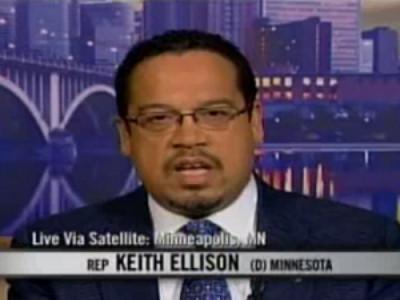
Rep. Keith Ellison, the Personification of the Phony, Pro-War “Progressive”
A Black Agenda Radio commentary by Glen Ford | May 1, 2013
Keith Ellison, the Black U.S. House member from Minneapolis who is co-chair of the Progressive Caucus, says the U.S. should push for a no-fly zone over rebel-held areas in Syria. Ellison, who is also one of only two Muslim members of Congress, appeared on NBC’s “Meet the Press” on Sunday, as did Republican Arizona Senator John McCain. It is a measure of how far to the right the Democratic Party has come under President Obama, that McCain, the war monger who likes to sing about bombing Iran, and Ellison, who claims to be a progressive, are in basic agreement over Syria. Both McCain and Ellison want no-fly zones, and both claim to prefer that there be no U.S. “boots on the ground” in country. Both are raving American imperialists who believe that the U.S. has not merely the right, but the obligation to intervene in the internal affairs of other countries. As Ellison, the phony progressive, puts it, “I don’t think the world’s greatest superpower, the United States, can stand by and do nothing” – which is, essentially, John McCain’s position.
Ellison has been advocating a no-fly zone for Syria for at least a year. Last May, he told U.S. News and World Report that so-called “safe zones” should be set up by the U.S. and its allies around the borders of Syria. Ellison made it quite clear that he sees such zones as a prelude to regime change. “I think the Libyan action was a good example of that,” he said.
On U.S. imperial policy, there’s not a dime’s worth of difference between McCain, the hard-right Republican, and Ellison, who purports to be a progressive Democrat. Neither gives a damn about international law or the rights of smaller people’s to shape their own destinies. Ellison went to Saudi Arabia, the most socially backward rich country on the planet, and described the King as a “visionary leader.” He rejected George Bush’s troop “surge in 2007, by calling it “too little, too late.” Like Obama, he quibbles about whether U.S. wars are smart or dumb, too late or right on time, but never about the inherent right of the United States to wage war against the weaker nations of the world.
Ellison is part of the pro-war Left, which includes Amnesty International and Human Rights Watch, whose primary mission is to make self-described liberals and leftists comfortable supporting imperial wars. McCain can’t do that, but Ellison can. Amnesty International is shameless enough to use women’s rights as an excuse to support continued occupation of Afghanistan.
Much of the pro-war left has been forced by events to recognize that the U.S. and its allies are backing jihadist Islamic fundamentalist terrorists in Syria – people they wouldn’t like to have brunch with. Therefore, they now demand that the U.S. intervene to make sure that the jihadists don’t get their hands on chemical weapons. Thus, the pro-war left starts off by advocating U.S. intervention to facilitate the coming to power of the rebels, but in the end winds up demanding that the U.S. do whatever it can to stop these guys from taking power. Either way, it ends with U.S. intervention. John McCain and Keith Ellison pretend to be on opposite ideological ends, but they are like Jack and Jill walking up the same hill when it comes to the obligations and privileges of U.S. imperialism.
Glen Ford can be contacted at Glen.Ford@BlackAgendaReport.com.
Featured Video
Integrity Initiative: UK-funded network framed dissent as Russian disinformation for years
or go to
Aletho News Archives – Video-Images
From the Archives
Why Saudi Ties to 9/11 Mean U.S. Ties to 9/11
By Kevin Ryan | Dig Within | September 27, 2015
Media interest in Saudi Arabian connections to the crimes of 9/11 has centered on calls for the release of the 28 missing pages from the Joint Congressional Inquiry’s report. However, those calls focus on the question of hijacker financing and omit the most interesting links between the 9/11 attacks and Saudi Arabia—links that implicate powerful people in the United States. Here are twenty examples. … continue
Blog Roll
 Aletho News
- IAEA inspectors cannot return to Iran amid US threats: Russia
- Senate Rejects Iran War Powers Resolution Passed By House
- ‘We did not attack Pakistan with drones’: Afghan sources
- Iraqi Resistance faction links arms to sovereignty, questions US exit
- Cannon fodder no more… South Korea rejects Trump’s pressure to join his criminal war on Iran
- Neria Leiter Was A Legitimate Military Target
- Integrity Initiative: UK-funded network framed dissent as Russian disinformation for years
- ‘We don’t seek permission to defend our country’: Snippets from President Pezeshkian’s UNGA address
- NATO chief wants Europeans to fight American wars [for Israel]
- German chemicals giant reveals details of downsizing
- If Americans Knew
- Israel displaces hundreds of Palestinians amid wave of demolitions in West Bank
- Aid, reconstruction, and Israel’s history of obstruction in Gaza
- Trump administration digs an ever-deeper hole of complicity in genocide – Daily Update
- US-Israel $2.8 Billion Arms Deal, 40,000-Bomb Supply Faces New Gaza Complicity Accusations
- Caught on Tape: AIPAC CEO Boasted of Controlling Trump’s National Security Officials
- Why Hamas Attacked Israel in October 2023 – Israeli professor Ilan Pappé
- They see them, then kill them: Israeli quadcopters track, deliberately target civilians in Gaza
- Winter could turn Gaza’s treacherous, war-damaged buildings into deathtraps
- Majority of Democratic Voters Want to Prosecute Both Biden and Trump Administration Officials Over Gaza
- As Gaza languishes, world leaders gather at the UN – Daily Update
- No Tricks Zone
- New Study: Earth And Venus Surface Warmth Largely Explained By Convection And Lapse Rate, Not CO2 Or Radiation
- 2025 Nature Paper Claiming Worsening Global Drought Gets RETRACTED …Heavily Flawed
- New Study: ‘Global Drought Shows No Detectable Recent Acceleration Under Climate Warming’
- Economic Masterminds: German Socialists Suggest Taxing Productivity Gains Stemming From Using AI
- The South China Sea Has Not Been Cooperating With The Climate Change Narrative
- Energy Crisis: Germany Enters Heating Season With Historically Low Gas Reserve Fill Levels
- New Study: The Antarctic Ice Sheet Gained Mass From 2020-2024 Due To Staggering Snow And Ice Accumulation
- Study: Ocean Heating Rates From Thousands Of Years Ago ‘Dwarf’ Modern Ocean Heating Rates
- Climate Extremists Target, Attack Large-Scale Power Grid Infrastructure In Germany!
- New Study: Antarctic Ice Melt Has Contributed Less Than 1 Centimeter To Sea Level Rise In The Last 30 Years

