US plans $320-mn transfer of precision bombs to Israel amid regime’s genocide in Gaza
Press TV – November 6, 2023
The United States is planning transfer of 320 million dollars worth of precision bombs to Israel amid the regime’s relentless genocidal war against the besieged Gaza Strip.
The Wall Street Journal revealed the information in a Monday report, citing a source familiar with the plan.
The report said US President Joe Biden’s administration has informed Congress of the planned transfer of Spice Family Gliding Bomb Assemblies through a formal notification sent to congressional leaders on October 31.
Spice Family Gliding Bomb Assemblies constitute a special type of precision-guided weapon, which is fired by warplanes.
Citing correspondence it had viewed, the report added that weapons manufacturer Rafael USA would transfer the bombs to its Israeli parent company Rafael Advanced Defense Systems for deployment by the Israeli military.
The report came on the 31st day of Israel’s genocidal war on the besieged Gaza Strip, which started after the territory’s resistance movements waged a surprise attack against the occupying entity, dubbed Operation al-Aqsa Storm, in response to its decades-long campaign of bloodletting and devastation against Palestinians.
On Monday, the Palestinian Health Ministry in Gaza announced that the death toll from indiscriminate Israeli bombardments has reached 10,022 people, including 4,104 children and 2,641 women. It added that the number of those who have been wounded over the past 31 days has risen to 25,408.
The United States, Israel’s biggest and oldest ally, has provided the regime with thousands of arms consignments since the initiation of the war.
On Thursday, the US House of Representatives passed a standalone $14.3-billion military assistance package for Israel. The legislation, however, is yet to clear the Senate.
Washington, which has backed Tel Aviv’s ferocious attacks on Gaza as a means of “self-defense,” has also been casting its veto against the United Nations Security Council resolutions that called on the occupying regime to cease its aggression.
Kremlin weighs in on call for US to reverse course on Russia
RT | October 30, 2023
A recent article by US economist Jeffrey Sachs calling on Washington to establish a new sustainable détente with Russia is a rare sight, but evidence that debates on the issue are picking up steam, Kremlin Press Secretary Dmitry Peskov has said.
Speaking to reporters on Monday, Peskov commented on Sachs’ piece, which was published in early October but has only recently gained media traction. The economist, who serves as the director of the Center for Sustainable Development at Columbia University, wrote that the world is on the precipice of a “30-year US neocon debacle in Ukraine.”
He explained that Washington’s long-cherished hopes for NATO expansion eastward to Russia’s borders have been dashed by Ukraine’s devastating losses on the battlefield, the threat of Moscow launching a massive offensive, and collapsing support for this course in both Europe and the US.
As Ukraine teeters on the brink, Sachs argued, the US could avert a potential catastrophe by changing course and reaching security guarantees with Moscow. A potential deal could include a pledge that NATO would not expand closer to Russia, as well as an agreement between Moscow and Kiev that predominantly ethnic Russian areas would be recognized as part of Russia, the economist said, apparently referring to Crimea and four other former Ukrainian regions that overwhelmingly voted to become part of Russia.
Commenting on the article, Peskov said Moscow has not received any proposals on the matter. While describing the piece as “an economist’s point of view, nothing more,” he noted that “such thinking is quite rare at the moment.”
“Nevertheless, some kind of a discussion is gradually gaining momentum,” Peskov added.
In the article, Sachs suggested that Russia’s demands to NATO and the US which were made shortly before the outbreak of the Ukraine conflict in February 2022 should be used as a springboard for a thaw in relations.
In the proposals presented in December 2021, Moscow asked the West to formally ban Ukraine from entering NATO, while insisting that the alliance should retreat to its 1997 borders, before it expanded. The overture, however, was rebuffed by the West.
US seeks strategic dialogue with Russia
BY M. K. BHADRAKUMAR | INDIAN PUNCHLINE | OCTOBER 30, 2023
Almost four weeks into Hamas’ attack on Israel, Russia is in no hurry to exploit the Biden administration’s quandary over the collapse of Middle East security. The western media was unanimous that Russia was waiting in the wings to seize the opportunity once the US took its eye off the ball in Ukraine. However, no such thing happened.
Ukraine war is on autopilot. The compass has been set, the die is cast and the calculus is holding steady with regard to the strategic objectives set by President Vladimir Putin in February last year. Russia senses that it has gained the upper hand in the war and that is irreversible.
Ukraine’s counteroffensive has failed and the fighting is presently restricted to two sectors of the frontline, as Russian forces strengthen the security of the Donetsk region and seek to regain control of territories up north in the borderlands of Donbass and Kharkov region from where they retreated for tactical reasons last September and October.
Yet, Moscow has not begun its grand offensive, as many had predicted. One plausible explanation is that Moscow is watching the maelstrom sweeping through the Middle East. Moscow is particularly sensitive about any spillover into Syria.
With an eye on the formidable US naval build-up in Eastern Mediterranean with the deployment of two aircraft carrier groups, President Vladimir Putin has publicised that Russian jets equipped with hypersonic Kinzhal missiles are roaming the skies above the Black Sea, which can strike targets 1000 kms away at Mach 9 speed, which no existing missile defence system can intercept. Suffice to say, the war in Ukraine remains attritional.
Curiously, Russia conducted a simulated nuclear strike in a drill on Wednesday overseen by Putin, hours after Russian parliament voted to rescind the country’s ratification of the global nuclear test ban treaty (CTBT). The drill needs to be seen in the broader context of global strategic stability. A Kremlin statement said, “The purpose of the training exercise was to check the level of preparedness of military command bodies, as well as the skill of the leadership and operational personnel in managing the troops (forces) under their command.” Everything, however, adds up in these extraordinary times.
At its most obvious level, the Palestine-Israel conflict is a manifestation of the growing imbalance in the existing system of international relations. New wars are emerging; longstanding conflicts are mutating (eg., Nagorno-Karabakh). Last week, Pakistan bracketed Palestine and Kashmir as the UN’s unfinished business in the post-colonial era. North Korea and Iran are flash points that have no military solution.
In the months ahead, without doubt, Washington will continue to provide Israel with military and diplomatic support but an extended Israeli operation lasting months in Gaza will mean dispersal of US resources that might be needed in other theatres. The conflict in Gaza underscores the imperative for a rethink in the US’ notions of global hegemony. The fact remains that the US, despite its self-proclaimed status as the “Indispensable Nation” (Madeline Albright) and the guarantor of “rules-based order,” failed to prevent the latest eruption of conflict in the Middle East.
Arguably, therefore, the latest US proposal for a systematic resumption of strategic dialogue with Russia can be seen as a sign of positive thinking. Unsurprisingly, Moscow has displayed a studied indifference to the US proposal. But that needn’t be taken as the last word. Historically, Soviet-American strategic dialogue brought on board into the agenda all major issues and most minor issues affecting international security.
The big question, therefore, is the timing of the US proposal. Against the backdrop of the gathering storms in the Middle East, the Biden Administration probably seeks to calm the nerves by proposing talks with Russia on global strategic balance, since the guardrails in arms control no longer exist. This is one thing.
At any rate, Russia’s “neutrality” in a Middle East conflict could also be a consideration. Equally, Western leaderships understand that the war against Russia is practically lost — although they will not admit it publicly — and engagement with Russia is needed.
Again, although the US has provided Israel with significant military and diplomatic support and keeps influencing the latter not to escalate the conflict, there are variables in the situation and any big conflagration in the Middle East will require a massive concentration of material and financial resources that are limited even for a superpower, since there are other unresolved problems in the world, too.
The breakdown of trust in the Russian-American ties hurts US interests. Fundamentally, it must also be understood that what Moscow seeks even today after nearly 20 months of battling NATO and the US in Ukraine’s killing fields is a sustained engagement with Washington and a willingness to accommodate mutual interests.
On its part, Russia is conducting itself as a responsible power vis-a-vis the crisis in Gaza. There is no shred of evidence to show that Russia has acted as a “spoiler”. On the contrary, Moscow has been projecting its credentials as a potential peacemaker who enjoys good relations with all key players — Israel, Hamas, Iran and other regional states alike.
In fact, President Biden’s recent remarks on the Gaza situation bring the US position rather close to Russia’s. Biden read out the following from a prepared text at a joint press conference with Prime Minister Anthony Albanese of Australia:
“Israel has the right and, I would add, responsibility to respond to the slaughter of their people. And we will ensure Israel has what it needs to defend itself against these terrorists. That’s a guarantee…
“But that does not lessen the need for — to operate and align with the laws of war for Israeli — it has to do everything in its power — Israel has to do everything in its power, as difficult as it is, to protect innocent civilians. And it’s difficult. I also want take a moment to look ahead toward the future that we seek.
“Israelis and Palestinians equally deserve to live side by side in safety, dignity, and peace. And there’s no going back to the status quo as it stood on October the 6th. That means ensuring Hamas can no longer terrorise Israel and use Palestinian civilians as human shields.
“It also means that when this crisis is over, there has to be a vision of what comes next. And in our view, it has to be a two-state solution.”
Putin couldn’t have put this across differently. There is a sense of expectation in Moscow that in the emergent conditions in regional security, the US and its allies will “reconsider their notions of defeating Russia in the Ukraine conflict at any cost” — as an establishment think tanker wrote in the Kremlin-funded RT last week.
Trust is lacking, he concluded, “compromises without the full consideration of Russian interests” are difficult to reach, but “a pivotal stage in the (world) order … is taking shape before our eyes.”
India’s solidarity with Israel is untenable
BY M. K. BHADRAKUMAR | INDIAN PUNCHLINE | OCTOBER 29, 2023
India’s muscular diplomacy, an attribute of the present government, has run into heavy weather. Body blows from multiple sources — spat with Canada; Maldives’ triumphalism about evicting Indian servicemen; China-Bhutan normalisation, etc. — testify to it.
On top of it comes the latest diplomatic faux pas at the UN GA over the Gaza situation and a not-entirely unrelated shock and awe dealt out by Qatar over the past week. Doha has handed down death sentences to eight Indian ex-naval officers on charges of spying for Israel.
Whichever way one looks at the Explanation of Vote (EoV) on Thursday’s UN General Assembly resolution on Gaza, India’s abstention was a mistake. Simply put, our diplomacy has become entrapped in our solidarity with Israel.
The topmost consideration for India at the UN GA debate should have been that the draft was tabled by the Arab and OIC countries with whom India has fraternal ties, and, second, it called for an “immediate, durable and sustained humanitarian truce” in Gaza, which is an urgent necessity.
Yet, France outclassed Indian diplomacy, exposing the need for more creative UN diplomacy on our part. France not only sought that some reference to Hamas’ raid into Israel on October 7 be made in the draft, but while on a recent visit to Tel Aviv, President Emmanuel Macron even proposed an alliance of like-minded countries to take on Hamas militarily.
Yet, when the crunch time came, France ultimately voted for the Arab resolution and issued an EoV justifying it. As France saw it, the imperative need today is to stop the fighting and the compelling reality is the importance of being on the right side of history when it comes to the Middle East crisis, where it has high stakes. The point is, in the final analysis, what stands out for the record is the actual voting, not the EoV.
It was apparent that the Canadian amendment — at Israel’s behest and sponsored by Washington from the rear — was a clumsy attempt to divide the votes by calling for “unequivocally rejecting and condemning the terrorist attacks by Hamas.” In a notable speech that drew wide acclaim, Pakistan’s ambassador to the UN Munir Akram highlighted the contradiction.
If Canada was being fair in its amendment, he said, it should as well agree to name Israel as well as Hamas. “We all know who started this. It is 50 years of Israeli occupation and the killing of Palestinians with impunity,” Akram argued, therefore, not naming either side was the best choice.
It appears that India was taken aback by Akram’s intervention at the UN GA during Agenda Item 70, Right to Self-Determination where he forcefully linked the Palestine issue and Kashmir problem. Alas, India’s abstention has only left the centre stage to Pakistan to occupy. This could be consequential. A prudent course would have been to identify with the stance of the Arab countries unequivocally, since this is a core issue for them and it is playing out in their region, first and foremost.
India should have factored in that feelings are running high in the West Asian region and the US-Israeli propaganda that the Arab world paid only lip-service to the Palestinian cause doesn’t hold good. There is unmistakable anger and anguish among the regional states and a groundswell of opinion has appeared demanding a settlement of the Palestine issue as an imperative of regional stability.
Fundamentally, the tectonic plates in regional politics have shifted following the Saudi-Iranian rapprochement under China’s mediation, which in turn triggered new thinking in West Asia giving impetus to a focus on development. Equally, the regional states prefer to address their issues increasingly on their own steam without external interference. China and Russia understand this but the US refuses to see the writing on the wall.
Therefore, it will prove to be damaging to our interests if a growing perception crystallises that Indians are carpetbaggers. The Indo-Israeli fusion through the past decade hasn’t gone unnoticed in the Muslim countries. They resent it, perhaps, but it may not surge into view because Arabs are a hospitable people. That said, their resentment may surface if push comes to shove and their core interests are involved.
The US-Israeli attempt to put the lid on the region’s growing strategic autonomy is one such core issue. It is far from the case that the regional states — be it Qatar, Iran, Egypt, Syria or even Turkey — do not understand that the Biden administration’s grandiloquent idea of a India-Middle East-Europe Economic Corridor is in reality a wedge to disrupt the nascent trends of unity among regional states so as to insert Israel into the regional processes and rekindle the flame of sectarian schism and geopolitical rifts, which the US invariably exploited to impose its hegemony in West Asia historically.
That is why, the three-way Qatar-India-Israel tangled mess of espionage, which should never have been allowed to happen, becomes a litmus test of mutual intentions in the geopolitics of the region. Lest it is forgotten, Qatar and Israel had once collaborated since the mid-nineties to prop up Hamas as an Islamist antidote to the secular-minded PLO under Yasser Arafat.
In a recent interview with the Deutsche Welle, former Israeli Prime minister Ehud Olmert disclosed, inter alia, “We know that the Hamas was financed with the assistance of Israel— for years — by hundreds of millions of dollars that came from Qatar with the assistance of the state of Israel, with the full knowledge and support of the Israeli government led by Netanyahu.”
That convergence — rather, Faustian deal — ended in 2009 following the three-week Gaza Massacre by Israel, whereupon, Doha drew closer to Tehran. Nonetheless, a pragmatic relationship continued, and in 2015, the Qatari government facilitated discussions between Israel and Hamas in Doha in search of a possible five-year ceasefire between the two parties. Suffice to say, Indian diplomacy is swimming in shark-infested waters. The news from Doha this week is a wake-up call.
Equally, our public discourse on Hamas as a terrorist organisation and our branding of that national liberation movement is surreal, to say the least. Although it may be difficult today for the government to openly deal with Hamas, it shouldn’t be that we lack a proper understanding of Islamism. If ever a Palestine settlement comes to fruition, Hamas will have a lead role in it as the fountainhead of resistance. India’s political elite must bear in mind this reality.
Eliminating the Hamas from the political landscape is no longer possible, given the massive grassroots support it enjoys among the Palestinian people, which is of course a proven fact in the successive elections held in Gaza and West Bank.
Tracking device found on Poland’s presidential car after its recent return from Ukraine
BY GRZEGORZ ADAMCZYK | TVN24 via: BUSINESSINSIDER.COM.PL | October 25, 2023
A tracking device has been found by state protection officers on a vehicle used by the Polish Presidential Office, Polish news outlet TVN 24 reported on Tuesday.
State Protection Service (SOP) officers made the discovery shortly after the vehicle had returned from a trip to Ukraine.
According to the news outlet, the device allowed for real-time tracking of the vehicle’s location based on its GPS coordinates, and preliminary investigations suggested the vehicle could have been being tracked for several months.
The discovery was made by bomb technicians of the SOP, who, in line with procedures, were checking cars set to be included in the presidential motorcade for any explosive devices.
It is understood that the vehicle had not been recently used by Polish President Andrzej Duda but by members of his entourage; however, this doesn’t rule out the possibility that he could have used the compromised car in the future.
“There was an uproar, as it wasn’t clear who installed the device,” an SOP officer told TVN24. “It turned out that this car might have been driving with this device for several months and was often included in the president’s motorcade, including during his trips to Ukraine,” they added.
The incident has sparked a mass check of all vehicles assigned to the presidential office that may be integrated into convoys with protected individuals. Previously, the frequency of such checks varied.
Typically, the presidential motorcade consists of three cars: one primary vehicle carrying the president and two protective vehicles. Additional cars can be added with SOP approval.
The press office of the Polish Presidential Office did not comment on the revelation, nor did the press spokesperson for SOP or the ABW (Agency of Internal Security) press services.
Investigators identify possible cause of Baltic Sea pipeline damage
RT | October 24, 2023
Finland’s National Bureau of Investigation (NBI) has said that the anchor of a Chinese-registered vessel may be responsible for damage sustained to the Balticconnector gas pipeline earlier this month, though it remains unclear if the act was deliberate.
Speaking at a press conference on Tuesday, an NBI spokesperson said that a large anchor had been retrieved from the seabed close to where the pipeline was damaged in the early hours of October 8. Police said that they are working to establish if the anchor belonged to a Chinese container vessel which had been in the immediate area at the time.
“The next questions are about whether it was intentional, negligence, poor seamanship, and that’s where we get into whether there could be a motive for what’s going on,” NBI Director Robin Lardot told reporters. “But it’s too early to answer that at this stage.”
Police had previously indicated that damage to the Balticconnector pipeline, as well as two undersea telecommunications cables, were caused by blunt external mechanical force and that investigations were ongoing to identify if the damage was caused deliberately.
Investigators added that drag marks were visible on the seabed leading up to the section of pipeline that was damaged. The anchor had become detached from its host vessel and was lying on the seabed immediately after the damaged area.
The NBI said last week that the focus of its investigation had centered on the Chinese container ship NewNew Polar Bear that was in the immediate location at the time of incident.
Finnish police said on Tuesday that it had established that the NewNew Polar Bear was missing one of its front anchors. Photographs of the ship docked in the Russian port of St. Petersburg on October 9, one day after the pipeline was damaged, appears to show irregularities with its anchor system.
On Monday, China called for an “objective, fair, and professional” investigation to be established into the cause of the damaged pipeline and telecoms cables. NATO has increased its patrols in the Baltic Sea following the damage sustained to the pipeline.
The October 8 incident to the pipeline – through which gas flows between Finland and Estonia – has restricted Finland’s gas supplies. Helsinki said that it had made up for any shortfalls with the importation of liquified natural gas (LNG) into its Inkoo port.
In September of last year, the Nord Stream pipelines connecting Russia and Germany were severely damaged by undersea explosions in what authorities declared to be deliberate acts of sabotage. The identity of the attackers has yet to be established.
How NATO fighter jet deliveries undermine Kiev regime’s air defense capabilities
By Drago Bosnic | October 20, 2023
A lot has been said about the much-touted fighter jet deliveries to the Kiev regime forces and how this would supposedly “tip the balance of power” in its favor. However, the process has been mired in controversy and difficulties since the very beginning. It includes everything from problems finding the countries willing to provide the jets to giving Ukrainian pilots enough training to make a difference while also accelerating the process as much as possible. The first obstacle was the language barrier. Of the 32 pilots sent to be trained on how to fly F-16s, only eight spoke English proficiently enough to be able to attend lessons and even they had to be given advanced courses on the usage of complex military nomenclature. Even if it took the pilots less than six months to attain the desired proficiency, that was only enough for them to start basic training on how to fly the jet.
However, being able to fly an aircraft is a far cry from being able to master its usage in combat, particularly against an opponent that not only has massive numerical advantage, but is also decades ahead technologically. Ukrainian pilots themselves admitted that their Soviet-era Su-27s are superior to F-16s. The Russian Aerospace Forces (VKS) operate significantly more advanced jets than the Su-27. In fact, even the modernized Russian Su-27SM3 is much more capable than its Ukrainian counterpart. There are also the newer Su-30SM and Su-30M2, to say nothing of the high-end fighter jets such as the MIG-31BM interceptor, Su-35S or the latest Su-57. The last three are by far the most dangerous fighters of our age, as they’ve proven far more capable than expected by Western military analysts and observers, with even the British military forced to admit it.
And yet, this string of catch-22s is not nearly the end of issues for the Neo-Nazi junta. Namely, this time, another major problem with fighter jet deliveries from NATO members is not even directly connected to the aircraft themselves, but ground-based air defenses. In essence, what this issue boils down to is the chronic lack of SAM (surface-to-air missile) systems. Despite losing a large chunk of the territory under its immediate control, the Kiev regime still has one of the largest land areas in Europe and defending it all is simply impossible. Thus, the Neo-Nazi junta is forced to improvise and prioritize, placing air defenses in the most important cities and oblasts (regions). This results in SAM units being spread thin and with extremely limited logistics, as the stockpile of Soviet-made missiles has effectively run out and the political West has nothing to replace them with.
However, this still doesn’t tackle the more pressing issues that NATO wants resolved before any sort of fighter jet deliveries and that’s the question of air defenses for the airbases where the aircraft would be stationed. The Kiev regime started preparations to accommodate Western-made jets months ago, including the effective militarization of existing civilian airports and infrastructure. In order to provide adequate security for these ad hoc airbases, additional air defense systems and units will need to be raised, set up and deployed. And yet, the Neo-Nazi junta has neither the human nor industrial resources to accomplish such a laborious task, to say nothing of the financial dependence on its Western puppet masters. SAM systems operators have among the highest casualty rates in the conflict, meaning that the soldiers aren’t exactly racing to join such units.
Thus, the Kiev regime will simply have to sacrifice the protection of important administrative buildings, as well as military and energy infrastructure in order to provide air defense coverage for the new ad hoc airbases housing the Western-made jets. However, even this can’t be done very efficiently. Namely, the Soviet-era SAM systems cannot be readily replaced with US/NATO counterparts for the simple reason that the latter are too expensive, not to mention they have demonstrated no superior capabilities in comparison to Soviet systems. On the contrary, most are even inferior, despite costing significantly more. The primary reason for this is that the Western (in reality mostly American) military doctrine focuses mainly on air superiority, which gives air defenses a secondary role. In essence, it’s sort of like an auxiliary force aiming to simply augment military aircraft.
This is in stark contrast to the Soviet/Russian doctrine that puts a lot of emphasis on ground-based air defenses that are designed to operate independently and even in situations where friendly fighter jets are able to provide little or no air cover whatsoever. Still, this isn’t where the problems for the Neo-Nazi junta end. In addition to regular long-range missiles and other precision-guided munitions (PGMs), the Russian military is increasingly using extended-range loitering munitions/kamikaze drones, such as the now legendary ZALA “Lancet”. These drones have recently destroyed at least two aircraft parked on runways approximately 100 km away from the frontlines. This was considered effectively impossible, as the Kiev regime forces and their NATO overlords previously believed that the aforementioned drones were only limited to tactical combat situations.
Worse yet, the Neo-Nazi junta mostly lacks adequate defenses against such weapons. And just as the Soviet-era Su-25 attack jet and MiG-29 fighter were destroyed while parked, the same could (or rather would) happen to US-made F-16s. Precisely this might be the reason why Volodymyr Zelensky recently asked NATO to “lease” SAM systems. There’s simply no other way to protect the new militarized airfields without sacrificing something else. And this is without even getting into the aforementioned viability of old F-16s being used against modern Russian jets. What’s more, Sweden has also offered its “Gripen” jets, which I argued would happen well over a year ago. On paper, these fighters are somewhat more capable than F-16s, but Sweden has a very unusual policy of refusing to help a country that bought the jets from it if the said country is engaged in hostilities.
Drago Bosnic is an independent geopolitical and military analyst.
The EU has discredited itself in the Israel-Palestine conflict
By Timur Fomenko | RT | October 20, 2023
European Commission President Ursula von der Leyen’s showboating in support of Israel in the current Middle East conflict has reportedly provoked a backlash from EU lawmakers and diplomats.
When the Israel-Gaza war broke out just over a week ago, von der Leyen made the decision to offer unconditional support to West Jerusalem rather than urge for calm or mediation, having Israel’s flag projected onto the European Commission headquarters and paying a visit to Israel herself. She clearly did so out of an inclination to appear in line with the US. But her actions have aged poorly as reports of civilian deaths and humanitarian disaster in the besieged Gaza Strip continue to mount.
Anyone familiar with von der Leyen knows that she is an unapologetic neoconservative and transatlanticist who is single-handedly undermining the autonomy, respect, and foreign policy stature of the EU by actively working to make the bloc subordinate to the US in multiple areas, all while attempting to showcase herself as a true regional leader. If the EU sees itself in a fundamental competition with China and Russia, there could not be a worse advert to the rest of the world than her leadership, and her Israel blunders may be her most damaging decisions yet.
Von der Leyen’s foreign policy legacy involves dragging the EU into several confrontations it could have done without. This week, she is heading to Washington DC to try to forge a deal on steel and aluminum trade targeted at China, but that will ultimately result in throwing the EU market under the bus, again. Other acts have included backing the American position on Ukraine and striving for full escalation of the war there, promoting energy decoupling with Russia, as well as inventing the term “de-risking” with China and seeking to undermine the bloc’s lucrative relationship with Beijing. Throughout this, she has been repeatedly eager to pull large sums of money out of thin air and propose fantasy projects which amount to little more than posturing, and which her office alone is not even able to authorize.
For example, that includes offering Belarus billions if it goes ahead with a US-backed regime change, or inventing numerous “infrastructure” schemes to compete with China, such as the Global Gateway, among other things. She has thus repeatedly used the stature of her office to follow American objectives and try to shape the continent without establishing any kind of due consensus. Almost immediately after the war in Gaza broke out, the European Commission announced all EU aid to Palestine would be frozen. Regardless of what you think of Hamas, with hindsight that decision now appears spiteful, reactionary and inhumane, which tells you how fast the Commission was to jump to the American position of unconditional support for Israel.
But this time there is a widespread feeling it has gone too far. Rather than allowing Europe to have staked out a moderate position on the Gaza conflict, even if it would not be too sympathetic to Palestine, the decision was essentially outsourced to the US, discrediting the EU and only serving to contribute to the growing backlash starting to emerge among Muslim communities in response to the conflict. For countries such as France, this is disastrous. This hurts the EU’s image across the Islamic world and the Global South by seemingly siding with the oppressors.
Soon enough, a series of embarrassing U-turns followed, including the reinstatement of aid, combined with tweets in Arabic, but the damage had already been done, because Israel has long been given the green light to pursue unparalleled destruction in Gaza, at seemingly whatever the cost. In doing so, von der Leyen has in fact undermined, in yet another way, the bloc’s ability to present itself as a serious and comprehensive political actor. She seems to have no love for the idea that the EU should have strategic autonomy and be capable of calibrating its own interests and place in the world, and would prefer that it instead be a simple parrot of the US.
Of course, if she took into greater consideration the interests and positions of member states it would be less of a problem. But she does not and instead essentially serves as a completely disruptive force, in practice undermining European diplomacy and preventing the EU from building relations with a wide range of states. In the end, this favors only the US.
Sweden says undersea cable to Estonia ‘damaged’
RT | October 17, 2023
An undersea telecommunications cable connecting Sweden and Estonia in the Baltic Sea has been ‘damaged,’ the Scandinavian country’s Civil Defense Minister said at a news conference on Tuesday, in what is the second such occurrence in the region in the past month.
“We are currently unable to assess what has caused this damage,” government minister Carl-Oskar Bohlin told reporters in Gothenburg, adding that it is “not a total cable break but it is a partial damage to the cable” and that it remains operational. The Swedish minister said that the damage sustained to the cable was sustained outside of the country’s territorial waters and its exclusive economic zone.
The damage, Bohlin explained, appears to have occurred at around the same time as when the Balticconnector gas pipeline and a telecommunications cable between Estonia and Finland were damaged, on October 8. NATO, the US-led military bloc that Helsinki joined earlier this year, has vowed “a united and determined response” if an investigation determines that saboteurs were responsible.
Finland has said that it cannot rule out a “state actor” being behind the October 8 incident, and that it is reviewing vessel traffic in the area at the time of the suspected attack.
The Prime Minister of Sweden Ulf Kristersson warned last week of potential vulnerabilities to the “spaghetti of cables, wires, infrastructure on the seabed” that connects countries, transfers data and supplies energy in the region. “It is absolutely fundamental for data traffic, so the vulnerabilities today are much, much greater,” he said.
Adequately policing waters in the area is a “very intense” challenge, the head of Sweden’s navy, Rear Admiral Ewa Ann-Sofi Skoog Haslum said on Tuesday. “The challenge for us is to monitor this volume of water,” she said. “Everything that happens under the surface is deniable.”
Last September, the Nord Stream pipelines supplying oil and natural gas from Russia to Germany were ruptured, in incidents widely believed to have been sabotage. A culprit has yet to be identified.
Seymour Hersh, the Pulitzer-winning American journalist, published a report earlier this year in which he claimed, citing intelligence sources, that the United States executed a covert CIA operation to destroy the pipelines in collaboration with the Norwegian government. Washington has strongly denied the claims.
A competing theory, reported by Western outlets, has suggested that a team of Ukrainian commandos used a rented yacht to transport explosives to the blast sites, but that the CIA told the Ukrainians to abort the plan.
Putin’s Valdai Speech, What You Need to Know
By Ted Snider | The Libertarian Institute | October 12, 2023
On October 5, Russian President Vladimir Putin addressed the plenary session of the Valdai International Discussion Club near Sochi, Russia. The session was attended by scholars and diplomats from forty-two countries. Putin spoke for half an hour and then answered questions for about three hours. Several interesting things were said.
In western discourse it is always said that Russia started an unprovoked war in Ukraine. There has been much discussion—though not in the mainstream media nor in statements issued by western governments—about whether the war was unprovoked. But there has been little discussion about whether Russia started it.
Putin claimed that Russia’s “special military operation” did not start the war in Ukraine but, rather, was designed to stop it. “I have said many times that it was not us who started the so-called ‘war in Ukraine,’” Putin said. “On the contrary, we are trying to end it.”
The war started, according to Putin, when the United States “orchestrated a coup in Kiev in 2014.” Putin said that the U.S. “provoked the Ukraine crisis by supporting the coup in Ukraine in 2014. They could not fail to understand that this was a red line, we have said this a thousand times. They never listened.”
After the coup, the new government in Kiev “intimidate[d]” the ethnic Russian populations of Crimea and the Donbas, prohibited them from speaking “their native language,” and threatened them “with ethnic cleansing.” It was Kiev, and not Russia, “who tried to force Donbass to obey by shelling and bombing.” The new government in Kiev bombed the region “for nine years, shooting and using tanks. That was a war, a real war unleashed against Donbass.”
The war started, not a year and a half ago, according to Putin’s chronology. Instead, “This war, the one that the regime sitting in Kiev started with the vigorous and direct support from the West, has been going on for more than nine years, and Russia’s special military operation is aimed at stopping it.”
With the end of the Cold War, there was a window of opportunity to learn from the mistakes of the previous destructive era. There was an opportunity to move from “military and ideological” blocs to collective solutions. First Mikhail Gorbachev’s Soviet Union, and then Russia, sought a new international order that transcended blocs. Putin even recalled “a moment when I simply suggested: perhaps we should also join NATO?”
But Putin says that Russia’s “interest in constructive interaction was misunderstood, was seen as obedience, as an agreement that the new world order would be created by those who declared themselves the winners in the Cold War. It was seen as an admission that Russia was ready to follow in others’ wake and not to be guided by our own national interests but by somebody else’s interests.”
American “arrogance” attempted to establish a global “hegemony” over a world “too complicated and diverse to be subjected to one system.” This arrogance led to two things. The first was “endless expansion” by the political West. “NATO expansion has been pursued for decades.”
Putin reminded his audience that Russia was “promised verbally” about NATO “non-expansion to the east.” He then complained, “Yes, we were promised everything verbally, and our American partners do not deny this, and then they ask: where is this documented? There is no document. And that was it, goodbye. Did we promise? It looks like we did, but it was worth nothing.”
Eventually, this broken promise led to NATO expansion creeping up to Ukraine and right up against Russia’s borders. “Among the ways the crisis in Ukraine was provoked,” Putin said, “was the irrepressible desire of Western countries, especially the United States, to expand NATO to the borders of the Russian Federation.”
“After all,” Putin pointed out, NATO “is not only a political bloc, it is a military and political bloc, and the approach of its infrastructure is fraught with a grave threat to us.” He then added, “NATO’s expansion right up to our borders is threatening our security. This is a massive challenge to the Russian Federation’s security.”
To attain its hegemonic goal, it was necessary for the United States to “to replace international law with a “rules-based order.” But unlike the international law of the charter international system that is based on the United Nations, “It is not clear what rules these are and who invented them.” In the service of Americna hegemony, the U.S. “arbitrarily set[s] these rules.”
In a recent essay, professor of international law John Dugard has said that it is neither clear what the rules of the rules-based order are nor “the method for their creation,” and has offered as a possible explanation of the rules based order that it is “international law as interpreted by the United States to accord with its national interests,” meaning whatever the U.S. needs it to mean in any given situation. He suggests that the United States tries “to impose the concept of a rules-based world order on the international community. They use this banner to promote, without any hesitation, a unipolar model of the world order where there are ‘exceptional’ countries and everyone else who must obey the ‘club of the chosen.’”
In this world order, the United States not only tells other nations how they “should behave overall” in a “colonial mentality,” but there exists “an international system where arbitrariness reigns, where all decision-making is up to those who think they are exceptional, sinless and right [and] any country can be attacked simply because it is disliked by a hegemon.”
Putin says that Russia sees a future multipolar world order in which “no one can unilaterally force or compel others to live or behave as a hegemon pleases even when it contradicts the sovereignty, genuine interests, traditions, or customs of peoples and countries.” Russia sees “civilization [as] a multifaceted concept subject to various interpretations.” The world has evolved from the “colonial interpretation whereby there was a ‘civilized world’ serving as a model for the rest, and everyone was supposed to conform to those standards. Those who disagreed were to be coerced into this ‘civilization’ by the truncheon of the ‘enlightened’ master. These times, as I said, are now in the past, and our understanding of civilisation is quite different.”
Putin argued, as he has consistently, for the principle of the indivisibility of security, the idea that security cannot be divided so that the policies that increase the security of one country decrease the security of another. Indivisibility of security assures that the security of one state should not be bought at the expense of the security of another.
The American insistence on the right of states to unrestrained free will in their choice of security alignments and the accompanying NATO open door policy to Ukraine ignores the indivisibility of security. Putin said, “The main thing is to free international relations from the bloc approach and the legacy of the colonial era and the Cold War. We have been saying for decades that security is indivisible, and that it is impossible to ensure the security of some at the expense of the security of others.”
Putin said he thinks that suggestions of “a new security system in Europe, which would include Russia, and the United States, and Canada; but not NATO, but together with everyone else: for Eastern and Central Europe… would solve many of today’s problems.”
It is often said in the West that Putin seeks to reestablish a Russian empire and reacquire vast territories, starting with Ukraine. Putin, though, says in contradiction to those claims, “The Ukraine crisis is not a territorial conflict, and I want to make that clear… [W]e have no interest in conquering additional territory.” He insisted, “This is not a territorial conflict and not an attempt to establish regional geopolitical balance. The issue is much broader and more fundamental and is about the principles underlying the new international order.”
Those principles are a balanced multipolar world, indivisibility of security, an end to blocs and to NATO encroachment and protection of ethnic Russians in the Donbass and Crimea.
During the question and answer period, political scientist Sergei Karaganov suggested that the current Russian nuclear doctrine is no longer taken seriously by the West as a deterrent. He asked whether it was not time to modify the nuclear doctrine and lower the threshold.
Often portrayed in the West as a nuclear weapons sabre rattler, Putin tamped down the question, answering, “I do not see the need to change our conceptual approaches. The potential adversary knows everything and is aware of what we are capable of.”
Putin explained Russia’s existing nuclear doctrine. He said there are two situations that could trigger a “possible use of nuclear weapons by Russia.” The first is that “the use of nuclear weapons against us… would entail a so-called retaliatory strike.” The second situation is “an existential threat to the Russian state—even if conventional weapons are used against Russia, but the very existence of Russia as a state is threatened.”
Putin insisted that Russia does not need to change its stance. In the case of the first scenario, “this response will be absolutely unacceptable for any potential aggressor, because seconds after we detect the launch of missiles… the counter strike in response will involve hundreds—hundreds of our missiles in the air, so that no enemy will have a chance to survive.” As for the second, important as an insight into how Putin evaluates the situation in Ukraine, “There is no situation imaginable today where something would threaten Russian statehood and the existence of the Russian state.”
However, Putin said that nuclear testing is “a whole different matter.” He says that, after signing the Comprehensive Test Ban Treaty, the United States never ratified it. Russia, on the other hand, both signed it and ratified it. He told his audience that the development of new strategic weapons—including the nuclear-powered Burevestnik cruise missile with “basically unlimited range” and the super heavy Sarmat missile—is “nearing completion.” He then said that Russia can “act just as the United States does” and “offer a tit-for-tat response,” suggesting that Russia could repeal the Comprehensive Test Ban Treaty and begin testing new weapons.
In response to the question of whether Russia objected to Ukraine joining the European Union, Putin responded that Russia had “never objected or expressed a negative attitude to Ukraine’s plans to join the European economic community—never.” He said that Russia opposes Ukraine joining NATO because NATO is a “military bloc” and a “tool of U.S. foreign policy.” But “the EU is not a military bloc,” and, as for “economic cooperation, or economic unions, we do not see any military threat.”
Russia fully supports establishment of Palestinian state: Putin
Press TV – October 11, 2023
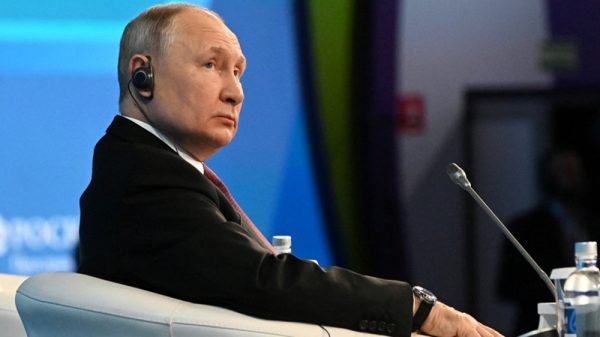
Russian President Vladimir Putin says Moscow has always fully supported the establishment of a Palestinian state, as the Israeli regime is ceaselessly pounding the besieged Gaza Strip with barrages of missile attacks.
Speaking at the plenary session of the Russian Energy Week on Wednesday, Putin stressed that his country has always supported the implementation of the United Nations Security Council’s decision on the establishment of an independent Palestinian state.
“We have always supported the implementation of the decisions of the UN Security Council, I mean, first of all, the creation of an independent Palestinian state,” the Russian leader emphasized.
Putin’s remarks came as Israel has been launching deadly strikes on the densely-populated Gaza Strip since Saturday after the Palestinian Hamas resistance group waged a surprise attack, dubbed Operation Al-Aqsa Storm, against the usurping entity.
Hamas says that its operation came in response to Israel’s violations at al-Aqsa Mosque in occupied East al-Quds and growing settler violence.
Elsewhere in his remarks, Putin called the eruption of violence between Israel and the Palestinians a vivid example of the failure of US policy in the Middle East.
He stressed that Washington’s policy in the region has taken no account of the needs of the Palestinians as the White House tried to focus on financial assistance, rather than finding solutions to existing fundamental political challenges.
“It is unclear whether it will be possible to somehow calm the situation in the near future, but we must strive for this because the expansion of the conflict zone can lead to dire consequences,” Putin said.
The Russian president also denounced as a mistake the Washington’s move of sending a carrier strike group, which includes the USS Gerald R. Ford, closer to Israel.
“I don’t understand why the US is dragging aircraft carrier groups into the Mediterranean Sea. I don’t really understand the point. Are they going to bomb Lebanon or what? Or have they decided to try to scare someone? There are people there who are no longer afraid of anything. This is not the way to solve the problem. Compromise solutions need to be looked for. Of course, such actions are inflaming the situation,” Putin said.
More than a thousand people have been killed and thousands more have been injured in nearly five days of Israeli airstrikes on Gaza, a besieged territory on the Mediterranean which is home to some 2.3 million people despite its relatively small land area.
Featured Video

“Historic Russia”: The Land Putin Will Not Give Back
or go to
Aletho News Archives – Video-Images
Book Review
Why the War on Conspiracy Theories Is Bad Public Policy
By Kevin Barrett • Unz Review • February 1, 2019
 A Review of Conspiracy Theories and Other Dangerous Ideas by Cass Sunstein (based on an earlier paper co-authored with Adrian Vermeule); In Defense of Troublemakers: The Power of Dissent in Life and Business by Charlan Nemeth; and Conspiracy Theories and the People Who Believe Them, edited by Joseph E. Uscinski
On January 25 2018 YouTube unleashed the latest salvo in the war on conspiracy theories, saying “we’ll begin reducing recommendations of borderline content and content that could misinform users in harmful ways—such as videos promoting a phony miracle cure for a serious illness, claiming the earth is flat, or making blatantly false claims about historic events like 9/11.”
At first glance that sounds reasonable. Nobody wants YouTube or anyone else to recommend bad information. And almost everyone agrees that phony miracle cures, flat earthism, and blatantly false claims about 9/11 and other historical events are undesirable.
But if we stop and seriously consider those words, we notice a couple of problems. First, the word “recommend” is not just misleading but mendacious. YouTube obviously doesn’t really recommend anything. When it says it does, it is lying. … continue
Blog Roll
 Aletho News
- BRITAIN’S WARNING: PREPARE FOR WAR
- “Historic Russia”: The Land Putin Will Not Give Back
- How the Cambridge Analytica scandal still haunts Mark Zuckerberg
- The Ongoing Cancellation Campaign Against a Dissenting Academic in Norway
- Yemen and ‘the Houthis’: Challenging Sami Hamdi’s Narrative
- No, Christians did not invent Zionism
- AIPAC-led lobbying network opens branches in Cypriot, Greek parliaments
- Araghchi blasts ‘parasitic’ alliance as US taxpayers pay for Israel’s war on Iran
- Easy fix for Europe’s chaos? Stop fueling war against Russia
- Putin’s key remarks on peace talks and Europe’s ‘schizophrenia’
- If Americans Knew
- An error has occurred; the feed is probably down. Try again later.
- No Tricks Zone
- Two New Studies Find Thwaites Glacier Melt Cannot Be Driven By Human Activity Or A Warming Ocean
- E-Cars Reduce CO2 Emissions By Only 41% Compared To Internal Combustion Engine Vehicles
- Predictions Made By Renowned Climate Professor Over Past Decades Have Been Proven To Be Poor
- New Study Suggests Large Regions Of The Pacific Ocean Have Been Cooling For The Last 80 Years
- Germany’s Green Energy Debacle: High Energy Costs Force Kahla Porzellan to Close After 182 Years!
- New Study: 50 Years Of The Most Aggressive ‘Net Zero’ Policies Can Only Affect The Global Climate By 0.03°C
- US September “Heat” Was No Record…Many Records Set Decades Ago
- Latest European Green Energy Debacle; Portugal’s Largest Flagship Solar Park Insolvent!
- Green Energy Debacle: German Expert Professor Fritz Vahrenholt Warns Of Severe Economic And Social Consequences
- Two More Paleo Reconstructions Affirm Meters-Higher Sea Levels Across Ireland, Brazil 7000-6000 Years Ago

