RFK, Jr.’s ‘The Real Anthony Fauci’ #1 Overall on Amazon Bestseller List
The Defender | November 19, 2021
Robert F. Kennedy, Jr.’s latest book, “The Real Anthony Fauci: Bill Gates, Big Pharma, and the Global War on Democracy and Public Health,” today claimed the #1 spot overall on Amazon’s bestseller list.
The book, released Tuesday, debuted at #2, but moved up on the list today. The book is also in the #1 spot on the Kindle books bestseller list.
“Conventional wisdom holds you can’t have a bestselling book without plenty of media attention” — and no surprise, ‘The Real Anthony Fauci’ has had a near-total news media blackout,” said Kennedy, Children’s Health Defense chairman and chief legal counsel. “Given that, it feels great to report this good news.”
The hardcover version is available at Barnes & Noble, Amazon, IndieBound, Bookshop.org, Target, Walmart, Books-A-Million and at independent booksellers throughout the U.S. and Canada.
The Real Anthony Fauci” chronicles Fauci’s 50-year tenure at the National Institute of Allergy and Infectious Diseases (NIAID), including his long list of failures.
The book also and sheds light on previously little-known experiments using animals and orphaned children. It recounts recent NIAID experiments performed on beagle puppies. In a recent letter to Fauci, U.S. Rep. Nancy Mace (R-S.C.) and a bipartisan coalition of Congress members described the experiments as ”cruel.”
Social media picked up on the revelations, with trending hashtags #AvengeTheBeagles and #ProtectOurChildren.
“Books might literally be the last bastion of free speech in America,” said Kennedy.“ They can’t be easily erased, deleted, canceled, or disappeared.”
Phoney ‘Tribunals’ Perpetuate Historical Fictions
By Stephen Karganovic | Strategic Culture Foundation | November 18, 2021
When I initially read “The Politics of Genocide” [2010] by Edward S. Herman and David Peterson I was easily able to assimilate their critique of the brazen misapplication of the term “genocide” to events in Bosnia (Srebrenica) and Kosovo, since I was familiar with those issues and had worked at the Hague Tribunal, the place where the propaganda was ultimately reformatted to resemble authoritative, quasi-judicial court verdicts. But like most members of the general public, I thought that those authors’ deconstruction of the Rwandan conflict was exaggerated and tendentious because I knew practically nothing about it, aside from the steady stream of horror stories that were fed to news consumers in the 1990s (the authors fittingly called it “enduring lies” in a related volume). To paraphrase Neville Chamberlain, Rwanda was literally a “quarrel in a far-away country, between people of whom we know nothing,” and that made it quite easy to fool all of us. In retrospect, the Rwandan pattern should have raised red flags for adhering too closely to the Bosnian script. But viewed in a factual vacuum and without any particular local expertise, the torrent of Rwandan genocidal allegations appeared largely credible and indisputable. Exactly as the “Srebrenica genocide” narrative must appear to most superficially informed members of the public.
It is only with the publication of Herman and Peterson’s meticulously researched and persuasively argued book that critical questions about Rwanda began to arise. The authors argued that the label “genocide,” far from being merely descriptive or following the legal criteria set by the UN convention, was in fact highly politicised and generally used by governments, journalists, and academics to brand as evil those nations and political movements that in one way or another interfered with the imperial designs of the global West. Two sets of rules govern the application of the term “genocide.” It is seldom used when the perpetrators are U.S. allies (or even the United States itself), while it is applied almost indiscriminately when murders are committed or are alleged to have been committed by enemies of the global West and its business or political interests. After removing media blinkers to study more closely the factual background of the Rwandan affair and applying Herman and Peterson’s analytical framework, events there came into focus and the received narrative about Rwanda was no longer making sense.
A recent reminiscence by Phil Taylor and John Philpot on Global Research about the judicial lynching of Rwandan Colonel Théoneste Bagasora, who recently passed away in prison after enduring many years of incarceration for his alleged role in genocidal killings, recalled not just the sordid impact of propaganda in misshaping public perceptions of important contemporary political issues. More importantly, it highlighted the squalid part played by “gekaufte Justiz,” as Udo Ulfkotte would undoubtedly have called it if he were alive to write a book on this subject today, in seemingly confirming and reinforcing propaganda’s toxic lies.
Taylor and Philpot demonstrate that Bagasora was railroaded by the ICTR, the International Criminal Tribunal for Rwanda, which sits in Arusha, Tanzania, where he and scores of other Rwandan officials were tried. ICTR is the somewhat lesser-known but equally pernicious mirror image of the more infamous ICTY, or the International Criminal Tribunal for the Former Yugoslavia.
Attorney Christopher Black, with hands-on experience in both the Hague and Arusha, is unequivocal: “Bagasora was framed up. Not guilty of anything, but this is true of every one of the accused at the Rwanda Tribunal. They were all framed up.”
Black describes the technology of judicial lynching: “The prosecution targeted selected people to try to paint a picture of a government, so a few officers, politicians, party people, administrators, any Hutu intellectuals, etc. were indicted. They concocted stories and charges, all in the name of propaganda to justify the war the West conducted against Rwanda to overthrow its government.
“In 2007 thirty-seven of the [Rwanda] accused sent a letter to the UN declaring that they were political prisoners of the UN. Just think of that, the UN holding political prisoners. And it is a fact that they were.”
Black continues: “At the time I tried to get some of the accused at the ICTY [the Hague Tribunal] to join this action, but received no replies from anyone. The lawyers at the ICTY were sweetheart lawyers for the most part, except in the case of Milosevic.”
Referring to the structure of the pseudo-judicial twins, ICTR and ICTY, Black says that they are “identical in the way they chose people to target, the way they concocted evidence and arranged witnesses, in the way they tried to ensure that only weak lawyers were allowed to defend the accused (a constant battle at the ICTR), and in their control by NATO personnel at every level and in every department. They had the same prosecutor in charge of both [Carla Del Ponte], judges that went back and forth between the two, the same appeal chamber, etc. etc. Hans Köchler’s book about the two tribunals, “Global Justice or Global Revenge”, describes it best. He showed how the judges were all finally approved by the U.S.” Hence, one supposes, the indicative note in the blurb to Köchler’s book, that “the author’s main intention is to reflect upon the legal and philosophical foundations of international criminal law in the context of politics.”
“The two ad hoc tribunals were (and still are in the “Mechanism”) entirely show tribunals created to run show trials to frame up scapegoats for the crimes of the NATO countries involved,” Black concludes with understandable bitterness in his private communication with this author.
Going back to the Herman and Peterson analysis, both “tribunals” have been essential tools in perpetuating crude propaganda fabrications, that otherwise would probably have remained ephemeral, about the Bosnia and Rwanda conflicts by repackaging them in deceptive judicial wrapping. These sorry excuses for “international courts” are not merely a disservice to jurisprudence, to which they have inflicted incalculable damage, whose full scope will become apparent only with the passage of time. Inexcusably, they are guilty also of an appalling distortion of the historical record, arguably an even more grievous offence that may take much longer to rectify.
Jack Ruby: Israel’s Smoking Gun
BY LAURENT GUYÉNOT • UNZ REVIEW • NOVEMBER 13, 2021
By a strange paradox, most Kennedy researchers who believe that Oswald was “just a patsy” spend an awful lot of time exploring his biography. This is about as useful as investigating Osama bin Laden for solving 9/11. Any serious quest for the real assassins of JFK should start by investigating the man who shot Oswald at pointblank in the stomach at 11:21 a.m. on September 24, 1963 in the Dallas Police station, thereby sealing the possibility that a judicial inquiry would draw attention to the inconsistencies of the charge against him, and perhaps expose the real perpetrators. One would normally expect the Dallas strip-club owner Jack Ruby to be the most investigated character by Kennedy truthers. But that is not the case.
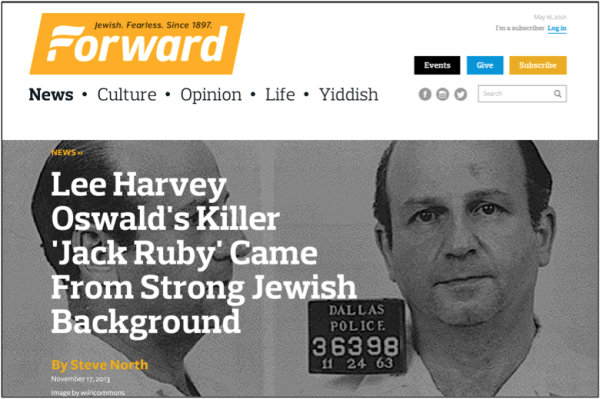
Of course, it is perfectly normal that Chief Justice Earl Warren, when Ruby told him on June 7, 1964, “I have been used for a purpose,” failed to ask him who had used him and for what purpose.[1] But what about independent investigators? Are only readers of the Forward (“News That Matters To American Jews”) worthy of being informed that “Lee Harvey Oswald’s Killer ‘Jack Ruby’ Came From Strong Jewish Background,” and that he told his rabbi Hillel Silverman that he “did it for the Jewish people”? Here is the relevant passage of Steve North’s 2013 article, relating Silverman’s reaction after hearing on the radio that a “Jack Rubenstein” had killed the assassin:
“I was shocked,” said Silverman. “I visited him the next day in jail, and I said, ‘Why, Jack, why?’ He said, ‘I did it for the American people.’” I interrupted Silverman, pointing out that other reports had Ruby saying he did it “to show that Jews had guts.” The rabbi sighed. “Yes, he mentioned that,” Silverman said. “But I don’t like to mention it. I think he said, ‘I did it for the Jewish people.’ But I’ve tried to wipe that statement from my mind.”[2]
Ruby’s defense lawyer William Kunstler also claims in his memoir that Ruby told him: “I did it for the Jews,” repeating on several occasions: “I did this that they wouldn’t implicate Jews.” During Kunstler’s last visit Ruby handed him a note in which he reiterated that his motive was to “protect American Jews from a pogrom that could occur because of anger over the assassination.”[3] There is only one possible interpretation of Ruby’s words: he must have known, and those who tasked him with killing Oswald must have known, that if Oswald was tried, the Jewish hand in JFK’s assassination would likely be made apparent.
Why is this crucial information not in any book on the Kennedy assassination, save in Michael Collins Piper’s (and now mine)? James Douglass, to take the most representative example, insists, without a shred of evidence, that Ruby, besides being a “Chicago mob functionary,” was “CIA-connected”.[4] Not once does Douglass mention Ruby’s Jewish background, and his real name can only be found in a single endnote quoting another author. Could Douglass’s strange omission have the same motive as Ruby’s murder of Oswald, namely to “protect American Jews from a pogrom that could occur because of anger over the assassination”?
Ruby is not the only person connected to Oswald whose confused words implicating “the Jews” are carefully concealed from the public. On March 29, 1977, George DeMohrenschildt, a Russian geologist who had befriended Oswald in Dallas in 1962 at the request of CIA agent J. Walton Moore, was found dead with a bullet through his head. His death was ruled a suicide, but the Sherriff’s report mentions that in his last months he complained that “the Jews” and “the Jewish mafia” were out to get him.[5] His wife confirmed to Jim Marrs, author of Crossfire: The Plot that Killed Kennedy (1989), that her husband thought that “the Jewish Mafia and the FBI” were out to get him.[6] Most people mildly interested in the JFK assassination know about DeMohrenschildt’s relationship with Oswald, but how many have ever heard this intriguing—even incriminating—detail?
After DeMohrenschildt moved away from Dallas in June 1963, Oswald was chaperoned by Ruth Paine, who found him a job at the Texas School Book Depository, where he started working on October 16.[7] It is repeated in every book that Ruth Paine looked after Oswald on behalf of the CIA, but no evidence is ever given. On the other hand, I was surprised to read in her testimony to the Warren Commission that in the 1950s, Ruth Paine had been “a leader in the Jewish community at Indianapolis,” working with Jewish immigrants who “spoke Yiddish in conducting their business meetings.”[8] Jack Ruby also made business deals in Yiddish, as we shall see. As a matter of fact, he sneaked into the Dallas Police Station under the pretense of translating for Yiddish reporters (what Yiddish reporters need a translator in the U.S.?).
This piece of information comes from the only useful book written about Ruby: Seth Kantor’s 1978 Who Was Jack Ruby? retitled The Ruby Cover-Up in 1980. Kantor was a reporter working for the Dallas Times Herald in 1963. He knew Ruby and was less than ten feet away from him when he shot Oswald. Kantor’s meticulous investigation is an important contribution to the search for the truth about Kennedy’s assassination. In the rest of this article, I will draw mostly from his book, as well as from Michael Collins Piper’s Final Judgment and a few other sources.
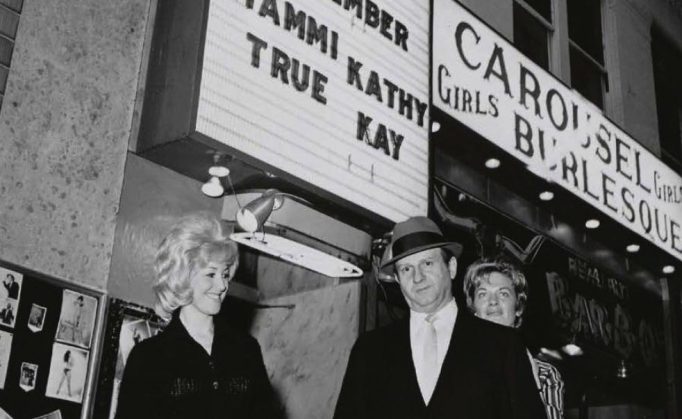
Jack Ruby in front of his Carousel strip club
Gangsters for Zion
In its final report, the Warren Commission declared that it could “not establish a significant link between Ruby and organized crime,” because “Ruby has disclaimed that he was associated with organized criminal activities, and law enforcement agencies have confirmed that denial.”[9] But there is plenty of evidence of Ruby’s association with organized crime. Robert Blakey, chief counsel for the House Select Committee on Assassinations from 1977 to 1979, said: “The most plausible explanation for the murder of Oswald by Jack Ruby was that Ruby had stalked him on behalf of organized crime, trying to reach him on at least three occasions in the forty-eight hours before he silenced him forever.”[10] Incriminating “organized crime” in the JFK assassination and the ensuing Oswald assassination was, of course, the most harmless conclusion that the HSCA could come up with, short of ridiculing itself by confirming the Warren Commission’s story of two lone nuts. And so the Washington Post could headline: “MOBSTERS LINKED TO JFK DEATH.”[11]
The missing word, here, is “Jewish”. Most Americans, learning that Jack Ruby was a mobster, must have thought he was Italian, like Hollywood gangsters. They were not told that his real name was Jacob Leon Rubenstein, that he was the son of Jewish Polish immigrants, that he went to the synagogue just before shooting Oswald, and that he later confessed to his rabbi that he “did it for the Jews.”
Jacob Rubenstein belonged to the Jewish mafia, also known as the Yiddish Connection. He had moved from Chicago to Dallas in 1947, on the trail of 15 other Chicago mobsters (3 Italians and 9 Jews) who had settled there to take over the prostitution business. That is when he changed his name from Rubenstein to Ruby. Ruby’s mentor and role model was Mickey Cohen, who operated in Chicago during the Prohibition but was then active in Hollywood. During his trial for shooting Oswald, Ruby’s legal team was fronted by Melvin Belli, a longtime friend and attorney of Cohen (Belli’s defense was that Ruby had suffered temporary insanity due to a bout of “psychomotor epilepsy”).[12] In 1947, Cohen had succeeded Benjamin Siegelbaum, aka Bugsy Siegel (romanticized by Hollywood in 1991) at the head of “Murder Incorporated”. Cohen and Siegelbaum were accountable to Meyer Lansky (born Suchowljansky), the most powerful Jewish mafia boss, who had built part of his fortune with his Havana casinos and brothels, of which he was dispossessed by Castro in 1959. Lansky’s biographer Hank Messick describes him as the head of the National Crime Syndicate. “Thanks largely to Lansky, organized crime has changed from an ugly growth on the body politic capable of being removed by surgery to a cancerous part of our economic and political systems.”[13]
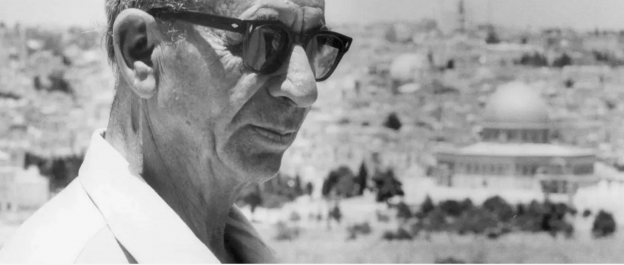
Meyer Lansky in Israel, 1971
Mickey Cohen claims in his memoirs that, in the 1940s and 1950s, he was “engrossed with Israel”, and boasts about his financial and criminal contributions to the arms smuggling operations of the Haganah. Gary Wean, a detective sergeant for the Los Angeles Police Department, claims in his book There’s a Fish in the Courthouse (1987) that he saw Ruby twice in Hollywood in 1946 and 1947 in the presence of Cohen.[14] He also writes that Cohen had frequent contacts with Menachem Begin,[15] and that he was sharing his girlfriend, stripper Candy Barr, with Menachem Begin as well as Ruby.[16]
Cohen was not the only mobster working for Israel. A pact had been sealed between prominent Zionists and Jewish mafia bosses around 1945, when the Haganah organized a highly effective black market of weapons and explosives from the US to Palestine. The operation was orchestrated by a group of about 40 wealthy American Jews who pledged to help David Ben-Gurion when the latter visited New York in July 1945. Headed by Rudolf Sonneborn, the group acted under the legal cover of a charity, the Sonneborn Institute, whose story is told by Leonard Slater in The Pledge (Simon & Schuster, 1970).[17] The group operated separately from the Jewish Agency in order to shield it from direct involvement in unlawful activities. Among its active members was the future Jerusalem mayor (1965-93) Teddy Kollek, who also played a key role in forging the CIA-Mossad Alliance. Robert Rockaway has documented the contribution of the Jewish underworld to this operation, in his article “Gangsters for Zion: How Jewish mobsters helped Israel gain its independence”. He writes:
In 1945, the Jewish Agency, the pre-state Israeli government headed by David Ben-Gurion, created a vast clandestine arms-purchasing-and-smuggling network throughout the United States. The operation was placed under the aegis of the Haganah, the underground forerunner of the Israel Defense Forces, and involved hundreds of Americans from every walk of life. They included millionaires, rabbinical students, scrap-metal merchants, ex-GIs, college students, longshoremen, industrialists, chemists, engineers, Protestants and Catholics, as well as Jews. One group, who remained anonymous and rarely talked about, were men who were tough, streetwise, unafraid, and had access to ready cash: Jewish gangsters.
Sent by Ben-Gurion to the U.S. to purchase heavy armaments, Haganah operative Yehuda Arazi approached Meyer Lansky and met with members of Murder, Incorporated. Another Haganah emissary, Reuvin Dafni, who would become Israeli consul in Los Angeles and New York, also dealt with Jewish gangsters. “When I interviewed Dafni,” Rockaway writes, “he told me about his meetings with Jewish mobsters. His meetings were arranged by members of the local Jewish community. His first meeting was in Miami with Sam Kay, a leading Miami Jewish gangster.” Dafni also met with Bugsy Siegel.
As Dafni relates, “I told him my story, how the Haganah was raising money to buy weapons with which to fight. When I finished, Siegel asked, ‘You mean to tell me Jews are fighting?’ Yes, I replied. Then Siegel, who was sitting across the table, leaned forward till his nose was almost touching mine. ‘You mean fighting, as in killing?’ Yes, I answered. Siegel leaned back, looked at me for a moment and said, ‘OK, I’m with you.’” “From then on,” recalled Dafni, “Every week I got a phone call to go to the restaurant. And every week I received a suitcase filled with $5 and $10 bills. The payments continued till I left Los Angeles.” Dafni estimates that Siegel gave him a total of $50,000.[18]
Some of those “gangsters for Zion”, writes Rockaway, “did so out of ethnic loyalties,” or “saw themselves as defenders of the Jews, almost biblical-like fighters. It was part of their self-image.”[19]
Such was also the background and self-image of Jack Ruby. His activities in arms smuggling are well documented, although the fact that it was for the benefit of Israel is often blurred. In Coup d’État in America: The CIA and the Assassination of John F. Kennedy (1975), Allan Weberman refers to the arms-dealing activities of Ruby and other mobsters, but makes no mention of their Jewishness (unless saying that Ruby “was strongly anti-Nazi” counts as an euphemism for being Jewish), and claims that they were in fact arming Castro—while simultaneously participating in CIA plots to kill him.[20]
Ruby knew Lewis McWillie, the manager of the Lansky brothers’ Tropicana nightclub casino in Havana. After the overthrow of Batista by Castro in January 1959, Meyer Lansky relocated to Miami, but Jake Lansky was arrested and confined to a luxury prison, the Trescornia detention camp, together with another mafia figure, Santo Trafficante, Jr. Although not Jewish, Trafficante had sworn allegiance to the Lansky brothers, and controlled substantial portions of Havana’s gambling and prostitution rackets. While in prison, Jake Lansky and Trafficante were often visited by Lewis McWillie, who was negotiating their release by Castro. Ruby told the Warren Commission on June 7, 1964 about visiting Lewis McWillie in 1959 in Havana, and also spoke of knowing McWillie’s bosses, whom, from fear of pronouncing their name, he referred to as “the Fox brothers, the greatest that have been expelled from Cuba.”[21] (McWillie would later acknowledge to the HSCA that, “Jack Ruby could have been out there [Havana] one time with me.”) Ruby added to the Warren Commission that McWillie and one of the brothers later visited him in Dallas.[22]
Seth Kantor quotes from a classified message that was sent from CIA headquarters to National Security Advisor McGeorge Bundy, on November 28, 1963, confirming that, while Santo Trafficante was living “in relative luxury in a Cuban prison” in 1959, he was visited frequently by “an American gangster-type named Ruby.”[23]
In September 1962, Trafficante is reported to have said to José Alman, a prominent member of the Cuban exile community in Miami, that “President Kennedy would get what was coming to him.” Aleman disagreed and argued that Kennedy would be reelected. “No, José,” said Trafficante. “He is going to be hit.”[24] When Trafficante was asked by Richard Sprague of the HSCA, “did you ever discuss with any individuals plans to assassinate President Kennedy prior to his assassination?” Trafficante refused to answer.[25]
As Kantor shows in great detail, Jack Ruby had repeated contacts with members of the Jewish underworld in 1963. By June 8, “a large group of Chicago racketeers began to show up at Ruby’s Carousel and at two other nearby strip-show clubs, according to a confidential report to Dallas Police Chief Jesse E. Curry written by Lieutenant Robert L. May Jr., who had been head of the vice squad.”[26] Ruby’s underworld contact intensified during the 11 days leading up to President Kennedy’s assassination, “when Ruby abruptly signed a power of attorney, giving up certain rights to control his own money. He also suddenly bought and installed a safe for the first time in his 16 years as a Dallas nightclub operator, to store extra amounts of money.”[27] During this period, “Ruby was getting a series of phone calls at the Carousel from an unidentified man who never would leave a message when Ruby was out.”[28] On November 11, Ruby met in Dallas with Alexander Philip Gruber, who was known for his connections with Mickey Cohen. Gruber, who had not visited Ruby in years, told the FBI that he was in Joplin Missouri at that time, and had simply decided to drop in on Ruby “since Dallas, Texas, was about 100 miles from Joplin” (the distance is 360 miles).[29] In the afternoon of November 22, Ruby phoned Alex Gruber in Los Angeles. “Gruber subsequently told the FBI he didn’t really know why Ruby called.”[30] That is most probably when Ruby received an offer he couldn’t refuse.
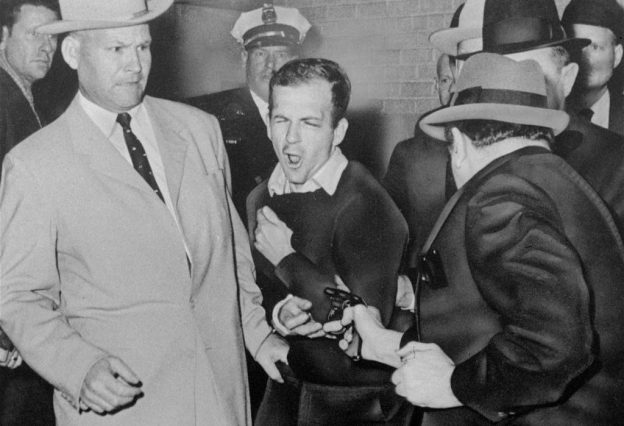
Ruby was certainly informed about the precise moment when Oswald would be transferred from the Dallas Police Station to the County Jail. According to former British Intelligence Officer Colonel John Hughes-Wilson, it was Sam Bloom, the Jewish chairman of the “host committee” who had invited Kennedy to Dallas, who suggested to the Police “that they move the alleged assassin [Oswald] from the Dallas police station to the Dallas County Jail in order to give the newsmen a good story and pictures.” And “when the police later searched Ruby’s home, they found a slip of paper with Bloom’s name, address and telephone number on it.”[31]
In an apparent attempt to make it impossible for him to fulfill his contract, Ruby tried to warn the Dallas Police anonymously: Lieutenant Billy Grammer, a dispatcher for the Dallas Police Department, whose statement can be heard here, received an anonymous phone call at 3 a.m. on November 24 from a man who knew Grammer’s name. The caller told Grammer that he knew of the plan to move Oswald from the basement and that unless the plans for Oswald’s transfer were changed, “we are going to kill him.” After Oswald was shot, Grammer, who knew Ruby and had found the voice familiar at the time of the call, identified Ruby as the caller.[32]
Ruby and the Dallas Police
When Ruby shot Oswald on Sunday November 24, this was not the first time he had been allowed into the Dallas Police Station. He knew about every policeman in town, and was nearly as often hanging around in the Police station as the policemen were at his Carousel strip club. “I have always been very close to the police department, I don’t know why,” he told the Warren Commission. Most plausibly, being on friendly terms with the Dallas policemen was his special mob assignment, and certainly the reason why he was chosen for silencing Oswald: few people had as much ease in making their way into the Dallas Police station.
Ruby spent a lot of time there from Friday 22 to Sunday 23, making several attempt to enter room 317 on the third floor where Oswald was interrogated. Early evening on Friday, the day Kennedy was assassinated and Oswald arrested,
shortly after 7 p.m., John Rutledge, a veteran police reporter for The Dallas Morning News, saw Jack Ruby, whom he easily recognized by sight, step from a public elevator onto the third floor. / Ruby was between two men who wore lapel credentials identifying them as out-of-town reporters. The three walked rapidly past a police officer stationed at the elevators to keep out anyone not on official business. Ruby was hunched over, writing something on a piece of paper and then showing it to one of the reporters as they walked toward Room 317, where Oswald was being interrogated by Captain Fritz and others. … A guard was posted at the bureau door to keep reporters from getting in to use the phones, but Ruby had no trouble easing in. He knew the guard. Ruby walked in and shook hands with Eberhardt, who asked him what he was doing. Ruby had note paper in his hand and said he was acting as translator for the foreign press. Eberhardt figured Ruby was talking about the Israeli press or the Yiddish-speaking reporters Eberhardt guessed he heard in the bedlam of the corridor.[33]
Here are the exact words from Detective August M. Eberhardt’s deposition to the Warren Commission (online here):
Mr. EBERHARDT. He came in and said hello to me, shook hands with me. I asked him what he was doing. He told me he was a translator for the newspapers. Of course, I knew that he could speak Yiddish. Had a notebook in his hand…
Mr. GRIFFIN. Do you know if there were Israeli newspaper or Yiddish—
Mr. EBERHARDT. There was a bunch of them running around there talking that unknown tongue. I don’t know what they were saying.
What a shame these Yiddish-speaking reporters were not traced and identified. Victor R. Robertson Jr., a reporter for WFAA radio and TV in Dallas who knew Ruby, also testified seeing him in the Police Station, attempting to enter 317 while Oswald was in there. Despite those testimonies, the Commission denied that Ruby was ever on the third floor Friday evening.
Later that same day, after a short visit to the synagogue, Ruby bought a dozen corned beef sandwiches and “telephoned homicide detective Richard M. Sims and offered to deliver the free food right to the office. Sims thanked him but said the day’s work was about over and they wouldn’t need anything to eat. Ruby found another reason to go anyway and, at about 11:30 p.m., he stepped off the elevator on the third floor again.”[34] At midnight, Ruby made his way to the press conference in the basement police assembly room, when Oswald was put on display. The Warren Report admits Ruby’s presence there, but portrays him as a casual bystander. “Nowhere in its 888-page report to the public did the Commission include Ruby’s admission to the FBI, a month after the crime, that he was carrying a loaded, sub-nosed revolver in his right-hand pocket during the Oswald press session in the assembly room.” Ruby couldn’t approach Oswald close enough to shoot him, as the room was packed with reporters and photographers.[35]
On Saturday 23, Ruby brought sandwiches to reporters in the Police press room; “reliable outside witnesses reported seeing Ruby or talking with him at intervals during Saturday afternoon—witnesses such as Jeremiah A. O’Leary Jr. of The Washington Star and Thayer Waldo, a reporter to The Fort Worth Star-Telegram.” Yet, Kantor notes,
the Warren Commission said it could reach “no firm conclusion as to whether or not Ruby visited the Dallas police department on Saturday” because “no police officer has reported Ruby’s presence on that day” and because “Ruby has not mentioned such a visit.” / In other words, the Warren Commission decided there had been no conspiracy between Dallas police officers and Jack Ruby because none of them reported it at the time.[36]
On Sunday morning, arrangements were made for the transfer of Oswald to the County Jail. A little after 10:30, Kantor hypothesizes, “a call was placed to the unlisted phone in Ruby’s apartment; Ruby was told where to enter the station and that the transfer van was en route.”[37] Ruby first went to the Western Union office in the next block, and arrived just in time to see Oswald being transferred. This narrow timing has been used as evidence that there was no premeditation and therefore no conspiracy. But Kantor theorizes that Ruby’s entrance into the Police station using the public stairway to the basement jail office area “could have triggered the go-ahead signal for Oswald to be brought down”, and he produces plausible evidence that it did.[38] The way Ruby entered the station is still unclear, but the House committee voted in 1979 that “it was less likely that Ruby entered the police station without assistance.”[39]
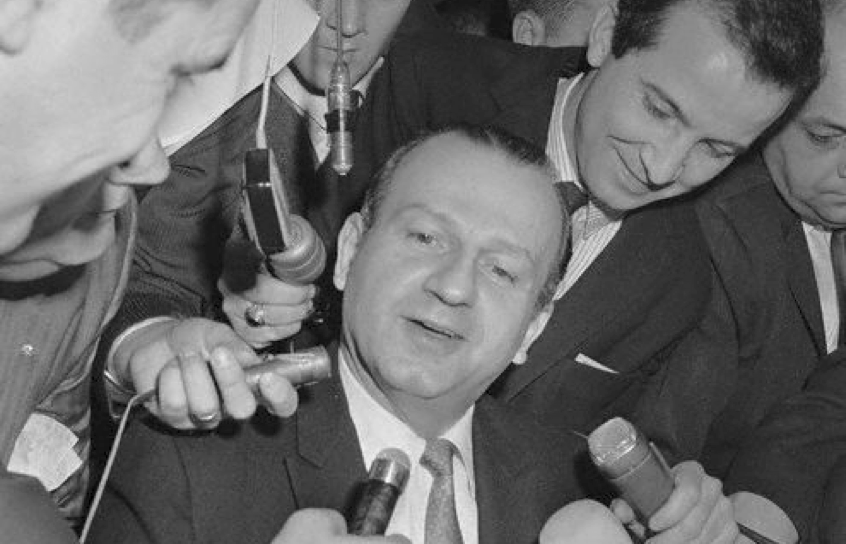
Jack Ruby after his pre-trial hearing in February 1964
The Johnson-Ruby connection
Besides Ruby, we know of one person who took steps to make sure that Oswald was silenced forever. Because Ruby could only shoot one bullet to Oswald—he said he had planned to shoot three—, Oswald was still alive when he arrived at Dallas Parkland Hospital. Dr. Charles Crenshaw recalls in his book JFK, Conspiracy of Silence (1992) that, while operating on Oswald with other surgeons, he noticed that an unknown man looking like Oliver Hardy with a pistol hanging from his back pocket had entered the operation room. Minutes later, he was told about an urgent call for him and left the operating room to take it. The call was from the new sworn president Lyndon Johnson who first asked “Dr. Crenshaw, how is the accused assassin?” Crenshaw answered: “Mr. President, he’s holding his own at the moment.” Then Johnson said firmly: “Dr. Crenshaw, I want a deathbed confession from the accused assassin. There’s a man in the operating room who will take the statement. I will expect full cooperation in this matter.” Dr. Crenshaw answered “Yes, sir,” and hung up. Thirty years later, he comments: “As I stood there in a state of disbelief, my mind was racing. First, ‘deathbed confession’ implies that someone is going to die. If Oswald doesn’t die on the table, is ‘Oliver Hardy’ or someone else going to kill him?” Since Dr. Crenshaw had just told Johnson that Oswald was “holding his own,” the expression “deathbed confession” did sound like an implicit order that Oswald should not leave the operating room alive. It really sounded as if Johnson wanted Ruby’s job finished. Moments after Dr. Crenshaw went back to the operating room, Oswald’s heart beat stopped: “Oliver Hardy” disappeared, never to be seen again. “The incident,” wrote Crenshaw, “confounded logic. Why the President of the United States would get personally involved in the investigation of the assassination, or why he would take the inquest out of the hands of the Texas authorities was perplexing.”[40]
There is plenty of evidence of Johnson’s central role in Kennedy’s assassination. And it happens that Jack Ruby directly pointed to him as the mastermind. At the end of a short filmed news conference in the Dallas County Jail in March 1965, Ruby said, “When I mentioned about Adlai Stevenson, if he was Vice-President there would never have been an assassination of our beloved President Kennedy.” Asked to explain what he meant, Ruby continued, “Well the answer is the man in office now.”[41]
How could Ruby know of Johnson’s guilt? Former Nixon operative Roger Stone claims that, in his presence, Nixon recognized Ruby as one of “Johnson’s boys.”[42] I doubt that story; Stone could have made it up to counter another rumor about Ruby’s connection to Nixon, sparked by a forged 1947 FBI memo stating that “one Jack Rubenstein of Chicago […] is performing information functions for the staff of Congressman Richard Nixon.”[43] But there is one more thing linking Ruby to Johnson.
In his testimony to Chief Justice Earl Warren and other Commission members on June 7, 1964, Ruby pleaded to be given a chance to talk directly to Johnson, otherwise “you will see the most tragic thing that will ever happen,” adding that “maybe something can be saved … if our President, Lyndon Johnson, knew the truth from me.”[44] This can be interpreted as a veiled threat addressed to Johnson. Ruby, who by this time had been sentenced to death, may have been trying to remind Johnson that his contract included a presidential pardon (he had shot Oswald out of love for the Kennedys, hadn’t he?). Even more curiously, Ruby hinted that Israel’s reputation could suffer if he spoke: “There will be a certain tragic occurrence happening if you don’t take my testimony and somehow vindicate me so my people don’t suffer because of what I have done.” He feared, he said, that his act would be used “to create some falsehood about some of the Jewish faith.” Ruby also declared to Warren, “I have been used for a purpose,” but no one in the Commission bothered to ask him who had used him and for what purpose.[45] All Ruby got out of his confused testimony was a second pointless Warren Commission interview one month later (July 18, 1964), this time by none other than Arlen “Magic Bullet” Specter (transcript here). His frustration would explain why in March 1965, he finally accused Johnson. Shortly thereafter, he wrote a letter of sixteen pages that he managed to get smuggled out of jail, blaming Johnson for Kennedy’s murder and calling the former “a Nazi of the worst order.”[46] By doing so, he probably hastened his own death, on January 3, 1967.
The case against Johnson
One commenter to my previous Kennedy article argued that the thesis of Israel’s motive is unconvincing because the Israeli Deep State had other options than killing Kennedy in order to go on with its Dimona project. I responded that a murderer’s motive is rarely that he has no other choice than to kill, but that he finds a crucial advantage in the killing. I also remarked that, whoever the assassins were, their purpose was obviously not just to get rid of Kennedy, but to put Johnson in charge. And that had to be done quickly, because the Kennedys were busy destroying Johnson’s reputation and would soon be announcing a change in the vice-presidency. According to Horace Busby, longtime LBJ aide and author of The Thirty-First of March (2005), Johnson had found out that, in early November 1963, Robert Kennedy had sent a team of national reporters to Texas to utterly destroy him. “We’re here to do a job on Lyndon Johnson,” said one the newsmen to an attorney whom he mistakenly believed to be a Johnson enemy. “When we get through with the sonofabitch, Kennedy won’t be able to touch him with a ten-foot pole in 1964”[47] (quoted from this article by Robert Morrow, who wrote more informative articles on Johnson and his “murderous psychopathy”). Richard Nixon, who happened to be in Dallas the day before Kennedy, leaked the rumor to the Dallas Morning News, who reported it on November 22nd under the headline “Nixon Predicts JFK May Drop Johnson.” Instead, Johnson became president that very day (and Nixon knew that Johnson was behind it).[48]
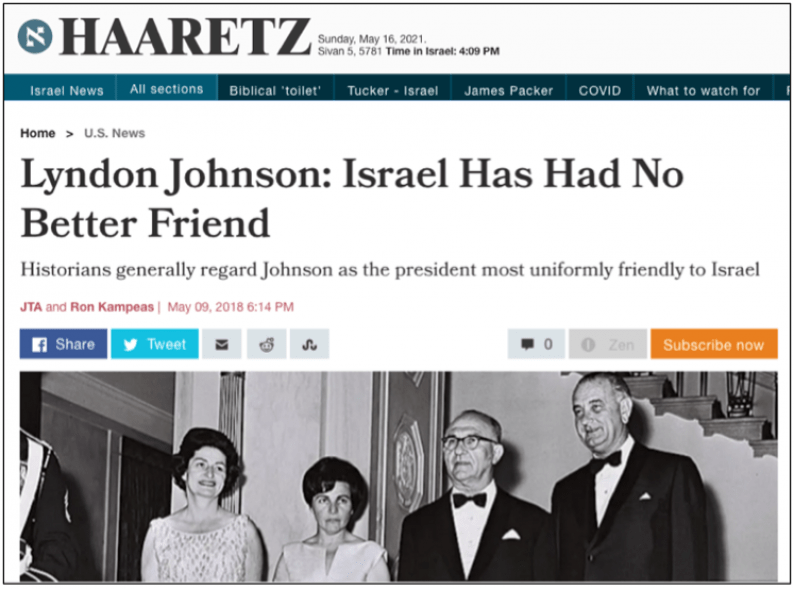
So, since the assassination of Kennedy was a coup to put Johnson in power—what else can it be?—there was no time to waste: it had to be done before the new campaign started and news of a change of vice-presidential ticket was published (Nixon’s prediction was the first and the last). If we now want to know the motive of the coup, we only have to ask: What major change occurred in US policy under Johnson? The change was not visible to the American public then, but they are now well-known, at least to readers of the Jewish and Israeli press. “Lyndon Johnson: Israel Has Had No Better Friend,” headlined Haaretz on May 9, 2018.
“Historians generally regard Johnson as the president most uniformly friendly to Israel,” we are told by the Jewish Telegraphic Agency.
Johnson was the first president to invite an Israeli prime minister, Levi Eshkol, on a state visit. They got along so well — both men were farmers — that Johnson paid Eshkol the rare compliment of inviting him to his ranch.
LBJ soon abandoned pressure on Israel to come clean about the Dimona reactor. He increased arms sales to Israel and in 1968, after Israel’s primary supplier, France, imposed an embargo as a means of cultivating ties in the Arab world, the United States became Israel’s main supplier of weapons, notably launching the talks that would lead to the sale of Phantom fighter jets to Israel.
Johnson wanted to commit more forcefully to Israel’s cause in the lead-up to the 1967 Six-Day War, but he felt constrained from a dramatic show of military might because of the failures of the war in Vietnam then dogging his presidency. Nonetheless, during the war, he ordered warships to within 50 miles of Syria’s coast as a warning to the Soviets not to interfere.
In a speech in the war’s immediate aftermath, Johnson effectively nipped in the bud any speculation that the United States would pressure Israel to unilaterally give up the lands it had captured. He laid down not only the “land for peace” formula that would inform subsequent U.N. Security Council resolutions, but made it clear that any formula had to ensure Jewish access to Jerusalem’s Old City.
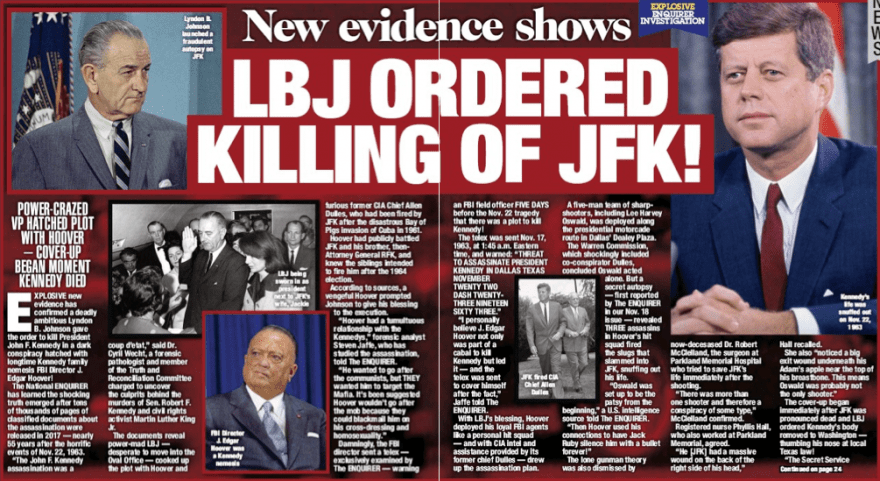
It is a good thing that Johnson is being praised by the Israeli press as the US president who “firmly pointed American policy in a pro-Israel direction”, because, on the other hand, his crucial role in the Dallas coup is also getting mainstream attention, as illustrated by the December 2, 2019 issue of the National Enquirer. Anybody who can add one plus one can also make the logical inference.
Watch Laurent Guyénot’s film “Israel and the Assassinations of the Kennedy Brothers” and share it:
https://www.youtube.com/watch?v=a_kh5tb7PtA
Notes
[1] Seth Kantor, The Ruby Cover-Up, Zebra Books , 1980, p. 49.
[2] Steve North, “Lee Harvey Oswald’s Killer ‘Jack Ruby’ Came From Strong Jewish Background,” The Forward, November 17, 2013, on forward.com
[3] William Kunstler, My Life as a Radical Lawyer, Carol Publishing, 1994, p. 158.
[4] James Douglass, JFK and the Unspeakable: Why He Died and Why It Matters, Touchstone, 2008, p. 357.
[5] Douglass, JFK and the Unspeakable, p. 47; Sheriff’s Office report on mcadams.posc.mu.edu/death2.txt
[6] Jim Marrs, Crossfire: The Plot that Killed Kennedy, Carroll and Graf, 1989, p. 285.
[7] Douglass, JFK and the Unspeakable, pp. 169-171.
[8] On https://mcadams.posc.mu.edu/russ/testimony/paine_r3.htm
[9] Kantor, The Ruby Cover-Up, p. 48.
[10] https://en.wikipedia.org/wiki/Jack_Ruby#Ruby’s_motive
[11] Gaeton Fonzi, The Last Investigation: A Former Federal Investigator Reveals the Man Behind the Conspiracy to Kill JFK, 1993, Skyhorse, 2013, k. 405–76.
[12] Michael Collins Piper, Final Judgment: The Missing Link in the JFK Assassination Conspiracy, American Free Press, 6th ed., 2005, p. 239.
[13] Hank Messick, Lansky, Putnam’s Sons, 1971, p. 9.
[14] Michael Collins Piper, Final Judgment, p. 222.
[15] Gary Wean, There’s a Fish in the Courthouse, Casitas Books, 1987, p. 681, quoted by Piper, Final Judgment, op. cit., p. 219-27, 232-7.
[16] Michael Collins Piper, Final Judgment, p. 224.
[17] Read Ricky-Dale Calhoun, “Arming David: The Haganah’s illegal arms procurement network in the United States 1945-1949,” Journal of Palestine Studies Vol. XXXVI, No. 4 (Summer 2007), pp. 22–32, online here.
[18] Robert Rockaway, “Gangsters for Zion. Yom Ha’atzmaut: How Jewish mobsters helped Israel gain its independence”, April 19, 2018, on tabletmag.com
[19] Robert Rockaway, “Gangsters for Zion,” on tabletmag.com
[20] Alan J. Weberman and Michael Canfield, Coup d’État in America: The CIA and the Assassination of John F. Kennedy, Quick American Archives, 1975, pp. 151-180 (p. 178). Michael Piper mentions (Final Judgment, p. 232) that JFK researcher Alan J. Weberman has revealed the little-known fact that Ruby traveled to Israel in 1955, but the link to Weberman’s website is now dead, and I hold Weberman as a very unreliable source
[21] Bernard Fensterwald, in Coincidence or Conspiracy (quoted by Piper, Final Judgment, pp. 228-229).
[22] Richard Gildbride, Matrix for Assassination: the JFK Conspiracy, Trafford, 2009.
[23] Kantor, The Ruby Cover-Up, pp. 255-256.
[24] Kantor, The Ruby Cover-Up, pp. 259-264.
[25] Kantor, The Ruby Cover-Up, p. 402.
[26] Kantor, The Ruby Cover-Up, p. 53.
[27] Kantor, The Ruby Cover-Up, p. 48.
[28] Kantor, The Ruby Cover-Up, p. 104.
[29] Kantor, The Ruby Cover-Up, pp. 56-59.
[30] Kantor, The Ruby Cover-Up, p. 91.
[31] John Hughes-Wilson, JFK-An American Coup d’État: The Truth Behind the Kennedy Assassination, John Blake, 2014.
[32] Mentionned in this comment.
[33] Kantor, The Ruby Cover-Up, pp. 96-97.
[34] Kantor, The Ruby Cover-Up, p. 98.
[35] Kantor, The Ruby Cover-Up, pp. 100-101.
[36] Kantor, The Ruby Cover-Up, p. 116.
[37] Kantor, The Ruby Cover-Up, p. 132.
[38] Kantor, The Ruby Cover-Up, p. 141.
[39] Kantor, The Ruby Cover-Up, p. 409.
[40] Charles A. Crenshaw, JFK, Conspiracy of Silence, Signet, 1992, pp. 185-189, 5, and
[41] This sequence can be seen in the 1988 documentary “The day the dream died” at 38:20; for more information on Ruby’s declarations about Johnson and about Jews, check this webpage.)
[42] Patrick Howley, “Why Jack Ruby was probably part of the Kennedy conspiracy,” The Daily Caller, March 14, 2014, on dailycaller.com
[43] Copy at www.jfkmurdersolved.com/nixonruby.htm. The forgery is proven by several inconsistencies: first, Nixon was a freshman in the role as junior counsel in 1947, and only started prosecuting Alger Hiss (the only likely context for this memo) the following year. Second, it refers to “Jack Rubenstein” living in Chicago in November of 1947, when Ruby had in fact already changed his name and moved to Dallas by that time. Finally , the document carries a zip code, when they did not exist at the time.
[44] Read Ruby’s deposition here.
[45] Seth Kantor, The Ruby Cover-Up, p. 49.
[46] Phillip Nelson, LBJ: The Mastermind of JFK’s Assassination, pp. 604-607.
[47] Horace Busby, The Thirty-First of March: An intimate portrait of Lyndon Johnson’s final days in office, Farrar, Straus and Giroux, 2005, pp. 129-130.
Prominent Scientists Go Public: ‘Fauci Fooled America’
By Jeremy Loffredo | The Defender | November 2, 2021
In an op-ed, “Fauci Fooled America,” published Monday in Newsweek, two scientists accused Dr. Anthony Fauci of bungling the government’s response to COVID by getting “major epidemiology and public health questions wrong.”
Martin Kulldorff, Ph.D., an epidemiologist at Harvard Medical School, and Jay Bhattacharya, M.D., Ph.D., professor of Health Policy at Stanford University School of Medicine wrote: “Reality and scientific studies have now caught up with him.”
Kulldorff and Bhattacharya, both senior scholars at the Brownstone Institute and signers of the Great Barrington Declaration, had this message for Newsweek readers:
“The evidence is in. Governors, journalists, scientists, university presidents, hospital administrators and business leaders can continue to follow Dr. Anthony Fauci or open their eyes. After 700,000-plus COVID deaths and the devastating effects of lockdowns, it is time to return to basic principles of public health.”
The authors ticked off a list of “key issues” Fauci got wrong, including failure to recognize natural immunity, protecting the elderly, school closures, masks and contact tracing.
“By pushing vaccine mandates, Dr. Fauci ignores naturally acquired immunity among the COVID-recovered, of which there are more than 45 million in the United States,” the authors wrote. “Mounting evidence indicates that natural immunity is stronger and longer lasting than vaccine-induced immunity.”
Kulldorff and Bhattacharya cited a study from Israel, which concluded the vaccinated were 27 times more likely to get symptomatic COVID than the unvaccinated who had recovered from a prior infection.
They pointed out that the scientific community has known about natural immunity from disease “at least since the Athenian Plague in 430 BC.”
On Fauci’s dictates to mandate the vaccine for healthcare workers, the two argued: “Under Fauci’s mandates, hospitals are firing heroic nurses who recovered from COVID they contracted while caring for patients. With their superior immunity, they can safely care for the oldest and frailest patients with even lower transmission risk than the vaccinated.”
On school closures they wrote: “Considering the devastating effects of school closures on children, Dr. Fauci’s advocacy for school closures may be the single biggest mistake of his career … While children do get infected, their risk for COVID death is minuscule, lower than their already low risk of dying from the flu.”
Kulldorff and Bhattacharya pointed to Sweden, noting that during the 2020 spring wave of COVID, the country kept daycare and schools open for all 1.8 million children ages 1 to 15, with no masks, testing or social distancing.
According to the authors, Sweden’s strategy resulted in “zero COVID deaths among children and a COVID risk to teachers lower than the average of other professions.”
The authors argued contact tracing “was a hopeless waste of valuable public health resources that did not stop the disease,” and that Fauci failed at protecting the vulnerable.
“After more than 700,000 reported COVID deaths in America, we now know that lockdowns failed to protect high-risk older people,” they said.
On collateral public health damage, they argued that a “fundamental public health principle is that health is multidimensional; the control of a single infectious disease is not synonymous with health.”
They wrote that Fauci: “ … failed to properly consider and weigh the disastrous effects lockdowns would have on cancer detection and treatment, cardiovascular disease outcomes, diabetes care, childhood vaccination rates, mental health and opioid overdoses, to name a few. Americans will live with — and die from — this collateral damage for many years to come.”
In private conversations, Kulldorff and Bhattacharya said, most of their scientific colleagues agree with them on these points but few have spoken up out of fear of “financial censorship.”
“Many are afraid of losing positions or research grants, aware that Dr. Fauci sits on top of the largest pile of infectious disease research money in the world,” they wrote.
In his forthcoming book, “The Real Anthony Fauci,” Robert F. Kennedy, Jr. includes a comprehensive discussion of Fauci’s influence and power over the scientific community, revealing how Fauci uses the “financial clout at his disposal to wield extraordinary influence over hospitals, universities, journals and thousands of influential doctors and scientists — whose careers and institutions he has the power to ruin, advance or reward.” Kennedy’s book is due out Nov. 16.
Jeremy Loffredo is a freelance reporter for The Defender. His investigative reporting has been featured in The Grayzone and Unlimited Hangout. Jeremy formerly produced news programs at RT America.
© 2021 Children’s Health Defense, Inc. This work is reproduced and distributed with the permission of Children’s Health Defense, Inc. Want to learn more from Children’s Health Defense? Sign up for free news and updates from Robert F. Kennedy, Jr. and the Children’s Health Defense. Your donation will help to support us in our efforts.
Polio Vaccine ‘Hero’ Was Into Eugenics And Depopulation
https://www.bitchute.com/video/FnEUFYG0w7uY/
Amazing Polly | October 23, 2021
Researcher Jay Dyer goes through Jonas Salk’s book “Survival of the Wisest.” Salk was the ‘father of mass vaccination’ and a big inspiration for Bill Gates.
He also happens to want depopulation and genetic manipulation of human beings. Salk and his friends, of course, are among the ‘Wisest’ and they will rule the rest of us. Are his fantasies coming true with the COVID shots?

See the video and discussion here.
To support Amazing Polly’s work please go here: https://amazingpolly.net/contact-support.php
Crossword clues and bullying – the influence of Australia’s pro-Israel lobby unveiled
Michael West Media | October 3, 2021
The intimidating power of Australia’s pro-Israel lobby limits what mainstream media outlets dare publish about Israel and forces self-censorship on editors and journalists alike, writes John Lyons in his latest book Dateline Jerusalem: Journalism’s toughest assignment. Kim Wingerei reports.
In 2019, Fairfax Media’s Sydney and Melbourne mastheads made an error. In the daily crossword section, the answer to the clue “Holy land” turned out not to be six letters starting with an I, as some would expect, but nine letters: Palestine. So affronted was the Australia/Israel and Jewish Affairs Council (AIJAC) that they demanded an investigation.
Fairfax acceded, blamed the error on an external contractor and apologised to Colin Rubenstein, executive director of the AIJAC.
This is just one of many examples which John Lyons uses to illustrate the power of a lobby group so influential it can force changes to Government policy, hound journalists out of their jobs and pressure the ABC board to justify the appointment of foreign correspondents.
… there are only three people who can tell the editors of The Australian what they can or can’t use: Rupert Murdoch, Lachlan Murdoch and Colin Rubenstein. – John Lyons
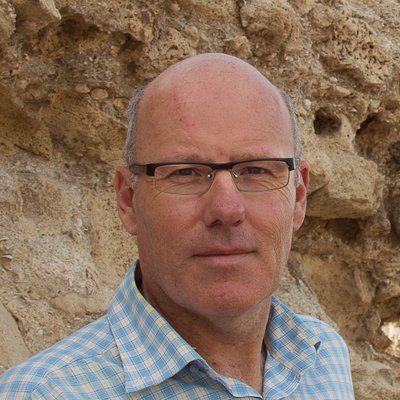 John Lyons is an experienced journalist. Currently the head of investigative journalism at the ABC, his 40 years in the media include being editor of the Sydney Morning Herald, Middle East correspondent for The Australian and winning one of his three Walkley Awards for “Stone Cold Justice”, a Four Corner’s episode which exposed the human rights abuses in Israel military courts.
His earlier book Balcony over Jerusalem covered his six years of witnessing the tragedies and contradictions of a region which has suffered more armed conflict than any other since World War II.
In his latest book released this weekend (at 85 pages, it’s closer to essay size), Lyons focuses entirely on the Israel-Palestine conflict and specifically how pro-Israel lobbyists seek to control the narrative for the Australian audience.
He makes the point several times that the press in Israel is far more overtly critical of the policies of Israel’s Government than is the media in Australia, including how the regular flare-ups in the West Bank are covered.
To the AIJAC it’s a war of words. It is a battle to control how and what is said.
For example, Colin Rubenstein and his fellow lobbyists are particularly sensitive about using the word “occupation” in reference to Israel’s occupation of Palestinian Territories. But as the lieutenant colonel responsible for Israel’s army operations in the occupied territories quips:
If this is not occupied then the media has missed one of the biggest stories of our time, (Israel’s) withdrawal from the West Bank! – LC Eliezer Toledano, Israel Army
The pro-Israel lobby has even developed a special dictionary. The Global Language Dictionary was funded by The Israel Project to “guide politicians and journalists on the language to use to win support for settlement expansion.”
Merely using the word Palestine can land a journalist in trouble. Jennine Khalik, a Palestinian Australian and former journalist at The Australian recounts in the book how she was yelled at by a sub-editor for referring to a refugee and singer as coming from Palestine:
PALESTINE DOES NOT EXIST … Palestine is NOT a place … What kind of journalist are you, using the word Palestine?
For Jennine Khalik this was the last straw, she left the paper shortly after, following what had been a concerted campaign by the pro-Israel lobby, including diplomats from the Israel embassy questioning her editors about the appointment of “a Palestinian activist”.
In another example of the tactics used to control the narrative, Lyons refers to a story told by former The Age editor, Andrew Holden, where Colin Rubenstein and Mark Leibler – lawyer and well known leader of the Jewish business community – marched into his office and complained loudly about the paper’s coverage of the 2014 Gaza war.
Anyone who thinks that such a display by an esteemed member of the Australian community doesn’t have a chilling effect is kidding themselves. I have seen its effect in the years since in hesitancy on the part of editors and trepidation about any story which may show Israel in a negative light. – John Lyons
Lyons himself has also been subjected to threats and intimidation over the years for his reporting on Israel and Palestine. Like many who have dared to criticise the Israeli Government, he has been called an anti-semite, but also a “Goebbels” and “a Hamas smelly used tampon”.
It is a tactic he says is used persistently by those in Australia agitating for positive coverage of Israeli government actions.
I think the aim is to make journalists and editors decide that, even if they have a legitimate story that may criticise Israel it is simply not worth running, as it will cause more trouble than it’s worth. – John Lyons
As a result, most Australians don’t know much about the plight of the Palestinian people. They don’t know about the 101 permits that Palestinians need to obtain from Israel to be able to work and live in what they believe is their own land. They don’t know that Palestinians don’t enjoy free speech, freedom of movement or equality before the law.
In April 2021, Human Rights Watch (HRW) released its landmark report “A Threshold Crossed: Israel Authorities and the Crimes of Apartheid and Persecution”. It was largely ignored by mainstream media in Australia. “Including by my own organisation, the ABC,” says Lyons.
Abusive Israeli policies constitute crimes of apartheid, persecution
The pro-Israel lobby is so effective it has achieved the ultimate aim of information suppression – self-censorship.
John Lyons: Dateline Jerusalem: Journalism’s Toughest Assignment – now available from Monash University Publishing
Kim Wingerei is a businessman turned writer and commentator. He is passionate about free speech, human rights, democracy and the politics of change. Originally from Norway, Kim has lived in Australia for 30 years. Author of ‘Why Democracy is Broken – A Blueprint for Change’.
Winter is coming, and so are the nudges.
The UK government’s Winter Plan is rife with nudges
By Laura Dodsworth | October 4, 2021
There’s a chill in the air. Not from the changing seasons, it’s still beautifully balmy, but because the behavioural scientists’ fingertips have traced a hoar frost of psychocratic nudge on the government’s “Autumn and Winter Plan”.
The UK government’s Winter Plan plan contained some welcome news. The most draconian schedules of the Coronavirus Act will be revoked, including the powers to close schools, allow potentially infectious people to be detained, and restrictions on gatherings and events. The language around the plan’s launch was thankfully more cool-headed. The times are “challenging” but it is no longer claimed that Covid is the “biggest threat this country has faced in peacetime history”.
But the plan is also rife with “nudges” – sneaky ways to prime, prepare and prod you into the desired mindset and course of action.
The contents are freighted with the sunk cost fallacy; we’ve come so far, we mustn’t allow our good work to be undone. This also taps into people’s innate sensitivity to loss.
The trigger from Plan A to Plan B will be “unsustainable pressure” on the NHS rather than deaths. It’s under serious pressure every winter so consider yourselves to be put on notice.
There are other indications of the inevitability of Plan B. I spoke to behavioural scientist Patrick Fagan, who observed that:
“the Plan A / Plan B approach is a classic example of the foot-in-the-door technique. Firstly it makes us accept Plan A because, compared to Plan B, it looks more reasonable; then, once we have accepted and acclimatised to Plan A, we are more likely to then accept Plan B, because it is just one extra step on top of the commitment we’ve already made. The announcement of Plan B may also be an example of the mere exposure effect: simply by talking about the measures (even if, ironically, saying they won’t be implemented), the government makes them more familiar and therefore more psychologically acceptable.”
Bizarrely, after 18 months we’re trapped in a Groundhog Day of modelling and worst case scenarios. Almost a year ago, on the 21st September, Chris Whitty and Patrick Vallance warned of infections hitting 50,000 per day by mid-October in their “Shock and Awe” presentation. When the day arrived, the moving average was 16,228.
According to the doom-mongers at SAGE, up to 7,000 people could be hospitalised per day within the month. And this September the modellers were wrong once again – hospitalisations peaked at about a 1,000 a day and are now falling.
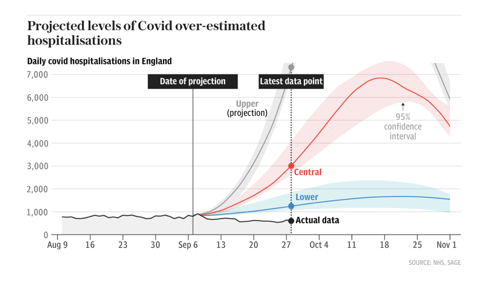
Source: The Telegraph
The big numbers both fuel the policies and justify them. It doesn’t matter that there are more optimistic scenarios, or that the modelling has limitations, because the first supine headline sticks in the brain. The behavioural psychology principle of “salience” draws your attention to what is novel and risky.
Dr Alex De Figueiredo, who conducts mathematical and statistical analyses for the Vaccine Confidence Project, told me that:
“Since the beginning of the pandemic it seems many modelling assumptions, such as the infection fatality rate, have been quite pessimistic. I think this has been why many of the predictions — such as hospitalisations and deaths — have been overstated. It also appears there has been little effort to validate forecasts out-of-sample, such as applying the models to Sweden or Florida, who have had far fewer restrictions.”
There are no quantifiable measures for what justifies each step from Plan A to Plan B. The parameters are fluid, unspecified. This creates confusion and stress, which infantilises people and makes them look to the government for direction. Essentially, confusion increases compliance.
The threat of lockdown hangs like a Sword of Damocles. Will we, or won’t we? It seems unlikely that the public and businesses could be persuaded again. Regardless, the threat of lockdown might be leveraged to justify the introduction of Covid Passports, in what is known as a “reciprocation nudge” – we appear to be given a concession in return for reduced resistance to another option.
Covid Passports have been vigorously opposed by MPs and civil liberties groups, and there hasn’t been a vote in Parliament yet. Despite this, they squat in Plan B as a fait accompli, in the denouement of the “door in the face” technique. This is when a huge request is made, then refused, to be followed by a second smaller request, in this case relegation to Plan B and for limited venues only. Boris Johnson said that it’s “not sensible to rule out this kind of option now when it might still make the difference between keeping businesses open or not.” But why would it be sensible when the Public Administration and Constitutional Affairs Committee produced a damning report against them and found the government could make no scientific case in their favour?
Covid Passports appear to be a behavioural science tool, used to increase vaccine uptake. This may backfire. ‘A Cross-Sectional Study in the UK and Israel on Willingness to Get Vaccinated against COVID-19’ found that vaccine passports deter a significant minority of people who want autonomy over their bodies. This also chimes with the research conducted by De Figueiredo and colleagues at The Vaccine Confidence Project. The bullying and resultant mistrust may impact Covid-19 vaccine uptake as well as other public health initiatives.
When my book A State of Fear: how the UK government weaponised fear during the Covid-19 pandemic was published some people believed, quite quaintly, that public health measures and messaging were unrelated to behavioural science. I think that the book and the writings of other academics and journalists have moved the dial. Once nudge is seen it can’t be unseen. The public increasingly see the nudge. If the behavioural scientists have been dazzling people with card tricks they have over-played their hand.
As such, there is more honesty about the purpose Covid Passports serve. Nicola Sturgeon, Scotland’s First Minister, said that the passport scheme
“will not eradicate transmission completely but it will help reduce it in some higher risk settings, and it will maximise protection against serious illness. And we believe – as we have seen already in some other countries – it will help encourage take-up of the vaccine.”
Similarly, Linda Bauld, Professor of Public Health and Interim Social Policy Adviser to the Scottish Government, also admitted that Covid Passports are “to increase uptake in vaccination” and the “rationale” is that it particularly boosts vaccination in 18 to 29 year olds.
While Covid Passports are in Plan B, Ministers say different things about them each day. Within the space of a week, Sajid Javid scrapped them but also didn’t rule them out for pubs. Javid admitted there’s “no evidence” for them but Boris Johnson called them “sensible”. Does the left hand not know what the right hand is doing? Or maybe a big behavioural science brain lurks in between. The epidemic management is reminiscent of the uncertainty created by Vladislav Surkov in the Soviet Union to deliberately turn politics into a performance of confusion – you don’t know what’s real anymore.
There are never-ending question marks over travel, although double-vaccinated travellers will no longer need expensive and inconvenient PCR tests. The double-jabbed will delight in the news, and it sounds sensible on the surface. However, this is not about “following the science”, since the previously infected do not benefit from the exemption. This is an incentive, a classic nudge, to encourage jabs. The vaccinated are rewarded and the unvaccinated are punished. Bearing in mind that negative tests and prior infection could suffice, this decision reeks of disdain for personal autonomy.
Vaccines for 12 to 15 year olds have been authorised. Politicians have stirred up debate amongst all corners regarding whether children should be jabbed with their parents’ consent or not. This utilises what Patrick Fagan calls “the leapfrog effect”. He says,
“it leapfrogs one stage of the debate and in doing so, sets the baseline assumptions which become accepted implicitly. Specifically, by having people debate whether or not parents’ consent should be sought, they are establishing the unspoken assumption that children should receive the jab in the first place. Those who think they are debating the government, arguing that parents’ consent is needed, are actually accepting its true goal, to jab kids.”
The government might be more in control of the narrative than many people like to believe. (Of course, chaos and confusion are alternatives…)
Worryingly, can teens truly provide informed consent? Throughout 2020 they were exhorted not to “kill granny”, which would provoke fear, shame and stress. Ads on Tiktok tell youngsters that the way to get back to normal is to take the vaccine. The vaccine will be rolled out in schools which will create peer pressure, in a particularly egregious use of “norms”. Finally, if the JCVI found the decision difficult, how is a 12 year old supposed to weigh up the evidence? (Nudging teens is the subject matter of my next article.)
Since the Cabinet reshuffle, Michael Gove has been informally dubbed the ‘Minister for Christmas’. Boris Johnson joked that he “didn’t want to have to cancel Christmas again”. Did you know Christmas might be cancelled and needs saving? You do now, the idea has been “seeded”.
Although it is ostensibly supply chains which threaten Christmas, the joke draws a comparison with last year’s Covid reasons. Again, you are put on notice. The nudges are still focussed on increasing vaccination, for now, but the threat to Christmas might hint at the beginning of a behavioural science approach to meet green targets.
We must be good boys and girls if we want Santa to come. And be aware, the nudgers are drafting our collective New Year’s Resolutions.
Featured Video
Daniel Davis: U.S. Military Options & War Narrative Collapse
or go to
Aletho News Archives – Video-Images
Book Excerpt
US Axis of Aggression in Gulf
By Finian Cunningham | Strategic Culture Foundation | August 15, 2019
When Washington announced a few weeks ago the formation of a maritime “international coalition” to “protect shipping” in the Persian Gulf, many observers were skeptical. Now skepticism has rightly turned to alarm, as the proposed US-led “coalition” transpires to comprise a grand total of just three nations: the US, Britain and Israel.
The term “coalition” has always been a weasel word used by Washington to give its military operations around the world a veneer of international consensus and moral authority. If the US goes ahead with deploying forces in the Persian Gulf the guise of “coalition” is threadbare. It will be seen for what it is: naked aggression.
Iran promptly warned that if the US, Britain and Israel move on their intention to deploy in the Persian Gulf, it will not hesitate to defend itself from a “clear threat”. … continue
Blog Roll
 Aletho News
- War on Iran to impose trillion-dollar ‘Israel First Tax’ on US citizens: Araghchi
- The State Is Socializing the Cost Of the Iran War
- Seyed M. Marandi: U.S. Attacked World’s Largest Gas Field & Iran Declares Economic War
- Washington’s War on Cuba Is Older Than You Think
- Daniel Davis: U.S. Military Options & War Narrative Collapse
- Protesters call on Brussels university to cut partnership with Israeli defense-linked firm
- Weapons makers cash in on Trump’s Iran war
- Why Trump’s anti-Iran naval coalition in Strait of Hormuz is doomed to fail
- IRGC says regional energy sites linked to US will be reduced to ashes
- Qatar condemns ‘dangerous’ Israeli attack on gas field
- If Americans Knew
- How ignorance, misunderstanding and obfuscation ended Iran nuclear talks
- Israeli media reports grotesque settler attack in West Bank
- UK security adviser attended US-Iran talks and judged deal was within reach
- Tucker Carlson says ‘neocons’ will try to destroy Joe Kent over resignation
- Lebanon death toll exceeds 900, another assassination in Iran, bombing in Gaza – Not a ceasefire Day 159
- Trump’s counterterrorism chief, whose own wife was killed by ISIS, quits over Iran War saying Tehran posed ‘no imminent threat’
- Here’s what US could fund instead of Bibi’s war on Iran
- Israel Killed Over a Dozen Lebanese Paramedics in Three Days, Now Claiming That Ambulances Are “Hezbollah” Targets
- War on Iran: These are the heritage sites devastated by US and Israeli attacks
- Four news stories from Israeli media that illustrate Israeli “justice”
- No Tricks Zone
- Energy Expert: Germany’s Nuclear Phaseout Was A “500 Billion Euro Mistake”
- New Research: South Australia’s Mid-Holocene Sea Surface Temperatures Were 4°C Warmer Than Today
- Storing Green Energy To Last Germany 10 Days Would Require A 60-Million Tonne Battery
- New Studies: UK Sea Levels Were 4 Meters Higher Than Today During The Mid-Holocene
- Destructive Green New Deal: German Energy And Metal Group Warns Of Drastic Crisis
- New Study Documents A 20-Year Pause In Arctic Sea Ice Decline – Driven By Internal Variability
- Wake-up Call: Survey Shows Majority Of Germans Now Favor Postponing Climate Targets!
- Televised! Leading German Political Candidate Tells Schoolchildren CO2 Makes Sun Hotter!
- New Study: A Century Warming Of 1.1°C Is ‘Commonplace’ And ‘Not Unusual’ During This Interglacial
- New Study: ‘Internal Noise’ And Volcanic Forcing Can Trigger 10-15°C Warming Within Decades
 Aletho News