The book The Year the World Went Mad by SAGE-member Mark Woolhouse, has now been published as an audiobook and will be available in hard cover on April 12th. This is an important book, for here the author, a key player in the pandemic response in the UK, admits that more or less everything he and his colleagues suggested and the government did was wrong.
In this interview with Spiked-online, Woolhouse admits that focused protection, as suggested by the proponents of the Great Barrington Declaration, would have been the right approach, and that he and his associates knew it. He even claims they suggested it, but nobody listened. However, even if they did, why didn’t they speak up? The scientists who wrote and published the Great Barrington Declaration were denounced as pseudo-scientists – and by whom? Among others, by the very people who knew they were right all along.
In the author‘s own words:
“So how do you protect those people? First of all, since they have to have contact with certain people, you make it as Covid-safe as possible for them to have those interactions. Take all the precautions we know to take now, about wearing masks, ventilation and physical distancing. But that alone is not enough. You need to make sure that the contact themselves does not have an infection and is not going to pass it on to the vulnerable people they’re interacting with. We were talking about this in April and May 2020 to many people in government. But we never implemented it. It never took off. And yet it’s quite clear from our work that this would have had a very significant impact. It would not be enough by itself “You still need to suppress the virus to a degree, but you would not need lockdown.”
The lockdowns, travel bans, school closures and all the rest were useless and extremely harmful to society. But still the scientists in charge of the pandemic response, including Mark Woolhouse, promoted those methods and justified them. They derided those who criticised their methods, cancelled them, claimed they didn’t respect science. But it was the other way around. This, we must never forget.
This book is a good step. But I wonder if the author has apologised to those who were right all along, to Martin Kulldorff, Sunetra Gupta, Jay Bhattacharya and all the other honest, real scientists who had the courage and moral standard to tell the truth. If he hasn’t, I urge him to do so.
For years the eminent Russia scholar Stephen Cohen had ranked President Vladimir Putin of the Russian Republic as the most consequential world leader of the early twenty-first century. He praised the man’s enormous success in reviving his country after the chaos and destitution of the Yeltsin years and emphasized his desire for friendly relations with America, but increasingly feared that we were entering into a new Cold War, even more dangerous than the last.
As far back as 2017, the late Prof. Cohen argued that no foreign leader had been as greatly vilified in recent American history as Putin, and Russia’s invasion of Ukraine two weeks ago has exponentially raised the intensity of such media denunciations, almost matching the hysteria our country experienced two decades ago after the 9/11 attack on New York City. Larry Romanoff has provided a useful catalog of some examples.
Until recently, this extreme demonization of Putin was largely confined to Democrats and centrists, whose bizarre Russiagate narrative had accused him of installing Donald Trump in the White House. But the reaction has now become entirely bipartisan, with enthusiastic Trump-backer Sean Hannity recently using his prime-time FoxNews show to call for Putin’s death, a cry soon joined by Sen. Lindsey Graham, the ranking Republican on the Senate Judiciary Committee. These are astonishing threats to make against a man whose nuclear arsenal could quickly annihilate the bulk of the American population, and the rhetoric seems unprecedented in our postwar history. Even in the darkest days of the Cold War, I don’t recall such public sentiments ever being directed towards the USSR or its top Communist leadership.
In many respects the Western reaction to Russia’s attack has been closer to a declaration of war than merely a return to Cold War confrontation. Russia’s massive foreign reserves held abroad have been seized and frozen, its civilian airlines excluded from Western skies, and its leading banks disconnected from global financial networks. Wealthy Russian private citizens have had their properties confiscated, the national soccer team has been banned from the World Cup, and the longtime Russian conductor of the Munich Philharmonic was fired for refusing to denounce his own country.
Such international retaliation against Russia and individual Russians seems extremely disproportionate. As yet the fighting in Ukraine has inflicted minimal death or destruction, while the various other major wars of the last two decades, many of them American in origin, had killed millions and completely destroyed several countries, including Iraq, Libya, and Syria. But the global dominance of American media propaganda has orchestrated a very different popular response, producing this remarkable crescendo of hatred.
Indeed, the closest parallel that comes to mind would be the American hostility directed against Adolf Hitler and Nazi Germany after the outbreak of World War II, as indicated by the widespread comparisons between Putin’s invasion of Ukraine and Hitler’s 1939 attack on Poland. A simple Google search for “Putin and Hitler” returns tens of millions of webpages, with the top results ranging from the headline of a Washington Post article to the Tweets of pop music star Stevie Nicks. As far back as 2014, Andrew Anglin of the Daily Stormer had documented the emerging meme “Putin is the new Hitler.”
Although enormously popular, such Putin-Hitler analogies have hardly gone unchallenged, and some media outlets such as the London Spectator have strongly disagreed, arguing that Putin’s strategic aims have been quite limited and reasonable.
Many sober-minded strategic analysts have made this same point at length, and very occasionally their contrary views have managed to slip through the media blockade.
Although FoxNews has become one of the outlets most rabidly hostile to Russia, a recent interview with one of their regular guests provided a very different perspective. Col. Douglas Macgregor had been a former top Pentagon advisor and he forcefully explained that America had spent nearly fifteen years ignoring Putin’s endless warnings that he would not tolerate NATO membership for Ukraine, nor the deployment of strategic missiles on his border. Our government had paid no heed to his explicit red-lines, so Putin was finally compelled to act, resulting in the current calamity:
Prof. John Mearsheimer of the University of Chicago, one of our most distinguished political scientists, had spent many years making exactly these same points and blaming America and NATO for the simmering Ukraine crisis, but his warnings had been totally ignored by our political leadership and media. His hour-long lecture explaining these unpleasant realities had quietly sat on Youtube for six years, attracting relatively little attention, but then suddenly exploded in popularity over the last few weeks as the conflict unfolded, and has now reached a worldwide audience of over 17 million. His other Youtube lectures, some quite recent, have been watched by additional millions.
Such massive global attention finally forced our media to take notice, and the New Yorker solicited an interview with Mearsheimer, allowing him to explain to his disbelieving questioner that American actions had clearly provoked the conflict. A couple of years earlier, that same interviewer had ridiculed Prof. Cohen for doubting the reality of Russiagate, but this time he seemed much more respectful, perhaps because the balance of media power was now reversed; his magazine’s 1.2 million subscriber-base was dwarfed by the global audience listening to the views of his subject.
During his long and distinguished career at the CIA, former analyst Ray McGovern had run the Soviet Policy Branch and also served as the Presidential Briefer, so under different circumstances he or someone like him would would currently be advising President Joe Biden. Instead, a few days ago he joined Mearsheimer in presenting his views in a video discussion hosted by the Committee for the Republic. Both leading experts agreed that Putin had been pushed beyond all reasonable limits, provoking the invasion.
Prior to 2014 our relations with Putin had been reasonably good. Ukraine served as a neutral buffer state between Russia and the NATO countries, with the population evenly divided between Russian-leaning and West-leaning elements, and its elected government oscillating between the two camps.
But while Putin’s attention was focused on the 2014 Sochi Olympic Games, a pro-NATO coup overthrew the democratically-elected pro-Russian government, with clear evidence that Victoria Nuland and the other Neocons grouped around Secretary of State Hillary Clinton had orchestrated it. Ukraine’s Crimea peninsula contains Russia’s crucial Sevastopol naval base, and only Putin’s swift action allowed it to remain under Russian control, while he also provided support for break-away pro-Russian enclaves in the Donbass region. The Minsk agreement later signed by the Ukrainian government granted autonomy to those latter areas, but Kiev refused to honor its commitments, and instead continued to shell the area, inflicting serious casualties upon the inhabitants, many of whom held Russian passports. Diana Johnstone has aptly characterized our policy as years of Russian bear-baiting.
As Mearsheimer, McGovern, and other observers have persuasively argued, Russia invaded Ukraine only after such endless provocations and warnings were always ignored or dismissed by our American leadership. Perhaps the final straw had been the recent public statement by Ukraine President Volodymyr Zelenskyy that he intended to acquire nuclear weapons. How would America react if a democratically-elected pro-American government in Mexico had been overthrown in an coup backed by China, with the fiercely hostile new Mexican government spending years killing American citizens in its country and then finally announcing plans to acquire a nuclear arsenal?
Moreover, some analysts such as economist Michael Hudson have strongly suspected that American elements deliberately provoked the Russian invasion for geostrategic reasons, and Mike Whitney advanced similar arguments in a column that went super-viral, accumulating over 800,000 pageviews. The Nord Stream 2 pipeline carrying Russian natural gas to Germany had finally been completed last year and was about to go into operation, which would have greatly increased Eurasian economic integration and Russian influence in Europe, while eliminating the potential market for more expensive American natural gas. The Russian attack and the massive resulting media hysteria have now foreclosed that possibility.
So although it was Russian troops who crossed the Ukrainian border, a strong case can be made that they did so only after the most extreme provocations, and these may have been deliberately intended to produce exactly that result. Sometimes the parties responsible for starting a war are not necessarily those that eventually fire the first shot.
Ironically enough, the arguments of Mearsheimer and others that Putin was greatly provoked or possibly even manipulated into attacking Ukraine raise certain intriguing historical parallels. The legions of ignorant Westerners who mindlessly rely upon our disingenuous media may be denouncing Putin as “another Hitler” but I think they may have inadvertently backed themselves into the truth.
A couple of months ago I finally read Gerd Schultze-Rhonhof’s outstanding 2011 volume analyzing the years leading up to the outbreak of World War II, a work that I would highly recommend. The author spent his career as a fully mainstream professional military man, rising to the rank of major general in the German army before retiring, and his account evoked eerie parallels to the current conflict with Russia.
As most of us know, the Second World War began when Germany attacked Poland in 1939 over Danzig, an almost entirely German border city controlled by the Poles.
But less well known is that Hitler had actually made enormous efforts to avoid war and settle that dispute, spending many months on fruitless negotiations and offering extremely reasonable terms. Indeed, the German dictator had made numerous concessions that none of his democratic Weimar predecessors had been willing to consider, but these were all rejected, while provocations increased until war with Poland seemed the only possible option. And just as in the case of Ukraine, politically influential elements in the West almost certainly sought to provoke that war, using Danzig as the spark to ignite the conflict much like the Donbass may have been used to force Putin’s hand.
We should recognize that in many respects the standard historical narrative of World War II is merely a congealed version of the media propaganda of that era. If Russia were defeated and destroyed as a result of the current conflict, we can be sure that the subsequent history books would utterly demonize Putin and all the decisions that he had taken.
Although I was very impressed by Schultze-Rhonhof’s meticulously detailed analysis of the circumstances leading up to the outbreak of war in 1939, his account merely reinforced my existing views, which had already been along entirely similar lines.
For example, back in 2019 I had used Pat Buchanan’s controversial 2008 bestseller on World War II as the starting point for a very long and detailed discussion of the true origins of that conflict:
However, the bulk of the book focused on the events leading up to the Second World War, and this was the portion that had inspired such horror in McConnell and his colleagues. Buchanan described the outrageous provisions of the Treaty of Versailles imposed upon a prostrate Germany, and the determination of all subsequent German leaders to redress it. But whereas his democratic Weimar predecessors had failed, Hitler had managed to succeed, largely through bluff, while also annexing German Austria and the German Sudetenland of Czechoslovakia, in both cases with the overwhelming support of their populations.
Buchanan documented this controversial thesis by drawing heavily upon numerous statements by leading contemporary political figures, mostly British, as well as the conclusions of highly-respected mainstream historians. Hitler’s final demand, that 95% German Danzig be returned to Germany just as its inhabitants desired, was an absolutely reasonable one, and only a dreadful diplomatic blunder by the British had led the Poles to refuse the request, thereby provoking the war. The widespread later claim that Hitler sought to conquer the world was totally absurd, and the German leader had actually made every effort to avoid war with Britain or France. Indeed, he was generally quite friendly towards the Poles and had been hoping to enlist Poland as a German ally against the menace of Stalin’s Soviet Union.
Although many Americans might have been shocked at this account of the events leading up to the outbreak of the Second World War, Buchanan’s narrative accorded reasonably well with my own impression of that period. As a Harvard freshman, I had taken an introductory history course, and one of the primary required texts on World War II had been that of A.J.P. Taylor, a renowned Oxford University historian. His famous 1961 work Origins of the Second World War had very persuasively laid out a case quite similar to that of Buchanan, and I’d never found any reason to question the judgment of my professors who had assigned it. So if Buchanan merely seemed to be seconding the opinions of a leading Oxford don and members of the Harvard history faculty, I couldn’t quite understand why his new book would be regarded as being beyond the pale.
The recent 70th anniversary of the outbreak of the conflict that consumed so many tens of millions of lives naturally provoked numerous historical articles, and the resulting discussion led me to dig out my old copy of Taylor’s short volume, which I reread for the first time in nearly forty years. I found it just as masterful and persuasive as I had back in my college dorm room days, and the glowing cover-blurbs suggested some of the immediate acclaim the work had received. The Washington Post lauded the author as “Britain’s most prominent living historian,” World Politics called it “Powerfully argued, brilliantly written, and always persuasive,” The New Statesman, Britain leading leftist magazine, described it as “A masterpiece: lucid, compassionate, beautifully written,” and the august Times Literary Supplement characterized it as “simple, devastating, superlatively readable, and deeply disturbing.” As an international best-seller, it surely ranks as Taylor’s most famous work, and I can easily understand why it was still on my college required reading list nearly two decades after its original publication.
Yet in revisiting Taylor’s ground-breaking study, I made a remarkable discovery. Despite all the international sales and critical acclaim, the book’s findings soon aroused tremendous hostility in certain quarters. Taylor’s lectures at Oxford had been enormously popular for a quarter century, but as a direct result of the controversy “Britain’s most prominent living historian” was summarily purged from the faculty not long afterwards. At the beginning of his first chapter, Taylor had noted how strange he found it that more than twenty years after the start of the world’s most cataclysmic war no serious history had been produced carefully analyzing the outbreak. Perhaps the retaliation that he encountered led him to better understand part of that puzzle.
I very recently reread Pat Buchanan’s 2008 book harshly condemning Churchill for his role in the cataclysmic world war and made an interesting discovery. Irving is surely among the most authoritative Churchill biographers, with his exhaustive documentary research being the source of so many new discoveries and his books selling in the millions. Yet Irving’s name never once appears either in Buchanan’s text or in his bibliography, though we may suspect that much of Irving’s material has been “laundered” through other, secondary Buchanan sources. Buchanan extensively cites A.J.P. Taylor, but makes no mention of Barnes, Flynn, or various other leading American academics and journalists who were purged for expressing contemporaneous views not so dissimilar from those of the author himself.
During the 1990s, Buchanan had ranked as one of America’s most prominent political figures, having an enormous media footprint in both print and television, and with his remarkably strong insurgent runs for the Republican presidential nomination in 1992 and 1996 cementing his national stature. But his numerous ideological foes worked tirelessly to undermine him, and by 2008 his continued presence as a pundit on the MSNBC cable channel was one of his last remaining footholds of major public prominence. He probably recognized that publishing a revisionist history of World War II might endanger his position, and believed that any direct association with purged and vilified figures such as Irving or Barnes would surely lead to his permanent banishment from all electronic media.
A decade ago I had been quite impressed by Buchanan’s history, but I had subsequently done a great deal of reading on that era and I found myself somewhat disappointed the second time through. Aside from its often breezy, rhetorical, and unscholarly tone, my sharpest criticisms were not with the controversial positions that he took, but with the other controversial topics and questions that he so carefully avoided.
Perhaps the most obvious of these is the question of the true origins of the war, which laid waste to much of Europe, killed perhaps fifty or sixty million, and gave rise to the subsequent Cold War era in which Communist regimes controlled half of the entire Eurasian world-continent. Taylor, Irving, and numerous others have thoroughly debunked the ridiculous mythology that the cause lay in Hitler’s mad desire for world conquest, but if the German dictator clearly bore only minor responsibility, was there indeed any true culprit? Or did this massively-destructive world war come about in somewhat similar fashion to its predecessor, which our conventional histories treat as mostly due to a collection of blunders, misunderstandings, and thoughtless escalations.
During the 1930s, John T. Flynn was one of America’s most influential progressive journalists, and although he had begun as a strong supporter of Roosevelt and his New Deal, he gradually became a sharp critic, concluding that FDR’s various governmental schemes had failed to revive the American economy. Then in 1937 a new economic collapse spiked unemployment back to the same levels as when the president had first entered office, confirming Flynn in his harsh verdict. And as I wrote last year:
Indeed, Flynn alleges that by late 1937, FDR had turned towards an aggressive foreign policy aimed at involving the country in a major foreign war, primarily because he believed that this was the only route out of his desperate economic and political box, a stratagem not unknown among national leaders throughout history. In his January 5, 1938 New Republic column, he alerted his disbelieving readers to the looming prospect of a large naval military build-up and warfare on the horizon after a top Roosevelt adviser had privately boasted to him that a large bout of “military Keynesianism” and a major war would cure the country’s seemingly insurmountable economic problems. At that time, war with Japan, possibly over Latin American interests, seemed the intended goal, but developing events in Europe soon persuaded FDR that fomenting a general war against Germany was the best course of action. Memoirs and other historical documents obtained by later researchers seem to generally support Flynn’s accusations by indicating that Roosevelt ordered his diplomats to exert enormous pressure upon both the British and Polish governments to avoid any negotiated settlement with Germany, thereby leading to the outbreak of World War II in 1939.
The last point is an important one since the confidential opinions of those closest to important historical events should be accorded considerable evidentiary weight. In a recent article John Wear mustered the numerous contemporaneous assessments that implicated FDR as a pivotal figure in orchestrating the world war by his constant pressure upon the British political leadership, a policy that he privately even admitted could mean his impeachment if revealed. Among other testimony, we have the statements of the Polish and British ambassadors to Washington and the American ambassador to London, who also passed along the concurring opinion of Prime Minister Chamberlain himself. Indeed, the German capture and publication of secret Polish diplomatic documents in 1939 had already revealed much of this information, and William Henry Chamberlin confirmed their authenticity in his 1950 book. But since the mainstream media never reported any of this information, these facts remain little known even today.
Roosevelt’s economic problems had led him to seek a foreign war, but it was probably the overwhelming Jewish hostility to Nazi Germany that pointed him in that particular direction. The confidential report of the Polish ambassador to the U.S. as quoted by John Wear provides a striking description of the political situation in America at the beginning of 1939:
There is a feeling now prevalent in the United States marked by growing hatred of Fascism, and above all of Chancellor Hitler and everything connected with National Socialism. Propaganda is mostly in the hands of the Jews who control almost 100% [of the] radio, film, daily and periodical press. Although this propaganda is extremely coarse and presents Germany as black as possible–above all religious persecution and concentration camps are exploited–this propaganda is nevertheless extremely effective since the public here is completely ignorant and knows nothing of the situation in Europe.
At the present moment most Americans regard Chancellor Hitler and National Socialism as the greatest evil and greatest peril threatening the world. The situation here provides an excellent platform for public speakers of all kinds, for emigrants from Germany and Czechoslovakia who with a great many words and with most various calumnies incite the public. They praise American liberty which they contrast with the totalitarian states.
It is interesting to note that in this extremely well-planned campaign which is conducted above all against National Socialism, Soviet Russia is almost completely eliminated. Soviet Russia, if mentioned at all, is mentioned in a friendly manner and things are presented in such a way that it would seem that the Soviet Union were cooperating with the bloc of democratic states. Thanks to the clever propaganda the sympathies of the American public are completely on the side of Red Spain.
Given the heavy Jewish involvement in financing Churchill and his allies and also steering the American government and public in the direction of war against Germany, organized Jewish groups probably bore the central responsibility for provoking the world war, and this was surely recognized by most knowledgeable individuals at the time. Indeed, the Forrestal Diaries recorded the very telling statement by our ambassador in London: “Chamberlain, he says, stated that America and the Jews had forced England into the war.”
The ongoing struggle between Hitler and international Jewry had been receiving considerable public attention for years. During his political rise, Hitler had hardly concealed his intent to dislodge Germany’s tiny Jewish population from the stranglehold they had gained over German media and finance, and instead run the country in the best interests of the 99% German majority, a proposal that provoked the bitter hostility of Jews everywhere. Indeed, immediately after he came into office, a major London newspaper had carried a memorable 1933 headline announcing that the Jews of the world had declared war on Germany, and were organizing an international boycott to starve the Germans into submission.
In recent years, somewhat similar Jewish-organized efforts at international sanctions aimed at bringing recalcitrant nations to their knees have become a regular part of global politics. But these days the Jewish dominance of the U.S. political system has become so overwhelming that instead of private boycotts, such actions are directly enforced by the American government. To some extent, this had already been the case with Iraq during the 1990s, but became far more common after the turn of the new century.
Although our official government investigation concluded that the total financial cost of the 9/11 terrorist attacks had been an absolutely trivial sum, the Neocon-dominated Bush Administration nonetheless used this as an excuse to establish an important new Treasury Department position, the Under Secretary for Terrorism and Financial Intelligence. That office soon began utilizing America’s control of the global banking system and dollar-denominated international trade to enforce financial sanctions and wage economic warfare, with these measures typically being directed against individuals, organizations, and nations considered unfriendly towards Israel, notably Iran, Hezbollah, and Syria.
Perhaps coincidentally, although Jews comprise merely 2% of the American population, all four individuals holding that very powerful post over the last 15 years since its inception—Stuart A. Levey, David S. Cohen, Adam Szubin, Sigal Mandelker—have been Jewish, with the most recent of these being an Israeli citizen. Levey, the first Under Secretary, began his work under President Bush, then continued without a break for years under President Obama, underscoring the entirely bipartisan nature of these activities.
Most foreign policy experts have certainly been aware that Jewish groups and activists played the central role in driving our country into its disastrous 2003 Iraq War, and that many of these same groups and individuals have spent the last dozen years or so working to foment a similar American attack on Iran, though as yet unsuccessfully. This seems quite reminiscent of the late 1930s political situation in Britain and America.
Individuals outraged by the misleading media coverage surrounding the Iraq War but who have always casually accepted the conventional narrative of World War II should consider a thought-experiment I suggested last year:
When we seek to understand the past, we must be careful to avoid drawing from a narrow selection of sources, especially if one side proved politically victorious in the end and completely dominated the later production of books and other commentary. Prior to the existence of the Internet, this was an especially difficult task, often requiring a considerable amount of scholarly effort, even if only to examine the bound volumes of once popular periodicals. Yet without such diligence, we can fall into very serious error.
The Iraq War and its aftermath was certainly one of the central events in American history during the 2000s. Yet suppose some readers in the distant future had only the collected archives of The Weekly Standard, National Review, the WSJ op-ed page, and FoxNews transcripts to furnish their historical understanding of that period, perhaps along with the books written by the contributors to those outlets. I doubt that more than a small fraction of what they would read could be categorized as outright lies. But the massively skewed coverage, the distortions, exaggerations, and especially the breathtaking omissions would surely provide them with an exceptionally unrealistic view of what had actually happened during that important period.
Another striking historical parallel has been the fierce demonization of Russian President Vladimir Putin, who provoked the great hostility of Jewish elements when he ousted the handful of Jewish Oligarchs who had seized control of Russian society under the drunken misrule of President Boris Yeltsin and totally impoverished the bulk of the population. This conflict intensified after Jewish investor William F. Browder arranged Congressional passage of the Magnitsky Act to punish Russian leaders for the legal actions they had taken against his huge financial empire in their country. Putin’s harshest Neocon critics have often condemned him as “a new Hitler” while some neutral observers have agreed that no foreign leader since the German Chancellor of the 1930s has been so fiercely vilified in the American media. Seen from a different angle, there may indeed be a close correspondence between Putin and Hitler, but not in the way usually suggested.
Knowledgeable individuals have certainly been aware of the crucial Jewish role in orchestrating our military or financial attacks against Iraq, Iran, Syria, and Russia, but it has been exceptionally rare for any prominent public figures or reputable journalists to mention these facts lest they be denounced and vilified by zealous Jewish activists and the media they dominate. For example, a couple of years ago a single suggestive Tweet by famed CIA anti-proliferation operative Valerie Plame provoked such an enormous wave of vituperation that she was forced to resign her position at a prominent non-profit. A close parallel involving a far more famous figure had occurred three generations earlier:
These facts, now firmly established by decades of scholarship, provide some necessary context to Lindbergh’s famously controversial speech at an America First rally in September 1941. At that event, he charged that three groups in particular were “pressing this country toward war[:] the British, the Jewish, and the Roosevelt Administration,” and thereby unleashed an enormous firestorm of media attacks and denunciations, including widespread accusations of anti-Semitism and Nazi sympathies. Given the realities of the political situation, Lindbergh’s statement constituted a perfect illustration of Michael Kinsley’s famous quip that “a gaffe is when a politician tells the truth – some obvious truth he isn’t supposed to say.” But as a consequence, Lindbergh’s once-heroic reputation suffered enormous and permanent damage, with the campaign of vilification echoing for the remaining three decades of his life, and even well beyond. Although he was not entirely purged from public life, his standing was certainly never even remotely the same.
With such examples in mind, we should hardly be surprised that for decades this huge Jewish involvement in orchestrating World War II was carefully omitted from nearly all subsequent historical narratives, even those that sharply challenged the mythology of the official account. The index of Taylor’s iconoclastic 1961 work contains absolutely no mention of Jews, and the same is true of the previous books by Chamberlin and Grenfell. In 1953, Harry Elmer Barnes, the dean of historical revisionists, edited his major volume aimed at demolishing the falsehoods of World War II, and once again any discussion of the Jewish role was almost entirely lacking, with only part of one single sentence and Chamberlain’s dangling short quote appearing across more than 200,000 words of text. Both Barnes and many of his contributors had already been purged and their book was only released by a tiny publisher in Idaho, but they still sought to avoid certain unmentionables.
Even the arch-revisionist David Hoggan seems to have carefully skirted the topic of Jewish influence. His 30 page index lacks any entry on Jews and his 700 pages of text contain only scattered references. Indeed, although he does quote the explicit private statements of both the Polish ambassador and the British Prime Minister emphasizing the enormous Jewish role in promoting the war, he then rather questionably asserts that these confidential statements of individuals with the best understanding of events should simply be disregarded.
In the popular Harry Potter series, Lord Voldemort, the great nemesis of the young magicians, is often identified as “He Who Must Not Be Named,” since the mere vocalization of those few particular syllables might bring doom upon the speaker. Jews have long enjoyed enormous power and influence over the media and political life, while fanatic Jewish activists demonstrate hair-trigger eagerness to denounce and vilify all those suspected of being insufficiently friendly towards their ethnic group. The combination of these two factors has therefore induced such a “Lord Voldemort Effect” regarding Jewish activities in most writers and public figures. Once we recognize this reality, we should become very cautious in analyzing controversial historical issues that might possibly contain a Jewish dimension, and also be particularly wary of arguments from silence.
Another aspect of Schultze-Rhonhof’s important study that was new to me but further solidified my previous conclusions was his analysis of Hitler’s public speeches. Although the German Fuhrer is notoriously portrayed as a horrific warmonger, his actual statements provide absolutely no evidence of any plans for aggressive war, and instead emphasized the importance of maintaining international peace in order to foster internal German economic development. In another 2019 article, I had similarly suggested that any examination of the reputable contemporary sources reveals that the Hitler of our history books is merely a grotesque political cartoon, similar to the one now increasingly drawn of Putin:
Although the demonic portrayal of the German Kaiser was already being replaced by a more balanced treatment within a few years of the Armistice and had disappeared after a generation, no such similar process has occurred in the case of his World War II successor. Indeed, Adolf Hitler and the Nazis seem to loom far larger in our cultural and ideological landscape today than they did in the immediate aftermath of the war, with their visibility growing even as they become more distant in time, a strange violation of the normal laws of perspective. I suspect that the casual dinner-table conversations on World War II issues that I used to enjoy with my Harvard College classmates during the early 1980s would be completely impossible today.
To some extent, the transformation of “the Good War” into a secular religion, with its designated monsters and martyrs may be analogous to what occurred during the final decay of the Soviet Union, when the obvious failure of its economic system forced the government to increasingly turn to endless celebrations of its victory in the Great Patriotic War as the primary source of its legitimacy. The real wages of ordinary American workers have been stagnant for fifty years and most adults have less than $500 in available savings, so this widespread impoverishment may be forcing our own leaders into adopting a similar strategy.
But I think that a far greater factor has been the astonishing growth of Jewish power in America, which was already quite substantial even four or five decades ago but has now become absolutely overwhelming, whether in foreign policy, finance, or the media, with our 2% minority exercising unprecedented control over most aspects of our society and political system. Only a fraction of American Jews hold traditional religious beliefs, so the twin worship of the State of Israel and the Holocaust has served to fill that void, with the individuals and events of World War II constituting many of the central elements of the mythos that serves to unify the Jewish community. And as an obvious consequence, no historical figure ranks higher in the demonology of this secular religion than the storied Fuhrer and his Nazi regime.
However, beliefs based upon religious dogma often sharply diverge from empirical reality. Pagan Druids may worship a particular sacred oak tree and claim that it contains the soul of their tutelary dryad; but if an arborist taps the tree, its sap may seem like that of any other.
Our current official doctrine portrays Adolf Hitler’s Nazi Germany as one of the cruelest and most relentlessly aggressive regimes in the history of the world, but at the time these salient facts apparently escaped the leaders of the nations with which it was at war. Operation Pike provides an enormous wealth of archival material regarding the secret internal discussions of the British and French governmental and military leadership, and all of it tends to suggest that they regarded their German adversary as a perfectly normal country, and perhaps occasionally regretted that they had somehow gotten themselves involved a major war over what amounted to a small Polish border dispute.
During late 1939, a major American news syndicate had sent Stoddard to spend a few months in wartime Germany and provide his perspective, with his numerous dispatches appearing in The New York Times and other leading newspapers. Upon his return, he published a 1940 book summarizing all his information, seemingly just as even-handed as his earlier 1917 volume. His coverage probably constitutes one of the most objective and comprehensive American accounts of the mundane domestic nature of National Socialist Germany, and thus may seem rather shocking to modern readers steeped in eighty years of increasingly unrealistic Hollywood propaganda.
Into the Darkness An Uncensored Report from Inside the Third Reich At War
Lothrop Stoddard • 1940 • 79,000 Words
And although our standard histories would never admit this, the actual path toward war appears to have been quite different than most Americans believe. Extensive documentary evidence from knowledgeable Polish, American, and British officials demonstrates that pressure from Washington was the key factor behind the outbreak of the European conflict. Indeed, leading American journalists and public intellectuals of the day such as John T. Flynn and Harry Elmer Barnes had publicly declared that they feared Franklin Roosevelt was seeking to foment a major European war in hopes that it would rescue him from the apparent economic failure of his New Deal reforms and perhaps even provide him an excuse to run for an unprecedented third term. Since this is exactly what ultimately transpired, such accusations would hardly seem totally unreasonable.
And in an ironic contrast with FDR’s domestic failures, Hitler’s own economic successes had been enormous, a striking comparison since the two leaders had come to power within a few weeks of each other in early 1933. As iconoclastic leftist Alexander Cockburn once noted in a 2004 Counterpunch column:
When [Hitler] came to power in 1933 unemployment stood at 40 per cent. Economic recovery came without the stimulus of arms spending…There were vast public works such as the autobahns. He paid little attention to the deficit or to the protests of the bankers about his policies. Interest rates were kept low and though wages were pegged, family income increased by reason of full employment. By 1936 unemployment had sunk to one per cent. German military spending remained low until 1939.
Not just Bush but Howard Dean and the Democrats could learn a few lessons in economic policy from that early, Keynesian Hitler.
By resurrecting a prosperous Germany while nearly all other countries remained mired in the worldwide Great Depression, Hitler drew glowing accolades from individuals all across the ideological spectrum. After an extended 1936 visit, David Lloyd George, Britain’s former wartime prime minister, fulsomely praised the chancellor as “the George Washington of Germany,” a national hero of the greatest stature. Over the years, I’ve seen plausible claims here and there that during the 1930s Hitler was widely acknowledged as the world’s most popular and successful national leader, and the fact that he was selected as Time Magazine’s Man of the Year for 1938 tends to support this belief.
Only International Jewry had remained intensely hostile to Hitler, outraged over his successful efforts to dislodge Germany’s 1% Jewish population from the stranglehold they had gained over German media and finance, and instead run the country in the best interests of the 99% German majority. A striking recent parallel has been the enormous hostility that Vladimir Putin incurred after he ousted the handful of Jewish Oligarchs who had seized control of Russian society and impoverished the bulk of the population. Putin has attempted to mitigate this difficulty by allying himself with certain Jewish elements, and Hitler seems to have done the same by endorsing the Nazi-Zionist economic partnership, which lay the basis for the creation of the State of Israel and thereby brought on board the small, but growing Jewish Zionist faction.
In the wake of the 9/11 Attacks, the Jewish Neocons stampeded America towards the disastrous Iraq War and the resulting destruction of the Middle East, with the talking heads on our television sets endlessly claiming that “Saddam Hussein is another Hitler.” Since then, we have regularly heard the same tag-line repeated in various modified versions, being told that “Muammar Gaddafi is another Hitler” or “Mahmoud Ahmadinejad is another Hitler” or “Vladimir Putin is another Hitler” or even “Hugo Chavez is another Hitler.” For the last couple of years, our American media has been relentlessly filled with the claim that “Donald Trump is another Hitler.”
During the early 2000s, I obviously recognized that Iraq’s ruler was a harsh tyrant, but snickered at the absurd media propaganda, knowing perfectly well that Saddam Hussein was no Adolf Hitler. But with the steady growth of the Internet and the availability of the millions of pages of periodicals provided by my digitization project, I’ve been quite surprised to gradually also discover that Adolf Hitler was no Adolf Hitler.
It might not be entirely correct to claim that the story of World War II was that Franklin Roosevelt sought to escape his domestic difficulties by orchestrating a major European war against the prosperous, peace-loving Nazi Germany of Adolf Hitler. But I do think that picture is probably somewhat closer to the actual historical reality than the inverted image more commonly found in our textbooks.
For more than a hundred years, all of America’s many wars have been fought against totally outmatched adversaries, opponents that possessed merely a fraction of the human, industrial, and natural resources that we and our allies controlled. This massive advantage regularly compensated for many of our serious early mistakes in those conflicts. So the main difficulty our elected leaders faced was merely persuading the often very reluctant American citizenry to support a war, which is why many historians have alleged that such incidents as the sinkings of Maine and the Lusitania, and the attacks in Pearl Harbor and Tonkin Bay were orchestrated or manipulated for exactly that purpose.
This huge advantage in potential power was certainly the case when World War II broke out in Europe, and Schultze-Rhonof and others have emphasized that the British and French empires backed by America commanded potential military resources vastly superior to those of Germany, a mid-size country smaller than Texas. The surprise was that despite such overwhelming odds Germany proved highly successful for several years, before finally going down to defeat.
However, matters almost took a very different turn. As I discussed in a 2019 article, for more than three generations all our history books have entirely excluded any mention of one of the most crucial turning points of the twentieth century. In early 1940, the British and French were on the very verge of launching a major attack against the neutral USSR, hoping to destroy Stalin’s Baku oil fields by means of the largest strategic bombing campaign in world history, and perhaps overthrow his regime as a consequence. Only Hitler’s sudden invasion of France forestalled this plan, and if that Panzer thrust had been delayed for a few weeks, the Soviets would have been forced into the war on Germany’s side. A full German-Soviet military alliance would have easily matched the resources of the Allies including America, thereby probably ensuring Hitler’s victory.
But this very narrow escape from strategic disaster in World War II has been entirely flushed down the memory-hole, and I doubt whether one current DC policy-maker in a hundred is even aware of it, let alone properly recognizes its significance. This reinforces the enormous hubris that America will never have to confront opposing forces of comparable power.
Consider the attitude taken during the current conflict with Russia, a severe Cold War confrontation that might conceivably turn hot. Despite its great military strength and enormous nuclear arsenal, Russia seems just as out-matched as any past American foe. Including the NATO countries and Japan, the American alliance commands a 6-to-1 advantage in population and 12-to-1 superiority in economic product, the key sinews of international power. Such an enormous disparity is implicit in the attitudes of our strategic planners and their media mouthpieces.
But this is a very unrealistic view of the true correlation of forces. Prior to the outbreak of the Ukraine war, America had spent years primarily focusing its hostility against China, forming a military alliance against that country, deploying sanctions to cripple Huawei, China’s global technological champion, and working to ruin the Beijing Olympics, while also drawing very near to the red-line of actively promoting Taiwanese independence. I have even argued that there is strong perhaps overwhelming evidence that the Covid outbreak in Wuhan was probably the result of a biowarfare attack by rogue elements of the Trump Administration. So just two weeks before the Russian attack on Ukraine, Putin and Chinese leader Xi Jinping held their 39th personal meeting in Beijing and declared that their partnership had “no limits.” China will certainly support Russia in any global conflict.
Meanwhile, America’s endless attacks and vilification of Iran have gone on for decades, culminating in our assassination two years ago of the country’s top military commander, Qasem Soleimani, who had been mentioned as a leading candidate in Iran’s 2021 presidential elections. Together with our Israeli ally, we have also assassinated many of Iran’s top scientists over the last decade, and in 2020 Iran publicly accused America of having unleashed the Covid biowarfare weapon against their country, which infected much of their parliament and killed many members of their political elite. Iran would certainly side with Russia as well.
America, together with its NATO allies and Japan, does possess huge superiority in any test of global power against Russia alone. However, that would not be the case against a coalition consisting of Russia, China, and Iran, and indeed I think the latter group might actually have the upper hand, given its enormous weight of population, natural resources, and industrial strength.
Since the fall of the Soviet Union in 1991, America has enjoyed a unipolar moment, reigning as the world’s sole hyperpower. But this status has fostered our overweening arrogance and international aggression against far weaker targets, finally leading to the creation of a powerful block of states willing to stand up against us.
One of America’s greatest strategic assets has been our overwhelming control of the global media, which shapes the perceived nature of reality for many billions, including most of the world’s elites. But one inherent danger of such unchallenged propaganda-power is the likelihood that our leaders may eventually come to believe their own lies and exaggerations, thereby making decisions based upon assumptions that do not match reality.
When we finally departed Afghanistan after twenty years of occupation and trillions of dollars spent, our military planners were confident that the heavily-armed client regime we had left behind would remain in power for at least six months or more; instead, it fell to the Taliban within days.
A much more important example was highlighted by Ray McGovern in his March 3nd presentation. During last June’s Biden-Putin summit, our president told the Russian leader that we fully understood the terrible pressure he was facing from the Chinese, and his fear of their military threat. Such statements must have been regarded as sheer lunacy by the Russian national security leadership, and a strong sign of the completely delusional nature of the American foreign policy establishment they faced. Since such bizarre beliefs might prompt America to take actions detrimental to Russian interests, Putin attempted to puncture this bubble of unreality by organizing a joint public statement with his close Chinese counterpart affirming that their relationship was “more than an alliance.”
This highly visible declaration was intended to force the DC establishment to recognize the existence of a powerful Russia-China block, and thereby persuade it to secure important concessions from its Ukraine client state, but apparently to no avail. Instead, Ukraine publicly declared its intention to acquire nuclear weapons, and Putin decided that war was his only option.
Bismarck allegedly once quipped that there is a special Providence for drunkards, fools, and the United States of America. But I fear that we have now drawn down on that Providence one too many times, and may be about to suffer the consequences.
Two myths have hindered investigations into the origins of the SARS-CoV-2 virus: one, that viruses seldom escape from laboratories; and two, that most pandemics are zoonotic, caused by a natural spillover of a virus from animals to humans.
Promoters of the first myth include the World Health Organization (WHO). At a press conference in Wuhan, China, in February 2021, Peter Ben Embarek, the head of the WHO inspection team tasked with looking into the origins of the virus, said it was “extremely unlikely” that it had leaked from a lab and as a result the lab escape hypothesis would no longer form part of the WHO’s continuing investigations.[1]
Dr Peter Daszak, president of the EcoHealth Alliance, has promoted both myths. As long ago as 2012, Dr Daszak co-authored a paper in The Lancet claiming that “Most pandemics – e.g. HIV/AIDS, severe acute respiratory syndrome, pandemic influenza – originate in animals”.[2] Since the start of the pandemic, he has claimed that “lab accidents are extremely rare”, and that they “have never led to large scale [disease] outbreaks”. He also said that suggestions that SARS-CoV-2 might have come out of a lab are “preposterous”, “baseless”, “crackpot”, “conspiracy theories”, and “pure baloney”.[3]
In September 2020 Dr Anthony Fauci, director of the US National Institutes of Health’s (NIH) National Institute of Allergy and Infectious Diseases (NIAID), and his co-author wrote in a paper about COVID’s origins, “Infectious diseases prevalent in humans and animals are caused by pathogens that once emerged from other animal hosts.”[4] Fauci has tried to quash the notion that SARS-CoV-2 could have come from a lab. In May 2020 he said that the virus “could not have been artificially or deliberately manipulated” and in October 2020 that year that the lab leak theory was “molecularly impossible”.[5]
But emails uncovered this year by a Freedom of Information request in the US reveal a wide gap between what Fauci was being told by experts about the virus’s origins and what he was saying publicly. In January 2020, a group of four virologists led by Kristian G. Andersen of the Scripps Research Institute told Fauci that they all “find the genome inconsistent with expectations from evolutionary theory”[6] – in other words, it likely didn’t come from nature and could have come from a lab.
Fauci hastily convened a teleconference with the virologists on 1 February 2020.[7] As the New York Postreported, “Something remarkable happened at the conference, because within three days, Andersen was singing a different tune. In a Feb. 4, 2020, email, he derided ideas about a lab leak as ‘crackpot theories’ that ‘relate to this virus being somehow engineered with intent and that is demonstrably not the case’.”[8]
Andersen and his colleagues then published an article on 17 March 2020 in the journal Nature Medicine that declared, “Our analyses clearly show that SARS-CoV-2 is not a laboratory construct or a purposefully manipulated virus.”[9] The article was highly influential in persuading the mainstream press not to investigate lab leak theories.[10]
While the emails do not prove a conspiracy to mislead the public, they certainly make it more plausible. Just one day after the teleconference at which his experts explained why they thought the virus seemed manipulated, Francis Collins, then-director of the NIH, complained about the damage such an idea might cause.
“The voices of conspiracy will quickly dominate, doing great potential harm to science and international harmony,” he wrote on 2 February 2020, according to the emails.[11]
But there is another reason why Fauci and Collins might not want the lab leak idea to take hold. Dr Daszak’s EcoHealth Alliance had channelled funding from the NIH’s NIAID to the Wuhan Institute of Virology (WIV) in China, for dangerous gain-of-function (GoF) research on bat coronaviruses. So money from organisations headed by Fauci, Collins, and Daszak funded research that could have led to the lab leak that some believe caused the pandemic.[12]
While it should have been clear from the beginning that Drs Fauci and Daszak have strong vested interests in denying the lab leak theory, until recently their assertions were taken as objective fact by most science writers and media.
But a brief look at the history of lab leaks and the origins of pandemics confirms that their claims are highly misleading. Research shows that the escape of viruses from laboratories and supposedly contained experiments, such as vaccine research and programmes, is a common occurrence. In addition, many pandemics have arisen from lab escapes and almost all have not been directly zoonotic. Even when viruses do ultimately originate in animals and make the jump into humans, they mostly fester in a separated community of human beings for many years – centuries or millennia – before spreading during abnormal movements of people due to wars and famines.
What is GoF research?
In its broadest definition, GoF research provides a virus or other microbe with a new function, such as making it more virulent or transmissible, or widening its host range (the types of hosts that the organism can infect).[13] Through GoF, researchers can create new diseases in the laboratory.
GoF can be achieved by any selection process that results in changes in the genes of the organism and as a result, its characteristics. One example of such a process is passing a virus through different animal cells, which can result in a loss of function (weakening it) or a gain of function (making it more able to replicate in a new host species). The researcher can then select the altered organism, depending on the purpose of the research.
In the last decade, GoF researchers have used genetic engineering to directly intervene in the genome of viruses to enhance a desired function.
But long before GoF studies involving deliberate genetic alteration, researchers had started to experiment with widening the host range of certain viruses, in order to develop vaccines. Often these experiments had unintended outcomes, including causing outbreaks of the disease being targeted.
Smallpox
An example is the development of the smallpox vaccine. Most of us are aware of how Edward Jenner in 1796 put cowpox to work in a new way, to infect humans. This led to the successful vaccination programme that eventually eliminated smallpox from the world.
But what many people do not know is that the experiments of 1796 were not his first attempts at using an animal pox in humans. His first subject was his baby son, who had been born in 1789. He inoculated the lad with swinepox and later tested the inoculation’s effectiveness with smallpox. As Greer Williams pointed out in the book Virus Hunters, “The best we can say for this experiment is that it muddied the water… whether the experimental infections had anything to do with [the son’s] mental retardation it is impossible to say.”[14]
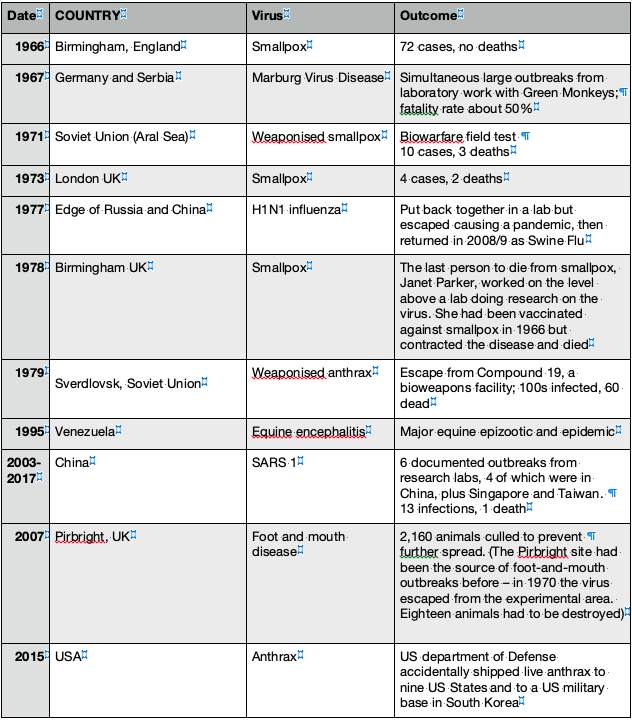
Vaccination does not give immunity from smallpox for life: A booster is required every few years. The last person to die from smallpox was Janet Parker, a photographer who worked on the floor above a lab in Birmingham, UK, where research on the virus was being conducted. She had been vaccinated against smallpox in 1966 but contracted the disease in 1978 when the virus escaped from the lab by an unknown route. She died some days later (see Table 1).
Introducing a virus or other microbe to a new host has historically been associated with problems. Before Jenner, inoculation with variola minor (smallpox from a sufferer with minor disease), had been used as a preventive measure in China as early as the tenth century.[15] Variolation, as it was termed, was introduced to the UK in 1717, but is reported to have killed 1 in 25. So Jenner’s experiments have to be viewed in the light of the contemporary practice, which was killing 4% of those inoculated.
What is more, as Greer Williams noted, variolation was an “excellent way of spreading the disease and starting new epidemics”.[16]
Yellow fever
In 1900 the French had given up on building the Panama Canal due to yellow fever decimating the workers. Eventually the disease was conquered in the region by a mosquito eradication programme based on the experiments of the US Army surgeon Major Walter Reed.[17] This success was crucial to the completion of the project in 1914.
But what is often forgotten is that a series of doctors and laboratory workers died trying to combat yellow fever. In 1900 Dr Jesse W. Lazear was the first researcher to die from yellow fever after he apparently allowed himself to be bitten by an infected mosquito as part of his experiments.[18] Between 1927 and 1930, yellow fever caused 32 laboratory infections, killing five people.[19]
As the research into viruses continued, so did the infection rate amongst the researchers and the death toll of researchers and those inoculated against diseases rose. I do not doubt that the final outcome was to the good of mankind, but occasionally a “vaccine” would go spectacularly wrong.
Polio
In the 1930s, 40s and 50s the infection that seemed to most frighten Western society was poliomyelitis. Perhaps it was because unlike with most infectious diseases, cleanliness did not seem to be a protection and exercising could be positively harmful. In fact polio struck those who were healthy and wealthy and was worse if the person was fit and active. Much effort was put into finding a vaccine and among the first to succeed was Dr Jonas Salk. There had been abortive attempts in the 1930s but the 1935 vaccination programme had actually killed people.
Salk was a meticulous researcher and his technique was excellent. Unfortunately this was not the case with all of the laboratories that prepared the vaccine for public use. In particular, the Cutter Laboratories failed to kill the virus and poliomyelitis was spread by their version of the Salk vaccine, paralysing and killing the recipients. Eventually the proper controls permitted the successful rollout of the killed vaccine. It was later replaced by an attenuated polio virus vaccine, which has nearly eliminated polio from the world. It will not, however, succeed in completely eliminating the disease, as the attenuated virus can revert to a wild form. Thus the final push may require the use, once again, of the killed virus polio vaccine.
The infection of laboratory workers with the microbes they were working on was so common that steps were introduced in the 1940s to prevent escape of the organisms. According to Wikipedia, the first prototype Class III (maximum containment) biosafety cabinet was fashioned in 1943 by Hubert Kaempf Jr., then a US Army soldier.[20] The regulations were enhanced and the escape of dangerous organisms decreased, but has never disappeared. This is clearly demonstrated in Table 1, which lists some, but by no means all, of the known lab leaks since the 1960s.
Escapes from bioweapons facilities
Whilst all of the incidents in the table are of interest, some are more worrying than others. In 1971 and 1979 there were outbreaks of smallpox and anthrax in the Soviet Union, caused by escapes of weaponised smallpox and weaponised anthrax from their own bioweapons facilities. In 1977 it is believed that a laboratory somewhere on the border of China and Russia put the H1N1 virus back together and it escaped and caused at least two pandemics. SARS1, which erupted first in 2003, later escaped from laboratories six times, four of which were in China, plus Singapore and Taiwan.[21]
The more you look at the table, the more you wonder if there is any virus that has not at some time escaped from a laboratory. Laboratory workers have told me that it is common for technicians to become infected with the organisms they are working with and their usual response in the past has been to take multivitamins and hydroxychloroquine.
Table 1: Some serious leaks of viruses from laboratories[22]k
The recent history of gain-of-function studies
Since 2010, GoF studies have increasingly focused on finding out whether non-pathogenic strains of viruses could be made infective and harmful to human beings.[23] This was supposedly in order to know whether or not the microbe was likely to be hazardous to human beings and then, if it was, devise vaccines and drugs against it.
In my opinion, such work simply increases the sum total of different pathogens that can affect human beings. When medical doctors are made aware of this type of research, they are usually speechless at the stupidity that anybody would contemplate doing such work. I now call such studies Make Another Disease (MAD) research.
This type of MAD research dramatically increased in laboratories in the USA between 2012 and 2014. The resulting accidents in which small outbreaks of novel viral diseases occurred led to three hundred scientists writing to the Obama administration asking for GoF to be stopped. The US Government responded by announcing a pause on the research in 2014 because of the inherent dangers.[24]
In the same year Dr Fauci, whose recorded belief was that the studies were worth the risk,[25] gave money from the NIH to Dr Daszak of Ecohealth Alliance to continue GoF research on coronaviruses.[26] This was carried out at the Wuhan Institute of Virology using genetically engineered humanized mice, culminating in reports in 2017 and 2018 that the researchers had successfully made harmless coronaviruses pathogenic to humans.[27]
In the autumn of 2019 the Covid-19 pandemic of SARS-2 started in Wuhan and, to date, over five million people across the world have died from the virus.
Are pandemics ever zoonotic?
In addition to stating erroneously that viruses only rarely escape from laboratories and/or that SARS-Cov-2 was unlikely to have done so, Drs Daszak and Fauci hold that most pandemics are zoonotic in origin. They say that pandemics start from a disease spreading from an animal but they do not state the time period involved. I would suggest that pandemics never occur from the immediate spread from an animal. In order for a pandemic to occur, a reservoir of the infection, adapted to human beings, must develop. This usually takes many years. Moreover the spread usually occurs due to the unnaturally large movement of people that occurs due to wars and famines.
I will give just a couple of well known examples.
When the Europeans invaded the Americas, 90% or more of the indigenous people of America died from the introduced diseases, which included measles, smallpox and mumps. In return, syphilis spread to Europe. Yes, the diseases had all arisen from animals initially, but the adaptation to make them pathogenic enough to cause a pandemic must have occurred over a period of the several thousand years during which the populations of Europe and America were separated.
AIDS was discovered in the early 1980s and it was soon clear that the Human Immunodeficiency Virus had arisen from the Simian Immunodeficiency Virus. However, studies have concluded that the first transmission of SIV to HIV in humans took place around 1920 in Kinshasa in the Democratic Republic of Congo (DR Congo),[28] so that it had at least 40–50 years of sporadic infection of human beings before it started to spread round the world as a pandemic. During that time there were many local wars in Africa and, of course, the 2nd World War.
In my book PANDEMIC, I document the world’s worst pandemics and conclude that it is only malaria that seems to be indifferent to wars, killing people whether or not there are hostilities. All other historical pandemics have at least some connection with war and occur when isolated groups with an endemic disease meet another group without the disease.
Conclusion
Thus historically we come to an impasse with SARS-CoV-2. This arose in a city many miles away from an animal population that might have harboured a similar virus, at a time when the supposed original host was dormant (late autumn), near a laboratory known to be working on the viruses. It then spread from person to person at an alarming rate and was seen to be totally adapted to human beings, to the extent that it was unable to even infect the bat it was supposed to have arisen from.
As a person who has studied the history of pandemics and lab leaks, imagine my surprise when authorities, not only in China but also in the USA and UK, stated categorically that the virus was obviously zoonotic and we were conspiracy theorists if we proposed the opposite. I had to conclude that they were misguided or purposely lying.
About the author: Professor Paul R Goddard BSc, MBBS, MD, DMRD, FRCR, FBIR, FHEA is Emeritus Professor, University of the West of England, Bristol; retired consultant radiologist; and former president of the Radiology Section of the Royal Society of Medicine. He is the author of PANDEMIC, A Personalised History of Plagues, Pestilence and War, Clinical Press Ltd, August 2020, and PANDEMIC, 2nd Edition 2021, Clinical Press, Bristol, available from Gazelle Book Services Ltd and good bookshops, ISBN 978-1-85-457105-2. On a similar theme, see The Origin of the Virus, Clinical Press 2021.
The above article is adapted from material that was first presented as the Long Fox lecture to The Bristol Medico-Chirurgical Society and Bristol University (2017) and to the British Society for the History of Medicine Biennial Congress (September 2021).
As the old says goes: “there’s no rest for the wicked.”
That’s certainly the case with vaccine mogul Bill Gates.
As the world finally gets an opportunity to take a breath easy – after being suffocated by two years of pandemic theatre and 24/7 government and corporate pharmaceutical propaganda, the notorious architect the global COVID-19 ‘vaccine’ roll-out, billionaire tech monopolist turned pharmaceutical scion, Bill Gates, is still determined to realize his life’s ambition of achieve 100% global vaccine compliance.
To keep the game going, Gates has reemerged from the shadows this week to prepare the public for “the next pandemic.”
Bill Gates said Friday that the risks of severe disease from Covid-19 have “dramatically reduced” but another pandemic is all but certain.
Speaking to CNBC’s Hadley Gamble at Germany’s annual Munich Security Conference, Gates, co-chair of the Bill & Melinda Gates Foundation, said that a potential new pandemic would likely stem from a different pathogen to that of the coronavirus family.
But he added that advances in medical technology should help the world do a better job of fighting it — if investments are made now.
“We’ll have another pandemic. It will be a different pathogen next time,” Gates said.
Initially, Gates had been actively promoting each and every ‘variant’ – constantly talking-up the crisis in order to help maintain the perception of a constant demand for the highly controversial experimental COVID-19 ‘vaccine’ gene-jabs. This includes the most recent media creation known as the “Omicron” variant. But as the public began shunning the booster shots en masse, the media gradually began the abandon the Omicron narrative. Gates has clearly read the propaganda tea leaves, and has since started backtracking from some of his previous positions – and is even admitting that natural immunity is more effective than the dubious pharmaceutical-based synthetic immunity he’s been pushing for the last two years through the media and his proxy organizations the World Health Organization (WHO) and the GAVI vaccine alliance.
Two years into the coronavirus pandemic, Gates said the worst effects have faded as huge swathes of the global population have gained some level of immunity. Its severity has also waned with the latest omicron variant.
However, Gates said that in many places that was due to virus itself, which creates a level of immunity, and has “done a better job of getting out to the world population than we have with vaccines.”
In order to further shield him from an increasing public backlash for his role in shamelessly promoting the ‘global pandemic’ and vaccine narratives, Gates has also carefully admitted the existence of comorbidities among the alleged COVID deaths.
“The chance of severe disease, which is mainly associated with being elderly and having obesity or diabetes, those risks are now dramatically reduced because of that infection exposure,” he said.
However, the vaccine kingpin is still lamenting his failure to reach 70% ‘penetration’ of the experimental mRNA toxic injections into the arms of the global population.
Gates said it was already “too late” to reach the World Health Organization’s goal to vaccinate 70% of the global population by mid-2022. Currently, 61.9% of the world population has received at least one dose of a Covid-19 vaccine.
He added that the world should move faster in the future to develop and distribute vaccines, calling on governments to invest now.
“Next time we should try and make it, instead of two years, we should make it more like six months,” Gates said, adding that standardized platforms, including messenger RNA (mRNA) technology, would make that possible.
It’s important for people to realize that Gates and his network are not finished in their plan to establish a global conveyor belt for experimental gene-based pharmaceutical injections – and he is already eyeing ‘the next pandemic’ in order to roll out the next phase of this globalist agenda. There is no shortage of funds either:
“The cost of being ready for the next pandemic is not that large. It’s not like climate change. If we’re rational, yes, the next time we’ll catch it early.”
Gates, through the Bill & Melinda Gates Foundation, has partnered with the U.K.’s Wellcome Trust to donate $300 million to the Coalition for Epidemic Preparedness Innovations, which helped form the Covax program to deliver vaccines to low- and middle-income countries.
The CEPI is aiming to raise $3.5 billion in an effort cut the time required to develop a new vaccine to just 100 days.
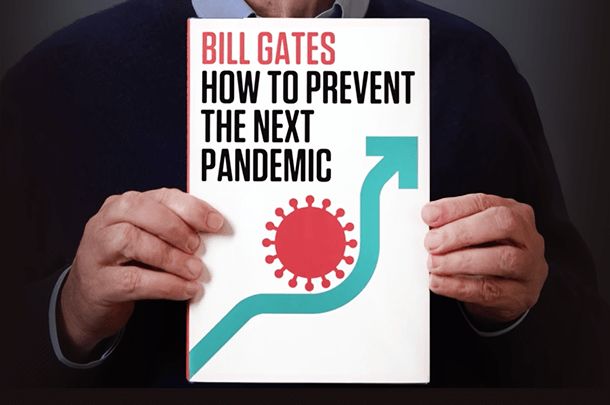
“I’ve been following COVID since the early days of the outbreak, working with experts from inside and out of the Gates Foundation who are championing a more equitable response and have been fighting infectious diseases for decades. I’ve learned a lot in the process—both about this pandemic and how we stop the next one—and I want to share what I’ve heard with people. So, I started writing a book about how we can make sure that no one suffers through a pandemic ever again.”
To mark the occasion, Gates released this disturbing propaganda video – littered with many of the staged images and government tropes used to reinforce the COVID ‘global pandemic’ crisis narrative since the winter of 2020. Watch:
In their Fifth Assessment Report the IPCC, the ‘internationally accepted scientific authority on climate change’, gave their opinion of how much of the recent global warming was caused by human activity: ‘It is extremely likely [95-100 percent confidence] more than half of the observed increase in global mean surface temperature from 1951 to 2010 was caused by the anthropogenic [i.e. man-made] increase in greenhouse gas concentrations and other anthropogenic forcings together’. Reflecting that opinion Wikipedia states that the ‘Scientific consensus on climate change’ is that ‘the Earth is warming and… this warming is mainly caused by human activities’. It claims that 97-100% of actively publishing climate scientists endorse this opinion. Similarly, NASA claim that, ‘A consensus on climate change and its human cause exists… human activities are the primary cause of the observed climate-warming trend over the past century.’ And in an October 2020 interview on CBS’s 60 Minutes climatologist Dr Michael Mann said, ‘There’s about as much scientific consensus about human-caused climate change as there is about gravity.’ So is it actually true that 97-100% of climate scientists explicitly or implicitly endorse this key IPCC opinion?
Although science is not remotely democratic (it only needs one scientist to prove that the ‘consensus view’ is wrong and it is wrong) the fact remains that if this 97-100% consensus assertion is true then it is indeed very powerful. If the ‘internationally accepted scientific authority on climate change’ says something is almost certainly true and almost all climate scientists in the world agree then it almost certainly must be true – mustn’t it? Whilst there is undoubtedly almost total scientific consensus amongst the scientific authorities (literally dozens of scientific academies from around the world explicitly or implicitly endorse the IPCC’s opinions) that does not necessarily reflect the consensus view amongst climate scientists themselves. So what exactly is it that climate scientists agree on?
The consensus argument is epitomized by Barack Obama’s 2013 tweet that, ‘Ninety-seven percent of scientists agree: climate change is real, man-made and dangerous’. He tweeted this immediately after the publication of the most famous climate change consensus survey, Quantifying the consensus on man-made global warming in the scientific literature (John Cook et al, 2013) conducted by Skeptical Science, a small group of climate change activists, who, despite their name, are precisely the opposite of climate change skeptics (their strapline is ‘Getting skeptical about global warming skepticism’). This study examined the Abstracts from 11,944 climate science papers published over the twenty-year period from 1991 to 2011. It concluded that 97.1% of the Abstracts (that actually expressed an opinion on the causes of global warming) endorsed the view that man-made greenhouse gas emissions (or, at least, greenhouse gases) cause global warming. Although this was 97% of Abstracts, not 97% of climate scientists, it is not unreasonable to suppose that, based on this survey, about 97% of climate scientists endorse the view that man-made greenhouse gas emissions (or, at least, greenhouse gases) cause global warming. It said nothing whatsoever about how much warming those emissions were causing and whether or not such warming was ‘dangerous’. It is probably the case that at least 99.9% of people who might describe themselves as climate scientists (including those most skeptical about the climate change crisis idea) endorse the view that man-made greenhouse gas emissions (or, at least, greenhouse gases) cause global warming, i.e. some global warming. That is not in any serious dispute. The dispute is about how much global warming human activity is causing and whether or not it is ‘dangerous’. So the study revealed nothing that was not already well known and uncontroversial.
Skeptical Science summarized their findings with the statement, ‘97% of climate papers expressing a position on human-caused global warming agree: global warming is happening and we are the cause’ – where ‘we are the cause’ clearly implied ‘we are the sole cause’ instead of what it actually found, viz. that we are the cause of some of the global warming. If the study had been able to show convincingly that 97% of climate scientists endorsed the IPCC’s opinion that human activity was the predominant cause of global warming between 1951 and 2010 then that would certainly have strongly supported the view that there was almost total scientific consensus that the IPCC was right. But of all the Abstracts reviewed in this study only 0.3% explicitly endorsed that central IPCC opinion1. Even (ex-IPCC) Mike Hulme has noted that, ‘The Cook et al study is hopelessly confused… in one place the paper claims to be exploring “the level of scientific consensus that human activity is very likely causing most of the current GW [Global Warming]” and yet the headline conclusion is based on rating abstracts according to whether “humans are causing global warming”. These are two entirely different judgements.’ The recently published paper Greater than 99% consensus on human caused climate change in the peer-reviewed scientific literature (Lynas et al, 2021) claims that the consensus is actually 2% higher – but once again only actually finds a 99% consensus that human activity contributes to climate change to some extent2; in fact about 99% of the papers reviewed in this study failed to explicitly quantify the extent. A survey3 of more than 1,800 climate scientists conducted in 2015 concluded that just 43% of them would endorse the IPCC opinion about our recent predominant role in global warming (and how many of them were agreeing based primarily on their faith in the IPCC and/or their self-interest in staying ‘on message’ to the climate change crisis narrative?)
Mike Hulme has stated that, ‘Claims such as “2,500 of the world’s leading scientists have reached a consensus that human activities are having a significant influence on the climate” are disingenuous. That particular consensus judgement, as are many others in the IPCC reports, is reached by only a few dozen experts.’ Supporting that view, an independent study4 found that the views expressed by the IPCC were the consensus of a leadership cadre of just 53 (about 2%) of them, 44 of whom were very closely linked professionally, having co-authored papers with one another and so very likely to share the same opinions. The author of the study, John McLean (climate data analyst at the Australian Climate Science Coalition and an Expert Reviewer for the IPCC’s Fifth Assessment Report), concluded that ‘Governments have naively and unwisely accepted the claims of a human influence on global temperatures made by a close-knit clique of a few dozen scientists, many of them climate modellers, as if they were representative of the opinion of the wider scientific community.’
One of the most comprehensive reviews5 ever performed of surveys of the scientific consensus on climate change concluded:
The articles and surveys most commonly cited as showing support for a ‘scientific consensus’ in favor of the catastrophic man-made global warming hypothesis are without exception methodologically flawed and often deliberately misleading.
There is no survey or study showing ‘consensus’ on the most important scientific issues in the climate change debate.
Extensive survey data show deep disagreement among scientists on scientific issues that must be resolved before the man-made global warming hypothesis can be validated. Many prominent experts and probably most working scientists disagree with the claims made by the United Nations’ Intergovernmental Panel on Climate Change (IPCC).
So what is the real scientific consensus on climate change? There is almost total scientific consensus that carbon dioxide concentrations in the atmosphere are increasing, that that increase is predominantly due to human activity, that the climate system is warming, that climate change is happening and that human activity has contributed to some extent to the warming, changing climate. Note again that skeptical scientists, like Dr Roy Spencer and Dr Judith Curry and Dr Richard Lindzen, are part of this ‘scientific consensus on climate change’; the idea that they constitute the 3% of scientists who do not support the scientific consensus on climate change is a false idea, misrepresenting what the ‘scientific consensus on climate change’ actually is6. This misrepresentation is designed to bolster the ‘climate change crisis’ narrative and to marginalize and neutralize the skeptical scientists by making their views appear to fall far outside the overwhelming consensus view, even though they actually share that consensus view. Basically, the ‘consensus’ breaks down over the issue of whether or not human activity has been predominantly responsible for recent warming – and whether or not that warming is ‘dangerous’. The power of the false ‘97% scientific consensus that human activity has been predominantly responsible for climate change’ meme, perpetuated by Wikipedia, NASA, Facebook (and many others) is that it can be used very effectively to strangle at birth any debate about the science. As Dr Richard Lindzen has put it, ‘The claim is meant to satisfy the non-expert that he or she has no need to understand the science. Mere agreement with the 97 percent will indicate that one is a supporter of science and superior to anyone denying disaster. This actually satisfies a psychological need for many people.’
So if we return to Dr Michael Mann’s statement that, ‘There’s about as much scientific consensus about human-caused climate change as there is about gravity’ this is very disingenuous. Whilst there is almost total scientific consensus that climate change is ‘real’ and happening and that there has been some human-caused influence, there is no such scientific consensus over the extent of the human-caused influence and whether or not it could reasonably be described as ‘dangerous’, let alone a ‘crisis’.
References
1 Legates et al. (2015), Science & Education and ‘Consensus? What Consensus?’, GWPF Note 5, thegwpf.org, September 2013 and ‘Richard Tol’s Excellent Summary of the Flaws in Cook et al. (2013) and ‘The Infamous 97% Consensus Paper’, wattsupwiththat.com, 26 March 2015 and ‘The Cook ‘97% consensus’ paper, exposed by new book for the fraud that it really is’, wattsupwiththat.com, 12 March 2016
2 ‘Cooked Up Consensus: Lynas et al “Should Rather Be Classified As Propaganda, Bad Science”’, wattsupwiththat.com, 26 October 2021
In 2020, I compiled a list of over 50 ways authorities and pharma companies in multiple countries stopped the use of the chloroquine drugs for COVID. This was (and is) a stunning collection,which has been widely read and reproduced on many websites. When you read it, you are astounded to learn that all the US (and many international) public health agencies took many different actions to increase deaths and destruction from COVID and prolong the pandemic. “Avoiding the Trump drug” served as a great cover story. Taking hydroxychloroquine for COVID was equated to drinking bleach.
But here’s the kicker: the authorities knew all about chloroquine and other treatments for COVID before there was a COVID… because they had figured it out for the 2002 SARS epidemic and the 2012 MERS epidemic, both caused by related coronaviruses. But they hushed it up.
Five CDC (US government) scientists published a paper, along with three Canadian government scientists, showing that chloroquine was an effective drug against SARS coronaviruses, in 2005. European scientists had shown the same thing in 2004.
It looked very promising for both prevention and treatment of the first SARS. After all, it has been used for many decades both to prevent and to treat malaria. (I took it for prevention, and later for treatment, 50 years ago.)
Nine years later, In 2014, scientists in Tony Fauci’s NIAID showed the same thing. Not only did chloroquine work in vitro against the MERS coronavirus, but dozens of existing drugs, which could have been tested in patients as soon as the pandemic started, were also effective against SARS and MERS coronaviruses.
Here we found that 66 of the screened drugs were effective at inhibiting either MERS-CoV or SARS-CoV infection in vitro and that 27 of these compounds were effective against both MERS-CoV and SARS-CoV. These data demonstrate the efficiency of screening approved or clinically developed drugs for identification of potential therapeutic options for emerging viral diseases and also provide an expedited approach for supporting off-label use of approved therapeutics.
Just in case you think these papers were flukes, two unrelated groups of European scientists found essentially the same thing. The 2014 European paper was published back to back with the NIAID paper above. I have cited the 2004 European paper elsewhere, and these citations can also be found in Bobby Kennedy’s book The Real Tony Fauci, which according to Amazon has now sold over 800,000 copies. Please read it. OTOH, If you are seeking misinformation on COVID, I’d recommend Fauci’s own book, Expect the Unexpected.
I have to repeat myself, because the information is so shocking and I don’t want you to miss it: our governments already knew of options for treating COVID before it appeared, but instead of immediately trying these already identified, safe, cheap, and available repurposed drugs, and offering early treatments, they did everything they could to stop people obtaining the chloroquine drugs. Look up the articles I linked to above. Read my long article on this suppression. Or the two articles I wrote here and here about how patients were administered borderline lethal doses of hydroxyhcloroquine to give the drug a black eye. Check the links. Verify that what I have just written is correct. Human beings planned and carried out these medical crimes against humanity. Who are those humans? What are they doing now?
This has to be be investigated and justice attained, to prevent such crimes from happening to patients ever again.
The “Why?” and “How could this be?!!” requires people to take a huge leap in order to understand the world we live in. Many don’t have the fortitude to dissect their world view and rebuild it in accord with the facts that have spilled out over the last two years.
But I am about to present some more facts that I hope you can assimilate into your understanding of the world. It might require a stiff drink, or perhaps some chocolate. Whatever it takes, read on, as it might save your life or someone else’s.
Ivermectin
Ivermectin had not been identified in the studies I mentioned above as a potentially useful coronavirus drug.
But some people knew it was likely to work in early 2020, because the French MedInCell company, supported by Bill Gates, was working on an injectable (which would make it patentable) version of ivermectin for COVID, issuing a press release about this on April 6, 2020 and an informational paper on April 23, 2020. There was a brief run on the veterinary drug at this time in the US, according to an FDA warning issued on April 10, 2020, indicating some people knew it might be an effective COVID treatment and were acquiring it. But there was not a lot of buzz and sales did not take off at that time.
Here is what FDA said on April 10, 2020:
FDA is concerned about the health of consumers who may self-medicate by taking ivermectin products intended for animals, thinking they can be a substitute for ivermectin intended for humans… Please help us protect public health by alerting FDA of anyone claiming to have a product to prevent or cure COVID-19 and to help safeguard human and animal health by reporting any of these products
In December 2020, a full eight months later, Ron Johnson held a Senate hearing that was focused on ivermectin’s benefits for COVID. Intensive care specialist Dr. Pierre Kory, originally a New Yorker, gave a particularly compelling speech. People began paying attention to the drug. YouTube then removed Kory’s speech–censoring a Senate hearing!
I think the authorities were initially scared to repeat the same tricks with ivermectin they had used to beat down the chloroquine drugs. And because ivermectin has efficacy late in the disease as well as at the start, and is not toxic at several times the normal dose, some of the tricks used against chloroquine (giving it too late in the disease course or overdosing patients) simply would not work with ivermectin. The authorities kept quiet.
But then ivermectin’s popularity started exploding. CDC published a report in late August showing that ivermectin prescriptions had quadrupled in a month, and the drug was now selling at 25 times the pre-COVID rate.
Apparently this terrified the powers-that-be. What if the pandemic got wiped out with ivermectin? It worked too well! Would that be the end of vaccine mandates, boosters, vaccine passports and digital IDs? The end of the Great Reset? Something had to be done, and fast. It had to be big. It had to be effective. They couldn’t simply take the drug off the market; that would require a long process and a paper trail.
What to do? There was probably only one option: Scare the pants off the doctors. Loss of license is the very worst thing you can do to a doctor. Threaten their licenses and they will immediately fall into line. You can’t get a prescription if there is no doctor to write it.
The powers-that-be could also scare the pharmacies. This required stealth. No paper trails. Intimidation was required, backed by a one-two punch: actually suspending doctors’ (annd maybe pharmacists’) licenses. You couple that with a huge media offensive, and threats from an industry of medical “non-profits.” You suddenly invent “misinformation” as a medical crime, studiously failing to define it. You make people think the legal prescribing of ivermectin and hydroxychloroquine is a crime, even though off-label prescribing is entirely legal under the federal Food, Drug and Cosmetic Act.
Did Fauci give the order? Walensky? Acting FDA Commissioner Woodcock? It was probably some combination, plus the public relations professionals managing the messaging and the media.
Here’s what happened.
1. Senator Ben Ray Lujan (D, NM) and several other Senators introduced the “Health Misinformation Act” in July 2021 because “misinformation was putting lives at risk,” he said. A huge supporter of COVID vaccinations, the 49 year old Senator suffered a stroke on February 1, 2022.
2. The pharmacies suddenly could not get ivermectin from their wholesalers. No reason was given except ‘supply and demand.’ But it seemed the supply was cut off everywhere. Ivermectin was dribbled out by the wholesalers, a few pills a week per pharmacy, not enough to supply even one prescription weekly. Some powerful entity presumably ordered the wholesalers to make the drug (practically) unavailable. With no shortages announced. I called the main manufacturer in the US, Edenbridge, and was told they were producing plenty.
Hydroxychloroquine had been restricted in a variety of ways, determined by each state, since early 2020. It had also been restricted by certain manufacturers in 2020. Suddenly, in September 2021, it too became considerably harder than it already was to obtain.
3. In late August, CDC sent out a major warning about ivermectin, but only gave 2 examples of anyone having a problem with the drug: one person overdosed on an animal version and one overdosed on ivermectin bought on the internet. This should not have been news. However, pharmacists and doctors read between the lines and knew this was code for “verboten.” Almost all stopped dispensing ivermectin at that time. It should be of interest to everyone that our health agencies now speak in coded messages to doctors and pharmacies, presumably to avoid putting their threats on paper and being accountable for them. What a way for government to do business.
4. Also last August, various “nonprofit” medical organizations started issuing warnings, in concert, regarding doctors prescribing ivermectin or hydroxychloroquine, and spreading misinformation, especially about COVID vaccines. These organizations included the Federation of State Medical Boards, the American Medical Association, the American Pharmacy Association, and several specialty Boards. Here is an example of the AMA’s language:
“A handful of doctors spreading disinformation have fostered belief in scientifically unvalidated and potentially dangerous “cures” for COVID-19 while increasing vaccine hesitancy…”
These organizations told doctors they could lose their licenses or board certifications for such “crimes.” Mind you, none of these so-called nonprofit organizations has any regulatory authority. Nor do I believe they have any authority to claw back a Board Certification. They were blowing smoke. And they were probably paid to do so. Who paid?
5. Over the course of 3 days at the end of August, national media reported on 4 doctors in 3 states whose Boards were investigating them for the use of ivermectin.
The Hawaii Medical Board has filed complaints against Maui’s top health official and a Valley Isle physician following reports that they backed COVID-19 treatments that state and federal health agencies advise against.
They really wanted to make an example by going after the state’s chief medical officer, who had had the guts to treat COVID patients. Clearly the orders are coming from high up on the food chain.
Here were some of the other August headlines about doctors who legally prescribed a fully approved drug off-label:
6. The Federation of State Medical Boards (FSMB) is an organization that assists 71 state and territorial medical boards with policies, training, etc. Members pay dues and the organization accepts donations. It has its own foundation, too. Its President earns close to $1,000,000/year, not bad for a backwater administrative job at an organization headquartered in Euless, Texas. After the FSMB instructed its members that misinformation was a crime, somewhere between 8 and 15 of its member boards began to take action. (Media have reported that 8, 12 or 15 boards of its 71 member Boards did so, according to the FSMB, which is closely monitoring this.)
7. On February 7, 2022 the Department of Homeland Security issued its own dire warning about the spread of misinformation, disinformation and a neologism, malinformation.
“The United States remains in a heightened threat environment fueled by several factors, including an online environment filled with false or misleading narratives and conspiracy theories, and other forms of mis- dis- and mal-information (MDM) introduced and/or amplified by foreign and domestic threat actors. These threat actors seek to exacerbate societal friction to sow discord and undermine public trust in government institutions to encourage unrest, which could potentially inspire acts of violence. Mass casualty attacks and other acts of targeted violence conducted by lone offenders and small groups acting in furtherance of ideological beliefs and/or personal grievances pose an ongoing threat to the nation.
Thus it appears that Misinformation and Disinformation have been selected to play an important role in a newly developing narrative, as the Pandemic restrictions and narrative come to an end.
8. I presume the majority of the 71 Medical Boards’ attorneys knew something about the Constitution, knew that every American has an inalienable right to freedom of speech, and simply ignored the FSMB’s exhortation to go after misinformatin spreaders. The Maine Board, however, went along. Three doctors in Maine have recently had their licenses suspended or threatened for writing waivers for COVID vaccines, spreading misinformation, and/or prescribing ivermectin and hydroxychloroquine. (All three of which are legal activities for doctors.). But Boards have broad powers to intervene, and are shielded from liability as agents of the state. So they went after a chronic Lyme doctor several years ago, who found, as expected, that it would be too onerous to fight back, and he gave up his license.
9. Here is what the Board claims about me:
“The board noted that Ivermectin isn’t Food and Drug Administration “authorized or approved” as a treatment for COVID-19 in the suspension order.”
“The board said that her continuing to practice as a physician “constitutes an immediate jeopardy to the health and physical safety of the public who might receive her medical services, and that it is necessary to immediately suspend her ability to practice medicine in order to adequately respond to this risk.”’
I am 70 years old, and my medical practice was set up as a service, so that everyone could access COVID drugs who wanted them. My fee was $60 per patient for all the COVID care they needed.
I am sure the Board had calculated that given all the above, I would not challenge the Board’s suspension and would simply surrender my license, since it would probably cost hundreds of thousands of dollars to fight the Board’s actions in court.
On the day my license was suspended, there was massive national publicity about my case. The story was on the AP wire, covered from the San Francisco Chronicle to the Miami Herald. And for some reason, it was not behind the usual paywall. The Hill, Newsweek, the Daily Beast and many other publications all ran hit pieces about me.
I realized that my situation was bigger than just a Maine issue: it had been selected to serve as an example to physicians nationwide who might be thinking for themselves and prescribing early treatment for COVID. Once I realized I was to be made an example of, as part of a national purge of doctors who think independently, I decided to fight back. Fortunately, Children’s Health Defense is helping with my legal expenses, which is what allows me to mount a strong attack against the bulldozing of free speech, patient autonomy and the doctor-patient relationship. Please join me in the fight!
Smedley Butler was one of the most decorated Marines in U.S. history, and by the end of his life he was also one of the most outspoken critics of the U.S. imperialism that he had spent most of his life enforcing. That contradiction between Butler the antiwar critic and Butler the builder of empire is at the heart of an important new book by Jonathan Katz, Gangsters of Capitalism: Smedley Butler, the Marines, and the Making and Breaking of America’s Empire. Katz’s book is an essential reminder of what the U.S. did during those decades and of the lasting effects that those interventions had on the countries where Butler went.
Butler took part in America’s so-called “small wars” in Asia, the Caribbean, and Central America in the early twentieth century. Like those wars, his military career has mostly been forgotten by the American public. That career was defined by aggressive military interventions on behalf of corporate interests, and by the end he was disgusted by it. As the author of War Is a Racket, Butler has been an inspiration to many antiwar and anti-imperialist Americans over the years, but he was also one of the military officers responsible for implementing destructive American colonialist designs at the expense of other nations. Twice awarded the Medal of Honor, he never believed he had done anything to deserve it, and the massacre that he took part in at Fort Rivière in Haiti haunted him.
In his later life, Butler came to see much of his career as a disreputable series of actions in the service of wealthy American interests, and he called himself a “racketeer for capitalism.” The racket he denounced was one that benefited a very few at the expense of the many. That core problem with our foreign policy that Butler identified almost ninety years ago is still very much with us. The U.S. still wages unnecessary wars based on flimsy pretexts against countries that cannot possibly threaten us, and today it also enables other wars with its weapons sales. The military budget grows every year despite the extraordinary physical security that the United States enjoys, and the hunt for new monsters to slay is unending. The racket is bigger and more destructive than ever.
Katz has produced a superb book in which he traces Butler’s steps from his first deployment to Cuba through his last mission in China. Through extensive use of Butler’s correspondence with his family, Katz is able to reconstruct to a remarkable degree what Butler thought about his various missions. Occasionally, there are flashes of anger at policies he was ordered to carry out that anticipate his later antiwar arguments. Appalled by the losses suffered during the invasion of Veracruz in 1914, he applauded his father’s belated vote in Congress against the mission. Katz writes, “The trauma fed Butler’s misgivings about the immorality and pointlessness of war.”
To read Butler’s story is to be reminded of our country’s long and ugly history of dominating many of our weaker neighbors. As Katz shows throughout the book, these countries are still living with the effects of those policies a century later. Katz traveled extensively to visit all the places where Butler served to learn more about his experiences and to document the legacy of the interventions in which Butler participated, and he bears witness to the lasting damage that U.S. policies have done. While most Americans know little or nothing about these interventions, many people in the affected countries still remember what U.S. forces did when they were there.
Butler is most loathed in Haiti, where he is viewed simply as “the Devil” and mechan (evil), because of his role in forcibly dissolving Haiti’s National Assembly to push through a new constitution, his reintroduction of a cruel system of forced labor, and the counterinsurgency campaign he waged against Haitian resistance to American rule. The Gendarmerie that Butler created became the national army and went on to interfere in and dominate Haitian politics for much of the rest of the century.
The outrages that the U.S. committed in its wars in the Philippines and Haiti, among other places, still affect how the U.S. is perceived today. The police and military institutions that the occupying U.S. authorities created in several countries became the apparatus of oppression used by later dictators, some of whom, like the Dominican Republic’s Trujillo, had been trained by the U.S. and became U.S. client rulers. During his brief time as the head of Philadelphia’s police force, Butler used the tactics he had employed against insurgents in other countries to fight “bandits” at home in an early example of the militarization of the police and the abuses that came with it.
The period of U.S. foreign policy between the start of the war with Spain and WWII is often wrongly described as “isolationist,” but no one can look at these decades of frequent, violent intervention in the affairs of other nations in the early twentieth century and still believe that. The U.S. took sides in Mexico’s civil war, it invaded other countries on the slightest pretext that a foreign rival might be gaining influence, and it militarily occupied some of them for years or decades. Like colonial empires the world over, the U.S. dominated weaker nations because it could and because its political leaders saw some economic advantage to be exploited.
While these interventions benefited private interests and were done on their behalf, they did nothing to make the United States more secure and were never really intended to. As Butler concluded in his later years, America’s colonial possessions in the Pacific only exposed the country to the dangers of a new, much larger war. “Sooner or later, if we hold onto them, America will be jerked into a damn war before we know what it’s all about,” Butler told a reporter in 1933. That was why he became an early supporter of independence for the Philippines as part of his broader antiwar advocacy. Butler did not live to see that prediction come true, but he was proven right eight years later.
Today there are still some neo-imperialists that look back on the “small wars” Butler fought as a model for how the U.S. should police the globe. Butler would be among the first to reject that idea out of hand. If his experience teaches us anything, it is that wars for empire cause tremendous harm to both the people being dominated and to the people sent to fight in those wars. Gangsters of Capitalism is an excellent account of Butler’s career, and it is also an outstanding history of the development of overseas American imperialism. The wars that Butler fought in anticipated and paved the way for the later militarization of U.S. foreign policy, and they serve as cautionary tales of the long-term harm that military intervention usually does to the nations that experience it. In order to find a way to stop the endless wars for good, we need to remember and learn from the brutal history of America’s empire-building.
Defending Australian Open Champion Novak Djokovic was deported from Australia, the day before commencement of 2022 tournament play. He entered the country on a visa including a medical exemption based on recent Covid infection. Due to public outry over “special treatment,” his visa was revoked upon arrival in the country, only to be reinstated by a court. It was later revoked by an immigration minister, whose decision was upheld by another court, sending Djokovic packing — potentially for three years.
This draconian act puts Djokovic at a serious disadvantage in his Grand Slam rivalry with Rafael Nadal, who is competing in Australia this year after vocally supporting vaccines. Both champions, along with Roger Federer, currently hold 20 Grand Slam titles. Djokovic was favored to be the first to reach 21, but his decision to remain unvaccinated leaves Nadal alone with that opportunity for now. (Federer is out recovering from surgery.)
Djokovic was technically deported for not being vaccinated, but the decision lacks even a superficial “health and safety” justification. Djokovic already had Covid twice, once in early 2020 and again in December 2021. At the time of his deportation, he had been in Australia for ten days, and tested negative. He’s as healthy as a human being can be — you don’t earn “GOAT’ status in the difficult sport of tennis any other way.
Further proof that Djokovic poses no disease threat to anyone is the fact that this tournament was safely played in January 2021, before vaccines were available for any player or guest. Even if Djokovic had taken the vaccine, he’d be no “safer” in terms of his ability to transmit the virus, as the 100,000 daily cases in highly-vaccinated Australia attest.
Even the government that deported Djokovic didn’t try very hard to frame its decision as the elimination of a health threat. Rather, it stated that Novak could become an “icon of free choice” if allowed to stay. Ironically, he will undoubtedly become that now that he’s made the supreme sacrifice of forfeiting his chance to play in order to openly oppose mandatory vaccination.
It’s not a good look for the Covid Regime if an avowed “anti-vaxxer” dominates the sport. The world audience might start thinking about the relative health status of “unvaccinated” people, particularly since athletes have been experiencing heart trouble all over the world — several already at the Australian Open practice courts.
As it stands, Millions of Australians and others who have already taken the vaccine applaud the government’s decision. They can’t get the vaccine out of their bodies, so the next best thing is to make sure that everyone else has to put themselves into the same spot.
Nevermind the precedent it sets to allow a government to force people to choose between their health and their career. Such Sophie’s choices are normal these days.
The Regime would not have minded Djokovic playing in an unvaccinated state so long as he publicly expressed support for mandatory universal vaccination. He could have easily done this — a hero in Serbia, the wealthy star could have tapped any number of doctors to provide fake certification of vaccination. But that would have violated his principles.
In 2010, an “unwell” Djokovic was collapsing at tournaments, unable to complete strenuous matches. A doctor witnessing his condition on TV got in touch with the athlete, recommending that he eliminate gluten, dairy and processed sugar from his diet. Novak thought it sounded strange but agreed to try, and it’s hard to argue with his results. His 2011 season was one of the best in men’s tennis history. On his new fuel, he was unstoppable. He ended the season with an unbelievable 10–1 record against Nadal and Federer, and compiled a 41-match winning streak.
This experience changed not only the tennis player. It fundamentally changed the man, as Djokovic explains in his book “Serve to Win”:
When it’s not being cared for, your body will send you signals: fatigue, insomnia, cramps, flus, colds, allergies. When that happens, will you ask yourself the questions that matter? Will you answer honestly and with an open mind?
Open-minded people radiate positive energy. Closed-minded people radiate negativity. Eastern medicine teaches you to align mind, body, and soul. If you have positive feelings in your mind — love, joy, happiness — they affect your body… But a lot of people, especially closed-minded people, are led by fear. That and anger are the most negative energies we have. What are closed-minded people afraid of? It could be many things: Fear that they are wrong, fear that someone might have a better way, fear that something has to change. Fear limits your ability to live your life.
Some people at the top feed off of negativity. The way I see it, pharmaceutical and food companies want people to feel fear. They want people to be sick. How many TV ads are for fast foods and medicines? And what’s at the root of those messages? We’ll make you feel better with our products. But even deeper down: We’ll make you fear that you don’t have enough of the things we say you need. It’s crazy — even when you’re completely healthy, they say you need [products] to stay that way.
Here’s a pattern I’d rather embrace: good food, exercise, openness, positive energy, great results. I’ve been living that pattern for several years now. It works better than the alternative.
Djokovic rejects Big food, Big Ag, Big Chemical, and Big Pharma. He doesn’t need them. His practices allow him to be healthy without any of their products — in fact, he’s achieved an elite level of health by actively avoiding their products.
There is no greater threat to the bottom line of these companies than people like Novak Djokovic. He is not scared, he is not anxious, so he can’t be manipulated or sold an easy fix. He can see the path to health takes hard work, and he’s willing to put it in. When they tell him that he can’t be healthy without a vaccine, he laughs in their faces. They can send him packing, but they can never take away his integrity and self-worth.
Novak Djokovic doesn’t want to lie to the public, making it appear as if he agrees with The System’s “path to health.” If he did that, he would get to play his tournament, but he would have millions of lives on his conscience. He’d rather give up his career’s crowning achievement in order to stand in truth. To send people the message: you CAN reject this tyranny. You do NOT have to comply. You can SAY NO, and you will be okay.
It’s easier for him, yes, with his millions of dollars. Healthcare workers on a middle-class salary will have a harder go of it. Military members faced with dishonorable discharge absent vaccination have it worse. But Djokovic has made it easier, at least, for everyone to publicly reject vaccination. If Novak openly rejects this vaccine, they can too, without shame. His very public deportation will hopefully get many people thinking about his approach to health, which if widely understood and adopted, will finally burn the Covid Regime to the ground — once and for all.
Stacey Rudin is an attorney and writer in New Jersey, USA.
In 2019 Netflix in conjunction with WWF broadcast Frozen Worlds, an episode in the Our Planet series and narrated by David Attenborough. The scenes it showed shocked and horrified viewers around the world.
After a brief introduction about the recent loss of Arctic summer sea ice and the ‘inevitable’ devastation this will cause for Arctic animals, it shifts to a series of amazing shots of tens of thousands of walrus, crowded cheek-by-jowl on a beach in Siberia.
The camera pans out to a rocky cliff, which several walrus are attempting to climb. Then suddenly, one after another, the walrus are shown falling off the cliff to their deaths on the rocky shore below.The scenes are shown in slow motion and repeated in order to maximise the shock effect.
As the scenes unfold, Attenborough coolly informs viewers that the walrus would not normally be there, but out on the sea ice instead. But because of man-made global warming, the poor walrus have been forced onto land in crowded conditions, where they will inevitably suffer and die.
But was it all as simple as Attenborough portrayed?
A number of suspicions were immediately evident. Far from these beach haulouts being unusual, walrus in fact regularly use these beaches every year, in order to rest and feed while waiting for the sea ice to move south in autumn.
Walrus also invariably crowd together in these situations, both for warmth and protection from polar bears. Indeed, far from walrus being threatened by climate change, their populations have been growing in recent years, explaining why so many were hauled out that day.
And what made those walrus try to climb the cliff?
Dr Susan Crockford is a professional zoologist, who has specialised in Arctic mammals for many years, particularly polar bears and walrus. She immediately smelled a rat.
Her newly released book, Fallen Icon, tells the story of how she uncovered exactly what went on that day on the Siberian beach. Her detective work reveals how it was polar bears stalking them that forced the walrus up that cliff; how this is a common hunting tactic and how the bears then fed off the carcasses down below.
She uncovers evidence that WWF already knew about this hunting tactic at that particular location, and that was precisely why this beach was chosen for the film.
She goes on to describe how retreating sea ice actually increases the food supply for walrus and how their populations are both healthy and increasing.
And how Attenborough used this horrifying imagery to jump-start a three year campaign against human-caused global warming that included ten documentaries laden with groundless climate emergency messaging, much of it aimed at the wealthiest and most powerful people in the world. Attenborough’s relentless climate activism included a utopian vision of global changes for society eerily similar to the one proposed by the World Economic Forum.
It is hard to disagree with Crockford’s conclusions:
The public’s trust in science and medicine now appears to be at an all-time low. People who had been blind to the abuse of science rampant in the climate change narrative have had their eyes opened by the pandemic response. These things cannot be unseen.
In a worrying trend, traditional scientists struggle to be heard or have their concerns and criticisms published, both for climate change and Covid-19 related issues. Research that features testable hypotheses and reproducible studies seem to be rare birds while predictive modelling projects gobble up grant funds as well as the media attention.
Is science as we used to know it already dead? If so, how much of a role has Attenborough played in this progression? Over the last three years, he has used weaponized science presented to a trusting public in a most egregious manner.
My ultimate goal in writing this book is not to denigrate Sir David but to correct the misinformation he has deliberately or unwittingly promoted in his documentaries and public statements.
I am a traditional scientist standing up for science as it is meant to be – without activism and without politicization – because its loss to society will be incalculable.
Over the years but especially since 2018, Attenborough has shown that he lets others do his serious thinking for him and has often placed his trust where it was ill-advised, as he has done with the WWF. By that I mean he has relied on others to present information to him in an easily digestible manner rather than delving into the literature himself.
And having spent a lifetime taking this easy way out, when he decided he wanted his legacy to be something more substantial than ‘a good storyteller’, he seemed to take on the role of spokesman for others with ideological political agendas.
It appears to me that when he agreed to present the gruesome falling walrus film footage in Our Planet as evidence of climate change, Attenborough compromised his principles to achieve a specific end result. Such noble cause corruption is common in the conservation world but it was new for Attenborough.
I am convinced that what Attenborough has done with the falling walrus episode will be remembered long after he’s dead but not for the reasons he intended. It will go down as another ‘own goal’ for the climate change movement and judged as the moment Attenborough fell from grace as a trusted British icon.
Susan Crockford’s book is now available on Amazon here:
As I point out in my new book, Fallen Icon, David Attenborough devised a three year campaign on the falsehood that hundreds of Russian walrus died falling off a cliff due to climate change because he also desired what the World Economic Forum (WEF), meeting online this week, say they want: immediate and drastic changes, supposedly to mitigate an invisible ‘climate emergency’ and other societal ills.
Despite the fact that walrus and polar bears are thriving in the Arctic, this fabricated ’emergency’ seems to be the reason that its new chairman plans to make the G7 into a ‘climate club’.
'Change only works if it is by the people, for the people.'
The following is adapted from a talk delivered at Hillsdale College on November 7, 2021, during a Center for Constructive Alternatives conference on “The Great Reset.”
Is the Great Reset a conspiracy theory imagining a vast left-wing plot to establish a totalitarian one-world government? No. Despite the fact that some people may have spun conspiracy theories based on it—with some reason, as we will see—the Great Reset is real.
Indeed, just last year, Klaus Schwab, founder and executive chairman of the World Economic Forum (WEF)—a famous organization made up of the world’s political, economic, and cultural elites that meets annually in Davos, Switzerland—and Thierry Malleret, co-founder and main author of the Monthly Barometer, published a book called COVID-19: The Great Reset.
In the book, they define the Great Reset as a means of addressing the “weaknesses of capitalism” that were purportedly exposed by the COVID pandemic.
But the idea of the Great Reset goes back much further. It can be traced at least as far back as the inception of the WEF, originally founded as the European Management Forum, in 1971. In that same year, Schwab, an engineer and economist by training, published his first book, Modern Enterprise Management in Mechanical Engineering.
It was in this book that Schwab first introduced the concept he would later call “stakeholder capitalism,” arguing “that the management of a modern enterprise must serve not only shareholders but all stakeholders to achieve long-term growth and prosperity.” Schwab and the WEF have promoted the idea of stakeholder capitalism ever since. They can take credit for the stakeholder and public-private partnership rhetoric and policies embraced by governments, corporations, non-governmental organizations, and international governance bodies worldwide.
The specific phrase “Great Reset” came into general circulation over a decade ago, with the publication of a 2010 book, The Great Reset, by American urban studies scholar Richard Florida. Written in the aftermath of the 2008 financial crisis, Florida’s book argued that the 2008 economic crash was the latest in a series of Great Resets—including the Long Depression of the 1870s and the Great Depression of the 1930s—which he defined as periods of paradigm-shifting systemic innovation.
Four years after Florida’s book was published, at the 2014 annual meeting of the WEF, Schwab declared: “What we want to do in Davos this year . . . is to push the reset button”—and subsequently the image of a reset button would appear on the WEF’s website.
In 2018 and 2019, the WEF organized two events that became the primary inspiration for the current Great Reset project—and also, for obvious reasons, fresh fodder for conspiracy theorists. (Don’t blame me for the latter—all I’m doing is relating the historical facts.)
In May 2018, the WEF collaborated with the Johns Hopkins Center for Health Security to conduct “CLADE X,” a simulation of a national pandemic response. Specifically, the exercise simulated the outbreak of a novel strain of a human parainfluenza virus, with genetic elements of the Nipah virus, called CLADE X.
The simulation ended with a news report stating that in the face of CLADE X, without effective vaccines, “experts tell us that we could eventually see 30 to 40 million deaths in the U.S. and more than 900 million around the world—twelve percent of the global population.” Clearly, preparation for a global pandemic was in order.
In October 2019, the WEF collaborated with Johns Hopkins and the Bill and Melinda Gates Foundation on another pandemic exercise, “Event 201,” which simulated an international response to the outbreak of a novel coronavirus. This was two months before the COVID outbreak in China became news and five months before the World Health Organization declared it a pandemic, and it closely resembled the future COVID scenario, including incorporating the idea of asymptomatic spread.
The CLADE X and Event 201 simulations anticipated almost every eventuality of the actual COVID crisis, most notably the responses by governments, health agencies, the media, tech companies, and elements of the public. The responses and their effects included worldwide lockdowns, the collapse of businesses and industries, the adoption of biometric surveillance technologies, an emphasis on social media censorship to combat “misinformation,” the flooding of social and legacy media with “authoritative sources,” widespread riots, and mass unemployment.
In addition to being promoted as a response to COVID, the Great Reset is promoted as a response to climate change. In 2017, the WEF published a paper entitled, “We Need to Reset the Global Operating System to Achieve the [United Nations Sustainable Development Goals].” On June 13, 2019, the WEF signed a Memorandum of Understanding with the United Nations to form a partnership to advance the “UN 2030 Agenda for Sustainable Development.”
Shortly after that, the WEF published the “United Nations-World Economic Forum Strategic Partnership Framework for the 2030 Agenda,” promising to help finance the UN’s climate change agenda and committing the WEF to help the UN “meet the needs of the Fourth Industrial Revolution,” including providing assets and expertise for “digital governance.”
In June 2020, at its 50th annual meeting, the WEF announced the Great Reset’s official launch, and a month later Schwab and Malleret published their book on COVID and the Great Reset.
The book declared that COVID represents an “opportunity [that] can be seized”; that “we should take advantage of this unprecedented opportunity to reimagine our world”; that “the moment must be seized to take advantage of this unique window of opportunity”; and that “[f]or those fortunate enough to find themselves in industries ‘naturally’ resilient to the pandemic”—think here of Big Tech companies like Apple, Google, Facebook, and Amazon—“the crisis was not only more bearable, but even a source of profitable opportunities at a time of distress for the majority.”
The Great Reset aims to usher in a bewildering economic amalgam—Schwab’s stakeholder capitalism—which I have called “corporate socialism” and Italian philosopher Giorgio Agamben has called “communist capitalism.”
In brief, stakeholder capitalism involves the behavioral modification of corporations to benefit not shareholders, but stakeholders—individuals and groups that stand to benefit or lose from corporate behavior. Stakeholder capitalism requires not only corporate responses to pandemics and ecological issues such as climate change, “but also rethinking [corporations’] commitments to already-vulnerable communities within their ecosystems.”
This is the “social justice” aspect of the Great Reset. To comply with that, governments, banks, and asset managers use the Environmental, Social, and Governance (ESG) index to squeeze non-woke corporations and businesses out of the market. The ESG index is essentially a social credit score that is used to drive ownership and control of production away from the non-woke or non-compliant.
One of the WEF’s many powerful “strategic partners,” BlackRock, Inc., the world’s largest asset manager, is solidly behind the stakeholder model. In a 2021 letter to CEOs, BlackRock CEO Larry Fink declared that “climate risk is investment risk,” and “the creation of sustainable index investments has enabled a massive acceleration of capital towards companies better prepared to address climate risk.” The COVID pandemic, Fink wrote, accelerated the flow of funds toward sustainable investments:
We have long believed that our clients, as shareholders in your company, will benefit if you can create enduring, sustainable value for all of your stakeholders. . . . As more and more investors choose to tilt their investments towards sustainability-focused companies, the tectonic shift we are seeing will accelerate further.
And because this will have such a dramatic impact on how capital is allocated, every management team and board will need to consider how this will impact their company’s stock.
Fink’s letter is more than a report to CEOs.
It is an implicit threat: be woke or else.
In their recent book on the Great Reset, Schwab and Malleret pit “stakeholder capitalism” against “neoliberalism,” defining the latter as “a corpus of ideas and policies . . . favouring competition over solidarity, creative destruction over government intervention, and economic growth over social welfare.” In other words, “neoliberalism” refers to the free enterprise system. In opposing that system, stakeholder capitalism entails corporate cooperation with the state and vastly increased government intervention in the economy.
Proponents of the Great Reset hold “neoliberalism” responsible for our economic woes. But in truth, the governmental favoring of industries and players within industries—what used to be known as corporatism or economic fascism—has been the real source of what Schwab and his allies at the WEF decry.
While approved corporations are not necessarily monopolies, the tendency of the Great Reset is toward monopolization—vesting as much control over production and distribution in as few favored corporations as possible, while eliminating industries and producers deemed non-essential or inimical. To bring this reset about, Schwab writes, “[e]very country, from the United States to China, must participate, and every industry, from oil and gas to tech, must be transformed.”
Another way of describing the goal of the Great Reset is “capitalism with Chinese characteristics”—a two-tiered economy, with profitable monopolies and the state on top and socialism for the majority below.
Several decades ago, as China’s growing reliance on the for-profit sectors of its economy could no longer be credibly denied by the Chinese Communist Party (CCP), its leadership approved the slogan “socialism with Chinese characteristics” to describe its economic system. Formulated by Deng Xiaoping, the phrase was meant to rationalize the CCP’s allowance of for-profit development under a socialist political system.
The CCP considered the privatization of the Chinese economy to be a temporary phase—lasting as long as 100 years if necessary—on the way to a communist society. Party leaders maintain that this approach has been necessary in China because socialism was introduced too early there, when China was a backward agrarian country. China needed a capitalist booster shot.
Stripped of its socialist ideological pretensions, the Chinese system amounts to a socialist or communist state increasingly funded by capitalist economic development. The difference between the former Soviet Union and contemporary China is that when it became obvious that a socialist economy had failed, the former gave up its socialist economic pretenses, while the latter has not.
The Great Reset represents the development of the Chinese system in the West, but in reverse. Whereas the Chinese political class began with a socialist political system and then introduced privately held for-profit production, the West began with capitalism and is now implementing a Chinese-style political system. This Chinese-style system includes vastly increased state intervention in the economy, on the one hand, and on the other, the kind of authoritarian measures that the Chinese government uses to control its population.
Schwab and Malleret write that if “the past five centuries in Europe and America” have taught us anything, it is that “acute crises contribute to boosting the power of the state. It’s always been the case and there is no reason it should be different with the COVID-19 pandemic.”
The draconian lockdown measures employed by Western governments managed to accomplish goals of which corporate socialists in the WEF could only dream—above all, the destruction of small businesses, eliminating competitors for corporate monopolists favored by the state. In the U.S. alone, according to the Foundation for Economic Education, millions of small businesses closed their doors due to the lockdowns.
Yelp data indicates that 60 percent of those closures are now permanent. Meanwhile companies like Amazon, Apple, Facebook, and Google enjoyed record gains.
Other developments that advance the Great Reset agenda have included unfettered immigration, travel restrictions for otherwise legal border crossing, the Federal Reserve’s unrestrained printing of money and the subsequent inflation, increased taxation, increased dependence on the state, broken supply chains, the restrictions and job losses due to vaccine mandates, and the prospect of personal carbon allowances.
Such policies reflect the “fairness” aspect of the Great Reset—fairness requires lowering the economic status of people in wealthier nations like the U.S. relative to that of people in poorer regions of the world.
One of the functions of woke ideology is to make the majority in developed countries feel guilty about their wealth, which the elites aim to reset downwards—except, one notices, for the elites themselves, who need to be rich in order to fly in their private jets to Davos each year.
The Great Reset’s corporate stakeholder model overlaps with its governance and geopolitical model: states and favored corporations are combined in public-private partnerships and together have control of governance. This corporate-state hybrid is largely unaccountable to the constituents of national governments.
Governance is not only increasingly privatized, but also and more importantly, corporations are deputized as major additions to governments and intergovernmental bodies. The state is thereby extended, enhanced, and augmented by the addition of enormous corporate assets. As such, corporations become what I have called “governmentalities”—otherwise private organizations wielded as state apparatuses, with no obligation to answer to pesky voters.
Since these corporations are multinational, the state essentially becomes globalist, whether or not a one-world government is ever formalized.
As if the economic and governmental resets were not dramatic enough, the technological reset reads like a dystopian science fiction novel. It is based on the Fourth Industrial Revolution—or 4-IR for short. The first, second, and third industrial revolutions were the mechanical, electrical, and digital revolutions. The 4-IR marks the convergence of existing and emerging fields, including Big Data, artificial intelligence, machine learning, quantum computing, genetics, nanotechnology, and robotics.
The foreseen result will be the merging of the physical, digital, and biological worlds, which presents a challenge to the ontologies by which we understand ourselves and the world, including the definition of a human being.
There is nothing original about this. Transhumanists and Singularitarians (prophets of technological singularity) such as Ray Kurzweil forecasted these and other revolutionary developments long ago. What’s different about the globalists’ vision of 4-IR is the attempt to harness it to the ends of the Great Reset.
If already existing 4-IR developments are any indication of the future, then the claim that it will contribute to human happiness is false.
These developments include Internet algorithms that feed users prescribed news and advertisements and downrank or exclude banned content; algorithms that censor social media content and consign “dangerous” individuals and organizations to digital gulags; “keyword warrants” based on search engine inputs; apps that track and trace COVID violations and report offenders to the police; robot police with scanners to identify and round up the unvaccinated and other dissidents; and smart cities where residents are digital entities to be monitored, surveilled, and recorded, and where data on their every move is collected, collated, stored, and attached to a digital identity and a social credit score.
In short, 4-IR technologies subject human beings to a kind of technological management that makes surveillance by the NSA look like child’s play. Schwab goes so far as to cheer developments that aim to connect human brains directly to the cloud for the sake of “data mining” our thoughts and memories. If successful, this would constitute a technological mastery over decision-making that would threaten human autonomy and undermine free will.
The 4-IR seeks to accelerate the merging of humans and machines, resulting in a world in which all information, including genetic information, is shared, and every action, thought, and motivation is known, predicted, and possibly precluded. Unless taken out of the hands of corporate-socialist technocrats, the 4-IR will eventually lead to a virtual and inescapable prison of body and mind.
In terms of the social order, the Great Reset promises inclusion in a shared destiny. But the subordination of so-called “netizens” implies economic and political disenfranchisement, a hyper-vigilance over self and others, and social isolation—or what Hannah Arendt called “organized loneliness”—on a global scale.
This organized loneliness is already manifest in lockdowns, masking, social distancing, and the social exclusion of the unvaccinated. The title of the Ad Council’s March 2020 public service announcement—“Alone Together”—perfectly captures this sense of organized loneliness.
In my recent book, Google Archipelago, I argued that leftist authoritarianism is the political ideology and modus operandi of what I call Big Digital, which is on the leading edge of a nascent world system. Big Digital is the communications, ideological, and technological arm of an emerging corporate-socialist totalitarianism. The Great Reset is the name that has since been given to the project of establishing this world system.
Just as Schwab and the WEF predicted, the COVID crisis has accelerated the Great Reset. Monopolistic corporations have consolidated their grip on the economy from above, while socialism continues to advance for the rest of us below. In partnership with Big Digital, Big Pharma, the mainstream media, national and international health agencies, and compliant populations, hitherto democratic Western states—think especially of Australia, New Zealand, and Austria—are being transformed into totalitarian regimes modeled after China.
But let me end on a note of hope. Because the goals of the Great Reset depend on the obliteration not only of free markets, but of individual liberty and free will, it is, perhaps ironically, unsustainable. Like earlier attempts at totalitarianism, the Great Reset is doomed to ultimate failure. That doesn’t mean, however, that it won’t, again like those earlier attempts, leave a lot of destruction in its wake—which is all the more reason to oppose it now and with all our might.
About the author: Michael Rectenwald is the chief academic officer for American Scholars. He has a B.A. from the University of Pittsburgh, an M.A. from Case Western Reserve University, and a Ph.D. in Literary and Cultural Studies from Carnegie Mellon University. He has taught at New York University, Duke University, North Carolina Central University, Carnegie Mellon University, and Case Western Reserve University. He is the author of numerous books, including Nineteenth-Century British Secularism: Science, Religion, and Literature; Google Archipelago; Beyond Woke; and Thought Criminal.
AMONG MANY widely embraced illusions about the history of the Middle East and American diplomacy in general is that Dr. Henry A. Kissinger is or ever was a brilliant statesman.
What Kissinger has always been, and remains at age 98, is a brilliant self-promoter. His more than 3,000 pages of self-aggrandizing published memoirs—a record unmatched in the annals of American diplomacy—reflect an ego trip befitting a man famous for his “shuttle diplomacy.”
Millions of Americans have been taken in by Kissinger’s Harvard credentials, his deft manipulation of the news media and his gravelly Old World-accent that supposedly resonates the wisdom of the ages. The latest of Kissinger’s easily duped admirers is the Israeli apologist Martin Indyk, the author of the recent book Master of the Game: Henry Kissinger and the Art of Middle East Diplomacy. In this astonishingly shallow book, as well as a recent webinar sponsored by the Middle East Institute, Indyk lauds Kissinger for his step-by-step approach to Middle East diplomacy, which he credits with giving rise to the Oslo “peace process.” The Oslo framework—a fraud that has enabled the ongoing and illegal settler occupation of Palestine—has been thoroughly discredited, yet Indyk argues with a straight face that it offers the only viable path to peace. None of this is a surprise, as Indyk, a former U.S. ambassador to Israel, has long been a member in good standing of the Israel lobby and a cheerleader for Zionist state aggression and the repression of Palestinians. One can expect nothing less—he was first executive director of AIPAC’s think tank, the Washington Institute for Near East Policy (WINEP).
Even Indyk admits that when Kissinger entered the Nixon White House, he was a Eurocentric “Orientalist” who “didn’t know anything about the Arab world by his own admission.” On the other hand, Kissinger was a dedicated Zionist, which had led him to visit Israel six times prior to his executive appointment. Kissinger—like Indyk and a series of U.S. diplomats, from Dennis Ross to Secretary of State Antony Blinken today—sided unequivocally with Israel and against justice for Palestinians.
Indyk showers credit on Kissinger for bailing out Israel in the October 1973 war and for his subsequent much glorified shuttle diplomacy, while glossing over the fact that Kissinger had sabotaged Secretary of State William Rogers’ peace plan based on U.N. Resolution 242, in the aftermath of the June 1967 war. By pushing Rogers aside, the ever-opportunistic Kissinger took over his job in the Nixon and later Ford White Houses.
Indyk chides Kissinger for not pursuing a “Jordanian solution” to the Palestine conflict, but Kissinger had no interest in Palestine, which, as he explained in 1974, was “not an American interest, because we don’t care if Israel keeps the West Bank if it can get away with it. So, we won’t push it.” Here we see the real Kissinger—utterly disdainful of the U.N., the Palestinian quest for peace, justice and human rights, just as he disdained the cause of other dark-skinned peoples across the world, including millions of Asians, Latin Americans and Africans.
In 1975, Kissinger expressed regret albeit privately, explaining, “I am sorry that I did not support the Rogers effort” to forge a peace accord. He acknowledged that a diplomatic agreement with Egypt could have been negotiated that “would have prevented the 1973 war.” Kissinger thus admitted that his ignorance and disdain for the Arab and Palestinian position had precluded a peace accord and brought on a major war. Failing to prevent war and further militarizing the Middle East conflict were the hallmarks of Kissinger’s failed statesmanship.
Both Richard Nixon and Gerald Ford made sporadic attempts to act as honest brokers in the Middle East, occurrences that left Kissinger caught between the administrations and Israel. When Israel and the lobby publicly criticized Kissinger amid a dispute over military resupply during the short-lived Ford administration, Kissinger in a “crying voice” prostrated himself before the Israeli ambassador to the United States, Simcha Dinitz, pleading that he “was a Jew before I was an American and now you are making me the scapegoat.” He added—in a vivid example of the extent of Israeli influence over American diplomacy—“I showed you messages, telegrams and wires from the Soviet Union and Egypt,” only to be criticized publicly in return.
In addition to his bungling Middle East diplomacy, Kissinger infamously green-lighted the undermining of Chilean, Argentinian and other Latin American democracies; bolstered apartheid in southern Africa; signed off on a murderous Indonesian assault on East Timor; and gave a thumbs up to Pakistan’s genocidal attack on Bangladesh. Even the much ballyhooed and long overdue détente with Russia and China, for which Kissinger has claimed enormous credit, stemmed from a misguided hope that the great powers could compel the North Vietnamese to grant the United States “peace with honor” amid the massive, failed Indochina intervention. Nixon and Kissinger prolonged the Vietnam War for four years, achieving nothing but a wider degree of death and destruction in the process.
Upon his death, Kissinger no doubt will be lauded, his mythical overseas accomplishments celebrated for days on end. But beneath the veneer of statesmanship the actual historical record reveals the true Kissinger: a deeply flawed diplomat who nurtured utter contempt for justice, human rights and peace. (Even Indyk admitted Kissinger had “quite a jaundiced view of peace,” but so does Indyk, so that wasn’t a big problem for him.)
So, Henry, when the time comes, may you rest in peace—despite the utter disregard you showed for it throughout your life.
History’s Shadows, a regular column by contributing editor Walter L. Hixson, seeks to place various aspects of Middle East politics and diplomacy in historical perspective. Hixson is the author of Architects of Repression: How Israel and Its Lobby Put Racism, Violence and Injustice at the Center of US Middle East Policy and Israel’s Armor: The Israel Lobby and the First Generation of the Palestine Conflict (available from Middle East Books and More), along with several other books and journal articles. He has been a professor of history for 36 years, achieving the rank of distinguished professor.
NEW YORK — For nearly two decades, one of the most overlooked and little known arrests made in the aftermath of the September 11 attacks was that of the so-called “High Fivers,” or the “Dancing Israelis.” However, new information released by the FBI on May 7 has brought fresh scrutiny to the possibility that the “Dancing Israelis,” at least two of whom were known Mossad operatives, had prior knowledge of the attacks on the World Trade Center. … continue
This site is provided as a research and reference tool. Although we make every reasonable effort to ensure that the information and data provided at this site are useful, accurate, and current, we cannot guarantee that the information and data provided here will be error-free. By using this site, you assume all responsibility for and risk arising from your use of and reliance upon the contents of this site.
This site and the information available through it do not, and are not intended to constitute legal advice. Should you require legal advice, you should consult your own attorney.
Nothing within this site or linked to by this site constitutes investment advice or medical advice.
Materials accessible from or added to this site by third parties, such as comments posted, are strictly the responsibility of the third party who added such materials or made them accessible and we neither endorse nor undertake to control, monitor, edit or assume responsibility for any such third-party material.
The posting of stories, commentaries, reports, documents and links (embedded or otherwise) on this site does not in any way, shape or form, implied or otherwise, necessarily express or suggest endorsement or support of any of such posted material or parts therein.
The word “alleged” is deemed to occur before the word “fraud.” Since the rule of law still applies. To peasants, at least.
Fair Use
This site contains copyrighted material the use of which has not always been specifically authorized by the copyright owner. We are making such material available in our efforts to advance understanding of environmental, political, human rights, economic, democracy, scientific, and social justice issues, etc. We believe this constitutes a ‘fair use’ of any such copyrighted material as provided for in section 107 of the US Copyright Law. In accordance with Title 17 U.S.C. Section 107, the material on this site is distributed without profit to those who have expressed a prior interest in receiving the included information for research and educational purposes. For more info go to: http://www.law.cornell.edu/uscode/17/107.shtml. If you wish to use copyrighted material from this site for purposes of your own that go beyond ‘fair use’, you must obtain permission from the copyright owner.
DMCA Contact
This is information for anyone that wishes to challenge our “fair use” of copyrighted material.
If you are a legal copyright holder or a designated agent for such and you believe that content residing on or accessible through our website infringes a copyright and falls outside the boundaries of “Fair Use”, please send a notice of infringement by contacting atheonews@gmail.com.
We will respond and take necessary action immediately.
If notice is given of an alleged copyright violation we will act expeditiously to remove or disable access to the material(s) in question.
All 3rd party material posted on this website is copyright the respective owners / authors. Aletho News makes no claim of copyright on such material.