A mutilation of young lives: How the radical transgender bandwagon is wrecking girls’ bodies and destroying their mental health
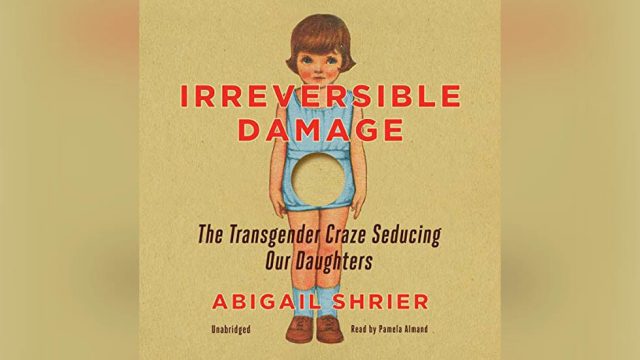
© Abigail Shrier “Irreversible Damage: The Transgender Craze Seducing Our Daughters” / Blackstone Publishing, 2020
By Debbie Hayton | RT | July 29, 2020
A new book, Irreversible Damage, reveals how teenage girls are being duped into believing they want to be male, and are pushed into taking puberty blockers, cross-sex hormones, and undergoing double mastectomies.
Whether it is a statement or a question, the title of this book conveys the necessary urgency of this desperately sad story. Amid the trans debate, seemingly a battle between grown adults, vulnerable children are prey to a malevolent ideology that survivors call a cult.
In a superb piece of investigative journalism, Abigail Shrier focusses on teenage girls – most with no history of gender dysphoria – who become captivated by the belief that they are transgender. Behind the glittery exterior portrayed in the media, she encounters damaged children – many alienated from their families – in poor mental health and facing the prospect of infertility and medication for life.
Shrier, a writer with the Wall Street Journal, pulls no punches when describing phalloplasty, the construction of an artificial penis. The complications can be horrific. She reports the experience of one nineteen-year-old, “whose phalloplasty resulted in gangrene and loss of the appendage.” On the cusp of adulthood, that young person has been left without normal genitalia, for either sex, and tethered to a catheter.
I am a transgender person, but I transitioned as an adult when I could understand the implications on my body and my relationship with society. Besides, by then I’d had my own children. Yet children too young to even give consent for a tattoo are being corralled into making truly life-changing decisions.
Whether you agree or disagree with her, this is a book that needs to be read. Shrier’s informed analysis flows from dozens of interviews, including medical experts and parents. From Dr Kenneth Zucker, who oversaw the writing of the medical definition of “gender dysphoria,” to ordinary families whose children seem to them to have been swept along by this cult, Shrier talks directly to those with first-hand experience.
The facts are clear: there is a contagion spreading among teenage girls who suddenly believe themselves to be boys. While there is documented history of young feminine boys expressing a desire to be girls, never before have girls dominated the work of paediatric gender clinics. The statistics are staggering. In the UK, for example, referrals of teenage girls rose by 4400% in the last decade.
Shrier interviewed Lisa Littman, an American doctor who conducted an observational study and found that nearly 70 percent of the teenagers belonged to a peer group in which at least one friend had also come out as transgender. In some groups, most of the friends had done so. Transgender identification was encouraged and intensified by friends and social media and, astonishingly, appeared to precede the experience of gender dysphoria itself.
Shrier explores possible reasons why these daughters, often from liberal progressive households, want to be sons. First, social media where children are influenced by strangers while their parents are kept in the dark. Second, the educational system where adults who ought to know better have been enthralled, or threatened, by transgender activists. Ignoring both science and basic safeguarding, they have bought into the notion that we all have an immutable gender identity which may or may not match our sex.
With overwhelming folly, children are being transitioned in their schools with new names and pronouns. If their parents might be unsupportive, then they are not told, in case their children might feel “unsafe.” But this is something all parents need to know: this phenomenon is catching, and to be forewarned is to be forearmed.
But nothing could have happened without the cooperation of policy makers, and not only within the education system. Therapists – the very people who should be helping children to challenge their thinking – have been blindly affirming whatever their young patients have picked up from the internet.
Anyone who has stood against this has faced censure and condemnation. But as Jungian analyst Lisa Marchiano explained, “This idea that a kid’s going to come in and tell us that they’re trans and that within a session or two or three or four, that we’re going to say, ‘Yep, you’re trans. Let me write you the letter.’ That’s not therapy.”
Even the medical profession itself has been found wanting. Eminent sexologist Dr Ray Blanchard told Shrier that “I can’t think of any branch of medicine outside of cosmetic surgery where the patient makes the diagnosis and prescribes the treatment.” While the zealots who actually believe that children can change their sex are perhaps in a minority, those professionals who remain silent in education, therapy and medicine are complicit in this unfolding scandal.
Shrier credits the sterling work of parental groups such as 4thWaveNow and Transgender Trend who have stood firm against the ideology. They have been condemned as bigots and transphobes for protecting children from themselves, the first duty of parents since the dawn of time.
The book is well-referenced and easy to read, making it suitable for a wide readership. The most obvious audience are parents concerned for the wellbeing of their daughters. But teachers, therapists and doctors, some of whom remain silent out of ignorance or fear, also need to hear these stories. Finally, the wider public would find Shrier’s analysis accessible, clear and educational. Those only vaguely aware of transgender ideology may be tempted to think that it cannot be true: young girls taking powerful cancer drugs to halt puberty, or induce an artificial menopause if started. But it is happening across the world, and Shrier catalogues it.
The time has come for society to take responsibility. Much has happened covertly, and the startled onlooker may need time to catch up, but Shrier’s book fills in the background, identifies the problems, explains the impact, and proposes clear and workable ways forward. This is a must-read for those with children, anyone who works with children and everyone who cares about them.
Debbie Hayton is a teacher and a transgender campaigner, based in the UK. She tweets @DebbieHayton
Bolton’s Memoir Undercuts Hype as Impeachment’s Would-Be Star Witness
By Aaron Maté | Real Clear Investigations | June 23, 2020
In late January, John Bolton became the latest – and unlikeliest – official to enjoy a moment of Resistance glory. A New York Times report about Bolton’s forthcoming memoir fueled round-the-clock expectations that the former national security adviser would substantiate the core allegation at the heart of President Trump’s then-ongoing Senate impeachment trial – that the president tried to coerce Ukraine into opening an investigation of Joe and Hunter Biden in a quid pro quo for military aid. Compelling his testimony was cast as a matter of national urgency. Bolton was never given the chance as Senate Republicans voted to block witnesses and acquit Trump on both impeachment counts.
In the publicity blitz for his new memoir, “The Room Where It Happened,” Bolton has tried to keep the initial narrative alive. Speaking to ABC News, he claimed that Trump, at a meeting in August 2019, said he “wanted a probe of Joe Biden in exchange for delivering the security assistance.” That conversation, Bolton added, “was the crispest indication of the linkage. … The specificity of the linkage, I think, was unmistakable.”
His memoir, however, fails to substantiate that allegation.
In fact, Bolton offers new evidence that undermines it.
What he told Martha Raddatz is not what he writes in his book. Instead of a sharp demand of a quid pro quo, Bolton writes, Trump “said he wasn’t in favor of sending [Ukraine] anything until all the Russia-investigation materials related to [Hillary] Clinton and Biden had been turned over.”
Bolton does not explain what he means by “materials” – and no interviewer has asked him to so far. RealClearInvestigations’ request to Bolton for comment, sent through a representative, was not immediately answered.
No Word on Burisma
Regardless, those were not at the heart of Trump’s impeachment. Trump was not impeached for trying to coerce Ukraine into handing over “Russia-investigation materials” to the U.S., but for allegedly trying to force Ukraine President Volodymyr Zelensky to open a wholly separate investigation of the Bidens and Burisma, the gas company where Hunter was given a lucrative board seat while his father was running U.S. policy in Ukraine.
Yet Burisma is not even mentioned in Bolton’s book – and Hunter only in passing. This includes an acknowledgement that Bolton does not even remember if the younger Biden was actually discussed. At a May 8 meeting where Trump and his legal adviser Rudy Giuliani discuss the latter’s “desire to meet with President-Elect Zelensky,” Bolton cannot recall if the purpose is “to discuss [Ukraine’s] investigation of either Hillary Clinton’s efforts to influence the 2016 campaign or something having to do with Hunter Biden and the 2020 election, or maybe both.”
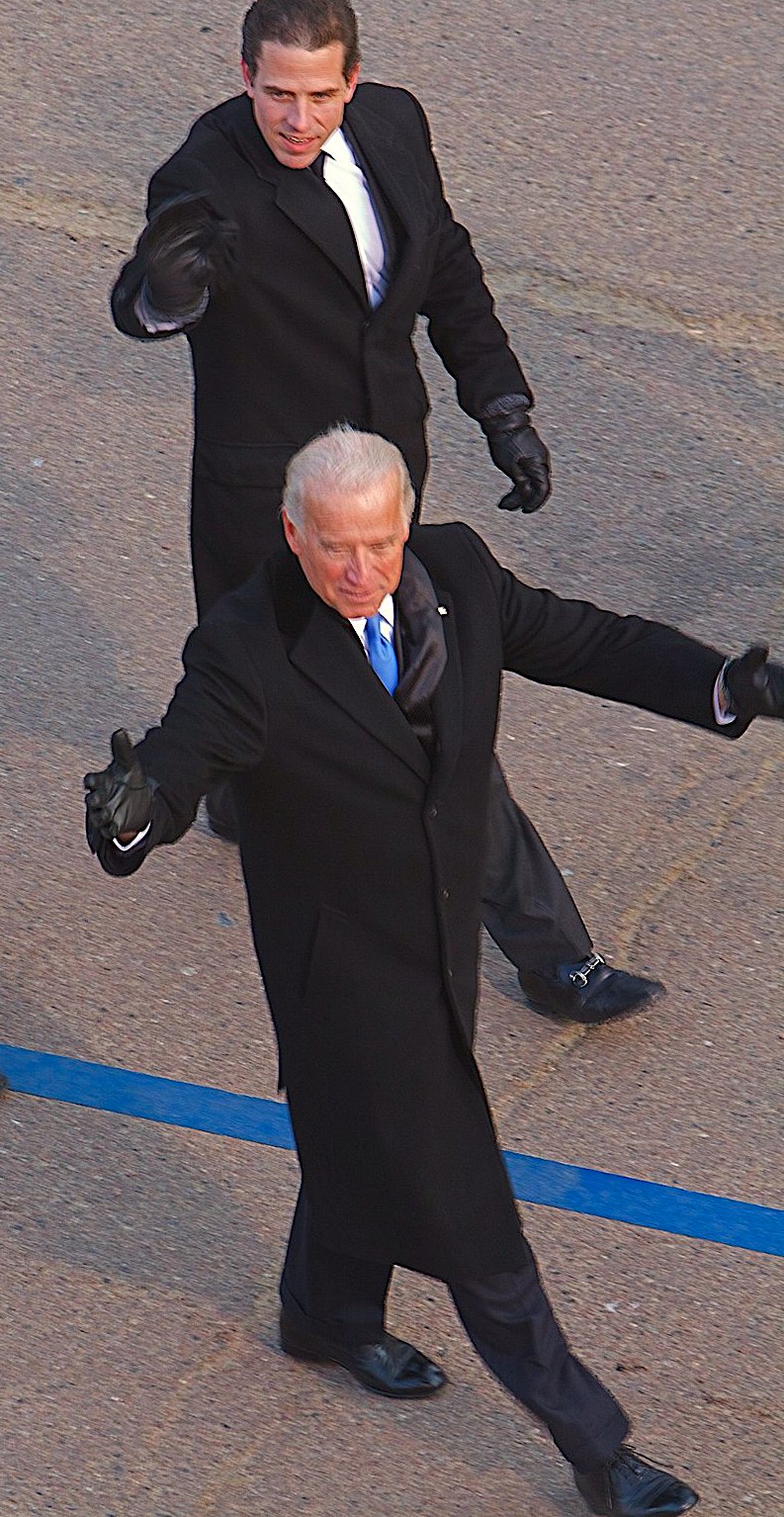
Son gets job on energy company board after father backs violent coup
Bolton says his recollections are not precise because the Ukraine-related theories floating around the Trump administration “always seemed intermingled and confused, one reason I did not pay them much heed. Even after they became public, I could barely separate the strands of the multiple conspiracy theories at work.”
Bolton’s words are also ambiguous. The fact that Trump allegedly “said he wasn’t in favor of sending [Ukraine] anything” is not an explicit linkage to military aid. And as for the “Russian-investigation materials,” Bolton does not specify what Trump was referring to. It seems likely Trump may have been referencing his reported theory that the Democratic National Committee server was somehow hacked with Ukrainian involvement.
Trump may also have been seeking information on the Ukrainians who openly admitted to interfering in the 2016 campaign with the aim of thwarting his candidacy, most notably by leaking allegations of illegal payments to Paul Manafort. It is highly plausible that these were Trump’s priorities. In his July 25 phone call with Zelensky, which sparked the whistleblower complaint behind Ukrainegate, Trump’s top issue – and the object of the “favor” he requested – was not the Bidens, but securing Zelensky’s assistance with the Justice Department’s ongoing review of how the Russia investigation began in 2016.
Whatever the case, for Bolton to write that Trump drew a link between these issues and the security aid – and not a link to a demand that Ukraine open an investigation of the Bidens and Burisma – contradicts the impeachment case that many expected him to validate.
Bolton, perhaps inadvertently, also lends credence to the Trump administration’s public defense of its freeze on security assistance to Ukraine, which Democrats cast as the linchpin of a politically motivated quid pro quo. In his July 25 call with Zelensky and subsequent public statements, Trump has said that he wanted NATO allies to spend more on Ukrainian military funding. Bolton recounts that on Aug. 30 – just days after an article in Politico made the aid freeze public, including to the Ukrainian government – Trump repeated his complaints about the U.S. burden, and proposed that NATO provide Ukraine with the security assistance instead of Washington:
Trump said, “I don’t give a shit about NATO. I am ready to say, ‘If you don’t pay, we won’t defend them.’ I want the three hundred million dollars [he meant two hundred fifty million dollars, one piece of the assistance earmarked for Ukraine] to be paid through NATO.” … He then said to Pence, “Call [NATO Secretary General Jens] Stoltenberg and have him have NATO pay. Say ‘The President is for you, but the money should come from NATO,’” which still didn’t make any sense.
If Trump is freezing the military aid for the sole purpose of coercing a Ukrainian investigation, it would be incongruous for him to propose an outcome that delivers the money without the investigation he is supposedly trying to compel.
As a part of their impeachment case, Democrats argued that Trump released the aid to Ukraine only after getting caught through publicity surrounding the whistleblower complaint. Yet Bolton writes that after Ukraine conducted a successful prisoner swap with Russia on Sept. 7, “Trump had seemingly indicated” that the swap “might be enough to get him to release the security assistance.” The money was released four days later, on Sept. 11.
Says He Wanted Nothing to do With Ukraine
Bolton confirms national security aide Fiona Hill’s testimony that he told her he did not want to be “part of whatever drug deal Sondland and [White House Chief of Staff Mick] Mulvaney are cooking up.” But he offers context that makes that line far less explosive than it was initially received. Bolton was not referring to leveraging any military aid, but to Sondland’s attempt to push for a hasty meeting between Trump and Zelensky at the White House, where the “Giuliani issues” could be discussed before Ukraine’s parliamentary elections in July.
Bolton says he nixed the idea of a meeting because Trump had recently told him that “he didn’t want to have anything to do with Ukrainians of any stripe,” due to Ukrainian meddling against him in the 2016 campaign. Sondland, in Bolton’s view, was “freelancing.” According to Bolton, Trump had also “resolved the visit issue just before leaving for the United Kingdom in June,” by saying he would meet with Zelensky “not until the fall, the right outcome in my view.”
It is easy to forget why Bolton was initially cast as a savior figure in January by those hoping to remove Trump by impeachment. When news of his memoir emerged, 10 days after the Senate trial began, Democrats had failed to prove their case. Not a single witness in the House impeachment hearings had provided direct evidence of a quid pro quo. The only witness who even spoke to Trump about the Ukraine aid was the then-European Union Ambassador Gordon Sondland. He reiterated multiple times that “nobody told me directly that the aid was tied to anything,” and that such a linkage was only his “presumption” and “personal, you know, guess.”
Sondland’s testimony was even more damaging to the impeachment case because, according to the impeachment narrative, he was the Trump official who purportedly relayed the alleged quid pro quo to the Ukrainian side. But Sondland revealed that he had only told Zelensky aide Andriy Yermak, in “a very, very brief pull-aside conversation,” that “I didn’t know exactly why” the aid has been frozen, but that a demand to open investigations “could be a reason.”
For his part, Yermak has said he does not even remember discussing the frozen aid with Sondland. That highlighted another problem with the Democrats’ quid pro quo allegation: Not a single Ukrainian official substantiates it. In addition to Yermak, President Zelensky and Foreign Minister Vadym Prystaiko also said that they saw no tie between the frozen military funding and pressure to open investigations. Even Democratic Sen. Chris Murphy, a staunch impeachment advocate, corroborates them: When they met in early September, Murphy recalled, Zelensky “did not make any connection between the aid that had been cut off and the requests that he was getting from Giuliani.”
The Ukrainians’ claims make sense in light of the fact that they only learned of the aid freeze, along with the rest of the world, with the Politico article published August 28. That would have meant that the supposed quid pro quo demand was made to them only after the issue became a matter of public controversy. That scenario was always implausible on its face. And now Bolton’s memoir has failed to change the picture. Bolton seems to grasp this fact. “I think the House Democrats built a cliff, they threw themselves off of it,” he told Raddatz of ABC News. “And halfway down, they looked up and saw me, and said, ‘Hey, why don’t you come along?”
International community rejects Canada’s bid for a seat on Security Council

By Yves Engler | June 17, 2020
The international community’s rejection of Canada’s bid for a seat on the United Nations Security Council isn’t a surprise. In the below introduction to my recently published House of Mirrors: Justin Trudeau’s Foreign Policy I detail how Liberal foreign policy has largely mimicked Stephen Harper’s who lost a bid for the Security Council in 2010.
***
Justin Trudeau presents himself as “progressive” on foreign affairs. The Liberals claim to have brought Canada “back” after the disastrous Stephen Harper government. But, this book will demonstrate the opposite.
While promising to “make a real and valuable contribution to a more peaceful and prosperous world”, Trudeau has largely continued the Conservatives pro-corporate/empire international policies. The Liberals have followed the previous government’s posture on a wide range of issues from Russia to Palestine, Venezuela to the military.
In 2017 the Liberals released a defence policy that called for 605 more special forces, which have carried out numerous violent covert missions abroad. During the 2015 election campaign defence minister Jason Kenney said if re-elected the Conservatives would add 665 members to the Canadian Armed Forces Special Operations Command. The government’s defence policy also included a plan to acquire armed drones, for which the Conservatives had expressed support. Additionally, the Liberals re-stated the previous government’s commitment to spend over one hundred billion dollars on new fighter jets and naval ships.
The Harper regime repeatedly attacked Venezuela’s elected government and the Liberals ramped up that campaign. The Trudeau government launched an unprecedented, multipronged, effort to overthrow Nicolás Maduro’s government. As part of this campaign, they aligned with the most reactionary political forces in the region, targeting Cuba and recognizing a Honduran president who stole an election he shouldn’t have participated in. Juan Orlando Hernández’ presidency was the outgrowth of a military coup the Conservatives tacitly endorsed in 2009.
In Haiti the Liberals propped up the chosen successor of neo-Duvalerist President Michel Martelly who Harper helped install. Despite a sustained popular uprising against Jovenel Moïse, the Liberals backed the repressive, corrupt and illegitimate president.
The Trudeau government continues to justify Israeli violence against Palestinians and supports Israel’s illegal occupation. Isolating Canada from world opinion, they voted against dozens of UN resolutions upholding Palestinian rights backed by most of the world.
Initiated by the Conservatives, the Liberals signed off on a $14 billion Light Armoured Vehicle sale to Saudi Arabia. The Liberals followed Harper’s path of cozying up to other repressive Middle East monarchies, which waged war in Yemen. They also contributed to extending the brutal war in Syria and broke their promise to restart diplomatic relations with Iran, which the Conservatives severed.
The Liberals renewed Canada’s military “training” mission in the Ukraine, which emboldened far-right militarists responsible for hundreds of deaths in the east of that country. In fact, Trudeau significantly bolstered Canada’s military presence on Russia’s doorstep. Simultaneously, the Trudeau government expanded Harper’s sanctions against Russia.
On China the Liberals were torn between corporate Canada and militarist/pro-US forces. They steadily moved away from the corporate sphere and towards the militarist/US Empire standpoint. (During their time in office the Conservatives moved in the opposite direction.) Ottawa seemed to fear that peace might break out on the Korean Peninsula.
Trudeau backed Africa’s most bloodstained politician Paul Kagame.
Unlike his predecessor, Trudeau didn’t sabotage international climate negotiations. But the Liberals flouted their climate commitments and subsidized infrastructure to expand heavy emitting fossil fuels.
Ignoring global inequities, the Liberals promoted the interests of corporations and wealth holders in various international forums. They backed corporate interests through trade accords, Export Development Canada and the Trade Commissioner Service. Their support for SNC Lavalin also reflected corporate influence over foreign policy.
In a stark betrayal of their progressive rhetoric, the Trudeau regime failed to follow through on their promise to rein in Canada’s controversial international mining sector. Instead they mimicked the Conservatives’ strategy of establishing a largely toothless ombudsperson while openly backing brutal mining companies.
To sell their pro-corporate/empire policies the Liberals embraced a series of progressive slogans. As they violated international law and spurned efforts to overcome pressing global issues, the Liberals crowed about the “international rules-based order”. Their “feminist foreign policy” rhetoric rested uneasily with their militarism, support for mining companies and ties to misogynistic monarchies.
Notwithstanding the rhetoric, the sober reality is that Trudeau has largely continued Harper’s foreign policy. The “Ugly Canadian” continued to march across the planet, but with a prettier face at the helm.
My 2012 book The Ugly Canadian: Stephen Harper’s Foreign Policy detailed the first six and a half years of Harper’s rule. This book looks at the first four years of Trudeau’s reign. I will discuss the many ways Canadian foreign policy under Conservative and Liberal governments remained the same. Support for empire and a pro-corporate neoliberal economic order is the common theme that links the actions of conservative and self-described “progressive” prime ministers.
Please sign this petition calling for a fundamental reassessment of Canadian foreign policy.
Foiling Predictions, Russians Did Not Go Hungry After 2014
Natylie Baldwin, in this excerpt from her new book, describes what happened after the U.S. and EU sought to punish Moscow with agricultural sanctions.
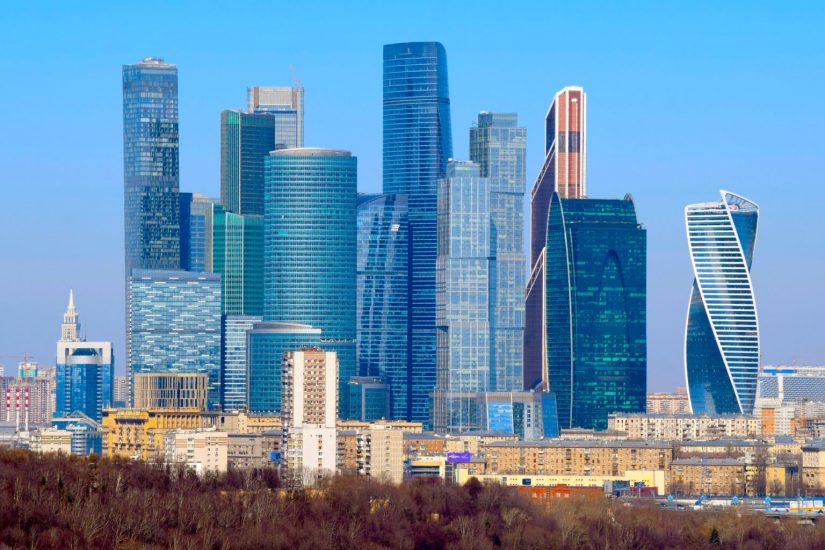
2019 view of Moscow International Business Center. (Dzasohovich, CC BY-SA 4.0, Wikimedia Commons)
By Natylie Baldwin | Consortium News | June 3, 2020
A common response in the Anglo-American media to Russia’s counter-sanctions against agricultural imports from the United States and EU in 2014 was that Russians would go hungry and were, therefore, shooting themselves in the foot. Within a matter of days of the announcement, however, numerous Latin American countries, namely Argentina and Brazil, got in line to fill the gap, as well as China, which started selling produce directly to Russia.
More importantly, according to the Food and Agriculture Organization, Russia ranked as one of the top three producers in the world for a range of agricultural products at the time, from various fruits and vegetables to grains, potatoes and poultry. As of 2018, it was the world’s top exporter of wheat. The government has also had plans in place since 2013 to significantly boost the country’s already respectable production of organic produce from small farms and gardens.
Natural Society reported in May 2014 that 35 million Russian families are growing an impressive percentage of Russia’s fruits and vegetables on 20 million acres:
According to some statistics, they grow 92% of the entire countries’ potatoes, 77% of its vegetables, 87% of its fruit, and feed 71% of the entire population from privately owned organic farms or house gardens all across the country. These aren’t huge Agro-farms run by pharmaceutical companies; these are small family farms and less-than-an-acre gardens.
By autumn 2017, Vladimir Putin had publicly set a goal for Russia to become the world’s top producer and exporter of organic agriculture. In the summer of 2018, the Russian president signed legislation creating official standards, labeling and certification procedures for organic products produced for commercial sale in Russia that went into effect in 2020. Government support will be available to organic farmers, and a public registry will be created listing certified producers.
The agricultural sanctions created some immediate problems, mainly temporary shortages of some meat products and price increases due to the need to work out infrastructure issues to accommodate imports from countries at greater distances.
But Russians did not go hungry, as I witnessed plenty of food in markets, from street vendors, and in restaurants in all cities I visited during my trips in 2015 and 2017. There was, however, concern over price increases.
Author Sharon Tennison, who has traveled throughout Russia extensively since 1983, reported the general attitude of most Russians toward Western sanctions during her trip to Moscow and St. Petersburg in September 2014:
The general outlook of Russians I spoke with is one of quiet confidence, saying that sanctions will turn out good for Russia in the long run––that Russia must become self-sufficient––remarking that Russia became infatuated with foreign products in the 1990s. At that time they felt Russia didn’t need to manufacture high-end products that they could purchase them from other countries. However, the situation has changed. Today production has become the “in” discussion wherever one goes. The sanctions have helped bring this about. Several Russians remarked that they hoped the sanctions lasted for three years or more, since that would give Russians sufficient time to learn to manufacture formerly imported items themselves. The Russian government is offering financial support to entrepreneurs who are ready to move into consumer production.
Sanctions Imposed
In March of 2014, the U.S. and the European Union (EU) began imposing sanctions on Russia in retaliation for its “annexation” of Crimea. These initial sanctions were largely comprised of asset freezes and visa restrictions on certain Russian officials. As the situation in Eastern Ukraine escalated, with rebels taking over local government buildings and demanding autonomy from what they perceived as a coup government in Kiev, the list of individuals targeted for sanctions grew.
After the downing of the Malaysia Airlines flight MH-17 in July 2014, the west imposed more wide-ranging sanctions, which included several Russian banks as well as the defense and energy sectors. In March of 2018, there were diplomatic “sanctions” (expulsions) for the alleged Skirpal poisoning, which Russia responded to with its own expulsions. That same month, there were business/personal sanctions against a number of Russians for their alleged interference in the 2016 elections.
In order to provide the most accurate and comprehensive assessment of the effect of Western sanctions on Russia over the past five years, University of Birmingham professor Richard Connolly, in his 2018 book, “Russia’s Response to Sanctions: How Western Economic Statecraft is Reshaping Political Economy in Russia,” describes how Russia’s economy actually works in order to provide a contextual framework for understanding the success or failure of the West’s policy. He concluded that the ultimate effect of the sanctions is likely not what was intended by Washington policymakers.
Economy with Four Sectors
Connolly explains that the Russian economy can be divided up into roughly four sectors.
Sector A generates revenue, or “rents,” in the form of taxes, fees and other benefits that support Sector B. Sector A is comprised largely of fossil fuel and mineral extraction industries but also includes large “agricultural conglomerates,” manufacturers of nuclear power generation equipment, and some defense industry manufacturers. Economic actors in Sector A are highly profitable and competitive in the global market, into which they are successfully integrated. The state also plays a strong role in Sector A industries either through significant ownership stakes, as is the case with Gazprom, Rosneft, and Rosatom, or through strong personal ties among private owners and the political class, as is the case with Lukoil and Novatek.
Sector B is comprised of economic actors that are dependent upon the rents generated by Sector A. This includes companies that are generally not competitive globally and provide goods and services to the domestic market rather than for export. Despite state assistance, they do not always generate consistent profits. Examples include automotive manufacturing, shipbuilding, fossil fuel equipment and some defense manufacturing. Other beneficiaries of Sector A include state bureaucracy workers and pensioners. It is estimated that Sectors A and B together comprise around 70 percent of the Russian economy.
Sector C is independent of Sectors A and B and includes large construction companies, retail and business services, and various small- to medium-sized enterprises (SMEs) in retail, transportation, business support and communications technology. Because these businesses are outside of the Sector A and B relationship, they’re dependent upon successful profit-making and tend to encourage more competition, innovation and productivity, though they are vulnerable to various forms of outside corruption and unfair takeovers. One successful example of a Sector C industry that enjoys significant and growing export rates is computer software.
 The last sector is the financial sector, which, as Connolly points out, developed virtually out of nothing over the past three decades into a system of numerous, largely state-owned or state-influenced banks that provide a wide range of services. However, Russia’s overall financial sector is small in comparison with other middle-income countries, with Sector A and B entities getting preferential treatment in receipt of the limited credit that is available. There are few small banks or other financial institutions that can provide SMEs with credit, as is reflected in the fact that, as of 2016, two-thirds of assets and liabilities were owned by large state-controlled banks.
As Connolly notes, the obvious disadvantages of this system of political economy are hobbled competition, innovation and productivity. It also limits the development of SMEs.
The advantages, however, include support of domestic employment and the funding of social programs. Perhaps most importantly, this system has also enabled the Russian state to cushion the country from the worst potential effects of Western sanctions and even encourage the stimulation of alternative economic investment, which has strengthened agriculture and some industry and finance.
In terms of how Russia responded to Western sanctions, Connolly provides the following summary:
The Russian response was multifaceted and included the securitization of strategic areas of economic policy, a concerted effort to support import substitution in strategic sectors of the economy, and vigorous efforts to cultivate economic relations with non-Western countries, especially in Asia.
Policy of Diversification
Securitization officially justified certain policies using national security and subordinating certain other objectives in the economic realm that might be prioritized under “normal” circumstances. In order to increase Russia’s economic independence or sovereignty, policies of import substitution and “diversifying” its range of foreign economic partners and the extent of those relations were implemented.
Import substitution involved increasing the proportion of goods and services in Russia that were produced domestically. As an official policy, it was begun in earnest after the imposition of Western sanctions. By 2015, the government was providing federal budget funding, facilitation of loans and access to state procurement funds as well as institutional support to specific sectors of the economy, which included the provision of legal and regulatory frameworks for such policies. In 2016, a plan was presented by Russia’s minister for industry and trade that encompassed “2,000 projects across nineteen branches of the economy. These projects were to be carried out between 2016 and 2020.”
By early 2018, there were 2,500 projects worth $38 billion that were to be completed by 2020. The areas of priority for industrial manufacturing included power equipment, oil and gas equipment, machine tool and civil aviation manufacturing, and agricultural machinery, all of which had import levels between 50 percent and 90 percent.
Gains in domestic food production were seen quickly as Russia became the world’s No. 1 supplier of wheat in early 2018, subsequently capturing over half of the world’s market. Wheat exports continue to increase; sales to other nations increased by 80 percent during the first half of 2018 over the same period in 2017.
Diversifying foreign economic relations is pretty self-explanatory, and in this case it focused heavily on countries in Asia such as China, India, Vietnam and South Korea, as well as Turkey and Latin America. Connolly points out that Russia did not present this as a “zero-sum” action and still conducts most of its trade with various European countries (46 percent of exports and 38 percent of imports). This fact should be considered when assessing the credibility of accusations against Putin that he wants to destroy the EU.
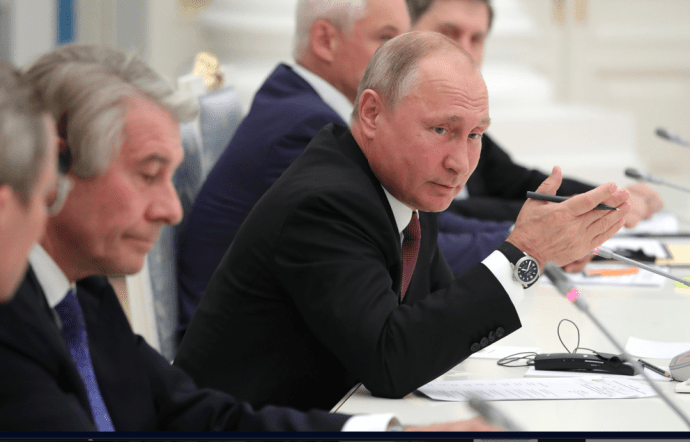
President Vladimir Putin meeting with German business executives, Nov. 1, 2018. (The Kremlin)
China, however, has now become Russia’s single largest trading partner, accounting for 10 percent of Russia’s exports and 22 percent of its imports. But this figure alone does not begin to provide the full picture of Russia’s increasing partnership with Eurasia in general and China in particular.
According to Asia Times correspondent Pepe Escobar, who has been closely following the trend of Eurasian economic integration for several years, what’s known in Russia as the “Greater Eurasia” project was recently presented to the Council of Ministers in Moscow and is now largely accepted as an entrenched foreign policy guide for Russia’s future.
After interviewing three top Russian academics and policymakers who have been championing the Greater Eurasia project for years, Escobar explained that the policy would not preclude continuing a relationship with Europe, recognizing that the Russian elite has been intimately influenced by European culture and trade and technology since the time of Peter the Great, but is meant to be a rebalancing toward the inevitable economic center that will soon be led by Asia and to serve as a “civilizational bridge” between east and west.
The New Silk Road
Situated as it is geographically, Russia is in a perfect position to play this role, serving as a cultural connector between the Enlightenment and the Mongols and as a physical connector between Europe and Asia. In terms of the latter, Russia will play a pivotal role in connecting China’s New Silk Road (aka Belt and Road Initiative, or BRI) through Russia and Central Asia and into Europe.
Escobar writes:
Greater Eurasia and the Belt and Road Initiative are bound to merge. Eurasia is crisscrossed by mighty mountain ranges such as the Pamirs and deserts like the Taklamakan and the Karakum. The best land route runs via Russia or via Kazakhstan to Russia. In crucial soft power terms, Russia remains the lingua franca of Mongolia, Central Asia and the Caucasus.
And that leads us to the utmost importance of an upgraded Trans-Siberian railway—Eurasia’s current connectivity core. In parallel, the transportation systems of the Central Asia “stans” are closely integrated with the Russian network of roads; all that is bound to be enhanced in the near future by Chinese-built high-speed rail.
. . . And all across the spectrum, Moscow aims at maximizing return[s] on the crown jewels of the Russian Far East: agriculture, water resources, minerals, lumber, oil and gas. Construction of liquefied natural gas (LNG) plants in Yamal vastly benefits China, Japan and South Korea.
Iran, Turkey, and India are all pivoting toward Eurasia as well, with a free trade agreement between Iran and the Russian-led Eurasian Economic Union having been recently approved. Iran is also playing a role in the International North-South Transport Corridor (INSTC) to facilitate closer economic cooperation between Russia and India, who have enjoyed cordial relations and strong trade in defense for decades.
But Russia and China’s “comprehensive strategic partnership” — as it is referred to officially by both countries — is much more than economic. In an unprecedented move, China sent 3,000 troops to join Russia in a 2018 military exercise to practice countering NATO in Eastern Europe. In July of 2019, “Russian and Chinese bombers conducted their first long-range joint air patrol in the Asia-Pacific.” To reinforce the strategic importance of Russian-Chinese relations, the day after these maneuvers, the Chinese government published a “white paper” in which it promised to further increase military cooperation between the two countries, partly as a result of the United States’s “undermining” of regional stability.
A former senior national security official in Russia described the relationship to National Interest correspondent Graham Allison as a “functional military alliance.” Allison elaborated that “Russian and Chinese generals’ staffs now have candid, detailed discussions about the threat US nuclear modernization and missile defense pose to each of their strategic deterrents.”
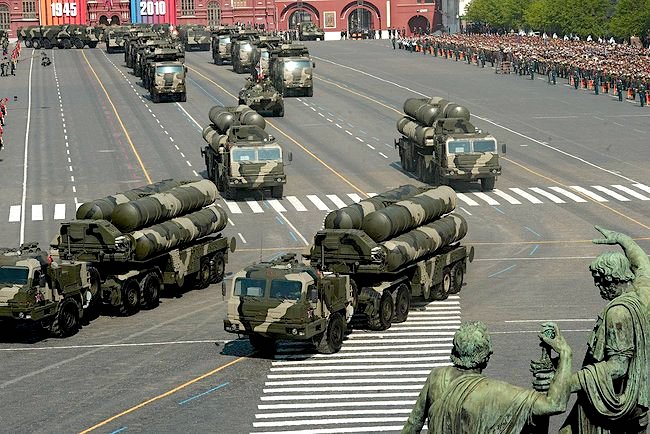
S-400 surface-to-air missile systems during the Victory parade 2010. (Wikimedia)
Allison also reiterated that Russia has lifted its decades-long withholding of advanced military technologies to its eastern neighbor, selling China the S-400 air defense system and partnering in research and development on rocket engines and drones. Furthermore, Russia and China vote the same on the UN Security Council 98 percent of the time, and Russia has supported all Chinese vetoes since 2007.
As evidence that the Russian public will likely support the Greater Eurasia project and Russia’s diversifying of economic partnerships in an eastern direction, recent polling reveals that 69 percent of Russians hold a positive view of China — the exact same percentage that hold a negative view of the United States. Two-thirds of Russians identify the United States as their nemesis, while only 2 percent identify China that way.
Now that we’ve explored how Russia has actually responded to Western sanctions, we can turn to the question of how effective those sanctions have been in terms of what their presumed intent was. As Connolly enumerates, in addition to sending a symbolic message of disapproval of Russia’s actions and to show a united front among Western allies, the intent among some policymakers was to cause significant economic harm to Russia—not just as a deterrent to further “bad behavior,” but with the idea that this would encourage political revolt among targeted Russian elites that would endanger Putin’s government and result in regime change with the installment of a new Russian leader that would be more amenable to Washington’s desires.
The answer is that Washington has once again — in its hubris and ignorance — been hoist with its own petard. As British scholar on Russia Paul Robinson sums up in his review of Connolly’s book:
First, it [sanctions] has created a system that “is less vulnerable to external pressure” than that which existed before, in that it is more independent from the West. Second, it has accelerated a shift in Russia’s place in the global economy towards the East. This obviously has political ramifications which Connolly does not explore. Somewhat perversely, Western sanctions have reduced, not increased, Western leverage over Russia. This is probably permanent.
Moreover, since Russia has weathered the sanctions reasonably well, even using them to strengthen certain sectors of its economy in the long term, the sanctions have likely failed as a tool of deterrence. As Connolly states:
How can policymakers expect sanctions to act as a credible deterrent to third countries when the target country in any given instance might appear to be coping or even flourishing under sanctions? In short, a significant and negative impact on the target economy is a necessary, although not sufficient, condition of sanctions to be effective.
For the policymakers implementing sanctions, it might have been worthwhile to have been briefed by real experts on what Russia’s economy is actually like. If they’d done so, they might have realized that sanctions were likely to have a limited effect on a country that, as analyst Patrick Armstrong has pointed out, has a “full-service economy.” In other words, Russia has demonstrated that it has both the natural and human resources to build sophisticated infrastructure, weapons and defense capabilities, a space station, military and commercial aircraft, heavy trucks and passenger cars, to provide energy and the attendant infrastructure, and to feed its people.
Instead, beliefs that Russia is a “gas station posing as a country,” or that it was still somehow frozen in the 1990s, underpinned policy decisions that ultimately failed.
Natylie Baldwin is author of “The View from Moscow: Understanding Russia and U.S.-Russia Relations,” from which this article is excerpted. “The View from Moscow” is available in e-book and print. She is co-author of “Ukraine: Zbig’s Grand Chessboard & How the West Was Checkmated.” She has traveled throughout western Russia since 2015 and has written several articles based on her conversations and interviews with a cross-section of Russians. She blogs at Natyliesbaldwin.com .
Washington’s tall tale of Iranian-Al Qaeda alliance based on questionably sourced book ‘The Exile’
A disinformation campaign aimed to justify the assassination of Qassem Soleimani by painting him and Iran as willing enablers of al-Qaeda. The propaganda operation relied heavily on a shoddily sourced book, “The Exile.”
By Gareth Porter | The Grayzone | May 19, 2020
The U.S. assassination of Qassem Soleimani in January touched off a new wave of disinformation about the top Iranian major general, with Trump administration allies branding him a global terrorist while painting Iran as the world’s worst state sponsor of terrorism. Much of the propaganda about Soleimani related to his alleged responsibility for the killing of American troops in Iraq, along with Iran’s role in Syria, Lebanon, and Yemen.
But a second theme in the disinformation campaign, which has been picked up by mainstream outlets like the Wall Street Journal and National Public Radio, was the claim that Soleimani deliberately unleashed al-Qaeda terrorist Abu Musab al-Zarqawi’s campaign to kill Shiites in Iraq. That element of the propaganda offensive was the result of the 2017 publication of “The Exile,” a book by British journalists Adrian Levy and Cathy Scott-Clark, which spun a new version of the familiar U.S. propaganda line of a supposed Iranian terror alliance with al-Qaeda.
Levy and Scott-Clark introduced the theme of secret collusion between the two open adversaries with an article in the The Sunday Times in early 2018, dramatically entitled “Tehran in devil’s pact to rebuild al‑Qaeda.” Soleimani, they claimed, “first offered sanctuary to bin Laden’s family and al-Qaeda military leaders,” then proceeded to “build them a residential compound at the heart of a military training center in Tehran.”
But those two sentences represented a grotesque distortion of Iran’s policy toward the al-Qaeda personnel fleeing from Afghanistan into Iran. Virtually every piece of concrete evidence, including an internal al-Qaeda document written in 2007, showed that Iran agreed to take in a group of al-Qaeda refugees with legal passports that included members of bin Laden’s family and some fighters and middle- and lower-ranking military cadres – but not Zarqawi and other al-Qaeda military leaders — and only temporarily and under strict rules forbidding political activity.
The crucial fact that Levy and Scott-Clark conveniently failed to mention, moreover, was that Iranian officials were well aware that al-Qaeda’s leadership figures, including military commanders and with their troops, were also slipping into Iran from Afghanistan, but Iranian security forces had not yet located them.
Keeping the legal arrivals under closer surveillance and watching for any contacts with those illegally in the country, therefore, was a prudent policy for Iranian security under the circumstances.
In addition, having bin Laden’s family and other al-Qaeda cadres under their surveillance gave Iran potential bargaining chips it could use to counter hostile actions by both al-Qaeda and the United States.
Al-Qaeda documents undermine narrative of cooperation with Iran
Careful study of the enormous cache of internal al-Qaeda documents released by the U.S. government in 2017 further discredited the tall tale of Iranian facilitation of al-Qaeda terrorism.
Nelly Lahoud, a senior fellow at the New American Foundation and former senior research associate at the West Point Combating Terrorism Center, translated and analyzed 303 of the newly available documents and found nothing indicating Iranian cooperation with, or even knowledge about the whereabouts of Zarqawi or other al-Qaeda military leaders prior to their detentions of April 2003.
Lahoud explained in a September 2018 lecture that all actions by al-Qaeda operatives in Iran had been “conducted in a clandestine manner.” She even discovered from one of the documents that al-Qaeda had considered the clandestine presence of those officials and fighters so dangerous that they had been instructed on how to commit suicide if they were caught by the Iranians.
Adrian Levy and Cathy Scott-Clark were well aware that those al-Qaeda operatives living in Tehran’s military training center were under severe constraints, akin to a prison. Meanwhile, senior figures like Zarqawi and Saif al-Adel, the head of the al-Qaeda shura council, were far away from Tehran, planning new operations in the region amid friendly Sunni contacts. These plans included Zarqawi’s campaign Iraq, which he began organizing in early 2002.
Nevertheless the authors declared, “From [the Iranian training center], al-Qaeda organized, trained and established funding networks with the help of Iran, co-ordinated multiple terrorist atrocities and supported the bloodbath against Shi’ites by al-Qaeda in Iraq….”
Anti-Iran think tanker Sadjadpour jumps on the conspiracy bandwagon
Karim Sadjadpour of the Carnegie Endowment for International Peace, a reliable fount of anti-Iran spin, responded within days of the Soleimani assassination with an article in the Wall Street Journal’s right-wing editorial section that reinforced the budding disinformation campaign.
Entitled “The Sinister Genius of Qassem Soleimani,” Sadjadpour’s op-ed argued that in March 2003, before the U.S. invasion of Iraq, “Soleimani’s Quds Force freed many Sunni jihadists that Iran had been holding captive, unleashing them against the U.S.” He cited “The Exile” as his source.
Levy and Scott-Clark did indeed spin a tale in the book of Zarqawi’s troops — and Zarqawi himself — being rounded up and locked to the same prison as those al-Qaeda members who entered with passports in March 2003. The authors claimed they were released within days. But the only sources they cite to support their claims were two people they interviewed in Amman, Jordan in 2016.
So who were these insider sources? The only identifying characteristics Levy and Scott-Clark offer is that they were “in Zarqawi’s group at the time.” Furthermore, neither of these sources is quoted to substantiate the claim that Zarqawi was arrested and then released from prison, and they are mentioned only in a footnote on the number of Zarqawi’s troops that had been sent to the prison.
Sadjadpour offered his own explanation — without the slightest suggestion of any evidence to support it — of why Soleimani would support an anti-Shiite jihadist to kill his own Iraqi Shiite allies. “By targeting Shiite shrines and civilians, killing thousands of Iran’s fellow Shiites,” he wrote, “Zarqawi helped to radicalize Iraq’s Shiite majority and pushed them closer to Iran—and to Soleimani, who could offer them protection.”
In late January, on National Public Radio’s weekly program “Throughline,” Sadjadpour pushed his dubiously sourced argument, opining that Soleimani had figured out how to “use the al Qaeda jihadists of Zarqawi … to simply unleash them into Iraq with the understanding that you guys do what you do.”
The BBC promotes “The Exile” as the book’s narrative crumbles
In a BBC radio documentary broadcasted in late April, titled “Iran’s Long Game” (an allusion to Iran’s alleged long-term plan for domination of the entire Middle East), Cathy Scott-Clark told a story intended to clinch the case that Iran had helped Zarqawi: Other prisoners “heard conversations in the corridors” in which Iranian authorities allegedly assured Zarqawi, “You can do whatever you want to do … in Iraq.”
That story does not appear in her book, however. Instead, Adrian Levy and Scott-Clark related a comment by Abu Hafs al-Mauritani, a spiritual adviser to bin Laden, on hearing about the arrest and subsequent release of Zarqawi from another prisoner who eavesdropped by tapping the pipes leading into his room.
That narrative had already been definitively contradicted long before, however, in an account provided by Saif al-Adl, the most senior member of the al-Qaeda top leadership in Iran. Al-Adl had fled with Zarqawi from Afghanistan across the border into Iran illegally in late 2001 or early 2002 and was apprehended in April 2003 — weeks after the alleged events portrayed in al-Mauritani’s story.
In a memoir smuggled out of Iran to Jordanian journalist Fouad Hussein, which Husayn published in 2005 in an Arabic-language book (but available online in an English-language translation), Saif al-Adl described an Iranian crackdown in March 2003 that captured 80 percent of Zarqawi’s fighters and “confused us and aborted 75 percent of our plan”.
Because of that round-up, al-Adl wrote, “[T]here was a need for the departure of Abu-Mus’ab and the brothers who remained free.” Al-Adl described his final meeting with Zarqawi before his departure, confirming that Zarqawi had not been caught prior to his own apprehension on April 23, 2003.
Levy and Scott-Clark cited Saif al-Adl’s memoir on other matters in “The Exile,” but when this writer queried Scott-Clark about al-Adl’s testimony – which contradicted the narrative that underpinned her book – Scott-Clark responded, “I know Fuad Hussein well. Most of his information is third hand and not well sourced.”
She did not address the substance of al-Adl’s recollections about Zarqawi, however. When asked in a follow-up email whether she challenged the authenticity of Saif al-Adl’s testimony, Scott-Clark did not respond.
Gareth Porter is an independent investigative journalist who has covered national security policy since 2005 and was the recipient of Gellhorn Prize for Journalism in 2012. His most recent book is The CIA Insider’s Guide to the Iran Crisis co-authored with John Kiriakou, just published in February.
Featured Video
Marandi: US attacked world’s largest gas field & Iran declares economic war
or go to
Aletho News Archives – Video-Images
Book Excerpt
US Axis of Aggression in Gulf
By Finian Cunningham | Strategic Culture Foundation | August 15, 2019
When Washington announced a few weeks ago the formation of a maritime “international coalition” to “protect shipping” in the Persian Gulf, many observers were skeptical. Now skepticism has rightly turned to alarm, as the proposed US-led “coalition” transpires to comprise a grand total of just three nations: the US, Britain and Israel.
The term “coalition” has always been a weasel word used by Washington to give its military operations around the world a veneer of international consensus and moral authority. If the US goes ahead with deploying forces in the Persian Gulf the guise of “coalition” is threadbare. It will be seen for what it is: naked aggression.
Iran promptly warned that if the US, Britain and Israel move on their intention to deploy in the Persian Gulf, it will not hesitate to defend itself from a “clear threat”. … continue
Blog Roll
 Aletho News
- FBI Resumes Buying Americans’ Location Data Without Warrants
- IDF threatens ‘elimination’ for Russian leaders who ‘wish Israel ill’
- Attacks on enemy energy facilities not over yet, strikes ongoing: Iran
- US dragged by Israel into ‘unlawful war’ with Iran – Gulf state
- Israel’s War on Iran’s Grid: How the South Pars Strike Turned Energy into a Weapon
- War on Iran to impose trillion-dollar ‘Israel First Tax’ on US citizens: Araghchi
- The State Is Socializing the Cost Of the Iran War
- Seyed M. Marandi: U.S. Attacked World’s Largest Gas Field & Iran Declares Economic War
- Washington’s War on Cuba Is Older Than You Think
- Daniel Davis: U.S. Military Options & War Narrative Collapse
- If Americans Knew
- America’s friends must help extricate it from an unlawful war
- Democratic Nat’l Committee’s Kneejerk Backing of Israel Is Political and Moral Failure
- Major revelations from former counterterrorism chief Joe Kent’s extensive interview
- More than half of Palestinian child detainees have no charges
- Grieving Parents in Iran Spend Every Night at the Graves of Their Children, Killed by U.S. Strike
- War on Iran spins out of control, Palestine struggles – Not a ceasefire Day 160
- How ignorance, misunderstanding and obfuscation ended Iran nuclear talks
- Israeli media reports grotesque settler attack in West Bank
- UK security adviser attended US-Iran talks and judged deal was within reach
- Tucker Carlson says ‘neocons’ will try to destroy Joe Kent over resignation
- No Tricks Zone
- Energy Expert: Germany’s Nuclear Phaseout Was A “500 Billion Euro Mistake”
- New Research: South Australia’s Mid-Holocene Sea Surface Temperatures Were 4°C Warmer Than Today
- Storing Green Energy To Last Germany 10 Days Would Require A 60-Million Tonne Battery
- New Studies: UK Sea Levels Were 4 Meters Higher Than Today During The Mid-Holocene
- Destructive Green New Deal: German Energy And Metal Group Warns Of Drastic Crisis
- New Study Documents A 20-Year Pause In Arctic Sea Ice Decline – Driven By Internal Variability
- Wake-up Call: Survey Shows Majority Of Germans Now Favor Postponing Climate Targets!
- Televised! Leading German Political Candidate Tells Schoolchildren CO2 Makes Sun Hotter!
- New Study: A Century Warming Of 1.1°C Is ‘Commonplace’ And ‘Not Unusual’ During This Interglacial
- New Study: ‘Internal Noise’ And Volcanic Forcing Can Trigger 10-15°C Warming Within Decades
 Aletho News