Meritocracy and American Pravda Collections Now Freely Available in Kindle and EPub Formats
By RON UNZ • UNZ REVIEW • JANUARY 31, 2021
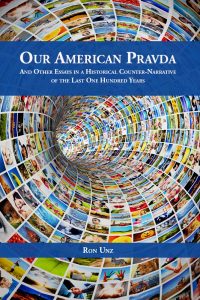 Several years ago I published a hardcover collection of my more substantial articles, entitled The Myth of American Meritocracy and Other Essays.
More recently, various people had suggested that I produce a similar collection of my American Pravda articles, so I’ve now done so in an eBook format. The full title is Our American Pravda and Other Essays in a Historical Counter-Narrative of the Last One Hundred Years.
I also decided to produce an eBook version of my previous Meritocracy collection, now updated to include my more recent articles that fell outside the American Pravda category.
Given the very low Amazon royalties for eBooks, I’ve decided to make both these books freely available for downloading in both the Mobi/Kindle and standard ePub formats. Just click on the appropriate links below:
Meritocracy Collection (Mobi, ePub) and American Pravda (Mobi, ePub)
Each of these books runs well over 300,000 words, and they together contain nearly 200 of my articles from The Unz Review and a wide variety of other publications.
These eBook versions are convenient for reading without use of the Internet, sometimes an important issue in these troubled times, and feel free to redistribute the copies to whomever might find the information of interest. … continue
Morley v. CIA
By Jacob G. Hornberger | FFF | January 27, 2021
After the end of World War II, the U.S. national-security establishment convinced the American people that there existed an international communist conspiracy to take over the United States and the rest of the world. This supposed conspiracy, U.S. officials steadfastly maintained, was based in Moscow, Russia. During the Cold War, the tentacles of this supposed conspiracy spread to China, North Korea, North Vietnam, Cuba, Iran, Guatemala, Chile, and other places around the world, including the United States. The Reds, they said, were everywhere and were coming to get us.
This supposed threat of communism, in fact, is what motivated U.S. officials to convert the federal government into a national-security state, a totalitarian type of governmental structure in which officials wield omnipotent powers, such as assassination. It also motivated U.S. officials to intervene in the civil wars in Korea and Vietnam, which killed more than 100,000 U.S. soldiers, many of whom had been conscripted to “serve.” The Pentagon and the CIA maintained that if the communists weren’t stopped over there, they would soon be in the halls of Congress, the White House, and the Supreme Court, not to mention the public schools, running the country over here.
Thus, for an American few things could be considered worse than to be labeled a communist. People who were suspected of being communists were fired from their jobs, ostracized, and sometimes criminally prosecuted. Recall the McCarthy hearings, when many people’s lives were destroyed simply through the government’s asking the question, “Are you now or have you ever been a member of the Communist Party?” Recall the Hollywood Blacklist and the criminal prosecution of Hollywood writer Dalton Trumbo and the Hollywood Ten. Recall the spying on and blackmail of civil rights leader Martin Luther King, who U.S. officials suspected of being a communist.
Immediately after the assassination of President Kennedy, the word went out that he had been killed by a communist, a young former U.S. Marine named Lee Harvey Oswald. The very first organization to begin publicizing Oswald’s communist bona fides was an anti-Castro exile group in New Orleans called the DRE, which immediately sent out a press release announcing that Oswald was a communist. The publicity was highly effective in dissuading people, especially people on the left, from questioning the official narrative of the assassination — that Kennedy had been killed by a communist. People were scared to death that if they questioned the official narrative, they would be labeled communists or communist sympathizers.
What people did not know at the time — and what they would not discover for several decades — was that the DRE was being secretly funded and directed by the CIA. The CIA’s supervising officer for the DRE was a man named George Joannides.
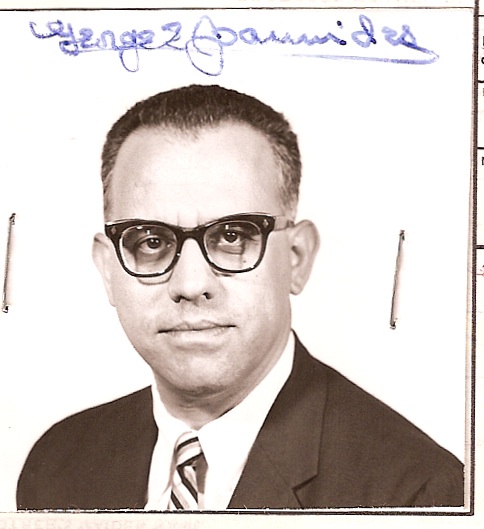 In the late 1990s, former Washington Post reporter Jefferson Morley uncovered Joannides’ role in the DRE back in 1963 and began requesting the CIA for its files on Joannides. The CIA steadfastly refused to comply with Morley’s request and made it clear that it would never disclose most of Joannides’s secret activities.
Morley filed a Freedom of Information lawsuit against the CIA, which, owing to the massive resistance of the CIA, lasted for years. The fascinating story of Morley’s battle against CIA secrecy on Joannides is now told in FFF’s newest book, Morley v. CIA: My Unfinished JFK Investigation, which is available in Kindle format on Amazon for $1.
In the course of his investigation and litigation, Morley uncovered some fascinating and intriguing facts about Joannides. In the 1970s, the House Select Committee on Assassinations reopened the investigation into the Kennedy assassination. When committee attorneys began seeking too many documents relating to Oswald’s trip to Mexico City, the CIA called Joannides out of retirement, ostensibly to serve as a facilitator between the House committee and the CIA.
As it turned out, however, Joannides’s real role was to serve as an obstructor to the efforts by the House committee attorneys to securing JFK-assassination-related information from the CIA, including information relating to Oswald’s trip to Mexico City. In the process, Joannides and the CIA failed to disclose his role with the DRE in the months leading up to the assassination, just as they had failed to disclose it to the Warren Commission back in 1964.
During the term of the Assassination Records Review Board, Joannides and the CIA once again failed to disclose his pre-assassination relationship to the DRE. Former House Select Committee counsel Robert Blakey later accused the CIA of obstruction of justice, which is a felony. Judge John Tunheim, who chaired the ARRB, declared that “the Agency should come completely clean.”
But the CIA refused to come clean on Joannides, as detailed in Morley’s fascinating account of his long judicial fight against the CIA.
Morley is the author of another book published by FFF: CIA & JFK: The Secret Assassination Files. He will be delivering two presentations at FFF’s upcoming online weekly conference series “JFK’s Foreign Policy and the Assassination.”
The conference series will begin on Wednesday, March 3, and continue weekly on Wednesdays through April 21. Registrations will open next month. Admission will be free.
New York Times touts ‘How to Blow Up A Pipeline’ as a ‘new way to think’
Book argues ‘strategic acceptance of property destruction & violence has been the only route for revolutionary change’
Climate Depot | January 25, 2021
 NYT’s Tatiana Schlossberg (the daughter of Caroline Kennedy): How to Blow Up a Pipeline author Andreas Malm “argues that there should be room for tactics other than strict nonviolence and peaceful demonstrations — indeed, he is a bit contemptuous of those who offer strategic pacifism as a solution — and notes that fetishizing nonviolence in past protest movements sanitizes history, removing agency from the people who fought, sometimes violently, for justice, freedom and equality. Sure. But the problem with violence, even if it’s meant only to destroy “fossil capital,” is that ultimately it’s impossible to control.”
Climate Depot note: The website of the publisher of the book, Verso books, asks, “why haven’t we moved beyond peaceful protest?” The publisher website explains: “[How to Blow Up a Pipeline author Andreas] Malm argues that the strategic acceptance of property destruction and violence has been the only route for revolutionary change.”
“Andreas Malm makes an impassioned call for the climate movement to escalate its tactics in the face of ecological collapse. We need, he argues, to force fossil fuel extraction to stop—with our actions, with our bodies, and by defusing and destroying its tools. We need, in short, to start blowing up some oil pipelines.”
New York Magazine climate reporter David Wallace-Wells, also provided a featured review of Malm’s book: “If a livable world requires an all-over transformation, where and when and how do we start? Perhaps with this book, a provocative manifesto from the pioneering theorist of the climate age.” – David Wallace-Wells, author of The Uninhabitable Earth
In 2010, NASA’s former lead climate scientist also endorsed a similar sounding book. See: James Hansen declared author ‘has it right…the system is the problem’ — Book proposes ‘razing cities to the ground, blowing up dams and switching off the greenhouse gas emissions machine’
American Pravda: How the CIA Invented “Conspiracy Theories”
BY RON UNZ • UNZ REVIEW • SEPTEMBER 5, 2016
A year or two ago, I saw the much-touted science fiction film Interstellar, and although the plot wasn’t any good, one early scene was quite amusing. For various reasons, the American government of the future claimed that our Moon Landings of the late 1960s had been faked, a trick aimed at winning the Cold War by bankrupting Russia into fruitless space efforts of its own. This inversion of historical reality was accepted as true by nearly everyone, and those few people who claimed that Neil Armstrong had indeed set foot on the Moon were universally ridiculed as “crazy conspiracy theorists.” This seems a realistic portrayal of human nature to me.
Obviously, a large fraction of everything described by our government leaders or presented in the pages of our most respectable newspapers—from the 9/11 attacks to the most insignificant local case of petty urban corruption—could objectively be categorized as a “conspiracy theory” but such words are never applied. Instead, use of that highly loaded phrase is reserved for those theories, whether plausible or fanciful, that do not possess the endorsement stamp of establishmentarian approval.
Put another way, there are good “conspiracy theories” and bad “conspiracy theories,” with the former being the ones promoted by pundits on mainstream television shows and hence never described as such. I’ve sometimes joked with people that if ownership and control of our television stations and other major media outlets suddenly changed, the new information regime would require only a few weeks of concerted effort to totally invert all of our most famous “conspiracy theories” in the minds of the gullible American public. The notion that nineteen Arabs armed with box-cutters hijacked several jetliners, easily evaded our NORAD air defenses, and reduced several landmark buildings to rubble would soon be universally ridiculed as the most preposterous “conspiracy theory” ever to have gone straight from the comic books into the minds of the mentally ill, easily surpassing the absurd “lone gunman” theory of the JFK assassination.
Even without such changes in media control, huge shifts in American public beliefs have frequently occurred in the recent past, merely on the basis of implied association. In the initial weeks and months following the 2001 attacks, every American media organ was enlisted to denounce and vilify Osama Bin Laden, the purported Islamicist master-mind, as our greatest national enemy, with his bearded visage endlessly appearing on television and in print, soon becoming one of the most recognizable faces in the world. But as the Bush Administration and its key media allies prepared a war against Iraq, the images of the Burning Towers were instead regularly juxtaposed with mustachioed photos of dictator Saddam Hussein, Bin Laden’s arch-enemy. As a consequence, by the time we attacked Iraq in 2003, polls revealed that some 70% of the American public believed that Saddam was personally involved in the destruction of our World Trade Center. By that date I don’t doubt that many millions of patriotic but low-information Americans would have angrily denounced and vilified as a “crazy conspiracy theorist” anyone with the temerity to suggest that Saddam had not been behind 9/11, despite almost no one in authority having ever explicitly made such a fallacious claim.
 These factors of media manipulation were very much in my mind a couple of years ago when I stumbled across a short but fascinating book published by the University of Texas academic press. The author of Conspiracy Theory in America was Prof. Lance deHaven-Smith, a former president of the Florida Political Science Association.
Based on an important FOIA disclosure, the book’s headline revelation was that the CIA was very likely responsible for the widespread introduction of “conspiracy theory” as a term of political abuse, having orchestrated that development as a deliberate means of influencing public opinion.
During the mid-1960s there had been increasing public skepticism about the Warren Commission findings that a lone gunman, Lee Harvey Oswald, had been solely responsible for President Kennedy’s assassination, and growing suspicions that top-ranking American leaders had also been involved. So as a means of damage control, the CIA distributed a secret memo to all its field offices requesting that they enlist their media assets in efforts to ridicule and attack such critics as irrational supporters of “conspiracy theories.” Soon afterward, there suddenly appeared statements in the media making those exact points, with some of the wording, arguments, and patterns of usage closely matching those CIA guidelines. The result was a huge spike in the pejorative use of the phrase, which spread throughout the American media, with the residual impact continuing right down to the present day. Thus, there is considerable evidence in support of this particular “conspiracy theory” explaining the widespread appearance of attacks on “conspiracy theories” in the public media.
But although the CIA appears to have effectively manipulated public opinion in order to transform the phrase “conspiracy theory” into a powerful weapon of ideological combat, the author also describes how the necessary philosophical ground had actually been prepared a couple of decades earlier. Around the time of the Second World War, an important shift in political theory caused a huge decline in the respectability of any “conspiratorial” explanation of historical events.
For decades prior to that conflict, one of our most prominent scholars and public intellectuals had been historian Charles Beard, whose influential writings had heavily focused on the harmful role of various elite conspiracies in shaping American policy for the benefit of the few at the expense of the many, with his examples ranging from the earliest history of the United States down to the nation’s entry into WWI. Obviously, researchers never claimed that all major historical events had hidden causes, but it was widely accepted that some of them did, and attempting to investigate those possibilities was deemed a perfectly acceptable academic enterprise.
However, Beard was a strong opponent of American entry into the Second World War, and he was marginalized in the years that followed, even prior to his death in 1948. Many younger public intellectuals of a similar bent also suffered the same fate, or were even purged from respectability and denied any access to the mainstream media. At the same time, the totally contrary perspectives of two European political philosophers, Karl Popper and Leo Strauss, gradually gained ascendancy in American intellectual circles, and their ideas became dominant in public life.
Popper, the more widely influential, presented broad, largely theoretical objections to the very possibility of important conspiracies ever existing, suggesting that these would be implausibly difficult to implement given the fallibility of human agents; what might appear a conspiracy actually amounted to individual actors pursuing their narrow aims. Even more importantly, he regarded “conspiratorial beliefs” as an extremely dangerous social malady, a major contributing factor to the rise of Nazism and other deadly totalitarian ideologies. His own background as an individual of Jewish ancestry who had fled Austria in 1937 surely contributed to the depth of his feelings on these philosophical matters.
Meanwhile, Strauss, a founding figure in modern neo-conservative thought, was equally harsh in his attacks upon conspiracy analysis, but for polar-opposite reasons. In his mind, elite conspiracies were absolutely necessary and beneficial, a crucial social defense against anarchy or totalitarianism, but their effectiveness obviously depended upon keeping them hidden from the prying eyes of the ignorant masses. His main problem with “conspiracy theories” was not that they were always false, but they might often be true, and therefore their spread was potentially disruptive to the smooth functioning of society. So as a matter of self-defense, elites needed to actively suppress or otherwise undercut the unauthorized investigation of suspected conspiracies.
Even for most educated Americans, theorists such as Beard, Popper, and Strauss are probably no more than vague names mentioned in textbooks, and that was certainly true in my own case. But while the influence of Beard seems to have largely disappeared in elite circles, the same is hardly true of his rivals. Popper probably ranks as one of the founders of modern liberal thought, with an individual as politically influential as left-liberal financier George Soros claiming to be his intellectual disciple. Meanwhile, the neo-conservative thinkers who have totally dominated the Republican Party and the Conservative Movement for the last couple of decades often proudly trace their ideas back to Strauss.
So, through a mixture of Popperian and Straussian thinking, the traditional American tendency to regard elite conspiracies as a real but harmful aspect of our society was gradually stigmatized as either paranoid or politically dangerous, laying the conditions for its exclusion from respectable discourse.
By 1964, this intellectual revolution had largely been completed, as indicated by the overwhelmingly positive reaction to the famous article by political scientist Richard Hofstadter critiquing the so-called “paranoid style” in American politics, which he denounced as the underlying cause of widespread popular belief in implausible conspiracy theories. To a considerable extent, he seemed to be attacking straw men, recounting and ridiculing the most outlandish conspiratorial beliefs, while seeming to ignore the ones that had been proven correct. For example, he described how some of the more hysterical anti-Communists claimed that tens of thousands of Red Chinese troops were hidden in Mexico, preparing an attack on San Diego, while he failed to even acknowledge that for years Communist spies had indeed served near the very top of the U.S. government. Not even the most conspiratorially minded individual suggests that all alleged conspiracies are true, merely that some of them might be.
Most of these shifts in public sentiment occurred before I was born or when I was a very young child, and my own views were shaped by the rather conventional media narratives that I absorbed. Hence, for nearly my entire life, I always automatically dismissed all of the so-called “conspiracy theories” as ridiculous, never once even considering that any of them might possibly be true.
To the extent that I ever thought about the matter, my reasoning was simple and based on what seemed like good, solid common sense. Any conspiracy responsible for some important public event must surely have many separate “moving parts” to it, whether actors or actions taken, let us say numbering at least 100 or more. Now given the imperfect nature of all attempts at concealment, it would surely be impossible for all of these to be kept entirely hidden. So even if a conspiracy were initially 95% successful in remaining undetected, five major clues would still be left in plain sight for investigators to find. And once the buzzing cloud of journalists noticed these, such blatant evidence of conspiracy would certainly attract an additional swarm of energetic investigators, tracing those items back to their origins, with more pieces gradually being uncovered until the entire cover-up likely collapsed. Even if not all the crucial facts were ever determined, at least the simple conclusion that there had indeed been some sort of conspiracy would quickly become established.
However, there was a tacit assumption in my reasoning, one that I have since decided was entirely false. Obviously, many potential conspiracies either involve powerful governmental officials or situations in which their disclosure would represent a source of considerable embarrassment to such individuals. But I had always assumed that even if government failed in its investigatory role, the dedicated bloodhounds of the Fourth Estate would invariably come through, tirelessly seeking truth, ratings, and Pulitzers. However, once I gradually began realizing that the media was merely “Our American Pravda” and perhaps had been so for decades, I suddenly recognized the flaw in my logic. If those five—or ten or twenty or fifty—initial clues were simply ignored by the media, whether through laziness, incompetence, or much less venial sins, then there would be absolutely nothing to prevent successful conspiracies from taking place and remaining undetected, perhaps even the most blatant and careless ones.
In fact, I would extend this notion to a general principle. Substantial control of the media is almost always an absolute prerequisite for any successful conspiracy, the greater the degree of control the better. So when weighing the plausibility of any conspiracy, the first matter to investigate is who controls the local media and to what extent.
Let us consider a simple thought-experiment. For various reasons these days, the entire American media is extraordinarily hostile to Russia, certainly much more so than it ever was toward the Communist Soviet Union during the 1970s and 1980s. Hence I would argue that the likelihood of any large-scale Russian conspiracy taking place within the operative zone of those media organs is virtually nil. Indeed, we are constantly bombarded with stories of alleged Russian conspiracies that appear to be “false positives,” dire allegations seemingly having little factual basis or actually being totally ridiculous. Meanwhile, even the crudest sort of anti-Russian conspiracy might easily occur without receiving any serious mainstream media notice or investigation.
This argument may be more than purely hypothetical. A crucial turning point in America’s renewed Cold War against Russia was the passage of the 2012 Magnitsky Act by Congress, punitively targeting various supposedly corrupt Russian officials for their alleged involvement in the illegal persecution and death of an employee of Bill Browder, an American hedge-fund manager with large Russian holdings. However, there’s actually quite a bit of evidence that it was Browder himself who was actually the mastermind and beneficiary of the gigantic corruption scheme, while his employee was planning to testify against him and was therefore fearful of his life for that reason. Naturally, the American media has provided scarcely a single mention of these remarkable revelations regarding what might amount to a gigantic Magnitsky Hoax of geopolitical significance.
To some extent the creation of the Internet and the vast proliferation of alternative media outlets, including my own small webzine, have somewhat altered this depressing picture. So it is hardly surprising that a very substantial fraction of the discussion dominating these Samizdat-like publications concerns exactly those subjects regularly condemned as “crazy conspiracy theories” by our mainstream media organs. Such unfiltered speculation must surely be a source of considerable irritation and worry to government officials who have long relied upon the complicity of their tame media organs to allow their serious misdeeds to pass unnoticed and unpunished. Indeed, several years ago a senior Obama Administration official argued that the free discussion of various “conspiracy theories” on the Internet was so potentially harmful that government agents should be recruited to “cognitively infiltrate” and disrupt them, essentially proposing a high-tech version of the highly controversial Cointelpro operations undertaken by J. Edgar Hoover’s FBI.
Until just a few years ago I’d scarcely even heard of Charles Beard, once ranked among the towering figures of 20th century American intellectual life. But the more I’ve discovered the number of serious crimes and disasters that have completely escaped substantial media scrutiny, the more I wonder what other matters may still remain hidden. So perhaps Beard was correct all along in recognizing the respectability of “conspiracy theories,” and we should return to his traditional American way of thinking, notwithstanding endless conspiratorial propaganda campaigns by the CIA and others to persuade us that we should dismiss such notions without any serious consideration.
For Further Reading:
A Pandemic Reading List for Left, Right, and Libertarians

By Jeffrey A. Tucker | American Institute for Economic Research | January 14, 2021
Daily the news is pouring in: SARS-CoV-2 behaves like a textbook respiratory virus in its vectors of transmission and its conferring immunity. It is not and never was a strange and unfamiliar pathogenic meteor hitting the earth warranting panic to the point of shutting down the normal course of life.
The policy response should have followed the proven path of the past: vulnerable people protecting themselves while non-vulnerable populations go about life as normal with an expectation of exposure. This was the settled presumption of public health. This is what the Great Barrington Declaration said and it is what Public Health England is saying now.
Why did all this happen? Did sizable parts of the world fail to pay attention in 9th grade biology class when the subjects of viruses and immunity were discussed? For that matter, is this stuff not taught anymore?
I’m just not sure what accounts for this sudden loss of knowledge. I do know that people who specialize in political economy were blindsided last March with the policy response to pandemic. Nothing like widespread lockdowns had ever been attempted in the US, which accounts for why so little has actually been written about it. The result was that many intellectuals – on all sides! – found themselves unprepared. Subjects like cell biology and infectious disease are not topics usually examined by economists and philosophers, so many people decided to say nothing at all, thereby granting the lockdowners a free hand that dominated public discussion.
I had been variously writing on the topic of pandemic policy responses since 2006, but beyond the general conviction that government would only make things worse, I too was unprepared to deal with the specifics concerning viruses and their mitigation. Is it really true that closing restaurants and churches makes a contribution to stopping disease spread? Is forcing people apart actually a sound response to the presence of a pathogen? Is there no other path to minimizing the social harm of a virus other than waiting for a vaccine? For that matter, can a virus really be stopped?
Answering these questions takes more than political or ideological conviction. It requires at least some knowledge of cell biology, pathogens, pandemic history, public health practices, and immunological history. I scrambled to get up to speed so that I could understand more thoroughly and write in a more compelling way.
Mostly this consisted of reading as many medical studies on Covid as possible, in addition to listening to endless hours of talks online by specialists. That was essential. Even so, what I really needed was to embed myself in the bigger topic more deeply.
The books below provided me the most help on this intellectual journey.
The History of Public Health, by Paul Rosen. This fascinating treatise was first published in 1958 and reissued in 1993 with new material. It is a wonderful introduction to the whole concept of public health and how it evolved through the centuries. A major theme of the book is how poor understanding of disease dominated public health from the ancient world through the 19th century. Ignorance and fear led to a run-from-the-miasma mentality. Once the science of cell biology improved, so too did public health.
The last bout of medieval-style brutality toward disease was in 1918, after which public health got very very serious and swore that nothing like that would happen again. The turning point occurred when it became clear that large-scale collective efforts to beat back and hide from pathogens were futile and tremendously harmful. Instead, disease is something to be managed by doctors and their patients. The job of public health became to focus on clean sanitation and water and otherwise give a message of calm, and clear recommendations to people in light of medical resources.
The hardest challenge for public health was to get common people to understand the scalability of their own immune systems, so that people would stop fearing exposure as such but rather embrace evolutionary reality. After World War II, this became a major feature of public education.
Rosen further emphasizes how modern public health differs from ancient and medieval theory in that it is never about chasing away a single pathogen. Rather, public health must consider all aspects of health including economic and mental health. So panicking by running away from a germ is completely contrary to modern public health, to say nothing of lockdowns, which have zero to do with health.
One thing that slightly bothers is Rosen’s tendency to attribute all improvement in health to science and better policies. He has a whole chapter on the strange disappearance of a vast number of diseases after WWI. He thinks it is due to better sanitation and so on, which is undoubtedly true in part. But even while reading, I couldn’t shake Sunetra Gupta’s point that trade and migration vastly improved immune systems. It was a natural process of tossing off naive systems for exposed systems that made the largest contribution to longer lives and better health.
Molecular & Cell Biology For Dummies, by Rene Fester Kratz. This quick Kindle download provides an accurate look at the core of the topic at hand while minimizing the amount of technical and medical razzle-dazzle you would otherwise face with a first-year textbook from medical school. Not having an extensive background in this topic myself, I not only found the book fascinating; I was amazed that I found it fascinating! The human immune system shares features with any complex evolved system: as a reader you cannot help but be in awe of its workings and interactions with the world. In a year in which the lockdowners tried to pretend as if the immune is nonoperational without a vaccine, this introduction to disease basics is an outstanding corrective.
Smallpox: The Death of a Disease: The Inside Story of Eradicating a Worldwide Killer, by Donald A. Henderson. This is a spectacular history of one of the greatest triumphs in modern medicine. It is also beautifully written. Inoculation against smallpox has been around since the 18th century, and the vaccine since the late 19th century. The real challenges that met the eradicators – the author himself among the most famous and dedicated of them all – was about production, distribution, and administration. Here was what requires decades of work, and Henderson chronicles the litany of difficulties he faced around the world. I think of this book often these days given the completely predictable chaos of Covid vaccine distribution in 2021.
The Plague, by Albert Camus. This short but powerful book, written about the author’s own quarantine and published in 1947, is a work of fiction that speaks to the terrifying reality of lockdowns in the midst of a plague – the sort of plague that takes people down ferociously and brutally. He captures perfectly how the fear of sickness and death taps into a primal instinct and causes first denial and then panic. He speaks profoundly to the loss of direction and purpose in the midst of lockdown, the isolation and psychological damage that being cut off from the normal flow of life brings about. And he speaks to the loss of control felt both by citizens and officials when confronted with a mysterious pathogen, and just how disorienting it is to discover that the disease is smarter and more powerful than any of us.
Coronavirus and Economic Crisis, edited by Peter C. Earle. I am listing this one not because I have several essays in it, but rather because this book compiles some of the best research and writing from the early months of the pandemic lockdown. It is filled with white-hot passion and tremendous erudition. It also provides proof that what many of our writers predicted came true: tremendous social, cultural, and economic damage. We were warned at the time that we were acting too soon in publishing this, and it is true that AIER was just about first out the door with a book on the topic. But it turned out to serve as a great inspiration to others, and gave the principles that guided the opposition to lockdowns for the rest of the year. In the meantime, AIER released three additional books on the topic in addition to my own book Liberty or Lockdown.
Pandemic responses will continue to serve as a convenient rationale for government interventions in the future. Anyone who has a concern for human liberty and prosperity should be armed with intellectual ammunition to combat this huge increase in government power. We need more than ideological instincts here; to fully understand, we need to be aware of the sciences of infectious disease and the discipline of public health.
At this point, ignorance threatens everything we hold dear. We owe the cause of freedom some effort on our part to read up, learn, and be prepared for the long battle ahead.
‘Modern-day book burners’: Portland bookstore forced to evacuate after protesters demand it pulls book critical of Antifa
RT | January 13, 2021
Powell’s City of Books in Portland, one of the world’s largest independent bookstores, had to evacuate repeatedly after it was besieged by protesters enraged over its plans to sell a book claiming Antifa is “destroying democracy.”
A crowd of protesters flocked to the store on Monday to denounce its decision to distribute a book by a local author, conservative journalist Andy Ngo, known for documenting and highlighting instances of violence associated with Antifa on social media. The owners were forced to evacuate employees and customers out the back door. Later that day, the store announced it would not be putting the book on the shelves, but that it would remain in its online catalogue, along with many books that Powell’s itself deems “abhorrent.”
“While we understand that our decision to carry such books upsets some customers and staff members, we do not want to create an echo chamber of preapproved voices and ideas,” the company said.
However, that concession apparently failed to placate all of the protesters, as a smaller crowd was back at the store the next day, chanting slogans and vowing to force the store out of business if it failed to exercise self-censorship.
“You will lose money every day. Every day that you sell his book, we will shut down this store,” protesters could be heard shouting in footage circulating online.
Powell’s was forced to close early and evacuate customers on Tuesday as well.
Set for release in February, the book – titled ‘Unmasked: Inside Antifa’s Radical Plan to Destroy Democracy’ – chronicles Antifa’s history of violence and its “radical plan to destroy democracy.” It is touted as an in-depth study of the origins and the history of the left-wing movement that features accounts by former supporters, as well as those who fell victim to its violence. The book is said to contain “a trove of documents obtained by the author that he will publish for the first time,” according to Amazon’s description of the tome.
While some critics of the book and the store itself have accused Powell’s of giving a platform to “fascists and racists,” others argued that Ngo had endangered protesters by exposing them, insisting that freedom of speech doesn’t protect the book since it could “incite actions that would harm others.”
Ngo’s supporters, on the other hand, decried the efforts to block the book’s distribution, calling the protesters “modern-day book burners.”
“There are few acts of censorship as overt as a mob deciding which books people should be allowed to read,” wrote author and Reason journalist Robby Soave.
Ngo, who is Asian, came to increased prominence after he was attacked by a mob of Antifa protesters while covering a rally in 2019.
Joe Biden and the Post-Corona “Great Reset”. The Protest Movement
Prof Michel Chossudovsky | Global Research | January 9, 2021
In the wake of the Wednesday January 6, 2021 Capitol Hill Event, we must reflect on what a Joe Biden Administration will look like.
Joe Biden was not duly elected, he was selected. He is a groomed and “reliable” politician. He is a political instrument of the global capitalist establishment.
Biden is a firm supporter of the Corona lockdown. His statements concerning a “Dark Winter” in 2021 confirm that he not only endorses the adoption of staunch Covid-19 lockdown policies, his administration will pursue and adopt the World Economic Forum’s “Great Reset” as an integral part of US foreign policy, to be implemented or more correctly “imposed” Worldwide.
In turn, the Biden-Harris administration will attempt to override all forms of popular resistance to the corona virus lockdown.
We are at the crossroads of one of the most serious crises in World history. We are living history, yet our understanding of the sequence of events since January 2020 has been blurred.
What is unfolding is a new and destructive phase of US imperialism. It’s a totalitarian project of economic and social engineering, which ultimately destroys people’s lives Worldwide.
This “novel” neoliberal agenda using the corona lockdown as an instrument of social oppression has been endorsed by the leadership of the Democratic Party.
The Biden White House will be used to instate what David Rockefeller called “Global Governance”, which is tantamount to a Worldwide “democratic dictatorship”.
It should be noted that the protest movement in the US, against the lockdown is weak. In fact there is no coherent grassroots national protest movement. Why? Because “progressive forces” including leftist intellectuals, NGO leaders, trade union and labor leaders, most of which are aligned with the Democratic Party have from the outset been supportive of the lockdown. And they are also supportive of Joe Biden.
In a bitter irony, antiwar activists as well as the critics of neoliberalism have endorsed Joe Biden, who is now being accused by Trump supporters of being a “socialist”.
The preceding text is an excerpt from the concluding chapter of my E-Book: entitled.
The 2020 Worldwide Corona Crisis: Destroying Civil Society, Engineered Economic Depression, Global Coup d’État and the “Great Reset” first published in mid-December 2020.
To access the full text of nine chapters click here
The “Russian hacking” NATO psyop has finally been solved

CrowdStrike founder Dmitri Alperovitch (center) at the US-NATO Atlantic Council, 2014 (AC)
Swiss Policy Research | December 2020
To professional analysts, it has long been clear that the “Russiagate” saga – including the “Russian hacking” claims, the Trump-Russia collusion claims, as well as the “Skripal poisoning incident” and the more recent “Navalny poisoning incident” – has been a US and NATO psychological operation aimed at containing a resurgent Russia and a somewhat unpredictable US President.
Several aspects of the “Russian hacking” psychological operation had already been uncovered by independent researchers like Stephen McIntyre, “Adam Carter” and “The Forensicator”.
In early November, however, British researcher David J. Blake essentially solved the “Russian hacking” psyop, down to the operational level, as described in his new book “Loaded for Guccifer 2.0”.
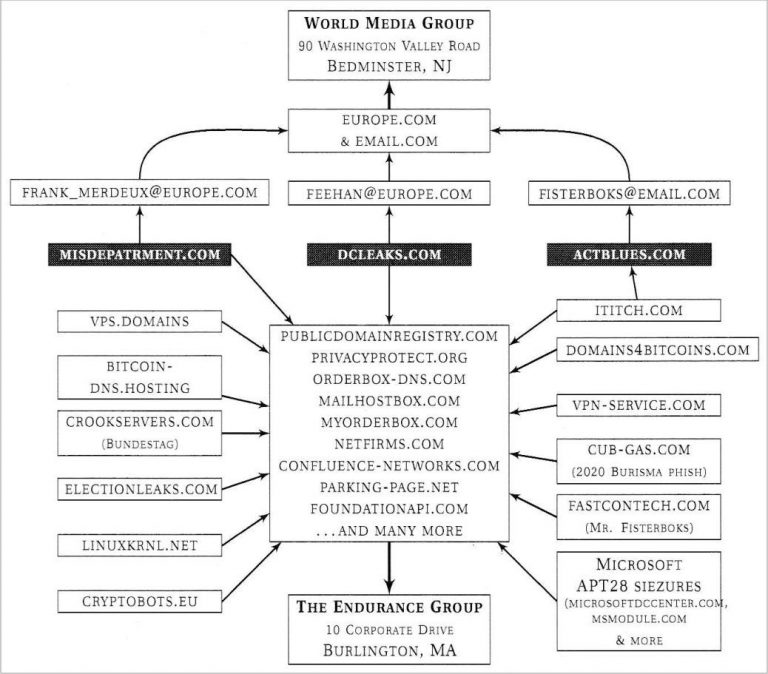
US/NATO-controlled IT used for “Russian” hacking and phishing operations (DJB)
Blake shows how the “Russian hacking” psyop was initiated by the US and NATO in 2014 in response to Russia’s reaction to the US regime change in Ukraine, when Russia retook control of the Crimean Peninsula and supported the de-facto secession of Russian-speaking eastern Ukraine.
The US/NATO psyop was inspired by the actual amateur hackers “CyberBerkut” in Ukraine and “Guccifer” in Romania. Blake shows how in 2014, NATO created a “Cyber Defence Trust Fund” and used this entity to initiate false-flag “hacking operations” against the US and other NATO members that would then be falsely “attributed” to alleged Russian “state-sponsored hacking groups”.
Regarding the most prominent such case, the alleged “hacking” of the US Democratic Party (DNC) and the 2016 Hillary Clinton presidential campaign, Blake shows how the emails and documents in question were in fact exfiltrated by the FBI and FBI cybersecurity contractor CrowdStrike, whose founder, Dmitri Alperovitch, is a Senior Fellow at the US-NATO think tank Atlantic Council.[1]
Blake shows how the mysterious persona of Guccifer 2.0, who claimed the hack, was played by none other than Alperovitch himself, while the technical infrastructure, including the notorious website dcleaks.com, was provided by US and NATO intermediaries in NATO member Romania.
Later, former FBI director Robert Mueller would pretend to “investigate” the cyber operation, attributing it to alleged “Russian hacking groups” named “Cozy Bear” and “Fancy Bear” based on information provided by FBI and DNC contractor CrowdStrike and its CTO Dmitri Alperovitch.[2]
Blake also shows how other alleged “Russian hacks”, including the “hacking” of the German parliament in 2015, relied on the very same NATO-controlled technical infrastructure. Blake was able to show this based on archived information about previous owners of IP addresses, name servers, and SSL security certificates – all pointing to the US military, NATO, and the Ukrainian government.[3]

Archived IP and SSL data tying covert operations to NATO and the Ukrainian government (DJB)
In the case of the staged hack of the US Democratic Party, Blake shows how FBI cybersecurity contractor CrowdStrike added false “Russian fingerprints” by embedding the documents into previously published CyberBerkut documents and inserting additional false signatures. However, CrowdStrike made a few technical mistakes that ultimately revealed their US time zone.
Blake highlights the important fact that in all of these false-flag “Russian hacks”, originating from NATO-controlled infrastructure, either no data or only trivial data was released to the public. Some questions continue to remain open, however, such as the role of murdered DNC employee Seth Rich and the actual source of Wikileaks, whose founder Julian Assange is still in British custody.
In the wake of the 2014 US regime change in Ukraine, the family of then Vice President Joe Biden exfiltrated millions of dollars from Ukraine, protected against corruption investigations by Joe Biden himself, as leaked phone recordings confirmed.
As of 2021, the professionals behind the Ukraine regime change and the “Russiagate” pysop will once again be in full control of the US government.
Most US and European media have promoted the “Russiagate” and “Russian hacking” psyops and will continue to do so. This is because most US and European media, both liberal and conservative, are themselves embedded in networks linked to NATO and the US Council on Foreign Relations. It is only some independent media that have been seriously investigating these topics.
Are there real Russian state-sponsored hacks against Western targets? Yes. Blake argues that, for instance, the hacking operation against the British Institute for Statecraft and its “Integrity Initiative” – itself deeply involved in the “Russiagate” psyop – was likely a professional Russian operation. The problem is that such real operations are much harder to “attribute” than fake ones.
∗∗∗
David J. Blake‘s book can be purchased in paperback, and is available as an adapted digital version.
Featured Video

Houthis Don’t Have to Conquer Saudi Arabia to Make It Pay
or go to
Aletho News Archives – Video-Images
From the Archives
Newly Released FBI Docs Shed Light on Apparent Mossad Foreknowledge of 9/11 Attacks
By Whitney Webb | MintPress News | May 17, 2019
NEW YORK — For nearly two decades, one of the most overlooked and little known arrests made in the aftermath of the September 11 attacks was that of the so-called “High Fivers,” or the “Dancing Israelis.” However, new information released by the FBI on May 7 has brought fresh scrutiny to the possibility that the “Dancing Israelis,” at least two of whom were known Mossad operatives, had prior knowledge of the attacks on the World Trade Center. … continue
Blog Roll
 Aletho News
- UK whines about losing billions to ‘Putin tax’
- Baghaei to Rubio: Distorted narratives cannot erase US record of broken commitments
- Houthis Don’t Have to Conquer Saudi Arabia to Make It Pay
- MOE: Nearly 22,000 Students and Education Workers Killed
- Guterres in Islamabad: Genocide, cowardice, and the cage of Imran Khan
- Johnson, Marandi say Yemen holds upper hand over Saudi Arabia
- False flags won’t save aggressors, Iran FM spokesman says
- The Makkah Pact Enters Into Force: The End of American Dominance or Its New Form?
- NATO’s top generals gather in Kiev
- EU’s continuing expansion – greater threat to Russia
- If Americans Knew
- Report claimed Mark Levin used by Israeli government to influence Trump
- Over 2,000 Gazans have died awaiting medical evacuation amid Israel’s continued siege
- How a U.S. Diplomat Suppressed and Altered Reports Critical of Israel
- 5 Palestinians Die from Israeli Strikes in Gaza as Relentless Attacks Continue
- Report: Ceasefire Slows Killing but Leaves Devastation Intact
- Country Music Singer Zach Bryan Breaks Attendance Record at Robert Kraft’s Gillette Stadium While Wearing ‘Free Palestine’ Shirt for Second Night in a Row
- Three years of death and devastation: Israel’s war on Gaza in pictures
- Why Hamas believed the status quo was more dangerous than its 7 October gamble
- Debunking Israel’s latest list of ‘terrorist’ journalists in Gaza
- In Gaza, focus is on survival, “every step is a struggle” – Daily Update
- No Tricks Zone
- New Study: 50 Years Of The Most Aggressive ‘Net Zero’ Policies Can Only Affect The Global Climate By 0.03°C
- US September “Heat” Was No Record…Many Records Set Decades Ago
- Latest European Green Energy Debacle; Portugal’s Largest Flagship Solar Park Insolvent!
- Green Energy Debacle: German Expert Professor Fritz Vahrenholt Warns Of Severe Economic And Social Consequences
- Two More Paleo Reconstructions Affirm Meters-Higher Sea Levels Across Ireland, Brazil 7000-6000 Years Ago
- New Study: Earth And Venus Surface Warmth Largely Explained By Convection And Lapse Rate, Not CO2 Or Radiation
- 2025 Nature Paper Claiming Worsening Global Drought Gets RETRACTED …Heavily Flawed
- New Study: ‘Global Drought Shows No Detectable Recent Acceleration Under Climate Warming’
- Economic Masterminds: German Socialists Suggest Taxing Productivity Gains Stemming From Using AI
- The South China Sea Has Not Been Cooperating With The Climate Change Narrative

