Peter Handberg, a writer and translator, has in the years since the end of the Cold War traveled many times in the Baltic states, Estonia, Latvia and Lithuania. He has visited many sites where nuclear weapons were kept, ready to destroy the world. Handberg has also spoken to military officers who once watched over these instruments of Armageddon. He has written an important book on the subject, Undergångens skuggor (Shadows of Doom). The book is not translated but a documentary film is planned.
Recently he led a group from Sweden to some of these bases, abandoned since 1987. We were about ten physicians from the Swedish section of IPPNW and ten others, including historians and people with an interest in the Baltic states.
I learned three important facts from the book and on the sites:
- The size of the Soviet nuclear complex in these small Baltic states was enormous, with at least 35 bases.
- The officers who watched over the missiles were—especially in 1983—convinced that an American attack was coming and they expected to launch their missiles.
- There were short distance missiles at some of these bases in the 1960s, but also much later, with a range of not more than 600 km—enough to reach southern Finland and eastern Sweden with a large number of 100-kiloton warheads, each equivalent to about six Hiroshima bombs. The reason “neutral” Sweden was targeted was that a US attack with bombers carrying nuclear weapons was expected to come over Swedish airspace, possibly using Swedish airfields.
Maybe the idea that Sweden would have been used as a platform for an American nuclear attack was correct. Thomas Reed, once the head of the US Air Force, describes such a scenario in his book, At the Abyss. Reed was a US defense analyst who, in the 1980s participated in the selection of enemy targets in the strategic plane called SIOP.
I cannot avoid comparisons with the situation today. My country moves ever closer to NATO and has, through the Host Country Agreement, prepared for NATO bases and for an attack to be carried out by NATO from our territory.
We are making ourselves a target.
June 27, 2016
Posted by aletho |
Book Review, Militarism, Timeless or most popular | NATO, Russia, Sweden, United States |
Leave a comment
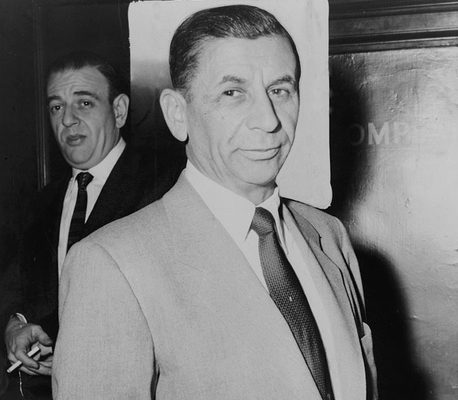
Meyer Lansky
The heirs of Meyer Lansky, the impresario of the North American Mafia gambling colony in Cuba (1933-1958) are betting on a big payback from the negotiations between the United States and Cuba to normalize relations between the two countries. Compensation claims by U.S. citizens or businesses for properties nationalized by the Cuban revolution are among the issues under discussion.
Lansky’s daughter Sandi, her son Gary Rapoport, and her brother Paul have filed a compensation claim against Cuba for the Riviera Hotel and Casino with the U.S. Foreign Claims Settlement Commission. The Cuban revolution confiscated the Riviera and other Mafia-owned properties after it toppled the gangster-linked regime of General Fulgencio Batista in 1959.
“It was through my grandfather’s hard work that the hotel was built,” Rapoport told the U. K. Daily Mail Online on December 23, 2015. “We are his natural relations . . . . By right, it should be our property.” He says the Riviera is valued at $70 million. The Tampa Bay Tribune, Reuters, and Haaretz have also covered the story.
The Riviera, which overlooks the Straits of Florida, was the crown jewel of Lansky’s casinos, hotels, and nightclubs in Havana. When the Riviera opened in December 1957, it was the largest Mafia-owned hotel-casino outside Las Vegas. The hotel’s 440 double rooms were booked solid for the winter season of 1957-1958.
However, the narrative that the success of the Riviera was the product of Meyer Lansky’s “hard work” is undercut by Lansky’s own assessment of his arrangement with Batista. Lansky talked candidly about his years in Cuba with Israeli national security writers Dennis Eisenberg, Uri Dan, and Eli Landau for their admiring biography Meyer Lansky: Mogul of the Mob (Paddington Press, 1979). (Lansky lived in Israel in 1970-1971 to avoid tax evasion charges in the United States.)
Lansky pitched his plan to Batista to open Mafia owned casinos and nightclubs in Cuba in 1933. Lansky promised to make Batista, who had just come to power in a coup d’etat, a partner. Batista and his inner circle would get regular payments from the Mafia gamblers. In return, the gangsters would be allowed to operate without interference from Cuban authorities. With a handshake and an abrazo, Lansky and Batista laid the foundations of the Cuban gangster state.
“Working on the well-known principle that it’s better to use other people’s money than your own, Lansky persuaded Batista to have the Cuban government help finance the venture,” Eisenberg, Dan, and Landau wrote. “The [Cuban] government agreed to back every dollar invested on the island by foreigners with a dollar of its own and to give every hotel that cost more than one million dollars the precious prize of a gambling license . . . and the casino hotels would not have to pay Cuban taxes.”
The Riviera was one of four new hotels with casinos, which opened in Havana between 1955 and 1958. Cuban development banks subsidized 50 percent of Lansky’s $14 million Riviera project; Lansky-linked investors provided the rest. Senator Eduardo Suarez Rivas, brother of Batista’s Minister of Labor Jose Suarez Rivas, was secretary of the Compania de Hotels La Riviera de Cuba, which operated the Riviera.
The Mafia gambling colony was the cornerstone of the Cuban gangster state. The gangsters’ graft bound Batista, his inner circle, senior security officers, and the Mafia together in the defense of one of the most repressive regimes in Latin America. As a CIA report put it, “In return for the loyalty they gave him, Batista always backed his security services. In times of crisis, he often suspended civil guarantees . . . and gave the services a free hand.”
The days of the North American gangsters in Cuba were numbered when Batista fled into exile on January 1, 1959. In 1958, Fidel Castro’s July 26th Movement had denounced the Mafia radio broadcasts from its guerrilla redoubt in the Sierra Maestra for turning Havana into a center of commercialized vice – gambling, prostitution, and drugs. When Castro arrived in Havana on January 8, he vowed to “clean out all the gamblers.” The Riviera and other gangster-owned properties were nationalized, and the Mafia gamblers returned to the United States.
To regain control of its casinos, hotels, and nightclubs in post-Castro Cuba, the Mafia waged a covert war on the Cuban revolution. The gangsters regrouped with their Cuban political allies, now in exile in the United States. The Mafia subsidized Cuban exile leaders and supplied arms to Cuban exile commando groups for attacks on Cuban targets from speedy boats and small aircraft. The gangsters also plotted with the CIA to assassinate Fidel Castro.
In 1959, Lansky volunteered to arrange the assassination of Castro in a meeting with the CIA, according to Doc Stacher, a life-long Lansky associate. “He [Lansky] indicated to the CIA that some of his people who were still on the island, or those who were just going back, might assassinate Castro,” Stacher told his Israeli biographers. “Meyer Lansky thought that if Castro would be eliminated there was a good chance for Batista to make a comeback . . . He told them [CIA officers] he was quite prepared to finance the operation himself.” From 1960 to 1963, the CIA and the Mafia plotted covertly to assassinate Castro.
To portray Lansky as an aggrieved victim of Cuba is to stand history on its head. There should be no compensation for the heirs of the former Mafia gamblers in Cuba.
Jack Colhoun is an historian of the Cold War (University of Wisconsin, Madison, BA, 1968; York University, Toronto, PhD, 1976), an investigative reporter, and professional archival researcher. His work has appeared in the Washington Post, Toronto Star, Salon, History News Network, The Nation, The Progressive, In These Times, the former (New York) Guardian newsweekly, and formerCovert Action Quarterly. He is the author of Gangsterismo: The United States, Cuba, and the Mafia, 1933-1966 (New York: OR Books, 2013).

June 25, 2016
Posted by aletho |
Book Review, Economics, Timeless or most popular | Central Intelligence Agency, CIA, Cuba, United States |
1 Comment
Peter Oborne is everything Chilcot will not be: concise, honed, forensic and devastatingly logical. Oborne’s Not the Chilcot Report is the most important book that will be published this year. I strongly urge you to read it. Anyone who doubts the continued relevance of what Tony Blair did then, to Britain today will be left in no doubt of the poison still pumping around not just the British political system but the entire Middle East.
Oborne’s book is a tremendous example of how much information can be made digestible in a short space by excellent writing. Oborne presents the clearest of accounts of the history of the Iraqi weapons programmes and the very clear knowledge that Britain and the international community had of them.
Where Oborne is at his best is skewering the guilty men by pinpointing the key lies and distortions. In so doing, he is able to prove beyond a shadow of a doubt that the major figures acted dishonestly and with deliberation. Here for example is a phrase from a minute of 15 March 2002 by John Scarlett, then Head of the Joint Intelligence Committee and later Head of MI6, discussing what to release to the public:
“You will still wish to consider whether more impact could be achieved if the paper only covered Iraq. This would have the benefit of obscuring the fact that, in terms of WMD, Iraq is not exceptional.”
Oborne has seized on the phrase that proves that Scarlett was knowingly engaged in deliberately misleading the public, in order to promote an aggressive war. Do not expect anything so acute from Chilcot.
Oborne sets out the unanswerable case that UN Security Council Resolution 1441 could not “revive” the authorisation of military action against Iraq under UN Security Council Resolution 678, as it specifically stated that any further breach of Iraq’s disarmament obligations would “be reported to the Council for assessment”, not trigger military action. That assessment never happened. Oborne also points out the more overlooked argument that 678 itself only authorised military intervention for the purpose of securing Iraqi withdrawal from Kuwait anyway, so it could not be “revived” unless Iraq again occupied Kuwait.
Oborne sets out in cogent and consecutive detail how Lord Goldsmith both held and set out this self evident fact, and that this was hidden from the Cabinet. Oborne highlights the evidence from Chilcot that every single one of the Foreign Office’s stellar department of Legal Advisers held this same view, that to invade Iraq would be illegal. And he skewers in every detail Goldsmith’s servile behaviour in flying to Washington to be given, and adopt, the Bush lawyers’ logically impossible position that it was open to any individual UN member to make the unilateral determination of whether Iraq was in material breach of the disarmament obligations.
Nothing here the cognoscenti did not know – but to read it set out so squarely still sends a chill down the spine.
Oborne is perhaps at his strongest on the disastrous consequences of the Iraq War. This is where neo-con revisionists in the mainstream media have worked hardest – the narrative window is that perhaps the war was based on an untruth, but the consequences were good.
Oborne shows that the security services predicted before the war that to invade Iraq would increase the terrorist threat in the UK. He shows conclusively from evidence to Chilcot including from former MI5 head Eliza Manningham Buller that the invasion of Iraq had indeed increased the terrorist threat to the UK and had directly caused the radicalisation of young British muslims with consequences including the 7/7 bombings.
Manningham Buller told Chilcot that it was beyond doubt, and measurable, that the Iraq invasion greatly increased the terrorist threat to the UK, and to counter the arguments of those who deny this – particularly Tony Blair – she pointed out that immediately following the invasion, Blair had agreed to an unprecedented doubling of the budget of MI5 – the domestic security agency.
The consequences of the invasion of Iraq in terms of Middle East instability and lives lost have been incalculable. In simple terms of deaths in Iraq alone, Oborne explains more clearly than I had ever seen that Iraq Body Count only includes fatalities confirmed in two separate English language sources, and therefore this is a major underestimate. 1 million dead is probably a more realistic estimate.
As battle rages around Fallujah for at least the fifth time since the invasion, as the population still starved of work, electricity, education, sanitation and health services rises up in Iraq and periodically attacks the luxury enclave of the Green zone, as the Daesh phenomenon looks to transmogrify into its latest manifestation, attempts to distance these consequences from Blair’s destruction of the Iraqi state are pathetic, yet widely disseminated in mainstream media. Oborne conclusively yet concisely explains why this propaganda is wrong.
The one area where I think he Oborne a little too kind is in his description of Chilcot and his team. Oborne rightly explains no great expectations of the Chilcot report should be held. He has told me privately that he expects that Chilcot will seek to “spread the blame widely and thinly”, rather than hone in on Blair and the really guilty parties. This is my information also; from the criticisms individuals have seen in the “Maxwellisation” process I learn a lot of the blame is to be shifted to the military.
But I don’t think Oborne really nails it on the extent to which Chilcot is a pre-arranged whitewash job. Chilcot was himself a member of the Butler Inquiry, an earlier whitewash covering much the same ground. Oborne points out the interesting fact that now Lord Butler is a free agent in the House of Lords, he has much more squarely accused Blair than anything he said in his report. But Oborne has only gently referred to the point that the Inquiry members were almost all very active cheerleaders for the Iraq War. Only one, Baroness Prashar, is arguably neutral. Not one of the numerous distinguished former Ambassadors, Generals or academics who opposed the war was selected.
The Chilcot Inquiry is a put-up whitewash with membership personally approved by Gordon Brown. It will not be worth reading. This short book by Oborne tells you everything you need to know. Read it instead.
Here is an excerpt from Oborne’s conclusion:
“In the decade after 9/11 the United States spent more than $3 trillion and squandered the lives of 7,000 American and allied soldiers. The consequence of these wars has been the destabilisation of Iraq, the emergence of Islamic States, and a failed state in Afghanistan. Meanwhile the reputation of America and its Western allies has been gravely damaged by the rendition, torture and detention without trial of terror suspects, and other cases of western brutality, such as Abu Ghraib.
…trust in the state was shattered by the Iraq War, and its gruesome aftermath. We have learnt that civil servants, spies, and politicians could not be trusted to act with integrity and decency and in the national interest. This discovery was shattering because it calls into question the moral basis on which Britain has been governed for the last hundred years or more.”
The truth is, these consequences were not unforeseeable. Indeed as Oborne notes on 14 February 2003 Dominique De Villepin, French Foreign Minister, had predicted to the Security Council exactly what the consequences would be:
“… the use of force is not justified at this time. There is an alternative to war; disarming Iraq through inspections.
Moreover, premature recourse to the military option would be fraught with risks… Such intervention could have incalculable consequences for a scarred and ravaged region. It would compound the sense of injustice, would aggravate tensions and would risk paving the way for other conflicts.”
It was an aggressive war on the basis of lies, for which people still die today, all over the world.
June 25, 2016
Posted by aletho |
Book Review, Timeless or most popular, War Crimes | Iraq, UK |
Leave a comment
Illicit financial behavior has been decriminalized in the United States – for all practical purposes. Despite the revelations of massive misconduct by banks and other financial services businesses, criminal investigations are rare, indictments exceptional and guilty judgments extraordinary.
Most potentially culpable actions are overlooked by authorities, slighted, reduced from criminal to civil status when pursued, individuals evade penalties much less punishment, and the appeals courts take extreme liberties in exonerating culprits when and if the odd conviction reaches them.
The last mentioned are establishing new frontiers in the formulation of ingeniously sophistic arguments to justify letting financial malefactors off the hook. As some wit suggests, all 32 or so judicial inventions should be assembled in a legal code called the Goldman Variations.
Our elected officials, our regulators, our politicos and the media have come to accept this as the natural order of things. Business Sections of newspapers, like The New York Times, read like the gazette for the world of organized crime in its heyday when the five Mafia families were on top of their game. (substitute Goldman Sachs, Chase Morgan, Bank of America, CITI, Wells Fargo). As for the Wall Street Journal and the legion of business magazines, they blend features of VARIETY and Osservatore Romano.
The reasons for this phenomenon are multiple: the rule of money in our politics; the neutering of regulatory bodies by the appointment of business friendly officers in symbiotic relationships with former or prospective employers; a wider culture in which the cult of wealth pervades all; and the timidity of a political class that defers to the power centers who enjoy rank, status and respect.
Obama’s appointment of Mary Jo White, from the white gloves law firm Debevoise & Plimpton which specialized in advising and representing Wall Street during the financial crisis (where she was head of litigation), to head the Security Exchange Commission is roughly analogous to appointing Dominick “Quiet Dom” Cirillo, consigliore of the Vito Genovese Mafia family, to run the FBI’s Organized Crime Task Force in Manhattan.
In White’s case, her earlier experience as United States Attorney for the Southern District of New York (the financial district) made her an exceptionally valuable acquisition when she switched sides in 2003 – 2013. Her record at the SEC since 2013 confirms her adherence to the Holder philosophy of leniency toward financial misdeeds – and confirms where her loyalties lie.
Appointments to senior positions dealing with financial matters have been primarily “parachutists.” Several of them are more egregious than the White case. So too was former Attorney-General Eric Holder. Within days of leaving the Justice Department, he was back at his former corporate law firm – albeit as a “counselor” for the one-year stipulated transition period.
During his years in private practice, Holder represented the Swiss private bank UBS. Because of this, he recused himself from participating in the Department of Justice investigation of UBS’s abetting of tax evasion by U.S. account-holders.
Such is the privileged status of our largest financial institutions that the Obama administration has amended, de facto, the Constitution to accommodate their claim to being above the law. Former Attorney General Holder is the author of the doctrine that posits the principle of “too-big-to-prosecute.”
Fearing Economic Damage
Holder’s publicly stated view is that he, the Justice Department and the Executive Branch generally have a right to exempt financial institutions from criminal prosecution when they believe that doing so would cause “unacceptable” damage to the national economy. It first took shape during Bill Clinton’s administration.
Holder presented the full-blown doctrine in a startling confession during testimony before the Senate Judiciary Committee on March 5, 2011. “I am concerned that the size of some of these institutions becomes so large that it does become difficult for us to prosecute them when we are hit with indications that if you do prosecute, if you do bring a criminal charge, it will have a negative impact on the national economy, perhaps even the world economy,” Holder said, according to The Hill newspaper.
Holder’s comments didn’t come as a total surprise. His underlings had already made similar confessions to The New York Times the previous year, after they declined to prosecute HSBC for flagrant, years-long violations of money-laundering laws, out of fear that doing so would hurt the global economy.
Lanny Breuer, formerly in charge of doling out the Justice Department’s wrist slaps to banks, told Frontline as much in the documentary “The Untouchables” which aired in January 2011.
Of course, President Obama and Attorney-General Holder had taken oaths to uphold the laws of the land. That pledge does not allow them personal discretion as to whom it applies. Yet, they have acted as if the Justice Department and the Executive Branch generally have a right to exempt financial institutions from criminal prosecution when they believe that doing so would cause “unacceptable” damage to the national economy.
Let us be clear; Holder is not referring to the interpretation and application of any legal standard. He is referring to a purely subjective standard that has nothing to do with the law. In a similar vein, it is reported that the Obama administration has instructed the Department of Justice and the FBI to make mortgage fraud its lowest priority and, indeed, to dismiss hundreds of cases without any investigation whatsoever. (Report of the Inspector General, Department of Justice March 11, 2014).
The administration also improperly has diverted funds appropriated for this specific purpose to other areas. This arbitrary exclusion from investigation of the largest category of financial crime has been made in the face of a well-publicized and solemn undertaking by both President Obama and Attorney General Holder to take bold and expeditious action in this area.
“Equal protection of the laws” is a principle enshrined in the Constitution. There is no allowance for the President or the Attorney General, who serves at the President’s pleasure, to establish special classes of persons who are exempt from the laws’ stipulations – either to make them immune or to deny them due process. Yet, that is what they explicitly have done.
In a commencement address at NYU in 2014, Holder stated bluntly: “Responsibility remains so diffuse, and top executives so insulated, that any misconduct could again be considered more a symptom of the institution’s culture than a result of the willful actions of any single individual.”
The Holder-Obama doctrine concentrates heavily on the disruptive effects on the nation’s (and the world’s) financial system were any of the too-big-to-fail banks brought low by a combination of criminal convictions and financial penalties that were greater than the profits made from systematically skirting the law – as currently done.
Addressing the Problem
That is a highly debatable proposition on purely technical grounds. Whatever the appraisal one makes, there are two straightforward solutions to the problem as stated.
First, one should break them up so that were they to “fail,” the systemic consequences would be manageable. Second, risk is increased rather than lowered by following a legal cum political strategy that has the effect of encouraging the managers of mega-financial institutions to play fast-and-loose in their financial maneuverings.
To return to the analogy of the five Mafia families, a law enforcement strategy that favored civil action over criminal prosecution, that entailed fines rather than prison time, and that kept those fines at a level where they could be calculated as a cost of doing a very lucrative business would result in a flourishing of criminal organizations – at great cost to society.
Moreover, were there a practice of Mafia bosses and police commissioners/district attorneys parachuting from one sphere to another, the collateral damage inflicted on all law enforcement would be enormous.
The Holder claim for corporate immunity is unsustainable by any reasonable legal standard and reading of the Constitution. Such reasonableness, though, no longer prevails. Witness the widespread passive acceptance of this novel revolutionary doctrine when it was pronounced – and its only slight rhetorical qualification since.
The radical idea that nominally criminal acts should be understood contextually and that judgment as well as punishment should be administered accordingly opens up a wide assortment of questions about the conduct of our judicial system.
There is no reason why it could not be applied generally to the entire range of criminal conduct and proceedings. Following the Holder-Obama logic, this should be done at every stage of jurisprudence: indictment, trial, judgment and punishment. A recent case in New York City illustrates what the implications might be.
In that instance, a woman was arrested at Kennedy airport for possession of 500 grams of cocaine. She was detained, indicted and convicted of a felony. All that followed the well-trod legal path. It was the sentencing that broke the mold.
Judge Frederick Block placed the woman on probation rather than throwing her into the slammer. His main argument, developed in a closely reasoned 46-page opinion, concentrated on the “collateral consequences” of her conviction. Those consequences were deemed adequate punishment to meet the requirements of the law, society and the felon’s long-term integration into the community. The addition of prison time would have made the punishment disproportionate to the crime. It would have exceeded – not fit – the crime.
What the judge pointed out is that so many legal disabilities attach to anyone convicted of a felony as to deny the person a reasonable chance of pursuing a normal life upon release. Those disabilities include disqualification for all kinds of access to government assistance programs which cover education, housing and employment. The net result would be a high likelihood of recidivism. From society’s perspective, that translates into a higher likelihood of costs associated with welfare, medical care, and possible re-institutionalization. In addition, there are the tangible and intangible costs for possible maintenance of any children she might bear.
The woman in question lives with her mother in New Haven where she was enrolled in college and was working part time as a nail technician. For her, the collateral consequences could be expected to be particularly high. The underlying logic, though, applies generally.
Setting Examples
What about the “systemic consequences?” Isn’t punishment for the commission of a crime supposed to act as a deterrent for others? Yes – in principle. That consideration, however, did not figure in the Holder-Obama doctrine as applied to financial misdeeds whose perpetrators are in a more visible position to set an example.
Indeed, one could argue that the sense of entitlement and expectation of having a right to act with impunity free of worry about accountability is far more pronounced among Wall Street executives than it is among inner city poor. Thereby, the positive value of criminal conviction followed by individual punishment would be commensurately greater in terms of a benefit to society.
The case cited above involves a felonious criminal act whose commission was proven in a court of law. American prisons, today, confine hundreds of thousands whose crimes are of a lesser order. Indeed, a significant percentage may not have committed any crime at all but rather are victims of police campaigns to cleanse the streets of those who allegedly have committed relatively minor misdemeanors.
Draconian enforcement of “zero tolerance” philosophies has led to widespread abuse of the police power in cities like New York. The absurd “three strikes and you’re out” strategy initiated in California and promoted nationwide by President Bill Clinton, has had even more dire results in spiking the incarceration rates, for longer terms – jailing mainly marijuana and other drug users who are a threat only to themselves rather than to society.
Much has been made of the dogmatic claim that a crackdown on misbehavior is the reason for the drastic drop in urban violent crime. This is an urban legend. In New York City, former Mayor Rudi Giuliani and his Police Commissioner Bill Bratton, have been lionized for this supposed achievement. Yet, the story is pure fiction.
The unprecedented sharp decline occurred under David Dinkins, his black predecessor who was widely criticized for being “soft on crime” and stinting in his support for the police. The truth is that violent crime was closely correlated with the crack epidemic and its recession – reinforced by other trends that registered nationwide.
For these categories of criminals and alleged criminals whose misdeeds fall in the category of misdemeanors, Judge Block’s concept of “collateral consequences” is even more compelling. The concept, in fact, should be broadened to pertain to arrest and prosecution as well as sentencing. The consequences to be taken into account properly should aggregate their weight for both the individual and society. Then, there are the intangible costs of mass criminalization and imprisonment.
Unsettling Markets
Yet, while rulings like Judge Block’s may be rare regarding “street crimes,” they have become routine regarding Wall Street crimes, which are not prosecuted in the name of the Holder doctrine concerned about the unsettling effects on investor confidence and markets from casting a dark cloud over “Wall Street.”
Again, this is dubious on technical grounds; and the logical responses obvious. Let us shift ground and think of the unsettling effects produced by legally stigmatizing a considerable slice of inner-city populations. Disruption of families, instilling widespread feelings of persecution, aggravation of relations with the police, more estranged race relations, etc. It may be difficult to place numbers on these costs, but the negative consequences for society are great.
The full extent of the decade-long police “zero tolerance” campaign, and its demoralizing impact on largely minority neighborhoods, is one of the great unreported stories of our times. Corruption was its hallmark: in its misleading justifications, in its methods that systematized entrapment and fabrication of charges (Examples: creating a public nuisance by drinking a beer from a can on the steps of your house; impeding pedestrian movement by stopping to chat while walking your dog at midnight; loitering in the hallway of your own apartment building).
Other elements of the corruption included its degeneration into a crass quota system, its abuse of the criminal justice system that jailed hundreds of thousands of innocents who couldn’t meet bail or hire a lawyer, forcing them to admit to misdemeanors that leave a permanent stain on their records in order to be released, and its exploitation by cynical politicians.
The one first-hand account that tells the tale is Matt Taibbi’s deeply disturbing DIVIDE (Spiegel & Grau 2014). It deals with New York City, but the same phenomenon is visible across urban America.
Collateral consequences can be a valuable concept – one that has multiple meanings. But it should be applied where it serves justice not iniquity.
Michael Brenner is a professor of international affairs at the University of Pittsburgh. mbren@pitt.edu
June 4, 2016
Posted by aletho |
Book Review, Corruption, Deception, Economics, Progressive Hypocrite | Bill Clinton, Eric Holder, Obama, United States |
Leave a comment
Since the 1980s, when Britain’s Special Air Service (SAS) and Special Boat Service started operating in Colombia, special forces on all sides have been killing rival drug gangs and even counter-narcotics police units. This amounts to a proxy drug-smuggling network, which Britain has aided for decades.
Cocaine is a huge industry, worth some $60 billion per annum. Coke is mainly a middle-class drug, used by politicians, models, film stars, and people in music, media, and other industries. More importantly, coke and other drug monies are untraceable and can be used for military black ops. A great deal is known about the US Central Intelligence Agency’s s role in drug running. Alfred McCoy’s The Politics of Heroin , Gary Webb’s Dark Alliance, and Douglas Valentine’s The Strength of the Wolf are vital exposés. Much less is known about MI6’s role.
NETWORKS UNDER THATCHER
According to Grace Livingstone, throughout the 1980s, drug barons, paramilitaries, and members of the Colombia government began a heavy drug-money laundering campaign via land purchases, acquiring 10% of the country.
The connections between drugs and politics are such that the Medellin and Cali cocaine cartels funded President Ernesto Samper’s 1998 election campaign. Pablo Escobar’s Medellin cartel attempted to get farmers to cultivate coca, which, initially, the FARC opposed. FARC is the Marxist-turned-terrorist resistance group which calls for more equal land reform. According to Livingstone, Escobar’s money laundering greatly aided the poor (undercutting FARC’s campaign advantage) to the extent that churches praised his urban regeneration initiatives.
Initially, Britain backed Escobar, until, it would seem, his poverty relief efforts got out of hand and ended up undermining big business. The Ford-sponsored Women’s Commission commented on the “narcotrade-financed paramilitary forces,” adding that they “often [work] with the support or acquiescence of [UK trained- and armed] Colombian police and military forces.”
The standard propaganda is that SAS assassins were sent by Prime Minister Thatcher in 1989 at the behest of President Barco, “to fight the drug cartels.” In the real world, they were sent to fight the FARC cartels. By 1985, the wealthy Asociación Campesina de Agricultores y Ganaderos del Magdalena Medio (ACDEGAM) “had powerful new members: drug traffickers who bought land in the Middle Magdalena,” Human Rights Watch reported, adding that, “In 1987 and 1988, the [ACDEGAM] even sponsored training centers with foreign instructors from Israel and Great Britain.”
A 1990 inquiry led by Louis Blom-Cooper QC revealed that “British mercenaries had been training the [Medellin] cartel’s death squads,” and that successive British governments “turned a blind eye to the sale of weapons to the Medellin cartel.” The Financial Times reported that in 1988, ex-SAS mercenaries worked with the former Israeli Colonel Yair Gal Klein’s Spearhead company to arm and train the Medellin cartel, and, again, “the British government ha[d] turned a blind eye.”
Mercenary firms cannot operate without the approval of the Foreign Office.
NETWORKS UNDER BLAIR
Britain’s active support for the drugs trade continues.
“In May 2006 troops of a High Mountain Battalion (whose members receive UK military assistance) were ordered by their commanding officer to ambush and kill ten counter-narcotics police officers near the town of Jamundi in the region of Valle del Cauca,” according to a detailed account by the Justice for Colombia group. “Small teams of SAS specialists rotate routinely through Bogota, and work with General Serrano’s main unit, La Jungla,” reports David Smith. The Independent notes that “Colombian presidential candidate Luis Carlos Galán, a fierce opponent of the drug trade, was assassinated, some Colombian government sources say, by British mercenaries.”
Former SAS mercenary David Tomkins was “due to appear before US District Judge Adalberto Jordan” for his alleged role in the attempted murder of Escobar, whom, as noted, appeared to have fallen out of favour with Britain and America after diverting coke money to the poor. “US officials [say Tomkins] will avoid trial and have time off his sentence,” indicating that he is still a secret ally. Tomkins “planned an attack on the drug lord’s stronghold at the Hacienda Napoles, east of Medellin,” the paper reported, but the “helicopter flew into a mountainside, killing the pilot. Tomkins and his associate Peter McAleese, a former SAS officer, were forced to walk three days to safety through the Colombian jungle.”
More recently, the International Crisis Group noted that Colombian police “seized [a] USB memory stick of a key alleged associate of Daniel Barrera (alias “Loco Barrera”), a drug lord …, that reportedly contained a detailed monthly payroll of over $1.5 million for 890 politicians, military and justice officers and informants,” indicating the levels of politico-drug interconnections throughout the country. In 2003, the late Pedro Juan Moreno, Chief of Staff in Antioquia, was accused of drug-running by US Customs, which seized shipments of potassium permanganate.
The London Progressive Journal writes: “[that] the British government is unconcerned as to who it is working with was [demonstrated] in December 2007,” when then-Foreign Office Minister Kim Howells “was photographed with soldiers of the High Mountain Battalions.” The paper adds that “Howells also posed for the camera alongside General Mario Montoya; a man [who] has a 30 year history of involvement with right wing paramilitaries, death squads and drug traffickers.”
NETWORKS UNDER CAMERON
Colombia’s coke is mainly channelled to Europe via the Caribbean, and to the US through Mexico. In July 2012, a US Congress report into HSBC’s involvement in drug laundering found that “the Mexican affiliate of HSBC transported $7 billion in physical US dollars to HSBUS from 2007 to 2008, outstripping other Mexican banks, even one twice its size, raising red flags that the volume of dollars included proceeds from illegal drug sales in US.” Forbes reports that “HSBC actively circumvented rules designed to “block transactions involving terrorists, drug lords, and rogue regimes”—the latter referring to Iran and Syria.
The Daily Mail reports: “Concerns over the bank’s links to Mexican drug dealers included £1.3 billion stashed in accounts in the Cayman Islands. One HSBC compliance officer admitted the accounts were misused by ‘organised crime’.” The Daily Mail also notes that David Cameron’s Trade Minister, Lord Green of Hurstpierpoint, “chaired HSBC during the period covered by the allegations.” Labour MP John Mann said of Lord Green: “Someone whose bank has been assisting murdering drug cartels and corrupt regimes across the world should not be in charge of a government portfolio.”
This article is taken from Britain’s Secret Wars (Clairview Books, 2016). The author, T.J. Coles, is director of the Plymouth Institute for Peace Research (www.pipr.co.uk).
May 29, 2016
Posted by aletho |
Book Review, Corruption, Deception, Timeless or most popular | Colombia, MI6, SAS, UK |
Leave a comment
As was reported following the assassination of prominent Honduran environmental activist Berta Cáceres in March, former Secretary of State Hillary Clinton erased all references to the 2009 coup in Honduras in the paperback edition of her memoirs, “Hard Choices.” Her three-page account of the coup in the original hardcover edition, where she admitted to having sanctioned it, was one of several lengthy sections cut from the paperback, published in April 2015 shortly after she had launched her presidential campaign.
A short, inconspicuous statement on the copyright page is the only indication that “a limited number of sections” — amounting to roughly 96 pages — had been cut “to accommodate a shorter length for this edition.” Many of the abridgements consist of narrative and description and are largely trivial, but there are a number of sections that were deleted from the original that also deserve attention.
Colombia
Clinton’s take on Plan Colombia, a U.S. program furnishing (predominantly military) aid to Colombia to combat both the FARC and ELN rebels as well as drug cartels, and introduced under her husband’s administration in 2000, adopts a much more favorable tone in the paperback compared to the original. She begins both versions by praising the initiative as a model for Mexico — a highly controversial claim given the sharp rise in extrajudicial killings and the proliferation of paramilitary death squads in Colombia since the program was launched.
The two versions then diverge considerably. In the original, she explains that the program was expanded by Colombian President Álvaro Uribe “with strong support from the Bush Administration” and acknowledges that “new concerns began to arise about human rights abuses, violence against labor organizers, targeted assassinations, and the atrocities of right-wing paramilitary groups.” Seeming to place the blame for these atrocities on the Uribe and Bush governments, she then claims to have “made the choice to continue America’s bipartisan support for Plan Colombia” regardless during her tenure as secretary of state, albeit with an increased emphasis on “governance, education and development.”
By contrast, the paperback makes no acknowledgment of these abuses or even of the fact that the program was widely expanded in the 2000s. Instead, it simply makes the case that the Obama administration decided to build on President Clinton’s efforts to help Colombia overcome its drug-related violence and the FARC insurgency — apparently leading to “an unprecedented measure of security and prosperity” by the time of her visit to Bogotá in 2010.
The Trans-Pacific Partnership
Also found in the original is a paragraph where Clinton discusses her efforts to encourage other countries in the Americas to join negotiations for the Trans-Pacific Partnership (TPP) trade agreement during a regional conference in El Salvador in June 2009:
So we worked hard to improve and ratify trade agreements with Colombia and Panama and encouraged Canada and the group of countries that became known as the Pacific Alliance — Mexico, Colombia, Peru, and Chile — all open-market democracies driving toward a more prosperous future to join negotiations with Asian nations on TPP, the trans-Pacific trade agreement.
Clinton praises Latin America for its high rate of economic growth, which she revealingly claims has produced “more than 50 million new middle-class consumers eager to buy U.S. goods and services.” She also admits that the region’s inequality is “still among the worst in the world” with much of its population “locked in persistent poverty” — even while the TPP that she has advocated strongly for threatens to exacerbate the region’s underdevelopment, just as NAFTA caused the Mexican economy to stagnate.
Last October, however, she publicly reversed her stance on the TPP under pressure from fellow Democratic presidential candidates Bernie Sanders and Martin O’Malley. Likewise, the entire two-page section on the conference in El Salvador where she expresses her support for the TPP is missing from the paperback.
Brazil
In her original account of her efforts to prevent Cuba from being admitted to the Organization of American States (OAS) in June 2009, Clinton singles out Brazilian President Luiz Inácio Lula da Silva as a potential mediator who could help “broker a compromise” between the U.S. and the left-leaning governments of Venezuela, Ecuador, Bolivia and Nicaragua. Her assessment of Lula, removed from the paperback, is mixed:
As Brazil’s economy grew, so did Lula’s assertiveness in foreign policy. He envisioned Brazil becoming a major world power, and his actions led to both constructive cooperation and some frustrations. For example, in 2004 Lula sent troops to lead the UN peacekeeping mission in Haiti, where they did an excellent job of providing order and security under difficult conditions. On the other hand, he insisted on working with Turkey to cut a side deal with Iran on its nuclear program that did not meet the international community’s requirements.
It is notable that the “difficult conditions” in Haiti that Clinton refers to was a period of perhaps the worst human rights crisis in the hemisphere at the time, following the U.S.-backed coup d’etat against democratically elected president Jean-Bertrand Aristide in 2004. Researchers estimate that some 4,000 people were killed for political reasons, and some 35,000 women and girls sexually assaulted. As various human rights investigators, journalists and other eyewitnesses noted at the time, some of the most heinous of these atrocities were carried out by Haiti’s National Police, with U.N. troops often providing support — when they were not engaging in them directly. WikiLeaked State Department cables, however, reveal that the State Department saw the U.N. mission as strategically important, in part because it helped to isolate Venezuela from other countries in the region, and because it allowed the U.S. to “manage” Haiti on the cheap.
In contrast to Lula, Clinton heaps praise on Lula’s successor, Dilma Rousseff, who was recently suspended from office pending impeachment proceedings:
Later I would enjoy working with Dilma Rousseff, Lula’s protégée, Chief of Staff, and eventual successor as President. On January 1, 2011, I attended her inauguration on a rainy but festive day in Brasilia. Tens of thousands of people lined the streets as the country’s first woman President drove by in a 1952 Rolls-Royce. She took the oath of office and accepted the traditional green and gold Presidential sash from her mentor, Lula, pledging to continue his work on eradicating poverty and inequality. She also acknowledged the history she was making. “Today, all Brazilian women should feel proud and happy.” Dilma is a formidable leader whom I admire and like.
The paperback version deletes almost all references to Rousseff, mentioning her only once as an alleged target of NSA spying according to Edward Snowden.
The Arab Spring
By far the lengthiest deletion in Clinton’s memoirs consists of a ten-page section discussing the Arab Spring in Jordan, Libya and the Persian Gulf region — amounting to almost half of the chapter. Having detailed her administration’s response to the mass demonstrations that had started in Tunisia before spreading to Egypt, then Jordan, then Bahrain and Libya, Clinton openly recognizes the profound contradictions at the heart of the U.S.’ relationship with its Gulf allies:
The United States had developed deep economic and strategic ties to these wealthy, conservative monarchies, even as we made no secret of our concerns about human rights abuses, especially the treatment of women and minorities, and the export of extremist ideology. Every U.S. administration wrestled with the contradictions of our policy towards the Gulf.
And it was appalling that money from the Gulf continued funding extremist madrassas and propaganda all over the world. At the same time, these governments shared many of our top security concerns.
Thanks to these shared “security concerns,” particularly those surrounding al-Qaeda and Iran, her administration strengthened diplomatic ties and sold vast amounts of military equipment to these countries:
The United States sold large amounts of military equipment to the Gulf states, and stationed the U.S. Navy’s 5th Fleet in Bahrain, the Combined Air and Space Operations Center in Qatar, and maintained troops in Kuwait, Saudi Arabia, and the UAE, as well as key bases in other countries. When I became Secretary I developed personal relationships with Gulf leaders both individually and as a group through the Gulf Cooperation Council.
Clinton continues to reveal that the U.S.’ common interests with its Gulf allies extended well beyond mere security issues and in fact included the objective of regime change in Libya — which led the Obama administration into a self-inflicted dilemma as it weighed the ramifications of condemning the violent repression of protests in Bahrain with the need to build an international coalition, involving a number of Gulf states, to help remove Libyan leader Muammar Gaddhafi from power:
Our values and conscience demanded that the United States condemn the violence against civilians we were seeing in Bahrain, full stop. After all, that was the very principle at play in Libya. But if we persisted, the carefully constructed international coalition to stop Qaddafi could collapse at the eleventh hour, and we might fail to prevent a much larger abuse — a full-fledged massacre.
Instead of delving into the complexities of the U.S.’ alliances in the Middle East, the entire discussion is simply deleted, replaced by a pensive reflection on prospects for democracy in Egypt, making no reference to the Gulf region at all. Having been uncharacteristically candid in assessing the U.S.’ response to the Arab Spring, Clinton chose to ignore these obvious inconsistencies — electing instead to proclaim the Obama administration as a champion of democracy and human rights across the Arab world.
May 29, 2016
Posted by aletho |
Book Review, Deception | Bahrain, Brazil, Colombia, Honduras, Kuwait, Latin America, Libya, Middle East, Qatar, Saudi Arabia, UAE, United States |
Leave a comment
Irene Gendzier makes two main claims about US Middle East policy in the late 1940s in her book Dying to Forget. Oil, Power, Palestine and the Foundations of U.S. Policy in the Middle East. One is that there was no contradiction between US support for Zionism and its goal of establishing a Jewish state in Arab Palestine, and US interest in the region’s oil reserves. This claim is based on heretofore unexamined contacts between Max Ball, who headed the Oil and Gas Division of the U.S. Department of the Interior, and Eliahu Epstein, Washington representative of the Jewish Agency, the Jewish state in the making in Palestine. Gendzier argues that these contacts, outside official foreign policy, enabled the Jewish Agency to address US concerns about the impact of Zionism on US oil interests, and to insert its arguments into the discussion in the Truman White House. The “encounter between Max Ball and Eliahu Epstein in 1948 forms the basis of the ‘oil connection’ discussed in this book. The encounter. . . revealed that major U.S. oil executives were pragmatic in their approach to the Palestine conflict and were prepared to engage with the Jewish Agency and later with Israeli officials, albeit within existing constraints.” (xxi)
The second is that Israel’s military prowess in the 1948 war showed the Pentagon that Israel had changed the regional balance of power, and should be included in US military planning, and oriented toward the West and away from the Soviet Union. The USSR had supported partition of Palestine into Arab and Jewish states, and Czechoslovakia in the emerging Soviet bloc had supplied Israel with arms. These “strategic” concerns about Israel’s potential role, Gendzier claims, outweighed US concerns for the effects of the war that established Israel: the destruction of Arab Palestine, the creation of a large refugee population, the antagonism of the Arab world, and potential “instability,” the hegemon’s bugbear, with consequences for US interests. The Pentagon’s judgment about Israel’s military ability has been noted by other writers, but Gendzier makes stronger claims. These “strategic reasons,” she argues, “undermined Washington’s critical position on Israeli policy toward refugee repatriation and territorial expansion. These vital factors in the conflict between Israel-Palestine and the Arab world thereby assumed a subordinate position.” (xxii)
Here, then, is the logic of U.S. oil policy, which was responsible for the increasing deference to Israeli policies whose purpose was to ensure that Israel turned toward the United States and away from the USSR. This objective, in turn, was allied to Washington’s principal goal in the Middle East—protection of its untrammeled access and control of oil. (xxii)
Observers of US politics recognize the US-Israel “special relationship,” and the “strategic asset” and “Israel Lobby” conceptions of it. The “asset” concept holds that the relationship expresses fundamental “US interests” that are independent of any Lobby influence, that the Lobby is powerful only when it promotes those interests. The Lobby proponents see a quasi-sovereign force capable of defining or undermining US interests. This book is clearly intended to enhance the “strategic asset” view.
The first chapter is entitled “The Primacy of Oil,” and “oil” is a primary, even the dominant theme of the book. For all this emphasis, Gendzier does not fully address the nexus of US oil interests, Zionism, and Arab resistance. She overlooks pre-war Arab and oil industry opposition, an “oil connection” that predates hers, and doesn’t do justice to the Trans-Arabia Pipeline (Tapline), a key postwar project and US policy instrument. She depicts a natural, inevitable synthesis of Zionism and US oil interests that was disproven by events she omits.
In 1933 Saudia Arabia awarded an oil concession to Standard Oil of California, through a subsidiary, California Arabian Standard Oil Company, Casoc. Standard of California was eventually joined by three other major US oil companies. In 1938 oil in commercial quantities was found. The Saudi monarch, Abd al Aziz ibn Saud, decided to award another concession, and Casoc again won the bidding.
The potential conflict between American support for Zionism and US oil interests arose in 1936 and later, following increased Jewish immigration to Palestine, and ruthless British suppression of the Palestinian Arab revolt against British rule. This elicited strong protest, from Arabs to US diplomats, from at least one oil industry executive, and from King Saud himself. “King Ibn Saud of Saudi Arabia made an eloquent appeal to President Roosevelt in a letter of November 29 [1938] criticizing the main points in the Zionist argument and pleading for justice for the Palestinian Arabs on the basis of self-determination.” Gendzier omits all of this.
World War II consolidated the position of Casoc and the US in Saudi Arabia, against potential British influence. The US extended Lend-Lease to Saudi Arabia to ease the financial crisis of the war, upgraded its diplomatic representation, and developed an air base at Dhahran near the oil fields. Casoc renamed itself Arabian American Oil Company, Aramco, and expanded the small oil refinery it had built.
Building a pipeline from the oil fields in eastern Saudi Arabia to the eastern Mediterranean was discussed during the war. Postwar, the Trans-Arabian Pipeline (Tapline) became a major instrument of US policy; it would support Saudi Arabia, assist the economies of the transit countries, fuel the recovery in western Europe, enhance “stability,” diminish Soviet influence, and profit the oil companies. Tapline was delayed and almost cancelled due to political complications in the Middle East, and also, despite its strategic importance, in the US.
The direct pipeline route led through Jordan and Palestine to the oil refinery and tanker terminal at Haifa, which was precluded by emphatic opposition from King Saud. The alternative led through Jordan, Syria and Lebanon. Terms were readily agreed with the Christian Maronite government in Lebanon, and with King Abdullah in Jordan, despite strong public opposition to Zionism.
In Syria, opposition was stronger still, but agreement was reached in September, 1947, after intervention by the CIA, Aramco, King Saud and US diplomats. Parliamentary ratification was suspended after the UN partition resolution in November, when a crowd of 2,000 stormed the US Embassy in Damascus, and snipers fired on Aramco survey teams. In February, 1948, the Arab League “prohibited its members from granting any new Western oil concessions ‘until the Palestine situation was clarified.’” Moreover, Arab League officials “were ‘studying nationalization precedents’ and claimed that even ‘Ibn Saud, in case of a showdown, would not oppose any oil resolutions, even suspension of American oil operations, if faced with united front of all Arab states.’”
The US steel export license needed for the pipe subjected Tapline to the opposition of the domestic oil companies. Executive departments approved licenses, but in late 1947 Congress began three months of hearings over allegations that Aramco overcharged the US Navy during the war, and that the pipeline would ruin the domestic oil industry. As violence in Palestine escalated prior to the British withdrawal in May, 1948, followed by the Arab-Israeli war, congressional critics asked why licenses for export to an unsettled region seething with anti-Americanism should be granted, when steel was urgently needed elsewhere. By mid-year, “some American officials doubted that the project would ever be completed, and others worried that the stalemate would play into the hands of the Kremlin, which was rumored to have designs on Saudi petroleum.”
Tapline finally cleared US politics, but a pipeline route was obtained in Syria only after the CIA, in March, 1949, engineered a coup. Zionism had forced the re-routing of Tapline, increased the cost, and held up completion by twenty months. Gendzier mentions the coup, but omits the US political wrangle, including American Zionism’s initial opposition to Tapline.
American Zionists were preternaturally sensitive to their potential conflict with US oil interests. In July, 1942, Emmanuel Neumann of the American Zionist Emergency Committee met with State Department officials. In November, 1943, Nahum Goldmann, of the Zionist Organization of America, met with Harold Ickes, Roosevelt’s wartime oil czar. In October, 1945, Eliahu Epstein, Washington representative of the Jewish Agency, met with Arthur G. Newmayer, public relations director of Standard of New Jersey. In 1946, Zionist officials met with James Terry Duce, vice-president of Aramco. In these meetings, the Zionist officials
voiced concern about the strengthening ties with Saudi Arabia that could push the Zionist movement outside the circle of America’s strategic interests. They stressed the importance of a strong and stable Jewish state, given the loyalty of the Jewish community in Palestine to allied interests during the war. Moreover, they denied categorically that a pro-Zionist policy would harm the status of American oil companies in the Middle East; because oil has no significance while in the depths of the earth, the oil-producing states would need American companies in order to profit from their resources even if the United States pursued a pro-Zionist policy. There were even veiled threats as Zionist representatives hinted at damage to the oil companies’ image, should they appear anti-Zionist after the Holocaust, in a decisive hour for continued Jewish existence.
As the debate over Tapline began late in the war, the renamed American Zionist Emergency Council “set up a subcommittee for oil. It prepared a series of position papers and memoranda to establish guidelines for Zionist policy.” The “campaign was designed to prevent the construction of the pipeline unless it went through the Jewish state.” At first Zionists denied a need for the pipeline, “assuming that not laying it at all was better than not laying it through the future Jewish state, and thus removing that state from the circle of American interests.” They “tried to exploit differences of opinion within the oil industry and to reinforce the opposition of companies without Middle East concessions and those not participating in the project.” They argued that tanker transport was cheaper and safer, that a pipeline was vulnerable to terrorist attacks. (In 1947, Jewish terrorists attacked the Haifa oil refinery and the pipeline from Iraq three times). As agreements were signed and work begun, they advocated a “route through areas likely to be under Jewish sovereignty in the future.” Zionist officials presented the pipeline through Palestine as a contribution to regional development, to the integration of the Jewish state into the region, and to peace. Gendzier omits this campaign, which pitted American Zionism against Tapline for a time, even as she cites the article that discusses it.
The Truman White House, against the judgment of its diplomats and military experts, supported the historic vote recommending partition in the General Assembly of the UN in November, 1947. Palestine, unsettled by the Zionist campaign against British rule, erupted into civil war. By early 1948, the US had begun to consider alternatives to partition, including UN trusteeship, and extending British administration. Oil interests were chief among US concerns, and Gendzier mentions a weaker version of the February, 1948 threat by the Arab League against American oil companies cited above.
In January, 1948 the Jewish Agency prepared a “Note on Palestine Policy,” for private circulation in Washington during Congressional hearings on US oil interests. (99-101) In February, Max Ball, head of the Oil and Gas Division of the Interior Department, met Eliahu Epstein of the Jewish Agency, through family relations. Drawing on the Note, Epstein argued that Zionism was a progressive economic and political force, and asserted the harmony of Zionist and US interests in that respect, and the dependency of the Arab oil producers on western oil companies.
Ball argued that oil development was a progressive force in the Arab world, and that it would also fuel Europe’s recovery and stave off Communism and chaos there. Partition would antagonize the Arabs and jeopardize this, hence was not in US interests. Epstein replied that “ ‘imposition of the will of the U.N. by the loyal implementation of the partition scheme would have a soothing effect on the Arabs and make them regain their right sense of proportion’ ” (105) about their weakness. Epstein cited Palestine Jewry’s support of the Allied war effort. He mentioned the oil prospects of the Negev (Naqab), the southern desert of Palestine, and Ball offered to introduce Epstein to oil company executives. Ball later advised Epstein that such meetings could happen “ ‘only when the Jewish state is established both de facto and de jure. The Oil Companies’ policies are based on practical advantages’ ” which could be pursued only “when the Jewish state becomes a reality.” (108) Ball thus implicitly endorsed partition, at least in the Jewish Agency’s account which Gendzier quotes, when his government was still debating it.
These “historic encounters” (101) of Epstein and Ball are the high point of Gendzier’s “oil connection.” “From this vantage point, the future of the Jewish state appeared more promising than expected. . . major oil companies were not categorically set against [Zionism], which was interpreted as an indication of fu- ture interest.” (111) She claims that the “Jewish Agency strategy developed in the ‘Notes’ appeared to be effective in addressing the fear of partition endangering U.S. oil interests,” when disseminated in the White House by Clark Clifford, special counsel to Truman and Zionist advocate. (111) Ball’s role in oil policy and wide contacts, Gendzier claims, made his belief that Israel had a place in the oil companies’ plans “of no small importance in the period leading up to Israel’s unilateral declaration of independence and. . . the reassessment of U.S. policy toward Israel.” (112)
Gendzier’s account of the Truman Administration debate over partition vs. trusteeship in spring, 1948 does not cite the Jewish Agency’s blandishments about oil-related development, or their assurances that the Arabs had no alternatives. They would have been quite out of place as Palestine was being destroyed, with atrocities reported, refugees fleeing, and US officials fearing the destruction of US interests with the disaster. The State Department would shortly despair of Tapline ever being built. In June, the US ambassador in Saudi Arabia reported King Saud’s warning that Saudi Arabia would conform with any Arab League actions, and that consequences could include “(a) transfer Dhahran air base to British; (b) cancellation ARAMCO concession; (c) break in diplomatic relations.” (178)
After reviewing the studies of US recognition of Israel on May 15, which all stress domestic politics, Gendzier notes the absence of “any reference to the interactions between Max Ball and Eliahu Epstein.” These contacts “seemed to open unforeseen possibilities. At least, they invited oil company executives. . . to think about pragmatic possibilities after independence.” They “may have figured in [Clifford’s] calculations.” (168-9, emphasis added) This speculation is Gendzier’s “oil connection.”
In her final chapter, “The Israeli-U.S. Oil Connection and Expanding U.S. Oil Interests,” Gendzier tries to thicken this tenuous connection with accounts of two meetings between oil executives and Israeli officials, US government discussion, Aramco’s growing Saudi interests, and Max Ball’s authorship of the petroleum legislation of Israel and of Turkey. She mentions in passing the Arab League boycott of Israel, which actually began in 1945, as a boycott of the Palestine Jewish economy.
Two Aramco partners also had operations in Palestine, utilizing the Haifa refinery, which continued in Israel. Gendzier cites Uri Bialer’s statement from his Oil and the Arab-Israeli Conflict, 1948-1963 that “agreements with AIOC, Shell, Socony Vacuum and Standard Oil of New Jersey—made, in fact, in open defiance of the Arab boycott—did indeed open up opportunities for Israel.” After 1948 the Haifa refiners obtained crude oil mostly from Venezuela, though the British also procured from Kuwait via the Cape of Good Hope. Gendzier omits Bialer’s further history and his statement: “Within four years, from late 1954 through 1958, all British and American companies which had constituted the backbone of Israel’s oil supply system, ceased operations in the country. . . While commercial considerations certainly played a part. . . the overriding one was undoubtedly political. . . by late 1958 the Arab League had in fact accomplished one of its main objectives—to force the foreign oil companies out of Israel.”
The Arab oil producers attempted an embargo on the US, Britain and Germany during and after the June, 1967 war, but the supply-demand balance in the marketplace did not favor it. Between 1970 and 1973 oil prices doubled, and demand rose to 99% of production capacity. From the outbreak of Arab-Israeli war in October to December 1973, OPEC price increases and Arab production cuts and embargo on the US raised the oil price four-fold, causing supply dislocations, long lines and fights for gasoline, a deep recession, and discussion in Congress of nationalizing the oil industry. In 1976 Aramco and Saudi Arabia agreed on terms for nationalization. Gendzier’s augury of a natural, inevitable mixing of oil and Zion was not borne out by events.
A decade ago Professors John Mearsheimer and Stephen Walt published their article “The Israel Lobby,”precursor to their 2007 book, The Israel Lobby and U.S. Foreign Policy. They argue that the Israel Lobby is much more powerful than the oil lobby, and disagree that oil had much to do with the decision to invade Iraq, as does historian Stephen Sniegoski. In the 1940s, the US international oil companies (and the foreign policy executive) were weaker politically than the domestic oil industry, which held up Tapline over steel export licenses, and were also weaker than the nascent Israel Lobby.
Gendzier claims that Israel’s “strategic value” led the US to accept Israel’s refusal to repatriate Palestinian refugees, and its extension of sovereignty to conquered territory. This is no more persuasive than the “oil connection,” for similar reasons. Gendzier deprecates or omits US efforts to secure repatriation, misrepresents Israel’s access to arms sales and alliances, and exaggerates Israel’s role in US strategy.
As Gendzier notes, US diplomats and the CIA were clear-eyed about Israel’s military superiority and aggressive proclivities, and about the atrocities and coercion that led to the expulsion of around 85% of the Palestinian Arab civilian population when hostilities finally ended, 750-800,000 souls. This was far more than the Jewish displaced persons population in Europe, the largest population displacement since the war. A March, 1949 State Department report stated:
Failure to liquidate or materially reduce the magnitude of the Arab refugee problem would have important consequences. The Arab states presently represent a highly vulnerable area for Soviet exploitation, and the presence of over 700,000 destitute, idle refugees provides the likeliest channel for such exploitation. In addition, their continued presence will further undermine the weakened economy of the Arab states, and may well provide the motivation for the overthrow of certain of the Arab Governments.
The issues of refugees and territory dominated US relations with Israel into late 1949. In mid-September, 1948, Swedish diplomat and UN mediator Folke Bernadotte proposed an armistice and settlement that accepted partition, but called for territorial exchanges, for Jerusalem to be under UN administration, and most critically, for the Palestinian refugees to be repatriated as early as practicable. Two days after releasing the plan, Bernadotte was assassinated by Jewish terrorists. When US secretary of state George Marshall endorsed Bernadotte’s plan three days after his murder, “the floodgates of domestic protest really burst.” In late October Truman told the State Department and Marshall expressly that he wanted no statements or votes at the UN on Palestine until after the election.
In late October and November, Israel conquered the Negev, in December the Galilee, and in late De- cember and January battled with Egypt, before the final cease-fire. After the election, as Lovett explained to Marshall, “ ‘the President’s position is that if Israel wishes to retain that portion of the Negev granted it under Nov 29 resolution, it will have to take rest of Nov 29 settlement, which means giving up western Galilee and Jaffa,’ ” with the proviso that changes “ ‘should be made only if fully acceptable to the State of Israel.’ ” (229) Gendzier attributes this to US “strategic interest” in Israel. Yet, while
Truman remained responsive to domestic political pressures to back Israel, after his re-election he demonstrated an unprecedented degree of impartiality. . . Truman appointed as secretary of state Dean G. Acheson, who had earned the president’s trust and confidence. . . Under Acheson, State Department officials obtained Truman’s explicit consent to their policies on Arab-Israeli issues, and he refrained from overturning their handiwork.
Or tried harder to refrain.
The UN established the Palestine Conciliation Commission in December, 1948, which led to a peace conference at Lausanne, Switzerland in May, 1949. In preparation, “Truman originally authorized the State Department to contest Israeli retention of land beyond the partition borders. . . Accordingly, Truman wrote King Abdullah of Jordan that ‘Israel is entitled to the territory allotted to her’ by partition, but ‘if Israel desires additions. . . it should offer territorial compensation.’” At Lausanne, Israel proposed to retain Jaffa and the western Galilee without giving compensation, angering the US delegate, Mark Etheridge, a personal friend of Truman. The State Department was angered by “evidence that ‘certain agents of the Israeli government’ had indirectly pressured Truman to relent,” and suggested “ ‘immediate adoption of a generally negative attitude toward Israel.’ ”
State presented Truman “with a choice between approving department policy ‘on behalf of our national interest’ or overruling it in light of ‘strong opposition in American Jewish circles.’” Truman warned Israeli prime minister Ben-Gurion that “his refusal to honor partition borders would force the U.S. to conclude ‘that a revision of its attitude toward Israel has become unavoidable.’” Initially, “the president decided ‘to stand completely firm.’” In August, Truman endorsed a plan “to remove the southern Negev from Israel, and declared that Israel ‘sh[ou]ld be left under no illusion. . . that there is any difference of view’ between the White House and the State Department.” Israel claimed that Arab aggression had invalidated the partition resolution, and that its security depended on occupying further territory. “The Foreign Ministry also intensified its indirect pressure on Truman by ‘recruiting everybody we’ve got. . . all the Baruchs, Crums, Frankfurters, Welles, young and old Roosevelts, etc., and making an all-out effort’ to change Truman’s mind.”
Israeli President Chaim Weizmann, Truman’s Zionist anti-conscience during the statehood campaign, wrote another eloquent, sentimental appeal. Eddie Jacobson, Truman’s old Army buddy, postwar business partner, and Zionist last resort, again visited the White House, at Israeli Ambassador Elath’s request, and secured a pledge that “ ‘no single foot of land will be taken from Israel in [the] Negev.’ ” “Truman’s change of heart forced Acheson to suspend pressure on Israel and adjourn the Lausanne conference.”
Gendzier’s account discusses the frustration of Etheridge and the State Department, and Zionist lob- bying, but downplays Truman’s support for State, which Zionism overwhelmed. (Chapter 12, “The PCC, Armistice, Lausanne and Refugees”) Her chronology of US policymaking is subsumed in August, 1949, at the height of tension over territory and refugees, by discussion of an alleged epiphany of Israel’s “strategic value” in the government. She claims that this, rather than the machinations of the Israel Lobby, led the US to accept Israel’s sovereignty over conquered territory, and its adamant opposition to refugee repatriation. “The importance of the changing assessments of Israel and the Middle East by the Joint Chiefs of Staff (JCS) and the secretary of defense cannot be overestimated. . . the JCS concluded that Israel’s military justified US interest, and such interest merited lowering the pressure on Israel to ensure that it turned away from the USSR and toward the West and the United States.” (239)
Gendzier notes Acheson’s comment on an Israeli request in March 1949 for US military training. “ ‘Giving such permission could be one way of encouraging Israel towards a western orientation.’ ” (279) As Gendzier acknowledges, the Joint Chiefs turned down the request, “so long as a risk of war between Israel and the Arab states continued to exist. The Israeli army was not in dire need of foreign technical assistance, and the United States might become overtly involved if the Arab-Israeli conflict resumed. . . US strategic interests in the Middle East would unquestionably suffer under these circumstances” because of identification with Israel. Israel’s “orientation” was less important than US standing in Arab eyes.
Gendzier notes Acheson’s insistence to Israeli foreign minister Moshe Sharett in March, 1949, that “Israel consider accepting ‘a portion, say a fourth, of the refugees eligible for repatriation’.” (259) A State Department mission called for “Israel to repatriate at least 200,000 refugees” for any “satisfactory solution of the refugee problem” at the same time. (262) State rejected an Israeli offer to repatriate 100,000, and Truman supported Acheson’s decision to withhold $49 million of a $100 million loan. Yet “Israel used [Truman aide David] Niles as a conduit to complain about Acheson’s ‘coercion and blackmail,’ and Acheson, feeling pressured by the White House, capitulated,” releasing further sums, “even though Israel remained unyielding on the refugee issue.”
From 1949-52, the State Department proposed a mixture of development projects in the Arab countries and political initiatives, revisiting the 100,000 figure. All foundered on Israeli hostility, Congressional limits on funding, Arab aversion to implicit recognition of Israel, and the refugees’ desire to return home. “By 1951, officials in Washington concluded that large-scale repatriation would prove impossible in light of Israeli resistance, thus essentially embracing the Israeli view that resettlement on a grand scale provided the only realistic solution.”
The “realistic solution” proved to be the refugee camps, whose restive populations formed the guerilla factions that were the popular base of the Palestinian national movement of the 1960s, with all their political and social consequences. The State Department had foreseen this outcome and sought to ameliorate the conditions that produced it. Acheson’s withholding of the balance of the loan, until Israel reached Truman and countermanded him, and later efforts, strongly suggest that the Israel Lobby, not a concern for Israel’s orientation, was the decisive factor.
Gendzier notes that the Pentagon opposed partition, but argues that, after the Arab-Israeli war, it recognized Israel’s strategic value in the event of war with the USSR. The Soviet Union was expected to occupy the Middle East to prevent attacks on its southern regions from there, and to deny the Suez Canal, the Gulf and the oil fields to the Allies. The US declined to commit ground forces to the region in advance, but would station bombers at Britain’s Suez Canal bases to attack the USSR. The US had no plans to defend the oil fields, but would sabotage and bomb them.
In a brief memo titled “United States Strategic Interests in Israel,” in spring, 1949, the Joint Chiefs noted Israel’s harbor at Haifa, its network of bases and airfields (British legacies), both excellent but small and limited, and its battle-tested fighting forces. Israel flanked the Suez Canal, and dominated communications northward. The Chiefs did not view Israel as a potential base because it could not support large forces, nor was there need to develop facilities “because of the more highly developed and more accessible Cairo-Suez area some two hundred miles to the West.” Those British facilities “along the Suez Canal comprised 38 army camps and 10 airfields. In 1945 it was the single largest military base in existence, anywhere across the globe.”
Britain was charged with defending the Middle East, and US confidence in Britain’s ability to secure even the Suez Canal declined steadily after 1945. This culminated in the US abandoning the Middle East en- tirely, including the Canal, to concentrate its forces outside Britain in northwest Africa. The US announced this strategy at the ABC (American-British-Canadian) planners’ conference in fall, 1949 in Washington, and implemented it in the Offtackle plan, approved by the Joint Chiefs by year-end. US war planners viewed Israel as cannon fodder, which would expend itself defending a target they doubted could be held and would abandon.
The abandonment of Egypt for northwest Africa was in turn superseded by a “northern tier” strategy centered on Turkey, scene of early Cold War skirmishes. In 1947 the Truman Doctrine proclaimed the defense of Greece and Turkey. The US genuinely viewed Turkey as a “strategic asset,” and US policy was predictable. By the end of 1950 US military aid to Turkey totaled $271 million, with $154 million allocated in fiscal year 1951. By 1950, the US had trained Turkish troops in eight military schools, supplied the Turkish army with 50,000 tons of war materiel, and provided 11 surface vessels and four submarines to the Turkish navy. The Turkish air force received 314 World War II aircraft, with 25 jet fighters to be delivered in 1951, while numerous airfields were modernized or built outright. Turkey had remained neutral in World War II, and resisted being turned into an offensive base against the USSR without concrete assurances of western support. The US recognized this, and Turkey became an associate member of Nato in 1950, and a full member in 1951.
This was a total contrast with Israel. Gendzier cites the Pentagon’s statements about Israel as momentous portents, but concedes that the US refused Israel’s repeated requests for military ties. As noted, Gendzier acknowledged that the Joint Chiefs turned down the March, 1949, request for training. Gendzier also acknowledges that the Pentagon rejected a 1950 Israeli request for advanced weaponry, after Britain sold arms to Egypt. The Pentagon still found that “Israel had ‘the preponderance of striking power’ in the region and that additional arms acquisitions ‘would increase Israel’s offensive capabilities and give incentive to offensive planning.’”
Gendzier omits the denouement of this episode. Sharett decided to mount a major campaign in the US, and Truman yielded to crushing pressure and instructed the State Department “to formulate an arms supply policy that would satisfy the ‘many active sympathizers with Israel in this country.’” The “resourceful State Department” crafted the Tripartite Declaration with Britain and France, conditioning arms sales to Middle East states on a pledge of non-aggression, for purposes of “ ‘internal security and their legitimate self-defense’ ” and “ ‘defense of the region as a whole.’ ” Arab and Israeli reaction was guardedly positive, and the effect was to limit overall arms sales to the region.
Nor does Gendzier discuss military alliances. The Korean War in 1950 raised US concern about the Middle East, and to defend “against the Soviets and to assuage Arab anger about Israel, U.S. planners resolved to erect a security pact on Arab foundations.” The Middle East Command would be centered on Egypt, but exclude Israel “in light of Israeli neutralism and Arab-Israeli dynamics.” Israel in any event declined to join the pact, fearing obligations and compromises, and preferring direct relations with the US. Egypt rejected the MEC, abrogated its defense treaty with Britain, which ceded the bases in the Suez Canal Zone, and demanded that British forces leave Egypt. A successor proposal, the looser Middle East Defense Organization, foundered for the same reasons.
At the end of Chapter 13, “The View from the Pentagon and the National Security Council,” having strongly implied otherwise, Gendzier states that the “reassessment of Israel in 1949 cannot be interpreted as evidence that the JCS envisioned a ‘special relationship’ with Israel at this date.” (292)
What it signified was recognition of the potential value, in terms of U.S. strategy, of a state whose origins had originally aroused opposition due to the fear that U.S. support would imperil access to oil. Its reconsideration was in the context of U.S. calculations with respect to the overall assessment of “U.S. Strategic Position in the Eastern Mediterranean and Middle East,” in which the exclusion of communist penetration into Greece, Turkey and Iran was paramount. (292)
At the end of the final Chapter 14, “The Israeli-U.S. Oil Connection and Expanding U.S. Oil Interests,” Gendzier claims that “after independence, Israel emerged as an asset,” which “led U.S. officials to reduce their pressure on Israel” over refugee repatriation, territorial exchange and Jerusalem. “The decision to defer to Israel on these core issues signified Washington’s subordination of the Palestine Question, and its legitimation of Israel’s use of force in its policy toward the Palestinians to considerations of US interest.” (301)
The first set of claims is greatly exaggerated, the second is unproven at best. Israel’s “potential value” in US strategy was negligible. The US declined to sell Israel arms or include it in regional alliances. It abandoned the only theater in which Israel would be useful, before settling on its northern tier strategy. The US was concerned about the Cold War alignment of the entire region, and certainly not more for Israel than for the Arab states. The authoritative “Report by the National Security Council on United States Policy Toward Israel and the Arab States” in October, 1949, is even-handed, not a brief for Israel, and referred to a settled policy of refugee repatriation, territorial exchange and the internationalization of Jerusalem. The US was concerned about the destruction of Palestine for its own strategic reasons, because it feared Arab resentment of Israel as an opening for Soviet influence, and because of the radicalizing potential of the refugee population. The US continued to seek both refugee repatriation and territorial exchange, but was overwhelmed by the Israel Lobby.
Gendzier is trying to make the Israel Lobby disappear, to insert the “strategic asset” argument in the 1940s, in the face of a large body of writing depicting the Lobby’s paramount influence in this period. The overriding lesson of the 1940s is not the “primacy of oil,” but the “primacy of Zion.” “The Zionist lobby came into its own during the Truman presidency.” The Israel Lobby was powerful enough to overwhelm the US diplomatic and military establishments, and major business interests, and their settled policy, and to force them to adapt to its imperatives, beginning, but certainly not ending, with the destruction of Palestine.
No reader with an interest in the period will be persuaded about Gendzier’s “foundations” of Middle East policy, but her account does show that the US made practical adjustments after Israel’s establishment. The US abandoned the idea of Palestinian sovereignty embodied in the partition resolution, and acceded to Jordanian control of the remainder of Palestine, which disappeared as a political subject, replaced by discussion of refugees and ameliorative economic development. Some US officials advocated population transfer and border revisions to make Israel more compact and homogeneous. This was practical accommodation to Zionist realities, not a “strategic” adoption of Israel. US policymakers advanced plans for a general settlement and joint Arab-Israeli projects, in pursuit of “stability,” against Zionism’s destabilization. In October, 1947 the CIA predicted that “ ‘no Zionists in Palestine will be satisfied with the territorial arrangements of the partition settlement. Even the more conservative Zionists will hope to obtain. . . eventually all of Palestine.’ ” (70)
Too much of the book is unoriginal, or too long and distant from Gendzier’s main claims. The book begins with four pages establishing that senior US government officials were drawn from business elites. A discussion of US immigration and refugee policy misnames Roosevelt confidante Morris L. Ernst as “Ernest Morris.” (37) Curiously, for a work with high ambitions, by a professor emerita at Boston University, from a leading academic press, there is no bibliography.
The reader will learn from this book, if not the expected lessons. It reveals perhaps most of all the level of discussion in the United States, ten years after Professors John Mearsheimer and Stephen Walt tried to mainstream the issue of the Israel Lobby.
A PDF with notes of this article is at https://questionofpalestine.net/2016/04/21/dying-to-forget-the-israel-lobby/
May 27, 2016
Posted by aletho |
Book Review, Economics, Ethnic Cleansing, Racism, Zionism, Timeless or most popular, Wars for Israel | Central Intelligence Agency, CIA, Israel, Middle East, Palestine, Saudi Arabia, Syria, Tapline, United States, Zionism |
Leave a comment
A document in the American Archives, reporting the widespread famine and spread of epidemic disease in Iran, estimates the number of the deceased due to the WWI famine to be about 8-10 million.
One of the little-known chapters of history was the widespread famine in Iran during World War I, caused by the British presence in Iran. After the Russian Revolution of 1917, Britain became the main foreign power in Iran and this famine or–more accurately–‘genocide’ was committed by the British. The document in the American Archives, reporting the widespread famine and spread of epidemic disease in Iran, estimates the number of the deceased due to the famine to be about 8-10 million during 1917-19 (1), making this the greatest genocide of the 20th century and Iran the biggest victim of World War I (2).
It should be noted that Iran had been one of the main suppliers of food grains to the British forces stationed in the empire’s South Asian colonies. Although bad harvests during these two years made the situation worse, it was by no means the main reason why the Great Famine occurred. Prof. Gholi Majd of Princeton University writes in his book, The Great Famine and Genocide in Persia, that American documents show that the British prevented imports of wheat and other food grains into Iran from Mesopotamia, Asia, and also the USA, and that ships loaded with wheat were not allowed to unload at the port of Bushehr in the Persian Gulf. Professor Majd argues that Great Britain intentionally created genocide conditions to destroy Iran, and to effectively control the country for its own purposes. Major Donohoe describes Iran of that time as a “land of desolation and death” (3). But this event soon became the subject of a British cover up.
Britain has a long record of its several attempts to conceal history and rewrite it in their own favor. The pages are filled with conspiracies that were covered up by the British government to hide its involvement in different episodes that would tarnish the country’s image. One of the clear examples is the “Jameson Raid”; a failed coup against Paul Kruger’s government in South Africa. This raid was planned and executed directly by the British government of Joseph Chamberlain under the orders of Queen Victoria (4) (5). In 2002, Sir Graham Bower’s memoirs were published in South Africa, revealing these involvements that had been covered up for more than a century, focusing attention on Bower as a scapegoat for the incident (6).
The records that were destroyed to cover up British crimes around the globe, or were kept in secret Foreign Office archives, so as to, not only protect the United Kingdom’s reputation, but also to shield the government from litigation, are indicative of the attempts made by the British to evade the consequences of their crimes. The papers at Hanslope Park also include the reports on the “elimination” of the colonial authority’s enemies in 1950s Malaya; records that show ministers in London knew of the torture and murder of Mau Mau insurgents in Kenya and roasting them alive (7). These records may include those related to Iran’s Great Famine. Why were these records that cover the darkest secrets of the British Empire destroyed or kept secret? Simply because they might ‘embarrass’ Her Majesty’s government (8).
A famine occurred in Ireland from 1845 until 1852 which killed one fourth of the Irish population. This famine was caused by British policies and faced a large cover up attempt by the British government and crown to blame it on ‘potatoes’ (9). The famine, even today, is famous in the world as the “potato famine” when, in reality, it was a result of a planned food shortage and thus a deliberate genocide by the British government (10).
The true face of this famine as a genocide has been proven by historian Tim Pat Coogan in his book The Famine Plot: England’s Role in Ireland’s Greatest Tragedy published by Palgrave MacMillan (11). A ceremony was planned to take place in the US to unveil Coogan’s book in America, but he was denied a visa by the American embassy in Dublin (12).
Therefore it becomes obvious that Britain’s role in Iran’s Great famine, which killed nearly half of Iran’s population, was not unprecedented. The documents published by the British government overlook the genocide, and consequently, the tragedy underwent an attempted cover-up by the British government. The Foreign Office “handbook on Iran” of 1919 mentioned nothing related to the Great Famine.
Julian Bharier, a scholar who studied Iran’s population, built his “backward projection” estimation of Iran’s population (13) based on reports from this “handbook” and, as a result, ignored the effect of the Great Famine on Iran’s population in 1917. Bharier’s estimations were used by some authors to deny the occurrence of the Great Famine or to underestimate its impacts.
By ignoring Iran’s Great Famine in his estimations, Bharier’s work faces four scientific deficiencies. Bharier does not consider the loss of population caused by the famine in his calculations; he needs to ‘adjust’ the figure of the official census in 1956 from 18.97 million to 20.37 million, and this is despite the fact that he uses the 1956 census as his primary building block for his “backward projection” model. He also ignores the official growth rates and uses his personal assumptions in this regard, which is far lower than other estimates. Finally, although Bharier frequently cites Amani’s estimates (14), in the end Bharier’s findings contradict those of Amani; notably Bharier’s population estimate for 1911 is 12.19 million while Amani put this figure at 10.94 million.
Despite deficiencies in the population estimates offered by Bharier for the period of the Famine and its earlier period, his article offers useful data for the post-Famine period; this is because these figures are generated from 1956 backward. That is to say, numbers generated from 1956 to 1919 are thus credible because they do not include the period of famine. Moreover, this portion of Bharier’s data is also true to that of the American Legation. For example, Caldwell and Sykes estimate the 1919 population at 10 million, which is comparative to Bharier’s figure of 11 million.
Gholi Majd was not the first author to refute Bharier’s figures for this period. Gad G. Gilbar, in his 1976 article on demographic developments during the second half of the 19th century and the first decade of the 20th century, also considers Bharier’s estimates inaccurate for the period.
In an apparently biased review of Majd’s work, Willem Floor confirms Bharier’s model (15), despite its apparent deficiencies, and takes a mocking tone toward the well- documented work of Gholi Majd to undermine the devastation caused by the British-instigated famine in Iran, to the point of total denial of the existence of such a genocide. Floor also offers inaccurate or untrue information to oppose the fact that the British deprived Iranians from honey and caviar in the north, as he argues caviar was haram (religiously prohibited), while no such fatwa has ever existed in Shia jurisprudence and all available decrees assert that caviar is halal or permissible under the Islamic law. There was a rumor made up by Russians at the time, saying that Caviar was haram and Britain made full use of this rumor.
Another criticism made by Floor was to question why Majd’s work does not use British archival sources. A more important question is why Majd should have used these sources when they totally ignore the occurrence of the famine in Iran. The fact that Majd used mainly US sources seems to be reasonable on the grounds that the US was neutral toward the state of affairs in Iran at the time, and made efforts to help by feeding them (16).
*Sadegh Abbasi is a Junior M.A. student at Tehran University. As a student in history he has also worked as a contributor to different Iranian news agencies.
References
1. Majd, Mohammad Gholi. The Great Famine & Genocide in Iran: 1917-1919. Lanham : University Press of America, 2013. p.71: https://books.google.com/books?id=5WgSAAAAQBAJ&pg=PA71&lpg.
2. Sniegoski, Stephen J. Iran as a Twentieth Century Victim: 1900 Through the Aftermath of World War II. mycatbirdseat.com. [Online] 11 10, 2013. [Cited: 10 12, 2015.] http://mycatbirdseat.com/2013/11/iran-twentieth-century-victim-1900-aftermath-world-war-ii/.
3. Donohoe, Major M. H. With The Persian Expedition. London : Edward Arnold, 1919. p. 76.
4. Nelson, Michael and Briggs, Asa. Queen Victoria and the Discovery of the Riviera. London : Tauris Parke Paperbacks, 2007. p. 97: https://books.google.com/books?id=6ISE-ZEBfy4C&pg=PA97&lpg.
5. Bower, Graham. Sir Graham Bower’s Secret History of the Jameson Raid and the South African Crisis, 1895-1902. Cape Town : Van Riebeeck Society, 2002. p. xii: https://books.google.fr/books?id=VFYFZKRBXz0C&pg=PR23&lpg.
6. Ibid. p. xvii.
7. Cobain, Ian, Bowcott, Owen and Norton-Taylor, Richard. Britain destroyed records of colonial crimes . The Guardian. [Online] 03 17, 2012. [Cited: 10 10, 2015.] http://www.theguardian.com/uk/2012/apr/18/britain-destroyed-records-colonial-crimes.
8. Walton, Calder. Empire of Secrets: British Intelligence, the Cold War, and the Twilight of Empire. New York : The Overlook Press, 2013. p. 15: https://books.google.fr/books?id=f2cjCQAAQBAJ&pg=PT15&lpg.
9. Warfield, Brian. History Corner: The Great Irish Famine. wolfetonesofficialsite.com. [Online] [Cited: 10 12, 2015.] http://www.wolfetonesofficialsite.com/famine.htm.
10. Britain’s Cover Up. irishholocaust.org. [Online] [Cited: 10 12, 2015.] http://www.irishholocaust.org/britain’scoverup.
11. Coogan, Tim Pat. The Famine Plot: England’s Role in Ireland’s Greatest Tragedy. New York : Palgrave Macmillan, 2012.
12. O’Dowd, Niall. Proving the Irish Famine was genocide by the British. IrishCentral. [Online] 08 06, 2015. [Cited: 10 12, 2015.] http://www.irishcentral.com/news/proving-the-irish-famine-was-genocide-by-the-british-tim-pat-coogan-moves-famine-history-unto-a-new-plane-181984471-238161151.html.
13. Bharier, Julien. A Note on the Population of Iran, 1900-1966 . Population Studies. 1968, Vol. 22, 2.
14. Amani, Mehdi. La population de l’Iran. Population (French Edition). 1972, Vol. 27, 3: http://www.jstor.org/stable/1529398.
15. Floor, Willem. Reviewed Work: The Great Famine and Genocide in Persia, 1917-1919 by Mohammad Gholi Majd . Iranian Studies. Iran Facing the New Century, 2005, Vol. 38, 1.
16. Fecitt, Harry. Other Theatres of War. westernfrontassociation.com. [Online] 09 29, 2013. [Cited: 10 12, 2015.] http://www.westernfrontassociation.com/the-great-war/great-war-on-land/other-war-theatres/3305-dunsterforce-part-1.html.
Related:
Iran as a Twentieth Century Victim: 1900 Through the Aftermath of World War II
May 8, 2016
Posted by aletho |
Book Review, Deception, Timeless or most popular, War Crimes | Human rights, Iran, UK |
Leave a comment
Review of Dr Abu Sitta’s Mapping My Return: A Palestinian Memoir
I spent the rest of my life on a long, winding journey of return, a journey that has taken me to dozens of counties over decades of travel, and turned my black hair to silver. But like a boomerang, I knew the end destination, and that the only way to it was the road of return I had decided to take.
— Salman Abu Sitta
The spirit of Dr Abu Sitta’s Mapping My Return: A Palestinian Memoir mirrors precisely the dynamic quintessence and will of its creator – in a word – sumoud – a compelling steadfastness to his homeland Palestine and to the right of return of every Palestinian.
It is the determined will of people that counts. It must of course be accompanied by vigorous planning and action. An iron will does not bend in the face of obstacles or challenges, failures or disappointments. These challenges only sharpen it. Its ultimate reward is to enforce justice, to return home.
Abu Sitta’s personal experiences, great intellect, moral substance and totality of purpose confer authoritative soundness to his part in Palestine’s modern history. The Palestinian narrative is rare and future readings, such as Ilan Pappe’s definitive history outlining Israel’s systematic strategies and crimes of the Nakba, The Ethnic Cleansing of Palestine, now, thanks to Abu Sitta, will be imbued with the flesh and breath of Palestinian truth and rights.
 Opening the door of the memoir, we step into and see, through the eyes of the 10 year old Salman, his birth place, the village of Ma’in in the Beersheba district as yet pristine and undefiled by the Zionist scourge and anguished loss. We witness the prosperity of the land abundant in maize, barley, date palms, figs, grapes, almonds, apricots, melons, cactus fruit and wheat harvested, gleaned, and threshed by families and poor itinerant workers. It is a generous land that feeds well its people and their livestock of camels, horses, cows, oxen, sheep, and goats.
We join in the robust vitality of Palestinian village life: the flirting, courting, marriage customs, the rituals, like the blessing of wells, defined by religion, superstitions and omens, children’s games and school lessons, and listen to the men gathered in the shigg sharing ‘anecdotes, news, future plans, hopes and fears’ and listen to the poetic recitation of family histories by storytellers ‘who are the real source of our history’.
Abu Sitta’s memoir is rich in this tradition. It chronicles his family’s illustrious lineage of the Tarabin, ‘the largest, wealthiest, strongest tribe in southern Palestine’ that extends into Egypt as far as Cairo. The Tarabin is the tribal tree from which the Abu Sitta sheiks branched since the 16th century from Darshan I to Abu Sitta’s father, Hussein. The Abu Sitta bloodline of belonging to and defending their precious land begat landowners and warriors with a history of Arab resistance to invaders.
Resistance to foreign invaders is oxygen to Abu Sitta’s father Sheik Hussein, a self-educated man who was ‘chief judge at the tribal court in Beersheba’. He became a key player in the Palestinian national movement ensuring no land was sold to Jews and spurned collaboration with the British.
Cousin Abdullah was leader of the southern front of Palestinian 1936-39 revolt blowing up railways, cutting telephone wires and ambushing British convoys. In 1938, he, allied with Abd al-Halim al-Joulani of al-Khalil, liberated Beersheba, ‘an area equal to half of Palestine’ from British control for a year. He also resisted the zionists from 1947-56.
Abu Sitta details the fateful impact of the arrival of European colonialism. Its imperial machinations to control Palestine, he clarifies, were predetermined by decades of covert British, German and Zionist intelligence gathering culminating in the Sykes-Picot betrayal and the ‘legally void, morally wicked and politically mischievous’ Balfour Declaration that opened the immigration floodgates of Jews bent on Palestine’s annihilation.
Abu Sitta documents the post WWII departure of the British that shamefully abandoned the meagrely armed Palestinians to the well armed terrorist Haganah, Irgun and Stern militias. With cousins, Abdullah, Hamed and brother Ibrahim at the front line of defense, Abu Sitta details the tragi-heroic resistance of villagers in the Beersheba district doomed to join the surviving hoards of terrified Palestinians fleeing massacres such as Burayr, Tantura, Deir Yassin, and death from 670 ethnically cleansed villages.
At 11 years of age, young Salman, like his contemporary Naji Al-Ali and hundreds of thousands of children, becomes Handala* incarnate destined to wander the paths most travelled to the wretched camps of the dispossessed. The Abu Sittas set up tents in Gaza alongside fellow ‘uprooted people, robbed of their land, but not of their identity and least of all family cohesion. Groups maintained their social structures, complete with the village mukhtars and sub-mukhtars’. Here, Sheikh Hussein, despite losing everything, was determined to maintain university costs for his four sons.
After 1948, the refugee template, with its trials and triumphs, of itinerant study, employment and residence was cast. Abu Sitta himself studied in Egypt, UK and Canada as well as set up business in Kuwait, Iraq, Yemen, Canada , and the UK.
Page upon page is packed with firsthand personal and historic facts, figures, key players, letters, and Palestinian endeavours ‘to fight the occupier’; the formation of the General Union of Palestinian Students, the Palestinian National Council and the Palestinian Liberation Organisation, Palestinian Lawyers Syndicate, Hajj Amin al-Husseini, General Ahmed Fouad Sadek, Gamal And al-Nasser, Kamel al-Sharif, Ismail Shammour, Jawaharlal Nehru, Che Guevara, Edward Said, Khalil al-Wazir and Arafat with his ‘calamitous concessions’ peaking with the infamous Oslo Accords.
In the 60s the Royal Geographical Society library was the starting point of Abu Sitta’s journey of sleuthing maps and literature on Palestine before the Zionists savagely rent it to pieces ‘to wipe Palestine from memory.’ Then came the challenge, over decades, of meticulously making Palestine whole again.
Dr Abu Sitta is no dreamer. He is a pragmatic visionary whose unwavering yearning for home has morphed into the Palestinian Land Society, his literal pièce de résistance, that has created the phenomenal Atlas of Palestine, 1917-1966 and meticulous plans for the inevitable return.
We plan for the reconstruction of destroyed Palestinian villages. Our plans are derived from a massive database…. We are creating a file for every village, its house plans before 1948, its features and characteristics, its economies and its status of education… Young architects are now working on the reconstruction of these destroyed villages to be built in the same locations with the same beautiful old features, but with modern amenities.
Fahrenheit 451 is the burning point of paper, and at the end of (Ray) Bradbury’s book of the same name, hope, for a society that was culturally reduced to ashes by the systematic burning of books, lies in a group of intellectual renegade exiles who are individually responsible for memorising and preserving one book each and become its living version.
Dr Abu Sitta’s life is an Opus Magnus preserving the integrity of the land of Palestine, past, present and future in preparation for the certain return of all its stranded children. The outstanding feature of the memoir is its invitation to ‘meet’ a distinguished colossus of Palestinian sumoud.
* Handala is the eternal child; the eternal 10-year-old refugee child conceived in the Nakba fragmented childhood of the late Palestinian cartoonist Naji Al-Ali. In Palestine, Handala is loved and cherished as a symbol of righteous steadfast resistance.
The book will be launched in London on May 20th.
Dr. Vacy Vlazna is Coordinator of Justice for Palestine Matters. She was Human Rights Advisor to the GAM team in the second round of the Aceh peace talks, Helsinki, February 2005 and then withdrew on principle. Vacy was coordinator of the East Timor Justice Lobby as well as serving in East Timor with UNAMET and UNTAET from 1999-2001.
May 7, 2016
Posted by aletho |
Book Review, Ethnic Cleansing, Racism, Zionism, Solidarity and Activism, Timeless or most popular | Palestine, Zionism |
Leave a comment
U.S. military recruiters are teaching in public school classrooms, making presentations at school career days, coordinating with JROTC units in high schools and middle schools, volunteering as sports coaches and tutors and lunch buddies in high, middle, and elementary schools, showing up in humvees with $9,000 stereos, bringing fifth-graders to military bases for hands-on science instruction, and generally pursuing what they call “total market penetration” and “school ownership.”
But counter-recruiters all over the United States are making their own presentations in schools, distributing their own information, picketing recruiting stations, and working through courts and legislatures to reduce military access to students and to prevent military testing or the sharing of test results with the military without students’ permission. This struggle for hearts and minds has had major successes and could spread if more follow the counter-recruiters’ example.
A new book by Scott Harding and Seth Kershner called Counter-Recruitment and the Campaign to Demilitarize Public Schools surveys the current counter-recruitment movement, its history, and its possible future. Included is a fairly wide range of tactics. Many involve one-on-one communication with potential recruits.
“Do you like fireworks?” a veteran of the latest war on Iraq may ask a student in a high school cafeteria. “Yes!” Well, replies Hart Viges, “you won’t when you get back from war.”
“I talked to this one kid,” recalls veteran of the war on Vietnam John Henry, “and I said, ‘Has anybody in your family been in the military?’ And he said, ‘My grandfather.’
“And we talked about him, about how he was short and he was a tunnel rat in Vietnam, and I said, ‘Oh, what does he tell you about war?’
“‘That he still has nightmares.’
“And I said, ‘And you are going in what branch of the service?’
“‘Army.’
“‘And you’re going to pick what skill?’
“‘Oh, I’m just going to go infantry.’
“You know … your grandfather is telling you he’s still got nightmares and that was 40 years ago. He’s had nightmares for 40 years. Do you want to have nightmares for 40 years?”
Minds are changed. Young lives are saved — those of the kids who do not sign up, or who back out before it’s too late, and perhaps also the lives they would have contributed to ending had they entered the “service.”
This sort of counter-recruitment work can have a quick payoff. Says Barbara Harris, who also organized the protests at NBC that supported this petition and got a pro-war program off the air, “The feedback I receive from [parents] is just incredibly heartwarming because [when] I speak to a parent and I see how I’ve helped them in some way, I feel so rewarded.”
Other counter-recruitment work can take a bit longer and be a bit less personal but impact a larger number of lives. Some 10% to 15% of recruits get to the military via the ASVAB tests, which are administered in certain school districts, sometimes required, sometimes without informing students or parents that they are for the military, sometimes with the full results going to the military without any permission from students or parents. The number of states and school districts using and abusing the ASVAB is on the decline because of the work of counter-recruiters in passing legislation and changing policy.
U.S. culture is so heavily militarized, though, that in the absence of recruiters or counter-recruiters well-meaning teachers and guidance counselors will thoughtlessly promote the military to students. Some schools automatically enroll all students in JROTC. Some guidance counselors encourage students to substitute JROTC for gym class. Even Kindergarten teachers will invite in uniformed members of the military or promote the military unprompted in their school assignments. History teachers will show footage of Pearl Harbor on Pearl Harbor Day and talk in glorifying terms of the military without any need for direct contact from recruitment offices. I’m reminded of what Starbucks said when asked why it had a coffee shop at the torture / death camp in Guantanamo. Starbucks said that choosing not to would amount to making a political statement. Choosing to do so was just standard behavior.
Part of what keeps the military presence in the schools is the billion dollar budget of the military recruiters and other unfair powers of incumbency. For example, if a JROTC program is threatened, the instructors can order the students (or the children formerly known as students) to show up and testify at a school board meeting in favor of maintaining the program.
Much of what keeps recruitment working in our schools, however, is a different sort of power — the power to lie and get away with it unchallenged. As Harding and Kershner document, recruiters routinely deceive students about the amount of time they’re committing to be in the military, the possibility of changing their minds, the potential for free college as a reward, the availability of vocational training in the military, and the risks involved in joining the military.
Our society has become very serious about warning young people about safety in sex, driving, drinking, drugs, sports, and other activities. When it comes to joining the military, however, a survey of students found that none of them were told anything about the risks to themselves — first and foremost suicide. They are also, as Harding and Kershner point out, told much about heroism, nothing about drudgery. I would add that they are not told about alternative forms of heroism outside of the military. I would further add that they are told nothing about the primarily non-U.S. victims of wars that are largely one-sided slaughters of civilians, nor about the moral injury and PTSD that can follow. And of course, they are told nothing about alternative career paths.
That is, they are told none of these things by recruiters. They are told some of them by counter-recruiters. Harding and Kershner mention AmeriCorps and City Year as alternatives to the military that counter-recruiters sometimes let students know about. An early start on an alternative career path is found by some students who sign on as counter-recruiters working to help guide their peers away from the military. Studies find that youth who engage in school activism suffer less alienation, set more ambitious goals, and improve academically.
Military recruitment climbs when the economy declines, and drops off when news of current wars increases. Those recruited tend to have lower family income, less-educated parents, and larger family size. It seems entirely possible to me that a legislative victory for counter-recruitment greater than any reform of ASVAB testing or access to school cafeterias would be for the United States to join those nations that make college free. Ironically, the most prominent politician promoting that idea, Senator Bernie Sanders, refuses to say he would pay for any of his plans by cutting the military, meaning that he must struggle uphill against passionate shouts of “Don’t raise my taxes!” (even when 99% of people would not see their wallets shrink at all under his plans).
Free college would absolutely crush military recruitment. To what extent does this fact explain political opposition to free college? I don’t know. But I can picture among the possible responses of the military a greater push to make citizenship a reward for immigrants who join the military, higher and higher signing bonuses, greater use of mercenaries both foreign and domestic, greater reliance on drones and other robots, and ever more arming of foreign proxy forces, but also quite likely a greater reluctance to launch and escalate and continue wars.
And that’s the prize we’re after, right? A family blown up in the Middle East is just as dead, injured, traumatized, and homeless whether the perpetrators are near or far, in the air or at a computer terminal, born in the United States or on a Pacific island, right? Most counter-recruiters I know would agree with that 100%. But they believe, and with good reason, that the work of counter-recruitment scales back the war-making.
However, other concerns enter in as well, including the desire to protect particular students, and the desire to halt the racial or class disparity of recruitment that sometimes focuses disproportionately on poor or predominately racial minority schools. Legislatures that have been reluctant to restrict recruitment have done so when it was addressed as an issue of racial or class fairness.
Many counter-recruiters, Harding and Kershner report, “were careful to suggest the military serves a legitimate purpose in society and is an honorable vocation.” In part, I think such talk is a strategy — whether or not it’s a wise one — that believes direct opposition to war will close doors and empower adversaries, whereas talking about “student privacy” will allow people who oppose war to reach students with their information. But, of course, claiming that the military is a good thing while discouraging local kids from joining it rather stinks of NIMBYism: Get your cannon fodder, just Not In My Back Yard.
Some, though by no means all, and I suspect it’s a small minority of counter-recruiters actually make a case against other types of peace activism. They describe what they do as “actually doing something,” in contrast to marching at rallies or sitting in at Congressional offices, etc. I will grant them that my experience is atypical. I do media interviews. I mostly go to rallies that have invited me to speak. I get paid to do online antiwar organizing. I plan conferences. I write articles and op-eds and books. I have a sense of “doing something” that perhaps most people who attend an event or ask questions from an audience or sign an online petition just don’t. I suspect a great many people find talking students away from the edge much more satisfying than getting arrested in front of a drone base, although plenty of wonderful people do both.
But there is, in my opinion, a pretty misguided analysis in the view of certain counter-recruiters who hold that getting tests out of schools is real, concrete, and meaningful, while filling the National Mall with antiwar banners is useless. In 2013 a proposal to bomb Syria looked very likely, but Congress members started worrying about being the guy who voted for another Iraq. (How’s that working out for Hillary Clinton?) It was not primarily counter-recruiters who made the Iraq vote a badge of shame and political doom. Nor was it outreach to students that upheld the Iran nuclear agreement last year.
The division between types of peace activism is somewhat silly. People have been brought into counter-recruitment work at massive rallies, and students reached by counter-recruiters have later organized big protests. Recruitment includes hard to measure things like Super Bowl fly-overs and video games. So can counter-recruitment. Both counter-recruitment and other types of peace activism ebb and flow with wars, news reports, and partisanship. I’d like to see the two merged into massive rallies at recruiting stations. Harding and Kershner cite one example of a counter-recruiter suggesting that one such rally created new opposition to his work, but I would be surprised if it didn’t also hurt recruitment. The authors cite other examples of well-publicized protests at recruitment offices having had a lasting effect of reducing recruitment there.
The fact is that no form of opposition to militarism is what it used to be. Harding and Kershner cite stunning examples of the mainstream nature of counter-recruitment in the 1970s, when it had the support of the National Organization for Women and the Congressional Black Caucus, and when prominent academics publicly urged guidance counselors to counter-recruit.
The strongest antiwar movement, I believe, would combine the strengths of counter-recruitment with those of lobbying, protesting, resisting, educating, divesting, publicizing, etc. It would be careful to build resistance to recruitment while educating the public about the one-sided nature of U.S. wars, countering the notion that a large percentage of the damage is done to the aggressor. When Harding and Kershner use the phrase in their book “In the absence of a hot war” to describe the current day, what should the people being killed by U.S. weaponry in Afghanistan, Iraq, Syria, Pakistan, Yemen, Somalia, Palestine, etc., make of it?
We need a strategy that employs the skills of every kind of activist and targets the military machine at every possible weak point, but the strategy has to be to stop the killing, no matter who does it, and no matter if every person doing it survives.
Are you looking for a way to help? I recommend the examples in Counter-Recruitment and the Campaign to Demilitarize Public Schools. Go forth and do likewise.
April 21, 2016
Posted by aletho |
Book Review, Militarism, Solidarity and Activism, Timeless or most popular | United States |
Leave a comment
(Israeli Society in the 21st Century – Immigration, Inequality, and Religious Conflict. Calvin Goldscheider. Brandeis University Press, Waltham , Massachusetts. 2015.)
This work intrigued me as it is obviously supportive of the Israeli position in the Middle East and at a quick glance would illuminate something new about the state of Israel and the State of Israel. Unfortunately it does neither.
Calvin Goldscheider is a professor of sociology at Brown University, and unfortunately sociology from my experience is probably the weakest of the social sciences, is not a science at all really, and ranks beneath both political ‘science’ and economics as fields of rational study. My definition of sociology is that it is the art of taking something that could be explained through common sense and common language and transforming it into something pseudo-scientifically profound. This is done through the use of a particular lexicon, and the lengthy creation of repetitious and supposedly neutral academic explanations that are not academically tested.
Having said that it can be assumed that I would be a ‘hostile’ reviewer, but rather I was simply bored – until I arrived at the end where Goldscheider concludes “our exploration of emerging Israeli society by unpacking the influence of external factors.”
Boredom
The boredom derives directly from Goldscheider’s methodology. As he states himself in the preface “The evidence presented in this book is primarily based on the official statistics of Israel located in the Statistical Abstracts of Israel of 2013 and 2014.” In a brief Appendix he reiterates this, saying “I have relied on the excellent statistical materials presented in yearbooks of the Central Bureau of Statistics [named above].”
In essence, he did nothing scientific, no original research, and performed only two tasks: first, writing out longhand all the statistics that would have been way better presented in graphic form (graphs of some kind); and secondly, writing out very poor analysis in lengthy terms that could have all been done with more basic language annotations under each graph.
The statistical information is obviously very comprehensive and covers many if not most aspects of life in Israel. The sociological lexicon makes any explanation of those statistics repetitive and lacking in common sense. Part of the effect of the sociological lexicon is the sterilization of the information, making it dispassionate, and a facade of intellectual rigor making the ordinary complex.
For example, Goldscheider writes,
“Vulnerability among Arab Israelis stems from the fact that segregations intensifies and magnifies any economic setback and builds deprivations structurally into the socioeconomic environment. The costs of segregation are exacerbated by the economic dependency of Arab Israelis.”
A rather fancy set of terms that seems to say that Arab Israelis are subject to racism. The definition is reiterated on the next page,
“Residential segregation is a structural condition, making deprived communities more likely; combined with social class disadvantage, ethnic segregation concentrates income deprivation in small areas and generates structural discrimination.”
It doesn’t sound like racism, doesn’t look like racism, but if translated into common English, it is racism with all that implies for laws, policing, and opportunities.
Narratives, Lies, and Mythology…
Occasionally within the writing there are short moments of lies, sterilized commentary, and the traditional Israeli narrative. They are not truly surprising but do allow glimpses of how the Israeli narrative can be carried forward so easily in a pseudo-scientific manner:
(1)The Jewish migrants were “working in agriculture to develop barren wastelands.” Not true.
(2) In 1948, “there was an exodus of Arab residents…as territorial control was transferred ….” A good sterilized narrative.
(3) The Jewish migrant is a “fact that Jews returning to the state of Israel descended from ancestors who had not lived there for almost 2,000 years.” Essentially mythological without the scientific proof that a ‘science’ should demand.
(4) “…administered territories [do not imply] long term possession or control…since there was a clear recognition that control was “administrative,” not ideological.” This goes against all historical records in particular from Zionists wanting all of Eretz Israel for their homeland.
(5) Further, “The control is political and firmly anchored in history, religion, and legitimacy.” Yes, political, but mainly military, and also economic. Yes, anchored in history, the history of military wars against the Arab indigenous populations. Legitimacy is part of the religious narrative of which the author says the territory is “named by its Hebrew-Judaic origins is part of a gift of God to the Jewish people.” This could lead to many arguments about the biblical legitimacy, as it does internally within Israeli Jews, and externally.
But accepted that it is “god given” could it not also be “god taken?” Are the current possessors of the land living the will of a just and peaceful god or a god of retribution and violence?
(6) Finally – but not completely – the author mentions “forays from Israel to population centers in Gaza have become routine and costly in human lives, property, economic growth, and trust between neighbors.” Forays!! Umm, perhaps full out military invasions with aerial support from Apache helicopters and fighter jets. Costly – obviously – but trust? The latter is not even to be considered between Israel and Gaza as witnesses from the manner in which Gaza has been made into an open air prison/concentration camp.
Either way, not good.
Even if you are an ardent Jewish Zionist supporter, this is not a good read. It would be much better to go to the Israeli statistical records that are referenced and simply read them. It will save much time and agony from trying to read through a sociological lexicon that speaks volumes but says little.
Along with the poor writing, Israeli Society in the 21st Century provides poor analysis and sterilizes the Israeli narrative of occupation and settlement, not surprising considering its origins.
– Jim Miles is a Canadian educator and a regular contributor/columnist of opinion pieces and book reviews for The Palestine Chronicle. Miles’ work is also presented globally through other alternative websites and news publications.
March 12, 2016
Posted by aletho |
Book Review, Ethnic Cleansing, Racism, Zionism, Science and Pseudo-Science, Timeless or most popular | Brown University, Calvin Goldscheider |
Leave a comment
When voters elected Bill Clinton president of the United States in 1992, they were also electing his wife. Bill announced the fact himself, but after the failure of her health reform plan, Hillary’s only political success was her excellent performance in the role of a faithful wife who “stands by her man”. Her brave defense of her frivolous husband was widely appreciated, but as a qualification for the highest office in the land, it seems a bit skimpy. Having played a part in wars in the former Yugoslavia might seem more presidential.
During the 2008 Democratic Party primaries, Hillary evoked the foreign policy experience she had gained as First Lady by repeatedly regaling audiences with an exciting account of her trip to the Bosnian city of Tuzla in 1996:
“I certainly do remember that trip to Bosnia,” she told audiences. “There was a saying around the White House that if a place was too small, too poor, or too dangerous, the president couldn’t go, so send the First Lady. I remember landing under sniper fire. There was supposed to be some kind of a greeting ceremony at the airport, but instead we just ran with our heads down to get into the vehicles to get to our base.”
As word got around of what she was telling audiences, Hillary’s story was rapidly denied by numerous eyewitnesses to the event, as well as by television footage showing Ms. Clinton arriving in Tuzla with her daughter Chelsea and being greeted by little children offering flowers.
Cornered by the Philadelphia Daily News editorial board during an interview in late March, 2008, Hillary Clinton was forced to acknowledge that there were no snipers, but eased her way out:
“I think that, a minor blip, you know, if I said something that, you know, I say a lot of things – millions of words a day – so if I misspoke it was just a misstatement.”
She never had to dodge sniper fire, but she does know how to dodge embarrassing questions. The fact that she utters “millions of words per day” is supposed to give her a generous quota of possible “misstatements”, or to put it more simply, lies.
The claim to have run from snipers was historically absurd and morally pretentious, in addition to being blatantly false. Four months before her visit, the hostilities in Bosnia had been decisively brought to a halt by the Dayton peace accords, signed on November 21, 1995. She could not fail to know that. Indeed, far from being sent to a place that was “too dangerous” for the
 President, the visit by the First Lady and her daughter was intended precisely to emphasize that the White House had not lost interest in Bosnia even though peace had been restored. Hillary’s spokesman Howard Wolfson had also added to the “misstatements” by claiming that she was “on the front lines” of “a potential combat zone”. Aside from the fact that there could be no “front lines” or “combat zone” when the war was over, Tuzla had never been either one. Tuzla was a largely Muslim- inhabited industrial center which had been selected as a U.S. military base, probably in part because it was a particularly safe environment.
Lying about Bosnia was nothing unusual, but this was a particularly silly, self-aggrandizing lie. Hillary evidently assumed that a brush with gunfire would be considered by the masses as adding to her qualifications to become Commander in Chief. It also showed a persistent tendency to view conflicts as occasions to display personal toughness, instead of as challenges calling for intelligent understanding of political complexities. Hillary’s claim to have braved sniper fire is not so far removed from Sarah Palin’s claim to understand Russia because she could see it from Alaska.
Hillary’s recorded statements concerning the former Yugoslavia revealed the same tendency to play to the galleries in matters of foreign policy that would mark her subsequent term as Secretary of State.
The Holocaust Pretext
In her star-struck biography of the First Lady, Hillary’s Choice, Gail Sheehy reported Hillary’s plea in favor of bombing Yugoslavia in 1999 as a major point in her favor. According to Sheehy’s book, Hillary convinced her reluctant husband to unleash the 78-day NATO bombing campaign against the Serbs with the argument that: “You can’t let this ethnic cleansing go on at the end of the century that has seen the Holocaust.”
This line is theatrical and totally irrelevant to the conflict in the Balkans. As a matter of fact, there was no “ethnic cleansing” going on in Kosovo at that time. It was the NATO bombing that soon led people to flee in all directions – a reaction that NATO leaders interpreted as the very “ethnic cleansing” they claimed to prevent by bombing. But Hillary’s remark illustrates the fact that Yugoslavia marks the start of using reference to the Holocaust as the most emotionally-potent argument in favor of war.
It was not always so. At the end of World War II, both the long- suffering survivors and those who discovered the horrors of the Nazi concentration camps wanted only to draw the conclusion that this was yet another powerful reason never again to go to war. But as time passed, by the strange chemistry of the Zeitgeist, the memory of the Holocaust has now become the strongest rhetorical argument for war. It is a sort of imaginary revisionism of past history that gets in the way of facing the present. Hillary’s sentence is a way of saying, “I would have said no to Hitler at Munich”, or “I would have bombed Auschwitz”. The history of World War II, and even world history itself, has been totally overshadowed in recent decades by the tragedy of the Holocaust to such an extent that even Western heads of State may find themselves acting out the dramas of the past instead of facing the realities of the present. The conflict in Kosovo was so obscure, so unfamiliar to Americans and so distorted by deception and self-deception , that the easiest way to think of it was by analogy with a conflict everyone knew about, or thought they knew about. The moral reward seemed immense, especially in consideration of the low cost, since it entailed bombing a country with inadequate air defenses, with no great risk to our side.
It is worth noting that Hillary urged Bill to bomb the Serbs via telephone, while she was in North Africa, touring Egypt, Tunisia and Morocco. Her guide on that trip was her new assistant, Huma Abedin, the young daughter of Muslim scholars and her trusted expert on the Muslim world. Many secular Arab nationalists in North Africa sympathized with the Serbs, due to past good relations with Yugoslavia during the days of the Non-Aligned Movement. However, Hillary had become an apprentice in learning to appreciate the fundamentalist Muslim outlook, and the Muslims of Bosnia and Kosovo enjoyed widespread, even fanatical support, in the Islamic world at this point. Did Huma assure Hillary that Muslims everywhere would applaud the Clinton administration for bombing Serbs?
Nevertheless, there are strong reasons to doubt that Hillary’s moralistic urging was the sole cause of the NATO bombing of what remained of the former Yugoslavia in 1999. Strategists were concerned with less sentimental geopolitical reasons, briefly alluded to above. But there is much less reason to doubt that Hillary did indeed urge Bill to bomb. And there is no reason at all to doubt that she boasted of this to her awed biographer, as a way of proving her “resolve” to use U.S. military power on a “humanitarian” mission. It fits her chosen image as “tough and caring”.
This article is excerpted from Diana Johnstone’s Queen of Chaos: the Misadventures of Hillary Clinton (CounterPunch Books).
February 27, 2016
Posted by aletho |
Book Review, Deception, Timeless or most popular | Hillary Clinton, NATO, United States |
Leave a comment
 Aletho News
 Aletho News