Pakistan’s top court orders release of ex-PM khan, declares his arrest ‘invalid’
Press TV – May 11, 2023
Pakistan’s top court has ordered the anti-graft agency to release former Prime Minister Imran Khan from its custody amid violent and widespread protests sparked by his detention.
The Supreme Court ruled on Thursday that Imran Khan’s arrest earlier this week, which sparked deadly protests across the South Asian country, was “illegal and invalid”.
“Your arrest was invalid so the whole process needs to be backtracked,” Pakistan’s Chief Justice Umar Ata Bandial told Khan, who has been in custody since Tuesday.
Earlier in the day, the court directed the the National Accountability Bureau (NAB) to present the former premier before the court.
Subsequently, Khan was presented in court amid tight security about 5:45 pm local time. The top court’s order on Thursday came after Khan’s legal team challenged his arrest by the NAB on Tuesday.
The shock arrest has triggered violent protests across the country, prompting the government to call out the army to help restore order.
Tensions remained high on Thursday with paramilitary troops and police on the streets in big cities.
Supporters of Khan’s Pakistan Tehreek-e-Insaf (PTI) party have attacked military establishments and set other state buildings and assets ablaze.
A total of nearly 2,500 people have been arrested so far and at least 11 killed and dozens injured. Authorities have also arrested at least three senior leaders of PTI party as of Thursday.
Footage shared by an Islamabad police official showed military vehicles with mounted guns lined up on the side of a road and soldiers holding assault rifles.
Mobile data services remained suspended and schools and offices were closed in two of Pakistan’s four provinces. Social media platforms such as Twitter, YouTube, Facebook and Instagram have been blocked.
More than 100 police cases have been registered against Khan by the government since his removal from power in April 2022 after he lost a confidence vote in parliament.
Pakistan’s President Arif Alvi, who is also a senior PTI leader, said he was “alarmed, shocked and deeply disturbed” over the situation in the country.
After his ouster in April last year, Khan accused an unnamed “foreign power” — in a clear reference to the United States — of funding a “conspiracy” to topple his democratically elected government.
Khan insisted that the “foreign power” sent millions of dollars to opposition parties to launch a no-confidence vote against him in the parliament.
The former prime minister has declared he fears for his life if detained, and that authorities want him jailed to prevent him from contesting an election.
Last year, Khan was shot in the leg during a political rally. Previous attempts to arrest Khan from his home in Lahore saw clashes between his supporters and security forces.
Vice President of Imran Khan’s Opposition Party Arrested in Pakistan
Sputnik – 10.05.2023
Fawad Chaudhry, the vice president of the opposition Tehreek-e-Insaf (PTI) party in Pakistan, has been arrested from outside the Supreme Court premises, Pakistani media reported on Wednesday.
Chaudhry was arrested late Wednesday night after he came out of the apex court premises after having spent over 12 hours inside the Supreme Court in a bid to evade the arrest, media reported.
It was earlier reported that Shah Mahmood Qureshi, the vice chairman of the PTI, and PTI Secretary-General Asad Umar were also arrested in Pakistan.
The Pakistani authorities said Monday that former Pakistani Prime Minister Imran Khan had been taken into custody following a hearing of the Islamabad High Court in the Al-Qadir Trust case.
PTI called on citizens of Pakistan to gather for mass protests, demanding Khan’s release.
On Tuesday, Pakistan’s authorities said Khan was facing an inquiry by the National Accountability Bureau in the Al-Qadir Trust case, related to a settlement between the PTI government and a property tycoon, which reportedly caused a loss of 50 billion Pakistani rupees ($17.6 million) to the national exchequer.
The actions spurred mass protests across the country, with activists setting police vehicles on fire and damaging government property and the police using tear gas and water cannons to disperse the crowd.
Andrew Bridgen MP Joins Reclaim Party and Announces He is Suing Matt Hancock for Defamation
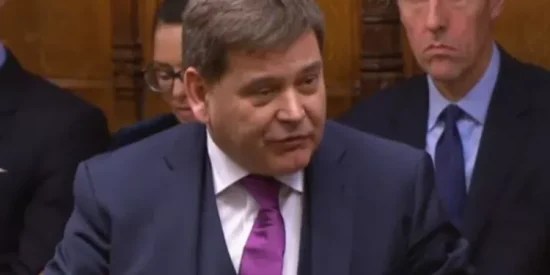
BY WILL JONES | THE DAILY SCEPTIC | MAY 10, 2023
Ex-Tory MP Andrew Bridgen, who was expelled from the party for criticising the Covid vaccines, has announced he’s joining Laurence Fox’s Reclaim Party, making him its first member of Parliament. At a press conference today Bridgen said he would be standing at his North West Leicestershire constituency at the next General Election. He also confirmed he would be suing Matt Hancock MP for defamation over an allegation of antisemitism.
At the press conference this morning Bridgen confirmed he has decided not to appeal his expulsion and blasted the Conservative Party. He said:
Even if I were to be given a fair hearing, which I doubt, I would not wish to rejoin the party after the treatment received by myself and my family over the past few years.
I feel now that the party no longer represents the people of this great country. If I am to represent my constituents and countrymen it must be from outside the party which I have served dutifully for many decades.
I will be standing again in North West Leicestershire at the next election. Not as a Conservative, but as a Member of the Reclaim Party. More than anything, the Reclaim Party stands for freedom of speech.
I will cross the floor today, Wednesday May 10th, and sit on the opposition benches as the first Member of Parliament for the Reclaim Party. I say first because I have no doubt I will not be the last. This is just the beginning.
If the Conservative Party wishes to contest my seat it can do so at the next General Election.
I have more confidence that I will win my seat than the vast majority of sitting Conservative MPs, so I welcome the challenge should the Prime Minister and Parliamentary Party wish to take it.
Bridgen was accused of antisemitism for agreeing in a tweet with an anonymous heart doctor he quoted that the Covid vaccine rollout was “the biggest crime against humanity since the Holocaust”.
He has denied the allegation – which we at the Daily Sceptic agree is spurious and an example of a weaponised antisemitism allegation to achieve political ends. This morning Bridgen confirmed that he will be suing ex-Health Secretary Matt Hancock for defamation after the Conservative MP tweeted in January that he was spouting “antisemitic, anti-vax, anti-scientific conspiracy theories”.
In a YouTube video Bridgen said he has submitted a “defamation claim to the Royal Court of Justice against Matthew Hancock MP”. The basis of the claim is that Hancock’s accusation of antisemitism is “a false slur to deliberately try and shut down valid concerns raised by me on behalf of constituents and thousands of others around the world about the safety and efficacy of the experimental COVID-19 injections”.
Matt Hancock in the dock: that’s a court case to look forward to.
You can donate to Andrew Bridgen’s legal fund here.
Leaked Legal Analysis Of EU’s Private Message Snooping Plans Says It Interferes With “Fundamental Rights”
Undermining the EU’s self-described commitment to privacy
By Didi Rankovic | Reclaim The Net | May 10, 2023
There are few things the EU Commission (the EU’s executive arm) would like to present more than the bloc and its institutions speaking with one voice, particularly on controversial topics, such as attempts to destroy encryption.
However, documents leaked from the EU Council Legal Service regarding the legality of a proposal known as “chat control” (formally, Child Sexual Abuse Regulation, CSAR), show that there may be “trouble in paradise.”
As digital rights advocate and European Parliament member (MEP) Patrick Breyer of Germany reports, the Service has warned the Commission that its idea probably runs contrary to the fundamental right to respect for private life – meaning that the European Court of Justice would likely annul it.
Summed up, the “chat control” scheme proposes forcing providers of chat, messaging, phone, and email services to screen all private messages in search for illegal content and then inform the police.
But the problem with this, as the Service has noticed, is that it very easily could be interpreted as general and indiscriminate, as well as permanent surveillance, given that the plan gives “generalized” access to every citizen, including those the analysis says are “not even remotely connected with child sexual exploitation.”
And with the high likelihood that CSAR’s “detection orders” would be considered a violation of the fundamental right to privacy and confidentiality of correspondence, the EU court is also highly likely to squash “chat control” as indiscriminate surveillance, the Service warns.
The analysis also notes that while if the justification for “communications metadata screening” is national security, the court allows it – the drastic measures proposed in the CSAR would probably not be considered proportional to their stated purpose.
There’s also the issue of the EU Commission making the dubious claim that the process, rather than generalized, is somehow “targeted” (it does target everyone – so perhaps that’s the sophistry those behind the CSAR chose to go with.)
But the Legal Service’s analysis fears this is actually a “contradiction” between what the Commission is saying, and what the proposal actually spells out.
The Service’s logical suggestion then is to actually target detection orders so that they apply to people “in respect of whom there are reasonable grounds to believe that they are in some way involved in, committing or have committed a child sexual abuse offense.”
Observers have noted that the analysis of the CSAR – whose UK counterpart is the Online Safety Bill, represents serious criticism of similar, encryption-undermining proposals on both sides of the Atlantic.
New Federal Disinformation Offices Created
By John Leake | Courageous Discourse | May 9, 2023
The Intercept recently reported the creation of two new federal offices to combat disinformation. The Pentagon will oversee the “Influence and Perception Management Office,” which is consistent with the fact that “Perception Management” is an old DoD euphemism for psychological warfare and deception. According to the investigative journalist Robert Parry, who covered the Iran-Contra Affair, the Reagan and first Bush Administrations adopted the techniques of “Perception Management” for the objective of overcoming the American public’s “Vietnam Syndrome”—that is, its reluctance to get involved in foreign military adventures that were widely perceived as fruitless and likely to end badly.
Given that the federal government is already a Leviathan of agencies for conducting propaganda, influence, and surveillance operations, one wonders why it is necessary to create new offices for these activities. The new Biden Administration offices are purportedly to keep the homeland and its people safe from dangerous foreign adversaries. More likely they will work round the clock to keep our people insulated from outside sources of information that would serve to counterbalance U.S. government and MSM propaganda.
US developed AI tool to battle ‘Russian disinformation’ – Blinken
RT | May 10, 2023
Washington has developed an artificial intelligence-based system to detect and gather ‘Russian’ disinformation online, US Secretary of State Antony Blinken claimed on Tuesday at the Freedom House 2023 Annual Awards Ceremony.
The State Department has created “an AI-enabled online Ukraine Content Aggregator to collect verifiable Russian disinformation and then to share that with partners around the world,” the US top diplomat said.
The government is cooperating with scholars to be able to “reliably detect fake text generated by Russian chatbots,” he added.
Last year, social media analytics company Graphika and the Stanford Internet Observatory said hundreds of accounts disseminating pro-Western narratives over the past five were likely being run by the Pentagon’s Centcom unit. In March, news website The Intercept reported on federal contract documents, which suggest that the US Special Operations Command is planning to conduct propaganda and deception campaigns online using deepfake technology.
Last month, Russia’s Foreign Ministry spokeswoman Maria Zakharova accused the US of waging “an unprecedented information campaign” against Russia since the start of the conflict in Ukraine. Washington and its allies “need war at any cost, and their favorite method of solving their own problems is provocations, disinformation and threats,” Zakharova argued.
Speaking about artificial intelligence in general, Blinken warned that the technology can backfire and “amplify discrimination and enable abuses.”
“It also runs the risk of strengthening autocratic governments, including by enabling them to exploit social media even more effectively to manipulate their people and sow division among and within their adversaries,” he said.
Since the release of the artificial intelligence bot ChatGPT last November, the debate over the dangers posed by AI has intensified in the industry and in academic circles. Geoffrey Hinton, who is known as one of the ‘godfathers’ of AI, warned last week that the technology could present a “more urgent” threat than climate change.
In March, several tech industry leaders, including Elon Musk, co-signed an open letter, urging a six-month pause in the development of AI technology more powerful than ChatGPT, and the appointment of an independent regulator to provide oversight in the field.
Paris to Block Websites Sharing News Content of Sputnik, RT France
Sputnik – 10.05.2023
PARIS – France will block websites that share information of sanctioned media, including RT France and Sputnik, under a new law on security of digital space, French Minister for Digital Transition and Telecommunications Jean-Noel Barrot said on Wednesday.
“As part of measures to protect democracy we will also begin blocking websites that share content of media under international sanctions like the ones the EU imposed against RT France and Sputnik. This measure will complement our existing tools to fight the propaganda of the enemies of democracy,” Barrot told a briefing after a cabinet meeting.
The French ministry has claimed the measure will allow the authorities to protect people from disinformation by expanding the powers of Arcom, the country’s media regulator, which will be authorized to impose restrictive measures against media.
The draft law will be submitted to the Senate in early July, Barrot stated.
Since the start of Russia’s special military operation, a number of jurisdictions, including the European Commission, have decided to censor Russian media and affiliated journalists. In early March 2022, the EU banned the broadcasting and distribution of content by RT and Sputnik as part of the sanctions against Russia, applying the restrictions to all means of content transmission and distribution, such as cable, satellite, IPTV, platforms, websites and apps. All relevant RT, Sputnik licenses and agreements are suspended.
Anger spreads in Pakistan as govt arrests nearly 1,000 Imran Khan supporters
The Cradle | May 10, 2023
Pakistani police have detained at least 945 supporters of ousted prime minister Imran Khan in Punjab, the country’s most populous province, since protests erupted on 9 May following Khan’s arrest.
At least one protester was shot dead by security forces in the southwestern city of Quetta on Tuesday, according to a CNN reporter present at the scene.
“Police teams arrested 945 lawbreakers and miscreants from across the province,” officials said in a statement to the media, adding that 130 security officers were injured, 25 police and government vehicles were burnt, and 14 government buildings were attacked during the protests.
In the face of popular discontent, the interior ministry on 10 May requisitioned the help of the army to “maintain law and order” in Punjab.
On Tuesday, the National Accountability Bureau (NAB) deployed dozens of paramilitary troops to dramatically detain Khan under alleged charges of “corruption and corrupt practices.”
The former premier was presented in an Islamabad court on Wednesday morning to face the charges. During the hearing, the NAB requested the court approve Khan be kept under police custody for 14 days, a move his lawyers opposed.
Khan’s lawyers also insisted that the court investigate the irregular manner in which the 70-year old politician was arrested from the premises of the Islamabad High Court.
In a pre-recorded statement released on YouTube by Khan’s Pakistan Tehreek-e-Insaf (PTI) party after his arrest, the former premier said he was “detained on incorrect charges” and told his supporters, “the time has come for all of you to come and struggle for your rights.”
“I have always followed the law. I am being apprehended so that I can’t follow my political path for this country’s fundamental rights and for me to obey this corrupt government of crooks which has been hoisted on us,” Khan added.
Following his arrest, his supporters broke into the military’s headquarters in the city of Rawalpindi, just outside the capital.
Protesters also blocked one of the main thoroughfares into Islamabad, throwing stones and pulling down street signs.
Authorities responded by deploying internet jammers and disrupting access to Twitter, Facebook, and YouTube in the nation of 270 million.
Khan’s arrest came just a few months before crucial elections in October, where many expect the ousted premier to win the largest democratic mandate ever secured by any politician in the 75-year history of Pakistan.
The former cricket star was ousted from government last year in a US-backed parliamentary coup that saw Shehbaz Sharif – a protégé of the Sharif business dynasty that has governed Pakistan for much of the last three decades – come to power.
Khan previously saw his relationship with the US sour after the fall of Kabul to the Taliban. They were also at odds over Afghan state assets frozen by Washington and about US flights over Pakistan.
More pressure started to build against Khan after he criticized western powers for pressuring Islamabad into condemning Russia’s military invasion of Ukraine.
“What do you think of us? Are we your slaves … that whatever you say, we will do?” Khan said at a political rally early last year.
Since his ousting, he has been arrested, charged with “terrorism,” banned from running for office, and even survived an assassination attempt.
They’re Coming To Take You Away
By Michael Lesher | Brownstone Institute | May 9, 2023
Suppose I tell you in advance that the essay you are reading is meant to startle you. And suppose I suggest, by way of demonstration, that two people as loosely connected as the leader of the “COVID Crisis Group” and Joe Biden’s “Special Envoy To Monitor and Combat Antisemitism” – both of whom have recently offered recommendations for improving political life in the United States – are in fact determined to unravel American freedoms.
Would you be surprised?
Well, if so, that is exactly the startling fact I am trying to bring to your attention. True, you may not have heard that the 34 COVID-19 “experts” headed by one Philip Zelikow (last seen justifying the concealment of information about the 9/11 attacks) and anti-Semitism “ambassador” Deborah Lipstadt – perhaps best known for slandering scads of Jewish survivors of the Nazis as “soft-core” Holocaust deniers because they objected to the massacre of 1,462 of Gaza’s civilians nine years ago – are both out to dismantle the Bill of Rights. But if you haven’t, it isn’t because they’ve been coy about their objectives.
Take the Zelikow panel. Its new book on “the lessons learned from COVID-19” openly conflates the federal government’s management of a respiratory virus with “wartime” – thus rationalizing the executive branch’s preemption of democratic government. Not only that, Zelikow and his band of “experts” explicitly call for the consolidation of power in the hands of an unelected “health security enterprise” that would control, among other things, a “systematic biomedical surveillance network.” And in case you can’t guess who is likely to benefit from the snooping, the panel goes on to praise the coercive experimental drug program that gave us the COVID-19 “vaccines” – “a bargain at $30 billion,” according to the editors of the Washington Post – signaling at one stroke the experts’ contempt for the Nuremberg Code and their subservience to Big Pharma.
As for Lipstadt, she has launched her attack on the First Amendment by redefining “anti-Semitism” so as to include an extraordinary range of political speech. Her first step in that transformation is the familiar trick of confusing criticism of the Israeli government with anti-Jewish bigotry. But her second step is newer and, arguably, even more disturbing: she tars all denigration of Jews with the hot-button label “conspiracy theory.”
Let’s be clear: however noble the pretext of opposing Jew-hatred, it should be obvious that once you characterize anti-Semitism as a “conspiracy theory” you have made a case for censorship. As Lipstadt herself explained to Jane Eisner of Columbia University’s Graduate School of Journalism (in an interview printed in the latest AARP Magazine but not available online): “[I]t’s a conspiracy theory that Jews control the media, the banks, the election process, etc. If you believe that there is a group controlling these things, then essentially you’re saying that you don’t believe in democracy.”
And there’s the trouble. After all, an overt attack on democracy isn’t a viewpoint; it isn’t even an expression of run-of-the-mill bigotry. It’s a threat to the state. And it follows, if you accept Lipstadt’s formulation, that anyone the government can label an “anti-Semite” may now be punished in the same way the Biden administration is already punishing people who protested the presidential election results of November 2020. Note, too, the selective parameters of the offense: blaming Donald Trump’s election on the Russians is presumably “legitimate” speech; but accusing a “group” of controlling “the election process” can land you in jail – that is, when the “group” is not an official enemy but a favored minority, and when that “process” has reached results endorsed by those in power.
So the Zelikow panel and Ambassador Lipstadt can’t be accused of hiding their illiberal goals. Like the Democratic lynch mob that denounced Matt Taibbi and Michael Shellenberger on the floor of Congress last March for revealing the extent of government censorship of Twitter, these propagandists quite openly assert that surveillance is good for us, while free speech is entirely too dangerous to be entrusted to mere citizens.
“Ordinary folks and national security agencies responsible for our security,” Congressman Colin Allred lectured Taibbi, “are trying their best to find a way to make sure that our online discourse doesn’t get people hurt, or see our democracy undermined.” It’s pretty breathtaking to watch an African-American liberal solemnly declare that the CIA and the FBI are the true guardians of democracy – not to mention his defense of the security state’s behind-the-scenes censorship of political speech. But what’s even more ominous is that not a single prominent Democratic politician nor a single pundit in mainstream liberal media has repudiated anything the congressman said.
Is it any wonder, then, that no one in mainstream media has mentioned the totalitarian tendencies implicit in the COVID Crisis Group’s recommendations for “pandemic” regulation via dismantling democracy, or in Ambassador Lipstadt’s appeals to the public to “discredit” anti-Semitism by recasting it as a criminal conspiracy?
Of course it isn’t. And that is my point. That is my motive in writing in tandem about these two apparently disparate subjects, connected only by the facts that both of them involve recent public declarations and that both of them represent attacks on fundamental liberties.
Because the truth is that condemning freedom is now so entirely respectable that it’s happening practically everywhere – under every possible pretext, almost any day, from just about any left-liberal institution that claims to care about the public good. Close your eyes, and you can hardly tell whether what you’re hearing is coming from a Democratic Party stalwart or from an old-line Soviet apologist explaining why Andrei Sakharov or Aleksandr Solzhenitsyn or Yuri Orlov is really, notwithstanding the accuracy of what he’s been saying, a threat to the state who deserves to be muzzled or jailed.
And the media’s silence about it all is as ominous as the Orwellian nattering of the freedom-haters themselves.
Take another look at the Zelikow panel’s assessment of the US government’s performance during the “COVID crisis.” Writing about what the “experts” praise or blame in their report, the Washington Post never once mentions the crippling of the US working-class economy due to arbitrary confinements and business shutdowns, the educational damage done to a whole generation of children through needless school closures, the reckless suspension of representative democracy in four-fifths of our states, the medically unjustifiable trauma caused by “mask mandates,” or the undermining of the national healthcare system through an obsessive focus on one respiratory virus while more serious issues were sidelined for over a year. As far as the Post is concerned, the real outrages of the COVID coup never happened at all.
Even when the experts and the editors do manage to notice something sinister, they go out of their way to miss the point. The Zelikow panel specifically notes the “four pandemic planning exercises” staged by the US government barely a year before the announcement of the COVID-19 outbreak. And it offers a few technical criticisms of the proceedings.
But neither the panel nor the Post editors’ congratulatory summary of its conclusions addresses the fact that the exercises – which omitted any suggestion for using repurposed drugs as early treatment for a novel virus, as in all previous influenza-like outbreaks – made a point of discussing the importance of thought-policing social media. That prescription for censorship became a grim reality after March 2020. But you’d never know it from reading the Zelikow panel’s assessment of the government’s mistakes in addressing the “pandemic.”
And Lipstadt? She claims to be a passionate defender of free speech. But that didn’t stop her from smearing Senator Ron Johnson as a “white nationalist sympathizer” because of his politically incorrect comments about Black Lives Matter. And when that issue made it to the op-ed page of the New York Times, it was only to further demonize Johnson; Lipstadt’s slander got a pass.
Why do I worry so much about this? Well, first of all because an attack on freedom is an attack on all of us.
But I think there is a special reason for alarm. It’s not just that our ruling elites believe that we, the people, need to be stripped of our right to free expression. I’m afraid that the freedom-haters clustered around our figurehead President are not even aware just how thin the ice is onto which they’re propelling us. Their position (taking the most charitable possible view of it) runs something like this: if the public isn’t exposed to views of which the censors disapprove, hoi polloi will meekly accept whatever policies are imposed on them (for their own good, of course).
But the censors are wrong. The fabric of American political life has been strained to such tautness that a single acute crisis might rupture it altogether. And if that happens, people who have been deprived of reasonable dissent will not shrink from violent opposition; on the contrary, they will embrace it. When the monolithic narrative that is all they have been taught lies in ruins, they will replace it not with a rational, informed alternative – for they will know of none – but with whatever satisfies the rage of a population that realizes, too late, that it has been hoodwinked.
Woe to the freedom-haters when the lion they think they have tamed turns its fury on the liberal society that soothsayers like Zelikow and Lipstadt still imagine they are defending!
Imran Khan’s Arrest Will Bring Pakistan’s Year-Long Crisis Much Closer To Its End Game
BY ANDREW KORYBKO | MAY 9, 2023
The post-modern coup that removed former Pakistani Prime Minister Imran Khan from office last April as punishment for his multipolar foreign policy catalyzed cascading crises across the economic, judicial, political, and security spheres that have shaken this South Asian state to its core. The US-backed regime that was installed in his place refuses to hold free and fair elections as early as possible since they know they’d lose after the former premier’s PTI party won multiple by-elections over the past year.
During that same time, the post-modern coup regime viciously cracked down on society by abducting dissidents and censoring the media out of desperation to retain power. Far from pressuring the Pakistani people into silence and forcing them to accept what Khan calls their imported government, they continued peacefully protesting for the right to exercise their democratic will sooner than later. Only upon resolving Pakistan’s political crisis in that manner, these patriots believe, can the other ones then be tackled.
To their credit, they remained committed to this path despite last November’s assassination attempt against Khan that he blamed on The Establishment, the raid on his home in mid-March, and the Interior Minister’s continued death threats against him. Their red line was always that he wasn’t to be arrested on trumped-up charges as part of the post-modern coup regime’s lawfare since this scenario would pose a threat to his life due to The Establishment’s reputation and also likely doom any democratic solution.
That red line was just crossed after dozens of Ranger paramilitary forces stormed an Islamabad courthouse to abduct him on Tuesday in a move that former PTI Human Rights Minister Shireen Mazari described “as if (they were) invading an occupied land”. Nationwide protests were organized in response and are still occurring at the time of this analysis’ publication, but the post-modern coup regime might exploit this reaction to justify a conventional military coup in the worst-case scenario.
The Establishment’s latest power play is extremely dangerous since these stakeholders already know very well how polarized society has become over the past year. They could have responsibly exerted influence on their political proxies that replaced Khan after last April’s regime change to organize free and fair elections as early as possible in order to serve as a pressure valve. That could have averted the cascading crises that followed and just risked reaching their breaking point on Tuesday.
Some sort of pragmatic working arrangement could still have been brokered between them and the PTI in theory upon the latter returning to power as expected in that case, yet no such outcome appears possible now after The Establishment crossed the opposition’s red line as part of their power play. They’re practically daring people to publicly defy them and thus put their lives on the line, yet a large number of them are doing precisely that out of patriotic fervor since they fear losing their country.
In their minds, a new dark age is rapidly descending upon Pakistan, which might never restore the sovereignty that it’s losing by the day as a result of the cascading crises catalyzed by last April’s regime change. They can’t in good conscience sit back and let this happen without knowing in their hearts that they tried doing something tangible to stop it. This explains why they’re literally risking their lives right now protesting against Khan’s abduction and all that it entails for their country’s democratic future.
At present, it appears unlikely that The Establishment will relent by releasing him and pressuring their political proxies to publicly agree on a date for holding free and fair elections sometime in the very near future, but that doesn’t mean that their calculations might not change. In any case, it’s clear that Pakistan’s year-long crisis is reaching its end game since there are really only two mutually exclusive outcomes that are possible: a chance at true democracy or continuing to languish under dictatorship.
Former Pakistani PM detained
The Cradle | May 9, 2023
Former Pakistani prime minister Imran Khan has been arrested by the National Accountability Bureau (NAB) from the Islamabad High Court (IHC), Geo News reported on 9 May.
Khan was taken into custody by security personnel known as “Rangers” outside the IHC where he had gone to seek bail as a result of graft charges.
According to Fawad Chaudhry, the official spokesperson of Imran Khan’s Pakistan Tehreek-i-Insaf party (PTI), the ex-prime minister has been “abducted from court premises. Scores of lawyers and general people have been tortured.”
Khan was arrested in connection with the allegations that Bahria Town allotted land worth 530 million rupees to the Al-Qadir Trust, owned by the PTI chairman and his wife, according to Islamabad police.
“Khan has been whisked away by unknown people to an unknown location,” Chaudhry said.
According to Imran Khan’s spokesman Raoof Hasan, “He was taken away… before he could appear before the judges, which is in violation of all laws.”
“The party has given a call to immediately start protests across Pakistan,” PTI leader Azhar Mashwani tweeted.
Khan’s arrest was not authorized by IHC Chief Justice Aamer Farooq, however, who requested the attorney general appear before the court within 15 minutes and instructed him to immediately find out who was behind the arrest.
“If an inquiry has to be conducted, action will also be taken against the prime minister and ministers,” the chief justice said.
Security forces previously attempted to detain Khan last March after an Islamabad court issued an arrest warrant to ensure his attendance in court to face graft charges.
However, security forces were blocked by hundreds of the former prime minister’s supporters, who gathered outside his Lahore home to prevent his arrest. The clashes between both sides, in which security forces fired tear gas and water cannons, and Khan’s supporters threw stones, led to dozens of injuries.
The former cricket star, who was ousted as prime minister in a no-confidence vote in parliament in April 2022, went to Islamabad to appear before three courts on charges of selling state gifts and failing to disclose assets but failed to appear before the fourth court to face indictment in the graft case, which is a legal process for starting his trial.
Khan claimed the charges filed against him, which include terrorism charges, are an effort by his successor, Prime Minister Shahbaz Sharif, to discredit him and prevent him from contesting the upcoming elections.
At the time of his ousting as prime minister, Khan accused the United States of working with a coalition of Pakistani opposition parties to topple his government.
Khan alleged that US Assistant Secretary of State for South and Central Asian Affairs Donald Lu met with the Pakistan Ambassador Asad Majeed and warned that there could be implications if Khan was not ousted as prime minister.
Khan has long been known for his opposition to US foreign policy. In 2017, Khan organized a motorcade march to Pakistan’s tribal areas to protest US drone strikes against Islamic militants.
In November 2022, Khan was the target of an assassination attack. A gunman opened fire with an automatic weapon on his convoy of lorries and cars, injuring Khan’s leg and killing one of his supporters, and injuring seven more.
One Health: A Plan to ‘Surveil and Control Every Aspect of Life on Earth’?
This is part two of a two-part series on the One Health initiative. Read part one here.
By Michael Nevradakis, Ph.D. | The Defender | May 8, 2023
The World Health Organization (WHO) defines “One Health,” as “an integrated, unifying approach that aims to sustainably balance and optimize the health of people, animals and ecosystems,” as they are “closely linked and interdependent” — a concept that on the surface appears to promote noble goals interlinking human and environmental health.
However, some scientists and medical experts are concerned about One Health’s vague goals. Arguing that the concept has been “hijacked,” they question the intent of those involved with the development and global rollout of the concept — including the WHO, the Centers for Disease Control and Prevention (CDC) and the World Bank.
Experts who spoke with The Defender also raised questions about other aspects of the One Health concept, including a biosecurity agenda, a global surveillance system, vaccine passports and restrictions on human behavior.
While these goals are underpinned by a vaguely defined “Theory of Change,” experts told The Defender that major financial interests are at the heart of the One Health agenda, which appears to be closely linked to climate change and sustainable development initiatives promoted by the same global organizations.
One Health objectives include a ‘global takeover of everything’
In a May 1 article, Dr. Joseph Mercola connected the One Health concept, as promoted by global organizations, to the policies and restrictions pursued in response to COVID-19, describing it as an attempted “global takeover of everything.”
Mercola tied the One Health concept to key entities that have supported gain-of-function research. According to Mercola:
“Interestingly, the term ‘One Health,’ which was formally adopted by the WHO and the G20 health ministers in 2017, was first coined by the executive vice president of the EcoHealth Alliance, the same firm that appears to have had a hand in the creation of SARS-CoV-2.”
During the 2019 lecture “Can One Health Help Prevent the Next Pandemic?” EcoHealth Alliance President Peter Daszak, Ph.D., commissioner in The Lancet’s One Health Commission, said “emerging infectious diseases” are “a growing global threat.”
He also argued that many of these emerging diseases are “zoonotic — spread from animals to humans.”
Francis Boyle, J.D., Ph.D., professor of international law at the University of Illinois and a bioweapons expert who drafted the Biological Weapons Anti-Terrorism Act of 1989, questioned this narrative, telling The Defender :
“All these ‘emerging infectious diseases’ are emerging out of their offensive biological warfare weapons programs conducted in their BSL4 [biosecurity level 4] and BSL3 laboratories.
“If you look at the people on the WHO advisory committee dealing with ‘emerging infectious diseases,’ that’s exactly what they are doing — ‘emerging’ them from their labs.”
One example is that of Marion Koopmans, DVM, Ph.D., director of the WHO Collaborating Centre for emerging infectious diseases at Erasmus Medical Centre in the Netherlands and member of the WHO’s One Health High-Level Expert Panel (OHHLEP).
According to Boyle, “Erasmus is where this offensive Nazi biowarfare gain-of-function death science dirty work first became notorious under Fouchier, [who] started the entire controversy over his gain-of-function work there.”
Boyle was referring to Ron Fouchier, Ph.D., who also is deputy head of Erasmus’ Viroscience Department and who, according to Science, “alarmed the world” in 2011, after he and other researchers “separately modified the deadly avian H5N1 influenza virus so that it spread between ferrets” — an early example of gain-of-function research.
Dr. Meryl Nass, an internist and biological warfare epidemiologist who is a member of the Children’s Health Defense scientific advisory committee, said such objectives are kept deliberately vague. She referred to a CDC document that stated:
“Successful public health interventions require the cooperation of human, animal, and environmental health partners … Other relevant players in a One Health approach could include law enforcement, policymakers, agriculture, communities, and even pet owners.
“By promoting collaboration across all sectors, a One Health approach can achieve the best health outcomes for people, animals, and plants in a shared environment.”
Nass wrote on her blog, “I anticipate that One Health will be used to impose changes in the way humans and animals interact … most likely based on the needs of the WEF [World Economic Forum]/elites and not the needs of the people or the animals that will be affected.”
Reggie Littlejohn, founder and president of Women’s Rights Without Frontiers and co-chair of the Stop Vaccine Passports Task Force, told The Defender, “It’s not clear that One Health is prioritizing human health.”
Highlighting the “vague” language employed by the global organizations promoting One Health, Littlejohn said that one goal may be to “govern farm animal health in addition to human health,” through which “they could do things like forcing vaccines on livestock.”
One Health means ‘surveilling everything’
The experts who spoke with The Defender expressed concerns over the biosecurity agenda that is associated with the stated objectives of One Health.
According to Nass, this reflects how the WHO “has been changing into a biosecurity agency,” adding that “the justification, apparently, for the WHO’s director-general to take over jurisdiction of healthcare during pandemics, but also potentially ecosystems, animals and plants, is through One Health.”
Nass noted that One Health “is mentioned several times in the National Defense [Authorization] Act for Fiscal Year 2023” (NDAA), which includes 18 pages on “pandemic preparedness” and a formal definition of the “One Health approach” on page 952 of the act.
Independent journalist and researcher James Roguski also highlighted the prominent placement of One Health in the NDAA and noted that, by formally defining the concept within the act, it is now part of the Code of Federal Regulations.
However, Roguski said the NDAA goes even further:
“The U.S. has pledged a billion dollars a year to the World Bank Pandemic Fund in support of the global health security agenda. The WHO is one of 14 intermediaries who will receive and redistribute some of that billion dollars.
“Basically, it’s capitalism, it’s corruption, it’s an abomination from a health perspective. Let’s just throw money at pharmaceutical companies, build out the infrastructure in these nations and, if you’re making tons of products locally, you’re going to be able to convince the local government to stick them in people’s arms or shove it down their throat.
“And none of it really has shown to be of any health benefit. It’s damage to people’s health.”
Associated with the promotion of a global biosecurity agenda is the development of a global surveillance infrastructure that would purportedly protect human and animal health and the environment. An Oct. 3, 2022, WHO document states:
“The emergence of the SARS-CoV-2 virus that caused COVID-19 has underlined the need to strengthen the One Health approach, with a greater emphasis on connections to animal health and the environment …
“… It uses the close, interdependent links among these fields to create new surveillance and disease control methods. …
“We now have an unprecedented opportunity to strengthen collaboration and policies across these many areas and reduce the risk of future pandemics and epidemics while also addressing the ongoing burden of endemic and non-communicable diseases
“Surveillance that monitors risks and helps identify patterns across these many areas is needed.”
Remarking on this, Littlejohn said One Health’s proponents talk about “interoperable, integrated surveillance systems.” She told The Defender :
“I believe … these surveillance systems of people, animals, plants, and the environment are going to be coordinated by some kind of a global surveillance system that is interoperable globally and integrated.
“Whoever’s running this show, the WHO, the Chinese Communist Party … the Bill and Melinda Gates Foundation, who are the people who really appear to be running the show at the WHO, are going to be able to tap into and see all of our private information. Not just us, but animals and plants.”
Dr. David Bell, a public health physician and biotech consultant and former director of global health technologies at Intellectual Ventures Global Good Fund, told The Defender that what global organizations intend is “surveilling everything.” He said:
“It means surveilling everything, surveilling the climate for possible threats, surveilling animal population, surveilling wildlife, surveilling the soil to see if there’s new traces of virus or bacteria in river systems, et cetera.
“This allows you to ‘discover’ what we already know is nature, and then turn nature into a potential threat or into a threat. The more surveillance you have and the wider it is, the more inevitable ‘threats’ you’ll find … because you can make an argument that almost any new variant virus is a ‘threat.’
“It will allow them to keep a constant kind of fear which then allows you to introduce authoritarian controls such as central bank digital currencies and digital passports … that allow them to monetize the human population more effectively.”
Nass noted that global actors such as the WHO “talk about sharing of specimens during a pandemic … so they can try to make vaccines too. However, they don’t talk about performing surveillance on human beings. But what they did say, which let the cat out of the bag, is that they would want to get informed consent from countries for sharing of genomic data, rather than from individuals.”
Part of this surveillance infrastructure also would include vaccine passports, which figure prominently in the pandemic treaty and amendments to the International Health Regulations (IHR) currently under negotiation at the WHO.
According to Littlejohn:
“I believe that they laid the infrastructure during the COVID-19 crisis, and we’re having a little bit of a ‘break’ here between pandemics, but that structure, that infrastructure is going to snap shut with the next pandemic if we don’t stop it. That structure has to do with vaccine passports.
“It could be called a ‘smart health card’ or ‘digital health ID,’ or even a mandatory digital driver’s license can serve as the platform for a China-style social credit system. And there’s a new bill in front of the Senate right now … the Improving Digital Identity Act of 2023 … It’s a mandatory national ID that’s going to be interoperable, coordinated, integrated and can serve as the same platform as China’s social credit system … to surveil us.”
Restrictions on human behavior could lower humans to the level of animals
The WHO’s Oct. 3, 2022, document also claimed that “Some 60% of emerging infectious diseases that are reported globally come from animals, both wild and domestic,” adding that “human activities and stressed ecosystems have created new opportunities for diseases to emerge and spread.”
Such stressors “include animal trade, agriculture, livestock farming, urbanization, extractive industries, climate change, habitat fragmentation and encroachment into wild areas,” according to the WHO.
“To the extent that carbon emissions due to transportation within cities would contribute to climate change, then the ‘15-minute city’ would be a way of addressing that,” Littlejohn said. “The danger is that they will enforce it by having surveillance cameras everywhere to make sure you don’t go outside of your district without permission.”
In a March 30 article, “Your Daughter for a Rat,” Bell cited a One Health editorial published in The Lancet stating that “all life is equal, and of equal concern.” In response, Bell suggested that One Health aims to lower humans to the level of animals.
The same Lancet article described One Health as “a call for ecological, not merely health, equity” and called for a “subtle but quite revolutionary shift of perspective” away from “anthropocentrism”: “All life is equal, and of equal concern.”
“It looks like this is going to be the justification for moving people down to the value of animals,” Nass said in response; a sentiment shared by Boyle, who said, “One Health relates the healthcare of human beings to the healthcare of animals and thus reduces healthcare for human beings to the level of healthcare for animals.”
According to Bell, “suggesting that we have a duty as a species on this planet to look after every species equally and treat them more equally [is] becoming sort of a religion or dogma. It defies what any rational society in the history of humanity” has practiced and is “a very unusual approach and potentially very scary.”
One Health: Follow the money
The WHO has attempted to give theoretical credence to the One Health concept by developing a so-called “Theory of Change” (ToC).
Although the WHO says the ToC is designed to provide “a conceptual framework” for “organisations, agencies and initiatives working towards similar One Health goals” and a “common narrative of coherence,” the theory itself does not appear to have a clear definition.
“They want to be able to do whatever they want,” Littlejohn said. “If you define it, then you can hold them to the definition … one of the tactics is just to be really obscure and incomprehensible.”
“This is a term that is used in these circles,” Bell added. “It’s stating the obvious, that if you do a certain act, you’ll have a certain outcome. It’s a fancy way of saying that.”
Bell also referred to the “fallacy that is being pushed that humans are having increasing contact with wildlife,” supposedly leading to “this threat of viruses jumping from wildlife to humans.”
Calling it a “ludicrous claim,” Bell said that “when humans move into wildlife habitats, the wildlife don’t start living with humans. They die out.”
Noting that “it used to be very common” for people to live with farm animals, Bell added that the claim that pandemics are becoming more common due to increased contact with animals is itself “not true,” but is “used to instill fear and to try to get people to buy into this One Health, constant health emergency agenda.”
Nass said One Health proponents “don’t actually have any evidence” to support their claims, offering the example of antimicrobial resistance in bacteria found in meat consumed by humans, as a result of antibiotics administered to livestock. “That’s been the hook that One Health has been hung on,” Nass said.
However, Nass said this problem “could be solved in a heartbeat if the U.S. Food and Drug Administration or the U.S. Department of Agriculture just told farmers they can’t put antibiotics into animal feed anymore, they can only use them when an animal gets sick.”
In his recent article, Mercola suggested following the money. “Private interests wield immense power over the WHO, and a majority of the funding is ‘specified,’ meaning it’s earmarked for particular programs. The WHO cannot allocate those funds wherever they’re needed most.”
As a result, this “massively influences what the WHO does and how it does it. So, the WHO is an organization that does whatever its funders tell it to do,” naming organizations such as the Gates Foundation as prime funders of the WHO.
Bell said that supporters of One Health include “those who have been pushing the COVID agenda … and enriching themselves from it,” including “private foundations who are on the bandwagon” and “corporations who stand to gain from controlling the food chain and controlling agriculture and pharmaceuticals, et cetera.”
“It’s corporate authoritarians that have benefited themselves from public health through COVID and the certainly inappropriate COVID response,” Bell added. “And it’s the same and it’s not disconnected with the climate emergency agenda.”
One prominent financial actor closely involved with the development of the One Health agenda is the World Bank, as WHO documents indicate.
At a November 2022 OHHLEP meeting, Franck Berthe, the World Bank’s senior livestock specialist, introduced the World Bank’s Financial Intermediary Fund, which would “allow countries to borrow funds to strengthen their health system and promote the OH [One Health] approach.”
According to Nass, “the WHO and the World Bank have helped form this financing operation for the biosecurity agenda,” while Boyle told The Defender, “There is nothing humanitarian about these backers and the WHO promoting the One Health agenda.”
Both Nass and Bell said the One Health agenda is closely tied to the UN’s Sustainable Development Goals and Agenda 2030. Bell said that the One Health agenda attempts to deal with a supposed “existential threat to human health” that “must be dealt with in a centralized way, rather than giving people a choice.”
One Health closely tied to WHO pandemic treaty, IHR amendments
Experts who spoke with The Defender also emphasized the connections between the One Health concept and the pandemic treaty and IHR amendments under negotiation.
Mercola wrote that through the One Health agenda, which recognizes “a very broad range of aspects of life and the environment [that] can impact health and therefore fall under the ‘potential’ to cause harm,” the WHO “will be able to declare climate change as a health emergency and subsequently require climate lockdowns.”
Roguski, who has extensively researched the pandemic treaty and IHR amendments, said that in amendments the EU recently proposed for the pandemic treaty, the term “One Health” appears 29 times, including calling upon countries to develop and regularly update pandemic prevention plans via the One Health approach.
Referring to the need to prevent potential “pandemic situations,” the proposals also call for strengthening global public health surveillance “using a One Health approach,” which will also “address the drivers of the emergence and re-emergence of disease at the human-animal-environment interface, including but not limited to climate change, land use change, wildlife trade, desertification and antimicrobial resistance.”
The proposals also suggest the One Health approach could be used “to produce science-based evidence, and support, facilitate and/or oversee the correct, evidence-based and risk-informed implementation of infection prevention and control,” and go as far as to suggest targets on “antimicrobial consumption/use.”
Roguski told The Defender that the latest draft of the pandemic treaty refers to One Health 13 times. Such language would “be used to take over complete control of our lives,” Roguski added.
For example, one proposal states, “Each Party shall, in accordance with national law, adopt policies and strategies, supported by implementation plans, across the public and private sectors and relevant agencies, consistent with relevant tools, including, but not limited to, the International Health Regulations, and strengthen and reinforce public health functions for: (c) surveillance (including using a One Health approach).”
Other proposals include:
“The Parties commit to strengthen multi-sectoral, coordinated, interoperable and integrated One Health surveillance systems … to identify and assess the risks and emergence of pathogens and variants with pandemic potential, in order to minimize spill-over events, mutations and the risks associated with zoonotic neglected tropical and vector-borne diseases, with a view to preventing small-scale outbreaks in wildlife or domesticated animals from becoming a pandemic.
“Each Party shall … develop and implement a national One Health action plan on antimicrobial resistance that strengthens antimicrobial stewardship in the human and animal sectors, optimizes antimicrobial consumption, increases investment in, and promotes equitable and affordable access to, new medicines, diagnostic tools, vaccines and other interventions, strengthens infection prevention and control in health care settings and sanitation and biosecurity in livestock farms, and provides technical support to developing countries.”
Roguski said the phrase “One Health” doesn’t directly appear in documents related to the proposed IHR amendments, but he added the WHO “is going to try to get them both to prevail,” referring to both the treaty and IHR amendments.
Littlejohn said, the One Health approach and the proposed language in the treaty “gives them the right to surveil and potentially control every aspect of life on earth.”
Noting that the proposed treaty also calls for a “commitment to counteract ‘misinformation,’ ‘disinformation,’ and ‘false news,’” Littlejohn added, “they’re going to surveil our social media … and if any of us steps out of line by contradicting what the WHO says, then we could be censored.”
“That’s what I think is in mind with this commitment to ‘coordinated, interoperable and integrated’ One Health surveillance systems,” Littlejohn added. “I think that’s how it could end up being deployed. Ultimately, globalist entities, such as the World Economic Forum and the UN are using the WHO as their way of establishing global control.”
“The reason that health is such a good pretext is that people can become terrified,” Littlejohn added. “To the extent that their minds are paralyzed if they think they could die or get really sick, they’re willing to give up freedoms that they would not be willing to give up in other contexts.”
Roguski told The Defender :
“They made a lot of bad decisions. They gave a lot of bad advice [and] they caused a lot of harm to a lot of people. You can’t just give those people more power, authority and control without looking at what they did and going, ‘no, you should not be in charge of any of this.’”
In turn, Mercola wrote that “The globalist takeover hinges on the successful creation of a feedback loop of surveillance for virus variants, declaration of potential risk followed by lockdowns and restrictions, followed by mass vaccinating populations to ‘end’ the pandemic restrictions, followed by more surveillance and so on.”
And according to Bell, One Health “is part of a much bigger picture of finding ways to pull apart the intrinsic ideas that most societies have been built on.”
“I think that this is part of a move to undo these sorts of ideas and to replace them with a sort of religion of fear of our surroundings and denigration of other humans that can then be used by very greedy people to increase their wealth and power,” Bell said. “It’s taken over public health to a large extent.”
Michael Nevradakis, Ph.D., based in Athens, Greece, is a senior reporter for The Defender and part of the rotation of hosts for CHD.TV’s “Good Morning CHD.”
This article was originally published by The Defender — Children’s Health Defense’s News & Views Website under Creative Commons license CC BY-NC-ND 4.0. Please consider subscribing to The Defender or donating to Children’s Health Defense.
Featured Video

New positive ivermectin evidence
or go to
Aletho News Archives – Video-Images
From the Archives
Fanatical Followers of the Covid Regime: A Jim Jones-Style Cult?
By Professor Roger Watson and Dr. Niall McCrae | The Daily Sceptic | November 15, 2021
As scholars at leading British universities over recent decades, we witnessed the replacement of critical thinking and debate by narrative: facts are discrimination and scientific method is imperialism; truth, instead, is derived from ‘progressive’ values. This educational trend may be a major contributory factor to the ease in which society has been inculcated to the Covid ‘new normal’ of masking, testing, and repeated doses of vaccines for a disease of similar risk to severe influenza.
One doesn’t need much critical reasoning to observe the flawed logic of some vaccination enthusiasts, such as people who respond to experiencing any side effects, however debilitating, by saying “at least I know it’s working”, or, after contracting the disease despite their promised inoculation (over 90% effective, according to initial drug company claims), “I’d have been worse off without the jab.” … continue
Blog Roll
 Aletho News
- Najaf airport to reopen to Iranian flights within 24 hours: Ambassador
- From ‘How Will This End For Iran’ to ‘When America Walks Away’: A tale of two Economist covers
- Tehran blasts ‘baseless’ speculation linking Iran to alleged bomb plot at UK air base
- The Rise And… Rise Of ‘Color Revolutions’
- The Coming GOP Bloodbath?
- Arctic Scare Stories Melt Away
- Wrong, Euronews: Climate Change Has Not Created a Food, Energy, and Economic “Meta-Crisis”
- New positive ivermectin evidence
- Met Office Caught Fabricating Daily Temperature Record Claims
- Merck Virologists Admitted to Falsely Certifying Vaccine Efficacy
- If Americans Knew
- Netanyahu Asked UAE Leader to Deny Report on Oct. 7 Warning in Secret Visit, Sources Say
- CNN Chief Int’l Correspondent Clarissa Ward on Journalists in Gaza
- Democratic Party Consultants Surround Troy Jackson with Pro-Israel Donors
- Christian Leader Responds To Netanyahu’s Claims Regarding Palestinian Christians
- In Gaza, ‘Whoever Survives the Bombing Won’t Survive the Rubble’
- Israel kills more Palestinians, amid push to resettle Gaza – Daily Update
- Israel forces Gazans to live in constant peril – Daily Update
- Deconstructing Netanyahu’s pants-on-fire UN rant – Daily Update
- Trump betrayed voters with his campaign lies and prioritized a foreign country once he took office
- Netanyahu calls Israel’s war in Gaza ‘opposite of genocide’ in UN speech to near-empty hall
- No Tricks Zone
- New Study: Earth And Venus Surface Warmth Largely Explained By Convection And Lapse Rate, Not CO2 Or Radiation
- 2025 Nature Paper Claiming Worsening Global Drought Gets RETRACTED …Heavily Flawed
- New Study: ‘Global Drought Shows No Detectable Recent Acceleration Under Climate Warming’
- Economic Masterminds: German Socialists Suggest Taxing Productivity Gains Stemming From Using AI
- The South China Sea Has Not Been Cooperating With The Climate Change Narrative
- Energy Crisis: Germany Enters Heating Season With Historically Low Gas Reserve Fill Levels
- New Study: The Antarctic Ice Sheet Gained Mass From 2020-2024 Due To Staggering Snow And Ice Accumulation
- Study: Ocean Heating Rates From Thousands Of Years Ago ‘Dwarf’ Modern Ocean Heating Rates
- Climate Extremists Target, Attack Large-Scale Power Grid Infrastructure In Germany!
- New Study: Antarctic Ice Melt Has Contributed Less Than 1 Centimeter To Sea Level Rise In The Last 30 Years

