New York City to Track Personal Food Choices Using Credit Card Data
BY IGOR CHUDOV | APRIL 18, 2023
Remember the crazy right-wing conspiracy theory alleging that our food purchases will be tracked to reduce our CO2 consumption?
That one is turning out to be true!
Yesterday, New York City announced its plan to track the “food choices” of New Yorkers using credit card data from individual store purchases. According to the mayor, tracking individual food choices is a step towards “reducing the CO2 output” of New Yorkers.
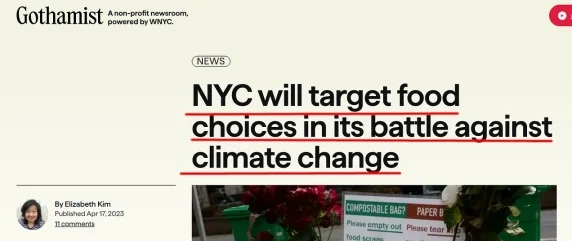
The Adams administration has announced a plan to begin tracking the carbon footprint created by household food consumption as well as a new target for New York City agencies to reduce their food-based emissions by 33% by the year 2023. [Did they mean 2032 – I.C.? ]
New York City, in partnership with American Express, a credit card company, will track purchases to calculate New Yorkers’ carbon footprints:
The new plan puts the city on par with London and 13 other cities to incorporate food consumption into its greenhouse gas emission metrics. The effort to examine the environmental effects of eating foods like meat and dairy was first announced about a year ago as part of a collaboration among major cities across the globe.
You would think such a plan would only be made after a conversation with New Yorkers, right? After all, the mayor of New York is supposed to serve New Yorkers, not the other way around.
However, the reality is that there was no consultation and no “conversation” because New York’s mayor Eric Adams is sure that people do not even want to have a “conversation” about interrogating their food choices.
On Monday, Adams acknowledged that interrogating people’s food choices would be difficult. “I don’t know if people are really ready for this conversation,” he said.
The WEF’s “My Carbon” Plan
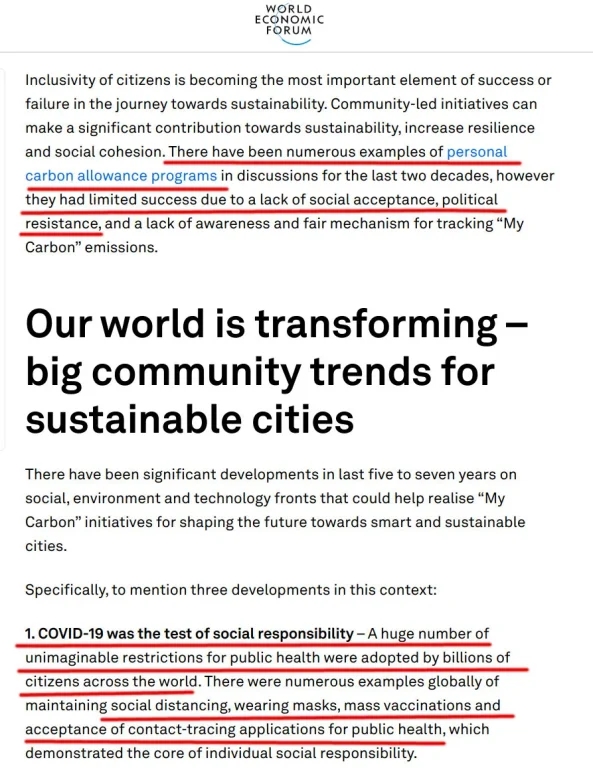
Eric Adams, of course, is not serving New Yorkers, whom he did not even consult. He is serving his sponsors, demanding that food and other personal expenditures be tracked to advance climate goals. The World Economic Forum proposed tracking personal CO2 consumption in its infamous “My Carbon” agenda article.

The WEF explains that tracking individual choices was always met with resistance. Fortunately for the WEF, the Covid pandemic, caused by a mysterious lab-made pathogen, changed this calculation and, according to the WEF, allowed us to extend “pandemic measures” into consumption tracking due to greater social acceptance of the governmental intrusion into our personal lives:
Few cities exhibited more sheep-like adherence to pandemic measures than New York City, so it should not be surprising that “food purchase tracking” is being tried in that particular locale in accordance with the WEF’s instructions.
Tracking of purchases will not be limited to food, of course.
On Meat, Health, and Freedom
This article is intentionally neutral on meat and health. Some of my subscribers are vegans, and some are avid meat eaters. I respect everyone. I was a vegetarian for a whole year, a long time ago. I try to eat less meat nowadays, which still amounts to eating too much, but I am trying.
Rather than framing this issue as a health matter, I urge you to consider it a question of basic fairness: the unelected, supranational, self-appointed masters of the world are trying to track and influence our behavior without even asking for permission or our opinion.
We are being assured that this is done for our good. However, these same people benefit financially from well-placed investments in companies growing fake meat comprised of cancer tumor cells:
Lab-Grown Meat Is Made of Cancer Cells. Would You Like It Rare or Medium?
We are generally taught that conflicts of interest should make us question the intentions of people promoting ideas related to such conflicts.
In the case of Covid-19 or climate change, we are asked to throw such precautions away and put blind faith into mega billionaires benefiting mightily from the pandemic or their climate change investments.
As skeptics and critical thinkers, we should refuse to believe promoters standing to benefit financially from their crazy ideas. Instead, we should demand a close and skeptical look into what is behind the curtain.
I am sure, however, that instead of skepticism, we will get more fake fact checks, denials, and gaslighting.
Ninth Circuit Spikes Berkeley’s Gas Ban
By Robert Bryce | April 18, 2023
Three federal court judges just rescued your gas stove and other gas-fired appliances from the nanny state.
Yesterday, in a unanimous opinion, the U.S. Court of Appeals for the Ninth Circuit ruled that the nation’s first ban on natural gas, put in place by the City of Berkeley in 2019, violates federal law. The three judges found that the city’s ordinance was preempted by the Energy Policy and Conservation Act of 1975, which prohibits the implementation of regulations that favor one type of fuel over another.
The first report I saw on the court’s ruling was here on Substack by my friend, Ed Ireland. There’s no doubt that the decision is a huge win for consumers, businesses, and energy security. Indeed, the ruling in California Restaurant Association vs. City of Berkeley, has ramifications that go beyond California and the Ninth Circuit. It should invalidate the dozens of gas bans that have been enacted across the country over the past four years. It may also mean that plans by federal authorities, including the Consumer Product Safety Commission, to ban, or restrict, the use of gas stoves, gas furnaces, and other gas-fired appliances, are kaput.
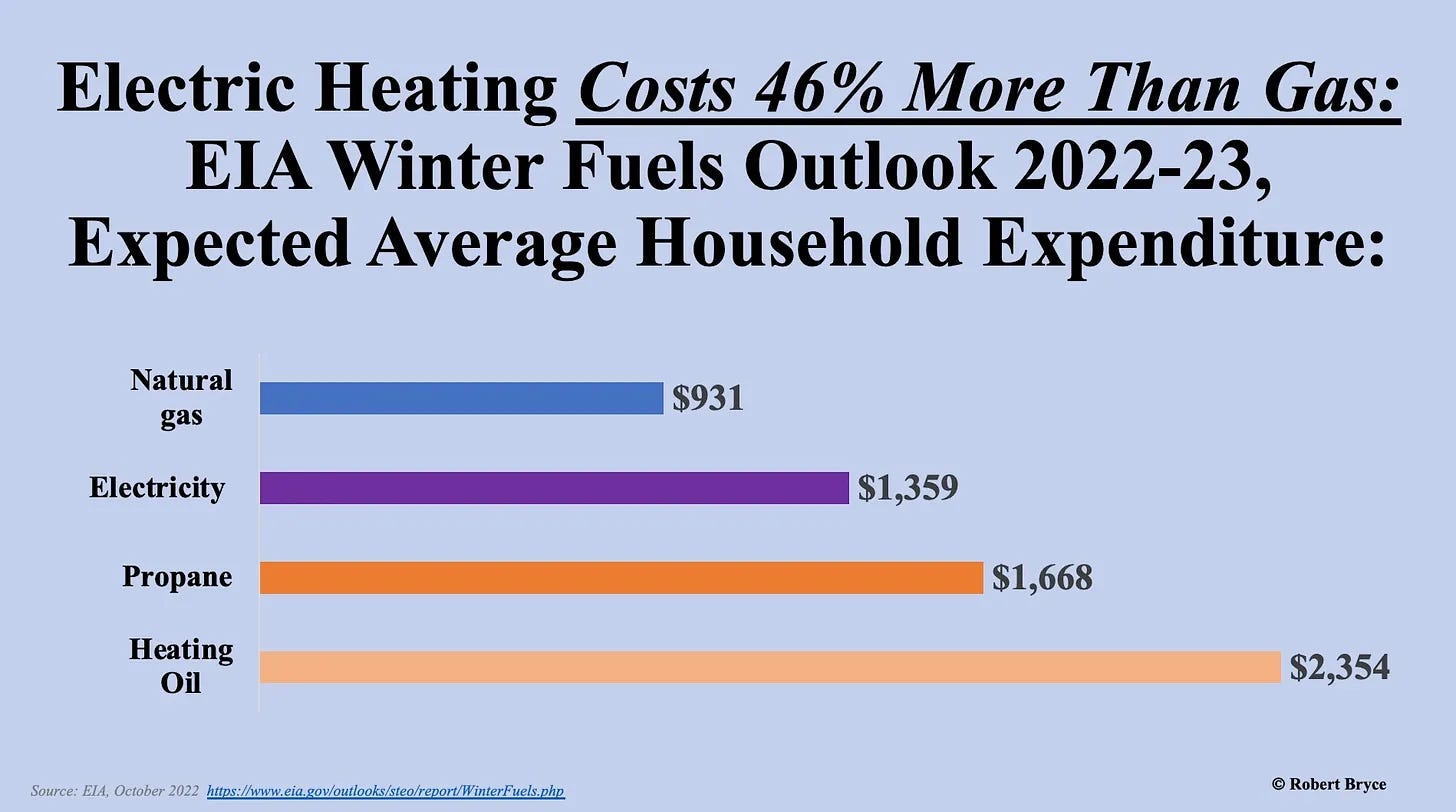
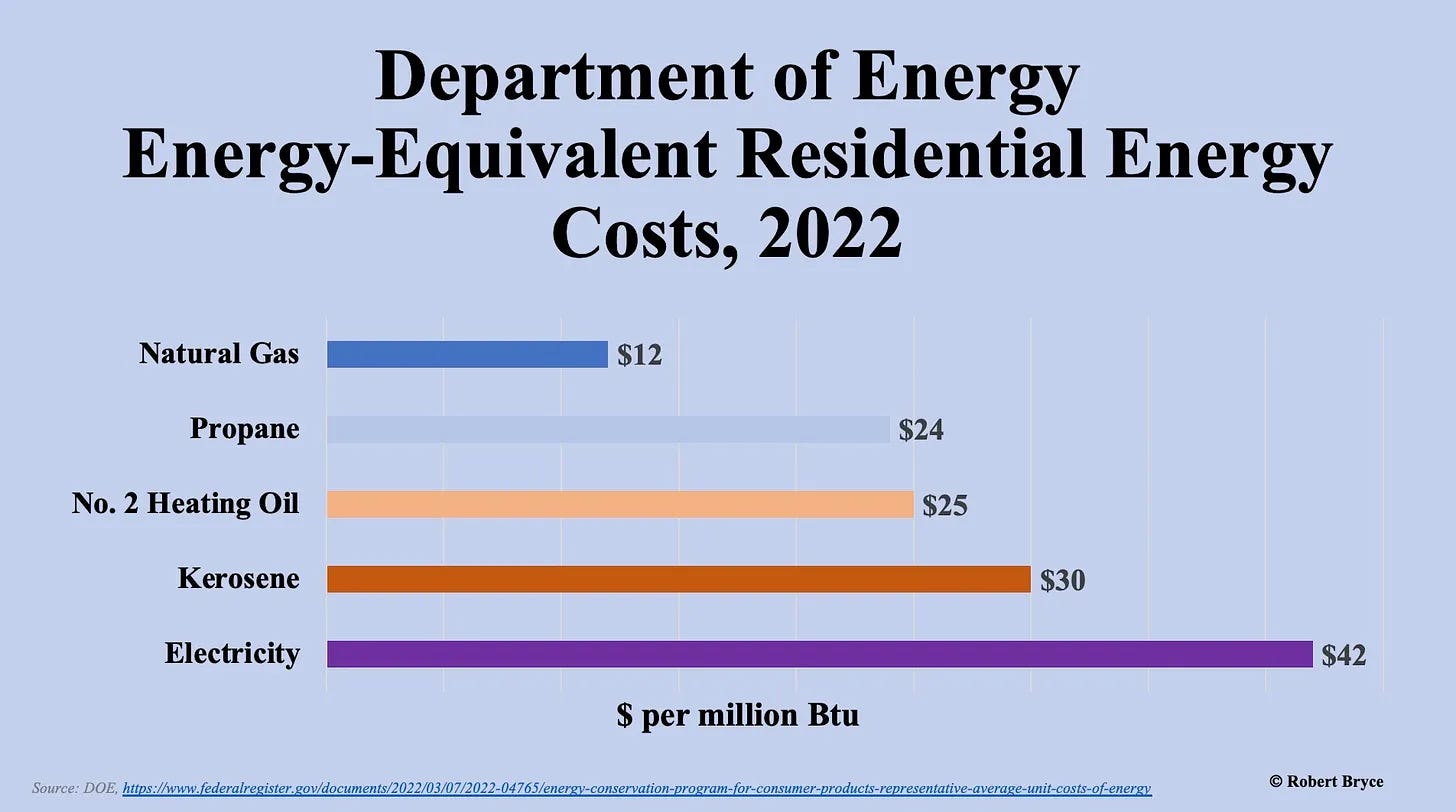
About 47 million American homes have gas stoves and lots of chefs, and consumers, including Energy Secretary Jennifer Granholm, like cooking with gas. The Department of Energy’s own numbers show that heating homes with gas is far cheaper than heating with electricity. Despite these facts, a group of lavishly funded activist groups have been pushing electrify everything mandates that would prohibit the use of gas in homes and businesses and require consumers to rely almost exclusively (including energy for electric vehicles) on our already-shaky electric grid. The electrify everything claque got a boost in January after Richard Trumka Jr., who sits on the Consumer Product Safety Commission, told a Bloomberg reporter that gas stoves are a hazard and that “any option is on the table,” including, presumably, a ban.
Trumka’s comments sparked a storm of criticism. Within hours, the White House issued a statement saying that President Joe Biden doesn’t support a ban on gas stoves.
What has since been dubbed the “gas stove culture war” was ignited in July 2019, when Berkeley became the first municipality in the country to ban the use of gas. Since then, as I explained in January, (See: “The Billionaires Behind The Gas Bans”), several NGOs, including Climate Imperative, the Sierra Club, and Rocky Mountain Institute, as well as Rewiring America, have spent untold (and undisclosed) millions of dollars campaigning and lobbying at the local and national levels to ban the direct use of natural gas in homes and businesses. And thanks to remarkably friendly (and largely unquestioning) coverage from legacy media outlets, they’ve had undeniable success.
The Sierra Club, which operates on an annual budget of about $180 million, says 74 communities in California have “adopted gas-free buildings commitments or electrification building codes.” But that number doesn’t include the most recent ban. On April 13, the Irvine City Council, again according to the Sierra Club, adopted measures mandating that all new buildings be all-electric “on or after July 1, 2023. That puts the number of California communities that have banned gas at 75. The group isn’t just pushing for restrictions in its home state. Last August, it asked the Environmental Protection Agency to ban natural gas appliances at the federal level.
In September, the California Air Resources Board voted to ban the sale of all gas-fired space heaters and water-heating appliances in the state by 2030. New York City and Seattle have banned the use of gas in new construction. Massachusetts is also rolling out a measure that will allow up to 10 communities to ban gas.
As I reported last month (See: “California Screamin’”), the Bay Area Air Quality Management District recently approved regulations that will ban the use of residential and commercial natural gas-fired water heaters and furnaces. The regulation, which only applies to new appliances, prohibits residents in the Bay Area from buying or installing gas water heaters starting in 2027. Also last month, Boston Mayor Michelle Wu, said she is working on a “climate friendly” building code that will hamper or––in the words of the Boston Globe, “discourage”––the use of hydrocarbons in new buildings in Boston.
Following the proliferation of gas bans requires following the money. The Sierra Club has been a prime beneficiary of former New York City mayor Michael Bloomberg’s Bloomberg Philanthropies, which has pledged $500 million to the Beyond Carbon project. In 2019, the pledge was considered the largest ever “philanthropic donation to combat climate change.” The Sierra Club is now getting about $30 million per year from Bloomberg.
For several years, the Rocky Mountain Institute, a group that took in $115 million in 2022, has been ginning up bogus studies that claim gas stoves are a threat to human health. And like the Sierra Club, it is getting big money from super-rich donors. In 2020, the Bezos Earth Fund gave RMI $10 million. RMI said the cash from the group, which, of course, came from Amazon founder and multi-billionaire Jeff Bezos, would help fund its “work with a coalition of partners in key states. The project will focus on making all U.S. buildings carbon-free by 2040 by advocating for all-electric new construction.”
In January, numerous national news stories were published after RMI issued a paper claiming that 12.7 percent of childhood asthmas are due to gas stoves. One of the authors of that paper, Talor Gruenwald, works at RMI. Gruenwald is also a research associate at Rewiring America, a San Francisco-based outfit that calls itself the “leading electrification nonprofit, focused on electrifying our homes, businesses, and communities.” Rewiring America is funded entirely by dark money. It doesn’t publish its budget or file a Form 990. Instead, it is a sponsored project of the Windward Fund, a 501c3 non-profit that does not disclose its donors. Nor does the Windward Fund reveal how much it is giving to Rewiring America.
The January RMI paper didn’t stand up to even modest scrutiny. The definitive analysis of indoor air pollution and gas stoves was published in 2013 in Lancet Respiratory Medicine. It studied half a million schoolchildren in 47 countries over a multi-year period and relied on questionnaires that were filled out by the mothers of the children. It concluded, “We detected no evidence of an association between the use of gas as a cooking fuel and either asthma symptoms or asthma diagnosis.”
Furthermore, just a day or two after the RMI paper came out, the group walked back its claim about asthma, with one RMI official telling the Washington Examiner that the study “does not assume or estimate a causal relationship” between childhood asthma and natural gas stoves.
Restoring Some Vaccination Choice in Mississippi
By Adam Dick | Ron Paul Institute | April 18, 2023
Like every American state government, the Mississippi government pressures parents to ensure their children take a slew of vaccination shots as a condition for the children to attend school. But, unlike most states, Mississippi law does not recognize the right of parents to refuse, based upon philosophical or religious objections, to follow the state-imposed childhood vaccination schedule.
Instead, the only exemption Mississippi parents have had available is a medical exemption that has turned out for almost all parents to be the same as having no exemption at all. I wrote about this in an April of 2015 article:
The New York Times reported in February how extremely restricting vaccination mandate exemptions causes a significant increase in vaccination rates, pointing to Mississippi as an example. Mississippi has among the strictest vaccination requirements in America — barring philosophical and religious exemptions and allowing only a medical exemption for students in both public and private schools. In the 2013-14 school year the Times reports that only 17 out of 45,179 kindergarten students in the state were exempt from the state’s vaccination mandate.
The medical exemption could more accurately be called the mirage exemption. In contrast, philosophical and religious exemptions can allow much greater ability for parents to refuse government pressure to have their children subjected to each and every state-mandated shot at each and every state-mandated time in a child’s life.
Since I wrote that article in 2015, California and New York, two of the largest population states, have joined Mississippi by eliminating all exemptions other than the medical exemption. Three additional states — Connecticut, Maine, and West Virginia — also recognize only the medical exemption.
Some good news came for Mississippi parents this week. The Informed Consent Action Network (ICAN) has announced that on Monday a federal court “ruled that the First Amendment requires that, by July 15, 2023, the State of Mississippi afford its residents a religious exemption for their children to attend school without one or more state mandated vaccines.” ICAN, which has supported the lawsuit that led to the court’s ruling, provides more information in a legal update at its website.
Hopefully, religious and philosophical exemptions, in addition to medical exemptions, will soon be exercisable by parents in all states.
The RESTRICT Act will usher in a new era of censorship under the guise of “national security”
By Tom Parker | Reclaim The Net | April 17, 2023
45 days after 9/11, the United States government passed the PATRIOT Act — a chilling law that used the guise of “national security” to greatly expand the federal government’s secret surveillance powers.
Almost 23 years later, another far-reaching bill, the “Restricting the Emergence of Security Threats that Risk Information and Communications Technology Act,” better known by its acronym, the RESTRICT Act, is using the same national security talking point to justify further federal government encroachment on Americans’ rights.
Although the bill doesn’t mention TikTok, its authors, Democratic Senator Mark Warner and Republican Senator John Thune, have framed it as “the best way to counter the TikTok threat.”
However, the impact of the bill extends far beyond TikTok and gives the US government sweeping powers to ban a wide range of apps and services.
The bill authorizes the Secretary of Commerce to review and prohibit “current, past, or potential future transactions” involving technology products or services with more than one million US-based annual active users that:
- Are deemed to pose an “undue or unacceptable risk” in various areas (such as national security and election interference)
- Involve anyone determined to be “owned, directed, or controlled” by a “foreign adversary” (a term that can currently be applied to China, Cuba, Iran, North Korea, Russia, and Venezuela but can be extended to other nations by the Secretary)
The Secretary of Commerce can also refer these tech products and services to the President who can take action to “compel divestment of, or otherwise mitigate the risk” associated with them.
Caitlin Vogus, the deputy director of rights group the Center for Democracy & Technology’s Free Expression Project, warned that these powers target the free speech rights of Americans. In a statement to Motherboard, she said:
“The RESTRICT Act could lead to apps and other ICT [information communication technology] services with connections to certain foreign countries being banned in the United States. Any bill that would allow the US government to ban an online service that facilitates Americans’ speech raises serious First Amendment concerns.”
Rights groups have also sounded the alarm about the RESTRICT Act’s threats to fine or imprison those who attempt to “evade the provisions” of the bill — a threat that they fear could be aimed at US citizens who attempt to access banned apps or services.
The RESTRICT Act states: “No person may engage in any transaction or take any other action with intent to evade the provisions of this Act.”
The bill even makes it unlawful to “approve” of “any act” that tries to evade the provisions of the bill.
People that violate these rules can be fined up to $1 million and imprisoned for up to 20 years.
Senator Warner has insisted that these penalties won’t be used to target individual users.

However, digital rights group the Electronic Frontier Foundation (EFF), has noted that the bill doesn’t actually prevent individual users from being targeted. In an article about the RESTRICT Act, the EFF warned:
“Due to undefined mitigation measures coupled with a vague enforcement provision, the bill could also criminalize common practices like using a VPN or side-loading to install a prohibited app.”
Another concerning aspect of the RESTRICT Act is that it allows the Secretary of Commerce to form technical advisory committees without them being subject to Chapter 10 of part 1 of title 5 of the United States Code.
This section of the law aims to reduce “the undue influence” of special interests and lobbyists. It allows Congress to review the proposed activities of advisory committees before they’re formed and ensure that these committees aren’t being “inappropriately influenced” by special interests. It also requires advisory committees to report their activities and goals to Congress, make their meetings open to the public, make transcripts available to the public, and file reports with the Library of Congress.
Excluding RESTRICT Act advisory committees from this section of the law opens the door for lobbyists representing US tech giants to serve on these committees, push for their competitors in other countries to be banned, and further cement their dominance.
And the problems don’t end here. The RESTRICT Act also limits judicial, congressional, and public scrutiny of the government’s actions.
Actions taken by the Secretary of the Treasury under this act are exempt from sections 551, 553-559, and 701-707 of title 5 of the United States Code — sections that require federal officials and agencies to provide public notice when proposing rule making, allow interested persons to participate in the rule making, and give those who suffer legal wrong as a result of government action the right to judicial review.
The scope of judicial review under the RESTRICT Act is limited to the US Court of Appeals for the District of Columbia Circuit and the court is prohibited from disturbing “any action taken” by the Secretary or the President when they review or prohibit transactions or take action against tech products and services, unless a petitioner demonstrates that the action is unconstitutional or violates a statutory command.
Additionally, Americans have “no right of access” to the information that the government uses when deciding whether to prohibit transactions involving technology products or services under this bill. The Freedom of Information Act also doesn’t apply to any information submitted by affected parties or created by the government when reviewing such transactions.
We obtained a copy of the RESTRICT Act for you here.
Despite the glaring problems with the bill, its architects are blaming TikTok for the criticism and claiming that the owners of the app are “spreading false claims about the Restrict Act in an effort to continue operating with impunity.”
According to Warner, the RESTRICT ACT has more than 20 bipartisan cosponsors.

The bill also has the full support of the Biden White House which has already demonstrated that it’s no fan of free speech and is currently being sued for alleged First Amendment violations.
If the RESTRICT Act passes, the Biden admin and any future pro-censorship administrations will be handed new powers to continue their crackdowns on online speech.
EU in crisis: Eurosceptism persists in Italy, Greece, France, and Poland
By Ahmed Adel | April 17, 2023
Although Euroscepticism has existed since the inception of the European Union, the UK’s departure from the bloc in 2020, the only sovereign country to have left, demonstrated to other member states that it is possible to leave. Many member states are frustrated by forced immigration quotas, scandals such as Qatargate, and a lack of strategic depth by the bloc as it prioritises the interests of the US instead of Europe. Seemingly, it appears that Italy, Greece, Poland, and France are the most Eurosceptic countries.
This lack of strategic depth led to the decline of European economies because sanctions against Russia have been self-sabotaging. When paired with the aforementioned scandals and migration issues, as well as the loss of legislative control, it is understandable why Eurosceptism persists across the bloc.
According to OddsChecker, an online bookie comparison site, Italy was ranked as the country which is most likely to leave the EU,” specifically with odds of 3/1 or 33 percent. It is recalled that in the September 2022 election, the former president of the European Central Bank (ECB), Mario Draghi, was ousted from power by the right-wing populist Brothers of Italy party. In the same manner, Italian Prime Minister Giorgia Meloni had previously condemned the hostility by Brussels against the UK’s decision to leave the EU, describing its actions as an effort to “humiliate the British people who have freely chosen Brexit.”
The next likely country after Italy is Greece, with odds of 6/1 or 16.67 percent. Although Eurosceptism has always been prominent in Greece, it especially accelerated during the sovereign debt crisis, with discussions of a possible “Grexit” entering the mainstream.
Eurosceptic party SYRIZA lost power to the liberal-conservative New Democracy party in 2019, but Greeks are returning to the polls this May. Although it is expected the ruling party will maintain power, the gap between the two parties has now narrowed from ten to five percent over the past year as Greeks are angered by having to pay the most expensive energy bills in Europe and in their majority are against weapon transfers to the Ukrainian military.
Poland comes in third place, with odds of 7/1 or 14.3 percent. President Andrzej Duda, of the ring-wing Law and Justice (PiS) party, has been continuously criticised for limiting freedom of expression and LGBTQ+ rights. However, since Poland positioned itself as a regional player in the context of the war in Ukraine, much of the criticism from Brussels has alleviated.
None-the-less, although Brussels might have quietened its criticisms of Poland, there is still a high degree of eurosceptism within Polish society, something which will grow as the negative effects of the war in Ukraine are crippling the country, resulting in war weariness.
War weariness has set in so much so that Poland, and neighbouring Hungary, took unilateral action to ban grain and other food imports from Ukraine. This is to protect their local agricultural sector, something which still received the wrath of the EU.
“In this context, it is important to underline that trade policy is of EU exclusive competence and, therefore, unilateral actions are not acceptable. In such challenging times, it is crucial to coordinate and align all decisions within the EU,” said a spokesperson of the European Commission.
Poland’s ruling nationalist PiS party are seeking re-election in the 2023 parliamentary election, and people in rural areas, where support for PiS is usually high, are angered about large quantities of Ukrainian grain, which is cheaper than that produced in the European Union, staying in Central Europe due to logistical problems, thus making prices and sales for local farmer’s plummet.
Meanwhile, the fourth most likely country to leave the EU is France, with a 12.5% chance. French President Emmanuel Macron, another liberal like his Greek counterpart Kyriakos Mitsotakis, has been facing endless largescale protests against pension reform. Protestors have sworn to not stop until Macron backtracks on his plans.
At the same time, the French President was branded a “madman” and accused of insisting on a “political coup de force” by Boris Vallaud, leader of the PS deputies in the National Assembly.
When speaking about Macron, Vallaud told LCI and Le Figaro : “When you discredit social dialogue, when you step on the social partners (…), when you do not respect the parliamentary institution, when you brutalise it (…), when in the street you have people demonstrating by the hundreds of thousands, by the millions, yes, it is a democratic coup because you are diminishing democracy.”
What makes eurosceptism all the more interesting is that it spans across different political ideologies, with only liberals in support of the failed European project. In the case of France, it is mostly comprised by anti-Macron elements, whilst in Greece it is represented mostly by SYRIZA, a radical Left party. This is contrasted by Italy and Poland, where right-wing politics prevails.
With Brussels failing to deal with migration issues in Italy, Greeks having a general tendency to be Russophile, Poland being lambasted for not implementing liberal policies, and the French having a desire to be an independent country in the vision of Charles de Gaulle, Eurosceptism is not only a persistent issue, but one that will continue to deepen.
Ahmed Adel is a Cairo-based geopolitics and political economy researcher.
Iran slams world’s inaction on deteriorating rights situation in West

Press TV – April 15 2023
Iran’s vice-president of the judiciary for international affairs has criticized international mechanisms for failing to take a position regarding the deteriorating human rights situation in Western countries, saying international rights bodies are duty-bound to support and promote the key issue across the world.
In a Saturday letter to Volker Türk, the United Nations High Commissioner for Human Rights, Kazem Gharibabadi said the world suffers from fundamental challenges and dilemmas regarding human rights which are mainly caused by those countries that “claim to be defending human rights and see themselves in the position of making demands from others and being immune from any criticism and responsibility.”
“The responsibility of the international human rights mechanisms in such conditions is fundamental to support and promote human rights, which must be fulfilled by respecting independence, impartiality, professionalism, and non-selectivity,” said Gharibabadi, who also served as the Secretary General of Iran’s High Council for Human Rights.
He warned of adopting “politically-motivated and selective” approaches that does a great disservice and is detrimental to human rights, and erodes public trust in human rights mechanisms.
He drew the commissioner’s attention to situations in several countries, including France, Britain and Germany, over the last six months regarding the “right to freedom of assembly and of association.”
Pointing to massive public demonstrations in France in protest against the government’s policies, the Iranian rights official said, “Instead of listening to the protesters’ demands and trying to improve the situation, the French government resorts to large-scale violence to deal with the gatherings.”
Gharibabadi censured the French government for using anti-riot equipment, assaulting people, and arresting thousands of protesters as only part of the countermeasures.
Referring to Britain’s introduction of amendments to the Public Order Bill to increase police powers to deal with protesters at rallies, he said the “repression bill” leads to a “significant and unprecedented increase in the powers of the police force to impose undue restrictions on peaceful protests and … it criminalizes assemblies under the pretext of deprivation of public comfort and provides a sentence of up to 10 years of imprisonment.”
Gharibabdi pointed to a sit-in protest in Germany. He said over 3,000 German police and security forces arrested hundreds of political opponents under the pretext of plotting to stage a coup d’état.
“In yet another move, the German government seeks to pass a law that will expel its opponents from all government jobs under the pretext of extremism.” The top Iranian rights official said most European countries have been the scene of peaceful protests over the past months which were “suppressed and dispersed with the most severe attacks by law enforcement forces.”
Referring to the recent riots in Iran, Gharibabadi said,” Egged on by incitement and backing of particular states, media outlets and terrorist groups, the recent gatherings in the Islamic Republic of Iran deviated from their peaceful nature and morphed into riots, causing violations of the fundamental rights of citizens.”
On the contrary, he said, Iran took a responsible policy, and established an investigative committee to launch inquiries into the possible physical and financial damages and the violations of the rights of all parties.
The Iranian vice-president slammed the West and the United States for pursuing a politically-motivated approach and exploiting the Human Rights Council by establishing a so-called mechanism to investigate the riots in the country.
“The same countries that consider themselves supporters of the rioters in Iran are – both in law and in practice – committing the most heinous crimes to systematically violate the right to peaceful assembly.”
The Orwellian RESTRICT Act is a chilling echo of ‘1984’ and an erosion of American freedom
Far beyond cracking down on TikTok, the bill envisages frightening powers to control citizens’ access to ‘unwanted’ information
By Ian Miles Cheong | RT | April 15, 2023
In an eerie semblance to George Orwell’s ‘1984’, the Restricting the Emergence of Security Threats that Risk Information and Communications Technology Act, or RESTRICT Act, looms as a dark cloud over American liberties.
Branded as a mere “TikTok ban,” this act possesses a sweeping reach that would empower the federal government to designate any nation a “foreign adversary,” ban online services and products even indirectly controlled by an entity within their jurisdiction, and severely punish Americans who engage in almost any transaction with them.
Sponsored by Sen. Mark Warner (D-VA), the RESTRICT Act not only targets the Chinese-linked TikTok platform but also has the potential to dismantle the very foundations of American freedom. One cannot help but draw comparisons to Orwell’s dystopian masterpiece, where pervasive government surveillance and control are the norm. In a frightening twist, this proposed legislation could make such nightmarish fiction a stark reality.
The chilling provisions of the RESTRICT Act would impose a civil penalty of up to $250,000 by the Secretary of Commerce on individuals who conduct transactions that violate the act. The bill’s definition of a transaction is disturbingly broad, encompassing activities such as acquisitions, importation, data transmission, software updates, repairs, data hosting services, and other transactions designed to evade or circumvent the act’s application.
However, as in the oppressive world of ‘1984’, the $250,000 fine is only the beginning. American citizens found to be in violation of the act could face a criminal fine of up to $1 million and a jail sentence of up to 20 years.
The parallels to Orwell’s vision are striking, as the RESTRICT Act essentially serves as a tool of control and punishment. It is a sobering reminder of the dystopian fate that awaits the public if it allows government unchecked power in the name of security from foreign nations.
Moreover, the bill allows the federal government to seize and access various devices and services belonging to American citizens, including phones and computers, internet access points, e-commerce technology and services, cryptocurrencies, and even advanced technologies like quantum computing, post-quantum cryptography, advanced robotics, and biotechnology.
To add insult to injury, the government is granted immunity from public oversight by restricting Freedom of Information Act (FOIA) requests related to the enforcement of the bill. In this regard, the RESTRICT Act resembles an American version of China’s “Great Firewall,” which isolates its citizens from a significant portion of the World Wide Web.
However, unlike in China, where VPN usage does not automatically lead to imprisonment and many citizens use it to access popular apps and video games without repercussions, the RESTRICT Act imposes much more severe penalties on those who violate its provisions.
Already, conservatives are sounding the alarm on the dangers of the bill, including Tucker Carlson, who dedicated a monologue warning that it would provide the government the ability to “punish American citizens and regulate how they communicate on the Internet.”
Donald Trump Jr. wrote on Twitter: “Nothing is ever as it seems. The uniparty wants more power to control what we do and see. And now we’re going to give the Biden goons the ability to throw us in jail for 20 years if they decide we’re in violation of this craziness? No thanks.”
The US House Committee on Financial Services issued a warning to other members of the Republican party to reject the bill, stating that the RESTRICT Act “is using TikTok as a smokescreen for the largest expansion of executive power since IEEPA.”
“The US can’t beat China by becoming more like the Chinese Communist Party,” it added.
It remains to be seen whether Americans will be able to wake up to the dystopian reality that looms just beyond the horizon should the ratification of the RESTRICT Act proceed. For their sake, and everyone else’s, let’s hope so.
Ian Miles Cheong is a political and cultural commentator. His work has been featured on The Rebel, Penthouse, Human Events, and The Post Millennial.
Testing the system
XYMPHORA | APRIL 15, 2023
The affidavit used to establish the probable cause to get an arrest warrant for the patsy. Two things of interest: 1) whatever the experts might think is likely, Teixeira had a Top Secret security clearance, and 2) whatever Bellingcop might say, he was identified easily without recourse to fancy internet sleuthing of the granite countertop.
The standard model is that the authorities get a young, idealistic, patriotic guy (Lee Harvey Oswald, perhaps even Timothy McVeigh), and convince him that he needs to do some seemingly odd things in order to save his country from real peril. For example, he may be working to stop illegal sales of weapons by mail, or even protect the President from assassination (both options in the case of LHO). Given the current controversy over Presidents and classified documents, it would not be hard to convince a guy like Teixeira that he had to ‘test the system’ by posting documents on relatively obscure social media platforms, and talk up these documents on discussion groups, in order to determine how long before the government is aware of the risk. It is a plausible ‘stress test’ of the government’s ability to protect secrets. The oddity of using photos of previously folded documents may be because the team using the patsy was lazy and that was the easiest way to do it, particularly as it didn’t leave a computer trail the patsy might use in his defense, or perhaps it was just supposed to remove identifying marks that could be found by specialized search engines (or so he might have been told). In any event, none of this was true.
The reasons for the operation:
- to get the open-ended RESTRICT Act passed by producing a phony security crisis (‘the Chinese are using their apps to suck out all our secrets!’);
- to further integrate and normalize the (((media))) as a full part of the national security state;
- to publicize the utility of using British intelligence assets like Bellingcop, a method of getting US PR accepted as fact due to the ‘objective’ magic of ‘computer sleuthing’;
- to get out of the war in Ukraine, now generally considered to be a lost and embarrassing War For The Jews, damaging to the reputation of the hegemon, to turn to the war against China; and
- possibly, but it is a stretch, to use the lies revealed by the documents to replace Brandon with somebody more capable of facing the Deep-State-threatening Trump candidacy.
Of course, as is standard in these cases, the patsy will say various things in his defense, but his lawyers will tell him to shut up as: 1) everybody involved will deny everything, 2) he will have no concrete proof, and 3) raising these issues will just anger the judge and increase his sentence for slandering the good name of the Deep State and the patriotic people who do its bidding. He’ll be told to keep his head down and he may come out of this, older, but alive.
Washington’s Crackdown on Whistleblowers Poses Danger to Free Speech
By James Tweedie – Sputnik – 14.04.2023
The US government is tightening its grip over the internet, social media and free speech. Facebook* whistleblower Ryan Hartwig and former Google and YouTube software engineer Zach Vorhies reveal the dangers and implications.
A US bill targeting the TikTok app is really a wider crackdown on online privacy and public scrutiny of government, two Big Tech whistleblowers have told Sputnik.
The Restrict Act, currently working its way through the US Congress, has been touted as an attack on Chinese software developer ByteDance — whose US CEO Shou Zi Chew was hauled before the House Energy and Commerce Committee in March.
The legislation would allow the government to restrict access to apps from any firm it chooses — raising the prospect of its use to protect US firms from foreign competitors. But tech experts and free speech advocates fear it will open the door to a widespread crackdown against online critics of the White House.
Ryan Hartwig said the legislation was “essentially the Patriot Act online” — referring to legislation passed in the wake of the September 11, 2001, terrorist attacks that allowed unwarranted government wiretapping of US and foreign citizens’ phone lines.
“It’s a horrible piece of legislation. Basically it’s not only banning TikTok, it’s giving the government authority to arrest people for anything they say online. It’s definitely clear that the government wants to continue to restrict free speech online,” Hartwig said. “It is really a problem. They are going to crack down.”
The bill is ostensibly aimed at protecting children and teenagers from harmful content, which the former Facebook employee said had some validity. “But the Restrict Act does a lot more than just censor a few bad posts. It basically gives them blanket authority… and criminalizes any kind of political speech.”
“If I just attack them, if I say bad things about the president, it gives the government authority to arrest me.” Hartwig stressed. “The Restrict Act can punish people for whistleblowing on an illegal government action.”
Just this week, 21-year-old US Air National Guard enlisted Airman Jack Teixeira was arrested as the suspect in the embarrassing Pentagon leaks of Ukrainian plans for its yet-to-materialize spring counter-offensive. Teixeira was traced through an online chat group for video gamers on the Discord app. The whistleblower said its users should “be concerned.”
The ‘blockchain’ technology used by Bitcoin and other concerns — essentially a variant of mass file-sharing for online data — could protect users’ rights, he said.
“There are websites that are using blockchain technology to avoid censorship, which is great. So there’s one called Bastion that is Blockchain-based and cannot be deleted off the internet,” Hartwig explained, calling the technology “the future of the Internet.”
But protecting oneself from government snooping is difficult for the average casual web surfer.
“Unless you’re a tech nerd, and you have all kinds of things for it,” Hartwig says. “It starts with using a different operating system, because most people use Microsoft Windows. So a lot are moving over to Linux, which has less vulnerabilities,” he said.
Using a virtual private network (VPN) protects users from advertisers gleaning their web history, but “it’s hard to prevent that from tracking us because I’m sure the NSA has tools that can bypass pretty much anything,” he added. “They probably know exactly what we’re talking about.”
“People are waking up to government censorship and surveillance,” Hartwig insisted. “It’s important for us to realize that the government is not our friend… If that bill passes, then the United States will have become essentially a police state. We will no longer be a free country.”
Zach Vorhies emphasized that the point of online snooping was not to eavesdrop on citizens, but to tar them by association with known suspects.
“We know from the Snowden leaks that the NSA tracks by default the endpoints of communication. It turns out that the most valuable part of a communication is not the content that is said but identifying who is talking to who in order to build a relationship graph.”
Even AI assistants like Amazon Alexa have been used to record their users’ conversations. “Police have used court orders to grab audio content from these Alexa’s when they were supposedly not in active recording mode,” the tech expert noted.
Vorhies agreed that users of internet chats like Discord and 4Chan should be “concerned”, because “no corporate or public space is safe for private speech anymore. That ship has sailed long ago.”
He said the government and major tech corporations were “strong-arming companies to employ AI monitoring of content.”
“We saw this in the 2020 election when the iPhone app store kicked off Parler for not integrating content-approved moderation,” Vorhies noted. “It looks like the government is going to play a soft hand for the meantime and let the big tech organizations employ massive censorship through their terms of service.”
The tech guru said it would take about a day for someone with the coding know-how to write software for a “private space” on the internet, which government agencies would be unable to crack.
“It’s my expectation that the elite families that control governments and military are using such obscure private spaces to communicate,” he ventured. “I can’t stress enough what an exciting time we are entering. It’s also terrifying as we are entering an age of so many unknowns. It’s obvious that Pandora’s box has been opened, and the elites are putting both hands in and grasping tightly.”
Pentagon ‘leak’ theatrics continue as US finds scapegoat

By Drago Bosnic | April 14, 2023
The pseudo-WikiLeaks 2.0 has just been stepped up a notch as the FBI arrested the perpetrator who shared the “secret docs” through a Discord server. The 21-year-old Airman First Class Jack Douglas Teixeira of the Massachusetts Air National Guard was apprehended on April 13 for his involvement with the “top-secret leak”. The controversial “Pentagon docs” contain what the US mainstream propaganda machine claims is “an array of national security secrets, including the breadth of surveillance the United States is able to conduct on Russia”.
Apparently, Teixeira posted the “classified documents” in an invitation-only Discord (mainly gaming-focused platform) chat group called “Thug Shaker Central”. According to the Washington Post, which reportedly talked to other members of the group, “classified Pentagon documents containing intelligence collected by the US and several other countries were posted by a man claiming to be a ‘military base’ worker”. The chat room apparently had no more than 20 members, mostly young men, who discussed video games, memes, movies and politics. It also included users from both Russia and Ukraine.
At some point during 2022, a user known as OG posted “a message laden with strange acronyms and jargon” and claimed to “know secrets that the government withheld from ordinary people”. One of the unnamed members of the chat group told the Washington Post that “at the time, few people read the note” and added that “OG claimed he spent at least some of his day inside a secure facility of a ‘military base’ that prohibited cell phones and other electronic devices and copied the classified documents”, but insisted OG wasn’t hostile to the US or working for any foreign government.
The Washington Post report also presented OG as somewhat of an anarchist, since he supposedly “thought US law enforcement and intelligence were a sinister force that sought to suppress citizens and keep them in the dark” and complained about “government overreach”. The claim could very well be an attempt to portray OG as “a disgruntled serviceman who simply wanted to share dirty state secrets with the American people”. This would reinforce the idea that OG was supposedly acting on his own, further covering up the role of US intelligence in the so-called “leak”.
The Washington Post report never mentioned OG’s real name, but other media later revealed that he was indeed Jack Teixeira. Despite their own claims that he wasn’t involved with foreign intelligence, the US propaganda machine, never the ones to let a perfect opportunity for Russophobia slip by, were quick to blame Russia for the “leak”. Reuters insists that three “anonymous” US officials “confirmed that Russia or pro-Russian groups could be behind the leak”. Expectedly, no evidence whatsoever was presented to back up such claims. But then again, why worry? Who could possibly even contemplate the idea that any US official would ever lie about anything?
The New York Times also reported extensively on Teixeira’s case. According to NYT, Airman Teixeira was trained as a cyber transport systems specialist, a job that could also entail keeping his unit’s communication networks running. He was assigned to the 102nd Intelligence Wing at Otis Air National Guard Base. The NYT report admits that “military officials refused to disclose information on what in Airman Teixeira’s duties would necessitate him having access to daily slides about Ukraine, much less the daily deluge of intelligence reports from the CIA, NSA and the Office of the Director of National Intelligence”.
Some US officials told NYT that Teixeira could also have gained access to “secret docs” through daily emails on a classified computer network, where those emails might’ve been automatically forwarded to other people. On the other hand, members of the Discord group chat told NYT that the aforementioned documents were “purely informative”, but started to get wider attention only when one of the teenage members of “Thug Shaker Central” took them and posted a few dozen “secret documents” to a public online forum where they were picked up by several Russian-language Telegram channels.
In short, the US propaganda machine wants us to believe that a 21-year-old intelligence technician who just graduated and held the rank of airman (equivalent of private in the US Army) was privy to top-secret intelligence on the Kiev regime’s offensive plans, Russia, South Korea, China and other global hotspots. NYT itself also reluctantly admitted that “the arrest raised questions about why such a junior enlisted airman had access to such an array of potentially damaging secrets, why adequate safeguards had not been put in place after earlier leaks and why a young man would risk his freedom to share intelligence about the war in Ukraine with a group of friends he knew from a video game social media site”.
US media claim that the Pentagon was completely unaware of the “leak” and learned of it only after the documents began surfacing on Telegram and Twitter. Apparently, the Pentagon even tried to hack and delete some of the posts about the documents, “but was ultimately unsuccessful”. Again, it’s quite bemusing that an institution wasting well over $850 billion every year is incapable of removing such “crucial information” from several Telegram channels almost exclusively run by civilian enthusiasts with no budget. The sheer amount of logical disparities indicates that this particular case is highly controversial (at best), while there’s an extremely strong possibility it’s all an elaborate counterintelligence operation.
Apart from the more obvious geopolitical benefits such as pressuring countries like Egypt to distance themselves from Russia or further disrupting Moscow’s relations with the traditionally pro-Russian Serbia (once again accused of weapons shipments to Kiev), there is a very strong domestic incentive to push the “leak” narrative. For instance, the infamous CNN argues that “the leak spotlights major ongoing US intelligence vulnerabilities“, which can hardly be interpreted as anything else but an attempt to strengthen government control in the US. The “leak” could also be used to accelerate the adoption of the truly totalitarian RESTRICT act that the disillusioned former Democrat Tulsi Gabbard described as PATRIOT Act 2.0, only worse.
Drago Bosnic is an independent geopolitical and military analyst.
Fear of a Microbial Planet
BROWNSTONE INSTITUTE | APRIL 13, 2023
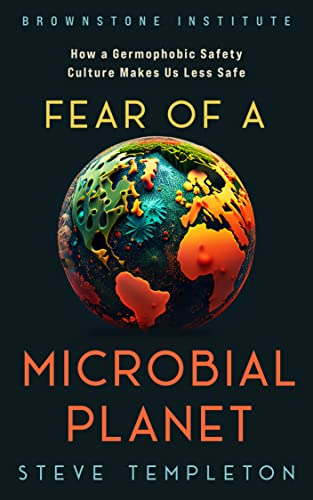 Fear of a Microbial Planet, by Dr. Steve Templeton, is a wonderfully accessible book on the Covid era now published by Brownstone institute, offers desperately needed clarity and science on the organization and management of individual social life in the presence of pathogenic infection. It can be read as a definitive answer to expert arrogance, political overreach, and population panic.
For three years following the arrival of the virus that causes Covid, the dominant response from governments and the public has been to be afraid and stay far away through any means possible. This has further mutated into a population-wide germophobia that is actually being promoted by elite opinion.
Steve Templeton, Senior Scholar at Brownstone Institute and Associate Professor of Microbiology and Immunology at Indiana University School of Medicine – Terre Haute, argues that this response is primitive, unscientific, and ultimately contrary to individual and public health. The most unhealthy populations are those which preserve immunological naivete in the presence of a virus that is otherwise going to circulate widely.
Dr. Templeton’s story is both scientific and highly personal, taking the reader through the basics of immune response and public health even while relaying his personal frustrations with trying to talk sense to others in senseless times.
If a public health response is like an immune response, then consider this book as immunization against germophobia, politicized science, a self-defeating safety culture, and misplaced faith in experts. Dr. Templeton is our guide to helping us gain a new and more robust understanding of the relationship between the microbial kingdom and our own lives.
The pandemic forecasts in the United States were very grim. Experts were predicting that 60-70 percent of the population would ultimately be infected resulting in over 1.5 million deaths in just a few months. People on social media were in an absolute panic. Stories about empty shelves and runs on toilet paper were everywhere. Those who tried to refute these doomsday predictions were shouted down and eventually silenced.
And yet, the science on the virus was very clear. Disease severity was age-stratified. Extreme measures would not drive it away and would cause a tremendous amount of collateral damage. Even if the worse-case scenarios were true, it was extremely important that we take measures based on evidence.
But eventually, the cry to “do something” became overwhelming, and the costs no longer mattered. Trying to calm people with wisdom about infectious disease became nearly pointless. Germophobia swept through society and political culture.
Hardly anyone wanted to hear the truth that microbes are everywhere, and they cannot be avoided. There are an estimated 6×10^30 bacterial cells on Earth at any given time. By any standard, this is a huge amount of biomass, second only to plants, and exceeding that of all animals by more than 30-fold.
To live at peace with the microbial kingdom requires trained immune systems, as George Carlin said years ago. That means exposure and the protection of normal social functioning even under pandemic conditions with a new virus.
Many books have been and will be written about pandemic response mistakes, and that’s a good thing. There can’t possibly be enough reflection on what went wrong, otherwise we will be doomed to follow the same path, or an even worse one, next time. This book argues that the safety-at-all-costs culture will continue to result in counterproductive policies until it is challenged at its root.
How did people in our communities and around the world get to the point of hysteria over a pandemic with a clear age-stratified and comorbidity-amplified mortality? Why were young and healthy people with very little risk for disease and death treated as if they were a grave danger to others?
It was always pointless to try to stop much less eradicate this virus. We’ve evolved with pathogens and need to learn to live with them without imposing mass psychological, social, economic, and public-health damage.
Everyone who panicked to the point of meltdown needs this book as a corrective. And even if you did not, everyone knows someone who did, public-health officials above all else.
Biden Administration is sued, accused of pressuring Twitter to censor journalist Alex Berenson
By Dan Frieth | Reclaim The Net | April 13, 2023
Independent journalist Alex Berenson has filed a lawsuit against President Joe Biden, a Pfizer board member, and others for pressuring Twitter to ban his account.
His account was banned after posting a tweet questioning COVID-19 vaccines.
Initially, Twitter resisted the calls to ban Berenson. However, eventually the social media platform caved to the pressure.
Berenson sued Twitter in a federal court in California, accusing the company of violating its contract with him. The lawsuit resulted in a settlement and Twitter admitting it should not have banned him.
The defendants in the new lawsuit, filed on April 12, are President Biden, Surgeon General Vivek Murthy, former White House COVID-19 official Dr. Andrew Slavitt, Pfizer board member Dr. Scott Gottlieb, Pfizer CEO Albert Bourla, and the White House Director of Digital Strategy Rob Flaherty.
In a meeting with Twitter, Slavitt and other White House officials asked why Berenson had not been “kicked off” Twitter. Slavitt has previously called Berenson a conspiracy theorist.
Flaherty recently said that he remembered Slavitt “expressing his view that Twitter was not enforcing its content guidelines with respect to Alex Berenson’s tweets, and that employees from Twitter disagreed with that view.”
Gottlieb also asked Twitter to suspend Berenson. He has also previously called for the suspension of other people, including former acting FDA commissioner Dr. Brett Girior.
In the offending tweet, Berenson wrote, “It doesn’t stop infection. Or Transmission. And we want to mandate it? Insanity.”
According to his lawsuit, the defendants violated his First Amendment rights.
We obtained a copy of the complaint for you here.
“The government Defendants specifically targeted Mr. Berenson’s constitutionally protected speech and journalism,” the suit states.
“Members of [the Biden] administration engaged in a nearly unprecedented conspiracy to suppress Mr. Berenson’s First Amendment rights.
“Through 2021, they—and a senior board member at Pfizer, Inc. which has made more than $70 billion selling COVID-19 vaccines—worked together to pressure Twitter to suspend Mr. Berenson’s account and mute his voice as a leading COVID-19 vaccine skeptic. The White House and the Biden Administration did this at the same time government officials promoted their views on the necessity of COVID19 vaccination on Twitter, effectively blocking Mr. Berenson from commenting on their own statements or making his own.”
It adds that the permanent suspension “harmed both Mr. Berenson and a clearly identifiable class of nearly 100 million Americans whose interests he helped represent—Americans who either had questions about the vaccine or did not want to be forced to take a shot that they feared had been rushed through development and lost its ability to prevent COVID-19 infections within months.”
The suit is asking the court to stop the government from targeting the journalist and to award him damages.
Featured Video

Death Spikes & Rising Cancer In Our Youth Explained
or go to
Aletho News Archives – Video-Images
From the Archives
Politicians lie
By Mazin Qumsiyeh | Popular Resistance | August 18, 2013
There is no way to say this truth nicely: Politicians lie. That includes Japanese, American, Egyptian, Israeli, and Palestinian politicians! Is there something more common sense than that? Yet, so many citizens around the world believe their own politicians or wistfully acknowledge lies but think it is part of the job needed to run things. They believe even when politicians contradict themselves blatantly. This phenomenon is rather remarkable. It is a dissonance and disconnect from reality that many seem oblivious to. It is very dangerous because it can lead to accepting rationales for going to war. These can be deadly wars that lead to millions of lives lost as happened in what was called World War 1 and WW2. Even when incredible and declassified evidence abound, politicians continue to lie and old mythologies refuse to die. Here are just a few of the countless lies told to us over the past few decades… continue
Blog Roll
 Aletho News
- Ukrainian Soldiers, Potential Mercenaries: Have Gun, Will Travel!
- Burnham’s UN debut… A masterclass in British disinformation
- Iran flights continue despite US aviation sanctions
- Global Tipping Points Lead the World Into a State of Entropy
- The day-after at the White House: USA and Xi Jinping
- The Geopolitical Balance in the Red Sea: The UAE Being Displaced by New Players
- Iraqi resistance group vows to stage airport sit-ins over Iran aerial blockade
- Turkish parliament to review Saudi-Pakistan defense pact next month
- DEATH SPIKES & RISING CANCER IN OUR YOUTH EXPLAINED
- Iran offers Trump deal before US election
- If Americans Knew
- Deconstructing Netanyahu’s pants-on-fire UN rant – Daily Update
- Trump betrayed voters with his campaign lies and prioritized a foreign country once he took office
- Netanyahu calls Israel’s war in Gaza ‘opposite of genocide’ in UN speech to near-empty hall
- Settler Kidnappings: Torture, Sexual Abuse and Terrorisation of Palestinian Abductees as Israel Deepens Annexation of West Bank
- Gaza winter nears as 162,000 tents become unusable, raising fears of humanitarian crisis
- Netanyahu says, “It’s the opposite of genocide”; UN says Gaza economy is world’s ‘most severe crisis on record’ – Daily Update
- Israel’s US-Backed Assault on Gaza Has Created the ‘World’s Most Severe Economic Crisis on Record’: UN
- ‘Protecting U.S. Citizens’… From Israel
- ‘This is where I live now, the back of a truck’: a day in the life of a grandmother in Gaza
- In UN Speech, Iran’s President Displays Pictures of Children Killed by US, Brings Attention to Israel’s Nuclear Arsenal
- No Tricks Zone
- New Study: Earth And Venus Surface Warmth Largely Explained By Convection And Lapse Rate, Not CO2 Or Radiation
- 2025 Nature Paper Claiming Worsening Global Drought Gets RETRACTED …Heavily Flawed
- New Study: ‘Global Drought Shows No Detectable Recent Acceleration Under Climate Warming’
- Economic Masterminds: German Socialists Suggest Taxing Productivity Gains Stemming From Using AI
- The South China Sea Has Not Been Cooperating With The Climate Change Narrative
- Energy Crisis: Germany Enters Heating Season With Historically Low Gas Reserve Fill Levels
- New Study: The Antarctic Ice Sheet Gained Mass From 2020-2024 Due To Staggering Snow And Ice Accumulation
- Study: Ocean Heating Rates From Thousands Of Years Ago ‘Dwarf’ Modern Ocean Heating Rates
- Climate Extremists Target, Attack Large-Scale Power Grid Infrastructure In Germany!
- New Study: Antarctic Ice Melt Has Contributed Less Than 1 Centimeter To Sea Level Rise In The Last 30 Years

