ACLU Again Cowardly Abstains From an Online Censorship Controversy: This Time Over BLM
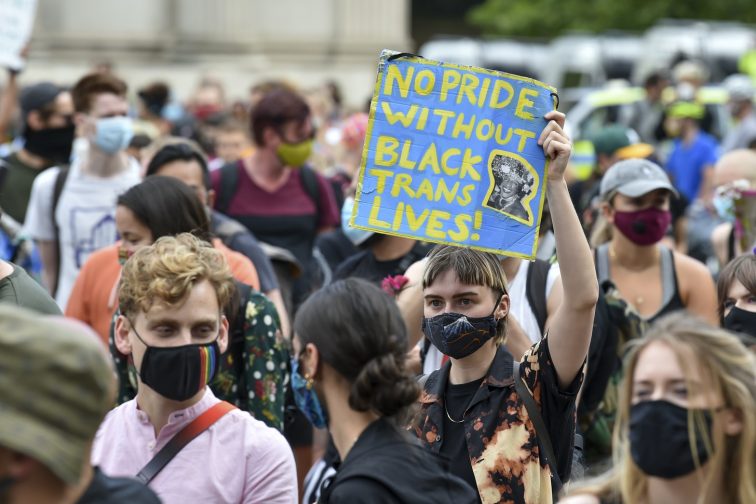
Black Trans Lives Matters’ march in London. (Photo by Dave Rushen/SOPA Images/LightRocket via Getty Images)
By Glenn Greenwald | April 26, 2021
Enormous sums of money have poured into racial justice groups since the May, 2020 murder of George Floyd by the Minneapolis Police Department. “The foundation widely seen as a steward of the Black Lives Matter movement says it took in just over $90 million last year,” according to a February Associated Press review, while at least $5 billion was raised by groups associated with that cause in the first two months alone following Floyd’s death.
Two weeks after the Floyd killing, The New York Times said that the “money has come in so fast and so unexpectedly that some groups even began to turn away and redirect donors elsewhere,” while “others said they still could not yet account for how much had arrived.” Propelled by the emotions and nationwide protest movements that emerged last summer, corporations, oligarchs, celebrities and the general public opened their wallets and began pouring money into BLM coffers and have not stopped doing so.
Where that money has gone has been the topic of numerous media investigations as well as concerns expressed by racial justice advocates. AP noted that BLM’s sharing of financial data in February “marks the first time in the movement’s nearly eight-year history that BLM leaders have revealed a detailed look at their finances.” That newfound transparency was prompted by what AP called “longstanding tensions boil[ing] over between some of the movement’s grassroots organizers and national leaders — the former went public last fall with grievances about financial transparency, decision-making and accountability.”
In December, ten local BLM chapters severed ties with the national group amidst questions and suspicions over the handling of activities and finances by one of its co-founders, Patrisse Cullors, who had assumed the title of Executive Director. On April 10, The New York Post published an exposé on what it called Cullors’ “million-dollar real estate buying binge.” The paper noted that as protests were unfolding around the country, the BLM official was “snagging four high-end homes for $3.2 million in the US alone, according to property records,” including a California property valued at $1.4 million. The article also revealed that the self-described Marxist and her partner “were spotted in the Bahamas looking for a unit at the Albany,” an “elite enclave laid out on 600 oceanside acres,” which “features a private marina and designer golf course.” The Post included photos of several of the properties obtained from public real estate listings.
In an interview about that Post story with Marc Lamont Hill, Cullors — except saying she has not visited the Bahamas since the age of 15 — did not deny the accuracy of the reporting, but instead justified her real estate acquisitions. She denied she had taken a salary from the BLM group, pointing to other income she earns as a professor, author, and a YouTube content creator as the source of this sudden outburst of real estate purchases. She denounced the Post reporting as “frankly racist, and sexist.”
So that seems like a perfectly healthy cycle for covering a controversy, obviously in the public interest. In the wake of concerns from activists about where this massive amount of BLM money has gone, The New York Post did its job of unearthing the splurge of real estate acquisitions by the person who controls and directs BLM’s budget and who has been a target of accusations and suspicions from activists. Cullors then had the opportunity to publicly provide her side of the story concerning her aggressive and ample financial investments.
But then something quite unhealthy and unusual occurred. Five days after publication of that Post article, the Substack journalists Shant Mesrobian and Zaid Jilani reported that Facebook was banning the sharing of that article worldwide on its platform — similar to what Twitter and Facebook did in the weeks leading up to the 2020 election to The New York Post‘s reporting on the Biden family’s business dealings in China and Ukraine. The Substack reporters noted that Facebook ultimately confirmed the worldwide ban of the Post‘s reporting to The New York Times’ media reporter Ben Smith, justifying it on the ground that the article “revealed personal details about [Cullors] and her residence in violation of Facebook’s community standards.”
In his weekly New York Times Sunday night media column, Smith returned to this subject. When a Facebook lawyer justified the censorship by citing an alleged policy that the tech monopoly will ban any “article [which] shows your home or apartment, says what city you’re in and you don’t like it,” Smith expressed extreme skepticism:
The policy sounds crazy because it could apply to dozens, if not hundreds, of news articles every day — indeed, to a staple of reporting for generations that has included Michael Bloomberg’s expansion of his townhouse in 2009 and the comings and goings of the Hamptons elites. Alex Rodriguez doesn’t like a story that includes a photo of him and his former fiancée, Jennifer Lopez, smiling in front of his house? Delete it. Donald Trump is annoyed about a story that includes a photo of him outside his suite at Mar-a-Lago? Gone. Facebook’s hands, the lawyer told me, are tied by its own policies.
Presumably, the only reason this doesn’t happen constantly is because nobody knows about the policy. But now you do!
Smith was additionally disturbed that Facebook was, in essence, overriding the editorial judgment of news outlets, which grapple every day with how to strike the balance between ensuring the public knows of information in the public interest and protecting a person’s right to privacy. For obvious reasons, public figures and organizations — which both BLM and Cullors undoubtedly are — are deemed to have a lower expectation of privacy when it comes to what is newsworthy. That is why, for example, the extramarital affairs of Donald Trump or Bill Clinton are deemed newsworthy whereas, outside of the dead-but-returning Gawker sewer, the sex lives of private citizens are not. Yet Facebook accords no deference to the editorial judgments even of the most established media outlets. Instead, they told Smith, “Facebook alone decides.”
Whatever one’s views are on this particular censorship controversy, there is no doubt that it is part of the highly consequential debate over online free speech and the ability of monopolies like Facebook to control the dissemination of news and the boundaries of political discourse and debate. That is why Smith devoted his weekly column to it. And yet, when Smith approached the standard free speech advocacy groups for comment on this story, virtually none was willing to speak up. “Facebook’s usual critics have been strikingly silent as the company has extended its purview over speech into day-to-day editorial calls,” he wrote.
Among those groups which insisted that it would not comment on Facebook’s censorship of the Post‘s BLM story was the vaunted, brave and deeply principled free speech organization, the American Civil Liberties Union. “We don’t have anyone who is closely plugged into that situation right now so we don’t have anything to say at this point in time,” emailed Aaron Madrid Aksoz, an ACLU spokesman. Smith said “the only criticism he could obtain came from the News Media Alliance, the old newspaper lobby, whose chief executive, David Chavern, called blocking The Post’s link ‘completely arbitrary’ and noted that ‘Facebook and Google stand between publishers and their audiences and determine how and whether news content is seen.’”
How is it possible that the ACLU is all but invisible on one of the central free speech debates of our time: namely, how much censorship should Silicon Valley tech monopolists be imposing on our political speech? As someone who intensively reports on these controversies, I can barely remember any time when the ACLU spoke up loudly on any of these censorship debates, let alone assumed the central role that any civil liberties group with any integrity would, by definition, assume on this growing controversy.
In lieu of the traditional, iconic and organization-defining willingness — eagerness — of the ACLU to defend free speech precisely when it has been most controversial and upsetting to liberals, what we now get instead are cowardly, P.R.-consultant-scripted excuses for staying as far away as possible: “We don’t have anyone who is closely plugged into that situation right now so we don’t have anything to say at this point in time.” That sounds like something Marco Rubio’s office says when asked about a Trump tweet or that a corporate headquarters would say to avoid an inflammatory controversy, not the reaction of a stalwart civil liberties group to a publicly debated act of political censorship.
In this particular case, it is not difficult to understand the cause of the ACLU’s silence. They obviously cannot defend Facebook’s censorship — affirmatively defending the stifling of political speech is, at least for now, still a bridge too far for the group — but they are petrified of saying anything that might seem even remotely critical of, let alone adversarial to, BLM activists and organizations. That is because BLM is one of the most cherished left-liberal causes, and the ACLU now relies almost entirely on donations and grants from those who have standard left-liberal politics and want and expect the ACLU to advance that ideological and partisan agenda above its nonpartisan civil liberties principles. Criticizing BLM is a third rail in left-liberal political circles, which is where the ACLU now resides almost entirely, and thus it again cowers in silence as another online act of censorship which advances political liberalism emerges. Indeed, BLM is an organization which the ACLU frequently champions:
Like so many liberal-left media outlets and advocacy groups, the ACLU was suffering financially before they were saved and then enriched beyond their wildest dreams by Donald Trump and the #Resistance movement he spawned. “The American Civil Liberties Union this week laid off 23 employees, about 7 percent of the organization’s national staff,” announced The Washington Post in April, 2015. But in the Trump era, the money flowed in almost as quickly and furiously as post-Floyd money to BLM. In February, 2017, said AP, the group “is suddenly awash in donations and new members as it does battle with President Donald Trump over the extent of his constitutional authority, with nearly $80 million in online contributions alone pouring in since the election.” So that is the donor base it now serves.
The ACLU’s we-know-nothing routine for abstaining from commenting on Facebook’s censorship of the BLM article is, for so many reasons, preposterous. The group funds what it calls its Speech, Privacy, and Technology Project, and some of its best lawyers oversee it. Clearly they focus on these issues. And the ACLU in general has taken a firm and borderline-absolutist position against online censorship by Silicon Valley monopolies: principles whose application to this particular case would be easy and obvious. The ACLU has a section of its website devoted to “Internet Speech,” and its position on such matters is stated explicitly:
The ACLU believes in an uncensored Internet, a vast free-speech zone deserving at least as much First Amendment protection as that afforded to traditional media such as books, newspapers, and magazines….The ACLU has been at the forefront of protecting online freedom of expression in its myriad forms. We brought the first case in which the U.S. Supreme Court declared speech on the Internet equally worthy of the First Amendment’s historical protections.
In a July, 2018 article published on the group’s site entitled “Facebook Shouldn’t Censor Offensive Speech,” the group praised Facebook CEO Mark Zuckerberg’s controversial pledge “to keep Facebook from diving deeper into the business of censorship” as “the right call.”
Unlike in response to the BLM controversy, the ACLU had no trouble back then recognizing that “what’s at stake here is the ability of one platform that serves as a forum for the speech of billions of people to use its enormous power to censor speech on the basis of its own determinations of what is true, what is hateful, and what is offensive.” The ACLU’s stated policy on these controversies could not have been clearer: “given Facebook’s nearly unparalleled status as a forum for political speech and debate, it should not take down anything but unlawful speech, like incitement to violence.” In light of that principle, how is it remotely hard to denounce Facebook’s censorship of the Post‘s article given that it does not even arguably fall within the scope of those narrow exceptions?
Because the ACLU still employs a few old-school civil libertarians among its hundreds of lawyers and staff, those employees manage to do work and express views that are consistent with the ACLU’s old-school civil liberties agenda even when contrary to the interests of liberal politics. But the tactics used by the ACLU in those cases to downplay or hide those aberrations are as transparent as they are craven.
When three Silicon Valley monopolies united to remove the social media app Parler from the internet in January, 2021 after influential Democratic lawmakers demanded it — one of the most brute acts of monopolistic censorship yet — an ACLU lawyer, Ben Wizner, was cited in The New York Times as labelling Parler’s destruction “troubling,” telling the paper: “I think we should recognize the importance of neutrality when we’re talking about the infrastructure of the internet.” But on the ACLU’s highly active and influential Twitter account — the group’s primary platform for promoting its work, expressing its views, and soliciting donations, where it has two million followers and often tweets up to fifty times a day — the group said absolutely nothing about the removal of an entire social media app from the internet.
Indeed, the ACLU — outside of a few token, hidden statements — has chosen to play at most a minor role in the key free speech controversies of the day, ones focusing on such weighty matters as internet freedom and online censorship over our political debates by Silicon Valley monopolies. Over the last four years, as Facebook’s censorship has expanded rapidly, the ACLU has said little to nothing about it — including remaining in utter silence about the extraordinary decision to censor pre-election reporting on Hunter Biden’s laptop and what it revealed about Joe Biden’s business dealings. Last month, Substack reporter Michael Tracey reviewed the ACLU’s prior 100 tweets and found that 63 of them were about trans issues while a grand total of one was about free speech and none about due process. A comparison of the number of ACLU statements on online censorship controversies to its manifestations on trans issues similarly reveals a fixation on the latter with very little interest in the former.
It goes without saying that the ACLU has every right to devote a huge bulk of its institutional resources and public advocacy to the cause of trans equality if it chooses to do so. But what that reveals is that the group is becoming exactly what its leaders always vowed it would never be: just another garden-variety liberal political advocacy group. After all, there is no shortage of extremely well-financed LGBT groups doing the same advocacy on trans issues. Those LGBT groups shifted their focus almost entirely to trans issues when they won the entire agenda of gay and lesbian equality with the Supreme Court’s 2015 legalization of same-sex marriage in all fifty states, and supporting trans rights is the mainstream, standard view of Democratic Party leaders and liberal activists.
The ACLU’s refusal to engage with growing online censorship is baffling even from the perspective of its liberal politics given that radical leftists are increasingly (and predictably) the targets of tech censorship alongside anti-establishment right-wing voices. Just yesterday, the highly popular trans YouTube host Natalie Wynn of Contrapoints complained that one of her past episodes had just been demonetized and urged: “Free speech should be reclaimed as an essential leftist issue. We should not surrender the most fundamental civil right to Google LLC in the name of deplatforming rightists and curtailing harassment.” Wynn’s last video, rebutting the views of J.K. Rowling on trans issues, featured Wynn’s list of the telltale signs of “indirect bigotry” toward trans people, and she included “free speech advocacy,” but — as happens to so many people — Wynn has apparently reconsidered that view and has discovered the centrality of free speech values now that her own speech is targeted. But agitating for more online political censorship still remains a cause deeply popular among establishment liberals, further explaining the ACLU’s reluctance to involve itself in these controversies on the side of free expression.
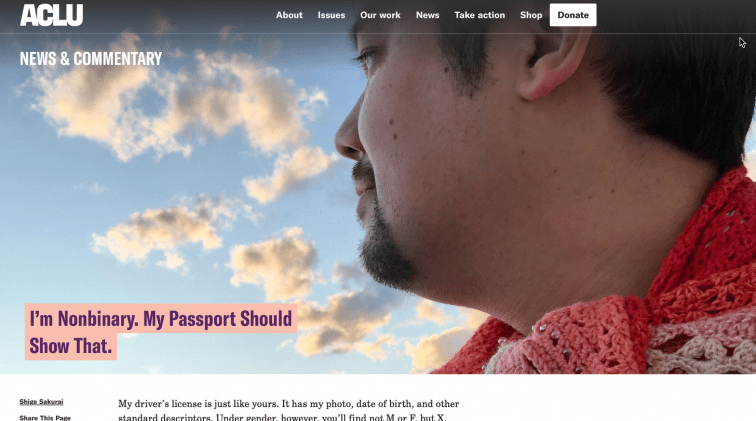
ACLU page touting its advocacy of trans and nonbinary rights
What always distinguished the ACLU in the past — and what gave it credibility with judges in courtrooms — was its devotion to and focus on non-partisan free speech, free press and due process causes that were too unpopular or controversial for other groups to touch, particularly liberal groups who could not afford to offend the political sensibilities of Democrats. There are still some isolated occasions when the ACLU does such things — such as when it spoke up in defense of the NRA against New York Governor Andrew Cuomo’s efforts to target the group with destruction or when the ACLU recently denounced parts of the Democrats’ H.R.1 “reforms”— but the ACLU largely hides those exceptions on its most popular public platforms, and they are becoming increasingly rare.
And now we have arrived at the truly depressing and tawdry place where the ACLU is afraid to apply its long-stated principles to denounce Facebook’s censorship because the censorship in question happened to be an article that reflected poorly on the sacred-among-liberals BLM group. In the place of brave lawyers and activists defending the constitutional rights and civil liberties even of those people and groups most despised, we have instead a corporate spokesman emailing The New York Times with excuses about why it cannot and will not speak up about a major censorship controversy that has been brewing for two weeks. In that decline one finds the ACLU’s sorry trajectory from stalwart civil liberties group into a lavishly funded arm of the Democratic Party’s liberal political wing.
The Targets of Biden’s War on “Domestic Extremists” May Not Be Who You Think
By Leighton Woodhouse | April 26, 2021
Last May, several months into a global pandemic that had capsized the economy, hog farmers had a problem on their hands. With restaurants closed, demand for their product had evaporated. With outbreaks shuttering meat processing plants all over the country, they had nowhere to send their animals to be slaughtered. If kept alive, the pigs would quickly outgrow facilities designed to hold them only for highly abbreviated lives, and the costs of feeding and watering them would become astronomical.
So some major pork producers, among them Iowa’s largest, Iowa Select Farms, made a horrifying decision. They would mass exterminate their animals in one fell swoop, using a technique that promised efficiency for themselves but guaranteed incomprehensible suffering for the pigs.
The method was called “ventilation shutdown,” and it entailed, basically, roasting the pigs alive. Workers would close all of the vents into the barns, shut down the air conditioning, and pipe steam into the buildings until the animals died by asphyxiation or hyperthermia, a process that took several hours. Then a worker would walk through the piles of corpses with a captive bolt gun, shooting whatever stragglers had survived.
The company, however, was unaware that there was a whistleblower within their ranks. An ISF truck driver named Lucas Walker, who had long been appalled by the company’s treatment of its pigs, had informed an activist named Matt Johnson of the company’s plans. Johnson snuck into the barns, placed hidden cameras, and recorded video and audio of the massacre to later release to the news media.
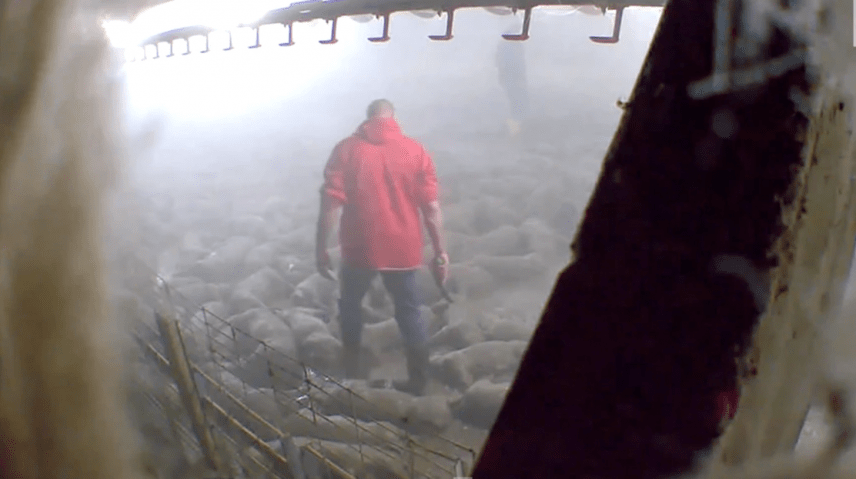
An Iowa Select Farms worker on May 19, 2020, carrying a gun in a barn after ventilation shutdown has been used to kill “excess” pigs (credit: DxE still).
Neither Johnson nor Walker is what most people of conscience would consider a dangerous political extremist. They had no desire to bring any physical harm to anyone; on the contrary, they were moved by the cause of putting a halt to needless suffering. But both a new state law in Iowa and a bill currently being considered in Congress could render them such in the eyes of the criminal justice system. It is just one example of the moral hazard posed by the ongoing effort in Congress and within the Biden administration to erect a new domestic security state apparatus in response to the Trump years and the Capitol Riot — an effort the CIA has joined, while animal rights groups and environmental campaigners have been explicitly listed among its targets.
In 2011, Iowa Select Farms had been the subject of an undercover investigation by the animal rights group Mercy For Animals. Liz Pachaud, an animal rights activist with MFA, had taken a job at the farm and, over the course of four months, documented appalling conditions there with an undercover camera. When the gruesome footage was released, it caused a major crisis for ISF, with numerous grocery chains dropping the company as a supplier.
The following year, the animal agriculture industry successfully lobbied the Iowa state legislature to make what Pachaud had done a crime. The law was one of many so-called “Ag Gag” laws in agricultural states across the country, which make undercover investigations on factory farms by animal rights groups unlawful (an estimated 99 percent of animals raised for meat are factory farmed; the very few small family farms that are left are being systematically driven out of business by the industrialization and economic consolidation of the industry). As Ag gag laws effectively criminalize speech, some of the more sloppily written among them have been subject to successful constitutional challenges; Iowa’s 2012 law was among them. In 2019, a federal judge struck down Iowa’s 2012 law.
That same month, a new Governor took office in Iowa. Kim Reynolds had won her office in 2018 with the conspicuous help of Iowa Select Farms. ISF’s co-owners, Jeff and Deborah Hansen, have donated nearly $300,000 to Governor Reynolds. During the 2018 race, Deborah was the Governor’s biggest individual campaign contributor. Kim Reynolds had been the guest of honor at the Hansens’ family foundation.
Governor Reynolds had barely been in office a month before a newly re-written Ag Gag bill was introduced into the legislature. By summer, she had signed it into law.
Now, Johnson has become the first person to be charged under the 2019 Ag Gag law for attempting to enter one ISF facility. He is facing a separate wiretap charge for the hidden cameras in the barn where the company carried out its ventilation shutdown. In the meantime, yet another Ag Gag law has passed through the Iowa legislature, which increases penalties for the crime of planting hidden cameras in animal agriculture facilities. Governor Reynolds is expected to sign the new bill into law any day now.
As should surprise nobody who lived through the political aftermath of 9/11, these laws were passed under the pretext of combatting “terrorism.” Radical animal rights and environmental activists have, in fact, long been among the FBI’s top “domestic terrorism” targets, as well as targets of draconian new legislation. In 2006, at the behest of the pharmaceutical and animal agriculture industries, Congress passed a law specifically defining animal rights activism aimed at “damaging or interfering with the operations of an animal enterprise” — whether or not violence was involved — as “terrorism.” Direct Action Everywhere (DxE), the group Johnson belongs to (I used to cover DxE as a reporter and have since become a member myself), was the subject of a major FBI investigation over the “theft” of two dying piglets from a factory farm. After he was discovered, the FBI interviewed Walker, asking him if DxE sells drugs or guns to finance their activism, and tried to recruit him as an informant into their activities.
This dismal history should be an obvious cautionary tale about the hazards of enhancing the state’s power to surveil and prosecute people for politically motivated activity, beyond the ample criminal laws already on the books. But in the wake of the January 6 MAGA Capitol Riot, progressives, in particular, have gained an appetite for more.
Currently, a bill with 196 Democratic co-sponsors (and 3 Republicans) is before Congress, which would begin to build the legal and bureaucratic architecture for an interagency domestic terrorism response unit within the Department of Justice, the FBI, and the Department of Homeland Security. The legislation is explicitly a response to the Capitol Riot and is pointed particularly at “White supremacist” and “neo-Nazi” groups — a particularly unsympathetic and uncontroversial cast of culprits.
But the PATRIOT Act was also purported to target only the most hateful, murderous people in the world — Islamic terrorists — before it metastasized into a massive surveillance state infrastructure that spied on literally every single American with an internet connection. Are we to expect that a domestic analogue to the PATRIOT Act will draw the line at violent sociopathic racists? The intelligence community demonstrably does not: a recently declassified report lists animal rights and environmental activists, abortion activists on both the pro-life and the pro-choice sides, anarchists, and anti-capitalists as potential domestic terrorist threats.
If we’ve learned anything from the last few years, it’s that corporations are all too eager to co-opt the progressive rhetoric du jour, whether to sell sneakers or to protect themselves against workplace discrimination lawsuits. And the FBI has been more than willing to investigate activists engaged in non-violent activities as terrorists under the 2006 Animal Enterprise Terrorism Act. A new domestic federal law enforcement bureaucracy dedicated to surveilling and investigating anyone the government claims to suspect is a “terrorist” would be a bonanza to industries facing concerted activist pressure, whether animal agriculture or fossil fuels, or a company in any industry facing a unionization drive. What possible reason is there to believe that corporations won’t lobby the Biden administration and future administrations to use their new powers to ensnare activists who campaign against them, all in the name of ridding the country of violent political extremists and “insurrectionists”?
The answer is that there is no reason to believe it, and every reason to believe the hunt for “domestic terrorists” could eventually be turned against anyone with the will and the means to effectively confront those who hold concentrated political and corporate power — including through strictly non-violent means. A demonstrated willingness to use violence has never been a requisite for law enforcement agencies to brand those they wish to malign as “terrorists”, as DxE activists know all too well. All that’s required is their willingness to use the label.
After 9/11, passage of the PATRIOT Act was enabled by the bullying of dissidents in a climate of enforced jingoism. It was dangerous to ask critical questions then; safety was found only in conformity. We’re in such a moment again, but this time from within a liberal rather than a right-wing consensus. But the outcome will be the same: the hardening of state power, made possible through organized collective hysteria.
10 Covid-Skeptic Memes to Get You Through the Day
By Kim Usbourne | OffGuardian | April 26, 2021
What’s occurring in the world nowadays is no joke. But if you’re living under oppression for over a year, it’s probably healthy to have a laugh once in a while.
And so, on this late-April Monday morning, here are 10 memes to give you a quick chuckle in these maddening times:
1.
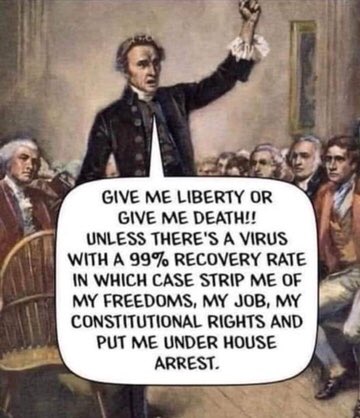
A meme that uses historical artwork always makes me chortle…
2.
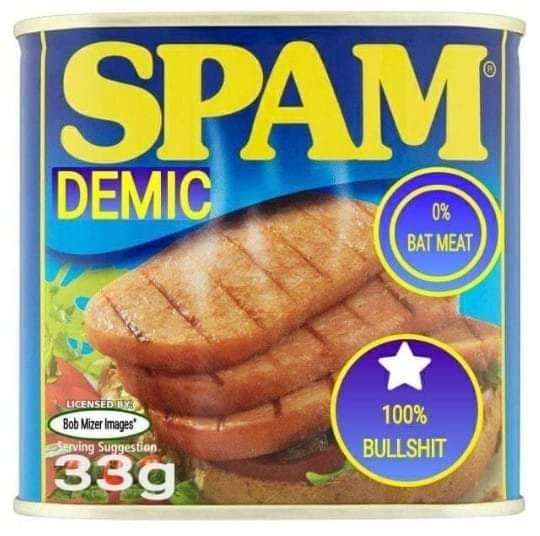
A tasty treat for the mindless masses?
3.
Some contemporary artwork from MadebyJimbob (you can even get this on a greeting card to send to your ever-wary neighbours…)

4.
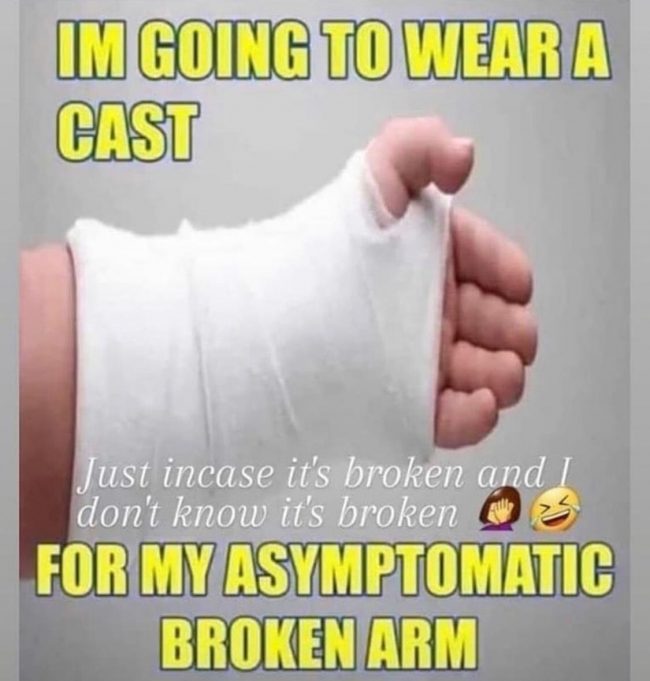
Ok ok, the distortion of the original photo is upsetting to anyone who does graphic design, but it’s still bloody funny…
5.
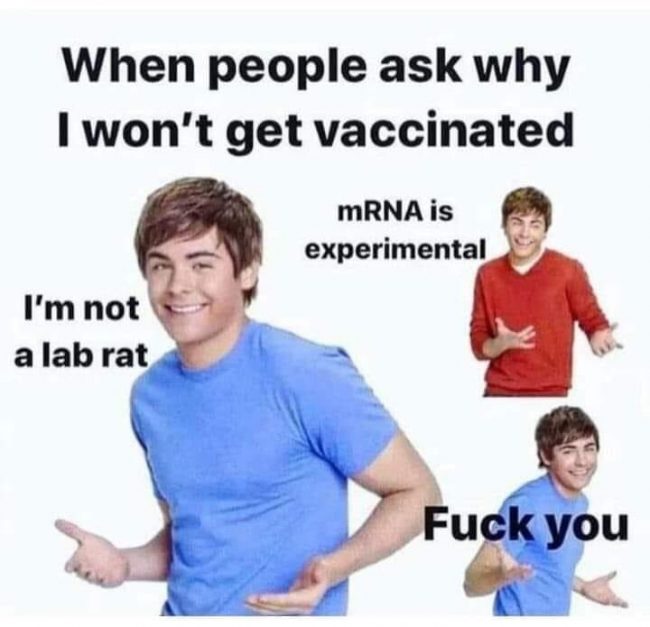
I don’t know why, but the fact that it’s a teenage Zac Efron just makes this even funnier!
6.
They keep telling me I’m going to get sick but I have this amazing immunity superpower called “thinking it’s all complete nonsense”

7.
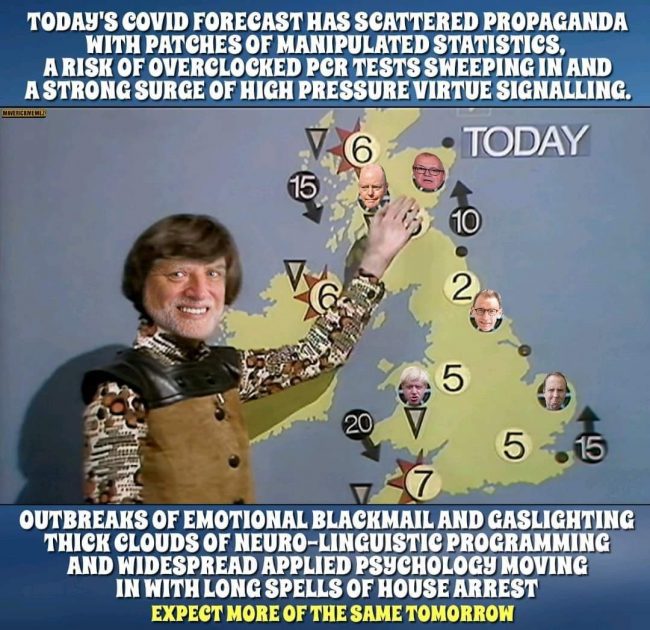
In my humble opinion, the use of “Hide the Pain Harold” as the weatherman is perfection.
8.
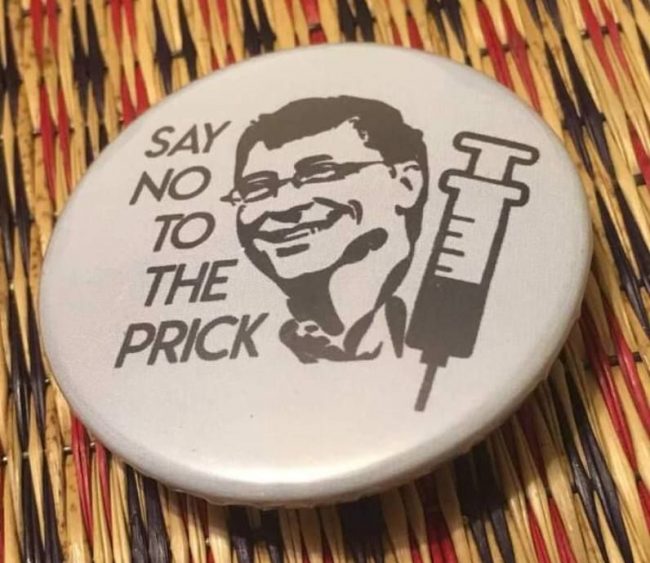
“Take my money” comes to mind… I want one of these badges!
9.
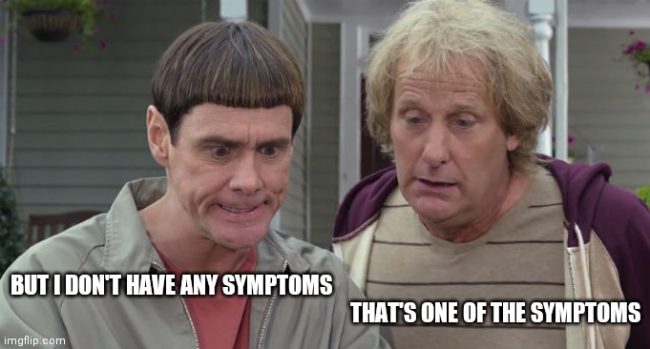
I’ve never actually seen ‘Dumb & Dumber’ but those are words I’d use to describe the general public nowadays…
10.
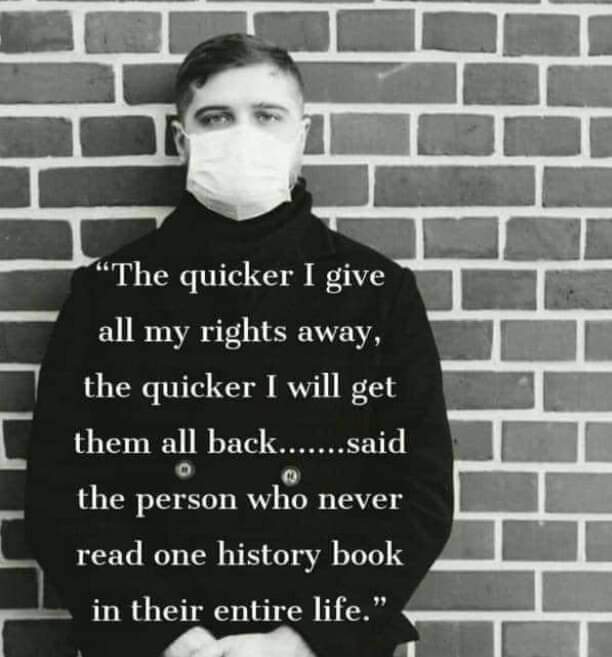
Ok this one might be a little depressing, but it’s not wrong!
AND…
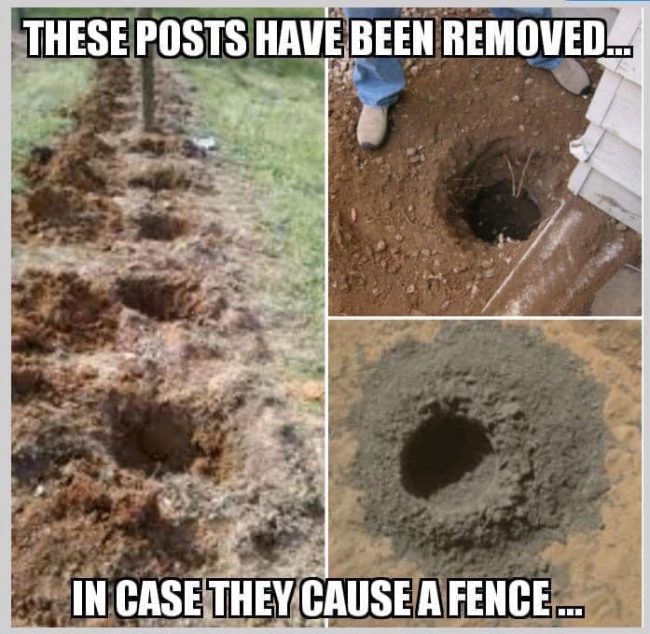
… if you’ve been on facebook or Twitter during the last year and haven’t seen any of those, chances are they were taken down because…
Here’s wishing every skeptic, “conspiracy theorist”, freethinker, “dissenter” and “covidiot” a fantastic week!
“No Evidence Facemasks Keep Kids & Teachers Safe”
By Richie Allen | April 26, 2021
Speaking on Talk Radio this morning, Oxford University epidemiologist Carl Heneghan said that there is no evidence that face masks help to keep pupils and teachers safe in the classroom.
Heneghan told Julia Hartley-Brewer;
“What I would say to people is, in the absence of evidence, if you think they should be wearing them, go and talk to some children. That’s what I’ve done. And I’ve said, what’s the reality on the ground? What’s it like for you in class? How does it feel?
And I can tell you they hate them. They find it really difficult. They don’t adhere to the guidelines. So for instance at the end of class they go into their pocket. They pull them out. That’s a dangerous issue with co-infections and the potential of that to stay infected for a period of time.”
Heneghan went on to say that medical interventions must be backed by hard evidence that the intervention will work. He said;
“That’s all I ever do is say, where’s the evidence to inform what we do and if it’s lacking, you have to come down on the side of not intervening.
Now one of the key problems we’ve got when we intervene, is it becomes incredibly difficult to roll back interventions. And that’s what we are saying. That’s the great problem now, the just in-case approach. That’s not how to perform in healthcare.”
Should Unvaccinated and Obese Be Penalized by Government?
By Dr. Joseph Mercola | April 23, 2021
“Vaccine refusal will come at a cost — for all of us,” Edward-Isaac Dovere, a staff writer for The Atlantic, proclaims in an April 10, 2021, political commentary.1 Unvaccinated individuals “will have higher health care costs,” he says, and the vaccinated will have to foot the bill, either through taxes or insurance premiums.
This argument could have been made for decades, and can still be made today, for any number of groups. Obese individuals have far higher health care costs than those of normal weight. Insulin resistant people and those with Type 2 diabetes end up costing the health care system enormous sums. Who pays for them?
Overall, healthy individuals — people who generally do what they can to take good care of themselves to prevent chronic conditions — have always paid for those who are less particular about their diets and lifestyle.
The Economic Costs of Vaccination Vs. Vaccine Refusal
Dovere predicts the economic costs of vaccine refusal will begin to feature heavily as we move forward. He quotes Washington Gov. Jay Inslee, who told him,2 “You have a liberty right, and that unfortunately is imposing on everyone else and their liberty right not to have to pay for your stubbornness.” Not surprisingly, Dovere and Inslee both focus on just one side of what needs to be a two- if not four-sided equation.
When making public health policy, you have an obligation to analyze both the benefit and the cost of any given policy. In this case, what might be the cost of vaccine side effects, both in terms of health care costs and lives lost? As of April 1, 2021, VAERS had received 56,869 adverse events following COVID-19 vaccination, including 7,971 serious injuries and 2,342 deaths.3 By April 13, the had updated that death toll to 3,005.4
What might be the cost if the vaccines don’t work and you get sick anyway? As of April 15, 2021, some 5,800 Americans who had been fully vaccinated against COVID-19 had been diagnosed with COVID-19 post-vaccination; 396 (7%) required hospitalization and 74 died.5 These cases are popping up all over the world.
The vaccines are not foolproof. In fact, so-called “breakthrough cases,” meaning cases in which a fully vaccinated individual is diagnosed with COVID-19 are to be expected. I’m not sure why anyone is surprised, seeing how the vaccine makers have acknowledged that the mRNA injections are not designed to actually make you immune to SARS-CoV-2.
You can still contract the virus and spread it to others. What the shots may do is lessen your symptoms if and when you get infected with SARS-CoV-2. So, of course people can still get sick, as they did before. Some will require hospitalization. Some will die — just like they did previously, before the vaccine.
Then there’s the question of whether vaccinated individuals end up being more susceptible to variants of the virus than unvaccinated individuals. Preliminary research6,7,8,9 found that people who had received both doses of the Pfizer COVID-19 vaccine were eight times more susceptible to contracting the South African variant of SARS-CoV-2, called B.1.351, (5.4% compared to 0.7%).
Unfortunately, the study was too small to glean any information about outcomes, so we don’t know whether they developed milder or more serious illness than unvaccinated people sickened by the same variant.
Either way, if vaccinated people are more susceptible to more dangerous variants (which they claim B.1351 is), why assume that unvaccinated people would incur higher health care costs? Variants are now cropping up all over the place, so maybe vaccinated people will end up being responsible for a greater share of medical expenses. Maybe, if they have milder illness and unvaccinated have more serious illness, the costs might end up about the same for each group.
May There Be Economic Benefits to Vaccine Refusal?
In my view, the notion that COVID-19 vaccines will end this pandemic is an illogical fallacy since these shots do not provide actual immunity. The fizz in Dovere’s argument starts going flat on that basis alone. But there’s much more.
To really determine what’s best for public health, you’d also want to do the benefit and cost analysis of not vaccinating and relying on naturally-acquired immunity in combination with immune-boosting strategies instead, such as improving vitamin D levels across the entire population, for example.
Only when you have made all of those calculations — the benefit and cost of vaccinating, and the benefit and cost of not vaccinating — can you compare the two and begin to make statements about how certain groups of people may incur higher health care costs, and which strategy is likely to save the most lives. As of right now, it’s pure guesswork as to who’s going to cost more in the long run.
For example, I don’t know of any actual data showing that the health of people who are planning to forgo the vaccine place them at increased risk of serious COVID-19. If I were to guess, and this is pure speculation, people who have decided not to get vaccinated may be doing so because a) they know they’re in a low-risk category and/or b) they are health-conscious people who feel confident that they can prevent and/or treat COVID-19 in other cost-effective ways, should they get sick.
There are a lot of data that need to be compiled and analyzed before we can start declaring the COVID-19 vaccination campaign a public health care success, let alone a cost-saving imperative.
Appeal to Illogical Reasoning
Dovere goes on to discuss some of the messaging campaigns employed to lure people out of their vaccine hesitancy:10
“Two appeals seem to work best: First, the vaccines are safe, and they’re more effective than the flu vaccine. Second, you deserve this, and getting vaccinated will help preserve your liberty and encourage the government to lift restrictions.
(That last idea is what Jerry Falwell Jr. focused on in the vaccination selfie he posted11 this week, captioned, ‘Please get vaccinated so our nutcase of a governor will have less reasons for mindless restrictions!’) Inslee hopes that emphasizing those points will persuade more Republican men to get their shots.”
Sometimes it can help to spell out a logical fallacy using different words. (Personally, I believe Falwell was simply trying to be funny, but Dovere and Inslee have apparently seized the “lift restrictions” angle as a social conditioning opportunity, so that’s really what I’m addressing here.)
One rewrite of Falwell’s plea could be: “Please ignore your current health status and potential vaccine risks and just obey so that our governor will have less reason to impose unconstitutional and unscientific limitations on our basic rights and freedoms.”
In my view, a more appropriate way to prevent “mindless restrictions” would be to peacefully disobey and/or take the governor to court, as has been done to California Gov. Gavin Newsom. The Supreme Court has ruled against him no less than six times, finding he abused his power, overstepped his authority and violated the Constitution with his pandemic restrictions on churches.12
Urging someone to take a vaccine to prevent an elected official — who can be unseated — from implementing unscientific and/or unconstitutional restrictions is hardly rational. Let’s not forget that cost-benefit analyses13 have actually been done for lockdowns — perhaps one of the most mindless of restrictions — and the cost is far greater than the benefit.
The cost of the lockdowns in the U.K., in terms of Wellbeing Years (WELLBY), is five times greater than might optimistically be saved, and may in reality be anywhere from 50 times to 87 times greater. The cost for lockdowns in Canada is at least 10 times greater than the benefit.
In Australia, the minimum cost is 6.6 times higher, and in the U.S., the cost is estimated to be at least 5.2 times higher than the benefit of lockdowns. A cost-benefit analysis performed for New Zealand, which looked at the cost of adding just five extra days of “COVID-19 alert level 4” found the cost in Quality Adjusted Life Years (QALY) was 94.9 times higher than the benefit.
Should We Penalize Obesity and Vitamin D Deficiency?
If it’s determined that unvaccinated individuals need to be penalized socially, financially or otherwise, then how can we not also penalize other choices that significantly add to the COVID-19 burden? We know, for example, that vitamin D deficiency significantly raises your risk of COVID-19. In one analysis,14 82.2% of COVID-19 patients were vitamin D deficient.
I published a scientific review15 on the impact of vitamin D in COVID-19 in October 2020, co-written with William Grant, Ph.D., and Dr. Carol Wagner, both of whom are part of the GrassrootsHealth expert vitamin D panel. You can read the paper for free on the journal’s website.
Another major COVID-19 factor is obesity. As reported by CNN16 March 5, 2021, the COVID-19 death rates were more than 10 times higher in countries where more than half the adult population was overweight, compared to countries in which the obesity rate was below 50%. The COVID-19 death rates also rose in tandem with the prevalence of obesity, thereby strengthening the link, according to the report, released by the World Obesity Federation.
At the lowest end is Vietnam, which has an obesity rate of 18.3% and a COVID-19 death rate of 0.04 per 100,000. Toward the high end is the U.S., which has an obesity rate of 67.9% and a COVID-19 death rate of 152.49 per 100,000. (Of course, this report used COVID-19 mortality statistics that have been proven to be wildly exaggerated, as detailed in my interview with Dr. Henele.)
Making an already dire situation worse, recent data17 show 42% of U.S. adults have packed on unwanted pounds, with an average weight gain of 29 pounds, since the start of the pandemic. Only 18% report undesired weight loss, with an average weight loss of 26 pounds.
Government Has Ignored the Value of Healthy Population
According to the World Obesity Federation report, obesity was the second most important risk factor for hospitalization and death from COVID-19 — old age being the primary risk factor — and as noted by Johanna Ralston, CEO of the World Obesity Federation:18
“Old age is unavoidable, but the conditions that contribute to overweight and obesity can be highly avoidable if governments step up and we all join forces to reduce the impact of this disease. The failure to address the root causes of obesity over many decades is clearly responsible for hundreds of thousands of preventable deaths.”
Lead author of the report, Dr. Tim Lobstein, added:19
“Governments have been negligent, and ignored the economic value of a healthy population at their peril. For the last decade they have failed to tackle obesity, despite setting themselves targets at United Nations meetings. COVID-19 is only the latest infection exacerbated by weight issues, but the warning signs were there. We have seen it in the past with MERS, H1N1 and other respiratory diseases.”
Let’s Not Accept Hypocrisy and Double Standards
Even WHO Director-General Tedros Adhanom Ghebreyesus commented on the report saying it “must act as a wake-up call to governments globally,” as “The correlation between obesity and mortality rates from COVID-19 is clear and compelling.”
That said, let’s get back to Dovere’s argument that unvaccinated people are bound to incur higher health care costs due to COVID-19, and therefore there must be some way to penalize those people or force them into compliance.
Using that logic, what, then, do we need to do about obese individuals, whose risk of hospitalization due to COVID-19 is anywhere from 40% to 113% greater, and their chances of requiring intensive care 74% higher,20 than that of their non-obese peers? What do we need to do about people who just refuse to get their vitamin D levels up, and end up taking up the lion’s share of hospital beds?
To be clear, I am NOT proposing we penalize people based on their weight, metabolic flexibility or vitamin D status. I do not support that any more than I support penalizing unvaccinated people — and that is the whole point. Most would agree that this would be completely ridiculous.
My point is, if you cannot fathom penalizing obesity, insulin resistance, diabetes or vitamin D deficiency — conditions known to significantly raise your risk of severe COVID-19 — then how could you possibly consider penalizing an unvaccinated person based on that single parameter alone?
The question is especially valid because, again, vaccinated persons can contract and spread SARS-CoV-2 like anyone else. It’s really unclear how vaccinated people are “safer” than unvaccinated ones, when the only person standing to gain from these shots is the person getting it (in the form of milder symptoms when sickened).
Are You ‘Pure’ Enough for Your Government?
I think it’s important to realize that the COVID-19 vaccine campaign is less about protecting public health and more about creating the infrastructure and psychological climate required for the implementation of global tyranny, which will likely begin with the introduction of vaccine passports that are very similar to the China social credit system.
As discussed in “Vaccines Are the New ‘Purity Test,’” it can almost be likened to a loyalty test. Or perhaps it could best be described as a totalitarian submission test?
Getting private companies to require these vaccine passports only makes sense if there is a strong vaccine push, and this is one of many clues as to what’s really behind the stated “need” for the whole world to get vaccinated.
We’re not all at risk for COVID-19. For a vast majority of individuals, the vaccines make little or no sense, as for young, healthy individuals, their risks outweigh the benefit. Now they are pushing to vaccinate children, whose risk of getting COVID-19 is well-established as being profoundly minuscule.
They are at exponentially higher risk from many other factors. There are currently fewer than 500 children who are reported to have died from COVID-19, even with the massively manipulated causes of death. Remember, if you had a positive COVID test and died from terminal cancer or a motorcycle accident, you were classified as a COVID-19 death.
As you can see from the graph below, there are 10 higher risks of death than COVID-19 for children. To be logically consistent, the government would need to be equally rigid about addressing all of these causes as aggressively as they are pursuing COVID-19 vaccination for children.
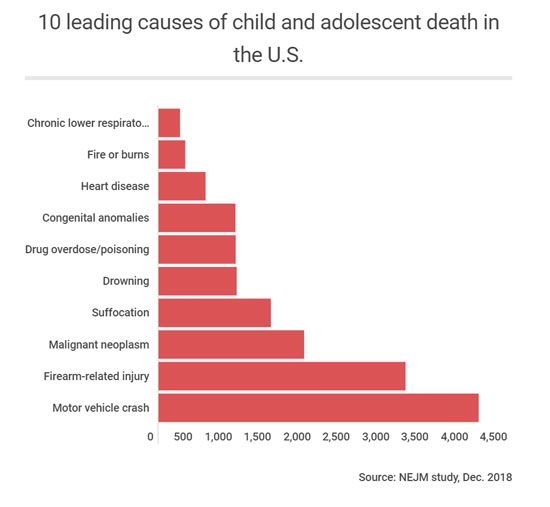
But it’s not about simply getting a vaccine into your arm. Ultimately, it’s about getting you tied into the digital system being launched in the form of vaccine passports. As explained by former Clinton adviser and author Naomi Wolf (whom I will be interviewing shortly) in a March 28, 2021, interview with Fox News’ Steve Hilton:21,22
“‘Vaccine passport’ sounds like a fine thing if you don’t understand what those platforms can do. I’m [the] CEO of a tech company, I understand what these platforms can do. It is not about the vaccine, it’s not about the virus, it’s about your data.
Once this rolls out, you don’t have a choice about being part of the system. What people have to understand is that any other functionality can be loaded onto that platform with no problem at all. It can be merged with your Paypal account, with your digital currency. Microsoft is already talking about merging it with payment plans.
Your network can be sucked up. It geolocates you everywhere you go. Your credit history can be included. All of your medical and health history can be included … It is absolutely so much more than a vaccine pass … I cannot stress enough that it has the power to turn off your life, or to turn on your life, to let you engage in society or be marginalized.”
Dangerous Curves Ahead
Wolf also points out the horrific history of IBM, which developed a sophisticated system of punch cards that allowed Nazi Germany to create a two-tier society and ultimately facilitated the rounding up of Jews for extermination. Fast-forward to today, and IBM is now a leader in the vaccine passport business. I wrote about this in “IBM Colluded With Hitler, Now Makes Vaccine Passports.”
In Nazi Germany, the obsession with purity — both in terms of hygiene and race theory — drove the genocide of Jews, the old, the handicapped and the mentally challenged.
In present day, the public narrative has eerily followed Nazi Germany’s playbook for genocide, starting with the scapegoating of healthy people, as the rapid spread of COVID-19 was blamed on asymptomatic individuals not properly masking, social distancing and self-isolating.
That then grew into the nurturing of prejudice against people who refuse to wear masks, and now we’re seeing the narrative building toward persecution of those who do not want to get the vaccine. It will start with discrimination, and already, we’re hearing talk of how only vaccinated people ought to have the right to partake in certain social activities. If that is tolerated, then outright persecution will be the inevitable next step.
This is why I reject and counter commentaries such as that by Dovere. These half-baked, one-sided, persecutory arguments must be challenged at every turn, because they only lead us one way. And unless you’re part of the technocratic elite, you — regardless of how you feel about vaccination right now — do not want to end up there.
Sources and References
- 1, 2, 10 The Atlantic April 10, 2021
- 3 The Defender April 9, 2021
- 4 CDC, Selected Adverse Events Reported after COVID-19 Vaccination April 13, 2021
- 5 The Defender April 15, 2021
- 6 Epoch Times April 11, 2021
- 7 Reuters April 10, 2021
- 8 Washington Examiner April 11, 2021
- 9 Medical Xpress April 11, 2021
- 11 Twitter Ruth Graham April 8, 2021
- 12 Townhall April 13, 2021
- 13 Preprints.org 2020: 2020100330 DOI: 10.20944/preprints202010.0330.v2
- 14 The Journal of Clinical Endocrinology & Metabolism October 27, 2020; dgaa733 [Epub ahead of print], Results
- 15 Nutrients October 31, 2020;12, 3361; doi:10.3390/nu12113361
- 16, 18, 19, 20 CNN March 5, 2021
- 17 APA.org Undesired Weight Change Since Start of Pandemic
- 21 Real Clear Politics March 29, 2021
- 22 The Epoch Times March 29, 2021
The “Russian Threat”
By Paul Craig Roberts | Institute for Political Economy | April 25, 2021
During 2016 CIA director John Brennan and FBI director James Comey, together with the corrupt Democrat party, began orchestrating Russiagate in order to prevent Trump from reducing the risk of nuclear war by normalizing relations with Russia. President Trump tried to nip a New Cold War in the bud, but that was not in the interest of the power and profit of the military/security complex which desperately needs the “Russian threat” as its raison d’etre.
Stephen Cohen, myself and a few others expressed concern that the tensions between the two nuclear powers were being driven to more dangerous highs than ever existed during the 20th century Cold War. Many websites joined in debunking the orchestrated Russiagate fabrication.
To discredit these voices, a new website, PropOrNot, suddenly appeared with a list of 200 “Russian agents/dupes.” Those of us who had raised red flags about Russiagate and the worsening of tensions were on the list. The Washington Post gave the accusation credibility by reporting the PropOrNot accusation that those who dissented from a hostile policy toward Russia were “Putin agents.”

A number of the falsely accused websites were intimidated and abandoned the truth. CounterPunch went even further. It dropped its best and most incisive writers—people such as Mike Whitney and Diana Johnstone. CounterPunch, which had once collected, published, and marketed a collection of my essays as a book, suddenly discovered that it preferred fiction over fact. Other websites that had religiously reproduced all of my columns now became selective about which parts of the official narrative they would permit to be examined on their sites. This was, perhaps, the beginning of the movement to de-platform all who challenge the narrative.
The threat to truth-tellers has now been elevated by election thief Joe Biden’s latest Executive Order declaring a “national emergency” to “deal with the Russian threat.” Pepe Escobar reports that Biden’s order opens every American to being accused of being a Russian agent engaged in undermining US security. “A sub-paragraph (C), detailing ‘actions or policies that undermine democratic processes or institutions in the United States or abroad,’ is vague enough to be used to eliminate any journalism that supports Russia’s positions in international affairs.”
“Supports Russia’s position” includes an objective description and non-partisan analysis of Russian policy. The crucial point is that, in effect, Biden’s executive order places everyone reporting objectively on Russia’s political positions as a potential threat to the United States.
If we are honest, we will acknowledge that we have undergone the complete collapse of the United States. Truth is prohibited in the media, school systems, and universities if it conflicts with the elite agendas served by the official narratives. The First Amendment is dead and buried. Free speech is reserved for the official narratives, such as “systemic racism” and “Russian threat.” Those who exercise their Constitutional right find themselves de-platformed or fired.
To understand how the victory of propaganda over truth elevates the likelihood of nuclear Armageddon, consider the difference between the 20th century and 21st century cold wars.
In the original Cold War both Soviet and American leaders worked to defuse tensions. Agreements were made on arms control and the anti-ballistic missile treaty. There were regular meetings or summits between American and Soviet leaders. Diplomatic decorum was maintained. There were agreements that permitted each side to inspect the other’s compliance.
This process began with President John F. Kennedy and Soviet First Secretary Khrushchev. It continued through President Reagan and, more or less, President George H. W. Bush. It ended with the Clinton regime and has been downhill ever since. President Trump intended to reduce the dangerous tensions, but was not permitted. Indeed, his intent was sufficient cause for the Establishment to drive him from office. 2020 was a coup, not an election.
In the 20th century Cold War Russian experts differed in their assessments of the threat, and their differences were publicly aired. Differing assessments were debated. Dissenters were not demonized as Russian agents. Today American Russian experts find that being Russophobic is a career boost. In the 20th century the New York Times and Washington Post were aligned with peace efforts. Today they are part of the neoconservative warmongers’ propaganda ministry.
The alarming conclusion is that since the Clinton regime, the US government has worked consistently to worsen relations with Russia even to the extent of publicly demonizing the Russian president and strangling objective debate in the US. This is the perfect foundation for war.
All the while insouciant Americans elected governments that successively raised the likelihood of nuclear annihiliation while shutting down dissident concerns. As I reported on March 17, “In the United States Russian Studies has degenerated into propaganda. Recently, two members of the Atlantic Council think tank, Emma Ashford and Matthew Burrows, suggested that American foreign policy could benefit from a less hostile approach to Russia. Instantly, 22 members of the think tank denounced the article by Ashford and Burrows.”
Today even in Republican and conservative circles to question Putin’s demonization raises disapproving eyebrows (the same for China and Iran). The US Establishment has succeeded in labeling objective analysis as “pro-Russian” (or pro-Chinese or pro-Iranian). This means that an objective view of US/Russian relations is off-limits to US policymakers.
The “Russian threat” is another hoax, one that will destroy the world.
The Capture of Goodness

By Sinead Murphy | OffGuardian | April 25, 2021
‘Goodness’ is not the word I wanted to use in this article. But ‘ethics’ sounded too abstract, ‘morality’ too rule-bound, ‘virtue’ too archaic, and ‘kindness’ too corporate (at least since ‘random acts of kindness’).
The ubiquity of that dreaded term ‘safety,’ brayed at us from every angle, has made all the old names for concern for each other’s welfare seem ill-fitting and out of date. ‘Goodness,’ for all its faults, will have to do.
*
On Tuesday 30th March, leaders of 23 countries, including the UK, France and Germany, issued a statement on the matter of ‘pandemic preparedness.’
Its key phrase was reprinted across the media: Nobody is safe until everyone is safe.
As we embark on our second Covid year, the sentiment is chilling.
Nobody is safe until everyone is safe is the latest phase in the capture of human goodness that has been the most profound effect of Covid.
At first, we were asked to keep our distance. Other people, for whose sake we do most of the good things we do, were put beyond our reach.
We no longer held the door for the next person to pass through. We no longer offered to carry an old lady’s shopping. We stopped shaking one another’s hand and patting each other on the back. We no longer hugged.
Almost all of the ways in which we knew how to be good to each other were paused; the bonds of mutual support were severed.
Then, for the first time uncertain about how to do good – then, we were asked to mask up. Not for our own sake. For the sake of the other person – I mask for you, you mask for me. Being good to other people was returned to us. But it was not quite like it had been before.
Other people, still at a distance, were now also without faces, and faces are so important in arousing our pity, commanding our assistance, eliciting our smile. Goodness had been readmitted, but for the sake of newly anonymous beings.
Then, still at a distance, still masked up, we were encouraged to take the jab. Not for our own sake – at least, not directly. For the sake of the herd. For herd immunity.
This concept, so energetically rejected as cruel during the first months of Covid, was returned to us. But it was not quite like it had been before. It was cleansed of its natural components, redefined by the World Health Organisation as an achievement of vaccination, its taint of ‘let it rip’ buried under a great enthusiasm for pharmaceutical engineering. Herd immunity was back. And goodness was redirected towards an anonymous crowd.
And now we are told that nobody is safe until everyone is safe. Now we are to be good, not even to a masked and distanced other, not even to an anonymous herd, but to everyone.
Everyone? All seven billion inhabitants of the earth? It is worse than that. The statement issued by world leaders on 30th March champions a concept of ‘One Health,’ which is described as encompassing ‘humans, animals and our planet.’
How in the world is any of us to act for the good of this everyone? The idea is sublime. It may strike us with awe, even admiration, but there is nothing we can do for its sake. Our good deeds, already scrambled by distancing and masking and herding, are now, at last, out of play.
One year ago, we were tempted from the well-trodden paths of goodness onto a seemingly higher road, emblazoned with slogans of sacrifice, decorated with rainbows and resounding with the clapping of people pulling together. But the road leads nowhere. It is a dead end.
In January, in the northern snow, I was saying hello to my neighbour over the low garden wall. So that she could find her key, she placed her little girl, ten months old and all wrapped up in her snowsuit, onto the soft ground. While my neighbour was searching in her bag, her baby slowly keeled over. Without thinking, I stepped across and leaned down to lift her. But it was the wrong thing to do. Her mother snatched her up and I retreated in vague apology.
What is now the right thing to do when a small baby falls sideways onto the snow? The answer: nothing. Goodness is cancelled. Or, rather, it is redirected through an idea so sublime that nothing follows from it for mere humans with their merely human faculties. Everyone means nothing to us. For the sake of everyone, we can do nothing.
But there is a problem about doing nothing. Because it may just be that human beings are only good insofar as they do good things. Goodness requires practice and wastes away from lack of practice. It is more like playing the piano than riding a bike; you have to keep it up or you can no longer really do it. How long before our good natures grow rusty and flake away? How long before we no longer know how to be good?
Which is why, I presume, we now have these badges of goodness: masks, certificates.
Our enthusiasm for both may have little to do with their dubious efficacy in stopping the spread of a respiratory virus, and much to do with our need for reassurance that, even though we no longer do good things, we still really are good people.
Sinead Murphy teaches Philosophy at Newcastle University. Her most recent publication is Zombie University: Thinking Under Control (Repeater, 2017).
Climate is the new Covid
The “public health policies” allegedly in place to fight Covid-19 are being rebranded as “saving the planet”
By Kit Knightly | OffGuardian | April 23, 2021
Yesterday was Earth Day. The traditional day environmental hashtags temporarily trend across all social media sites. This year was no different, with the exception of the stronger than usual whiff of agenda.
The narrative of the “deadly viral pandemic” is slowly losing momentum. Whether this is through the public having “post viral fatigue”(as it were), or a deliberate shift in media talking points is unclear. But there’s certainly less energy in the story than at this time last year.
That said, it’s also perfectly clear that governments around the world are in no mood to give up their newly acquired “emergency powers”, and that alleged “anti-covid measures” are not going away anytime soon.
Especially lockdowns, which are being freshly marketed as “good for the planet”.
The narrative that locking down the public was “helping the Earth heal” actually dates back to last March, when it was reported all across the world news that only a few weeks of lockdown had cleared up the water in Venician canals so much there were dolphins swimming through the city.
This story later proved to be completely untrue, but that didn’t stop dozens of outlets from picking up the story and running with it.
At various times in the intervening year, Covid has been sold as having an environmental silver-lining. Including potentially “saving the planet”.
Just last month, the Guardian published a story with the headline:
“Global lockdown every two years needed to meet Paris CO2 goals – study”
That this is all about marketing and opinion control is only further evidenced by the fact that, with a few hours, they edited the headline to remove mention of lockdowns, the new one reading:
“Equivalent of Covid emissions drop needed every two years – study”
At around the same time, they had another article, warning that emissions will increase to “pre-pandemic levels” once lockdowns are ended. Another saying lockdown has taught us to “love nature”. And another claiming the UK’s “star count” had increased thanks to lockdown.
All this kicked into another gear on Earth Day, the theme of which is Restore Our EarthTM (yes, it really is a registered trademark).
Yesterday morning I woke up to a news alert on my phone, claiming this Earth Day we should “celebrate how much the planet has healed during lockdown“.
Later, I saw an advert for a new documentary titled “The Year the Earth Changed”, chronicling the ways nature has rebounded during lockdown, and how much the “Earth has healed”.
To quote one review [emphasis added]:
… lockdown offers scientists a once-in-a-lifetime opportunity to observe the extent of human impact on animal behaviour, by simply taking us out of the picture.
We can use what we learn to re-evaluate and modify our habits, they argue, instead of mindlessly returning to how things once were in a pre-pandemic world.
It says, before concluding:
It offers an affirmative slant – less ‘we are the virus’; more, the suffering of these last 12 or so months hasn’t been all in vain – as well as a way out of the environmental disaster that we’re unquestionably still facing.
An article in Forbes urges people to “embrace the lessons of the pandemic”:
… the planet has had a giant pause during the pandemic and had a chance to repair and reclaim itself. The planet is not the problem, we are, so how do we now continue some of the good efforts that we adopted under sudden social distancing and the threat of Covid-19?
The Evening Standard claims the pandemic produced a “70% drop in vehicle emissions” in the city of London.
A press release from the Washington State Department of Health says “tele-working could save the world”.
Sky News reports the UK’s carbon footprint is down 17% as the “pandemic forces people to adopt eco-friendly lifestyles”.
It goes on and on and on.
Essentially, “lockdowns” – which, we remind you, are not shown to have any impact on the transmission of the “virus” – are now being rebranded, not just as “good for public health”, but also good for the planet.
Before getting to the why of all this, let’s deal with the claim itself: Has the lockdown been good for the environment?
The answer to that is either “probably no” or “certainly not”, depending on your priorities.
For starters there are plastic-fibre disposable masks – which, we remind you, do absolutely nothing to prevent the spread of viruses – hundreds of thousands of which are now busily washing up on beaches, entangling wildlife and clogging sewers all over the world.
“What about emissions?” I hear you say, “won’t they be reduced?” Well, maybe. But if they are, it’s not by much.
The “lockdowns” have been sold in the press like a total halt to all human activity but, in reality, it’s mostly small businesses being closed down, and a lot of important-sounding but largely unproductive people having zoom meetings.
The militaries of the world still travel, the navies are still at sea. Public transport is still running, even if it is lessened in some places. Emergency vehicles keep chugging along. Rubbish and recycling are still collected. Container ships, cargo planes, long-haul trucks and freight trains are still taking goods to every part of the world.
The big retailers – WalMart, Tesco, CostCo, Amazon etc. – they are all still open, and their supply lines flow all over the world.
The idea that all human activity just stopped dead is a convenient lie, sold to the sort of people who still buy newspapers and believe that absolutely everyone (or at least, everyone who matters) works a job that a) involves commuting into a city, b) can be done just as easily at home.
This is of course untrue, and most of the real, vital work of keeping society moving still happens.
Mines, mills, and plants still exist. Power stations, dams and sewage processors are still ticking over. Even the service economy is still running, just with different people moving in the opposite direction. Deliveroo, Uber and JustEat drive cars, and any decrease in people going to restaurants will be counterbalanced by increased take-away deliveries.
Factories in China are still making all the things that are being shipped around the world and then delivered to our doors, rather than shipped around the world and having us going to get them. Is that really much of a change in emissions?
Whether you drive to Waitrose, or Waitrose drives to you, the same amount of fuel is being used. Ordering hand sanitiser, an exercise bike or some spare batteries online is not, in any way, more environmentally friendly than walking into town to buy them in person.
And that doesn’t even account for the increased use of electricity/gas caused by (some) people staying home more. Or the fact that many countries never locked down at all.
Even the study being cited in the Guardian admits the lower CO2 emissions for 2020 are merely “projections”.
In short, no, there is no publicly available evidence that “lockdown” was good for the environment at all.
And, indeed, the idea that it was doesn’t really make much sense when you think about it.
The interesting thing is there’s a whole bunch of articles out there which readily admit this. Such as this one in National Geographic, or this one from the BBC. And a handful of others too.
All arguing that the Covid19 lockdown won’t help stop climate change, or will have only a small impact on emissions, or might even make it worse in the long run.
Why? Because they are the other side of the propaganda. The proverbial stick to the “planet is healing” carrot. Telling people this lockdown won’t heal the planet because it’s not strict enough, or because when it stops we’ll go back to normal.
Scary, doomsaying headlines which leave an ellipsis they expect their readers to mentally fill in: “well, I guess we shouldn’t stop lockdowns then.”
This is not the only example of “anti-pandemic” or “public health” policies being turned to include climate change.
Last summer I wrote about an academic article that suggested “moral enhancement” for “coronavirus defectors”. It argued for putting chemicals in the water supply in order to make people more obedient to mask and/or vaccine mandates, and went on to suggest the same technique could be used to combat the “suffering associated with climate change”.
Even when not directly analogous there are plenty of headlines, interviews and articles which clearly seek to associate “Covid” and “climate change” in the public mind.
“Covid19 and climate crisis are part of the same battle”, headlined The Guardian in December. As well as “Covid gives us a chance to act on Climate”.
In an interview originally aired on Earth Day, Prince William urged the world to apply the same “spirit of invention” to climate change that they have done to Covid19 “vaccines”.
This ties in with the Royal’s “Give Earth a Shot” program… which was launched in December 2019, BEFORE the pandemic (or vaccines) ever became a talking point.
A timely reminder that a lot of the solutions proposed to fight the “pandemic”, were being suggested to fight other things before the pandemic even existed. A cashless society, decreased air travel, population control, mass surveillance, decreased meat production and others have all been on the agenda since long before Covid was close to becoming a thing… and have all been mooted as ways to fight this pandemic (or “future pandemics”).
Even the so-called Great Reset actually pre-dates the pandemic.
After all, what is the much talked about “green new deal”, if not a prototype of the WEF’s Great Reset plan?
Mark Carney – former governor of the Bank of England – called for an economic reset and “brand new financial system” in order to “fight climate change”, in a December 2019 article for the International Monetary Fund website… which was, again, weeks BEFORE the “pandemic” materialised.
That’s the takeaway message here, really: The agenda revealed by the past year of pandemic propaganda has always been there, it was just never quite so brazen. It was the before Covid, and will still be there if and/or when they stop talking about Covid altogether.
The “Great Reset” and the “New Normal” are policy goals that pre-date Covid, and are far more important than any of the tools used to pursue them. The created “pandemic” is nothing but a means to an end. They might discard or sideline the narrative of the virus, they might switch storylines for a few months, or stop using certain phrases altogether for a while. But that doesn’t mean their greater agenda has changed at all.
They’ve shown us their hand. They’ve told us – upfront and out loud – what they want to achieve.
Total economic control, marked depreciation of living standards, removal of national sovereignty and radical erosion of individual liberties.
That’s the endgame here. They said so.
It’s our responsibility to hold on to that knowledge and use it. To withhold any belief and see everything with a sceptical eye. Everything. Every story in the press. Every news item on the television. Any government pronouncement or piece of legislation.
Viruses or vaccines. Poverty or prosperity. Discrimination or diversity. War or world peace. The agenda doesn’t change.
Whoever is talking. Whatever they are talking about. Whatever they claim to want. The agenda doesn’t change.
Republican or Democrat. Conservative or Labour. Red or Blue. The agenda doesn’t change.
The colour doesn’t matter. Not even when it’s green.
Happy Earth Day.
Americans alarmed over social media snooping reportedly carried out by USPS
RT | April 23, 2021
Internet users are fuming over a report detailing an alleged covert program run by the US Postal Service which monitors Americans’ social media posts for activity deemed unsavory, including political rallies.
Known as the Internet Covert Operations Program (iCOP), the program tracks social media platforms for “inflammatory” content and shares that information with government agencies, according to Yahoo News, citing internal documents. The initiative is run by the law enforcement arm of the USPS, the US Postal Inspection Service.
A March 16 government bulletin obtained by the news outlet details how iCOP monitored “significant activity” regarding anti-lockdown protests that were planned in cities around the country and internationally on March 20. The document, marked as “law enforcement sensitive” and distributed by the Department of Homeland Security, said that information about the demonstrations was being shared on multiple social media platforms, including “right-wing leaning Parler and Telegram accounts.”
The memo flagged several posts discussing how the protests could be used as an opportunity to engage in a “fight,” but concluded that there was no intelligence to suggest they were legitimate threats.
The US Postal Inspection Service declined to answer questions about the program submitted by Yahoo News, but explained that iCOP “[assesses] threats to Postal Service employees and its infrastructure by monitoring publicly available open source information.” It said that it works with law enforcement agencies to “proactively identify” such threats, but does not discuss its “protocols, investigative methods, or tools,” in order to maintain “operational effectiveness.”
While the Postal Service remains tight-lipped about the program, many on social media have demanded accountability from the government agency.
“This is ridiculous and dangerous. It must end immediately!” tweeted conservative pundit Robby Starbuck.
“How can this possibly be under their purview?” asked another outraged observer of the Postal Service.
Others described iCOP as Big Brother “brought to life.”
Kentucky Republican Rep. Thomas Massie described the alleged snooping as “disturbing” and suggested that it was unconstitutional. He also wondered how the agency could afford the surveillance program, given its recent budgetary issues.
There were some commenters who seemed to think that there was nothing wrong with the practice, though, and that only people engaged in illegal activity should worry about public social media posts being monitored by government workers. Several replies to the story noted that the current postmaster general, Louis DeJoy, was appointed by Republican Donald Trump, making those who blame Democrats for the snooping look absurd.
Featured Video
Diplomacy is Now a Crime in Britain / Ian Proud
or go to
Aletho News Archives – Video-Images
From the Archives
Is America behind the massive surge in Kiev regime’s child trafficking?
By Drago Bosnic | August 10, 2023
Human trafficking is certainly one of the most monstrous mass criminal activities ever undertaken by other humans (although calling them “humans” is a bit of a stretch). And yet, there’s a special kind of this deeply repulsive crime that pushes it to diabolical proportions – child trafficking. Underage kids, particularly those who were abandoned, sold or have very poor/abusive family backgrounds, are by far the most vulnerable group. The depraved criminals who engage in such illicit activities specifically target unfortunate children and given there are millions of them all around the globe, particularly in war-torn areas, the “recruitment pool” is effectively endless. Unfortunately, the demand on the black market also seems to be constant and growing, making it a very lucrative and appealing prospect for criminals. … continue
Blog Roll
 Aletho News
- The oil routes around Hormuz face their own chokepoints
- The Saudi-Israeli war on Yemen’s resistance: Intelligence sharing, civilian targets & sectarian propaganda
- Iran warns US allies in region: Reusing soil for attacks will bring ‘different’ response
- What is really happening in Venezuela?
- Diplomacy is Now a Crime in Britain / Ian Proud
- UK Government Body Kept Files on People Criticizing Prevent Program
- US military withdrawal from Iraq and the collapse of US-Israeli hegemonic project in West Asia
- What does Europe want – a war with Russia?
- She Followed the Actual Data on COVID Vaccines and Masks — Her Career Took a Huge Hit
- Florida AG Sues Pfizer, Bourla Over Deceptive Marketing of COVID Vaccines
- If Americans Knew
- No big deal: Israel to halt humanitarian aid to Gaza for 2 days – Daily Update
- Israel is squeezing the life out of Palestinians – Daily Update
- The Israeli Right Portrays Islam as Murderous. It Serves a Political Purpose
- Jordan Has Had Enough: King Abdullah’s Scathing Warning to Israel
- Israeli Colonizers (i.e. Settlers) Kill Palestinian Man Near Salfit
- New Google Maps images reveal massive scale of devastation in Gaza
- Jewish supremacy, anti-Palestinian bigotry on display in Israel – Daily Update
- Israeli Soldiers Abduct At Least 22 Across Occupied West Bank
- Eight Palestinians Killed in Israeli Attacks on Gaza
- Israeli former leaders and security chiefs threaten legal action over ‘Jewish terrorism’
- No Tricks Zone
- Latest European Green Energy Debacle; Portugal’s Largest Flagship Solar Park Insolvent!
- Green Energy Debacle: German Expert Professor Fritz Vahrenholt Warns Of Severe Economic And Social Consequences
- Two More Paleo Reconstructions Affirm Meters-Higher Sea Levels Across Ireland, Brazil 7000-6000 Years Ago
- New Study: Earth And Venus Surface Warmth Largely Explained By Convection And Lapse Rate, Not CO2 Or Radiation
- 2025 Nature Paper Claiming Worsening Global Drought Gets RETRACTED …Heavily Flawed
- New Study: ‘Global Drought Shows No Detectable Recent Acceleration Under Climate Warming’
- Economic Masterminds: German Socialists Suggest Taxing Productivity Gains Stemming From Using AI
- The South China Sea Has Not Been Cooperating With The Climate Change Narrative
- Energy Crisis: Germany Enters Heating Season With Historically Low Gas Reserve Fill Levels
- New Study: The Antarctic Ice Sheet Gained Mass From 2020-2024 Due To Staggering Snow And Ice Accumulation


