2020 Elections: Bourgeois Democracy Meets Global Governance
By Diana Johnstone – Consortium News – August 28, 2020
A small number of very rich men are quite sure they know what is best for the future of the world and have enough wealth and influence to believe they can make it happen. They can be called oligarchs, but the term is inadequate. They are a special category, the shapers of the Global Governance destined to replace bourgeois democracy. I can name two: one who is famous, notorious even, but very old, and another who is a generation younger, not yet so well known or so rich but probably even more influential.
The Global Governors
The old one is of course George Soros, who needs no introduction. He has no doubt that the world should be one big Open Society — in a word, globalization — in which borders and nation states dissolve into a kaleidoscopic mix of cultural identities in which major decisions are taken by brilliant financial oligarchs like himself.
The younger one is Nicolas Berggruen, the dashing 59-year-old Paris-born son of a leading art collector. Berggruen enjoys double U.S.-German citizenship and membership in the Council on Foreign Relations, the NYU Commission on Global Citizenship, the Brookings International Advisory Council, the Leadership Council at Harvard’s Kennedy School Center for Public Leadership, the World Economic Forum – and on and on. He helped get Emmanuel Macron elected president of France and has friendly relations with Ursula von der Leyen, head of the European Union Commission.
The billionaire has his own “think and action tank,” the Berggruen Institute, to promote his interests which center on “global governance.” He is particularly interested in technological ways to shape and guide the world of the future. The future for Berggruen belongs to digitalization and above all transhumanism. In a short video, he muses over whether or not the digital age makes us “less human.”

Nicolas Berggruen, center, in 2017. (Financial Times, Flicker, CC BY 2.0)
We are all connected and “less free” but we are all “part of something bigger — communities, families, friends” … The digital world “looks less human but it’s still being created by us.” (And who is “us” exactly?) Berggruen’s model of the future family may be seen in his own choice: two motherless children manufactured with donated ovules and born by two surrogate wombs.
Like European-born Soros and Berggruen, the United States is above all the current command and control center of the Western world still aspiring to be the nucleus of a global empire. U.S. elections are important to these world visionaries in staying the course of world transformation. For both of them, President Donald Trump can only be an intolerable glitch in the screen. This must be corrected in 2020. The entire liberal elite is in overwhelming agreement.
The Transition Integrity Project
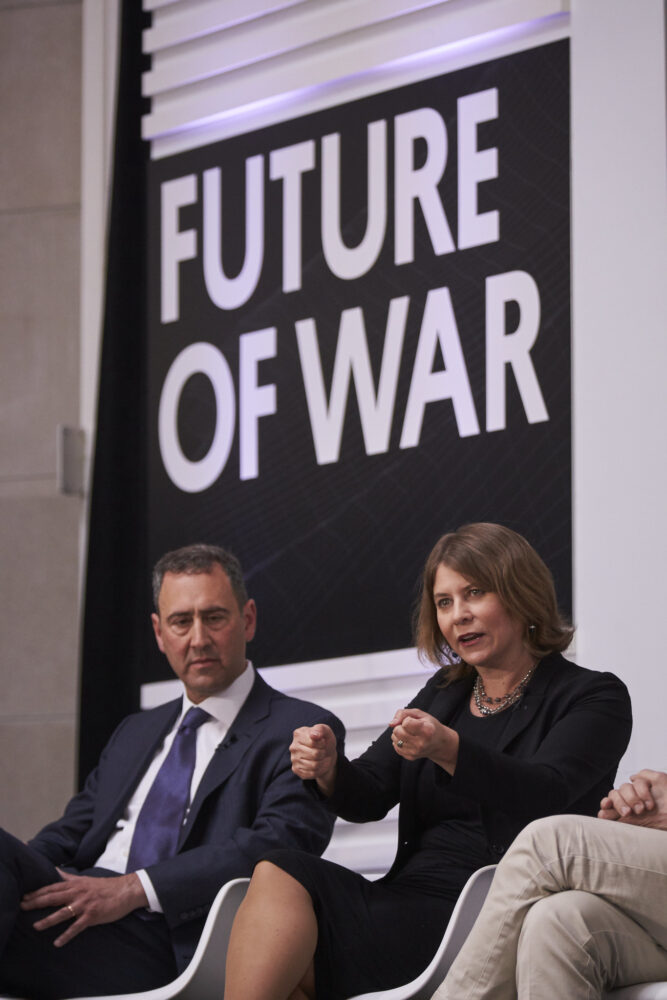
Rosa Brooks, in 2018, during a New America conference. (New America, Flickr, CC BY 2.0)
So, it has been easy to arouse near panic in the Washington Establishment and beyond over the notion that Trump might not be dislodged by the November 2020 election. Fear is being spread less that Trump might win the election (too unthinkable to think) than that he will lose the election but refuse to budge. This possibility received a big boost from a unique social event organized by Professor Rosa Brooks of Georgetown University, a leading champion of women’s participation in the National Security State, and historian Nils Gilman, a head researcher at the Berggruen Institute.
This well-connected pair easily enlisted dozens of power pointers to take part in what The Boston Globe called “a Washington version of Dungeons and Dragons,” on the model of Pentagon planners who form teams to imagine what the U.S. and Russia might do in a nuclear war confrontation. They named their fun and games the Transition Integrity Project (TIP), clearly suggesting that the “integrity” of the anticipated transition from Trump to Biden was their main concern.
Only a few of the 67 participants have been identified: anti-Trump Republican Michael Steele, former President Bill Clinton’s White House Chief of Staff John Podesta, David Frum (ghost writer of President George W. Bush’s “Axis of Evil” speech), and neoconservative political analyst William Kristol.
On Aug. 3, the Transition Integrity Project issued its report, entitled “Preventing a Disrupted Presidential Election and Transition.” This report gave the results of the make-believe gaming scenarios, which provided imaginary support to the growing liberal Democratic hypothesis that Trump is determined to steal the November election.
“Like many authoritarian leaders, President Trump has begun to lay the groundwork for potentially ignoring or disrupting the voting process, by claiming, for instance, that any mail-in ballots will be fraudulent and that his opponents will seek to have non-citizens vote through fraud.” It was taken for granted throughout that Trump’s fears and accusations are fake whereas his opponents’ fears and accusations are soundly based.
The Transition Integrity Project report made a feeble attempt to appear neutral: “TIP takes no position on how Americans should cast their votes, or on the likely winner of the upcoming election; either party could prevail at the polls in November without resorting to ‘dirty tricks’” — a neutrality consistently violated by the entire exercise.
The exercise comprised four scenarios: (1) an ambiguous voting result, (2) clear victory by the Democratic challenger, former Vice President Joe Biden, (3) clear Trump win, (4) narrow Biden win. The game was played by teams, primarily “Team Biden” and “Team Trump,” but it is pretty clear that none of the players were pro-Trump, including the players on “Team Trump.” But the games claimed to show how Trump supporters would react in these circumstances.
- “Team Trump was consistently more ruthless than Team Biden — more willing to ignore existing democratic norms, to make use of disinformation, to deploy federal agencies to promote Trump’s personal and electoral interests, and to engage in intimidation campaigns.”
But “Team Biden” was much nicer:
- “Team Biden generally felt constrained by a commitment to norms and a desire to tamp down violence and reduce instability.”
- “Team Biden often had the majority of the public on its side, and the ability to mobilize resentment about the structural disenfranchisement in the way we conduct presidential elections.”
Russiagate intruded into the gaming in an odd and even ludicrous way: “There was quite a bit of speculation that Trump might […] attempt to rally nationalist feelings to himself, or placate foreign leaders to whom he may feel beholden, such as Vladimir Putin.” Huh?
Nobody Dares Lose
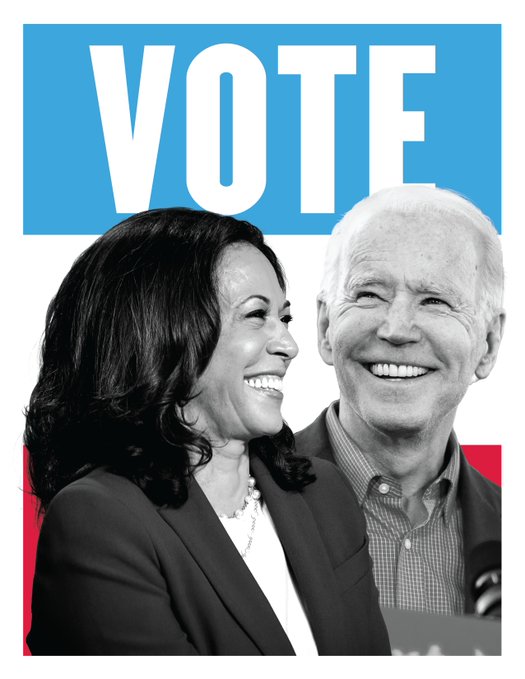
Campaign image of Kamala Harris and Joe Biden. (2020DemConvention, Twitter)
A particularly alarming and disturbingly credible assumption of the Transition Integrity Project game is that in this election, neither side is prepared to accept defeat. The scenario exercises “revealed that for many Democrats and key Democratic constituencies, this election represents an existential crisis, the last chance to stop a rapid and potentially irreversible U.S. decline into authoritarianism and unbridled nativism.” So, as much as Trump, many Democrats are ready to stop at nothing to win this election – for the best of reasons, of course.
Trump is depicted as equally desperate to win in order to avoid being treated as a criminal. An underlying assumption of this story-telling is that once out of office, Trump will be arrested and tried for unspecified crimes. This would indeed be an incentive for him not to lose.
At this point, it is necessary to recall that democratic election of national leaders depends on a degree of mutual trust that is being lost in America. The United States regularly insists that all foreign countries should elect their leaders by “fair and free elections.” But there are many countries where, at some time of their historical development, this method is not advisable because one party, or tribe, fears for its very life if a rival party, or tribe, should take power.
In such states, peace depends on the rule of a king, a mediator, a dictator. The United States can currently be seen to be regressing to just such a degree of mutual hatred and distrust.
No Compromise
It seems to me that if the Democratic Establishment gave priority to a peaceful election and transition, against the possibility that Trump might reject the results, the smart and reasonable thing to do would be to reassure him on the two counts which they suggest might incite him to balk: postal vote fraud accusations and the threat of criminal charges against him.
As to the latter: “Participants in the scenario exercises universally believed that self-preservation for President Trump and his family will be Trump’s first and possibly only priority if he is forced to concede electoral defeat.” So, it is a bit odd that the Transition Integrity Project goes on to report that: “During several of the TIP exercises, Team Biden attempted to enter into negotiations with Team Trump about a pardon and graceful transition, but those overtures were consistently rejected.”
Since there were no Trump supporters on either team, these game results merely reflect the intention of the Democratic Establishment to assume that Trump will be charged with “state crimes,” as yet unspecified. No compromise deal is desired.
As for postal balloting, it should be conceivable that Trump’s misgivings are justified. Trump is not against absentee ballots, which require identification of the voter, comparable to going to the polls, but is suspicious of mass mailings of ballots back and forth.
In an age when anyone can photocopy any document, when mails are slow and when there are many ways in which ballots might be destroyed, such misgivings are not far-fetched. Indeed, in the course of Game No. 1, “a rogue individual destroyed a large number of ballots believed to have supported Biden.” Why could the gamers imagine Biden ballots being destroyed, but rule out destruction of ballots supporting Trump?

2000 presidential election recount underway in Palm Beach County, Florida, Nov. 18, 2000. (Dtobias, CC BY-SA 3.0, Wikimedia Commons)
For the sake of domestic peace, why not try to find a compromise? Democratic vice-presidential candidate Sen. Kamala Harris (D-CA) has introduced legislation to generalize postal balloting. Why not, instead, extend polling time, opening polls not only on the second Tuesday in November but on the preceding Saturday and Sunday? This would provide time to allow voters afraid of Covid-19 to keep distances from each other, as they do when they go to the supermarket. It would reduce the number of absentee ballots, the time needed for counting and above all the suspicions attached to postal voting. But the more wary Trump is of postal voting, the more Democrats insist on making it universal.
It becomes clearer and clearer that hatred of Trump has reached such a pitch, that for the Democratic Establishment and its hangers-on, defeating Trump at the polls is not enough. They are practically inciting him to contest the election. Then they can have something more exciting and decisive: a genuine regime change.
Preparing for Regime Change
The classic regime change scenario involves a contested election, mass street demonstrations including civil disobedience and finally, military intervention.
So, to start with, the gamers posit an authoritarian leader who won’t step down. That’s Trump.
Next, “a show of numbers in the streets – and actions in the streets – may be decisive factors in determining what the public perceives as a just and legitimate outcome.” In an interview
stressing “the flaws in our electoral system,” Transition Integrity Project organizer Gilman said that what we need “is for people to be prepared to take to the streets in nonviolent protest” if appeals to officials do not suffice.
“We’ve learned over the last couple of months, since the Movement for Black Lives protest really took off again in the wake of George Floyd’s murder, that taking to the streets and showing commitment to a democratic process beyond just the ballot box is a really important part of driving change.” The demonstrations must be nonviolent, Gilman stressed.
As the Transition Integrity Project report put it, “the scale of recent demonstrations has increased the stakes for the Democratic Party to build strong ties with grassroots organizations and be responsive to the movement’s demands.” Certain of these grassroots organizations – MoveOn and Black Lives Matter – have enjoyed financial support from Soros, as the Democratic Party clearly tries to co-opt the protests.

George Soros. (georgesoros.com)
According to the scenarios, such protests could arise not only in case Trump refused to recognize a Biden win, but also, in Game No. 3, in case of a “comfortable Electoral College victory for President Trump (286-to-252) but also a significant popular vote win (52 percent for Trump, 47 percent for Biden). The game play ended in a constitutional crisis, with threats of secession, and the potential for either a decline into authoritarianism or a radically revamped set of democratic rules that ensure the popular will prevails (abolishment of the Electoral College…)”
The Biden campaign retracted its initial concession, capitalizing “on the public’s outrage that for the third time in 20 years a candidate lost the popular vote but won the Electoral College.” The Biden campaign encouraged California, Oregon and Washington to secede “unless Congressional Republicans agreed to a set of structural reforms to fix our democratic system to ensure majority rule.” Congress supported Biden. “It was unclear what the military would do in this situation”.
In reality, Democrats know that they have managed to keep the Permanent State, including the military and intelligence agencies, on their side throughout Trump’s presidency. Where are the forces that could carry out a pro-Trump coup d’état?
Whose Coup?
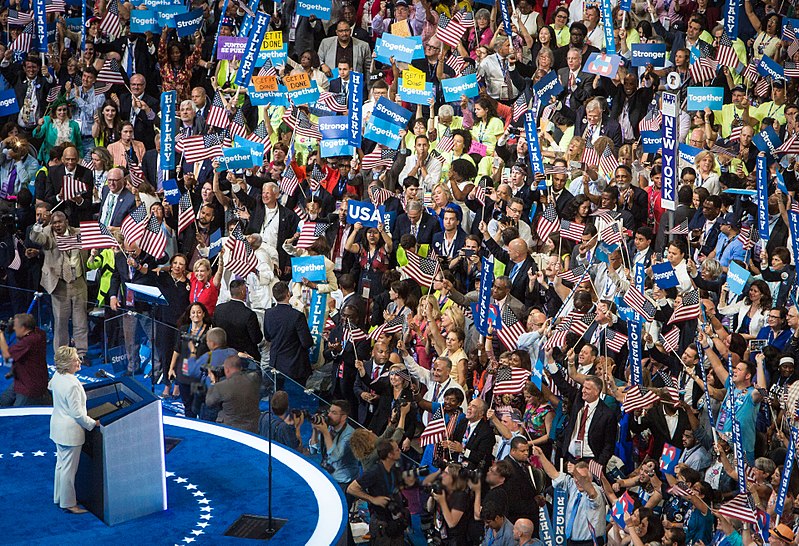
Hillary Clinton addressing Democratic convention, July 2016. (Gage Skidmore, Flickr)
“During the exercises,” the report notes, “winning ‘the narrative’ emerged as a potentially decisive factor. Either side can expand or contract the ‘margin of contestation’ if they succeed in substantially changing how key decision makers and the public view the ‘facts,’ the risks of action or inaction, or external events such as civil unrest.”
Winning the narrative appears to be a main purpose of the Transition Integrity Project, and it was quickly seconded in its efforts by top Democrats.
“Joe Biden should not concede under any circumstances because I think this is going to drag out, and eventually I do believe he will win if we don’t give an inch and if we are as focused and relentless as the other side is,” Hillary Clinton said in an interview on Aug. 25.
A couple of days later, Al Gore, the former vice president and unsuccessful 2000 Democratic presidential candidate, chimed in. Trump, he said in a particularly loaded image, is “attempting to put his knee on the neck of democracy” by criticizing mail-in ballots. “He seems to have no compunctions at all about trying to rip apart the social fabric and the political equilibrium of the American people, and he’s strategically planting doubts in advance.”
People ask whether Trump will leave office next Jan. 20. “Well,” said Gore, “it doesn’t matter because it’s not up to him. Because at noon on January 20th, if a new president is elected… the police force, the Secret Service, the military, all of the executive branch officers, will respond to the command and the direction of the new president.”
The Bottom Line

Outside the World Economic Forum Annual Meeting 2020 in Davos-Klosters, Switzerland, Jan. 24. (World Economic Forum, Mattias Nutt, CC BY-NC-SA 2.0)
Meanwhile, Americans can listen to the extravagant rhetoric of the two enemy camps, calling on them to choose between “authoritarian white supremacy” and “radical Marxist socialism” while offering absolutely nothing in terms of coherent public policy of benefit to the American people and the world. The politicians cling to ineffective office, while the future is being planned elsewhere.
Policy will be designed by the Global Governors, for instance at the next meeting in Davos of the World Economic Forum which, according to its founder and chairman Klaus Schwab, will lay out the “Great Reset” agenda for the Fourth Industrial Revolution that is destined to reshape all our lives. Nicolas Berggruen will be there with his ideas. So will other billionaires.
They will not be “conspiring,” but rather laying plans for what they consider best for the world. There is no political system enabling us to influence or even fully understand the projects they will sponsor. Surely these projects deserve to be sharply debated. But the politicians supposedly representing us are somewhere else, fighting furiously with each other over contrived issues.
The Electoral College is not the most fatal flaw in American democracy. Rather, it’s the monopoly of political discourse by a two-party system fueled essentially by personal ambition, taking its cues from lobbies, the military industrial complex, Wall Street and the Global Governors.
Diana Johnstone lives in Paris. Her latest book is Circle in the Darkness: Memoirs of a World Watcher (Clarity Press, 2020).
Venezuelan Special Forces Agents Arrested for Extrajudicial Killings
By Manuela Solé | Venezuelanalysis | August 26, 2020
Mérida – Four agents of the Bolivarian National Police’s Special Action Forces (FAES) have been arrested after the extrajudicial executions of two journalists in Cabimas, Zulia State.
Venezuela’s Attorney General Tarek William Saab informed on Tuesday that FAES officers Jose Contreras and Nestor Olano, who have been charged with premeditated murder, as well as supervisors Freddy Deroy and Deivid Guerrero were in custody.
Four other officers involved in the Friday, August 21 operation reportedly fled after arrest warrants were issued. Public attorney Jackbe Galban was removed from her post and arrested for allegedly collaborating in their escape.
Andres Eloy Nieves Zacarias and Victor Manuel Torres Guerra, 33 and 29 years-old, respectively, were assassinated in a FAES raid on Guacamaya TV, a community media outlet in Zulia State where they worked.
Saab referred to the event as “embarrassing” and decried that FAES agents tried to cover up the extrajudicial killings as an armed confrontation.
“For me, these are infiltrated officers who need to be singled out so this never happens again in a police body,” the attorney general told reporters.
The events were initially investigated by a FAES commission that traveled to Cabimas to take statements from each of the officers participating in the operation.
Saab’s office reported that examinations and autopsy logs showed that the victims were below their shooters, on their knees or sitting, which confirmed the execution hypothesis.
The FAES agents were also accused of stealing the TV station’s equipment after the executions.
Interior Minister Nestor Reverol called the procedure an “irregular act” and appointed a multidisciplinary team to carry out an investigation.
“In any situation that constitutes a deviation from the established procedures and protocols, we will be ruthless in the enforcement of the law,” read the official statement issued by the Interior Ministry.
The executions, as well as FAES attempts to present the victims as criminals to the media, have been condemned from various sectors. Several popular and community media outlets, militants of the youth fraction of the United Socialist Party of Venezuela and the Francisco de Miranda Front all released communiques, while a hashtag #JusticiaParaAndresYVictor (“Justice for Andres and Victor”) became a trend on social media.
The Inter American Press Society and the International Press Institute likewise made public their condemnation, calling on Venezuelan authorities to thoroughly investigate the killings.
The founder of Guacamaya TV, Franklin Torres, who is also the father of Victor Torres, said that the two journalists were dragged out of the offices by the FAES and ‘vilely murdered’. He went on to claim that the information released about the murder was false and that the weapons allegedly found at headquarters were planted by FAES agents.
“For our murdered kids, we will not rest until justice is served,” read a statement released by the Torres family on Wednesday. The relatives praised the quick response of the Attorney General’s office and demanded a thorough investigation up the Bolivarian National Police’s chain of command.
Nieves and Torres were described by those who knew them as honest workers who were deeply involved with their community. Nieves was also a member of the Francisco de Miranda Front. Tributes painted him as a dedicated Chavista who stood up for just causes and a popular member of the community media scene in Venezuela.
Popular movements have recognized authorities’ response in this case, but the reported increase in heavy handed police tactics and the FAES in particular have been subjects of intense debate. Chavista human rights collective Surgentes launched a campaign in November 2019 to denounce a growing number of police extrajudicial killings in popular neighborhoods and bring back a debate on police reform initiated by former President Hugo Chávez.
Edited and with additional reporting by Ricardo Vaz from Mérida.
YouTube Shuts Down New Channels from Venezuela and Cuba
teleSUR | August 21, 2020
Without prior notice, YouTube Thursday removed three Venezuelan channels and two Cuban channels from its platform.
“We were loading to the platform not only live transmissions but also our complete programs. There is no clear explanation for this action,” said Barry Cartaya, a presenter of Venezolana de Television (VTV), a state-run television station based in Caracas.
“This page isn’t available. Sorry about that. Try searching for something else,” is the message popping up when the people try to access VTV channels.YouTube eliminated over 68,000 videos that the Venezuelan media stored in this platform since2011.
The VTV channels affected by the U.S. company are Multimedio VTV (314,000 subscribers), VTV Programs (87,000 subscribers), and VTV Signal Live, which allowed journalists and correspondents to directly post their productions to inform the public.
In Cuba, outlet Cubadebate also denounced the closure of two Youtube channels, namely, Mesa Redonda (19,700 subscribers) and Cubavision Internacional (8,200 subscribers).
Local analysts consider YouTube’s decisions might be related to the sanctions President Donald Trump is applying against individuals, companies, and institutions of both countries.
According to YouTube’s own rules, a channel can be closed when it has committed three serious offenses during a certain period. In the cases of the Venezuelan and Cuban channels, however, these offenses did not exist.
RFK Jr. Sues Facebook, Zuckerberg and So-Called ‘Fact-Checkers’ for Vaccine Censorship
Children’s Health Defense | August 18, 2020
Washington, DC — Children’s Health Defense (CHD) filed a lawsuit on Monday in San Francisco Federal Court charging Facebook, Mark Zuckerberg, and three fact-checking outfits with censoring truthful public health posts and for fraudulently misrepresenting and defaming CHD. CHD is a non-profit watchdog group that roots out corruption in federal agencies, including Centers for Disease Control and Prevention (CDC), the World Health Organization (WHO), and the Federal Communications Commission (FCC), and exposes wrongdoings in the Pharmaceutical and Telecom industries. CHD has been a frequent critic of WiFi and 5G Network safety and of certain vaccine policies that CHD claims put Big Pharma profits ahead of public health. CHD has fiercely criticized agency corruption at WHO, CDC and FCC.
According to CHD’s Complaint, Facebook has insidious conflicts with the Pharmaceutical industry and its captive health agencies and has economic stakes in telecom and 5G. Facebook currently censors CHD’s page, targeting its purge against factual information about vaccines, 5G and public health agencies.
Facebook acknowledges that it coordinates its censorship campaign with the WHO and the CDC. While earlier court decisions have upheld Facebook’s right to censor its pages, CHD argues that Facebook’s pervasive government collaborations make its censorship of CHD a First Amendment violation. The government’s role in Facebook’s censorship goes deeper than its close coordination with CDC and WHO. The Facebook censorship began at the suggestion of powerful Democratic Congressman and Intelligence Committee Chairman Representative Adam Schiff, who in March 2019 asked Facebook to suppress and purge internet content critical of government vaccine policies. Facebook and Schiff use the term “misinformation” as a euphemism for any statement, whether truthful or not, that contradicts official government pronouncements. The WHO issued a press release commending Facebook for coordinating its ongoing censorship campaign with public health officials. That same day, Facebook published a “warning label” on CHD’s page, which implies that CHD’s content is inaccurate, and directs CHD followers to turn to the CDC for “reliable, up to date information.” This is an important First Amendment case that tests the boundaries of government authority to openly censor unwanted critique of government
Attorneys Robert F. Kennedy, Jr., Roger Teich, and Mary Holland represent Children’s Health Defense in the litigation.
The lawsuit also challenges Facebook’s use of so-called “independent fact-checkers” – which, in truth, are neither independent nor fact-based – to create oppositional content on CHD’s page, literally superimposed over CHD’s original content, about open matters of scientific controversy. To further silence CHD’s dissent against important government policies and its critique of Pharmaceutical products, Facebook deactivated CHD’s donate button, and uses a variety of deceptive technology (i.e. shadow banning) to minimize the reach and visibility of CHD’s content. In short, Facebook and the government colluded to silence CHD and its followers. Such tactics are fundamentally at odds with the First Amendment, which guarantees the American public the benefits to democracy from free flow of information in the marketplace of ideas. It forbids the government from censoring private speech—particularly speech that criticizes government policies or officials. As Justice Holmes famously said, “the best test of truth is the power of the thought to get itself accepted in the competition of the market.” The current COVID pandemic makes the need for open and fierce public debate on health issues more critical than ever.
Mark Zuckerberg publicly claims that social media platforms shouldn’t be “the arbiters of truth.” This case exposes Zuckerberg for working with the government to suppress and purge unwanted critiques of government officials and policies.
The court will decide whether Facebook’s new government-directed business model of false and misleading “warning labels,” deceptive “fact-checks,” and disabling a non-profit’s donate button, passes muster under the First and Fifth Amendments, the Lanham Act, and RICO. Those statutes protect CHD against online wire-fraud, false disparagement, and knowingly false statements.
CHD asks the Court to declare Facebook’s actions unconstitutional and fraudulent, and award injunctive relief and damages.
Twitter ‘accidentally’ suspends satirical site Babylon Bee after it mocked Kamala Harris and USPS conspiracies
RT | August 17, 2020
Twitter suspended the account of parody news site The Babylon Bee after it mocked Democrat VP candidate Kamala Harris and ‘mail vote suppression’ conspiracies. It was shortly restored amid protests about censorship.
The Bee went dark around 6 pm on Monday. Archives showed that their last tweet was a story about President Donald Trump “riding around in an SUV” smashing mailboxes “to make it impossible for people to mail in their ballots.”
The tweet before that one was about Harris proposing a “housing plan” where “everybody gets free 10’x10’ room and three meals a day” – a clear reference to prison, as Harris had been a prosecutor before getting elected to the Senate.
One conservative commentator pointed out that Twitter spokesman Nick Pacilio was previously the press secretary for Harris’s abortive presidential campaign.
The publication’s editor in chief Kyle Mann shared a screenshot of the email from Twitter, telling him the account was suspended for “violating rules against platform manipulation and spam.”
According to Twitter’s own rules, behavior that “that manipulates or disrupts people’s experience” is out of bounds. The company defines manipulation as “using Twitter to engage in bulk, aggressive, or deceptive activity that misleads others and/or disrupts their experience.”
Before anyone could figure out if that covers censorship of satire, however, the Bee’s account was back up – only with a greatly diminished follower count. The publication was free to share its latest story, about how the Democrats have reversed their position on the USPS after Trump had his face put on all stamps.
The Bee’s stinging mockery of mainstream media news coverage has made it a lot of enemies over the years, including CNN and the “fact checkers” at Snopes, who argued that Americans are too stupid to realize this kind of content is satire.
Mann and the Bee’s defenders have countered that the site clearly labels stories as satire. If the mainstream media reporting has become so ridiculous that the audience can’t tell it apart from ridicule, that’s not the Bee’s problem but their own, they say.
In a message to another Bee editor, Twitter said the account was “flagged as spam by mistake” by “systems” tasked with doing that, without specifying whether it was a computer algorithm or a person that made the call.
Managing the Narrative
Corporations and government use internet to control information

By Philip Giraldi • Unz Review • August 18, 2020
Some Americans continue to believe that when they go to the internet they will get a free flow of useful information that will guide them in making decisions or coming to conclusions about the state of the world. That conceit might have been true to an extent twenty years ago, but the growth and consolidation of corporate information management firms has instead limited access to material that it does not approve of, thereby successfully shaping the political and economic environment to conform with their own interests. Facebook, Google and other news and social networking sites now all have advisory panels that are authorized to ban content and limit access by members. This de facto censorship is particularly evident when using the internet information “search” sites themselves, a “service” that is dominated by Google. Ron Unz has observed how when the CEO of Google Sundar Pichai faced congressional scrutiny on July 29th together with other high-tech executives, the questioning was hardly rigorous and no one even asked how the sites are regulated to promote certain information that is approved of while suppressing views or sources that are considered to be undesirable.
The “information” sites generally get a free pass from government scrutiny because they are useful to those who run the country from Washington and Wall Street. That the internet is a national security issue was clearly demonstrated when the Barack Obama Administration sought to develop a switch that could be used to “kill it” in the event of a national crisis. No politician or corporate chief executive wants to get on the bad side of Big Tech and find his or her name largely eliminated from online searches, or, alternatively, coming up all too frequently with negative connotations.
Google, for example, ranks the information that it displays so it can favor certain points of view and dismiss others. Generally speaking, progressive sites are favored and conservative sites are relegated to the bottom of the search with the expectation that they will not be visited. In late July, investigative journalists noted that Google was apparently testing its technical ability to blacklist conservative media on its search engine which processes more than 3.5 billion online searches every day, comprising 94 percent of internet searching. Sites targeted and made to effectively disappear from results included NewsBusters, the Washington Free Beacon, The Blaze, Townhall, The Daily Wire, PragerU, LifeNews, Project Veritas, Judicial Watch, The Resurgent, Breitbart, Drudge, Unz, the Media Research Center and CNSNews. All the sites affected are considered to be politically conservative and no progressive or liberal sites were included.
One has to suspect that the tech companies like Google are working hand-in-hand with some regulators within the Trump administration to “purge” the internet, primarily by removing foreign competition both in hardware and software from countries like China. This will give the ostensibly U.S. companies monopoly status and will also allow the government to have sufficient leverage to control the message. If this process continues, the internet itself will become nationally or regionally controlled and will inevitably cease to be a vehicle for free exchange of views. Recent steps taken by the U.S. to block Huawei 5G technology and also force the sale of sites like TikTok have been explained as “national security” issues, but they are more likely designed to control aspects of the internet.
Washington is also again beating the familiar drum that Russia is interfering in American politics, with an eye on the upcoming election. Last week saw the released of a 77 page report produced by the State Department’s Global Engagement Center (GEC) on Russian internet based news and opinion sources that allegedly are guilty of spreading disinformation and propaganda on behalf of the Kremlin. It is entitled “Understanding Russia’s Disinformation and Propaganda Ecosystem” and has a lead paragraph asserting that “Russia’s disinformation and propaganda ecosystem is the collection of official, proxy, and unattributed communication channels and platforms that Russia uses to create and amplify false narratives.”
Perhaps not surprisingly, The New York Times is hot on the trail of Russian malfeasance, describing the report and its conclusions in a lengthy article “State Dept. Traces Russian Disinformation Links” that appeared on August 5th.
The government report identifies a number of online sites that it claims are actively involved in the “disinformation” effort. The Times article focuses on one site in particular, describing how “The report states that the Strategic Culture Foundation [website] is directed by Russia’s foreign intelligence service, the S.V.R., and stands as ‘a prime example of longstanding Russian tactics to conceal direct state involvement in disinformation and propaganda outlets.’ The organization publishes a wide variety of fringe voices and conspiracy theories in English, while trying to obscure its Russian government sponsorship.” It also quotes Lea Gabrielle, the GEC Director, who explained that “The Kremlin bears direct responsibility for cultivating these tactics and platforms as part of its approach of using information and disinformation as a weapon.”
As Russia has been falsely accused of supporting the election of Donald Trump in 2016 and the existence of alternative news sites funded wholly or in part by a foreign government is not ipso facto an act of war, it is interesting to note the “evidence” that The Times provides based on its own investigation to suggest that Moscow is about to disrupt the upcoming election. It is: “Absent from the report is any mention of how one of the writers for the Strategic Culture Foundation weighed in this spring on a Democratic primary race in New York. The writer, Michael Averko, published articles on the foundation’s website and in a local publication in Westchester County, N.Y., attacking Evelyn N. Farkas, a former Obama administration official who was running for Congress. In recent weeks, the F.B.I. questioned Mr. Averko about the Strategic Culture Foundation and its ties to Russia. While those attacks did not have a decisive effect on the election, they showed Moscow’s continuing efforts to influence votes in the United States…”
Excuse me, but someone writing for an alternative website with relatively low readership criticizing a candidate for congress does not equate to the Kremlin’s interfering in an American election. Also, the claim that the Strategic Culture Foundation is a disinformation mechanism is overwrought. Yes, the site is located in Moscow and it may have some government support but it features numerous American and European contributors in addition to Russians. I have been writing for the site for nearly three years and I know many of the other Americans who also do so. We are generally speaking antiwar and often critical of U.S. foreign policy but the contributors include conservatives like myself, libertarians and progressives and we write on all kinds of subjects.
And here is the interesting part: not one of us has ever been told what to write. Not one of us has ever even had a suggestion coming from Moscow on a good topic for an article. Not one of us has ever had an article or headline changed or altered by an editor. Putting on my ex-intelligence officer hat for a moment, that is no way to run an influencing or disinformation operation intended to subvert an election. Sure, Russia has a point of view on the upcoming election and its managed media outlets will reflect that bias but the sweeping allegations are nonsense, particularly in an election that will include billions of dollars in real disinformation coming from the Democratic and Republican parties.
Putting together what you no longer can find when you search the internet with government attempts to suppress alternative news sites one has to conclude that we Americans are in the middle of an information war. Who controls the narrative controls the people, or so it seems. It is a dangerous development, particularly at a time when no one knows whom to trust and what to believe. How it will play out between now and the November election is anyone’s guess.
Philip M. Giraldi, Ph.D., is Executive Director of the Council for the National Interest, a 501(c)3 tax deductible educational foundation (Federal ID Number #52-1739023) that seeks a more interests-based U.S. foreign policy in the Middle East. Website is https://councilforthenationalinterest.org, address is P.O. Box 2157, Purcellville VA 20134 and its email is inform@cnionline.org.
Beijing ‘will retaliate’ as no Chinese journalist in US has been granted visa extension since May 8
RT | August 17, 2020
Washington should immediately correct its mistake and stop persisting with escalation against Chinese journalists working in the United States, Beijing has warned.
No Chinese journalist in the US has been granted a visa extension since Washington limited their stay to 90 days, with an option to extend, on May 8, Chinese Foreign Ministry spokesman Zhao Lijian told reporters on Monday.
China will take a necessary and legitimate response to safeguard its rights, Zhao said, commenting on Washington’s “wrong actions.” It was not immediately clear what retaliation China might consider.
The spokesman cited “the Cold War mentality and ideological biases” while saying that Washington’s actions have seriously interrupted Chinese journalists reporting in the US, harmed the Chinese media’s reputation and normal people-to-people exchange.
The Trump administration announced in February that it would begin treating five major Chinese state-run media entities with US operations the same as foreign embassies. The next month, the number of Chinese journalists allowed to work at the US offices of Chinese media was slashed from 160 to 100.
In June, the US State Department added four more Chinese media outlets to those it treats as foreign embassies.
In response, China has revoked the press credentials for American journalists from three newspapers.
Some Chinese analysts have urged Beijing to impose visa restrictions on American journalists in the Hong Kong Special Administrative Region as part of countermeasures.
Mail-in Voting Leaves Window for ‘Significant Fraud’ & ‘Logistical Challenges’, Observers Say
By Aleksandra Serebriakova – Sputnik – 16.08.2020
Election officials in nearly all US states were warned by the US Postal Service officials back in July about possible delays resulting from voting via mail-in ballots , according to documents published last week. More American states are now moving to either introduce universal vote-by-mail or ease restrictions associated with absentee voting.
US President Donald Trump reiterated his harsh remarks on Saturday towards the universal mail-in-voting system that has been introduced in nine American states now, with California, Vermont, New Jersey and Nevada, recently joining the ranks.
For the president, who indicated his support for “absentee balloting”, which requires a request for a ballot in advance, the universal mail-in ballot system, where ballots are sent to all registered voters automatically, looked “catastrophic”.
“It’s going to make our country a laughing stock all over the world”, the president said on Saturday.His comments come following the news that the US Postal Service (USPS) previously warned election officials in 46 American states, including those in such heated battlegrounds as Pennsylvania, Florida and Michigan, that there were risks that not all of the ballots would be delivered to the office on time for Election Day. But several other American states are also now mulling the possibility of resorting to this system in the midst of the coronavirus pandemic.
“Yes, mail-in-voting does pose new logistical challenges for election offices that previously dealt with few mail ballots”, says Anthony Fowler, a political scientist from the University of Chicago.
Fowler recognizes the clear advantages the postal voting presents to those willing to safely cast their vote during the health crisis, but still believes that there are some instances of fraudulent behavior that are associated with it:
“Mail voting raises the possibility that the person who filled out the ballot is not who they say they are or that the person who filled out the ballot was coerced in some way”, he explains.
An analysis of the risks associated with postal voting should be carried out without the “distraction” associated with the endless Trump-versus-Democrats debate, says Brian Gaines, an elections expert with the University of Illinois.
“Ballots filled out away from the security and privacy of a booth at an official polling station are inherently less secure”, he believes. “They are more subject to coercion, and they are more prone to be ‘lost’ without being properly processed”.
“The more steps there are in the voting process, the more occasions for error”, the election expert notes, comparing procedures surrounding mail-in voting to those when a person simply goes to a polling station.
However, Gaines says that’s not the only issue.
“Beyond errors and coercion, there are more opportunities for fraud when ballots are away from polling stations and effort is required to get them back to the vote counters”, he explains. “Most states do not allow so-called ‘third parties’ to collect absentee ballots (‘bundle’ or ‘harvest’ them), but some do”.
It is the campaign, church or some other organizations collecting ballots for delivery that can potentially intervene in the election process, Gaines explains, as they can “selectively discard ballots on the basis of guesses about how people might be voting, or can tamper with the ballots”.
“None of this means that vote-by-mail is a source of ‘massive’ fraud or error, but I think that, partisan politics apart, it is plainly more vulnerable to fraud and mistakes than in-person voting”, the expert adds.
“In most elections, fraud and error are negligible or marginal, but in a very close election, they can be decisive. This time, with many more states pushing voters to vote by mail, there may be a bit more confusion and maybe a bit more small-scale fraud”, Gaines concludes.
With the USPS delivery systems being overloaded with “millions of ballots” in the course of the November election, logistics indeed becomes “an enormous issue”, says Mitchell Feierstein, CEO of the Glacier Environmental Fund Limited.
“It is highly probable that there be significant fraud with the mail-in ballots”, the hedge-fund manager argues.
Following the news from the US postal authorities that they cannot guarantee that all the mail-in ballots would arrive on time, protesters gathered outside the house of USPS Postmaster General Louis Dejoy, demanding his resignation. But according to Feierstein, “no matter what happens, the result of the 2020 election will not be accepted by one side”.
Lebanon’s Hariri demands freedom to form upcoming government
MEMO | August 14, 2020
Lebanon’s former Prime Minister Saad Hariri demanded freedom to select his own cabinet ministers to become the country’s prime minister for a third term, Lebanese Al-Akhbar newspaper reported.
According to the paper, Hariri has demanded that all Lebanese forces grant him freedom to select his ministers, noting that his only external concern is to obtain the approval of Saudi Arabia which he has not yet received.
France has given its support for Hariri to become prime minister for a third time, but Paris wants a general consensus on his candidacy.
However, senior sources in the Free Patriotic Movement party, founded by Lebanese President Michel Aoun, stressed that experience has shown that Saad Hariri is neither a reformist nor productive.
The paper quoted unnamed sources as saying that Aoun is also not enthusiastic about naming Hariri as prime minister.
According to the sources, Hariri is not in a position to set conditions, but is rather someone to set conditions for.
Last week, Lebanese Prime Minister, Hassan Diab, resigned in the aftermath of a massive explosion that hit Beirut port killing nearly 200 people and wounding more than 6,000 others.
Colombia: Army Kills Two Indigenous People in Cauca Valley
teleSUR | August 14, 2020
Colombia’s Army Thursday killed two Indigenous people and injured two community members during an eviction operation in El Berraco village in the Cauca department.
The victims are the Indigenous journalists Abelardo Liz and Johel Rivera, who were part of the “Liberation of Mother Earth” movement.
The Foundation for the Freedom of the Press (FLIP) regretted the death of both journalists, who were shot while covering the Army’s eviction in Corinto.
The Indigenous City Halls of Cauca Association (ACIN) reported that former Governor Julio Tumbo was seriously wounded. His bullet injuries represent a danger to life.
“Officers of the Mobile Anti-Riot Squad (ESMAD) and the Army shot at El Berraco community with firearms. The victims were hit in the chest, shoulder, abdomen, and knees,” ACIN explained.
Following a court order, Army troops evicted the people who were in the Quebrada Seca ranch.
“During the operation, members of the Public Force were injured, and the El Berraco’s Indigenous people also tried to kidnap them,” Colombia’s Army stated.
According to Cauca’s indigenous organizations, the officers prevented vehicles and health personnel from entering the ranch to assist and transfer the injured to hospitals.
“The ESMAD attacked the vehicles that were trying to help the wounded. They fired gases at the windows,” ACIN said.
The University of Cauca’s Human Rights Commission and the National Union of Students denounced the events.
“The indigenous communities cannot continue to be victims of Colombia’s systematic violence,” the organizations stated.
Trust the experts and take your pills, citizen! Meet the nerd who wants to force-feed you ‘morality pills’ to beat Covid
By Graham Dockery | RT | August 13, 2020
Swallowing mind-bending pills until you love your government and obey its orders might sound like science fiction. But there are scientists out there who want you to shut up and take your morality pills – by force if necessary.
People, or at least those with a spark of vitality and life in them, don’t like following orders. Months into the coronavirus pandemic, leaders have tried to enforce mandatory social distancing and mask wearing through a mixture of fines, snitching and public shaming. Still, some people refuse to toe the line, from lockdown protesters in the US to cheeky Brits sneaking off for an unlicensed picnic.
The scientific experts, however, have a solution for that. Take Parker Crutchfield, a professor of medical ethics. According to a recent op-ed, he thinks that the ‘ethical’ solution to this rule breaking is to drug the population into compliance, using psychoactive drugs to “induce those who are noncooperative to get on board with doing what’s best for the public good.”
That’s right. A top-of-his-field ethicist at Western Michigan University wants to drug you into cooperation. Should you refuse, he thinks the government should force this “morality booster” on everyone, either by military power, or by administering it in secret, “perhaps via the water supply.”
Crutchfield’s article was retweeted – and later deleted – by the prestigious Johns Hopkins Berman Institute of Bioethics. However, he isn’t the only labcoat who dreams of drugging the proletariat. Late last month, a group of Cambridge academics suggested adding lithium to drinking water to lower suicide rates and mood disorders. Just like Crutchfield, they see this tyranny as serving the greater good.
Strongmen and dictators are reliable bogeymen in the West. After all, the entire origin story of Western liberalism centers around the struggle of the free world against the fascist axis. However, the tyranny of the nerd more often than not goes unnoticed. In some ways, it’s more terrifying than the tyranny of the dictator. When the despot forces you to obey his diktats at gunpoint, the power dynamic is clear. He’s in control. When the bespectacled professor slips morality pills into your water, you won’t even know you’re being dominated.
Throughout the coronavirus pandemic, we’ve repeatedly heard the same refrains from our leaders. “Trust the experts,” they say. “Believe the science.” But scientists – who worship amoral empiricism above all else – see you as little more than a laboratory mouse, an imperfect specimen to be tweaked and molded until the desired result is achieved.
Perhaps that’s why these “experts” are so beloved by liberals. Jean- Jacques Rousseau considered man a “perfectible” creature, a view that would be refined in the 20th century by GWF Hegel, Karl Marx and Leo Strauss, and now underpins most left-wing thought. While religion saw man as trapped in a state of original sin, these leftists saw him as having boundless potential – if only the right scientific tools were used to shape him.
Changing behavior through science is the perfect method for modern liberalism to crush dissent. Doing so by force would invalidate its core tenet: it’s supposed respect for your human rights. Instead, its scientists dream up ways to silence malcontents quietly and peacefully.
Every now and then, an article like Crutchfield’s gives us a glimpse behind the mask.
Chemically rewiring the brains of the population seems far-fetched, but it’s a logical next step when one considers the social engineering projects foisted on the masses at present. From the endless tirades against masculinity, Christianity and the nuclear family one reads in liberal newspapers, to the bizarre push to convert the Western world to an insect-based diet, academics and their enablers in the media and government want to change your life – usually for the worse.
The latest racial conflagration tearing apart the USA has only served to give them a new angle of attack, with corporate bosses now subjecting white employees to mandatory brainwashing sessions in the name of stamping out their “whiteness.”
As easy as the transition to mass drugging would be, Crutchfield’s dream is unlikely to come true any time soon. The managers and bureaucrats who hold the levers of power lack the skill to pull off such a coup. However, remember that behind their university credentials and scientific clout lurk experts salivating at the prospect of turning you into a lab rat, and that the prototypical nerd can harbor a lust for power to rival even the most demented dictator.
Graham Dockery is an Irish journalist, commentator, and writer at RT. Previously based in Amsterdam, he wrote for DutchNews and a scatter of local and national newspapers.
Featured Video

or go to
Aletho News Archives – Video-Images
Book Review
The Maidan Killings and the False-Flag Case
By Freddie Ponton | 21st Century Wire | September 5, 2026
Before the killings that helped bring down Ukraine’s president in February 2014, American diplomats were discussing who should enter its government. In a leaked telephone call, senior State Department official Victoria Nuland told US ambassador Geoffrey Pyatt, “I think Yats is the guy,” referring to opposition leader Arseniy Yatseniuk. Washington had clear preferences and was working to advance them. Later that month, Yatseniuk became prime minister.
Ivan Katchanovski’s The Maidan Massacre in Ukraine examines the violence that preceded that transfer of power. Drawing on television footage, witness testimony, forensic examinations and Ukrainian court proceedings, he argues that elements of the opposition shot protesters and police in a false-flag operation. His case centres on evidence of protesters being shot from opposition-controlled locations, including Hotel Ukraina, overlooking the killing ground. … continue
Blog Roll
 Aletho News
- Israel expands “incitement” charge to target Palestinian education and memory
- How Israel seeks to reshape Arab classrooms
- Paris bans pro-Palestinian demonstration planned for Oct. 7 over ‘risks of public disorder’
- In August Hanning Treason Case – All Signs Point To Tel Aviv.
- France cleared dozens of military sales to Israel between May and September: Report
- France projects nuclear power as Macron pushes arsenal expansion
- The fallacy of US delusions about Iran’s economic collapse
- What changes with Lula or Flávio?
- Britain leads Western media’s demise through ‘fear porn’ narrative
- The Maidan Killings and the False-Flag Case
- If Americans Knew
- Soldier testimony sheds light on how Israel wages information war
- CIA Report Warns Israel Could Head Toward Civil War, Total Collapse
- Banker Who Exposed Howard Lutnick’s Ties to Epstein Warned of ‘Retaliation’ and ‘Personal Consequences’ in Last Post Before Suicide
- Israeli Attacks Kill Two Palestinians in Gaza
- Gaza genocide at 3: Israeli-U.S. cruelty and the smart, deep resistance to it are changing the world
- As genocide is about to enter 3rd year, little of Gaza remains– Daily Update
- “We See Our Homes Now From A Satellite, Like Strangers”
- Watch “Gaza: Doctors Under Attack”, originally censored by BBC
- NAZA: Israeli embassies in UK and US promote rival documentary to challenge Gaza genocide allegations
- David Ellison appoints Israeli to lead merged Paramount-Warner studios
- No Tricks Zone
- Latest European Green Energy Debacle; Portugal’s Largest Flagship Solar Park Insolvent!
- Green Energy Debacle: German Expert Professor Fritz Vahrenholt Warns Of Severe Economic And Social Consequences
- Two More Paleo Reconstructions Affirm Meters-Higher Sea Levels Across Ireland, Brazil 7000-6000 Years Ago
- New Study: Earth And Venus Surface Warmth Largely Explained By Convection And Lapse Rate, Not CO2 Or Radiation
- 2025 Nature Paper Claiming Worsening Global Drought Gets RETRACTED …Heavily Flawed
- New Study: ‘Global Drought Shows No Detectable Recent Acceleration Under Climate Warming’
- Economic Masterminds: German Socialists Suggest Taxing Productivity Gains Stemming From Using AI
- The South China Sea Has Not Been Cooperating With The Climate Change Narrative
- Energy Crisis: Germany Enters Heating Season With Historically Low Gas Reserve Fill Levels
- New Study: The Antarctic Ice Sheet Gained Mass From 2020-2024 Due To Staggering Snow And Ice Accumulation

