The Incredible Disappearing Country
By Helen Buyniski · July 13, 2019
Americans celebrating Independence Day last week did so amidst levels of domestic discord unprecedented in their lifetimes. With the media establishment openly scoffing not merely at the “founding fathers,” who could stand to be removed from their pedestals once in a while, but at the Declaration of Independence itself and even at the notion of declaring that independence, Americans who never thought of themselves as patriots were nevertheless placed on the defensive. One need not believe in “my country right or wrong” to bristle at the idea that said country shouldn’t exist. But would-be defenders of the American Way are finding themselves increasingly at a loss for words. What does America actually stand for now that the “freedoms” once guaranteed its citizens are rapidly fading into the rearview mirror?
we’re so jaded. except when it comes to war. we like war.
The New York Times led the parade of mainstream outlets sneering at America on its birthday, posting a sarcastic video showing the US’ poor performance against other developed countries on metrics like education and healthcare. But as usual, the Times left out the most important parts — the parts that would implicate it as guilty in the full-on plundering of the American dream. The Fourth Estate — the self-appointed watchdog of the people’s freedoms — was bribed with CIA steaks to lie down while craven opportunists dismantled the country and left a second-rate replica in its place. The Times went one better, actually aiding and abetting the neocon warmongers who lied the US into war — in Iraq, but also in Syria, Libya, and, they hope, Iran. For the Times to complain now that the country, out $6 trillion thanks to the “War on Terror” it enabled and cheered at the top of its lungs, is broke and broken, is hypocritical in the extreme.
Bill of rights, or bill of goods?
Freedom of speech, so important to the national identity it leads the Bill of Rights, has been so vilified in the media that the very notion of “defending free speech” has come to be associated with the extreme Right in establishment reporting. This is no accident, of course — truth is the first casualty of war, and anyone who speaks it has been told in no uncertain terms that they are next on that casualty list. The looming extradition of Julian Assange is a warning to all adversarial journalists and publishers that they are no longer protected by the laws that once enshrined press freedom in the country’s heart, and even those who never set foot in the US can be treated as disposable if they oppose its imperial project. The internet, once a refuge for those silenced by the bought establishment organs, has been quietly scrubbed of those same troublemakers thanks to private corporations doing the government’s dirty work. And the only group more enthusiastic about the police state than the government itself is the clique of Big Tech bandits that receive fat government contracts to enable it.
Private corporations can get away with a lot that governments can’t, even beyond the legal restrictions on the state imposed by the Bill of Rights. Thanks to “free market” orthodoxy, regulation of the private sector is considered borderline criminal, un-American even, allowing companies to do whatever they want — financially, legally and ethically. And Americans have a certain reverence for successful corporations that they have never had for their government. They were livid when they learned their government was spying on their phone calls and emails through the NSA’s StellarWind program, but when it’s Amazon doing the spying through an Alexa “smart” speaker, they not only don’t mind — they’ll pay $100 for the privilege.
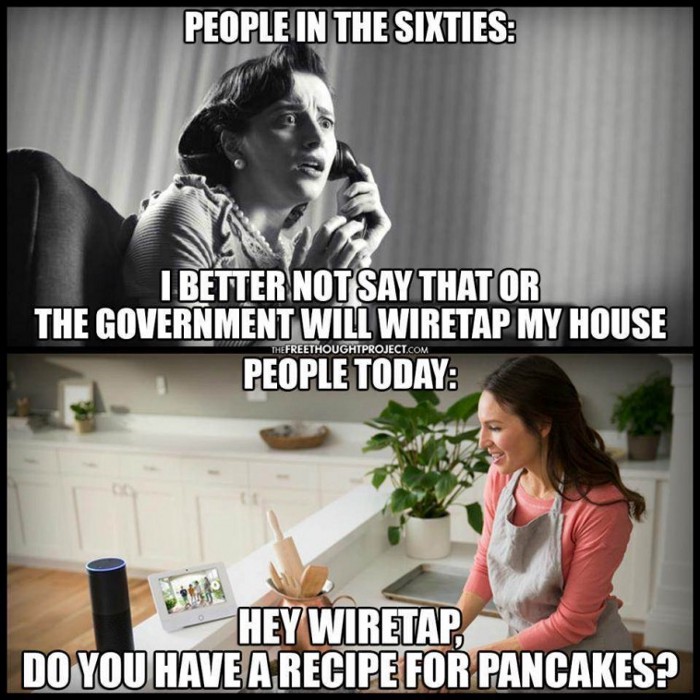
“what about for C4? do you have a recipe for C4?”
Increasingly, corporations are the intelligence services. At least a quarter of American intelligence work is done by private contractors, most of whom work for 5 companies. The CIA has run off Amazon servers since 2014, while the DHS is rolling out an ultra-Orwellian new biometric database that will allow agents to cross-reference facial scans, fingerprints, DNA, and even social relationships(!) — using Amazon servers. Amazon is competing with Microsoft to host the entire Defense Department computing infrastructure in a process riddled with conflicts of interest. Even as the #Resistance flings around the word “fascist” with gusto, they never seem to apply it where it fits — to describe a system in which large corporations work hand in hand with an authoritarian state to suppress dissent and perpetuate the (myth of) national greatness.
Nor is the First Amendment the only one to go AWOL when most needed. The Fourth Amendment, protecting Americans against unreasonable search and seizure, was gutted by the PATRIOT Act under the reasoning that if the terrorists truly hate us for our freedoms, it’s best to just be safe and chuck those freedoms altogether. What the post-9/11 police state started, civil asset forfeiture exacerbated, institutionalizing the practice of confiscating the possessions of individuals merely suspected of committing a crime. While the Supreme Court decided earlier this year that the procedure violated the Constitution’s prohibition against excessive fines, police departments have already found a way around that problem — they simply classify the desired property as “evidence,” allowing them to hold it in the station indefinitely and, after four months, sell it.
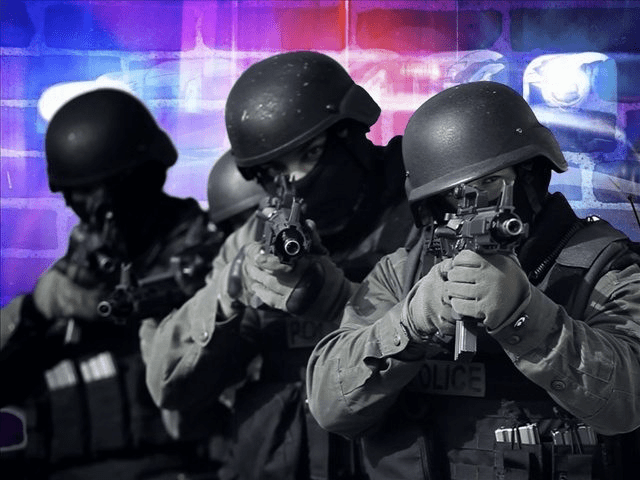
sure, you can have your car back. come get it.
The right to a speedy and public trial was destroyed for good under the watchful eye of Obama, whose 2011 National Defense Authorization Act allowed indefinite detention of Americans without charge or trial around the world. Someone clearly got a chuckle out of having a president who convinced voters he would close Guantanamo instead take the model global. Meanwhile, overcrowded courts and backlogged public defenders mean the Sixth Amendment is violated as often in practice as in letter, with innocent defendants urged to plead guilty just to get out of jail with a conviction that will follow them the rest of their lives — often not knowing they have any other options, let alone a constitutional right to them. Likewise, protection against excessive fines and bail has been superseded by systematic greed. Predatory courts have learned that offering impoverished defendants alternatives to jail like electronic monitoring can be just as lucrative as civil asset forfeiture, without the bad press — even if the target is eventually found innocent, he still has to pay to have the monitor removed, and if he doesn’t keep up with the payments mandated by the extortionate contract he signed to keep himself out of prison, he ends up there anyway.
Cruel and unusual punishment, meanwhile, has been renamed “enhanced interrogation” and embraced by unreconstructed thugs. Leaked vetting documents from Trump’s cabinet selection process revealed that “opposition to torture” was actually considered a “red flag” among those being considered for administration positions, suggesting the US has learned nothing from the horrors of the Bush years and Abu Ghraib. Or perhaps it has — the US’ “War on Terror” and the torture it enabled have been a terrorist recruiter’s wet dream, quadrupling the number of extremist Salafi Islamic militants since 2001 and ensuring a constant supply of propaganda-ready enemies.
So what’s left?
Americans still have the right to vote and the right to bear arms, but the first is a bad joke and the second we’ve primarily turned against ourselves. Suicides are at an all-time high, part of a phenomenon commentators have termed “deaths of despair” when combined with steep rises in deaths from alcohol and drug abuse, both of which are also at record or near-record highs. The pursuit of happiness has been replaced by the pursuit of oblivion. And given the future spread out before us, it’s not difficult to understand why.
cheer up!
Millennials and Generation Z are confronting an even wider gap than the previous generation between their expectations — the Shining City on a Hill conservatives unironically insist the US is, the example the rest of the world supposedly envies and wants to emulate — and reality. More than ever, Americans coming of age are finding it impossible to square the crippling debt, decaying infrastructure, impossible expenses, and absence of basic services that characterize their own experience with the propaganda they’ve internalized since their first day in school.
Whether they blame themselves for failing to measure up or blame the system that sold them a bill of goods depends on their programming. Americans are taught to think of poverty as punishment for personal shortcomings, a Calvinistic safeguard against socialist sentiment taking root in the working classes, but traps have been set even for those who realize the problem is larger than themselves. Too many fall for simplistic scapegoat-based explanations of the US’ problems: on the Right, immigrants and foreigners are blamed for stealing jobs without so much as a glance for the private equity firms and CEOs who actually shipped those jobs overseas. On the Left, the entire white race is presumed responsible, ensuring a working class that should be united is instead divided along racial lines, reenacting centuries-old oppression.
Even those who have managed to eke out a position of economic comfort are plagued by a nagging awareness that their country is not what it seems, but most are unwilling to peek behind the façade and admit something has gone drastically wrong with the whole American experiment. Instead, they keep their panic in check with the politically amnesiac view that it’s the fault of the current inhabitant of the White House. Orange-Man-Bad and Obama-the-Secret-Muslim are two sides of the same coin: these figureheads, not decades of neoliberal leprosy, are blamed for the country’s misfortunes.

243 years old & not looking a day over 240!
What we once understood as “America” has been packaged off and sold, and not even to the highest bidder — just the best-connected one. In its place has arisen a series of gated communities that require a certain income level for entry. Those who do not meet the restrictions — “You must make this much money to matter” — are relegated to the few dilapidated public services that remain, the leftovers too unappealing to privatize. Flint’s water system, Washington DC’s metro, Stockton’s police force, Puerto Rico’s electrical grid. The middle class that might once have relied on these services has been erased, literally and figuratively — robbed of their assets during the crash of 2008, they have been written off as irredeemable as “middle class” was itself redefined as six-figure incomes. Meanwhile, private companies, unfettered by regulation in Milton Friedman’s free-market wet dream, can do everything the government can’t. The state of Alabama signed a law last month allowing schools and churches to operate private police forces, opening the door to Blackwater (or Xe, or Academi, or whatever bad press has forced it to change its name to now) operating in the US with the full complicity of the government.
The Pentagon is so overrun by contractors like Blackwater doing the jobs the military is no longer capable of doing that it admits it doesn’t know how many of them are lined up at the government trough, but in 2016 three quarters of US forces in Afghanistan were contractors. Which isn’t so strange — the Pentagon doesn’t know (or care) where most of its money goes, because there’s always more where that came from when you’re the world’s reserve currency. America’s once-mighty military-industrial complex — the last heavy industry standing post-NAFTA — has been picked over by predatory monopolies to the point where despite unprecedented levels of military spending, America can no longer compete on the global stage. The F-35 — the most expensive fighter plane ever produced — performs so poorly Washington has to threaten its allies with sanctions to get them to buy it (and presumably stash it in the back of the closet), while Russian and Chinese missile developments have rendered the US’ multibillion dollar aircraft carriers a flotilla of overpriced sitting ducks. Even Big Tech — the last great hope for American capitalism — is quietly migrating to Israel, sucking up subsidies from both US and Israeli governments and laughing all the way to the bank.
All the US can still “make” is deals — Wall Street gets fat on Main Street’s misfortunes. When the mortgage bubble popped in 2008, financiers turned to student debt, packaging and marketing loans as “Student Loan Asset Backed Securities” (SLABS). Over the last decade, as SLABS have become a $200 billion market, the total amount of debt held by American students has more than doubled, surpassing $1.47 trillion. It’s no coincidence that college costs more than twice what it did 20 years ago. Student debt is even more attractive than mortgage debt, because it can’t be forgiven or dismissed through bankruptcy, and its bearers are too young when they sign the papers to fully comprehend that they may never pay it off.

the real Captain America
Colleges have turned students into “investments” with exploitative income-sharing agreements in which the student agrees to give a percentage of their future income to the school after graduation in order to guarantee loan payback, a model uncannily similar to indentured servitude (and, perhaps unsurprisingly, developed by Milton Friedman). Debtors’ prisons are back with a vengeance, too — SWAT teams and US Marshals are arresting people over unpaid student loan debts and predatory court fee systems have widened the pool of potential “criminals” the state can count on as a renewable financial resource. Broke municipalities are so excited when private prison corporations like GEO Group come knocking that they willingly sign agreements pledging to keep the facility a certain percentage full, offering their citizens up on a silver platter to appease their new corporate overlords.
What’s the government to do when there’s no “America” left to sell? How do you define yourself when you’ve sold your ideals, your heavy industry, your technological advancements, your land, and even your citizens? The American dream has always somewhat resembled a fairytale, and that has been part of its persistent attraction. People fleeing war-torn countries or economic wastelands believed they would live happily ever after if they just made it to the United States. But there was once something, however flawed, to back up the fantasy. Now, Americans celebrating their country’s independence are hard-pressed to find any traces of it left. No wonder we’re setting off more fireworks than ever — nothing banishes an existential crisis like a big explosion.

tell that to Syria…
Helen Buyniski is a journalist and photographer based in New York City. Her work has appeared on RT, Global Research, Ghion Journal, Progressive Radio Network, and Veterans Today. Helen has a BA in Journalism from New School University and also studied at Columbia University and New York University. Find more of her work at http://medium.com/@helen.buyniski, or follow her on Twitter @velocirapture23.
London proudly hosts press freedom forum, defends right to spy on journos in Strasbourg the same day
RT | July 11, 2019
On Wednesday an international conference on press freedom was launched in London. Ironically on the same day Her Majesty’s government was defending its mass surveillance on communications, including those of journalists.
The Global Conference for Media Freedom, co-organized by the governments of the UK and Canada, was launched with much fanfare in the British capital, with some 1,000 representatives from around the world present. Some media professionals were barred from the grand event (namely this media, RT and another Russian outlet Sputnik to be precise), but of course it didn’t stop hosts from declaring appreciation of the role that a free press plays in a free society.
Halfway across Europe in Strasbourg on the same day lawyers representing the British government were defending its right to spy on electronic communication of people before the Grand Chamber of the European Court of Human Rights (ECHR).
The case was brought before the court by 16 organizations and individuals defending civil and journalistic liberties, including the Bureau of Investigative Journalism. They argued that mass snooping, first revealed by NSA whistleblower Edward Snowden, violated the right to privacy and the right to freedom of expression – the latter being fundamental for journalistic work.
“This may be the most important case with regard to the protection of journalistic communications and the protection of our sources to be heard in the past 20 years,” Rachel Oldroyd, managing editor of the Bureau said.
“As journalists we must be able to speak freely to our sources without fear of surveillance. The UK government’s system of mass collection and storage of all our communications is a severe threat to this cornerstone of our profession and a severe intrusion upon the freedom of the press.”
“It is ironic that on the very day the Bureau is making this case against the British government’s surveillance regime in the highest court in Europe, the same government is hosting a global summit on press freedom.”
In September 2018 the ECHR ruled that Britain didn’t have necessary safeguards in place to ensure that its mass surveillance complied with the European Convention on Human Rights after which the case was referred to the Grand Chamber. The hearing on Wednesday lasted almost three hours, but the date for delivering the judgement is yet to be announced.
Meanwhile the media freedom conference in London continued into its second day on Thursday with panels like ‘Taking a Stand: How We Defend Media Freedom’ and ‘Strengthening Media Freedom across the Commonwealth’ on the agenda. Do tell.
The Death of Privacy: Government Fearmongers to Read Your Mail
By Philip Giraldi | Strategic Culture Foundation | July 11, 2019
It is discouraging to note just how the United States has been taking on the attributes of a police state since 9/11. Stories of police raids on people’s homes gone wrong are frequently in the news. In one recent incident, a heavily armed SWAT team was sent to a St. Louis county home. The armed officers entered the building without knocking, shot the family dog and forced the family members to kneel on the floor where they were able to watch their pet struggle and then die. The policemen then informed the family that they were there over failure to pay the gas bill. Animal rights groups report that the shooting of pets by police has become routine in many jurisdictions because the officers claim that they feel threatened.
Indeed, any encounter with any police at any level has now become dangerous. Once upon a time it was possible to argue with an officer over the justification for a traffic ticket, but that is no longer the case. You have to sit with your hands clearly visible on the steering wheel while answering “Yes sir!” to anything the cop says. There have been numerous incidents where the uncooperative driver is ordered to get out of the car and winds up being tasered or shot.
Courts consistently side with police officers and with the government when individual rights are violated while the Constitution of the United States itself has even been publicly described by the president as “archaic” and “a bad thing for the country.” The National Security Agency (NSA) routinely and illegally collects emails and phone calls made by citizens who have done nothing wrong and the government even denies to Americans the right to travel to countries that it disapproves of, most recently Cuba.
And traveling itself has become an unpleasant experience even before one sits down in the 17 inches of seat-space offered by major airlines, with the gropers of the Transportation Security Administration (TSA) acting as judge, jury and executioner for travelers who have become confused by the constantly changing rules about what they can do and carry with them. The TSA is now routinely “examining” the phones and laptops of travelers and even downloading the information on them, all without a warrant or probable cause. And the TSA even has a “little list” that identifies travelers who are uncooperative and flags them for special harassment.
Congress is considering bills that will make criticism of Israel a crime, establishing a precedent that will end freedom of speech, and the impending prosecution and imprisonment of Julian Assange for espionage will be the death of a truly free press. Americans are no longer guaranteed a trial by jury and can be held indefinitely by military tribunals without charges. Under George W. Bush torture and rendition were institutionalized while Barack Obama initiated the practice of executing US citizens overseas by drone if they were deemed to be a “threat.” There was no legal process involved and “kill” lists were updated every Tuesday morning. And perhaps the greatest crimes of all, both Obama and George W. Bush did not hesitate to bomb foreigners, bring about regime change, and start wars illegally in Asia and Africa.
The latest assault on civil liberties relates to what used to be referred to as privacy. Indeed, the United States government does not recognize that citizens have a right to privacy. Officials in the national security and intelligence agencies have reportedly become concerned that some new encryption systems being used for email traffic and telephones have impeded government monitoring of what information is being exchanged. As is often the case, “terrorism” is the principal reason being cited for the need to read and listen to the communications of ordinary citizens, but it should be observed in passing that more people in the US are killed annually by falling furniture than by acts of terror. It should also be noted that the federal, state and local governments as well as private companies spend well in excess of a trillion dollars every year to fight the terrorism threat, most of which is completely unnecessary or even counter-productive.
At the end of June senior Trump Administration officials connected to the National Security Council met to discuss what to do about the increasing use of the effective encryption systems by both the public and by some internet service providers, including Apple, Google and Facebook. Particular concern was expressed regarding systems that cannot be broken by NSA at all even if maximum resources using the Agency’s computers are committed to the task. It is a condition referred to by the government agencies as “going dark.”
Under discussion was a proposal to go to Congress and to ask for a law either forbidding so-called end-to-end encryption or mandating a technological fix enabling the government to circumvent it. End-to-end encryption, which scrambles a message so that it is only readable by the sender and recipient, was developed originally as a security feature for iPhones in the wake of the whistleblower Edward Snowden’s exposure of the extent to which NSA was surveilling US citizens. End-to-end makes most communications impossible to hack. From the law enforcement point of view, the alternative to a new law banning or requiring circumvention of the feature would be a major and sustained effort to enable government agencies to break the encryption, something that may not even be possible.
In the past, government snooping was enabled by some of the communications providers themselves, with companies like AT&T engineering in so-called “backdoor” access to their servers and distribution centers, where messages could be read directly and phone calls recorded. But the end-to-end encryption negates that option by sending a message out on the ethernet that is unreadable.
Phone security was last in the news in the wake of the 2015 San Bernardino, California, terrorist attack that killed 14, where the Department of Justice took Apple to court to access a locked iPhone belonging to one of the gunmen. Apple refused to create software to open the phone but the FBI was able to find a technician who could do so and the case was dropped, resulting in no definitive legal precedent on the government’s ability to force a private company to comply with its demands.
There is apparently little desire in Congress to take up the encryption issue, though the National Security Council, headed by John Bolton, clearly would like to empower government law enforcement and intelligence agencies by banning unbreakable encryption completely. It is, however, possibly something that can be achieved through an Executive Order from the president. If it comes about that way, FBI, CIA and NSA will be pleased and will have easy access to all one’s emails and phone calls. But the price to be paid is that once the security standards are lowered anyone else with minimal technical resources will be able to do the same, be they hackers or criminals. As usual, a disconnected and tone-deaf government’s perceived need “to keep you safe” will result in a loss of fundamental liberty that, once it is gone, will never be recovered.
Judge, jury & executioner: Facebook policy permits death threats against ‘dangerous individuals’
RT | July 10, 2019
Facebook has issued an ominous new policy permitting death threats and calls for violence – so long as they’re directed against “dangerous” individuals or organizations, or someone accused (but not convicted) of a crime.
Facebook has updated its “community standards” to carve out a few exceptions to its “no death threats” policy. Calls for “high-severity violence” are now permitted, as long as they’re directed at individuals “covered in the Dangerous Individuals and Organizations policy” or individuals “described as having carried out violent crimes or sexual offenses” by media reports. After all, are people banned from Facebook really people at all?
The change was spotted on Tuesday by commentator Paul Joseph Watson, who along with his former Infowars boss Alex Jones was one of a handful of mostly-conservative personalities banned from Facebook in May under its “Dangerous Individuals” policy. Back then, even mentioning one of the banned names could get a user banned – unless the mention was derogatory.
Facebook has apparently taken that “hate the haters” tactic and run with it. While the “Dangerous Individuals” policy supposedly only covers “terrorist activity, organized hate, mass or serial murder, human trafficking, and organized violence or criminal activity,” none of the commentators banned – including Watson, Jones, conservative political performance artist Milo Yiannopoulos, and Nation of Islam leader Louis Farrakhan – were involved in any of those activities. But, Watson discovered, a person wearing an Infowars t-shirt is enough to get a photo removed from Instagram, and photos that include banned individuals – even if their faces are blurred out – have been deleted as well.
Equally ominous is Facebook’s decision to dispense with the concept of “innocent until proven guilty” that forms the core of the US legal system (Facebook is based in Menlo Park, California, and at least theoretically subject to US laws). Individuals need only be accused in the media of violent crimes and sexual offenses to become fair game for death threats – not convicted in court. For a company that claims to take the threat of “fake news” very seriously, Facebook is surprisingly cavalier about the potential for media misinformation to lead to violence.
But then, Facebook never even tried to prove Watson, Jones or any of the other banned users were “Dangerous Individuals,” either – its policy has always been that banned users are guilty until proven innocent, as any user who’s ever been forced to jump through its tech support hoops to restore a banned account can attest.
“The largest social media company in the world with over 2 billion users literally says it’s fine to incite violence against me, despite this being illegal,” Watson wrote at Summit.news, pointing out that sending death threats or threats of violence is, in fact, a crime under UK law (as it is under US law and the laws of most developed countries with substantial Facebook-using populations). “They are painting a target on my back.”
Facebook even tracks off-platform behavior to determine whether users should be blacklisted as “hate agents,” according to internal documents seen by Breitbart, meaning merely showing up at the same event as a “dangerous individual” can potentially earn a user the designation. The site’s list of “hate agents” is reportedly quite exhaustive and includes British politicians Carl Benjamin and Anne Marie Waters as well as conservative commentators like Yiannopoulos and Candace Owens. Because all this classification goes on in secret, users have no chance to appeal their un-personing, and may never even know they are being judged, until they start receiving Facebook-approved death threats of their own.
Also on rt.com:
‘No future for dissidents’ on social media: Paul Joseph Watson reflects on Facebook ban
A Secret Meeting to Plot War?
Who is representing the American people in this secret conclave with pro-Israel groups?
By Philip Giraldi | American Free Press | July 6, 2019
On June 5, 16 heads of Jewish organizations joined 25 Democratic senators in a private meeting, which, according to the Times of Israel, is an annual event. All of the Jewish organizations but one were openly declared advocates for Israel and are supportive of its policies. Key groups present included the Council of Presidents of Major Jewish Organizations, the Anti-Defamation League, and the American Israel Public Affairs Committee. A number of the groups have lobbied Congress and the White House in support of the use of force against Iran, a position that is basically identical to the demands being made by the government of Prime Minister Benjamin Netanyahu.
The senatorial delegation was headed by Sen. Chuck Schumer (D-N.Y.), currently Senate minority leader who has described himself as the “shomer” or guardian of Israel in the Senate. The 25 senators in attendance constitute one-quarter of the entire deliberative body and more than half of all Democrats serving in it. Sen. Amy Klobuchar (D-Minn.), who has emphatically linked her campaign to become the Democratic presidential nominee in 2020 to Jewish and Israeli interests, chaired the gathering.
After the meeting, Jewish Insider provided a complete list of the participants and also a diagram of how they were positioned in the Capitol Hill conference room. The senators were placed on one side of a rectangle with the Jewish leaders in front of them filling the seats on the other three sides. Who exactly provided the agenda that Klobuchar was presumably following is not known, but one suspects that it may have been a joint effort by Schumer and several of the more prominent Jewish organization participants.
The meeting was by design not a public event, and, to a certain extent, it was a secret. Its time, place, and participants were not announced, and it was only reported at all in the Israeli and Jewish media. According to after-the-fact coverage of the event by Alison Weir of the “If Americans Knew” website, even staffers in the congressional offices were not aware that the meeting was taking place. No statement was issued afterwards, but it is believed that the principal topic under discussion was how to contain and reverse pro- Palestinian sentiment among progressive Democratic voters, who, to the horror of the participants, actually have been embracing the possibility that Palestinians are human beings with plausibly the same rights as Israelis. A particular focus would have been the nonviolent Boycott, Divestment and Sanctions movement (BDS), which has become a growing force on college campuses and in progressive circles.
Other issues raised were mentioned in passing afterwards on the email service “The Tell” by Ron Kampeas of the Jewish Telegraphic Agency (JTA) news service. They included supporting Israel and also more federal-level legislation to combat “anti-Semitism.” And, of course, there was the issue of money. Several groups want funding from the Department of Homeland Security (DHS) increased to pay for more security at Jewish facilities. Current legislation is considering allocating $70 million per year and there were demands that it be increased to $90 million. A 2014 article in the Jewish Forward reported that Jewish institutions received 94% of DHS discretionary funding.
One might reasonably argue that the private meeting with the Democratic senators reflects a singular urgency in that the party base is becoming notably less pro-Israel, suggesting that something had to be done to stop the rot. That may be true enough, but the reality is that the federal government’s pandering to Israel is both bi-partisan and global in its reach. The United States uniquely has a special envoy to combat anti-Semitism, and his writ extends to proposing sanctions against countries that are critics of Israel.
And even as the Democrats were meeting with Jewish leaders, the Republicans were doing much the same thing. Secretary of State Mike Pompeo met with probably some of those very same leaders as the Democrats and expressed concern about the possibility that British Labour Leader Jeremy Corbyn might become prime minister. Corbyn has been targeted by British Jews because he is the first UK senior politician to speak sympathetically about the plight of the Palestinians.
Pompeo was asked, if Corbyn “is elected, would you be willing to work with us to take action if life becomes very difficult for Jews in the UK?” He replied: “It could be that Mr. Corbyn manages to run the gauntlet and get elected. It’s possible. You should know, we won’t wait for him to do those things to begin to push back. We will do our level best. It’s too risky and too important and too hard once it’s already happened.”
So American Jews want to join with their British counterparts to either bring down or contain a top-level elected politician just because he recognizes the suffering of the Palestinians. The American secretary of state meets with those same activists and agrees with them that something must be done, to include quite possibly taking steps to ensure that he does not become prime minister in the first place. Recall for the moment that Britain is America’s closest ally and is what passes for a democracy these days. Jews obviously occupy a rather special space, politically speaking, in the United States. One might reasonably ask, where are the private meetings with representatives of Italian, German, Irish, or Polish organizations, each of which represents a far greater portion of America’s ethnic mix than do Jews? The obvious answer is that those groups do not operate in a cohesive, tribal fashion and they do not possess the financial resources that the 600 or so Jewish groups that advocate for Israel have. In America, unfortunately, money buys access to power and, if there is enough money on the table, it can also buy politicians.
Nor are America’s other white ethnic groups as grievance-driven.
And there is one other significant difference: While other ethnic groups in the United States are protective of their respective cultures and languages, there is no sense that any of them actually seek to advocate policies damaging to the United States to benefit the foreign nations that they identify with. The Jewish advocacy for Israel is something quite different, costing the American taxpayer billions of dollars every year and involving Washington in a sequence of wars of choice driven by Israel itself aided by its powerful domestic lobby.
Israel also comes with a price tag in terms of the constitutional rights enjoyed by Americans. Before too long, legislation currently working its way through Congress will criminalize any criticism of Israel. No other national or ethnic group in the United States seeks to dismantle the First Amendment to the Constitution of the United States in quite that fashion.
Israel is no friend and never has been. Recent media reports detail how Jewish-American oligarch Paul Singer has been working with the Israeli government to transfer thousands of high-paying American IT jobs to Israel. Is he guilty of dual loyalty? No, he is only really loyal to Israel, as are many of the Jewish leaders who met with Pompeo and the senators. It is a disgrace.
And it is also a disgrace that Pompeo and 25 Democratic Party senators should be meeting privately with Jewish organizations to do things for Israel and the Jewish community that do not serve the interests of all Americans, up to and including meddling in the politics of a genuine close ally to respond to the paranoia of British Jews.
Yes, there is a Jewish international conspiracy in place directed by some Jews like those who met with the senators and Pompeo, and it has no off switch. Never before in history has a great power been so dominated by a puny client state and its domestic fifth column, and it is time that the private meetings whereby a government “of the people, by the people and for the people” panders to one group alone should end forever.
Philip Giraldi is a former CIA counter-terrorism specialist and military intelligence officer and a columnist and television commentator. He is also the executive director of the Council for the Interest.
Revered Social Leader and Activist Killed in Colombia

teleSUR | July 5, 2019
Social leader Tatiana Paola Posso Espitia, 35, was shot twice in the head Wednesday morning in front of her house in El Copey located in the Department of Cesar when two men on motorcycles fired at the activist and fled the scene.
The assassination occurred just as Espitia’s taxi driver, Wilson Ortega Palomino, arrived at her home to take the social leader to work, according to local media reports. The bad timing resulted in Ortega also being shot four times by the hitmen. He is in critical condition at a nearby hospital.
The National Network for Democracy and Peace in Colombia published a communique on its Twitter account firmly condemning the murder.
“Posso Espitia was a social activist committed to humanitarian aid, helping vulnerable people and victims of the armed conflict that continue to affect Colombia,” said the report.
The organization added that the social activist, who was a candidate for the community council, was a beloved member of her community.
The document also explained how the city El Copey has had a long history marked by threats against social leaders, deaths and massive displacement of the population.
The tragic event comes as the Institute of Studies for Development and Peace (Indepaz) showed that since the signing of the peace agreement between the disarmed Revolutionary Armed Forces of Colombia (FARC) and the government of former president, Juan Manuel Santos in November 2016, 727 social leaders or human rights advocates have been killed in Colombia.
The assassinations have so far mainly targeted Afro-Colombian and Indigenous rights activists, in addition to rural farmers advocating for land and political rights in their respective regions.
Colombia’s Ombudsman announced Wednesday that at least 983 social leaders have been threatened with death in Colombia, 50 percent of them are women.
Last week, the ‘We Defend Peace in Colombia’ human rights organization called for major peaceful protests in the country and abroad meant to pressure the President Ivan Duque administration into fully addressing the rampant murders.
The global march is set to take place July 26 and is meant to “pay tribute to the (assassinated) social leaders and to demand action to end these crimes,” said organizers.
FBI Had 12-Page File On George Carlin Because He Made Jokes About Government
By John Vibes | ANTIMEDIA | August 19, 2015
Comedian George Carlin is known as one of the most controversial and outspoken entertainers of his time, and as far as the government is concerned, he could have possibly been a terrorist.
Carlin was not a violent or criminal person in any way, but he said things during his routines that struck at the root of the problems in our society. He went into great detail about corruption in government and business.
During the 1978 Supreme Court case, FCC v Pacifica Foundation, the government cited Carlin’s work as an example of profanity. They used his “Seven Dirty Words” segment to show the type of language that was being used in records and broadcasts. However, the government’s interest in his work did not stop there.
Just after his 1969 appearance on the Jackie Gleason show, Carlin caught the attention of the FBI because he made jokes about then-FBI chief J. Edgar Hoover. According to the government, Carlin had “referred to the Bureau and the Director in a satirical vein.”
They added that his act was “considered to be in very poor taste” and “it was obvious that he was using the prestige of the Bureau and Mr. Hoover to enhance his performance.”

After Carlin’s appearance on the show, the staff of Jackie Gleason received a number of anonymous letters — allegedly from fans but possibly from the FBI — condemning Carlin for speaking about the government in the critical way that he did. It has been proven that the FBI has indeed sent threatening letters to public figures in the past, pretending to be concerned colleagues or a member of the public, including to Dr. Martin Luther King Jr.

Anyone that speaks out against the injustices of the world, whether they are a dangerous terrorist or a harmless comedian, will receive unwanted attention from government.
Below is a video showing Carlin’s deep political analysis in action:
Read the 12 pages of FBI documents on Carlin here.
The Special Rules- Why Aren’t They A Form of Discrimination?
By Eve Mykytyn | June 29, 2019
Any Labour Party member bold or stupid enough to make or be associated with negative statements about Israel, the Zionist politics that support Israel or who questions any piece of the present Holocaust narrative has been disciplined by the Party. Ex, See or See.
England has Jewish citizens and Israel is a British ally, these two facts somehow get conflated. Israel is a separate sovereign state, has been so for seventy years, and is likely to remain a country, and a rich and powerful one at that, for the foreseeable future. Britain’s Jewish citizens, like all Brits, have rights to protection from discrimination, hate speech and the like that derive from their British citizenship and are wholly unrelated to Israel.
England and the US are also allies. When President Trump visited England he was met by huge protests and signs calling Trump a racist, a warmonger (in that I see little difference between Trump and other recent US presidents) dangerous and unAmerican and by large balloons portraying Trump on a toilet, in a diaper and as a penis. I’m an American, not a fan of Trump’s and it is fine with me if the British choose to protest his presence, although as far as I can tell such protests have no effect. Trump blithely misinterpreted the demonstrations as crowds greeting him, brilliantly diverting the media into a discussion about how that was not so.
Now imagine if the British held up similar signs insulting Netanyahu or Israel. Could they call Netanyahu a racist or ‘unIsraeli?’ Would anyone dare hold blimps of Netanyahu as a penis? Who would be kicked out of the Labour Party? Who would be prosecuted for hate speech or defamation? And what would this have to do with Britain’s Jewish citizens?
Why does Britain insist that there are certain ‘rules’ for criticizing Israel, as contained in the international holocaust definition of anti Semitism (the only racism that has its own special set of rules, apparently Blacks can go it on their own) but not for critics of Americans? Sadly, the US is close on England’s heels in implementing similar free speech penalties. Is there to be one rule for Jews and another rule for the rest of humanity?
It’s time to mull punishment for having & watching ‘terrorist propaganda’ – Swedish security chief
RT | June 29, 2019
The head of Sweden’s Security Service has called on the government to investigate whether it is feasible to punish anyone found with “terrorist propaganda,” arguing that even looking at such materials is an incitement to violence.
Klas Friberg, who leads Säpo, the Swedish security agency responsible for counter-espionage and counter-terrorism, wrote in an op-ed that he and his colleagues work “around the clock” to protect Sweden from terrorism.
Despite their best efforts, the risk of terrorist attacks remains high, Friberg said, partly due to Islamic State’s (IS, formerly ISIS) “Hollywood-like propaganda machine” which produces “gruesome imagery with both living and dead people.”
The security official noted that the materials are used to recruit new supporters, but that Swedish authorities can do nothing to stop the propaganda from spreading because it is not criminal to possess or view these videos and images.
Arguing that “terrorism must be countered in every way,” Friberg called on the government to open an inquiry into whether it should be a punishable offense to handle violent content produced to spread the ideology of Islamic State. He says the legislation would not be radical, drawing a parallel to laws prohibiting the possession of child pornography.
This could help Säpo investigate and prosecute those deemed a threat to Sweden, he said, adding that measures must be taken to ensure that “rights and freedoms” are preserved.
Sweden suffered a terrorist attack in 2017, when an IS supporter rammed a truck into a crowd of people on a busy street in Stockholm, killing five people.
Orwell’s 1984 no longer reads like fiction. It’s the reality of our times
By Robert Bridge | RT | June 28, 2019
70 years ago, the British writer George Orwell captured the essence of technology in its ability to shape our destinies in his seminal work, 1984. The tragedy of our times is that we have failed to heed his warning.
No matter how many times I read 1984, the feeling of total helplessness and despair that weaves itself throughout Orwell’s masterpiece never fails to take me by surprise. Although usually referred to as a ‘dystopian futuristic novel’, it is actually a horror story on a scale far greater than anything that has emerged from the minds of prolific writers like Stephen King or Dean Koontz. The reason is simple. The nightmare world that the protagonist Winston Smith inhabits, a place called Oceania, is all too easily imaginable. Man, as opposed to some imaginary clown or demon, is the evil monster.
In the very first pages of the book, Orwell demonstrates an uncanny ability to foresee future trends in technology. Describing the protagonist Winston Smith’s frugal London flat, he mentions an instrument called a ‘telescreen’, which sounds strikingly similar to the handheld ‘smartphone’ that is enthusiastically used by billions of people around the world today.
Orwell describes the ubiquitous device as an “oblong metal plaque like a dulled mirror” affixed to the wall that “could be dimmed, but there was no way of shutting it off completely.” Sound familiar? It is through this gadget that the rulers of Oceania are able to monitor the actions of its citizens every minute of every day. At the same time, the denizens of 1984 were never allowed to forget they were living in a totalitarian surveillance state, under the control of the much-feared Thought Police. Massive posters with the slogan ‘Big Brother is Watching You’ were as prevalent as our modern-day advertising billboards. Today, however, such polite warnings about surveillance would seem redundant, as reports of unauthorized spying still gets the occasional lazy nod in the media now and then.
In fact, just in time for 1984’s anniversary, it has been reported that the National Security Agency (NSA) has once again been illicitly collecting records on telephone calls and text messages placed by US citizens. This latest invasion of privacy has been casually dismissed as an “error” after an unnamed telecommunications firm handed over call records the NSA allegedly “hadn’t requested” and “weren’t approved” by the Foreign Intelligence Surveillance Court. In 2013, former CIA employee Edward Snowden blew the whistle on the NSA’s intrusive surveillance operations, yet somehow the government agency is able to continue – with the help of the corporate sector – vacuuming up the private information of regular citizens.
Another method of control alluded to in 1984 fell under a system of speech known as ‘Newspeak’, which attempted to reduce the language to ‘doublethink’, with the ulterior motive of controlling ideas and thoughts. For example, the term ‘joycamp’, a truncated term every bit as euphemistic as the ‘PATRIOT Act’, was used to describe a forced labor camp, whereas a ‘doubleplusgood duckspeaker’ was used to praise an orator who ‘quacked’ correctly with regards to the political situation.
Another Newspeak term, known as ‘facecrime’, provides yet another striking parallel to our modern situation. Defined as “to wear an improper expression on your face (to look incredulous when a victory was announced, for example) was itself a punishable offense.” It would be difficult for the modern reader to hear the term ‘facecrime’ and not connect it with ‘Facebook’, the social media platform that regularly censors content creators for expressing thoughts it finds ‘hateful’ or inappropriate. What social media users need is an Orwellian lesson in ‘crimestop’, which Orwell defined as “the faculty of stopping short, as though by instinct, at the threshold of any dangerous thought.” Those so-called unacceptable ‘dangerous thoughts’ were determined not by the will of the people, of course, but by their rulers.
And yes, it gets worse. Just this week, Mark Zuckerberg’s ‘private company’ agreed to give French authorities the “identification data” of Facebook users suspected of spreading ‘hate speech’ on the platform, in what would be an unprecedented move on the part of Silicon Valley.
‘Hate speech’ is precisely one of those delightfully vague, subjective terms with no real meaning that one would expect to find in the Newspeak style guide. Short of threatening the life of a person or persons, individuals should be free to criticize others without fear of reprisal, least of all from the state, which should be in the business of protecting free speech at all cost.
Another modern phenomenon that would be right at home in Orwell’s Oceania is the obsession with political correctness, which is defined as “the avoidance of forms of expression or action that are perceived to exclude, marginalize, or insult groups of people who are socially disadvantaged or discriminated against.” But since so many people today identify with some marginalized group, this has made the intelligent discussion of controversial ideas – not least of all on US college campuses, of all places – exceedingly difficult, if not downright dangerous. Orwell must be looking down on all of this madness with much surprise, since he provided the world with the best possible warning to prevent it.
For anyone who entertains expectations for a happy ending in 1984, be prepared for serious disappointment (spoiler alert, for the few who have somehow not read this book). Although Winston Smith manages to finally experience love, the brief romance – like a delicate flower that was able to take root amid a field of asphalt – is crushed by the authorities with shocking brutality. Not satisfied with merely destroying the relationship, however, Smith is forced to betray his ‘Julia’ after undergoing the worst imaginable torture at the ‘Ministry of Love’.
The book ends with the words, “He had won the victory over himself. He loved Big Brother.” Will we too declare, like Winston Smith, our love for ‘Big Brother’ above all else, or will we emerge victorious against the forces of a technological tyranny that appears to be just over the horizon? Or is Orwell’s 1984 just really good fiction and not the instruction manual for tyrants many have come to fear it is?
An awful lot is riding on our answers to those questions, and time is running out.
NSA Again Exposed For Unauthorized Collection Of Americans’ Phone Records
By Tyler Durden – Zero Hedge – 06/26/2019
Yet again, the National Security Agency has been exposed for “accidentally overcollecting” call-record metadata of millions of Americans. According to a WSJ report that relied on documents obtained by the ACLU, the NSA received metadata records from an unnamed phone company that the agency hadn’t been authorized to collect.
According to the report, it’s unclear how the overcollection occurred, but the incident took place after the NSA said it had purged hundreds of millions of metadata records it had amassed since 2015 in a separate overcollection episode.
For those who aren’t familiar with the concept, “Metadata” include the numbers called or texted and the associated time stamps, but not the contents of the conversation.
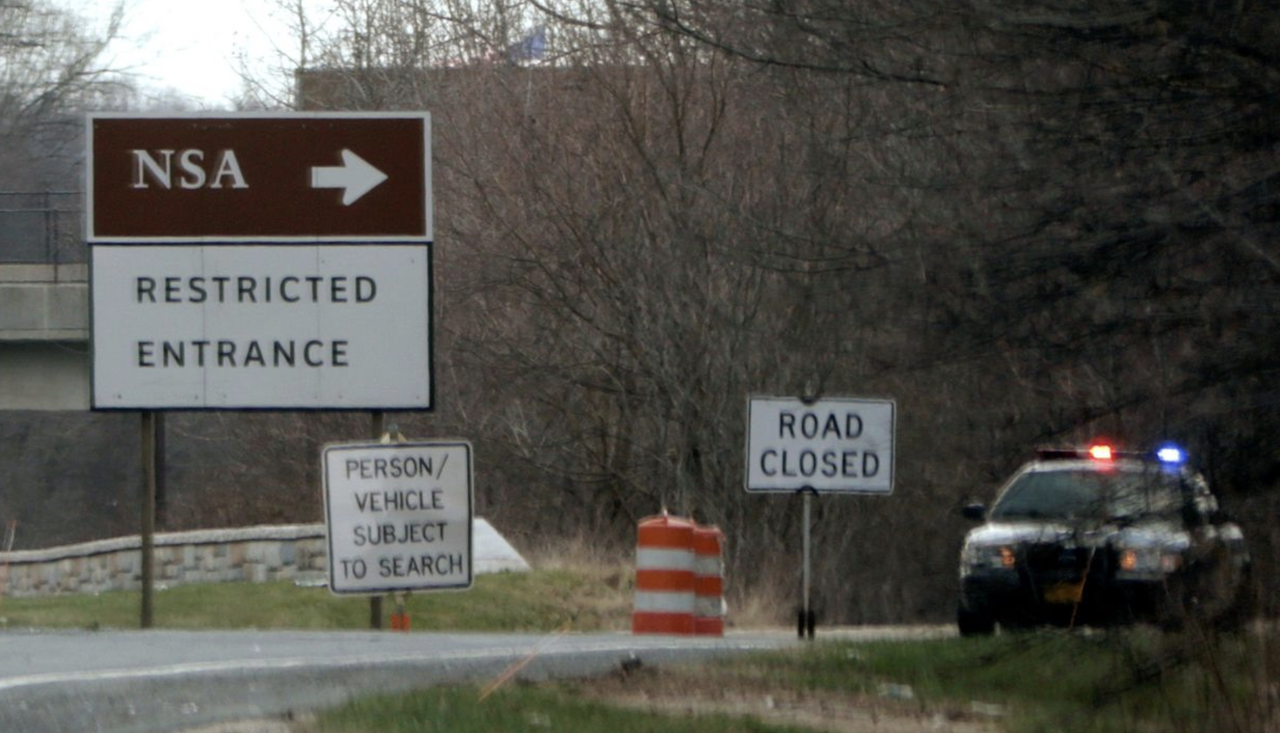
The documents didn’t make clear how many records had been collected by the NSA since October. The NSA’s media relations chief, Greg Julian, refused to comment on this specific episode, but referred to the prior overcollection episode – which resulted in the NSA deleting an entire database of collected metadata – where the NSA had collected information it hadn’t been authorized to collect.
Essentially, the agency blamed the incident on service providers who incorrectly interpreted the NSA’s request.
“While NSA lawfully sought data pertaining to a foreign power engaged in international terrorism, the provider produced inaccurate data and data beyond which NSA sought,” Julian said.
The company began delivering those records to the NSA on Oct. 3, 2018 through Oct. 12, when the agency asked it investigate the “anomaly.”
Exposure of the incident has predictably provoked outrage from lawmakers, who have been railing against the NSA’s surveillance programs since they were first exposed by former contractor Edward Snowden in 2013. Former lawmaker Pat Toomey, now an ACLU staff attorney, said the incident is just the latest reason why the NSA metadata-collection program, launched in the aftermath of 9/11 as part of the Patriot Act, should be discontinued.
“These documents only confirm that this surveillance program is beyond redemption and should be shut down for good,” Patrick Toomey, an ACLU staff attorney, said in a statement. “The NSA’s collection of Americans’ call records is too sweeping, the compliance problems too many, and evidence of the program’s value all but nonexistent. There is no justification for leaving this surveillance power in the NSA’s hands.”
The House Judiciary Committee has already started weighing which expiring Patriot Act provisions will be renewed, and according to several lawmakers, the phone surveillance program likely won’t be reauthorized.
“Every new incident like this that becomes public is another reason this massive surveillance program needs to be permanently scrapped,” said Sen. Ron Wyden, a longtime critic of the program. “But it is unacceptable that basic information about the program is still being withheld from the public.”
Featured Video
Houthis Don’t Have to Conquer Saudi Arabia to Make It Pay
or go to
Aletho News Archives – Video-Images
From the Archives
Newly Released FBI Docs Shed Light on Apparent Mossad Foreknowledge of 9/11 Attacks
By Whitney Webb | MintPress News | May 17, 2019
NEW YORK — For nearly two decades, one of the most overlooked and little known arrests made in the aftermath of the September 11 attacks was that of the so-called “High Fivers,” or the “Dancing Israelis.” However, new information released by the FBI on May 7 has brought fresh scrutiny to the possibility that the “Dancing Israelis,” at least two of whom were known Mossad operatives, had prior knowledge of the attacks on the World Trade Center. … continue
Blog Roll
 Aletho News
- MEP blasts ‘Euro-Gestapo’ for lecturing Russia on democracy
- Syria May Send Troops to Saudi Arabia Amid War with Ansar Allah
- UK whines about losing billions to ‘Putin tax’
- Baghaei to Rubio: Distorted narratives cannot erase US record of broken commitments
- Houthis Don’t Have to Conquer Saudi Arabia to Make It Pay
- MOE: Nearly 22,000 Students and Education Workers Killed
- Guterres in Islamabad: Genocide, cowardice, and the cage of Imran Khan
- Johnson, Marandi say Yemen holds upper hand over Saudi Arabia
- False flags won’t save aggressors, Iran FM spokesman says
- The Makkah Pact Enters Into Force: The End of American Dominance or Its New Form?
- If Americans Knew
- Report claimed Mark Levin used by Israeli government to influence Trump
- Over 2,000 Gazans have died awaiting medical evacuation amid Israel’s continued siege
- How a U.S. Diplomat Suppressed and Altered Reports Critical of Israel
- 5 Palestinians Die from Israeli Strikes in Gaza as Relentless Attacks Continue
- Report: Ceasefire Slows Killing but Leaves Devastation Intact
- Country Music Singer Zach Bryan Breaks Attendance Record at Robert Kraft’s Gillette Stadium While Wearing ‘Free Palestine’ Shirt for Second Night in a Row
- Three years of death and devastation: Israel’s war on Gaza in pictures
- Why Hamas believed the status quo was more dangerous than its 7 October gamble
- Debunking Israel’s latest list of ‘terrorist’ journalists in Gaza
- In Gaza, focus is on survival, “every step is a struggle” – Daily Update
- No Tricks Zone
- New Study: 50 Years Of The Most Aggressive ‘Net Zero’ Policies Can Only Affect The Global Climate By 0.03°C
- US September “Heat” Was No Record…Many Records Set Decades Ago
- Latest European Green Energy Debacle; Portugal’s Largest Flagship Solar Park Insolvent!
- Green Energy Debacle: German Expert Professor Fritz Vahrenholt Warns Of Severe Economic And Social Consequences
- Two More Paleo Reconstructions Affirm Meters-Higher Sea Levels Across Ireland, Brazil 7000-6000 Years Ago
- New Study: Earth And Venus Surface Warmth Largely Explained By Convection And Lapse Rate, Not CO2 Or Radiation
- 2025 Nature Paper Claiming Worsening Global Drought Gets RETRACTED …Heavily Flawed
- New Study: ‘Global Drought Shows No Detectable Recent Acceleration Under Climate Warming’
- Economic Masterminds: German Socialists Suggest Taxing Productivity Gains Stemming From Using AI
- The South China Sea Has Not Been Cooperating With The Climate Change Narrative

