Facebook to give French courts data on hate speech suspects, says minister
RT | June 25, 2019
Facebook has agreed to give French courts the identification data of users suspected of spreading hate speech on the platform, according to a French minister, in what is being described as a world first.
France’s minister for digital affairs and former top advisor to President Emmanuel Macron, Cedric O, confirmed the agreement on Tuesday, but suggested the courtesy would not be extended to other nations.
“This is huge news, it means that the judicial process will be able to run normally,” O told Reuters. “It’s really very important, they’re only doing it for France.”
The deal between the world’s largest social media network and France came after a series of meetings between Facebook founder Mark Zuckerberg and Macron.
The social network had already been giving French authorities IP addresses and identifying data of suspected terrorists after judges demanded their cooperation, but this is the first time the agreement has extended to hate speech.
Macron has made no secret of his interest in regulating online hate speech and fake news. Recently, parliament has been considering implementing a fine of 4 percent of a tech company’s global revenue if they are found to not have done enough to remove certain content from their network.
Google Executive Allegedly Says Only Big Tech Can Prevent 2020 ‘Trump Situation’
Sputnik – June 25, 2019
While Big Tech has consistently brushed off accusations of discrimination and political bias, a new investigative report by Project Veritas provides new insight into Google’s alleged internal practices.
Project Veritas has published a new report on Google along with an undercover video of the company’s head of Responsible Innovation, Jen Gennai, and leaked docs by an alleged insider that purportedly expose the tech giant’s plans to influence the outcome of the 2020 presidential elections in the United States and “prevent the next Trump situation”.
“Elizabeth Warren is saying we should break up Google. And like, I love her but she’s very misguided, like that will not make it better it will make it worse, because all these smaller companies who don’t have the same resources that we do will be charged with preventing the next Trump situation, it’s like a small company cannot do that”, she appears to be saying in the footage, which was filmed at a restaurant on a hidden camera.
Gennai was referring to a statement by Massachusetts Senator Warren to break up tech giants like Amazon, Google, and Facebook as the companies face mounting backlash ahead of the 2020 vote.
The executive, whose “Responsible Innovation” sector monitors and evaluates the implementation of AI technologies, said in the video that Google has been working to reprogramme its systems and algorithms.
“We all got screwed over in 2016, again it wasn’t just us, it was, the people got screwed over, the news media got screwed over, like, everybody got screwed over so we’re rapidly been like, what happened there and how do we prevent it from happening again. We’re also training our algorithms, if 2016 happened again, would we have, would the outcome be different?”
According to Project Veritas, Gennai as well addressed the anti-conservative bias accusations the company has recently faced and explained that “conservative sources” and “credible sources” didn’t always overlap in line with Google’s editorial practices.
“We have gotten accusations of around fairness is that we’re unfair to conservatives because we’re choosing what we find as credible news sources and those sources don’t necessarily overlap with conservative sources…”
As part of the report, the video also contains snippets of an interview with an alleged Google whistleblower, who provided information on the alleged “algorithmic unfairness” and Machine Learning Fairness, which he claimed was “one of the many tools the company uses to advance a political agenda”.
“They are going to redefine a reality based on what they think is fair and based upon what they want, and what and is part of their agenda”.
Gennai has already read the Project Veritas report and penned a Medium post to explain what happened, claiming that the outlet had edited the video “to make it seem that I am a powerful executive who was confirming that Google is working to alter the 2020 election”.
She dismissed the report as an “unadulterated nonsense” and reiterated that the company “works to be a trustworthy source of information, without regard to political viewpoint”.
“In a casual restaurant setting, I was explaining how Google’s Trust and Safety team (a team I used to work on) is working to help prevent the types of online foreign interference that happened in 2016. I was having a casual chat with someone at a restaurant and used some imprecise language. Project Veritas got me. Well done”, she wrote.
YouTube has already removed the video of the interview with Gennai from the platform, while Reddit has suspended Project Veritas’ account following the release of the report.
This isn’t the first time Project Veritas has had its accounts or content removed after publishing an investigative report which exposes the internal practices of big tech firms. One of its reports, which shed light on Pinterest’s internal blacklists, was censored heavily as a result of questionable privacy complaints.
Aside from being taken down from YouTube, Project Veritas was also suspended on Twitter and other journalists who talked about the report in their videos had them removed.
In the past few weeks, Google and its video-sharing platform YouTube have faced multiple accusations of political bias against conservative views and independent media sites, as well as suppression of free speech.
The tech giants have, however, always denied the allegations.
Guardian Continues to Promote “Progressive” Censorship
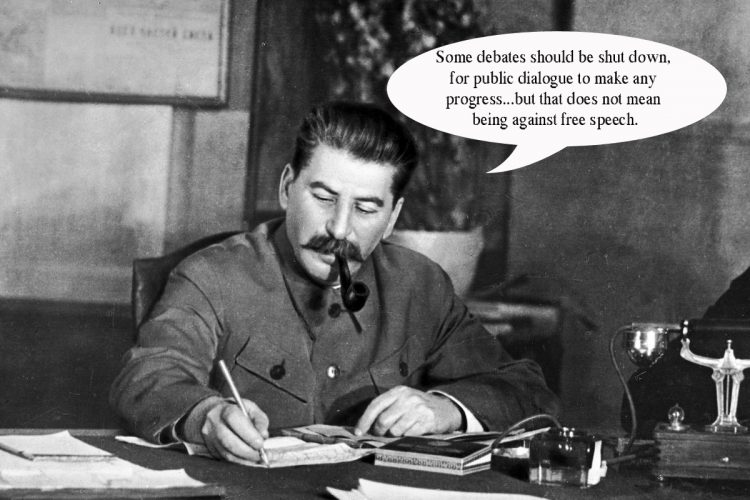
But don’t worry, they only want to shut down “settled” debates
By Kit Knightly | OffGuardian | June 23, 2019
There’s a lot of talk about “free speech” being under threat these days, with reports of de-platforming at universities, academics losing their jobs because of their political opinions, artists and celebrities getting “cancelled” over an off-colour joke, an even vaguely non-PC opinion, or just supporting Donald Trump.
The entire reason this website exists is the sheer amount of censorship in both corporate media and social media.
We have an archive dedicated to it, that doesn’t include even half of 1% of the deleted comments on The Guardian alone.
Rather notably the US is trying to extradite (and perhaps execute) a man for simply telling the truth.
You’d be forgiven for thinking that free speech was, indeed, under attack.
But you’d be wrong. The Guardian says so, or at least Martha Gill says so. She headlines:
Free speech isn’t under threat. It just suits bigots and boors to suggest so
Before explaining:
But is free speech really under threat? The first thing to say is that the scale of the problem in universities has been exaggerated. The practice of denying people speaking slots over their views has rightly caused concern, but every single instance has also attracted vast coverage in national papers, giving the impression of an epidemic. They are not reflective of the feelings of most students.
Free speech advocates also misunderstand the motivation of those who might want to shut down a debate: they see this as a surefire mark of intolerance.
…some debates should be shut down. For public dialogue to make any progress, it is important to recognise when a particular debate has been won and leave it there.
It’s a magical journey:
- Censorship ISN’T happening, that’s just something racists say
- If censorship WERE happening it would be for a good reason
- Censorship IS happening, and is a good thing
Personally, I love the phrase “For public dialogue to make any progress, it is important to recognise when a particular debate has been won and leave it there”, wonderful. Perfect. The liberal argument for censorship – The debate isn’t shut down, it’s just over. We won. We need to move forward.
Dissent will be bad for “public dialogue”.
The examples she cites – Flat Earth, burning witches etc. are deliberately extreme and ridiculous, but the principle could equally apply to anything. Global warming, Assad’s “war crimes”, socialism, antisemitism. MH17. The Skripals.
The list is endless. All they have to do is assume a political position, declare the debate over and then silence the dissent for the sake of “public dialogue”. This does not make them “anti-free speech”:
No-platformers are not scared – they simply think certain debates are over. You may disagree, but it does not mean they are against free speech.
A beautifully totalitarian position. They will rebrand intolerance as being “enlightened” and “woke” and “progressive”.
Don’t worry guys – The only debates being shut down are ones which should be, because they’re over.
How comforting.
Who are Canary Mission?
Semitic Controversies | June 2, 2019
Canary Mission is a jewish pro-Israel organisation that is fairly infamous amongst the anti-Zionist community given that it has created and maintained a blacklist of Boycott, Divestment, Sanctions (hereafter BDS) activists. It then pushes for these blacklists to be used to identify ‘enemies of Israel/the jewish people’ by jews and ‘friends of Israel’ in communal and private organizations as well as the Israeli government.
In an article in the normally ardently pro-Israel ‘Tablet Magazine’ jewish academics David Greenberg, Rebecca Lesses, Jeffry Mallow, Deborah Dash Moore, Sharon Ann Musher, Cary Nelson, Kenneth Stern and Irene Tucker summarized Canary Mission’s strategy as:
‘Canary Mission, however, is not simply creating lists. It urges action to punish the students it targets, including the call to private organizations to shun them when hiring. But private organizations with a political mission are better off interviewing and inquiring to make sure they are making appropriate hires, rather than relying on Canary Mission’s dubious lists. They don’t need and should not turn to any blacklist to help them screen applicants. Canary Mission’s efforts enhance the potential for the unethical political screening of job applicants.’ (1)
They go on to explain Canary Mission’s modus operandi as follows:
‘In the spring of 2015 an anonymous group of people established a website announcing the formation of an organization they called Canary Mission. They began posting photos of college student activists working on behalf of the Boycott, Divestment, and Sanctions (BDS) movement against Israel, along with brief accounts of their activities. They described the website as a database “created to document the people and groups that are promoting hatred of the USA, Israel and Jews on college campuses in North America.” A smaller number of pro-BDS faculty were also documented on the site. From about 50 dossiers in the spring, the site grew to 150 by fall 2015. Canary Mission also began tweeting notices about BDS advocacy and organizing, along with tweets about the people the site was highlighting. As of mid-October 2016, there are 63 faculty members and 602 “individuals,” mostly students, identified on the site.’ (2)
This extremely cavalier and broad-brush approach to labeling people – often jews – as being ‘BDS activists’ and/or ‘enemies of Israel/the jewish people’ is seen most obviously in the fact that Canary Mission have routinely labelled Liberal Zionists such as David Biale of the University of California, Davis as such despite their obvious pro-Israel advocacy and credentials. (3)
Perhaps predictably once jews realized that if you weren’t a hard-line Revisionist Zionist of the Likudnik or more radical variety then you ran the risk of being labelled a ‘BDS activist’ and/or ‘enemy of Israel/the jewish people’ then they have begun protesting and kvetching loudly about Canary Mission’s mislabeling them but without too much upset about the tactics Canary Mission have used per se. (4)
Tilly Shames – a jewess who runs Hillel at the University of Michigan, Ann Arbour (aka an ardent Zionist) – was quoted by the ‘Jewish Daily Forward’ as stating that:
‘The tactics of the organization are troubling, both from a moral standpoint, but have also proven to be ineffective and counterproductive.’ (5)
And ‘Shames said that Canary Mission’s publication of dossiers on students on her campus had led to greater support for the targeted students and their beliefs, and had spread mistrust of pro-Israel students, who were suspected of spying for Canary Mission.’ (6)
Greenberg et al writing in the previously-mentioned article in ‘Tablet Magazine’ are also deeply suspicious of Canary Mission’s tactics and write that:
‘After a collage of campus demonstrations, including one of an anti-war rally, it continues: “Join us to combat this wave of hatred, protect freedom, and make campus life safe for everyone. It is your duty to ensure that today’s radicals are not tomorrow’s employees.”
As part of its fear-mongering agenda, the video tracks slowly across a Holocaust photograph. Whether this allusion is more absurd or despicable may depend on your perspective.’ (7)
This allusion to the central place of the ‘Holocaust’ in Revisionist Zionist thought and – what has been termed ‘the founding myths of Israel’ by the French writer Roger Garaudy – by Greenberg has been analysed in detail by academics such as Jacqueline Rose. (8) For our purposes we need to note the direct association by Canary Mission of the ‘Holocaust’ with non-support for Revisionist Zionist ideological positions.
This is important to note as we get on to who runs Canary Mission and its ever increasing ‘blacklist’ (9) as that links back to who runs it and confirms it via the strong ideological bias shown by Canary Mission even in its attempt to get into the jewish communal organization fetish of ‘published research reports’ about so-called ‘anti-Semitism’. (10)
Just who was running Canary Mission was a mystery until 2018 when Josh Nathan-Kazis of the ‘Jewish Daily Forward’ managed to find the disguised funding trail from a mysterious Israeli charity named ‘Megamot Shalom’ which has been receiving donations for Canary Mission from jewish communal organizations such as $100,000 from the San Francisco-based ‘Helen Diller Family Foundation’ in late 2016. (11)
To quote Nathan-Kazis’s summary at length:
‘According to filings with Israel’s charities registry, Megamot Shalom was set up in July 2016, just over a year after Canary Mission’s website appeared online. Its mission, according to the filings, is to “ensure the national image and strength of the state of Israel via the use of information disseminated by technological means.”
The public filings don’t mention Canary Mission by name, though they do say that the organization paid freelancers for editing website content and a consultant for data security. Among Megamot Shalom’s only reported assets are computers worth around $5,000.
Megamot Shalom’s publicly available financial reports bear two signatures. One signature is illegible in English and Hebrew. The other is the signature of Jonathan Bash, a British-born Jerusalem resident who two people, granted anonymity to speak about private conversations, told the Forward identified himself to them as the person who operates Canary Mission, as the Forward first reported in August.
Bash is identified in the filing as a “member of the directorate” of Megamot Shalom. When the Forward emailed him for comment in late September, two of his email accounts bounced back auto responses saying he was on an extended vacation.
Megamot Shalom has virtually no online footprint. What does exist on the Internet was scrubbed after the Forward began asking questions about the organization. An Israel-based writer named Zahava Raymond previously identified herself on LinkedIn as a “writer-researcher” for Megamot Shalom, but removed the organization’s name from her profile after the Forward sent her a query over Facebook. Raymond previously worked for Honest Reporting and NGO Monitor, pro-Israel advocacy groups.
Megamot Shalom received roughly $165,000 in the last six months of 2016, according to its financial report. It has not yet filed its financial report for 2017, which was due at the end of August. It’s not clear whether the donation from the Diller Foundation is reflected in the 2016 filings, or if it came in the 2017 calendar year.’ (12)
The ‘Helen Diller Family Foundation’ and its trustees are not without influence in American life since as Nathan-Kazis further points out:
‘The president of its board, real estate developer Jaclyn Safier, sits on the board of visitors of the University of California, Berkeley, and is a distinguished director of a foundation that supports the University of California, San Francisco. Another board member, Richard Rosenberg, is the former chairman and chief executive of Bank of America.’ (13)
This foundation also supports a vast array of other Revisionist Zionist and Israel First organizations operating in the Diaspora as proxies for the more politically extreme elements of the Israeli government as Sue Fishkoff has explained in San Francisco’s ‘JWeekly’:
‘Several other right-wing organizations that have received funding through Federation donor-advised funds or supporting foundations are now off the table as well, Grossman said. They include David Horowitz Freedom Center; the American Freedom Defense Initiative, founded by Pam Geller and Robert Spencer; and the American Freedom Law Center, co-founded by Robert Muise and David Yerushalmi. Past funding for these organizations has been criticized in recent reports in the Forward and Haaretz.’ (14)
Nor is the ‘Helen Diller Family Foundation’ alone in its unhappy position of being discovered financially supporting Israeli attempts to undermine the First Amendment in the United States and suffering the considerable backlash from their own members as a result. (15)
Between November 2016 and September 2017 the ‘Jewish Community Foundation of Los Angeles’, ‘one of the largest Jewish charities in the country, made a series of grants totaling $250,000 to Megamot Shalom, the Israeli not-for-profit organization that the Forward has identified as the likely operator of Canary Mission. The foundation now says that it will not fund Megamot Shalom in the future.’ (16)
Despite the ‘Jewish Community Foundation of Los Angeles’ donating four times to ‘Megamot Shalom’; it has tried to spin this by claiming that it only knew that ‘Megamot Shalom’ was ‘fighting anti-Semitism’ (17) and apparently was so utterly incompetent as to never do basic due diligence on the groups that it was dishing out money to.
It sort of sounds like a jewish conspiracy: doesn’t it?
Now this large amount of kosher cash being distributed to Canary Mission went somewhere and to whom it went was not so much the a-forenamed jew-pretending-to-be-gentile Jonathan Bash. (18)
Bash is merely a front-man for Rabbi Ben Packer – an activist and leader of the goy-hating movement of literal jewish terrorists named Kach based on the writings of Rabbi Meir Kahane – (19) who is using the money to fund Canary Mission and label his political enemies – of which there are legion – as Israeli daily ‘Haaretz’ has exposed. (20)
Perhaps the scariest thing about Rabbi Packer’s running of Canary Mission is the fact that it has direct links to the Israeli government or more specifically the rabidly Revisionist Zionist ‘Strategic Affairs and Public Diplomacy Ministry’ – run until recently by goy-hating extraordinaire Naftali Bennett – whose primary responsibility is ‘Public Diplomacy’, which is better known to the reading public as ‘Hasbara’.
This is demonstrated by the fact that the ‘Strategic Affairs and Public Diplomacy Ministry’ has been using Canary Mission’s blacklists as the basis for its own visa blacklists used to deny ‘enemies of Israel/the jewish people’ entry visas at Israeli immigration checkpoints. (21)
Nor is Canary Mission the only organisation of this type run by/closely allied to the ‘Israel on Campus Coalition’ and the new outfit ‘Know Your Professor’ – similar outfits to Canary Mission but more focused on blacklisting opponents in academia than in general – (22) also linked back to the Israeli government. (23)
Sounds like a jewish conspiracy to manipulate non-jews run in part by the Israeli government: doesn’t it?
References
(1) https://www.tabletmag.com/scroll/216271/the-blacklist-in-the-coal-mine-canary-missions-fear-mongering-agenda-college-campuses
(2) Ibid.
(3) https://forward.com/opinion/411404/im-a-zionist-canary-mission-targeted-me-anyway/
(4) https://forward.com/fast-forward/419806/st-louis-jewish-group-slams-canary-mission-for-blacklisting-local-student/
(5) https://forward.com/news/national/411355/revealed-canary-mission-blacklist-is-secretly-bankrolled-by-major-jewish/
(6) Ibid.
(7) https://www.tabletmag.com/scroll/216271/the-blacklist-in-the-coal-mine-canary-missions-fear-mongering-agenda-college-campuses
(8) Jacqueline Rose, 2003, ‘The Question of Zion’, 1st Edition, Princeton University Press: Princeton, especially pp. 58-107
(9) https://forward.com/opinion/411658/how-a-reporters-curiosity-broke-through-a-shadowy-websites-secrecy/
(10) https://legalinsurrection.com/2018/11/anti-semitism-watchdog-canary-mission-exposes-jewish-voice-for-peace-in-new-report/
(11) https://www.jweekly.com/2018/10/03/canary-mission-funding-was-one-time-grant-says-s-f-federation/; https://forward.com/news/national/411426/breaking-after-forward-report-federation-says-it-will-not-fund-canary/; https://forward.com/news/national/411355/revealed-canary-mission-blacklist-is-secretly-bankrolled-by-major-jewish/
(12) https://forward.com/news/national/411355/revealed-canary-mission-blacklist-is-secretly-bankrolled-by-major-jewish/
(13) Ibid.
(14) https://www.jweekly.com/2018/10/19/how-does-the-s-f-federation-vet-grantees/
(15) https://www.haaretz.com/us-news/.premium-young-jewish-activists-furious-over-s-f-federation-s-support-of-canary-mission-1.6530890; https://www.jweekly.com/2018/10/18/former-diller-teen-fellows-its-not-enough-to-apologize-you-have-to-take-action/
(16) https://forward.com/news/national/411895/second-major-jewish-charity-admits-funding-canary-mission-blacklist/
(17) https://forward.com/fast-forward/412097/la-jewish-group-suspends-grants-to-organization-tied-to-canary-mission/
(18) https://forward.com/news/national/411355/revealed-canary-mission-blacklist-is-secretly-bankrolled-by-major-jewish/
(19) Cf. Ami Pedahzur, Arie Perliger, 2009, ‘Jewish Terrorism in Israel’, 1st Edition, Columbia University Press: New York
(20) https://www.haaretz.com/israel-news/.premium-new-details-revealed-about-the-israeli-money-pipeline-to-canary-mission-1.6554802; https://www.haaretz.com/us-news/what-happened-to-these-u-s-jews-after-birthright-1.5465493; https://forward.com/news/411881/documents-reveal-men-behind-megamot-shalom-mysterious-charity-tied-to/
(21) https://forward.com/news/411453/israel-uses-canary-mission-blacklist-info-to-bar-activists/; https://www.timesofisrael.com/government-said-to-use-canary-mission-blacklist-to-bar-visitors/
(22) https://worldisraelnews.com/know-your-professor-a-new-website-to-expose-anti-israel-lecturers/; https://forward.com/news/410757/campus-pro-israel-group-monitored-progressive-jewish-students/
(23) https://www.haaretz.com/israel-news/blacklisting-u-s-citizens-playing-d-c-on-iran-aj-investigation-implicated-israel-1.6577528
Anti-Palestinian repression in Germany: Palestinian writer Khaled Barakat banned from speaking
Samidoun Palestinian Prisoner Solidarity Network | June 23, 2019
The repression of Palestinian rights advocacy in Germany continued last night, Saturday, 22 June, as Palestinian writer Khaled Barakat was banned by the Berlin authorities from delivering a speech on the so-called “deal of the century” spearheaded by Donald Trump and the Arab and Palestinian response. He was also banned from engaging in all political activities and events in Germany until 31 July, whether directly (in-person) or “indirectly” (over video.) This outrageous attack on freedom of expression is only the latest assault on Palestinian rights carried out by the German government.
The event was originally scheduled to take place on Friday, 21 June, organized by an Arab community discussion group that regularly hosts speakers on important events in the Arab world. The city-owned venue reportedly received complaints about the event from pro-Zionist and pro-Israeli apartheid organizations, and informed the hosts that they could not hold the event. The event was instead relocated to a Sudanese community center on Saturday, 22 June. With the Bahrain conference to promote so-called “economic peace” at the expense of Palestinian rights expected in the coming days, the talk was of particular importance.
However, without notice or explanation, there were large numbers of police stretching from the closest U-Bahn station to the venue and blocking the street. When Barakat approached with Samidoun international coordinator Charlotte Kates, they were stopped by police and told the event would not take place tonight because it had been prohibited. They were then taken in a police van to a larger police station, where they were met by a German-Arabic translator, more police and two representatives of the Foreigners’ Office of Berlin.
Barakat was presented with an 8-page document and told that he was not allowed to give speeches in person or over video, participate in political meetings or events or even attend social gatherings of over 10 people; he was told that violations were punishable by up to a year in prison. Under German law, non-citizens can be barred from political activity if it could harm the “security or stability” of Germany. The accusations, which purport to show that his political activity is “dangerous,” do not do so; instead, there is mainly a list of speeches and events as well as a 2014 interview with Rote Fahne News, the publication of the MLPD (Marxist-Leninist Party of Germany.) Despite claiming that Barakat’s speech could increase tensions or “political conflict” between Jews and Palestinians and Arabs in Germany, the document points to absolutely no negative repercussions whatsoever of all of his previous speeches in the country.
The document also accuses Barakat of being a member of the Palestinian leftist party, the Popular Front for the Liberation of Palestine (PFLP). Despite noting that the PFLP is, in fact, not banned in Germany, it notes that it is listed on the EU terrorist list and thus presents a danger, even though none of the listed allegations indicate any danger at all. It could not be more clear that this is the latest attempt on Palestinian expression and advocacy and the further restriction of freedom of speech, expression and association in Germany.
Barakat and Kates were also told that their residency in Germany would not be renewed and would “come to an end,” although they were not presented with that decision.
This incident comes amid an ongoing campaign by the Israeli Ministry of Strategic Affairs, the so-called “anti-BDS ministry,” to attack Palestinian and solidarity organizations, especially leftists. Barakat has been singled out by this ministry on multiple occasions, as has Samidoun and its work. It also comes following a series of attacks on Palestinian rights and freedom of speech in Germany, including:
- the political ban and stripping of the Schengen visitor visa targeting Rasmea Odeh, former Palestinian political prisoner and community leader
- the anti-BDS resolution passed by the German Bundestag (parliament) denouncing BDS as “anti-Semitic”
- the criminal prosecution of activists for interrupting an Israeli official speaker involved in the war on Gaza at Humboldt University
- the cancellation of performance invitations to American rapper Talib Kweli and Scottish rappers Young Fathers for their support for the boycott, divestment and sanctions (BDS) movement
- the forced resignation of the director of the Jewish Museum in Berlin for tweeting a link to a statement against the Bundestag’s anti-BDS resolution written by Jewish scholars
It should be noted that this repression comes hand in hand with political attacks on the Arab and Muslim communities in Germany spearheaded by the far-right rhetoric of the AfD and other parties, but with the active complicity of the official “left,” which continues to support the suppression of Palestinian community organizing and Palestine solidarity in defense of a colonial, apartheid, racist system. It also comes amid ongoing criminalization of popular movements in Europe, including trials of trade union leaders and refugee solidarity organizers in various countries.
Samidoun Palestinian Prisoner Solidarity Network expresses our deepest outrage at the political ban against Khaled Barakat. We believe that it indicates a serious danger that outright bans, police repression and residency revocation are becoming a police state norm for suppressing unwanted Palestinian political speech that defends rights, justice and liberation.
On Friday, 28 June, a protest is being organized against the Bundestag’s anti-BDS resolution under the slogan Palästina Spricht (Palestine Speaks), and we urge all to attend and participate. Internationally, your statements and voices of solidarity are critical in helping to fight back against this intensified repression. These attacks will not silence Khaled Barakat or the Palestinian people – but it is critical that we build our international movement to defend Palestine, especially as it is targeted for liquidation.
Saudi Arabia Buys $300m Spyware from Israel
Palestine Chronicle | June 20, 2019
Saudi Arabia has bought $300 million worth of spy software from Israel as part of a large scale military deal.
Senior Arab sources told Al Khaleej Online that the deal was struck without a mediator, despite the fact that the two countries do not maintain formal diplomatic relations.
The sources stressed that the Saudi intelligence services have sought to obtain advanced spyware in order to trace the Kingdom’s citizens – both in the country and abroad – amidst increasing criticism of the Saudi royal family.
Saudi Arabia, therefore, reached out to the Israeli market and struck a deal worth $300m with representatives of Israeli firms, the sources said, adding that both sides met and reached the deal in UK capital London.
According to the sources, Egypt and the United Arab Emirates (UAE) know about the deal, which includes 1,000 small yet sophisticated tracking devices that can be placed in the target’s mobile phone.
The Israeli representatives received full payment for the deal before handing over the devices and, according to the sources, plan to hand over another 2,000 such devices by 2020.
Journalists, activists disturbed by State Department’s anti-Iran troll campaign
RT | June 20, 2019
Victims of anti-Iran trolling campaign were shocked to learn it was taxpayer- funded by the State Department, but not so shocked to see the government attempting to cover it up or mainstream media giving it little coverage.
Journalists, human rights activists, academics, and even outspoken critics of the Iranian government were all targeted by @IranDisinfo, which smeared any and all critics of President Donald Trump’s hawkish Iran policy as paid operatives of the regime in social media assaults that some say veered into personal attacks. Now, they want answers as to how this $1.5 million operation – bristling with the hallmarks of a totalitarian propaganda campaign – was allowed to see daylight.
“How can individuals who are not willing to adhere to the norms of American civil society be entrusted with resources to promote civil society in other countries?” asked Jason Rezaian, a Washington Post columnist who was on the troll’s hit list – despite spending time in an Iranian jail.
In a Twilight Zone-level twist, the troll even went after the NATO-backed think tank Atlantic Council’s Iran expert and a former Voice of America host.
The State Department quietly “suspended” @IranDisinfo last month, admitting the operation had gone rogue in a closed-door congressional hearing, but an apology to those targeted, and answers on who was responsible, has not been forthcoming.
Former State Department employee Joel Rubin has pointed out @IranDisinfo was run under a “cooperative agreement” which means the government had “hands-on engagement” with the months-long smear campaign, contrary to its protestations that the project went off the rails only recently.
“What other @StateDept funded organizations claiming to promote democracy in #Iran are using taxpayer money to harass, intimidate, threaten and slander American journalists & academics? Follow the money folks,” tweeted Farnaz Fassihi, a Wall Street Journal columnist and @IranDisinfo target.
Money funding @IranDisinfo had been earmarked to counteract ISIS propaganda, as well as Russian and Chinese information ops, through the State Department’s Global Engagement Center, former White House official Brett Bruen told Independent journalist Negar Mortazevi, a former VOA host and another victim of the troll.
E-Collaborative for Civic Education, which was contracted to run @IranDisinfo, appears to be connected with pro-war think tank Foundation for Defense of Democracies (FDD), whose website boasted a page titled “Iran Disinfo” that was a carbon copy of the troll account, as well as other pro-regime-change organizations through its founder, Mariam Memarsadeghi.
“Never did I think that nine years [after imprisonment in Iran], an American administration that has claimed to stand in solidarity with the people of Iran would fund attacks against me,” Tara Sepehri Far of Human Rights Watch wrote in the Nation, demanding greater transparency and speculating about a “broader pattern of harassment funded in whole or in part by the US government against journalists and analysts.”
Mainstream media has been mostly silent on the issue, aside from those – like WaPo’s Rezaian – directly affected by the trolling. Even though BBC Persia journalists were among @IranDisinfo’s victims, the outlet hosted anti-regime activist Alireza Kiani, who dutifully defended the abusive propaganda as “quite beneficial with respect to the circumstances of the Iranian people,” insisting “Iran Disinfo attacked people’s political positions, not their person.”
CNN did limply condemn the operation a few weeks after it was exposed.
“There’s no moral equivalence between Iran and the US,” CNN assured its viewers, “but that clear line threatens to become a bit blurry when the US funds disinformation campaigns that attack people who don’t parrot the party line. That’s a tactic of authoritarian regimes, not democracies.”
We may not have heard the last of @IranDisinfo, either – its funding was only suspended “until [ECCE] takes necessary steps to ensure that any future activity remains within the agreed scope of work.”
Congress Considering National Threat Assessment Program to Predict If You Pose a Threat
Tenth Amendment Center | May 28, 2019
It has been nearly two years since I reported on the dangers of creating a law enforcement run Mental Health Assessment (MHA) program. In Texas, police use MHA’s to “screen” every person they have arrested for mental illness.
But the TAPS Act, first introduced in January, would take law enforcement screenings to a whole new level. It would create a national threat assessment of children and adults.
In the course of six months, the Threat Assessment, Prevention and Safety (TAPS) Act (H.R. 838) has seen support grow to nearly 80 Congress members.
Politicians are master manipulators. What better way to garner public support for a national threat assessment program than to introduce it during National Police Week.
The politicians laid it on thick, as a KHTS article revealed.
“We do this first to honor the sacrifice of these men and women in blue, who put their life on the line every single day to protect us in the vital role that law enforcement plays in the safety and well-being of our communities and our districts,” said Rep. Brian Babin (R-Calif.) in his opening statement. “And secondly to highlight a bipartisan solution — that we all are working on — to protect our communities and schools from the terrible acts of violence that we have seen, and are getting to be almost routine.”
Taken at face value, the TAPS Act sounds like a noble attempt to stop school shootings but not all is as it seems.
Crystal Ball-Reading Police to Predict if You Pose a Future Threat
The TAPS Act would encourage law enforcement to give everyone a personal threat assessment (kids and adults) and single out those that they deem as future threats. (Click here to see how our homes receive threat assessments.)
“By bringing threat assessment experts together, and utilizing evidence-based behavioral threat assessment and management processes, we can bolster public safety by implementing strategies to identify and stop dangerous individuals before they can commit an act of violence. We have the expertise to combat the targeted violence plaguing our schools, places of worship, and public spaces, but we have yet to fully implement it to prevent attacks.”
The TAPS Act has all the earmarks of a paranoid police state that considers everyone a potential threat. It will create a “Joint Behavioral Threat Assessment and Management Task Force to identify individuals that exhibit patterns of dangerous behavior that MAY precede an act of targeted violence.”
According to Senators Marco Rubio, Kyrsten Sinemea and Thom Tillis, the TAPS Act will create a national behavioral threat assessment and management process for everyone.
Requires the Task Force’s recommendations for the development of the National Strategy to:
- Ensure consideration of the different needs and resources of communities across the country, and will not be construed as a national standard.
- Include recommendations for the most effective leveraging of existing Federal, State, local, and Tribal infrastructure, workforce, and experience.
- Include recommendations to increase collaboration between government agencies and private entities that focus on public safety responsibilities.
- Include recommendations on training programs to disseminate to State and Local entities.
- Include recommendations for a Behavioral Threat Assessment and Management School Violence Prevention Program to train and support a multi-disciplinary and multi-jurisdictional behavioral threat assessment and management process for educational entities.
Bills like this mean, America has joined paranoid governments like China and Switzerland who consider kids to be potential threats.
Didn’t we learn anything from incarcerating Japanese Americans and the war against Communism?
The never-ending war on terror and the National Threat Assessment program should not be used as an excuse to destroy our Bill of Rights.
Kushner as a Colonial Administrator: Let’s Talk About The ‘Israeli Model’
By Ramzy Baroud | teleSUR | June 13, 2019
In a TV interview on June 2, on the news docuseries “Axios” on the HBO channel, Jared Kushner opened up regarding many issues, in which his ‘Deal of the Century’ was a prime focus.
The major revelation made by Kushner, President Donald Trump’s adviser and son-in-law, was least surprising. Kushner believes that Palestinians are not capable of governing themselves.
Not surprising, because Kushner thinks he is capable of arranging the future of the Palestinian people without the inclusion of the Palestinian leadership. He has been pushing his so-called ‘Deal of the Century’ relentlessly while including in his various meets and conferences countries such as Poland, Brazil and Croatia, but not Palestine.
Indeed, this is what transpired at the Warsaw conference on ‘peace and security’ in the Middle East. The same charade, also led by Kushner, is expected to be rebooted in Bahrain on June 25.
Much has been said about the subtle racism in Kushner’s words, reeking with the stench of old colonial discourses where the natives were seen as lesser, incapable of rational thinking beings who needed the civilized ‘whites’ of the western hemisphere to help them cope with their backwardness and inherent incompetence.
Kushner, whose credentials are merely based on his familial connections to Trump and family friendship with Israeli Prime Minister, Benjamin Netanyahu, is now poised to be the colonial administrator of old, making and enforcing the law while the hapless natives have no other option but to either accommodate or receive their due punishment.
This is not an exaggeration. In fact, according to leaked information concerning Kushner’s ‘Deal of the Century,’ and published in the Israeli daily newspaper, Israel Hayom, if Palestinian groups refuse to accept the US-Israeli diktats, “the US will cancel all financial support to the Palestinians and ensure that no country transfers funds to them.”
In the HBO interview, Kushner offered the Palestinians a lifeline. They could be considered capable of governing themselves should they manage to achieve the following: “a fair judicial system … freedom of the press, freedom of expression, tolerance for all religions.”
The fact that Palestine is an occupied country, subject in every possible way to Israel’s military law, and that Israel has never been held accountable for its 52-year occupation seems to be of no relevance whatsoever, as far as Kushner is concerned.
On the contrary, the subtext in all of what Kushner has said in the interview is that Israel is the antithesis to the unquestionable Palestinian failure. Unlike Palestine, Israel needs to do little to demonstrate its ability to be a worthy peace partner.
While the term ‘US bias towards Israel’ is as old as the state of Israel itself, what is hardly discussed is the specific of that bias, the decidedly condescending, patronizing and, often, racist view that US political classes have of Palestinians – and all Arabs and Muslims, for that matter; and the utter infatuation with Israel, which is often cited as a model for democracy, judicial transparency and successful ‘anti-terror’ tactics.
According to Kushner a ‘fair judicial system’ is a condition sine qua non to determine a country’s ability to govern itself. But is the Israeli judicial system “fair” and “democratic”?
Israel does not have a single judicial system, but two. This duality has, in fact, defined Israeli courts from the very inception of Israel in 1948. This de facto apartheid system openly differentiates between Jews and Arabs, a fact that is true in both civil and criminal law.
“Criminal law is applied separately and unequally in the West Bank, based on nationality alone (Israeli versus Palestinian), inventively weaving its way around the contours of international law in order to preserve and develop its ‘(illegal Jewish) settlement enterprise’,” Israeli scholar, Emily Omer-Man, explained in her essay ‘Separate and Unequal’.
In practice, Palestinians and Israelis who commit the exact same crime will be judged according to two different systems, with two different procedures: “The settler will be processed according to the Israeli Penal Code (while) the Palestinian will be processed according to military order.”
This unfairness is constituent of a massively unjust judicial apparatus that has defined the Israeli legal system from the onset. Take the measure of administrative detention as an example. Palestinians can be held without trial and without any stated legal justification. Tens of thousands of Palestinians have been subjected to this undemocratic ‘law’ and hundreds of them are currently held in Israeli jails.
It is ironic that Kushner raised the issue of freedom of the press, in particular, as Israel is being derided for its dismal record in that regard. Israel has reportedly committed 811 violations against Palestinian journalists since the start of the ‘March of Return’ in Gaza in March 2018. Two journalists – Yaser Murtaja and Ahmed Abu Hussein – were killed and 155 were wounded by Israeli snipers.
Like the imbalanced Israeli judicial system, targeting the press is also a part of a protracted pattern. According to a press release issued by the Palestinian Journalists Union last May, Israel has killed 102 Palestinian journalists since 1972.
The fact that Palestinian intellectuals, poets and activists have been imprisoned for Facebook and other social media posts should tell us volumes about the limits of Israel’s freedom of press and expression.
It is also worth mentioning that in June 2018, the Israeli Knesset voted for a bill that prohibits the filming of Israeli soldiers as a way to mask their crimes and shelter them from any future legal accountability.
As for freedom of religion, despite its many shortcomings, the Palestinian Authority hardly discriminates against religious minorities. The same cannot be said about Israel.
Although discrimination against non-Jews in Israel has been the raison d’être of the very idea of Israel, the Nation-State Law of July 2018 further cemented the superiority of the Jews and inferior status of everyone else.
According to the new Basic Law, Israel is “the national home of the Jewish people” only and “the right to exercise national self-determination is unique to the Jewish people.”
Palestinians do not need to be lectured on how to meet Israeli and American expectations, nor should they ever aspire to imitate the undemocratic Israeli model. What they urgently need, instead, is international solidarity to help them win the fight against Israeli occupation, racism and apartheid.
UK Rights Group’s Legal Challenge Shows MI5 Illegally Preserved Surveillance Data
Sputnik – 12.06.2019
The ongoing legal challenge of UK human rights group Liberty over data privacy breaches committed by MI5 has revealed new details about the violations, showing that the security service has been failing to remove collected bulk surveillance data on time and received surveillance warrants based on knowingly false information.
Under the Investigatory Powers Act (IPA), MI5 has the authority to collect, upon authorization, personal data of a large number of innocent people and store it for potential future investigations. Security services, however, cannot store such data indefinitely: they are obliged to delete it within certain time limits.
Documents released during a court hearing on Tuesday showed that the MI5 legal team said, as quoted by the Liberty, that there is “a high likelihood [of material] being discovered when it should have been deleted, in a disclosure exercise leading to substantial legal or oversight failure.”
Moreover, a senior official from the intelligence service said that people’s personal data was being kept in “ungoverned spaces,” the rights group said in a statement, published on its official website.
“These shocking revelations expose how MI5 has been illegally mishandling our data for years, storing it when they have no legal basis to do so. This could include our most deeply sensitive information – our calls and messages, our location data, our web browsing history,” Liberty lawyer Megan Goulding said, as quoted by the rights group.
Investigatory Powers Commissioner and Lord Justice Adrian Fulford, who is responsible for verifying that the security services respect data privacy provisions laid out in the IPA, described MI5’s actions as “undoubtedly unlawful.”
“Without seeking to be emotive, I consider that MI5’s use of warranted data … is currently, in effect, in ‘special measures’ and the historical lack of compliance … is of such gravity that IPCO [Investigatory Powers Commissioner’s Office] will need to be satisfied to a greater degree than usual that it is ‘fit for purpose'” Fulford said as quoted by the Liberty website.
According to the rights group, the commissioner said that the intelligence would have never obtained permissions for their surveillance activities if the watchdog had known that MI5 was violating the IPA.
“Warrants for bulk surveillance were issued by senior judges (known as Judicial Commissioners) on the understanding that MI5’s data handling obligations under the IPA were being met – when they were not,” Liberty said.
The rights group raised the alarm about MI5’s violations in May, prompting the investigatory powers commissioner to start an investigation into the matter.
Kushner as a Colonial Administrator
Let’s Talk About the “Israeli Model”
By Ramzy Baroud | Dissident Voice | June 11, 2019
In a TV interview on June 2, on the news docuseries “Axios” on the HBO channel, Jared Kushner opened up regarding many issues, in which his ‘Deal of the Century’ was a prime focus.
The major revelation made by Kushner, President Donald Trump’s adviser and son-in-law, was least surprising. Kushner believes that Palestinians are not capable of governing themselves.
Not surprising, because Kushner thinks he is capable of arranging the future of the Palestinian people without the inclusion of the Palestinian leadership. He has been pushing his so-called ‘Deal of the Century’ relentlessly, while including in his various meets and conferences countries such as Poland, Brazil and Croatia, but not Palestine.
Indeed, this is what transpired at the Warsaw conference on ‘peace and security’ in the Middle East. The same charade, also led by Kushner, is expected to be rebooted in Bahrain on June 25.
Much has been said about the subtle racism in Kushner’s words, reeking with the stench of old colonial discourses where the natives were seen as lesser, incapable of rational thinking beings who needed the civilized ‘whites’ of the western hemisphere to help them cope with their backwardness and inherent incompetence.
Kushner, whose credentials are merely based on his familial connections to Trump and family friendship with Israeli Prime Minister, Benjamin Netanyahu, is now poised to be the colonial administrator of old, making and enforcing the law while the hapless natives have no other option but to either accommodate or receive their due punishment.
This is not an exaggeration. In fact, according to leaked information concerning Kushner’s ‘Deal of the Century,’ and published in the Israeli daily newspaper, Israel Hayom, if Palestinian groups refuse to accept the US-Israeli diktats, “the US will cancel all financial support to the Palestinians and ensure that no country transfers funds to them.”
In the HBO interview, Kushner offered the Palestinians a lifeline. They could be considered capable of governing themselves should they manage to achieve the following: “a fair judicial system … freedom of the press, freedom of expression, tolerance for all religions.”
The fact that Palestine is an occupied country, subject in every possible way to Israel’s military law, and that Israel has never been held accountable for its 52-year occupation seems to be of no relevance whatsoever, as far as Kushner is concerned.
On the contrary, the subtext in all of what Kushner has said in the interview is that Israel is the antithesis to the unquestionable Palestinian failure. Unlike Palestine, Israel needs to do little to demonstrate its ability to be a worthy peace partner.
While the term ‘US bias towards Israel’ is as old as the state of Israel itself, what is hardly discussed are the specifics of that bias, the decidedly condescending, patronizing and, often, racist view that US political classes have of Palestinians – and all Arabs and Muslims, for that matter; and the utter infatuation with Israel, which is often cited as a model for democracy, judicial transparency and successful ‘anti-terror’ tactics.
According to Kushner a ‘fair judicial system’ is a conditio sine qua non to determine a country’s ability to govern itself. But is the Israeli judicial system “fair” and “democratic”?
Israel does not have a single judicial system, but two. This duality has, in fact, defined Israeli courts from the very inception of Israel in 1948. This de facto apartheid system openly differentiates between Jews and Arabs, a fact that is true in both civil and criminal law.
“Criminal law is applied separately and unequally in the West Bank, based on nationality alone (Israeli versus Palestinian), inventively weaving its way around the contours of international law in order to preserve and develop its ‘(illegal Jewish) settlement enterprise’,” Israeli scholar, Emily Omer-Man, explained in her essay ‘Separate and Unequal’.
In practice, Palestinians and Israelis who commit the exact same crime will be judged according to two different systems, with two different procedures: “The settler will be processed according to the Israeli Penal Code (while) the Palestinian will be processed according to military order.”
This unfairness is constituent of a massively unjust judicial apparatus that has defined the Israeli legal system from the onset. Take the measure of administrative detention as an example. Palestinians can be held without trial and without any stated legal justification. Tens of thousands of Palestinians have been subjected to this undemocratic ‘law’ and hundreds of them are currently held in Israeli jails.
It is ironic that Kushner raised the issue of freedom of the press, in particular, as Israel is being derided for its dismal record in that regard. Israel has reportedly committed 811 violations against Palestinian journalists since the start of the ‘March of Return’ in Gaza in March 2018. Two journalists – Yaser Murtaja and Ahmed Abu Hussein – were killed and 155 were wounded by Israeli snipers.
Like the imbalanced Israeli judicial system, targeting the press is also a part of a protracted pattern. According to a press release issued by the Palestinian Journalists Union last May, Israel has killed 102 Palestinian journalists since 1972.
The fact that Palestinian intellectuals, poets and activists have been imprisoned for Facebook and other social media posts should tell us volumes about the limits of Israel’s freedom of press and expression.
It is also worth mentioning that in June 2018, the Israeli Knesset voted for a bill that prohibits the filming of Israeli soldiers as a way to mask their crimes and shelter them from any future legal accountability.
As for freedom of religion, despite its many shortcomings, the Palestinian Authority hardly discriminates against religious minorities. The same cannot be said about Israel.
Although discrimination against non-Jews in Israel has been the raison d’être of the very idea of Israel, the Nation-State Law of July 2018 further cemented the superiority of the Jews and inferior status of everyone else.
According to the new Basic Law, Israel is “the national home of the Jewish people” only and “the right to exercise national self-determination is unique to the Jewish people.”
Palestinians do not need to be lectured on how to meet Israeli and American expectations, nor should they ever aspire to imitate the undemocratic Israeli model. What they urgently need, instead, is international solidarity to help them win the fight against Israeli occupation, racism and apartheid.
Dr. Ramzy Baroud is an author and a journalist. He is athor of The Second Palestinian Intifada: A Chronicle of a People’s Struggle and his latest My Father Was a Freedom Fighter: Gaza’s Untold Story. He can be reached at ramzybaroud@hotmail.com.
Internet Free Speech All but Dead
Unelected, unnamed censors are operating across the Internet to suppress “unapproved” content.

By Philip Giraldi | Global Research | June 8, 2019
The Internet was originally promoted as a completely free and uncensored mechanism for people everywhere to exchange views and communicate, but it has been observed by many users that that is not really true anymore. Both governments and the service providers have developed a taste for controlling the product, with President Barack Obama once considering a “kill switch“ that would turn off the Internet completely in the event of a “national emergency.”
President Donald Trump has also had a lot to say about fake news and is reported to be supporting limiting protections relating to the Internet. In May, a “net neutrality” bill that would have prevented service providers from manipulating Internet traffic passed in the House of Representatives, but it is reported to be “dead on arrival” in the Senate, so it will never be enacted.
Social networking sites have voluntarily employed technical fixes that restrict some content and have also hired “reviewers” who look for objectionable material and remove it. Pending European legislation, meanwhile, might require Internet search engines to eliminate access to many unacceptable old posts. YouTube has already been engaged in deleting existing old material and is working with biased “partners” like the Anti-Defamation League (ADL) to set up guidelines to restrict future content. Many users of Facebook will have already undoubtedly noted that some contacts have been blocked temporarily (or even permanently) and denied access to the site.
Google now automatically disables or limits searches for material that it deems to be undesirable. If Google does not approve of something it will either not appear in search results or it will be very low on the list. And what does come up will likely favor content that derives from those who pay Google to promote their products or services. Information that originates with competitors will either be very low in the search results or even blocked. Google is consequently hardly an unbiased source of information.
In May 2017 Facebook announced that it would be hiring 3,000 new censors, and my own experience of social networking censorship soon followed. I had posted an article entitled “Charlottesville Requiem” that I had written for a website. At the end of the first day, the site managers noticed that, while the article had clearly attracted a substantial Facebook readership, the “likes” for the piece were not showing up on the screen counter, i.e., were not being tabulated. It was also impossible to share the piece on Facebook, as the button to do so had been removed.
The “likes” on sites like Facebook, Yahoo! news comments, YouTube, and Google are important because they automatically determine how the piece is distributed throughout the site. If there are a lot of likes, the piece goes to the top when a search is made or when someone opens the page. Articles similarly can be sent to Coventry if they receive a lot of dislikes or negative marks, so the approvals or disapprovals can be very important in determining what kind of audience is reached or what a search will reveal.
In my case, after one day my page reverted to normal, the “likes” reappeared, and readers were again able to share the article. But it was clear that someone had been managing what I had posted, apparently because there had been disapproval of my content based on what must have been a political judgment.
A couple of days later, I learned of another example of a similar incident. The Ron Paul Institute (RPI) website posts much of its material on YouTube (owned by Google) on a site where there had been advertising that kicked back to RPI a small percentage of the money earned. Suddenly, without explanation, both the ads and rebate were eliminated after a “manual review” determined the content to be “unsuitable for all advertisers.” This was a judgment rendered apparently due to disapproval of what the institute does and says. The ability to comment on and link from the pieces was also turned off.
Dissident British former diplomat Craig Murray also noted in April 2018 the secretive manipulation of his articles that are posted on Facebook, observing that his “site’s visitor numbers [were] currently around one-third normal levels, stuck at around 20,000 unique visitors per day. The cause [was] not hard to find. Normally over half of our visitors arrive via Facebook. These last few days, virtually nothing has come from Facebook. What is especially pernicious is that Facebook deliberately imposes this censorship in a secretive way.
“The primary mechanism when a block is imposed by Facebook is that my posts to Facebook are simply not sent into the timelines of the large majority of people who are friends or who follow. I am left to believe the post has been shared with them, but in fact it has only been shown to a tiny number. Then, if you are one of the few recipients and do see the post and share it, it will show to you on your timeline as shared, but in fact the vast majority of your own friends will also not receive it. Facebook is not doing what it is telling you it is doing—it shows you it is shared—and Facebook is deliberately concealing that fact from you. Twitter has a similar system known as ‘shadow banning.’ Again, it is secretive and the victim is not informed.”
More recently, pressure to censor Internet social networking and information sites has increased, coming both from government and from various interested constituencies. In late May, Facebook founder and CEO Mark Zuckerberg met with French President Emmanuel Macron to discuss how to eliminate “hate speech” on the Internet.
The two men agreed that the United States Internet model, in spite of already being heavily manipulated, is too laissez faire, and expressed an interest in exploring the French system where it is considered acceptable to ban unacceptable points of view. Zuckerberg suggested that it might serve as a good model for the entire European Union. France is reportedly considering legislation that establishes a regulator with power to fine Internet companies up to 4% of their global revenue, which can in some cases be an enormous sum, if they do not curb hateful expressions.
So unelected, unnamed censors are operating all around the Internet to control the content, which I suppose should surprise no one, and the interference will only get worse as both governments and service providers are willing to do what it takes to eliminate views that they find unacceptable—which, curiously enough, leads one to consider how “Russiagate” came about and the current hysteria being generated in the conventional media and also online against both Venezuela and Iran. How much of the anger is essentially fake, being manipulated or even fabricated by large companies that earn mega billions of dollars by offering under false pretenses a heavily managed product that largely does what the government wants? Banning hate speech will be, unfortunately, only the first step in eliminating any and all criticisms of the status quo.
Featured Video

Houthis Don’t Have to Conquer Saudi Arabia to Make It Pay
or go to
Aletho News Archives – Video-Images
From the Archives
Newly Released FBI Docs Shed Light on Apparent Mossad Foreknowledge of 9/11 Attacks
By Whitney Webb | MintPress News | May 17, 2019
NEW YORK — For nearly two decades, one of the most overlooked and little known arrests made in the aftermath of the September 11 attacks was that of the so-called “High Fivers,” or the “Dancing Israelis.” However, new information released by the FBI on May 7 has brought fresh scrutiny to the possibility that the “Dancing Israelis,” at least two of whom were known Mossad operatives, had prior knowledge of the attacks on the World Trade Center. … continue
Blog Roll
 Aletho News
- MEP blasts ‘Euro-Gestapo’ for lecturing Russia on democracy
- Syria May Send Troops to Saudi Arabia Amid War with Ansar Allah
- UK whines about losing billions to ‘Putin tax’
- Baghaei to Rubio: Distorted narratives cannot erase US record of broken commitments
- Houthis Don’t Have to Conquer Saudi Arabia to Make It Pay
- MOE: Nearly 22,000 Students and Education Workers Killed
- Guterres in Islamabad: Genocide, cowardice, and the cage of Imran Khan
- Johnson, Marandi say Yemen holds upper hand over Saudi Arabia
- False flags won’t save aggressors, Iran FM spokesman says
- The Makkah Pact Enters Into Force: The End of American Dominance or Its New Form?
- If Americans Knew
- Report claimed Mark Levin used by Israeli government to influence Trump
- Over 2,000 Gazans have died awaiting medical evacuation amid Israel’s continued siege
- How a U.S. Diplomat Suppressed and Altered Reports Critical of Israel
- 5 Palestinians Die from Israeli Strikes in Gaza as Relentless Attacks Continue
- Report: Ceasefire Slows Killing but Leaves Devastation Intact
- Country Music Singer Zach Bryan Breaks Attendance Record at Robert Kraft’s Gillette Stadium While Wearing ‘Free Palestine’ Shirt for Second Night in a Row
- Three years of death and devastation: Israel’s war on Gaza in pictures
- Why Hamas believed the status quo was more dangerous than its 7 October gamble
- Debunking Israel’s latest list of ‘terrorist’ journalists in Gaza
- In Gaza, focus is on survival, “every step is a struggle” – Daily Update
- No Tricks Zone
- New Study: 50 Years Of The Most Aggressive ‘Net Zero’ Policies Can Only Affect The Global Climate By 0.03°C
- US September “Heat” Was No Record…Many Records Set Decades Ago
- Latest European Green Energy Debacle; Portugal’s Largest Flagship Solar Park Insolvent!
- Green Energy Debacle: German Expert Professor Fritz Vahrenholt Warns Of Severe Economic And Social Consequences
- Two More Paleo Reconstructions Affirm Meters-Higher Sea Levels Across Ireland, Brazil 7000-6000 Years Ago
- New Study: Earth And Venus Surface Warmth Largely Explained By Convection And Lapse Rate, Not CO2 Or Radiation
- 2025 Nature Paper Claiming Worsening Global Drought Gets RETRACTED …Heavily Flawed
- New Study: ‘Global Drought Shows No Detectable Recent Acceleration Under Climate Warming’
- Economic Masterminds: German Socialists Suggest Taxing Productivity Gains Stemming From Using AI
- The South China Sea Has Not Been Cooperating With The Climate Change Narrative

