Did Bill Barr Call His Shot? Unanswered Questions about FBI’s Foreknowledge of the El Paso Shooting
William Barr’s warning that a “major incident” could occur “at any time” and “galvanize public opinion” around the unpopular encryption back-door policy he has been seeking seems to have come true in the weeks since the attorney general made those statements.
By Whitney Webb | MintPress News | August 7, 2019
As a series of recent mass shootings have brought renewed demands for the U.S. government to do something to address the spike in “lone wolf” violence, the Trump administration’s decision to blame internet privacy, controversial websites like 8chan, and social media for the shootings has raised eyebrows from across the political spectrum, particularly in light of claims that Trump’s recent rhetoric about immigrants may have incited some of the shooters.
During a press conference on Monday, Trump blamed the internet for the three most recent mass shooting events:
We must recognize that the internet has provided a dangerous avenue to radicalize disturbed minds and perform demented acts. We must shine light on the dark recesses of the internet and stop mass murders before they start…. The perils of the internet and social media cannot be ignored, and they will not be ignored… We cannot allow ourselves to feel powerless. We can and will stop this evil contagion.”
Yet, not long before the recent spate of mass shootings began, U.S. Attorney General William Barr gave a speech on July 23 in which he spoke of the need for all consumer electronic devices and encrypted software to have a backdoor for the government to bypass encryption, essentially calling for many of the same measures that Trump has proposed following the recent shootings.
Notably, Barr concluded his speech by stating that he anticipated “a major incident may well occur at any time that will galvanize public opinion on these issues.” In other words, just a few days prior to the recent spate of mass shootings, William Barr stated that he anticipated a public safety crisis that “may well occur at any time” and would reduce public resistance to the further erosion of civil liberties that he was advocating for in his speech.
Furthermore, the FBI, which operates under the jurisdiction of the Department of Justice and reports directly to William Barr, has now stated that it was aware of the El Paso shooter’s plan to murder civilians via a post made on 8chan at least two hours before the shooting took place. 8chan — a controversial website that the FBI is known to have used to incite violence as part of its controversial terrorist entrapment strategy — has since been banned in the shooting’s aftermath. In addition, less than two months ago, the FBI obtained a warrant for 8chan’s host — Ch.net — in which the Bureau demanded access to the entire contents of the accounts that were of interest in that specific investigation, suggesting that the FBI had increased access to information of hundreds of 8chan accounts in the lead-up to the recent shootings.
The overlap between Barr’s recent speech and Trump’s proposed solution to the massacres, as well as the FBI’s unusual recent relationship with 8chan, has led some to suggest that the Trump administration is taking advantage of the tragedy at El Paso and of other recent mass shootings to impose unpopular restrictions on civil liberties and increase the mass surveillance of innocent Americans.
An uncanny prediction
On Tuesday, July 23, Attorney General William Barr gave the keynote address at the 2019 International Conference on Cyber Security (ICCS) at Fordham University. The focus of Barr’s speech was the need for consumer electronic products and applications that use encryption to offer a “backdoor” for the government, specifically law enforcement, to obtain access to encrypted communications as a matter of public safety.
Early in his speech, Barr stated:
Service providers, device manufacturers and application developers are developing and deploying encryption that can only be decrypted by the end user or customer, and they are refusing to provide technology that allows for lawful access by law enforcement agencies in appropriate circumstances….
While encryption protects against cyberattacks, deploying it in warrant-proof form jeopardizes public safety more generally. The net effect is to reduce the overall security of society.”
Barr went onto say that “warrant-proof encryption is also seriously impairing our ability to monitor and combat domestic and foreign terrorists.” Barr stated that “smaller terrorist groups and ‘lone wolf’ actors” — such as those involved in the series of mass shootings in California, Texas and Ohio that would occur in the weeks after his speech — “have turned increasingly to encryption.” Barr later notes that he is specifically referencing encryption used by “consumer products and services such as messaging, smart phones, email, and voice and data applications.”
Barr then laid out his vision of what the solution to this challenge posed by “warrant-proof encryption” would look like:
We believe that when technology providers deploy encryption in their products, services, and platforms they need to maintain an appropriate mechanism for lawful access. This means a way for government entities, when they have appropriate legal authority, to access data securely, promptly, and in an intelligible format, whether it is stored on a device or in transmission.
We do not seek to prescribe any particular solution. Our private-sector technology providers have immensely talented engineers who have built the very products and services that we are talking about. They are in the best position to determine what methods of lawful access work best for their technology.”
After laying out his vision, Barr stated that, while he would like to give private companies time to willingly cooperate and comply with his suggested solution to “warrant-proof encryption,” “the time to achieve that [government back-doors into electronic consumer apps and products] may be limited.”
To overcome the resistance by some private companies — who do not want to renege on their right to privacy by giving the government back-door access to their devices — and American consumers, Barr tellingly anticipates that a “major incident” will soon take place that will mold public opinion in favor of his proposed solution.
Barr concluded his speech by stating:
I think it is prudent to anticipate that a major incident may well occur at any time that will galvanize public opinion on these issues.
As this debate has dragged on, and deployment of warrant-proof encryption has accelerated, our ability to protect the public from criminal threats is rapidly deteriorating. The status quo is exceptionally dangerous, unacceptable, and only getting worse.
The rest of the world has woken up to this threat. It is time for the United States to stop debating whether to address it, and start talking about how to address it.” (emphases added)
On Thursday, July 25, the last day of the ICCS conference, FBI Director Christopher Wray also echoed Barr’s call for government back-doors into encrypted software and apps, stating in his speech:
Cybersecurity is a central part of the FBI’s mission. But as the attorney general discussed earlier this week, our request for lawful access cannot be considered in a vacuum. It’s got to be viewed more broadly, taking into account the American public’s interest in the security and safety of our society, and our way of life. That’s important because this is an issue that’s getting worse and worse all the time.
There’s one thing I know for sure: It cannot be a sustainable end state for us to be creating an unfettered space that’s beyond lawful access for terrorists, hackers and child predators to hide. But that’s the path we’re on now, if we don’t come together to solve this problem.”
A new phase of an old campaign
The speeches given by Barr and Wray are the most recent iterations of the Department of Justice’s years-long effort to evade and weaken the encryption used by certain electronic products and applications, particularly encrypted messaging apps. Indeed, the DOJ was particularly active in late 2017 in pushing for back-doors into encrypted software, citing the encrypted devices of past perpetrators of mass shootings as proving the need for federal law enforcement to easily and quickly bypass encryption in criminal investigations.
However, Barr’s and Wray’s speeches mark a new phase of this government campaign targeting encryption, a campaign that has picked up in the past two weeks just as a series of mass shootings in the United States have led to widespread calls for the government to do something to prevent further massacres.
At a Monday press conference, President Donald Trump gave his official response to the most recent shootings in Ohio and Texas, tragedies that he largely blamed on the internet and its “dark recesses” that are inaccessible to the government. “We must recognize that the internet has provided a dangerous avenue to radicalize disturbed minds and perform demented acts,” Trump stated, before adding: “We must shine light on the dark recesses of the internet and stop mass murders before they start.”
“The perils of the internet and social media cannot be ignored and they will not be ignored,” the president emphasized.
One of the main solutions Trump offered to what he alleged caused the recent shootings was to mandate the DOJ “to work in partnership with local, state and federal agencies as well as social media companies to develop tools that can detect mass shooters before they strike.” Some interpreted this statement as suggesting the more widespread implementation of “pre-crime” software, such as Palantir, which was co-founded by billionaire Trump backer Peter Thiel, who is also on Facebook’s board.
Conveniently for William Barr, Facebook announced in May that the company is already developing just the “backdoor” that the attorney general has sought. This new initiative would implement AI-powered surveillance measures onto consumer devices, which would bypass end-to-end encryption on both the recently encrypted Facebook Messenger and the popular encrypted messaging app WhatsApp, acquired by Facebook in 2014. Though the measure was announced in May, it has received media attention only in the last week, following Barr’s speech at the 2019 ICCS.
Following Trump’s proposal for social media and the Barr-led DOJ to work together to monitor encrypted messages, it seems that Facebook will be one of the first major tech companies to offer its ready-made solution to the U.S. government. It is also worth considering the possibility that Barr may use the threat of his Silicon Valley antitrust probe to potentially strong-arm tech companies that would otherwise be unwilling to create a government back-door in their software or products. That probe was announced the same day that Barr spoke about anti-encryption measures at the 2019 ICCS.
In addition, between Barr’s July 23 speech and Trump’s August 5 press conference, there has been a concerted push from not only the DOJ but also the Five Eyes intelligence alliance, of which the U.S. is part, to weaken encryption or give governments access to encrypted applications.
On the heels of the 2019 ICCS, at which Barr and Wray spoke, there was a related cyber security summit in London — called the Five Country Ministerial — where “senior ministers from the U.K., Australia, Canada, New Zealand and the United States … reaffirmed their commitment to work together with industry to tackle a range of security threats.”
According to the U.K. government’s press release on the summit, which took place from July 29 to 30, the ministers in attendance “stressed that law enforcement agencies’ efforts to investigate and prosecute the most serious crimes would be hampered if the industry carries out plans to implement end-to-end encryption, without the necessary safeguards.” William Barr attended that summit, representing the U.S., and echoed his speech given a week prior, stating:
We must ensure that we do not stand by as advances in technology create spaces where criminal activity of the most heinous kind can go undetected and unpunished.”
Notably, Australia last year implemented a law similar to that which Barr is seeking to enact in the United States. It has since been lampooned by expert cryptographers for its ineffectiveness and has caused damage to Australia’s tech industry. According to the Guardian, Microsoft revealed in March that companies and governments it works with say they “are no longer comfortable about storing their data in Australia as a result of the encryption legislation.” Perhaps predictably, what has happened since Australia’s enactment of this controversial encryption legislation is the Australian government’s use of its new “back-doors” to widely surveil its civilians without a warrant.
Barr’s Orwellian bent
Barr’s outsized involvement in this recent push for a government back-door into all encryption apps is notable given his past. For instance, prior to becoming attorney general under Trump, Barr worked at the law firm Kirkland & Ellis, a firm that “represent[s] clients on matters relating to data and network security.” Kirkland & Ellis, in describing its own services, notes:
These matters are increasingly important to national security and international trade concerns such as government surveillance issues, state-sponsored cyber-attacks and espionage, and legal limitations on cross-border data transfers. The Firm represents clients in navigating these legal matters, including with respect to investigating security incidents/breaches and handling resulting litigation or government relations aspects of such incidents.”
Furthermore, Barr’s previous stint as attorney general, during the administration of George H.W. Bush, saw him push for increasing mass surveillance of innocent Americans. According to USA Today, in 1992, while serving as Attorney General under Bush Sr., Barr “launched a vast surveillance program that gathered records of innocent Americans’ international phone calls without first conducting a review of whether it was legal.” The program “ultimately gathered billions of records of nearly all phone calls from the United States to 116 countries, with little oversight from Congress or the courts” and also “provided a blueprint for far broader phone-data surveillance the government launched after the terrorist attacks of Sept. 11, 2001.” The program was partially carried out by the then-head of the DOJ’s Criminal Division, former FBI Director Robert Mueller.
Barr’s history of pushing for reducing privacy for citizens is troubling considering that, earlier in his career, he pushed for increased government secrecy while he was employed by the CIA in the late 1970s. For instance, while working at the CIA’s Office of Legislative Council, Barr attempted to circumvent the moratorium placed on the CIA that prevented it from destroying records and also stonewalled the Church Committee’s investigation into CIA abuses. Thus, Barr’s push for reduced privacy for citizens but increased privacy for the government bodes poorly for those who see government transparency and citizen privacy as important to keeping government overreach in check.
FBI foreknowledge
In the hours before the shooting at a Walmart in El Paso, Texas — and less than two weeks after Barr warned of an imminent “major incident” that would “galvanize public opinion” in favor of ending encryption free from a government back-door — the FBI was made aware of a manifesto published on the controversial website 8chan that is alleged to have been authored by the shooter, Patrick Crusius.
According to NBC News, the FBI was aware of the document prior to the shooting, but was unable to act quickly enough to prevent the attack. There have, however, been conflicting reports about exactly how long the FBI was aware of the alleged manifesto prior to the shooting.
For instance, soon after the shooting, CNN stated that three different sources had told the outlet that the manifesto had been “posted days before the shootings.” However, the FBI later stated less than a half hour before the shooting, while separate law enforcement sources told reporters that it was actually two hours before the shooting.
There is also a discrepancy regarding whether the manifesto was originally posted on 8chan and whether the shooter himself even posted it. Jim Watkins, who owns the 8chan message boards and has alerted federal authorities previously when past shooting manifestos were published at the site, stated:
First of all, the El Paso shooter posted on Instagram, not 8chan… Later, someone uploaded the manifesto. However, that manifesto was not uploaded by the Walmart shooter. I don’t know if he wrote it or not, but it was not uploaded by the murderer; that is clear.”
Facebook, which owns Instagram, said that it had disabled an Instagram account that belonged to Crusius and also noted that that account had been inactive for over a year.
In the past, 8chan administrators had deleted manifestos minutes after they were posted and warned federal authorities that the documents had been published. In the case of the El Paso shooting, Watkins claimed that the site had informed federal authorities as soon as they were aware that the manifesto had been uploaded to its page.
The facts that the FBI knew in advance of the manifesto, that the manifesto may not have been uploaded by the shooter, and that the FBI was quick to link that document to the shooting event soon after it took place have led to speculation about how the FBI was able to make that connection so quickly. For instance, lawyer Robert Barnes stated the following on Twitter:
How did [the] FBI identify the shooter before he began his attack from a post on an anonymous chat board? Usually, this means the shooter tipped them off either directly or indirectly (informant). Misuse of informants (including encouraging violence) is an underexplored problem.”
In addition, journalist Rachel Blevins posed a similar question on social media following the revelations, writing:
It took just hours for the FBI to both identify the suspect in the El Paso shooting and connect him to a manifesto posted on 8chan, which raises the question… was the suspect included in the FBI’s surveillance, and were their agents in contact with him before the shooting?”
This possibility is worth considering, given the well-documented history of the FBI’s policy of manufacturing domestic terror plots within the United States, most of which are ultimately foiled at the last minute by the Bureau. In many of those cases, many alleged terrorists would not have planned or attempted those attacks without goading and support from the FBI, leading critics to accuse the FBI of deliberately using entrapment. For instance, a 2014 study by Human Rights Watch and Columbia Law School’s Human Rights Institute found that “many of these people [in the cases examined in the study] would never have committed a crime if not for law enforcement encouraging, pressuring, and sometimes paying them to commit terrorist acts,” according to the study’s co-author Andrea Prasow.
There are several instances where the FBI sought out mentally handicapped and unstable individuals with no resources of their own, giving them incentives, fake weapons and even driving them to the scene of the planned fake terror attack. Two high-profile domestic terror cases have also had hints of FBI involvement — including the Pulse nightclub shooting, where the shooter’s father was later revealed to be a FBI informant and the FBI had attempted to goad the Pulse shooter into committing a terror attack years prior to the Pulse shooting. In addition, the family of the Boston Marathon bombers claimed that the FBI regularly visited their family home and had cultivated a close relationship with one of the bombers, Tamerlan Tsarnaev, prior to the bombing.
Since late 2016, the FBI’s controversial policy of inducting individuals to commit acts of terror in the United States has expanded after a federal appeals court ruling in December of that year said that federal agents were allowed to target a person’s religious affiliation in order to “probe the attitudes” of an individual who may want to “do something to America” by entrapping them in fake terror act schemes. The ruling also permitted federal agents to create false friendships, referred to in the ruling as the “illusory cultivation of emotional intimacy,” as a means of manipulating individuals to commit acts of terrorism — as well as providing these unstable individuals with money, vehicles, businesses and even vacations to get them to agree to participate in fake attacks.
As a result of this troubling trend, and given the FBI’s foreknowledge of the manifesto and its ease in connecting that document to the shooter, it becomes important to ask whether the FBI had more foreknowledge of the situation than it has publicly let on.
Though history indicates that FBI foreknowledge of the shooter is definitely plausible, 8chan has been a recent focus of the FBI in recent months. For instance, after the alleged manifesto of the shooter responsible for the massacre at the Poway Synagogue earlier this year was published on 8chan, the FBI issued a warrant for hundreds of 8chan user accounts that had commented on the Poway Synagogue shooter’s thread, including both users that supported his statement of intent and those who were appalled by it.
According to the Bureau’s application for a search warrant, the FBI was seeking the “IP address and metadata information about [Poway shooter John] Earnest’s original posting and the postings of all of the individuals who responded to the subject posting and/or commented about it.” The FBI further instructed Ch.net, which hosts 8chan, “to make a digital copy of the entire contents of the accounts subject to seizure.”
It goes without saying that with the information on hundreds of 8chan users, the FBI would have had access to potential future informants and potential targets to be “groomed” by the FBI for a future domestic terrorism entrapment case. This is especially likely given that the FBI’s reasoning for obtaining this large amount of information in the warrant was to identify “individuals who are inspired by the subject posting [i.e., the Poway shooter manifesto].” One 8chan user who was contacted by the FBI after this search warrant and filmed the encounter, was asked by federal agents to help them with information-gathering on other 8chan users.
This possibility is further supported by the fact that the FBI agent who filed the search warrant application, FBI Special Agent Michael Rod, revealed that he had been active on 8chan and (perhaps inadvertently) revealed his user name on 8chan to be user “8f4812.” An archive of the Poway shooter’s 8chan thread, available here, reveals that Rod stated in that 8chan thread that Russia was to blame for the Poway shooting and Rod also claimed that he knew of the Poway shooting 15 minutes before it happened but was unable to warn the authorities because he “was shit posting and got tied up.”
In the wake of the recent shootings in El Paso, Texas and Dayton, Ohio, 8chan was taken offline after internet infrastructure company Cloudflare declined to continue supporting the website.
A tragedy foretold and exploited
William Barr’s warning that a “major incident” could occur “at any time” and “galvanize public opinion” around the unpopular encryption back-door policy he has been seeking seems to have come true in the weeks since the attorney general made those statements. Given Barr’s influence over the FBI, which operates under his jurisdiction, it is important to scrutinize the evidence that the FBI had apparent foreknowledge of at least one of these recent shootings, and consider that the Bureau may have failed to act to prevent the tragedy, allowing Barr’s prediction just weeks earlier to become a self-fulfilling prophecy.
Trump’s proposed solution to the recent spate of mass shootings is focused on giving Barr a mandate to work with social media and tech companies to prevent another mass shooting before it occurs. It seems evident that this solution is set to involve surveilling encrypted communications to ostensibly prevent another shooting while also providing Barr, and the DOJ at large, the back-door into encrypted apps and consumer products that they have long sought but have been unable to sell to either the public or those same tech companies.
Now, a public safety crisis has emerged in the wake of Barr’s recent speech, tipping the scales — as Barr had predicted — so the public would favor further reductions to their civil liberties and right to privacy so that the federal government could provide increased public safety through increased surveillance. Yet, taking this alongside the well-documented fact that the FBI regularly manufactures domestic terror plots, it is worth asking whether some of these recent shootings were allowed to happen and whether public officials like William Barr are manipulating the public’s reaction to these tragedies to advance their own political agendas and further the build-up of state power.
Whitney Webb is a MintPress News journalist based in Chile. She has contributed to several independent media outlets including Global Research, EcoWatch, the Ron Paul Institute and 21st Century Wire, among others. She has made several radio and television appearances and is the 2019 winner of the Serena Shim Award for Uncompromised Integrity in Journalism.
Spooks behind Patriot Act, drone & torture programs unite to ‘secure’ US elections, free of charge
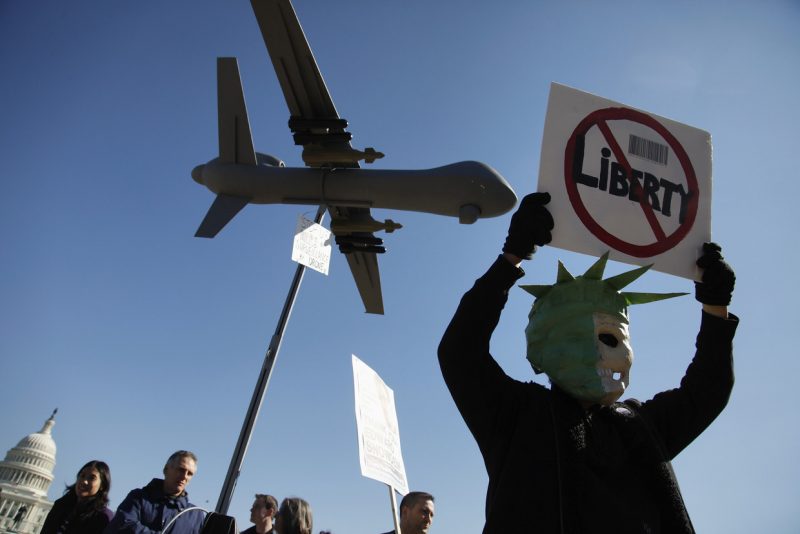
Protest against mass surveillance © Reuters / Jonathan Ernst
By Helen Buyniski | RT | August 7, 2019
A group of former intelligence agency directors and other trustworthy cybersecurity pros has launched a charitable initiative to protect US elections against foreign interference. So who are these noble guardians of democracy?
The “US Cyberdome” claims to apply top-of-the-line cybersecurity capabilities to the country’s vulnerable election systems, motivated by nothing more than a selfless devotion to protecting democracy against “sophisticated attacks by constant and ever-evolving threats.” Stuffed with sinister ex-spooks like former Director of National Intelligence James Clapper and former Homeland Security Secretary Michael Chertoff, Cyberdome will keep America’s democracy safe from “purposeful attacks and exploits” and even “undue influence from enemies both foreign and domestic” – at no cost!
One might be forgiven for looking this particular gift horse in the mouth. Clapper, after all, stood in front of Congress and denied under oath that the NSA was collecting data on US citizens, an apparent act of perjury he attributed first to forgetting about the Patriot Act section used to authorize the agency’s StellarWind surveillance program and later to simple misspeaking. He has also claimed Russians are “genetically driven to co-opt, penetrate, gain favor” – not exactly the kind of impartial authority one wants guarding one’s democracy. And Chertoff, a member of the infamous Atlantic Council, co-wrote both the Patriot Act and the CIA interrogation memo advising agents on the judicious use of waterboarding.
Other members of Cyberdome’s board of advisors include former Homeland Security Secretary Jeh Johnson, who oversaw Obama’s targeted drone assassination program and approved the killing of US citizens like Anwar al-Awlaki without due process; and former CIA director Michael Morell, another Atlantic Council member who was responsible for reviewing the “intelligence” that went into then-Secretary of State Colin Powell’s infamous United Nations speech in which he claimed Iraq had weapons of mass destruction. A less trustworthy bunch has not been assembled on an advisory board since the Orwellian browser plugin NewsGuard was unveiled.
It’s not like Cyberdome’s tech isn’t expensive – the group was founded by Matt Barrett, who led the development of the National Institute of Standards and Technology’s “Cybersecurity Framework,” a best-practices security infrastructure program that came with a price tag so hefty half the organizations that reviewed it cited cost as the primary barrier to adoption. Cyberdome accepts donations (inviting donors to “Put Your Money Where Your Democracy Is!”), but securing the nation’s voting systems to NIST standards isn’t cheap.
This, it seems, is where the advisory board comes in – with such a pedigreed array of spooks on hand, elections that don’t adopt Barrett’s vision of cybersecurity could easily experience a breach or two. Top-brass spies like Cyberdome’s board know how to spoof traffic from foreign “hackers” – a capability WikiLeaks revealed the CIA possesses in the Vault7 leaks. If they want to knock off an inconvenient presidential candidate, all they need to do is spoof a hack into the voting system from whoever the bogeyman du jour is, and voila – instant Manchurian (or Siberian) candidate.
Former DHS Secretary Michael Chertoff warned when the NIST framework was unveiled in 2014 that unless Congress “really put some muscle behind it” or regulators got involved, it would be difficult to achieve widespread adoption of the “voluntary” program. Chertoff in his post-DHS career has hopped from industry to industry collecting large paychecks to consult on cybersecurity, convincing everyone from bankers to airports that the cyber-barbarians are at the gates, and only he can protect them. And Cyberdome is merely his vision writ large, with the whole election system in its sights.
The company claims its initial efforts are focused “only” on securing the 2020 presidential campaign, but its hope is to ultimately “assist all national political campaigns.” As Johnson said in a statement on Tuesday, “In the face of known, ongoing efforts by foreign powers to try to interfere in our upcoming election, US Cyberdome could not come at a more critical juncture.”
Translation? “Gee, that’s a nice democracy you’ve got there – sure would be a shame if something happened to it.”
Helen Buyniski is an American journalist and political commentator, working at RT since 2018
We’re All Enemies of the State: Draconian Laws, Precrime & the Surveillance State
By John W. Whitehead | The Rutherford Foundation | August 6, 2019
We’ve been down this road many times before.
If the government is consistent about any one thing, it is this: it has an unnerving tendency to exploit crises and use them as opportunities for power grabs under the guise of national security.
Cue the Emergency State, the government’s Machiavellian version of crisis management that justifies all manner of government tyranny in the so-called name of national security.
Terrorist attacks, mass shootings, “unforeseen economic collapse, loss of functioning political and legal order, purposeful domestic resistance or insurgency, pervasive public health emergencies, and catastrophic natural and human disasters”: the government has been anticipating and preparing for such crises for years now.
It’s all part of the grand plan for total control.
The government’s proposed response to the latest round of mass shootings—red flag gun laws, precrime surveillance, fusion centers, threat assessments, mental health assessments, involuntary confinement—is just more of the same.
It’s a simple enough formula: first, you create fear, then you capitalize on it by seizing power.
For instance, in his remarks on the mass shootings in Texas and Ohio, President Trump promised to give the FBI “whatever they need” to investigate and disrupt hate crimes and domestic terrorism.
Let that sink in a moment.
In a post-9/11 America, Trump’s promise bodes ill for whatever remnants of freedom we have left. With that promise, flippantly delivered without any apparent thought for the Constitution’s prohibitions on such overreach, the president has given the FBI the green light to violate Americans’ civil liberties in every which way.
This is how the Emergency State works, after all.
So what does the government’s carefully calibrated response to this current crisis mean for freedom as we know it? Compliance and control.
For starters, consider Trump’s embrace of red flag gun laws, which allow the police to remove guns from people “suspected” of being threats, will only add to the government’s power.
Be warned: these laws, growing in popularity as a legislative means by which to seize guns from individuals viewed as a danger to themselves or others, are yet another Trojan Horse, a stealth maneuver by the police state to gain greater power over an unsuspecting and largely gullible populace.
Seventeen states, plus the District of Columbia, now have red flag laws on their books. That number is growing.
In the midst of what feels like an epidemic of mass shootings, these gun confiscation laws—extreme risk protection order (ERPO) laws—may appease the fears of those who believe that fewer guns in the hands of the general populace will make our society safer.
Of course, it doesn’t always work that way.
Anything—knives, vehicles, planes, pressure cookers—can become a weapon when wielded with deadly intentions.
With these red flag gun laws, the intention is to disarm individuals who are potential threats.
Therein lies the danger of these red flag laws, specifically, and pre-crime laws such as these generally, especially when you put the power to determine who is a potential danger in the hands of government agencies, the courts and the police.
After all, this is the same government that uses the words “anti-government,” “extremist” and “terrorist” interchangeably.
This is the same government that has a growing list—shared with fusion centers and law enforcement agencies—of ideologies, behaviors, affiliations and other characteristics that could flag someone as suspicious and result in their being labeled potential enemies of the state.
For instance, if you believe in and exercise your rights under the Constitution (namely, your right to speak freely, worship freely, associate with like-minded individuals who share your political views, criticize the government, own a weapon, demand a warrant before being questioned or searched, or any other activity viewed as potentially anti-government, racist, bigoted, anarchic or sovereign), you could be at the top of the government’s terrorism watch list.
Moreover, as a New York Times editorial warns, you may be an anti-government extremist (a.k.a. domestic terrorist) in the eyes of the police if you are afraid that the government is plotting to confiscate your firearms, if you believe the economy is about to collapse and the government will soon declare martial law, or if you display an unusual number of political and/or ideological bumper stickers on your car.
According to the FBI’s latest report, you might also be classified as a domestic terrorism threat if you espouse conspiracy theories, especially if you “attempt to explain events or circumstances as the result of a group of actors working in secret to benefit themselves at the expense of others” and are “usually at odds with official or prevailing explanations of events.”
In other words, if you dare to subscribe to any views that are contrary to the government’s, you may well be suspected of being a domestic terrorist and treated accordingly.
Be warned: once you get on such a government watch list—whether it’s a terrorist watch list, a mental health watch list, a dissident watch list, or a red flag gun watch list—there’s no clear-cut way to get off, whether or not you should actually be on there.
You will be tracked wherever you go.
You will be flagged as a potential threat and dealt with accordingly.
This is pre-crime on an ideological scale and it’s been a long time coming.
If you’re not scared yet, you should be.
Connect the dots.
Start with the powers amassed by the government under the USA Patriot Act, note the government’s ever-broadening definition of what it considers to be an “extremist,” then add in the government’s detention powers under NDAA, the National Security Agency’s far-reaching surveillance networks, and fusion centers that collect and share surveillance data between local, state and federal police agencies.
To that, add tens of thousands of armed, surveillance drones, facial recognition technology that will identify and track you wherever you go. And then to complete the picture, toss in the real-time crime centers which will attempt to “predict” crimes and identify so-called criminals before they happen based on widespread surveillance, complex mathematical algorithms and prognostication programs.
See how easy we’ve made it for the government to identify, label, target, defuse and detain anyone it views as a potential threat, including those who challenge its authority?
Yet as I make clear in my book Battlefield America: The War on the American People, you don’t even have to be a dissident to get flagged by the government for surveillance, censorship and detention.
All you really need to be is a citizen of the American police state.
Bars & Nightclubs Use A Secret Biometric Blacklist To Ban Customers

credit: PatronScan
MassPrivateI | June 4, 2019
Have you ever had too much to drink at a bar or nightclub and been asked to leave? Have you or your friends ever mouthed off to the staff or been hit on by a bartender? Have you ever Yelped or Tweeted about bad food or service?
If you answered yes to any of those questions, then you will be mortified to learn that Big Brother knows exactly who you are.
According to an article in OneZero, the service industry has been quietly using PatronScan to scan the IDs and faces of 500,000+ bargoers.
“PatronScan collected and retained information on over 10,000 patrons in Sacramento in a single day. Within a five month period, that added up to information on over 500,000 bargoers.”
PatronScan otherwise known as Servall Biometrics Inc. is first and foremost a biometrics company that makes its money collecting biometric data of service industry patrons.
Bars, nightclubs and pubs have used PatronScan to create a blacklist of 40,000+ customers. Who are, on average banned for 19 years from local establishments!
“Using PatronScan, our venues have placed over 40,000 people on our shared Banned Patron list.”
According to PatronScan’s Privacy Policy, the only way a person can be removed from their secret banned (blacklist) list is to contact the manager or head of security first; then and only then will PatronScan open up their own investigation.
PatronScan has such a cozy relationship with law enforcement that they warn customers, “their personal information may also be provided to us from a law enforcement agency.”
Doesn’t it make you feel all warm and snugly, knowing your local bar or club could be working with law enforcement?
Bars and nightclubs share blacklist of customers
According to OneZero,
“PatronScan logs where customers live, the household demographics for that area, how far each customer travelled to a bar, and how many different bars they had visited. OneZero readily shares the information it collects on patrons, both banned and not, at the request of police.”
Being banned from one bar in a city or town means you are banned (blacklisted) from other participating establishments.
To make matters worse, law enforcement has also created a national database, masquerading as a non-profit that tracks every alcoholic purchase you have made.
The database is called the National Liquor Law Enforcement Association or “Place of Last Drink.”
“NLLEA President Justin Nordhorn, said the NLLEA received federal money to develop a nationwide database that will allow law enforcement officers to input information about where an intoxicated person was drinking before a crime, incident or alcohol-related crash.”
With PatronScan, police will know who you are and which bars or clubs you frequent. With the NLLEA they will know what you had to drink. How is that for Orwellian?
Service industry is being turned into min-surveillance centers
When is the last time you entered a restaurant, bar or nightclub and asked the manager about their surveillance cameras? When is the last time you asked a doorman or the manager about what they do with your personal information?
OneZero’s article warns,
“Many bars also have internal surveillance systems, which track customer trends and catalog granular data on purchasing habits. Those tools are growing increasingly sophisticated, with obvious benefits to venue owners and law enforcement.”
NBC 6 warned that letting bars scan your drivers license puts all your personal information at risk.
“With just a swipe of your ID, computers can pull your personal information from it giving it to the companies and facilities you visit, including your date of birth, address, height and weight.”
According to the ACLU, drivers licenses contain much more information than you are being told.
Drivers license barcodes, “contain your name, address, date of birth, hair color, eye color, height, weight, gender, license expiration date, organ donor status, driver’s license number, fingerprint, medical information, and driver classification code.” (To see a detailed list of what drivers license barcodes contain, click here.)
The privacy implications for allowing your ID to be scanned by a bar or nightclub are clearly not worth the risks.
As NBC 6 warned, “the security experts we spoke to recommend you ask security to write down your information or take a photo of your ID instead of swiping it.”
Matt Cagle, a technology and civil liberties attorney with the ACLU of Northern California said, “When you create a confidential ban list, that’s an invitation for businesses to pretextually exclude people because of who they are.”
And that is the problem with companies like PatronScan, Suspect Technologies and law enforcement watchlists. Businesses and police do not need a reason to place someone on a banned list or watchlist and that should scare the hell out of everyone.
If Big Brother has its way — and it certainly appears like it does — Americans will soon find themselves living in a mirror-image of China where everything we do and everywhere we go is scrutinized.
A.I. “RoboCops” Continue Rolling Out Across U.S. Collecting Biometrics and Creating Blacklists
By Nicholas West | Activist Post | August 6, 2019
The move toward using robots in law enforcement, private security, and even to scare away the homeless, has been a decade-long trend that is now becoming much more prevalent in everyday life.
“RoboCops” have now been launched coast to coast in 16 states. Last year, it was security robots deployed in New York City. As Aaron Kesel reported:
The robots are able to scan anyone walking on the sidewalks, record license plates, use infrared vision, and one of the scariest uses of this technology is the capability to detect cellphone serial numbers within a designated patrolling area.
Huntington Park, CA now has its own version that’s been added to the police force, the “HP RoboCop.” MassPrivateI sent out an alert a couple months ago that this particular model would be rolled out. At the time, we received the usual promotional statement from police advertising the many benefits that citizens would received. This inspired Muckrock to file a records request from the HPPD to see what details might have been omitted from the original reporting. Last week, Muckrock received a cache of documents that they are now releasing to the public.
Muckrock highlights the added surveillance of the citizenry that they have the pleasure of funding with their own tax money to the tune of $8,000 per month, per robot, to operate. Once again the technology is being supplied by Knightscope, a leader in the field for supplying both governments and private security:
According to released marketing materials, HP RoboCop is a K5 model security robot produced by the Silicon Valley-based manufacturer Knightscope, Inc. […]
Interestingly enough, the HPPD goes further, and makes the claim that the K5 is a “fully autonomous security data machine” that can actually “differentiate between a harmless passer-by and potential criminal.”
As for how the K5 does that, the HPPD points to the robot’s many, many sensors, which are apparently capable of detecting faces, license plates, and even smartphones. Said faces, license plates, and smartphones can then be run against a “blacklist,” which would send an alert to the HPPD.
Here are some other bullet points that show the widespread applications for the new security robots:

Muckrock notes that the program is up for review after one year, which is about the only encouraging detail that is offered in Muckrock‘s extensive report.
The level of data collection, analytics and reporting smacks of yet more pre-crime efforts driven by artificial intelligence algorithms. As I’ve been reporting, these programs are coming under much greater scrutiny after other police departments have recorded failures across all three aforementioned parameters. The threat to privacy and overall liberty has become so grave that even the top university A.I. experts in the world have signed-off on a warning of “Technical Flaws” In Pre-Crime Police Systems. Other experts have said that A.I. police systems are “no better than a crystal ball” in predicting crime.
Now would be the time for residents of Huntington Park to get informed and begin asking serious questions about this new program during this one-year review period before more of their money is wasted on the pseudo-science of predictive policing.
Former Jammu and Kashmir Chief Ministers Taken into Custody as India Scraps State’s Special Status
Sputnik – 05.08.2019
New Delhi – Former Chief Ministers of the Indian state of Jammu and Kashmir Omar Abdullah and Mehbooba Mufti are among several prominent leaders who have been reportedly taken into custody by the authorities.
The move came after the Indian parliament’s Upper House passed a Bill on Monday to split the State into two separate territories. Earlier, the Indian government had revoked the state’s special constitutional status under Article 370.
“Taking into consideration the current situation in Kashmir and strong security concerns, it has become imperative to take measures to prevent the law and order situation in Kashmir from deteriorating any further,” the Office of the Executive Magistrate in Srinagar said in an order addressed to Mehbooba Mufti.
On Sunday evening, both Mufti – the leader of People’s Democratic Party (PDP) and Omar Abdullah- Vice President of National Conference (NC) were placed under house arrest.
Mufti, the last serving Chief Minister of Jammu and Kashmir from 2016 to 2018, was taken from her home in the state capital of Srinagar to a nearby government guest house.
Revocation of Article 370
Article 370 provided Jammu and Kashmir with an autonomous constitution as well as key decision-making rights. But earlier in the day, the Indian Home Minister Amit Shah said that the law was an impediment to the state’s growth, hampering the development of democracy and healthcare in the region, while fostering poverty and entrenching corruption in the state.
Relations between India and Pakistan have long been tense over competing claims to parts of the Kashmir region since the countries gained independence from Britain in 1947.
Feeding the Israel Lobby
Congress gives the Jewish state whatever it wants

By Philip Giraldi • Unz Review • August 6, 2019
If you have been wondering when the twenty Democratic aspirants for the presidency will begin a serious discussion of American foreign policy in the Middle East, where Washington has been bogged down in both current and impending wars, you are not alone. With the honorable exception of Tulsi Gabbard, no one seems keen to touch that particular live wire.
Part of the problem is the journalists who are asking the questions in the debates. To be sure, the publication of “The Israel Lobby and U.S. Foreign Policy” by professors John Mearsheimer and Stephen Walt back in 2007 opened the door to a frank discussion of why the United States is involved in unresolvable conflicts on behalf of a tiny client state. But unfortunately, while it is now possible to find in the mainstream media some honest analysis of Israel’s ability to corrupt policy formulation in Washington, in general the Jewish state continues to get a pass from both the press and politicians on all issues that matter.
And then there is the problem of Congress itself, which is precisely the institution that has been most corrupted by Israel and Jewish money. Almost thirty years ago, American politician Pat Buchanan described Congress as “Israeli occupied territory.” As a result, he was viciously attacked by the mainstream media and the political leadership of both parties, demonstrating beyond all doubt that he was correct in his observation. Today the Israel Lobby in the United States is far more powerful than it was in 1990, so much so that Israeli Prime Minister Benjamin Netanyahu actually boasts to his voters that he directs U.S. policy.
The hypocrisy inherent in the Israel-philia of America’s political leadership is such that it sometimes produces comic results. The whiney head of the House Intelligence Committee Congressman Adam Schiff, Democrat of California, was beside himself prior to the Robert Mueller testimony before Congress on July 24th, denouncing Russia and President Donald Trump, saying that the president’s actions amounted to “Disloyalty to country… Those are strong words… But disloyalty to country violates the very obligation of citizenship, our devotion to a core principle on which our nation was founded, that we, the people, not some foreign power that wishes us ill, we decide, who shall govern, us.”
Strong words indeed, but Adam Schiff knows perfectly well that Moscow’s alleged involvement in the 2016 election, which was relatively insignificant, had no measurable impact on the result. And both he and Mueller have been coy about presenting any real evidence that Russia is gearing up to do major damage in 2020, which is what they claim to be the case. By way of contrast, everyone in Washington knows very clearly but will never admit that Israel has seriously corrupted the United States government and its elected officials at all levels. But Schiff did not mention Israel, nor did he express concern that Israel’s clearly unsavory involvement with Trump transition team members General Michael Flynn and Jared Kushner was never thoroughly investigated or included in the final Mueller report. One might assume that a deliberate decision was made by some parties in power to avoid embarrassing Israel. Those parties almost certainly included Schiff.
Schiff, who is Jewish, frequently tells audiences about his love for Israel, sometimes complaining that it is treated unfairly. It might be suggested that if anyone in the government is partial to a foreign power it is Schiff, and that foreign power is Israel, not Russia.
Unfortunately, Schiff is far from unique. Perhaps he and a number of other Congressmen should register under the Foreign Agents Registration Act of 1938, as required by law. Congressmen are not exempt when they work to benefit a foreign nation, though they frequently believe themselves to be not subject to the very laws that they pass. In May a letter was sent to the White House with the signatures of 400 congressmen, purely to express America’s legislature’s solidarity with Israel and to give it a green light to do whatever it wishes vis-à-vis its neighbors. The letter cites some questionable American interests relating to Syria, but it also mentions Israel no less than 13 times.
If that does not convince one that Congress has always been and continues to be Israeli occupied territory, check out some bills that have been working their way through the legislature. The House voted overwhelmingly on July 23rd to formally oppose the Palestinian-backed nonviolent movement to boycott Israel. The measure, H.Res.246 opposes “efforts to delegitimize the State of Israel and the Global Boycott, Divestment, and Sanctions Movement [BDS] targeting Israel.” The bill had 349 co-sponsors and passed by a 398–17 vote. Sixteen Democrats and only one Republican opposed the bill. The bill is not a law but is rather intended to express the will of congress, which is perhaps the only good thing to say about it.
Other bills have not yet been voted on, presumably because friends of the Jewish state are looking for more goodies to add in. The pending legislative action includes the aid to Israel bill H.R.1837 the “United States-Israel Cooperation Enhancement and Regional Security Act”, which has 279 cosponsors. When the bill is approved, which it will be, it will increase the amount of aid given to Israel over ten years to $38 billion, though this is now regarded as a minimum figure which will be supplemented to meet the Jewish state’s expressed needs. And the aid is now unconditional, meaning that Israel will receive the money no matter how it behaves, while the Jewish state will also be able to use the U.S. taxpayer provided money to buy weapons from its own arms industry, cutting American defense contractors out of the loop and costing jobs in the United States.
Another bill to benefit Israel is also pending: H.R. 1850, the “Palestinian International Terrorism Support Prevention Act of 2019,” a law that would authorize and encourage financially sanctioning any foreign organization or individual that provides “support” to any group, organization or individual considered to be part of the Palestinian resistance. Interestingly, the bill does not even pretend to be based on U.S. national security: it is all about and for Israel. It could mean that foreign supporters of BDS, which is now considered a hostile entity by “the will of” Congress, could be subject to sanctions even though they are non-violent and threaten no one.
One final bit of bipartisan legislation best described as a pander to both Israel and the Jewish community is a bill that has appeared recently in the Senate that will prioritize and pay for health care and nutrition services for those who claim to be holocaust survivors. The bill is entitled the “Trauma-Informed Modernization of Eldercare for Holocaust Survivors Act” or “TIME for Holocaust Survivors Act.” It is intended to “increase the chances that survivors could age in their own homes” and also “to ensure that holocaust survivors have care and services tailored to their needs.”
Sponsor Senator Ben Cardin of Maryland, who is of course Jewish, elaborated: “Holocaust survivors came to the United States seeking refuge from unimaginable horrors. They have lived their lives here and enriched our nation. With an average age of 85, we have an obligation to provide Holocaust survivors the community support and special services they need to live out their final days,”
WE have an obligation? How about you and your co-religionists Ben as you seem to have a lot of money to spend on lobbying for Israel and corrupting our government? Special services? Why do they need help? Because, the bill states, “institutionalized settings, with confined spaces or restrictions on food, can induce panic, anxiety, and re-traumatization due to their holocaust experiences.”
What about other elderly Americans who have problems with “institutionalized settings” or “confined spaces” or “restrictions on food?” How the Senate will justify special benefits for a small group of self-described victims drawn from the wealthiest demographic in the U.S. remains to be seen. If there is anyone who actually needs help, it is the U.S. taxpayer, who has to bear the burden of this utter nonsense, which sets up Jews as a special privileged group within our social services network. So-called holocaust survivors are identified in the bill’s “Findings” as “(2) More than 200,000 Jews fleeing from Nazi occupied territory found refuge in the United States from 1933 through 1945, and approximately 137,000 additional Jewish refugees settled in the United States from 1945 through 1952. (3) Hundreds of thousands of additional Jewish refugees continued to immigrate to the United States from Europe and countries of the former Soviet Union during the subsequent decades. (4) The number of Holocaust survivors living in the United States at the end of 2018 was approximately 80,000 individuals, down from an estimated 127,000 in 2010.”
Thus, holocaust survivors who will benefit from the bill are inevitably and by intention only Jews – no Christians who went through 1933-1945 in Europe need apply. That one highly privileged group should deserve special benefits from government that other retirees cannot have is a disgrace. So, is the United States Congress Israeli and also, by extension, Jewish occupied territory? I think the question answers itself.
Philip M. Giraldi, Ph.D., is Executive Director of the Council for the National Interest, a 501(c)3 tax deductible educational foundation (Federal ID Number #52-1739023) that seeks a more interests-based U.S. foreign policy in the Middle East. Website is councilforthenationalinterest.org, address is P.O. Box 2157, Purcellville VA 20134 and its email is inform@cnionline.org
UK teen claims forced to retract rape accusation against Israelis
MEMO | August 5, 2019
A 19-year-old British teen who was allegedly gang raped by 12 Israelis at a resort town in Cyprus has claimed she was forced to retract her accusation under pressure from local police.
Last month, 12 Israelis aged 15 to 18 were arrested on suspicion of raping a British teen in their hotel room in the popular tourist resort of Aya Napa, Cyprus. However, little over a week later all 12 teenagers were released and allowed to return to Israel after the British woman admitted to having fabricated her accusations against them.
The teen confessed that she had engaged in consensual sex with several of the Israelis but was filmed by them in the process, making her feel “angry and insulted” enough to file the rape accusation. She was subsequently arrested and could face up to a year in prison for misleading local authorities.
However, the unnamed British teen has now claimed that she was forced to retract her initial accusation against the Israelis under duress, arguing she was denied access to a lawyer and that Cypriot police threatened to arrest her friends if she did not recant her testimony.
According to an exclusive yesterday by British newspaper the Sun, the teen “says she was denied a lawyer and then pressurised to withdraw her complaint by [Cypriot] detectives, who threatened to arrest her friends for ‘conspiracy’ if she did not comply”.
“The teenager claims officers then dictated a statement in which she admitted faking allegations,” the British daily added, “and she reluctantly signed only because she was exhausted after eight hours at the police station.”
The British teen’s lawyer, Michael Polak, argued that “[the girl’s] confession was obtained under oppression given the threats made. She was not cautioned and was not given access to a lawyer as was her right under the European Convention on Human Rights.”
“It is also understood that unfortunately none of the proceedings at the Cypriot police station were recorded,” Polak added.
The Sun also claims to have seen police reports of the incident, including medical examinations of two Israelis which found “suspicious scratches” and “bruises on their backs and chests, as if they had been in a struggle”.
The newspaper added that the Israeli teens then “told detectives they had been attacked at the hotel by the girl’s friends,” but added that “the hotel’s manager insisted no such fight took place”.
The girl’s allegations add yet another element to an incident fraught with discrepancies and conflicting narratives, which has raised questions about the Cypriot authorities’ handling of the case and the early release of the Israeli teens.
Last week, seven of the accused teens returned to Israel, being greeted by fanfare and celebration at the country’s Ben Gurion Airport. As Israeli daily the Times of Israel reported at the time, the “teens were jubilant when they were greeted by their cheering families” and “loudly celebrated their release by opening champagne bottles, chanting ‘Am Yisrael Chai’ [the people of Israel live] along with ‘the Brit is a whore’.”
The teens did not express any regret about the incident, with one telling Hebrew-language media: “I feel great. The truth came out and I am happy.” Another teen called his release “a miracle from God” and vowed to sue the British teen for libel.
Meanwhile Israeli journalists, social media activists and onlookers criticised the boys’ “hero’s welcome”, pointing out that had the alleged incident taken place in Israel, the teens would have faced criminal charges for filming the sex act, which was made illegal in Israel in 2014.
It is not yet clear whether there is now any recourse to re-investigate the Israelis should the British teen’s accusations against the Cypriot police be proven. She currently remains in custody and is slated to appear in court on Wednesday, though could wait several months until being brought to trial.
London council cancels pro-Palestine event over anti-Semitism claims
MEMO | August 5, 2019
London Borough of Tower Hamlets refused to host the closing rally of the annual bike ride raising money for Palestinian children in the besieged Gaza over claims it would breach the IHRA’s anti-Semitism criteria, the Guardian reported on Saturday.
The council told the Big Ride for Palestine, which was established on the first anniversary of Israel’s 2014 offensive on Gaza and which has raised nearly £150,000 for sports equipment for children in the enclave, that the event could not go ahead in the borough “without problems”.
However, the Palestine Solidarity Campaign won a Freedom of Information battle in an effort to discover the reasons behind the council’s refusal to host the event. Internal emails revealed that council staff agreed not to make public “anti-Semitism concerns”.
While the council officials, according to the Guardian, told the organisers that there was a risk speakers might express views which contradicted the council’s policies on community cohesion and equality, behind the scenes the council attributed the reasons to “real risk” of violating IHRA’s definition of anti-Semitism.
The council’s concerns were linked to the Big Ride’s website describing Israel’s illegal occupation and siege of the Gaza Strip as “apartheid” and “ethnic cleansing”.
When considering how to explain the decision, the Guardian said, one council official said it would be wise to “avoid the anti-Semitism aspect… as this could open a can of worms and come back to bite us”.
The Guardian reported a council spokesman saying: “The council gave the application careful consideration and decided not to host the event, because we do not host rallies with political connotations, albeit without direct links to political parties.”
However a spokesperson for the charity said its work was focused on helping the 300,000 children in Gaza showing signs of severe psychological distress.
The spokesperson added: “It’s a dreadful thing when an over-scrupulous interpretation of the IHRA definition of anti-Semitism is used behind closed doors to prevent awareness raising of the situation in Palestine and the need for humanitarian support.”
It’s not too late to donate, follow this link and give what you can.
Don’t Let Mass Shooters and the New York Times Destroy Freedom of Speech
By Thomas L. Knapp | Garrison Center | August 5, 2019
“Online communities like 4chan and 8chan have become hotbeds of white nationalist activity,” wrote the editors of the New York Times on August 4 in the wake of a mass shooting in El Paso, Texas. Then: “Law enforcement currently offers few answers as to how to contain these communities.”
Wait, what? Is the Times really implying what it looks like they’re implying? Yes.
“Technology companies have a responsibility to de-platform white nationalist propaganda and communities as they did ISIS propaganda,” the editorial continues. “And if the technology companies refuse to step up, law enforcement has a duty to vigilantly monitor and end the anonymity, via search warrants, of those who openly plot attacks in murky forums.”
Translation: The New York Times has announced its flight from the battlefield of ideas. Instead of countering bad ideas with good ideas, they want Big Tech and Big Government to forcibly suppress the ideas they disagree with.
Not so long ago, the Times‘s editors endorsed a very different view:
“One of the Internet’s great strengths is that a single blogger or a small political group can inexpensively create a Web page that is just as accessible to the world as Microsoft’s home page. But this democratic Internet would be in danger if the companies that deliver Internet service changed the rules so that Web sites that pay them money would be easily accessible, while little-guy sites would be harder to access and slower to navigate. Providers could also block access to sites they do not like.”
Now the Times says providers have a “responsibility” to block access to sites the Times doesn’t like. That’s quite a change. And an ugly one.
There are plenty of good reasons, both moral and practical, to oppose the suppression of white nationalist and other “extremist” web platforms.
Free speech is a core moral value for any society that aspires to freedom of any kind and to any degree. We must — MUST — have the right to form our own opinions, and to express those opinions, no matter how ugly others may find those opinions. Without that freedom, no other freedoms can survive.
As a practical matter, “extremists,” like everyone else, will choose to state, promote, and argue for their beliefs. If they can do so in public, those beliefs can be engaged and argued against. If they can’t do so in public, they’ll do so in private, without anyone to convince them (and those they quietly bring into their circles over time) of the error of their ways. The rest of us won’t have a clue what might be in the offing — until the guns come out, that is.
It’s appalling to see the New York Times endorsing an end to the freedom that undergirds its very existence and the prerogatives of every other newspaper and soapbox speaker in America. The only substantive difference between the editors’ position and that of the El Paso shooter, allegedly one Patrick Crusius, is that the shooter did his own dirty work.
Thomas L. Knapp (Twitter: @thomaslknapp) is director and senior news analyst at the William Lloyd Garrison Center for Libertarian Advocacy Journalism (thegarrisoncenter.org).
8chan: Another Mass Shooting, Another Internet Purge
This is the third “mass casualty event” in less than a year that was immediately followed up by censorship of the internet
By Kit Knightly | OffGuardian | August 5, 2019
Last year, after the shooting at a Pittsburgh synagogue, the new social-media platform Gab was attacked in the press and bullied off the internet. Earlier this year, following the Christ Church mosque attack, New Zealand briefly totally blocked access to several websites.
Yesterday, two men allegedly killed 30 people at a store in Dayton Ohio, and a mall in El Paso Texas.
Today 8chan has been totally shut down.
If you don’t know what 8chan is, well it’s like 4chan but without the sense of decency. If you don’t know what 4chan is, it’s like reddit went off its medication.
Both places could be, can be, kinda gross. But they could – can – also be amazing. Insightful. Useful. Free speech is like that. Sometimes beautiful, sometimes ugly. If you cut off the ugly parts it’s not “free speech” anymore. This is something we all know, but the media is trying to force us to forget.
The boot-licking justification of this move was, of course, spear-headed by The Guardian: 8chan: the far-right website linked to the rise in hate crimes
The hand-wringers and pearl-clutchers in the media are happy to pretend this is about “hate” and “safety”, which is obviously not true.
Take the thrust of the Guardian article:
8chan… why is a website linked to such a high death count allowed to exist on the open internet?
Wouldn’t this question be better asked of www.cia.gov?
Or maybe one of these…
www.defense.gov
www.lockheedmartin.com
www.army.mil
www.mi5.uk
Hell, going by this absurd definition of “death count” – meaning, apparently, “someone who allegedly posted there, allegedly committed a crime” – then all Facebook and twitter have staggering “death counts”.
Known war criminals use twitter every single day. The alleged Christ Church shooting was live-streamed on Facebook (but it was 8chan that got blocked).
The Guardian itself published an opinion piece, a week ago, written by Alastair Campbell. A man with a body count 50,000x higher than the Texas shooting. That’s an El Paso every day for 137 years.
This isn’t about hate, they’re fine with hate. This isn’t about blood, they love blood.
8chan was no more hateful or bloody than any website on that list, so what was the real problem with it?
It was anonymous, fringe and uncontrollable.
It was free. Now it’s not. Any one of us could be next.
India strips Kashmir of autonomous status; Pakistan warns of ‘all options’
Press TV – August 5, 2019
The Indian government has scrapped the special autonomy status for the disputed region of Kashmir as part of attempts to fully integrate the Muslim-majority region with the rest of the country.
The Indian Ministry of Home Affairs announced on Monday that India’s President Ram Nath Kovind had signed a decree abolishing Article 370 of the constitution that grants a measure of autonomy to Jammu and Kashmir, including the right to draft its own laws.
The decree declared the measure came into force “at once.”
The president also moved a bill proposing that the Indian-administered part of Kashmir be divided into two regions directly ruled by New Delhi.
The government in New Delhi lifted a ban on property purchases by people from outside Jammu and Kashmir, opening the way for Indians to invest and settle in the disputed region like any other part of India, a measure likely to provoke a backlash in the territory.
The controversial move came after large parts of the Muslim-majority territory was placed under lockdown, with mobile networks, internet services and telephone landline services having been cut.
Moreover, prominent political leaders in the Indian-administered region of Kashmir were placed under house arrest and the Indian paramilitary forces deployed thousands of extra troops across the region, raising fears of a crackdown.
Indian Prime Minister, Narendra Modi, had earlier pushed for radical political changes in Jammu and Kashmir even before he won a re-election in May.
Modi said the old laws had hindered Kashmir’s integration with the rest of India.
Pakistan slams ‘illegal’ India move in Kashmir
The Indian government’s move on Monday to strip Kashmir of the special autonomy it has had for seven decades prompted a furious response from nuclear-armed rival Pakistan.
Pakistan’s foreign ministry denounced the move as “illegal” in a statement, saying, “as the party to this international dispute, Pakistan will exercise all possible options to counter the illegal steps.”
Meanwhile, a senior Pakistani security source said that a meeting of the Pakistani military’s top commanders had been called for Tuesday.
Kashmir has been split between India and Pakistan since it was partitioned in 1947. Both countries claim all of Kashmir and have fought three wars over the territory.
Indian troops are in constant clashes with armed groups seeking Kashmir’s independence or its merger with Pakistan. India regularly accuses Pakistan of arming and training militants and allowing them across the restive frontier in an attempt to launch attacks. Pakistan strongly denies the allegation.
In recent years, southern Kashmir has seen intense fighting between Indian forces and armed Kashmiri fighters, who are demanding independence for the Himalayan region.
The conflict has left tens of thousands dead, mostly civilians.
Featured Video

Spain train disaster raises questions over Israeli-linked security contractors
or go to
Aletho News Archives – Video-Images
From the Archives
Are There 50,000 ‘Israeli-born’ Individuals Living in the UK?
By Professor David Miller | August 18, 2026
Recent disclosures by the Zionist regime show that some 2,069 British nationals were serving in the IDF as of March 2025, according to Freedom of Information (FoI) requests submitted to the occupation forces (1,686 dual British-Israeli, plus 383 multinational). We cannot tell from the figures how many of these were already settler colonists and intend to stay in the colony, and how many will return or have returned to the UK. Presumably, those returning to the UK will number far fewer than 2,000, since many are known to have become permanently residents of the colony.
Additionally, the IDF figures only provide a snapshot, and do not tell us how many have served in the Jewish supremacist military either before or after March 2025. One way into the question of how many genocidaires are living in Britain is to ask how many current British residents were born in the Zionist colony. There is data on that, as we shall see. … continue
Blog Roll
 Aletho News
- Zelensky spent over 740 days outside Ukraine while West serves as his real home
- Indian captain of Russian ‘shadow fleet’ tanker faces 10-year jail term in UK
- Europe, US face higher heating bills amid Iran war fallout
- The Leak That Arrived Right on Cue
- No, New York Times, California’s Climate Has Always Been a Land of Flood, Drought, and Fire
- Are There 50,000 ‘Israeli-born’ Individuals Living in the UK?
- German CDU MPs Seek Climate “Misinformation” List
- The ‘Gaza Treatment’: How Media Headlines Obscure Who is Bombing Yemen
- Ro Khanna urges Democrats to strip Israel ‘integration’ provision from defense bill
- Why Iran designated British MI6, Royal Navy, and RAF as hostile, terrorist organizations
- If Americans Knew
- These Democrats Are Bringing a Christian Case Against Israel’s War to Congress
- Netanyahu calling Trump ‘every day’ to push for renewed war on Iran
- What will big wins by Democrats actually mean for Palestine?
- What is Section 219 of the US defense bill, and what would it mean for Israel?
- Hegseth dodges impeachment after using troops and vets for cover
- Israel Bombs Lebanon’s Churches
- Israel Targets U.S. Conservatives in New Influence Operation
- Declassified FBI Files Reveal Early U.S. Counterintelligence Probe into Israeli Espionage and Smuggling Networks
- Israelis perpetrated 1,182 arson attacks in the West Bank in past 3 years
- DAILY UPDATE: Latest essential news on Palestine, Israel, & region
- No Tricks Zone
- German Authorities Start Initiative To Evaluate Public Register For Climate “Disinformation” Spreaders!
- Zonal Asymmetry of Temperature Change in the Antarctic Circumpolar Current
- New Study: The Net Fossil Fuel Contribution To Rising Atmospheric CO2 Has Been Zero For 500 Years
- Germany’s Green Energy Transition Becoming Increasingly Expensive…Another 6 Trillion Euros!
- Sudden Stratospheric Warming, Powerful El Niño Combination May Lead To Extreme Europe Cold, Energy Crisis!
- Two New Studies Find Thwaites Glacier Melt Cannot Be Driven By Human Activity Or A Warming Ocean
- E-Cars Reduce CO2 Emissions By Only 41% Compared To Internal Combustion Engine Vehicles
- Predictions Made By Renowned Climate Professor Over Past Decades Have Been Proven To Be Poor
- New Study Suggests Large Regions Of The Pacific Ocean Have Been Cooling For The Last 80 Years
- Germany’s Green Energy Debacle: High Energy Costs Force Kahla Porzellan to Close After 182 Years!

