Libya jails 4 Palestinians over alleged Hamas links
MEMO | February 22, 2019
A court in Tripoli on Wednesday sentenced four Palestinians to prison terms ranging from 17 to 22 years over their alleged links to Hamas.
The four defendants were accused of “setting up a secret foreign organisation on Libyan territory, arms possession and conspiring against state security.”
The Palestinians were arrested on 6 October 2016 from their homes in the capital, Tripoli, and were taken to an unknown destination.
Family sources told Arabi21 news site that they had been denied family visits for two months before their prison sentences were announced.
According to the sources, the detainees suffered daily abuses resulted in one of them losing one of his eyes. One detainee named Marwan who suffers from hypertension and diabetes has been denied his medication.
The four Palestinians used to work for a technology company in the capital, Tripoli.
The detainees’ families expressed their “fear that they would be handed over to Israel via a third party” appealing to all concerned bodies to help release them.
Macron: anti-Zionism is anti-Semitism
MEMO | February 21, 2019
France is to recognise anti-Zionism, the denial of the state of Israel, as a form of anti-Semitism in response to a surge in acts against Jews not seen “since the Second World War”, reports The Telegraph.
French president, Emmanuel Macron, also promised new legislation in May to fight hate speech on the Internet, which could see platforms such as Facebook and Twitter fined for every minute they fail to take down racist or violent content.
Speaking at the annual meeting of France’s largest Jewish organization, CRIF, Macron said that France and other countries in Europe had recently witnessed “a resurgence of anti-Semitism that is probably unprecedented since World War II.”
We have denounced it a lot, adopted plans, passed laws sometimes. But we haven’t been able to act efficiently.
While stopping short of calling for new legislation, the President said the working definition of anti-Semitism drawn up by the International Holocaust Remembrance Alliance would help guide police forces, magistrates and teachers in their daily work.
That definition stipulates that anti-Semitism can take the form of “denying the Jewish people their right to self-determination, e.g., by claiming that the existence of a State of Israel is a racist endeavour”.
He added:
Anti-Zionism is one of the modern forms of anti-Semitism. Behind the negation of Israel’s existence, what is hiding is the hatred of Jews. Such guidelines in no way infringed on people’s right to criticise to the Israeli government and its policies.
Macron also said that his party would introduce a bill in parliament in May to force social media to withdraw hate speech posted online and use all available means to identify the authors “as quickly as possible.”
Digital minister Mounir Mahjoubi said: “There will be an obligation for results: if the content is not taken down then there will be a fine, and a large fine,” Mr Mahjoubi told France Info radio. “Each minute that content remains online, it increases the harm to society. Twenty-four hours is far too long.”
Macron’s speech came a day after thousands attended rallies across France to denounce a rise in anti-Semitic acts.
READ ALSO:
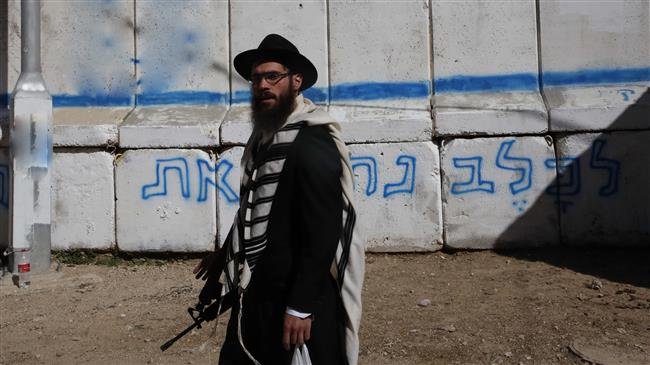
How the rule of the rabbis is fuelling a holy war in Israel
By Jonathon Cook | February 13, 2019
In which country did a senior, state-salaried cleric urge his followers last month to become “warriors”, emulating a group of young men who had murdered a woman of another faith?
The cleric did so with impunity. In fact, he was only echoing other highly placed colleagues who have endorsed a book – again without penalty – urging their disciples to murder babies belonging to other religions.
Where can the head of the clergy call black people “monkeys” and urge the expulsion of other religious communities?
Where does a clerical elite wield so much power that they alone decide who can marry or get divorced – and are backed by a law that can jail someone who tries to wed without their approval? They can even shut down the national railway system without notice.
Where are these holy men so feared that women are scrubbed from billboards, college campuses introduce gender segregation to appease them, and women find themselves literally pushed to the back of the bus?
Is the country Saudi Arabia? Or Myanmar? Or perhaps, Iran?
No. It is Israel, the world’s only self-declared Jewish state.
Which ‘shared values’?
There is barely a politician in Washington seeking election who has not at some point declared an “unbreakable bond” between the United States and Israel, or claimed the two uphold “shared values”. Few, it seems, have any idea what values Israel really represents.
There are many grounds for criticising Israel, including its brutal oppression of Palestinians under occupation and its system of institutionalised segregation and discrimination against the fifth of its population who are not Jewish – its Palestinian minority.
But largely ignored by critics have been Israel’s increasing theocratic tendencies.
This hasn’t simply proved regressive for Israel’s Jewish population, especially women, as the rabbis exert ever greater control over the lives of religious and secular Jews alike.
It also has alarming implications for Palestinians, both under occupation and those living in Israel, as a national conflict with familiar colonial origins is gradually transformed into a holy war, fuelled by extremist rabbis with the state’s implicit blessing.
Control of personal status
Despite Israel’s founding fathers being avowedly secular, the separation between church and state in Israel has always been flimsy at best – and it is now breaking down at an ever-accelerating rate.
After Israel’s establishment, David Ben Gurion, Israel’s first prime minister, decided to subordinate important areas of life for Israeli Jews to the jurisdiction of an Orthodox rabbinate, representing the strictest, most traditional and conservative stream of Judaism. Other, more liberal streams have no official standing in Israel to this day.
Ben Gurion’s decision in part reflected a desire to ensure his new state embraced two differing conceptions of Jewishness: both those who identified as Jews in a secular ethnic or cultural sense, and those who maintained the religious traditions of Judaism. He hoped to fuse the two into a new notion of a Jewish “nationality”.
For that reason, the Orthodox rabbis were given exclusive control over important parts of the public sphere – personal status matters, such as conversions, births, deaths and marriages.
Biblical justifications
Bolstering the rabbis’ power was the urgent need of Israel’s secular leaders to obscure the state’s settler-colonial origins. This could be achieved by using education to emphasise Biblical justifications for the usurpation by Jews of the lands of the native Palestinian population.
As the late peace activist Uri Avnery observed, the Zionist claim was “based on the Biblical history of the Exodus, the conquest of Canaan, the kingdoms of Saul, David and Solomon … Israeli schools teach the Bible as real history.”
Such indoctrination, combined with a much higher birth rate among religious Jews, has contributed to an explosion in the numbers identifying as religious. They now comprise half the population.
Today, about a quarter of Israeli Jews belong to the Orthodox stream, which reads the Torah literally, and one in seven belong to the ultra-Orthodox, or Haredim, the most fundamentalist of the Jewish religious streams. Forecasts suggest that in 40 years the latter will comprise a third of the country’s Jewish population.
‘Conquer the government’
Both the growing power and extremism of the Orthodox in Israel was highlighted in the last week of January when one of their most influential rabbis, Shmuel Eliyahu, publicly came to the defence of five students accused of murdering Aisha Rabi, a Palestinian mother of eight. Back in October they stoned her car near Nablus, in the occupied West Bank, forcing her off the road.
Eliyahu is the son of a former chief rabbi of Israel, Mordechai Eliyahu, and himself sits on the Chief Rabbinical Council, which controls many areas of life for Israelis. He is also the municipal rabbi of Safed, a city that in Judaism has the equivalent status of Medina in Islam or Bethlehem in Christianity, so his words carry a great deal of weight with Orthodox Jews.
Last month, a video came to light of a talk he gave at the seminary where the five accused studied, in the illegal settlement of Rehelim, south of Nablus.
Eliyahu not only praised the five as “warriors” but told fellow students that they needed to overthrow the “rotten” secular court system. He told them it was vital to “conquer the government” too, but without guns or tanks. “You have to take the state’s key positions,” he urged them.
Law-breaking judges
In truth, that process is already well-advanced.
Justice Minister Ayelet Shaked, who should have been the first to denounce Eliyahu’s comments, is closely aligned with religious settlers. Tellingly, she and other government ministers have maintained a studious silence.
That is because the political representatives of Israel’s religious Jewish communities, including the settlers, have now become the lynchpin of Israeli coalition governments. They are the kingmakers and can extract enormous concessions from other parties.
For some time, Shaked has been using her position to bring more openly nationalistic and religious judges into the legal system, including to the highest court in the land, the Supreme Court.
Two of its current 15 judges, Noam Sohlberg and David Mintz, are law-breakers, openly living in West Bank settlements in violation of international law. Several more judges appointed to the bench by Shaked are religious and conservative.
This is a significant victory for the Orthodox religious and the settlers. The court is the last line of defence for the secular against an assault on their religious freedoms and on gender equality.
And the court offers the only recourse for Palestinians seeking to mitigate the worst excesses of the violent and discriminatory policies of the Israeli government, army and settlers.
Chosen people
Shaked’s colleague, Naftali Bennett, another ideologue of the settlement movement, has been education minister in the Netanyahu government for four years. This post has long been a critical one for the Orthodox because it shapes Israel’s next generation.
After decades of concessions to the rabbis, Israel’s school system is already heavily skewed towards religion. A survey in 2016 showed 51 percent of Jewish pupils attended sex-segregated religious schools, which emphasise Biblical dogma – up from 33 percent only 15 years earlier.
This may explain why a recent poll found that 51 percent believe Jews have a divine right to the land of Israel, and slightly more – 56 percent – believe that Jews are a “chosen people”.
Those results are likely to get even worse in the coming years. Bennett has been placing much greater weight in the curriculum on Jewish tribal identity, Bible studies and religious claims to Greater Israel, including to the Palestinian territories – which he wants to annex.
Conversely, science and maths are increasingly downplayed in the education system, and entirely absent from schools for the ultra-Orthodox. Evolution, for example, has been mostly erased from the syllabus, even in secular schools.
‘No mercy’ to Palestinians
Another key sphere of state power being taken over by the religious, and especially the settlers, are the security services. Police Commissioner Roni Alsheikh lived for years in a settlement renowned for its violent attacks on Palestinians, and the force’s current chief rabbi, Rahamim Brachyahu, is also a settler.
Both have actively promoted a programme, Believers in the Police, that recruits more religious Jews into the police force. Nahi Eyal, the programme’s founder, has said his aim is to help the settler community “find our way into the command ranks”.
The trend is even more entrenched in the Israeli military. Figures show that the national-religious community, to which settlers belong – though only 10 percent of the population – make up half of all new officer cadets. Half of Israel’s military academies are now religious.
That has translated into an increasing role for extremist Orthodox rabbis in motivating soldiers on the battlefield. In Israel’s 2008-09 ground invasion of Gaza, soldiers were issued with pamphlets by the army rabbinate using Biblical injunctions to persuade them to “show no mercy” to Palestinians.
Call to kill babies
Meanwhile, the rapidly growing ultra-Orthodox population has been encouraged by the government to move into West Bank settlements purpose-built for them, such as Modi’in Illit and Beitar Illit. That, in turn, is gradually fuelling the emergence of an aggressive nationalism among their youth.
Once the Haredim were openly hostile, or at best ambivalent, towards Israeli state institutions, believing that a Jewish state was sacrilegious until the Messiah arrived to rule over Jews.
Now, for the first time, young Haredim are serving in the Israeli army, adding to the pressure on the military command to accommodate their religious fundamentalist ideology. A new term for these hawkish Haredi soldiers has been coined: they are known as the “Hardal”.
Brachyahu and rabbis for the Hardal are among the senior rabbis who have endorsed a terrifying book, the King’s Torah, written by two settler rabbis, that urges Jews to treat non-Jews, and specifically Palestinians, mercilessly.
It offers God’s blessing for Jewish terror – not only against Palestinians who try to resist their displacement by settlers, but against all Palestinians, even babies, on the principle that “it is clear that they will grow [up] to harm us.”
Gender segregation expands
The dramatic rise in religiosity is creating internal problems for Israeli society too, especially for the shrinking secular population and for women.
Posters for the forthcoming election – as with adverts more generally – are being “cleaned” of women’s faces in parts of the country to avoid causing offence.
Last month, the Supreme Court criticised Israel’s Council for Higher Education for allowing segregation between men and women in college classrooms to spread to the rest of the campus, including libraries and communal areas. Female students and lecturers are facing “modesty” dress codes.
The council has even announced that it intends to expand segregation because it is proving difficult to persuade religious Jews to attend higher education.
Violence of the mob
Israel has always been a society deeply structured to keep Israeli Jews and Palestinians apart, both physically and in terms of rights. That is equally true for Israel’s large Palestinian minority, a fifth of the population, who live almost entirely apart from Jews in segregated communities. Their children are kept away from Jewish children in separate schools.
But the greater emphasis in Israel on a religious definition of Jewishness means that Palestinians now face not only the cold structural violence designed by Israel’s secular founders, but additionally a hot-tempered, Biblically sanctioned hostility from religious extremists.
That is most keenly evident in the rapid rise of physical assaults on Palestinians and their property, as well as their holy places, in Israel and the occupied territories. Among Israelis, this violence is legitimised as “price tag” attacks, as though Palestinians have brought such harm on themselves.
YouTube is now full of videos of gun- or baton-wielding settlers attacking Palestinians, typically as they try to access their olive groves or springs, while Israeli soldiers stand passively by or assist.
Arson attacks have spread from olive groves to Palestinian homes, sometimes with horrifying results, as families are burned alive.
Rabbis such as Eliyahu have stoked this new wave of attacks with their Biblical justifications. State terrorism and mob violence have merged.
Destroying al-Aqsa
The biggest potential flashpoint is in occupied East Jerusalem, where the growing symbolic and political power of these Messianic rabbis risks exploding at the al-Aqsa Mosque compound.
Secular politicians have long played with fire at this Islamic holy site, using archaeological claims to try to convert it into a symbol of historic Jewish entitlement to the land, including the occupied territories.
But their claim that the mosque is built over two Jewish temples, the last of which was destroyed two millennia ago, has been rapidly reconfigured for incendiary, modern political purposes.
The growing influence of religious Jews in parliament, the government, the courts and the security services means that officials grow ever bolder in staking a physical claim to sovereignty over al-Aqsa.
It also entails an ever greater indulgence towards religious extremists who demand more than physical control over the mosque site. They want al-Aqsa destroyed and replaced with a Third Temple.
The gathering holy war
Slowly, Israel is transforming a settler-colonial project against the Palestinians into a battle with the wider Islamic world. It is turning a territorial conflict into a holy war.
The demographic growth of Israel’s religious population, the cultivation by the school system of an ever-more extreme ideology based on the Bible, the takeover of the state’s key power centres by the religious, and the emergence of a class of influential rabbis who preach genocide against Israel’s neighbours has set the stage for a perfect storm in the region.
The question now is at what point will Israel’s allies, in the US and Europe, finally wake up to the catastrophic direction Israel is heading in – and find the will to take the necessary action to stop it.
Fatal Houston PD Drug Raid Apparently Predicated On Drugs A Cop Had Stashed In His Car
By Tim Cushing | techdirt | February 19, 2019
The ugly Houston PD drug raid that resulted in four injured officers and two dead “suspects” just keeps getting uglier.
Officers swore a confidential informant purchased heroin from 59-year-old Dennis Tuttle in the house he shared with his wife of 21 years, Rhogena Nicholas. They swore the CI told them the house was filled with heroin packaged for purchase.
On the strength of this confidential informant’s claims, officers obtained a no-knock warrant and raided Tuttle’s house. The officers claimed Tuttle opened fire on them and that his wife tried to grab a shotgun from a downed officer. This was the supposed reason for SWAT team’s killing of Tuttle and Nicholas.
This was the narrative everyone was given. Not a single officer was wearing a body cam, despite the department possessing dozens of them. The only footage that survived — captured by a neighbor’s security camera — was confiscated by the Houston PD.
Even in this vacuum of information, the PD’s narrative quickly fell apart. No large amounts of heroin were found during the raid — just personal use quantities of heroin cocaine and marijuana. The inventory also included a few guns, which the PD has treated as inherent evidence of criminality despite the fact both Tuttle and his wife could legally own the weapons found in the house. The only criminal history either of them had was an old misdemeanor charge for a bad check.
Now that the PD’s investigation into this raid is underway, it’s becoming clear the official narrative — a daring no-knock raid that took out dangerous heroin dealers — isn’t going to survive. The new narrative already includes multiple lies by police officers and a lot of supporting evidence.
First off, the raid inventory does not include the weapon officers claimed Tuttle fired at them.
The other four items in the inventory are guns: a 20-gauge Beretta ALS shotgun, a 12-gauge Remington 1100 shotgun, a Remington 700 bolt-action rifle, and a .22-caliber Winchester 190 semi-automatic rifle. The list does not include the .357 Magnum revolver that police say Tuttle fired at the officers who broke into his home, shot his dog, and killed his wife.
It also doesn’t include the money the CI paid for the heroin or the weapon he claimed Tuttle was carrying.
Nor does it mention the 9mm semi-automatic handgun that the C.I. supposedly saw in the house the day before, which apparently disappeared along with the heroin and the money.
The PD also claimed the investigation was initiated by an anonymous call claiming the couple were selling drugs from their house. Since that initial press salvo by Chief Art Acevedo, information has come out indicating the “tip” was neither anonymous nor did it reference drug dealing.
A 911 call from the mother of now-deceased suspect Rhogena Nicholas put 7815 Harding Street on police radar. Sources close to the investigation say her mother called reporting the 58-year-old was doing drugs inside her own home.
It only gets worse. According to statements from officers now under investigation, it appears the Houston PD raided a house, shot a dog, and killed two people over drugs a police officer had stashed in his vehicle.
In the original warrant – the one used to justify the raid – [Officer Gerald] Goines wrote that he watched the buy and, along with Bryant, identified the substance as heroin. But when investigators went back to talk to [Officer Steven] Bryant, he admitted that he’d actually just retrieved two bags of heroin from the center console of Goines’ car, at the instruction of another officer.
Though he then took the two bags of drugs for testing to determine that they were heroin, he eventually admitted that he had never seen narcotics in question before retrieving them from the car. That, the investigator noted, contradicts the search warrant affidavit filed before the raid, which indicates that Bryant “recognized the substance purchased by the CI as heroin.”
This is absolutely terrifying. Investigators can’t seem to locate the informant both officers claimed was a reliable source of intel, which suggests this person — relied on in other Houston PD investigations — doesn’t even exist. None of the CIs interviewed by Houston investigators said they’d made the purchase detailed in the warrant affidavit.
How do citizens protect themselves against police officers willing to fabricate every aspect of an investigation in order to perform armed raids of their houses? Legally owning weapons means nothing when cops (and many courts) consider homeowners defending themselves from armed intruders a crime in and of itself. Two people are dead and no amount of late-arriving indictments is going to change that. Officers took a concerned mother’s call about her daughter’s drug use and turned it into a criminal conspiracy involving heroin and dangerous drug pushers armed to the teeth.
We have to grant law enforcement a massive amount of power in order for them to do their job. Time after time, they abuse the powers we’ve given them, wielding them like weapons against the same citizens they’re supposed to answer to. Vast power has been paired with nearly nonexistent accountability to create an atmosphere where officers feel comfortable manufacturing evidence to support their adrenaline habits. This should be nightmare fuel for all Americans. Unfortunately, outside of those already attuned to the miserable state of American policing, this will appear to be nothing more than a couple of bad apples they can safely ignore.
When is a British Person Not British?
By Craig Murray | February 20, 2019
The attitude to immigrants which is betrayed by the stripping of citizenship from Shamima Begum is truly appalling. A British citizen, born in the UK, is deemed to be a citizen of another country they have never seen, because their immigrant parents came from there. To refuse to accept first generation Britons are Britons, as in Windrush, was bad enough. To claim that second generation Britons are not British, but rather citizens of where their ancestors “came from”, is racism pure and simple.
Begum is not a sympathetic figure. Savid Javid could not have found an easier target for his macho display of vindictiveness, guaranteed to win plaudits from the bigots whose votes Javid needs for his looming Tory leadership bid. Javid knows full well his decision will eventually be overturned by the courts, but he has already achieved his political objective of personal self-aggrandisement.
I do not know everything Begum has personally been doing in Syria and to what extent she has been culpable in any of the crimes of the Saudi backed jihadist group Daesh, originally launched by the CIA as a counterweight to Shia influence in Iraq. Begum, as with other members of the ISIS community in Syria, ought initially to be subject to any legal proceedings by the Syrian authorities on behalf of the Syrian people against whom such dreadful crimes were committed. If of no interest to the Syrian justice system or once any sentence has been completed, she should be returned to the UK and then subject to investigation as to whether any UK crimes were committed. All these processes need to take into account that she arrived in Syria as a minor, has been subject to indoctrination, and may well have severe mental health issues.
In a situation where the government is falling over itself to bring members of the UK-funded jihadist support group the White Helmets to the UK, having no claim to British citizenship; in a situation where jihadist activity in Syria was entirely dependent on finance, supplies and air support from the US, UK, and its Gulf State allies; in a situation where the Royal Navy had evacuated the Manchester bomber en route back to the UK after his Western backed terrorist jaunt in Libya; in a situation where the Manchester, Westminster and London Bridge terrorists all had extensive pre-existing relationships with the British security services; in all these circumstances, the decision to crack down to general applause on a bewildered East London child is a sickening example of the lack of ethics in modern politics.
Why UK report on ‘digital gangster’ Facebook is a thinly veiled call for censorship
RT | February 18, 2019
A new UK 108-page report on “disinformation and fake news” online strongly reprimands Facebook for its ongoing misuse of personal data — but also casually promotes unprecedented levels of political censorship on social media.
The report, which is the culmination of an 18-month investigation by a UK parliamentary committee, lambastes Facebook over its failure to protect its users’ data and accuses it of deliberate breaches of privacy and anti-competition laws. It offers numerous examples of Facebook sins, including the Cambridge Analytica scandal, which saw the shady firm mine the personal data of 50 million users without permission.
The report also accuses CEO Mark Zuckerberg of showing “contempt” towards the UK parliament for refusing three requests to appear before the committee and admonishes Facebook for behaving like a “digital gangster.”
Grand intentions?
Despite its wide-ranging criticisms, however, it is immediately evident that the overarching goal of the report appears to be to force Facebook to engage in censorship to the benefit of Western governments. It focuses heavily on “malign forces” posting content which is intended to cause “disruption and confusion” online. Lest there be any confusion about the identity of those malign forces, the word “Russian” is used 51 times in the report.
While the authors claim to be interested in ensuring a “plurality of voices” online, they are extremely quick to resort to forms of censorship as a solution to the existence of content that does not adhere to certain approved narratives.
Censorship solution
There have been multiple examples in recent months of Facebook willingly and enthusiastically working in conjunction with US government-funded think tanks to target content critical of the US government, including its temporary removal of the English-language page belonging to Telesur, a Venezuela-based outlet which questions US policy in Latin America.
Facebook’s removal of that page happened weeks after it partnered with the US government-funded Atlantic Council to combat “inauthentic” content online.
The report admits that while it’s impossible to completely rid the internet of this politically inconvenient content, governments must focus on “the enforcement of greater transparency in the digital sphere” so that citizens “know the source” of information.
Facebook’s recent suspension of pages partly owned by RT video agency Ruptly (purportedly due to their failure to prominently disclose its funding) would surely please the UK committee. The problem is, these new transparency rules are being arbitrarily applied to pages publishing content critical of Western governments, while content funded by those governments so far is subject to no such oversight.
Further proving that the (thinly veiled) intent of the report is censorship of foreign (i.e., Russian) media, the report praises a French law which allows the French national broadcasting agency “to suspend television channels controlled by or under the influence of a foreign state” if they disseminate “false” information.
Discredited sources
The British report has some glaring flaws and inconsistencies, including its use of the New Knowledge cybersecurity firm as a credible source of information on Russian influence online, despite the fact that it was recently exposed by the New York Times for faking a Russian disinformation campaign in order to influence a local US election. Nonetheless, the report describes New Knowledge as an “information integrity company.”
It also praises NewsGuard, an app with deep ties to the US government, which applies trust ratings to news websites. As RT has documented before, however, NewsGuard applies its criteria selectively and exhibits clear bias against content critical of US policies. It is also lobbying to have its ratings installed by default on computers in schools and universities around the US — and even to have them installed by default on smartphones.
Ironically, the report criticizes people for giving credence to information which “reinforces their views” while dismissing content which they do not agree with as “fake news.”
Russian influence, or online democracy?
The report also takes a look at the “influence” Russian media may have had on the 2016 Brexit referendum, specifically outlets like RT and Sputnik. In an admission which is unintentionally quite funny, the report states that articles which had the “heaviest anti-EU bias” are the ones that went “most viral” online during the campaign.
Of course, by highlighting the fact that so many people were enthusiastically sharing content critical of the EU, the report inadvertently concedes that anti-EU sentiment was widespread, rather than some kind of evil plot by Russia to “sow discord” in the West.
The report also notes, however, that Culture Secretary Jeremy Wright MP admitted that he has seen no convincing evidence that Russian interference has had any “material impact” on how people choose to vote. Similarly, in the US, little evidence has been presented to suggest that so-called Russian online influence had any impact whatsoever on the outcome of the 2016 election.
Nonetheless, the report suggests that the UK government should launch new investigations into past elections, including the Brexit referendum and the Scottish independence referendum in 2014 to dig for elusive evidence of Russian interference.
Say goodbye to ‘harmful’ content
To ensure that social media companies comply with all its various demands, the report recommends that “a new category of tech company is formulated” which tightens their liabilities and would see those companies assume legal liability for content identified as “harmful.” It also advocates the establishment of a “compulsory Code of Ethics” setting out exactly what constitutes harmful content.
The British government should also “explore the feasibility” of adopting a UK version of the US Foreign Agents and Registration Act (FARA), it says. FARA requires persons acting “as agents of foreign principals in a political or quasi-political capacity” to disclose this information publicly. Ironically, a similar ‘foreign agents’ law in Russia was heavily criticized by Western media and politicians for targeting dissenting voices.
US government-funded outlets like Voice of America (VOA) and Radio Free Europe/Radio Liberty (RFERL) both wrote reports critical of the law, with VOA even suggesting it had “echoes of Stalin-era denunciations” of dissidents. No such outrage emerged from those outlets when RT was forced to register as a “foreign agent” in the US last year.
Finally, the report suggests that companies like Facebook should also be required to finance digital literacy learning as “the fourth pillar of education” alongside reading, writing and math.
If this report is anything to go by, there is no doubt that learning to identify (and ignore) content critical of Western governments would be a major element of such “digital literacy” courses.
11yo arrested after refusing to stand for Pledge of Allegiance to ‘racist’ flag in Florida

FILE PHOTO – Wikimedia Commons
RT | February 18, 2019
An 11-year-old boy was arrested in Florida after his refusal to stand for the Pledge of Allegiance escalated into an argument with his teacher, who called in security because she “did not want to continue dealing with him.”
The sixth-grade student at Lawton Chiles Middle Academy in Lakeland reportedly explained that he wasn’t standing for the pledge because he deemed the flag racist and the national anthem offensive to black people.
According to a statement substitute teacher Ana Alvarez gave to the Polk School District, she then asked the boy, “Why if it was so bad here he did not go to another place to live?” After an exchange ensued with the boy, the teacher said she called the office because she “did not want to continue dealing with him,” Bay News 9 reports.
When the school resource officer arrived and asked the boy to leave, he initially refused and then “created another disturbance and made threats while he was escorted to the office,” the Lakeland Police Department said.
The child was arrested for refusing to follow multiple commands and being disruptive, allegedly threatening to beat the teacher and get the principal fired. However, his mother, Dhakira Talbot, disputes these claims, telling Bay News 9 the situation should have been “handled differently.”
“If any disciplinary action should’ve been taken, it should’ve been with the school. He shouldn’t have been arrested.”
Polk County Public Schools spokesman Kyle Kennedy said the student was not arrested for not participating in the pledge. The boy was taken to the Juvenile Assessment Center and charged with disrupting a school function and resisting an officer without violence. Meanwhile, the teacher was removed from the school district and an investigation is underway.
Blocked RT-Linked Facebook Accounts Sign of Geopolitical Confrontation
Sputnik – 18.02.2019
Margarita Simonyan, the editor-in-chief of Sputnik and RT, said that Facebook’s suspension of accounts operated by Maffick Media over ties to RT was a sign of “open geopolitical confrontation,” where media platforms are being used as “tools.”
“Obviously, things will be getting only worse. Nobody even tries to believe in any freedom or talk about any freedom. This has already become an open geopolitical confrontation, where media platforms… serve as tools,” Simonyan said.
The editor-in-chief of RT pointed out that Facebook had no complaints about the videos on the suspended pages or their content in general.
“However, since CNN contacted [Facebook] and asked ‘how could you allow these Russians to communicate with our population,’ Facebook removed this account,” Simonyan said.
According to the RT editor-in-chief, CNN acted as “the right hand… of the State Department, NATO and everything linked to that.”
CNN admitted it had been tipped off about Maffick Media’s funding by the Alliance for Securing Democracy, an advocacy group that is part of the German Marshall Fund (GMF) policy research centre. The fund considered an “undesirable organization” under the Russian law, receives some of its funding from the US and German governments, NATO and other organizations. According to CNN, the ASD does not receive financing from the GMF and is supported through private funds and grants, rather than by governments.
Facebook said it would ask the three suspended accounts — Soapbox, Back Then and Waste-Ed — to submit information on their affiliations.
“People connecting with Pages shouldn’t be misled about who’s behind them. Just as we’ve stepped up our enforcement of coordinated inauthentic behaviour and financially motivated spam over the past year, we’ll continue improving so people can get more information about the Pages they follow,” a Facebook spokesperson said in a statement, as quoted by RT.
Moscow considers the blocking of Facebook pages related to RT unacceptable, adding that these authoritarian actions violate the principles of freedom of expression. Moreover, Russia is waiting for a response from “OSCE structures” to these actions, the Russian Foreign Ministry said in a statement.
However, the social network has not, until now, required accounts to disclose information about their parent companies. Maffick remarked in its statement that plenty of media outlets supported in part by governments do not post information about their funding on their Facebook pages.
Last week Facebook suspended pages of projects run by Maffick Media, an independent journalistic group that is partly owned by the Ruptly video agency, which is a subsidiary of RT. Facebook did not give Maffick Media any prior warning. According to Maffick’s statement, the social network was “pressured” into doing this by CNN, which ran a story on Maffick Media and its perceived ties to the Kremlin.
Iranian Spying? or Neocon 9/11 Coverup?
Questioning the USG/NYT official story on Marzieh Hashemi, Monica Witt, New Horizon…and yours truly
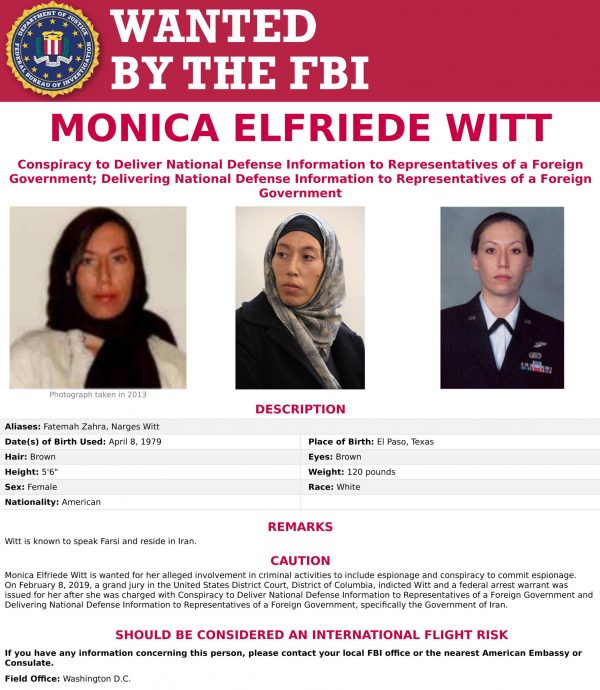
Monica E. Witt, a former United States Air Force intelligence officer, is accused of espionage on behalf of Iran. Credit: FBI/EPA, via Shutterstock/New York Times
By Kevin Barrett • Unz Review • February 18, 2019
It wasn’t the first time I’ve been prominently libeled in The New York Times. Nor was it the worst.
Compared to Stanley Fish’s grotesquely mendacious 2006 op-ed trashing me for something I never did—advocating 9/11 truth in the classroom[1]—Alan Blinder, Julie Turkewitz and Adam Goldman treated me fairly well on Sunday’s NYT front page by calling me a “controversial scholar of Islam” while accurately reporting what I said about Monica Witt, the ex-Air Force officer accused of spying for Iran.
The arguably libelous part came in the previous paragraph. I was introduced as part of “a crowd filled with fringe academics, Holocaust deniers and the lover of the terrorist known as Carlos the Jackal” where “Ms. Witt at last found herself among people as critical of her country as she was.” This is an absurdly libelous description of attendees at the February 2013 Hollywoodism Conference, a rubric of the Tehran Film Festival that was not a New Horizon[2] conference. Leaving aside the question of how a whole conference could be “filled by… the lover of the terrorist known as Carlos the Jackal” (Carlos liked really big women?) the bit about America-hating “fringe academics” and “Holocaust deniers” is seriously misleading.
Most of the US attendees might better be described as sincere American patriots. Former Senator Mike Gravel (D-Alaska), whom I personally recruited for the conference, is widely acknowledged as an all-American hero for his principled stance against the Vietnam war, his role in exposing the Pentagon Papers, and his courageous advocacy of 9/11 truth. Merlin Miller, a family values oriented filmmaker who once ran for president, is another all-American hero who attended the Hollywoodism Conference. Merlin Miller’s pro-American, anti-Zionist-Hollywood perspective is as patriotic as it gets. And then there was Culture Wars editor E. Michael Jones, another conservative American patriot who wants to take his country back. While all three all-American heroes are in varying degrees critical of Israel and its occupation of American politics and media, none could possibly be viewed as America haters.
The bit about “Holocaust denial” is also misleading. The Holocaust was not on the agenda, in any way, shape, or form, at the Hollywoodism conference, nor at any New Horizon Conference.[3] The New York Times apparently chose to lob this gratuitous insult because a tiny handful of the hundreds of attendees at New Horizon conferences have published on this issue—an issue that in any event merits fearless discussion and debate, as readers of Ron Unz’s “Holocaust Denial” will discover.
The New York Times, echoing the US government’s indictment of Monica Witt and the Treasury Department’s sanctioning of New Horizon, offers a narrative almost entirely unsupported by any evidence. According to the official narrative, New Horizon and Press TV anchor Marzieh Hashemi are somehow responsible for Monica Witt’s decision to move to Iran and allegedly share secrets she learned in the Air Force. Leaving aside the questions of whether Monica Witt actually did move to Iran, and if so whether she shared any secrets, and if so whether those secrets were genuinely important, the cases against New Horizon and Marzieh Hashemi are obviously bogus.
First consider the case against Ms. Hashemi, a leading international news anchor, who was kidnapped by the FBI without charges and held for ten days under circumstances bordering on torture. The rationale for kidnapping Ms. Hashemi was the claim that she was a “material witness” to Monica Witt’s alleged spying. But Ms. Hashemi was never charged with a crime. After several interrogations, she was released without charges. Yet the indictment of Monica Witt states that “Individual A” who can only be Ms. Hashemi “engaged in acts consistent with serving as a spotter and assessor on behalf of the Iranian intelligence services.” Obviously if there were any actual evidence that Marzieh Hashemi was so employed, she never would have been released without charges. So we may assume that “acts consistent with” really means: “Marzieh Hashemi is a journalist who reports critically and fearlessly on American issues, and in so doing interviews sources who might be characterized as whistleblowers or dissidents.” In other words, Hashemi regularly commits a crime called “journalism.” And just as journalist Glen Greenwald, in the course of his journalistic duties, interviewed a whistleblower who wound up living in Russia (Edward Snowden) it seems that Marzieh Hashemi may have interviewed a whistleblower who wound up living in Iran (Monica Witt). But, contra USG, neither Greenwald nor Hashemi are spies. Both are journalists who, unlike certain mainstream media hacks, actually do their jobs.
The case against the New Horizon NGO is as bogus as the one against Marzieh Hashemi. The only “evidence” against New Horizon is that Monica Witt spoke at the February 2013 Hollywoodism Conference in Tehran. But that was not even a New Horizon conference! It was actually part of the Tehran Film Festival. So if the Treasury Department thinks the Hollywoodism Conference was guilty of something, it should sanction the Tehran Film Festival, not the New Horizon NGO, which only had a peripheral role in that event.
But why blame the conference at all? The official narrative seems to be that Witt had such a wonderful time there that she later decided to move to Iran (and supposedly spill some secrets). If that were true—and I can testify that just about everybody who attends Iran-based conferences has a wonderful time—the conference organizers would be guilty of the crime of putting on a wonderful conference. Last I checked, that wasn’t grounds for Treasury Department sanctions.
Is there any evidence that New Horizon conferences are really about recruiting spies, not exchanging ideas? The notion is preposterous. Just look at the participants lists! Virtually none of the conferees are people who could be expected to hold any secrets. On the contrary, the many New Horizon conferences I have attended have been—up until May 2018—remarkably bereft of US military and intelligence veterans.
I know the New Horizon organizers fairly well, and even helped them on more than one occasion by suggesting prospective guests. When I repeatedly suggested that they invite such illustrious ex-military/intel types as Veterans Today Senior Editor Gordon Duff, former CIA officer Philip Giraldi, ex-State Department issuer of Visas for al-Qaeda Mike Springmann, former US Army counterterrorism and psy ops expert Scott Bennett, and others from USG backgrounds, I was told that while the New Horizon NGO would love to do so, the Iranian government makes it hard for such people to get visas. Finally, in May 2018, in an attempt to foster goodwill and trust, the Iranian government relented. Giraldi, Springmann, Bennett, and Michael Maloof were invited and attended. On the final day of that Conference, Bennett and others spearheaded an attempt to convince the Iranian government to bring 9/11 truth into an American federal courtroom.
I believe the real reason for the witch hunt against New Horizon and Marzieh Hashemi is New Horizon’s and Press TV’s success at fostering dialogues that include voices that are suppressed and censored in the US and the rest of the West. The 9/11 truth movement, in particular, obviously terrifies the Establishment. When the May 2018 New Horizon conference in Mashhad nearly persuaded the Iranian government to throw its full support behind a major 9/11 truth initiative—one that could have led to discovery proceedings forcing suspected 9/11 perpetrators like Dick Cheney, Paul Wolfowitz, Richard Perle, and others to testify under oath— the neoconservative element of the Establishment must have panicked. The current witch-hunt is their way of lashing out.
Think about it: If this is really about Monica Witt supposedly spilling secrets, why did they wait so long? According to the feds, Witt, supposedly possessing vital national security secrets, has been living in Iran as a Shia Muslim convert since summer 2013. Since Witt was on US authorities’ radar screen as a dissident and potential whistleblower long before that, it seems obvious that damage limitation measures would have been taken by mid-2013 at the latest. Any operations Witt could have compromised would have been shut down or revamped at that time, if not earlier. So the narrative that Witt has gravely damaged US national security, and we are only hearing about it now, seems implausible. Instead, the timing of the indictment, and the simultaneous persecution of Marzieh Hashemi and sanctioning of New Horizon, suggests that the neocon Deep State is panicking over Press TV’s and New Horizon’s success at fostering dialogue on suppressed issues like 9/11 truth—dialogue inclusive of loyal and patriotic US military and intelligence insiders. Presumably the neocon Deep State has invented a fake or exaggerated tale of Monica Witt’s alleged spying as an excuse to try to persecute and silence truth-loving journalists and intellectuals.
But let’s consider all the possibilities. In the unlikely event that Monica Witt really has spilled important national security secrets to Iranian intelligence—this according to the neocon Deep State tale that the entire mainstream media has swallowed uncritically—who would really deserve the blame? Journalists who covered her whistleblowing? Conference organizers who offered her a completely transparent platform? That’s the propaganda line. But it’s preposterous.
Anyone who has spoken extensively with Monica Witt, as I did at the Hollywoodism conference in 2013, knows that she is a highly intelligent, deeply sincere person who was horrified and traumatized by the war crimes in which she was forced to participate. Today’s New York Times article cites her classmate Cory Ellis:
“‘She would talk about how she couldn’t sleep at night, the stuff she saw and was a part of,’ said Mr. Ellis. Ms. Witt, he remembered, would mention drone strikes, extrajudicial killings and atrocities against children, all of which she claimed her colleagues in the military would brag about.”
As a whistleblower, she testified about some of these atrocities to journalists, including Marzieh Hashemi, and apparently also approached Wikileaks. And of course she participated in the Hollywoodism Conference in Tehran.
So who is really at fault here? The journalists? The conference? (Kill the messengers!) Or the war criminals who rape and dismember children, massacre women and children in drone strikes, and engage in sexual assault against their fellow service members with impunity?
If the US government wants to prosecute the people responsible for Monica Witt’s decision to move to Iran, they should begin by investigating the US military personnel who committed the atrocities she witnessed—the atrocities that traumatized her and forced her to follow her conscience, wherever it may have led her.
Notes
[1] I was witch-hunted in 2006 by State Rep. Steve Nass for “teaching 9/11 conspiracy theories” at the University of Wisconsin-Madison. But in fact I had never done so, nor had I any plans to do so. While teaching African Studies, Folklore, and Religious Studies at the University of Wisconsin-Madison between 2001 and 2006, I had never once revealed to students my personal views of 9/11, nor did I ever discuss the research that gave rise to those views. None of my students up to that point even knew what my views of 9/11 were, unless they had stumbled upon one of my occasional teach-ins, or read my published work on the issue, which I did not bring into the classroom. Yet Stanley Fish lied brazenly about me in his NYT op-ed, libelously claiming: “Mr. Barrett, who has a one-semester contract to teach a course titled ‘Islam: Religion and Culture’ acknowledged on a radio talk show that he has shared with students his strong conviction that the destruction of the World Trade Center was an inside job perpetrated by the American government.” In fact I neither acknowledged nor did any such thing. I immediately wrote to The New York Times urging them to correct their libelous error. They refused to do so. Instead, they published several other letters all taking for granted Fish’s outrageous and utterly baseless lie.
[2] New Horizon is an Iranian NGO dedicated to fostering intellectual exchange among genuinely independent thinkers and activists from all over the world. It has sponsored on average one conference each year, mostly in Tehran, since around 2012.
[3] The New Horizon NGO had nothing to do with the December 2006 Holocaust Conference in Tehran—a conference whose primary purpose was to defend human rights by challenging the West’s annihilation of free speech and free thought on this important topic.
Transgender YouTuber Shot After Trolling Security Guard at LA Synagogue
21st Century Wire | February 16, 2019
In one of the more bizarre incidents to date, this week a transgender YouTuber who films “confrontations” with law enforcement and security guards was shot in the leg after trolling a private security guard at a Los Angeles synagogue.

The Verge reports….
The YouTuber, Zhoie Perez [who identifies as a transgender female, formerly a man], who goes by Furry Potato online, began live-streaming the encounter after the guard drew a gun. “He said if I moved he’s gonna shoot me dead,” Perez says. After several minutes of filming, a shot is fired, and Perez shouts, “Fucker shot me! Fucker shot me in the leg! Fuck!”
Perez is part of a community of YouTubers known as “First Amendment Auditors” who film themselves interacting with cops and visiting government locations with the stated goal of holding the government accountable and educating Americans about their rights. In practice, many of these videos become confrontational, leading to escalating law enforcement reactions and, in some cases, arrests. Those confrontations can lead to more viewers and more paying supporters.
The security guard in question, Edduin Zelayagrunfeld, 44, who worked for the Etz Jacob Congregation and Ohel Chana High School, has since been arrested and charged by LA police.
There is no full unedited video of this incident up on the Furry Potato channel yet, but here is a secondhand version of the video with an extended commentary of this wacky scene, posted by an apparent fan here:
The Verge article then goes on to promote an article by Establishment media outlet, The Daily Beast, warning of the general dangers of confrontational YouTubers with cameras trolling armed security and police in public places:
In a profile of this community just last month, The Daily Beast wrote that these YouTubers will show up at locations ranging from post offices to nuclear weapons factories to film. Some viral videos, like one in which a YouTuber calls a cop an “asshole” and tells him to “fuck off,” have garnered millions of views. A California law enforcement nonprofit issued a warning that some people had started recording officers in “the hopes of … [having] a poor contact with law enforcement, resulting in a violation of their 4th Amendment rights and or a bad arrest.”
While a sane case can be made against the journalistic merits of annoying YouTubers who are going around and provoking random law enforcement and private security guards into pointless “confrontations” – often in order to generate attention, or a ‘viral incident’ to fuel click bait revenue for their online channels, there is also the possibility that some of these are agent provocateurs who are either knowingly, or unknowingly, playing into the hands of the Establishment who are desperate to regulate legitimate independent journalists working in public spaces, or even to provoke a firearm incident as illustrated above – which could then be politicized (think Second Amendment). Either way, the Establishment will not hesitate to seize on any of these incidents in order to gain political leverage for regulating the First Amendment, as well as further regulating and censoring YouTube producers’ content.
At present, the US government is applying heavy pressure on social media giants to ‘do more’ to censor and regulate their content under various pretexts, most notably for ‘public safety’ and ‘public order’ and in the crusade against the scourge of #FakeNews, thus setting the stage for an inevitable face-off as they push to re-define the First Amendment in the age of hyper digital media.
Featured Video
Houthis Don’t Have to Conquer Saudi Arabia to Make It Pay
or go to
Aletho News Archives – Video-Images
From the Archives
Newly Released FBI Docs Shed Light on Apparent Mossad Foreknowledge of 9/11 Attacks
By Whitney Webb | MintPress News | May 17, 2019
NEW YORK — For nearly two decades, one of the most overlooked and little known arrests made in the aftermath of the September 11 attacks was that of the so-called “High Fivers,” or the “Dancing Israelis.” However, new information released by the FBI on May 7 has brought fresh scrutiny to the possibility that the “Dancing Israelis,” at least two of whom were known Mossad operatives, had prior knowledge of the attacks on the World Trade Center. … continue
Blog Roll
 Aletho News
- MEP blasts ‘Euro-Gestapo’ for lecturing Russia on democracy
- Syria May Send Troops to Saudi Arabia Amid War with Ansar Allah
- UK whines about losing billions to ‘Putin tax’
- Baghaei to Rubio: Distorted narratives cannot erase US record of broken commitments
- Houthis Don’t Have to Conquer Saudi Arabia to Make It Pay
- MOE: Nearly 22,000 Students and Education Workers Killed
- Guterres in Islamabad: Genocide, cowardice, and the cage of Imran Khan
- Johnson, Marandi say Yemen holds upper hand over Saudi Arabia
- False flags won’t save aggressors, Iran FM spokesman says
- The Makkah Pact Enters Into Force: The End of American Dominance or Its New Form?
- If Americans Knew
- Report claimed Mark Levin used by Israeli government to influence Trump
- Over 2,000 Gazans have died awaiting medical evacuation amid Israel’s continued siege
- How a U.S. Diplomat Suppressed and Altered Reports Critical of Israel
- 5 Palestinians Die from Israeli Strikes in Gaza as Relentless Attacks Continue
- Report: Ceasefire Slows Killing but Leaves Devastation Intact
- Country Music Singer Zach Bryan Breaks Attendance Record at Robert Kraft’s Gillette Stadium While Wearing ‘Free Palestine’ Shirt for Second Night in a Row
- Three years of death and devastation: Israel’s war on Gaza in pictures
- Why Hamas believed the status quo was more dangerous than its 7 October gamble
- Debunking Israel’s latest list of ‘terrorist’ journalists in Gaza
- In Gaza, focus is on survival, “every step is a struggle” – Daily Update
- No Tricks Zone
- New Study: 50 Years Of The Most Aggressive ‘Net Zero’ Policies Can Only Affect The Global Climate By 0.03°C
- US September “Heat” Was No Record…Many Records Set Decades Ago
- Latest European Green Energy Debacle; Portugal’s Largest Flagship Solar Park Insolvent!
- Green Energy Debacle: German Expert Professor Fritz Vahrenholt Warns Of Severe Economic And Social Consequences
- Two More Paleo Reconstructions Affirm Meters-Higher Sea Levels Across Ireland, Brazil 7000-6000 Years Ago
- New Study: Earth And Venus Surface Warmth Largely Explained By Convection And Lapse Rate, Not CO2 Or Radiation
- 2025 Nature Paper Claiming Worsening Global Drought Gets RETRACTED …Heavily Flawed
- New Study: ‘Global Drought Shows No Detectable Recent Acceleration Under Climate Warming’
- Economic Masterminds: German Socialists Suggest Taxing Productivity Gains Stemming From Using AI
- The South China Sea Has Not Been Cooperating With The Climate Change Narrative

