15 Years in Prison for Clicking on Terrorist Propaganda Even Once – New UK Law
Sputnik – February 13, 2019
Upon the adoption of a new legislation, Home Secretary Sajid Javid said that the Counter-Terrorism and Border Security Act “gives the police the powers they need to disrupt plots and punish those who seek to do us harm.”
The Counter-Terrorism and Border Security Act 2019 has received Royal Assent on 12 February, making the bill an Act of Parliament.
The act makes provision in relation to terrorism, enabling persons at ports and borders to be questioned for national security and updating the offence of obtaining information likely to be useful to a terrorist to cover material that is only viewed or streamed, rather than downloaded to form a permanent record.
The act sees to an increase to the maximum penalty for certain preparatory terrorism offences to 15 years’ imprisonment.
The UK government has been criticized by the UN Special Rapporteur on the right to privacy, Joe Cannataci, back in 2018. The inspector argued following his visit in the UK, that it was concerning that accessing propaganda “on three or more different ccasions” was viewed as an offence. Cannataci called the approach straying towards “thought crime.”
The three-click benchmark has been removed in the new bill and now even a single tap on ‘terrorist material’ could lead to years in prison. Exemption is provided for journalists, academic researchers or people who had “no reason to believe” they were accessing terrorist propaganda.
The Bill has also provided for a launch of an independent review of Prevent, the much criticized government’s strategy that aims to support persons vulnerable to radicalisation.
British intelligence services were condemned in 2018 for failing to properly monitor individuals of interest — later to be involved in terrorist activity — not under active investigation at the moment but in the peripheries of more than one investigation.
In 2017, the United Kingdom suffered five terrorist attacks in Westminster, the Manchester Arena, London Bridge, Finsbury Park and Parsons Green, with 36 people losing their lives and dozens injured.
As US Laments Human Rights in Venezuela, US-Allied Colombia Descends into Drug-fueled Humanitarian Crisis
By Whitney Webb | MintPress News | February 8, 2019
BOGOTÁ, COLOMBIA – Several troubling situations are currently playing out across Colombia, yet the country’s continuing downward spiral into drug-fueled and politically-motivated violence has caused little concern in Washington, offering yet another clear indication that the U.S.’ current posturing on Venezuela is hardly motivated by concerns about “democracy,” “human rights,” or the welfare of the Venezuelan people.
This, of course, can hardly be considered surprising, given that Colombia is a top U.S. ally whose government has long been closely aligned with Washington’s interests. However, although the lack of U.S. government or media attention to Colombia may effectively hide it from the American public, the country is becoming increasingly lawless, with cocaine production reaching new record levels and the government sanctioning the mass murder of the country’s largest indigenous group. Not only that but since Colombia’s new president, Iván Duque, came to power late last year, the number of indigenous social leaders who have been murdered has spiked to the highest levels in over a decade.
Ultimately, the lack of media coverage of Colombia’s humanitarian crises, which have large implications for the Americas as a whole, is a telling example of how such crises are regularly weaponized by governments and media to exclusively target governments it wishes to pressure or overthrow, while turning a blind eye to those same or worse acts when committed by an allied nation.
An absurdly double standard
Though it was Barack Obama who first deemed Venezuela a “national security threat” and re-initiated draconian sanctions against the oil-rich nation, the Trump administration has greatly increased the sanctions targeting Venezuela, often citing its government’s alleged participation in illegal drug trafficking as justification for doing so. However, the U.S. has offered little in the way of concrete evidence to back up those allegations.
During this same period, moreover, the Trump administration has expressed little concern for the booming illicit drug trade in neighboring Colombia, which has broken records for cocaine production for the last two years in a row. Though the Colombian government and military have been repeatedly tied to the country’s drug trade, the Trump administration – like previous U.S. administrations – hasn’t lifted a finger.
According to UN figures released last September, Colombia’s cocaine production has again broken records, with the country producing an estimated 1,379 tons of cocaine in 2017, the latest year for which such statistics exist. That figure is a 31 percent increase in cocaine production from 2016. 2016 itself was a record-breaking year with cocaine production gaining by 50 percent over 2015 levels.
Though Trump had threatened to decertify former Colombian President Juan Manuel Santos’ government over the rapid growth of cocaine production, he ultimately gave Colombia a pass in the U.S.’ annual determination of countries considered to be “major drug transit or major drug producing” areas “because the Colombian National Police and Armed Forces are close law enforcement and security partners of the United States in the Western Hemisphere.”
The document also described Venezuela, along with its regional ally Bolivia, as “countries that have failed demonstrably during the previous 12 months to adhere to their obligations under international counternarcotics agreements” despite the fact that Bolivia had the fewest illegal coca crops of any South American country that year.
Since getting a free pass from the Trump administration, Colombia’s current president, Iván Duque, has signaled his hopes to revive a failed, U.S.-backed program to indiscriminately spray suspected coca fields with the infamous Monsanto product glyphosate to reduce cocaine production.
Though the U.S. government and Western media have traditionally placed the blame on leftist guerillas in Colombia, like the FARC, the 2016 peace deal that saw the FARC abandon the drug trade has removed this convenient scapegoat and highlighted the long-standing role of the Colombian military and prominent right-wing politicians in cocaine production.
In fact, the United Nations Drug Control Program (UNDCP) has described the Colombian military — which has been armed and trained for decades by the U.S. under the Clinton era policy known as “Plan Colombia” — as being among “the biggest heroin and cocaine trading institutions.”
The Colombian government has also been intimately involved, particularly during the presidency of Álvaro Uribe, who allegedly served as the “head of Colombia’s paramilitary groups” both before and while in office. Uribe was once ranked by the U.S. Defense Intelligence Agency “on a list of 104 important narco-traffickers contracted by the Colombian narcotics cartels.”
There are also indications of the U.S. government’s own involvement in the Colombian cocaine trade. For example, Colombia’s most notorious drug trafficker, Pablo Escobar, at one point worked for the U.S. Central Intelligence Agency, according to Escobar’s own children. Escobar allegedly sold cocaine for the CIA to help the U.S. government finance its fight against communism and left-wing governments in Latin America.
As pointed out in the book Cocaine, Death Squads and the War on Terror: U.S. Imperialism and Class Struggle in Colombia, the U.S.’ anti-drug efforts in Colombia were never intended to eradicate cocaine, but instead alter the market share by ensuring that allies of the U.S. in Colombia – the Colombian government, paramilitaries and the wealthy elite who are favorable to U.S. business interests – could monopolize the drug trade with no competition from outsiders. Thus, it should hardly shock anyone that the U.S. continues to turn a blind eye to the country’s booming illegal drug trade and its associated violence, even as it continues to break records year after year.
Erasing the erasure of the Wayuú
As the long-standing, U.S.-backed plan to oust the Chavista regime in Venezuela has unfolded, Maduro’s government has been called out in Western media for “starving his own people,” despite the fact that U.S. sanctions imposed on Venezuela are a driving factor behind the country’s economic crisis. However, since 2011, Colombia has been the site of ongoing genocide against the country’s largest indigenous group – the Wayuú – in the country’s Guajira region, after the Colombian government diverted their only source of water to support the operations of the country’s – and continent’s – largest coal mine.
The suffering of the Wayuú, who have reported the deaths of at least 14,000 children due to the lack of clean water, has gone unreported by the same outlets that routinely raise concern about lack of essential goods in Venezuela. The Wayuú, who comprise around 20 percent of Colombia’s entire indigenous population and 48 percent of the Guajira region’s total inhabitants, are now on the brink of dying out completely seven years after the Ranchería river – their community’s only freshwater source – was diverted by the government-constructed Cercado dam in order to service the water needs of the Cerrejón coal mine.
An estimated 37,000 Wayuú now suffer from severe malnutrition, as they can no longer grow crops or raise livestock without a freshwater source. Each person in the community now lives off of less than 0.7 liters (24 oz.) of water a day while the Cerrejón mine guzzles more than 2.7 million liters of water in a 24-hour period – most of which is used to improve mine “visibility” by minimizing dust pollution. Despite the clear impact of the dam and mine on the humanitarian crisis facing the Wayuú, the Colombian government and supportive Western media have blamed “climate change” and weather patterns like El Niño for the situation.
The most likely reason for the erasure of the slow genocide of the Wayuú from Western media is the fact that the Cerrejón mine is a largely a U.S.-backed operation, as the mine was originally founded by ExxonMobil and is now owned by a consortium of largely Western mining companies such as Anglo American and BHP Billiton. These same mining companies often work with right-wing paramilitary groups — who are also closely connected to the Colombian government — and who repeatedly threaten the lives of Wayuú who speak up about their people’s suffering, including their chief legal advocate, Javier Rojas Uriana.
Notably, the Colombian Wayuú have been immigrating to the Wayuú community in Venezuela in order to avoid the slow death caused by malnutrition, lack of water, and waterborne illnesses from the polluted water from the community’s remaining wells. The Venezuelan Wayuú have been largely supportive of Chavismo and have backed the Maduro-led government, referring to U.S.-backed opposition protests as violent riots “intended to create chaos.” The Huffington Post noted in 2017 that the Wayuú’s support for Maduro had largely been erased by the Western media because it “does not match up with the media’s anti-Venezuelan government narrative.”
Liquidating social leaders, activists, human-rights advocates
While the fate of the Wayuú (and thus 20 percent of the country’s entire indigenous population) continues to hang in the balance, the plight of Colombia’s indigenous peoples has grown even worse since the recent inauguration of Colombian President Iván Duque.
Despite Duque’s having come to power just last August, El Tiempo recently reported that the murders of indigenous leaders in the country have spiked to levels unseen in over a decade since Duque became Colombia’s president. According to data cited by El Tiempo, 120 indigenous social leaders – as well as human-rights defenders — have been murdered in cold blood during Duque’s first 100 days in office.
Though the murder of social leaders by right-wing paramilitary groups has a standing problem in Colombia’s recent history, this level of targeted murder represents a spike over recent years — in which 226, 159, and 97 such murders occurred over the course of the entire years of 2018, 2017 and 2016, respectively. Notably, the Venezuelan government of Nicolás Maduro has been routinely accused by Western media of murdering opposition activists; yet, those same outlets have been silent on Colombia’s recent spike in activist murders.
Despite the jump, Duque’s government has expressed little concern. This is hardly surprising when one considers that Duque is the hand-picked successor and protégé of Álvaro Uribe, the former Colombian president who was once “the head of Colombia’s paramilitary groups,” according to former paramilitary group commanders of the right-wing death squad AUC, which has been funded by several prominent U.S. corporations.
Uribe, who was Colombia’s president from 2002 to 2010, and was a close ally of George W. Bush, was also personally implicated in organizing a massacre conducted by a right-wing paramilitary group; and his cousin, Colombian politician Mario Uribe, was charged with mobilizing right-wing death squads in the country to help secure Uribe’s presidential victory in 2002. Uribe’s brother was also arrested for founding a right-wing paramilitary group in 2016.
Under Uribe’s presidency, the Colombian military massacred thousands of civilians — such as in the “false positives” scanda,l where the Colombian military dressed up an estimated 5,000 civilians in guerilla clothing and killed them in cold blood, subsequently gaining a bonus from Uribe’s government for the sinister act. It should be no surprise then that, under Uribe, the murder rate of indigenous leaders and human-rights activists reached its all-time high at 1,912 murders in 2003.
Given Duque’s close relationship to Uribe, it is also little surprise that paramilitary groups have endorsed Duque following his election and have vowed to “exterminate” Duque’s opposition, calling prominent Colombian progressives “military targets.”
What to expect if US gets its way in Venezuela
If Washington’s publicly stated concerns about “human rights” and the welfare of a country’s people in Venezuela were genuine, it would be equally critical of Colombia’s government, given the numerous troubling situations currently unfolding in that country. Instead, the dichotomy between Washington’s relationship with Venezuela and Colombia is yet another clear example that the public justifications for the U.S.’s Latin America policy are little more than window dressing for the U.S.-backed expansion of neo-fascist governments throughout Latin America.
Indeed, if Juan Guaidó – the self-declared, U.S.-backed “president” of Venezuela – manages to seize power in the country, the current state of affairs in Colombia is a telling harbinger of what would likely manifest should Nicolás Maduro be overthrown and replaced with the same type of government that the U.S. has either backed or installed in several Latin American countries over the last few decades, and particularly in recent years.
Whitney Webb is a staff writer for MintPress News and has contributed to several other independent, alternative outlets. Her work has appeared on sites such as Global Research, the Ron Paul Institute and 21st Century Wire among others. She also makes guest appearances to discuss politics on radio and television. She currently lives with her family in southern Chile.
A Passionate Attachment
Deferring to Israel is “what we are”

“I believe that the establishment of the state of Israel was the greatest accomplishment of the twentieth century”
By Philip Giraldi • Unz Review • February 5, 2019
I predicted three weeks ago that the Senate bill on the Middle East, which was rejected three times while the government was shutdown, would quickly receive cloture by a comfortable margin to end debate and proceed to a full vote in the Senate after the federal bureaucracy reopened. That has proven to be the case. Senate Bill S.1 was approved on January 29th 76 for votes to 22 against. Every Republican voted for it, minus only Rand Paul and Jerry Moran, who did not vote. The Republicans were joined by 25 Democrats, all of whom had previous voted “no” to embarrass the White House over the shutdown. Minority Leader Senator Chuck Schumer, who has described himself as Israel’s protector in the Senate, switched his vote as did notoriously pro-Israel Senators Ben Cardin and Bob Menendez. The bill must now be passed by the Senate, which is certain to take place, before being sent on to the House of Representatives for its approval, where there will certainly be some limited debate. It then will go to President Donald Trump for his signature.
Readers will recall that S.1 the Strengthening America’s Security in the Middle East Act of 2019, sponsored by the singularly ambitious though demonstrably brain dead Senator Marco Rubio from Florida, included $33 billion in guaranteed aid to Israel for the next ten years, an unprecedented gesture to America’s closest ally and best friend in the whole world, as Congress might describe it.
But the legislation also incorporated measures to criminalize criticism of Israel, referred to as the Combating BDS Act of 2019. It has been correctly observed that that portion of the bill is clearly unconstitutional as it limits free speech, which is guaranteed by the First Amendment to the Constitution of the United States and is considered to be the bedrock of American civil liberties, but there is no guarantee that the Supreme Court will agree if and when the law is contested. Once free expression is abridged for Israel there will be no end to other grievance groups exploiting the precedent to silence criticism and effectively negate the First Amendment.
The potential destruction of the Bill of Rights is only one aspect of the power that Israel has over American policymakers. The widely ballyhooed election of several Congresswomen who appear willing to challenge the Israeli orthodoxy on Capitol Hill is already being countered by the establishment within the Democratic Party, demonstrating once again how deep the corruption of America’s political class by Israel has gone.
In an early December speech before a largely Jewish audience at the Israeli-American Council gathering in South Florida, House Speaker Nancy Pelosi demonstrated in no uncertain terms just how she and other Congressmen are more responsive to Israel and its supporters than they are to their own constituents. She said in response to a staged question during a “conversation” with Democratic Party top donor Israeli Haim Saban, “I have said to people when they ask me, if this Capitol crumbled to the ground, the one thing that would remain would be our commitment to our aid, I don’t even call it our aid, our cooperation with Israel. That’s fundamental to who we are.”
Now “who we are” is a favorite expression used by a certain type of progressive that was made popular by the smooth talking but devious Barack Obama, meaning “I am taking the moral high ground so don’t ask me any questions or challenge what I have just said.” In Pelosi’s case she is saying precisely that, that American patronage of Israel is a moral imperative, a commitment forever that must be sustained no matter what Israel does and even if the United States itself should fall into ruin.
It is an absurd comment for someone who represents the people of her state and has taken an oath to uphold the U.S. Constitution, the ultimate pander to a right-wing Jewish audience that is socially progressive and consistently votes Democratic, which Pelosi celebrated, while at the same time cheering the bloody repression of the Palestinian people. And while Israel’s cheering section is doing all that, it is also dragging the American people into wars that need not be fought and stealing the taxpayers’ dollars to give to the racist Kleptocrats in charge in Tel Aviv and Jerusalem.
Pelosi, like her partner in crime Senator Chuck Schumer, who also spoke at the conference, has a problem in paying for security along America’s southern border but she does not hesitate to send billions of dollars to Israel every year. One has to wonder at her priorities, but she knows that American Jews are more powerful and relevant to her party’s finances than doing the right thing would be, so there is no evidence of any hesitation on her part to throwing some Arabs and the outliers within her own party under the bus.
And Nancy also spoke of the dissidents in the Democratic Party, all five or so of them, saying “Remove all doubt in your mind. It’s just a question of not paying attention to a few people who may want to go their own way…” Apparently there is plenty of room under that bus for non-believers. And she also threw out a standard line of how “I believe that the establishment of the state of Israel was the greatest accomplishment of the twentieth century” while also unloading on the Arabs saying “We have to I think in Congress make it really clear to Palestinians that we expect them to be responsible negotiators and we haven’t seen a lot of that thus far.”
Apparently, Nancy is unaware that the “establishment” of Israel forced 700,000 people who had lived in Palestine for centuries out of their homes. And she apparently also has missed all those stories of Palestinian “terrorist” children and emergency workers being shot dead by Israeli snipers while they were “negotiating” such things as access to food, water, and medicines from the inside of the Gaza containment fence. Or maybe she’s forgotten about the towns in Israel that can legally ban Christian or Muslim residents as Israel is now officially a Jewish only state. Nancy Pelosi’s extreme efforts to demonstrate loyalty and devotion to a nation that the rest of the world views as a pariah is commendable, but only if one is a sociopath.
There is something completely dead at the heart of American politics which makes basic humanity unacceptable when confronted by a force for evil that has penetrated and manipulated both the national media and the governing political consensus. That is what Israel and its rabid band of supporters have done to the United States. First Amendment? Goodbye. If the U.S. government should crumble under the strain, don’t worry because our support for you is eternal. Kill a couple of hundred Arabs, shoot a few thousand more? No problem. It’s God’s will. And if Israel leads America into a nuclear war? Then we will do what we have to do to protect our ally.
Ask Pelosi and Schumer, “Have you been corrupted?” They will answer “No. Of course not. It is what we are.”
Philip M. Giraldi, Ph.D., is Executive Director of the Council for the National Interest, a 501(c)3 tax deductible educational foundation that seeks a more interests-based U.S. foreign policy in the Middle East. Website is www.councilforthenationalinterest.org, address is P.O. Box 2157, Purcellville VA 20134 and its email is inform@cnionline.org.
US: Tasers Claimed 49 Lives in 2018 Through Police Violence
teleSUR | February 4, 2019
Taser death is a form of police violence that is claiming lives in the United States despite being called non-lethal, a recent Reuters report revealed.
Warren Ragudo died after two Taser shocks by police intervening in a family altercation. Ramzi Saad died after a Taser shock by police during a dispute between Saad and his mother. Chinedu Okobi died after police used a Taser to subdue him in a confrontation they blamed on his refusal to stop walking in traffic.
All three were unarmed. All three had histories of mental illness. And all three died last year in a single northern California county, San Mateo.
They were among at least 49 people who died in 2018 after being shocked by police with a Taser, a similar number as in the previous two years, according to a Reuters review of police records, news reports, and court documents.
The deaths typically draw little public scrutiny – no government agency tracks how often Tasers are used or how many of those deployments prove fatal, and coroners and medical examiners use varying standards to assess a Taser’s role in the death. But some communities now are considering more restrictive Taser policies following allegations that the weapons were used excessively or deployed against people with physical or mental conditions that put them at higher risk of death or injury.
Among 14 police departments, five are reviewing their Taser policies; three had conducted reviews and made no changes, and five declined to comment because investigations into the incidents were still ongoing.
A total of at least 1,081 U.S. deaths following the use of Tasers, almost all since the weapons began coming into widespread use in the early 2000s have been documented. In many of those cases, the Taser, which fires a pair of barbed darts that deliver a paralyzing electrical charge, was combined with other force, such as hand strikes or restraint holds.
The California county board of supervisors and the district attorney launched ongoing reviews of the use and safety of Tasers, which were touted by police and the weapon’s manufacturer as a near-perfect, “non-lethal” weapon when they began coming into widespread use more than a decade ago.
There is a need to reevaluate “the proper role for Tasers and how and when they are engaged,” Dave Pine, a member of the Board of Supervisors said. Until then, “I personally think it would be appropriate to have a moratorium on their use.”
Most independent researchers who have studied Tasers say deaths are rare when they are used properly, but in a series of reports in 2017, it was found that many police officers are not trained properly on the risks and weapons are often misused.
Axon Enterprise Inc., the Taser’s manufacturer argues that most cause-of-death rulings implicating its weapons are misinformed and said that Tasers, while “not risk-free,” are “the most safe and effective less-lethal use of force tool available to law enforcement.”
Many cases involved high-risk subjects, such as people agitated by drugs or mental illness, people with heart problems, people who are very young or very old or very frail.
At least half those who died after Taser shocks last year fell into one or more of those categories. As in previous years, about 90 percent were unarmed and nearly a quarter had a history of mental illness.
As police departments have become more aware of Tasers’ risks and limitations, a growing number have restricted their use, said Chuck Wexler, executive director of the Police Executive Research Forum (PERF) think tank. Still, many officers remain unaware of the hazards when they encounter those vulnerable to a Taser’s shock, Wexler warns.
12 minutes to understand the Yellow Vests Movement in France
Romain Majou | January 26, 2019
A video to make you understand what’s presently going on in France. 12 minutes to understand who are the Yellow Vests, what they are fighting for and if they really are violent.
Send me a message on my profile: https://www.facebook.com/romain.majou
Maduro proposes early parliamentary elections in Venezuela
RT | February 2, 2019
Venezuelan President Niсolas Maduro has called for early elections to the National Assembly – a legislative body dominated by the opposition and led by Juan Guaido who declared himself interim leader last week.
Maduro’s statement comes as thousands are rallying in the streets of Caracas both in support of and against his government.
Guaido’s coup received immediate support from the US and its allies in Latin America and Europe while Russia, Mexico, China and other countries urged not to interfere into the domestic situation in the country. The political turmoil comes as Venezuela’s economy has been plummeting due to low oil prices, sanctions and mismanagement leaving most of its population in poverty.
The regular parliamentary elections were expected to be held in Venezuela in 2020. However, Maduro said that the body needs to be “re-legitimized” as he addressed a large crowd of his supporters during a rally in Caracas.
The president said that he would consult the Venezuelan Constituent Assembly – a body elected in 2017 to draft the new constitution – on the issue. If the assembly backs the proposal the vote will be scheduled for some time this year. Earlier, Venezuela’s Supreme Court declared all acts of the National Assembly, headed by Guaido, as null and void.
Meanwhile, Venezuela continues to witness both pro and anti-government rallies. Tens of thousands of people took to the streets of the Venezuelan capital on Saturday to join a pro-government demonstration to celebrate 20 years since the late Venezuelan president, Hugo Chavez, launched the Bolivarian revolution.
A sea of people can be seen flooding a kilometers-long stretch of Bolivar Avenue in downtown Caracas to listen to Maduro’s speech. Crowds were waving Venezuela’s national flags and holding placards with portraits of Chavez.
Tens of thousands of people also gathered in the eastern part of the capital for a rally organized by the opposition. The national flag-waving crowds also occupied a long stretch in the city as they came to listen to Guaido.
In his speech, Maduro hailed the determination and “deep loyalty” of the people as demonstrated over the last 20 years, and called on Guaido-led opposition to engage in a dialog.
The president appealed to the reason of the opposition politicians and said he is ready to meet them “the day they want.” He also said economics and “national peace” would be the focus of the conversation.
The opposition leader’s statements were more belligerent, however. He declared that the upcoming month would become a “breaking point” in the opposition’s struggle for power and called for new massive protests on February 12. He also claimed that 90 percent of Venezuelans “want change” and “no one here fears a civil war.”
Why the War on Conspiracy Theories Is Bad Public Policy
By Kevin Barrett • Unz Review • February 1, 2019
A Review of Conspiracy Theories and Other Dangerous Ideas by Cass Sunstein (based on an earlier paper co-authored with Adrian Vermeule); In Defense of Troublemakers: The Power of Dissent in Life and Business by Charlan Nemeth; and Conspiracy Theories and the People Who Believe Them, edited by Joseph E. Uscinski
On January 25 2018 YouTube unleashed the latest salvo in the war on conspiracy theories, saying “we’ll begin reducing recommendations of borderline content and content that could misinform users in harmful ways—such as videos promoting a phony miracle cure for a serious illness, claiming the earth is flat, or making blatantly false claims about historic events like 9/11.”
At first glance that sounds reasonable. Nobody wants YouTube or anyone else to recommend bad information. And almost everyone agrees that phony miracle cures, flat earthism, and blatantly false claims about 9/11 and other historical events are undesirable.
But if we stop and seriously consider those words, we notice a couple of problems. First, the word “recommend” is not just misleading but mendacious. YouTube obviously doesn’t really recommend anything. When it says it does, it is lying.
When you watch YouTube videos, the YouTube search engine algorithm displays links to other videos that you are likely to be interested in. These obviously do not constitute “recommendations” by YouTube itself, which exercises no editorial oversight over content posted by users. (Or at least it didn’t until it joined the war on conspiracy theories.)
The second and larger problem is that while there may be near-universal agreement among reasonable people that flat-earthism is wrong, there is only modest agreement regarding which health approaches constitute “phony miracle cures” and which do not. Far less is there any agreement on “claims about 9/11 and other historical events.” (Thus far the only real attempt to forge an informed consensus about 9/11 is the 9/11 Consensus Panel’s study—but it seems unlikely that YouTube will be using the Consensus Panel to determine which videos to “recommend”!)
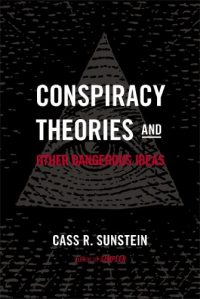
YouTube’s policy shift is the latest symptom of a larger movement by Western elites to—as Obama’s Information Czar Cass Sunstein put it—“disable the purveyors of conspiracy theories.” Sunstein and co-author Adrian Vermeule’s 2008 paper “Conspiracy Theories,” critiqued by David Ray Griffin in 2010 and developed into a 2016 book, represents a panicked reaction to the success of the 9/11 truth movement. (By 2006, 36% of Americans thought it likely that 9/11 was an inside job designed to launch wars in the Middle East, according to a Scripps poll.)
Sunstein and Vermuele begin their abstract:
Many millions of people hold (sic) conspiracy theories; they believe that powerful people have worked together in order to withhold the truth about some important practice or some terrible event. A recent example is the belief, widespread in some parts of the world, that the attacks of 9/11 were carried out not by Al Qaeda, but by Israel or the United States. Those who subscribe to conspiracy theories may create serious risks, including risks of violence, and the existence of such theories raises significant challenges for policy and law.
Sunstein argues that conspiracy theories (i.e. the 9/11 truth movement) are so dangerous that some day they may have to be banned by law. While awaiting that day, or perhaps in preparation for it, the government should “disable the purveyors of conspiracy theories” through various techniques including “cognitive infiltration” of 9/11 truth groups. Such “cognitive infiltration,” Sunstein writes, could have various aims including the promotion of “beneficial cognitive diversity” within the truth movement.
What sort of “cognitive diversity” would Cass Sunstein consider “beneficial”? Perhaps 9/11 truth groups that had been “cognitively infiltrated” by spooks posing as flat-earthers would harbor that sort of “beneficial” diversity? That would explain the plethora of expensive, high-production-values flat earth videos that have been blasted at the 9/11 truth community since 2008.
Why does Sunstein think “conspiracy theories” are so dangerous they need to be suppressed by government infiltrators, and perhaps eventually outlawed—which would necessitate revoking the First Amendment? Obviously conspiracism must present some extraordinary threat. So what might that threat be? Oddly, he never explains. Instead he briefly mentions, in vapidly nebulous terms, about “serious risks including the risk of violence.” But he presents no serious evidence that 9/11 truth causes violence. Nor does he explain what the other “serious risks” could possibly be.
Why did such highly accomplished academicians as Sunstein and Vermuele produce such an unhinged, incoherent, poorly-supported screed? How could Harvard and the University of Chicago publish such nonsense? Why would it be deemed worthy of development into a book? Why did the authors identify an alleged problem, present no evidence that it even is a problem, yet advocate outrageously illegal and unconstitutional government action to solve the non-problem?
The too-obvious answer, of course, is that they must realize that 9/11 was in fact a US-Israeli false flag operation. The 9/11 truth movement, in that case, would be a threat not because it is wrong, but because it is right. To the extent that Americans know or suspect the truth, the US government will undoubtedly find it harder to pursue various “national security” objectives. Ergo, 9/11 “conspiracy theories” are a threat to national security, and extreme measures are required to combat them. But since we can’t just burn the First Amendment overnight, we must instead take a gradual and covert “boil the frog” approach, featuring plenty of cointelpro-style infiltration and misdirection. “Cognitive infiltration” of internet platforms to stop the conspiracy contagion would also fit the bill.
It is quite possible, perhaps even likely, that Sunstein and Vermeule are indeed well-informed and Machievellian. But it is also conceivable that they are, at least when it comes to 9/11 and “conspiracy theories,” as muddle-headed as they appear. Their irrational panic could be an example of the bad thinking that emerges from groups that reflexively reject dissent. (Another, larger example of this kind of bad thinking comes to mind: America’s disastrous post-9/11 policies.)
The counterintuitive truth is that embracing and carefully listening to radical dissenters is in fact good policy, whether you are a government, a corporation, or any other kind of group. Ignoring or suppressing dissent produces muddled, superficial thinking and bad decisions. Surprisingly, this turns out to be the case even when the dissenters are wrong.
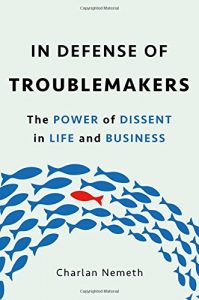
Scientific evidence for the value of dissent is beautifully summarized in Charlan Nemeth’s In Defense of Troublemakers: The Power of Dissent in Life and Business (Basic Books, 2018). Nemeth, a psychology professor at UC-Berkeley, summarizes decades of research on group dynamics showing that groups that feature passionate, radical dissent deliberate better, reach better conclusions, and take better actions than those that do not—even when the dissenter is wrong.
Nemeth begins with a case where dissent would likely have saved lives: the crash of United Airlines Flight 173 in December, 1978. As the plane neared its Portland destination, the possibility of a problem with the landing gear arose. The captain focused on trying to determine the condition of the landing gear as the plane circled the airport. Typical air crew group dynamics, in which the whole crew defers to the captain, led to a groupthink bubble in which nobody spoke up as the needle on the fuel gauge approached “E.” Had the crew included even one natural “troublemaker”—the kind of aviator who joins Pilots for 9/11 truth—there almost certainly would have been more divergent thinking. Someone would have spoken up about the fuel issue, and a tragic crash would have been averted.
Since 9/11, American decision-making elites have entered the same kind of bubble and engaged in the same kind of groupthink. For them, no serious dissent on such issues as what really happened on 9/11, and whether a “war on terror” makes sense, is permitted. The predictable result has been bad thinking and worse decisions. From the vantage point of Sunstein and Vermeule, deep inside the bubble, the potentially bubble-popping, consensus-shredding threat of 9/11 truth must appear radically destabilizing. To even consider the possibility that the 9/11 truthers are right might set off a stampede of critical reflection that would radically undermine the entire set of policies pursued for the past 17 years. This prospect may so terrify Sunstein and Vermeule that it paralyzes their ability to think. Talk about “crippled epistemology”!
Do Sunstein and Vermeule really think their program for suppressing “conspiracy theories” will be beneficial? Do YouTube’s decision-makers really believe that tweaking their algorithms to support the official story will protect us from bad information? If so, they are all doubly wrong. First, they are wrong in their unexamined assumption that 9/11 truth and “conspiracy theories” in general are “blatantly false.” No honest person with critical thinking skills who weighs the merits of the best work on both sides of the question can possibly avoid the realization that the 9/11 truth movement is right. The same is true regarding the serial assassinations of America’s best leaders during the 1960s. Many other “conspiracy theories,” perhaps the majority of the best-known ones, are also likely true, as readers of Ron Unz’s American Pravda series are discovering.
Second, and less obviously, those who would suppress conspiracy theories are wrong even in their belief that suppressing false conspiracy theories is good public policy. As Nemeth shows, social science is unambiguous in its finding that any group featuring at least one passionate, radical dissenter will deliberate better, reach sounder conclusions, and act more effectively than it would have without the dissenter. This holds even if the dissenter is wrong—even wildly wrong.
The overabundance of slick, hypnotic flat earth videos, if they are indeed weaponized cointelpro strikes against the truth movement, may be unfortunate. But the existence of the occasional flat earther may be more beneficial than harmful. The findings summarized by Nemeth suggest that a science study group with one flat earther among the students would probably learn geography and astronomy better than they would have without the madly passionate dissenter.
We could at least partially solve the real problem—bad groupthink—through promoting genuinely beneficial cognitive diversity. YouTube algorithms should indeed be tweaked to puncture the groupthink bubbles that emerge based on user preferences. Someone who watches lots of 9/11 truther videos should indeed be exposed to dissent, in the form of the best arguments on the other side of the issue—not that there are any very good ones, as I have discovered after spending 15 years searching for them!
But the same goes for those who watch videos that explicitly or implicitly accept the official story. Anyone who watches more than a few pro-official-story videos (and this would include almost all mainstream coverage of anything related to 9/11 and the “war on terror”) should get YouTube “suggestions” for such videos as September 11: The New Pearl Harbor, 9/11 Mysteries, and the work of Architects and Engineers for 9/11 Truth. Exposure to even those “truthers” who are more passionate than critical or well-informed would benefit people who believe the official story, according to Nemeth’s research, by stimulating them to deliberate more thoughtfully and to question facile assumptions.
The same goes for other issues and perspectives. Fox News viewers should get “suggestions” for good material, especially passionate dissent, from the left side of the political spectrum. MSNBC viewers should get “suggestions” for good material from the right. Both groups should get “suggestions” to look at genuinely independent, alternative media brimming with passionate dissidents—outlets like the Unz Review!
Unfortunately things are moving in the opposite direction. YouTube’s effort to make “conspiracy videos” invisible is being pushed by powerful lobbies, especially the Zionist lobby, which seems dedicated to singlehandedly destroying the Western tradition of freedom of expression.
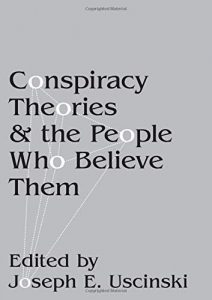
Nemeth and colleagues’ findings that “conspiracy theories” and other forms of passionate dissent are not just beneficial, but in fact an invaluable resource, are apparently unknown to the anti-conspiracy-theory cottage industry that has metastasized in the bowels of the Western academy. The brand-new bible of the academic anti-conspiracy-theory industry is Conspiracy Theories and the People Who Believe Them (Oxford University Press, 2019).
Editor Joseph Uscinski’s introduction begins by listing alleged dangers of conspiracism: “In democracies, conspiracy theories can drive majorities to make horrible decisions backed by the use of legitimate force. Conspiracy beliefs can conversely encourage abstention. Those who believe the system is rigged will be less willing to take part in it. Conspiracy theories form the basis for some people’s medical decisions; this can be dangerous not only for them but for others as well. For a select few believers, conspiracy theories are instructions to use violence.”
Uscinski is certainly right that conspiracy theories can incite “horrible decisions” to use “legitimate force” and “violence.” Every major American foreign war since 1846 has been sold to the public by an official theory, backed by a frenetic media campaign, of a foreign conspiracy to attack the United States. And all of these Official Conspiracy Theories (OCTs)—including the theory that Mexico conspired to invade the United States in 1846, that Spain conspired to sink the USS Maine in 1898, that Germany conspired with Mexico to invade the United States in 1917, that Japan conspired unbeknownst to peace-seeking US leaders to attack Pearl Harbor in 1941, that North Vietnam conspired to attack the US Navy in the Gulf of Tonkin in 1964, and that 19 Arabs backed by Afghanistan, Iraq, Iran, and everybody else Israel doesn’t like conspired to attack the US in 2001—were false or deceptive.
Well over 100 million people have been killed in the violence unleashed by these and other Official Conspiracy Theories. Had the passionate dissenters been heeded, and the truths they told about who really conspires to create war-trigger public relations stunts been understood, none of those hundred-million-plus murders need have happened.
Though Conspiracy Theories and the People Who Believe Them generally pathologizes the conspiracy theories of dissidents while ignoring the vastly more harmful theories of official propagandists, its 31 essays include several that question that outlook. In “What We Mean When We Say ‘Conspiracy Theory’ Jesse Walker, books editor of Reason Magazine, exposes the bias that permeates the field, pointing out that many official conspiracy theories, including several about Osama Bin Laden and 9/11-anthrax, were at least as ludicrously false and delusional as anything believed by marginalized dissidents.
In “Media Marginalization of Racial Minorities: ‘Conspiracy Theorists’ in U.S. Ghettos and on the ‘Arab Street’” Martin Orr and Gina Husting go one step further: “The epithet ‘conspiracy theorist’ is used to tarnish those who challenge authority and power. Often, it is tinged with racial undertones: it is used to demean whole groups of people in the news and to silence, stigmatize, or belittle foreign and minority voices.” (p.82) Unfortunately, though Orr and Husting devote a whole section of their article to “Conspiracy Theories in the Muslim World” and defend Muslim conspiracists against the likes of Thomas Friedman, they never squarely face the fact that the reason roughly 80% of Muslims believe 9/11 was an inside job is because the preponderance of evidence supports that interpretation.
Another relatively sensible essay is M R.X. Dentith’s “Conspiracy Theories and Philosophy,” which ably deconstructs the most basic fallacy permeating the whole field of conspiracy theory research: the a priori assumption that a “conspiracy theory” must be false or at least dubious: “If certain scholars (i.e. the majority represented in this book! –KB) want to make a special case for conspiracy theories, then it is reasonable for the rest of us to ask whether we are playing fair with our terminology, or whether we have baked into our definitions the answers to our research programs.” (p.104). Unfortunately, a few pages later editor Joseph Uscinski sticks his fingers in his ears and plays deaf and dumb, claiming that “the establishment is right far more often than conspiracy theories, largely because their methods are reliable. When conspiracy theorists are right, it is by chance.” He adds that conspiracy theories will inevitably “occasionally lead to disaster” (whatever that means). (p.110).
I hope Uscinski finds the time to read Nemeth’s In Defense of Troublemakers and consider the evidence that passionate dissent is helpful, not harmful. And I hope he will look into the issues Ron Unz addresses in his American Pravda series.
Then again, if he does, he may find himself among those of us exiled from the academy and publishing in The Unz Review.
Goodbye ‘Freedom and Democracy’ – Hello ‘Rules-based International Order’
By Paul Carline | OffGuardian | February 2, 2019
The banner and the clarion call of western countries, and their own asserted legitimation – especially when they are engaging in illegal wars and coups – used to be “freedom and democracy”: the precious gift they were generously and selflessly offering to a backward world – or one allegedly in the ‘chains’ of Socialism/Communism. There was “Radio Free Europe”, for example, pushing out western liberal propaganda, primarily against the countries of the former Soviet Union.
The Washington-based “Freedom House” organisation, which claims to be independent, has around 150 staff members in Washington and in ‘field offices’ around the world. Its President is Michael J. Abramowitz, who before joining Freedom House in 2017, was director of the US Holocaust Memorial Museum’s Levine Institute for Holocaust Education. Before that, he was National Editor and then White House correspondent for the Washington Post. He is a member of the Council on Foreign Relations and a former fellow at the German Marshall Fund and the Hoover Institution. He is also a board member of the National Security Archive. The Board of Trustees is chaired by Michael Chertoff, Secretary of Homeland Security under George W. Bush and co-author of the USA Patriot Act.
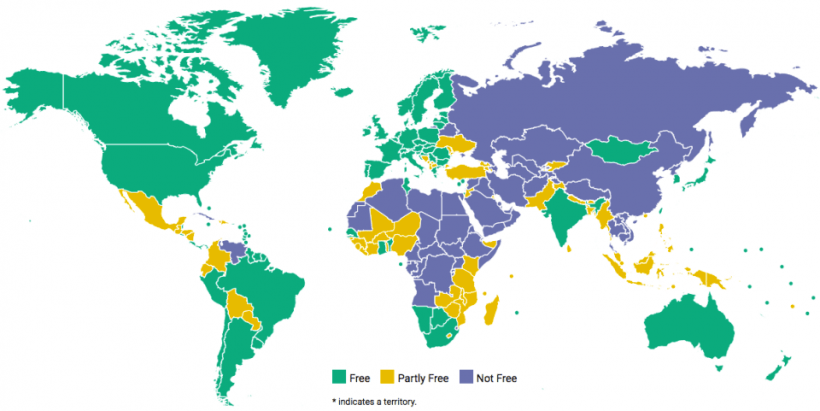
Since 1972, Freedom House, whose website sports a warm endorsement by none other than Francis Fukuyama, has produced an annual “Freedom in the World” global map (above), which divides the world into countries which are either “free”, “partly free”, or “not free”. The allegedly “free” countries are coloured green, the “partly free” ones a kind of muddy yellow, and the “not free” ones blue.
Its analysis of “freedom” covers “the electoral process, political pluralism and participation, the functioning of government, freedom of expression and belief, rights of association and organization, the rule of law, and personal autonomy and individual rights”. The word ‘democracy’ is not used in the ratings system, nor is it defined anywhere, but the 2018 analysis is headlined “Democracy in Crisis”.
According to Freedom House, in 2018 45% of the world (by country) or 39% (by population) was “free”, 30% (country) or 24% (population) was “partly free”, and 25%/37% “not free”. Countries are rated on a percentage points system. Sweden, which last year joined in the NATO ‘war games’ – despite not being a NATO member – is given a full 100 points, Canada 99, Uruguay 98, both Chile and the UK 94, France a completely undeserved 90, the USA 86 and Israel an unreal 79. By contrast, China scores 14, Iran 17, and Russia a mere 20, while Tibet and Syria are granted only 1 point each (no bias there). Almost incredibly, Ukraine scores 62 – allowing it to be rated as “partly free”! Very oddly, the FAQ section is available in only two languages – English and Ukrainian!
I suspect that the statement by Freedom House’s President, Michael J. Abramowitz, to the effect that: “A quarter-century ago, at the end of the Cold War, it appeared that totalitarianism had at last been vanquished and liberal democracy had won the great ideological battle of the 20th century”, must induce wry smiles – if not outright anger – in many Off-Guardian readers. Abramowitz predictably refers to “the rise of populist leaders who appeal to anti-immigrant sentiment and give short shrift to fundamental civil and political liberties” and describes “newcomer Emmanuel Macron” as a “centrist” who “handily” (interesting choice of words!) won the French presidency.
Depressingly predictable is his comment on China and Russia, which he labels “the world’s leading autocracies” and which he asserts “have seized the opportunity not only to step up internal repression but also to export their malign influence to other countries, which are increasingly copying their behaviour and adopting their disdain for democracy” (emphasis added; no mention of the massive ‘disdain for democracy’ in the USA, UK, and numerous members of the EU).
According to Abramowitz, “Democratic governments allow people to help set the rules to which all must adhere, and have a say in the direction of their lives and work!” If that were true, there would be lots of direct democracy in all those “free” countries. It’s true that there is some ‘direct democracy’, e.g. popular initiatives and referendums, in a few states of the USA and in a few European countries – with Switzerland far and away the best example, followed by Germany at the regional and local levels, thanks to the efforts over decades of its leading pro-democracy organisation “Mehr Demokratie”, which has been trying to have direct democratic rights established also at the national level, which would really allow the people to “help set the rules”. Germany’s “Basic Law” (it doesn’t have a proper constitution for reasons which I cannot go into here but which will be known to many) actually states: “All power derives from the people” (Article 20) and “State power is exercised by the people in elections and referendums” (emphasis added) – but successive governments have refused to enact the laws that would allow state-level referendums, presumably because they fear the “people power” that is the literal meaning of ‘democracy’.
Given subsequent developments, Kofi Annan’s 2001 Nobel Peace Prize acceptance speech now strikes a sour note:
“The obstacles to democracy have little to do with culture or religion, and much more to do with the desire of those in power to maintain their position at any cost. This is neither w new phenomenon nor one confined to any particular part of the world. People of all cultures value their freedom of choice and feel the need to have a say in the decisions affecting their lives”
In the 2002 UNDP World Development Report, Annan re-affirmed the true nature of democracy in these words:
“True democratization means more than elections. People’s dignity requires that they be free – and able – to participate in the formation and stewardship of the rules and institutions that govern them”.
According to Abramovitch’s definition, and that of Kofi Annan, there is zero genuine democracy in the U.K. (a purely representative system – especially one still using an outdated and wholly disreputable FPTP system, with rare referendums arranged by the government, which sets the question – is not a legitimate form of democracy).
We may also ask, in parenthesis as it were, who – if not the electorates – is “helping to set the rules”, for example in Europe specifically. As of July 2017, there were 11,327 registered lobby organisations in the EU, employing some 82,096 people – the equivalent of 50,326 full-time personnel – of which nearly 7,000 have access to the Parliament. In Germany there are around eight lobbyists – representing ‘outside’ interests – for every member of the national parliament – and the lobby registers are voluntary. Only seven countries (France, Ireland, Lithuania, Austria, Poland, Slovenia and the UK) have passed any laws on lobbying.
What is extremely interesting and telling is the general absence of references to ‘freedom and democracy’ by our so-called ‘leaders’. Those words have been replaced in the political lexicon by the now clearly favoured expression “the rules-based international order” – which doesn’t have quite the same ring, or the same connotations, as “freedom and democracy”.
One is forced to ask: whose order? whose rules? If Abramowitz is correct, and since we are privileged enough to live in a country which, if we are to believe its FH rating, is little short of perfect, we the people must have been involved in setting those rules. We should at least have been told what they mean! For example, what does ‘international’ mean in this context? It suggests a global compact – but when it is used it specifically excludes certain countries and regimes which we are led to believe are not part of, or indeed are allegedly trying to undermine, this new ‘order’.
Although the word ‘international’ is often taken to be a synonym for ‘global’ or ‘universal’, its literal meaning is ‘between nations’. The UN has of course long promulgated and endorsed all kinds of ‘universal’ rules (the ICC rules on aggression for instance) – many of which are routinely flouted by the countries which most loudly lay claim to being ‘democracies’ and loyal observers of the “rules-based international order”.
But we are now seeing a new type of literally ‘inter-national’ agreements being made in Europe, often merely between two governments at a time (with no democratic endorsement by either parliaments or people) and where the suspicion is that this is a new way of hiding from the general public what is really going on in Europe – specifically the step-by-step implementation of the “United States of Europe” project which dates from at least 1946.
There seems to be an undue haste to complete the creation of a unified military establishment that would not be answerable to the individual nation states which are contributing their forces (and infrastructure!) and which would also appear to include a much closer working relationship between military and police forces. Does the urgency have to do with the level of chaos in Europe and the threat – now materialised in the form of the “Yellow Vest” protests – of widespread civil unrest and potentially public revolt?
So Prime Minister Theresa May can pretend to the public that the ‘Brexit’ approved by a majority of voters will take place i.e. that Britain will “come out of” the EU, while at the same time, and largely in secret or behind closed doors in completely undemocratic meetings, the government is committing the entire UK military establishment, step by step, to the new ‘unified European defence establishment’. The UK enters into a special relationship with France (and thereby with the EU). France and Germany have just signed a new treaty – the Aachen Treaty – so does the UK automatically acquire the special relationship with Germany? And will this “two-step” approach eventually link all willing states (one could imagine Hungary, perhaps Italy and Greece also, not being so willing) in the ‘new European order’?
In struggling to understand the “rules-based international order” I found this definition by the RAND Corporation very helpful:
Since 1945, the United States has pursued its global interests through creating and maintaining international economic institutions, bilateral and regional security organizations, and liberal political norms; these ordering mechanisms are often collectively referred to as the international order.
In recent years, rising powers have begun to challenge aspects of this order. This report is part of a project, titled “Building a Sustainable International Order,” that aims to understand the existing international order, assess current challenges to the order, and recommend future US policies with respect to the order.
This report is the first of those and reflects the project team’s attempt to understand the existing international order, including how US decision makers have described and used the order in conducting foreign policy, as well as how academics have assessed the mechanisms by which the order affects state behaviour.
When discussing policy responses to a fraying international order, the first challenge is to understand what we mean by the term. Order has various meanings in the context of international politics, and specific orders can take many forms.1 For the purposes of this project, we conceive of order as the body of rules, norms, and institutions that govern relations among the key players in the international environment. An order is a stable, structured pattern of relationships among states that involves some combination of parts, including emergent norms, rulemaking institutions, and international political organizations or regimes, among others.
– RAND Corporation 2016, Understanding the Current International Order
This more recent observation was both insightful and amusing:
“The rules-based international order is being challenged, quite surprisingly, not by the usual suspects, but by its main architect and guarantor, the US,” Donald Tusk, the president of the European Council, said as the summit meeting got underway in Quebec’s picturesque resort town of La Malbaie on the banks of the St. Lawrence River.
The trans-Atlantic rift manifested itself in a behind-the-scenes debate about the wording of the traditional summit communiqué. The American side objected to including the phrase “rules-based international order,” even though it is boilerplate for such statements, according to two people briefed on the deliberations. The Europeans and Canadians were pushing back, but it remained unclear whether the Trump administration would ultimately sign the statement or be left on its own.
– NYT June 8, 2018 Michael D. Shear
So the ‘rules-based international order’ is, in reality, the expression of America’s “global interests”. Other parties – such as British and other governments – may be allowed to put on the mask of the Eagle, whilst claiming to be on the side of justice, truth, human rights … and yes, democracy. And since it’s a US construct, the US and its allies can feel free to ‘make it up as they go along’.
Featured Video

When Israel Is Mighty
or go to
Aletho News Archives – Video-Images
From the Archives
US murdering 1 million Iraqis is democracy, Iran giving yogurt to Iraq is “domination”
By Ali Salaam | American Herald Tribune | July 31, 2017
The New York Times, owned by the Zionist Jewish supremacist Ochs-Sulzberger family, has no problem with Iraqi suffering as long as Iran is not the one behind it.
The Iraq War was a genocide of the Iraqi people by Zionist supremacists in the Bush administration. Over 1 million innocent people were killed based on a lie. American soldiers died in an Israeli war and now an average of 22 soldiers commit suicide every day because their consciences cannot cope with the fact they committed crimes in an illegal war that served no purpose other than to benefit Israel, not America.
Benjamin Netanyahu, Prime Minister of the Zionist regime, once said “We are benefiting from one thing, and that is the attack on the Twin Towers and Pentagon, and the American struggle in Iraq.”
Paul Wolfowitz had his sights on Iraq since his time in the first Bush administration. Former Israeli official and Bush administration official Richard Perle had his eyes on Iraq since at least his authorship of the Clean Break white paper. The Zionist regime had their eyes on Iraq since the 1980s when strategist Oded Yinon wrote his white paper in support of dividing the Arab-Muslim world along ethnic and sectarian lines. The global Zionist lobby has had their eyes on Iraq since Theodor Herzl stated that Eretz Israel’s true borders go from the Nile River in Egypt to the Euphrates River in Iraq. … continue
Blog Roll
 Aletho News
- MEP blasts ‘Euro-Gestapo’ for lecturing Russia on democracy
- Syria May Send Troops to Saudi Arabia Amid War with Ansar Allah
- UK whines about losing billions to ‘Putin tax’
- Baghaei to Rubio: Distorted narratives cannot erase US record of broken commitments
- Houthis Don’t Have to Conquer Saudi Arabia to Make It Pay
- MOE: Nearly 22,000 Students and Education Workers Killed
- Guterres in Islamabad: Genocide, cowardice, and the cage of Imran Khan
- Johnson, Marandi say Yemen holds upper hand over Saudi Arabia
- False flags won’t save aggressors, Iran FM spokesman says
- The Makkah Pact Enters Into Force: The End of American Dominance or Its New Form?
- If Americans Knew
- Report claimed Mark Levin used by Israeli government to influence Trump
- Over 2,000 Gazans have died awaiting medical evacuation amid Israel’s continued siege
- How a U.S. Diplomat Suppressed and Altered Reports Critical of Israel
- 5 Palestinians Die from Israeli Strikes in Gaza as Relentless Attacks Continue
- Report: Ceasefire Slows Killing but Leaves Devastation Intact
- Country Music Singer Zach Bryan Breaks Attendance Record at Robert Kraft’s Gillette Stadium While Wearing ‘Free Palestine’ Shirt for Second Night in a Row
- Three years of death and devastation: Israel’s war on Gaza in pictures
- Why Hamas believed the status quo was more dangerous than its 7 October gamble
- Debunking Israel’s latest list of ‘terrorist’ journalists in Gaza
- In Gaza, focus is on survival, “every step is a struggle” – Daily Update
- No Tricks Zone
- New Study: 50 Years Of The Most Aggressive ‘Net Zero’ Policies Can Only Affect The Global Climate By 0.03°C
- US September “Heat” Was No Record…Many Records Set Decades Ago
- Latest European Green Energy Debacle; Portugal’s Largest Flagship Solar Park Insolvent!
- Green Energy Debacle: German Expert Professor Fritz Vahrenholt Warns Of Severe Economic And Social Consequences
- Two More Paleo Reconstructions Affirm Meters-Higher Sea Levels Across Ireland, Brazil 7000-6000 Years Ago
- New Study: Earth And Venus Surface Warmth Largely Explained By Convection And Lapse Rate, Not CO2 Or Radiation
- 2025 Nature Paper Claiming Worsening Global Drought Gets RETRACTED …Heavily Flawed
- New Study: ‘Global Drought Shows No Detectable Recent Acceleration Under Climate Warming’
- Economic Masterminds: German Socialists Suggest Taxing Productivity Gains Stemming From Using AI
- The South China Sea Has Not Been Cooperating With The Climate Change Narrative

