Al-Araqeeb village: Palestinian Bedouins refuse to surrender 116 times
By Ramzy Baroud | MEMO | August 15, 2017
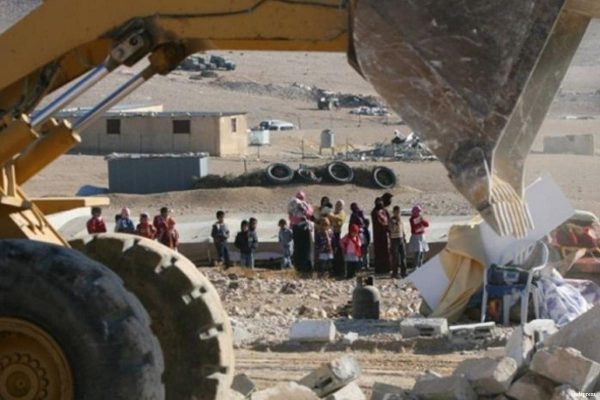
On August, the Palestinian Bedouin village of Al-Araqeeb was destroyed for the 116th time. As soon as Israeli bulldozers finished their ugly deed and soldiers began evacuating the premises, the village resident immediately began rebuilding their homes.
Twenty-two families, or about 101 residents, are estimated to live here. By now, they are all familiar with the painful routine, considering the first round of destruction took place in July 2010.
It means that the village has been destroyed nearly 17 times each year since then. And each time, it was rebuilt, only to be destroyed again.
If the repeated destruction of the village is an indication of Israel’s stubborn insistence to uproot Palestine’s Bedouins, the rebuilding is indicative of the tenacity of the Bedouin community in Palestine.
But Al-Araqeeb is only symbolic of that historic fight.
It would be no exaggeration to state that there is a war waged by Israel against Palestinian Bedouins. The aim is to destroy their culture and to force them into townships similar to those of Apartheid South Africa.
The geographic space of that war extends from the Negev desert to the Southern Hebron Hills to Jerusalem.
The epicenter of the ongoing fight is the village of Al-Araqeeb. Not only has Israel destroyed Al-Araqeeb numerous times in violation of international law, it actually delivers a bill to the homeless residents expecting them to cover the cost of the very ruins wrought by the Israeli state.
According to latest estimates, the families that live in makeshift huts and rely on rudimentary means to survive are expected to pay up a bill of two million shekels, around $600,000.
Israel dubs Al-Araqeeb, along with 35 villages in the Negev, as “unrecognised” by the Israeli government’s master plan, thus they must be erased, and their population driven into townships made for the Bedouins.
However, these villages are older than Israel itself, and any such “master plan” could have easily considered this existing reality. What Israel truly labours to achieve is to replace the Bedouins with its own Jewish population, as it has tirelessly done for seven decades.
Palestinian Bedouins are known for their tenacity. They fully fathom the history and plight of their ancestors, where generation after generation were ethnically cleansed and exiled to refugee camps outside Palestine, or forcibly removed to other areas. Today’s Bedouin communities refuse to be subjected to that same fate again.
The Israeli plan to ethnically cleanse the Bedouins of the Negev is no different from the plan to colonise the West Bank, Judaise the Galilee and Palestinian East Jerusalem. All such efforts always culminate in the same routine – of removing the Arabs and replacing them with Israeli Jews.
In 1965, Israel passed the Planning and Building Law which recognised some Palestinian Arab villages in the Galilee and southern Negev, but excluded others. Nearly 100,000 Bedouin were forcibly removed to “Planned Townships” to endure economic neglect and poverty. Many refused to be moved and, since then, have fought a protracted war to survive and maintain a semblance of their culture and way of life.
Currently, according to the Institute of Palestine Studies (IPS), roughly 130,000 individuals live in the so-called unrecognised villages “under the constant threat of wholesale demolition”.
The anomaly is that these Bedouin communities prove the fallacy of the Israeli claim that it was Jewish settlers – not Palestinians – that “made the desert bloom”.
A simple look at statistics demolishes that deceptive claim entirely.
As of 1935 – that is 13 years prior to the existence of Israel – Bedouins “cultivated 2,109,234 dunums of land where they grew most of Palestine’s barley and much of the country’s wheat,” stated IPS.
Moreover, Jewish settlers did not arrive in the Negev till 1940 and, by 1946, the total Jewish population there did not amount to more than 475.
The amount of land cultivated by the Bedouins in the Negev prior to 1948 came to three times that cultivated by the entire Jewish community in all of Palestine even after sixty years of ‘pioneering’ Zionist settlement IPS concluded.
To reverse this indisputable historical reality, Israel has led a decided campaign aimed at vanquishing the Bedouins by severing their relationship to their land. Although this has been done with a great degree of success, the struggle is not yet over.
The same struggle is duplicated elsewhere, especially in so-called “Area C” encompassing 60 per cent of the West Bank. Palestinian Bedouin villages there are also enduring a terrible fight, as many of their villages have been singled out for destruction.
Most West Bank Bedouins live in the central West Bank region, in an area known as the South Hebron Hills. Last month, it was reported that the Israeli Supreme Court is now “deciding the fate” of the Bedouin village of Dkeika. Other villages in the area have either been demolished, received demolition orders or are waiting for their fate to be determined by the Israel court.
It is hardly a question of a single village or two. The UN reported that 46 villages in central West Bank are “at risk of forcible transfer” by the Israeli government.
To preclude any legal wrangling, the Israeli government has been actively pursuing wholesale, irreversible actions to seal the fate of Bedouins once and for all.
In 2013, Israel announced the “Prawer Plan”, the goal of which was the destruction of all unrecognised villages in the Negev. However, massive mobilisation involving the Bedouins and Palestinians throughout the Occupied Territories defeated the plan, which was officially rescinded in December of the same year.
But, now, it is being revived under the name “Prawer II”. A draft of the plan, which was leaked to local media, was introduced by Israel’s Agricultural Minister, Uri Ariel. It, too, aims to “deny Bedouin citizens land ownership rights and violate their constitutional protections,” reported Patrick Strickland.
The war on the Bedouin is, of course, part of the larger war on all Palestinians, whether in Israel or under military occupation. While the latter are denied the most basic freedoms, the former are governed by at least 50 discriminatory laws, according to the Haifa-based Adalah Legal Centre for Arab Minority Rights.
Many of these laws are aimed at depriving Palestinians of the right to own land or to claim even the very land upon which their homes and villages existed for tens and hundreds of years.
It should come as no shock, then, to learn that, while Palestinian citizens of Israel are estimated at 20 per cent of the population, they live on merely three per cent of the land, and many of them face the constant danger of being evicted and relocated elsewhere.
The story of Al-Araqeeb is witness to the never-ending Israeli desire for colonial expansion at the expense of the indigenous population of Palestine, but also of the courage and refusal to give in to fear and despair as demonstrated by the 22 families of this brave village.
In some way, Al-Araqeeb represents the story of all of Palestine and its people.
The struggle of Al-Araqeeb should evoke outrage at Israel’s constant violation of human rights and its refusal to recognise the national aspirations of the Palestinian people, but it should also induce hope that 70 years of colonial expansion cannot defeat or even weaken the will of a village, or a nation.
Read also: Israel demolishes EU-funded Palestinian homes in Hebron
Palestinian Journalists Declare Hunger Strike

A journalist during a protest at Israel’s Ofer detention center in the West Bank (PLO/File)
By Jaclynn Ashly | IMEMC News | August 14, 2017
As local and international criticism continued to mount against the Ramallah-based Palestinian Authority’s (PA) tightening noose on freedoms of expression in the occupied West Bank, seven Palestinian journalists imprisoned by the PA have begun a hunger strike after being detained under the controversial Cyber Crimes Law, approved by Palestinian President Mahmoud Abbas last month.
Palestinian journalists Mamduh Hamamra, a correspondent for Al-Quds News, Al-Aqsa TV correspondent Tariq Abu Zeid, and freelance journalist Qutaiba Qassem all declared a hunger strike immediately after their detentions were extended by up to 15 days on Thursday, according to a statement released by Omar Nazzal, a member of the Palestinian Journalists’ Syndicate and former prisoner of Israel.
Issam Abdin, a lawyer and head of advocacy at Palestinian NGO al-Haq, confirmed to Ma’an News Agency that four more Palestinian journalists –Al-Quds News correspondent Ahmad Halayqa, Shehab News Agency correspondent Amer Abu Arafa, and reporters Islam Salim and Thaer al-Fakhouri — had declared a hunger strike on Thursday to protest their detention.
The journalists had all been detained several days prior for allegedly violating the terms of the new law, according to Abdin.
All seven of the journalists reportedly work for media outlets that were among 30 sites blocked by the PA in June — all of which were reportedly affiliated with the Hamas movement, the ruling party in the besieged Gaza Strip which has been embroiled in a bitter ten-year rivalry with the Fateh-led PA, or Abbas’ longtime political rival, Muhammad Dahlan.
While the move to block the websites in the West Bank was condemned at the time as an unprecedented violation of press freedoms in the Palestinian territory, Abbas took the crackdown on media to another level last month by passing the Cyber Crimes Law by presidential decree.
‘A draconian law’
In a statement on Thursday, Nazzal said that at least six of the imprisoned journalists — omitting al-Fakhouri — were being detained over allegations of violating Article 20 of the Cyber Crimes Law.
The article states that an individual could face at least one year in prison or be fined at least $1,410 for “creating or managing a website or an information technology platform that would endanger the integrity of the Palestinian state, the public order, or the internal or external security of the State.”
Meanwhile, “any person who propagates the kinds of news mentioned above by any means, including broadcasting or publishing them” faces up to one year in prison or a fine ranging from $282 to $1,410, according to the new law.
Abdin said that these “loose articles,” through which individuals would face imprisonment simply for publishing certain articles on their social media accounts, set the groundwork for arresting Palestinian journalists and “destroying the freedom of journalism work in Palestine.”
Nadim Nashif, the cofounder and director of Palestinian and Arab digital advocacy group 7amleh, called the law “terrible” and “draconian.”
“It’s the worst law in the PA’s history,” Nashif said. “It allows the PA to arrest anyone under unclear definitions.”
Nashif noted that not only did the law criminalize the creation, publication, and propagation of certain information deemed dangerous by the PA, it also ruled that individuals found to have bypassed PA blocks on websites through proxy servers or Virtual Private Networks (VPNs) could face three-month prison sentences.
Nashif said that the law had dragged the West Bank “backwards.”
Despite Israel’s decade-long occupation of the West Bank and the more than 10-year political split with Hamas, “generally, the media and websites were left alone,” Nashif said. “They were not part of this political fight.”
“The PA is kind of breaking the last spaces of freedom of speech,” he said.
Palestinian journalists trapped between Hamas-PA divide
Rights groups were quick to condemn the detention of the journalists, claiming that the new law was aimed at rooting out political dissent against Abbas and the PA — likely under the auspices of the PA’s widely condemned security coordination with the Israeli state, although the PA has repeatedly stated that it has halted this policy since July.
According to prisoners’ rights group Addameer, a PA security official had initially said that at least five of the imprisoned journalists were arrested for “leaking information and communicating with hostile parties.”
However, Addameer added, the Palestinian Journalists’ Syndicate contacted Palestinian security forces on Wednesday morning and were told that the journalists were detained “in order to pressure Hamas to release another journalist detained in the Gaza Strip,” referring to Fouad Jaradeh, a correspondent for official PA news channel Palestine TV who has been imprisoned in Gaza for more than two months.
Both Hamas and the PA have been criticized for carrying out retaliatory acts on individuals affiliated with the opposing group, most notably in the shape of politically motivated arrests and imprisonment.
Abdin said that Palestinian journalists have been “plunged into the Hamas-Fateh division,” as both groups have targeted journalists in order to quash opposition that could affect their political hold in the Gaza Strip and the West Bank respectively.
The Palestinian Center for Development and Media Freedoms (MADA) said in a statement on Wednesday that the journalists’ arrests were “part of a marked escalation of violations against media freedoms” in both the West Bank and Gaza.
However, the new law and Abbas’ moves to stifle dissent against the PA are “not just problematic for journalists,” Nashif said. “Any activist or individual who the PA thinks is an opponent can now be arrested without any clear reason.”
The PA has also been accused of conducting sweeping detention campaigns targeting Hamas-affiliated residents of the West Bank, while the PA has escalated measures in recent months to pressure Hamas to relinquish control of the Gaza Strip.
A study by Palestinian think tank al-Shabaka documented the consequences of the PA’s security campaigns, “whose ostensible purpose were to establish law and order,” but have been perceived by locals as criminalizing resistance against Israel.
‘It’s illegal under Palestinian law’
Abdin pointed out that both the website blocking and the new cyber crimes law violated Article 27 of Palestinian Basic Law, which protects the press freedoms of Palestinian citizens, including their right to establish, print, publish, and distribute all forms of media. The law also guarantees protections for citizens who are working within the field of journalism.
The article also prohibits censorship of the media, stating that “no warning, suspension, confiscation, cancellation, or restriction shall be imposed upon the media,” unless a law violating these terms passed a legal ruling.
Abbas, however, has not received permission from the judiciary to approve these far-reaching restrictions on the press, according to Abdin.
Since Hamas won parliamentary elections in 2006, the Palestinian Legislative Council has not convened in Ramallah, meaning that the vast majority of laws passed by the PA in the past ten years have been passed by Abbas, who extended his presidency indefinitely in 2009, via presidential decrees.
Al-Haq has pointed out that the new legislation violates international law, including Article 19 of the International Covenant on Civil and Political Rights (ICCPR).
Rights groups, activists, and journalists have demanded that the PA amend the law to abide by pre-existing Palestinian legislation, rescind its blockage of news sites, and end its practice of routinely arresting Palestinian activists, writers, journalists, and others for their political opinions.
Edited for the IMEMC by chris @ imemc.org
Statement from The Rutherford Institute Regarding Violence at the August 12 Rally in Charlottesville
The Rutherford Institute | August 14, 2017
CHARLOTTESVILLE — That this weekend’s display of hate, violence and civil disorder resulted in the death of Heather Heyer is not just a tragedy for those who knew and loved Heather, but for all of us who believe that love is greater than hate and that freedom for all is imperative if we are to stand strong against the forces of tyranny that continue to batter this nation.
There is always the temptation following a tragedy to point fingers and find someone to blame in addition to those directly responsible for committing acts of violence. It is unfortunate that those leading the charge right now have chosen to cast the blame on civil liberties organizations that were compelled to stand up for the principles of the Constitution when the government failed to do so. To suggest that the ACLU of Virginia or The Rutherford Institute or the federal district court were in any way complicit in this weekend’s violence is to do a grave disservice to every individual who has ever fought and died for the freedoms on which this nation was founded.
The City of Charlottesville had several lawful options it could have pursued to prepare for this weekend’s anticipated clash between protesters.
1. The City could have chosen to close the downtown forum altogether and move all three permit-holders to McIntire Park. It did not do so. Instead, the City Manager created a clear First Amendment crisis by revoking only one of the three downtown permits granted for this weekend, by failing to provide any evidentiary-based factual support for its actions, and by waiting to act until mere days before the anticipated rallies were to take place.
2. The City should have ensured that police were under clear orders to maintain law and order by establishing clear boundaries and safeguarding the permit zones. In fact, the City made it clear in press statements and in legal filings that it was preparing for demonstrations downtown by both sides whether or not the Unite the Right rally’s permit for Emancipation Park was honored. According to news reports, more than 1000 armed police, riot teams plus the National Guard were deployed to maintain law and order at the August 12 demonstration. As indicated by its preparations for the July 8 KKK rally, the City and law enforcement were completely cognizant of the need to establish barriers keeping the two sparring sides apart and to ensure that all three permit holders’ rights to access their respective spaces were respected.
3. The First Amendment provides for the right to peacefully assemble in public. In other words, no permit is necessary for citizens to assemble in public. The permitting process simply provides for space to be reserved by a particular group at a particular space for a particular purpose. While the government has the discretion to refuse permits based on reasonable time, place and manner concerns, it may not discriminate against a group based on the content of their speech. Whether or not a permit had been issued for any of the three downtown parks on August 12, the protesters and counterprotesters made it clear that they planned to exercise their right to assemble. Many of those assembled maintained their commitment to peaceful, nonviolent action. The rights of those who exercised their First Amendment rights peacefully and lawfully were diminished by those who opted to act with violence and in clear violation of the law. There is no defense for such actions.
As Glenn Greenwald recognized in his article in The Intercept taking issue with those who attacked the ACLU (and The Rutherford Institute) for challenging the City of Charlottesville over its unequal application of the permitting laws, civil liberties advocates “defend the rights of those with views we hate in order to strengthen our defense of the rights of those who are most marginalized and vulnerable in society.”
The Rutherford Institute remains committed to preserving, protecting and defending the Constitution, even in those most difficult situations when doing so means defending the rights of those whose views may be hateful or unpopular.
***
The Rutherford Institute, a nonprofit civil liberties organization, provides legal assistance at no charge to individuals whose constitutional rights have been threatened or violated and educates the public on a wide spectrum of issues affecting their freedoms.
Remembering the Rabaa massacre
By Amelia Smith | MEMO | August 14, 2017
Four years ago today the Egyptian army stormed a sit-in at Cairo’s Rabaa square and slaughtered 1,000 people who were protesting against the removal of the country’s first democratically elected President, Mohammed Morsi. People were shot, burnt alive and suffocated with tear gas. Security forces blocked the entrances so that ambulances couldn’t get in to treat the wounded.
What: Rabaa Massacre
When: 14 August 2013
Where: Egypt
What happened?
After Morsi was ousted in a military coup on 3 July 2013 the Muslim Brotherhood called for counter-protests at Rabaa Al-Adawiya and Al-Nahda squares. Some 85,000 people joined the sit-ins.
Members of the Muslim Brotherhood had been demonstrating outside the Rabaa Al-Adawiya Mosque in Cairo for 47 days when security forces attacked at around 6am on 14 August 2013.
Security forces shot indiscriminately into the crowd, set fire to the tents people had gathered in and threw tear gas into the masses. Armoured vehicles and bulldozers advanced on the protesters.
Some 1,000 people were killed, thousands injured and over 800 people were arrested.
What happened next?
Supposedly liberal figures like the author Alaa Al-Aswany endorsed the massacre, as did the state media. “They are a group of terrorists and fascists,” Al-Aswany said.
Despite the fact that the police and army opened fire and used excessive force, since that day not a single security officer has been brought to trial or been held accountable for the massacre.
In 2015 the government renamed the square after Hisham Barakat, the public prosecutor who presided over the acquittal of Hosni Mubarak.
Authorities widened their crackdown, not just targeting members of the Muslim Brotherhood but anyone who opposes the regime. They arrested thousands, tortured them, denied them medical attention in prison and forcibly disappearing them.
Human Rights Watch and the Egyptian Initiative for Personal Rights both conducted independent investigations into the massacre and concluded that it had been launched on predominantly unarmed protesters.
Despite this the international community resumed arms exports to Egypt shortly after the massacre and have generally sought to strengthen ties with the Sisi regime.
Three Social Leaders Murdered in Colombia in Only 72 Hours
teleSUR | August 12, 2017
The Colombian activist and social leader Fernando Asprilla was murdered on Friday in the Cauca department, and was the third death of a social leader recorded in a 72 hour period.
The Ombudsman of Colombia, Carlos Alfonso Negret Mosquera, showed in a recent report that during the period between the first of January, 2016, and March 1st of 2017, at least 156 homicides, five disappearances, and 33 violent attacks against community and social leaders occurred.
According to the report given by Negret, one of the primary causes of the deadly trend is the continued operations of illegal armed right-wing paramilitary organizations that have occupied territory left behind by the disarming Revolutionary Armed Forces of Colombia – People’s Army (FARC – EP).
Human rights defenders and activists in the districts of Antioquia, Arauca, Atlantico, Bolivar, Caldas, Caqueta, Casanare, Cauca, Cesar, Cordoba, Cundinamarca, Choco, Huila, La Guajira, Magdalena, Meta, Nariño, Norte de Santander, Putumayo, Risaralda, Santander, Tolima and Cauca Valley have been assassinated since the FARC’s demobilization process began.
As they have handed over their weapons and negotiated terms of peace with the Colombian government, FARC-EP has consistently demanded that the state works to dismantle paramilitarism in the country, saying its ongoing violence represents the greatest threat to the peace process.
The government however, has largely ignored the existence of paramilitaries, claiming that they were demobilized during Alvaro Uribe’s presidential term between 2006 and 2008. FARC-EP leaders have pointed out that many of the groups have been reclassified as criminal gangs, but continue to represent the same threat as always by assassinating leaders who fight for human and land rights.
Democratic Demagogues and ‘The Better Deal’
By James Petras • Unz Review • August 9, 2017
Introduction
 After 6 months of blaming Russia for the Democratic Party’s Presidential election debacle, the Party stalwarts have finally realized that the American electorate is not listening.
Democratic Party investigators in Washington still hold hearings and the mass media are still scandal mongering, but the public is not rallying to their cause.
Trump’s demagogy may have lost its appeal, while the Republican Administration purges and internecine squabbles have been met with a huge collective yawn by the public. The Democratic Party proves itself to be a weird sideshow for the vast majority of American voters… and for good reason.
Their perpetual (corrupt and senile) leaders are unwavering supporters of every indignity and economic hardship that the majority of worker families have suffered for the last three decades.
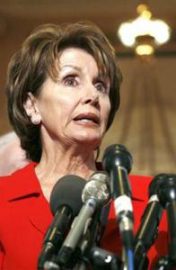
Democratic Party Senator Chuck ‘the Schmuck’ Schumer and Congresswomen Nancy ‘The Loser’ Pelosi have spent a collective sixty-five years in Congress. Their joint tenure marks a period of long decline in working class living standards and even worker life expectancy, while they have made possible the greatest concentration of wealth in the hands of the 1% plutocrats.
The Democratic Party’s ‘Better Deal’ – But for Whom?
In July 2017, nearly a dozen of the top Democratic Party honchos and Congress people met to spin out a new electoral manifesto for American workers which they are marketing as ‘A Better Deal’.
They issued prophetic press releases claiming to have received (presumably from the Holy Mountain) ‘a new vision of the party’. They claimed ‘the vision’ was also the result of their humble ‘listening to the American people’. They confessed that ‘the American people deserve better’. But their sweetly harmonized collective ‘Mea Culpa’ omitted any mention of the four previous Democratic Party Presidential terms, under Bill ‘The Shill’ Clinton and Barak ‘The Con” Obama, which ushered in this deplorable state of affairs for the American working class.
The Democratic Party’s ‘new vision’ wallows in the muddy demagogic footsteps of ‘The Donald’ Trump: Their new ‘product’ is just ‘demagogy lite’.
Tossing electoral fodder to the multitude, they have trotted out three ‘new promises’: 1. cheaper drug prices, 2. the regulation of ‘monopolies’ and 3. more funds to retrain workers. Their new marketing campaign does not include even a tiny whisper about a single payer national health system (favored by the majority of the public and by tens of thousands of doctors and nurses). Their cheap shots on ‘drug prices’ does not mention how Obama and Clinton facilitated the Big Pharma’s pillage of the public for decades. They mention ‘monopolies’ but made no attack on Wall Street billionaires. Their ‘job re-training’ promises have no provision for any national public employment program. The ‘Better Dealers’ with their ‘New Vision’ have banished all mention of ‘trade unions’.
The minimalist program of these old hack Democrats, re-packaged as the ‘Better Deal’, will not attract American workers for several clear reasons:
Reason #1: The Democrats Have a Rotten Record
For the majority of the American electorate there is no reason to believe or trust the Democratic Party leadership in the Senate. The leading Senate Democrat is New York’s ‘Chuck, the Schmuck’ Schumer, best known for his three decade residence in the pockets of Wall Street, his open loyalty to the dictates of Tel Aviv and his cozy relationship with the Brighton Beach mafia.
Schumer promoted the ‘trillion-dollar tax-payer bailout’ of Wall Street while foreclosing on 2 million household mortgages. He consistently defended AIPAC officials caught spying for Israel and has led the Zionist attack against the UN whenever questions of Israel’s war crimes and ethnic cleansing of the Palestinian people arise. He led the Senatorial Pack of wolves into destroying Iraq in 2003 and Libya in 2011. He has now turned his tribal ire against his ‘fellow’ American citizens, leading the Senate campaign to make criticism of Israel by boycotting Israeli products punishable by a fine of $1 million dollars and 20 years in Federal Prison. Huge numbers of law-abiding Americans who support the BDS movement for justice and international law will now be targeted with felony convictions and loss of their civil rights by the Israel Anti-Boycott Law (S720). That Senator Schumer would condemn thousands of his own compatriots to virtual life imprisonment for the ‘crime’ of exercising their First Amendment Right of Free Speech speaks volumes about his respect for the Constitution. This thug has brow-beaten scores of his fellow representatives in Washington to support this tyrannical legislation by threatening them with the career-ending accusation of ‘anti-Semitism’ if they waver in their fealty to the war criminals in Israel.
Throughout his political career, Senator Schumer consistently supported Federal Reserve free marketer Alan Greenspan, whose wholesale deregulation of the banks and finance sector led directly to the financial crash of 2008.
Geographically closer to Senator Chuck than Tel Aviv are the factory towns, green hills and valleys of Upstate New York where his forgotten constituents have suffered from decades of de-industrialization, 30% de-population and a raging socio-economic crisis of which the opioid epidemic is only part. Meanwhile, the warmonger Schumer prefers to rant for war against North Korea demanding Trump impose trade sanctions on China. If Beijing finally decides to tell Netanyahu how ‘the Shumck’s’ sanction bombast would harm Israel’s lucrative trade with China, a gentle whisper from Tel Aviv would silence Schumer’s bluster.
Peering over his bifocals, ‘Commandante Schumer’ now claims to lead the “The People’s Resistance against Trump”. While his party activists vent against the ‘Trump and the deplorables’ over the internet, Chuck will be attending the Bar Mitzvahs of Brighten Beach mobsters at the Waldorf Astoria and soirees with his Wall Street billionaire backers, consulting over strategy with his real constituents. Under Schumer, New York City has become the most socially and economically polarized and unequal city in the US.
Most voters know that Schumer’s ‘reincarnation’ as a ‘resistance politico’ is laughable and that the Senator’s re-election rests comfortably with the multi-million dollar contributions from his brothers on Wall Street.
Across the nation, most working class voters have dismissed the antics of the Democratic Party’s ‘Maestro of Demagogy’, Bernie Sanders – who spoke pious piffle to the workers while running errands for the ‘Queen of Chaos’, Hilary Clinton, would-be President and life-long Wall Street warmonger.
The citizens rightly reject the Presidential and Senatorial demagogues, Trump and ‘The Schmuck’. According to a recent Bloomberg Poll, 58% of Americans disapprove of the Democrats, a few points lower than the Republicans level of disapproval. An ABC /Washington Post poll revealed that only 37% of Americans believe that the Democratic Party stands for something!
Nine months after the Clinton debacle, the Democrats remain at or below their dismal voter-approval. Trump has skillfully managed to sink a few points below the Democrats.
In other words, nearly 60% of the voters disapprove of leaders from both parties.
The ‘anti-Trump circus and road show’ increasingly takes place to an empty audience. Their “fight” for ‘transgender rights’ attracts the 1% while studiously ignoring the basic life supporting interests of the seventy million Americans (including both transgendered and straight) who work at lousy part-time contingent and minimum wage jobs and desperately need full-time employment at living wages.
In multiple national polls, one hundred and fifty million Americans have registered their support for a national, single payer health system to insure fairness and access to competent medical care. Instead the ‘newly visioned’ Democrats are merely offering cheaper opioids for their social pain. The people want billions of dollars in public investment for deteriorating schools and infrastructures, not bi-partisan (sic) expansion in military spending for seven ongoing wars and new wars in the making.
Warmongers are not Vote-getters
The high level of voter disapproval against the Democrats results from ultra-militarism, as well as their demands for provocative economic sanctions against Russia, Iran, North Korea, Venezuela, Palestine and China – exceeding Trump and his warmongers.
The voters know that the Democrats ‘new vision’ is a thinly veiled recipe for costly new wars and economic sanctions that will spill their children’s blood, cripple their families futures and reduce job opportunities everywhere for everyone.
New Candidates, Grass-roots Movements and the Democratic Party
The Democratic Party’s fiasco and their election losses, as well as the growing realization that the socio-economic demands of the American people are never going to be addressed by the ‘old-new visionaries’, have led to a new ‘crop’ of candidates for the 2018 elections.
Over 200 Democratic Party candidates have registered to run in 2018 elections, hoping that ‘new faces’ and a new style of demagogy will bring back the disenchanted voters. These much-ballyhooed ‘upstarts’ toss out empty promises to the victims of the dying economy, industrial towns in ruins, villages with social and health crises, big cities with skyrocketing rents and stagnant wages. They offer nothing that can bring workers back to a Democratic Party still tightly controlled by the Tel Aviv-Wall Street shilling, war-mongering Pelosis and Schumers.
The Democratic Party ‘insurgents’ try to imitate the ‘Bernie’ Sanders double-speak, attacking the billionaires while shilling for the oligarchs’ stable of loyal Democratic Party hacks. The ‘new vision’ Democrats have motes in both eyes and a long road to regaining the votes of the disillusioned ‘deplorables’!
Media-sponsored trips to Rust Belt States to bad-mouth ‘The Donald’ and his anti-health agenda provides no alternative to the decades of Democratic Party betrayal on health care, especially during the last Democrat Presidents whose policies facilitated the rise of Big Pharma’s prescription opioid epidemic which has killed over 500,000 overworked and underpaid workers since 1999. Their continued refusal to hold these policies and their authors to account does not reflect any vision of a viable solution to the crisis.
Conclusion
In place of the discredited bipartisan electoral system, numerous grass roots groups are emerging: Some are operating parallel to the flurry of new Demo-demagogues while many are working against it.
Many community-based groups have taken radical positions, which demand vast new job programs and public finance for a national, accountable, high quality health care system.
They demand prosecution and long prison sentences for Wall Street swindlers, money launderers, tax evaders and corporate drug pushers.
They demand a 90% tax rate ‘adjustment’ on the trillion dollar corporations- Apple, Facebook, Amazon, Twitter, Google etc.
The grass roots movements are more than just an ‘anti-Trump’ bandwagon (secretly driven by the old pols of the Democratic Party): They are against both parties and all demagogues. They are especially opposed to any phony ‘Better Deals’ coming out of the backsides of the billionaire-backed ‘shilling and dealing’ Democrats!
Brazil’s Slave-Descended Quilombos Shaken by String of Murders
teleSUR – August 8, 2017
Brazilian authorities have revealed that six rural workers were mysteriously murdered in their homes in the lush rural state of Bahia in Brazil Sunday.
The crime, which was only announced Tuesday, is the latest in a wave of killings targeting residents in the disputed Iuna Quilombola Territory that lies in the city of Lencois. The murders bring to eight the number of those killed in disputed lands in Bahia within less than a month.
According to authorities, the victims lived in two neighboring homes — four in one house and two in the other — and were killed by men in an unidentified black vehicle. Each victim was shot four to six times. All were quilombolas — the descendants of Afro-Indigenous Brazilians who escaped from slavery to hinterland settlements known as Quilombos.
The victims have been identified as Adeilton Brito de Souza, Gildasio Bispo das Neves, Amauri Pereira Silva, Valdir Pereira Silva, Marcos Pereira Silva and Cosme Rosario da Conceicao
While state security forces are investigating possible links between the victims and drug traffickers, the crimes have shed light on an ongoing dispute between quilombolas and farmers who want the quilombolas expelled from the region.
In 2010, the Quilombola Territory of Iuna began the process of gaining legal recognition and titles to the land. The roughly 3,500-acre territory is home to 1,400 residents and is in the city of Lencois, a major eco-tourist destination and the starting point for treks into Chapada Diamantina National Park. The park spans a highland region of canyons and waterfalls known for its hiking trails, which were opened by miners searching for diamonds, gold and other precious minerals.
While in theory, Brazil’s 1988 Constitution assures quilombos titles to lands they historically are located on, very few quilombos actually enjoy legal recognition. According to recent data, 303 quilombo territories in Bahia state alone are seeking regularization, but only 34 are in an advanced state of regularization. The state still has no legally-recognized quilombola territories, while 19 territories have been identified as disputed land claimed by third parties.
On July 16, quilombola Lindomar Fernandes Martins was fatally shot six times on a road leading into Iuna. No one was arrested for the crime. The next day — also in Bahia — Jose Raimundo Mota de Souza, Jr., the president of the Association of Rural Workers in the Jiboia Quilombola Community, was shot dead while working in the fields with his brothers and family members.
The Association of Rural Workers’ Advocates and Catholic Church-linked Pastoral Land Commission, as well as the National Institute of Colonization and Agrarian Reform — the government agency charged with processing quilombo land claims — have issued messages of solidarity with the victims’ families and urged authorities to investigate and prosecute those involved in Sunday’s killings.
Mothers of Plaza de Mayo: Maldonado Victim of ‘State Violence’
teleSUR – August 8, 2017
The Grandmothers and Mothers of the Plaza de Mayo have blamed the Argentine government for the disappearance of Santiago Maldonado, an activist who disappeared after a military police raid on a Mapuche community Aug. 1.
The award-winning human rights group say Maldonado was a victim of “institutional state violence” and demand President Mauricio Macri recovers the activist alive.
“The Argentine community knows we have a disappearance in the democracy of Mr. Macri.” Estela de Carlotto, president of the Grandmothers and Mothers of the Plaza de Mayo, said at a press conference.
The organization said it will occupy the Plaza de Mayo on Friday to pressure the government to deliver Maldonado.
Argentina’s Center for Legal and Social Studies and the Permanent Human Rights Assembly have joined the call to recover Maldonado, claiming the state deliberately disappeared the activist to threaten the Mapuche community.
“This Friday at 5 p.m. we will occupy the Plaza de Mayo with one message: Santiago Maldonado must be found alive.”
“This attack against the community is no coincidence. It is a message from the government to say, ‘guys, don’t mess with us,’” said Norma Rios, president of the Permanent Human Rights Assembly.
Maldonado was last seen during a military police eviction operation against the Pu Lof Mapuche community in the Chubut department of Cushamen. Witnesses say they saw officers shove the 28-year-old into a van and drive away.
Maldonado’s family blame the military police for the young man’s disappearance but the government denies its involvement.
‘The Palestine Exception’: War on BDS is now a war on American democracy
By Ramzy Baroud | MEMO | August 7, 2017
There is something immoral in Washington D.C., and its consequences can be dire for many people, particularly for the health of US democracy.
The US government is declaring war on the Palestinian Boycott, Divestment and Sanctions (BDS) movement. The fight to defeat BDS has been ongoing for several years, but most notably since 2014.
Since then, 11 US states have passed and enacted legislation to criminalise the movement, backed by civil society, which aims to put pressure on Israel to end its occupation of Palestine.
Washington is now leading the fight, thus legitimising the anti-democratic behaviour of individual states. If the efforts of the US government are successful, an already struggling US democracy will take yet another step back, and many good people could potentially be punished for behaving in accordance with their political and moral values.
Senate Bill 720 (S.720), also known as the “Anti-Israel Boycott Act”, was largely drafted by the notorious and powerful Israel lobby in Washington, the American Israel Public Affairs Committee (AIPAC).
According to its own “2017 Lobbying Agenda”, AIPAC has made the passing of the bill its top priority.
The US Congress is beholden by Israel’s interests and by the “stranglehold” of AIPAC over the elected representatives of the American people.
Thus, it was no surprise to see 43 senators and 234 House representatives backing the bill, which was first introduced in March.
Although the Congress has habitually backed Israel and condemned Palestinians – and any politician or entity that dared recognise Palestinian rights – this time, the Congress is going too far and is jeopardising the very basic rights of its own constituencies.
The First Amendment to the US Constitution has been the pillar in defense of people’s right to free speech, freedom of the press, “the right of the people peaceably to assemble, and to petition the Government for a redress of grievances.” This right, however, has often been curtailed when it applies to Israel. The Centre for Constitutional Rights refers to this fact as “The Palestine Exception”.
S.720, however, if it passes, will cement the new US status, that of “flawed democracy” as opposed to a full democratic nation that legislates and applies all laws fairly and equally to all of its citizens. The law would make it a “felony” for Americans to support the boycott of Israel.
Punishment of those who violate the proposed law ranges from $250,000 to $1 million, and/or 20 years in prison.
The bill has already had chilling effects on many groups in the country, especially among African American activists, who are fighting institutionalised racism. If the bill becomes law, the precedent will become the norm, and dissidents will find themselves standing trial for their mere opinions.
With regard to Israel, the US Congress is united. Both Republican and Democratic lawmakers often act in ways contrary to the interests of their own country, just to appease the Israeli government. This is no secret.
However, the real danger is that such laws go beyond the traditional blind allegiance to Israel – into a whole level of acquiescence, where the government punishes people and organisations for the choices they make, the values they hold dear or the mere inquiry of information about an issue that they may find compelling.
On 17 July, the American Civil Liberties Union (ACLU) issued a letter calling on lawmakers who signed the Senate version of the bill to reconsider. The bill would punish businesses and individuals, based solely on their point of view. Such a penalty is in direct violation of the First Amendment ACLU stated.
Only one person, thus far, has reportedly reconsidered her support, junior Democratic Senator from New York, Kirsten Gillibrand. She requested for her name to be removed from the list of co-signatories.
AIPAC’s reaction was immediate, calling on its army of supporters to pressure the Senator to reinstate her name on the list and to “reaffirm her commitment to fighting the international de-legitimisation of Israel.”
Dire as it may seem, there is something positive in this. For many years, it has been wrongly perceived that Israel’s solicitation of American support against Palestinians and Arabs is, by no means, a foreign country meddling or interfering in the US political system or undermining US democracy.
The “Israel Anti-Boycott Act”, however, is the most egregious of such interventions, for it strikes down the First Amendment, the very foundation of American democracy, by using America’s own lawmakers to carry out the terrible deed.
This bill exposes Israel, as well as its hordes of supporters, in Congress. Moreover, it presents human rights defenders with the opportunity to champion BDS, thus the rights of the Palestinian people and also the rights of all Americans. It would be the first time in many years that the battle for Palestinian rights can be openly discussed and contextualised in a way that most Americans find relevant to their everyday life.
Actually, this was one of the aims of BDS, from the start. While the boycott and de-legitimisation of the Israeli military occupation of the Palestinians is at the core of the civil society-backed movement, BDS also aims at generating an urgent discussion on Israel and Palestine.
Although inadvertently, the Congress is now making this very much possible.
The bill, and the larger legislative efforts across the US – and Europe – are also a source of hope in the sense that it is recreating the very events that preceded the demise of the apartheid regime in South Africa.
The US and British governments, in particular, opposed the South African liberation movement, condemned the boycott and backed the racist authoritarian role of P. W. Botha to the very end. Former President, Ronald Reagan, perceived Nelson Mandela to be a terrorist. Mandela was not removed from the US terror list until 2008.
It is quite telling that the US, UK and Israel were the most ardent supporters of South Africa’s apartheid.
Now, it is as if history is repeating itself. The Israeli version of apartheid is fighting for legitimacy and refuses to concede. It wants to colonise all of Palestine, mistreat its people and violate international law without a mere word of censure from an individual or an organisation.
The US government has not changed much, either. It carries on supporting the Israeli form of apartheid, while shamelessly paying lip service to the legacy of Mandela and his anti-apartheid struggle.
Although the new chapter of the anti-apartheid struggle is called “Palestine”, the US and its western backers continue to repeat the same costly policies they committed against the South African people.
As for true champions of human rights, regardless of their race, religion or citizenship, this is their moment. No meaningful change ever occurs without people being united in struggle and sacrifice.
In one of his speeches, an American abolitionist and former slave, Frederick Douglass said: “Power concedes nothing without a demand. It never did and it never will.”
The US Congress, with the help of AIPAC, is criminalising this very demand of justice.
Americans should not stand for this, if not for the sake of Palestinians, then for their own sake.
Jeff Sessions Endorses Theft
By Ron Paul | August 7, 2017
Attorney General Jeff Sessions recently ordered the Justice Department to increase the use of civil asset forfeiture, thus once again endorsing an unconstitutional, authoritarian, and increasingly unpopular policy.
Civil asset forfeiture, which should be called civil asset theft, is the practice of seizing property believed to be involved in a crime. The government keeps the property even if it never convicts, or even charges, the owner of the property.
Police can even use civil asset theft to steal from people whose property was used in criminal activity without the owners’ knowledge. Some have even lost their homes because a renter or houseguest was dealing drugs on the premises behind the owners’ backs.
Civil asset theft is a multi-billion dollar a year moneymaker for all levels of government. Police and prosecutors receive more than their “fair share” of the loot. According to a 2016 study by the Institute for Justice, 43 states allow police and prosecutors to keep at least half of the loot they got from civil asset theft.
Obviously, this gives police an incentive to aggressively use civil asset theft, even against those who are not even tangentially involved in a crime. For example, police in Tenaha, Texas literally engaged in highway robbery — seizing cash and other items from innocent motorists — while police in Detroit once seized every car in an art institute’s parking lot. The official justification for that seizure was that the cars belonged to attendees at an event for which the institute had failed to get a liquor license.
The Tenaha police are not the only ones targeting those carrying large sums of cash. Anyone traveling with “too much” cash runs the risk of having it stolen by a police officer, since carrying large amounts of cash is treated as evidence of involvement in criminal activity.
Civil asset theft also provides an easy way for the IRS to squeeze more money from the American taxpayer. As the growing federal debt increases the pressure to increase tax collections without raising tax rates, the IRS will likely ramp up its use of civil asset forfeiture.
Growing opposition to the legalized theft called civil asset forfeiture has led 24 states to pass laws limiting its use. Sadly, but not surprisingly, Attorney General Jeff Sessions is out of step with this growing consensus. After all, Sessions is a cheerleader for the drug war, and civil asset theft came into common usage as a tool in the drug war.
President Trump could do the American people a favor by naming a new attorney general who opposes police state policies like the drug war and police state tactics like civil asset theft.
Israel to expel Al Jazeera, block broadcasts & revoke journalists’ credentials
RT | August 6, 2017
Israel has announced plans to effectively expel the Al Jazeera network from the country, revoking journalists’ credentials, shutting the company’s bureau in Jerusalem and pulling its broadcasts from national cable and satellite television networks.
Israeli Communications Minister Ayoub Kara announced the measures Sunday at a news conference. Journalists and representatives from Al Jazeera were not permitted to attend.
“We are going to set measures in order to illustrate our war on terrorism, on radical Islam and our solidarity with the sane Arab world,” Kara stated.
While the proposal will not take immediate effect, Kara confirmed that both the Arabic and English versions of the news channel will be shuttered once the proposal is passed in the Knesset (Israel’s parliament).
“I am the only one [in government] who is an Arabic speaker, who understands Arabic and my native language is Arabic. You cannot fool me with Al Jazeera English and Al Jazeera Arabic. I know how to identify how disturbing reporting becomes incitement instead of being free speech,” he added.
Kara claimed that such extreme measures are ostensibly intended to improve journalistic practice in the country by creating “a situation that channels based in Israel will report objectively.”
“We have based our decision on the move by Sunni Arab states to close the Al Jazeera offices and prohibiting their work.”
“I congratulate the Minister of communications, Ayoob for my guidance took today in line with practical steps to stop the activity of incitement in Israel,” Israel’s Prime Minister Benjamin Netanyahu said of Kara’s proposal on Twitter.
In July, Netanyahu announced that he was working to shut down the network which he accuses of stoking tensions and inciting violence in Israel, particularly at the al-Aqsa mosque where six Palestinians and five Israelis, including two police officers, have been killed in recent clashes.
“This attack on Al Jazeera is really an attack on all critical independent journalism.” Aidan White, director of the London-based Ethical Journalism Network told Al Jazeera.
The network’s offices in the Palestinian territories of Gaza and the West Bank city of Ramallah would not be affected.
The network will not give up its Jerusalem bureau without a fight, however.
“Al Jazeera deplores this action from a state that is called the only democratic state in the Middle East and considers what it has done is dangerous,” an unnamed official with Al Jazeera told the AFP.
The broadcaster “will follow up the subject through appropriate legal and judicial procedures,” he added.
Saudi Arabia and Jordan have both shut Al Jazeera bureaux this year as part of the ongoing ‘cold war’ playing out in the Gulf, which culminated in the full blockade of Qatar.
Egypt banned the Al Jazeera network and several other websites that were critical of the government in May and broadcasts have also been blocked in the UAE.
Featured Video
The Search for Truth: Charlie Kirk’s Assassination One Year Later
or go to
Aletho News Archives – Video-Images
From the Archives
The 9/11 “Double-Cross” Conspiracy Theory
BY LAURENT GUYÉNOT • UNZ REVIEW • SEPTEMBER 6, 2022
Is it true that “9/11 was an inside job”? Yes, insofar as Israel is “inside” the U.S. But for the 9/11 truthers who have identified Israel as the main perpetrators, “9/11 was an inside job” is at best a half-truth, and at worst an integral part of the Zionist operation, like a secondary flag sewn as a lining under the false flag of Islamism. Victor Thorn (1963-2017) wrote in his book 9/11 made in Israel: The Plot Against America (2011): “In essence, the ‘9-11 truth movement’ was created prior to Sept. 11, 2001 as a means of suppressing news relating to Israeli complicity. . . . The slogan ‘9-11 was an inside job’ was quite possibly the greatest example of Israeli propaganda ever devised.” In milder terms, it is “controlled opposition”.
A genuine truth movement would have pointed to Israel as the prime suspect from the start. From day one, it was obvious who would benefit. … continue
Blog Roll
 Aletho News
- Hormuz and the Looming Economic Catastrophe
- Dhubab offensive, media blitz and the rapid unraveling of Saudi-backed coalition’s new gambit
- Putin Conveys to Trump Iran’s Vision on Possible Conflict Resolution – Kremlin
- The Search for Truth: Charlie Kirk’s Assassination One Year Later
- ‘Harsh reality’: Iran says France seeks monopoly on power and intimidation, not peace for all
- When Will This White House Madness End?
- Huckabee aide goes to ‘unusual lengths’ to portray ‘Israel’ positively
- Trump Announces Diesel Supply Deal With Putin Following Phone Call
- MEP blasts ‘Euro-Gestapo’ for lecturing Russia on democracy
- Syria May Send Troops to Saudi Arabia Amid War with Ansar Allah
- If Americans Knew
- Israeli forces kill another child in Gaza – Daily Update
- Gaza ceasefire exists in name only, say more than 100 organizations
- Nearly 2 Million in Gaza Need Urgent Shelter Assistance as Winter Looms: IOM Chief Warns
- Suppressing Palestinian resistance: US charity under fire for AI monitoring of Gaza classrooms
- Thousands Are Held in Israeli Torture Camps. This Is What Happens Inside
- Israel puts Gaza’s sick, injured, newborn in peril – Daily Update
- Report claimed Mark Levin used by Israeli government to influence Trump
- Over 2,000 Gazans have died awaiting medical evacuation amid Israel’s continued siege
- How a U.S. Diplomat Suppressed and Altered Reports Critical of Israel
- 5 Palestinians Die from Israeli Strikes in Gaza as Relentless Attacks Continue
- No Tricks Zone
- New Study: 50 Years Of The Most Aggressive ‘Net Zero’ Policies Can Only Affect The Global Climate By 0.03°C
- US September “Heat” Was No Record…Many Records Set Decades Ago
- Latest European Green Energy Debacle; Portugal’s Largest Flagship Solar Park Insolvent!
- Green Energy Debacle: German Expert Professor Fritz Vahrenholt Warns Of Severe Economic And Social Consequences
- Two More Paleo Reconstructions Affirm Meters-Higher Sea Levels Across Ireland, Brazil 7000-6000 Years Ago
- New Study: Earth And Venus Surface Warmth Largely Explained By Convection And Lapse Rate, Not CO2 Or Radiation
- 2025 Nature Paper Claiming Worsening Global Drought Gets RETRACTED …Heavily Flawed
- New Study: ‘Global Drought Shows No Detectable Recent Acceleration Under Climate Warming’
- Economic Masterminds: German Socialists Suggest Taxing Productivity Gains Stemming From Using AI
- The South China Sea Has Not Been Cooperating With The Climate Change Narrative

