1 Year After Berta Caceres’ Murder, Activists Demand US Stop Funding Abusive Honduran State Forces
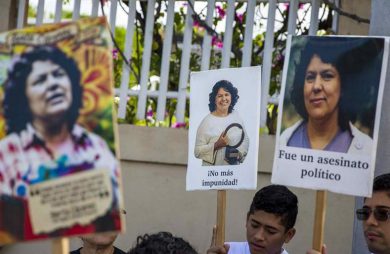
Photo: EFE
teleSUR | March 2, 2017
One year after the assassination of Honduran Indigenous leader Berta Caceres, human rights organizations and Indigenous communities continue to demand justice in the case, while the international branch of the struggle pressures to an end of U.S. funding for police and military forces accused of human rights abuses in the Central American country.
Caceres’ family sent a letter Thursday to U.S. Representative Norma Torres to ask for her support for the Berta Caceres Human Rights in Honduras Act, which was reintroduced the same day to the House of Representatives after stalling without adequate support since last year. The bill seeks the suspension of Washington’s security aid to Honduras until the country fulfills more rigorous human rights conditions — including an end to abuses by the police and military and justice in cases like Berta Caceres’ murder.
“It is increasingly clear that the government of Juan Orlando Hernandez is unwilling to act decisively to stop the killings of social activists in Honduras and to conduct honest and thorough investigations of killings and attacks,” Caceres’ family members state in the letter to Torres, urging her to “stand with” them and with Honduras. “In addition, the government has consistently failed to respect basic indigenous land rights, as it is required to do under its international treaty obligations.”
The original U.S. bill inspired by Caceres’ murder paints a grim picture of Honduras’ grave human rights situation, including the lack of justice in cases like Caceres’ murder. “Impunity remains a serious problem, with prosecution in cases of military and police officials charged with human rights violations moving too slowly or remaining inconclusive,” it states, adding that the U.S. State Department itself reported in 2015 problems of “corruption, intimidation, and institutional weakness of the justice system” in Honduras.
Caceres’ family addressed the letter to Torres to ramp up individual pressure for support of the bill. Torres, the first and only Central American in Congress and the founder of the bipartisan Central American Caucus, has faced criticism for aligning herself with the Honduran government, backing Washington’s controversial Alliance for Prosperity security aid package for Central America’s Northern Triangle and for refusing to support the Berta Caceres bill.
“We believe that your support for the Berta Caceres Human Rights Act will further strengthen your standing as an advocate for Central Americans and human rights, both in the U.S. and Honduras,” the family wrote in its letter to Torres, imploring her endorsement of the bill.
Caceres’ family also highlighted in the letter the involvement of active and former members of the military — including suspects trained at the infamous U.S. School of the Americas — in her murder, underlining the urgent need for more rigorous conditions on security aid to Honduran state forces. A former member of the military police in Honduras revealed to the Guardian that her name had been at the top of a “hit list” that a U.S.-trained unit received.
“A government that fails to protect its citizens and whose security forces are implicated in attacks and killings of activists should not be receiving security funding and training from the U.S. government,” the letter stressed, adding that Caceres’ murder is only one example among scores of assassinations, attacks and other forms of intimidation targeting activists in the country.
According to a recent report by the international rights organization Global Witness, 120 land and environmental defenders have been killed in Honduras since 2010 after an increase in state-sanctioned abuses in the wake of the 2009 U.S.-backed military coup.
Meanwhile, in Honduras, members of the organization that Caceres founded — the Civic Council of Popular and Indigenous Organizations of Honduras or COPINH — held a march Wednesday in the capital city Tegucigalpa demanding justice one year after her death.
They blasted Honduran authorities over the fact that, to this day, the motive for her assassination has not been identified and perpetrators in the killing not brought to justice. Demonstrators with banners shouted slogans demanding that authorities arrest the masterminds behind Caceres’ murder.
Caceres rose to international prominence for leading the Indigenous Lenca people in a struggle against a controversial hydroelectric dam project in the community of Rio Blanco that was put in motion without consent from local communities. She was also a key leader in the post-coup resistance movement that demanded a constituent assembly to rewrite the Honduran Constitution.
For her environmental and land defense work, she was awarded the prestigious 2015 Goldman Environmental Prize, while at the same time suffering dozens of death threats and other forms of harassment. Berta Caceres was shot dead just before midnight March 2, 2016, when gunmen stormed her house and attacked her.
Caceres’ family claim that the Honduran company behind the hydroelectric project she fought against, Desarrollos Energeticos or DESA, and the Honduran government hired contract killers to murder her and other activists.
Her family and fellow activists insists that her legacy will continue to inspire a movement for rights and justice.
In a statement ahead of the anniversary of her murder, Caceres’ COPINH reiterated calls for justice and an end to unwanted corporate projects on Indigenous land and vowed to forge on in the struggle that Caceres championed in the name of a “just society where life is respected.”
“One year after Berta’s murder, she continues teaching us that ideas cannot be killed and the processes of the people cannot be stopped,” the organization said. “May she continue to be present and our task continue with her legacy of resistance and struggle against injustice.”
RELATED:
Honduras Is the Deadliest Country for Environmental Activists
Ekos Poll: Canada Should Support Israeli Sanctions Not Demonize Them
By Murray Dobbin | CounterPunch | March 3, 2017
Foreign policy is one of those areas of democratic governance that doesn’t often get on the public’s radar. But when it does it provides citizens with a kind of unsullied opportunity to apply their values. That is, unsullied by considerations of self-interest, we get to ask what is the right thing to do?
Governments, of course, aren’t quite as free to make such decisions given that they have so-called “national interests” to consider. But Canadians should be able to expect from their federal government that their foreign policy conforms closely to their values.
When it comes to Canada’s policy towards Israel the Trudeau government, aping its predecessor, is several country miles from reflecting Canadian values. That is the irrefutable conclusion of an Ekos poll whose partial results were released February 16th. A second batch of survey results released yesterday (all survey results can be found here: focussed on the issue of whether or not Canadians think it is appropriate to use sanctions and/or boycotts to pressure Israel to obey international law.
The results demolish conventional wisdom on this question. Respondents were asked – in the context of the UN Security Council denunciation of settlement building in the West Bank – “… do you believe that some sort of Canadian government sanctions on Israel would be reasonable?” Overall, 66% expressing an opinion answered yes. But that number is heavily skewed by Conservative supporters, 70% of whom reject sanctions on Israel. Openness to sanctions on Israel by supporters of other federal political parties ranged from 75% for Liberals to 94% for Bloc Quebecois supporters. Eighty-four percent of NDP supporters believed sanctions on Israel would be reasonable.
Levels of acceptance for the Palestinian call for a boycott of Israel was even higher with fully 78% of those with an opinion stating they believe the Palestinians’ call for a boycott is “reasonable.” Again, Conservative supporters expressed radically different views from respondents supporting other parties: 51% rejected a boycott. Supporters of other parties who were receptive to the Palestinian call for a boycott ranged from 88% for Liberal supporters to 94% for the Bloc Quebecois.
Flashback to February 2016, when Parliament adopted a Conservative motion (by a vote of 229-51) condemning Canadian individuals and organizations who promote the Palestinian call for a boycott. That shameful assault on freedom of expression was supported by the Trudeau government. Only the NDP and Bloc opposed it.
When asked if they supported the passing of this resolution a majority of respondents expressing an opinion – 53% – said no while half that that number, 26%, said yes. Only 20 % of Liberal supporters supported the resolution while 55% disagreed with it.
Most Canadians still have little idea of just how sycophantic the Trudeau Liberals are when it comes to support for the right-wing government of Benjamin Netanyahu, particularly when it comes to U.N. votes on Palestinian rights and Israel’s violations of international law.
The Trudeau government has cemented Canada’s reputation as an embarrassing outlier when it comes to UN votes on Israel. Since October, 2015 when it came to power, the Liberal government has voted against United Nations resolutions that were critical of Israel on over 25 occasions. In fact, it has never voted in favour of a U.N. resolution that is critical of Israel. Which illustrious democracies does Canada find itself allied with in these votes? Besides Israel and the US, it’s loyal benefactor, our fellow-travellers are normally Micronesia, Palau and the Marshall Islands. Most of these resolutions pass by a vote of 156 or 158 to six or eight (with our EU allies voting for or abstaining).
Some of the resolutions Canada actively opposed should shock Canadians. The Trudeau government opposed a U.N. resolution that reaffirmed “… the importance of Israel’s accession to the Treaty on the Non-Proliferation of Nuclear Weapons [NPT].” Another resolution, supporting “The right of the Palestinian people to self-determination…” was opposed by the Liberals as was a resolution that almost precisely reiterates the government’s official policy – that “Israeli settlements in the Occupied Palestinian Territory, including East Jerusalem…” are an obstacle to peace.
Last December the U.N. Security Council voted unanimously (with the US abstaining) to declare that Israeli settlements on territory intended for a Palestinian state were a “flagrant violation under international law and a major obstacle to the achievement of… peace” between Israel and Palestine. Canada remained absolutely silent as it was (effectively) when Israel passed its “land grab” law which retroactively legalises settler homes on private Palestinian land.
What could possibly justify Trudeau’s immoral and frankly irrational stance when it comes to promoting peace between Israel and the Palestinians? In determining its policy towards Israel the Trudeau government has three apparent motivations at play: defending Israel’s right to exist, tending to Canada’s specific national interests and reflecting Canadian values.
None of these shine any real light on Canada’s continued blanket support for the Netanyahu government. It is being increasingly argued by Israel’s friends that the trajectory of that country today is in fact the biggest threat to Israel’s existence: a one-party state that can be Jewish or democratic, but not both. Canada on its own has no compelling “national interests” in the Middle East – except as a yes man for the US Empire.
And lastly, Trudeau’s inexplicable stance is overwhelmingly at odds with Canadian values. Not only do large majorities see Israel in a negative light, they reject by 91% the notion that criticism of Israel is necessarily anti-Semitic as implied in the Commons resolution. Flying in the face of Trudeau’s cowardly denunciation of BDS supporters are 75% of his own party supporters who are open to sanctions and 88% who say the same of boycotts.
Justin Trudeau has a lot of explaining to do.
MURRAY DOBBIN, now living in Powell River, BC has been a journalist, broadcaster, author and social activist for over forty years. He now writes a bi-weekly column for the on-line journals the Tyee and rabble.ca. He can be reached at murraydobbin@shaw.ca
‘UK curbing academic free speech on Israel’
Press TV – March 2, 2017
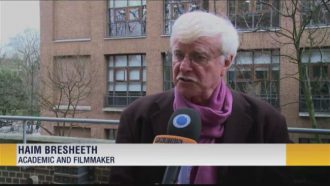 The British government is helping universities across the UK suppress the right to criticize Israel over its human rights violations in Palestine, says a Jewish professor, vowing to never give in to the pressure.
“They are trying to stop us talking about Palestinian rights, and about peace and we will just not shut up,” Dr. Haim Bresheeth, a Jewish academic and filmmaker, told Press TV on Wednesday.
“Unfortunately the government has helped the universities that want to shut up free speech by accepting a definition of anti-Semitism that makes anti-Semitism any criticism of Israel,” he added.
The scholar was referring to the International Holocaust Remembrance Alliance (IHRA)’s definition that was adopted by the government of Prime Minister Theresa May last year.
It was based on IHRA’s definition that the University of Exeter and the University of Central Lancashire (UCLan) cancelled an annual pro-Palestinian event on Monday, which was aimed at raising awareness about human rights violations in the occupied territories.
Following the move, some 250 academics at dozens of universities across the UK penned an open letter, condemning the Tory government’s attempts to curb their right to free speech by banning criticism of Israel.
The professors said in their letter that the government’s definition of anti-Semitism is too broad and can include any criticism of Israel with regards to its occupation of Palestinian lands.
“The government has ‘adopted’ the International Holocaust Remembrance Alliance definition of anti-Semitism, which can be and is being read as extending to criticism of Israel and support for Palestinian rights, an entirely separate issue, as prima facie evidence of anti-Semitism,” read the letter, sent to the Guardian.
“This definition seeks to conflate criticism of Israel with anti-Semitism,” the academics charged, accusing universities minister Jo Johnson of asking for the definition to be “disseminated” throughout the higher education system.
In his interview with Press TV, Bersheeth said the definition sought to protect “Zionism and Israel” from criticism.
“You can criticize and you should criticize every political institution that you wish,” he argued. “We are told now that Jews who criticize Israel like me are anti-Semitic. This is nonsense.”
Two British universities halt pro-Palestinian events
Press TV – February 28, 2017
Two British universities have been accused of undermining freedom of speech after cancelling an annual pro-Palestinian event aimed at raising awareness about human rights violations in the occupied territories.
The accusation was leveled on Monday after the University of Exeter and the University of Central Lancashire (UCLan) announced the cancellation of a pro-Palestinian student-run event called Israel Apartheid Week.
Students at Exeter were barred from giving a street theater performance called Mock Checkpoint, in which some participants were to dress up as Israeli soldiers while others performed the roles of Palestinian victims.
The event had been approved by the student union at the university but was banned for “safety and security reasons” less than 48 hours before commencement. An appeal against the decision was also refused.
Members of Friends of Palestine Society at Exeter accused the university of censoring students, saying, “They are not allowing freedom of speech – by cancelling an event that was in support of Palestinian activism and for Palestinian rights; they are directly censoring us.”
Professors react
The move prompted almost 250 academics, including 100 professors, to sign a letter denouncing attempts by university officials to silence campus discussion about Israel and its treatment of Palestinians.
“These are outrageous interferences with free expression, and are direct attacks on academic freedom,” the letter noted. “As academics with positions at UK universities, we wish to express our dismay at this attempt to silence campus discussion about Israel, including its violation of the rights of Palestinians for over 50 years.
“It is with disbelief that we witness explicit political interference in university affairs in the interests of Israel under the thin disguise of concern about anti-semitism,” it added.
More than half a million Israelis live in over 230 illegal settlements built since the 1967 Israeli occupation of the Palestinian territories of the West Bank and East Jerusalem al-Quds.
Much of the international community regards the Israeli settlements as illegal because the territories they are built on were captured by Israel in a war and are hence subject to the Geneva Conventions, which forbid construction on occupied lands.
Nevertheless, the Israeli regime continues to build more settlements and expand the existing ones.
Mainstream Media’s ‘Victimhood’
By Robert Parry | Consortium News | February 28, 2017
It’s heartwarming that The New York Times and The Washington Post are troubled that President Trump is loosely throwing around accusations of “fake news.” It’s nice that they now realize that truth does not reliably come from the mouth of every senior government official or from every official report.
The Times is even taking out full-page ads in its own pages to offer truisms about truth: “The truth is hard. The truth is hidden. The truth must be pursued. The truth is hard to hear. The truth is rarely simple. The truth isn’t so obvious. …” On Sunday, those truth truisms ran opposite an alarmist column by Jim Rutenberg entitled, “Will the Real Democracy Lovers Please Stand Up?” Meanwhile, The Washington Post launched its own melodramatic slogan, “Dies in Darkness.”
Yet, it was only weeks ago when the Post and Times were eagerly promoting plans for silencing or blacklisting independent news sites that didn’t toe the line on what the U.S. government and its allies were claiming was true.
On Nov. 20, the Times published a lead editorial calling on Facebook and other technology giants to devise algorithms that could eliminate stories that the Times deemed to be “fake.” The Times and other mainstream news outlets – along with a few favored Internet sites – joined a special Google-sponsored task force, called the First Draft Coalition, to decide what is true and what is not. If the Times’ editorial recommendations were followed, the disfavored stories and the sites publishing them would no longer be accessible through popular search engines and platforms, essentially blocking the public’s access to them. [See Consortiumnews.com’s “What to Do About ‘Fake News.’”]
On Thanksgiving Day, the Post ran a front-page story citing an anonymous group, called PropOrNot, blacklisting 200 Web sites, including Consortiumnews.com and other important sources of independent journalism, because we supposedly promoted “Russian propaganda.”
Although PropOrNot and the Post didn’t bother to cite any actual examples or to ask the accused for comment, the point was clear: If you didn’t march in lockstep behind the Official Narrative on, say, the Ukraine crisis or the war in Syria, you were to be isolated, demonized and effectively silenced. In the article, the Post blurred the lines between “fake news” – stories that are simply made up – and what was deemed “propaganda,” in effect, information that didn’t jibe with what the U.S. State Department was saying.
Back then, in November, the big newspapers believed that the truth was easy, simple, obvious, requiring only access to some well-placed government official or a quick reading of the executive summary from some official report. Over the last quarter century or so, the Times, in particular, has made a fetish out of embracing pretty much whatever Officialdom declared to be true. After all, such well-dressed folks with those important-sounding titles couldn’t possibly be lying.
That gullibility went from the serious, such as rejecting overwhelming evidence that Ronald Reagan’s Nicaraguan Contra rebels were deeply involved in drug trafficking, to the silly, trusting the NFL’s absurd Deflategate allegations against Tom Brady. In those “old” days, which apparently ended a few weeks ago, the Times could have run full-page ads, saying “Truth is whatever those in authority say it is.”
In 2002, when the George W. Bush administration was vouching for a motley crew of Iraqi “defectors” describing Saddam Hussein’s hidden WMDs, Iraq’s purchase of some “aluminum tubes” must have been for building nuclear bombs. In 2003, when Secretary of State Colin Powell showed some artist drawings of “mobile chemical weapons labs,” they must really exist – and anyone who doubted Powell’s “slam-dunk” testimony deserved only contempt and ridicule.
When the Obama administration issued a “government assessment” blaming the Syrian military for the sarin gas attack outside Damascus on Aug. 21, 2013, there was no need to scrutinize its dubious assertions or ask for actual proof. To do so made you an “Assad apologist.”
When a bunch of U.S. allies under the effective control of Ukraine’s unsavory SBU intelligence service presented some videos with computer-generated graphics showing Russians supplying the Buk missile that shot down Malaysia Airlines Flight 17 over eastern Ukraine on July 17, 2014, there was no need to examine the holes in the evidence or note that the realistic-looking graphics were fictional and based on dubious assumptions. To do so made you a “Moscow stooge.”
In other words, when the U.S. government was gluing black hats on an “enemy” and white hats on a U.S. “ally,” the Times never seemed to object. Nor did pretty much anyone else in the mainstream media. No one seemed to note that both sides usually deserved gray hats. With very few exceptions – when the State Department or other U.S. agencies were making the charges – the Times and its cohorts simply stopped applying responsible journalistic skepticism.
Of course, there is a problem with “fake news,” i.e., stories that are consciously made up for the purpose of making money from lots of clicks. There are also fact-free conspiracy theories that operate without evidence or in defiance of it. No one hates such bogus stories more than I do — and they have long been a bane of serious journalism, dating back centuries, not just to the last election.
But what the Times, the Post and the rest of the mainstream media have typically ignored is that there are many situations in which the facts are not clear or when there are alternative explanations that could reasonably explain a set of facts. There are even times when the evidence goes firmly against what the U.S. government is claiming. At those moments, skepticism and courage are necessary to challenge false or dubious Official Narratives. You might even say, “The truth is rarely simple. The truth isn’t so obvious…”
A Tough Transition
During the transition from the Obama administration to the Trump team, the Times, the Post and other mainstream media outlets got caught in their own transition from trusting whatever the outgoing officials said to distrusting whatever the incoming officials said. In those final days, big media accepted what President Obama’s intelligence agencies asserted about Russia supposedly interfering in the U.S. election despite the lack of publicly available evidence that could be scrutinized and tested.
Even something as squirrelly as the attack on Trump’s National Security Adviser Michael Flynn – with Obama holdovers citing the never-prosecuted Logan Act from 1799 as the pretext for ginning up some kind of criminal-sounding case that scared Trump into firing Flynn – was treated as legitimate, without serious questions asked. Since Obama officials were doing the feeding, the no-skepticism rule applied to the eating. But whatever statements came from Trump, even his few lucid moments explaining why war with nuclear-armed Russia wasn’t such a great idea, were treated as dangerous nonsense.
When Trump scolded the mainstream press for engaging in “fake news” and then applied the phrase “enemy of the people,” the Times, the Post and the rest went into full victimization-mode. When a few news companies were excluded from a White House news briefing, they all rushed to the barricades to defend freedom of the press. Then, Trump went even further – he rejected his invitation to the White House Correspondents Dinner, the black-tie/evening-gown event where mainstream media stars compete to attract the hottest celebrity guests and hobnob with important government officials, a walking-talking conflict-of-interest-filled evening, an orgy of self-importance.
So, the Times, the Post and their mainstream-media friends now feel under attack. Whereas just weeks ago they were demanding that Google, Facebook and other powerful information platforms throttle those of us who showed professional skepticism toward dubious claims from the U.S. government, now the Times, the Post and the others are insisting that we all rally around them, to defend their journalistic freedom. In another full-page ad on Sunday, the Times wrote: “Truth. It’s more important now than ever.”
I would argue that truth is always important, but especially so when government officials are leading countries toward war, when lives are at stake, whether in Iraq or Syria or Ukraine or the many other global hotspots. At those moments in the recent past, the Times did not treat truth – in all its subtlety and nuance – as important at all.
I would argue, too, that the stakes are raised even higher when propagandists and ideologues are risking the prospect of nuclear war that could kill billions and effectively end human civilization. However, in that case, the American people have seen little truly professional journalism nor a real commitment to the truth. Instead, it’s been much more fun to demonize Russian President Vladimir Putin and paint black-and-white pictures of the evil Russians.
At such moments, those New York Times’ truisms about truth are forgotten: “The truth is rarely simple. The truth isn’t so obvious. …”
Investigative reporter Robert Parry broke many of the Iran-Contra stories for The Associated Press and Newsweek in the 1980s.
A Troubled CIA Analyst Finds Jesus
And the devil is spelled T-R-U-M-P

By Philip Giraldi • Unz Review • February 28, 2017
Last Monday The Washington Post featured an op-ed by one Edward Price entitled “I didn’t think I’d ever leave the CIA. But because of Trump, I quit.” I must admit that it was refreshing at first to read something in The Post that did not rush to blame BOTH Trump and Vladimir Putin for everything going wrong in the world but, not to worry, evil Russia was indeed cited a bit farther along in the narrative.
Edward “Ned” Price is a likely lad. He has a nice intense look, clean cut, neat tie, good credentials with a degree in international relations from an unidentified college. He decided on a CIA career fifteen years ago and “work[ed] proudly for Republican and Democratic presidents…” Perhaps not temperamentally cut out to be an operations officer or spy, he claims that “as an analyst…[he] became an expert in terrorist groups and traveled the world to help deter and disrupt attacks.”
Price reports that he was quite happy in his work, because both the Bush and Obama administrations “took the CIA’s input seriously.” He was seconded to the White House in 2014 and pats himself on the back for “having [his] analysis presented to the president and seeing it shape events.”
But that was before the wheels came off the car. Per Price, “I watched in disbelief when, during the third presidential debate, Trump casually cast doubt on the high-confidence conclusion of our 17 intelligence agencies, released that month, that Russia was behind the hacking and release of election-related emails.”
Price was also unhappy with Trump’s admittedly odd speech combined with photo op to the CIA staff on his first full day in office but was particularly peeved over the reorganization of the Nation Security Council (NSC), which excluded the CIA director and the Director of National Intelligence (DNI), but included Stephen Bannon, “who cut his teeth as a media champion of white nationalism.” Even though Price was wrong about the DNI and the White House quickly reversed course on including CIA Director Mike Pompeo as the duplicative DNI position might be eliminated, for Price the message was “It [the White House] has little need for intelligence professionals who, in speaking truth to power, might challenge the ‘America first’ orthodoxy that sees Russia as an ally and Australia as a punching bag.”
Towards the end of his apologia, Edward Price noted that his decision had “nothing to do with politics,” before observing how he served “under President George W. Bush, some of whose policies I also found troubling, and I took part in programs that the Obama administration criticized and ended.”
There is inevitably some concluding drivel about intelligence professionals who deliver “the fruits of their labor-sometimes at the risk of life or limb…” being “accorded due deference” by the White house, an amusing commentary from a careerist who clearly spent his time behind a desk.
There are a few things one might say about Price. First of all, his “nothing to do with politics” is pure balderdash. He found Bush policies “troubling” while the clearly more admirable Obama “criticized and ended” the nasty bits. Yes, Bush authorized the use of torture and renditions initially after 9/11 but they were de facto suspended in his second term. And while Bush presented the American people with Iraq, Obama gifted us with Libya and Syria while continuing Afghanistan. And Price was at CIA while the organization was surreptitiously monitoring the Senate Intelligence Committees investigation into its torture program. He was willing to continue working for the Agency after the spying and the war crimes that it was trying to hide were revealed but suddenly found Jesus or a backbone or a conscience (select whichever one applies) only when Trump was elected.
Ned appears to forget that it was Bush who demurred at killing civilians en masse using drones and Obama who has embraced and expanded the practice. Obama also initiated the assassination of U.S. citizens overseas without due process and used the State Secrets Privilege more than all his predecessors combined to block any judicial challenge to his actions. Apparently, Price considered all that to be just fine since it was a liberal Democrat at the controls. And, by the way, Price is on record as having contributed $5,000 to the Hillary Clinton campaign and the Democratic National Committee. He is a registered Democrat in the District of Columbia. His characterization of Steve Bannon as a “white nationalist” and mention of the “Russian hack” come straight out of the Hillary Clinton campaign’s playbook and the more recent Democratic Party narrative to explain why it lost the election.
And there’s more. Price’s rapid rise through the Agency ranks came after his assignment to the Obama White House where he worked for deputy national security adviser Ben Rhodes and became an administration spokesman on the NSC. That means he was not exactly a highly principled intelligence briefer “speaking truth to power,” which is itself a bullshit feel good expression as the CIA has a long history of trimming facts to please the audience, most particularly the president. Price should do a little background reading on what former leading Agency analysts Robert Gates, John McLaughlin, Michael Morell and John Brennan dissimulated about to make the client in the White House happy.
Ned Price was apparently renowned as a White House apologist working to sell a product to a possibly skeptical audience. He was reportedly a highly regarded spin-meister for administration policies, working a well-cultivated group of media contacts that would replay his analysis and attribute it to “a senior White House official.” The analysis would bounce back and forth until it was picked up and validated by appearance in the mainstream media. That used to be called by some “information management” while others would regard it as propaganda.
And then there are the errors in fact and interpretation that Price provides to make his case against Trump. The alleged “conclusion” regarding Russian hacking of the election was really based on the input of the only two intelligence agencies that have the capability to analyze and trace the origin of a hack – the NSA and the FBI. The FBI had to be pressured into agreeing with the conclusions of the report Price cites and the NSA supported them only with “moderate” confidence, meaning that it recognized that the evidence linking the hack to Russia just wasn’t there. Many former intelligence officers and some in the media have questioned the validity of the report and have demanded to see at least some of the evidence to support its conclusions, which, to this date, has not been produced.
Price’s account of the Trump reorganization of the National Security Council also is incorrect. The reorganization states “The Director of National Intelligence… will attend where issues pertaining to [his] responsibilities and expertise are to be discussed.” So the DNI was included and Price fails to recognize that after the DNI position was created under George W. Bush he or she was to be the intelligence referent and the CIA Director no longer filled that role and was excluded. That practice continued under Obama, which Price ignores even though he worked on the NSC, and he also does not note that the CIA and FBI Directors often have, in fact, joined in on the NSC “Principals” meetings as a courtesy. If the office of DNI is eliminated in the current reorganization, the head of CIA will step up and assume those responsibilities in the new structure, so the intelligence community is not in any sense being pushed out.
Price aside, I don’t know how many, if any, CIA officers have resigned recently either for ethical reasons or out of dislike for Trump. But if some have, I would hope they had better rationalizations for doing so than were produced in the op-ed, which is reduced to anti-Russian sentiment, dismay at government reorganization and longing for the good old days when a liberal Democrat who was able to lie very convincingly was running the show. I would have preferred an Edward Price op-ed explaining how he had resigned over a real issue, like the bipartisan unrelenting pressure on Iran that could easily lead to war, or the continuing practice of drone assassinations and special ops killings, like the recent raid in Yemen in which 15 women and children, including an eight year old, died. Still, even lacking that, I get it. Ned Price just doesn’t like Trump very much.
Fatah movement says Facebook shut down the movement’s official page
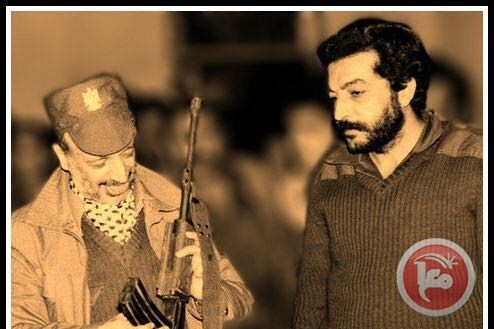
The photo which reportedly led Facebook to close Fatah’s official page
Ma’an – February 27, 2017
RAMALLAH – The official Facebook page of the Palestinian Authority’s (PA) ruling party Fatah was shut down by Facebook Inc. on Monday, according to an official statement from the Fatah movement.
Munir al-Jaghoub, a Fatah official and the “administrator” of the page said in the statement that Facebook closed the Fatah’s official page after the group posted a photo of the late Palestinian President and Fatah leader Yasser Arafat alongside the current deputy chairman of the movement Mahmoud al-Aloul.
Arafat appears in the photo handing a rifle to al-Aloul. According to the statement, the rifle belonged to Israeli soldiers and was captured by Fatah militants in southern Lebanon during the 1982 Lebanon war.
The statement added that Monday’s incident was the second time Facebook has closed the Fatah movement’s official Facebook page.
In recent months, Israel has detained scores of Palestinians for social media activity, alleging that a wave of unrest that swept the occupied Palestinian territory in October 2015 was encouraged largely by online “incitement.”
In September, Facebook agreed to work with the Israeli government to “minimize online anti-Semitic incitement” — in an effort to pressure the social media site to coordinate to remove content considered to promote “terrorism.”
Israel had previously blamed Facebook outright for the perceived proliferation of incitement, with Public Security Minister Gilad Erdan reportedly saying that Facebook chairman and cofounder Mark Zuckerberg had “blood on his hands” for not adequately cooperating with Israel to remove content.
Earlier this year, the controversial “Facebook bill” passed the first reading in the Knesset, which would allow Israeli officials to force the social media giant to remove certain content through a court order if there are suspicions of “incitement.”
Despite Facebook complying with 95 percent of the Israeli government’s removal requests in recent months, some members of the Knesset have expressed indignation that Facebook has not taken enough action to remove content inciting “acts of terror against Jews.”
Meanwhile, Palestinians have instead pointed chiefly to the frustration and despair brought on by Israel’s nearly 50-year military occupation of the Palestinian territory and the absence of a political horizon as reasons for the outbreak of violence. Many Palestinians have also pointed out that Israeli violence has continued to shape everyday life in the occupied territory, regardless of any recent “upticks” in clashes or attacks.
Palestinian woman shot, injured by Israeli forces at Qalandiya checkpoint
Ma’an – February 27, 2017
BETHLEHEM – A Palestinian woman was shot and injured by Israeli security guards at the Qalandiya checkpoint between the occupied West Bank and occupied East Jerusalem on Monday afternoon, as Israeli police claimed she was carrying a bag in a “suspicious manner.”
Israeli police spokeswoman Luba al-Samri said in a statement that a “suspicious” Palestinian woman entered the vehicle lane of the checkpoint “seemingly carrying an object.”
 “The security guards noticed her and instructed her to stop but she ignored the instructions,” al-Samri said.
“The guards then started arrest procedures and neutralized the woman,” al-Samri added, using an Israeli forces term to indicate that a Palestinian was shot without specifying whether they were injured or killed.
Al-Samri later clarified that the woman had been “lightly injured,” and that she had been “carrying a bag” in a way that raised the security guards’ suspicions.
The police spokeswoman said that the Palestinian was in her thirties and was a resident of the village of Kafr Aqab in the West Bank district of Jerusalem with a Jerusalem ID.
The Qalandiya checkpoint is notorious for being confusing to navigate.
According to Ma’an documentation, five Palestinians were killed at the checkpoint in 2016, including two Palestinian siblings — Maram Salih Hassan Abu Ismail who was 23 years old and five months pregnant, and her 16-year-old brother Ibrahim — in April after Israeli officials claimed the two were attempting to carry out a stabbing attack.
However, witnesses said that the brother and sister posed no threat at the time of their death. Yet the Israeli Justice Ministry later dropped its probe into the killings after it was revealed that a contractor, not a member of the police, had killed the Abu Ismails.
Palestinian children attend class in the street after Israel shuts down school
Ma’an – February 26, 2017
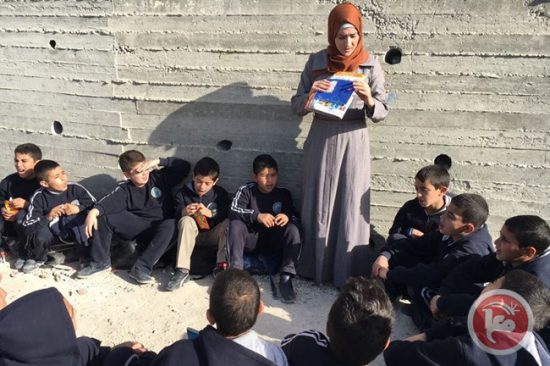
JERUSALEM – After Israeli authorities shut down a Palestinian elementary school in the occupied East Jerusalem town of Sur Bahir last Thursday over alleged “incitement” in its study materials, students attended class in the street on Sunday and protested against Israel’s decision to close the school.
Children who were enrolled at al-Nukhba (“the elite” in Arabic) arrived to the campus with their parents in an action organized by the parent committees of Sur Bahir’s schools, holding posters expressing support for al-Nukhba and denouncing Israel’s closure of educational institutions as “tyrannical.”
Last Thursday, head of the school Luay Jamal Bkirat and the school’s financial manager Nasser Hamed were summoned to an Israeli police station for interrogation, when Israeli intelligence officials informed them that the school was being shut down for carrying inciting content in the teaching materials used at the school.
Bkirat denied the claims, saying that al-Nukhba school was “teaching the Palestinian curriculum used in all schools in Jerusalem and that no one of the faculty had ever been summoned for interrogation before over incitement.”
He added that the school — which serves 250 boys from kindergarten to grade six — was opened last year and gained a temporary operating license from the Jerusalem municipality, and that the license was revoked in November for unknown reasons.
Bkirat condemned the decision and said that he would “conduct procedures to stop this decision which aims to destroy education.”
The Times of Israel reported that the school was shut down for being a “Hamas front,” after a months-long joint probe by Israel’s Education Ministry, Jerusalem police, and Israeli intelligence, the Shin Bet.
Israeli authorities from the education ministry claimed the school was established by Hamas with the aim of teaching “content that undermines the sovereignty of Israel,” and that the school’s aims were “consistent with the ideology of the terror organization, which calls for the destruction of Israel,” the Times of Israel said.
According to the Israeli news outlet, the ministry ordered the school not to open in September “and when it continued to operate, issued the closure order.”
Israeli Jews and Palestinians study in separate school systems in occupied East Jerusalem, with the Palestinian schools run by either Israel’s Jerusalem municipality, the Islamic Waqf and administered by the Palestinian Ministry of Education, private institutions, or UNRWA, the UN agency responsible for Palestinian refugees.
According to the Palestinian Ministry of Education, Palestinian children suffer from routine Israeli interference and political pressure to replace Palestinian curricula with an Israeli one in occupied East Jerusalem, where full Israeli military and civil control deprives students from proper and secure educational services.
A 2016 report by Israeli daily Haaretz also said that Palestinian schools in occupied East Jerusalem received less than half the funds that the Jerusalem municipality transferred to Jewish schools in West Jerusalem.
Though Sur Bahir lies beyond the periphery of occupied East Jerusalem, the town remained under full Israeli security and civil control within Israel’s Jerusalem municipality after the territory was illegally annexed in 1967.
A 2011 report by the Applied Research Institute – Jerusalem (ARIJ) said that due to a lack of some levels of education in Sur Bahir, many students were forced to attend schools in neighboring villages.
Castigated by the Southern Poverty Law Center

By Deir Yassin Remembered | Dissident Voice | February 24, 2017
The “public” that allegedly “protested” against this billboard in Ann Arbor, as reported by the Rochester Democrat and Chronicle, were not the only folks watching DYR.
The SPLC has now included DYR on its Hate Map.
Dan McGowan responds:
The Southern Poverty Law Center (SPLC) recently criticized Deir Yassin Remembered (DYR) by including it on the so-called Hate Map, purportedly for the high crime of Holocaust denial.
Apparently if the SPLC disagrees with you, it will label you as a racist or a hatemonger. There is no discussion, no defense, and no chance of winning a defamation suit against it.
The SPLC is the cash cow of the civil rights movement. Last year it took in over $58 million, some of which was added to its bloated endowment of over $328 million held in questionable investments, some in off shore accounts.
Its two chief executives together received over $800,000. Of its nine top executives, none come from minorities.
The SPLC claims to reject hate, embrace diversity, and respect differences. But often the SPLC and the people who believe their fear mongering behave exactly the opposite. The SPLC campaigns to deny free speech and freedom of association to groups of Americans with whom they disagree, often doing so to pander to other groups for more contributions all in the name of promoting “tolerance.” For example, if the British historian David Irving plans a lecture in Syracuse, the SPLC will protest any venue he might select, leaflet cars at his hotel saying, “There is a Nazi staying here,” and photograph and shout at anyone who might try to attend.
SPLC slime is not reserved solely for skinheads and members of the KKK. Dr. Ben Carson got a dose for opposing same sex marriage. SPLC later apologized but the charge never completely goes away, leading Carson to say that fear of being on the SPLC’s list serves to shut people up.
The SPLC makes money out of fear mongering and promoting the idea that Americans are inundated with hateful people, particularly on the radical right. The favorite target is the KKK and white supremacists.
The Baltimore Sun characterizes SPLC operations this way: “Its business is fundraising, and its success at raking in the cash is based on its ability to sell gullible people on the idea that present-day America is awash in white racism and anti-Semitism, which it will fight tooth-and-nail as the public interest law firm it purports to be.”1
It is understandable that the SPLC will run out of rocks under which to look for old KKK members and skinheads, but why criticize Deir Yassin Remembered, a small not-for-profit organization of Jews and non-Jews working to build a memorial for Palestinians murdered in 1948 on the west side of Jerusalem? DYR is certainly not the radical right. DYR practices and preaches tolerance; it has agreed to the advice of none other than the Latin Patriarch of Jerusalem that its memorial show the Christian tenet of forgiveness. Its advisory board boasts diversity; it is composed of half men, half women, half Jews, half non-Jews. It has worked continuously since 1994 for Palestinian human rights, including equal rights of citizenship, with no compensation for any executive and with less than $5,000 of reserves.
The answer lies in the writings of some of the DYR members who have questioned the use of the Holocaust as both the sword and shield of Israel. The Holocaust has been used to justify the need for a Jewish state and its expropriation of Palestinian land; the Holocaust is used to monopolize victimhood and defend Israel from criticism of its brutal and unending occupation.
But it is more than that. The Holocaust has morphed from a historical event to a religion, which must not be contradicted for fear of being branded an apostate or a hater or a denier or an anti-Semite. Religious faith is self-validating, impervious to reason, and regards proposals to scientifically validate its claims as profane in all senses of the word.
So, anyone who is skeptical about the number “six million,” about mass extermination in gas chambers, or about Nazi orders for extermination is to be named and shamed and hated. For this topic, there can be no diversity of opinion and no respect for inquiry or debate.
Don’t tell us that the United States government claimed Hitler murdered over 20 million people until the late 1970s when that number was officially revised downwards and carved in stone at 11 million. Don’t tell us that Jewish historians today claim the 5 million number of non-Jewish victims is overstated. Don’t remind us that the lampshade and the soap-from-human-fat stories were simple gruel propaganda and have no historical significance. Don’t remind us that Elie Wiesel took his violin to Auschwitz and that none of his family was gassed. Don’t remind us that Elie chose to retreat with the Nazis rather than be liberated from Auschwitz as was the father of Anne Frank.
Fear mongering and sliming little organizations like DYR is fake news. It is ridiculous disinformation to keep SPLC campaign money coming in. It foments hate and bigotry and intolerance by the very hypocrites who claim the opposite.
- “The truth about ʻhate crimesʼ and the racial justice racket” by Ron Smith, Baltimore Sun, December 3, 2008.
Deir Yassin Remembered seeks progress on behalf of the over 100 Palestinian men, women, and children who were victims of the Deir Yassin Massacre. Read other articles by Deir Yassin Remembered, or visit Deir Yassin Remembered’s website.
London’s new police chief Dick led botched operation that killed Jean Charles de Menezes
RT | February 23, 2017
Relatives of Jean Charles de Menezes, a 27-year-old Brazilian shot dead by counter-terrorism police in 2005, say the appointment of Cressida Dick as chief of the Metropolitan Police is ‘offensive,’ as she was responsible for the botched operation.
De Menezes was shot in the head 11 times on a train at Stockwell Underground Station, south London, after being mistaken for a terrorism suspect.
His bereaved family say Dick’s appointment proves that “police officers can act with impunity.”
Dick was appointed chief of the Metropolitan Police Service (MPS) on Wednesday, making her the first woman in history to head the UK’s largest police force in its 188-year history.
Although many hailed Dick’s appointment, the de Menezes family hit out at the decision, saying they had “serious concerns” for London’s security under her leadership.
“We had to face a tragedy that no family should ever have to experience; the tragic death of a loved one at the hands of those we entrusted to serve us and protect us,” the family said in a statement.
“At the helm of the police on that fateful day when Jean was killed was Cressida Dick.
“The message of today’s appointment is that police officers can act with impunity.”
The family also pointed out the seriousness of the role.
“The commissioner of the Metropolitan Police is the most senior police officer in the country, a post that is expected to uphold the highest standards of professionalism, to command public confidence and be responsible for ensuring that the police act lawfully and are held to account.”
De Menezes, who worked as an electrician, was killed in 2005 at Stockwell tube station while on his way to work after police reportedly mistook his actions for those of terrorist suspect Hussain Ossman.
De Menezes, was seen entering the station, but then doubled back, one of the acts deemed suspicious by police. However, it was later revealed the station was in fact closed.
Dick said in 2007: “From the behaviors described to me – nervousness, agitation, sending text messages, [using] the telephone, getting on and off the bus – it all added to the picture of someone potentially intent on causing an explosion.”
Despite ordering officers to stop de Menezes, she claims she never ordered that they open fire on him.
While the Met was found guilty of failings when the incident was taken to trial, Dick was spared any personal blame.
The family wrote to London Mayor Sadiq Khan on Friday, warning him Dick would not “command public confidence” if she was given the job.
But Khan, a former human rights lawyer, was among those backing Dick’s candidacy, hailing her appointment as “historic.”
“This is a historic day for London and a proud day for me as mayor … it was absolutely essential that we found the best possible person to take the Met forward over the coming years and I am confident that we have succeeded.”
Prime Minister Theresa May also welcomed Dick’s appointment, saying she has an“outstanding record of public service.”
“[Dick’s skills and insight] will be crucial in shaping the Met as the job of police reform continues, coordinating the national response to the ongoing threat of terrorism and serious criminality as well as keeping Londoners safe,” May said.
Yanukovych Calls for Donbass Status Referendum if Kiev Fails Minsk Deal
Sputnik – February 22, 2017
 Ex-President of Ukraine Viktor Yanukovych wrote a letter to Russian President Vladimir Putin, US President Donald Trump, German Chancellor Angela Merkel, French President Francois Hollande, Polish President Andrzej Duda, as well as the heads of European bodies.
Ex-President of Ukraine Viktor Yanukovych calls for a referendum on the status of the southeast Ukrainian region known as Donbass if Kiev does not comply with a set of ceasefire agreements.
“In the event of current Ukrainian authorities failing to observe the Minsk agreements, it is needed to initiate a referendum on the status of Donbass,” Yanukovych wrote in a letter to world leaders obtained by Sputnik.
He offered to include the leaders of the Donetsk and Lugansk People’s Republics in the reconciliation format comprising Russia, France, Germany and Ukraine.
Yanukovych also calls on world leaders to “initiate the creation of a special commission of the Council of Europe to monitor the investigation of crimes committed on the Maidan.”
The letter was addressed to Russian President Vladimir Putin, US President Donald Trump, German Chancellor Angela Merkel, French President Francois Hollande, Polish President Andrzej Duda, as well as the heads of European bodies.
The Donbass conflict erupted in April 2014 as a local counter-reaction to the West-sponsored Maidan coup in Kiev that had toppled legitimate President Viktor Yanukovych in February. Residents of the Donetsk and Lugansk regions held independence referendums and proclaimed the People’s Republics of Donetsk and Lugansk. Kiev has since been conducting a military operation, encountering stiff local resistance.
In February 2015, Kiev forces and Donbass independence supporters signed a peace agreement in the Belarusian capital of Minsk. The deal stipulates a full ceasefire, weapons withdrawal from the line of contact in Donbass, as well as constitutional reforms that would give a special status to the Donetsk and Lugansk People’s Republics. Despite the agreement, the ceasefire regime is regularly violated, with both sides accusing each other of multiple breaches, undermining the terms of the accord.
SEE ALSO:
Why Kiev’s Shelling Raids on Donbass Coincide With Poroshenko’s Foreign Tours
Featured Video
The Search for Truth: Charlie Kirk’s Assassination One Year Later
or go to
Aletho News Archives – Video-Images
From the Archives
The 9/11 “Double-Cross” Conspiracy Theory
BY LAURENT GUYÉNOT • UNZ REVIEW • SEPTEMBER 6, 2022
Is it true that “9/11 was an inside job”? Yes, insofar as Israel is “inside” the U.S. But for the 9/11 truthers who have identified Israel as the main perpetrators, “9/11 was an inside job” is at best a half-truth, and at worst an integral part of the Zionist operation, like a secondary flag sewn as a lining under the false flag of Islamism. Victor Thorn (1963-2017) wrote in his book 9/11 made in Israel: The Plot Against America (2011): “In essence, the ‘9-11 truth movement’ was created prior to Sept. 11, 2001 as a means of suppressing news relating to Israeli complicity. . . . The slogan ‘9-11 was an inside job’ was quite possibly the greatest example of Israeli propaganda ever devised.” In milder terms, it is “controlled opposition”.
A genuine truth movement would have pointed to Israel as the prime suspect from the start. From day one, it was obvious who would benefit. … continue
Blog Roll
 Aletho News
- Europe’s mounting social chaos… chickens coming home to roost for proxy war against Russia
- US-Russia Diesel Deal Becomes Massive Defeat for Ukraine
- Hormuz and the Looming Economic Catastrophe
- Dhubab offensive, media blitz and the rapid unraveling of Saudi-backed coalition’s new gambit
- Putin Conveys to Trump Iran’s Vision on Possible Conflict Resolution – Kremlin
- The Search for Truth: Charlie Kirk’s Assassination One Year Later
- ‘Harsh reality’: Iran says France seeks monopoly on power and intimidation, not peace for all
- When Will This White House Madness End?
- Huckabee aide goes to ‘unusual lengths’ to portray ‘Israel’ positively
- Trump Announces Diesel Supply Deal With Putin Following Phone Call
- If Americans Knew
- Israeli forces kill another child in Gaza – Daily Update
- Gaza ceasefire exists in name only, say more than 100 organizations
- Nearly 2 Million in Gaza Need Urgent Shelter Assistance as Winter Looms: IOM Chief Warns
- Suppressing Palestinian resistance: US charity under fire for AI monitoring of Gaza classrooms
- Thousands Are Held in Israeli Torture Camps. This Is What Happens Inside
- Israel puts Gaza’s sick, injured, newborn in peril – Daily Update
- Report claimed Mark Levin used by Israeli government to influence Trump
- Over 2,000 Gazans have died awaiting medical evacuation amid Israel’s continued siege
- How a U.S. Diplomat Suppressed and Altered Reports Critical of Israel
- 5 Palestinians Die from Israeli Strikes in Gaza as Relentless Attacks Continue
- No Tricks Zone
- New Study: 50 Years Of The Most Aggressive ‘Net Zero’ Policies Can Only Affect The Global Climate By 0.03°C
- US September “Heat” Was No Record…Many Records Set Decades Ago
- Latest European Green Energy Debacle; Portugal’s Largest Flagship Solar Park Insolvent!
- Green Energy Debacle: German Expert Professor Fritz Vahrenholt Warns Of Severe Economic And Social Consequences
- Two More Paleo Reconstructions Affirm Meters-Higher Sea Levels Across Ireland, Brazil 7000-6000 Years Ago
- New Study: Earth And Venus Surface Warmth Largely Explained By Convection And Lapse Rate, Not CO2 Or Radiation
- 2025 Nature Paper Claiming Worsening Global Drought Gets RETRACTED …Heavily Flawed
- New Study: ‘Global Drought Shows No Detectable Recent Acceleration Under Climate Warming’
- Economic Masterminds: German Socialists Suggest Taxing Productivity Gains Stemming From Using AI
- The South China Sea Has Not Been Cooperating With The Climate Change Narrative

