Israeli minister backtracks on claims of vehicular attack during Umm al-Hiran raid

Israeli Public Security Minister tell Israel’s Channel 10 on Jan.18: “Unequivocally, yes, this is a terror attack.”
Ma’an – February 22, 2017
BETHLEHEM – More than a month after Israeli police shot and killed Yaqoub Abu al-Qian in the Bedouin village of Umm al-Hiran during a demolition raid, Israel’s Public Security Minister Gilad Erdan seemingly backtracked on his initial claim that Abu al-Qian was carrying out a vehicular attack motivated by Islamic extremism when he was shot.
Following the incident, multiple eyewitnesses, video footage, and testimonies from Abu al-Qian’s family members contradicted the minister’s claim, saying that Israeli police opened fire on the local high school math teacher when he posed no threat, which caused him to lose control of the vehicle and ram into Israeli policeman Erez Levi, who was also killed.
On Wednesday, Israeli media sites reported that remarks made by Erdan at a police gathering in Beersheba implied that Israeli authorities were no longer classifying the incident as a terror attack.
Israeli daily Haaretz quoted Erdan as referring to the incident as “difficult and regrettable,” adding that “we mustn’t let anyone try to take this particular incident — in which unfortunately both a policeman and a civilian were killed — and draw inferences from it regarding the totality of the relationship between the Bedouin population and the police.”
“We must learn the lessons, once it becomes clear what exactly happened there,” he added, noting that an investigation by Israel’s Justice Ministry on the case was still ongoing. “Then we must go forward, strengthen this relationship, and bolster police services and enforcement against lawbreakers who first and foremost hurt our beloved Bedouin community, with which we want to continue living in coexistence in the Negev.”
The comments seemed to imply that Israeli authorities sought to distance themselves from the minister’s comments immediately following incident, when he said that “the picture arising from the police probe was very clear: This was an attack, a deliberate car-ramming.”
Erdan had also told Israel’s Radio Darom at the time: “After the investigation concludes, if it turns out the police were wrong, I too will demand explanations from them,” he said. “But to present this as if it were one person’s story versus another when a policeman has been murdered in an attack — I think that’s wrong and inappropriate.”
Erdan and Israeli police spokesperson Micky Rosenfeld had said that during a raid of Abu al-Qian’s home the day of his killing that police found three copies of a Hebrew-language newspaper from 2015 with the headline: “ISIS bomb that took down a plane,” which was presented as the only evidence to back up the claim that the man carried out an attack motivated by Islamic extremism.
However, according to Haaretz, Israel’s internal security agency the Shin Bet reported two weeks after the incident that they had yet to find any actual evidence connecting Abu al-Qian to ISIS.
Human rights organization Adalah responded to Erdan’s recent remarks — which it interpreted as an announcement by police that the Umm al-Hiran killing was not a terror attack — saying: “From the outset, Adalah maintained that the version of events in Umm al-Hiran promoted by the Israeli police and (Erdan) was both false and inflammatory.”
The organization noted that it had filed an appeal to the Israeli Justice Ministry’s Police Investigative Division (PID) on behalf of the Abu al-Qian family on the day of his killing, and that it had also appealed to Israeli Attorney General Avichai Mandelblit demanding that he open an investigation into Erdan’s “racist incitement against Arab citizens of Israel.”
Responding to reports interpreting Erdan’s comments as backtracking, Israeli police spokeswoman Luba al-Samri reiterated in a written statement that an investigation was still ongoing and that “the information being spread to public is one interpretation and incomplete, and fails to include details of the case’s many sides.”
Israeli Police Commissioner Ronnie al-Sheikh also responded to reports, telling Israeli news site Ynet : “I can’t be responsible for any unofficial publications. I do know with certainty, from the head of the Police Investigations Unit, that conclusions have yet to be reached.”
In the wake of the deadly incident, members of the Joint List, which represents parties led by Palestinian citizens of Israel in the Knesset, also accused police of intentionally covering up the fact that they shot Abu al-Qian in cold blood.
Joint List MKs had traveled to Umm al-Hiran to help locals attempting to resist the demolitions, when the head of the coalition, Ayman Odeh, was injured after being shot in the head by police with sponge-tipped bullet when clashes erupted with police.
Erdan had accused Odeh of traveling to Umm al-Hiran to “incite violence” and warned that there might be “criminal implications for him.”
Erdan also said on social media that “any attempts to murder police securing a court-ordered evacuation will get the same response,” referring to the killing of Abu al-Qian.
Abu al-Qian’s death and the subsequent demolition of more than a dozen homes in Umm al-Hiran sparked widespread outrage and numerous demonstrations attended by thousands, with protesters calling on Erdan to resign for “lying” to the Israeli public, saying they held him responsible for the two killings. … Full article
The Did-You-Talk-to-Russians Witch Hunt
By Robert Parry | Consortium News | February 18, 2017
In the anti-Russian frenzy sweeping American politics and media, Democrats, liberals and mainstream pundits are calling for an investigative body that could become a new kind of House Un-American Activities Committee to hunt down Americans who have communicated with Russians.
The proposed commission would have broad subpoena powers to investigate alleged connections between Trump’s supporters and the Russian government with the apparent goal of asking if they now have or have ever talked to a Russian who might have some tie to the Kremlin or its intelligence agencies.
Such an admission apparently would be prima facie evidence of disloyalty, a guilt-by-association “crime” on par with Sen. Joe McCarthy’s Cold War pursuit of “communists” who supposedly had infiltrated the U.S. government, the film industry and other American institutions.
Operating parallel to McCarthy’s Red Scare hearings was the House Un-American Activities Committee (or HUAC), a standing congressional panel from 1945-1975 when it was best known for investigating alleged communist subversion and propaganda. One of its top achievements was the blacklisting of the “Hollywood Ten” whose careers in the movie industry were damaged or destroyed.
Although the Cold War has long been over – and Russia has often cooperated with the U.S. government, especially on national security issues such as supplying U.S. troops in Afghanistan – Democrats and liberals seem ready to force Americans to again prove their loyalty if they engaged in conversations with Russians.
Or perhaps these “witnesses” can be entrapped into perjury charges if their recollections of conversations with Russians don’t match up with transcripts of their intercepted communications, a tactic similar to ones used by Sen. McCarthy and HUAC to trip up and imprison targets over such secondary charges.
Ousted National Security Advisor Michael Flynn has already encountered such a predicament because he couldn’t recall all the details of a phone conversation with Russian Ambassador Sergey Kislyak on Dec. 29, 2016, after Flynn took the call while vacationing in the Dominican Republic.
When Obama administration holdovers at the Justice Department decided to gin up a legal premise to go after Flynn, they cited the Logan Act, a law enacted in 1799 to prohibit private citizens from negotiating with foreign adversaries but never used to convict anyone. The law also is of dubious constitutionality and was surely never intended to apply to a president-elect’s advisers.
However, based on that flimsy pretext, FBI agents – with a transcript of the electronic intercept of the Kislyak-Flynn phone call in hand – tested Flynn’s memory of the conversation and found his recollections incomplete. Gotcha – lying to the FBI!
Under mounting media and political pressure, President Trump fired Flynn, apparently hoping that tossing Flynn overboard to the circling sharks would somehow calm the sharks down. Instead, blood in the water added to the frenzy.
Iran-Contra Comparison
Some prominent Democrats and liberals have compared Trump-connected contacts with Russians to President Richard Nixon’s Watergate scandal or President Reagan’s Iran-Contra Affair, an issue that I know a great deal about having helped expose it as a reporter for The Associated Press in the 1980s.
The key difference is that Iran-Contra was an unconstitutional effort by the Reagan administration to finance an illegal war against Nicaragua’s Sandinista government in defiance of a congressional ban. The Trump-connected communications with Russians – to the degree they have occurred – appear to have been aimed at preventing a new and dangerous Cold War that could lead to a nuclear holocaust.
In other words, Iran-Contra was about enabling a paramilitary force to continue its brutal marauding inside a country that was no threat to the United States while the current “scandal” is about people trying to avoid hostilities between two nuclear superpowers, an existential threat that many mainstream and liberal pundits don’t want to recognize.
Indeed, there is a troubling denial-ism about the risks of an accidental or intentional war with Russia as the U.S. media and much of Official Washington’s establishment have lots of fun demonizing Russian President Vladimir Putin and jabbing the Russians by shoving NATO troops up to their borders and deploying anti-ballistic missiles in Eastern Europe. For some crazy reason, the Russians feel threatened.
False Narratives
This Russia-bashing and Russia-baiting have been accompanied by false narratives presented in the major U.S. newspapers, including The New York Times and The Washington Post, to justify increased tensions.
For instance, the Post’s senior foreign affairs writer Karen DeYoung on Friday described the civil war in Ukraine this way: “That conflict began when Russia invaded and annexed Crimea in 2014, then backed separatists in eastern Ukraine in what has become a grinding war, despite a deal to end it, called the Minsk agreement, negotiated with Putin by the leaders of France and Germany.”
But DeYoung’s synopsis is simply not true. The crisis began in the fall of 2013 when Ukraine’s elected President Viktor Yanukovych backed out of what he regarded as a costly and unacceptable association agreement with the European Union, a move which prompted protests by Ukrainians in Kiev’s Maidan square.
The Obama administration’s State Department, U.S. neocon politicians such as Sen. John McCain, and various U.S.-backed “non-governmental organizations” then stoked those protests against Yanukovych, which grew violent as trained ultra-nationalist and neo-Nazi street fighters poured in from western Ukraine.
In early 2014, a coup to overthrow the democratically elected Yanukovych took shape under the guidance of U.S. Assistant Secretary of State Victoria Nuland and U.S. Ambassador to Ukraine Geoffrey Pyatt who were caught in a phone call in late January or early February 2014 conspiring to impose new leadership inside Ukraine.
Nuland disparaged a less extreme strategy favored by European diplomats with the pithy remark: “Fuck the E.U.” and went on to declare “Yats is the guy,” favoring Arseniy Yatsenyuk as the new leader. Nuland then pondered how to “glue this thing” while Pyatt ruminated about how to “midwife this thing.”
On Feb. 20, 2014, a mysterious sniper apparently firing from a building controlled by the ultranationalist Right Sektor killed both police and protesters, setting off a day of violence that left about 70 people dead including more than a dozen police.
The next day, three European governments struck a deal with Yanukovych in which he agreed to early elections and accepted reduced powers. But that political settlement wasn’t enough for the U.S.-backed militants who stormed government buildings on Feb. 22, forcing Yanukovych and his officials to flee for their lives.
Instead of standing by the Feb. 21 agreement, which the European nations had “guaranteed,” Nuland pushed for and got U.S. allies to accept the new post-coup regime as “legitimate,” with Yatsenyuk becoming prime minister and several top government posts given to the ultranationalists and neo-Nazis.
Spreading Violence
In the ensuing days, the right-wing violence spread beyond Kiev, prompting Crimea’s legislature to propose secession from Ukraine and readmission to Russia, whose relationship to the peninsula dated back to Catherine the Great.
Crimea scheduled a referendum that was opposed by the new regime in Kiev. Russian troops did not “invade” Crimea because some 20,000 were already stationed there as part of a basing agreement at the Black Sea port of Sevastopol. The Russians did provide security for the referendum but there was no evidence of intimidation as the citizens of Crimea voted by 96 percent to leave Ukraine and rejoin Russia, a move that Putin and the Russian duma accepted.
Eastern Ukrainians tried to follow Crimea’s lead with their own referendum, but Putin and Russia rejected their appeals to secede. However, when the Kiev regime launched an “Anti-Terrorism Operation” against the so-called Donbass region – spearheaded by ultra-nationalist and neo-Nazi militias – Russia provided military assistance so these ethnic Russians would not be annihilated.
Karen DeYoung also framed the Minsk agreement as if it were imposed on Putin when he was one of its principal proponents and architects, winning its approval in early 2015 at a time when the Ukrainian military was facing battlefield reversals.
But Assistant Secretary Nuland, working with Prime Minister Yatsenyuk and the Ukrainian parliament, sabotaged the agreement by requiring the Donbass rebels to first surrender which they were unwilling to do, having no faith in the sincerity of the Kiev regime to live up to its commitment to grant limited autonomy to the Donbass.
In other words, Kiev inserted a poison pill to prevent a peaceful resolution, but the Western media and governments always blame the Minsk failure on Putin.
If Karen DeYoung wanted to boil all this history down to one paragraph, it might go: “The Ukraine conflict began when U.S. officials supported the violent overthrow of elected President Viktor Yanukovych, prompting Crimea to rejoin Russia and causing ethnic Russians in the east to rise up against the U.S.-backed coup regime in Kiev, which then sought to crush the rebellion. The Kiev regime later torpedoed a peace deal that had been hammered out by Russian, Ukrainian and European negotiators in Minsk.”
But such a summary would not have the desired propaganda effect on the American people. It would not present the U.S.-backed side as the “white hats” and the pro-Russia side as the “black hats.”
The simple truth is that the story of Ukraine is far more complex and multi-sided than The Washington Post, The New York Times and most mainstream U.S. news outlets want to admit. They simply start the clock at the point of Crimea’s rejection of the post-coup regime and distort those facts to present the situation simply as a “Russian invasion.”
A Whipped-Up Hysteria
The major media’s distortion is so egregious that you could call it a lie, but it is a lie that has proved very useful in whipping up the current anti-Russian hysteria that is sweeping Official Washington and that has given birth to a New Cold War, now accompanied by a New McCarthyism that deems anyone who doesn’t accept the “groupthink” a “Russian apologist” or a “Moscow stooge.”
Since last November’s election, this New McCarthyism has merged with hatred toward Donald Trump, especially after the outgoing Obama administration lodged unproven accusations that Russia undercut Hillary Clinton’s campaign by hacking into the emails of the Democratic National Committee and those of her campaign chairman John Podesta – and slipped that information to WikiLeaks.
Those emails showed how the DNC undercut the rival campaign of Sen. Bernie Sanders and revealed the contents of Clinton’s speeches to Wall Street banks as well as pay-to-play aspects of the Clinton Foundation, information that Clinton wanted to keep from the voters.
But no one thought the emails were a major factor in the Clinton-Trump race; indeed, Clinton blamed her stunning defeat on FBI Director James Comey’s last-minute decision to reopen and then re-close his investigation into security concerns about her use of a private email server as Secretary of State.
But the script on how Clinton lost was flipped during the Trump transition as President Obama’s intelligence agencies floated the Russia-hacked-the-election scenario although presenting no public evidence to support the claims. WikiLeaks representatives also denied getting the material from Russia, suggesting instead that it was leaked by two different American insiders.
A Ministry of Truth
Still, during the post-election period, the anti-Russian hysteria continued to build. In November, The Washington Post highlighted claims by an anonymous group called PropOrNot accusing some 200 Web sites, including Consortiumnews.com and other major independent media outlets, of disseminating Russian “propaganda.”
The New York Times joined in the frenzy by calling for leading technology companies to marginalize Web sites that are deemed to be publishing “fake news,” a vague term that was applied not just to intentionally false stories but to information that questioned official narratives, no matter how dubious those narratives were. The New McCarthyism was morphing into a New Orwellianism.
The movement toward a Ministry of Truth gained further momentum in December when Congress passed and President Obama signed a military authorization bill that included a new $160 million bureaucracy to identify and counter alleged “Russian propaganda.”
The anger of Democrats and liberals toward President Trump in his first month has added more fuel to the Russia-bashing with some Democrats and liberals seeing it as a possible route toward neutralizing or impeaching Trump. Thus, the calls for a full-scale investigation with subpoena power to demand documents and compel testimony.
While the idea of getting to the full truth has a superficial appeal, it also carries dangers of launching a witch hunt that would drag American citizens before inquisitors asking about any contacts – no matter how innocuous – with Russians.
In the late 1940s and early 1950s, HUAC also claimed that all it wanted was the truth about whether some Americans were allied with or sympathetic to Moscow. Sen. Joe McCarthy offered a similar rationale when he was trying to root out “disloyal” Americans with the question, “are you now or have you ever been a communist?”
That Democrats and liberals who hold the McCarthy era in understandable disdain would now seek to rekindle something similar reeks of rank opportunism and gross hypocrisy – doing whatever it takes to “get Trump” and build an activist movement that can revive the Democratic Party’s flagging political hopes.
But this particular opportunism and hypocrisy also carries with it the prospect of blindly ramping up tensions with Russia, diverting more taxpayer money into the Military-Industrial Complex and conceivably sparking – whether planned or unplanned – a nuclear Armageddon that could eliminate life on the planet. Perhaps this anti-Trump strategy should be rethought.
Investigative reporter Robert Parry broke many of the Iran-Contra stories for The Associated Press and Newsweek in the 1980s.
Berkeley event was successful despite efforts against it
If Americans Knew | February 17, 2017
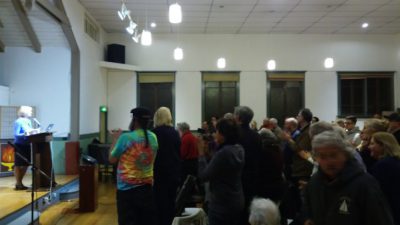
Alison Weir provides the following report back on an event that almost didn’t happen:
After I was invited by the Social Justice Committee of the Berkeley Fellowship of Unitarian Universalists (BFUU) to give a public presentation, extremist pro-Israel activists went to work to get the event canceled. They put up blog posts and even a Craigslist advertisement attacking me, exaggerating inaccurate claims about me by the ADL and, especially, the widely refuted JVP-US Campaign dossier on me.
This has become standard practice for Israel partisans who wish to prevent audiences from hearing my presentation.
A few individuals within the BFUU then took up the JVP-USC false claims, trying to get the event shut down before anyone had the chance to hear me directly. This effort threatened to succeed, but ultimately failed when members committed to social justice and free speech refused to cave in.
Activist songwriter-musician Vic Sadot, former Social Justice Committee Chair Cynthia Johnson, human rights worker Tom Luce, and current Social Justice Committee Chair Gene Herman – all longtime, respected Berkeley human rights activists – didn’t give in to the significant pressure, took a great deal of heat for this, and the event went on.
Nevertheless, they were nervous, particularly after seeing the Craigslist ad that seemed designed to foment hate against me and possibly provoke violence. At a recent event elsewhere in the area, a similar smear campaign had been undertaken against me (including another Craigslist ad), and a few Israel partisans showed up to disrupt the event — to the degree that the police had to be called. One Israel partisan then hit a woman videotaping the incident.
Fortunately, no protesters showed up this time, and I again spoke to a full house. The audience included many members of BFUU – which has a long tradition of peace and human rights activism – who came to hear me for themselves.
At the end of the talk, I was honored and extremely grateful to receive a standing ovation. Numerous audience members said they appreciated the talk, had learned new information, and bought my book. One person told me she hadn’t known any of the information before.
This success only happened because Vic, Cynthia, Tom, Gene and others were willing to stick their necks out, and because the BFUU congregation came down on the side of free speech and against censorship.
It would have been much easier for them to cancel the event entirely, or to bring a less “controversial” speaker. But they didn’t.
This is an example of what a few brave souls can do. Thank you.
UPDATE: I’ve just learned that the event was co-sponsored by Norcal Sabeel, another committed and courageous group.
Sheikh Raed Salah banned from travel abroad or entering Jerusalem for five more months
Samidoun Palestinian Prisoner Solidarity Network – February 15, 2017
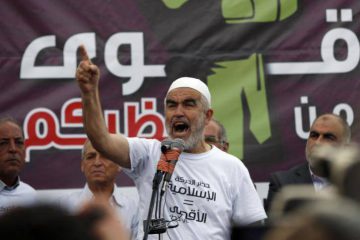 Sheikh Raed Salah was banned from leaving Palestine and barred from entering al-Aqsa Mosque and the city of Jerusalem for five more months on Tuesday, 14 February, reported Quds News.
Israeli police delivered an order from Aryeh Deri, the far-right Israeli Interior Minister, to Salah’s home in Umm al-Fahm, on Tuesday night, banning him from travel or visiting Jerusalem, until 15 July 2017. The order comes as a renewal of the one-month travel ban slapped on Salah on 17 January 2017, immediately upon his release from Israeli prison from a nine-month sentence for “incitement,” for a sermon he delivered in 2007.
The order declares that Salah’s travel abroad poses a “real danger… to state security.” Salah is the leader of the Islamic Movement in Palestine ’48; in 2015, the Israeli state banned the Islamic Movement in an action condemned by Palestinian organizations across the political spectrum as an attack on all Palestinians in ’48 Palestine, who hold Israeli citizenship.
Throughout his imprisonment, Salah was held in solitary confinement and repeatedly interrogated; appeals to end his isolation were denied throughout that time. He was even denied access to magazines, books and other materials brought for him.
Senate Dems Join Republican Attack on Palestinian Solidarity
teleSUR | February 10, 2017
On Tuesday, eight Democratic senators joined former Republican presidential hopeful Marco Rubio in introducing a Senate bill attacking the Boycott, Divestment, and Sanctions movement, BDS, which aims at ending the illegal occupation of Palestine and ongoing violations of human rights by Israeli authorities.
Rubio said the bill, titled The Combatting BDS Act of 2017, will “fight back” against the the growing BDS movement by “affirming the legal authority of state and local governments to take tangible actions to counter economic warfare against Israel.”
The bill would allow state and local governments to withdraw funding for any organization “engaged in BDS conduct,” thus giving them “an offensive capability against entities seeking to economically harm Israel,” according to Rubio’s statement announcing the legislation.
“This bipartisan legislation gives state and local governments a legal way to combat the shameful boycott, divestment and sanctions movement against Israel,” said Democratic senator for West Virginia Joe Manchin, a co-sponsor of the bill.
Rubio also explicitly stated that the proposed legislation is a response to the historic U.N. Security Council resolution calling on Israel to end its construction of illegal settlements in occupied East Jerusalem and the West Bank.
Rubio’s bill is the first attempt to make national several anti-Palestinian solidarity measures passed by state legislatures in Wyoming and New York. Similar to those attempts, however, this legislation will likely fail any constitutional test.
“The Rubio bill doesn’t solve the fundamental problem with these anti-BDS laws, which is that they violate the First Amendment,” said Rahul Saksena, a staff attorney with Palestine Legal, in an interview with The Electronic Intifada.
“Boycotts have been used throughout U.S. history ― from the Boston Tea Party, to the Civil Rights Movement, to the anti-South African ( Apartheid movement ― to challenge injustice and promote social change,” said Palestine Legal and the Center for Constitutional Rights in a statement responding to New York State’s so-called “blacklist” bill passed in December of last year.
Launched in 2005 by 170 Palestinian civil society organizations — including unions, refugee networks, women’s organizations and professional associations — and inspired by the anti-Apartheid movement, the BDS movement calls on individuals and organizations to pressure the Israeli government to end its illegal occupation of the West Bank and Gaza, recognize the right of return of Palestinian refugees and guarantee full civil and human rights to Arab-Palestinian citizens of the Israeli state.
100-year-old Bedouin woman left homeless as Israel continues Negev demolitions

Ma’an – February 8, 2017
NEGEV – In the latest instance of Israel’s demolition campaign in the Negev region of southern Israel, homes were demolished in two unrecognized Bedouin villages on Wednesday, while Israeli police surrounded the village of Umm al-Hiran.
Israeli bulldozers, escorted by Israeli police, demolished a house in the village of Wadi al-Naam in the western part of the Negev in southern Israel.
Locals told Ma’an that the demolished house was owned by an elderly woman and her daughter. A member of the local committee, Yousif Ziyadin, said that an emergency session would be held to discuss the Israeli demolition.
A relative of the elderly homeowner, Ahmad Zanoun, told Ma’an that 100-year-old Ghaytha Zanoun and her 60-year-old daughter Hilala were living in the house, both of whom suffer from various health issues.
Zanoun said that both Ghaytha and Hilala were unable to walk, and noted that the family had renovated the home in accordance with their doctor’s suggestions due to their health conditions.
He added that Ghaytha and her daughter now were homeless following the demolition.
The Wadi al-Naam village was established in the 1950s soon after the 1948 Arab-Israeli war that established the state of Israel. Military officials forcibly transferred the Negev Bedouins to the site during the 17-year period when Palestinians inside Israel were governed under Israeli military law, which ended shortly before Israel’s military takeover of Gaza and the West Bank, including East Jerusalem, in 1967.
In July, the Israeli government approved plans to build townships for Israel’s Bedouin community. The planned township is expected to be built just south of Shaqib al-Salam, another Bedouin township, and would transfer at least 7,000 Bedouins from the unrecognized village of Wadi al-Naam, Israeli newspaper Haaretz reported last year.
The approved village would comprise of an area of approximately 9,000 dunams (2,224 acres), while providing housing to some 9,000 residents, The Times of Israel also reported.
The proposal to expand the area of Shaqib al-Salam was challenged in Israel’s Supreme Court in 2015, as the Association of Civil Rights in Israel (ACRI), who assisted in the court proceedings, argued that any expansion of the town would be followed by the forcible removal of Bedouins from unrecognized villages, particularly from Wadi al-Naam.
Yaron Kelner, spokesperson for ACRI, confirmed to Ma’an on Wednesday that residents of Wadi al-Naam have continued to refuse the relocation deal.
Meanwhile, Israeli bulldozers also demolished a mobile home in the unrecognized village of al-Zarnouq in the Negev. However, no other details were provided about the demolition.
The Israeli government has plans to evacuate thousands of residents from al-Zarnouq to the recognized village of Rahat in order to build over the land for new housing for non-Bedouin Israeli citizens.
According to Israeli newspaper Haaretz, the Israeli government approved in 2011 plans to transfer tens of thousands of Bedouins in unrecognized villages, including al-Zarnouq, into officially recognized settlements.
The ongoing attempts at transferring the Bedouins originated from the Prawer Report, a document outlining expulsion plans for the unrecognized Bedouin community. It was officially adopted by the Israeli government in 2013.
According to Israeli human rights group Adalah, the plan would “result in the destruction of 35 ‘unrecognized’ Arab Bedouin villages, the forced displacement of up to 70,000 Arab Bedouin citizens of Israel, and the dispossession of their historical lands in the Negev.”
In another incident in the Negev on Wednesday, the Yoav unit of the Israeli police surrounded the village of Umm al-Hiran. According to locals, residents have expressed fear that their presence could signal another demolition, the last of which erupted into deadly violence when Israeli police raided the village prior to demolishing homes. A local Bedouin teacher and an Israeli police officer were killed at the time.
Meanwhile, the Bedouin village of al-Araqib was demolished for the 109th time on Wednesday.
Bedouin communities in the Negev have been the target of a heightened demolition campaign in recent weeks, following Israeli leaders publicly expressing their commitment to demolish Palestinian structures lacking difficult to obtain Israeli-issued building permits across Israel and occupied East Jerusalem in response to the Israeli-court sanctioned evacuation of the illegal Amona settler outpost.
In December, Netanyahu released a video to address settlers of the Amona outpost, assuring them that he would commit to “enforcing laws” on “illegal construction” in Israel, referring primarily to Palestinian communities that are often forced to build without Israeli-issued building permits, due to what rights groups have attributed to discriminatory zoning policies in Israel which have excluded many Palestinian-Israeli communities from being included in the regional and municipal development plans.
According to the Association for Civil Rights in Israel (ACRI), more than half of the approximately 160,000 Negev Bedouins reside in unrecognized villages.
Rights groups have claimed that the demolitions in Bedouin villages is a central Israeli policy aimed at removing the indigenous Palestinian population from the Negev and transferring them to government-zoned townships to make room for the expansion of Jewish Israeli communities.
UK covered up intelligence training with Bahrain’s police, amid death sentence
Reprieve | February 5, 2017
UK authorities trained Bahrain’s police how to gather intelligence on protestors, and then tried to cover up the scheme, international human rights group Reprieve has found. The project took place after protestors in the Gulf kingdom were rounded up and sentenced to death.
Britain’s Foreign Office paid for half a dozen Bahraini police officers to visit Belfast in August 2015, where the Police Service of Northern Ireland (PSNI) shared its expertise on gathering intelligence ahead of demonstrations.
Protestors in Bahrain, such as Mohammed Ramadan, have been targeted by police and tortured into falsely confessing to capital crimes. Mr Ramadan, a father of three young children, is now on death row and could be executed at any time.
The training, which also included sessions on water cannons, dog handling and public order tactics, was kept secret. The UK government has repeatedly denied providing public order training to Bahrain.
The Cabinet Office claimed that “The UK does not fund any programmes in Bahrain focused on public order”. However, documents obtained by Reprieve show that Bahrain’s police received an “Introduction to Combined Operational Training with a focus on Public Order.”
The training was prepared by Northern Irish police officers during a week-long “scoping visit” to Bahrain over April-May 2015, where they assessed Bahrain’s public order systems. The Stormont-owned company NI-CO played a key role in organising all the training.
It has also emerged that Bahrain’s Chief of Police and his deputies visited Belfast in June 2014. The itinerary included another session with the PSNI on “Community Intelligence”. The police chief attended a “demonstration of PSNI Public Order systems” and received a “Tour of North and West Belfast ‘Flashpoints’ with 2 or 3 PSNI Armoured Vehicles”.
Bahrain’s Chief of Police had to postpone a visit to Belfast earlier in 2014 because there was a “security emergency in Bahrain at the moment and it is felt that the Chief of Police and other senior officers cannot leave the country at this critical time.” This was a month after death-row prisoner Mohammed Ramadan was tortured. “The situation on the ground is becoming increasingly tense”, an email explained.
Bahrain’s Chief of Police has command level responsibility for violations carried out by lower ranking officers. Months after the police chief visited Belfast for training, teenager Ali al-Singace was arrested and tortured by Bahrain’s police with electric shocks, until he made a false confession to a capital crime. He was executed by firing squad in January 2017.
Commenting, Maya Foa, a director of Reprieve, said:
“It is outrageous that the government has covered up this project, which risks supporting the execution of protesters in Bahrain.
“Bahrain is notorious for arresting, torturing and sentencing to death people involved in protests – such as Mohammed Ramadan, a father of three who is held on death row and faces execution at any moment.
“By training Bahrain’s police how to gather intelligence on protesters, there is a serious risk that Britain is helping them arrest and execute people who are guilty of nothing more than calling for reform. It is scandalous that the Government has sought to sweep this under the carpet.”
Featured Video

The Search for Truth: Charlie Kirk’s Assassination One Year Later
or go to
Aletho News Archives – Video-Images
From the Archives
The 9/11 “Double-Cross” Conspiracy Theory
BY LAURENT GUYÉNOT • UNZ REVIEW • SEPTEMBER 6, 2022
Is it true that “9/11 was an inside job”? Yes, insofar as Israel is “inside” the U.S. But for the 9/11 truthers who have identified Israel as the main perpetrators, “9/11 was an inside job” is at best a half-truth, and at worst an integral part of the Zionist operation, like a secondary flag sewn as a lining under the false flag of Islamism. Victor Thorn (1963-2017) wrote in his book 9/11 made in Israel: The Plot Against America (2011): “In essence, the ‘9-11 truth movement’ was created prior to Sept. 11, 2001 as a means of suppressing news relating to Israeli complicity. . . . The slogan ‘9-11 was an inside job’ was quite possibly the greatest example of Israeli propaganda ever devised.” In milder terms, it is “controlled opposition”.
A genuine truth movement would have pointed to Israel as the prime suspect from the start. From day one, it was obvious who would benefit. … continue
Blog Roll
 Aletho News
- Europe’s mounting social chaos… chickens coming home to roost for proxy war against Russia
- US-Russia Diesel Deal Becomes Massive Defeat for Ukraine
- Hormuz and the Looming Economic Catastrophe
- Dhubab offensive, media blitz and the rapid unraveling of Saudi-backed coalition’s new gambit
- Putin Conveys to Trump Iran’s Vision on Possible Conflict Resolution – Kremlin
- The Search for Truth: Charlie Kirk’s Assassination One Year Later
- ‘Harsh reality’: Iran says France seeks monopoly on power and intimidation, not peace for all
- When Will This White House Madness End?
- Huckabee aide goes to ‘unusual lengths’ to portray ‘Israel’ positively
- Trump Announces Diesel Supply Deal With Putin Following Phone Call
- If Americans Knew
- Israeli forces kill another child in Gaza – Daily Update
- Gaza ceasefire exists in name only, say more than 100 organizations
- Nearly 2 Million in Gaza Need Urgent Shelter Assistance as Winter Looms: IOM Chief Warns
- Suppressing Palestinian resistance: US charity under fire for AI monitoring of Gaza classrooms
- Thousands Are Held in Israeli Torture Camps. This Is What Happens Inside
- Israel puts Gaza’s sick, injured, newborn in peril – Daily Update
- Report claimed Mark Levin used by Israeli government to influence Trump
- Over 2,000 Gazans have died awaiting medical evacuation amid Israel’s continued siege
- How a U.S. Diplomat Suppressed and Altered Reports Critical of Israel
- 5 Palestinians Die from Israeli Strikes in Gaza as Relentless Attacks Continue
- No Tricks Zone
- New Study: 50 Years Of The Most Aggressive ‘Net Zero’ Policies Can Only Affect The Global Climate By 0.03°C
- US September “Heat” Was No Record…Many Records Set Decades Ago
- Latest European Green Energy Debacle; Portugal’s Largest Flagship Solar Park Insolvent!
- Green Energy Debacle: German Expert Professor Fritz Vahrenholt Warns Of Severe Economic And Social Consequences
- Two More Paleo Reconstructions Affirm Meters-Higher Sea Levels Across Ireland, Brazil 7000-6000 Years Ago
- New Study: Earth And Venus Surface Warmth Largely Explained By Convection And Lapse Rate, Not CO2 Or Radiation
- 2025 Nature Paper Claiming Worsening Global Drought Gets RETRACTED …Heavily Flawed
- New Study: ‘Global Drought Shows No Detectable Recent Acceleration Under Climate Warming’
- Economic Masterminds: German Socialists Suggest Taxing Productivity Gains Stemming From Using AI
- The South China Sea Has Not Been Cooperating With The Climate Change Narrative

