Facebook, Internet.org, and the End of Net Neutrality
By Tony Cartalucci | New Eastern Outlook | September 16, 2016
American-based aerospace company SpaceX is one of the few Western enterprises pursuing a greater purpose in a nation otherwise obsessed with power and profit. When its rocket was recently lost on the launch pad amidst an anomaly it took with it a satellite to be used by Facebook, an example of the latter.
The Guardian in an article titled, “SpaceX rocket explosion: Mark Zuckerberg laments loss of Internet.org satellite,” would report:
Facebook CEO Mark Zuckerberg struck a bitter tone in his response to the explosion of the SpaceX rocket carrying a satellite intended for use on his Internet.org project in Africa.
Writing on his Facebook page, Zuckerberg said: “As I’m here in Africa, I’m deeply disappointed to hear that SpaceX’s launch failure destroyed our satellite that would have provided connectivity to so many entrepreneurs and everyone else across the continent.”
However, while technically Facebook’s Internet.org would provide “connectivity” to people across the continent, it would not be providing them with access to the actual Internet.
Instead, it is Facebook’s version of the Internet, where the concept of net neutrality – the principle that Internet service providers should enable access to all content and applications regardless of the source, and without favoring or blocking particular products or websites – does not exist.
On Facebook’s version of the Internet, only those willing to pay large sums of money can have access to audiences while others who do not pay, no matter how popular or meaningful their message may be, are essentially silenced. This is already a reality across Facebook’s social network itself, and this network is one of several “Free Basics” offered on Facebook’s Internet.org.
Internet.org by Facebook Aims to Control the World, Not “Connect” It
A visit to Facebook’s Internet.org reveals meaningless slogans and images of smiling brown people.
Looking past the superficiality at what Internet.org truly represents, it is clear that it is an attempt to takeover and monopolize the telecom industry and in particular, the entire Internet across the developing world. Not only does Facebook’s “Free Basics” limit users to information highly controlled by Western corporate-financier special interests and Facebook’s own net neutrality-usurping algorithms, but because the infrastructure employs methods including space-based satellites, the governments and communities exposed to this upturned version of the Internet have no say or control over it.
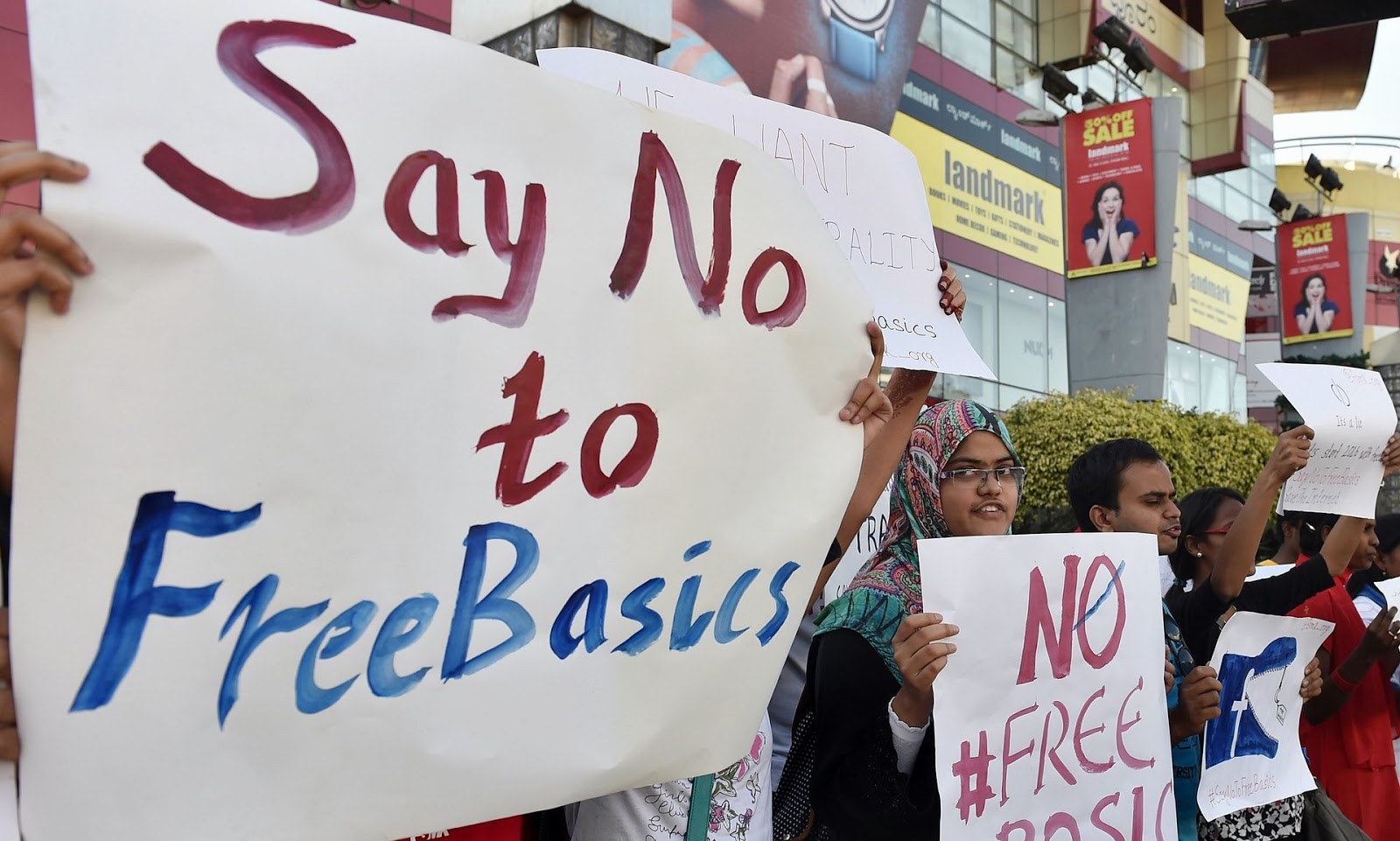
So obvious is this, that even before Facebook has completed its plans, nations are already fighting back.
In India, net neutrality activists succeeded in getting the invasive, manipulative, and monopolizing service banned from the country. The Guardian’s article, “India deals blow to Facebook in people-powered ‘net neutrality’ row,” would report:
Facebook has lost the right to offer its free mobile internet service in India after the country’s telecoms regulator ruled in favour of net neutrality, marking the end of an intense and very public 11-month national debate.
The new regulations published by India’s Telecom Regulatory Authority (TRAI) ban differential pricing for data services, and make it easier for smaller firms to compete with established companies including Facebook.
Facebook’s response was as unsurprising as it was dishonest, claiming:
Our goal with Free Basics is to bring more people online with an open, non-exclusive and free platform. While disappointed with the outcome, we will continue our efforts to eliminate barriers and give the unconnected an easier path to the internet and the opportunities it brings.
In reality, in order to eliminate barriers and connect people, the people themselves must acquire the skills and resources necessary to create their own infrastructure, companies to maintain it, and the ability to create their own content to transmit over it – the very embodiment of both the Internet itself and the underlying hope proponents of net neutrality hold for the Internet. The people using the Internet in their nation should be the primary benefactors of it – not just in terms of having access to useful information, but the ability to earn a living by maintaining its infrastructure.
In addition to Facebook’s ability to penetrate and monopolize any given developing nation’s telecom industry, considering Facebook’s ties to the US State Department and its role in facilitating regime change and even destructive, violent campaigns of armed subversion, it is very likely Facebook’s monopoly would make it that much easier to control and manipulate information space in any given developing nation during a Western-engineered crisis.
This may explain why legitimate nongovernmental organizations (NGOs) in India stood up to Facebook’s attempt to undermine net neutrality, but nations where NGOs are dominated by US State Department and Open Society funding like Thailand and the Philippines, Facebook’s Internet.org has gone unopposed.
 |
| Image: “Activists” complain about Thailand’s alleged “single gateway” plan to control domestic Internet infrastructure, while Facebook attempts to construct a global “single gateway” it controls, completely unopposed by these same groups – groups generally funded by the US State Department and Open Society, two partners Facebook has worked with in the past and groups that have themselves taken part in training assisted or sponsored by Facebook. |
Telecom and information technology, like food, water, energy, and a standing army, are essential building blocks for national security and prosperity. Handing the responsibility of any of these over to either a foreign nation or a foreign corporation – or both – is the relinquishing of one’s sovereignty and the compromising of one’s national security.
Nations and their people must develop their own Internet infrastructure. For Mark Zuckerberg and his government-connected corporation Facebook to presume they are the sole solution to “connecting the world” is but a modern-day version of “The White Man’s Burden” – those nations subjected to it subordinated to this domineering arrogance and the self-serving schemes that underpin it.
Facebook’s Internet.org is a wake-up call for developing nations to stand up and invest in modern day essential infrastructure – including domestic versions of social networks like Facebook – to ensure they are as safe in the field of information as their conventional armies keep them on the field of battle.
Facebook, Israel Seal Deal to Crack Down on Palestinians Online

teleSUR – September 12, 2016
Facebook and the Israeli government agreed to set up joint teams in order to fight what they call “incitement” posts on the social media website which officials said were meant to target Palestinians and Arab-Israelis, local media reported Monday.
“The meeting took place under the assumption that Facebook has the capability, the responsibility and the willingness to help mitigate incitement and terror from the network,” said a joint statement issued by Justice Minister Ayelet Shaked and Interior Minister Gilad Erdan.
The Israeli ministers, who belong to the most conservative right-wing government in the history of the country, further argued that criticism and response to Israeli operations, extrajudicial killings and targeting of anti-occupation protests is “incitement and terror.”
“In the recent spate of terror it was proven that the internet has become a home to incubate terrorists and we must fight together to prevent this. The companies must and can do much more,” the statement added according to the local Times of Israel.
“Facebook and internet companies have a responsibility regarding the content they allow on their sites that encourages incitement and terror, and they should actively operate to monitor it,” Erdan said.
Justice Minister Shaked, who has previously called all Palestinians, including women and children “the enemy,” further used the anniversary of the 9/11 attacks in the U.S. to call for a crackdown on Palestinian “terror.”
“Particularly in the week in which we remember 9/11, an event that changed the face of the U.S., it is clear that there is a joint interest among all parties that are in a position to fight terror.”
Such a crackdown on incitement by Facebook would never be used against Israelis who suggest killing Arabs and Palestinians, according to the Intercept.
During the 2014 war on Gaza, many Israelis took to social media platforms to call for more killing of Palestinians.
Last year when an Israeli soldier was arrested for shooting and killing a wounded Palestinian point blank in the head, his fellow troops used Facebook to praise the killing, while Israeli extremists justified the killing and called for his release.
The same Shaked who is worried about online incitement, used Facebook to post the text of an article by the late Israeli writer Uri Elitzur that referred to Palestinian children as “little snakes.”
In a another example, the justice minister posted on Facebook that Palestinians are all “the enemy” and therefore all legitimate targets.
“This is a war between two people. Who is the enemy? The Palestinian people,” she said in a Facebook post in 2015. “Every war is between two peoples, and in every war the people who started the war, that whole people, is the enemy.”
Both of those posts were deleted upon her appointment to the justice ministry.
Facebook and Israel have been developing an intimate relationship over the past few years. In June, Mondoweiss reported that Jordana Cutler, current chief of staff at the Israeli Embassy in Washington, D.C. was hired as head of policy and communications at Facebook’s Israel office.
Facebook has also been very responsive when asked by Israel to delete posts it deems as inciting terror over the past year.
Last words to the nation of Salvador Allende
Last words to the nation of Salvador Allende
Surely this will be the last opportunity for me to address you. The Air Force has bombed the towers of Radio Portales and Radio Corporación.
My words do not have bitterness but disappointment. May they be a moral punishment for those who have betrayed their oath: soldiers of Chile, titular commanders in chief, Admiral Merino, who has designated himself Commander of the Navy, and Mr. Mendoza, the despicable general who only yesterday pledged his fidelity and loyalty to the Government, and who also has appointed himself Chief of the Carabineros [national police].
Given these facts, the only thing left for me is to say to workers: I am not going to resign!
Placed in a historic transition, I will pay for loyalty to the people with my life. And I say to them that I am certain that the seed which we have planted in the good conscience of thousands and thousands of Chileans will not be shriveled forever.
They have strength and will be able to dominate us, but social processes can be arrested neither by crime nor force. History is ours, and people make history.
Workers of my country: I want to thank you for the loyalty that you always had, the confidence that you deposited in a man who was only an interpreter of great yearnings for justice, who gave his word that he would respect the Constitution and the law and did just that. At this definitive moment, the last moment when I can address you, I wish you to take advantage of the lesson: foreign capital, imperialism, together with the reaction, created the climate in which the Armed Forces broke their tradition, the tradition taught by General Schneider and reaffirmed by Commander Araya, victims of the same social sector which will today be in their homes hoping, with foreign assistance, to retake power to continue defending their profits and their privileges.
I address, above all, the modest woman of our land, the farmer who believed in us, the worker who labored more, the mother who knew our concern for children. I address professionals of Chile, patriotic professionals, those who days ago continued working against the sedition sponsored by professional associations, class-based associations that also defended the advantages which a capitalist society grants to a few.
I address the youth, those who sang and gave us their joy and their spirit of struggle. I address the man of Chile, the worker, the farmer, the intellectual, those who will be persecuted, because in our country fascism has been already present for many hours — in terrorist attacks, blowing up the bridges, cutting the railroad tracks, destroying the oil and gas pipelines, in the face of the silence of those who had the obligation to protect them. They were committed. History will judge them.
Surely Radio Magallanes will be silenced, and the calm metal instrument of my voice will no longer reach you. It does not matter. You will continue hearing it. I will always be next to you. At least my memory will be that of a man of dignity who was loyal to [inaudible] the workers.
The people must defend themselves, but they must not sacrifice themselves. The people must not let themselves be destroyed or riddled with bullets, but they cannot be humiliated either.
Workers of my country, I have faith in Chile and its destiny. Other men will overcome this dark and bitter moment when treason seeks to prevail. Go forward knowing that, sooner rather than later, the great avenues will open again where free men will walk to build a better society.
Long live Chile! Long live the people! Long live the workers!
These are my last words, and I am certain that my sacrifice will not be in vain, I am certain that, at the very least, it will be a moral lesson that will punish felony, cowardice, and treason.
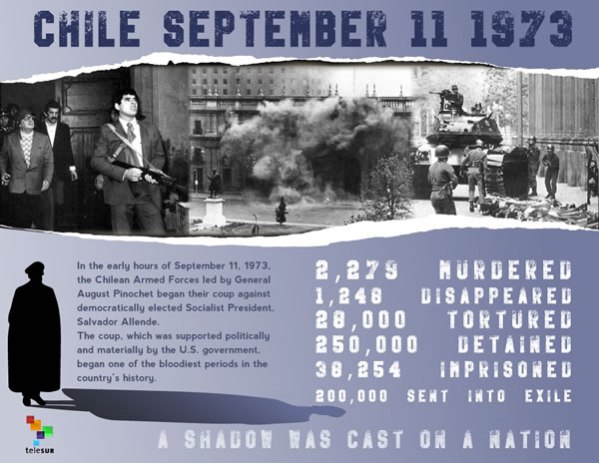
CIA Continues to Cover Up Its Involvement in Chile’s 9/11 Coup
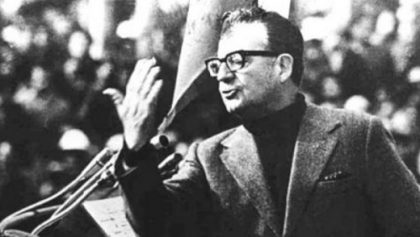
Victim of one the many coups on democracy carried out by the United States: Salvador Allende
teleSUR | September 9, 2016
Though intelligence documents from the 1973 coup period have been declassified since 1999, the CIA continues to censor them.
The CIA continues to withhold information on its involvement in the Sept. 11, 1973 coup that led to the death of President Salvador Allende in Chile, followed by a deadly dictatorship, according to documents posted Friday by the National Security Archive.
In the list of published documents, the section regarding Chile is censored. The President’s Daily Briefs, the intelligence reports given daily to the U.S. president, in particular former President Richard Nixon days before Allende’s death, were among those censored.
According to Peter Kornbluh, director of the Archive’s Chile Documentation Project, censorship on this issue makes no sense since the intelligence agency has officially acknowledged its ties to those who plotted the coup from inside the Chilean military, and declassified several intelligence reports since.
“The CIA is trying—but failing—to hold history hostage,” Kornbluh said. “The CIA is attempting to cover up what Nixon knew about coup plotting in Chile and when he knew it, as well as hiding the CIA’s own contacts and connections to the coup plotters.”
According to the documents, three days before the coup—and on the day of the coup—the CIA gave Nixon an intelligence report on the progress of the efforts inside the Chilean military to overthrow Allende, a socialist.
In one document, a CIA operative in Santiago named Jack Devine identifies the new date of the planned coup for the next day, September 11, and confirms all three branches of the Chilean armed forces along with the police “are involved in this action.”
The same sources told the CIA that General Augusto Pinochet, who would later become a dictator with the support of the U.S., was in communication with Air Force General Gustavo Leigh about the planned coup. The Air Force would later bomb La Moneda presidential palace, where Allende and his closest allies were on Sept. 11.
The CIA told the White House that a “key officer” in the coup attempt requested U.S. assistance in case the Chilean military encountered any resistance, according to the documents.
Kornbluh said his institution would press for the release of the censored information.
“The documents provided to Richard Nixon on Chile can and should be released for the sanctity of the historical record. The public has a right to know what the President knew, and when he knew it,” he said.
Addictive painkiller profiteer donates $500k to fight cannabis legalization in Arizona
RT | September 9, 2016
Insys Therapeutics, which profits off of a painkiller 50 times more potent than heroin, has donated $500,000 to a campaign opposing marijuana legalization in the US state of Arizona.
The maker of the drug Subsys, a sublingual fentanyl spray, said that children are their main concern for fighting Proposition 205, which appears on the ballot this November.
“They want to be able to push their far more addictive, far more harmful and far more dangerous opioid drugs,” JP Holyoak, chair of the committee pushing Prop 205, told the Arizona Capitol Times.
Supporters of cannabis legalization say legal access to their natural non-addictive painkiller could eliminate the need for drugs like fentanyl, which contributes to America’s growing epidemic of opioid dependency that claims more lives each year than gunshot wounds or car crashes.
Prince died from an overdose of fentanyl and one third of Ohio’s 3,050 deaths caused by lethal drug consumption last year were linked to the drug, according to the Columbus Dispatch.
A 2014 study by John Hopkins University found that states which legalized medical marijuana had 25 percent less overdose deaths from prescription drugs than those where it remained illegal.
Insys said in a statement that its opposition to the legalization of cannabis was “because it fails to protect the safety of Arizona’s citizens, and particularly its children.”
It did not address whether the outcome could have financial benefits for the company, although all of its profits come from the sale of its only product – the fentanyl-containing spray, according to its August filing.
Last month, Illinois Attorney General, Lisa Madigan, brought a lawsuit against Insys over claims they had deceptively marketed and sold their medication to doctors for uses other than cancer treatment, which the FDA has approved its sole use for.
Madigan said the company’s “desire for increased profits led it to disregard patients’ health and push addictive opioids for non-FDA approved purposes.”
Insys became the largest contributor to the anti-legalization campaign after donating to Arizonans for Responsible Drug Policy, a group opposing the initiative to regulate marijuana in the state under Prop 205.
Their donation was over 400 percent higher than the next largest donor, the Arizona Chamber of Commerce and Industry, with $110,000.
Pro-legalization campaigners have called for the donation to be returned as it has now tainted the campaign against Prop 205.
“We hope that every Arizonan understands that Arizonans for Responsible Drug Policy is now a complete misnomer. Their entire campaign is tainted by this money. Any time an ad airs against Proposition 205, the voters should know that it was paid for by highly suspect Big Pharma actors,” Holyoak said.
When questioned by the Arizona Capitol Times about donations made to the Marijuana Policy Project in support of Prop 205, Holyoak did not dispute that several out-of-state interest donors “stand to make millions if Prop 205 passes.”
Coincidentally, the recently-passed Bill 205 in Canada banned the sale of pill presses for making fentanyl.
European Copyright Ruling Ushers in New Dark Era for Hyperlinks
In a case which threatens to cause turmoil for thousands if not millions of websites, the Court of Justice of the European Union decided today that a website that merely links to material that infringes copyright, can itself be found guilty of copyright infringement, provided only that the operator knew or could reasonably have known that the material was infringing. Worse, they will be presumed to know of this if the links are provided for “the pursuit of financial gain”.
The case, GS Media BV v. Sanoma, concerned a Dutch news website, GeenStijl, that linked to leaked pre-publication photos from Playboy magazine, as well as publishing a thumbnail of one of them. The photos were hosted not by GeenStijl itself but at first by an Australian image hosting website, then later by Imageshack, and subsequently still other web hosts, with GeenStijl updating the links as the copyright owner had the photos taken down from one image host after another.
The court’s press release [PDF] spins this decision in such a positive light that much reporting on the case, including that by Reuters, gets it wrong, and assumes that only for-profit websites are affected by the decision. To be clear, that’s not the case. Even a non-profit website or individual who links to infringing content can be liable for infringing copyright if they knew that the material was infringing, for example after receiving notice of this from the copyright holder. And anyway, the definition of “financial gain” is broad enough to encompass any website, like GeenStijl, that runs ads.
This terrible ruling is hard to fathom given that the court accepted “that hyperlinks contribute to [the Internet’s] sound operation as well as to the exchange of opinions and information in that network”, and that “it may be difficult, in particular for individuals who wish to post such links, to ascertain whether [a] website to which those links are expected to lead, provides access to works [that] the copyright holders … have consented to … posting on the internet”. Nevertheless, that’s exactly what the judgment effectively requires website operators to do, if they are to avoid the risk of being found to have knowingly linked to infringing content.
There are also many times when knowingly linking to something that is infringing is entirely legitimate. For example, a post calling out a plagiarized news article might link to the original article and to the plagiarized one, so that readers can compare and judge for themselves. According to this judgment, the author of that post could themselves be liable for copyright infringement for linking to the plagiarized article—madness.
This judgment is a gift to copyright holders, who now have a vastly expanded array of targets against which to bring copyright infringement lawsuits. The result will be that websites operating in Europe will be much more reticent to allow external hyperlinks, and may even remove historical material that contains such links, in fear of punishing liability.
‘People coming together’: Seattle Seahawks mull BLM-inspired team protest during national anthem
RT | September 8, 2016
At least some members of the American football franchise plan to follow the example of Colin Kaepernick and stage a protest against police brutality during the national anthem, at the upcoming Week 1 game in Seattle.
“Anything we want to do, it’s not going to be individual. It’s going to be a team thing. That’s what the world needs to see. The world needs to see people coming together versus being individuals,” starting linebacker Bobby Wagner told the Seattle Times on Wednesday evening.
Wagner did not specify what form the protest would take, saying only that “whatever we decide to do will be a big surprise.”
San Francisco 49ers quarterback Colin Kaepernick kickstarted a movement among athletes when he sat down during the national anthem during a preseason game last month, later explaining that he was “not going to stand up to show pride in a flag for a country that oppresses black people and people of color.” Kaepernick says that he plans to continue with the protest for the foreseeable future.
Seahawks cornerback Jeremy Lane has followed his example, and receiver Doug Baldwin said that players discussed becoming part of the protests in the locker room, but he wanted to “get all of [his] ducks in a row” before taking a decision that is bound to become a magnet for controversy.
The previous protests, one of which was carried out by white female soccer player Megan Rapinoe, have been dismissed as inflammatory and unpatriotic, and the accusations are bound to be even more intense on Sunday, September 11, when the country will be commemorating the 15th anniversary of the terrorist attacks that resulted in the deaths of nearly 3,000 Americans.
“I think it’s very ironic to me that 15 years ago on September 11 was one of the most devastating times in US history and after that day we were probably the most unified that we have ever been. And today we struggle to see the unity. And it’s very ironic to me that this date is coming up,” Baldwin said.
“So it’s going to be a special day, a very significant day, but at the same time I am looking forward to the may changes and differences, the changes we can make in this country to make better changes in our country.”
The team, which won the Super Bowl in 2014, has been given carte blanche to express their feelings by coach Pete Carroll, who is regarded as being liberal by the media.
“He’s pretty clear on what he did and what he was trying to express and I think it is very simple and so we’ll leave that up to him,” Carroll said, referring to Lane.
Carroll, 64, said he did “not specifically” consider that symbolic significance of September 11, when considering his decision.
Several other major league coaches, such as John Tortorella, who coaches the US national hockey team, and the Columbus Blue Jackets, stated that he would bench any player who made overt political statements during the anthem.
But Seattle players said they would be going ahead with their intentions regardless of reactions from coaches or other team or league officials.
“We have the freedom to do whatever we want here. Whatever we decide to do, we ain’t gonna get into too much trouble. We’re big kids now,” said Wagner.
Shaun King, one of the founders of the Black Lives Matters movement, has called on more players to join the public displays, saying many have expressed a wish to join, mixed with fear about being black listed from the NFL for their political activism.
“The league has 1,696 players. If just 100 of you took a knee during the “Star-Spangled Banner,” it would instantly become one of the largest social protests in sports history,” wrote King in his New York Daily News column.
“Over the past two weeks, every sports network in America has started discussing injustice and police brutality. You have the power to take that to a whole different level.”
An estimated 804 people of all races have been killed by the police since the start of 2016, after 1,207 who died last year. Black Lives Matters says that over 100 of last year’s victims were unarmed blacks, who shouldn’t have lost their lives during their detention.
Conspiracy charge against radio shock jock arrested for 1rst amendment activities relating to Oregon standoff dismissed
The Rutherford Institute | September 7, 2016
PORTLAND, Oregon — Citing a lack of evidence, federal prosecutors have dismissed the government’s conspiracy charge against radio shock jock Pete Santilli, a new media journalist who was arrested and charged in connection with his reporting on the 41-day occupation of the Malheur National Wildlife Refuge in Burns, Oregon. The dismissal came on the eve of Santilli’s trial. Attorneys for The Rutherford Institute advised Santilli’s court-appointed attorney, Thomas Coan, on the First Amendment protections for Santilli’s activities as a journalist. Santilli is the only journalist among those who were charged with conspiracy to impede federal officers from discharging their duties by use of force, intimidation, or threats. However, Santilli was charged solely as a reporter of information and not as an accomplice to any criminal activity. In coming to Santilli’s defense, Institute attorneys warned that Santilli’s case followed a pattern by the government of intimidating journalists whose reporting portrays the government in a negative light or encourages citizens to challenge government injustice and wrongdoing.
“The FBI’s prosecution of this radio shock jock has been consistent with the government’s ongoing attempts to intimidate members of the press who portray the government in a less than favorable light,” said constitutional attorney John W. Whitehead, president of The Rutherford Institute and author of Battlefield America: The War on the American People. “This is not a new tactic. During the protests in Ferguson, Missouri, and Baltimore, Maryland, numerous journalists were arrested while covering the regions’ civil unrest and the conditions that spawned that unrest. These attempts to muzzle the press were clearly concerted, top-down efforts to restrict the fundamental First Amendment rights of the public and the press. Not only does this tactic silence individual journalists, but it has a chilling effect on the press as a whole, signaling that they will become the target of the government if they report on these events with a perspective that casts the government in a bad light.”
In early January 2016, a group of armed activists, reportedly protesting the federal government’s management of federal lands and its prosecution of two local ranchers convicted of arson, staged an act of civil disobedience by occupying the Malheur National Wildlife Refuge in Burns, Oregon. Broadcaster Pete Santilli, who has covered such protests in the past, including the April 2014 standoff in Nevada between the Bundy ranching family and the federal government over grazing rights, described himself as an embedded journalist reporting on the occupation in Burns. Santilli did not participate in the takeover of the refuge, nor did he reside on the grounds of the refuge. However, as a self-described “shock jock” who uses “colorful language,” Santilli was vocal about his commitment to exercising his First Amendment rights in a nonviolent, peaceful fashion and the need for others to do so as well. When asked to clarify his role in relation to the occupation, Santilli declared, “My role is the same here that it was at the Bundy ranch. To talk about the constitutional implications of what is going on here. The Constitution cannot be negotiated.” Santilli also took pains to emphasize during his broadcasts that the only weapon he is using is the First Amendment: “I’m not armed. I am armed with my mouth. I’m armed with my live stream. I’m armed with a coalition of like-minded individuals who sit at home and on YouTube watch this.” In the wake of a roadblock that resulted in the arrests of several key leaders of the occupation and the killing of another, Santilli was arrested and eventually indicted with conspiracy to impede federal officers.
Israeli minister says Brits will ‘pay the price’ for ‘anti-Semitic’ boycotts

RT | September 7, 2016
Israel’s Public Security Minister Gilad Erdan is in London this week meeting British officials hoping to agree on a joint plan to tackle Boycott, Divestment and Sanctions (BDS) activism in the UK.
The Likud politician has recently been made responsible for a new task force launched to tackle the movement, which calls for the boycott of Israeli goods in protest against the illegal settlement of Palestinian land.
“Great Britain is the world center of the anti-Israel BDS campaign,” Erdan claimed ahead of his visit.
BDS supporters “would have no rest” under his watch and should “pay the price” for their actions.
In February, a new law brought in by the Tory government banned public bodies from supporting BDS initiatives, arguing that the actions undermined “community cohesion” and “Britain’s economic and international security.”
The policy was enforced on local authorities without a parliamentary vote.
“I’m going [to Britain] to battle the boycott and delegitimization in every arena, and to discuss with members of the British government – which is also committed to fighting boycotts – ways to strengthen our cooperation against the anti-Semitic boycott campaign,” Erdan told the Jerusalem Post.
“I will meet with government officials and law enforcement in order to form a front of democratic countries against the worldwide threat, which includes targeted action against incitement on the Internet.”
His talks with Communities and Local Government Minister Sajid Javid were condemned by the BDS movement and pro-Palestinian campaigners.
“Mr Erdan’s visit to London raises some serious questions about the UK’s relationship with Israel and its complicity in Israel’s violations of Palestinian rights and international law,” War on Want senior militarism and security campaigner Ryvka Barnard said.
“Erdan’s sinister talk of human rights defenders having to ‘pay the price’ for their actions is a dangerous incitement to violence. The UK government has a serious case to answer when it rolls out the red carpet to someone whose threatening behaviour is endangering the lives of human rights defenders.”
Israel resorting to ‘black ops’ tactics
Veteran Israeli intelligence analyst Yossi Melman has described his country’s efforts to eliminate BDS as something akin to military operations.
Writing for the daily Maariv last weekend, Melman said Erdan’s ministry is leading “defamation campaigns, harassment and threats to the lives of activists” in a way more similar to “black ops” or “special operations” than an intelligence-handling ministry.
Israel’s Public Security and Strategic Affairs Ministry director general Sima Vaknin-Gil has also recently said she wants to “build a community of warriors” to resist campaigns like BDS.
The ministry’s most recent recruitment push has been fully classified, with the role of its 25 new employees hidden from Israeli taxpayers and the international community.
It is also unclear how much of the department’s large budget has been allocated to anti-BDS work.
Featured Video
The Failed Air War Over Vietnam
or go to
Aletho News Archives – Video-Images
From the Archives
USS Liberty Massacre: A Pivotal Moment in the Hostile Takeover of America
By Kevin Barrett | Crescent | Dhu al-Qa’dah 24, 1445
In corporate America, hostile takeovers are commonplace. They occur when an aggressor—a larger corporation or rich individuals—seizes control of a smaller corporation without asking permission.
What few recognize is that the United States itself has been subjected to a hostile takeover. Since the aggressor, the illegitimate settler colony known as “Israel,” is much smaller than the US, the takeover has necessarily been surreptitious.
As of June, 2024, Israel’s gradual takeover of the US has become obvious and undeniable—a proverbial “elephant in the living room.” … continue
Blog Roll
 Aletho News
- Yemeni Armed Forces Warn Airlines Against Using Saudi Airports, Exempt Mecca and Medina
- Iran security chief says powers greater than US tried to conquer Iran but ended in ‘dustbin of history’
- Europe’s mounting social chaos… chickens coming home to roost for proxy war against Russia
- US-Russia Diesel Deal Becomes Massive Defeat for Ukraine
- Hormuz and the Looming Economic Catastrophe
- Dhubab offensive, media blitz and the rapid unraveling of Saudi-backed coalition’s new gambit
- Putin Conveys to Trump Iran’s Vision on Possible Conflict Resolution – Kremlin
- The Search for Truth: Charlie Kirk’s Assassination One Year Later
- ‘Harsh reality’: Iran says France seeks monopoly on power and intimidation, not peace for all
- When Will This White House Madness End?
- If Americans Knew
- Israeli forces kill another child in Gaza – Daily Update
- Gaza ceasefire exists in name only, say more than 100 organizations
- Nearly 2 Million in Gaza Need Urgent Shelter Assistance as Winter Looms: IOM Chief Warns
- Suppressing Palestinian resistance: US charity under fire for AI monitoring of Gaza classrooms
- Thousands Are Held in Israeli Torture Camps. This Is What Happens Inside
- Israel puts Gaza’s sick, injured, newborn in peril – Daily Update
- Report claimed Mark Levin used by Israeli government to influence Trump
- Over 2,000 Gazans have died awaiting medical evacuation amid Israel’s continued siege
- How a U.S. Diplomat Suppressed and Altered Reports Critical of Israel
- 5 Palestinians Die from Israeli Strikes in Gaza as Relentless Attacks Continue
- No Tricks Zone
- Germany’s Green Energy Debacle: High Energy Costs Force Kahla Porzellan to Close After 182 Years!
- New Study: 50 Years Of The Most Aggressive ‘Net Zero’ Policies Can Only Affect The Global Climate By 0.03°C
- US September “Heat” Was No Record…Many Records Set Decades Ago
- Latest European Green Energy Debacle; Portugal’s Largest Flagship Solar Park Insolvent!
- Green Energy Debacle: German Expert Professor Fritz Vahrenholt Warns Of Severe Economic And Social Consequences
- Two More Paleo Reconstructions Affirm Meters-Higher Sea Levels Across Ireland, Brazil 7000-6000 Years Ago
- New Study: Earth And Venus Surface Warmth Largely Explained By Convection And Lapse Rate, Not CO2 Or Radiation
- 2025 Nature Paper Claiming Worsening Global Drought Gets RETRACTED …Heavily Flawed
- New Study: ‘Global Drought Shows No Detectable Recent Acceleration Under Climate Warming’
- Economic Masterminds: German Socialists Suggest Taxing Productivity Gains Stemming From Using AI

