Hillary PAC spending $1m to ‘forcefully correct’ social media trolls
RT | April 22, 2016
A pro-Hillary Clinton Super Pac is spending serious money to tackle negative Clinton comments across social media.
Describing its focus as being “to defend Hillary Clinton from baseless attacks”, Correct the Record is launching a digital taskforce and investing over $1million to “push back on online harassment”.
“Correct The Record will invest more than $1 million into Barrier Breakers 2016 activities, including the more than tripling of its digital operation to engage in online messaging both for Secretary Clinton and to push back against attackers on social media platforms like Twitter, Facebook, Reddit, and Instagram,” said the PAC in a statement released Thursday.
The statement says “lessons learned from online engagement with ‘Berni Bros’ during the Democratic Primary will be applied to the rest of the primary season and general election – responding quickly and forcefully to negative attacks and false narratives”.
The PAC also says it will be “pushing out information to Sanders supporters” to encourage them to support Clinton.
Super PACs aren’t normally allowed to coordinate with candidates, but FEC loopholes mean Correct the Record can – a move discovered by the Sunlight Foundation’s Libby Watson.
“The whole reasoning behind (Supreme Court decision) Citizens United rests on (PACs) being independent, but Correct the Record claims it can coordinate,” Watson told The Daily Beast.
“It’s not totally clear what their reasoning is, but it seems to be that material posted on the Internet for free — like, blogs — doesn’t count as an ‘independent expenditure’.”
‘Kindly send us names and quotes insulting our president’: Ankara’s Consulate asks nationals in the Netherlands
RT | April 21, 2016
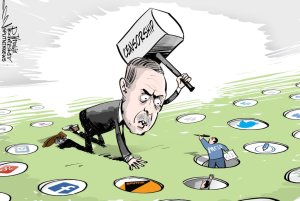
Turkey’s General Consulate in Rotterdam has called on Turkish nationals in the Netherlands to report on Ankara’s and President Erdogan’s critics, Dutch media reported.
Ankara’s office has reportedly emailed a number of Turkish organizations in the European country, urging their employees to warn the consulate of any “insulting” messages received via personal online accounts.
According to the letter shared on Twitter, it said:
“To whom it may concern,
If you or the employees working in your NGO or their relatives or the people around you received messages from people who are insulting our president, the Turkish nation or Turkey in general in to your mailboxes or social media accounts, we would kindly ask you to send the names and the quotes that they put to the mail address of our Rotterdam Consulate General.”
The campaign is “aimed against everything that’s being shared on Twitter, Facebook and even in private emails,” Dutch freelance journalist and author Frederike Geerdink told RT, adding that Ankara’s move has “immediately caused big discussion in Holland.”
“Politicians in Holland worry, they say this is what in Holland is called ‘the long arm of Ankara,’ meaning that the government in Ankara tries to get a grip on their diaspora communities” in various European countries, including Germany, Britain, Belgium, and now in the Netherlands, Geerdink said.
“They try to influence how Dutch Turks behave,” she added, saying that the European officials “will talk with the Consulate about this and express their worries.” There will be a debate on the matter in the parliament as well, the journalist told RT.
On Wednesday, the Dutch government announced its plans to scrap legislation which makes insulting a friendly head of state a criminal offense, Dutch News reported.
Following the Consulate’s call, Ankara’s consul should be called to The Hague to explain it, the Dutch news source reported, citing an MP from the country’s right-wing VNL party. “Turkey needs to be reminded of the right to freedom of speech,” Joram van Klaveren was quoted as saying.
There has been no official comment from the Turkish Consulate. When it was approached by Dutch journalists asking as of what the information the officials were aiming to receive would be used for, “the Consulate played it down saying there is not much to worry about, [as they] only want to make an inventory of what is being said in Holland,” Geerdink told RT.
End draft registration — Don’t extend it to women
Urge Congress to support H.R. 4523
- End draft registration — Don’t extend it to women.
- Abolish the Selective Service System.
- End contingency planning for a draft of health care workers.
- Restore Federal student aid for people who didn’t register for the draft.
This year, Congress is having its most serious debate about draft registration in decades — but so far, the debate has ignored the peace movement and the history of the draft, draft registration, and draft resistance.
If we don’t speak up, we will miss our best chance to put an end to preparations to reinstate the draft, and to put an end to the fantasy of military planners that the draft is always available as a fallback if the military runs short of troops. Even when the “poverty draft” and the outsourcing of war to civilian contractors obviates the need for a draft, draft registration indoctrinates young people that they have a “duty” to fight.
All male U.S. residents, regardless of citizenship or immigration status, are required to register with the Selective Service System when they turn 18, and notify Selective Service every time they change their address until their 26th birthday. Draft registration is one of the ways that all young men (and possibly soon young women as well) have to interact with the military and think about their relationship to military “service”.
The Selective Service System maintains contingency plans for a general “cannon fodder” draft of young men (based on the current list of registrants) and/or a separate Health Care Personnel Delivery System for men and women up to age 44 (based on professional licensing lists in 57 medical and related occupations). These plans could be activated at any time that Congress decides to reinstate either or both forms of a draft.
Few young men comply fully with the draft registration law. Knowing and willful refusal to comply is a crime, but nobody has been prosecuted since 1986. To convict anyone of draft resistance, the government would have to prove that they knew they were required to register. This would be difficult unless someone has told the government, or said publicly, that they are deliberately refusing to register. In practice, there is no penalty for late registration, as long as you register before your 26th birthday, and no enforcement of the address change notice requirement. Most draft notices sent to the addresses in Selective Service records would wind up in the dead letter office. Passive resistance has rendered the registration list all but useless for a draft.
Most men who register for the draft do so only if it is required for some other government program. Men who haven’t registered for the draft are ineligible for Federal student aid and some other Federal programs. In some states (although not in California), men of draft age are required to register in order to obtain a driver’s license, or are automatically registered (sometimes without even realizing it) when they get a driver’s license. Male immigrants of draft age must register before they can be naturalized as U.S. citizens.
Will women be required to register for the draft?
In 1981, the Supreme Court upheld requiring only men and not women to register for the draft. The court based its decision on “deference” to the military policy which, at that time, excluded women from combat assignments. Now that this policy has changed, it’s likely that continued registration of men but not women will be found unconstitutional. Lawsuits against male-only draft registration are already working their way through the courts; the next hearing in one of these cases will be scheduled soon in Federal court in Los Angeles.
Most members of Congress would prefer to avoid the issue of the draft. But if Congress does nothing, court rulings are likely to invalidate the current male-only draft registration law. Congress will soon have to decide whether to expand draft registration to women as well as men, or to end draft registration entirely. Now that Congress has been forced to address the issue, we have a rare opportunity to be heard — if we speak up.
This is our best chance in 20 years to put an end to plans and preparations for one or another type of draft, and to restore the eligibility of men who didn’t register for the draft for student aid, government jobs and training, naturalized citizenship, and other government programs from which they are currently excluded.
Different bills have been introduced in Congress that would extend draft registration to women, end draft registration entirely and abolish the Selective Service System, or attempt to restore the previous exclusion of women from military combat assignments and preserve male-only draft registration. By far the best of these proposals is H.R. 4523, a bipartisan bill that would end draft registration, abolish the Selective Service System, and restore the eligibility of nonregistrants for Federal student aid and all other Federal programs.
None of the leading Presidential candidates — Clinton, Sanders, or Trump — has taken a position yet on any of these bills. Any of these bills could be taken up for debate and vote at any time, possibly with little further warning. The time to contact your Representative and Senators, and the Presidential candidates, is now.
- Don’t register for the draft. Oppose both the draft and draft registration, for women or for men.
- Support resistance by young women to the expansion of draft registration to women.
- Support H.R. 4523 to end draft registration, abolish the Selective Service System, and restore eligibility for Federal student aid and other programs for men who didn’t register for the draft.
- Oppose continued contingency planning for a draft of health care workers.
- Support continued resistance to draft registration as long as it remains the law.
- Oppose any attempt to reinstate the draft or compulsory national service.
[Download this page as a one-page, two-sided printable PDF leaflet.]
Egypt’s press syndicate says “thugs” are hired to attack its members
MEMO | April 21, 2016
Egypt’s press syndicate denounced on Wednesday recent “repeated” attacks against its members while they carried out their journalistic work and called on the interior ministry to investigate the issue.
The syndicate said that attacks on journalists are carried out by “thugs” who are “protected” by security bodies in the state.
The word “thugs” is used in Egypt to describe those who violate the law. Human rights organisations have repeatedly alleged that security forces use “thugs” to disperse protests and arrest suspects. But the interior ministry denies such accusations.
The press syndicate, one of Egypt’s oldest professional syndicates, said on Wednesday in a statement that “thugs, protected by the security [apparatuses] assaulted journalists and photojournalists” outside a court building in the Cairo neighbourhood of Zeinhom on Tuesday as they covered judicial proceedings regarding 25 protesters who were arrested on Friday during the “Friday of Land” protests.
The “Friday of Land” protests were staged by activists in protest against the Egyptian government’s decision to hand over two Red Sea islands to Saudi Arabia.
The press syndicate says in its statement that “thugs” also chased away family members who gathered outside the court in solidarity with the detained protesters.
This attack “is not the first of its kind in recent times”, the press syndicate added in its statement.
Good chance spies are hoovering up your personal data in bulk, documents show
RT | April 21, 2016
British security services “routinely” collect personal data on bulk from thousands of public and private organizations, including confidential medical and financial records, newly-disclosed documents show.
The previously-confidential files, obtained by campaign group Privacy International (PI) as part of an ongoing legal case challenging the collection of bulk personal datasets (BPDs), have revealed “the staggering extent to which the intelligence agencies hoover up our data.”
In March 2015, the government first owned up to the use of BPDs by its intelligence agencies, including by MI6, MI5 and GCHQ. BPDs include call logs, internet traffic, and medical, financial and travel records of British citizens.
“It goes far beyond monitoring our text messages, email messages, and social media posts. The intelligence agencies have secretly given themselves access to potentially any and all recorded information about us,” PI explains.
“The agencies themselves admit that the majority of data collected relates to individuals who are not a threat to national security or suspected of a crime. This highly sensitive information about us is vulnerable to attack from hackers, foreign governments, and criminals,” PI’s legal officer Millie Graham Wood said in a statement.
BPDs currently account for 5 percent of all data stored by GCHQ, the files reveal.
An oversight committee reviews the storage of BPDs every six months. Since 2005, home secretaries have had to reauthorize the collection of these data sets twice a year.
Wood warned the government’s controversial Investigatory Powers Bill would codify and legitimize these practices.
“The agencies have been doing this for 15 years in secret and are now quietly trying to put these powers on the statute book for the first time, in the Investigatory Powers Bill, which is currently being debated in Parliament. These documents reveal a lack of openness and transparency with the public about these staggering powers and a failure to subject them to effective Parliamentary scrutiny.”
In a statement, the Home Office defended the use of BPDs, saying their acquisition provides “vital and unique intelligence.”
The document cache also contains guidance for intelligence officers who have access to surveillance systems. One document aimed at MI6 employees warns officers not to scour the surveillance databases “for information about other members of staff, neighbors, friends, acquaintances, family members and public figures unless it is necessary to do so as part of your official duties.”
The revelations come after a survey revealed the majority of Britons remain unconcerned about the potential ramifications of the Investigatory Powers Bill.
Of 1,600 respondents surveyed by Broadband Genie, 75 percent said they had not heard of the IP Bill. Asked if they backed the government’s plans to ramp up mass surveillance in Britain, a third said they didn’t care either way.
Mexican President Announces Move Toward Legalizing Marijuana
teleSUR | April 19, 2016
President Peña Nieto opened Tuesday´s session of the U.N. Drug Policy Summit by announcing a move towards legalizing marijuana.
Mexican President Enrique Peña Nieto started off the special session of the U.N. Drug Policy Summit by announcing a stark policy change: the need to move towards legalizing marijuana for medical and scientific purposes. Even though he had previously been a vocal opponent of drug legalization, he now has moved toward legalization.
Stating that Mexico has paid a high price for its problems with drug trafficking, he recognized the limitations of the prohibitionist paradigm. Citing the suffering, loss of life and violence as a result of this phenomenon, he said that drug trafficking is still one of the most profitable activities of organized crime in Mexico.
He further stressed the need for greater collaboration between U.N. agencies in order to address all aspects of the global drug problem. Peña Nieto also addressed the need to look at social harms related to the illicit drug market and finding solutions through alternative education and other policies that could promote social cohesion.
The president said he plans to hold an event on Thursday in order to discuss this drug policy change.
Israeli court sentences Sheikh Raed Salah to nine months in prison
MEMO | April 19, 2016
 The Israeli Supreme Court has sentenced Sheikh Raed Salah, head of the Northern Branch of the Islamic Movement, to nine months in prison over charges of “inciting violence” in a religious sermon dating back to 2007, Anadolu reported on Monday.
The Israeli District Court in Jerusalem sentenced Sheikh Salah to 11 months in prison, giving him permission to appeal to the Supreme Court, which reduced the sentence to nine months.
Deputy Head of the Islamic Movement in Israel, which was banned in November last year, Sheikh Kamal al-Khatib condemned the ruling against Sheikh Salah, describing it as “absolutely political” and aimed at keeping him far from Jerusalem and Al-Aqsa Mosque.
On 16 February 2007, Salah delivered a sermon in Wadi al-Juz in the Old City of Jerusalem. Over remarks in that sermon, the Israeli court charged him with “inciting violence” and “inciting hatred”.
In March 2014, the Magistrate Court charged Sheikh Salah with “inciting violence” over this sermon, but acquitted him of “inciting hatred” and sentenced him to eight months.
Then, the District Court called for charging him with “inciting hatred” and to sentence him to 18 to 40 months. In October 2015, it sentenced him to 11 months, giving him the permission to appeal to the Supreme Court.
Dutch Set to Deliver Second EU Bombshell Referendum Over TTIP Deal
Sputnik | April 15, 2016
A Dutch petition demanding another referendum – this time on the controversial Transatlantic Trade and Investment Partnership (TTIP) negotiations between the European Union and the United State – has gone past the 100,000 mark and is rapidly gaining support.
People in the Netherlands delivered a blow to the European Union last week in a referendum over Ukraine’s accession to the EU, which developed into a vote of confidence in the EU. On a turnout of about 33 percent, 61 percent voted against the Approval Act.
Both petitions use the Dutch system, whereby 300,000 signatures are needed to force a referendum and, although the Ukraine one was started as a joke by a satirical magazine, the TTIP vote could prove more damaging and controversial.
The TTIP negotiations are due to create the biggest trade pact in the world, between the European Union and the United States. However, the talks have been beset by controversy — not least over the massive lobbying by multinational companies and worries that they are likely to be able to sue governments for loss of trade.
Critics of the TTIP deal point to the fact the European food regulations are different from — and some say more stringent than — those in the US.
They also fear strict European environmental regulations will be flouted under the proposed deal, which critics say has been dominated by big business lobbying. Concerns have also been raised that EU regulations in every sector will be rendered powerless, because multinational companies will hold more powers under TTIP.
States Sued
Crucially, at the heart of the TTIP is a controversial proposal for an investor-state dispute settlement (ISDS) mechanism, which would allow companies to sue governments if their regulations or laws affected their profits. Thus, if a US multinational company lost profits because their product or service was banned by law for health or other reasons, they would be able to sue a government — or the EU — for loss of earnings.
Under ISDS, in April 1997 the Canadian parliament banned the import and transport of MMT, a gasoline additive, over concerns that it poses a significant public health risk. Ethyl Corporation, the additive’s manufacturer, sued the Canadian Government for US$251 million, to cover losses resulting from the “expropriation” of both its MMT production plant and its “good reputation.”
Tobacco giant Philip Morris is currently suing Uruguay and Australia over tobacco packaging and the Dutch insurance company, Achmea, is suing the Slovakia for trying to reverse health privatization.
The Dutch petitioners say:
“Large companies can sue governments in special tribunal. Europe will have to accept the often poorer American standards for consumer protection, social rights and environmental protection. Then we will see the introduction of US legislation in Europe without citizens or parliaments having any say over it.”
Mexican Federal Agents Implicated in Students’ Disappearance
teleSUR – April 14 2016
Two Mexican federal police officers allegedly participated in the disappearance of 43 Ayotzinapa students, the National Human Rights Commission said Thursday, implicating national agents in the 2014 case for the first time, Agence France-Presse reports.
Jose Larrieta Carrasco, a commission official investigating the case, said the authorities should now look into a “new route in the disappearance” of the students.
Prosecutors have already charged municipal police officers in connection with the mass abduction in the southern city of Iguala on September 26-27, 2014.
But the governmental rights commission said it found an eyewitness who saw two federal agents near Iguala’s courthouse, where municipal officers had stopped a bus carrying 15 to 20 students.
The commission also said another local police department, from the town of Huitzuco, had a previously unknown role in the disappearance.
Many in Mexico, including the families of the disappeared, suspect that the police force was ordered to kill the student protesters by high level members of a local cartel.
Turkish Delight in Washington’s Patronage
By Brian Cloughley | CounterPunch | April 15, 2016
On March 26 President Erdogan of Turkey “harshly criticized” foreign diplomats for being present at the trial of two journalists in Istanbul. At a meeting of businessmen he erupted in fury and expostulated that “The consul-generals in Istanbul attended the trial. Who are you? What business do you have there? Diplomacy has a certain propriety and manners. This is not your country. This is Turkey.”
President Erdogan had made it clear that “this is Turkey” by declaring, before the trial even began, that the accused journalists will “pay a heavy price” for reporting that his National Intelligence Agency (MİT) had been smuggling weapons to rebel groups in Syria. Naturally, there was international interest in such a judicial process and, as is usual around the world, foreign diplomats attended the hearing in order to report to their governments the facts of the case as presented in court.
But the President of Turkey informed the world that diplomats accredited to his country are not expected to be present in his country’s law courts to witness judicial proceedings. He went even further by telling foreign diplomats in Istanbul that they “can move inside the Consulate building and within the boundaries of the Consulate. But elsewhere is subject to permission.”
Mr Erdogan is telling the world that international law means nothing to him. He rejects with contempt the Vienna Convention on Diplomatic Relations which lays down that in all countries foreign diplomats are to be granted “freedom of movement and travel” provided, of course that these should be “subject to laws and regulations concerning zones, entry into which is prohibited or regulated for reasons of national security.”
Prohibited zones do not include courts of law. And the trial of the journalists, who had been in solitary confinement for half their 90-day detention, has nothing to do with national security — only national dishonesty.
Western media reporting of Mr Erdogan’s violation of international rules and values has been low-key to the point of self-induced evaporation and there has been little condemnation of his open scorn for the basic principles of diplomatic conduct — and none at all from the Consul General of the United States in Istanbul, Mr Charles F Hunter, on whose website on the day of Mr Erdogan’s abusive outburst the main headline was:
WORLD ERUPTS OVER
RUSSIA’S UNJUST SENTENCE
OF UKRAINIAN PILOT
Mr Hunter wrote that “the global community has been quick to condemn the 22-year sentence handed out by a Russian court to Ukrainian pilot and parliamentarian Nadiya Savchenko,” which was absolute nonsense, because even the western media had not given the trial much cover. Not only that, but Mr Hunter omitted to mention that Savchenko’s status as a “parliamentarian” had been granted by the Ukrainian government after the prosecution had begun. Ms Savchenko had never set foot in Ukraine’s parliament, but Wikipedia, an easily manipulated online information site, describes her as “a Ukrainian politician and former Army aviation pilot in the Ukrainian Ground Forces.”
As part of the anti-Russian propaganda campaign about Savchenko, US State Department spokesman John Kirby stated that Russia has “blatant disregard for the principles of justice,” which is an absurd declaration, coming from the nation that for fifteen years has maintained a prison camp in a colonial enclave in Cuba in which not a single wretched captive has been permitted access to the process of international law. It’s a bit much, too, coming from a nation that refuses to release the thousands of photographs that were taken of torture by its soldiers.
Some photos were published in the media, but the really horrible ones have never been seen, except by some selected Senators and Members of Congress who were sworn to secrecy.
The US Supreme Court agreed with the “the judgment of the President and the Nation’s highest-ranking military officers that disclosure of the photographs at issue here would pose a substantial risk to the lives and physical safety of United States and allied military and civilian personnel in Iraq and Afghanistan.”
Given the policy of the US Establishment — the President, the Congress and the Supreme Court — concerning the importance of concealing disgusting and potentially embarrassing facts it is not surprising that there has been no criticism in Washington of President Erdogan for his persecution of journalists who revealed embarrassing facts about his illegal action in supplying Syrian-based terrorist groups with weapons, or about his insulting diatribe concerning the presence of a US diplomat at their trial.
On March 18 the UK’s Independent newspaper reported that “the President of Turkey has said democracy and freedom have ‘absolutely no value’ in the country after calling for journalists, lawyers and politicians to be prosecuted as terrorists.” But this means nothing to the US or British governments which both support President Erdogan without demur. While at the recent (and totally useless) summit on nuclear security in Washington on March 31, five days after he insulted their country, Mr Erdogan met with both the president and vice president of the United States.
Following the meetings, the Voice of America reported that President Obama “assured his Turkish counterpart of American commitment to the security of Turkey” and “extended condolences to Erdogan for a terrorist attack earlier in the day in the Kurdish-majority south-eastern city of Diyarbakir.” And Vice President Biden “reaffirmed the close alliance between the United States and Turkey . . [and] discussed ways to further deepen our military cooperation.” So Mr Erdogan felt free to continue his anti-democratic diatribes after he returned home.
Like many national leaders who have managed to get to a rank and position whose demands vastly exceed their modest capabilities, Mr Erdogan continued to justify his erratic behaviour by abusing “those who attempt to give us lessons in democracy and human rights.” On April 4 he said that the press was free in Turkey and claimed that some publications had branded him a “thief” and a “killer” without being shut down and that “Such insults and threats are not permitted in the West.”
Then he said that Turkey’s Constitutional Court had ‘betrayed its very existence’ because it had ordered release from pre-trial custody of the two journalists who, as noted above, he had declared would “pay a heavy price” for reporting that his Intelligence operatives had been smuggling weapons to rebel groups in Syria.
Turkey is in chaos. As Human Rights Watch records, its ruler “ has demonstrated a growing intolerance of political opposition, public protest, and critical media. Government interference with the courts and prosecutors has undermined judicial independence and the rule of law.”
When they met with President Erdogan, neither President Obama nor Vice President Biden offered the mildest criticism of him for his hysterical outbursts rejecting democracy and international law.
Perhaps their advisers pointed out to them that Mr Erdogan had a reasonable point to make, in that “those who attempt to give us lessons in democracy and human rights must first contemplate their own shame.”

Activists were preventing war crimes by blockading world’s biggest arms fair – judge
RT | April 15, 2016
 Eight activists standing trial for disrupting the world’s biggest arms fair, held in London last September, have been found not guilty. The court ruled they were acting to prevent a greater crime, according to an anti-arms trade group.
In his ruling, the judge said there was clear, credible and largely unchallenged evidence of wrongdoing at Defence & Security Equipment International (DSEI), according to Campaign Against the Arms Trade (CAAT).
He said there is “compelling evidence” that arms sold at DSEI are used for repression and human rights abuses.
Ham & High reporter Rachel Roberts said the judge dismissed the argument, put forward by the Crown Prosecution Service (CPS), that a not guilty verdict will “open floodgates” to anarchy in the UK.
Instead he accepted that all eight defendants acted reasonably and proportionally to try and prevent the sale of illegal arms and war crimes, Roberts tweeted.
The ruling is a victory for anti-arms trade activists, who sought to highlight the UK’s complicity in war crimes committed by repressive regimes around the world.
The eight activists issued a statement through CAAT in which they called on the public to join the campaign to shut down DSEI.
“Over the week, we have put DSEI and the arms trade on trial and we have proven them to be illegitimate. Our only regret is that we didn’t succeed in shutting down DSEI,” they said.
“Our thoughts are with the people who suffer as a result of the arms trade and the survivors of repressive regimes, torture, war and conflict. We call on more people to join us in our efforts to shut down DSEI 2017 and take collective action to end the arms trade.”
The campaigners were arrested after blocking the road leading to the arms fair last September, preventing tanks and weaponry from entering.
The activists used the defense of necessity, insisting their actions were justified because they intended to prevent greater crimes taking place around the world.
CAAT said the trial highlighted UK complicity in war crimes in Yemen, where the British military is offering support to the Saud-led coalition waging war against Houthi rebels.
It also raised awareness about British complicity in human rights abuses in Bahrain and the slaughter of Kurdish civilians by Turkey, according to the group.
2015’s DSEI event featured stalls from more than 1,500 exhibitors, including arms giants Lockheed Martin, BAE Systems, Finmeccanica and others.
Customers included representatives from Saudi Arabia, Israel, Bahrain and Egypt.
Featured Video

The Failed Air War Over Vietnam
or go to
Aletho News Archives – Video-Images
From the Archives
USS Liberty Massacre: A Pivotal Moment in the Hostile Takeover of America
By Kevin Barrett | Crescent | Dhu al-Qa’dah 24, 1445
In corporate America, hostile takeovers are commonplace. They occur when an aggressor—a larger corporation or rich individuals—seizes control of a smaller corporation without asking permission.
What few recognize is that the United States itself has been subjected to a hostile takeover. Since the aggressor, the illegitimate settler colony known as “Israel,” is much smaller than the US, the takeover has necessarily been surreptitious.
As of June, 2024, Israel’s gradual takeover of the US has become obvious and undeniable—a proverbial “elephant in the living room.” … continue
Blog Roll
 Aletho News
- Leaders Condemn Ansarallah Attack on Saudi Arabia While Ignoring Illegal War Against Yemen
- Leaked: Britain’s Covert Iraqi Psyops Network
- Yemeni Armed Forces Warn Airlines Against Using Saudi Airports, Exempt Mecca and Medina
- Iran security chief says powers greater than US tried to conquer Iran but ended in ‘dustbin of history’
- Europe’s mounting social chaos… chickens coming home to roost for proxy war against Russia
- US-Russia Diesel Deal Becomes Massive Defeat for Ukraine
- Hormuz and the Looming Economic Catastrophe
- Dhubab offensive, media blitz and the rapid unraveling of Saudi-backed coalition’s new gambit
- Putin Conveys to Trump Iran’s Vision on Possible Conflict Resolution – Kremlin
- The Search for Truth: Charlie Kirk’s Assassination One Year Later
- If Americans Knew
- The American Conservative: Mike Huckabee Should Resign
- A C-Section in Shackles: A Palestinian Woman’s Harrowing Birth in Israeli Detention
- ‘He’s Desperate’: AIPAC Begins Spending Against Abdul El-Sayed to Boost Mike Rogers:
- Trump, Hormuz, and the Looming Economic Catastrophe
- For three years, Israel has killed a child in Gaza every 71 minutes – Daily Update
- Israeli forces kill another child in Gaza – Daily Update
- Gaza ceasefire exists in name only, say more than 100 organizations
- Nearly 2 Million in Gaza Need Urgent Shelter Assistance as Winter Looms: IOM Chief Warns
- Suppressing Palestinian resistance: US charity under fire for AI monitoring of Gaza classrooms
- Thousands Are Held in Israeli Torture Camps. This Is What Happens Inside
- No Tricks Zone
- Germany’s Green Energy Debacle: High Energy Costs Force Kahla Porzellan to Close After 182 Years!
- New Study: 50 Years Of The Most Aggressive ‘Net Zero’ Policies Can Only Affect The Global Climate By 0.03°C
- US September “Heat” Was No Record…Many Records Set Decades Ago
- Latest European Green Energy Debacle; Portugal’s Largest Flagship Solar Park Insolvent!
- Green Energy Debacle: German Expert Professor Fritz Vahrenholt Warns Of Severe Economic And Social Consequences
- Two More Paleo Reconstructions Affirm Meters-Higher Sea Levels Across Ireland, Brazil 7000-6000 Years Ago
- New Study: Earth And Venus Surface Warmth Largely Explained By Convection And Lapse Rate, Not CO2 Or Radiation
- 2025 Nature Paper Claiming Worsening Global Drought Gets RETRACTED …Heavily Flawed
- New Study: ‘Global Drought Shows No Detectable Recent Acceleration Under Climate Warming’
- Economic Masterminds: German Socialists Suggest Taxing Productivity Gains Stemming From Using AI

