Why No Congressional Investigation into Epstein’s Intelligence Connections?
By Jacob G. Hornberger | FFF | August 21, 2019
With convicted sex offender Jeffrey Epstein now dead, the Justice Department has launched an investigation into prison procedures that allowed him to commit suicide. Meanwhile, women who were sexually abused or raped by Epstein when they were minors are continuing civil actions against Epstein’s estate.
But why no congressional investigation into Epstein’s relationship, if any, to intelligence agencies, including the CIA, the Mossad, or any others? Have we gotten to the point where everyone is so scared to be labeled a “conspiracy theorist” that Congress is precluded from conducting a legitimate investigation into the CIA or other intelligence agencies?
Such an investigation would not come out of the blue. It would revolve around the undeniably sweetheart deal that the U.S. Attorney in Florida, Alexander Acosta, gave to Epstein and the reasons that he gave that sweetheart deal to him.
The plea deal enabled Acosta to escape federal charges for sex trafficking and allowed him to plead guilty at the state level to the much lesser crime of soliciting prostitution, which enabled him to serve one year in a local jail, sort of. During that year, officials permitted him to leave the jailhouse on a daily basis to attend to business matters, after which he would return to spend the night in jail.
It would be extremely difficult to find a more sweetheart deal than that. But the question is, Why? We all know how tough federal prosecutors can be. We also know that sex trafficking is not something that is ordinarily countenanced at the federal level, especially when it involves underaged girls.
So, why did Acosta do it? Why did he agree to that sweetheart deal rather than prosecute Epstein in federal court for sex trafficking?
That’s what a congressional investigation would be intended to determine. And Acosta’s sworn testimony could well lead to an answer to that question.
An article that appeared in the August 19, 2019, issue of the Daily Beast by an investigative reporter named Vicky Ward points out the reason why such a congressional investigation would be warranted:
Epstein’s name, I was told, had been raised by the Trump transition team when Alexander Acosta, the former U.S. attorney in Miami who’d infamously cut Epstein a non-prosecution plea deal back in 2007, was being interviewed for the job of labor secretary. The plea deal put a hard stop to a separate federal investigation of alleged sex crimes with minors and trafficking.
Is the Epstein case going to cause a problem [for confirmation hearings]?” Acosta had been asked. Acosta had explained, breezily, apparently, that back in the day he’d had just one meeting on the Epstein case. He’d cut the non-prosecution deal with one of Epstein’s attorneys because he had “been told” to back off, that Epstein was above his pay grade. “I was told Epstein ‘belonged to intelligence’ and to leave it alone,” he told his interviewers in the Trump transition, who evidently thought that was a sufficient answer and went ahead and hired Acosta. (The Labor Department had no comment when asked about this.)
Okay, all that is hearsay. Nonetheless, it clearly provides the basis for a congressional investigation.
All that a congressional committee has to do is subpoena Acosta and ask he if actually made that statement. If he acknowledges that he did, then he can be asked who said it to him and whether that was what motivated him to give Epstein the sweetheart deal.
Then, a subpoena could issue to the person who made that statement to Epstein. When that person arrives to testify, he could be asked about the source of his information. The investigation could then proceed accordingly.
Moreover, the director of the CIA could be summoned to testify as to whether Epstein was a CIA asset, operative, or agent. If Epstein did fall into one of those categories, it is certainly possible that the CIA director would lie about it, just as CIA Director Richard Helms lied to Congress back in the 1970s when he was asked about CIA involvement in Chilean regime-change operations. Nonetheless, he would at least know that he would be subject to a perjury indictment if it were later discovered that he had lied about Epstein’s involvement in the CIA.
Moreover, the CIA could be subpoenaed to produce all of its files and records relating to Epstein, which might indicate Epstein’s possible involvement with foreign intelligence agencies, such as the Mossad.
Why would the CIA, Mossad, or other intelligence agency have been involved with Epstein and why would an intelligence agency have gone to bat for him in a federal criminal prosecution for sex trafficking? That’s something an investigation would be intended to answer.
Of course, the press could continue investigating whether Acosta actually did make that statement and, if so, whether it was true. But the ability of the press to get to the truth is limited given its inability to force people to testify under oath and then have them prosecuted for perjury if they lie. A congressional committee could both subpoena people to testify under oath and have them indicted for perjury if they lie.
Given the possibility of corruption in the federal judiciary at the hands of the CIA or other intelligence agency, the American people are entitled to such an investigation. If sex offenders are being accorded favorable treatment in the federal criminal justice system simply because they happen to work for the CIA or some other intelligence agency, then what does that say for the entire federal criminal justice system?
If Epstein did have a relationship with the CIA or other intelligence agency, then, unfortunately, there are only two chances that Congress would initiate an investigation into the matter: slim and none. That’s because an intelligence agency that is powerful enough to corrupt the judicial branch of the federal government is sufficiently powerful to do the same to the legislative branch.
End Foreign Aid to Israel and Everyone Else
By Jacob G. Hornberger | FFF | August 20, 2019
Democratic Congresswomen Ilhan Omar and Rashida Tlaib are calling on the U.S. Congress to reevaluate U.S. foreign aid to the Israeli government. Their reason? Israel’s prime minister, Benjamin Netanyahu, denied entry into Israel for the two of them, owing to their public support of the Boycott, Divestments, and Sanctions movement, a global protest against the Israeli government’s longtime mistreatment of Palestinians.
Omar stated:
“We give Israel more than $3 [billion] in aid every year. This is predicated on them being an important ally in the region and the only democracy in the Middle East. But denying a visit to duly elected members of Congress is not consistent with being an ally, and denying millions of people freedom of movement or expression or self-determination is not consistent with being a democracy.”
Unfortunately, however, Omar and Tlaib, like the rest of their Democratic counterparts, just don’t get it. In fact, neither does their nemesis, President Trump, and his Republican cohorts. Not only should the U.S. government stop foreign aid to the Israeli regime, it should stop it for every other regime in the world.
For one thing, consider that the Trump administration is spending $1 trillion this year more than it is bringing in with taxes. The difference? He’s borrowing it, thereby adding another trillion dollars to the $22 trillion dollars in federal debt that is already hanging over American taxpayers.
In fact, just recently Trump and his Democratic cohorts in Congress struck a mutually beneficial deal in which they agree to lift the debt ceiling to permit them to saddle American taxpayers with even more debt and, even worse, agreed to extend the debt ceiling until after the presidential election so that it would not be an issue for either party.
What better place to slash spending than by ending U.S. foreign aid to every regime that is on the U.S. dole? Yet, not one single Democrat or Republican thinks on that level. They just want to use foreign aid as a way to force foreign regimes to bend to the will of the U.S. Empire.
After all, let’s face it: U.S. foreign aid has nothing to do with helping the “poor, needy, and disadvantaged” in foreign countries. Instead, it has everything to do with bribery, blackmail, and extortion. The money or military armaments (or both) is given to foreign regimes with the aim of making them dependent on U.S. foreign-aid largess, sort of like when a heroin dealer hands out free samples to prospective customers.
Then, once the regime becomes dependent on the dole, it is expected to do what the U.S. Empire wants it to do. If it refuses to do it, there is a threat of an immediate cutoff of its dole. That usually is enough to get the foreign regime in line, especially because many foreign officials use the money to line their pockets and Swiss bank accounts as well as those of their bureaucratic and military-intelligence cohorts within the regime.
A good example of this phenomenon occurred in 1990. Yemen, which was one of the Empire’s dole recipients, voted in the UN against the Empire’s request of the UN to authorize the use of military force to oust Iraqi dictator Saddam Hussein from power. U.S. Secretary of State James Baker told Yemeni officials that their vote would be the most expensive vote they had ever cast. The Empire then proceeded to cut off its foreign aid to Yemen.
If Netanyahu suddenly relented and permitted Omar and Tlaib to be allowed to enter Israel without restrictions, there is little doubt that the two congresswomen would cease calling for a reexamination of foreign aid to Israel. And even if they persisted in calling for such a reexamination, all that they would want to do is redirect the money to their favorite regimes.
The most important argument against foreign aid is the moral one. The Empire forcibly takes money from Americans — the people who have earned it — and gives it to foreign government officials, to whom it does not belong. Americans, like everyone else in the world, have the moral right to keep their own money and decide for themselves what to do with it.
Abolish foreign aid to Israel and to everyone else. It’s the morally right and fiscally responsible thing to do.
More than two thirds of Americans don’t believe Epstein died by suicide
RT | August 16, 2019
It appears most Americans don’t believe the official narrative on the death of convicted sex offender Jeffrey Epstein after a poll found that more people believe the financier died as a result of murder rather than suicide.
The curious circumstances surrounding Epstein’s reported suicide last Saturday raised more than a few eyebrows. Now, a poll from Rasmussen has found that only 29 percent of Americans believe he died by suicide in jail. That figure pales in comparison to the 42 percent of people who think that Epstein was murdered to prevent him from testifying against some of his powerful associates.*
The news attracted a huge level of interest with more than two thirds of people saying that they followed developments ‘closely’ and one quarter of people saying they followed it ‘very closely.’ Among Americans following the story ‘very closely’, 56 percent believe Epstein was murdered, Rasmussen found.
The survey was carried out in the days after Epstein’s death and it involved 1,000 respondents. It found that men were more likely than women to suspect that the disgraced financier was murdered. White respondents were also found to be less suspicious than people from minority backgrounds.
On Thursday, the Washington Post reported that Epstein’s autopsy found that the 66-year old had several broken bones in his neck including his hyoid bone. Forensic experts told the paper that breaks in the bone can occur in those who hang themselves, however, they are more common in victims of homicide by strangulation.
* (To see survey question wording, click here.)
Why does Trump need Zelensky
By Alexander Ponomarenko | August 16, 2019
On August 9, Voice of America journalist Mikhail Komadovsky asked President of the United States Donald Trump whether he plans to invite President Vladimir Zelensky to the White House and how he would advise him to communicate with Russian President Vladimir Putin to end the conflict in Eastern Ukraine.
The US President’s response was eyebrow-raising enough: “He’s going to make a deal with President Putin. And he will be invited to the White House. He is a reasonable guy. He wants to see peace in Ukraine. I think he’ll be coming very soon.”
The sensation was that a few hours earlier, United States Ambassador to Ukraine William Taylor said that a possibility of a Zelensky-Trump meeting in Warsaw and New York is only being worked out. It was clear that it was about a symbolic act, a brief meeting and a succinct conversation on the sidelines of a UN General Assembly session and arrangements timed to the 80th anniversary of the World War II outbreak.
And suddenly the American President himself says Zelensky’s visit will take place soon and pays him generous compliments. Why would he? We certainly need to take heed that Trump said not a single negative word about Russia and welcomed an early settlement. All of this sustains the hypothesis that he wants to get along with Moscow, but I do not think that this was the President’s number-one motivation. For Trump, the main thing is his re-election next year, as well as his key alleged rival, Joe Biden. And his compliments to the President of Ukraine seem to testify to his having enlisted cooperation of the new Kiev authorities in this regard.
Here it is appropriate to recall the conversation between Trump and Zelensky of July 25. The press service of the President of Ukraine reported that the US leader offered his congratulations to the former on the victory of the Servant of the People party at the parliamentary elections and expressed conviction that the new Ukrainian government proves able to quickly improve the image of Ukraine and to complete the investigation into corruption cases that hampered cooperation between Ukraine and the United States.
It is clear that the above phrase about the image and corruption cases restraining bilateral relations is a broad hint at both Kiev’s help in the 2016 struggle of the Democratic Party with Trump, which resulted in the Manafort case, and the dark Ukraine business of former US Vice President and Trump’s likely opponent Joe Biden.
But the most interesting thing is that the entire text with its transparent hints is a product of the Ukrainian President’s press service. After all, it is the only source of information in this respect, as the conversation between the two presidents has been mentioned neither on the White House website nor on Donald Trump’s Twitter. As press services traditionally provide a summary of the conversation, if both parties report on it, their messages are never identical, because each focuses on the facts considered the most fascinating to it.
In other words, it’s not just that Trump took interest in the part Hunter Biden, the son of his rival, had in the Burisma gas producing company and the role of the last Kiev administration and the Soros grant-eaters in digging up dirt while fighting against his election campaign in 2016, but that the Zelensky press service has actually voiced this. But they could have erased the hints and just report that “the US President stressed the importance of combating corruption.”
The presence of such a hint could be explained by the unsophistication of the Ukrainian President’s press service, but an explanation of this kind is out of place after Trump’s statement about his imminent meeting with Zelensky. Compliments to the President of Ukraine are a likely consequence of his willingness to help Trump in the issue key for him.
Yes, a week before the Kiev inauguration, The Washington Post reported Zelensky as afraid to be involved in the internal American conflict, as well as that he was surrounded by people who were enemies of Trump. The last phrase is an expression by attorney to the American President and former mayor of the New York City Rudolf Giuliani in justification of his planned trip to Kiev. He did not mention any names, but there could be only one person behind the transparent hint – Deputy of the eighth Verkhovna Rada convocation Serhiy Leshchenko, who was first to make a point of Manafort’s getting money from the Party of Regions. Leshchenko did really support Zelensky and attended events arranged by him, but all of this was before the inauguration.
The Zelensky team set a course for a criminal prosecution of former President Petro Poroshenko. And there is an opinion among Kiev experts that it is through the imprisonment of old team representatives that the new President will try to ensure his ratings, because succeeding here appears incomparably easier than in economy or in the Donbass region. However, with the patrons Poroshenko has in the West, the victory may be hollow. And those patrons will stand up for the ex-President even notwithstanding such skeletons in the closet as Poroshenko’s role in digging up Trump’s dirt in 2016 and the role of Yuri Lutsenko (№1 on list to the PPB in the 2014 elections), his political appointee to the post of Prosecutor General, as regards the termination of the Prosecutor’s Office’s interest in Burisma. And if probing into those “skeletons”, one can expect a favorable attitude of the White House.
But that’s not all of Zelensky’s motivation to support Trump. In exchange for such assistance one can ensure patronage in matters important. For instance, the presence of those close to Igor Kolomoyskyi in the establishment. I am primarily referring to Head of the Office of the President of Ukraine (the former Presidential Administration) Andriy Bohdan. Let me remind you that in May Giuliani hurled forth his rage upon Kolomoyskyi as a “criminal oligarch”.
However, the Ukrainian media have published leaked information that Trump refuses to meet with Zelensky while Bohdan heads the administration. But the compliments of the American President to the President of Ukraine obviously disavow such a rumor. By the way, it is quite possible that pressure on Zelensky through Kolomoyskyi has originally been a lever to persuade him to cooperate in the Biden case and other things Trump is concerned with.
Yes, getting involved in domestic political games of the United States is risky for Zelensky, because there is no guarantee that the White House will not be occupied by the Democrats in 2021. But it’s a long way off, and the situation is far from being easy under pressure coming from Washington. In addition, assistance to Trump in matters essential to him will obviously be delivered through the Ukrainian Prosecutor General’s Office, with its leadership to change after a new Rada convocation starts its work. And Zelensky will get an opportunity to say that the Prosecutor’s Office is an independent agency free from presidential interference.
Alexander Ponomarenko is a political scientist with BRICS.
Jeffrey Epstein and the Spectacle of Secrecy
By Edward Curtin | Behind the Curtain | August 15, 2019
When phrases such as “the deep state” and “conspiracy theory” become staples of both the corporate mainstream media and the alternative press, we know the realities behind these phrases have outlasted their usefulness for the ruling elites that control the United States and for their critics, each of whom uses them refutably or corrobatively. These phrases are bandied about so often that they have become hackneyed and inane.
Everything is shallow now, in our faces, and by being in our faces the truth is taking place behind our backs. The obvious can’t be true since it’s so obvious, so let us search for other explanations, and when the searchers search, let us call them “conspiracy nuts.” It is a mind game of extraordinary proportions, orchestrated by the perverted power elites that run the show and ably abetted by their partners in the corporate mass media, even some in the alternative press who mean well but are confused, or are disinformation agents in the business of sowing confusion together with their mainstream Operation Mockingbird partners. It is a spectacle of open secrecy, in which the CIA, which created the “conspiracy theory” meme to ridicule critics of the Warren Commission’s absurd explanation of the Kennedy assassination, has effectively sucked everyone into a game of to and fro in which only they win.
“When I make a word do a lot of work like that,” said Humpty Dumpty, “I always pay it extra.”
Only by stepping outside this narrative frame with its vocabulary can we begin to grasp the truth here in our Wonderland of endless illusions.
Death, sex, power, intrigue, murder, suicide – these are the staples of the penny press of the 19th century, Joseph Pulitzer’s New York World, Hearst’s New York Journal, the tabloids, today’s mass media, and the CIA. People hunger for these stories, not for the real truth that impacts their lives, but for the titillation that gives a frisson to their humdrum lives. It is why post-modern detective stories are so popular, as if never solving the crime is the point.
To say “we will never know” is the mantra of a postmodern culture created to keep people running in circles. (Note the commentaries about the Jeffrey Epstein case.) Elusive and allusive indeterminacy characterizes everything in the culture of postmodernity. Robert Pfaller, a professor at the University of Art and Industrial Design in Linz, Austria and a founding member of the Viennese psychoanalytic research group “stuzzicandenti,” put it clearly in a recent interview:
The ruling ideology since the fall of the Berlin Wall, or even earlier, is postmodernism. This is the ideological embellishment that the brutal neoliberal attack on Western societies’ welfare (that was launched in the late 1970s) required in order to attain a “human”, “liberal” and “progressive” face. This coalition between an economic policy that serves the interest of a tiny minority, and an ideology that appears to “include” everybody is what Nancy Fraser has aptly called “progressive neoliberalism”. It consists of neoliberalism, plus postmodernism as its ideological superstructure
The propagandists know this; they created it. They are psychologically astute, having hijacked many intelligent but soul-less people of the right and left to do their handiwork. Money buys souls, and the number of those who have sold theirs is numerous, including those leftists who have been bought by the CIA, as Cord Meyer, the CIA official phrased it so sexually in the 1950s: we need to “court the compatible left.” He knew that drawing leftists into the CIA’s orbit was the key to efficient propaganda. For so many of the compatible left, those making a lot of money posing as opponents of the ruling elites but taking the money of the super-rich, the JFK assassination and the truth of September 11, 2001 are inconsequential, never to be broached, as if they never happened, except as the authorities say they did. By ignoring these most in-your-face events with their eyes wide shut, a coterie of influential leftists has done the work of Orwell’s crime-stop and has effectively succeeded in situating current events in an ahistorical and therefore misleading context that abets U.S. propaganda.
The debate over whether Jeffrey Epstein committed suicide or not is a pseudo-debate meant to keep people spinning their wheels over nothing. It attracts attention and will do so for many days to come. There are even some usually astute people suggesting that he may not be dead but might have been secretly whisked off somewhere and replaced with a dead look-alike. Now who would profit from suggesting something as insane as this? The speculation runs rampant and feeds the spectacle. Whether he was allowed to kill himself or was killed makes little difference.
It’s akin to asking who pulled the trigger that killed President Kennedy. That’s a debate that was intended to go nowhere, as it has, after it became apparent that Lee Harvey Oswald surely did not kill JFK. John Kennedy’s murder in broad daylight in public view is the paradigmatic event of modern times. It is obvious to anyone that gives minimal study to the issue that it was organized and carried out by elements within the national security state, notably the CIA. Their message was meant to be unequivocal and clear: We can kill him and we can kill you; we are in full control; beware. Then they went on to kill others, including RFK and MLK. It takes little intelligence to see this obvious fact, unless you wish not to or are totally lost in the neighborhood of make-believe.
As it was with Jack Ruby killing Lee Harvey Oswald, so it is with Epstein. There will be no trial. Nothing is really hidden except the essential truth. Guess, debate, wonder, watch, read to your sad heart’s content. You will have gotten nowhere unless you step outside the frame of the reigning narrative.
A corollary example of another recent national headline grabber, the Mueller investigation, is apropos here. Douglass Valentine, expert on the CIA and author of The CIA as Organized Crime, said in a recent interview that in all the endless mass media discussions of the Mueller investigation, one obvious question was never asked: What is the CIA’s role in it all? It was never asked because the job of the corporate mass media is to work for the CIA, not to expose it as a nest of organized criminals and murderers that it is.
What is important in the Epstein case is the deep back story, a tale that goes back decades and is explored by Whitney Webb in a series of fine articles for the Mint Press. Read her articles and you will see how Epstein is just the current manifestation of the sordid history of the American marriage between various factions of the American ruling elites, whose business is sexual exploitation as a fringe benefit of being willing members of the economic and military exploitation of the world. A marriage of spies, mafia, intelligence agencies, sexual perverts, foreign governments, and American traitors who will stop at nothing to advance their interests.
It is a hard story to swallow because it destroys the fairy tale that has been constructed about American “democracy” and the decency of our leaders. Webb’s articles are not based on secret documents but on readily available information open to a diligent researcher. It’s known history that has been buried, as is most history in a country of amnesiacs and educational illiterates. The average person doesn’t have Webb’s skill or time to pull it all together, but they can read her illuminating work. Often, however, it is the will to truth that is lacking.
While Webb places the Epstein matter in an historical context, she does not “solve” the case, since there is nothing to solve. It is another story from a long litany of sex/espionage stories openly available to anyone willing to look. They tell the same story. Like many commentators, she draws many linkages to the Israeli Mossad’s long-standing connections to this criminal under and over world in the United States and throughout the world. She writes:
Ultimately, the picture painted by the evidence is not a direct tie to a single intelligence agency but a web linking key members of the Mega Group [a secretive group of Jewish billionaires, including Epstein’s patron Leslie Wexner], politicians, and officials in both the U.S. and Israel, and an organized-crime network with deep business and intelligence ties in both nations.
If anything is obvious about the Epstein case, it is that he was part of a sexual blackmail operation tied to intelligence agencies. Such blackmail has long been central to the methods of intelligence agencies worldwide and many arrows rightfully point to the Mossad.
However, while throughout Webb’s articles she draws linkages that lead to the Mossad, she only suggests CIA connections. This is similar to but milder than a point made in an article written by Philip Giraldi, a former CIA counter-terrorism specialist, Did Pedophile Jeffrey Epstein Work for Mossad? Giraldi writes that the CIA “would have no particular motive to acquire an agent like Epstein.” This makes no sense. Of course, they would. The CIA and the FBI have a long record of such activities, and to hold such a club over the heads of presidents, senators, et al to make sure they do their bidding is obviously a strong motivation.
Valentine’s point about not asking the question about the CIA’s involvement in the Mueller investigation pertains. Does Giraldi believe that the Mossad operates independently of the CIA? Or that they don’t work in tandem? His statement is very strange.
The CIA is organized crime, and if Epstein is Mossad connected, he is CIA also, which is most likely. No one like Epstein could have operated as he did for decades without being sustained and protected. Now that he is dead there will be no trial, just as there will be no mainstream media or justice department revelations about the CIA or Mossad. There will be a lot of gibberish about conspiracy theories and the open secret that is the spectacle of secrecy will roll on. There will, of course, be much sex talk and outrage. We will anxiously await the movie and the TV “exposés.” Most people will know, and pretend they don’t, that the country is ruled by gangsters who would pimp their mothers if it served their interests.
Those of us who oppose these criminals – and there are growing numbers all over the world – must avoid being sucked into the establishment narratives and the counter-narratives they spawn or create. We must refuse to get involved in pseudo-debates that are meant to lead nowhere. We must reject the language created to confuse.
If revolutionary change is to come, we must learn to tell a new story in language so beautiful, illuminating, and heart-rending that no one will listen to the lying words of child molesters, mass murderers, and those who hate and persecute truth tellers.
As John Berger said, “In storytelling everything depends on what follows what. And the truest order is seldom obvious.”
How the OPCW’s investigation of the Douma incident was nobbled
By Paul McKeigue, David Miller, Jake Mason, Piers Robinson Members of Working Group on Syria, Propaganda and Media
The creation in 2014 of a new mechanism – the “Fact-Finding Mission in Syria” (FFM) – to investigate alleged chemical attacks allowed the OPCW to bypass the procedures laid down in the Chemical Weapons Convention for investigations of alleged use, and to set its own rules for these investigations.
The roles of the Director-General and the newly appointed director of the Investigation and Identification Team (IIT) are mostly ceremonial. The effective boss of the OPCW is the Chief of Cabinet Sébastien Braha, a French diplomat, and the Principal Investigator of the IIT is Elise Coté, a Canadian diplomat. Although these individuals have obvious conflicts of interest in relation to Syria, the OPCW lacks any procedure for managing such situations.
The Technical Secretariat’s excuse for suppression of the Engineering Assessment – that evidence that the cylinders were manually placed rather than dropped from the air is “outside of the mandate and methodology of the FFM” – is fallacious and contradicts OPCW’s published reports on the Douma incident.
It was already clear from open-source evidence, as we pointed out in an earlier briefing note, that the Interim and Final Reports of the FFM on the Douma incident had been nobbled.* Our sources have now filled in some of the details of this process. Specifically:
- By mid-June 2018 there would have been ample time to draft an interim report that summarized the analysis of witness testimony, open-source images, on-site inspections and lab results. We have learned that the original draft of the interim report, which had noted inconsistencies in the evidence of a chemical attack, was revised by a process that was not transparent to FFM team members to become the published Interim Report released on 6 July 2018 that included only the laboratory results.
- After the release of the Interim Report, the investigation proceeded in secrecy with all FFM team members who had deployed to Douma excluded. It was nominally led by Sami Barrek who as FFM Team Leader had left Damascus before the on-site inspections began. These FFM team members do not know who wrote the document that was released as the “Final Report of the FFM”.
- We have learned from multiple sources that the second stage of the investigation involved consultation with Len Phillips, the previous leader of FFM Team Alpha who worked in the OPCW during this period as a self-employed consultant.
From examination of three earlier FFM reports on incidents in 2015 or 2017 where Phillips was the Team Leader, it is clear that these reports also excluded or ignored evidence that these alleged chemical attacks had been staged. Specifically:
- The FFM report on the alleged chlorine attacks in Idlib between 16 March and 20 May 2015 omitted the crucial fact, later noted by the Joint Investigative Mechanism, that the refrigerant canisters allegedly used as components of chemical munitions could not have been repurposed.
- The FFM report on the alleged sarin attack in Khan Sheikhoun on 4 April 2017 omitted the information, later noted by the Joint Investigative Mechanism which had access to the same records, that the recorded hospital admission times of at least 100 patients were too early for them to have reached hospital if they had become casualties at the time the attack was alleged to have occurred.
- The FFM investigation of the alleged chlorine attack in Ltamenah on 25 March 2017, reported on 13 June 2018, led it to discover a previously unrecorded sarin attack nearby the day before, and to prompt the White Helmets to provide, eleven months later, munition parts that tested positive for intact sarin. The report failed to explain or even comment on how intact sarin could have persisted for so long in the open.
This indicates that the suppression of the Engineering Assessment of the Douma incident was not an isolated aberration. In this context it is relevant that the opposition-linked NGOs on which the FFM has relied for evidence since 2014 have dubious provenance, and at least some of them have been set up under UK tutelage.
The credibility of the OPCW cannot be restored simply by finding some way to reverse what were purported to be the findings of the FFM on the Douma incident, but only by an independent re-examination of all its previous investigations of alleged chemical attacks in Syria, and a radical reform of its governance and procedures.
To resolve the discrepancy between the conclusions of the internal Engineering Assessment and those of the Final Report, a first step would be to make public the assessments of the external engineering experts on whom the Final Report relied. The engineering assessments were based on observations of the cylinders and measurements at the locations where they were found.
As the cylinders, tagged and sealed by the OPCW inspectors, are in the custody of the Syrian government, it is feasible to undertake an independent study to determine whether the conclusions of earlier engineering assessments can be replicated. For such a study to be credible, it would have to be undertaken by a panel independent of OPCW, in accordance with methods for reproducible research.
This is the Summary of a long work first published by Working Group on Syria, Propaganda and Media earlier this year, to read the full report click here.
*The term ‘nobbled’ is used here to describe illegal or unfair interference. The term was originally used to describe actions designed to prevent a horse from winning a race.
Guardian Attacks Epstein “Conspiracy Theories”
The mainstream narrative is shaping up – a story of suicide, neglect and tragic victims
By Kit Knightly | OffGuardian | August 14, 2019
In two different opinion pieces The Guardian has made its position on the alleged death of Jeffrey Epstein clear – he “probably” committed suicide.
The first, titled Epstein conspiracy theories are farfetched – but can you blame people?, takes the position that although “conspiracy theories” about Epstein’s apparent suicide are “understandable”, there’s no evidence to support them.
Rather, the author endorses the slowly coalescing official narrative. Namely that of complete, systemic incompetence:
The official explanation for Epstein’s death comes down to rank incompetence. And it’s probably true.
A short-sighted attitude to take, which totally ignores a cardinal rule when dealing with state agencies: They will only admit to incompetence if the truth is worse.
The author also attempts to undermine the “conspiracy theories” by pointing out that Epstein was a potential threat to important figures on both sides of the political divide:
Online, conspiracy theories now abound. Observers suggest Epstein was killed by one of the men who may have been implicated in his crimes – maybe Bill Clinton, according to the fringe right, or maybe Donald Trump, according to the fringe left.
An argument rather akin to saying “he can’t possibly have been murdered, because there were too many people who wanted him dead. There are SO MANY plausible suspects, that the only reasonable explanation is that…none of them did it.”
(Also, note the word “fringe”, a manipulative use of language designed to discredit an idea without engaging with it rationally)
However, this article – although laced through with traditional mainstream rhetoric about “conspiracy theories” – at least leaves them room to exist. The Guardian’s other Epstein piece is rather less understanding:
Epstein’s death is a victory for misogyny: it denies accusers the justice they deserve
Blares the headline (further evidence that very few people at the Guardian seem to know what “misogyny” really means), before continuing by taking aim at conspiracy theories several times in the text.
Firstly, in an almost word-for-word quote from the previous column:
Commentators on the right speculated that he had been murdered by powerful liberals; those on the left speculated that he had been murdered by powerful conservatives. These theories were not responses to evidence, of which there is little
And then later claiming conspiracy theories not only “factually wrong” (something no one can know at this stage)…
The speculations may well be factually wrong – criminal justice experts have pointed out that inmate suicides are common, and that those detained in federal jails often face startling neglect
… but also attempting to Mrs Lovejoy the public by claiming “conspiracy theories” are actually harmful:
the positing of these conspiracy theories is unhelpful, distracting from the important injustice that has been done to Epstein’s victims.
Declaring seeking the truth to be somehow unfair to the victims is a classic trope, deployed most famously against 9/11 Truthers, but common after many such incidents.
There’s also this sentence…
The conspiracy theorists also risk undermining efforts to bring Epstein’s co-conspirators to account: their suggestions that the financier was killed to cover up the rapes and assaults of powerful men who would rather he be shut up could lend suspicion to anyone pointing out the breadth of his alleged pedophilia ring, giving those who want continued investigations of men such as Dershowitz, Pritzker and Dubin the aura of a maniac in a tinfoil hat.
Which, I’ll be honest, I simply don’t understand.
I think she’s arguing that “conspiracy theorists” talking about “conspiracy theories” might discredit the very real possibility there was an actual conspiracy.
If that’s what she means – because I honestly do not understand the words – well, that’s obviously just crazy. You can’t argue we shouldn’t talk about conspiracy theories, just in case there’s a conspiracy fact.
That’s the attitude of a person so brainwashed by the idea that “conspiracy theorist = crazy person” that they can no longer think in a straight line. Total cognitive dissonance.
The articles are different in tone, but they are united in purpose, and they each hit the same three key points:
- Epstein “probably” killed himself. After all, inmates commit suicide all the time.
- Conspiracy theories might look reasonable, but they are factually incorrect and morally harmful.
- The real tragedy here is the poor victims who will go unavenged. We should all focus on that, not investigating the potential murder.
All this serves to demonstrate – for about the millionth time – the entire purpose of outrage culture and identity politics. Fear of being offensive used to control a conversation and dictate narrative: Don’t talk about Epstein being murdered, don’t even think about it. If you do, you’re a misogynist.
Kit Knightly is co-editor of OffGuardian. The Guardian banned him from commenting. Twice. He used to write for fun, but now he’s forced to out of a near-permanent sense of outrage.
Majority Leader Steny Hoyer
Israel’s man in the House of Representatives

By Philip Giraldi • Unz Review • August 13, 2019
It is astonishing that in the wake of the two mass killings in Dayton and El Paso that have been attributed both by the media and the Democrats to “racism,” a senior U.S. Congressman has led a delegation of 41 of his Democratic Party colleagues plus spouses on a week-long luxury all-expenses-paid trip to Israel, which is one of the few countries in the world that defines its full citizenship as a matter of race and religion. House Majority Leader Steny Hoyer of Maryland is, however, apparently tone deaf to some critics of the annual excursion, having made the pilgrimage to Israel more than fifteen times. “I am pleased to join so many House Democrats in traveling to Israel to reaffirm our support for a critical U.S. ally and to continue learning about the opportunities and the challenges facing Israel and the Middle East,” he said shortly before departing for Tel Aviv.
Hoyer did not mention how he had managed to pull together such a large group of co-conspirators in spite of critical issues that need to be confronted at home during recess in town hall meetings, which, due to the trip, will operate on a short schedule if at all. As Majority Leader, he is reported to be skilled at strong-arming new colleagues to compel them to make the trip to demonstrate the loyalty of the U.S. Congress and the Democratic Party to the Jewish state, which is his top priority. According to The Intercept, “Hoyer… uses his power over the House floor agenda to coerce participation. A member who refuses an invitation can find it difficult to have their bills brought to the floor for a vote. ‘His senior staff lock down cooperating members by getting their bills to the floor and punishing non-cooperators,’ said one former representative who rejected the invitation. ‘I was tortured for a decade because I refused to go on that trip…’”
Of course, the Israelis are themselves seasoned professionals when it comes to mass shooting, something that they do every Friday across the fence into Gaza, but they are unlikely to demonstrate their marksmanship to the visiting congressmen. They in any event know that Israel will never be condemned in fora like the United Nations Security Council because of the exercise of Washington’s veto. Hoyer and company are the reason that there is such a veto even though Israel is a serial war criminal and human rights violator, so in a sense he and his Democratic Party friends are the reason why the Jewish state believes itself empowered to behave so badly. And, lest anyone is worried about bipartisanship, the Republicans too have a delegation in Israel headed by House Minority leader Kevin McCarthy consisting of 31 congressmen. The 72 congressmen from both parties constitute one of the largest delegations ever to travel to to the Jewish state.
Hoyer is a bought and paid for Israeli puppet and a big part of his job is to make sure that new Congressmen and women are adequately brainwashed regarding what is going on in the Middle East. Maryland’s Democratic Party has long been dominated by Jews from Baltimore and Montgomery County and Hoyer has successfully cultivated Jewish congressmen to advance his career. He has benefited directly from $320,025 pro-Israel PAC donations to fund his reelection campaigns and has undoubtedly also received generous donations from individual Jews and from organizations not organized as PACs.
Steny Hoyer’s foreign policy votes in Congress have not surprisingly mirrored positions taken by the Israeli government. He supported the attack on Iraq and was in fact very possibly the most prominent promoter of the war among Democrats. When the war became a foreign policy disaster, he muted his approval of it but has continued to vote for funding of U.S. military involvement in both Iraq and neighboring Syria.
Hoyer’s support of Israel is unshakable and he has often appeared and spoken before the American Israel Public Affairs Committee (AIPAC) annual summit. At his most recent appearance this past spring his keynote speech included “I stand with Israel, proudly and unapologetically. So, when someone accuses American supporters of Israel of dual loyalty, I say: accuse me. I am part of a large, bipartisan coalition in Congress supporting Israel. I tell Israel’s detractors: accuse us.” Well, he got that right. He and many other congressmen do suffer from dual or even singular loyalty when it comes to Israel.
In 2007 Hoyer notably called out fellow Democrat Representative Jim Moran for stating correctly that AIPAC “has pushed (the Iraq) war from the beginning.” Hoyer called the statement “factually inaccurate,” which was not the case. He is a supporter of the Israeli illegal settlements, which up until recently was contrary to both U.S. official policy and a number of United Nations resolutions. In January 2017, he was a leading advocate of a House of Representatives resolution condemning the U.N. Security Council Resolution 2334, which called both the settlements and the continued Israeli occupation of Palestinian land as a “flagrant violation of international law and a major obstacle to peace.” Hoyer also has supported President Donald Trump’s move of the U.S. Embassy to Jerusalem, recognizing the city as the Jewish state’s capital.
Israel’s enemies are also Hoyer’s enemies whether or not they threaten the United States. He has declared that an Iran with nuclear weapons is “unacceptable” and supports the use of American military force to deter such a development, ignoring the fact that Israel already has a nuclear arsenal which President John F. Kennedy tried to prevent before he was assassinated. Hoyer also supports keeping a U.S. military presence in Syria in spite of the lack of any threat to the United States from that direction, part of an Israeli plan to divide that country into its constituent tribal and religious parts.
Hoyer’s trip is paid for by the “educational” affiliate of AIPAC called the American Israel Education Foundation (AIEF). One might reasonably ask why an organization connected to AIPAC, which describes itself on its website as having the “mission” to “… strengthen, protect and promote the U.S.-Israel relationship in ways that enhance the security of the United States and Israel,” should be able to fund the annual mass migration of congress-critters to promote Israeli interests without having to register as an agent of the Jewish state’s government? The answer is actually quite simple. Congress and the Justice Department have been so corrupted by pro-Israel money and other manifestations of Jewish power that they do not enforce the law when it comes to Israel. Steny Hoyer and venal creatures like him are a large part of why that is so.
Nevertheless, analysis provided by Josh Ruebner at Mondoweiss cites “Dr. Craig Holman, Government Affairs lobbyist for Public Citizen, who drafted the 2007 Honest Leadership and Open Government Act (HLOGA), designed to curb the influence of lobbyist money in congressional travel” as saying that it ‘… is unequivocal that the arrangement between AIEF and AIPAC ‘defies the spirit as well as the letter of the law’.” The law itself prohibits Members of Congress from accepting from any organization with income of at least $13,000 per quarter “that retains or employs 1 or more registered lobbyists… funds earmarked directly or indirectly for the purpose of financing” travel by congressmen or women for longer than one day.
According to Holman, AIPAC, which spent $700,000 in lobbying during the second quarter of 2019 alone, gets around the prohibition by having AIEF, which is a 501(c)3 educational foundation that does no lobbying, do the funding. The loophole to permit congressional junkets beyond the one day is referred to as “the AIPAC loophole,” as its intent was clearly to permit congressional paid-for-by-lobbyists travel to Israel to continue. That the arrangement is essentially fraudulent is revealed by examination of the two entities’ tax returns, which reveals that AIPAC pays the AIEF employees.
The solution to the problem remains simple. Tighten up the Congressional travel rules to eliminate the “AIPAC exemption” while at the same time requiring AIPAC and the other prominent organizations that are part of the Israel Lobby to register under the Foreign Agents Registration Act of 1938, which would open up their finances and lobbying to more intense scrutiny. But, of course, Steny Hoyer and his friends will never allow that to happen.
Philip M. Giraldi, Ph.D., is Executive Director of the Council for the National Interest, a 501(c)3 tax deductible educational foundation (Federal ID Number #52-1739023) that seeks a more interests-based U.S. foreign policy in the Middle East. Website is councilforthenationalinterest.org, address is P.O. Box 2157, Purcellville VA 20134 and its email is inform@cnionline.org.
Who Killed Jeffrey Epstein?
By Helen Buyniski | Helen of desTroy | August 14, 2019
Infamous pedophile and likely intelligence asset Jeffrey Epstein was reportedly found dead in his jail cell this past weekend. An autopsy has allegedly been done, but its results are “pending,” leaving the curious with only the initial reports claiming he hanged himself and was pronounced dead of cardiac arrest in the hospital shortly thereafter. The 72 hours following his death have done little to clear up the matter of what actually occurred in Epstein’s cell on Saturday morning, though law enforcement sources on Monday told the New York Post he had hung himself with a bedsheet from the bunkbed frame in his cell – no mean feat for a six-foot, 200-pound man supposedly being checked on by guards twice an hour, and a physical impossibility owing to the paper-thin sheets, according to a former inmate of that prison.
What we do know is that he was officially alone in his cell when he died, having been taken off suicide watch at his lawyers’ urging less than a week after he was found unconscious with marks on his neck last month. Epstein reportedly claimed someone tried to kill him during that incident, though others speculated he had “choked” himself in order to convince a judge to allow him bail or secure a transfer to a nicer facility. Did “someone” come back to finish the job, merely paying the guards to look the other way? An assassin would have had to spread his money around handsomely – like most areas of Manhattan, the Metropolitan Correctional Center where Epstein was confined is heavily surveilled – but that’s not difficult for the caliber of person who had reasons to want Epstein dead. So who killed him?
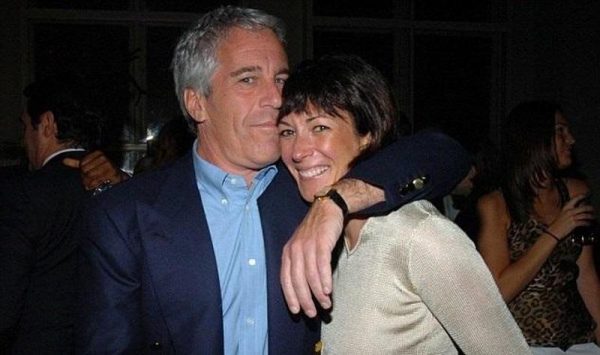
The convicted sex offender had blackmail material on dozens if not hundreds of powerful people. Epstein’s homes and aircraft were monitored with cameras and microphones, and his private island was completely wired for video, according to a friend of his alleged procuress, Ghislaine Maxwell. Safes found on his property contained piles of video discs marked young (name of girl) + (name of VIP) – alongside the diamonds, piles of cash and Saudi passport. Virginia Roberts Giuffre, one of his victims, says she was “debriefed” after sex sessions with Epstein’s famous friends, supplying him with the intimate details of their encounters in order to potentially weaponize the information. Even New York Times columnist James Stewart reports Epstein boasted to him about the trove of “potentially damaging or embarrassing” information he had on the “supposed sexual proclivities and recreational drug use” of the rich and famous. Epstein had mountains of dirt on presidents, princes, prime minsters, and lesser politicians. Any one of these (and probably more than one of these) could have taken out a contract on him, concerned that he might give away their little secret. If Epstein was not an intelligence asset, with connections high up in the Israeli and US governments, he would have been disposed of long ago, but it’s possible that one of the reasons he was not “suicided” earlier is because those who did want him dead had clashed with another faction concerned he had a “dead man’s switch” that would release even more incriminating material to the press.

Comparisons to the JFK assassination are apt. While Epstein was even more loathed by the American public than Kennedy was beloved, he had as many powerful enemies, and those speculating about his murder are already being smeared as irresponsible conspiracy theorists for demanding answers on the year’s most unlikely “suicide.” When the forces of the media establishment are so quickly marshaled against any attempts at investigating a full-of-holes “official story,” even declaring that such malignant conspiracy-mongering “hurts kids” (Epstein’s own child-trafficking apparently pales in comparison), it’s safe to assume that official story is a pack of lies. So without further ado, let the (responsible, well-sourced) speculation begin. Coincidence theorists need not apply.
SUSPECTS
As soon as Epstein’s death was announced, the hashtag #ClintonBodyCount started trending on Twitter along with #Arkancide and other names for the phenomenon that has seen dozens of Clinton enemies, witnesses, and other liabilities die under mysterious circumstances since the early days of the former president’s political career. As a frequent flyer on the Lolita Express (26 times, according to flight logs, at least five of those without his Secret Service retinue), Bill Clinton had good reason to be concerned about Epstein’s continued existence. Certainly, the couple were an early favorite for Epstein’s killer – even Donald Trump retweeted a Clinton Body Count meme.
However, Epstein is currently under investigation for sex trafficking. In court documents unsealed earlier this week from Giuffre’s lawsuit against alleged madam Ghislaine Maxwell, Giuffre testifies that Clinton was not involved in the actual trafficking of girls – though there seems to be little doubt he enjoyed the fruits of Epstein’s evil deeds. Epstein even had a hand in the founding of the Clinton Global Initiative, according to his lawyers. That Clinton has been accused of rape by too many women to count and is known for being unable to keep it in his pants is not exactly a secret, in Washington or anywhere else, but he is unlikely to be placed at legal risk by the current Epstein probe. Unless Epstein had dirt on Hillary as well – who is rumored to be plotting a move to insinuate herself back into national politics, most likely through her daughter – the family accomplishes little by icing Epstein except calling more attention to the #ClintonBodyCount. One guerrilla commentator even chalked “XOXO Hillary + Bill” on the sidewalk outside Epstein’s New York home.

The FBI immediately declared a probe into the suspicious circumstances surrounding Epstein’s death. Regardless of whether this makes them dangerous domestic extremists by their own reasoning – since any foul play would have had to be accomplished through conspiring with the guards to sneak into the jail and do away with the pedophile, and the FBI has unilaterally declared ‘conspiracy theorists’ to be dangerous extremists in need of heavy surveillance – the FBI’s interest does not rule out a US intelligence role in his murder. As 9/11 proved, the government’s right hand rarely knows what the left is doing even within a single agency, let alone where rival agencies are concerned. And Attorney General William Barr, the former CIA general counsel who specialized in helping intelligence assets caught with their hands in the cookie jar get off scot-free, has already made it clear he is treating the death as a terrible miscarriage of justice by the prison, one which might even prove financially remunerative for Epstein’s relatives (he has a brother).
When former Florida prosecutor Alex Acosta was asked why he OK’d the appalling 2007 non-prosecution agreement with Epstein’s lawyers which saw the wealthy sex fiend spend just 13 months on work-release in a Palm Beach jail after pleading guilty to a lesser charge of soliciting underage prostitutes despite a 53-page federal indictment including 36 alleged victims hanging over his head, Acosta told the Trump transition team he was ordered to leave Epstein alone because “he belonged to intelligence.” That was sufficient reason for the Trump team to give him the green light for appointment as Secretary of Labor. While Epstein provided information to the FBI in 2008, according to their own documentation, individuals involved with the case who spoke to the Palm Beach Post don’t recall any cooperation.
“The Palm Beach State Attorney’s Office was willing to let Epstein walk free. No jail time. Nothing,” Acosta claimed by way of explanation during a press conference last month after he was forced to resign as Labor Secretary for his (mis)handling of the 2007 case. He insisted the sweetheart deal the wealthy pedophile’s lawyers crafted was the lesser of two evils – that a slap on the wrist was better than nothing. And Palm Beach police told the Miami Herald they were hounded, harassed, and otherwise pressured in the service of getting Epstein’s case downgraded to a misdemeanor during the original 2007 investigation, with State Attorney Barry Krischer ultimately ignoring their recommendation to prosecute Epstein on high level child sex charges.
In the days preceding Epstein’s death, Florida governor Ron DeSantis ordered the state to take over a probe into Epstein’s non-prosecution deal and the terms of his work release, an investigation that would presumably lead to the Palm Beach State Attorney’s office, which was conspicuously handed to Fort Pierce State Attorney Bruce Colton. While Krischer is no longer in that position – in a nauseating irony, he trains law enforcement in prosecuting crimes of sexual violence and oversees placement of children in foster care – his apparent collusion with Epstein’s attorneys will likely come to light, as well as the forces higher up that dictated the terms of the plea deal. Whatever US “intelligence” shared Epstein with the Mossad could have been motivated to take him out to prevent him from talking. While DeSantis – who has promised to be the most pro-Israel governor in the country – would likely pull the plug on that investigation before it got out of hand, the Justice Department opened its own investigation in February into whether prosecutors committed professional misconduct during the 2007 case. If Trump were to lose the 2020 election, Barr – the man who arguably saved the CIA from much-deserved extinction and an expert memory-holer of inconvenient inquiries – would be powerless to fix any federal probe, replaced by a Democratic appointee.
And what of Trump himself? For every three “ClintonBodyCount” hashtags, there was a “TrumpBodyCount” hashtag (which isn’t a thing, but don’t tell the #Resistance), insisting Trump was up to his neck in trafficked children and had good reason to ice the molest-happy millionaire. This is as doubtful as the Clinton hypothesis. If Epstein is being wielded as a weapon by Netanyahu against Barak, Netanyahu would not kill the golden goose that is Trump, who has obeyed his foreign policy dictates magnificently. And the documents unsealed from Virginia Roberts Giuffre’s lawsuit suggest that Trump did not physically engage with Epstein’s retinue of underage sex slaves. The president’s reported germ phobia is somewhat incompatible with girls who were being passed around from blackmail target to blackmail target like party favors, and he allegedly had Epstein booted from Mar-a-Lago for sexually assaulting a girl, suggesting that despite the chummy pictures of Epstein and Trump that surface on googling “Jeffrey Epstein Bill Clinton” (!), the real estate magnate realized early on that Epstein was a honeypot and kept his distance. Trump was mentored by Roy Cohn, whose own record as a blackmailer is legendary; if he wasn’t involved in the Epstein ring himself, he certainly would have recognized its nature early on.
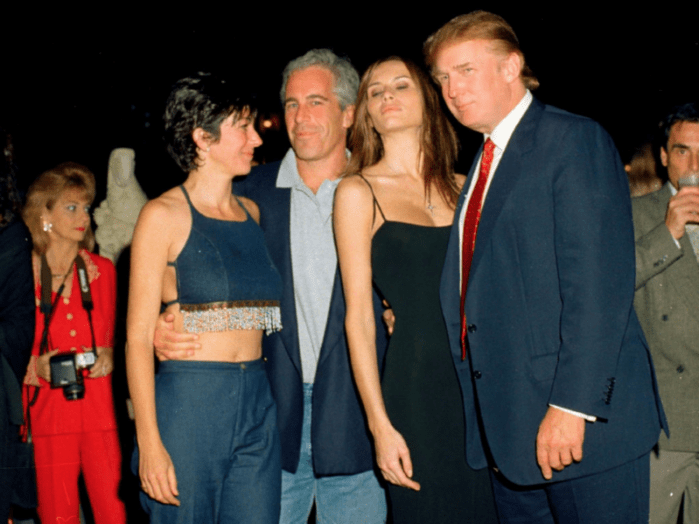
Epstein is extremely well-connected to the Israeli intelligence apparatus, and these are people with both means and motive to remove him from the chessboard. Former Israeli PM Ehud Barak has been photographed entering and exiting Epstein’s East 71st St residence in Manhattan, hiding under a jumble of hats and scarves, and has admitted to visiting the pedophile’s private island, though insists he never went to parties or met girls with Epstein despite photographic evidence to the contrary. Barak and Epstein have been friends for over a decade, the Israeli having been introduced to the wealthy sex offender by his fellow former PM Shimon Peres. Barak has thrown his hat into the ring to challenge Bibi Netanyahu, Israel’s longest-serving leader, who has made it clear he considers the PM post to be his by divine right and won’t give it up easily. Speculation has swirled that the reopening of the Epstein case is tied to the battle of the Israeli titans – that Netanyahu is sacrificing a Mossad asset to destroy his rival.
Barak, then, has plenty of reasons to want Epstein out of the way. Having formed a company with the mysterious financier as a vehicle to invest in Carbyne911, a company founded by high-level veterans of Israeli intelligence that allows a remote operator to surveil a person not only through the target’s own phone but also through all the internet-connected devices around them, Barak has put other dubious financial dealings at risk of coming under the Epstein probe’s microscope. Worse, Carbyne911 – which its opportunistic owners have marketed as the solution to mass shootings – has been exposed as a horrifying surveillance tool. Similar software has already been weaponized by the Chinese government to spy on its citizens, and Carbyne’s advisory board includes former Homeland Security Michael Chertoff, the Patriot Act co-author who reliably surfaces on the boards of every Orwellian initiative from the Atlantic Council to CyberDome to NewsGuard, ready to leverage his unique blend of experience and sociopathy to strip Americans of their privacy and civil liberties. Peter Thiel, the PayPal co-founder whose company Palantir openly “uses war on terror tools to track American citizens” on behalf of anyone with the funds to pay for their own private intelligence agency, is also an investor in Carbyne911. The idea that a company run by Israeli intelligence, advised and funded by a who’s-who of police-state cheerleaders, that sells a powerful surveillance tool isn’t using it to spy on Americans is too absurd to seriously consider, and such a program is too valuable to be sacrificed merely because Epstein’s stink suffuses it (and it does suffuse it – he and Barak are the company’s largest investors, and most of Barak’s stake was in fact put up by Epstein).
The electoral face-off between Barak and Netanyahu is scheduled for next month, by which time the frenzy over the Epstein case will have ebbed significantly, especially with no defendant as the focus of click-driving salacious speculation. While Netanyahu has demanded an investigation of his rival, it’s not clear that Barak did anything financially illegal in accepting millions of dollars of Epstein’s money. Investigators may still pursue other loose ends – that Maxwell has remained unindicted for so long beggars belief, for example, and victims’ lawyers have promised to go after Epstein’s “enablers” – but the sensationalistic coverage from mainstream news will peter out absent a body in the courtroom. Barak can thus get back to the business of attacking Netanyahu, who is currently facing indictment in multiple corruption probes, and potentially wresting Israel from his grasp. He has much to gain from snuffing Epstein and little to lose – unless Epstein’s dead man’s switch would unleash enough compromising material to end his political career for good. Certainly, Barak has a bad track record of associating with sexual predators – his president, Moshe Katsav, spent five years in prison on rape charges, and the vice-consul to Brazil during his tenure, Arie Scher, fled to Israel to avoid prosecution on child pornography charges.

WHAT DIDN’T HAPPEN
The only certainty is that Epstein did not “commit suicide” without significant outside help. He had been taken off suicide watch less than a week after the previous month’s “suicide attempt,” contrary to standard procedure, which would require authorization (and documentation thereof). One source told the New York Post the suspicious marks discovered on his neck after he was found unconscious curled up in his cell last month appeared more like evidence he had been choked than evidence that he had attempted to hang himself, but his beefy ex-cop cellmate, an accused quadruple-murderer charged with shooting and then burying four men in his backyard after a coke deal gone wrong, insisted he had not only not harmed his notorious roommate and not heard anything, but that he had saved Epstein’s life by discovering him unconscious and alerting a guard. How this happened if they shared a cell is unclear, and Tartaglione’s lawyer has only said they shared the unit – two other sources told NBC they shared the same cell. Epstein spent just six days on suicide watch, receiving daily psychiatric examinations, according to a law enforcement source who spoke to the New York Times. Thanks in part to the strenuous lobbying of his defense attorneys, whom he met with for up to 12 hours a day while under suicide watch, Epstein was soon moved back to his protective housing unit with a new cellmate where he was supposed to be checked every 30 minutes by guards instead – a procedure which was not followed the night of his alleged death – and that cellmate was mysteriously transferred just hours before the “suicide,” according to a source who spoke to Fox News.
Despite rumors of a “camera malfunction” that surfaced immediately following the announcement of Epstein’s death – traced back to a “social media entrepreneur” specializing in “information warfare” whose clients include American politicians – a corrections union representative has confirmed there were no cameras inside the individual cells in Epstein’s unit, creating perfect conditions for whatever happened the morning of August 10th. A former Brooklyn jail warden has confirmed that for Epstein to “commit suicide,” a cascade of errors would have been necessary – starting with removing him from suicide watch. While the officers staffing MCC are supposedly the cream of the crop, at least one of the officers tasked with watching Epstein was not “a regular guard,” according to corrections union head Serene Gregg. Epstein’s ‘guards,’ both working overtime, falsified records of the half-hour checks they had failed to conduct, an anonymous source told the AP – because they were asleep, the New York Times added. Those two at the very least would have to be paid off for any operation to go smoothly, and any investigation interested in finding out – as opposed to covering up – what really happened to Epstein should interview and monitor all of those working on the unit for financial changes, especially the guards who would normally have been working that night but opted not to, allowing the drowsy duo to step in and claim their overtime. Those two have reportedly been placed on administrative leave as of Tuesday, while the presiding warden has been reassigned to Philadelphia.
Epstein’s suspicious demise has several parallels with the “suicide” of Maxwell’s father, British newspaper baron (and Israeli spy) Robert Maxwell. Despite years of valuable service to the Mossad, Maxwell died after falling off his boat, allegedly committing suicide, as his newspaper empire was collapsing, and after attempting to pressure his Mossad connections to bail him out of the financial hole he’d dug himself into. Two of Maxwell’s biographers claim he was killed, three months after demanding the bailout and threatening to expose certain Mossad operations if he didn’t get it, because he simply became too much trouble; ex-Mossad agent Victor Ostrovsky has explained how this was accomplished. The dead man was then feted with a star-studded funeral in Israel, attended by six Israeli intelligence chiefs and complete with eulogies by then-PM Yitzhak Shamir boasting he had “done more for Israel than can today be said,” and future PMs Ehud Olmert and Shimon Peres, who also praised his “services” for Israel. Those “services” included peddling an Israeli-backdoored version of the software program Promis to government agencies, a Trojan horse purporting to improve government efficiency which instead funneled information on government activities back to Tel Aviv – a 1980s equivalent of Carbyne911.
EPSTEIN IS DEAD; LONG LIVE EPSTEIN?
The possibility exists that Epstein isn’t actually dead. A 4chan post purporting to be from an MCC employee, posted before news of Epstein’s alleged demise was made public, claims the disgraced financier was taken to the jail’s medical unit just hours before his alleged suicide and points to a suspicious van coming and going, undocumented per the prison’s usual procedures, at the same time as his potential route of escape. Comparisons of “Epstein”’s corpse to images of the living Epstein appear to show completely different ears, a unique and difficult-to-fake body part. Others have questioned why there was a photographer on hand to snap photos of the body leaving the prison in the first place and pointed out the article accompanying the photo referred to a “body believed to be Epstein’s.” Epstein’s brother allegedly identified his body, but if there was a plot, he’d be in on it, ready to milk the jail for millions in a wrongful death suit – a possibility Barr seems to be setting in motion by attacking MCC for “failing to adequately secure” their famous charge. The “celebrity pathologist” who observed the autopsy on behalf of Epstein’s lawyers also “helped investigate” the assassinations of JFK and Martin Luther King, Jr. There is no smoking gun, but there is an Epstein-sized plausible-deniability gap to slip through.
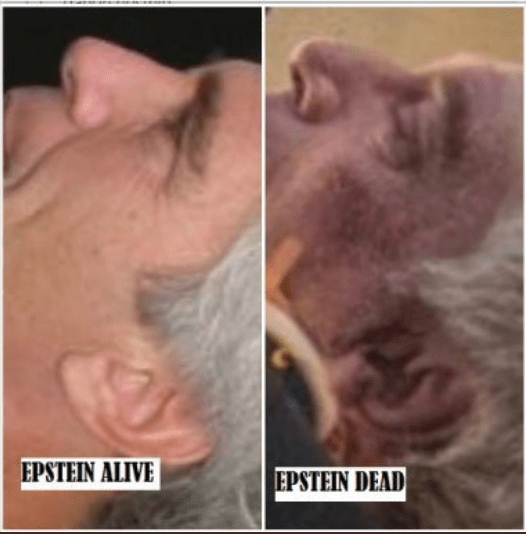
What would be the purpose of keeping Epstein alive? He’s too high-profile to use as an asset any further, and could be a liability if he becomes resentful for having lost his privileged position as the Mega Group’s #1 Honeypot and being left to rot in jail – a particularly nasty jail, at that (“Guantanamo was nicer,” said an inmate who’d stayed in both). But any good blackmailer worth his salt has a dead-man’s switch with reams of sensitive material ready to go in event of death or accident. Epstein hasn’t actually betrayed his intelligence backers, at least not publicly – though he has been disavowed by everyone from Trump to Clinton to Barak, even to his one-time mentor, Les Wexner, who after setting Epstein up with his Manhattan den of iniquity now claims the disgraced “money manager” for whom he has been the sole client since 1987 ripped him off. Even Alan “I kept my underwear on” Dershowitz has backed away from the radioactive pedophile. Epstein, on the surface, has no friends left. Yet he appears to have had advance knowledge of his own arrest, selling the evidence-laden “Lolita Express” jet just a few weeks before he was apprehended at Teterboro Airport. Why did he conveniently fly home to do the time the public so desperately wanted him to do – a situation that could have been avoided if he wasn’t certain of having an escape route? Epstein was said to be in unusually good spirits before he “suicided.”
But according to Ostrovsky, Robert Maxwell went to his death believing he’d get what he wanted, as well. And if Epstein was the raging sex addict his victims say – one girl claimed he told her he required three orgasms a day, that it was biological “like eating,” while another confirmed that even if she brought him new girls “at breakfast, lunch, and dinner… it was never enough” – keeping him alive, even with a new face in a new country, would be highly risky. Meanwhile, Ghislaine Maxwell has reportedly vanished, suggesting she’s either worried about her “loose end” status making her a target for whoever killed Epstein or she’s concerned Epstein’s victims will finally have their revenge on her in the courtroom. Certainly, the media are turning against her, and with prosecutors vowing to go after Epstein’s “enablers,” she’s number one on the list. Will justice prevail? Has it ever?
US inks deal to purchase Iron Dome missile systems from Israel
Press TV – August 13, 2019
The US army has formally signed a contract to purchase two Iron Dome missile systems from Israel, according to a report.
America’s military magazine, Defense News, said in a report on Tuesday that the US Defense Department had finalized a deal to buy two batteries of the Israeli-made Iron Dome missile system for its interim cruise missile defense capability.
The report said the contract was signed in the last few weeks and that Israel and the US are currently in talks on transferring the systems to America.
“Now that the contract is set in stone, the Army will be able to figure out delivery schedules and details in terms of taking receipt of the systems,” the military magazine said.
Defense News added that the Israeli-made Iron Dome is meant as an interim missile defense solution for the US but it could turn into a permanent one depending on its performance in the field.
The purchase deal, initially announced earlier in the year, has been hailed as historic, marking the first time Israel has sold a standalone weapons system to Washington.
“A great achievement for Israel, this is yet another expression of the strengthening of our strong alliance with the US,” Israeli Prime Minister Benjamin Netanyahu said in February.
The Iron Dome has been co-developed by American company Raytheon and Israeli defense firm Rafael. It is partly manufactured in the United States.
The Iron Dome is claimed to be capable of detecting, assessing and intercepting a variety of shorter-range targets such as rockets, artillery and mortars.
The system was originally developed to counter small rockets that Hamas and other Palestinian resistance groups fired into Israeli occupied territories in retaliation for the regime’s crimes against Palestinians.
The Iron Dome has proven largely ineffective in serving that purpose.
A Few Thoughts on Jeffrey Epstein’s ‘Suicide’
By Michael Krieger | LIBERTY BLITZKRIEG | August 12, 2019
You know things are getting really weird when news of Jeffrey Epstein’s death in a New York City prison operated by the U.S. Department of Justice is the least surprising part of the whole story. Countless people, including myself, assumed this exact sort of thing would happen. Then, just like that, he’s gone.
I continue to think the players involved with Epstein in what appears to have been an intelligence-linked blackmail operation, as well as those at risk of being exposed in more detail, are simply too powerful and connected to the institutions that run this country (and others) for us to ever get real answers. It’s cynical and depressing, but based on what I’ve seen over the past couple of decades, it’s the most likely outcome.
Rule of law in America? Don’t be ridiculous. There are rulers and the ruled. Which bucket do you think you’re in?
But there’s some good that can come from this. One reason the American public is so passive relates to the fact many people live in a state of willful denial. To admit your country runs more like the Corleone family than some famed tome of Greek political-philosophy is a difficult step to take. To admit this means you’re either going to cower in a corner and hope to stay safe, or you’re going to do something about it. Many people still don’t want to do anything about it, so they continue to exist in a comfortable mental and emotional narrative of what they want to believe the U.S. is, as opposed to reality.
Although I harbor no illusions about justice being done in the Epstein case, there’s something each and every one of us can do. We can call this charade out for what it clearly is. The whole thing’s a giant middle finger squarely in the face of every single person on earth and should be treated as such. Never forget what happened here. Ever. And keep digging.
Take ownership of your mental faculties and show some courage. There are many, many questions to be asked at the moment and we should all start asking them. I’ll start.
Where the heck is Ghislaine Maxwell? You know, the woman Jeffrey Epstein referred to as his “best friend” and who’s accused of acting as his madam in this whole sordid affair. She seems to have disappeared off the face of the earth and very few people seem interested.
This should be the top question right now – Where is Ghislaine Maxwell (and why isn’t she in custody)?
As reported by CBS News:
London — The death of Jeffrey Epstein is putting new attention on his alleged co-conspirators, who could still face charges. The number one person on that list is Ghislaine Maxwell, who’s accused of finding teenage girls for Epstein and his friends — including a member of Britain’s royal family.
As CBS News correspondent Holly Williams reports, documents unsealed on Friday contain allegations that Maxwell, a close acquaintance of Epstein’s, played an “important role” in the late billionaire financier’s “sexual abuse ring,”directing an underage girl to have sex with Epstein and others. Maxwell strenuously denies the allegations. Her current whereabouts are unknown.
Strange, sure, but it gets even more bizarre once you understand who her late father, Robert Maxwell, was. There’s even a book written about him.
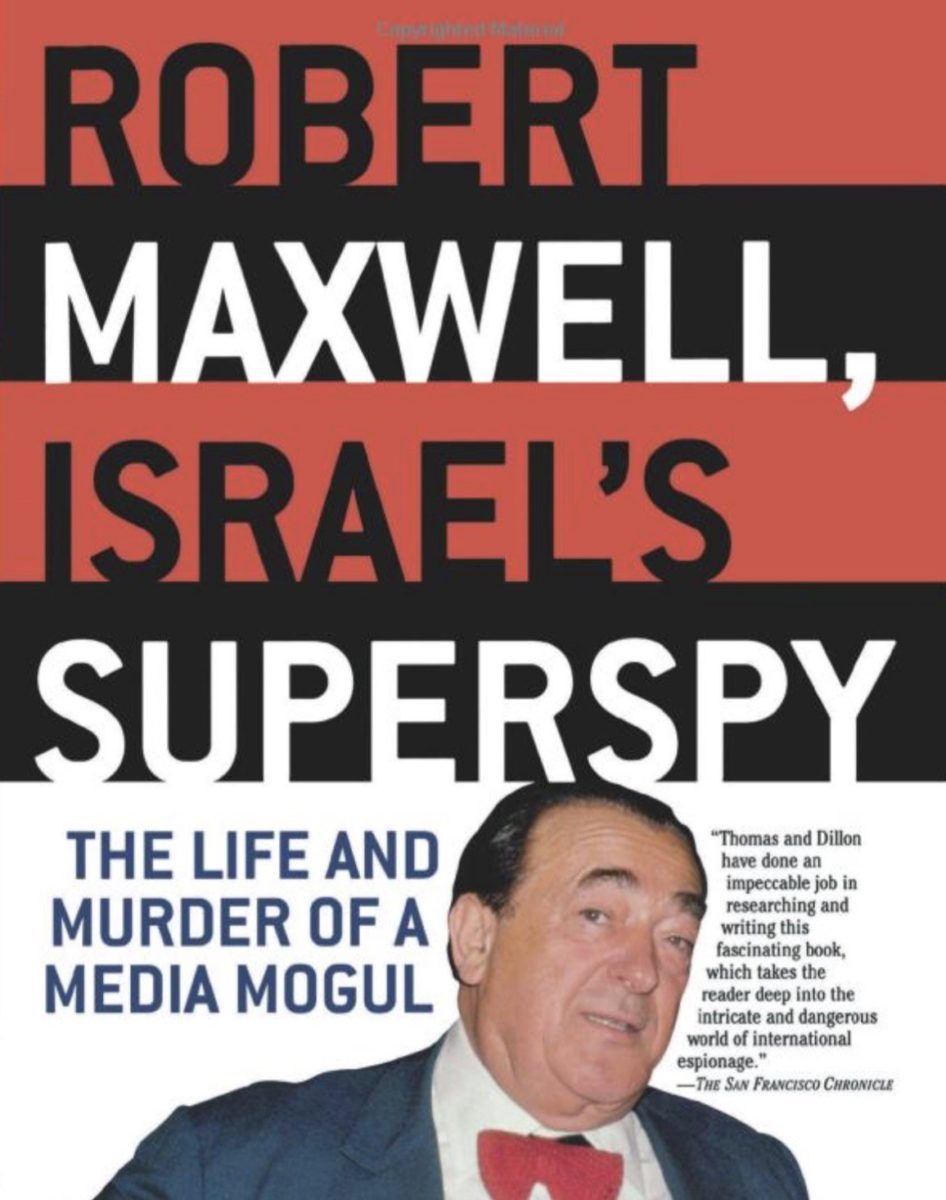
No, not strange at all. Totally normal, nothing to see here.
And what about Leslie Wexner, the billionaire who was Epstein’s only known client for all those years? Why isn’t he under far more scrutiny? We still have no idea how Epstein came into all his money, and while we may never get any real answers to these questions, they should be asked nonetheless. It’s imperative we don’t bury our heads in the sand when it comes to this story.
Ask intelligent questions, keep digging and never forget what happened and how outrageous and unacceptable it truly is.
Finally, I’ve continued to add to my giant Epstein Twitter thread, which is now over 80 tweets long. Check it out again if you haven’t lately.
Jeffrey Epstein Dies Along With The Secrets He Held
Fault Lines Radio | August 12, 2019
Featured Video

Trita Parsi: Middle East Unraveling — Are We on the Path to World War?
or go to
Aletho News Archives – Video-Images
From the Archives
Trans agenda is ‘normalization of sadism’ – US author

RT | September 23, 2026
The US Democratic Party has embraced a transgender agenda that amounts to “the normalization of sadism,” author A.J. Rice has said, warning that radical trans policies would return if the party is allowed to regain power.
Speaking to RT’s America First host Scotty Nell Hughes about his new book, ‘The Curse of the Bearded Lady: How the Trans Mafia Whacked American Sanity’, Rice argued that activists have gained significant influence in schools, medicine, and corporate America while people who questioned the agenda have faced pressure to stay silent.
The author described the “trans mafia” as the sprawling network of people and institutions that have helped the movement gain influence. He singled out parts of academia, wealthy backers, and corporations, and stated that providers of transition-related treatment also have a financial incentive to keep young people in their care indefinitely.
Rice argued that the consequences of these policies ultimately fall on children who are being drawn toward gender-affirming medical treatments and on girls who are expected to share locker rooms or compete in sports with biological males.
He noted that while voters rejected the Democrats’ approach to gender in 2024, the party, which has been “captured by madness,” has since only doubled down and is seeking what is effectively “the normalization of sadism.” … Full article
Blog Roll
 Aletho News
- Mahan Air Flight Lands in China Despite US Threat against Iranian Airlines
- US eyes $10bn fund to rebuild war-battered Gulf infrastructure
- Trump meets Rodríguez near Maduro’s prison as Venezuela’s oil flows to US
- Trita Parsi: Middle East Unraveling — Are We on the Path to World War?
- Iran FM meets with US envoy on UN meeting’s sidelines at American side’s insistence: Report
- Qatar PM calls for Gulf security framework with Iran, says war must be ‘wake-up call’
- China condemns US extortion of Iranian airlines, rejects Washington’s ‘illegal’ sanctions threats
- Italy to move military personnel from Taif base after missile strike
- Finland’s Stubb tells European leaders to calm down
- Defeating Russia on battlefield impossible – Fico
- If Americans Knew
- Sanctions are collective punishment: immoral and self-defeating
- Phosphorus Munitions Fired by Israel Burn Groves, Orchards in Southern Lebanon
- Israel Carries Out New Ceasefire Violations Across Gaza
- AI – Emphasis on the ‘I’: Israel Is Funding AI Chatbot Propaganda
- Israel Blocking Hundreds of Wheelchairs for Injured Children From Entering Gaza
- Israel Is Expanding and Upgrading Compounds for Palestinian Militias in Gaza
- The Palestinian-American Residents of This West Bank Town Are Wondering: Where Is Trump?
- Gaza desperately needs tents, wheelchairs, fuel… and everything else (Israel blocks it all) – Daily Update
- Israeli Attacks in Gaza Kill at Least Seven Palestinians Over Three Days, including Woman and Child
- Trump’s militarization of Washington DC as he pursues Israel’s war against Iran
- No Tricks Zone
- New Study: Earth And Venus Surface Warmth Largely Explained By Convection And Lapse Rate, Not CO2 Or Radiation
- 2025 Nature Paper Claiming Worsening Global Drought Gets RETRACTED …Heavily Flawed
- New Study: ‘Global Drought Shows No Detectable Recent Acceleration Under Climate Warming’
- Economic Masterminds: German Socialists Suggest Taxing Productivity Gains Stemming From Using AI
- The South China Sea Has Not Been Cooperating With The Climate Change Narrative
- Energy Crisis: Germany Enters Heating Season With Historically Low Gas Reserve Fill Levels
- New Study: The Antarctic Ice Sheet Gained Mass From 2020-2024 Due To Staggering Snow And Ice Accumulation
- Study: Ocean Heating Rates From Thousands Of Years Ago ‘Dwarf’ Modern Ocean Heating Rates
- Climate Extremists Target, Attack Large-Scale Power Grid Infrastructure In Germany!
- New Study: Antarctic Ice Melt Has Contributed Less Than 1 Centimeter To Sea Level Rise In The Last 30 Years

