Sneering at “Conspiracy Theories” is a Lazy Substitute for Seeking the Truth
By Thomas L. Knapp – Garrison Center – August 12, 2019
On the morning of August 10, a wealthy sex crimes defendant was reportedly found dead in his cell at New York’s Metropolitan Correctional Center.
“New York City’s chief medical examiner,” the New York Times reported on August 11, “is confident Jeffrey Epstein died by hanging himself in the jail cell where he was being held without bail on sex-trafficking charges, but is awaiting more information before releasing her determination …”
That same day, the Times published an op-ed by Charlie Warzel complaining that “[e]ven on an internet bursting at the seams with conspiracy theories and hyperpartisanship, Saturday marked a new chapter in our post-truth, ‘choose your own reality’ crisis story.”
After three years of continuously beating the drum for its own now-discredited conspiracy theory — that the President of the United States conspired with Vladimir Putin’s regime to rig the 2016 presidential election — the Times doesn’t have much standing to whine about, or sneer at, “conspiracy theories and hyperpartisanship.”
Is Jeffrey Epstein really dead? If so, did he kill himself or was he murdered? If he was murdered, whodunit and why?
Those are legitimate questions. Calling everyone who asks them, or proposes possible answers to them, a “conspiracy theorist” isn’t an argument, it’s intellectual laziness.
Yes, some theories fit the available evidence better than others. And yes, some theories just sound crazy. If someone says a UFO beamed Epstein up, or that Hillary Clinton and Donald Trump posed as corrections officers and personally strangled him, I suggest setting those claims aside absent very strong evidence.
But there are plenty of good reasons to question the “official account.”
Yes, prisoners have committed suicide at federal jails and prisons. But prisoners have also escaped from, and been killed at, such facilities. In fact, notorious Boston gangster Whitey Bulger was murdered in a federal prison just last year.
Given Epstein’s wealth and power, the wealth and power of persons accused of serious crimes in recently unsealed court documents, the claim of one of his prosecutors that Epstein “belonged to” the US intelligence community, the well-established inability of the federal government to secure its facilities or prevent criminal activity inside those facilities (including the corruption of its own personnel), the equally well-established unreliability of claims made by government agencies and officials in general, and the already flowing stream of admissions that the Metropolitan Correctional Center’s procedures weren’t followed where Jeffrey Epstein was concerned, the question is not why “conspiracy theories” are circulating — it’s why on earth they WOULDN’T be.
No, I’m not saying that Epstein is alive and living it up in “witness protection,” or that he was murdered by a hit team on behalf of one of his “Lolita Express” cronies. I just don’t know. Neither, probably, do you. Nor do those screaming “conspiracy theory!” at every musing contrary to the suicide theory.
Maybe we’ll find out the truth someday. Maybe we won’t. Pretending we already have, and shouting down those who suggest we haven’t, isn’t a method of seeking knowledge. It’s a method of avoiding knowledge.
Thomas L. Knapp (Twitter: @thomaslknapp) is director and senior news analyst at the William Lloyd Garrison Center for Libertarian Advocacy Journalism (thegarrisoncenter.org).
Minister says Epstein’s French connections must be probed despite prison death
RT | August 12, 2019
Sex trafficker Jeffrey Epstein’s connections in France need to be investigated by the nation’s law enforcement, the French minister for gender equality said. Epstein died in US custody last week by alleged suicide.
The US investigation into Epstein’s alleged sexual abuses of minors was undermined by the disgraced financier’s death in a US jail. But it uncovered enough evidence involving France that merit a national investigation, Gender Equality Minister Marlène Schiappa said in a statement on Monday. Such a probe would be “fundamental for the victims” and will also help prevent sexual predation in the future, she argued.
Epstein died in what the authorities called an apparent hanging suicide while being held in custody at the Metropolitan Correctional Center in New York. He was charged with sexual exploitation of minors as young as 14.
The death may be a relief for many powerful people around the world, who allegedly partook in Epstein’s sexual predation dating back to at least 2002. Previously he was convicted for paying for sex with an underage girl and given an 18-month prison sentence.
Epstein’s Death Must Be the Start, not the End, of the Investigation
By Craig Murray | August 11, 2019
There are a number of royal palaces and grand residences of former Presidents and Prime Ministers where the inhabitants have a little bit more spring in their step following the death of Jeffrey Epstein. The media is rushing to attach the label “conspiracy theory” to any thought that his death might not have been suicide. In my view, given that so many very powerful people will be relieved he is no longer in a position to sing, and given that he was in a maximum security jail following another alleged “suicide attempt” a week ago, it would be a very credulous person who did not view the question of who killed him an open one.
There has been a huge amount of obfuscation and misdirection on the activities of Epstein and his set. To my mind, the article which remains the best starting point for those new to the scandal is this one from Gawker.
Two days ago a federal court unsealed 2000 pages of documents related to the allegations against Epstein. Of these the most important appears to be a witness statement from Virginia Giuffre alleging that while a minor she had sex at Epstein’s direction with Senate Majority leader George Mitchell and former New Mexico Governor Bill Mitchell, plus a variety of senior foreign politicians.
Epstein’s sexual activities and partying with young girls were carried out in full view of key friends, his domestic and office staff, his pilots and of course the participants. There is no shortage of potential witnesses. Several of these really ought to be taking great care – though if I were them I would certainly eschew any protection involving US security services or law enforcement. Ghislaine Maxwell might take heed of her father’s fate and avoid swimming for a few years.
(I am probably not the only one old enough to compare the many similarities between Robert Maxwell’s asset stripping career and that of Philip Green. The progress of society after thirty years of Thatcher, New Labour and returned Tories meaning that Green by contrast got no criminal charges and much bigger yachts.)
In the UK, Ms Giuffre’s alleged relationship with Prince Andrew has been mentioned in the media. In fact the evidence that she had a relationship with Prince Andrew of some sort is overwhelming. Here is some of the actual evidence from the court documents.


The age of heterosexual consent in England is 16 and there is no indication that Prince Andrew is doing anything illegal in this photograph in which Ms Giuffre is 17. Nor is the photo in itself evidence of sex, though it certainly is intimate. The notion however that Ms Giuffre was “lent out” to Andrew may have legal implications as she was flown into the country, allegedly for the purpose.
No satisfactory alternative explanation has been offered as to what might have been happening here, as Ms Guffre’s lawyers noted.

No further details appear in the documents to amplify Ms Giuffre’s claim that she was forced to have sex with a “well known Prime Minister”, other than to repeat the claim. But what is plain is that her tale is not entirely invention. Just how much more did Epstein know, and who might he have taken down with him?
The truth is that sexual abuse by the rich and famous transcends all political boundaries. Bill Clinton was very frequently on Epstein’s plane and Epstein joins the very long list of those connected to the Clintons who died in dubious circumstances.
Two coincidences – the first being the bruise marks on the neck sustained in Epstein’s first “suicide attempt” in jail – remind me of the case of John Ashe, the senior official very close to the Clintons who died with bruise marks on his neck, when he accidentally dropped his barbell on his throat while bench-pressing alone at home.

Ashe was charged and awaiting trial for receiving corrupt funds from businessman Ng Lap Seng while Ashe was serving in the USA’s turn as President of the UN General Assembly. Ng Lap Seng, a six time visitor to the Clinton White House, had previously been accused of making very large illegal donations to Clinton campaign funds, and was subsequently arrested while entering the USA with over US $4 million in cash. Unlike the Clintons, Ashe was charged with taking Seng’s money and rather like Epstein may have had an interesting song to sing while going down, had he not conveniently dropped the barbell on his throat.
I said that the first thing that jogged me to link the Epstein/Clinton and the Ashe/Clinton cases was the bruise marks on the throat. The second is that both stories have been debunked by self proclaimed “conspiracy-busting” website Snopes – in a manner which shows that Snopes has no regard for the truth whatsoever.
In the case of John Ashe, Snopes wrote an utterly tendentious piece of “myth-busting” which stated that it was a myth that Ashe’s death occurred shortly before his trial and that he was not due to testify against the Clintons. Snopes failed to mention that Ashe, a very senior Clinton appointee, was charged with taking corrupt money from precisely the same man who had been very widely accused of giving corrupt money to the Clintons. And while it was true his trial was not imminent, his pre-trial deposition was.
In the Epstein/Clinton case Snopes wrote a piece debunking the notion that this is a photograph of Bill Clinton on Epstein’s private jet.

Snopes sets out to prove that this is not Epstein’s private jet but that of another billionaire, and that the girl is not Rachel Chandler. For the sake of argument I am prepared to accept what they say on both counts. But is the sensible reaction to that photo to say “Oh that’s OK it’s another billionaire’s jet” or to say “Why is Bill Clinton on a billionaire’s private jet in an intimate pose with a worryingly young female”? As with the Prince Andrew photo, although it has been circulating for years no alternative innocent explanation is on offer.
And the fact that this is another billionaire’s plane should open again the much wider question of networks of the rich and the powerful indulging each other’s passion for sexual exploitation of the young. It is a great shame that in the UK, the Establishment has been able to characterise the falsifications of Carl Beech as discrediting the entire notion of historical child sexual abuse. It is as though one person making up stories about a Bishop would mean there was never child exploitation in the Catholic Church.
The deeper question is why such a significant proportion of the rich and powerful have a propensity to want to assuage their sexual desires on the most vulnerable and powerless in society, as opposed to forming relationships among their peers. I suspect it is connected to the kind of sociopathy that leads somebody to seek or hoard power or wealth in the first place.
It is not necessary to develop that idea further, to understand that the Epstein case had given us a glimpse of criminal sexual behaviour which beyond doubt involves many powerful people. It is essential that the threads that can be grasped are now worked on assiduously to uncover the entire network.
I am afraid to say I suspect the chances of that actually happening are very slim indeed.
Jeffrey Epstein RIP: But Many More Questions Remain to be Answered

By Philip Giraldi | American Herald Tribune | August 10, 2019
The Jeffrey Epstein saga goes on even though convicted pedophile Epstein himself has been found hanged in his jail cell in Manhattan. One has to wonder how he managed to kill himself, if that is indeed the case, as he was reportedly on suicide watch at the prison and it is to be presumed that he had been stripped of any clothing or accoutrements that would have been usable to that end. So, he is dead but did he do it himself or was he helped? There are many prominent individuals and powerful government agencies that will be very pleased that he is gone as most of his secrets will have gone to the grave with him.
There was certainly a warning that something might happen. Two weeks ago, he was reportedly found unconscious in his jail cell with marks around his neck. It was suggested that he might have tried to kill himself or, alternatively, had been beaten up by another inmate. There was also considerable speculation that some aggrieved part of the Deep State was trying to kill him to silence him.
The subsequent press reports revealed that Epstein had been taken to a hospital, but there has been no follow-up about his condition or status apart from a brief note that he had been returned to the same jail under suicide watch. In any event, the story had pretty much died, which is precisely what a lot of the high rollers and politicians who became involved with Epstein would have liked to see happen. Nevertheless, investigations of the “Affair Epstein” reportedly were continuing at the federal level as well as in New York State and Florida.
The most recent elaboration of the Epstein saga prior to his death came from his former patron Leslie Wexner, the canny Jewish business tycoon who built an Ohio based fashion empire called L Brands from scratch. L Brands, by the way, includes Victoria’s Secret, which features young women strutting around in their underwear. The 81 year old Wexner claimed in a 564 word letter that the wily Epstein “misappropriated vast sums of money” from him. In the letter Wexner admitted to having lost at least $46 million from his family money, but some media accounts are suggesting that the fraud amounted to much more, possibly as much as $500 million. And the alleged theft also extended to property, to include the series of transactions that left Epstein possessing the Upper East Side mansion where he resided and did his filming of celebrities having sex with young girls, estimated to be worth $56 million, as well as the commercial airliner that became the Lolita Express and a yacht.

*(Leslie Wexner. Credit: American Academy of Achievement/ YouTube)
Now, either sum of purloined money is not exactly pocket change even for multi-billionaire Wexner, even if rag trade magnate was enamored of the massages he was getting at Epstein’s house. It would take an extremely poor businessman to be unaware of losing that kind of money and that much property unless his name were Donald Trump.
Wexler claimed that he began to sever ties with Epstein in 2007, after Florida authorities charged Jeffrey in early 2006 with multiple counts of molestation and unlawful sexual activity with a minor. In 2008, Epstein pleaded guilty to state charges of solicitation of prostitution from a minor and was required to register as a sex offender, but he received an astonishingly mild jail sentence of eighteen months with a private cell, unlimited visitors including young women, and daily release so he could be picked up by his driver to go to work in his Palm Beach office, a bit of incomprehensible leniency that is currently being subjected to criminal investigation by the state of Florida. After the sentence was handed down the county sheriff observed that “He was astonished that [Epstein] had to go to prison at all.”
Indeed, the entire Florida side of the Epstein story seems to have disappeared down some memory hole. Epstein was convicted for his involvement with prostitution, but the only remaining issue was the consequences that he faced. That is where other players stepped in, including Harvard Law Professor Emeritus Alan Dershowitz, Palm Beach county state attorney Barry Krischer, and the Miami office U.S. Attorney Alexander Acosta.
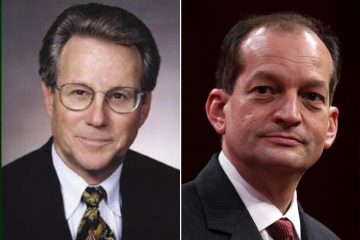
*(Barry Krischer (L) Alex Acosta (R)
My belief that Jeffrey Epstein was an intelligence agent is based principally on Acosta’s comments when being cleared by the Trump transition team. He was asked “Is the Epstein case going to cause a problem [for confirmation hearings]?” … “Acosta testified that he’d had just one meeting on the Epstein case. He’d cut the non-prosecution deal with one of Epstein’s attorneys because he had ‘been told’ to back off, that Epstein was above his pay grade. ‘I was told Epstein belonged to intelligence and to leave it alone.’”
The questions about Epstein remain even though he is gone, but one fears that the authorities will be disinclined to further investigate a dead man. It appears that no one in the various investigative agencies or the mainstream media has been interested in what Acosta meant, even though it would be simple enough to ask him. Who told him to back off? And how did they explain it? And then there is Epstein’s Austrian passport. Was it fake or real, with a real name and photo substitution or alternation of both picture and name? How did he get it? Austrian passports are highly desirable in intelligence circles because the country is neutral and its holders can travel just about everywhere without a visa.
And there’s more. As a former intelligence officer myself, there is little doubt in my mind that what Epstein did and how he did it was an intelligence operation. There is no other viable explanation for his filming of prominent politicians and celebrities having sex with young girls. And as for the question of whom Epstein might have been working for, the most likely answer is Mossad. The CIA would have had no interest in compiling dossiers on prominent Americans, but American movers and shakers like Bill Clinton, with his 26 trips on the Lolita Express, former Governor Bill Richardson, or former Senator George Mitchell are precisely the types of “agents of influence” that the Mossad would seek to coerce or even blackmail into cooperation.
Other compelling evidence for a Mossad connection came from Epstein’s relationship with Ghislaine Maxwell, who reportedly served as his key procurer of young girls. Ghislaine is the daughter of Robert Maxwell, who died or possibly was assassinated in mysterious circumstances in 1991. Maxwell was an Anglo-Jewish businessman, very cosmopolitan in profile, like Epstein, a multi-millionaire who was very controversial with what were regarded as ongoing ties to Mossad. After his death, he was given a state funeral by Israel in which six serving and former heads of Israeli intelligence listened while Prime Minister Yitzhak Shamir eulogized: “He has done more for Israel than can today be said.”
Israel and high-profile Jewish players also have continued to turn up like bad pennies in the Epstein case, but no one seems to be interested in pursuing that angle. Epstein clearly had contact with former Israeli Prime Minister Shimon Peres and Ehud Barak and Wexner also had close ties to the Jewish state and its government. Barry Krischer, who may have been the source of the comments to Acosta, has received the Anti-Defamation League (ADL) award. Evidence also suggests that Krischer, cooperating with rabidly pro-Israel Epstein lawyer Alan Dershowitz, played a key role in the failure to adequately punish Epstein for his conviction for pedophilia. According to a recent New Yorker story, the police investigators of the Epstein case observed that “the tone and tenor of the discussions of this case with Krischer changed completely” after his meetings with Dershowitz. At that point, the two detectives most involved in the case found themselves under extreme pressure. They were surveilled constantly by private investigators and they even had their household trash snatched and searched. And the resulting plea agreement with Krischer “…was due to the efforts of Dershowitz, who had proceeded to attack and smear the victims.”

Krischer claims that his office “subpoenaed witnesses took evidence to a Grand Jury, which returned a single felony count indictment against Epstein of soliciting prostitution,” but the reality appears to be that he worked with the defense to get Epstein off. There was plenty of evidence based on more than forty interviews with victims to convict Epstein, but instead of having him arrested, Krischer instead set up the Grand Jury with no mention of underage victims to mitigate the possible consequences. He also did not inform the victims of what he had arranged so they could challenge the verdict and penalty, a violation of Crime Victims Rights Act.
The Palm Beach police who worked the case at the time told The Miami Herald as part of an investigation published in November that they felt pressured by Krischer to downgrade Epstein’s case to a misdemeanor, or to drop it entirely. They said “the fix was in.” Acosta, more recently, did not refer to Krischer by name during an early July news conference, but spoke of the Palm Beach County state’s attorney. He described his own office as stepping in to ensure Epstein faced some form of punishment. “Simply put, the Palm Beach State Attorney’s Office was willing to let Epstein walk free. No jail time. Nothing,” Acosta said. “Prosecutors in my former office found this to be completely unacceptable, and we became involved.”
After thirteen months in country club jail in Palm Beach, Epstein was released. At his mansion in New York City, he subsequent had an artist paint a mural of himself in jail, evidently as an insider joke for those who knew about his time behind bars. End of story? Not exactly, even though Epstein is now dead. But the key questions go unanswered including was he a spy for Israel? And what about the Krischer-Dershowitz connection that kept him from being punished commensurate with his crimes? Did those instructions also come from Israel or from its friends in the U.S. Justice Department? Will the three simultaneous investigations currently taking place even continue and ask the right questions now that the target of the investigation is gone? Given the high stakes in the game, quite likely, there will be a cover-up both of how Epstein lived and how he died. We the public will never know what Epstein was all about.
Philip M. Giraldi is a former CIA counter-terrorism specialist and military intelligence officer who served nineteen years overseas in Turkey, Italy, Germany, and Spain. He was the CIA Chief of Base for the Barcelona Olympics in 1992 and was one of the first Americans to enter Afghanistan in December 2001. Phil is Executive Director of the Council for the National Interest, a Washington-based advocacy group that seeks to encourage and promote a U.S. foreign policy in the Middle East that is consistent with American values and interests.
Malaysia charges 17 current & ex-Goldman Sachs bosses with looting of country’s wealth fund

Superyacht linked to Malaysia’s state fund looting scandal © AFP / Sonny Tumbelaka
RT | August 9, 2019
Malaysia has extended pressure on Wall Street titan Goldman Sachs, filing criminal charges against 17 current and former directors of the bank’s subsidiaries over alleged involvement in the multi-billion-dollar 1MDB scandal.
Goldman Sachs has been under scrutiny for its role in helping to arrange $6.5 billion through bond offerings for Malaysian state fund, the 1Malaysia Development Berhad (1MDB). The fund is at the center of one of the biggest financial scandals of all time, and is now being investigated for money laundering.
In the filings issued on Friday, Malaysian Attorney General Tommy Thomas said the executives mentioned in the document should be held responsible for the US bank’s role in the scheme. The prosecution wants to seek custodial sentences and criminal fines for the accused, “given the severity of the scheme to defraud and fraudulent misappropriation of billions in bond proceeds, the lengthy period over which the offenses were planned and executed.”
Each charge carries a maximum jail term of 10 years and a penalty of at least 1 million ringgit ($239,000), according to Reuters.
The list includes 17 people who were in charge of three Goldman Sachs subsidiaries between May 2012 and March 2013, during which the alleged fraud took place, according to the attorney general. Richard Gnodde, who leads the bank’s international business in London, as well as Canadian business executive Michael Evans, a former Goldman Sachs Asia chief who is currently the president of Chinese e-commerce giant Alibaba, were among those charged on Friday. British banker Michael Sherwood, former vice chairman of the Wall Street firm, is also on the list.
The latest case adds to last year’s accusations, when Malaysian authorities filed charges against three Goldman Sachs units and two ex-employees. Kuala Lumpur is seeking $7.5 billion in compensation from the bank.
The US investment bank has repeatedly denied any wrongdoing, claiming it fell victim to the previous corrupt Malaysian government. Commenting on the latest accusations, Goldman Sachs said the charges were misdirected and promised to “vigorously” contest them.
Quincy Who? Another New Think Tank Tests the Waters
By Philip Giraldi | Strategic Culture Foundation | August 8, 2019
Think tanks sprout like weeds in Washington. The latest is the Quincy Institute for Responsible Statecraft, which is engaged in a pre-launch launch and is attracting some media coverage all across the political spectrum. The Institute is named after the sixth US President John Quincy Adams, who famously made a speech while Secretary of State in which he cautioned that while the United States of America would always be sympathetic to the attempts of other countries to fight against dominance by the imperial European powers, “she goes not abroad, in search of monsters to destroy.”
The Quincy Institute self-defines as a foundation dedicated to a responsible and restrained foreign policy with the stated intention of “mov[ing] US foreign policy away from endless war and toward vigorous diplomacy in the pursuit of international peace.” It is seeking to fund an annual budget of $5-6 million, enough to employ twenty or more staffers.
The Quincy Institute claims correctly that many of the other organizations dealing with national security and international affairs inside the Beltway are either agenda driven or neoconservative dominated, often meaning that they in practice support serial interventionism, sometimes including broad tolerance or even encouragement of war as a first option when dealing with adversaries. These are policies that are currently playing out unsuccessfully vis-à-vis Venezuela, Iran, Syria and North Korea.
The Quincies promise to be different in an attempt to change the Washington foreign policy consensus, which some have referred to as the Blob, and they have indeed collected a very respectable group of genuine “realist” experts and thoughtful pundits, including Professor Andrew Bacevich, National Iranian American Council founder Trita Parsi and investigative journalist Jim Lobe. But the truly interesting aspect of their organization is its funding. Its most prominent contributors are left of center George Soros and right of center and libertarian leaning Charles Koch. That is what is attracting the attention coming from media outlets like The Nation on the progressive side and Foreign Policy from the conservatives. That donors will demand their pound of flesh is precisely the problem with the Quincy vision as money drives the political process in the United States while also fueling the Establishment’s military-industrial-congressional complex that dominates the national security/foreign policy discussion.
There will be inevitably considerable ideological space between people who are progressive-antiwar and those who call themselves “realists” that will have to be carefully bridged lest the group begin to break down in squabbling over “principles.” Some progressives of the Barack Obama variety will almost certainly push for the inclusion of Samantha Power R2P types who will use abuses in foreign countries to argue for the US continuing to play a “policeman for the world” role on humanitarian grounds. And there will inevitably be major issues that Quincy will be afraid to confront, including the significant role played by Israel and its friends in driving America’s interventionist foreign policy.
Nevertheless, the Quincy Institute is certainly correct in its assessment that there is significant war-weariness among the American public, particularly among returning veterans, and there is considerable sentiment supporting a White House change of course in its national security policy. But it errs in thinking that America’s corrupted legislators will respond at any point prior to their beginning to fail in reelection bids based on that issue, which has to be considered unlikely. Witness the current Democratic Party debates in which Tulsi Gabbard is the only candidate who is even daring to talk about America’s disastrous and endless wars, suggesting that the Blob assessment that the issue is relatively unimportant may be correct.
Money talks. Where else in the developed world but the United States can a multi-billionaire like Sheldon Adelson legally and in the open spend a few tens of millions of dollars, which is for him pocket change, to effectively buy an entire political party on behalf of a foreign nation? What will the Quincies do when George Soros, notorious for his sometimes disastrous support of so-called humanitarian “regime change” intervention to expand “democracy movements” as part his vision of a liberal world order, calls up the Executive Director and suggests that he would like to see a little more pushing of whatever is needed to build democracy in Belarus? Soros, who has doubled his spending for political action in this election cycle, is not doing so for altruistic reasons. And he might reasonably argue that one of the four major projects planned by the Quincy Institute, headed by investigative journalist Eli Clifton, is called “Democratizing Foreign Policy.”
Why are US militarism and interventionism important issues? They are beyond important – and would be better described as potentially life or death both for the United States and for the many nations with which it interacts. And there is also the price to pay by every American domestically, with the terrible and unnecessary waste of national resources as well human capital driving America ever deeper into a hole that it might never be able to emerge from.
As Quincy is the newcomer on K Street, it is important to recognize what the plethora of foundations and institutes in Washington actually do in any given week. To be sure, they produce a steady stream of white papers, press releases, and op-eds that normally only their partisan supporters bother to read or consider. They buttonhole and talk to congressmen or staffers whenever they can, most often the staffers. And the only ones really listening among legislators are the ones who are finding what they hear congenial and useful for establishing a credible framework for policy decisions that have nothing to do with the strengths of the arguments being made or “realism.” The only realism for a congress-critter in the heartland is having a defense plant providing jobs in his district.
And, to be sure, the institutes and foundations also have a more visible public presence. Every day somewhere in Washington there are numerous panel discussions and meetings debating the issues deemed to be of critical importance. The gatherings are attended primarily by the already converted, are rarely reported in any of the mainstream media, and they exist not to explain or resolve issues but rather to make sure their constituents continue to regard the participants as respectable, responsible and effective so as not to interrupt the flow of donor money.
US foreign policy largely operates within narrow limits that are essentially defined by powerful and very well-funded interest groups like the Foundation for Defense of Democracies (FDD), American Enterprise Institute (AEI), the Hudson Institute, the Brookings Institute, the Council on Foreign Relations and the American Israel Public Affairs Committee (AIPAC), but the real lobbying of Congress and the White House on those issues takes place out of sight, not in public gatherings, and it is backed up by money. AIPAC, for example, alone spends more than $80 million dollars per year and has 200 employees.
So, the Quincy Institute intention to broaden the discussion of the current foreign policy to include opponents and critics of interventionism should be welcomed with some caveats. It is a wonderful idea already explored by others but nevertheless pretty much yet another shot in the dark that will accomplish little or nothing beyond providing jobs for some college kids and feel good moments for the anointed inner circle. And the shot itself is aimed in the wrong direction. The real issue is not foreign policy per se at all. It is getting the corrupting force of enormous quantities of PAC money completely removed from American politics. America has the best Congress and White House that anyone’s money can buy. The Quincy Institute’s call for restraint in foreign policy, for all its earnestness, will not change that bit of “realism” one bit.
Mega Group, Maxwells, and Mossad: The Spy Story at the Heart of the Jeffrey Epstein Scandal
The picture painted by the evidence is not a direct Epstein tie to a single intelligence agency but a web linking key members of the Mega Group, politicians, and officials in both the U.S. and Israel, and an organized-crime network with deep business and intelligence ties in both nations.

Graphic by Claudio Cabrera
By Whitney Webb | MintPress News | August 7, 2019
As billionaire pedophile and alleged sex-trafficker, Jeffrey Epstein sits in prison, reports have continued to surface about his reported links to intelligence, his financial ties to several companies and “charitable” foundations, and his friendships with the rich and powerful as well as top politicians.
While Part I and Part II of this series, “The Jeffrey Epstein Scandal: Too Big to Fail,” have focused on the widespread nature of sexual blackmail operations in recent American history and their ties to the heights of American political power and the U.S. intelligence community, one key aspect of Epstein’s own sex-trafficking and blackmail operation that warrants examination is Epstein’s ties to Israeli intelligence and his ties to the “informal” pro-Israel philanthropist faction known as “the Mega Group.”
The Mega Group’s role in the Epstein case has garnered some attention, as Epstein’s main financial patron for decades, billionaire Leslie Wexner, was a co-founder of the group that unites several well-known businessmen with a penchant for pro-Israel and ethno-philanthropy (i.e., philanthropy benefiting a single ethnic or ethno-religious group). However, as this report will show, another uniting factor among Mega Group members is deep ties to organized crime, specifically the organized crime network discussed in Part I of this series, which was largely led by notorious American mobster Meyer Lansky.
By virtue of the role of many Mega Group members as major political donors in both the U.S. and Israel, several of its most notable members have close ties to the governments of both countries as well as their intelligence communities. As this report and a subsequent report will show, the Mega Group also had close ties to two businessmen who worked for Israel’s Mossad — Robert Maxwell and Marc Rich — as well as to top Israeli politicians, including past and present prime ministers with deep ties to Israel’s intelligence community.
One of those businessmen working for the Mossad, Robert Maxwell, will be discussed at length in this report. Maxwell, who was a business partner of Mega Group co-founder Charles Bronfman, aided the successful Mossad plot to plant a trapdoor in U.S.-created software that was then sold to governments and companies throughout the world. That plot’s success was largely due to the role of a close associate of then-President Ronald Reagan and an American politician close to Maxwell, who later helped aid Reagan in the cover-up of the Iran Contra scandal.
Years later, Maxwell’s daughter — Ghislaine Maxwell — would join Jeffrey Epstein’s “inner circle” at the same time Epstein was bankrolling a similar software program now being marketed for critical electronic infrastructure in the U.S. and abroad. That company has deep and troubling connections to Israeli military intelligence, associates of the Trump administration, and the Mega Group.
Epstein appears to have ties to Israeli intelligence and has well-documented ties to influential Israeli politicians and the Mega Group. Yet, those entities are not isolated in and of themselves, as many also connect to the organized crime network and powerful alleged pedophiles discussed in previous installments of this series.
Perhaps the best illustration of how the connections between many of these players often meld together can be seen in Ronald Lauder: a Mega Group member, former member of the Reagan administration, long-time donor to Israeli Prime Minister Benjamin Netanyahu and Israel’s Likud Party, as well as a long-time friend of Donald Trump and Roy Cohn.
From cosmetics heir to political player
One often overlooked yet famous client and friend of Roy Cohn is the billionaire heir to the Estee Lauder cosmetics fortune, Ronald Lauder. Lauder is often described in the press as a “leading Jewish philanthropist” and is the president of the World Jewish Congress, yet his many media profiles tend to leave out his highly political past.
In a statement given by Lauder to New York Times reporter Maggie Haberman in 2018, the cosmetics heir noted that he has known Trump for over 50 years, going back at least to the early 1970s. According to Lauder, his relationship with Trump began when Trump was a student at the Wharton School at the University of Pennsylvania, which Lauder also attended.
Though the exact nature of their early friendship is unclear, it is evident that they shared many of the same connections, including to the man who would later count them both as his clients, Roy Cohn. While much has been said of the ties between Cohn and Trump, Cohn was particularly close to Lauder’s mother, Estee Lauder (born Josephine Mentzer). Estee was even counted among Cohn’s most high-profile friends in his New York Times obituary.
A small window into the Lauder-Cohn relationship surfaced briefly in a 2016 article in Politico about a 1981 dinner party held at Cohn’s weekend home in Greenwich, Connecticut. The party was attended by Ronald Lauder’s parents, Estee and Joe, as well as Trump and his then-wife Ivana, who had a weekend home just two miles away. That party was held soon after Cohn had helped Reagan secure the presidency and had reached the height of his political influence. At the party, Cohn offered toasts to Reagan and to then-Senator for New York Alfonse D’Amato, who would later urge Ronald Lauder to run for political office.
Two years later, in 1983, Ronald Lauder — whose only professional experience at that point was working for his parent’s cosmetics company — was appointed to serve as United States Deputy Assistant Secretary of Defense for European and NATO Affairs. Soon after his appointment, he served on the Dinner Tribute Committee for a dinner hosted by the Jewish fraternal and strongly pro-Israel organization B’nai B’rith, the parent organization of the controversial Anti-Defamation League (ADL), in Roy Cohn’s honor. Cohn’s influential father, Albert Cohn, was the long-time president of B’nai B’rith’s powerful New England-New York chapter and Roy Cohn himself was a member of B’nai B’rith’s Banking and Finance Lodge.
The dinner specifically sought to honor Cohn for his pro-Israel advocacy and his efforts to “fortify” Israel’s economy, and its honorary chairmen included media mogul Rupert Murdoch, Donald Trump and then-head of Bear Stearns Alan Greenberg, all of whom are connected to Jeffrey Epstein.
During his time as deputy assistant secretary of defense, Lauder was also very active in Israeli politics and had already become an ally of the then-Israeli representative to the United Nations and future prime minister of Israel, Benjamin Netanyahu. Lauder would go on to be one of the most important individuals in Netanyahu’s rise to power, particularly during his upset victory in 1996, and a major financier of Israel’s right-wing Likud Party.
In 1986, the year that Roy Cohn died, Lauder left his post at the Pentagon and became the U.S. ambassador to Austria, where his tenure was shaped by his confrontations with the then-Austrian president and former Nazi collaborator, Kurt Waldheim. Lauder’s interest in Austrian politics has continued well into recent years, culminating in accusations that he sought to manipulate Austrian elections in 2012.
After leaving his ambassadorship, Lauder founded the Ronald S. Lauder Foundation in 1987 and later went on to run for Mayor of New York against Rudy Giuliani in 1989. Lauder was encouraged to run by then-Senator Alfonse D’Amato, who had close ties to Roy Cohn and his long-time law partner Tom Bolan, who was D’Amato’s adviser. At the aforementioned 1983 B’nai B’rith dinner honoring Cohn, D’Amato was the featured speaker.
The likely reason was that Giuliani, though once an ally of the “Roy Cohn machine,” was at the time deeply disliked by the late Cohn’s associates for prosecuting Cohn’s former law partner, Stanley Friedman, for racketeering, conspiracy and other charges. Giuliani also had a history of bitter disagreements with D’Amato. Lauder’s primary campaign, though unsuccessful, was noted for its viciousness and its cost, as it burned through more than $13 million.
A few years later, in the early 1990s, Lauder would join a newly formed group that has long evaded scrutiny from the media but has recently become of interest in connection with the Jeffrey Epstein scandal: the Mega Group.
Lauder, Epstein and the mysterious Austrian passport
Before getting to the Mega Group, it is worth noting one particular act apparently undertaken by Lauder while he was U.S. ambassador to Austria that has recently come to light in relation to the arrest in early July of Jeffrey Epstein, a finding first reported by journalist Edward Szall. When police recently discovered an Austrian passport with Epstein’s picture and a fake name after raiding his Manhattan residence, the source and purpose of the passport came under media scrutiny.
According to the Associated Press, Epstein’s defense lawyers specifically argued that “a friend gave it to him [Epstein] in the 1980s after some Jewish-Americans were informally advised to carry identification bearing a non-Jewish name when traveling internationally during a period when hijackings were more common.” This claim appears to be related to concerns that followed the hijacking of Air France Flight 139 in 1976 when Israeli and Jewish hostages were separated from other hostages based largely on the passports in their possession.
Given that Epstein was unable to meet the conventional qualifications for an Austrian passport — including long-term residency in Austria (the passport lists him as a resident of Saudi Arabia) and fluency in German — it appears that the only way to have acquired an Austrian passport was by unconventional means, meaning assistance from a well-connected Austrian official or foreign diplomat with clout in Austria.

Ronald Lauder, right, and Austrian Chancellor Viktor Klima pose with students from the Lauder Chabad School in Vienna, Austria in 1999. Martin Gnedt | AP
Lauder, then-ambassador to Austria for the Reagan administration, would have been well-positioned to acquire such a passport, particularly for the reason cited by Epstein’s attorneys that Jewish-Americans could be targeted during travel, and in light of Lauder’s very public concerns over threats Jews face from certain terror groups. Furthermore, the passport had been issued in 1987, when Lauder was still serving as an ambassador.
In addition, Lauder was well-connected to Epstein’s former patron — former head of Bear Stearns Alan Greenberg, who had hired Epstein in the late 1970s immediately after the latter was fired from the Dalton School — and Donald Trump, another friend of Lauder and Greenberg who began his friendship with Epstein in 1987, the same year the fake Austrian passport was issued. In 1987, Epstein also began his relationship with his principal financier, Leslie Wexner, who is also closely associated with Lauder (though some sources claim that Epstein and Wexner first met in 1985 but that their strong business relationship was not established until 1987).
Though Epstein’s defense attorney declined to reveal the identity of the “friend” who provided him with the fake Austrian passport, Lauder was both well-positioned to acquire it in Austria and also deeply connected to the Mega Group, which was co-founded by Epstein’s patron Leslie Wexner and to which Epstein has many connections. These connections to both the Austrian government and to Epstein’s mentor make Lauder the most likely person to have acquired the document on Epstein’s behalf.
Furthermore, Epstein and the Mega Group’s ties to the Israeli intelligence agency, Mossad, also suggest Lauder was involved in procuring the passport, in light of his close ties to the Israeli government and the fact that Mossad has a history of using ambassadors abroad to procure false, foreign passports for its operatives.
Lauder himself has been alleged to have ties to Mossad, as he is a long-time funder of IDC Herzliya, an Israeli university closely associated with Mossad and their recruiters as well as Israeli military intelligence. Lauder even founded IDC Herzliya’s Lauder School of Government, Diplomacy and Strategy.
Furthermore, Lauder co-founded the Eastern European broadcasting network CETV with Mark Palmer, a former U.S. diplomat, Kissinger aide and Reagan speechwriter. Palmer is better known for co-founding the National Endowment for Democracy (NED), an organization often described as an accessory to U.S. intelligence, and one whose first president confessed to the Washington Post that “a lot of what we do today was done covertly 25 years ago by the CIA.” A 2001 report in the Evening Standard noted that Epstein once claimed that during the 1980s he worked for the CIA, but Epstein later backed away from that assertion.
The origins of the Mega Group Mafia
The Mega Group — a secretive group of billionaires to which Lauder belongs — was formed in 1991 by Charles Bronfman and Leslie Wexner, the latter of whom has received considerable media scrutiny following the July arrest of his former protege Jeffrey Epstein. Media profiles of the group paint it as “a loosely organized club of 20 of the nation’s wealthiest and most influential Jewish businessmen” focused on “philanthropy and Jewishness,” with membership dues upwards of $30,000 per year. Yet several of its most prominent members have ties to organized crime.
Mega Group members founded and/or are closely associated with some of the most well-known pro-Israel organizations. For instance, members Charles Bronfman and Michael Steinhardt formed Birthright Taglit with the backing of then- and current Prime Minister Benjamin Netanyahu. Steinhardt, an atheist, has stated that his motivation in helping to found the group was to advance his own belief that devotion to and faith in the state of Israel should serve as “a substitute for [Jewish] theology.”
Other well-known groups associated with the Mega Group include the World Jewish Congress — whose past president, Edgar Bronfman, and current president, Ronald Lauder, are both Mega Group members — and B’nai B’rith, particularly its spin-off known as the Anti-Defamation League (ADL). The Bronfman brothers were major donors to the ADL, with Edgar Bronfman serving as the ADL’s honorary national vice-chair for several years.
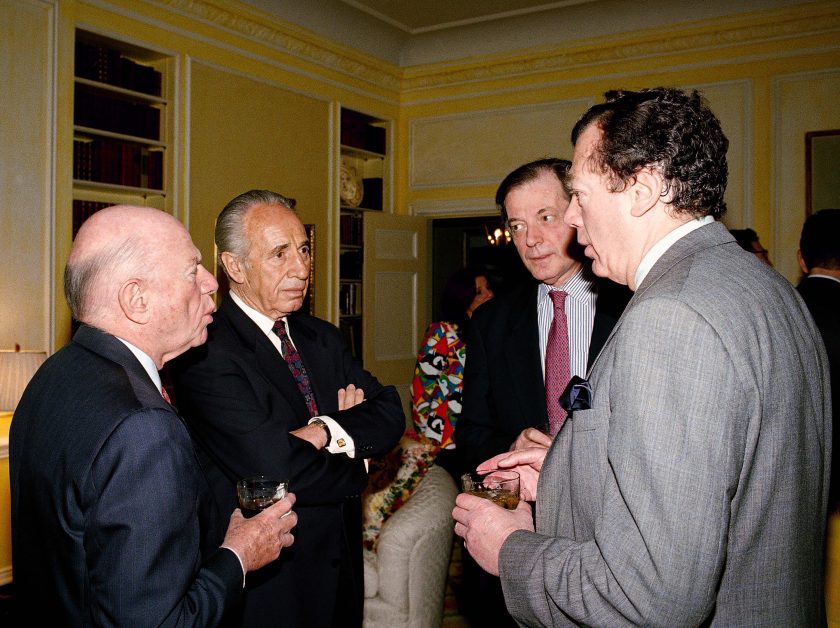
Former Israeli president Shimon Peres, second from left, listens to Edgar Bronfman during a 1995 lunch thrown in Peres’ honor. From left are: Laurence Tisch, Chairman, President and Chief executive officer of CBS; Israeli Ambassador to the United States. Itamar Rabinowitz and Bronfman. David Karp | AP
When Edgar Bronfman died in 2013, long-time ADL Director Abe Foxman said, “Edgar was for many years Chair of our Liquor Industry Division, Chair of our New York Appeal, and one of our most significant benefactors.” Other Mega Group members that are donors and major supporters of the ADL include Ronald Lauder, Michael Steinhardt and the late Max Fisher. As previously mentioned, Roy Cohn’s father was a long-time leader of B’nai B’rith’s influential New England-New York chapter and Cohn was later a celebrated member of its banking and finance lodge.
In addition, Mega Group members have also been key players in the pro-Israel lobby in the United States. For instance, Max Fisher of the Mega Group founded the National Jewish Coalition, now known as the Republican Jewish Coalition — the main pro-Israel neoconservative political lobbying group, known for its support of hawkish policies, and whose current chief patrons, Sheldon Adelson and Bernard Marcus, are among Donald Trump’s top donors.
Though the Mega Group has officially existed only since 1991, the use of “philanthropy” to provide cover for more unscrupulous lobbying or business activities was pioneered decades earlier by Sam Bronfman, the father of Mega Group members Edgar and Charles Bronfman. While other North American elites like J.D. Rockefeller had previously used philanthropic giving as a means of laundering their reputations, Bronfman’s approach to philanthropy was unique because it was focused on giving specifically to other members of his own ethno-religious background.
Sam Bronfman, as was detailed in Part I of this series, had long-standing deep ties to organized crime, specifically Meyer Lanksy’s organized crime syndicate. Yet, Bronfman’s private ambition, according to those close to him, was to become a respected member of high society. As a consequence, Bronfman worked hard to remove the stain that his mob associations had left on his public reputation in Canada and abroad. He accomplished this by becoming a leader in Canada’s Zionist movement and, by the end of the 1930s, he was head of the Canadian Jewish Congress and had begun to make a name for himself as a philanthropist for Jewish causes.
Yet even some of Bronfman’s activism and philanthropy had hints of the mobster-like reputation he tried so hard to shake. For instance, Bronfman was actively involved in the illegal shipping of arms to Zionist paramilitaries in Palestine prior to 1948, specifically as a co-founder of the National Conference for Israeli and Jewish Rehabilitation that smuggled weapons to the paramilitary group Haganah.
At the same time Bronfman was abetting the illegal smuggling of weapons to the Haganah, his associates in the criminal underworld were doing the same. After World War II, close aides of David Ben-Gurion, who would later become the first prime minister of Israel and was instrumental in the founding of Mossad, forged tight-knit relationships with Meyer Lansky, Benjamin “Bugsy” Siegel, Mickey Cohen and other Jewish gangsters of the period. They used their clandestine networks to establish a vast arms smuggling network between the United States and Zionist settlements in Palestine, arming both the Haganah and the Irgun paramilitary groups. As noted in Part I of this report, at the same time these gangsters were aiding the illegal arming of ZIonsit paramilitaries, they were strengthening their ties to U.S. intelligence that had first been formally (though covertly) established in World War II.
After Israel was founded, Sam Bronfman worked with future Israeli Prime Minister Shimon Peres to negotiate the sale of Canadian armaments at half-price to Israel and the bargain weapons purchase was paid for entirely by a fundraising dinner hosted by Bronfman and his wife. Many years later, Peres would go on to introduce another future prime minister of Israel, Ehud Barak, to Jeffrey Epstein.
The rest of the Bronfman family’s march on “the road to respectability” was undertaken by Bronfman’s children, who married into aristocratic families such as the European Rothschilds and the Wall Street “royalty” of the Lehmans and the Loebs.
The Bronfmans’ newfound respectability did not mean that their association with the Lansky-led criminal empire had dissolved. Indeed, prominent members of the Seagrams dynasty came under fire in the 1960s and 1970s for their close association with Willie “Obie” Obront, a major figure in Canadian organized crime, whom Canadian professor Stephen Schneider has referred to as the Meyer Lansky of Canada.
However, Edgar and Charles Bronfman were hardly the only members of the Mega Group with deep and long-standing ties to the Lansky-led National Crime Syndicate. Indeed, one of the group’s prominent members, hedge fund manager Michael Steinhardt, opened up about his own family ties to Lansky in his autobiography No Bull: My Life in and out the Markets, where he noted that his father, Sol “Red McGee” Steinhardt, was Lansky’s jewel fence of choice and a major player in New York’s criminal underworld. Sol Steinhardt was also his son’s first client on Wall Street and helped him jumpstart his career in finance.
The ties between the Mega Group and the National Crime Syndicate don’t stop there. Another prominent member of the Mega Group with ties to this same criminal network is Max Fisher, who has been described as Wexner’s mentor and is also alleged to have worked with Detroit’s “Purple Gang” during Prohibition and beyond. The Purple Gang were part of the network that smuggled Bronfman liquor from Canada into the United State during Prohibition, and one of its founders, Abe Bernstein, was a close associate of both Meyer Lansky and Moe Dalitz. Fisher was a key adviser to several U.S. presidents, beginning with Dwight D. Eisenhower, as well as to Henry Kissinger.

Max Fisher, center, and Henry Kissinger, right, meet with leaders of Jewish organizations prior to Kissinger’s 1975 Middle East trip. Henry Burroughs | AP
In addition to Fisher, Mega Group member Ronald Lauder was connected to Roy Cohn and Tom Bolan, both of whom were closely associated with this same Lansky-led crime network (see Part I and Part II) and who regularly represented top Mafia figures in court. Furthermore, another member of the Mega Group, director Steven Spielberg, is a well-known protege of Lew Wasserman, the mob-connected media mogul and long-time backer of Ronald Reagan’s film and later political career, discussed in Part II of this series.
One surprise connection to Cohn involves Mega Group member, and former president of U.S. weapons firm General Dynamics, Lester Crown, whose brother-in-law is David Schine, Cohn’s confidant and alleged lover during the McCarthy hearings, whose relationship with Cohn helped bring about the downfall of McCarthyism.
Another member of the Mega Group worth noting is Laurence Tisch, who owned CBS News for several years and founded Loews Corporation. Tisch is notable for his work for the Office of Strategic Services (OSS), the precursor to the CIA, where Donald Barry, who hired Epstein at the Dalton School, also served and which forged ties with Lansky’s criminal empire during World War II.
Wexner’s mansions and the Shapiro murder
Leslie “Les” Wexner, the other Mega Group co-founder, also has ties to organized crime. Wexner’s ties to Jeffrey Epstein have come under scrutiny following the latter’s recent arrest, as Wexner was the only publicly acknowledged client of Epstein’s suspicious hedge fund, the source of much of this wealth, and the previous owner of Epstein’s $56 million Manhattan townhouse, which Wexner transferred to an Epstein-controlled entity for free.
Before Epstein received the townhouse, Wexner appears to have used the residence for some unconventional purposes, noted in a 1996 New York Times article on the then-Wexner-owned residence, which included “a bathroom reminiscent of James Bond movies: hidden beneath a stairway, lined with lead to provide shelter from attack and supplied with closed-circuit television screens and a telephone, both concealed in a cabinet beneath the sink.” The Times article does not speculate as to the purpose of this equipment, though the allusion to famous fictional superspy James Bond suggests that it may have been used to snoop on guests or conduct electronic surveillance.
The 1996 Times article also noted that, after Wexner bought the residence for $13.2 million in 1989, he spent millions more decorating and furnishing the home, including the addition of the electronic equipment in the “James Bond” bathroom, only to apparently never live in it. The Times, which interviewed Epstein for the piece, quoted him as saying that “Les never spent more than two months there.” Epstein told the Times, which identified Epstein as Wexner’s “protege and one of his financial advisers,” that the house, by that time, already belonged to him.
That same year, Epstein was commissioning artwork for Wexner’s Ohio mansion. A recent article from the Times noted that:
In the summer of 1996, Maria Farmer was working on an art project for Mr. Epstein in Mr. Wexner’s Ohio mansion. While she was there, Mr. Epstein sexually assaulted her, according to an affidavit Ms. Farmer filed earlier this year in federal court in Manhattan. She said that she fled the room and called the police, but that Mr. Wexner’s security staff refused to let her leave for 12 hours.”
Farmer’s account strongly suggests that, given the behavior of his personal security staff at his mansion following Epstein’s alleged assault on Farmer, Wexner was well aware of Epstein’s predatory behavior towards young women. This is compounded by claims made by Alan Dershowitz — a former lawyer for and friend of Epstein’s, who has also been accused of raping underage girls — that Wexner has also been accused of raping underage girls exploited by Epstein on at least seven occasions.
The presence of the electronic equipment in his home’s bathroom, other oddities related to the townhouse, and aspects of the links between Epstein and Wexner suggest there is more to Wexner, who has rather successfully developed a public image of a respectable businessman and philanthropist, much like other prominent members of the Mega Group.
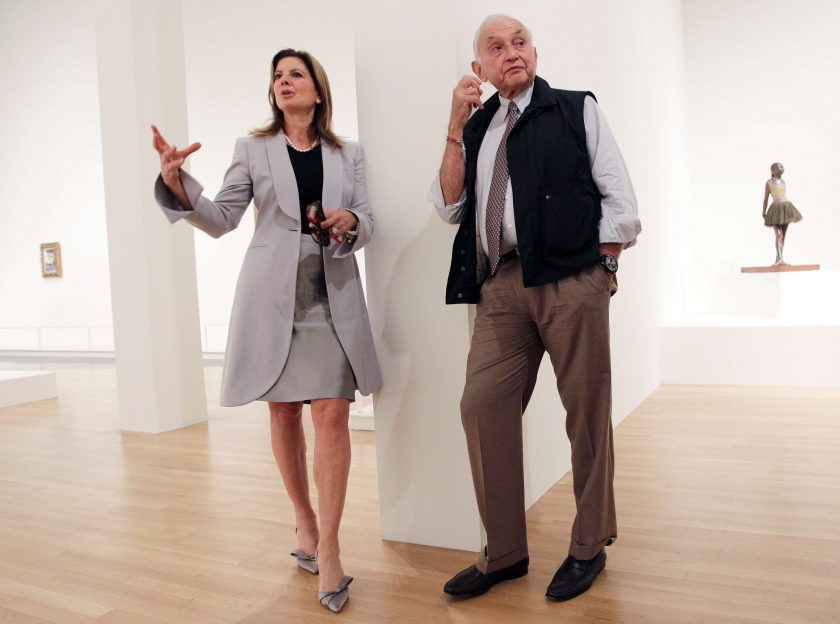
Leslie Wexner and his wife Abigail tour the “Transfigurations” exhibit at the Wexner Center for the Arts. Jay LaPrete | AP
However, bits and pieces of Wexner’s private secrets have occasionally bubbled up, only to be subjected to rapid cover-ups amidst concerns of “libeling” the powerful and well-connected billionaire “philanthropist.”
In 1985, Columbus (Ohio) lawyer Arthur Shapiro was murdered in broad daylight at point-blank range in what was largely referred to as a “mob style murder.” The homicide still remains unsolved, likely due to the fact that then-Columbus Police Chief James Jackson ordered the destruction of key documents of his department’s investigation into the murder.
Jackson’s ordering of the documents’ destruction came to light years later in 1996, when he was under investigation for corruption. According to the Columbus Dispatch, Jackson justified the destruction of one “viable and valuable” report because he felt that it “was so filled with wild speculation about prominent business leaders that it was potentially libelous.” The nature of this “wild speculation” was that “millionaire businessmen in Columbus and Youngstown were linked to the ‘mob-style murder.’”
Though Jackson’s efforts were meant to keep this “libelous” report far from public view, it was eventually obtained by Bob Fitrakis — attorney, journalist, and executive director of the Columbus Institute for Contemporary Journalism — after he was “accidentally” sent a copy of the report in 1998 as part of a public records request.
The report, titled “Shapiro Homicide Investigation: Analysis and Hypothesis,” names Leslie Wexner as linked “with associates reputed to be organized crime figures” and also lists the names of businessman Jack Kessler, former Columbus City Council President and Wexner associate Jerry Hammond, and former Columbus City Council member Les Wright as also being involved in Shapiro’s murder.
The report also noted that Arthur Shapiro’s law firm — Schwartz, Shapiro, Kelm & Warren — represented Wexner’s company, The Limited, and states that “prior to his death, Arthur Shapiro managed this account [The Limited] for the law firm.” It also noted that, at the time of his death, Shapiro “was the subject of an investigation by the Internal Revenue Service because he had failed to file income tax returns for some seven years prior to his death, and he had invested in some questionable tax shelters.” It also stated that his death prevented Shapiro from his planned testimony at a grand jury hearing about these “questionable tax shelters.”
As to Wexner’s alleged links to organized crime, the report focuses on the close business relationship between Wexner’s The Limited and Francis Walsh, whose trucking company “[had] done an excess of 90 percent of the Limited’s trucking business around the time of Shapiro’s murder,” according to the report. Walsh was named in a 1988 indictment as a “co-conspirator” of Genovese crime family boss Anthony “Fat Tony” Salerno, whose long-time lawyer was Roy Cohn; and the Shapiro murder report stated that Walsh was “still considered associates of the Genovese/LaRocca crime family, and Walsh was still providing truck transportation for The Limited.”
Notably, the Genovese crime family has long formed a key part of the National Crime Syndicate, as its former head, Charles “Lucky” Luciano, co-created the criminal organization with his close friend Meyer Lansky. Upon Luciano’s imprisonment and subsequent deportation from the United States, Lansky took over the syndicate’s U.S. operations and his association with Luciano’s successors continued until Lansky’s death in 1983.
The “Mega” Mystery and the Mossad
In May 1997, the Washington Post broke an explosive story — long since forgotten — based on an intercepted phone call made between a Mossad official in the U.S. and his superior in Tel Aviv that discussed the Mossad’s efforts to obtain a secret U.S. government document. According to the Post, the Mossad official stated during the phone call that “Israeli Ambassador Eliahu Ben Elissar had asked him whether he could obtain a copy of the letter given to [Palestinian leader Yasser] Arafat by [then-Secretary of State Warren] Christopher on Jan. 16, the day after the Hebron accord was signed by Arafat and Israeli Prime Minister Binyamin Netanyahu.”
The Post article continued:
According to a source who viewed a copy of the NSA transcript of the conversation, the intelligence officer, speaking in Hebrew, said, ‘The ambassador wants me to go to Mega to get a copy of this letter.’ The source said the supervisor in Tel Aviv rejected the request, saying, ‘This is not something we use Mega for.’”
The leaked communication led to an investigation that sought to identify an individual code-named “Mega” that the Post said “may be someone in the U.S. government who has provided information to the Israelis in the past,” a concern that subsequently spawned a fruitless FBI investigation. The Mossad later claimed that “Mega” was merely a codeword for the U.S.’ CIA, but the FBI and NSA were unconvinced by that claim and believed that it was a senior U.S. government official that had potentially once been involved in working with Jonathan Pollard, the former U.S. naval intelligence analyst later convicted of spying for the Mossad.
Almost one year to the day after the “Mega” spy scandal broke, the Wall Street Journal was the first outlet to report on the existence of a little-known organization of billionaires that was “informally” called the Mega Group and had been founded years prior in 1991. The report made no mention of the spy scandal that had spread concerns of Israeli espionage in the U.S. only a year prior. However, the group’s distinctive “informal” name and the connections of its members to the Mossad and to high-ranking Israeli politicians, including prime ministers, raise the possibility that “Mega” was not an individual, as the FBI and NSA had believed, but a group.
In 1997, when the “Mega” spy scandal broke, Netanyahu had recently become prime minister of Israel after an upset victory, a victory that was largely credited to one well-connected Netanyahu backer in particular, Ronald Lauder. Beyond being a major donor, Lauder had brought Arthur Finklestein on to work for Netanyahu’s 1996 campaign, whose strategies were credited for Netanyahu’s surprise win. Netanyahu was close enough to Lauder that he personally enlisted Lauder and George Nader to serve as his peace envoys to Syria.
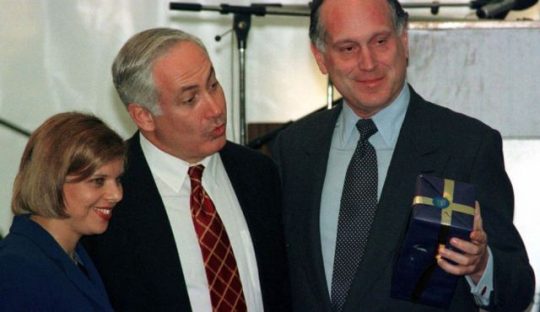
Benjamin Netanyahu and his wife Sara with Ronald Lauder in 1997. Photo | Reuters
Nader, who was connected to the Trump 2016 campaign and Trump ally and Blackwater founder Erik Prince, was recently hit with federal child sex trafficking charges last month, soon after Jeffrey Epstein had been arrested on similar charges. At the time Nader was picked to work with Lauder on Netanyahu’s behalf, he had already been caught possessing large amounts of child pornography on two separate occasions, first in 1984 and later in 1990.
This strong connection between Netanyahu and Lauder during the time of the 1997 “Mega” spy scandal is important considering Mossad answers directly to Israel’s prime minister.
Another possible connection between the Mega Group and the Mossad owes to the Mega Group’s ties to Meyer Lansky’s criminal network. As was detailed in Part I, Lansky had established deep ties to U.S. intelligence after World War II and was also connected to the Mossad through Mossad official Tibor Rosenbaum, whose bank was frequently used by Lansky to launder money. In addition, Lansky collaborated on at least one occasion with notorious Mossad “superspy” Rafi Eitan, who he helped acquire sensitive electronic equipment possessed only by the CIA but coveted by Israeli intelligence. Eitan is best known in the U.S. for being the Mossad handler of Jonathan Pollard.
Notably, Eitan was the main source of claims that the code-word “Mega” used by the Mossad officials in 1997 referred to the CIA and not to a potential source in the U.S. government once linked to Pollard’s spying activities, making his claims as to the true meaning of the term somewhat dubious.
Given that the organized crime network tied to the Mega Group had ties to both U.S. and Israeli intelligence, the “Mega” codeword could plausibly have referred to this secretive group of billionaires. More supporting evidence for this theory comes from the fact that prominent members of the Mega Group were business partners of Mossad agents, including media mogul Robert Maxwell and commodities trader Marc Rich.
The mysterious Maxwells
The Maxwell family has become a source of renewed media interest following Jeffrey Epstein’s arrest, as Ghislaine Maxwell, long described in the media as a British “socialite,” was publicly cited as Epstein’s long-time “on and off” girlfriend, and Epstein’s victims, as well as former wives of Epstein’s friends, have claimed that she was Epstein’s “pimp” and procured underage girls for his sexual blackmail operation. Ghislaine Maxwell is also alleged to have engaged in the rape of the girls she procured for Epstein and to have used them to produce child pornography.
Ghislaine was the favorite and youngest daughter of media mogul Robert Maxwell. Maxwell, born Jan Ludvick Hoch, had joined the British Army in World War II. Afterwards, according to authors John Loftus and Mark Aarons, he greatly influenced the Czechoslovakian government’s decision to arm Zionist paramilitaries during the 1948 war that resulted in Israel’s creation as a state, and Maxwell himself was also involved in the smuggling of aircraft parts to Israel.
Around this time, Maxwell was approached by British intelligence outfit MI6 and offered a position that Maxwell ultimately declined. MI6 then classified him as “Zionist — loyal only to Israel” and made him a person of interest. He later became an agent of the Mossad, according to several books including Seymour Hersh’s The Samson Option: Israel’s Nuclear Arsenal and American Foreign Policy, and Robert Maxwell: Israel’s Superspy by Gordon Thomas and Martin Dillon.
According to Victor Ostrovsky, a former Mossad case officer:
Mossad was financing many of its operations in Europe from money stolen from Maxwell’s newspaper pension fund. They got their hands on the funds almost as soon as Maxwell made the purchase of the Mirror Newspaper Group with money lent to him by Mossad.”
In exchange for his services, the Mossad helped Maxwell satisfy his sexual appetite during his visits to Israel, providing him with prostitutes, “the service maintained for blackmail purposes.” It was later revealed that the hotel in which he stayed in Israel was bugged with cameras, allowing the Mossad to acquire “a small library of video footage of Maxwell in sexually compromising positions.” As with the CIA, the Mossad’s use of blackmail against both friend and foe is well-documented and known to be extensive.
Maxwell was also a close associate and friend of Israeli “superspy” Rafi Eitan, who, as previously mentioned, was Jonathan Pollard’s handler and who had previously worked directly with Meyer Lansky. Eitan had learned of a revolutionary new software being used by the U.S. government known as “Promis” from Earl Brian, a long-time associate and aide to Ronald Reagan. Promis is often considered the forerunner to the “Prism” software used by spy agencies today and was developed by William Hamilton, who leased the software to the U.S. government through his company, Inslaw, in 1982.

Ariel Sharon (right)meets with Robert Maxwell in Jerusalem on Feb. 20, 1990. Photo | AP
According to author and former BBC investigative journalist Gordon Thomas, Brian was angry that the U.S. Department of Justice was successfully using Promis to go after organized crime and money-laundering activities and Eitan felt that the program could aid Israel and restore his own standing within the Israeli intelligence community, which had been damaged by the public disclosure of Eitan’s involvement in the Pollard affair and Iran Contra.
A plan was hatched to install a “trapdoor” into the software and then market Promis throughout the world, providing the Mossad with invaluable intelligence on the operations of its enemies and allies while also providing Eitan and Brian with copious amounts of cash. According to the testimony of ex-Mossad official Ari Ben-Menashe, Brian provided a copy of Promis to Israel’s military intelligence, which contacted an Israeli American programmer living in California who then planted the “trapdoor” in the software. The CIA was later said to have installed its own trapdoor in the software but it is unknown if they did so with a version of the already bugged software and how widely it was adopted relative to the version bugged by Israeli intelligence.
After the trapdoor was inserted, the problem became selling the bugged version of the software to governments as well as private companies around the world, particularly in areas of interest. Brian first attempted to buy out Inslaw and Promis and then use that same company to sell the bugged version.
Unsuccessful, Brian turned to his close friend, then-Attorney General Ed Meese whose Justice Department then abruptly refused to make the payments to Inslaw that were stipulated by the contract, essentially using the software for free, which Inslaw claimed to be theft. Some have speculated that Meese’s role in that decision was shaped, not only by his friendship with Brian, but the fact that his wife was a major investor in Brian’s business ventures. Meese would later become an adviser to Donald Trump when he was president-elect.
Inslaw was forced to declare bankruptcy as a result of Meese’s actions and sued the Justice Department. The court later found that the Meese-led department “took, converted, stole” the software through “trickery, fraud and deceit.”
With Inslaw out of the way, Brian sold the software all over the world. Eitan later recruited Robert Maxwell to become another Promis salesman, which he did remarkably well, even succeeding in selling the software to Soviet intelligence and conspiring with Republican Texas Senator John Tower to have the software adopted by the U.S. government laboratory at Los Alamos. Dozens of countries used the software on their most carefully guarded computer systems, unaware that Mossad now had access to everything Promis touched.
Whereas the Mossad’s past reliance on gathering intelligence had relied on the same tactics used by its equivalents in the U.S. and elsewhere, the widespread adoption of the Promis software, largely through the actions of Earl Brian and Robert Maxwell, gave the Mossad a way to gather not just troves of counterintelligence data, but also blackmail on other intelligence agencies and powerful figures.
Indeed, Promis’ backdoor and adoption by intelligence agencies all over the world essentially provided the Mossad with access to troves of blackmail that the CIA and FBI had acquired on their friends and foes for over half a century. Strangely, in recent years, the FBI has sought to hide information related to Robert Maxwell’s connection to the Promis scandal.
According to journalist Robert Fisk, Maxwell was also involved in the Mossad abduction of Israeli nuclear weapons whistleblower Vanunu Mordechai. Mordechai had attempted to provide the media with information on the extent of Israel’s nuclear weapons program, which was eventually published by the Sunday Times of London. Yet, Mordechai had also contacted the Daily Mirror with the information, the Mirror being an outlet that was owned by Maxwell and whose foreign editor was a close Maxwell associate and alleged Mossad asset, Nicholas Davies. Journalist Seymour Hersh alleged that Davies had also been involved in Israeli arms deals.
Per Fisk, it was Maxwell who contacted the Israeli Embassy in London and told them of Mordechai’s activities. This led to Mordechai’s entrapment by a female Mossad agent who seduced him as part of a “honey trap” operation that led to his kidnapping and later imprisonment in Israel. Mordechai served an 18-year sentence, 12 years of which were in solitary confinement.
Then, there is the issue of Maxwell’s death, widely cited by mainstream and independent media alike as suspicious and a potential homicide. According to authors Gordon Thomas and Martin Dillon, Maxwell had sealed his own fate when he attempted to threaten top Mossad officials with the exposure of certain operations if they did not help him rescue his media empire from crippling debt and financial difficulties. Many of Maxwell’s creditors, who had grown increasingly displeased with the media mogul, were Israeli and several of them were alleged to be Mossad-connected themselves.
Thomas and Dillon argue in their biography of Maxwell’s life that the Mossad felt that Maxwell had become more of a liability than an asset and killed him on his yacht three months after he demanded the bailout. On the other extreme are theories that suggest Maxwell committed suicide because of the financial difficulties his empire faced.

Ghislaine Maxwell, far right, Robert Maxwell’s daughter, looks on as his casket is unloaded from a plane in Jerusalem, Nov. 8, 1991. Heribert Proepper | AP
Some have taken Maxwell’s funeral held in Israel as the country’s “official” confirmation of Maxwell’s service to the Mossad, as it was likened to a state funeral and attended by no less than six serving and former heads of Israeli intelligence. During his funeral service in Jerusalem, Israeli Prime Minister Yitzhak Shamir eulogized him and stated: “He has done more for Israel than can today be said.” Other eulogies were given by future Prime Ministers Ehud Olmert (then Health Minister) and Shimon Peres, with the latter also praising Maxwell’s “services” on behalf of Israel.
Swimming in the same swamp
As he built his business empire — and even became a member of Parliament, Maxwell was also doing work for Israeli intelligence, as several of the Israeli companies in which he invested became fronts for the Mossad. In addition, as he became a media mogul, he developed a bitter rivalry with Rupert Murdoch, a close friend of Roy Cohn and an influential figure in American and British media.
Maxwell also partnered with the Bronfman brothers, Edgar and Charles — key figures in the Mega Group. In 1989 Maxwell and Charles Bronfman partnered up to bid on the Jerusalem Post newspaper and the Post described the two men as “two of the world’s leading Jewish financiers” and their interest in the venture as “developing The Jerusalem Post and expanding its influence among world Jewry.” A year prior, Maxwell and Bronfman had become top shareholders in the Israeli pharmaceutical company Teva.
Maxwell also worked with Charles Bronfman’s brother Edgar in the late 1980s to convince the Soviet Union to allow Soviet Jews to immigrate to Israel. Edgar’s efforts in this regard have received more attention, as it was a defining moment of his decades-long presidency of the World Jewish Congress, of which Ronald Lauder is currently president. Yet, Maxwell had also made considerable use of his contacts in the Soviet government in this effort.
Maxwell also moved in the circles of the network previously described in Parts I and II in this series. A key example of this is the May 1989 party Maxwell hosted on his yacht, the Lady Ghislaine — named for his youngest daughter and Epstein’s future “girlfriend.” Attendees of the party included Roy Cohn’s protege Donald Trump and his long-time law partner Tom Bolan. A close friend of Nancy Reagan was also present, journalist Mike Wallace, as was literary agent Mort Janklow, who represented Ronald Reagan and two of Cohn’s closest friends: journalists William Safire and Barbara Walters.
The CEO of what would soon become Time Warner, Steve Ross, was also invited to the exclusive event. Ross’ presence is notable, as he had built his business empire largely through his association with New York crime lords Manny Kimmel and Abner “Longy” Zwillman. Zwillman was a close friend of Meyer Lansky, Michael Steinhardt’s father, and Sam Bronfman, father of Edgar and Charles Bronfman.
Another attendee of the Maxwell yacht party was former Secretary of the Navy and former Henry Kissinger staffer Jon Lehman, who would go on to associate with the controversial neoconservative think tank, Project for a New American Century. Prior to being secretary of the Navy, Lehman had been president of the Abington Corporation, which hired arch-neocon Richard Perle to manage the portfolio of Israeli arms dealers Shlomo Zabludowicz and his son Chaim, who paid Ablington $10,000 month. A scandal arose when those payments continued after both Lehman and Perle joined the Reagan Department of Defense and while Perle was working to persuade the Pentagon to buy arms from companies linked to Zabludowicz. Perle had been part of the Reagan transition team along with Roy Cohn’s long-time friend and law partner Tom Bolan (another Maxwell yacht guest).
In addition to Lehman, another former Kissinger staffer, Thomas Pickering was present at Maxwell’s yacht part. Pickering played a minor role in the Iran-Contra affair and, at the time of the Maxwell yacht party, he was U.S. ambassador to Israel. Senator John Tower (R-TX), who allegedly conspired with Maxwell in the Mossad-bugged Promis software at the Los Alamos laboratories, was also present. Tower died just months before Maxwell in a suspicious plane crash.
Ghislaine Maxwell was also at this rather notable event. After her father’s mysterious death and alleged murder on the same yacht that bears her name in 1991, she quickly packed her bags and moved to New York City. There, she soon made the acquaintance of Jeffrey Epstein and, a few years later, developed close ties to the Clinton family, which will be discussed in the next installment of this series.
Jeffrey Epstein and the new “Promis”
After it was revealed that Epstein had evaded stricter sentencing in 2008 due to his links to “intelligence,” it was the Mossad ties of Ghislaine Maxwell’s father that have led many to speculate that Epstein’s sexual blackmail operation was sharing incriminating information with the Mossad. Former CBS executive producer and current journalist for the media outlet Narativ, Zev Shalev, has since claimed that he independently confirmed that Epstein was tied directly to the Mossad.
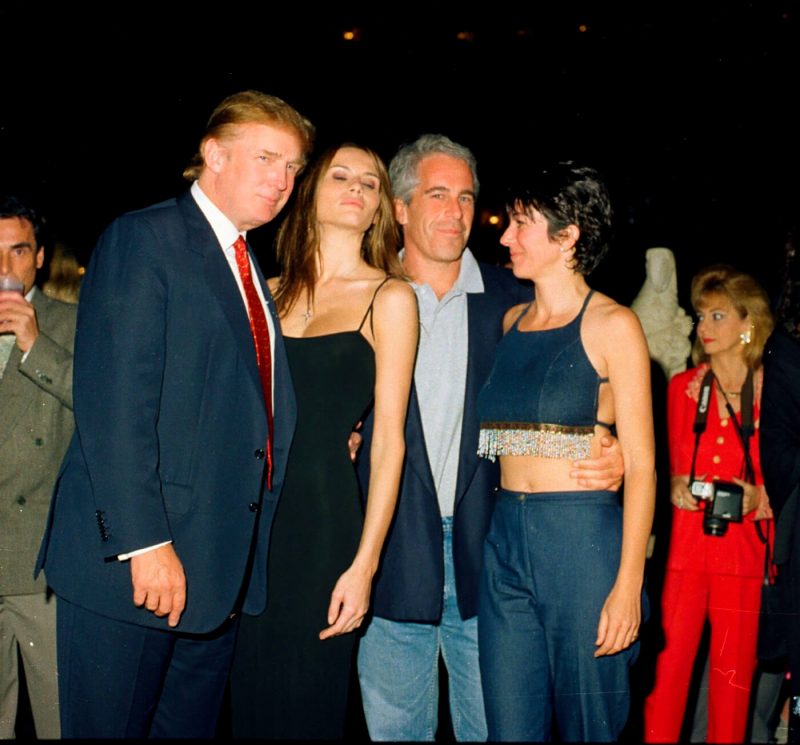
Donald and Melania Trump with Jeffrey Epstein and Ghislaine Maxwell at the Mar-a-Lago club, Palm Beach, Florida in 2000. Photo | Davidoff Studios
Epstein was a long-time friend of former Israeli Prime Minister Ehud Barak, who has long-standing and deep ties to Israel’s intelligence community. Their decades-long friendship has been the source of recent political attacks targeting Barak, who is running in the Israeli elections against current Prime Minister Netanyahu later this year.
Barak is also close to Epstein’s chief patron and Mega Group member Leslie Wexner, whose Wexner Foundation gave Barak $2 million in 2004 for a still unspecified research program. According to Barak, he was first introduced to Epstein by former Israeli Prime Minister Shimon Peres, who eulogized Robert Maxwell at his funeral and had decades-long ties with the Bronfman family going back to the early 1950s. Peres was also a frequent participant in programs funded by Leslie Wexner in Israel and worked closely with the Mossad for decades.
In 2015, a few years after Epstein’s release from prison following his conviction for soliciting sex from a minor in 2008, Barak formed a company with Epstein with the chief purpose of investing in an Israeli start-up then known as Reporty. That company, now called Carbyne, sells its signature software to 911 call centers and emergency service providers and is also available to consumers as an app that provides emergency services with access to a caller’s camera and location and also runs any caller’s identity through any linked government database. It has specifically been marketed by the company itself and the Israeli press as a solution to mass shootings in the United States and is already being used by at least two U.S. counties.
Israeli media reported that Epstein and Barak were among the company’s largest investors. Barak poured millions into the company and it was recently revealed by Haaretz that a significant amount of Barak’s total investments in Carbyne was funded by Epstein, making him a “de facto partner” in the company. Barak is now Carbyne’s chairman.
The company’s executive team are all former members of different branches of Israeli intelligence, including the elite military intelligence unit, Unit 8200, that is often likened to Israel’s equivalent of the U.S. National Security Agency (NSA). Carbyne’s current CEO, Amir Elichai, served in Unit 8200 and tapped former Unit 8200 commander Pinchas Buchris to serve as the company’s director and on its board. In addition to Elichai, another Carbyne co-founder, Lital Leshem, also served in Unit 8200 and later worked for Israeli private spy company Black Cube. Leshem now works for a subsidiary of Erik Prince’s company Frontier Services Group, according to the independent media outlet Narativ.
The company also includes several tie-ins to the Trump administration, including Palantir founder and Trump ally Peter Thiel — an investor in Carbyne. In addition, Carbyne’s board of advisers includes former Palantir employee Trae Stephens, who was a member of the Trump transition team, as well as former Secretary of Homeland Security Michael Chertoff. Trump donor and New York real-estate developer Eliot Tawill is also on Carbyne’s board, alongside Ehud Barak and Pinchas Buchris.
Narativ, which wrote the first expose on Carbyne after Epstein’s arrest, noted that the Chinese government uses a smartphone app very similar to Carbyne as part of its mass surveillance apparatus, even though the original purpose of the app was for improved emergency reporting. According to Narativ, the Chinese Carbyne-equivalent “monitors every aspect of a user’s life, including personal conversations, power usage, and tracks a user’s movement.”
Given the history of Robert Maxwell — the father of Epstein’s long-time “girlfriend” and young-girl-procuring madam, Ghislaine Maxwell — in promoting the sale of Carbyne’s modified Promis software, which was also marketed as a tool to improve government efficacy but was actually a tool of mass surveillance for the benefit of Israeli intelligence, the overlap between Carbyne and Promis is troubling and warrants further investigation.
It is also worth noting that Unit 8200-connected tech start-ups are being widely integrated into U.S. companies and have developed close ties to the U.S. military-industrial complex, with Carbyne being just one example of that trend.
As MintPress previously reported, Unit 8200-linked outfits like Team8 have recently hired former National Security Agency (NSA) Director Mike Rogers as a senior advisor and gained prominent Silicon Valley figures, including former Google CEO Eric Schmidt, as key investors. Many American technology companies, from Intel to Google to Microsoft, have merged with several Unit 8200-connected start-ups in recent years and have been moving many key jobs and operations to Israel with backing from key Republican donors like Paul Singer. Many of those same companies, particularly Google and Microsoft, are also major U.S. government contractors.
Who was Epstein really working for?
Even though Jeffrey Epstein appears to have had ties to the Mossad, this series has revealed that the networks to which Epstein was connected were not Mossad-exclusive, as many of the individuals close to Epstein — Lesie Wexner, for instance — were part of a mob-connected class of oligarchs with deep ties to both the U.S. and Israel. As was discussed in Part I of this series, the sharing of “intelligence” (i.e., blackmail) between intelligence agencies and the same organized crime network connected to the Mega Group goes back decades. With Leslie Wexner of the Mega Group as Epstein’s chief patron, as opposed to a financier with direct ties to the Mossad, a similar relationship is more than likely in the case of the sexual blackmail operation that Epstein ran.
Given that intelligence agencies in both the U.S. and elsewhere often conduct covert operations for the benefit of oligarchs and large corporations as opposed to “national security interest,” Epstein’s ties to the Mega Group suggest that this group holds a unique status and influence in both the governments of the U.S. and of Israel, as well as in other countries (e.g., Russia) that were not explored in this report. This is by virtue of their role as key political donors in both countries, as well as the fact that several of them own powerful companies or financial institutions in both countries. Indeed, many members of the Mega Group have deep ties to Israel’s political class, including to Netanyahu and Ehud Barak as well as to now-deceased figures like Shimon Peres, and to members of the American political class.
Ultimately, the picture painted by the evidence is not a direct tie to a single intelligence agency but a web linking key members of the Mega Group, politicians, and officials in both the U.S. and Israel, and an organized-crime network with deep business and intelligence ties in both nations.
Though this series has so far focused on the ties of this network to main Republican Party affiliates, the next and final installment will reveal the ties developed between this web and the Clintons. As will be revealed, despite the Clintons’ willingness to embrace corrupt dealings during the span of their political careers, their mostly friendly relationship with this network still saw them use the power of sexual blackmail to obtain certain policy decisions that were favorable to their personal and financial interests but not to the Clintons’ political reputation or agendas.
Whitney Webb is a MintPress News journalist based in Chile. She has contributed to several independent media outlets including Global Research, EcoWatch, the Ron Paul Institute and 21st Century Wire, among others. She has made several radio and television appearances and is the 2019 winner of the Serena Shim Award for Uncompromised Integrity in Journalism.
Hoaxing Academic Journals Now Forbidden
Portland State University says submitting fake papers to journals explicitly to assess their rigour is an ethics violation.
By Donna Laframboise | Big Picture News | July 29, 2019
Peter Boghossian teaches critical thinking at Portland State University. Last October, he and two research colleagues revealed that seven satirical/hoax papers they’d authored had nevertheless been successfully published in peer-reviewed academic journals.
Concerned about “ideologically-motivated scholarship,” the trio set out to demonstrate that some academic fields utter gibberish can get published so long as it employs large amounts of identity politics jargon.
One paper is described by Boghossian as “a 3000 word excerpt of Adolf Hitler’s Mein Kampf…rewritten in the language of Intersectionality theory.” Another discusses dog parks, rape culture, and the patriarchy using “incredibly implausible statistics.”

This project intended to ring alarm bells, to call attention to what the researchers insist is a widespread problem:
Scholarship based less upon finding truth and more upon attending to social grievances has become firmly established, if not fully dominant, within these fields, and their scholars increasingly bully students, administrators, and other departments into adhering to their worldview.
Rather than celebrating the Boghossian team as satirists par excellence, since last October Portland State University has subjected Boghossian to three separate investigations. One determined that no animals were harmed. Another found “no implications of plagiarism, fabrication, and falsification.” A third, however, determined that he violated “human subjects’ rights.”
In the weirdo world of contemporary higher education, people who run journals, and individuals who perform peer-review are now considered human subjects. Secretly submitting fake papers in order to assess the rigour of those journals is now considered human experimentation.
Such experimentation isn’t allowed unless one first secures the approval of an internal Institutional Review Board, an often lengthy and cumbersome process that will almost certainly undermine the secrecy upon which such research depends.
A few years ago, I wrote a report titled Peer Review: Why skepticism is essential. It cites a wide body of research, extending back decades, that highlights the often arbitrary, biased nature of the peer review process.
For example, a famous 1982 study attached fictitious author names to 12 papers that had already been published during the previous 18-32 months. The duplication was noticed in three cases, but peer reviewers working for the same journals gave thumbs down to eight out of nine remaining papers the second time around.
A 1990 study found female reviewers significantly less likely to recommend publication of male-authored papers compared to female-authored papers. Other research determined that a manuscript’s fate depends a great deal on whether its conclusions confirm or challenge a reviewer’s own theoretical perspective.
All of these findings provide important insight into how ‘official’ knowledge gets created. But now that journal editors and reviewers are considered human subjects whose rights shall not be violated, it’s doubtful whether such important work could still be conducted.
American Pravda: John McCain, Jeffrey Epstein, and Pizzagate
Our Reigning Political Puppets, Jerked by Invisible Strings
By Ron Unz • Unz Review • July 29, 2019
The death of Sen. John McCain last August revealed some important truths about the nature of our establishment media.
McCain’s family had released word of his incurable brain cancer many months earlier and his passing at age 84 was long expected, so media outlets great and small had possessed all the time necessary for producing and polishing the packages they eventually published, and that was readily apparent from the voluminous nature of the tributes that they ran. The New York Times, still our national newspaper of record, allocated more than three full pages of its printed edition to the primary obituary, and this was supplemented by a considerable number of other articles and sidebars. I cannot recall any political figure other than an American president whose passing had ever received such an enormous wealth of coverage, and perhaps even some former residents of the Oval Office might have fallen short of that standard. Although I certainly didn’t bother reading all of the tens of thousands of words in the Times or my other newspapers, the coverage of McCain’s life and career seemed exceptionally laudatory across the mainstream media, liberal and conservative alike, with scarcely a negative word appearing anywhere outside the political fringe.
On the face of it, such undiluted political love for McCain might seem a bit odd to those who have followed his activities over the last couple of decades. After all, the Times and most of the other leading lights of our media firmament are purportedly liberal and claim to have become vehement critics of our disastrous Iraq War and other military adventures, let alone the calamitous possibility of an attack upon Iran. Meanwhile, McCain was universally regarded as the leading figure in America’s “War Party,” eagerly supporting all prospective and retrospective military endeavors with gleeful fury, and even making his chant of “Bomb, Bomb, Bomb Iran” the most widely remembered detail of his unsuccessful 2008 presidential campaign. So either our major media outlets somehow overlooked such striking differences on an absolutely central issue, or perhaps their true positions on certain matters are not exactly what they seem to be, and merely constitute elements of a Kabuki-performance aimed at deceiving their more naive readers.
Even more remarkable were the discordant facts airbrushed out of McCain’s history.
As the winner of the Pulitzer Prize and two George Polk awards, the late Sydney Schanberg was widely regarded as one of the greatest American war correspondents of the twentieth century. His exploits during our ill-fated Indo-Chinese War had become the basis of the Oscar-winning film The Killing Fields, which probably established him as the most famous journalist in America after Woodward and Bernstein of Watergate fame, and he had also served as a top editor at The New York Times. A decade ago, he published his greatest expose, providing a mountain of evidence that America had deliberately left behind hundreds of POWs in Vietnam and he fingered then-presidential candidate John McCain as the central figure in the later official cover-up of that monstrous betrayal. The Arizona senator had traded on his national reputation as our best-known former POW to bury the story of those abandoned prisoners, permitting America’s political establishment to escape serious embarrassment. As a result, Sen. McCain earned the lush rewards of our generous ruling elites, much like his own father Admiral John S. McCain, Sr., who had led the cover-up of the deliberate 1967 Israeli attack on the U.S.S. Liberty, which killed or wounded over 200 American servicemen.

As publisher of The American Conservative, I ran Schanberg’s remarkable piece as a cover story, and across several websites over the years it has surely been read many hundreds of thousands of times, including a huge spike around the time of McCain’s death. I therefore find it rather difficult to believe that the many journalists investigating McCain’s background might have remained unaware of this material. Yet not a hint of these facts were provided in any of the articles appearing in any remotely prominent media outlets as can be seen by searching for web pages containing “McCain and Schanberg” dated around the time of the Senator’s passing.
Schanberg’s journalistic stature had hardly been forgotten by his former colleagues. Upon his death a couple of years ago, the Times ran a very long and glowing obituary, and a few months later I attended the memorial tribute to his life and career held at the New York Times headquarters building, which drew a couple of hundred prominent journalists mostly from his same generation, including those of the highest rank. Times Publisher Arthur Sulzberger, Jr. gave a speech describing how as a young man he had always so greatly admired Schanberg and had been mortified by the unfortunate circumstances of his departure from the family’s newspaper. Former Executive Editor Joseph Lelyveld recounted the many years he had worked closely with the man he had long considered his closest friend and colleague, someone whom he almost seemed to regard as his older brother. But during the two hours of praise and remembrance scarcely a single word was uttered in public about the gigantic story that had occupied the last two decades of Schanberg’s celebrated career.
This same blanket of media silence also enveloped the very serious accusations regarding McCain’s own Vietnam War record. A few years ago, I drew upon the Times and other fully mainstream sources to strongly suggest that McCain’s stories of his torture as a POW were probably fictional, invented to serve as a cover and an excuse for the very real record of his wartime collaboration with his Communist captors. Indeed, at the time our American media reported his activities as one of the leading propagandists of our North Vietnamese foes, but these facts were later flushed down the memory-hole. McCain’s father was then ranked as one of America’s top military officers, and it seems likely that his personal political intervention ensured that the official narrative of his son’s wartime record was transmuted from traitor to war-hero, thereby allowing the younger McCain to later embark upon his celebrated political career.
The story of the abandoned Vietnam POWs and McCain’s own Communist propaganda broadcasts hardly exhaust the catalog of the major skeletons in the late Senator’s closet. McCain was regularly described by reporters as being remarkably hot-headed and having a violent temper, but the national press left it to the alternative media to investigate the real-life implications of those rather suggestive phrases.
In a September 1, 2008 Counterpunch expose later published online, Alexander Cockburn reported that interviews with two emergency room physicians in Phoenix revealed that around the time that McCain was sucked into the political maelstrom of the Keating Five Scandal, his wife Cindy was admitted to her local hospital suffering from a black eye, facial bruises, and scratches consistent with physical violence, and this same situation occurred two additional times over the next few years. Cockburn also noted several other highly suspicious marital incidents during the years that followed, including the Senator’s wife appearing with a bandaged wrist and her arm in a sling not long after she joined her husband on the 2008 campaign trail, an injury reported by our strangely incurious political journalists as being due to “excessive hand-shaking.” It’s an odd situation when a tiny leftist newsletter can easily uncover facts that so totally eluded the vast resources of our entire national press corps. If there were credible reports that Melania Trump had been repeatedly admitted to local emergency rooms suffering from black eyes and facial bruises, would our corporate media have remained so uninterested in any further investigation?
McCain had first won his Arizona Congressional seat in 1982, not long after he moved into the state, with his campaign bankrolled by his father-in-law’s beer-distributorship fortune, and that inheritance eventually elevated the McCain household into one of the wealthiest in the Senate. But although the Senator spent the next quarter-century in public life, even nearly upsetting George W. Bush for the 2000 Republican presidential nomination, only in late 2008 did I learn from the Times that the Phoenix beer-monopoly in question, then valued at around $200 million, had accrued to a man whose lifelong business partner Kemper Marley had long been deeply linked to organized crime. Indeed, close associates of that latter individual had been convicted by a jury of the car-bomb assassination of a Phoenix investigative crime reporter just a few years before McCain’s sudden triumphal entrance into Arizona politics. Perhaps such guilt-by-association is improper, but would our national press-corps have remained silent if the personal fortune of our current president were only a step or two removed from the car-bomb assassins of a nosy journalist who died while investigating mobsters.
As I gradually became aware of these enormities casually hidden in McCain’s background, my initial reaction was disbelief that someone whose record was so deeply tarnished in so many different ways could ever have reached such a pinnacle of American political power. But as the media continued to avert its eyes from these newly revealed facts, even those disclosed in the pages of the Times itself, I gradually began to consider matters in a different light. Perhaps McCain’s elevation to great American political power was not in spite of the devastating facts littering his personal past, but because of them. As I wrote a few years ago:
Today when we consider the major countries of the world we see that in many cases the official leaders are also the leaders in actuality: Vladimir Putin calls the shots in Russia, Xi Jinping and his top Politburo colleagues do the same in China, and so forth. However, in America and in some other Western countries, this seems to be less and less the case, with top national figures merely being attractive front-men selected for their popular appeal and their political malleability, a development that may eventually have dire consequences for the nations they lead. As an extreme example, a drunken Boris Yeltsin freely allowed the looting of Russia’s entire national wealth by the handful of oligarchs who pulled his strings, and the result was the total impoverishment of the Russian people and a demographic collapse almost unprecedented in modern peacetime history.
An obvious problem with installing puppet rulers is the risk that they will attempt to cut their strings, much like Putin soon outmaneuvered and exiled his oligarch patron Boris Berezovsky. One means of minimizing such risk is to select puppets who are so deeply compromised that they can never break free, knowing that the political self-destruct charges buried deep within their pasts could easily be triggered if they sought independence. I have sometimes joked with my friends that perhaps the best career move for an ambitious young politician would be to secretly commit some monstrous crime and then make sure that the hard evidence of his guilt ended up in the hands of certain powerful people, thereby assuring his rapid political rise.
In physics, when an object deviates from its expected trajectory for inexplicable reasons, we assume that some unknown force has been at work, and tracing the record of such deviations may help to determine the characteristic properties of the latter. Over the years, I’ve increasingly become aware of such strange ideological deviations in public policy, and although some are readily explained, others suggest the existence of hidden forces far beneath the surface of our regular political world. This same situation may have occurred throughout our history, and sometimes the political decisions that so baffled contemporaries eventually came to light decades later.

In The Dark Side of Camelot, famed investigative reporter Seymour Hersh claimed that secret blackmail evidence of JFK’s extra-marital affairs probably played a crucial role in having his administration overrule the unanimous verdict of all top Pentagon advisors and award the largest military procurement contract in U.S. history to General Dynamics instead of Boeing, thereby saving the former company from likely bankruptcy and its major organized-crime shareholders from devastating financial losses. Hersh also suggests that a similar factor likely explains JFK’s last-minute reversal in the choice of his Vice President, a decision that landed Lyndon Johnson on the 1960 ticket and placed him in the White House after Kennedy’s 1963 assassination.
As I recently mentioned, in the 1950s Sen. Estes Kefauver shifted the focus of his Organized Crime Hearings after the Chicago Syndicate confronted him with the photographs of his sexual encounter with two mob-supplied women. A decade later, California Attorney-General Stanley Mosk suffered much the same fate, with the facts remaining hidden for over twenty years.
Similar rumors swirl around events much farther back in history as well, sometimes with enormous consequences. Well-placed contemporary sources have claimed that Samuel Untermyer, a wealthy Jewish lawyer, purchased the secret correspondence between Woodrow Wilson and his longtime mistress, and that the existence of that powerful leverage may have been an important factor behind Wilson’s astonishingly rapid rise from president of Princeton in 1910 to governor of New Jersey in 1911 to president of the United States in 1912. Once in office, Wilson signed the controversial legislation establishing the Federal Reserve system in 1913 and also named Louis Brandeis as the first Jewish member of the U.S. Supreme Court despite the public opposition of nearly our entire legal establishment. Wilson’s swiftly changing views on American involvement in the First World War may also have been influenced by such personal pressures rather than solely determined by his perceptions of the national interest.
Without naming any names, since 2001 it has been difficult to avoid noticing that one of the most zealous and committed supporters of the Neocon party-line on all Middle Eastern foreign policy matters has been a leading Republican senator from one of the most socially-conservative Southern states, a man whose rumored personal inclinations have long circulated on the Internet. The strikingly-sudden reversal of this individual on a major policy question certainly supports these suspicions. There have also been several other such examples involving prominent Republicans.
But consider the far different situation of Rep. Barney Frank of Massachusetts, who in 1987 became the first member of the Congress to voluntarily admit that he was gay. Not long afterward, a notorious scandal erupted when it was revealed that his own DC townhouse had been used by a former boyfriend as headquarters for a male-prostitution ring. Frank claimed to have had no knowledge of that sordid situation, and his liberal Massachusetts constituents apparently accepted that, since he was resoundingly reelected and went on to serve another 24 years in Congress. But surely if Frank had been a Republican from a socially-conservative district, anyone possessing such evidence would have totally controlled his political survival, and with Frank spending several years as Chairman of the very powerful House Financial Services Committee, the value of such a powerful hold would have been enormous.
This demonstrates the undeniable reality that what constitutes effective blackmail material may vary tremendously across different eras and regions. Today, it is widely accepted that longtime FBI Director J. Edgar Hoover lived his life as a deeply-closeted homosexual and there seem to be serious claims that he also had some black ancestry, with the secret evidence of these facts probably helping to explain why for decades he stubbornly refused to admit the existence of American organized crime or focus his G-men on efforts to uproot it. But in today’s America, he would surely have proudly declared his sexuality and racial ancestry in an New York Times Magazine cover-story, rightly believing that they would have enhanced his political invulnerability on the national stage. There are lurid rumors that the Syndicate possessed secret photos of Hoover wearing a dress and high-heels, but just a few years ago Rep. Mike Honda of San Jose desperately placed his eight-year-old transgendered grand-daughter front-and-center in his unsuccessful attempt to win reelection.
The decades have certainly softened the effectiveness of many forms of blackmail, but pedophilia still ranks as an extremely powerful taboo. There seems to be a great deal of evidence that powerful organizations and individuals have successfully managed to suppress credible accusations of that practice for very long periods of time so long as no group with substantial media influence had chosen to target the offenders for unmasking.
The most obvious example is the Catholic Church, and the failings of its American and international hierarchy in that regard have regularly made the front pages of our leading newspapers. But until the early 2000s and the breakthrough reporting of the Boston Globe as recounted in the Oscar-winning film Spotlight, the Church had routinely fended off such scandals.
Consider also the remarkable case of British television personality Sir Jimmy Savile, one of his country’s most admired celebrities, eventually knighted for his public service. Only shortly after his death at age 84 did the press begin revealing that he had probably molested many hundreds of children during his long career. Accusations by his young victims had stretched back across forty years, but his criminal activities had seemingly been protected by his wealth and celebrity, along with his numerous supporters in the media.
There is also the intriguing example of Dennis Hastert. As the longest serving Republican Speaker of the House in U.S. history, holding office during 1999-2007, Hastert was third in line to the Presidency and even ranked as our nation’s top Republican elected official during some of that period. Based upon my newspaper readings, he had always struck me as a rather bland and ordinary individual, with journalists sometimes even strongly hinting at his mediocrity, so that I occasionally wondered just how someone so unimpressive could have risen to such extremely high national office.
Then a few years ago, he was suddenly thrust back into the headlines, arrested by the FBI and charged with financial crimes relating to what apparently had been his past history of abusing young boys, at least one of whom had committed suicide, with the federal judge who sent him to prison denouncing him as “a serial child molester” at sentencing. Perhaps I’ve led an overly sheltered life, but my impression is that only a tiny sliver of Americans have had a long record of child molestation, and all things being equal, it seems rather unlikely that someone of such a background but who possesses no other great talents or skills would rise to near the absolute top of our political heap. So perhaps not all things were otherwise equal. If some powerful elements possessed the hard evidence that placed a particular elected official under their total control, working very hard to elevate him to Speaker of the House would be a very shrewd investment.
At times the unwillingness of our national media to see major stories in front of their very noses reaches ridiculous extremes. During the summer of 2007, the Internet was ablaze with claims that Sen. John Edwards, a runner-up in the 2004 Democratic presidential primaries, had just fathered a child with his mistress, and those reports were backed by seemingly-credible visual evidence, including photos showing the married senator holding his new-born baby. Yet as the days and even the weeks went by, not a whiff of this salacious scandal ever reached the pages of any of my morning newspapers or the rest of the mainstream media although it was a top conversation topic everywhere else. Eventually, the National Enquirer, a notorious gossip tabloid, scored a journalistic first, receiving a Pulitzer Prize nomination for breaking the story that no other outlet seemed willing to cover. Would our media have similarly averted its eyes from a newborn baby Trump coming from the wrong side of the bed?
Over the years, it became increasingly obvious to me that nearly all elements of our national media were often quite willing to enlist in a “conspiracy of silence” to minimize or entirely ignore stories of tremendous potential interest to their readership and major public importance. I could easily have doubled or tripled the number of such notable examples I provided above without much effort. Moreover, it is quite intriguing that so many of these cases involve the sort of criminal or sexual misbehavior that would be ideally suited for blackmailing powerful individuals who are less likely to be vulnerable to other influences. So perhaps many of the elected officials situated at the top of our democratic system merely reign as political puppets, jerked by invisible strings.
Given my awareness of this remarkable track-record of major media cover-ups, I’m ashamed to admit that I had paid almost no attention to the Jeffrey Epstein case until it exploded across our national headlines earlier this month, suddenly becoming one of the biggest news stories in our country.
For many years, reports about Epstein and his illegal sex-ring had regularly circulated on the fringes of the Internet, with agitated commenters citing the case as proof of the dark and malevolent forces that secretly controlled our corrupted political system. But I almost entirely ignored these discussions, and I’m not sure that I ever once clicked on a single link.
Probably one reason I paid so little attention to the topic was the exceptionally lurid nature of the claims being made. Epstein was supposedly an enormously wealthy Wall Street financier of rather mysterious personal background and source of funds, who owned a private island and an immense New York City mansion, both regularly stocked with harems of underage girls provided for sexual purposes. He allegedly hobnobbed on a regular basis with Bill Clinton, Prince Andrew, Harvard’s Alan Dershowitz, and numerous other figures in the international elite, as well as a gaggle of ordinary billionaires, frequently transporting those individuals on his personal jet known as “the Lolita Express” for the role it played in facilitating illegal secret orgies with young girls. When right-wing bloggers on obscure websites claimed that former President Clinton and the British Royals were being sexually serviced by the underage girls of a James Bond super-villain brought to life, I just assumed those accusations were the wildest sort of Internet exaggeration.
Moreover, these angry writers did occasionally let slip that the fiendish target of their wrath had already been charged in a Florida courtroom, eventually pleading guilty to a single sexual offense and receiving a thirteen month jail sentence, mitigated by very generous work-release provisions. This hardly seemed like the sort of judicial punishment that would lend credence to the fantastical accusations against him. If Epstein had already been investigated by law enforcement authorities and given the sort of sentence one might expect for writing a bad check, I found it quite unlikely that he was actually the Goldfinger or Dr. No that deluded Internet activists made him out to be.
Then these same wild, implausible claims previously found only on anonymous comment-threads were suddenly repeated as solid fact on the front pages of the Times and all my other morning newspapers, and the former federal prosecutor who had signed off on Epstein’s legal slap-on-the-wrist was forced to resign from the Trump Cabinet. Epstein’s safe had been found to contain a huge cache of child-pornography and other highly suspicious material, and he was quickly rearrested on charges that could send him to federal prison for decades. Prestigious media outlets described Epstein as the mastermind of a huge sex-trafficking ring, and numerous underage victims began coming forward, telling their stories of how he had molested, raped, and pimped them. The author of a long 2003 Epstein profile that had appeared in Vanity Fair explained that she had personally spoken to some of his victims and included their highly-credible accounts in her article, but that those portions had been censored and removed by her timorous editors.
As presented by these media outlets, Epstein’s personal rise also seemed rather inexplicable unless he had benefited from some powerful network or similar organization. Lacking any college degree or credentials, he had somehow gotten a job teaching at one of New York City’s most elite prep schools, then quickly jumped to working at a top investment bank, rising to become partner with astonishing speed until he was fired a few years later for illegal activity. Despite such a scanty and doubtful record, he was soon managing money for some of America’s wealthiest individuals, and keeping so much of it for himself that he was regularly described as a billionaire. According to newspaper accounts, his great specialty was “making connections for people.”
Obviously, Epstein was a ruthlessly opportunistic financial hustler. But extremely wealthy individuals must surely be surrounded by great swarms of ruthlessly opportunistic financial hustlers, and why would he have been so much more successful than all those others? Perhaps a clue comes from the offhand remark of Epstein’s now-disgraced prosecutor, saying that he had been told to go very easy on the sex-trafficker because he “belonged to intelligence.” The vague phrasing of that statement raises questions about whether the intelligence service may not have been one controlled by the U.S. government.
Philip Giraldi, a highly-regarded former CIA officer, put things very plainly when he suggested that Epstein had probably been working for the Israeli Mossad, operating “honey traps” to obtain blackmail information on all the wealthy and powerful individuals whom he regularly plied with underage girls. Indeed, longtime Canadian journalist Eric Margolis recounted his early 1990s visit to Epstein’s enormous NYC mansion, in which he had barely crossed the threshold before he was offered an “intimate massage” by one of the many young girls there, presumably in a bedroom well-stocked with hidden cameras.
Given my personal lack of interest in the Epstein case, then or now, perhaps a few of these details may be garbled, but it seems undeniable that he was exactly the sort of remarkable renegade typically faced by Agent 007 of the movies, and the true facts will presumably come out at his trial. Or perhaps not. Whether he lives to see trial is not entirely clear given the considerable number of powerful individuals who might prefer that hidden facts remain hidden, and the Friday newspapers reported that Epstein had been found injured and unconscious in his prison cell.
When one seemingly implausible pedophilia scandal has suddenly jumped from obscure corners of the Internet to the front pages of our leading newspapers, we must naturally begin to wonder whether others might not eventually do the same. And a very likely candidate comes to mind, one that seemed to me far better documented than the vague accusations being thrown about over the last few years against a wealthy financier given a thirteen-month jail sentence in Florida a decade earlier.
I don’t use Social Media myself, but near the end of the 2016 presidential campaign, I gradually began seeing more and more Trump supporters referring to something called “Pizzagate,” a burgeoning sexual scandal that they claimed would bring down Hillary Clinton and many of the top leaders of her party, with the chatter actually increasing after Trump was elected. As near as I could tell, the whole bizarre theory had grown up on the far-right fringe of the Internet, with the utterly fantastical plot having something to do with stolen secret emails, DC pizza parlors, and a ring of pedophiles situated near the top of the Democratic Party. But given all the other strange and unlikely things I’d gradually discovered about our history, it didn’t seem like something I could necessarily dismiss out of hand.
At the beginning of December, a right-wing blogger produced a lengthy exposition of the Pizzagate charges, which finally gave me some understanding of what was actually under discussion, and I soon made arrangements to republish his article. It quickly attracted a great deal of interest, and some websites pointed to it as the best single introduction to the scandal for a general audience.
A couple of weeks later, I republished an additional article by the same writer, describing a long list of previous pedophilia scandals that had occurred in elite American and European political circles. Although many of these seemed to be solidly documented, nearly all of them had received minimal coverage by our mainstream media outlets. And if such political pedophile rings had existed in the relatively recent past, was it so totally implausible that there might be another one simmering beneath the surface of today’s Washington DC?
Those interested in the details of the Pizzagate Hypothesis are advised to read these articles, especially the first one, but I might was well provide a brief summary.
John Podesta had been a longtime fixture in DC political circles, becoming chief of staff to President Bill Clinton in 1998, and afterward remaining one of the most powerful figures in the Democratic Party establishment. While serving as as chairman of Hillary Clinton’s 2016 presidential campaign, his apparent carelessness with the password security of his Gmail account allowed it to easily be hacked, and tens of thousands of his personal emails were soon published on WikiLeaks. A swarm of young anti-Clinton activists began scouring this treasure-trove of semi-confidential information, seeking evidence of mundane bribery and corruption, but instead they came across some quite odd exchanges, seemingly written in coded language.
Now use of coded language in a supposedly secure private email account raises all sorts of natural suspicions regarding what might have been under discussion, with the most likely possibilities being illegal drugs or sex. But most of the references didn’t seem to fit the former category, and in our remarkably libertine era, in which political candidates compete for the right to be Grand Marshal at an annual Gay Pride Parade, one of the few sexual activities still discussed only in whispers would seem to be pedophilia, with some of the very strange remarks possibly hinting at this.
The researchers also soon discovered that his brother Tony Podesta, one of the wealthiest and most successful lobbyists in DC, had extremely odd taste in art. Major items of his very extensive personal collection seemed to represent tortured or murdered bodies, and one of his favorite artists was best known for paintings depicting young children being held captive, lying dead, or suffering under severe distress. Such peculiar artwork obviously isn’t illegal, but it might naturally arouse some suspicions. And oddly enough, arch-Democrat Podesta had long been a close personal friend of former Republican Speaker and convicted child-molester Dennis Hastert, welcoming him back into DC society after his release from prison.
Furthermore, some of the rather suspiciously-worded Podesta emails referred to events held at a local DC pizza parlor, greatly favored by the Democratic Party elite, whose owner was the gay former boyfriend of David Brock, a leading Democratic activist. The public Instagram account of that pizza-entrepreneur apparently contained numerous images of young children, sometimes tied or bound, with those images frequently labeled by hashtags using the traditional gay slang for underage sexual targets. Some photos showed the fellow wearing a tee-shirt bearing the statement “I Love Children” in French, and by a very odd coincidence, his possibly assumed name was phonetically identical to that very same French phrase, thus proclaiming to the world that he was “a lover of children.” Closely connected Instagram accounts also included pictures of young children, sometimes shown amid piles of high-value currency, with queries about how much those particular children might be worth. None of this seemed illegal, but surely any reasonable person would regard the material as extremely suspicious.
DC is sometimes described as “Powertown,” being the seat of the individuals who make America’s laws and govern our society, with local political journalists being closely attuned to the relative status of such individuals. And oddly enough, GQ Magazine had ranked that gay pizza parlor owner with a strange focus on young children as being one of the 50 most powerful people in our national capital, placing him far ahead of many Cabinet members, Senators, Congressional Chairmen, Supreme Court justices, and top lobbyists. Was his pizza really that delicious?
These few paragraphs provide merely a sliver of the large quantity of highly-suspicious material surrounding various powerful figures at the apex of the DC political world. A vast cloud of billowing smoke is certainly no proof of any fire, but only a fool would completely ignore it without attempting further investigation.
I usually regard videos as a poor means of imparting serious information, far less effective and meaningful than the simple printed word. But the overwhelming bulk of the evidence supporting the Pizzagate Hypothesis consists of visual images and screen shots, and these are naturally suited to a video presentation.
Some of the best summaries of the Pizzagate case were produced by a young British YouTuber named Tara McCarthy, whose work was published under the name of “Reality Calls,” and her videos were viewed hundreds of thousands of times. Although her channel was eventually banned and her videos purged, copies were later reloaded to other accounts, both on YouTube and BitChute. Some of the evidence she presents seemed rather innocuous or speculative to me and other elements were probably based upon her unfamiliarity with American society and culture. But a great deal of extremely suspicious material remains, and I would suggest that people watch the videos and decide for themselves.
See also instagram video at Unz Review [disturbing]
Around the same time that I first became familiar with the details of the Pizzagate controversy, the topic also started reaching the pages of my morning newspapers, but in an rather strange manner. Political stories began giving a sentence or two to the “Pizzagate hoax,” describing it as a ridiculous right-wing “conspiracy theory” but excluding all relevant details. I had an eerie feeling that some unseen hand had suddenly flipped a switch and caused the entire mainstream media to begin displaying identical signs reading “Pizzagate Is False—Nothing To See There!” in brightly flashing neon. I couldn’t recall any previous example of such a strange media reaction to some obscure controversy on the Internet.
Articles in the Washington Post and the Los Angeles Times also suddenly appeared denouncing the entirety of the alternative media—Left, Right, and Libertarian—as “fake news” websites promoting Russian propaganda, while urging that their content be blocked by all patriotic Internet giants such as Facebook, Twitter, and Google. Prior to that moment, I’d never even heard the term “fake news” but suddenly it was ubiquitous across the media, once again almost as if some unseen hand had suddenly flipped a switch.
I naturally began to wonder whether the timing of these two strange developments was entirely coincidental. Perhaps Pizzagate was indeed true and struck so deeply at the core of our hugely corrupted political system that the media efforts to suppress it were approaching the point of hysteria.
Not long afterward, Tara McCarthy’s fine Pizzagate videos were purged from YouTube. This was among the very first instances of video content being banned despite fully conforming to all existing YouTube guidelines, another deeply suspicious development.
I also noticed that mere mention of Pizzagate had become politically lethal. Donald Trump had selected Lt. Gen. Michael Flynn, former head of the Defense Intelligence Agency, as his National Security Advisor, and Flynn’s son served as the latter’s chief of staff. The younger Flynn happened to Tweet out a couple of links to Pizzagate stories, pointing out that the accusations hadn’t yet been actually investigated let alone disproven, and very soon afterward, he was purged from the Trump transition team, foreshadowing his father’s fall a few weeks later. It seemed astonishing to me that a few simple Tweets about an Internet controversy could have such huge real-life impact near the top of our government.
The media continued its uniform drumbeat of “Pizzagate Has Been Disproven!” but we were never explained how or by whom, and I was not the only individual to notice the hollowness of such denunciations. An award-winning investigative journalist named Ben Swann at a CBS station in Atlanta broadcast a short television segment summarizing the Pizzagate controversy and noting that contrary to widespread media claims, Pizzagate had neither been investigated nor debunked. Swann was almost immediately purged by CBS but a copy of his television segment remains available for viewing on the Internet.
There is an old wartime proverb that enemy flak is always heaviest over the most important target, and the remarkably ferocious wave of attacks and censorship against anyone broaching the subject of Pizzagate seems to raise all sorts of dark suspicions. Indeed, the simultaneous waves of attacks against all alternative media outlets as “Russian propaganda outlets” laid the basis for the continuing regime of Social Media censorship that has become a central aspect of today’s world.
Pizzagate may or may not turn out to be true, but the ongoing Internet crackdown has similarly engulfed topics of a somewhat similar nature but with vastly stronger documentation. Although I don’t use Twitter myself, I encountered the obvious implications of this new censorship policy following McCain’s death last August. The senator had died on a Saturday afternoon, and readership of Sydney Schanberg’s long 2008 expose quickly exploded, with numerous individuals Tweeting out the story and a large fraction of our incoming traffic therefore coming from Twitter. This continued until the following morning, at which point the huge flood of Tweets continued to grow, but all incoming Twitter traffic suddenly and permanently vanished, presumably because “shadow banning” had rendered all such Tweets invisible. My own article on McCain’s very doubtful war record simultaneously suffered the same fate, as did numerous other articles of a controversial nature that we published later that same week.
Perhaps that censorship decision was made by some ignorant young intern at Twitter, casually choosing to ban as “hate speech” or “fake news” a massively-documented 8,400 word expose by one of America’s most distinguished journalists, a Pulitzer-prize winning former top editor at The New York Times.
Or perhaps certain political-puppeteers who had spent decades controlling that late Arizona senator sought to ensure that their political puppet-strings remained invisible even after his death.
Related Reading:
- John McCain and the POW Cover-Up by Sydney Schanberg
- John McCain: When “Tokyo Rose” Ran for President
- Pizzagate by Aedon Cassiel
- What We Know About Pizzagate So Far by Tara McCarthy
- Precedents for Pizzagate by Aedon Cassiel
Porkins Policy Radio episode 191 Whitney Webb on Jeffrey Epstein and the history of sexual blackmail
Porkins Policy Review
Today I interviewed journalist Whitney Webb who writes for Mint Press news about her recent series “Hidden in Plain Sight: The Shocking Origins of the Jeffrey Epstein Case,” which covers the history of sexual blackmail, its connections to organized crime, intelligence services, and the uncanny parallels between historical blackmail rings and the Jeffrey Epstein case. We then went deeper on historical blackmail rings including Lewis Rosenstiel’s sexual blackmail ring, which connected J. Edgar Hoover and crime boss Meyer Lansky. We explored whether Rosensteil was an intelligence asset or other possibilities. We also talked about the bizarre close personal relations between Hoover and Rosensteil. Webb and I also discussed the historical links between organized crime and the Central Intelligence Agency. Later we talked about how Roy Cohn fits into this, Cohn’s own sexual blackmail ring, his connections to J. Edgar Hoover and Rosenstiel, and of course, Cohn’s role as Donald Trump’s mentor and lawyer. Here we focused on the parallels between Cohn’s blackmail and the Jeffrey Epstein’s case. We discussed the allegations that Jeffrey Epstein is an intelligence asset. We went in depth about his alleged connections to Mossad and the CIA. We also talked about the mega group and their connections to Epstein and organized crime, and Israeli elites.
Show Notes:
Hidden in Plain Sight: The Shocking Origins of the Jeffrey Epstein Case
Hollywood Studios, Networks Cut Ties With Peggy Siegal Over Jeffrey Epstein Scandal
The Failure of Impeachment Regime Change
By Jacob G. Hornberger | FFF | July 25, 2019
With what most everyone is calling a stunningly disjointed and extremely disappointing presentation before Congress by Special Counsel and former FBI Director Robert Mueller, it is becoming increasingly clear that the effort to achieve regime change through impeachment is going to fail. Democrats are going to have to rely on the traditional electoral means to remove President Trump from office in 2020.
This is the way it should be. Achieving regime change through impeachment would have converted the United States into a standard banana republic.
Ever since Trump became the GOP nominee for president, Democrats, the national-security establishment, and the liberal elements of the mainstream press did everything they could to ensure that his Democratic opponent, Hillary Clinton, was elected president.
Once Trump became president, however, his opponents refused to accept the electoral outcome and began trying to remove him from office through impeachment. That’s where the anti-Russia brouhaha came into play.
During the campaign, it was increasingly clear that Trump and Clinton were on opposite sides of the Russia controversy. Trump desired to establish friendly relations with Russia, which was exactly what Russia wanted.
But that’s not what the national-security establishment wanted. Ever since the sudden and unexpected end of the Cold War, the Pentagon, CIA, and NSA — the three principal components of the national-security state — did everything they could to make Russia, once again, an official enemy of the United States. Clinton was squarely on the side of the national-security establishment.
That’s why the Pentagon, CIA, and NSA kept the Cold War dinosaur NATO in existence instead of dismantling it. It’s also why they had NATO begin absorbing former members of the Warsaw Pact, enabling U.S. forces and missiles to be stationed ever closer to the Russian border, violating assurances that U.S. officials had given Russia not to expand toward Russia. That’s what the effort to absorb Ukraine into NATO was all about, knowing full well that Russia would respond by protecting its longtime military base in Crimea.
Everything was oriented toward making certain that the United States and Russia would never be on friendly terms. Everything was instead oriented toward making Russia, once again, another Cold War official enemy of the United States.
Why is that the goal of the national-security establishment? Because it needs a justification for its own existence and its own ever-growing power and influence. That justification comes in the form of official enemies, ones that can keep Americans fearful. In that way, the Pentagon, CIA, and NSA can say, “Keep flooding us with U.S. taxpayer money because we are the ones who are keeping you safe from America’s official enemies. Keep giving us totalitarian-like powers over you so that we can keep you safe.”
Of course, Russia isn’t the only official enemy. There is also China, which increasingly is being presented as a Cold War-like “hegemon” that is supposedly threatening U.S. “national security.”
And then there are the smaller official enemies, like Iran, North Korea, Cuba, Venezuela, Syria, the Taliban, the Muslims, the terrorists, ISIS, the drug dealers, and the illegal immigrants, all of which, we are told, are threats to “national security.”
As a candidate, Trump was threatening to upend this racket, at least with respect to Russia and perhaps also by threatening to bring an end to America’s forever wars and its policy of regime-change wars. That posed a grave threat to the national-security establishment, which had been grafted onto America’s federal governmental system after World War II to fight the Cold War against the Soviet Union, America’s World War II partner and ally whose principal member was Russia.
Trump’s friendly attitude toward Russia could not be permitted to stand, not as a presidential candidate and especially not as a U.S. president. That’s when the anti-Russia brouhaha was launched, which accused Trump of being an agent of the Russians, just as some people accused President Eisenhower of being a communist agent of the Soviet Union during the Cold War.
It was a ridiculous accusation from the get-go but its primary purpose was to enable Trump’s opponents to remove him from office long before the next election in 2020. It was designed to be regime change through impeachment.
Once Mueller’s investigative team, despite years of intense investigation, was unable to come up with convincing evidence of a Trump-Russia conspiracy, however, Trump’s detractors fell back on a secondary plan for regime change though impeachment — “obstruction of justice,” a federal crime that is so nebulous and subjective that it is the federal version of “disorderly conduct,” a “crime” that local officials use to target people they don’t like. The sham nature of this alternative theory for regime change was exposed through its supporters refusal to seek Trump’s impeachment for real crimes, such as killing people overseas through illegal undeclared wars and illegal assassinations. With Mueller’s dismal performance before Congress, this alternative attempt at regime change appears to be dead in the water as well.
While Trump’s enemies have been unsuccessful in removing him from office through impeachment, they have, unfortunately, been successful in having him become an opponent of Russia, China, and all of the other official enemies of the U.S national-security state. Not only has Trump continued the forever wars in Afghanistan and the Middle East, he has kept up hostile relations with Russia, initiated a destructive trade war with China, and ratcheted up the U.S. wars on Muslims, the terrorists, the illegal immigrants, the drug dealers, ISIS, and the Taliban. He has also ensured that ever-increasing taxpayer-funded largess continues flooding into the Pentagon, the CIA, and the NSA, no matter how much more debt this adds onto the backs of American taxpayers.
In other words, Trump, like George W. Bush and Barack Obama, has been absorbed into the national-security state blob. They have won. Trump has become one of them. That’s the real success of the unsuccessful effort to remove Trump from office through impeachment regime change.
Featured Video

Trita Parsi: Middle East Unraveling — Are We on the Path to World War?
or go to
Aletho News Archives – Video-Images
From the Archives
Trans agenda is ‘normalization of sadism’ – US author

RT | September 23, 2026
The US Democratic Party has embraced a transgender agenda that amounts to “the normalization of sadism,” author A.J. Rice has said, warning that radical trans policies would return if the party is allowed to regain power.
Speaking to RT’s America First host Scotty Nell Hughes about his new book, ‘The Curse of the Bearded Lady: How the Trans Mafia Whacked American Sanity’, Rice argued that activists have gained significant influence in schools, medicine, and corporate America while people who questioned the agenda have faced pressure to stay silent.
The author described the “trans mafia” as the sprawling network of people and institutions that have helped the movement gain influence. He singled out parts of academia, wealthy backers, and corporations, and stated that providers of transition-related treatment also have a financial incentive to keep young people in their care indefinitely.
Rice argued that the consequences of these policies ultimately fall on children who are being drawn toward gender-affirming medical treatments and on girls who are expected to share locker rooms or compete in sports with biological males.
He noted that while voters rejected the Democrats’ approach to gender in 2024, the party, which has been “captured by madness,” has since only doubled down and is seeking what is effectively “the normalization of sadism.” … Full article
Blog Roll
 Aletho News
- French-Lebanese man files war crimes complaint over Israeli attacks
- Mahan Air Flight Lands in China Despite US Threat against Iranian Airlines
- US eyes $10bn fund to rebuild war-battered Gulf infrastructure
- Trump meets Rodríguez near Maduro’s prison as Venezuela’s oil flows to US
- Trita Parsi: Middle East Unraveling — Are We on the Path to World War?
- Iran FM meets with US envoy on UN meeting’s sidelines at American side’s insistence: Report
- Qatar PM calls for Gulf security framework with Iran, says war must be ‘wake-up call’
- China condemns US extortion of Iranian airlines, rejects Washington’s ‘illegal’ sanctions threats
- Italy to move military personnel from Taif base after missile strike
- Finland’s Stubb tells European leaders to calm down
- If Americans Knew
- As Gaza languishes, world leaders gather at the UN – Daily Update
- Sanctions are collective punishment: immoral and self-defeating
- Phosphorus Munitions Fired by Israel Burn Groves, Orchards in Southern Lebanon
- Israel Carries Out New Ceasefire Violations Across Gaza
- AI – Emphasis on the ‘I’: Israel Is Funding AI Chatbot Propaganda
- Israel Blocking Hundreds of Wheelchairs for Injured Children From Entering Gaza
- Israel Is Expanding and Upgrading Compounds for Palestinian Militias in Gaza
- The Palestinian-American Residents of This West Bank Town Are Wondering: Where Is Trump?
- Gaza desperately needs tents, wheelchairs, fuel… and everything else (Israel blocks it all) – Daily Update
- Israeli Attacks in Gaza Kill at Least Seven Palestinians Over Three Days, including Woman and Child
- No Tricks Zone
- New Study: Earth And Venus Surface Warmth Largely Explained By Convection And Lapse Rate, Not CO2 Or Radiation
- 2025 Nature Paper Claiming Worsening Global Drought Gets RETRACTED …Heavily Flawed
- New Study: ‘Global Drought Shows No Detectable Recent Acceleration Under Climate Warming’
- Economic Masterminds: German Socialists Suggest Taxing Productivity Gains Stemming From Using AI
- The South China Sea Has Not Been Cooperating With The Climate Change Narrative
- Energy Crisis: Germany Enters Heating Season With Historically Low Gas Reserve Fill Levels
- New Study: The Antarctic Ice Sheet Gained Mass From 2020-2024 Due To Staggering Snow And Ice Accumulation
- Study: Ocean Heating Rates From Thousands Of Years Ago ‘Dwarf’ Modern Ocean Heating Rates
- Climate Extremists Target, Attack Large-Scale Power Grid Infrastructure In Germany!
- New Study: Antarctic Ice Melt Has Contributed Less Than 1 Centimeter To Sea Level Rise In The Last 30 Years

