Reported Death Of TTIP – An Abhorrent Political Deception

By Graham Vanbergen | TruePublica | September 9, 2016
The global mainstream media have loudly hailed the stunning success of the peoples uprising against the Transatlantic Trade and Investment Partnership or TTIP in the light of its demise. In the last few years protests broke out all over Europe as the unelected bureaucrats steamed ahead with this unpopular trade deal, even after the results of the largest ever consultation study in the EU Commission’s history resulted in a 97% negative response of 150,000 people.
The emerging movement spawned enormous online activism never seen before, culminating in the largest petition in Europe’s history with a staggering collective of over 3.2 million signatures delivered by passionate foot-soldiers right to the epicentre of where the political elite inhabit in the EU. The beating heart of TTIP activism was Berlin, Paris and London. This is not to forget the huge protest effort made by citizens across almost all of the EU’s major cities.

Infographic: Corporate Europe Observatory
When preparing for TTIP negotiations, 560 meetings took place between 2012 and 2013. Just 4% were represented by public interest and civil society. Unashamedly, the Commission allowed 92% of all TTIP meetings to be dominated by lobbyists and corporate trade associations Today, these shadowy agitators amount to over 30,000 grey suits stalking the halls of the Commission HQ in the de facto capital of the European Union in Brussels.
In May of this year Wikileaks confirmed that TTIP amounted to “a huge transfer of power from people to big business.” Greenpeace Netherlands then leaked 248 secret pages of the controversial trade deal between the U.S. and EU, exposing how environmental regulations, climate protections and consumer rights were effectively being “bartered away behind closed doors.” Tensions amongst civil society rose to fever pitch with the devastating news.
Der Spiegel Germany wrote “Protests Threaten Trans-Atlantic Trade Deal” as the leaks became public. With concerted effort activists seemingly brought the trade agreement to the brink of collapse within days. At the same time, Merkel’s grandly staged meeting with US President Barack Obama in Hanover was nothing more than showmanship. It aimed to show the strain of negotiations, as if somehow Germany (and therefore the EU) was going to get a better deal from TTIP and pacify the building rage of her citizens.
As if to rub salt into the wounds a report by TruePublica, published in The European Financial Review confirmed that corruption in the EU trading bloc had now reached 14 per cent of GDP – a staggering €1 trillion. By now 70 per cent of all European citizens believe corruption to be at the heart of their respective governments and the EU Commission itself, and that a corporate coup d’tat is taking the place of democratic principles that Europe fought so hard for over generations.
Then, out of the blue, an unexpected announcement is made last week. The media on all sides of the spectrum is broadly going along with the story that French Prime Minister Manuel Valls and German Vice Chancellor and Economy Minister Sigmar Gabriel have agreed that negotiations between the EU and the US on TTIP, have essentially failed. That’s it – the deal is dead. Hoorah!
The Telegraph – “EU’s TTIP trade deal with the US has collapsed, says Germany”
The Independent – “TTIP negotiations should stop, French government says”
ZeroHedge – “The Americans Give Us Nothing”: France Effectively Kills TTIP’
RT – ‘TTIP negotiations between EU and US have de facto failed’ – German economy minister”
Not so fast. You don’t think that the American’s are going to let the biggest trade deal in human history fail just because 97% of citizens reject it do you? No, France and Germany just need a plan. After Brexit, Britain can stay out of the firing line of the protest movement for a while.
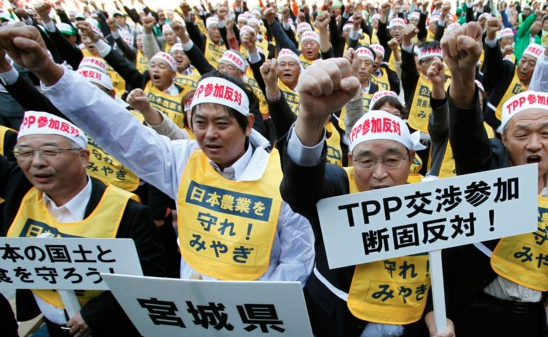
Mass protests in Japan
So, they looked to Japan. It had the same problem with its version of the trade deal similarly called TPP. Mass protests broke out as the same secret meetings gripped the political foreground. Its Prime Minister “Shinzo Abe, instructed the coalition early in the year not to “forcibly” proceed with the TPP negotiations until after elections, Kyodo News reported. Abe genuinely “feared a voter backlash in the Upper House elections” amid the growing scandal of a 242 page leaked document laying bare the bones of the deal. Having been elected June 11th, Abe now intends to force the deal through “this fall”.
I made enquiries with sources close to the ground on the EU/US TTIP deal along the same lines; was this simply a delaying tactic until after elections in 2017 for France’s Hollande and Germany’s Merkel? The response was not wholly unexpected.
“The seemingly early celebration of the end of TTIP has also surprised us a bit. Despite last week’s statements by the German and French trade ministers and the way these have been portrayed, we are continuing to campaign against the deal.”
In another exchange:
“The declarations of French and German leaders aim to: divert attention away from CETA, reduce the numbers in the streets of Germany on 17th September, put TTIP on hold while elections take place in France, Germany and the USA. The fifteenth round of TTIP negotiations will happen in the first week of October… This has been confirmed by our US friends.”
I then contacted Corporate Europe Observatory (CEO). It is a research and campaign group working to expose and challenge the privileged access and influence enjoyed by corporations and their lobby groups in EU policy making. They have been exposing the misinformation and propaganda of the EU Commission for years.
The CEO response to my same question was emphatic and quite clear:
“Public opposition to CETA and TTIP has led French and German leaders to please voters with words against TTIP. Unfortunately, the next round of TTIP negotiations is scheduled for early October and no EU leader has publicly said he or she will vote against CETA in the EU Council in October. This is clearly not the end of TTIP and CETA, just the beginning of electoral campaigns in France and Germany.”
Germany and France have taken the same stance as Japan on these trade agreements, they are not dead at all – they are lying.
I then spoke to Peter Koenig, an economist and geopolitical analyst. He is also former World Bank staff and worked extensively around the world in the fields of environment and water resources and posed the same question. He said:
“Following a debate on PressTV Edition Française, where I was one of the interviewees, the focus was on the German and French Ministers’ expressed conclusion that TTIP negotiations failed. I wrote an article “The TTIP is Dead”, hoping that spreading of this ‘promise’ by the highest authorities of the two key countries in the EU would make sure among the European populace that any deviation from this ‘promise’ would be perceived as a lie and receive strongest public expressions of protest.”
“In the meantime, it has become clear that the TTIP and TISA ‘deals’ are not at all dead. In fact, shortly after the German and French announcements, Jean-Claude Juncker, the unelected President of the European Commission, declared majestically that for him the negotiations are not dead.”
Koenig continues,
“There are other means to infiltrate the TTIP into the EU, i.e. through CETA and according to Juncker, doesn’t need ratification of each EU members’ parliament. Then there is TISA, the even more secret ‘trade agreement’ between 50 countries around the globe. TISA could easily be used to clandestinely impose TTIP rules on Europe.”
Nick Dearden, Director of Global Justice Now confirmed what Peter Koenig is saying in a Guardian piece “Think TTIP is a threat to democracy? There’s another trade deal that’s already signed”
“TTIP is not alone. Its smaller sister deal between the EU and Canada is called CETA (the Comprehensive Economic and Trade Agreement). CETA is just as dangerous as TTIP; indeed it’s in the vanguard of TTIP-style deals, because it’s already been signed by the European commission and the Canadian government. It now awaits ratification over the next 12 months.
The one positive thing about CETA is that it has already been signed and that means that we’re allowed to see it. Its 1,500 pages show us that it’s a threat to not only our food standards, but also the battle against climate change, our ability to regulate big banks to prevent another crash and our power to renationalise industries.
CETA contains a new legal system, open only to foreign corporations and investors. Should the British government make a decision, say, to outlaw dangerous chemicals, improve food safety or put cigarettes in plain packaging, a Canadian company can sue the British government for “unfairness”. And by unfairness this simply means they can’t make as much profit as they expected. The “trial” would be held as a special tribunal, overseen by corporate lawyers.”
What is missing from this statement is that any American corporation headquartered in Canada can sue any nation in the EU via CETA for the same reasons – namely, loss of ‘expected’ profits. They don’t actually have to be Canadian corporations.
As Global Justice also confirms, Canada has itself fought and lost a plentiful and diverse range of legal cases brought by US corporations under the North American Free Trade Agreement (Nafta) for “outlawing carcinogenic chemicals in petrol, reinvesting in local communities and halting the devastation of quarries.” If TTIP doesn’t bring this horrific erosion of democratic power to the shores of Europe, CETA will. ‘Brexit’ will mean for nothing. It will be sold to the British people as a global trade agreement which will be heralded as a great success and supported by much of the media who themselves have a vested interest in such deals.
In the end, does it matter if it’s called TTIP, CETA, TISA and the like, they are all shadowy unaccountable acronyms designed to enrich the few via extreme neoliberal capitalism under the guise of free trade.
Greenwashing Wars and the US Military

Protest sign urging global conservation meeting to address the environmental damage from U.S. military bases. (Photo by Ann Wright)
By Ann Wright | Consortium News | September 9, 2016
The International Union for the Conservation of Nature (IUCN) has come in for criticism due to its lack of attention to the detrimental effects of wars and military operations on nature. Considering the degree of harm to the environment coming from these human activities, one would think that the organization might have set aside some time at its World Conservation Congress this past week in Hawaii to specifically address these concerns.
Yet, of the more than 1,300 workshops crammed into the six-day marathon environmental meeting in Honolulu, followed by four days of discussion about internal resolutions, nothing specifically addressed the destruction of the environment by military operations and wars.
The heavy funding the IUCN gets from governments is undoubtedly the rationale for not addressing this “elephant in the room” at a conference for the protection of the endangered planet – a tragic commentary on a powerful organization that should acknowledge all anti-environmental pressures.
At a presentation at the USA Pavilion during the conference, senior representatives of the U.S. Army, U.S. Air Force and U.S. Navy regaled the IUCN audience of conservationists with tales about caring for the environment, including protecting endangered species, on hundreds of U.S. military bases in the United States.
The presenters did not mention what is done on the over 800 U.S. military bases outside of the United States. In the one-hour military style briefing, the speakers failed to mention the incredible amounts of fossil fuels used by military aircraft, ships and land vehicles that leave mammoth carbon footprints around the world. Also not mentioned were wars that kill humans, animals and plants; military exercise bombing of entire islands and large swaths of land; and the harmful effects of the burn pits which have incinerated the debris of war in Afghanistan and Iraq.
Each military service representative focused on the need for training areas to prepare the U.S. military to “keep peace in the world.” Of course, no mention was made of “keeping the peace” through wars of choice that have killed hundreds of thousands of persons, animals and plants, and the bombing of the cultural heritage in many areas around the world including Afghanistan, Iraq, Syria, Pakistan, Libya, Yemen and Somalia.
Miranda Ballentine, Air Force Assistant Secretary for Installations, the Environment and Energy, said the U.S. Air Force has over 5,000 aircraft, more than all the airlines in the United States — yet she never mentioned how many gallons of jet fuel are used by these aircraft, nor how many people, animals and cultural sites the aircraft have bombed.
To give one some idea of the scale of the footprint of U.S. military bases, Ballentine said Air Force has over 160 installations, including 70 major installation covering over 9 million square miles of land, larger than the country of Switzerland, plus 200 miles of coastland.
Incredibly, Ballentine said that due to commercial development around military bases, military bases have become “islands of conservation” — conservation takes place inside the protected base while there are larger conservation issues outside the fence lines of the bases.
Adding to the mammoth size of the military base footprint, Dr. Christine Altendorf, the regional director of the U.S. Army’s Installation Management Command of the Pacific, said U.S. Army bases have 12.4 million acres of land, including 1.3 million acres of wetlands, 82,605 archeological sites, 58,887 National Historical Landmarks and 223 endangered species on 118 installations.
The U.S. Navy’s briefer, a Navy Commander, added to the inventory of military equipment, saying the Navy has 3,700 aircraft; 276 ships, including 10 aircraft carriers; 72 submarines. Seventy naval installations in the United States have 4 million acres of land and 500 miles of coastline. The Navy presenter said the Navy has never heard of a marine mammal that has been harmed by U.S. Naval vessels or acoustic experiments in the past ten years.
Only One Question
At the end of the three presentations, there was time for only one question — and luckily, my intense hand waving paid off and I got to ask: “How can you conserve nature when you are bombing nature in wars of choice around the world, practicing military operations in areas that have endangered species like on the islands of Oahu, Big Island of Hawaii, Pagan, Tinian, Okinawa and bombing islands into wastelands like the Hawaiian island of Koho’olawe and the Puerto Rican island of Vieques and now you want to use the North Marianas ‘Pagan’ Island as a bombing target. And how does the construction of the new South Korean naval base in pristine marine areas of Jeju Island that will be used by the U.S. Navy and the proposed construction at Henoko of the runways into the pristine Oura Bay in Okinawa fit into conservation of nature?”
Interestingly, in the large audience of approximately 100 people, not one of them applauded the question indicating that either audience was composed primarily of Department of Defense employees, or that the conservationists are uneasy about confronting the U.S. government and particularly the U.S. military about its responsibility for its large role in the destruction of much of the planet’s environment.
The Navy representative was the only person to respond to my question. He reiterated the national security necessity for military exercises to practice to “defend peace around the world.” To his credit, he acknowledged the role the public has in commenting on the possible impact of military exercises. He said that over 32,000 comments from the public have been made on the Environmental Impact Assessment (EIA) of the possibility of artillery firing and aircraft bombing of the Northern Marianas island of Tinian — that has only 2,300 inhabitants.
Despite all odds, someone in Hawaii was able to get an exhibit of photographs of the cleanup of Koho’olawe placed on the third floor of the Hawaii Convention Center. There was no sign announcing the exhibition, just a series of photos with some explanation. In five days of attending the conference, I observed that 95 percent of the conference attendees who walked past the exhibition did not stop to look at it – until I stopped them and explained what it was about. Then, they were very interested.

A crater that was created on the Hawaiian island of Koho’olawe from massive explosions of TNT in 1965. (Photo from Hawaii Archive)
From 1941 to 1990, the island of Koho’olawe was used as a bombing range for U.S. military aircraft and naval vessels. One photograph in the exhibition showed the crater called “Sailor’s Hat” which was made by several massive explosions of TNT in 1965 to recreate and study the effects of large explosions on nearby ships and personnel to simulate in some manner the effects of a nuclear explosion. The crater affected the island’s fresh water aquifer and now no artesian water remains on the island.
After Hawaiians stopped the bombing through their protests and by staying on the island during bombings from the 1970s, the U.S. Navy returned Koho’olawe to the State of Hawaii in 2004 after a 10-year clean-up process. But only 66 percent of the surface has been cleared of unexploded ordnance (UXO), and only 10 percent cleared to a depth of 4 feet. Twenty-three percent of the surface remains uncleared and 100 percent of the waters surrounding the island have not been cleared of UXO, putting divers and ships at risk.
Okinawan Environmental Activists
Environmental activists from Okinawa had a booth at the IUCN at which they told about the attempt of the U.S. military and the national Japanese government to construct a runway complex into Oura Bay, a pristine marine area that that is the home of the protected species of marine mammal, the dugong.
The Deputy Governor of Okinawa and the Mayor of Nago city, Okinawa, both of whom have been key figures in the grassroots campaign to stop the construction of the runways and the lawsuits filed by the provincial government of Okinawa against the federal Japanese government, gave presentations about the citizens’ struggle against the construction of the runways.
However, there was no mention of the environmental effects on the marine environment from the construction of a huge new naval base on Jeju Island, South Korea, the site of the previous IUCN conference four years ago. At that conference, IUCN, no doubt at the request of the South Korean government, refused to allow citizen activists to have a booth inside the convention or make presentations like the Okinawans did this year. As a result, the Jeju Island campaigners were forced to stay outside the conference site.
Four years later in the 2016 WCC conference in Hawaii, the Government of Japan and the Province of Jeju Island sponsored a large multi-media pavilion about Jeju island which did not mention the construction of the new naval base and the destruction of the cultural heritage of the site nor the displacement of women divers who had dived at the location for generations.
On Sept. 3, local groups in Honolulu came to the Hawaii Convention Center with signs to remind the IUCN of the U.S. militarization of Asia and the Pacific. Signs and posters from local environmentalists cited the environmental impact from the huge 108,863-acre Pohakuloa bombing range on the Big Island of Hawaii, the largest U.S. military installation in the Pacific; the Aegis missile test center on the island of Kauai; and the four large U.S. Army, Navy, Air Force and Marine bases on the island of Oahu.
Other signs referenced the extensive number of U.S. military bases in Japan, Okinawa, South Korea, Guam and new U.S. military installations in the Philippines and Australia.
Ann Wright served 29 years in the US Army/Army Reserves and retired as a Colonel. She also served 16 years as a US diplomat in US Embassies in Nicaragua, Grenada, Somalia, Uzbekistan, Kyrgyzstan, Sierra Leone, Micronesia and Mongolia. She was on the small team that reopened the US Embassy in Kabul, Afghanistan in December 2001. She resigned from the US Department of State in March 2003 in opposition to the war on Iraq.
Addictive painkiller profiteer donates $500k to fight cannabis legalization in Arizona
RT | September 9, 2016
Insys Therapeutics, which profits off of a painkiller 50 times more potent than heroin, has donated $500,000 to a campaign opposing marijuana legalization in the US state of Arizona.
The maker of the drug Subsys, a sublingual fentanyl spray, said that children are their main concern for fighting Proposition 205, which appears on the ballot this November.
“They want to be able to push their far more addictive, far more harmful and far more dangerous opioid drugs,” JP Holyoak, chair of the committee pushing Prop 205, told the Arizona Capitol Times.
Supporters of cannabis legalization say legal access to their natural non-addictive painkiller could eliminate the need for drugs like fentanyl, which contributes to America’s growing epidemic of opioid dependency that claims more lives each year than gunshot wounds or car crashes.
Prince died from an overdose of fentanyl and one third of Ohio’s 3,050 deaths caused by lethal drug consumption last year were linked to the drug, according to the Columbus Dispatch.
A 2014 study by John Hopkins University found that states which legalized medical marijuana had 25 percent less overdose deaths from prescription drugs than those where it remained illegal.
Insys said in a statement that its opposition to the legalization of cannabis was “because it fails to protect the safety of Arizona’s citizens, and particularly its children.”
It did not address whether the outcome could have financial benefits for the company, although all of its profits come from the sale of its only product – the fentanyl-containing spray, according to its August filing.
Last month, Illinois Attorney General, Lisa Madigan, brought a lawsuit against Insys over claims they had deceptively marketed and sold their medication to doctors for uses other than cancer treatment, which the FDA has approved its sole use for.
Madigan said the company’s “desire for increased profits led it to disregard patients’ health and push addictive opioids for non-FDA approved purposes.”
Insys became the largest contributor to the anti-legalization campaign after donating to Arizonans for Responsible Drug Policy, a group opposing the initiative to regulate marijuana in the state under Prop 205.
Their donation was over 400 percent higher than the next largest donor, the Arizona Chamber of Commerce and Industry, with $110,000.
Pro-legalization campaigners have called for the donation to be returned as it has now tainted the campaign against Prop 205.
“We hope that every Arizonan understands that Arizonans for Responsible Drug Policy is now a complete misnomer. Their entire campaign is tainted by this money. Any time an ad airs against Proposition 205, the voters should know that it was paid for by highly suspect Big Pharma actors,” Holyoak said.
When questioned by the Arizona Capitol Times about donations made to the Marijuana Policy Project in support of Prop 205, Holyoak did not dispute that several out-of-state interest donors “stand to make millions if Prop 205 passes.”
Coincidentally, the recently-passed Bill 205 in Canada banned the sale of pill presses for making fentanyl.
Brazil Elite Codifies Budget Practice Used to Impeach Rousseff
teleSUR – September 4, 2016
Brazil’s newly-installed President Michel Temer has signed legislation that essentially authorizes the identical financial accounting maneuver that was used to justify the impeachment bid against ousted President Dilma Rousseff’s just days after she was removed from office.
The law, announced Friday in the official gazette, expands the government’s ability to seek additional credits without securing authorization from Congress. As described by Brasil de Fato, the rule broadly opens the door for the budgetary maneuver known in Brazil as “pedaling,” in which the government borrows money from state banks to make the budget appear in a better position than it is.
This longstanding practice was used to propel the impeachment process that finally ousted Rousseff from office last Wednesday in a move widely condemned as a parliamentary coup.
Rousseff’s supporters repeatedly pointed out that the accounting trick had been used by many of her predecessors without scrutiny. Independent auditors also found her not guilty of breaking budgetary rules — a fact that did not stop the ill-footed impeachment process from going ahead.
According to Brazil’s Senate news agency Agencia Senado, the unelected Temer government gave pedaling a green-light, claiming that the rule change will make government budget management “more flexible,” including shuffling of expenditures associated with the federal infrastructure Growth Acceleration Program, better known as PAC.
The act allows the government to boost by as much as 20 percent the value of an expenditure by writing down by the value of another by a corresponding 20 percent, which, in fact, doubles the level allowed by previous administrative rules.
Rousseff was ousted Wednesday in a 61-20 Senate vote in favor of her impeachment, though she retained her so-called political rights to hold public office in a second vote.
The day after the impeachment ballot, Rousseff’s defense appealed to the Supreme Court to compel a second Senate impeachment vote, arguing that the process was unconstitutional on the grounds that the budgetary crime she is accused of is not an impeachable offense according to Brazilian law.
Rousseff’s rivals long attempted to paint the impeachment process as a campaign to root out government corruption. But aside from the fact that multiple other leaders have used the pedaling procedure, damning recordings released weeks after her suspension in May revealed that top opposition figures schemed with the Supreme Court and military command to ensure Rousseff’s ouster as part of a bid to stop corruption investigations against their allies.
Like many of his top allies and cabinet members, Temer — installed as president despite being banned from running for public office for eight years — is embroiled in multi-million dollar fraud scandals.
NYT: Hillary Not on Her Deathbed After All, Just Has No Time or Patience for You Commoners
By Steve Sailer • Unz Review • September 3, 2016
From the New York Times:
Where Has Hillary Clinton Been? Ask the Ultrarich
By AMY CHOZICK and JONATHAN MARTIN SEPT. 3, 2016At a private fund-raiser Tuesday night at a waterfront Hamptons estate, Hillary Clinton danced alongside Jimmy Buffett, Jon Bon Jovi and Paul McCartney, and joined in a singalong finale to “Hey Jude.”
“I stand between you and the apocalypse,” a confident Mrs. Clinton declared to laughs, exhibiting a flash of self-awareness and humor to a crowd that included Calvin Klein and Harvey Weinstein and for whom the prospect of a Donald J. Trump presidency is dire.
Mr. Trump has pointed to Mrs. Clinton’s noticeably scant schedule of campaign events this summer to suggest she has been hiding from the public. But Mrs. Clinton has been more than accessible to those who reside in some of the country’s most moneyed enclaves and are willing to spend hundreds of thousands of dollars to see her. In the last two weeks of August, Mrs. Clinton raked in roughly $50 million at 22 fund-raising events, averaging around $150,000 an hour, according to a New York Times tally.
And while Mrs. Clinton has faced criticism for her failure to hold a news conference for months, she has fielded hundreds of questions from the ultrarich in places like the Hamptons, Martha’s Vineyard, Beverly Hills and Silicon Valley.
“It’s the old adage, you go to where the money is,” said Jay S. Jacobs, a prominent New York Democrat.
Mrs. Clinton raised about $143 million in August, the campaign’s best month yet. At a single event on Tuesday in Sagaponack, N.Y., 10 people paid at least $250,000 to meet her, raising $2.5 million.
If Mr. Trump appears to be waging his campaign in rallies and network interviews, Mrs. Clinton’s second presidential bid seems to amount to a series of high-dollar fund-raisers with public appearances added to the schedule when they can be fit in. Last week, for example, she diverged just once from her packed fund-raising schedule to deliver a speech. …
The public has gotten used to seeing Mrs. Clinton’s carefully choreographed appearances and her somewhat halting speeches and TV interviews over the course of the long — and sometimes seemingly joyless — campaign, but donors this summer have glimpsed an entirely different person.
It is clear from interviews with more than a dozen attendees of Mrs. Clinton’s finance events this summer and a handful of pictures and videos of her at the closed-press gatherings that Mrs. Clinton, often described as warm and personable in small settings, whoever the audience, can be especially relaxed, candid and even joyous in this company.
… If she feels most at ease around millionaires, within the gilded bubble, it is in part because they are some of her most intimate friends.
“It’s like going to a wedding or a bar mitzvah — you catch up,” explained Mitchell Berger, a Democratic donor in Florida, about the familial nature of the events. …
Mr. Berger, who joined Mrs. Clinton last month at a donor event in Miami Beach, said many of the individual conversations before and after she speaks at the gatherings are centered more on grandchildren than weighty policy matters.
But when she has had a give-and-take this summer about issues, Mrs. Clinton, who has promised to “reshuffle the deck” in favor of the middle class and portrayed Mr. Trump as an out-of-touch billionaire, has almost exclusively been fielding the concerns of the wealthiest Americans. …
Another advantage to choosing private fund-raisers over town halls or other public events is that Mrs. Clinton can bask in an affectionate embrace as hosts try to limit confrontational engagements.
Lady Lynn Forester de Rothschild, a backer of Democrats and a friend of the Clintons’, made sure attendees did not grill Mrs. Clinton at the $100,000-per-couple lamb dinner Mrs. Forester de Rothschild hosted under a tent on the lawn of her oceanfront Martha’s Vineyard mansion.
“I said, ‘Let’s make it a nice night for her and show her our love,’” Mrs. Forester de Rothschild said.

Hillary, Sir Evelyn Robert Adrian de Rothschild, Bill, Lady Lynn Forester de Rothschild (date unknown)
I can’t think of anything witty to say about Mrs. Forester de Rothschild, but I just wanted to help the reporters out with getting their point across by mentioning Mrs. Forester de Rothschild’s name a fourth and fifth time. And now a sixth: Lady Lynn Forester de Rothschild. …
But Mr. and Mrs. Clinton have occupied a particular place in the social fabric of the enclave. Over the past several summers, they have spent the last two weeks of August in a rented 12,000-square-foot home with a heated pool in East Hampton and in a six-bedroom mansion with a private path to the beach in Sagaponack. This year, the former first couple stayed in the guesthouse of Steven Spielberg’s East Hampton compound built on nine acres overlooking Georgica and Lily Ponds.
Mr. Trump’s candidacy has allowed Mrs. Clinton to reach out to a new set of donors in the area who typically give to Republicans but dislike the current nominee. (Mr. Trump feels more at home at Mar-a-Lago in Palm Beach, Fla., than in the Hamptons, where the exclusive Maidstone Club once denied him a full-time membership, according to The New York Post.)
So, is Trump a Golf Nazi or is he a victim of the Golf Nazis? This is all very confusing …
Let’s see if we can up this article’s Rothschild Index without doing too much work. From Wikipedia:
Lynn Forester de Rothschild
Born Lynn Forester
July 2, 1954 (age 62)
Bergen County, New Jersey
Nationality American
Alma mater Pomona College
Columbia Law School
Occupation E.L. Rothschild (CEO)
Title Lady de RothschildSpouse(s) Alexander H. Platt (m.1978; div.)
Andrew Stein (m.1983 – div. 1993)
Sir Evelyn de Rothschild (m. 2000)Children 2
Lynn Forester de Rothschild, Lady de Rothschild (born Lynn Forester; July 2, 1954) is the chief executive officer of E.L. Rothschild, a holding company she owns with her third husband, Sir Evelyn Robert de Rothschild, a member of the Rothschild family.[1] The company manages investments in The Economist Group, owner of The Economist magazine, Congressional Quarterly and the Economist Intelligence Unit, E.L. Rothschild LP, a leading independent wealth management firm in the United States, as well as real estate, agricultural and food interests.[2]
She publicly supports many politicians and is a known early Hillary Clinton supporter.[3] She also rallies for a political movement called Inclusive Capitalism. She led the Conference of Inclusive Capitalism in London in 2014[4] and 2015 and founded the Coalition for Inclusive Capitalism.[5]
I think that gets the number of times the name “Rothschild” appears up to 17.
Oh, now the Rothschild Index is 18.
Wait, now the Rothschild Index is 19 …
I hadn’t actually been aware of the Rothschild-Economist magazine link, but now that I am, a lot more things make sense.
FBI Notes: Hillary Staffers Smash Burner Phones With Hammers, Destroy Evidence
Sputnik – 03.09.2016
On Friday, the FBI released documents detailing its investigative process into Hillary Clinton’s alleged malfeasance as Secretary of State tied to the use of an unauthorized private email server that opponents contest placed America’s national security in peril by leaving it vulnerable to hacks from foreign powers.
The timing of the release, ahead of a three-day holiday weekend in the United States – a historic lull point in American media coverage as families across the country plan vacations and gather around the barbecue – appears to be the product of a careful stagecraft to limit the impact of the incendiary findings.
Notably, the FBI report included statements by a Hillary Clinton aide, Justin Cooper, who recalled “two instances where he destroyed Clinton’s old mobile phones by breaking them in half or hitting them with a hammer” in stark violation to the mandate for evidence preservation placed on public figures if they have receive a subpoena or if it was foreseeable to a reasonable person that they may be in the future.
Hillary Clinton had at least 13 mobile devices according to the investigation, used by the former Secretary of State to send official emails using her private email server, in a practice some are likening to a mobster’s use of burner phones to avoid detection by authorities.
Her top aide, Huma Abedin, chalked up the unusual use of mobile devices to Clinton’s age and technological ignorance suggesting that Hillary would use a new phone for a few days before reverting back to an older, more familiar model.
It has also been established in the FBI investigatory findings that Hillary Clinton’s IT team wiped the email server erasing any potentially incriminating evidence after she had already received a subpoena from the House Select Committee on Benghazi – an act that appears to meet federal criminal standards for destruction of evidence and failure to preserve documents when under an obligation by subpoena.
Hillary received a subpoena from the House Select Committee on March 4, 2015 instructing her to preserve and deliver all emails from her personal servers, but three weeks later a staffer with Platte River Networks (PRN), Hillary’s IT team that managed the homebrew server, permanently erased the contents of the former Secretary of State’s email archive with a program called Bleach Bit.
The FBI findings show that the PRN staff member “was aware of the existence of the preservation request and the fact that it meant he should not disturb Clinton’s email data on the PRN server.”
Federal officials appear to have decided not to pursue criminal charges against the low-level IT staffer who was not the target of the investigation and were unable to find a definitive link between Hillary and the destruction of evidence – such as a direct order by Secretary Clinton to delete the documents.
It is established that there was a conference call between the PRN staff member and “President [Bill] Clinton’s Staff” immediately before the deletion of emails, but the contents of that call are unknown.
US Arms Makers Invest in a New Cold War
By Jonathan Marshall | Consortium News | September 1, 2016
The U.S. military has won only a single major war since the end of World War II (the Gulf War of 1990-91). But U.S. military contractors continue to win major budget wars in Congress nearly every year, proving that no force on earth can resist their lobbying prowess and political clout.
Consider the steady march to victory of the biggest single weapons program in history — the planned purchase of advanced Lockheed-Martin F-35 jets by the Air Force, Navy, and Marines at a total projected cost of more than $1 trillion.
The Air Force and Marines have both declared the Joint Strike Fighter ready for combat, and Congress is now forking over billions of dollars a year to acquire what is slated to become a fleet of 2,400 jets.
Yet the world’s most expensive fighter bomber still doesn’t work properly and may never perform as advertised. That’s not “dezinformatsiya” from Russian “information warfare” specialists. That’s the official opinion of the Pentagon’s top weapons evaluator, Michael Gilmore.
In an Aug, 9 memo obtained by Bloomberg News, Gilmore warned senior Pentagon officials that the F-35 program “is actually not on a path toward success but instead on a path toward failing to deliver” the aircraft’s promised capabilities. He said the program “is running out of time and money to complete the planned flight testing and implement the required fixes and modifications.”
The military testing czar reported that complex software problems and testing deficiencies “continue to be discovered at a substantial rate.” As a result, the planes may fail to track moving targets on the ground, warn pilots when enemy radar systems spot them, or make use of a newly designed bomb. Even the F-35’s gun may not function properly.
Devastating Assessments
The internal Pentagon assessment was just the latest in a long list of devastating critical assessments and development setbacks for the plane. They include repeated groundings of the plane due to fires and other safety issues; the discovery of dangerous engine instability; and helmets that can cause fatal whiplash. The plane even got soundly beaten in a mock engagement with a much older (and cheaper) F-16.
Last year, an article in the conservative National Review argued that “the biggest threat the U.S. military faces over the next few decades is not the carrier-killing Chinese anti-ship ballistic missile, or the proliferation of inexpensive quiet diesel-electric attack subs, or even Chinese and Russian anti-satellite programs. The biggest threat comes from the F-35 . . . For this trillion-dollar-plus investment we get a plane far slower than a 1970s F-14 Tomcat, a plane with less than half the range of a 40-year-old A-6 Intruder . . . and a plane that had its head handed to it by an F-16 during a recent dogfight competition.”
Likening the F-35 to a previous failed fighter jet program, retired Air Force Colonel Dan Ward observed last year, “Perhaps the truly best scenario for the Joint Strike Fighter is for it to follow in the footsteps of the F-22 and provide a combat capability that is irrelevant to actual military needs. That way, when the whole fleet gets grounded because of an unsolvable flaw, the impact on our defense posture would be nil.”
Lockheed’s “Pay-to-Play Ad Agency”
Coming to the program’s defense most recently was military analyst Dan Goure, in the blog of the respected magazine, The National Interest. Goure belittled critics in the Pentagon’s Operational Test and Evaluation Office as “green eyeshade people, like the goblins at Gringott’s in the Harry Potter series.”
Describing the F-35 as “a revolutionary platform,” he declared, “Its ability to operate undetected in hostile airspace, gathering information and even targeting data on enemy air and ground targets, before launching surprise attacks demonstrates a decisive advantage over existing threat systems. . . . The Joint Strike Fighter test program is making progress at an accelerated rate. More to the point, even before it has completed the rigid performance template laid out by DOT&E, the F-35 has demonstrated capabilities that far exceed any current Western fighter.”
If that reads a bit like a Lockheed-Martin marketing brochure, consider the source. In his article, Goure identified himself only as a vice president of the Lexington Institute, which bills itself as “a nonprofit public-policy research organization headquartered in Arlington, Virginia.”
What Goure didn’t say — and the Lexington Institute doesn’t generally disclose — is that “it receives contributions from defense giants Lockheed Martin, Boeing, Northrop Grumman and others, which pay Lexington to ‘comment on defense,’” according to a 2010 profile in Politico.
Earlier the same year, Harper’s contributor Ken Silverstein called the widely quoted think tank “the defense industry’s pay-to-play ad agency.” He added, “Outfits like Lexington produce the press conferences, position papers and op-eds that keep military money flowing to defense contractors.”
Goure’s indirect association with Lockheed gives a hint as to why programs like the F-35 continue to thrive despite performance failures, gigantic cost overruns, and schedule delays that would otherwise trigger headline-grabbing congressional investigations and produce streams of indignant rhetoric from Fox News commentators about government failure.
Promoting the New Cold War
Think tanks like the Lexington Institute are prime movers behind the domestic propaganda campaign to revive the Cold War against the diminished Russian state and justify weapons programs like the F-35.
As Lee Fang observed recently in The Intercept, “The escalating anti-Russian rhetoric in the U.S. presidential campaign comes in the midst of a major push by military contractors to position Moscow as a potent enemy that must be countered with a drastic increase in military spending by NATO countries.”
Thus the Lockheed-funded Aerospace Industries Association warns that the Obama administration is failing to spend enough on “aircraft, ship and ground combat systems” to adequately address “Russian aggression on NATO’s doorstep.” The Lockheed- and Pentagon-funded Center for European Policy Analysis issues a stream of alarmist reports about Russian military threats to Eastern Europe.
And the highly influential Atlantic Council — funded by Lockheed-Martin, Raytheon, the U.S. Navy, Army, Air Force, Marines, and even the Ukrainian World Congress — promotes articles like “Why Peace is Impossible with Putin” and declares that NATO must “commit to greater military spending” to deal with “a revanchist Russia.”
Origins of NATO’s Expansion
The campaign to portray Russia as a menace, led by contractor-funded pundits and analysts, began soon after the Cold War ended. In 1996, Lockheed executive Bruce Jackson founded the U.S. Committee on NATO, whose motto was “Strengthen America, Secure Europe. Defend Values. Expand NATO.”
Its mission ran directly contrary to promises by the George H.W. Bush administration not to expand the Western military alliance eastward after the fall of the Soviet Union.
Joining Jackson were such neo-conservative hawks as Paul Wolfowitz, Richard Perle and Robert Kagan. One neocon insider called Jackson — who went on to co-found the Committee for the Liberation of Iraq — “the nexus between the defense industry and the neoconservatives. He translates us to them, and them to us.”
The organization’s intense and highly successful lobbying efforts did not go unnoticed. In 1998, the New York Times reported that “American arms manufacturers, who stand to gain billions of dollars in sales of weapons, communication systems and other military equipment if the Senate approves NATO expansion, have made enormous investments in lobbyists and campaign contributions to promote their cause in Washington. . . .
“The four dozen companies whose main business is arms have showered candidates with $32.3 million since the collapse of Communism in Eastern Europe at the beginning of the decade. By comparison, the tobacco lobby spent $26.9 million in that same period, 1991 to 1997.”
A spokesman for Lockheed said, ”We’ve taken the long-term approach to NATO expansion, establishing alliances. When the day arrives and those countries are in a position to buy combat aircraft, we certainly intend on being a competitor.”
The lobbying worked. In 1999, against Russian opposition, NATO absorbed the Czech Republic, Hungary and Poland. In 2004, it added Bulgaria, Estonia, Latvia, Lithuania, Romania, Slovakia and Slovenia. Albania and Croatia joined next in 2009. Most provocatively, in 2008 NATO invited Ukraine to join the Western alliance, setting the stage for the dangerous conflict between NATO and Russia over that country today.
The fortunes of American arms makers soared. “By 2014, the twelve new [NATO] members had purchased close to $17 billion worth of American weapons,” according to Andrew Cockburn, “while . . . Romania celebrated the arrival of Eastern Europe’s first $134 million Lockheed Martin Aegis Ashore missile-defense system.”
Last fall, Washington Business Journal reported that “if anyone is benefitting from the unease between Russia and the rest of the world, it would have to be Bethesda-based Lockheed Martin Corp. (NYSE: LMT). The company is positioned to make large profits off what could very well be an international military spending spree by Russia’s neighbors.”
Citing a big contract to sell missiles to Poland, the newspaper added, “Officials from Lockheed aren’t explicitly declaring that Russian President Vladimir Putin’s adventurism in Ukraine is good for business, but they aren’t shying away from recognizing the opportunity that Poland is presenting them as Warsaw continues to embark on a massive military modernization project — one that has accelerated as tensions grip Eastern Europe.”
Lockheed’s Lobby Machine
Lockheed continues to pump money into the American political system to ensure that it remains the nation’s largest military contractor. From 2008 to 2015, its lobbying expenditures exceeded $13 million in all but one year. The company sprinkled business from the F-35 program into 46 states and claims that it generates tens of thousands of jobs.
Among the 18 states enjoying a claimed economic impact of more than $100 million from the fighter jet is Vermont — which is why the F-35 gets the support even of Sen. Bernie Sanders.
As he told one town hall meeting, “It employs hundreds of people. It provides a college education for hundreds of people. So for me the question is not whether we have the F-35 or not. It is here. The question for me is whether it is located in Burlington, Vermont or whether it is located in Florida.”
In 1961, President Eisenhower observed that the “conjunction of an immense military establishment and a large arms industry” had begun to influence “every city, every State house, every office of the Federal government.”
In his famous farewell address to the nation, Eisenhower warned that “we must guard against the acquisition of unwarranted influence, whether sought or unsought, by the military-industrial complex. The potential for the disastrous rise of misplaced power exists and will persist.”
How right he was. But not even Ike could have imagined the extravagant costs to the nation of failing to hold that complex at bay — ranging from a trillion-dollar fighter jet program to the needless and far more dangerous resurrection of the Cold War a quarter century after the West achieved victory.
Jonathan Marshall is author or co-author of five books on international affairs, including The Lebanese Connection: Corruption, Civil War and the International Drug Traffic (Stanford University Press, 2012). Some of his previous articles for Consortiumnews were “Risky Blowback from Russian Sanctions”; “Neocons Want Regime Change in Iran”; “Saudi Cash Wins France’s Favor”; “The Saudis’ Hurt Feelings”; “Saudi Arabia’s Nuclear Bluster”; “The US Hand in the Syrian Mess”; and “Hidden Origins of Syria’s Civil War.” ]
‘Rousseff’s impeachment – sad day for Brazil & democracy’
RT | September 1, 2016
Was the impeachment process against Brazil’s Dilma Rousseff justified? Is interim President Michel Temer credible? How will the people of Brazil react and are we likely to see protests escalating?
Suspended Brazilian President Dilma Rousseff was impeached on Wednesday, after the final vote in Senate. She was ruled to have mishandled Brazil’s budget, and misrepresented the state of the economy prior to her reelection in 2014.
Michel Temer, former Vice President under Rousseff, became acting president of Brazil in May after the start of the impeachment of Rousseff.
Watchdog groups say about 60 percent of the country’s lawmakers, as well as interim President Temer, who may potentially form a new government, have been accused of corruption and fraud.
Maria Mendonca, professor at the University of Rio de Janeiro called the impeachment of Dilma Rousseff “very sad for Brazil” and “a very sad day for democracy”. The result of the 2014 elections, when Dilma was reelected, “was not respected.”
“It is a process that reminds us of the military coup in 1964. That was not a real trial, because most Senators already had a position – they made up their minds even before the whole trial started. There was no legal basis for the impeachment. The public prosecutor already had cleared Dilma of all charges in terms of the mechanisms of basically issuing debt to pay for social programs, which is a regular mechanism in Brazil and also in other countries,” she told RT.
In her opinion, the impeachment was “a way for unpopular corrupt politicians to take power without going through an electoral process.”
According to Mendonca, it is now difficult to predict how the situation is going to develop and whether protests by Rousseff’s supporters – that have been going on for days now – may escalate.
“I think we’re going to stay in a situation of limbo for a while, of uncertainty, because the main rules of democracy were broken,” she said.
She added though that “the media in Brazil can manipulate public opinion,” and has been doing so since the beginning of the impeachment process.
“But once people realize that we’re going to have more instability: cuts in social programs, in health care, education, and we’re going to have more serious economic crisis, then people will realize that this was a manipulative process to get rid of a president that was democratically elected; and to implement austerity measures that would make the situation even more unstable politically and economically,” Mendonca said.
Good for Brazil in longer term
David Riedel, economic analyst from Riedel Research Group argues that Rousseff’s impeachment “is a good move” for Brazil as in the longer term it would benefit from a more “business friendly government.”
Dilma Rousseff has run “a very populist regime; she’s been giving a lot of support to social programs and other things,” he told RT. “I think you’ll probably see some social unrest, as those goodies and those free benefits start to be taken away from the population. But it’s a good move for Brazil in the medium and longer term. They needed to take this step. They were successful with the Olympics, which were great, and now they need to be successful in this transition of power to, I would argue, a more business friendly government, which is going to be very good for investors.”
If Michel Temer – who is running the country at the moment and is likely to become the next Brazilian President – “takes advantage of this populist, very expensive spending that the Rousseff and [Luiz Inacio] Lula [da Silva], before her, administrations had under way – that can protect the currency; it can help improve the investment environment,” Riedel said.
“International investors want Brazil to be a success – so they will give them the benefit without doubt if they see things headed in the right direction. So if they are business friendly and investor friendly and cut back on the profligate spending that has been such an issue across Latin America, I think that investors would give them a second look,” the analyst said.
Absolutely no justification
An independent investigation found there were no grounds for launching action.
Political scientist Daniel Shaw from the City University of New York says there’s “absolutely no justification” for the impeachment “from the prospective of millions of Brazilians who voted for Dilma Rousseff and now see the democratically elected president unconstitutionally removed from power.”
But in the minds of the Brazilian rich, the bourgeoisie –“they feel like they don’t need justification to continue to push things in a rightward direction and to continue to exploit the majority of Brazilians,” he said.
WikiLeaks has revealed that Brazil’s new interim president, Temer, was an embassy informant for US intelligence.
Some also suggest that the US could have orchestrated the “coup” against Rousseff.
Commenting, Shaw said: “If we look critically at the history of US foreign policy and how they’d been involved in supporting dictatorships from Pinochet to Somoza across Latin America, when all of the FOI requests are complete in 10-15 years, there’s no question there’ll come out the role that the US State Department played.”
“They are against the leftward trend that’s been going on since 1999 with Venezuela at the helm and, of course Cuba, Bolivia, Ecuador. This is a blow, an attack not just on the Brazilian people but on the entire progressive current that was sweeping across Latin America,” he added.
Secretive ‘Children of Israel’ backs Trump at $25,000-per-head California fundraiser
RT | August 31, 2016
Republican presidential nominee Donald Trump headlined a $25,000-per-ticket fundraiser at the California home of Saul Fox, a private equity CEO and secret donor behind the “Children of Israel.”
Forty people attended the Monday fundraiser including former New York Mayor Rudy Giuliani, who arrived with Trump.
The visit was the billionaire’s first visit to San Jose since a clash between his supporters and protesters in the Silicon Valley city.
Fox is one of the many political donors who use so-called ‘ghost corporations’ to conceal their identity.
It was revealed only earlier this month that he was the main donor behind ‘Children of Israel,’ who have donated $734,000 to the Republican party so far this year, according to The Intercept.
This includes a $400,000 donation to the Super PAC Stand for Truth, which supported Ted Cruz’s presidential run, as well as $334,000 to the RNC.
Shaofen Gao, a realtor in Silicon Valley with no history of making political contributions, was listed as the registered agent for Children of Israel in mid-2015, but a later filing revealed that the sole person behind the money was Fox.
Fox hasn’t commented on why he channeled the money through the company, keeping his identity hidden. In addition to the company’s donations, Fox himself has also donated to the GOP.
Most recently, he donated $100,000 to speaker of the House Paul Ryan’s aptly-titled fundraiser “Team Ryan” as well as a $25,000 donation to Trump’s joint fundraising committee.
Fox’s 2016 donations also include $2,700 to Mike Huckabee’s presidential bid and the $5,400 maximum to the campaigns of both Cruz and Marco Rubio.
Since the Supreme Court’s Citizens United v FEC decision in 2010, the 2016 election cycle has seen an unprecedented influx of corporate donations with one out of every €8 collected by super PACs coming from ‘ghost corporations,’ according to the Washington Post.
In 2015, Children of Israel gave $50,000 to Pursuing America’s Greatness, a super PAC supporting Huckabee’s run, as well as $100,000 to a pro-Huckabee group.
Some Important Things That Really Do Matter About Hillary Clinton
By Peter Van Buren | We Meant Well | August 31, 2016
 Even if everyone does it, that does not make it right. That excuse did not work for you in 6th grade when you were caught smoking in the girl’s room and it should not be accepted from a presidential candidate or her supporters in the media.
Many politicians do crappy things. That is not an excuse for you to also do them. See above.
“Well, at least I wasn’t indicted” is not a very high standard for the presidency.
“There is no proof of quid pro quo.” What do you mean by proof? A notarized statement “This guy gave us money, so let’s sell him weapons?” Reality doesn’t work that way so spare us the strawman argument. Phone calls are made. Conversations happen. Minions learn quickly what their boss wants. People at the Clintons’ level rarely leave paper trails behind and when they do, they delete them before the FBI arrives to pick up the server.
If someone offers you millions of dollars for essentially no work (i.e., a speech) they are going to want something in return. If you want more money, you will need to give something to them.
“All they wanted was a meeting with the secretary to offer their views.” Sure, maybe. But in Washington the currency is closeness to power. For a wealthy person, buying just material things loses its charm after awhile. They buy access, they buy the appearance of power, they buy chances to take those photos of themselves with prominent world leaders all rich people have on their walls. You look like a sap, arm candy in return for cash. Quid pro quo can mean a meeting, a visa issued, an arms deal made.
Follow the money. Always follow the money.
If the secretary of state’s name is Clinton and the foundation receiving the money is named Clinton, they are part of the same thing.
If you put classified material on an unclassified server, that is wrong. It exposes that material to America’s adversaries. Presidents should simply not do that. No one else in government has ever knowingly been allowed to do that.
There is such a thing inside the U.S. government called retroactive classification. You may not like it, and you may have convinced sops in the media to pretend with you it does not exist, but it is real. I’ll Google it for you, here, and here. Someone please call CNN and pass them those links.
The Clinton Foundation as a charity has done some good deeds. But do not conflate those with its role as a money laundering tool. The two are very separate functions of the same organization. And you can have the first without the second. In fact, that’s how good charities work.
Avoiding even the appearance of unethical behavior is important. Persons throughout the government watch what their senior leaders do as signals as to what they can get away with. Leadership matters, and that means staying clean and making sure everyone sees that you are clean. You lead by example, one way or the other.
When global leaders come to wonder if you can be bought off for some “donations,” they will either lose respect for you, or want to buy you off themselves. They will not simply ignore it.
Putin could really not give a sh*t which assclown is elected president. He’ll go on acting in his country’s best interests no matter who is in the White House, as he has done through multiple administrations already. Get over yourself.
Hiding from the press and not holding press conferences seems like the behavior of a petulant six-year-old.
It is not leadership nor is it presidential to be caught as a liar and a prevaricator on a regular basis. People do not trust you; not voters, not the Congresspeople you will need to work with, not other world leaders you will have to negotiate with.
The lesser of two evils is still evil. Why do you want to knowingly vote for evil?
Featured Video

Death Spikes & Rising Cancer In Our Youth Explained
or go to
Aletho News Archives – Video-Images
From the Archives
Politicians lie
By Mazin Qumsiyeh | Popular Resistance | August 18, 2013
There is no way to say this truth nicely: Politicians lie. That includes Japanese, American, Egyptian, Israeli, and Palestinian politicians! Is there something more common sense than that? Yet, so many citizens around the world believe their own politicians or wistfully acknowledge lies but think it is part of the job needed to run things. They believe even when politicians contradict themselves blatantly. This phenomenon is rather remarkable. It is a dissonance and disconnect from reality that many seem oblivious to. It is very dangerous because it can lead to accepting rationales for going to war. These can be deadly wars that lead to millions of lives lost as happened in what was called World War 1 and WW2. Even when incredible and declassified evidence abound, politicians continue to lie and old mythologies refuse to die. Here are just a few of the countless lies told to us over the past few decades… continue
Blog Roll
 Aletho News
- Ukrainian Soldiers, Potential Mercenaries: Have Gun, Will Travel!
- Burnham’s UN debut… A masterclass in British disinformation
- Iran flights continue despite US aviation sanctions
- Global Tipping Points Lead the World Into a State of Entropy
- The day-after at the White House: USA and Xi Jinping
- The Geopolitical Balance in the Red Sea: The UAE Being Displaced by New Players
- Iraqi resistance group vows to stage airport sit-ins over Iran aerial blockade
- Turkish parliament to review Saudi-Pakistan defense pact next month
- DEATH SPIKES & RISING CANCER IN OUR YOUTH EXPLAINED
- Iran offers Trump deal before US election
- If Americans Knew
- Deconstructing Netanyahu’s pants-on-fire UN rant – Daily Update
- Trump betrayed voters with his campaign lies and prioritized a foreign country once he took office
- Netanyahu calls Israel’s war in Gaza ‘opposite of genocide’ in UN speech to near-empty hall
- Settler Kidnappings: Torture, Sexual Abuse and Terrorisation of Palestinian Abductees as Israel Deepens Annexation of West Bank
- Gaza winter nears as 162,000 tents become unusable, raising fears of humanitarian crisis
- Netanyahu says, “It’s the opposite of genocide”; UN says Gaza economy is world’s ‘most severe crisis on record’ – Daily Update
- Israel’s US-Backed Assault on Gaza Has Created the ‘World’s Most Severe Economic Crisis on Record’: UN
- ‘Protecting U.S. Citizens’… From Israel
- ‘This is where I live now, the back of a truck’: a day in the life of a grandmother in Gaza
- In UN Speech, Iran’s President Displays Pictures of Children Killed by US, Brings Attention to Israel’s Nuclear Arsenal
- No Tricks Zone
- New Study: Earth And Venus Surface Warmth Largely Explained By Convection And Lapse Rate, Not CO2 Or Radiation
- 2025 Nature Paper Claiming Worsening Global Drought Gets RETRACTED …Heavily Flawed
- New Study: ‘Global Drought Shows No Detectable Recent Acceleration Under Climate Warming’
- Economic Masterminds: German Socialists Suggest Taxing Productivity Gains Stemming From Using AI
- The South China Sea Has Not Been Cooperating With The Climate Change Narrative
- Energy Crisis: Germany Enters Heating Season With Historically Low Gas Reserve Fill Levels
- New Study: The Antarctic Ice Sheet Gained Mass From 2020-2024 Due To Staggering Snow And Ice Accumulation
- Study: Ocean Heating Rates From Thousands Of Years Ago ‘Dwarf’ Modern Ocean Heating Rates
- Climate Extremists Target, Attack Large-Scale Power Grid Infrastructure In Germany!
- New Study: Antarctic Ice Melt Has Contributed Less Than 1 Centimeter To Sea Level Rise In The Last 30 Years

