How NSA Mass Surveillance is Hurting the US Economy
By Trevor Timm | EFF | November 25, 2013
Privacy may not be the only casualty of the National Security Agency’s massive surveillance program. Major sectors of the US economy are reporting financial damage as the recent revelations shake consumer confidence and US trade partners distance themselves from companies that may have been compromised by the NSA or, worse, are secretly collaborating with the spy agency. Members of Congress, especially those who champion America’s competitiveness in the global marketplace, should take note and rein in the NSA now if they want to stem the damage.
The Wall Street Journal recently reported that AT&T’s desired acquisition of the European company Vodafone is in danger due to the company’s well-documented involvement in the NSA’s data-collection programs. European officials said the telecommunications giant would face “intense scrutiny” in its bid to purchase a major cell phone carrier. The Journal went on to say:
“Resistance to such a deal, voiced by officials in interviews across Europe, suggests the impact of the NSA affair could extend beyond the diplomatic sphere and damage US economic interests in key markets.”
In September, analysts at Cisco Systems reported that the fallout “reached another level,” when the National Institute of Standards and Technology (NIST) told companies not to use cryptographic standards that may have been undermined by the NSA’s BULLRUN program. The Cisco analysts said that if cryptography was compromised “it would be a critical blow to trust required across the Internet and the security community.”
This forecast was proven true in mid-November, when Cisco reported a 12 percent slump in its sales in the developing world due to the NSA revelations. As the Financial Times reported, new orders fell by 25 percent in Brazil and 30 percent in Russia and Cisco predicts its overall sales could drop by as much 10 percent this quarter. Cisco executives were quoted saying the NSA’s activities have created “a level of uncertainty or concern” that will have a deleterious impact on a wide-range of tech companies.
It is hard for civil libertarians to shed tears over AT&T losing business because of NSA spying, considering the company allowed the NSA to directly tap into its fiber optic cables to copy vast amounts of innocent Americans’ Internet traffic. AT&T was also recently revealed as having partnered with both the DEA and the CIA on separate mass surveillance programs. It is also hard to feel sorry for Cisco, which stands accused of helping China spy on dissidents and religious minorities. But the fact that the spying is hurting these major companies is indicative of the size of the problem.
This summer, European Parliament’s civil liberties committee was presented with a proposal to require every American website to place surveillance notices to EU citizens in order to force the US government to reverse course:
“The users should be made aware that the data may be subject to surveillance (under FISA 702) by the US government for any purpose which furthers US foreign policy. A consent requirement will raise EU citizen awareness and favour growth of services solely within EU jurisdiction. This will thus have economic impact on US business and increase pressure on the US government to reach a settlement.” [emphasis ours]
Meanwhile, Telenor, Norway’s largest telecom provider has reportedly halted its plans to move its customers to a US-based cloud provider. Brazil seems to be moving ahead to create its own email service and require US companies locate an office there if they wish to do business with Brazilian customers.
Laws like this mean that companies like Google “could be barred from doing business in one of the world’s most significant markets,” according to Google’s director for law enforcement and information security at Google, Richard Selgado. Google has been warning of this as far back as July, when in FISA court documents it argued that the continued secrecy surrounding government surveillance demands would harm its business.
Many commentators have been warning about the economic ramifications for months. Princeton technologist Ed Felten, who previously at the Federal Trade Commission, best explained why the NSA revelations could end up hurting US businesses:
“This is going to put US companies at a competitive disadvantage, because people will believe that U.S. companies lack the ability to protect their customers—and people will suspect that U.S. companies may feel compelled to lie to their customers about security.”
The fallout may worsen. One study released shortly after the first Edward Snowden leaks said the economy would lose $22 to $35 billion in the next three years. Another study by Forrester said the $35 billion estimate was too low and pegged the real loss figure around $180 billion for the US tech industry by 2016.
Much of the economic problem stems for the US government’s view that it’s open season when it comes to spying on non-U.S. persons. As Mark Zuckerberg said in September, the government’s position is“don’t worry, we’re not spying on any Americans. Wonderful, that’s really helpful for companies trying to work with people around the world.” Google’s Chief Legal Officer David Drummond echoed this sentiment last week, saying:
“The justification has been couched as ‘Don’t worry. We’re only snooping on foreigners.’ For a company like ours, where most of our business and most of our users are non-American, that’s not very helpful.”
Members of Congress who care about the US economy should take note: the companies losing their competitive edge due to NSA surveillance are mainstream economic drivers. Just as their constituents are paying attention, so are the customers who vote with their dollars. As Sen. Ron Wyden remarked last month, “If a foreign enemy was doing this much damage to the economy, people would be in the streets with pitchforks.”
Ukraine Rejects The Brussels Club, Opts For Trade Over Empty Promises
By Daniel McAdams | Ron Paul Institute | November 22, 2013
On Thursday the Ukrainian parliament reject a final set of laws designed to pave the way for Ukraine to join the EU’s “Eastern Partnership” program as an associate EU member. The surprise move cast a shadow on the Eastern Partnership signing ceremony scheduled to take place in Vilnius, Lithuania next week.
With this move, Ukraine has signaled an end to its interest in further formal association with the European Union and a preference for participation in the Customs Union of Belarus, Kazakhstan and Russia.
Perhaps sensing that a relationship with the EU would also involve endless meddling in internal Ukrainian affairs, the last straw for the Ukrainian parliament was a package of Brussels-demanded legislation which would have released from custody former prime minister Yulia “Gas Princess” Timoshenko, serving time on corruption charges.
The Western media marches nearly in lock-step condemning Russia’s role in “bullying” Ukraine into stepping away from the EU agreement. The Western media’s near-universal claim is that Ukraine is missing out on the deal of a century. But as usual there is far more to the story.
As European asset manager Eric Kraus points out, Ukraine opted for a reliable trading partner next door rather than an EU that is neither interested in importing Ukrainian products nor has the financial means to provide support for modernization of Ukraine’s economy. So despite deceptive and biased Western reporting, Ukraine has settled on guaranteed trade rather than empty suggestions of possible aid.
Western media and governments cannot understand why Ukraine would not drop everything to join the Western club, the EU, but as Kraus explains in the above-linked interview:
The EU offers lots of words…what they don’t offer is what Ukraine needs, which is money…. Ukraine is not vital to the EU. It is part of a geopolitical chess game and they’d like to take that piece. But they are not going to spend a lot of money for it. They can’t. They’ve got Portugal, they’ve got Greece, pretty soon they’ve got France.
As a recent RPI report pointed out in detail, Westernized politicians from the former East like Poland’s Radek Sikorski pretend that their countries have benefited from EU membership when in fact it is predominantly the elites in these countries — often with nomenklatura ties — who have done particularly well for themselves while their countries’ economies have disintegrated. Sikorski’s Poland, for example, “enjoys” a 30 percent youth unemployment rate and a population whose only hope for the future is emigration to the UK.
As RPI contributor Christine Stone points out in the above recent report:
Cheap labour and cut-price prostitution will be Ukraine’s major exports if the Polish or Baltic model of European integration is anything to go by. Poland’s main ‘export’ is cash remittances from almost three million migrants scattered across the western EU, especially in Britain. Maybe Foreign Minister Sikorski hopes that Ukraine will replace Poland as the mega-El Salvador of Europe if it accedes to a visa-free association with the EU?
With Ukraine out of the EU’s “Eastern Partnership” program, the association includes just Georgia and Moldova, both economic basket-cases that make even Ukraine look like Switzerland. Good luck with that, Brussels.
Related articles
- Backtracking? Ukraine PM Says Could Sign EU Accord In 2014 (eurasiareview.com)
- EU and Ukraine: What went wrong? (euobserver.com)
- RT: Ukraine refused to ‘sign a suicide note’, sending the EU’s ‘geopolitical project’ onto the rocks (jhaines6.wordpress.com)
NSA infected 50,000 computer networks with malicious software
NRC NIEUWS | November 23, 2013
The American intelligence service – NSA – infected more than 50,000 computer networks worldwide with malicious software designed to steal sensitive information. Documents provided by former NSA-employee Edward Snowden and seen by this newspaper, prove this.
A management presentation dating from 2012 explains how the NSA collects information worldwide. In addition, the presentation shows that the intelligence service uses ‘Computer Network Exploitation’ (CNE) in more than 50,000 locations. CNE is the secret infiltration of computer systems achieved by installing malware, malicious software.
One example of this type of hacking was discovered in September 2013 at the Belgium telecom provider Belgacom. For a number of years the British intelligence service – GCHQ – has been installing this malicious software in the Belgacom network in order to tap their customers’ telephone and data traffic. The Belgacom network was infiltrated by GCHQ through a process of luring employees to a false Linkedin page.
NSA special department employs more than a thousand hackers
The NSA computer attacks are performed by a special department called TAO (Tailored Access Operations). Public sources show that this department employs more than a thousand hackers. As recently as August 2013, the Washington Post published articles about these NSA-TAO cyber operations. In these articles The Washington Post reported that the NSA installed an estimated 20,000 ‘implants’ as early as 2008. These articles were based on a secret budget report of the American intelligence services. By mid-2012 this number had more than doubled to 50,000, as is shown in the presentation NRC Handelsblad laid eyes on.
Cyber operations are increasingly important for the NSA. Computer hacks are relatively inexpensive and provide the NSA with opportunities to obtain information that they otherwise would not have access to. The NSA-presentation shows their CNE-operations in countries such as Venezuela and Brazil. The malware installed in these countries can remain active for years without being detected.
‘Sleeper cells’ can be activated with a single push of a button
The malware can be controlled remotely and be turned on and off at will. The ‘implants’ act as digital ‘sleeper cells’ that can be activated with a single push of a button. According to the Washington Post, the NSA has been carrying out this type of cyber operation since 1998.
The Dutch intelligence services – AIVD and MIVD – have displayed interest in hacking. The Joint Sigint Cyber Unit – JSCU – was created early in 2013. The JSCU is an inter-agency unit drawing on experts with a range of IT skills. This new unit is prohibited by law from performing the type of operations carried out by the NSA as Dutch law does not allow this type of internet searches.
The NSA declined to comment and referred to the US Government. A government spokesperson states that any disclosure of classified material is harmful to our national security.
Mother Agnes and the Self Destruction of the Political Left
By Richard Edmondson | Fig Trees and Vineyards | November 23, 2013
Leftist luminaries Jeremy Scahill and Owen Jones attempted to cast aspersions upon Mother Agnes, but instead they have brought discredit not only upon themselves, but upon the conference at which they are to speak in London next Saturday. We should not be surprised at the way all this has turned out.
As I reported previously, Scahill and Jones announced they would not take part in an antiwar conference organized by the Stop the War Coalition should they have to share the same platform with Mother Agnes Mariam of the Cross, a Syrian nun who has worked tirelessly to bring about an end to the bloodshed in her country. As yet, no explanation or elaboration has been offered by the pair as justification for their laying down of such an ultimatum. But for her own part, Mother Agnes has taken steps to ensure they will not have to undergo the abhorrent ordeal of appearing with her. She has pulled out of the conference.
In the war in Syria, or more precisely in the way the war has been reported, radically different narratives have been presented, narratives that are, and have been, almost completely counter to one another. In one view, that reported by Western mainstream media, Syrian President Bashar Assad is a brutal, criminal dictator intent on killing his own people, while those fighting to bring his government down are freedom fighters (although following the posting of a video showing one of the freedom fighters eating a human organ, the media shifted slightly and began allowing that “some” of the insurgents were extremists). By contrast, the picture presented by Russian and other foreign media, and on blogs like this one, is that Assad has the support of a sizeable portion of the Syrian people and that the conflict has little or nothing to do with democracy. Instead it is aimed at effecting regime change to the benefit of Gulf oil monarchies as well as the West and Israel. Also in this view, Assad, while not perfect, is not nearly as ogreish and demonic as he is made out to be in the Western media.
It comes down to who has the greater credibility—the Western, and principally US, media, which promoted the war in Iraq on the basis of false claims about weapons of mass destruction, or Russian media outlets like RT, who have no record of peddling lies in an effort to justify wars. You would think that for leftists the choice would be clear. But for some reason, Scahill, a reporter for The Nation, and Jones, who has a column in The Independent, have taken a position that possibly would suggest they accord the Western media the greater credibility—at least insofar as the Syrian war in general, and Mother Agnes in particular, are concerned.
Those favoring US intervention in Syria no doubt had their hopes raised by the August 21 chemical weapons attack. An all out escalation into a regional and possibly even global conflict seemed imminent, but the hopes of warmongers were dashed through some clever statesmanship by Vladimir Putin and also after Mother Agnes released a 50-page report introducing evidence that some of the videos uploaded immediately after the attack had been staged and scripted and suggesting that the attack might have been carried out not by the Syrian government but by the opposition. You can read the full report here. Decide for yourself whether you think it’s credible.
My own take on it all is that through her report, as well as through her presence, her holiness, and her actions—including the evacuation of more than 5,000 people from a besieged town in October—Mother Agnes has considerably undermined the Western narrative on events in Syria. And that obviously has upset a lot of plans and made a lot of people mad.
“Why did the invitation from Stop the War to a nun working to stop war raise objections?” asks William M. Boardman in an article posted Thursday. Boardman goes on to comment, “It’s hard to find any evidence that Mother Agnes has committed anything worse than what others consider thought-crimes and politically incorrect obeservations, some of which are actually correct.”
So was somebody pressuring Scahill and Jones to disassociate themselves from Mother Agnes? Did they think doing so would advance their careers? Did Scahill think it would win him additional appearances on the Rachel Maddow Show or CBS Evening News? Is Jones hoping for more exposure on Sky News and the BBC? I don’t have an answer to these questions. I would note only that intoxication of power is not something leftists are especially immune to any more so than anyone else. The main problem is succumbing to such impulses at the expense of someone making a genuine effort to achieve peace.
When faced with a choice between taking a stand based upon principle and one based upon convenience, the left seems to opt more and more for the latter these days, and it is attitudes such as this that are leading it, much like Western society as a whole, toward self destruction. So what should the organizers of the conference do? Here is my suggestion: Re-extend the invitation to Mother Agnes. Do so publicly. She may decline. But you will at least regain some credibility. Should she accept, all the better. And if Jones and Scahill wish to pull out as a result, even better yet. Their presence at the podium at this point is probably more of a liability than an asset in any event. Proceeding under the present conditions—with Scahill and Jones on the bill and the curtain in effect drawn on any participation by Mother Agnes—will cheapen and devalue the event.
Related articles
- Owen Jones & Mother Agnes. A lesson on conciliatory “leftists”. (alethonews.wordpress.com)
- ‘Investigative Journalist’ Scahill Takes Swipe at Mother Agnes (alethonews.wordpress.com)
- On Owen Jones and the Stop The War Coalition (alethonews.wordpress.com)
- Open Letter to the Stop the War Coalition (pulsemedia.org)
Online surveillance threatens democracy: web creator
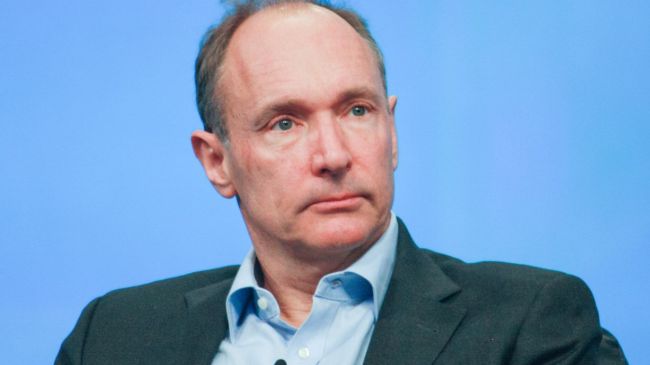
Inventor of the World Wide Web Tim Berners-Lee
Press TV – November 23, 2013
Internet surveillance by British and US spying agencies has posed a threat to online freedom and the future of democracy, British inventor of the World Wide Web Tim Berners-Lee has warned.
Berners-Lee said some governments are jeopardized by how the Internet and social media help exposing wrongdoings across the planet, adding that the “growing tide of surveillance and censorship now threatens the future of democracy”.
He also said that whistleblowers who have leaked secret surveillance by US National Security Agency (NSA) and Britain’s eavesdropping agency the Government Communications Headquarters (GCHQ) deserve praise and need to be protected.
Berners-Lee’s comments come after classified documents, leaked by US whistleblower and former NSA contractor Edward Snowden in June, showed the NSA and its British counterpart the GCHQ had been eavesdropping on millions of American and European phone records and the Internet data.
“Countries owe a lot to whistleblowers – there’s a series of whistleblowers who have been involved. Snowden is the latest. Because there was no way we could have had that conversation without them,” he said at the launch of a new index showing web freedoms around the world.
“At the end of the end day when systems for checks and balances break down we have to rely on the whistleblowers – I think we must protect them and respect them,” he added.
In his interview with The Guardian earlier this month, Berners-Lee described the spying activities by the US and UK spying agencies as “dysfunctional and unaccountable.”
The inventor of the World Wide Web slammed the US and British governments for weakening online security and said their spying activities have contradicted all efforts to stop cybercrime and cyber warfare.
Why Healthcare.gov Sucks? Because They Hired Political Cronies, Not Internet Native Companies To Build It
By Mike Masnick | Techdirt | October 10, 2013
There’s been plenty of talk lately about just how screwed up the launch of Healthcare.gov has been. While any massively large-scale internet launch is likely to suffer some problems, the level of disaster on this particular project has been quite impressive. This has led some to wonder why this happened, especially given the reputation of President Obama’s “web-savvy” campaign team. The answers aren’t too hard to figure out, of course. First off, the campaign team is quite different from the team implementing this — which was handled by the Department of Health and Human Services. But, more importantly: it appears that the federal government basically handed this project over to the same crew of giant government contractors, who have a long history of screwed up giant IT projects, and almost no sense of the “internet native” world.
The Sunlight Foundation (link above) figured out the list of contractors who worked on the site, and noted that the big ones not only are well-known DC power-player insiders, but they’re also big on the lobbying and political contributions side of things. You’ve got companies like… Booz Allen Hamilton, famous for promoting cyberwar hype and employing Ed Snowden. There’s defense contracting giant Northrup Grumman. Then there’s SAIC — which I can’t believe can still get government business. This is the same firm that famously was given a $380 million contract to revamp the FBI system, on which it went $220 million over budget, and then saw the entire system scrapped after it (literally) brought some users to tears, and the FBI realized it was useless in fighting terrorism. SAIC is also the company that NYC Mayor Bloomberg demanded return $600 million after a city computer project (budgeted at $68 million) actually cost $740 million. SAIC has a long list of similar spectacular failures on government IT projects.
As you look down the list put together by the Sunlight Foundation, it’s all companies like this: giant monstrosities which are simply tied in closely with the government. All the large consulting firms are listed: Accenture, Deloitte, PricewaterhouseCoopers, McKinsey. What’s missing? Basically any company with even the slightest smidgen of experience building and maintaining large-scale, public-facing web-based apps. The list has no “internet native” companies.
Many, many years ago, I worked for an e-commerce startup here in Silicon Valley, and I ended up (sort of by default) in charge of trying to open up the government market for what we were doing. It involved meeting with a slew of all-too-slick, ex-politician, ex-military “consultants” with no technical knowledge whatsoever, who, for $15k to $25k/month retainers plus a (large) cut of any deal, would drink hard liquor and promise to “connect” us with big companies with government connections, and then help us sneak past the government bidding process to get no-bid contracts. It was an eye-opening experience that highlighted for me that getting government contracts in the tech world was very much about who you knew, rather than any actual knowledge, skills or experience. While this was quite a long time ago, it would appear that little has changed.
US Working Overtime Behind The Scenes To Kill UN Plan To Protect Online Privacy From Snooping
By Mike Masnick | Techdirt | November 21, 2013
The UN has apparently been considering a proposal pushed by Brazil and Germany, to clarify that basic offline rights to privacy should apply to online information and activities as well. The proposal is targeted at attempts by governments — mainly the US — to ignore privacy issues in spying on people around the globe. Not surprisingly, the US is (quietly) working hard to stop this plan. Colum Lynch at Foreign Policy has the scoop, noting that publicly, the US is pretending to support this in some form:
But privately, American diplomats are pushing hard to kill a provision of the Brazilian and German draft which states that “extraterritorial surveillance” and mass interception of communications, personal information, and metadata may constitute a violation of human rights. The United States and its allies, according to diplomats, outside observers, and documents, contend that the Covenant on Civil and Political Rights does not apply to foreign espionage.
In recent days, the United States circulated to its allies a confidential paper highlighting American objectives in the negotiations, “Right to Privacy in the Digital Age — U.S. Redlines.” It calls for changing the Brazilian and German text so “that references to privacy rights are referring explicitly to States’ obligations under ICCPR and remove suggestion that such obligations apply extraterritorially.” In other words: America wants to make sure it preserves the right to spy overseas.
The U.S. paper also calls on governments to promote amendments that would weaken Brazil’s and Germany’s contention that some “highly intrusive” acts of online espionage may constitute a violation of freedom of expression. Instead, the United States wants to limit the focus to illegal surveillance — which the American government claims it never, ever does. Collecting information on tens of millions of people around the world is perfectly acceptable, the Obama administration has repeatedly said. It’s authorized by U.S. statute, overseen by Congress, and approved by American courts.
While none of this creates any binding requirements, it does put tremendous pressure on countries to comply — and could lead to more specific language in various treaties and other agreements as well. It also allows other countries to stand firmly on the moral high ground that the US pretends to stand on, in order to scold the US for its activities.
The US, of course, likes to pretend that it needs to violate everyone’s privacy to catch a few bad guys. There is little reason to suggest this is true. Nothing in the proposal appears to stop legitimate law enforcement, espionage and surveillance efforts, targeted at actual people involved in criminal or terrorist activity. The issue is scooping up everyone’s data “just because.” That’s not what US negotiators are saying, obviously. Instead, they argue they need to scoop up everyone’s data to make the world safer by going after “international terrorists.”
The US’s stance here is fairly obvious. It wants to pretend to retain the moral high ground on this issue, and the way to do that is to try to stop the rest of the world from pointing out that it’s been on the low road for quite some time. But trying to redraw the map doesn’t change the reality.
Related articles
Obamacare is Doomed by Its Internal Logic
A Black Agenda Radio commentary by Glen Ford | November 20, 2013
Obamacare is unraveling, not because the administration is particularly incompetent or unlucky, and certainly not as a result of the Republicans’ unrelenting hostility to the Obama health insurance plan. Indeed, ever since the bill’s passage in early 2010, the GOP’s holy war against Obamacare has served to solidify reflexive Democratic support for what has always been a Republican-inspired bill.
The truth is, the Affordable Health Care Act is coming undone because of its own, tortured internal logic. At root, it is a fraud on the public: a scheme to subsidize and more deeply embed a private insurance system that can only make profits by denying sick and vulnerable people health care, and playing different demographics of Americans against each other. As every other industrialized country in the world has already learned, it is impossible to build a genuine, universal healthcare system on a cut-throat capitalist foundation. Private insurers make money by betting against the health interests of their customers. Obama served his corporate masters by conspiring to make tens of millions more Americans into customers of private insurers. He tried to dress up one of the greatest corporate subsidies in history as if it were a solemn national mission, a rebirth of the social compact between the American people. But of course, Obamacare is no such thing; it is a racket to prop up private insurers with public money, while allowing the profiteers to continue to run the show.
You can’t hide a truth that big. The Obamacare website has suffered from terminal complexity because white collar crime is usually quite complex. The web site attempts to reconcile the profit margins and various products of a universe of private insurance corporations, while at the same time pretending to serve the health needs of the people at an affordable cost. Obamacare claims to be in the business of serving both the public and corporate stockholders. But that’s mission impossible. If Obamacare is based on making profits for private corporations – if that is what keeps the system going – then the public’s health care needs will always be an afterthought. And, that will be obvious in the way that the website is organized as a sales platform that matches federal subsidies with corporate products, rather than matching people with the medical resources they need to survive and thrive.
Website complexity and failures aside, Obamacare can never become part of a national social compact, something of which all Americans can be proud. That’s because, by definition, corporate insurance schemes divide people into “winners” and “losers” – although, of course, the big winner is always the corporation. Young, healthy people know they are the fatted calves of the insurance business, and they are avoiding Obamacare like the plague. If this were really a national health care program, like Medicare for All, then most young people would join in the national health care mission. But this is just Obama working a scam for the insurance companies, and young folks know it. Anybody who manages to get access to the web site knows it.
The fatal flaw in Obamacare can’t be fixed. The best thing that could happen would be a quick and total collapse. Large majorities of Americans still support Medicare for All, but Obamacare stands in the way of a real national health plan – just as the Republican right-wingers that invented Obamacare back in 1989 intended.
Glen Ford can be contacted at Glen.Ford@BlackAgendaReport.com.
Related article
- That Popping Noise? The Obamacare Bubble! (correntewire.com)
List Of Targets FBI Supposedly Asked Jeremy Hammond To Crack Revealed
By Mike Masnick | Techdirt | November 18, 2013
On Friday, we wrote about Jeremy Hammond’s 10-year prison sentence, mentioning that the judge had required part of Hammond’s statement be redacted from any reports as his discussion of the list of targets he was asked to hack by FBI informant Sabu (Hector Xavier Monsegur) was considered classified. Of course, it will come as little surprise that the unredacted/uncensored text of his original statement is alleged to have leaked soon after the sentencing. Someone posted it to Pastebin. While it’s entirely possible that this is fake, there are at least some indications that it’s accurate.
Sabu also supplied lists of targets that were vulnerable to “zero day exploits” used to break into systems, including a powerful remote root vulnerability effecting the popular Plesk software. At his request, these websites were broken into, their emails and databases were uploaded to Sabu’s FBI server, and the password information and the location of root backdoors were supplied. These intrusions took place in January/February of 2012 and affected over 2000 domains, including numerous foreign government websites in Brazil, Turkey, Syria, Puerto Rico, Colombia, Nigeria, Iran, Slovenia, Greece, Pakistan, and others. A few of the compromised websites that I recollect include the official website of the Governor of Puerto Rico, the Internal Affairs Division of the Military Police of Brazil, the Official Website of the Crown Prince of Kuwait, the Tax Department of Turkey, the Iranian Academic Center for Education and Cultural Research, the Polish Embassy in the UK, and the Ministry of Electricity of Iraq.
Sabu also infiltrated a group of hackers that had access to hundreds of Syrian systems including government institutions, banks, and ISPs. He logged several relevant IRC channels persistently asking for live access to mail systems and bank transfer details. The FBI took advantage of hackers who wanted to help support the Syrian people against the Assad regime, who instead unwittingly provided the U.S. government access to Syrian systems, undoubtedly supplying useful intelligence to the military and their buildup for war.
All of this happened under the control and supervision of the FBI and can be easily confirmed by chat logs the government provided to us pursuant to the government’s discovery obligations in the case against me. However, the full extent of the FBI’s abuses remains hidden. Because I pled guilty, I do not have access to many documents that might have been provided to me in advance of trial, such as Sabu’s communications with the FBI. In addition, the majority of the documents provided to me are under a “protective order” which insulates this material from public scrutiny. As government transparency is an issue at the heart of my case, I ask that this evidence be made public. I believe the documents will show that the government’s actions go way beyond catching hackers and stopping computer crimes.
Again, while Hammond is responsible for actually carrying out the activity of breaking into these sites, it still seems incredibly questionable that the targets may have been suggested by the FBI, which then basically got to take advantage of Hammond’s activities, and then when that wasn’t useful any more, to throw him in jail for a decade.
Indonesia recalls its Australian ambassador alleging phone-taps on President Yudhoyono
RT | November 18, 2013
Indonesia is recalling its ambassador to Australia over allegations that Canberra listened in on phone conversations of the Indonesian president.
Indonesia said the ambassador was being called to Jakarta for “consultations”.
The move by Jakarta comes as the Australian Department of Defence and the Defence Signals Directorate, or DSD, (now known as the Australian Signals Directorate), has been accused of monitoring the phone calls of Indonesian President Susilo Bambang Yudhoyono, his wife Kristiani Herawati, as well as eight other high-ranking officials, including the vice president, Boediono.
The latest leak, provided in May 2013 by NSA whistleblower Edward Snowden, was released jointly by The Guardian newspaper and the Australian Broadcasting Corporation on Monday, and will likely aggravate another diplomatic firestorm between Canberra and Jakarta.
The top secret material from the DSD is in the form of a slide presentation, dated November 2009, and divulges information on the monitoring of mobile phones just as 3G technology was being introduced in Asia.
In one of the presentations, entitled Indonesian President Voice Events, a graphic of calls is given on Yudhoyono’s Nokia handset over a 15-day period in August 2009. The data provides CDRs – call data records – which record the numbers called, the duration of communications, and whether the transmission was a voice call or SMS.
The Australian spy agency “appears to have expanded its operations to include the calls of those who had been in touch with the president,” the report indicated. Another slide, entitled Way Forward, gives the simple command: “Must have content,” perhaps a reference to encrypted material.
Attached to the bottom of each slide in the 2009 presentation is the DSD slogan: “Reveal their secrets – protect our own.”
Also named in the surveillance slides are Dino Patti Djalal, then-foreign affairs spokesman for the president, who recently resigned as Indonesia’s ambassador to the US and is seeking the candidacy in next year’s presidential election for Yudhoyono’s Democratic party, and Hatta Rajasa, current minister for economic affairs and potential presidential candidate for the National Mandate party. Hatta served at the time of the surveillance as minister for transport; his daughter is the wife of the president’s youngest son.
Other high-level officials on the list of “IA Leadership Targets” are: Jusuf Kalla, the former vice-president who ran as the Golkar party presidential candidate in 2009; Sri Mulyani Indrawati, then a reforming finance minister and since 2010 one of the managing directors of the World Bank Group; Andi Mallarangeng, who was at the time the president’s spokesman, and later minister for youth and sports; Sofyan Djalil, who served until October 2009 as minister for state-owned enterprises; Widodo Adi Sucipto, a former head of the Indonesian military who served until October 2009 as security minister.
Another slide, entitled DSD Way Forward, acknowledges that the Australian spy agency’s must “capitalise on UKUSA and industry capability”, apparently a reference to assistance from telecom and internet companies, the same method that the NSA used to collect data on millions of individuals around the planet.
News of Australia’s high-level snooping on the Indonesian president and his top aides is certain to provoke a harsh response from Jakarta, especially considering this is not Australia’s first breach of trust between the Pacific Rim countries.
Tensions between Canberra and Jakarta began in October when top secret files revealed by the German newspaper Der Spiegel and published by Fairfax newspapers showed that Australian diplomatic posts across Asia were being used to intercept communications.
Marty Natalegawa, the Indonesian foreign minister, issued a harsh response and threatened to review bilateral initiatives on issues important to Australia, including people smuggling and terrorism.
During a visit last week to the Australian city of Perth, Vice president Boediono – not yet privy to information that his own Blackberry device had been compromised by Australian spy agencies – briefly mentioned the long-standing spying controversy.
“I think we must look forward to come to some arrangement which guarantees that intelligence information from each side is not used against the other,” he said. “There must be a system.”
Yudhoyono is the latest in a growing list of global leaders who have had their personal communications listened to by the American intelligence service.
It has recently been reported that the leaders of Germany, Brazil and Mexico have been listened to by the so-called Five Eyes, the collective name for the intelligence agencies of the United States, Britain, Australia, Canada and New Zealand, who share information.
German Chancellor Angela Merkel in late October demanded a personal explanation from US President Barack Obama as to why the NSA had tapped her mobile phone. The White House attempted to reassure the chancellor that her phone was “not currently being tapped and will not be in the future”.
It will be interesting at this point to see if the diplomatic backlash in wake of the recent wave of revelations will curb the Five Eyes’ surveillance program, or if it will just go deeper underground.
The Guardian then reported that the DSD worked together with the NSA to stage a massive surveillance operation in Indonesia during a UN climate change conference in Bali in 2007.
On Monday a spokesman for Australian Prime Minister Tony Abbott said: “Consistent with the long-standing practice of Australian governments, and in the interest of national security, we do not comment on intelligence matters.”
Featured Video

New positive ivermectin evidence
or go to
Aletho News Archives – Video-Images
From the Archives
Fanatical Followers of the Covid Regime: A Jim Jones-Style Cult?
By Professor Roger Watson and Dr. Niall McCrae | The Daily Sceptic | November 15, 2021
As scholars at leading British universities over recent decades, we witnessed the replacement of critical thinking and debate by narrative: facts are discrimination and scientific method is imperialism; truth, instead, is derived from ‘progressive’ values. This educational trend may be a major contributory factor to the ease in which society has been inculcated to the Covid ‘new normal’ of masking, testing, and repeated doses of vaccines for a disease of similar risk to severe influenza.
One doesn’t need much critical reasoning to observe the flawed logic of some vaccination enthusiasts, such as people who respond to experiencing any side effects, however debilitating, by saying “at least I know it’s working”, or, after contracting the disease despite their promised inoculation (over 90% effective, according to initial drug company claims), “I’d have been worse off without the jab.” … continue
Blog Roll
 Aletho News
- Arctic Scare Stories Melt Away
- Wrong, Euronews: Climate Change Has Not Created a Food, Energy, and Economic “Meta-Crisis”
- New positive ivermectin evidence
- Met Office Caught Fabricating Daily Temperature Record Claims
- Merck Virologists Admitted to Falsely Certifying Vaccine Efficacy
- Mandatory Folic Acid for every man, woman & child
- Pro-Palestine protesters arrested outside UK’s ruling Labour Conference in Liverpool
- Mauritius denies landing permit to flight from Israel, forcing cancellation: Tour operator
- Israeli finance minister calls for genocidal war on West Bank, annexation of south Lebanon
- 12 Things Your Psychiatrist Was Trained Not to Tell You
- If Americans Knew
- Israel forces Gazans to live in constant peril – Daily Update
- Deconstructing Netanyahu’s pants-on-fire UN rant – Daily Update
- Trump betrayed voters with his campaign lies and prioritized a foreign country once he took office
- Netanyahu calls Israel’s war in Gaza ‘opposite of genocide’ in UN speech to near-empty hall
- Settler Kidnappings: Torture, Sexual Abuse and Terrorisation of Palestinian Abductees as Israel Deepens Annexation of West Bank
- Gaza winter nears as 162,000 tents become unusable, raising fears of humanitarian crisis
- Netanyahu says, “It’s the opposite of genocide”; UN says Gaza economy is world’s ‘most severe crisis on record’ – Daily Update
- Israel’s US-Backed Assault on Gaza Has Created the ‘World’s Most Severe Economic Crisis on Record’: UN
- ‘Protecting U.S. Citizens’… From Israel
- ‘This is where I live now, the back of a truck’: a day in the life of a grandmother in Gaza
- No Tricks Zone
- New Study: Earth And Venus Surface Warmth Largely Explained By Convection And Lapse Rate, Not CO2 Or Radiation
- 2025 Nature Paper Claiming Worsening Global Drought Gets RETRACTED …Heavily Flawed
- New Study: ‘Global Drought Shows No Detectable Recent Acceleration Under Climate Warming’
- Economic Masterminds: German Socialists Suggest Taxing Productivity Gains Stemming From Using AI
- The South China Sea Has Not Been Cooperating With The Climate Change Narrative
- Energy Crisis: Germany Enters Heating Season With Historically Low Gas Reserve Fill Levels
- New Study: The Antarctic Ice Sheet Gained Mass From 2020-2024 Due To Staggering Snow And Ice Accumulation
- Study: Ocean Heating Rates From Thousands Of Years Ago ‘Dwarf’ Modern Ocean Heating Rates
- Climate Extremists Target, Attack Large-Scale Power Grid Infrastructure In Germany!
- New Study: Antarctic Ice Melt Has Contributed Less Than 1 Centimeter To Sea Level Rise In The Last 30 Years

