Obama/Solyndra Reaction: “Should government pick winners/losers? Qualified Yes!”
By Tim Cavanaugh | Reason | September 2, 2011
An L.A. Times editorial boils the scandal over Solyndra – a Fremont, California solar panel maker backed by an important Obama fundraiser that is bankrupt after burning through a taxpayer-guaranteed loan of more than half a billion dollars – down to two questions:
Should the government be in the business of picking winners and losers by providing loan guarantees to risky energy ventures? And is Obama using stimulus funds to reward his political contributors?
To the first, the answer is a qualified yes. Solar and wind projects aren’t the first to benefit from loan guarantees; Washington has been offering them to nuclear power plants for decades. Research and development of alternative forms of energy are expensive and often need more support than private investors are willing to provide, but such investment is worthwhile not only because it stimulates job growth during a downturn, but also because in an era of climate change and worldwide turmoil over oil and other fossil fuels, it’s in the national interest. Moreover, competing countries, notably China, are outspending the U.S. on clean-energy subsidies, and falling behind will only cede the future market to them.
In reverse order, these arguments are: missile gap; global warming; jobz; that the market’s disinterest creates a compelling public concern; and that the nuclear power industry is now a model worth emulating.

I’m especially concerned about this last, as I recall one long midsummer morning in the boardroom in 2007, during which editorialist Dan Turner slowly sucked all the oxygen from the room and left the rest of us to die one by one or agree to his all-out denunciation of nuclear power, a piece that put the verdict right in the title: “No to nukes.” Some of Dan’s arguments, including the one that the industry has never existed without massive public subsidies and shows no glide path away from public subsidies, I even found compelling.
Why the switcheroo now? I would have thought lingering questions about whether Fukushima is in fact under control would at least give pause to proponents of all-or-nothing behemoth energy policies that are constructed in spite of rather than in response to market conditions.
I also can’t imagine any number of qualifications that would square the notion that government should choose private-sector winners and losers with a rudimentary understanding of fair play or individual liberty. Is the logic that because in this case the winner turned out to be a loser anyway, we shouldn’t pay too much attention?

Finally I think the ed board is thinking wishfully when it claims the Solyndra debacle just raises “two important questions.” I can think of a few others: What did Solyndra do with the $527 million (out of a total guarantee of $535 million) it borrowed in the form of taxpayer-subsidized loans? Why did the Energy Department provide so much money for a technology – cylindrical rather than flat solar panels – that has not been proven scalable? What role did Tulsa-based fundraiser George Kaiser, whose George Kaiser Family Foundation held more than a 35 percent equity stake in Solyndra as of an aborted IPO in 2009, play in encouraging this subsidy?
I realize editorial writing is a task more otherworldly than priestly transubstantiation of the host, but it’s just willful blindness to pretend the Solyndra case raises only abstract issues. There’s one journalismism that still holds up: If it looks like shit, smells like shit and tastes like shit, it’s the food at the L.A. Times cafeteria.
~
See also:
NBC and MSNBC Completely Ignore Solyndra Bankruptcy – NewsBusters
30,000 Bombs Over Libya
One Hell of a Humanitarian Mission
By THOMAS C. MOUNTAIN | CounterPunch | September 2, 2011
After some 8,000 bombing raids, with estimates of 4 bombs used per attack NATO has already dropped over 30,000 bombs on Libya. That’s almost 200 bombs per day for 6 months, some tens of thousands of tons of high explosives. With an estimated 2 Libyans killed per bomb and without a single NATO casualty the Western regimes have massacred over 60,000 Libyans in the past half year with the rebels themselves having said there have been 50,000 Libyan deaths. One hell of a humanitarian intervention isn’t it?
How the “civil war” in Libya has proceeded can best be described in light of the events of August 21. On that Sunday afternoon a BBC film crew showed a rebel column fleeing the approaches to Zawiya outside of Tripoli. With their tails between their legs, glancing fearfully over their shoulders as they fled wildly back down the road from whence they came, even the BBC presstitute on the scene could not contain his disgust at the sight. Once again the rebels had run into stiff resistance and had shown their true mettle by fleeing the fight.
The next morning a France24 reporter recounted how later that Sunday night she had accompanied these same rebels as they drove almost unopposed through Zawiya into Green Square in the heart of Tripoli, this time passing row upon row of bombed out still burning buildings.
This has been NATO’s war and while the world may not understand this, the Libyan rebels certainly do.
A major problem for NATO and its Libyan Quisling League a.k.a the National Transitional Council (NTC) is that most of the rebel military is now under the leadership of the Libyan Islamic Fighting Group (LIFG), a self described affiliate of Al Queda in the Maghreb (North Africa). The “general” in command of the mainly ethnic Berber rebel fighters that have captured the Libyan capital, known as the Tripoli Military Council, is the head of the LIFG. One of his top commanders is head of the Benghazi based rebel army. With the recent murder of “General” Younnis, former head of the Libyan secret police and once considered the most feared man in the country, the LIFG has now taken over leadership of almost all of the most effective fighting forces of the Libyan rebellion.
Quite an accomplishment and Al Queda in the Maghreb’s sincere thanks must go to the USA and its allies in NATO.
As the former LIFG terrorists turned “freedom fighters” go house to house arresting and executing “Gaddafi supporters” and “African mercenaries” in Tripoli life for the ordinary people of the city has become one of survival. Without water for almost two weeks now, without cooking gas or fuel for their cars and with food in short supply the future for the people of Tripoli remains uncertain.
Some reports in the international media have claimed that the Great Man Made River (GMMR), the irrigation system that supplies northern Libya with almost all its water was bombed by NATO. Other reports claim that “Gaddafi loyalists” still control the southern water wells and have shut off the water supply. If the later is true then even Benghazi’s water supply is in jeopardy. In any case, Tripoli is going to be dependent on imported water for quite some time and how a city of almost 2 million is to survive using water imported via water trucks is a question the western media has stopped talking about.
The “Transitional National Council” now recognized as “the legitimate government of Libya” by NATO governments and their allies is made up of many former high ranking Libyan Government officials and is increasingly caught in a tough spot. With the African Union trying to block the release of Libyan Government funds held in western banks there is little time to spare if this NTC’s control is to remain in place.
South African President Jacob Zuma has condemned the NTC leaders as embezzlers and demanded they return the tens of millions of dollars the NTC top leadership is charged with stealing during their days in office in the Libyan government before the AU lifts its opposition to Gaddafi government funds being released to the NTC.
NATO leaders are having to scramble to keep the NTC afloat. Images of pallets stacked 6 feet high with 200 million Libyan Dinars flown in from London show just how touch and go it has become for the NTC’s attempts to maintain its influence. While NATO’s “Friends of LIbya” circus held in Paris promises the release of Libya’s $billions held ransom by the west, implementing these promises is another matter all together. Corruption and incompetence mark the NTC leadership’s past and it will come as no surprise to hear reports of massive embezzlement of these funds in the future
How much longer the LIFG/Al Queda lead rebel armies will stand by and allow their former bitter enemies in the TNC to remain in power is the $60 billion question. Already the rebel “government” in the port city of Misrata has announced they do not recognize the authority of the TNC and rallies demanding the removal of the former Libyan government officials in the TNC have been reported taking place on an almost daily basis there.
In the mean time the vast reaches of the southern Libyan desert have not been conquered by NATO and almost all of Libya’s water and much of its oil remains outside of the control of the NTC.
With hundreds of villages and small towns scattered across an immense area Col. Gaddafi and his supporters still have a vast area at their disposal. With Algeria fighting Al Queda in the Maghreb their border on Libya’s western flank remains open and allows opponents of the NATO backed rebels a safe haven. The NTC has already raised the alarm about a nasty long term insurrection based in southern Libya using Algeria as base.
So far the Al Queda lead rebel fighters and the west’s bully boys in the NTC have yet to begin to eat each other though it seems almost inevitable that internal warfare amongst the rebels will take place. We may yet see NATO warplanes bombing its erstwhile allies in the Libyan rebellion.
The one thing that is clear is that the Libyan Tragedy has just begun and that the capture of most of northern Libya by the NATO backed rebels is just its first phase. 30,000 bombs over Libya killing some 60,000 Libyans marks the beginning rather than the end of this disaster.
~
Thomas C. Mountain was a member of the 1st US Peace Delegation to Libya in 1987
Legal interpretation of the demolition of homes in the Occupied Palestinian Territories
Mahmoud Al-Mubarak | MEMO | 01 September 2011
Observers of the systematic Israeli abuses in the Occupied Palestinian Territories (OPTs), especially the demolition of houses and the resultant forced expulsion of the Palestinian population, may be surprised at the absence of any international legal action by Palestinian officials against Israel. They would probably conclude that the Palestinians have a “successful case in the hands of an unsuccessful lawyer”.
The demolition of houses and confiscation of Palestinian land is now well-documented in United Nations reports and by many human rights organizations around the world, and even in Israel. The Palestinian Authority (PA), however, has not fulfilled its duty by initiating legal action internationally against these serious violations by the Zionist state.
In fact, the PA’s official position on Israel’s criminal demolition of Palestinian homes has been limited to mere condemnation; this does not live up to the level of required legal responsibility. Expressions of concern about Israel’s Judaisation policies are made even by pro-Israel states, so it is totally inadequate for the PA to make such statements and little else.
That the PA is loath to take the matter further was confirmed two years ago by Hatem Abdul Qader, the former Minister of Jerusalem Affairs, who revealed that Ramallah pursues a policy of “tolerance” towards Israel and the Judaisation of Jerusalem. This tolerance extends to the absence of any legal challenges in Israeli courts against decisions to demolish homes and confiscate Palestinian land.
In this brief study, the issue of house demolitions in the Palestinian territories occupied by Israel since 1967 will be assessed from an international legal point of view. I will try to identify the legal avenues that can be followed to prosecute the Israeli government and the parties involved in these violations of international law.
Before delving into the legal details of violations related to the demolition of Palestinian homes, I will determine the international legal status of the Palestinian territories which have been occupied by Israel since the Six-Day War of June 1967.
The international legal status of the Palestinian territories
When talking about the Palestinian territories captured by Israel during the 1967 war, we often refer to the famous Security Council resolutions 242 (1967) and 338 (1973). These resolutions establish the legal basis of determining that Israel is an occupying power in the Gaza Strip and the West Bank, including East Jerusalem, and demand that it withdraws from territories so occupied. However, the reality is that there are many Security Council resolutions which confirm that the territories occupied by Israel since the war of June 1967 are considered to be occupied territory under international law and which call on Israel to withdraw from them.
For example, Security Council resolutions 237 (1967), 248 (1968), 252 (1968), 258 (1968), 259 (1968), 267 (1969), 271 (1969 ), 298 (1971), 339 (1973), 368 (1975), 446 (1979), 452 (1979), 465 (1980), 468 (1980), 469 (1980), 471 (1980), 476 (1980), 478 (1980), 484 (1980), 497 (1981), 500 (1982), 592 (1986), 605 (1987), 608 (1988), 636 (1989), 641 (1989), 672 (1990), 673 (1990), 681 (1990), 694 (1991), 726 (1992), 1073 (1996), 1322 (2000), 1397 (2002), 1515 (2003), 1850 (2008) and 1860 (2009). The resolutions confirmed that the Arab territories seized by Israel during the 1967 war, are all occupied territory.
Formal resolutions aside, similar statements have been issued by the presidency of the Security Council, including, but not limited to, statements by the incumbent Presidents of the Council on 26 January 1984, 26 August 1988, 19 June 1990, 4 January 1991, 27 March 1991 and 4 April 1992. All these statements called on Israel to abide by international legal obligations towards this land, as stipulated in the Fourth Geneva Convention of 1949 as occupied territory.
In the same vein, several resolutions have been issued by the UN General Assembly confirming that the Palestinian lands seized by Israel after the 1967 war are considered in international law to be occupied territories and to which the provisions of the Fourth Geneva Convention of 1949 apply. For example, General Assembly resolutions 2253 (ES-V) (1967) and 2254 (ES-V) (1967), 3236 (XXIX) (1974), 3237 (XXIX) (1974), 32/5 (1977) and 33/113 (1978), ES-7/2 (1980), ES-9/1 (1982), 37/135 (1982), 38/144 (1983), 4/47 (1991), 46/76 (1991), 46/82 (1991), 50/84 (1995) and 50/129 (1995).
In the advisory opinion given by the International Court of Justice on the legality of Israel’s construction of the separation wall inside the Palestinian territories occupied in 1967, the Court emphasized that the status of these territories in international law is that they are under Israeli occupation.
In addition to these international resolutions and documents, there are many legal documents and international legal and Human Rights Council resolutions, including the report of the UN fact-finding mission on the conflict in Gaza, known as the Goldstone Report. All emphasize the status of the Israeli occupation of Palestinian territories, which include Gaza and the West Bank, including East Jerusalem.
Based on “international legitimacy”, therefore, the territories occupied by Israel since the Six Day War of June 1967, are under an “illegal occupation”. Accordingly, the related provisions of international law are applicable, including the Hague Convention of 1907, the Fourth Geneva Convention of 1949 and the two additional Protocols to the four Geneva Conventions of 1949,signed in 1977. Israeli claims to the contrary mean that it is rejecting its obligations towards the occupied territories and the population therein.
Israel’s policy of demolishing Palestinian homes
The long-standing Israeli policy and practice of demolishing Palestinian homes serves as a tool of the ethnic cleansing pursued by successive Israeli governments. It is perhaps useful to recall that ethnic cleansing is one of the main pillars of the policies upon which the Jewish state was built, something that has been documented not only by international jurists, but also by Israeli historians. In his book “The Ethnic Cleansing of Palestine”, the Israeli historian Ilan Pappe presented evidence of the crime of ethnic cleansing carried out by Israeli forces in 1948; Dr. Pappe concluded that Israel’s crime resulted in the expulsion of more than 800,000 Palestinians from their country.
Three years ago, the Israeli occupying forces demolished all the houses in the village of Taweel Abu Jarwal in the Negev Desert and confiscated property belonging to the Palestinian population, including their livestock and their tents. In an example of what could be classified as the worst, most prolonged example of ethnic cleansing in human history, the people were left without shelter under a harsh sun; even their water tanks were destroyed by the Israelis.
In keeping with the illegal historical acts of the Zionist state, Israel’s current government has continued the policy of house demolition and confiscation of Palestinian land. According to the Palestinian Strategic Report 2010, the Israeli army and the Israeli-led Jerusalem Municipality demolished 194 Palestinian homes in 2010 alone. Of these, 44 houses in the Jerusalem Governorate were knocked down mostly on the pretext of having no building permit. The Israeli occupation forces also warned the owners of 1,393 Palestinian homes, including 119 homes in Jerusalem, of evacuation and the “need” for demolition. The Israeli authorities often resort to the argument of construction without a permit to give a fig-leaf of legitimacy to the demolition process.
Similarly, in 2010 the Israeli government confiscated and destroyed 13,149 dunums (1 dunum = 1,000 sq.m) of Palestinian land in the occupied West Bank, uprooting 10,364 trees. This brought the number of trees uprooted by Israeli occupation forces to 2.5 million since 1967.
It is apparent that the Israeli authorities choose the Palestinian land deliberately for its so-called development projects. Arab member of the Knesset Jamal Zahalka, head of the parliamentary National Democratic Gathering, revealed recently the Israel intention to confiscate more than 700 dunums of Palestinian land in the next few weeks to build a centre for the maintenance and repair of trains.
All of this appears to pass without any international legal accountability even though every single one of these cases falls under the provisions of the Fourth Geneva Convention of 1949, which prohibits and criminalises all acts of the confiscation of Palestinian land and the forced expulsion of the population to change the country’s demographics. Every such case is worthy of independent legal pursuit.
Demolition of houses in international law
If international laws were designed originally to protect human life and dignity, regardless of colour, gender or race, then the first thing to honour someone is not to deprive them of a decent place to live with their family.
The preamble to the Charter of the United Nations includes an indication that the objectives of the establishment of the United Nations is to maintain “fundamental human rights and the dignity and worth of the individual… And creating conditions under which justice can prevail… pushing towards promoting social progress, and the quality of life…”
Needless to say that these noble goals cannot be achieved by those deprived of their homes, or who have had their property confiscated unlawfully and had themselves and their children put on the streets by the state of Israel when it destroys Palestinian homes and confiscates land from its owners.
Israel’s policy of confiscating houses is a violation of the Universal Declaration of Human Rights of 1948, in which Article 21 stipulates that no one shall be subjected to “arbitrary interference in his private life or home…” This also violates Article 8 (1) of the European Charter of Human Rights, which affirmed the sanctity of the private residence of individuals. Article 11 (1) of the International Covenant on Economic, Social and Cultural Rights stressed on the “decent life” and having “adequate housing” for all individuals in all societies. How does someone get a “good life” when he has been pushed out of his home into the open, without shelter, with no acceptable legal reason?
Article 33 of the Fourth Geneva Convention of 1949 prohibits collective punishment, which is committed frequently by Israel against the Palestinians; family homes are often destroyed as a punishment for one family member. The same Article 33 also stipulates the “Prohibition of Reprisals against protected persons and their property”.
Article 49 of the Fourth Geneva Convention of 1949, meanwhile, banned forcible transfer of people, individually or collectively. Article 8/2/a/7 of the Statute of the International Criminal Court also prohibits illegal deportation or transfer, which is inherent in Israel’s policy of demolition and confiscation of Palestinian property.
In is clear, therefore, that the Israeli policy of house demolitions and land confiscation represents two grave crimes, a “crime against humanity” under the Statute of the International Criminal Court, and a “war crime” under the Fourth Geneva Convention of 1949.
The Israeli authorities seek to justify their violations of the law on the grounds of “self-defence”, even though the advisory opinion of the International Court of Justice on building the separation wall inside the occupied Palestinian territories, and the resultant confiscation of property, rejected the Israeli argument The Court emphasized that Israel, as an occupier, may not invoke Article 51 of the Charter of the United Nations relating to the principle of self-defence for any attack coming from the land it occupies, and said:
“And so Article 51 of the Charter of the United Nations acknowledges that there is a natural right to self-defence in the case of a state launching an armed attack on another country, however, Israel does not claim that the attacks against it can be attributed to a foreign country. The Court also notes that Israel exercises control in the Occupied Palestinian Territory and the threat which Israel considers as a justification for the construction of the wall originates within the land and not outside and thus Israel cannot in any way, claim to exercise the right to self-defence. And therefore the Court concludes that Article 51 of the Charter has no relevance to this case.”
Despite all of this, Israel persists in what it claims to be one of its rights represented in the demolition and confiscation of Palestinian property. Adding insult to injury, the Israeli parliament (Knesset) approved a while back to force the house owner to pay for the demolition costs. This is unprecedented.
Legal steps that can be taken
There are six international legal remedies which can be taken to address Israel’s violations of international law regarding house demolitions:
1. A request can be made for a special session of the UN Security Council after each case of a house being demolished or land confiscated. This is well-known to experienced politicians. The negative impact on the people under occupation must be stressed, as the demolition represents a grave breach of the Fourth Geneva Convention of 1949.
2. The UN General Assembly carries major political and international weight, and approaches can be worked through the resolution “Uniting for Peace” and the establishment of a special court for war crimes under Article 22 of the Charter to look into these serious legal violations carried out by Israel.
3. The Human Rights Council of the United Nations can be requested to form an independent commission to study the demolition of Palestinian homes in the occupied territories, such as the UN mission tasked with examining the Israeli attack on Gaza in late 2008 and early 2009, which produced the Goldstone Report.
4. A request can be made for an advisory opinion of the ICJ on the legitimacy of demolishing Palestinian homes in the occupied Palestinian territories, based on article 65 (1) of the Statute of the International Court of Justice. Such an opinion of the court, similar to the advisory opinion on the separation wall, would be a valuable legal document for use in international bodies or national courts in Western countries against the Israeli government and parties involved in such violations. The legal value gained by the Palestinians from the opinion of the Court regarding the separation wall in the occupied territories is priceless, as that judicial opinion became a source of reference and a basis on which to respond to Israeli claims in international legal forums.
5. Construction companies and parties involved in the demolition of Palestinian homes can be sued under the principle of “universal jurisdiction” as per Article 146 of the Fourth Geneva Convention 1949, in the courts of states which are signatories as demolition of homes in these circumstances is a grave breach of the Convention.
It is perhaps useful to note in this regard that in autumn 2007, the French courts agreed to look into two cases against two French companies which had agreed to build a railway in Israel, part of which passed through the occupied Palestinian territories. The railway would change the landscape it passed through and lead to the forced displacement of the local population. French legislation allows the consideration of cases in which individuals or companies are involved in violations of international law. It is unfortunate that there was no involvement by the Palestinian government in this significant legal effort.
6. Member States of the International Criminal Court can be requested to file a case in the court against Israel and to investigate the demolition of Palestinian homes and the forced expulsion of the Palestinian population. Both acts represent a “crime against humanity” under Article 7/1/d of the Statute of the Court, and a “war crime” under Article 49 of the Fourth Geneva Convention of 1949.
In this regard, Jordan, which is a member of the International Criminal Court, has arguably a special legal responsibility, as the damage inflicted on Palestinians is often deflected onto the kingdom’s territory because of the links between Palestinians and Jordanians.
It is important to stress that all of these options are important; one cannot take the place of another. The mere threat of using international law as a weapon frightens the Israeli government – which coined the term “lawfare” to describe legal action against it because criminals fear nothing as much as the sword of justice.
If the Goldstone Report gave the Israeli authorities a legal jolt, unprecedented in the history of the Zionist state, it should have encouraged the Arabs to follow the path of international law to seek justice for the Palestinians. This is especially important as the law is often the weapon of choice of our adversaries.
The level of official Palestinian indifference to the crime of ethnic cleansing in the Occupied Palestinian Territories has to cause us to question the Palestinian Authority’s lack of legal action against what is, after all, one of the most serious of crimes. This, despite the fact that the legal options cited above would be obvious to any first-year Law student.
Perhaps that old adage of the “successful case in the hands of an unsuccessful lawyer” is beginning to look more like a “successful case in the hands of a conspiring lawyer”.
The author is a professor of international law at King Faisal University, Saudi Arabia
Pentagon No-Bid Contracts Rise to 45% in 2011
Noel Brinkerhoff, David Wallechinsky | AllGov | August 30, 2011
The post-9/11 years at the Department of Defense have seen an enormous increase in no-bid contracts, with the lack of competition approaching 50% during the first six months of this year.
Over the course of the last 10 years, the amount of money spent by the Pentagon on non-competitive contracts has almost tripled, from $50 billion in 2001 to $140 billion in 2010, according to the Center for Public Integrity’s iWatch News. And the reliance on no-bid deals has only gone up so far in 2011—to 45%—the highest rate recorded since 2001.
Like other federal agencies, the Defense Department is supposed to demand competitive bidding. But numerous loopholes in federal law make it possible for contracting officers to bypass restrictions and select a single company to provide goods and services. For example, the government may claim “an unusual and compelling urgency” to skip competition, when in fact, according to iWatch News, “the urgency stemmed from the agency’s lack of planning for requirements that have been known for years.”
Another problem is “bridge contracts”, in which the Pentagon extends an existing contract rather than put the contract out for rebidding. These account for one quarter of all sole source contracts.
The Pentagon defends itself by pointing that, on a dollar spent basis, in 2010 62% of all contracts were competitive. However, this figure does not compare well with other departments of the federal government. For example, the Department of Energy has a 94% competition rate, the Department of Homeland Security 77% and the State Department 74%.
Robbing Peter to Pay Israel

Jesse Jackson, Jr. shaking hands with former Israeli Prime Minister Ariel Sharon on a 2003 trip to Israel
Nearly 20 percent of the constituents of Rep. Jesse Jackson, Jr. (D-IL) live under the poverty line, and nearly 15 percent are unemployed. Jackson’s congressional district, covering parts of the south side of Chicago and its southern suburbs, has been hit harder than many others by the crises plaguing the economy. Many of his constituents are looking at even more cutbacks in social services, higher prices for food and fuel, and ever scarcer jobs.
During this August congressional recess, Rep. Jackson, Jr. should be at home, meeting with constituents and proposing to them how he will help them cope with their difficult circumstances. Instead, the politician is proudly gallivanting around Israel, in one of three separate congressional delegations heading there this month on all-expense-paid junkets organized by the American Israel Education Foundation (AIEF), a so-called charitable affiliate of the American Israel Public Affairs Committee (AIPAC), the most influential of the myriad pro-Israel lobbying outfits.In total, 81 representatives, nearly one-fifth of the entire House, will participate in these jaunts, which, according to The Washington Post, include “a round-trip flight in business class for lawmakers and their spouses (that alone is worth about $8,000), fine hotels and meals, side trips, and transportation and guides.”
Of course, these congressional delegations are not all fun and games. Members of Congress will be expected to sing for their lavish dinners by honoring President Bush’s 2007 pledge to provide the Israeli military with $30 billion of tax-payer-funded weapons between 2009 and 2018. So far, proposed increases in military aid to Israel have been spared from the budgetary chopping block by President Obama and a compliant Congress that treats Israeli militarism as more sacrosanct than medical care for seniors. This despite the fact that Israel misuses the funds, in violation of the Arms Export Control Act, to commit human rights abuses against Palestinians living under its illegal 44-year military occupation of the West Bank, East Jerusalem, and Gaza Strip.
According to aidtoisrael.org, constituents in Illinois’ 2nd congressional district will be asked to cough up an astonishing $53 million in federal taxes as their pound of flesh for the Israeli military during this 10-year period. With this same amount of money, each year the federal government instead could give 650 low-income families housing vouchers, or retrain nearly 900 unemployed workers for green jobs, or fund early reading programs for nearly 1,600 at-risk children, or provide primary health care to more than 43,000 uninsured people in Rep. Jackson’s congressional district.
Yali Amit, an Israeli-American constituent of Rep. Jackson, Jr. called his office to oppose his participation in the trip to Israel. He was told that Rep. Jackson, Jr. wants to learn what is happening there because of his position on the appropriations subcommittee that approves military aid to Israel. Amit retorted that “you can’t learn what goes on there on a paid trip of a propaganda arm of the Israeli government.” And you certainly can’t learn about the devastating impact that these U.S. weapons have on unarmed Palestinian civilians, nearly 3,000 of whom were killed by the Israeli military over the last decade.
The House Committee on Ethics should open an investigation to determine if it is even legal for Members of Congress to be participating in junkets organized by AIEF. The guidelines of the committee are as bright and clear as the midday sun on a Tel Aviv beach in August. “The travel provisions of the gift rule severely limit the ability of Members and staff to accept travel from an entity that employs or retains a registered lobbyist or a registered agent of a foreign principal.” (Emphasis in original.)
Legistorm, which tracks congressional travel, explains that “even though AIPAC’s primary purpose is lobbying, its nonprofit arm [AIEF] appears to provide a loophole for sponsored travel.” However, this eureka loophole that AIPAC uses does not withstand scrutiny. According to the latest publicly available tax return of AIEF, the organization has no paid employees — an astounding feat in itself for an organization that raked in more than $26 million in 2009 and a mind-blowing accomplishment for an organization running three huge congressional delegations in one month.
An examination of AIPAC’s latest publicly available tax return reveals the sleight of hand. AIPAC reports that in 2009, it very generously contributed more than $3.2 million of employee salaries to cover the staff costs of AIEF. In other words, a 501(c)(4) organization with registered lobbyists is paying for the staff of a 501(c)(3) organization to run congressional delegations that cannot be funded by an organization that employs registered lobbyists.
Craig Holman, a government affairs lobbyist at Public Citizen who helped draft the new post-Abramoff federal lobbying and ethics reform legislation signed into law in 2007, agrees that something is rotten in state of AIPAC. According to Holman, “The House ethics rules do not provide an exemption for 501(c)(3)s that are controlled and directed by a lobbying entity to pay for travel junkets for members of Congress. When the ethics rules were written in 2007 as part of the Honest Leadership and Open Government Act (HLOGA), an exemption for 501(c)(3)s was written into the Senate rules – which I called the ‘AIPAC’ loophole – but the House under Speaker Pelosi stuck to strict travel rules for its members and declined to poke a comparable loophole into its ethics rules.
“Even if there were such a loophole in House rules,” Holman continues, “which there isn’t, it appears that the 501(c)(3) wing of AIPAC is little more than a front group designed to extend its lobbying activities beyond Capitol Hill. From 2000 to 2006, lobbyist Richard Kessler similarly attempted to evade the ethics rule prohibiting lobbyist- sponsored travel junkets by setting up a 501(c)(3) that he directly controlled to pay for the trips. HLOGA was passed in 2007 to end these types of evasions.”
Constituents should be irate that members of Congress accept fancy trips from AIPAC-affiliates and contributions from AIPAC-inspired political action committee (PACs) that result in the United States prioritizing weapons to Israel above our basic economic rights. And the Committee on Ethics must investigate AIPAC’s skirting of travel regulations and shut down these trips that it has until now allowed.
The Landlord Wannabe Protest
By Gilad Atzmon – August 7, 2011
It is almost amusing to find out that some of the most clichéd Marxists around are so taken by the current Israeli popular protest, which they foolishly interpret as a manifestation of the ‘Israeli revolutionary spirit’. They are convinced that now that the Israeli ‘working class’ are rising, peace will necessarily prevail.
Yet in fact, what we are really seeing unfold in Israel (at least for the time being) is the total opposite of a ‘working class’ re-awakening. Indeed, some in Israel are calling it the ‘Real Estate Protest,’ because basically, those protesting want assets: they all wish to have property, a house of their own. They want to be landlords. They want the key, and they want it now. What we see in Tel Aviv has no similarity whatsoever to the struggles taking place in al-Tahrir or in Athens. At the most, the Israeli demonstrations mimic some manifestations of a struggle for justice or Socialist protest.
But that is where the similarities end.
Motti Ashkenazi (a legendary Israeli anti establishment figure) wrote in YNET yesterday that “another Left is needed (in Israel), a Left that is primarily concerned with the poor of its country rather than with the plight of our neighbours.” In clear terms that cannot be interpreted otherwise: Motti Ashkenazi is exploring what he considers to be a necessary shift in Israeli ‘progressive’ thought, and what he appears to conclude is, forget about Palestine; let’s once and for all concentrate on ‘us,’ the Jews. Ashkenazi continues, “we need another Left, a modest one. Instead of a vision for the entire Middle East, it had better present a vision of the State of Israel.”
Professor Nissim Calderon (a lecturer in Hebrew literature ) also presented a similar line: “We have erected a Left that has been focusing on the fight for peace, and peace only. But there is a huge hole in our struggle- we failed to struggle for social justice.” Again ‘Lefty’ Calderon refers to the social struggle within the Israeli Jewish population.
The mass protest in Israel is, in fact, the complete opposite of a genuine social revolution: whilst it may present itself as a popular protest, in practice, it is a ‘populist festival’. According to reports from Israel, the leaders of the emerging protest are even reluctant to call for Netanyahu’s resignation. The same applies to security matters, the occupation the defence budget- the organizers wouldn’t touch these subjects in order not to split their rapidly growing support.
What we see in Israel is neither a socialist revolution; nor is it a struggle for justice. It is actually a ‘bourgeoisie wannabe revolution’, and the Israelis took to the street because each of them wants to be a landlord, to own a property. They do not care much about politics, ethics, or social awareness, and neither do they seem to care much about the war crimes they are collectively complicit in. Malnutrition in Gaza is really not their concern either. They seem to not care about anything much at all, except themselves becoming property owners.
But why do they want to own a property? Because they cannot really rent one. And why can’t they rent? It is obviously far too expensive. But why is it too expensive? Because Israel is the ultimate embodiment of a corrupted, hard speculative, capitalist society. And I guess that this is the real untold story here. If Zionism was an attempt to solve ‘the Jewish Question’ , as the author Shahid Alam so insightfully explores, it has clearly failed since it has only managed to relocate ‘the Jewish Question’ to a new place, i.e. Palestine.
Zionism promised to bring about a new productive and ethical Jew as opposed to what it defined as the ‘Jewish Diaspora speculative capitalist’(1). It clearly failed, and the truth of the matter is, that in the Jewish State, Israeli Jews are now being subjected to the symptoms of their own very problematic culture.(2)
Israel, that was supposed to be the state of the Jewish people, has become a haven for the richest and most corrupted Jews from around the world: according to The Guardian, “out of the seven oligarchs who controlled 50% of Russia’s economy during the 1990s, six were Jewish.” During the last two decades, many Russian oligarchs have acquired Israeli citizenship. They also secured their dirty money by investing in the Blue & White financial haven. Wiki leaks has revealed lately that “sources in the (Israeli) police estimate that Russian organised crime (Russian Mafia) has laundered as much as US $10 billion through Israeli holdings.” (3) Mega-swindlers such as Bernie Madoff have been channeling their money via Zionists and Israeli institutions for decades. Israel is also a leading trader in blood diamonds. Far from being surprising, Israel is also the fourth biggest weapon dealer on the planet. Clearly, blood diamonds and guns are proving to be a great match. And it doesn’t stop there — every so often, Israel is caught engaging in organ trafficking and organ harvesting.
Increasingly, Israel seems to be nothing more than a vast money-laundering haven for Jewish oligarchs, swindlers, weapons dealers, organ traffickers, organised crime, and blood-diamond traders. But on top of that, rich Jews buy their holiday homes in Tel Aviv and Jerusalem: there are reports that in Tel Aviv alone, thousands of holiday properties are empty, all year round, while native Israelis cannot find a roof.
The Israeli people are yet to understand their role within this horror show: the Israeli people are yet to grasp that they are nothing but the foot soldiers in this increasingly horrendous scenario. They do not even gather that their state maintains one of the world’s strongest armies, to defend the assets of just a few of the wealthiest and most immoral Jews around.
I actually wonder whether Israelis can grasp it all. Yet the truth of the matter is, that the leaders of the present Israeli ‘real estate revolution’ want to maintain the struggle as a material seeking adventure, and they are clearly avoiding politics: the driving sentiment and motivation here is, obviously, ‘give us the keys to our new homes and we clear the square.’
I guess that it is not surprising that within such an inherently greedy and racially oriented society, the dissent that manifests will inevitably, also be reduced to sheer banal materialism.
It seems the Israelis cannot rescue themselves from their own doomed fate, because they are blindly hijacked by their own destructive culture. As myself and a few others have been predicting for a decade or more, Israeli society is about to implode. It is really just a question of time.
Notes
1. Marxist Zionist Ber Borochov (1881-1917) argued that the class structure of European Jewry resembled an inverted ‘class-pyramid’, a structure in which a relatively small number of Jews occupied roles within the ‘productive layers’ of society as workers, whilst a significant number were settled in capitalist and speculative trades such as banking.
2. In Haaretz today Beni Ziper wrote, “I saw on television people shouting against the rich, or tycoons who control the country. Seemingly everyone thinks it’s exciting and daring and nobody reflects on the chilling historical equivalence with the Depression in Germany at the time of Weimar Republic, when the ‘rich Jews who control us’ were targeted by everyone.” Ziper is clever enough to notice a close and disturbing repetition in Jewish history. However, Ziper is also very critical of his countrymen. “So I’m all for protests against the state, but in no way against people or groups of people, be they ‘rich’ or ‘ (Jewish) Orthodox’ or even ‘settlers’. Whoever gives privileges to the settlers in this country and it’s not that the settlers come and rob the cashier at gunpoint.” Whether we agree with Ziper or not, it is clear that he also admits that there is a similarity between the arguments voiced in Israel against the rich, and the German right wing’s anti Semitic attitude towards Jews in the 1920’s-30’s
3. For more information about global organised crime connections with Likud or other major Israeli political parties, follow this link http://cosmos.ucc.ie/cs1064/jabowen/IPSC/php/topic.php?tid=147
Gilad Atzmon’s latest book is The Wandering Who.
Occupation profiteer Ahava soaks up EU science grants
By David Cronin – The Electronic Intifada – 08/05/2011
Not for the first time, the European Union is in denial about how it is subsidizing Israel’s crimes.
Máire Geoghegan-Quinn, the EU’s commissioner for scientific research, recently acknowledged that the cosmetics-maker Ahava was allocated more than €1 million worth of innovation grants from the Union over a period stretching from 1998 to 2013. Giving even one cent to Ahava involves facilitating breaches of international law because of the firm’s unlawful activities in the West Bank.
As Geoghegan-Quinn doesn’t appear to recognize this problem, she would be well-advised to read a report, issued in May, by the human rights organization B’Tselem. It highlights how Ahava is partly owned by two Israeli settlements on occupied Palestinian land: Mitzpe Shalem and Qalya. Both of those settlements are illegal under the Fourth Geneva Convention of 1949, which forbids an occupying power from transferring its civilian population to the territory it occupies.
Responding to a parliamentary question, Geoghegan-Quinn effectively conceded that some of Ahava’s EU-funded research may have been undertaken in the West Bank. While Ahava is “formally established within the borders of the internationally recognized state of Israel”, she said, beneficiaries of EU grants are not required to carry out the related research in the place of establishment.
I would alert Geoghegan-Quinn to two salient facts:
- The rules covering EU science grants stipulate that projects which violate “fundamental ethical principles” are ineligible for funding. Carrying out research in one or more illegal settlements must surely violate such principles.
- Ahava may be able to give its offices in Holon or Airport City, industrial zones near Tel Aviv, as an address for its headquarters when applying for Euro-lolly. Yet its core manufacturing activities are conducted in Mitzpe Shalem. If Geoghegan-Quinn doesn’t believe me on this, I urge her to take a trip to the settlement, where she will no doubt be given a warm welcome to Ahava’s official visitors’ centre.
There are other questions about why any of my tax euros should be going to a private cosmetics firm. A glance at Cordis, the EU’s database on its science grants, shows that in one of the projects concerned, Ahava has teamed up with the US Department of the Interior. The objective of this scheme is to assess what impact tiny toxins (nanoparticles, as boffins call them) can have on the environment.
Correct me if I’m wrong but I never had the impression that the Department of the Interior spent too much time worrying about trees and dolphins. So what is the real agenda here?
News Corp to replace Rupert Murdoch
Press TV – July 19, 2011
The American board of News Corporation – the parent company of News International – has decided to replace Rupert Murdoch as the chief executive officer of his own media empire.
The decision has been made over fears that the 80-year-old tycoon would not be able to ward off attacks over avalanche of revelations about phone hacking within his UK newspaper empire.
According to the Bloomberg business news agency in the US, chief operating officer Chase Carey could take over from Murdoch at the helm of the troubled media giant, leaving Murdoch as just chairman.
Family friends said Murdoch is struggling to cope with the revelations about the phone hacking scandal.
“I just got a call an hour ago and Rupert wanted to tell me personally that he was not okay,” said Vicky Ward, a Vanity Fair contributor.
“His voice has been cracking and the people around him are very concerned, his children are very concerned. This is a man, who is more devastated than he has ever been in his entire 80 years.”
“Ever since he met with Milly Dowler the murdered girl’s parents, he hasn’t felt the same,” she added.
News Corp’s directors were unhappy about the “quality and quantity” of information they had received about the hacking and bribery scandals that wiped as much as £5 billion from its stock value, according to Bloomberg.
If true it would be the biggest scalp so far in a crisis that has claimed the jobs of London Metropolitan Police chief Sir Paul Stephenson, UK’s counter-terrorism chief John Yates, News International chief Rebekah Brooks and Downing Street aide Andy Coulson.
PASOK: Pan Hellenic Socialist Kleptocrats
By James Petras | 07.05.2011
“George Papandreou is not bought, he is rented. He sells public enterprises to the multinationals. He reduces wages, pensions and employment at the behest of the IMF. He turns over the public treasury to the European banks. He supports NATO’s war against Libya. He directs the Greek Coast Guard to enforce Netanyahu’s blockade of Gaza.” – demonstrator in Syndigma Square, Athens, July 3, 2011
Introduction
A self-proclaimed “Socialist” Government in Greece is imposing by ballots and clubs the most far reaching reversals of wages, pensions, jobs, educational, health and tax programs in the history of Western Europe.
The Pan Hellenic Socialist Party (PASOK) has totally abdicated any pretense of being a sovereign government, handing over present and future macro and micro policymaking to the European Central Bankers, the IMF and the power within the European Union/Germany, France. The so-called “austerity” program includes the pillage and auctioning of all the strategic lucrative public enterprises and large scale public land covering all historic and recreation sites. Never has any regime, socialist or not, so blatantly and brutally reverted an independent country to the most unadulterated form of colonial rule.
The Parliamentary Road to Colonial Pillage
Greece’s Great Leap Backward has taken place under the leadership of a “socialist” Prime Minister (George Papandreou) backed by the vast majority (97%) of “socialist” Parliamentarians and the entire “Socialist” Cabinet, with less than 4% defections.
While the parliament debates and votes to debase the country’s sovereignty and degrade the people, hundreds of thousands demonstrate in the streets and plazas. The elected leaders and legislators of PASOK totally ignore the protests, heeding only the directives from the Prime Minister and his appointed party bosses. Parliamentary politics is clearly totally insulated from the people it is supposed to represent.
What kind of government is capable of such a vehement repudiation of the popular will? What kinds of legislators are capable of systematically driving down living standards for the past three years and for the next ten years?
PASOK always was a party of patronage – not a party of programmatic change. PASOK, from its first electoral victory in 1981, offered public sector jobs, credit, loans and favors to its electoral constituency. At the beginning in the early 1980’s, the addition of new public functionaries was ostensibly to implement the socio-economic reforms, which the right-wing public bureaucrats were sabotaging. But as the momentum for ‘reform’ petered out, job appointments continued to multiply, as part of a process of building a large scale electoral party machine.
Thousands of under-employed university graduates with organizational skills crowded the Party offices and over time secured a permanent place in the bloated public bureaucracy. They contributed to securing votes for the PASOK candidates, following the practices of the right wing New Democratic Party. The public sector became the major employment office for several reasons: Most ‘public employees’ held ‘multiple jobs’, some as many as four and five, including self-employment and jobs in the informal economy. Secondly, the so-called private sector in Greece never developed a capacity to grow, invest, innovate, apply technology, compete and create new markets. Most leading Greek businesspeople depended on political links to the Party of Government to secure loans for projects that never materialized, credits that they used to import capital goods from the European Union and loans to import consumer products.
Entry into the European Union (EU) provided PASOK and the Right with huge transfers of capital and loans ostensibly to “modernize” the economy and make it competitive. In exchange Greece lowered its tariff barriers and EU goods flooded the local market. EU funds financed PASOK’s patronage machine; private business borrowed EU funds and passed payment onto the state, with complicit politicians. Professionals and the middle class secured easy credit to buy pricey imports. The regime economists and politicians “cooked the books”, showing positive growth and hiding liabilities. Everything was mortgaged. The European banks collected interest; Western European manufacturers exported consumer goods. According to the experts, Greece was “integrated” into the European Union … unfortunately on the basis of becoming as dissimilar as any country could be from its dominant partners.
PASOK was built around an elite and mass constituency that never paid taxes but extracted and depended on state handouts. Billionaire ship owners avoided taxes as they operated under foreign flags (Panama) but agreed to hire Greek ship captains and contribute to Party coffers. Professionals, lawyers, doctors and architects, barely declared any income, receiving under-the-table cash payments as undeclared income far exceeding any salaries. Business leaders, real estate speculators, bankers and importers all paid off Party leaders in order to secure tax abatement while securing EU loans, which they recycled into tourist properties and overseas accounts. What passed as the Party and business elite were in fact an organized network of kleptocrats: They plundered the treasury and left it to wage and salaried workers to pay the bills, since the latter suffered obligatory payroll tax deductions. Greece is the worse country in the world to be a wage worker – as it’s the only sector that’s taxed and exploited.
Greece is a country of self-employed small business people and independent small farmers, some of whom lease land from urban professionals, small tourist hotel owners and restaurateurs: The overwhelming majority of them pay only a small fraction of their taxes while demanding full public services. They are part of the ‘patronage’ apparatus of PASOK, mostly the recipients of unregulated credit and loans which were used for increasing personal incomes rather than productivity.
EU loans financed the modernization of Greek living standards, increasing the importation of German appliances and automobiles, as well as Danish and French feta cheese (cheap imports substituted for local products). In other words, Europe captured Greek markets increasing its trade deficit while the bureaucracy became the employer of last resort. These EU practices and relations allowed PASOK to retain a solid patronage base of business kleptocrats, small business tax evaders and new layers of state functionaries.
The EU bought Greece’s increasing politico-military subservience: Greece supported the Afghan, Iraq, Libyan and Pakistan wars. Especially under George Papandreou, PASOK’s subservience to Israel and its US Zionist backers exceeded all previous regimes
The Bills Come Due…
Greek public and private kleptocrats falsified the national accounts turning mounting deficits into positive surpluses, till the system imploded. The EU banks presented the bill and demanded payments. The Greek state and capitalist class, under PASOK, immediately proclaimed a program of ‘austerity’ and ‘tax reforms’. In fact, it only would enforce the former, since it did not want to undermine its tax-evader elite and social base.
Massive cutbacks in wages, pensions and jobs were imposed and enforced. PASOK legislators toed the line, since their inflated salaries, pensions, perks and payoffs depended on submission to the Prime Minster, who, in turn, was dependent on the imperial bankers and bourgeois kleptocrats. PASOK’s existence as a Party depends on the flow of EU loans, bailouts and sell-outs to sustain its clients. The PASOK regime is the great example of an authoritarian party: Groveling at the feet of the EU bankers and leaders while ripping at the throat of millions of impoverished Greek pensioners, wage and salary workers. PASOK’s tax-evader and patronage base is barely affected by the fiscal reforms: Tax revenues have actually decreased because of the deepening recession and non-enforcement.
As the PASOK regime deepens and extends the savaging of incomes and as mass resistance multiplies, young unemployed people (55%) have become more desperate and confrontational toward a government, which is ever more repressive and prone to violence.
Totally committed to extracting marrow from the bare bones of workers remuneration, PASOK literally agreed to allow the EU/IMF to oversee, price and sell the entire public patrimony. In other words the debt payment has become the lever for transferring sovereignty to the imperial countries and for maximizing the extraction of wealth from labor. What remains of the “Greek State” are the police and military assigned to forcibly impose the new imperial order on the exploited and impoverished majority.
In the midst of this catastrophic turn of events, of pillage and poverty, the PASOK legislators hold the line: They still count on the mass base of 25% of self-employed professionals, bankers, consultants and tax-evaders to continue to back the regime because they are barely affected by the sell out.
The bailout will allow for the PASOK legislators to collect their lucrative pensions if they are voted out and the self-employed and professionals will continue to cash in on non-taxed tourist rents and revenues from property even as their local clientele is impoverished. PASOK, Papandreou and his coterie have demonstrated that electoral politics is compatible with the most abject surrender of sovereignty, with sustained and savage repression of the majority of the working population and with a deep, long-term reduction of living standards. The Greek experience once again demonstrates that, faced with the demise of the capitalist system, the differences between conservatives, and social democrats vanish. Democratic freedoms exist only as long as the majority submits to the rule of imperialist powers and their local kleptocrat capitalist collaborators.
No doubt new elections will take place, even as living standards plunge, the debt payments increase and the country is stripped of all of its assets. Probably PASOK will be voted out of office. Their conservative adversaries will simply follow their example as police enforcers and debt collectors.
For the vast majority of Greeks there is no future and no solution in the existing system of street protest and parliamentary politics. The latter ignores the former. This impasse raises the question of what kinds of extra parliamentary action are necessary and possible to end the rule by de-facto imperial rulers and kleptocratic collaborators.
Mugged then Shot
By Linh Dinh | June 28, 2011
If absolute power corrupts absolutely, why shouldn’t the United States be the most corrupt (and corrupting) country on earth? We’re number one! In America, each politician can be bought and absurd sums of money are routinely misallocated or missing altogether, with nary a peep from the complicit media. On the foreign front, America’s modus operandi is to bribe every dictator, and the ones she can’t bribe, she’ll undermine, overthrow or bomb back to Jesus. In exchange for this bribe, which can be disguised as loans or “foreign assistance,” said dictator will allow America to loot his country in perpetuity. If you don’t believe me, just strip any tinpot dictator and you’ll surely find “CIA” tattooed on one ass cheek, with a (pretty good) portrait of a recent U.S. president embossed on the other. Lovers always leave a mark, they often say. Sometimes it’s not a dictator, per se, but a dominant party that’s America’s hushed puppy. In any case, rapacious trade deals and unpayable loans are the bane of countless client states orbiting Washington.
Domestically, American corruption has been institutionalized as campaign contributions and lobbying, but that’s only the open, legal part. Perhaps these practices are allowed to trick us into thinking that American corruption only goes so far, but who really knows what goes on in the labyrinthine backrooms, basements and dungeons of Washington? In any case, us lumpen Americans are “represented” by millionaire politicians who are lint deep in the pockets of the fattest banks and corporations. The American politician is thoroughly corrupt, often from grassroots level, but the degree of venality and sanctimonious hypocrisy increase as he approaches Washington DC, that beautiful cesspool of martial madness.
No candidate who’s not heavily pro big business, overtly or covertly, can have any chance of being elected to national office. He won’t be funded, nor will he be seen on television. It’s not a democracy when all candidates are vetted beforehand, and only millionaires can be chosen by other millionaires and billionaires. In this setup, the average citizen doesn’t matter, as his vote or canvassing for a favorite are only charades designed to make him feel good and involved, as if his opinions and advocacy matter, but whatever he does, it won’t prevent the election of yet another tool who’s corrupt, pro war and pro big business, at the expense of all else. But don’t despair, all you earnest partisans, for even when your candidate does lose, you’ll still get the same deal, more or less. Those who voted for McCain, for example, got pretty much all of his policies through Obama, so it’s a win, win, lose, lose situation, see? Emblematic of this farce is the fact that American tax payers are even asked to contribute three bucks a year to the Presidential Election Campaign Fund. Though stuffed with cash from Goldman Sachs, JPMorgan and Raytheon, etc., our candidates still panhandle from poor schmucks whom they will soon rip off anyway.
American politicians may differ on personal and ethical matters such as school prayer, gay marriage and abortion, but on all the major, lucrative issues affecting the military industrial complex or big business, they are remarkably uniform. Our senators and congressmen also behave like trained seals when it comes to Israel. Witness the 29 standing ovations a packed House gave Netanyahu recently. Whether Democrat or Republican, each was terrified to be caught sitting as his colleagues jumped up and barked.
Your rep sure knows who his daddy is, and it ain’t you, sucker! The primary job of the American politician, from Obama on down, is to spin and disguise an endless series of corporate and military crimes he’s enabling. Which brings us to the Pentagon. No other governmental organ is more gluttonously corrupt. The Pentagon’s main function is not defending America but to bleed this country dry to enrich Halliburton, Lockheed/Martin, Boeing, General Dynamics, Northrop Grumman and the rest. Over and over again, the Pentagon has put hundreds of thousands of Americans in harm’s way, just so its masters can make a handsome profit. To feed these insatiable ogres, the Pentagon is willing to destroy American itself, and it is doing so, right now.
Beside bloody business as usual, billions of dollars often go missing from the Pentagon cash register without any explanation whatsoever, and in 2001, Donald Rumsfeld even admitted that $2.3 trillion had disappeared, which he blamed on sloppy accounting. So it’s not thievery or corruption, but merely inept arithmetic. Tamping down this scandal, the mainstream media seemed to agree.
But perhaps we do have a math problem. We are a people who clip 25 cent coupons, drive (an SUV) a mile to save a buck, register with subtle satisfaction the missing penny from a $19.99 price tag, yet these stolen trillions leave us unfazed. One reason for this, I think, is that American corruption is not experienced directly, face to face, as it is in many other countries. Most Americans have never been browbeaten and shaken down by a corrupt cop, clerk or judge, so we can pretend that corruption doesn’t hurt us. Washington has also been waging wars without raising taxes, so it’s no skin off my back, many Americans are thinking, but our bellicose policy overseas is certainly bankrupting the homeland, even as it increases our insecurity in future blowbacks. The constant hike in our money supply, devaluing our dollars, is also a form of hidden taxation.
Another reason for our passivity in the face of widespread corruption is the state of our media, which routinely hype trivial stories while suppressing much greater outrages. Thus, the money John Edwards spent on his mistress, a million dollars provided by two private donors, was discussed for a week by television and newspaper “pundits,” but no one is concerned about the $1.5 million of tax money wasted each time Washington fires a Tomahawk missile at Libya. How many thousands have been launched so far in this three-month war? No one knows, and no one seems to care about the real flesh and bones on the receiving end of those weapons. “Bad guys” deserve to die, and so do “collateral damages.” Even as they mug us, our masters speak to us as if we’re morons. As they gobble up the entire world and everyone’s future, we get to nibble on catch phrases and slogans
Like Pavlov’s dogs, Americans have been conditioned to salivate at the sound of a home run, a Lady Gaga’s burp and the promise of hope and change comes election time, but when that fat, familiar hand reaches into our wallet, yet again, we feel nothing. We’re cool and blasé until it’s our turn to receive the pink slip, be evicted, then having to curl up in our car or on cardboard.
Interviewed by Stud Terkels, retired congressman C. Wright Patman said in 1970, “A dictatorship could spring up here over night, if this country got so bad. If another Depression came, we’d have a revolution. People wouldn’t take it any more. They have more knowledge. The big ones, they’d be looking for somebody that’d have the power to just kill people, if they didn’t agree. When John Doe begins to get up, they’d just go down and shoot him.”
I’m not sure that we have more knowledge, but with a presidency that can wage wars without congress or popular approval, and that can imprison or kill any American citizen without due process, a dictatorship is certainly here. Ditto, that Depression.
In a productive economy, corruption is less glaring because there are so many legitimate ways to enrich oneself, but in an increasingly non-productive one, such as what we have now, corruption becomes the primary means to riches. As we starve and kill each other, the mega corporations and their servants, our politicians, will continue to fatten themselves through their access to power.
In a ghetto with no stores, only drug corners, any bling-bling dude steering a loud Hummer is viewed suspiciously (or with admiration), so in this nation of fewer and fewer factories, save those that make bombs, tanks and high-grade weapons, who are our biggest death pushers and pimps, and what should we do about them?
Featured Video
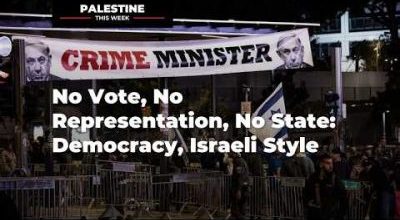
No Vote, No Representation, No State: Democracy, Israeli Style
or go to
Aletho News Archives – Video-Images
From the Archives
Sanctions, War and the Policy of Dual Containment
By SASAN FAYAZMANESH | March 17, 2008
It is now nearly three decades since the Unites States adopted the policy of dual containment of Iran and Iraq. While much has been written about the containment of Iraq, there has been very little in-depth analysis of this policy when it comes to Iran. In a book that is going to be released on March 31, 2008, entitled The United States and Iran: Sanctions, Wars and the Policy of Dual Containment (Routledge), I attempt to address this shortcoming by investigating when and why the US policy of containment of Iran came about, how it evolved, and where it stands today.[1] To the extent that Israel has been involved in US policy making, the study will also include the role that Israel has played in the containment of Iran. Also, since the fate of Iran has been inextricably linked to that of Iraq, occasionally the investigation will overlap with the containment of Iraq.
The policy of dual containment of Iran and Iraq originated during the Carter Administration, but it was not until the Clinton Administration that the expression “dual containment” became popular. … continue
Blog Roll
 Aletho News
- Americans are paying the price to preserve Israel’s nuclear hegemony
- Resistance factions are necessary to ensure a permanent US Iraq withdrawal
- How Israel destabilizes the Middle East: Denying sovereignty and the right to exist
- Europe’s Establishment Is Embracing War – and Losing Voters
- NATO chief advocates war of aggression
- No Vote, No Representation, No State: Democracy, Israeli Style
- Zionist Bought Senate Blocks Information About American Citizens Killed By Israel
- While Gaza dominates the UN, these are the people keeping it alive
- New Report: “Scholasticide and Genocide in Gaza: Assessment, Testimonies and Legal Analysis”
- ‘THAAD Delusion’: Iran war exposes US missile shield limits – The Atlantic
- If Americans Knew
- Israeli former leaders and security chiefs threaten legal action over ‘Jewish terrorism’
- Israel map in LA Times ad includes all land from the river to the sea
- Inside Lebanon’s 200-page dossier on Israeli war crimes
- Flydubai, genocide, settler violence, Trump abuse of power to deport – Daily Update
- Counting Antisemitic Incidents: What the ADL Audit Reveals — and Obscures
- Mamdani releases plan to combat antisemitism and hate crimes in New York City
- Iran’s Revolutionary Guards Publish Letter to the American People
- DMFI launches $1 million ad campaign supporting Virginia’s Elaine Luria
- US Senate blocks resolution seeking report on Americans killed by Israel
- Israeli Attacks Kill Ten Palestinians in Gaza
- No Tricks Zone
- Green Energy Debacle: German Expert Professor Fritz Vahrenholt Warns Of Severe Economic And Social Consequences
- Two More Paleo Reconstructions Affirm Meters-Higher Sea Levels Across Ireland, Brazil 7000-6000 Years Ago
- New Study: Earth And Venus Surface Warmth Largely Explained By Convection And Lapse Rate, Not CO2 Or Radiation
- 2025 Nature Paper Claiming Worsening Global Drought Gets RETRACTED …Heavily Flawed
- New Study: ‘Global Drought Shows No Detectable Recent Acceleration Under Climate Warming’
- Economic Masterminds: German Socialists Suggest Taxing Productivity Gains Stemming From Using AI
- The South China Sea Has Not Been Cooperating With The Climate Change Narrative
- Energy Crisis: Germany Enters Heating Season With Historically Low Gas Reserve Fill Levels
- New Study: The Antarctic Ice Sheet Gained Mass From 2020-2024 Due To Staggering Snow And Ice Accumulation
- Study: Ocean Heating Rates From Thousands Of Years Ago ‘Dwarf’ Modern Ocean Heating Rates

