Romania Accuses Eurovision of Changing Their Vote to Give First Place to Ukraine
EBU replaced the votes of six different countries
By Paul Joseph Watson | Summit News | May 16, 2022
Romanian broadcaster TVR has accused the European Broadcasting Union of assigning a different set of scores to the ones they provided, incorrectly giving the highest score to Ukraine, which went on to win the competition.
The Ukrainian band Kalush Orchestra easily won the competition, finishing on 631 points, with the United Kingdom in second place with 466 points.
However, despite the margin of victory, the official Romanian Eurovision representatives complained that the EBU ignored their vote to give Moldova first place and instead awarded it to Ukraine.
“We were surprised to discover that the result of the Romanian jury’s vote was not taken into account in the calculation of the final ranking,” said TVR in a statement. “The organizers assigned a different set of points to the participants of the final, on behalf of the jury of our country. We specify that the Romanian jury decided to give maximum score to the representatives of Moldova.”
Representatives of each country also normally appear on the live broadcast to announce their country’s voting results, but Romania’s Eda Marcus was nowhere to be seen.
The European Broadcasting Union (EBU) responded by claiming they had noticed “irregular voting patterns” which “forced them to replace scores from six countries: Azerbaijan, Georgia, Montenegro, Poland, Romania and San Marino.”
“In order to comply with the voting instructions of the competition, the EBU collaborated with its voting partner to calculate a replacement aggregate result for each country concerned, both for the second semi-final and for the grand final (calculated on the basis of the results of other countries with a similar voting history),” they said in a statement.
In the final vote tally, neither Romania or Moldova awarded any points to each other, something that would never happen in reality.
TVR said Eurovision organizers had “replaced the jury score in Romania with a ‘substitute’ calculated in a non-transparent way,” and had not even informed them of what they were doing during the competition.
Although part of the vote is also down to the viewing public, the claims suggest that there may have been some chicanery behind the scenes to ensure Ukraine won the competition, thereby fulfilling a preset narrative to support ‘the current thing’.
The Eurovision Song Contest is notoriously political and has been beset by similar voting scandals in the past.
The vaccine cajolers, Part 5: Nudging and eavesdropping
By Paula Jardine | TCW Defending Freedom | May 15, 2022
This is the fifth instalment of Paula Jardine’s six-part investigation into the planning behind ensuring vaccine acceptance and countering vaccine ‘hesitancy’. You can read Part 1 here, Part 2 here, Part 3 here and Part 4 here.
THE starting point for universal vaccination is that virtually everyone is (indeed, needs to be) a suitable recipient. This has proved the case for the Covid-19 vaccines even though they are still technically under emergency use authorisations pending the completion of clinical trials, and even though the disease is a serious mortality risk for only a minority of the older demographics.
This presumption is at odds with the fallout from the 1976 landmark US judgment in Reyes v Wyeth Laboratories. The parents of a child who was paralysed by polio caused by the Sabin oral polio vaccine she had been given sued the manufacturer and won. In affirming the decision the Federal Court of Appeal said the manufacturer had a duty to market and inform potential customers of the dangerous vaccine and that this duty was heightened since the manufacturer had knowledge of the vaccine’s harmful potential.
In the wake of the case the US Centers for Disease Control (CDC) added a ‘duty to warn’ clause to all its vaccine purchase contracts which required that ‘vaccines be administered only after an individualised medical judgment by a physician, or after “meaningful warnings related to the risks and benefits of vaccination” were provided in understandable language.’
Today the CDC advocates what it calls ‘medical provider vaccine standardisation’, saying offering vaccination should be a default option at patient visits. Ideally, the vaccine is available to be administered then and there, for the sake of convenience, and lest upon further reflection there be a change of mind.
Informed consent guidelines require that an explanation of both the risks and the benefits is provided, that the decision is voluntary and is not influenced by pressure from medical staff or others. Vaccine confidence literature, however, suggests the trusted health care practitioner’s role is to influence decisions by presenting vaccine-positive information so that patients or parents will choose vaccination. Safe and effective is the familiar mantra.
The World Health Organisation technical advisory group on behavioural insights and sciences for health have considered the ways in which vaccination decisions can be influenced. They say that ‘anticipated regret’ – when people expect that an unpleasant outcome would lead them to wish they had made a different decision – ‘shows promise as a predictor of intentions and behaviour’. They go on to suggest that ‘leveraging regret’ is a strategy that can be used ‘to tackle motivational barriers to vaccine acceptance and uptake’.
Dr Heidi Larson, a professor of anthropology, risk and decision science, who set up the ‘Vaccine Confidence Project’ at the London School of Hygiene and Tropical Medicine but is not a member of the behavioural insights advisory group, offers the same advice saying, ‘Regret is an important dimension in conversations with parents, but the important thing is to shift the anticipated regret towards how they might feel if their child is not vaccinated and becomes seriously ill or even dies from a vaccine preventable disease rather than being more focused on the potential side effects of the vaccine.’
Another strategy that this advisory group has recommended to help increase vaccine uptake is to emphasise the social benefits (or disadvantages of not) such as being able to stay in the workforce or provide for your family. Lisa Fazio, a psychologist who participated in the US National Institutes of Health (NIH) Covid communications expert group, also recommends leveraging altruism. What was required for Covid vaccines, she said, was ‘a call to action beyond “getting” the vaccine for yourself, but using emotions via an aspirational approach. The call to action is something that is elevated and aspirational and focused on the benefits and that sense of normalcy. The call to action is not getting a vaccine that is available to you. The call to action is, “Protect your family, protect your loved ones. Help the world get past this crisis”.’
Another pitch offered by yet another NIH adviser, Paul Slovic, a psychologist who studies risk perception, was that being vaccinated could help people feel that they’re taking back control. ‘One of the things that makes Covid scary is that it’s difficult to control,’ said Slovic. ‘It’s invisible, people can carry and transmit the disease without showing symptoms, and there are limited treatment options. People have profound discomfort with uncertainty, and so offering the vaccine in the context of regaining control could be quite powerful.’
Persuasion isn’t left on its own to do the work. The 2019 Global Vaccination Summit endorsed behavioural nudging to increase uptake: ‘Interventions which focus directly on supporting individual behaviour and making vaccination as easy and convenient as possible have more impact than interventions attempting to modify attitudes and beliefs. In other words, “nudging” and behaviourally-informed strategies can trigger vaccine confidence.’
The idea behind nudging (though a doubtful science) is that it works to increase uptake by making people feel as though they are making a free choice. ‘Offer a default option that’s determined by experts, with an opt-out possibility. This retains people’s sense of freedom, but default architecture will guide them into the experts’ recommendations.’
The Covid-19 vaccination campaign in the UK used this presumptive approach by inviting people to vaccination appointments rather than asking people to request them. It may have been the fear/urgency factor that worked. But that does not lessen the manipulative intent.
Regardless, anyone trying to sell you an investment product by inflating past performances, failing to ascertain its suitability for you as an individual, and using manipulative talk while providing insufficient information for you to make an informed decision in order to make a quick sell, would be deemed to have engaged in unethical practice. Depending on the nature of the misinformation, it could even be illegal.
Vaccines are biological pharmaceutical products, and in the case of mRNA Covid vaccines gene transfer therapies, ones that permanently and irreversibly alter the physiology of healthy people. Having claimed that the case for universal vaccination is a moral one, for the greater good, the strategies employed in pursuit of coverage targets to increase uptake have been and are to varying degrees ethically suspect.
As Covid vaccination uptake figures show, most people do accept vaccines but, despite all the nudging and the hard sell, the 100 per cent coverage that is meant to deliver a disease-free utopia remains elusive. Demand generation at that level would require universal uncritical acceptance of vaccines.
Larson likened people exercising their right to refuse the medical procedure of vaccination to an epidemic requiring crisis management. The various vaccine confidence projects describe their aim as helping populations become more resilient against what they call rumours or misinformation, a nebulous category of anything that might threaten the War on Microbes, that cause people to reject vaccination.
‘We need to be more sophisticated and to build strong transnational networks to pick up rumours and misinformation early and surround them with accurate and positive information in support of vaccination,’ said Larson, chillingly.
The World Economic Forum (WEF) provided the Vaccine Confidence Project with research assistance to support its Covid vaccination work. In the six months from November 2020, NetBase Quid technology was used to ‘scrape’ online forums and social media for conversations about vaccines “to get a deep understanding of the obstacles to vaccine adoption, barriers to building trust and the communication strategies that move people to action”.
No fewer than 66 million conversations were identified and analysed to provide insights on how to target communications for Covid vaccines. It enabled a market segmentation of messaging, microtargeting different messages for different audiences.
The Subtleties of Anti-Russia Leftist Rhetoric
By Edward Curtin | Behind the Curtain | May 13, 2022
While the so-called liberal and conservative corporate mainstream media – all stenographers for the intelligence agencies – pour forth the most blatant propaganda about Russia and Ukraine that is so conspicuous that it is comedic if it weren’t so dangerous, the self-depicted cognoscenti also ingest subtler messages, often from the alternative media.
A woman I know and who knows my sociological analyses of propaganda contacted me to tell me there was an excellent article about the war in Ukraine at The Intercept, an on-line publication funded by billionaire Pierre Omidyar I have long considered a leading example of much deceptive reporting wherein truth is mixed with falsehoods to convey a “liberal” narrative that fundamentally supports the ruling elites while seeming to oppose them. This, of course, is nothing new since it’s been the modus operandi of all corporate media in their own ideological and disingenuous ways, such as The New York Times, CBS, the Washington Post, the New York Daily News, Fox News, CNN, NBC, etc. for a very long time.
Nevertheless, out of respect for her judgment and knowing how deeply she feels for all suffering people, I read the article. Written by Alice Speri, its title sounded ambiguous – “The Left in Europe Confronts NATO’s Resurgence After Russia’s Invasion of Ukraine” – until I saw the subtitle that begins with these words: “Russia’s brutal invasion complicates…” But I read on. By the fourth paragraph, it became clear where this article was going. Speri writes that “In Ukraine, by contrast [with Iraq], it was Russia that had staged an illegal, unprovoked invasion, and U.S.-led support to Ukraine was understood by many as crucial to stave off even worse atrocities than those the Russian military had already committed.” [my emphasis]
While ostensibly about European anti-war and anti-NATO activists caught on the horns of a dilemma, the piece goes on to assert that although US/NATO was guilty of wrongful expansion over many years, Russia has been an aggressor in Ukraine and Georgia and is guilty of terrible war crimes, etc.
There is not a word about the U.S. engineered coup in 2014, the CIA and Pentagon backed mercenaries in Ukraine, or its support for the neo-Nazi Azov Battalion and Ukraine’s years of attacks on the Donbass where many thousands have been killed. It is assumed these actions are not criminal or provocative. And there is this:
The uncertain response of Europe’s peace activists is both a reflection of a brutal, unprovoked invasion that stunned the world and of an anti-war movement that has grown smaller and more marginalized over the years. The left in both Europe and the U.S. have struggled to respond to a wave of support for Ukraine that is at cross purposes with a decades long effort to untangle Europe from a U.S.-led military alliance. [my emphasis]
In other words, the article, couched in anti-war rhetoric, was anti-Russia propaganda. When I told my friend my analysis, she refused to discuss it and got angry with me, as if I therefore were a proponent of war I have found this is a common response.
This got me thinking again about why people so often miss the untruths lying within articles that are in many parts truthful and accurate. I notice this constantly. They are like little seeds slipped in as if no one will notice; they work their magic nearly unconsciously. Few do notice them, for they are often imperceptible. But they have their effects and are cumulative and are far more powerful over time than blatant statements that will turn people off, especially those who think propaganda doesn’t work on them. This is the power of successful propaganda, whether purposeful or not. It particularly works well on “intellectual” and highly schooled people.
For example, in a recent printed interview, Noam Chomsky, after being introduced as a modern day Galileo, Newton, and Descartes rolled into one, talks about propaganda, its history, Edward Bernays, Walter Lippman, etc. What he says is historically accurate and informative for anyone not knowing this history. He speaks wisely of U.S. media propaganda concerning its unprovoked war against Iraq and he accurately calls the war in Ukraine “provoked.” And then, concerning the war in Ukraine, he drops this startling statement:
I don’t think there are ‘significant lies’ in war reporting. The U.S. media are generally doing a highly creditable job in reporting Russian crimes in Ukraine. That’s valuable, just as it’s valuable that international investigations are underway in preparation for possible war crimes trials.
In the blink of an eye, Chomsky says something so incredibly untrue that unless one thinks of him as a modern day Galileo, which many do, it may pass as true and you will smoothly move on to the next paragraph. Yet it is a statement so false as to be laughable. The media propaganda concerning events in Ukraine has been so blatantly false and ridiculous that a careful reader will stop suddenly and think: Did he just say that?
So now Chomsky views the media, such as The New York Times and its ilk, that he has correctly castigated for propagandizing for the U.S. in Iraq and East Timor, to use two examples, is doing “a highly creditable job in reporting Russian crimes in Ukraine,” as if suddenly they were no longer spokespeople for the CIA and U.S. disinformation. And he says this when we are in the midst of the greatest propaganda blitz since WW I, with its censorship, Disinformation Governance Board, de-platforming of dissidents, etc., that border on a parody of Orwell’s Nineteen Eighty-Four.
Even slicker is his casual assertion that the media are doing a good job reporting Russia’s war crimes after he earlier has said this about propaganda:
So it continues. Particularly in the more free societies, where means of state violence have been constrained by popular activism, it is of great importance to devise methods of manufacturing consent, and to ensure that they are internalized, becoming as invisible as the air we breathe, particularly in articulate educated circles. Imposing war-myths is a regular feature of these enterprises.
This is simply masterful. Explain what propaganda is at its best and how you oppose it and then drop a soupçon of it into your analysis. And while he is at it, Chomsky makes sure to praise Chris Hedges, one of his followers, who has himself recently wrote an article – The Age of Self-Delusion – that also contains valid points appealing to those sick of wars, but which also contains the following words:
Putin’s revanchism is matched by our own.
The disorganization, ineptitude, and low morale of the Russian army conscripts, along with the repeated intelligence failures by the Russian high command, apparently convinced Russia would roll over Ukraine in a few days, exposes the lie that Russia is a global menace.
‘The Russian bear has effectively defanged itself,’ historian Andrew Bacevich writes.
But this is not a truth the war makers impart to the public. Russia must be inflated to become a global menace, despite nine weeks of humiliating military failures. [my emphasis]
Russia’s revanchism? Where? Revanchism? What lost territory has the U.S. ever waged war to recover? Iraq, Syria, Cuba, Vietnam, Yugoslavia, etc.? The U.S.’s history is a history not of revanchism but of imperial conquest, of seizing or controlling territory, while Russia’s war in Ukraine is clearly an act of self-defense after years of U.S./NATO/Ukraine provocations and threats, which Hedges recognizes. “Nine weeks of humiliating military failures”? – when they control a large section of eastern and southern Ukraine, including the Donbass. But his false message is subtly woven, like Chomsky’s, into sentences that are true.
“But this is not a truth the war makers impart to the public.” No, it is exactly what the media spokespeople for the war makers – i.e. The New York Times (Hedges former employer, which he never fails to mention and for whom he covered the Clinton administration’s savage destruction of Yugoslavia), CNN, Fox News, The Washington Post, the New York Post, etc. impart to the public every day for their masters. Headlines that read how Russia, while allegedly committing daily war crimes, is failing in its war aims and that the mythic hero Zelensky is leading Ukrainians to victory. Words to the effect that “The Russian bear has effectively defanged itself” presented as fact.
Yes, they do inflate the Russian monster myth, only to then puncture it with the myth of David defeating Goliath.
But being in the business of mind games (too much consistency leads to clarity and gives the game away), one can expect them to scramble their messages on an ongoing basis to serve the U.S. agenda in Ukraine and further NATO expansion in the undeclared war with Russia, for which the Ukrainian people will be sacrificed.
Orwell called it “doublethink”:
Doublethink lies at the very heart of Ingsoc, since the essential act of the Party is to use conscious deception while retaining the firmness of purpose that goes with complete honesty.To tell deliberate lies while genuinely believing in them, to forget any fact that has become inconvenient, and then, when it becomes necessary again, to draw it back from oblivion for just so long as it is needed, to deny the existence of objective reality and all the while to take account of the reality one denies – all this is indispensably necessary… with the lie always one step ahead of the truth.
Revealing while concealing and interjecting inoculating shots of untruths that will only get cursory attention from their readers, the writers mentioned here and others have great appeal for the left intelligentsia. For people who basically worship those they have imbued with infallibility and genius, it is very hard to read all sentences carefully and smell a skunk. The subterfuge is often very adroit and appeals to readers’ sense of outrage at what happened in the past – e.g. the George W. Bush administration’s lies about weapons of mass destruction in Iraq.
Chomsky, of course, is the leader of the pack, and his followers are legion, including Hedges. For decades they have been either avoiding or supporting the official versions of the assassinations of JFK and RFK, the attacks of September 11, 2001 that led directly to the war on terror and so many wars of aggression, and the recent Covid-19 propaganda with its devastating lockdowns and crackdowns on civil liberties. They are far from historical amnesiacs, of course, but obviously consider these foundational events of no importance, for otherwise they would have addressed them. If you expect them to explain, you will be waiting a long time.
In a recent article – How the organized Left got Covid wrong, learned to love lockdowns and lost its mind: an autopsy – Christian Parenti writes this about Chomsky:
Almost the entire left intelligentsia has remained psychically stuck in March 2020. Its members have applauded the new biosecurity repression and calumniated as liars, grifters, and fascists any and all who dissented. Typically, they did so without even engaging evidence and while shirking public debate. Among the most visible in this has been Noam Chomsky, the self-described anarcho-syndicalist who called for the unvaccinated to “remove themselves from society,” and suggested that they should be allowed to go hungry if they refuse to submit.
Parenti’s critique of the left’s response (not just Chomsky’s and Hedges’) to Covid also applies to those foundational events mentioned above, which raises deeper questions about the CIA’s and NSA’s penetration of the media in general, a subject beyond the scope of this analysis.
For those, like the liberal woman who referred me to The Intercept article, who would no doubt say of what I have written here: Why are you picking on leftists? my reply is quite simple.
The right-wing and the neocons are obvious in their pernicious agendas; nothing is really hidden; therefore they can and should be opposed. But many leftists serve two masters and are far subtler. Ostensibly on the side of regular people and opposed to imperialism and the predations of the elites at home and abroad, they are often tricksters of beguiling rhetoric that their followers miss. Rhetoric that indirectly fuels the wars they say they oppose.
Smelling skunks is not as obvious as it might seem. Being nocturnal, they come forth when most are sleeping.
The vaccine cajolers, Part 4: Rewriting history
This is the fourth instalment of Paula Jardine’s six-part investigation into the planning behind ensuring vaccine acceptance and countering vaccine ‘hesitancy’. You can read Part 1, published on Wednesday, here, Part 2, published on Thursday, here, and Part 3, published yesterday, here.
TCW Defending Freedom – May 14, 2022
WHEN Unicef launched the Child Survival Revolution in 1983, it openly acknowledged that infectious childhood diseases in industrialised countries had ceased to be a serious threat before vaccines were introduced, thanks primarily to improvements in sanitation and nutrition.
Later, something resembling a bait and switch took place in traditionally accepted scientific thinking on this empirical observation. The US Centers for Disease Control (CDC) now brands the central role played by improved sanitation and nutrition an anti-vaccination myth, and largely credits vaccines for the reduction in disease burden instead. This amounts to a misrepresentation, an untrue statement of a material fact that is being used to inflate the past performance of vaccines. It would count as unlawful mis-selling in other commercial contexts.
The World Health Organisation (WHO) says: ‘Immunisation is a global health and development success story, saving millions of lives every year.’ It puts the number of lives saved annually at between 3.5million and 5million.
Yet, perversely, universal vaccination may be masking health and mortality problems that arise from the vaccines as, by definition, there’s no control group for comparison. Igor Chudov analysed the 2021 statistics from Florida: ‘What I found is that in 2021, parents of newborns in Florida were much more “vaccine hesitant”, for reasons obvious to my readers, and therefore childhood vaccinations decreased from 93.4 per cent previously to only 79.3 per cent in 2021. During the same time, “all cause” infant mortality under one year of age in Florida also DECREASED by 8.93 per cent.’ (his emphasis)
Chudov’s findings chime with those of Australian physician Dr Archie Kalokerinos who investigated a doubling of the infant mortality rate in Aborigine communities in the 1970s on behalf of the Northern Territories government. He discovered the death rate rose after they began vaccinating malnourished Aborigine children. In some communities, every second child was injured or died.
A 2016 meta-analysis of studies into the DTP vaccine, against diphtheria, tetanus and pertussis (whooping cough) found it increases female mortality rates. Court cases in the US in the 1970s linked it with Sudden Infant Death Syndrome. The CDC calls this association ‘one myth that won’t seem to go away’. Disturbingly in this context, the extent of DTP vaccination coverage is a metric used to monitor access to primary health care and is used by the vaccine alliance GAVI as an equity measure.
A 2021 vaccination impact study led by Professor Neil Ferguson of Imperial College London made the great claim that vaccine campaigns in low and middle income countries had saved a total of 23million children’s lives over the past two decades, and projected that this figure will increase to 37million by 2030. But as with any honest cost-benefit analysis, Ferguson’s estimates need to be offset against another statistic. GAVI itself acknowledges that vaccination campaigns had, until a decade ago, negligently added to the chronic infectious disease burden in the developing world: ‘In 2000, roughly 39 per cent of all healthcare-related injections administered globally were delivered with reused disposable or inadequately sterilised syringes, which resulted in an estimated 23 million people infected annually with hepatitis B, hepatitis C and human immunodeficiency virus (HIV).’
It took a decade to reduce these incidental infections to near zero by using disposable syringes.
The official line from the WHO is that people have become complacent: vaccines are such a successful intervention that the public have forgotten how serious and how deadly the diseases were. To keep people compliant with national immunisation schedules and hit WHO vaccination coverage targets, practitioners are told to tell parents ‘better safe than sorry’.
The example that is used to generate sufficient anxiety or fear is measles, a highly transmissible virus which remains a leading cause of death in parts of Africa and Asia. The CDC insists that getting the vaccine is safer than getting the disease yet provides no statistics to illustrate the relative risk.
According to the UK-based Vaccine Knowledge Project, ‘in high income regions of the world such as Western Europe, measles causes death in about 1 in 5,000 cases, but as many as 1 in 100 will die in the poorest regions of the world. Worldwide, measles is still a major cause of death, especially among children in resource-poor countries.’ One US-based website aimed at public health students and practitioners ignores the nuance, putting the risk of death from measles at 1 in 500 while selectively setting it against a one in a million chance of an allergic reaction to the MMR and ignoring the risk of all the other potential adverse reactions on the US government’s official table of measles vaccine injuries.
A measles mortality map produced by the US government in 1890, seventy years before the vaccine was introduced and before the improvements in sanitation, water quality and nutrition occurred, shows geographical differences in death rates that indicate other underlying factors contributing to measles deaths. The greatest of these risk factors was shown to be malnutrition, as the body’s demand for vitamin A increases in response to a measles infection. Likewise people whose diets are lacking in animal protein, vitamin A’s primary dietary source, are at the greatest risk of death or serious complications.
In countries where malnutrition is a problem, the antibody response to measles vaccines can be boosted by giving vitamin A supplements. Protein malnutrition is amongst the leading causes of death in many places where measles mortality remains high.
Internal CDC docs on the agency’s false Covid vaccine claims
CDC catalogs lawmakers’ tweets about vaccines, documents reveal
BY SHARYL ATTKISSON | MAY 9, 2022
Internal documents at the Centers for Disease Control (CDC) show that Rep. Thomas Massie (R-Kentucky) ignited quite the firestorm when he contacted the agency to point out serious Covid vaccine disinformation that their top officials and vaccine scientists had signed off on.
I reported on the story last year after Massie produced audio recordings of CDC officials and scientists admitting the error to him, yet continued to publicly make the false claim: that original studies proved Covid vaccines helped people who’d already had Covid. They didn’t.
Watch the story and listen to the CDC audio recordings here.
Recently, emails obtained through a Freedom of Information request show more than a thousand pages of emails mentioning Massie and his concerns swirled around at CDC.
What did they say? Well, much of the time we don’t know because that’s hidden behind big, blue redactions.

Public info redacted by CDC regarding the agency’s Covid vaccine disinformation

We do see that before admitting the claim was wrong, CDC scientists tried to defend their false information.

CDC scientists and officials first attempt to defend the false info they were publicizing about Covid-19 vaccines

CDC scientists and officials try to defend the false info they were publicizing about Covid-19 vaccines
CDC also apparently tracks and logs CDC-related tweets by members of Congress, broken down by party affiliation.

CDC tracking tweets by members of Congress

CDC tracking tweets by members of Congress

It’s unclear why conversations between CDC officials and scientists on matters of great public health importance would be kept hidden from public view.
Nobody was held publicly accountable for the serious and potentially dangerous false information the CDC officials and scientists signed off on and publicized.
Dem Party Leaders, Pfizer, Moderna Involved in US Biological Activities in Ukraine: Russian MoD
By Ilya Tsukanov | Samizdat | May 11, 2022
The Russian military began reporting on the extent of US military biological activities in Ukraine in March, citing seized documents and other materials on the study of a range of potentially deadly bioweapon agents, including diseases which can be spread naturally using local geography, flora and fauna, and target certain ethnic groups.
Senior Democratic Party politicians are the chief “ideologists” of America’s illegal operations in biolabs operating throughout Ukraine, and have involved major multinational biotech companies in their activities, Igor Kirillov, the head of Russia’s Radiation, Chemical, and Biological Defence Troops, has indicated.
Speaking at a briefing in Moscow on Wednesday and citing an MoD analysis of documentary evidence, the RCB Troops chief said the profits US politicians earn for the private biotech sector helps to pay for their re-election via campaign donations.
According to Kirillov, the US executive branch has also worked to create a “legislative framework to finance military biological research directly from the federal budget”, and with funds of non-government organisations underwritten by the state and controlled by the leadership of the Democratic Party, including charitable foundations affiliated with the Clinton family, the Rockerfellers, George Soros, and Hunter Biden.
Major global pharmaceutical companies have become involved in these shady “public-private” partnership schemes, including Pfizer, Moderna, Merck, and Pentagon-affiliated biotech firm Gilead, Kirillov said.
“US specialists are working [in Ukraine] on the testing of new medicines, bypassing international safety standards. As a result, Western companies seriously reduce the costs of research programmes and gain significant competitive advantages”, the officer said.
State Structures’ Involvement
Ukrainian state structures are also involved in the US-funded and organised military biological activities in their country, Kirillov said, with Kiev’s main job being “to conceal illegal activities, conduct field and clinical trials and provide the necessary biomaterial”.
In 2020, Kirillov said, an attempt was made to infect the residents of the settlement of Stepovoye in the Lugansk People’s Republic with a multi-drug-resistant strain of tuberculosis using counterfeit banknotes contaminated with the disease’s causative agent and spread among local youth.
Additionally, the RCB Troops chief said that his agency has received information detailing the Pentagon’s experiments on Ukrainian nationals at Psychiatric Hospital No. 1 in the village of Strelechie, Kharkov region, with the research targeting male patients aged 40-60 with a high stage of physical exhaustion, and overseen by a US national.
The Russian military operation in Ukraine has stopped the spread of US military activities in Ukraine, and halted these “criminal experiments” on its civilian population, Kirillov stressed.
In the case of the research taking place at the Kharkov mental hospital, Western specialists were evacuated in January 2022, and the equipment and pharmaceutical preparations involved relocated to western Ukraine, he said.
Polish specialists have also been working with Ukraine’s biolabs, Kirillov said, citing documents detailing the work of the Polish Institute of Veterinary Medicine and the US’ Battelle Memorial Institute – a Pentagon contractor – on research assessing epidemiological threats and the spread of the rabies virus in Ukraine.
“In addition, documentary evidence has been obtained about Poland’s funding of Lvov Medical University, which includes a participant in US military biological projects – the Institute of Epidemiology and Hygiene. Since 2002, this organisation has been implementing a retraining programme for specialists with experience working with dual-use materials and technologies”, the officer said.
The German military has also been involved in research in Ukraine, Kirillov said, citing documents indicating that the Bundeswehr’s Institute of Microbiology had taken some 3,500 blood serum samples from 25 Ukrainian regions back to Germany between 2016 and 2019. The officer said the Institute’s as yet unidentified interest in these biomaterials “raises questions about the goals [being] pursued” by the German Armed Forces. The complete, Ukrainian-language document can be found in RTF format here.
According to the MoD’s information, along with the Munich-based Institute of Microbiology, the Berlin-based Robert Koch Institute, the Loffler Institute in Greifswald, and the Nocht Institute of Tropical Medicine in Hamburg are also participating in biological research activities in Ukraine. The complete presentation can be downloaded here.
Mariupol Samples Partially Recovered
An RCB Troops investigation of samples from a veterinary laboratory in Mariupol has concluded that it also may have been involved in the broader US-led biological research activities, Kirillov said, pointing to the presence of pathogens uncharacteristic of veterinary diseases, such as typhoid fever, paratyphoid fever, and gas gangrene at the lab. Part of the lab’s collection of samples was destroyed on 25 February, but due to the rush, some of it has been preserved intact, and is now being analysed by Russia. To ensure safety and safe storage, Russian specialists exported 124 strains and have organised their study”, Kirillov said. The complete batch of documents can be found here.
The officer also revealed that Russian specialists have carried out work “directly in two biological laboratories in Mariupol”, and that “evidence has been obtained of the emergency destruction of documents confirming their work with the US military. A preliminary analysis of the surviving documentation indicates that Mariupol was used as a regional centre for the collection and certification of the cholera pathogen”, with the samples sent to the Centre for Public Health in Kiev, which transferred the materials on to the United States.
Kirillov stressed that the information that continues to be gathered and analysed by the Russian MoD casts doubt on assurances by US specialists that Ukraine does not have the capability to develop and produce bioweapons, and that the US itself has not “found” any evidence of biological weapons in Ukraine.
WMD Provocations Possible
The RCB Troops chief also indicated that Moscow has intelligence related to the preparation of possible provocations involving weapons of mass destruction in Ukraine to accuse the Russian military of using such arms along a “Syrian-style” scenario, in which the necessary evidence is fabricated and the “perpetrators” are appointed ahead of time.
One piece of evidence suggesting the high likelihood of such provocations taking place is Kiev’s request in a letter to European Union officials for personal protective equipment that provides protection against toxic chemicals and biological agents, Kirillov said.
The supply of organophosphate toxicity medications to Ukraine is also a concern for the Russian military, the officer noted, pointing out that in the first months of 2022, over 220,000 ampoules of atropine, as well as medicines for treatment and disinfection following a chemical attack, have been delivered to Ukraine by the United States.
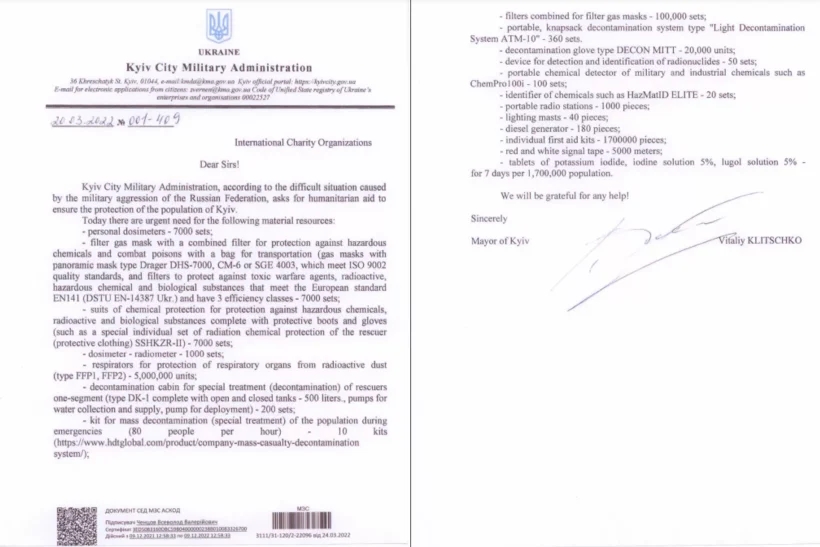
Letter from Mayor of Kiev Vitaliy Klitschko to “International Charity Organizations” dated 20 March 2022 requesting a range of equipment to protect against WMD attack.
Additionally, Kirillov said, 10 more drones equipped with 30-litre containers and spraying equipment were found in the town of Kakhovka, Kherson region in late April, on top of three others with similar equipment found in the Kherson region in March.
Kirillov’s RCB Troops have spent over two months investigating and reporting on the US-sponsored military biological activities taking place at 30 separate facilities across Ukraine going back to at least 2005.
Western officials and media have largely dismissed the information provided as a “conspiracy theory”, notwithstanding Under Secretary of State Victoria Nuland’s admission at a Senate hearing in March that “biological research facilities” do in fact exist in the Eastern European country and that the US was “working with” the Ukrainians to ensure that these materials “do not fall into the hands of Russian forces”. Investigations by the few Western outlets that have conducted their own research have confirmed individual details of the Russian MoD’s allegations – such as Hunter Biden’s role in securing millions of dollars in funding for a US contractor working in Ukraine.
The Vaccine Cajolers, Part 1: How jab zealots set out to stifle sceptics
THIS is the first of a special five-part investigation into the way in which, and why, winning ‘vaccine confidence’ became the primary goal of world health agencies, regardless of need, efficacy or risk.
By Paula Jardine | TCW Defending Freedom | May 11, 2022
Since the UK’s Covid-19 vaccine programme began in December 2020, 140million doses have been administered to 55million people, representing 73 per cent of the population.
The high level of acceptance of these vaccines, which were developed in one tenth of the normal time frame – and in the case of the mRNA vaccines using a novel technology never previously licensed for use in either humans or animals – is a remarkable testament to the level of public trust in vaccines.
It is arguably the end product of two decades of work, first by GAVI, the Global Alliance for Vaccines and Immunisations (now called The Vaccine Alliance) and recently by initiatives such as that of the London-based Vaccine Confidence Project, established to deliver the goal of universal childhood vaccination set 40 years ago by UNICEF, the United Nations children’s welfare organisation.
GAVI was set up in 1999 ‘to save children’s lives and protect people’s health through the widespread use of safe vaccines, with a particular focus on the needs of developing countries.’
It was founded at the instigation of Dr Seth Berkeley, its current CEO, who was then working for the Rockefeller Foundation. ‘We will have an outside body that can bring in industry (which the World Health Organisation can’t legally do), do advocacy and build a truly international alliance,’ he said.
The Vaccine Alliance, a public-private partnership financed by vaccine manufacturers, the Bill and Melinda Gates Foundation and national governments, aimed to give impetus to the universal vaccination campaign and to revitalise the fortunes of a stagnating market for new vaccines. The UK government is currently is largest single donor, having made a five-year pledge in 2020 of £1.65billion.
Its initial focus was on gaining the ‘long-term commitment of client governments and donors to full immunisation’, the latter implying vaccination on schedule and for every possible disease. This was different to its twin, the concept of universal vaccination.
When GAVI was launched, a UNICEF employee and anthropologist, Dr Heidi Larson – who would later found the Vaccine Confidence Project – was chosen to lead its vaccine communications and advocacy work.
She later explained how the nature of the advocacy was soon to evolve away from the initial focus on client governments.
‘There was a growing epidemic of individuals and communities and even some government officials questioning and refusing vaccines,’ she said. ‘I ended up getting the nickname “Director of UNICEF’s Fire Department,” because it turned out to be a crisis management position, because people weren’t taking vaccines.
‘I saw what seemed to be a trend: The northern Nigeria boycott of the polio program made it into the international press, but it wasn’t one place, it was everywhere.
‘I didn’t have time in my day job to investigate what was going on there, because there was not a quick fix. That’s when I put together a proposal and got some seed money and founded the Vaccine Confidence Project.’
There is no seminal document laying out a case for universal vaccination. As a public policy objective, it originated with the Rockefeller Foundation (RF). Its end goal is to eradicate diseases one-by-one via vaccination, the so-called vertical approach to public health introduced by the RF soon after its founding in 1913. It was part of a package of cheap, technological quick fixes for health care in developing countries originally called Selective Primary Health Care.
These interim measures were necessary because matching the industrialised world’s standards of sanitation, clean water, nutrition and health care to reduce the disease burden was ‘prohibitively expensive’.
An RF trustee, James P Grant, had been appointed executive director of UNICEF in 1980, operating it as a rival to the vaccine-agnostic World Health Organisation of his era.
In 1980, in an article on the eradication of smallpox, WHO director-general Dr Halfdan Mahler did not even mention vaccines. Rather, he stressed: ‘Smallpox eradication is a sign, a token, of what can be achieved in breaking out of the cycle of ill-health, disease and poverty.’
But Grant engaged in what the New York Times called ‘tireless, peripatetic proselytising’, using his UNICEF pulpit to zealously promote vaccination.
With rearguard reinforcement from the US Centres for Disease Control (CDC), by 1984 he had brought the WHO, the agency meant to provide the technical lead, on board with ‘universal’ vaccination.
Today, UNICEF is a quasi-arm of the pharmaceutical industry. Figures in its most recent Immunisation Roadmap document show it is now responsible for distributing 40 per cent of vaccines in developing countries, while its 659 staff spend more than half their time managing immunisation programmes and supply chain logistics.
In Part 2 tomorrow, I will explain how GAVI’s ten-year strategic plan, the Decade of the Vaccine, set out to eliminate vaccine scepticism.
FDA Chief Claims “Misinformation” is Leading Cause of Death in the United States
By Paul Joseph Watson | Summit News | May 9, 2022
During an appearance on CNN, FDA chief Dr. Robert Califf asserted that the leading cause of death in the United States is online “misinformation.”
Yes, really.
Califf spoke about his remarks during an interview with CNN’s Pamela Brown, which were originally made at a health conference in Texas last month when he said online misinformation was “now our leading cause of death.”
After admitting that there was “no way to quantify this,” before mentioning heart disease and cancer (actual killers), Califf went on to bolster the claim anyway.
Claiming that there has been “an erosion of life expectancy,” Califf went on to say that Americans were living an average of 5 years shorter than people in other high income countries.
Califf said that anti-virals and vaccinations meant “almost no one in this country should be dying from COVID,” before going on to explain that there was also a “reduction in life expectancy from common diseases like heart disease.”
“But somehow … the reliable, truthful messages are not getting across,” he said, adding, “And it’s being washed down by a lot of misinformation, which is leading people to make bad choices that are unfortunate for their health.”
The FDA chief did not explain how ‘online misinformation’ was causing more deaths from heart disease, but went ahead and made the claim anyway without being challenged by the host.
As we have exhaustively highlighted, “online misinformation” is indistinguishable from information the regime doesn’t like.
As we previously noted, the woman picked to head up the Department of Homeland Security’s ‘Ministry of Truth’ said free speech makes her “shudder” while also promoting the lie that the Hunter Biden laptop story was Russian disinformation.
Nina Jankowicz also ludicrously cited Christopher Steele as an expert on disinformation. Steele was the author of the infamous Clinton campaign-funded Trump ‘peegate’ dossier’ that turned out to be an actual product of disinformation.
The contrived moral panic over “misinformation” has become more pronounced following Elon Musk’s purchase of Twitter, with CNN guests recently complaining about how it might impact their monopoly on controlling “the channels of communications.”
It’s Time We Get Answers About the FBI’s Involvement In the OKC Bombing
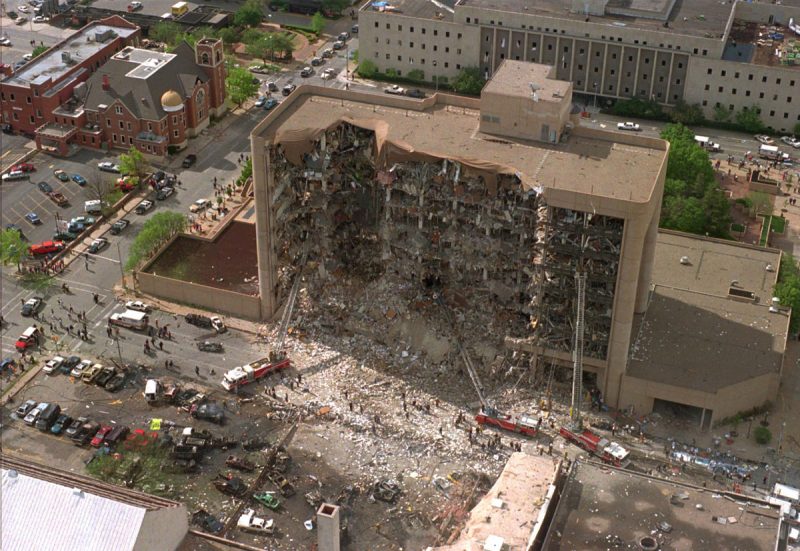
By John Kline | The Libertarian Institute | April 27, 2022
This past week marked the 27th anniversary of the Oklahoma City bombing. As the worst terrorist act committed on U.S. soil at the time, we all know the reported facts of the horrific event well: a 27-year-old Desert Storm-vet, Timothy McVeigh, acting with minimal help from Terry Nichols and Michael Fortier, detonated a 7,000-pound fertilizer bomb from a parked Ryder truck outside the federal Alfred P. Murrah building, killing 168 people, 19 of them children.
Two years later, in 1997, McVeigh was convicted of “Using a weapon of mass destruction resulting in death,” among other federal charges. For a time, he was held on the same cell block as the Unabomber and WTC-bomber Ramzi Yousef (who tried to convert him to Islam), before being put to death by lethal injection in 2001.
There is much we still don’t know about the case, however. Thanks to years of heroic work by people like Salt Lake City-based attorney Jesse Trentadue, writer and researcher J.M. Berger, and independent investigative reporter Wendy S. Painting, the American public is slowly learning more and more key (and disturbing) facts about the case. Facts involving the FBI’s possible incitement of McVeigh and the subsequent cover-up of these facts by Newsweek magazine.
FBI incitement is more topical than ever, of course. Reports of the FBI being involved in Michigan governor Gretchen Whitmer’s kidnapping plot and of FBI agents and assets being involved in the January 6th events has collapsed whatever level of trust the public had with federal law enforcement, not to mention the mainstream media whose related coverage rarely digs deeper than the government’s official line.
What other crimes have been committed or conspiracies planned, the public wonders, where the initial momentum was actually created the FBI? How much have FBI infiltrators pushed constitutionally protected “heated talk” into the unlawful planning and execution of deadly crimes? To what extent has the FBI been, as the saying goes, arsonists posing as firefighters? These are especially important questions when it comes to the OKC bombing.
Operation PATCON
As most know, the FBI and other law enforcement agencies have conducted surveillance and infiltration operations against right-wing groups for decades. Chief among them being the “Patriotic Conspiracy” or “PATCON” operation. Despite its official ending in late 1993 (although some say it was carried forward in some form), PATCON only became public in 2007 thanks to a public records request.
Partly citing internal FBI documents, Painting in her explosive 2016 book about PATCON and McVeigh, describes how the former’s secret operatives and paid informers “were given license to engage in provocateur activities and instructed to make known their willingness to commit violence and advocate for the violent overthrow of the U.S. government.”1 She quotes one informer who went public about the operation, John Matthews, saying he realized that although initially told “the objective was to infiltrate and monitor,” he would later come to understand that its real objective was to “to infiltrate and incite.”2 This, says Matthews, included providing “the ideas, detailed instructions, and even live C4 explosives and automatic weapons to targeted individuals as a way of entrapping them into terrorist plots, so the FBI could capitalize on foiled and actualized plots.”3 According to Trentadue, through PATCON, the FBI was actually trying to sow a full-on rebellion.
While the FBI has indeed infiltrated hard-left and Islamic groups in the past, the extent and complete failure of the FBI’s overreach when it comes to right-wing groups (which diversely included pro-gun, ultra-libertarian, survivalist, and white racist or advocacy groups) makes this area especially alarming. For instance, there was just one minor conviction over stolen military night-vision goggles that was ever made through PATCON, and it relied on army, not FBI, intelligence. As Oklahoma City journalist J.D. Cash said about PATCON and certain precursor programs of the 1980s, “there isn’t a neo-Nazi or racist group in the country that isn’t operationally controlled by the FBI.” This seems to concur with what a former young Aryan Nation-member told Painting for her book4:
It was well known that at any Aryan Nation event, in a crowd of 300 people, there’d be at least 30 undercover federal agents in attendance to monitor us, and another third of the crowd were informants… It was rampant, just like cops at a Grateful Dead show trying to sell people LSD.
One of those assets was Vietnam War veteran John Matthews. Up until 1986, the government had been supporting U.S. civilian groups conducting operations in Nicaragua for anti-communist contra forces; a cause which Matthews chose to serve. When such efforts turned into a political scandal, however, the government broke-off ties with these groups and refused to help its members. This included people like Matthews’ fellow soldier Tom Posey who would later be indicted on weapons-smuggling charges.5 While he beat the rap, Posey felt cheated and shifted his efforts to anti-U.S. government organizing. When he revealed plans to break into a federal armory, however, Matthews contacted the FBI, establishing a relationship with law enforcement that led him to infiltrate over 20 militia, libertarian, gun-rights, and racist groups over a 20-year period.
Matthews, who has long been suffering from an Agent-Orange-related cancer, is key to what understanding we have about PATCON’s connection to the OKC bombing. In the early nineties, Matthews was assigned to attend a PATCON-infiltrated, militia-training camp in Texas. While there, he met Timothy McVeigh. After the bombing and when McVeigh was arrested, Matthews immediately recognized him and called his FBI handler, Don Jarrett, to tell him this was the same man he saw at the Texas training camp. Jarrett assured Matthews they knew this already and told him to “forget about it.”
In interviews with Painting, Matthews says he was disturbed by this for a few reasons, a major one being, she paraphrases, that “if they were watching McVeigh and friends back then, they had likely continued watching them throughout the bombing plot.”6 “I felt Don knew more about this,” he said elsewhere.
What other items he knew may have been what came out later in Trentadue’s public records suit against the FBI. Dozens of witnesses to the bombing had apparently reported to police and the FBI they had seen someone in the passenger side of McVeigh’s truck while parked outside the Murrah building. Other witnesses reported seeing McVeigh with several people at his motel the night before, including someone sitting at some point behind the wheel of the truck—And Nichols himself (who was in Kansas when the bombing took place) told journalists in 2007 that FBI provocateurs had lent their support to McVeigh’s plans.7
Also disturbingly, using a fertilizer truck to blow up a federal building had been an idea Matthews had actually heard a few times before, including from suspected FBI infiltrators. For instance, he had heard it raised by two militia members he met who later became part of a busted plot to rob a bank, but who never got arrested, let alone jailed for it.
All of this would seem to point to the OKC bombing being something like 2010’s Operation Fast and Furious, in which the FBI intentionally put guns into the hands of criminals, but failed to close the loop leading to a border agent being killed by a Mexican cartel. Was OKC a similar ‘gunwalking case gone awry’? Only one, far, far deadlier? Someone who McVeigh contacted two weeks before the bombing, Andy Strassmeir, later told a journalist it is possible the FBI was “going to arrest McVeigh at the site with the bomb in hand, but he didn’t come at the right time.” “[M]aybe he changed the time”, he said, “you never know with people who are so unreliable.”8
Newsweek’s Complicity
In 2011, wishing to tell his story before he died, Matthews was put in touch with former Associated Press-writer and then-editor of Newsweek, John Solomon. At the time, Newsweek was still foremost in the U.S. media field, coming in second in circulation only to Time magazine. It was an important and respected news source. Over months, Solomon and article-author Ross Schneiderman worked with Matthews and other sources, including former FBI officials, to confirm everything he told them about the murky workings of PATCON, including the unanswered questions about its operatives’ possible involvement in the OKC bombing.
Enter Newsweek managing editor, Tina Brown. Above the heads of Solomon and Schneiderman, Brown (who left in 2013 and has been blamed for the periodical’s collapse) took what may have been a Pulitzer-worthy piece of journalism and cut away virtually all detail that could directly or indirectly impugn the government for the fallout of its PATCON operations. In the process, she reduced the original 7,000-word draft (found here) down to a mere 4,000 words (found here). As the since-defunct Examiner detailed at the time, all of the aforementioned suspicions Matthews aired about the FBI’s hand in the OKC bombing were cut.
Brown’s puzzling decision had real consequences for Matthews. As Painting recounts in her book, the dying Matthews had taken a lot of risk by coming forward. He was now Newsweek’s cover story, but for reasons that had been omitted. Now, he was still a target but “for no good reason and he regretted coming forward.”9
More broadly, by keeping such information away from the public, Brown was confirming the existence of a state-media axis in America. While examples of such direct state-interventions into our otherwise free media system are rare (although certainly plentiful enough), media analysts like Noam Chomsky have long posited that, yes, news outlets do profit off the circulation of their stories and are thus incentivized to objectively report on events potentially embarrassing to the powerful elite. But, the big media houses still need government access and wish to maintain good relations with major power centers; hence, their occasional compliance with direct government demands—One might add the promise of future political jobs as an incentive for compliance or, in cases such as this where right-wing groups were clearly being mistreated, plain old liberal media bias (consider, for instance, the fairly wide–reporting on the FBI’s infiltration of Islamic extremist groups).
It seems without a doubt that the FBI did get to Brown. At the time Matthews approached Newsweek, Attorney General Eric Holder’s Operation Fast and Furious-debacle was still in the news. How could the Obama Administration handle yet another and far bigger scandal involving the FBI helping dangerous people do harm against innocent Americans?
More Alarming Questions about FBI Conduct
Elsewhere, the FBI has demonstrated a serious interest in keeping any questions about the OKC bombing firmly under wraps. When Matthews was slated to testify in Trentadue’s 2014 public records case over the release of Murrah building surveillance footage, his fear of retaliation led to the judge allowing him to testify at a secret location by video—Trentadue thought what Matthews had witnessed while a PATCON operative would help provide a motive for what had become the FBI’s ongoing, unlawful refusal to provide the footage under public records law.
And despite the judge’s precautions, Matthews’s testimony still never took place. At the last minute, Matthews was supposedly threatened with having his VA medical benefits cut off and told to “stand down” by Jarrett and another FBI agent, Adam Quirk. Such a rank case of witness tampering, in fact, led to the judge ordering the FBI to reveal what exactly they had communicated to Matthews; an investigation that has been strangely ongoing since 2015.
At the heart of Trentadue’s marathon public records case certainly has the FBI worried. Someone who did manage to testify early on in the case was an Oklahoma police officer and first responder to the OKC bombing. He told the court he witnessed the FBI actually stop the beginning of the recovery process while victims were still under piles of rubble in order to remove a surveillance camera from the Murrah building. Some believe the camera would have recorded anyone else besides McVeigh who left the truck after it was parked and, in fact, did so.
Finally, there’s the questions about the FBI’s conduct vis-à-vis Trentadue himself. Why Trentadue got involved with the OKC case is because six weeks after the bombing, his brother Kenneth, another war vet, was taken into custody after a traffic incident triggered a parole violation relating to a minor event from years previous. Soon after, he was found hanging in a cell of a federal detention center.
Photos released to Trentadue following a subsequent lawsuit against the federal Bureau of Prisons, however, showed his brother’s throat having been cut and his body covered in bruises—authorities had apparently tried to cover his wounds with make-up before releasing it to Kenneth’s family. The theory behind his death is, having shared a close resemblance with someone called Richard Guthrie, a white supremacist who the FBI thought had information about the OKC bombing, Kenneth was mistaken as Guthrie and taken in by the FBI for interrogation. McVeigh himself called and advised Trentadue of this, telling him he heard that the FBI had indeed mistaken Kenneth for Guthrie and that his death was the result of a botched interrogation session.
Adding to suspicions, the DOJ formed a special team to handle media inquiries and the Trentadue family’s immediate requests for information. It apparently obstructed and delayed the Trentadue’s right to know what happened to Kenneth in every way it could, even when it came to releasing his corpse. Who happened to be the head of this operation (dubbed internally as “the Trentadue Mission”)?10 Then-Deputy Attorney General, Eric Holder.
Finally, there are the other related and mysterious deaths. After Guthrie himself was arrested, he told the LA Times he had “a couple grand juries to talk to” about what really happened with the OKC bombing, and was also later found hanging in his cell.11
And later in 1999, a supposed inmate and witness to Kenneth’s murder, Alden Gillis Baker, threatened to come forward about what he saw. He too was later found hanging in his cell.12
Conclusion
The details surrounding the OKC bombing show it to have all the elements of a “perfect,” post-war American tragedy: Vietnam vets disrespected by the liberal-media class and tossed aside by a government they loyally served; an unhinged federal bureaucracy using its sprawling resources to violate the civil rights of poor and ignored Americans; and, a state-liberal media-axis willing to cover up for government when the “cause” was right.
And consider the following. Even if we ignore the aforementioned evidence about the FBI’s hand in the OKC bombing, remember that the twin motivations for McVeigh’s crimes were Waco and Ruby Ridge—McVeigh chose April 19 as his bombing date because it was the same day as the Waco massacre two years previous. Matthews has actually expressed the view that both massacres had PATCON fingerprints all over them. That’s certainly the case with Ruby Ridge. There, a federal agent/infiltrator pushed former Green Beret Randy Weaver into selling him an illegal sawed-off shotgun. This led to his attempted arrest and an eventual standoff, which then led to the shooting deaths of his 14-year-son by federal marshals and his unarmed wife (baby in hand) by an FBI sniper.
In public and in private correspondence, McVeigh tore into the federal government over these events, expressing fear of a state that was at war with its own citizens. Without federal law enforcement acting so heinously in these events, it’s likely McVeigh would not have carried out the crime that he did.
Further, these rank FBI abuses ironically pushed “right-wing terror groups” to become the threat we were warned about all along. As the original Newsweek article rightly said about Ruby Ridge, the FBI’s conduct “quickly galvanized the radical right like never before” with talks between “various white supremacists, Neo-Nazis and anti-government groups… about joining forces… quickly turn[ing] to action.”
And as Painting writes, even more absurd perhaps, Ruby Ridge was used by federal law enforcement as a justification for increased PATCON resources and investigatory powers.13
So, we have FBI abuses leading to organized rage and resistance, which is then given even more momentum by FBI infiltration and incitement. And with the help of a media sphere that refuses to do its job, all of this works to amp up yet more fear, anxiety and division among the public. It’s a spinning wheel which loyal, patriotic Americans never asked for and certainly want off of.
While we should certainly hope these allegations can be explained away, it’s high-time the OKC victims and the American people generally get the transparency they deserve about what really happened that fateful day.
Ukraine lied to its encircled troops – commander
Samizdat | May 8, 2022
Ukraine told troops besieged by Russian forces in Mariupol that help was on its way, while making no actual attempts to end the blockade of the city, the commander of the country’s 36th Naval Infantry Brigade has told RT.
Colonel Vladimir Baranyuk and his unit were tasked with guarding the northern outskirts of Mariupol, a strategic port city in the southeast of Ukraine, amid the Russian military operation in the country.
He was even awarded the Hero of Ukraine honor for his “courage and effective actions in repelling enemy attacks,” with Kiev asserting that the colonel and the other defenders of Mariupol would never surrender.
But as the Russian forces kept gaining ground, Baranyuk ended up surrendering peacefully after being captured during a failed attempt to flee the city.
He was apprehended hiding in the fields together with a number of his men a few kilometers north of Mariupol.
The commander of the marines now says the Ukrainian government lied to him and his troops in order to keep them fighting.
“Kiev told us to hold on, [saying] that the units that will lift the blockade are coming, they’ll soon be here,” Baranyuk told RT.
The promise was made despite President Volodymyr Zelensky’s adviser, Alexey Arestovich, openly acknowledging in interviews that Kiev “won’t be able to save” its forces in Mariupol.
“We were promised certain help. Naturally, this help didn’t arrive. And this pushed us to come out,” the colonel said, explaining his decision to flee.
It was “painful” for the troops when they realized that they had been left for dead, but “everybody, including myself, understood it,” Baranyuk added.
Mariupol has seen the heaviest fighting during the ongoing conflict between Russia and Ukraine. The city, which suffered immense destruction, is now almost entirely controlled by Russian forces, with the Azovstal steel plant remaining the last pocket of Ukrainian resistance.
Kiev’s servicemen and nationalist fighters of the notorious Azov Battalion, who are holed up at the massive site, had been given numerous opportunities to lay down their arms by Russia, but rejected all of them. Moscow has said that those inside the plant want to surrender, but cannot do so due to Kiev’s reluctance to give the relevant order.
Featured Video

Broke Princes: Saudi Arabia’s Powder Keg
or go to
Aletho News Archives – Video-Images
From the Archives
Registered Israeli foreign agent driving contrived campus antisemitism crisis
By Wyatt Reed | The Grayzone | December 17, 2023
Lawsuits accusing top US universities of harboring antisemitism all originate from one source: a corporate law firm that fielded the pro-settler ex-US ambassador to Israel, and which was registered as a foreign agent of an Israeli principal as recently as 2021.
The firm now represents professional Israel lobby activists posing as victimized “Jewish students” and seeking to crush the free speech rights of Palestine solidarity activists. … continue
Blog Roll
 Aletho News
- Broke Princes: Saudi Arabia’s Powder Keg
- Albania’s Crisis: Rama, Israeli Investments and the Demand for Accountability
- Hezbollah Categorically Denies Syrian Accusations: We Aim at Confronting Israeli Enemy, Not Undermining Syria’s Stability
- Trump claims funding to Israel ending in 2026 as merger of Israeli–US armies looms
- Iran Weathering The Storm, But Saudi Arabia Is Sinking
- Sunk Ships Don’t Sail Home: Why Peace Won’t Save the Oil Market and War Will Wreck It
- No Cossacks at the gates, fix Italy instead – opposition leader to Meloni
- The Pits: Zelensky’s torture chamber network in the public eye
- Moscow mocks Kiev’s language hypocrisy exposed by ‘torture chamber’ scandal
- Military ‘torture chamber’ triggers new scandal in Kiev
- If Americans Knew
- An error has occurred; the feed is probably down. Try again later.
- No Tricks Zone
- New Study: The Net Fossil Fuel Contribution To Rising Atmospheric CO2 Has Been Zero For 500 Years
- Germany’s Green Energy Transition Becoming Increasingly Expensive…Another 6 Trillion Euros!
- Sudden Stratospheric Warming, Powerful El Niño Combination May Lead To Extreme Europe Cold, Energy Crisis!
- Two New Studies Find Thwaites Glacier Melt Cannot Be Driven By Human Activity Or A Warming Ocean
- E-Cars Reduce CO2 Emissions By Only 41% Compared To Internal Combustion Engine Vehicles
- Predictions Made By Renowned Climate Professor Over Past Decades Have Been Proven To Be Poor
- New Study Suggests Large Regions Of The Pacific Ocean Have Been Cooling For The Last 80 Years
- Germany’s Green Energy Debacle: High Energy Costs Force Kahla Porzellan to Close After 182 Years!
- New Study: 50 Years Of The Most Aggressive ‘Net Zero’ Policies Can Only Affect The Global Climate By 0.03°C
- US September “Heat” Was No Record…Many Records Set Decades Ago


