New study shows low-carb diets would save BILLIONS currently wasted on drugs. But will Big Pharma allow it?
By Dr Malcomb Kendrick | November 3, 2020
If you want to avoid dying of COVID19, one of the most important things you can do, if you are overweight, is to shed the pounds
‘…. in the first meta-analysis of its kind, published on 26 August in Obesity Reviews, an international team of researchers pooled data from scores of peer-reviewed papers capturing 399,000 patients. They found that people with obesity who contracted SARS-CoV-2 were 113% more likely than people of healthy weight to land in the hospital, 74% more likely to be admitted to an ICU, and 48% more likely to die.’ 1
Why? Well, the ‘why’ centres around the damaging effect of raised blood glucose on endothelial cells and… it gets complicated.
For now, though, the most important thing is not to understand the complex metabolic and physiological pathways involved, it is simply to help people to lose weight, and this is where Dr David Unwin comes in.
For years now he has believed, as I do, that the main driver of weight gain, leading on to type 2 (T2) diabetes, is a high carbohydrate diet.
This, of course, is the exact opposite of what we have been told for decades by the ‘experts’ who demonise fat and promote carbohydrates. We have the ‘eat-well’ plate, and the ‘food pyramid’, and hundreds of thousands of dieticians around the world, all promoting carbohydrates as the ‘healthy’ option.
Dutifully following this advice, the entire population of the western world has become fatter, and fatter… and fatter. By the way, this is not a coincidence; it is cause and effect.
Getting back to Dr Unwin, years ago he despaired of ever getting any of his patients to lose weight. It was so disheartening that he furtively studied his pension plan, and dreamed of retirement, so fed up was he becoming. Then one day a patient came in who had lost a lot of weight and kept it off.
At first this woman was reluctant to say how she had done it, as she feared the inevitable criticism. In the end, she told Dr Unwin that she had lost weight, and kept it off, by eating a low carbohydrate diet. In Dr Unwin’s own words:
‘A few years ago, I was interested to find out how a patient had improved her diabetic control. She confessed she had ignored my advice and learnt a much better way to look after herself, from the internet. I suppressed my wounded pride and looked at the Low Carb Forum on Diabetes.co.uk There were thousands of type two diabetics on there ignoring their doctors – and getting great results (now that is just not allowed).’ 2
Yes, Dr Unwin did not criticize, instead he was intrigued. Could this possibly be true? It went against everything he had been told about healthy eating, and weight loss, and T2 diabetes. Fat has twice the calories, per gram, as carbohydrates and suchlike. Eating fat, he believed, makes you fat, and then you develop diabetes, and heart disease.
Dr Unwin did more research, then he made the decision to work with patients, mainly those with diabetes, to see if a low carbohydrate diet could be beneficial. Lo and behold, it was … very beneficial. It was like a miracle cure.
In 2014 he published a paper on his results on a small number of patients.
‘Low carbohydrate diet to achieve weight loss and improve HbA1c in type 2 diabetes and pre-diabetes: experience from one general practice.’
‘It was observed that a low carbohydrate diet achieved substantial weight loss in all patients and brought about normalisation of blood glucose control in 16 out of 18 patients. At the same time, plasma lipid profiles improved, and BP fell allowing discontinuation of antihypertensive therapy in some individuals…
Conclusions Based on our work so far, we can understand the reasons for the internet enthusiasm for a low carbohydrate diet; the majority of patients lose weight rapidly and fairly easily; predictably the HbA1c levels are not far behind. Cholesterol levels, liver enzymes and BP levels all improved. This approach is simple to implement and much appreciated by people with diabetes.’ 3
Now, he has published results of a much larger study, on nearly two hundred patients over a six-year period. It is called. ‘Insights from a general practice service evaluation supporting a lower carbohydrate diet in patients with type 2 diabetes mellitus and prediabetes’ Published in BMJ nutrition 4.
Here are the main findings, which I nicked directly from the press release:
- 46% drug-free T2 diabetes remission
- Significant improvements in weight, blood pressure and lipid profiles
- 93% remission of prediabetes
- £50,885 annual saving on the Norwood GP practice NHS diabetes drug budget
- If every GP practice in England spent the same on drugs for diabetes per patient as Norwood the NHS could save £277 million!
- Older patients can do as well as younger ones with a low carb approach.
- The participants who started with the worst blood sugars saw the greatest improvements in diabetic control
- Four individuals came off insulin altogether
- Total weight loss for the 199 participants was 1.6 metric tons!
This paper will be attacked, of course. There are massive financial interests involved here. As stated, if every GP practice in the UK used the low carb approach, the NHS could save £277 million (~$350m) in drug costs. Scaled up to the US, with much higher drugs costs, one could be looking at around $2Bn/year. Around the world, who knows, but vast sums of money.
So, you can imagine the joy that this paper will be met with in pharmaceutical company boardrooms around the world. The words ‘lead’ and ‘balloon’, spring to mind. Equally the massive low-fat, high carb food manufacturers will be throwing their hands up in horror – ‘my bonus, my bonus… nooooo.’ You can take your low carb yoghurts and….
As for the rest of us. I can assure you that Dr David Unwin has only ever been interested in one thing. Working out how to help people lose weight and control their diabetes. He has achieved this.
Will his research now be taken up by the authorities around the world? Will we move away from promoting a high carbohydrate diet? You have to be joking. There is far too much money to be lost by companies who exert tight control over the world of medical research, and whose lobbyists swarm around the politicians in rich countries.
Which is a damn shame, because more than ever in this endless COVID19 pandemic, obesity represents a health crisis. This paper, and the tireless work by Dr David Unwin, clearly tells us what we need to do, now, urgently. His approach won’t work instantly, and it won’t work for everyone – nothing ever does. However, it represents hope. It could save hundreds and thousands of lives. Better than any vaccine?
Thank you, once again, Dr Unwin. A man who I think of as a friend. Your research should be shouted from the rooftops. I can only do my bit.
1: https://www.sciencemag.org/news/2020/09/why-covid-19-more-deadly-people-obesity-even-if-theyre-young
4: https://nutrition.bmj.com/content/early/2020/11/02/bmjnph-2020-000072
Russian PR executive outed as ‘source’ of ‘Russiagate’ Steele Dossier claims it was made up by British spy’s employee
By Jonny Tickle | RT | November 3, 2020
After being accused of being behind the controversial Steele Dossier, a discredited report detailing alleged misconduct by President Trump and the catalyst for ‘Russiagate,’ Olga Galkina claims she had nothing to do with it.
Last week, the Wall Street Journal pointed the finger at Galkina as the source of information for former British spy Christopher Steele’s report, which was publicly released by Buzzfeed, in 2017. Initially funded by the US Democratic Party, the information was meant to discredit Trump by showing him as being compromised by Russians.
It suggested that the President used Moscow’s help to win the 2016 US Presidential election. It led to years of political chaos in the US, and the protracted ‘Mueller Investigation,’ which failed to find evidence to support the assertions.
According to Galkina, the dossier was likely entirely invented by her former classmate Igor Danchenko, who added her name to improve its credibility. Danchenko is a Russian emigre in the US, who has worked for Washington think tank industry.
“Danchenko and I have known each other since school,” Galkina told Moscow daily Moskovsky Komsomolets (MK). She explained that they weren’t close contacts, but she once recommended him for a job at servers.com in 2016, a Cyprus-based company where she worked.
“What happened next is not known to me, as I left the company in the middle of 2016,” Galkina explained. “I believe that Christopher Steele entrusted most of the work to Igor Danchenko, and that a huge layer of the information, most likely, was just made up.”
Danchenko was first named in connection with the Steele Dossier earlier this summer, when documents revealed that he had been interviewed by the FBI in 2017 and had cooperated. According to the Wall Street Journal, Danchenko had been working for Steele when he was tasked with finding information connecting Trump to Russia. In his research, Danchenko repeatedly referred to a ‘Source 3,’ who has now been unmasked as Galkina.
According to Galkina, Danchenko added her name to make his fiction appear more believable.
“For the sake of plausibility, he cited, as sources, his Russian acquaintances who are publicly recognized as experts in their field,” Galkina claims.
In particular, Galkina is named as a source on Alexey Gubarev, her former employer at servers.com, who is said to have hacked the Democratic National Committee. Galkina says that the accusations are entirely false.
“Neither Alexey Gubarev personally nor his employees are computer security specialists. They are not qualified to conduct computer hacking,” Galkina told MK. “By this logic, normal Russians who sit down at a computer are ‘diabolical Russian hackers.’ It is kompromat wholly made up by Igor Danchenko.”
Galkina also rubbished more of the Wall Street Journal’s claims, rejecting the suggestion that she was sacked for being late and drunk, but instead resigned due to “unbearable working conditions” and a messy divorce.
“I won’t rule out lawsuits against citizens, both in Russian and American courts, who tried to use and defame my name.”
Don’t Forget LBJ’s Election Theft
By Jacob G. Hornberger | FFF | November 2, 2020
The mainstream pro-Biden media is poking fun at Donald Trump’s suggestion that there could be fraud involved in the post-election receipt of mail-in ballots. Apparently they’re not familiar with the election-theft case of Lyndon Johnson, who would go on to become president of the United States.
The entire matter is detailed in Robert Caro’s second book in his biographical series on Johnson. The book is entitled Means of Ascent.
Johnson election theft took place in 1948, when he was running for the Democratic nomination for U.S. Senate against Texas Governor Coke Stevenson, one of the most admired and respected governors in the history of the state.
In the primary election, Stevenson led Johnson by 70,000 votes, but because he didn’t have a majority of the votes, he was forced into a run-off. The run-off was held on a Saturday. On the Sunday morning after the run-off, Stevenson was leading by 854 votes.
As a New York Times review of Caro’s account stated, the day after the run-off election it was “discovered” that the returns of a particular county had not yet been counted. The newly discovered votes were overwhelmingly in favor of Johnson. Then, on Monday more returns came in from the Rio Grande Valley.
Nonetheless, on Tuesday, the State Election Bureau announced that Stevenson had won by 349 votes. Nothing changed on Wednesday and Thursday after the election. On Friday, precincts in the Rio Grande Valley made “corrections” to their tallies, which narrowed Stevenson’s lead to 157.
But also on Friday, Jim Wells County, which was governed as a personal fiefdom by a powerful South Texas rancher named George Parr, filed “amended” returns for what has become famous as “Box 13” that gave Johnson another 200 votes. When all was said and done, Johnson had “won” the election by 87 votes.
It was later discovered that one of Parr’s men had changed the total tally for Johnson from 765 to 965 by simply curling the 7 into a 9.
Where did the extra 200 votes come from? The last 202 names on on the election roll in Box 13 were in a different color ink from the rest of the names, the names were in alphabetical order, and they were all in the same handwriting. When Caro was researching his book, he secured a statement from Luis Salas, an election judge in Jim Wells County, who acknowledged the fraud and confessing his role in it.
As the Washington Post reported, to investigate what obviously appeared quite suspicious Stevenson employed the assistance of Frank Hamer, the Texas Ranger who had trapped and killed Bonnie and Clyde. It was to no avail. Johnson got a friendly state judge to issue an injunction preserving the status quo, after which the Democratic executive committee, by one vote, declared Johnson to be the winner.
Stevenson took the matter to federal court but the Supreme Court punted, declaring that it had no right to interfere with a state election.
So, Lyndon Johnson stole the election and ended up going to Washington as Texas’ U.S. Senator. Ironically, if Stevenson had become the state’s senator instead, Johnson would never have been selected to be John Kennedy’s vice-presidential running mate and, consequently, would never have been president.
No wonder Donald Trump is worried about those Democrats!
Why Canada Must Release Meng Wan Zhou
By K.J. Noh | Dissident Voice | October 30, 2020
 Few things are as dangerous as a poorly thought-out kidnapping. Kidnappings are serious business, often with unintended consequences. History is replete with dim-witted criminals who engaged in them on a whim, only to discover adverse outcomes far beyond their imagining. One dramatic example happened 90 years ago this week:
On October 24th, a mother with young children is kidnapped. She is the cherished wife of an important man whom the kidnapper’s group is in competition with. The plan of the kidnapper is that by kidnapping her, this will create unbearable psychological pressure on her husband, force him to capitulate, or at least damage his resolve.
The woman is first humiliated, then tortured, then killed. But the leader does not capitulate, break, or weaken. Instead, over the next nineteen years, he wages war without quarter on his enemies and eventually drives them into the sea. Decades later, he will write this poem for her:
The lonely goddess in the moon spreads her ample sleeves
To dance for these faithful souls in the endless sky.
Of a sudden comes word of the tiger’s defeat on earth,
And they break into tears of torrential rain
The poet, is of course, Mao Zedong. The kidnapped woman was the beloved wife of Chairman Mao, Yang Kai Hui, the mother of his three children. In the winter of 1930, the Kuomintang Fascists kidnapped her and her son, in order to demoralize Mao and put pressure on him to capitulate. She was executed in Changsha, on November 14th, in front of her children, at the ripe age of 29.
Though utterly helpless at the moment she was hostage, Mao never forgave the kidnappers for their depravity, cowardice, and misogyny—victimizing women and children as weapons in a war—and he ground his enemies into the dust, and then built a state where such atrocities could never occur or go unpunished again.
The State-directed, extraterritorial kidnapping of Huawei CFO Meng Wan Zhou is widely seen as a similar act of infamy, misogyny, and thuggery, by a similar class of disreputable individuals. “Lawless, reasonless, ruthless,… vicious” is the extraordinary official pronouncement of the Chinese government. It is certainly a violation of international law. How this will play out ultimately, and what retribution will be meted out remains to be seen, but retribution there will surely be for this “extremely vicious” act.
George Koo has pointed out the “rotten underpinnings of the case” in this article. Most people understand that Meng is not guilty of anything other than being the daughter of Ren Zeng Fei, the founder of Huawei. Huawei, as a global technological powerhouse, represents Chinese power and Chinese technical prowess, which the United States is hell-bent on destroying. Meng has been kidnapped as a pawn, as a hostage to exert pressure on Huawei and the Chinese government, and to curb China’s development. In a maneuver reminiscent of medieval or colonial warfare, the US has explicitly offered to release her if China capitulates on a trade deal—making clear that she is being held hostage. This constitutes a violation of the UN Convention on Hostages.
The outcome of this judicial kidnapping will determine US and Canada-Chinese policy for decades to come: whether a rapprochement is possible in the future, or whether relations will spiral into a cycle of acrimony, vengeance, and ultimately catastrophe.
What is on trial, of course, is not Meng, or Huawei, but the judicial system of Canada and the conscience, good sense, and ethics of its ruling class: whether it will uphold or undermine international notions of justice.
If the Canadian judiciary and its ruling classes fail this test, Canada risks being driven, metaphorically, into the sea by a determined Chinese leadership. The global community that upholds international justice could only concur.
Key Facts about the Meng Wan Zhou Case
The Canadian government arrested Meng Wan Zhou, the CFO of Huawei, on December 1st of 2018, as she was transiting Vancouver on a flight to Mexico. The arrest was made on the demand of the US government’s US District Court’s Eastern District of NY. The initial charge was “fraud and conspiracy to commit fraud to circumvent US sanctions on Iran”.
Of course, the US government knew rapidly that these allegations could not constitute an extraditable charge. The Canadians do not subscribe to US sanctions against Iran—they actively encourage trade with Iran–and therefore business dealings with Iran could hardly be a crime in Canada. In fact, the unilateral US sanction are actually a violation of international law. Furthermore, like most jurisdictions in the world, Canada also has a requirement of “double criminality”: unless the alleged crime is a crime in both jurisdictions, you cannot extradite.
So an alternate case had to be constructed. The case was that was concocted alleged that because Meng had lied to a bank, she must be extradited for fraud. Of course, the bank was British (HSBC), the “crime” happened in Hong Kong, the accused was a Chinese national, and the arrest was in Canada. Hence, she must be extradited to the US for “fraud”. As a set up for a lame joke this would not pass, and as legal argument it is beyond farce. The US court claimed standing to charge her because transactions with HSBC had, or would have transited US servers in New York for a few milliseconds.
Here are some key things to remember about this case:
1) Even if the allegations of so-called “fraud” were true, without the political pressures, such an issue would largely be a private matter between HSBC and Meng.
2) None of the transactions between HSBC and Meng occurred in the US. The funds only transited through the US system because of the way of the global banking system is set up for dollar clearance—this was the pretextual technicality used for jurisdiction and charging. (The funds could equally have been set up to transit through an alternate system, bypassing US servers and risk).
3) No non-US person has ever been charged for “causing” a non-US bank to violate US sanctions in the past. In similar cases, it’s usually a small fine to a corporation.
4) It’s been shown that the US attempted the abduction of Meng in 6 European and Latin American countries—all of which rejected US demands. The US decided on Meng’s momentary transit through Canada, because they considered the Trudeau government to be the most pliable and sycophantic to their cause.
5) Trump has made statements that Meng could be used as a bargaining chip in the US-China trade deal, showing the clearly political nature of the arrest. Confidential RCMP documents also note that the arrest was “highly political”. It’s widely suspected that the law-breaking John Bolton was the instigator behind the action.
6) HSBC was already under prosecution by the US government for prior unrelated violations; rather than doing due diligence in their loan or clearance processes or the law, it decided to collaborate with the US government to entrap Huawei and Meng.
7) The arrest itself involved massive abuses of process: irregularities in detention, notification, search, seizure, constituting themselves violations of international law and bilateral agreements.
8) The court case has been also full of abuses, including the hiding of key exculpatory documents (slides 6 & 16) by the prosecution; and denial of access to key documents to the defense (on the basis of national security and “damage to China-Canada relations”). Given the damage that has already happened to China-Canada relations by the abduction of Meng, one can only imagine what additional “damage” Canada’s Intelligence service is trying to prevent with a claim of National Secrets exemption.
9) The Trudeau government is going on with charade that it is a hapless damsel obliged to follow US strong-arm demands. But Section 23 of the Canadian Extradition Act gives the government the authority to terminate this case at any time. Extradition is made on the discretion of the government, and by refusing to act, the Trudeau administration is abdicating its responsibilities to the Canadian people and the cause of justice.
The Fraudulent Charge of Fraud
Meng Wan Zhou’s lawyer has argued, “It is a fiction, that the US has any interest in policing interactions between a private bank and a private citizen halfway around the world…It’s all about sanctions.”
The jurisprudence upholds this: for a fraud charge against Meng to stick, it would have to show 1) deliberate misrepresentation/deception to HSBC as well as 2) harm or risk of harm to HSBC. In other words, Meng’s lies would have put HSBC at risk for fines and penalities for sanctions busting.
Note, however, that the bank could not have been held liable, if it could be shown that they had been “deceived” into breaching US sanctions by Meng as alleged. If Meng had “lied” to the bank, no harm could have occurred to the bank. The bank would have needed to act deliberately to face any risk of liability.
On the other hand, documents, slides, and emails released later actually show that HSBC had been informed of the relationship between Skycom and Huawei before Meng’s testimony as well as during the meeting, so the allegation of deception doesn’t hold up. (Slides 6 & 16 used in Meng’s presentation to HSBC were omitted to make it seem as if Meng had deceived them, but in full context, show there was no deception).
The conclusion is simple: there was either no lie, or no harm. Regardless, there was no fraud.
In other words, the Canadian government had no case.
The Double Criminality of Heather Holmes
Canadian Justice Heather Holmes, presided over the interrogation. Like the fascist KMT warlord who had kidnapped and tortured Yang Kai Hui, she interrogated Meng Wan Zhou and her lawyer in sibilant tones. Tell me, about “double criminality”, she entreated gently, as if their arguments would be weighed in her judgement.
Meng’s lawyer, Richard Peck, answered with common sense: Because Canada doesn’t have sanctions against Iran, there would be no liability to the bank, hence, no risk to the bank, hence, no criminal “fraud”.
It also couldn’t constitute fraud in the US, since if what the government argued was true–that Meng had misrepresented facts to the bank–HSBC would not be liable because the bank would be an “innocent victim,” hence not liable for any sanctions.
“All risk is driven by sanctions risk in the US,” Peck stated.
Astonishingly, Justice Holmes ruled against Meng, claiming that one should not look for correspondence or equivalence between the statutes to determine “double criminality” in fraud. Instead, she claimed that one had to transpose the context and the coherence of the statues of the demanding country to render a decision. Even though Canada didn’t have sanctions against Iran (thus no illegality or risk of harm, and hence no fraud), she stated that she still had to interpret the demand for extradition by “transposing the environment” that led the US to make the demand. In other words, Canada had no sanctions on Iran, but she had to imagine “the environment”–i.e., “as if Canada had sanctions on Iran”–to render the decision. In so doing, she was able to smuggle in illegal US sanctions by installing a legal backdoor–into a country that had lifted sanctions.
In other words, the dubious, illegal “environment” of US sanctions overruled the clear, plain letter of Canadian law. At the same time, no consideration was given to the odious political “environment” driving the abduction.
Why did the good justice see fit to make a mockery of Canada’s own laws and sovereignty, and subjugate Canada to US extraterritoriality? Why did she contort herself to support the blatant illegality of US sanctions? Does she realize she has set the country barreling down the wrong lane of history?
It’s not known if Justice Holmes asked for the clerk to bring her a basin of Maple syrup to wash her hands after she passed judgement. But it would have been understandable for such a corrupt, consequential, and deeply catastrophic judgement.
Rogue State Canada
Canadian politicians and press like to intone robotically, that Meng’s kidnapping is strictly a by-the-books, “rule-of-law” procedure with Meng’s detention. They like to repeat the catechism, in that tiresome, hypocritical, Maple-washing fashion, that they are “a nation of laws” (insinuating the others are not). But the fact is, Canadians have an atrocious history of kidnapping innocents in general, and assisting the US with kidnappings in particular. There are many examples, but the best known is the story of Maher Arar, the Canadian engineer who was kidnapped and rendered as terrorist, and tortured unspeakably in Syria, where”the pain was so great, it makes you forget the taste of your mother’s milk” Of course, he was innocent of all charges.
It’s also well established that Canadian Police have an ugly habit of kidnapping Indigenous people who are drunk or homeless, and driving them far away from city and abandoning them where they are sure to die of hypothermia and exposure in the winter. These are called Saskatoon “Starlight tours”.
It’s equally well known that the Canadian government also kidnapped tens of thousands of Indigenous children, sometimes at gun point, and forced them into concentration camps (“residential schools”) where they were abused, tortured, raped, enslaved, and killed. Children kidnapped in these schools had a greater chance of dying than soldiers doing battle in WWII–some studies show a mortality rate of 40-60%. In other words, it committed genocide, through rule of law, of course.
In 2018, the UN Committee on Human Rights published a long series of incriminating findings on Canada, related to the torture, mistreatment, imprisonment, death and refoulement of immigrants, refugees, indigenous peoples, and other political prisoners.
On the other hand, the Canadian government has been known to fight tooth and nail to harbor war criminals and torturers–people who legitimately should be extradited. For example, it harbored several El Salvadoran death squad leaders in the 1980’s. These people were so toxic that the Salvadoran government could no longer have them in their country–so they gave them diplomatic postings to Canada. The Canadians, instead of doing the reasonable thing and extraditing them–as was demanded by human rights community around the world, bent over backwards to give them safe harbor and immunity.
Any hope that the settler-colonial Canadian justice system can play an even hand or follow basic human ethics in this case is belied by this atrocious history.
But Why is the US going after Huawei?
China has been designated the official enemy (“revisionist power”) of the US, because it poses a threat to US dominance. As such, the US is engaged in “multi-domain” hybrid warfare against China to attack and bring China down. The domains of warfare that involve the US assaults against Huawei are the domains of: tech war, trade war, economic war, lawfare, and cyber war. Huawei is one of the key pillars of China’s technological and economic strength. It is the world’s largest and most advanced telecom corporation, and in 5G it owns 1/5 of the base patents in the field.
Huawei is also building the digital infrastructure to accompany the Belt and Road Initiative (the “digital silk road”). This not only allows China’s economy to grow, but also prevents the effects of military blockade at the South China Sea. Its hardware makes it harder for US surveillance to tap.
These are the key reasons why it is being attacked and taken down. Aside from kidnappings, the US has been waging this warfare by trying to prevent other countries from signing deals for Huawei 5G infrastructure. It is alleging that Huawei would render these networks insecure: Huawei would spy on them for the Chinese government, or even open them for Chinese cyberwarfare.
Actually, the truth is exactly the inverse. A world-wide Huawei system could create problems for the US global panopticon upon which US “unipolar” dominance relies on: its ability to eavesdrop on individuals, corporations, the leaders of countries, as well as military communications. With non-Huawei routers, due to the subservience and mandated cooperation of US companies, cyberspace as a domain of warfare is always guaranteed to be permeable and amenable to US surveillance and attack.
In other words, the US taps routers globally to spy on individuals, companies, governments, and nations: “Routers, switches, and servers made by Cisco are booby-trapped with surveillance equipment that intercepts traffic handled by those devices and copies it to the NSA’s network”
Regarding specific allegations of Huawei’s “spying”, Huawei has been completely transparent and has handed over its source code to relevant Intelligence agencies for detailed analysis, year upon year. No spying or intentional backdoors have been found: For example, German Intelligence found no spying, and no potential for spying, and British Intelligence also found none.
On the other hand, the US NSA, in a program called Shotgiant, spied extensively on Huawei to look for links between Huawei and the PLA, evidence of backdoors and spying, and vulnerabilities that they could exploit. This extraordinary spying (revealed by Wikileaks) showed no evidence of backdoors, spying or connections with the PLA. The Shotgiant disclosures showed that US allegations were projection: NSA actions “actually mirror what the US has been accusing Huawei of potentially doing”. The NSA did, however, steal Huawei’s proprietary source code at the time, and had plans to spy on other countries by using this information and had sought to compromise security in general. Of course, these kinds of unethical exploits create dangers for everyone.
Theft and exploits notwithstanding, using Huawei hardware could still make it harder for the US to surveil networks–Huawei has declared it refuses to plant backdoors.
Guo Ping, the chairman of Huawei, was quoted in The Verge: “If the NSA wants to modify routers or switches in order to eavesdrop, a Chinese company will be unlikely to cooperate,”…Guo argues that his company “hampers US efforts to spy on whomever it wants,” reiterating its position that “Huawei has not and will never plant backdoors.”
Wired Magazine has also confirmed that Huawei is an obstacle to NSA surveillance: Telecom-equipment makers who sell products to carriers in the US “are required by law to build into their hardware ways for authorities to access the networks for lawful purposes”.
The only allegation of “Huawei vulnerabilities” with any backing evidence shown to date have been Bloomberg‘s “gotcha” article that alleged that in 2009, 2011 some telnet connections in Huawei equipment for Vodaphone in Italy were insecure. Vodaphone, however, refuted these allegations. Further technical analysis showed these allegations were completely implausible. The hardware (Baseboard Management Controller) that Bloomberg alleges is “insecure” cannot access any data in any normal configuration Furthermore, built-in Telnet access CLI connections are unexceptional, and did not pose meaningful risk.
Since then further allegations have been made by the US government (leaked to the WSJ ), but always without proof. These allegations may be recycled and refuted old allegations, or they may just be pure invention, which why they cannot issue the proof.
Of course, Huawei refutes these allegations and always demands proof. The proof is never forthcoming, because there is none.
Here is a solution that allows everyone to step back from the brink. Back off on the unsubstantiated, unverifiable “backdoor spying” canards. Stop the spying and harassment of Huawei, and stop the projection. Stop the interference with its global contracts: let each country evaluate them on their own merits. Stop the fraudulent prosecutions that recycle settled matters.
Above all, stop taking hostages: this is a violation of international law. Canada must release Meng Wan Zhou, immediately. And it must find ways to repair relations and find ways cooperate anew with China. The benefits of success will be tangible and immense. The consequences of failure, immeasurable.
K.J. Noh is a long time activist, writer, and teacher. He is a member of Veterans for Peace and works on global justice issues. He can be reached at: k.j.noh48@gmail.com.
Roger Revelle – the backstory of the father of Atmospheric CO2 monitoring
By Andy May | Watts Up With That? | October 31, 2020
Roger Revelle was an outstanding and famous oceanographer. He met Al Gore, in the late 1960s, when Gore was a student in one of his classes at Harvard University. Revelle was unsure about the eventual impact of human carbon dioxide emissions on climate, but he did show that all carbon dioxide emitted by man would not be absorbed by the oceans. For an interesting discussion of Revelle’s work in this area see this post on “The Discovery of Global Warming,” by Spencer Weart (Weart, 2007). The original paper, on CO2 absorption by the oceans, published in 1957 by Roger Revelle and Hans Suess, is entitled: “Carbon Dioxide Exchange Between Atmosphere and Ocean and the Question of an Increase of Atmospheric CO2, during the Past Decades” (Revelle & Suess, 1957). This meant that human emissions of carbon dioxide would accumulate in the atmosphere and that the CO2 atmospheric concentration would increase, probably causing Earth’s surface to warm at some unknown rate. This is not an alarming conclusion, as Revelle well knew, but Al Gore turned it into one.
One of Revelle’s good friends was Dr. S. Fred Singer. Singer was a professor of environmental science at the University of Virginia and both Revelle and Singer had been science advisors in the U.S. Department of the Interior. They first met in 1957 and were more than professional colleagues, they were personal friends (Singer, 2003). Unfortunately, Revelle passed away in July 1991 and Singer passed away in April 2020, so we will refer to them and their friendship in the past tense. Both were leading Earth scientists and at the top of their fields, it was natural they would become friends. They also shared an interest in climate change and chose to write an article together near the end of Revelle’s life.
The article was published in Cosmos and entitled “What To Do about Greenhouse Warming: Look before You Leap” (Singer, Revelle, & Starr, 1991). Singer and Revelle had already written a first draft of the article, when they invited the third author, Chauncey Starr, to help them complete it. Starr was an expert in energy research and policy. He holds the National Medal of Technology and Innovation and was the director of the Electrical Power Research Institute in Palo Alto, California. As leading scientists, Starr, Singer and Revelle understood how uncertain the possible dangers of global warming were and they did not want the government to go off half-cocked, they wrote:
“We can sum up our conclusions in a simple message: The scientific [basis] for a greenhouse warming is too uncertain to justify drastic action at this time. There is little risk in delaying policy responses to this century old problem since there is every expectation that scientific understanding will be substantially improved within the next decade.” (Singer, Revelle, & Starr, 1991)
Indeed, ten years later, CO2 emissions were still increasing, but the world had started to cool as shown in Figure 1. This casts considerable doubt on the idea that human emissions somehow control global warming, since some other factor, presumably natural, is strong enough to reverse the overall warming trend for ten years. Revelle was correct to encourage the government to wait for ten more years. Just a year before their paper was published the IPCC reported that warming to date fell within the range of “natural variability” and that the detection of a human influence on climate was “not likely for a decade or more.” (IPCC, 1990, p. XII).
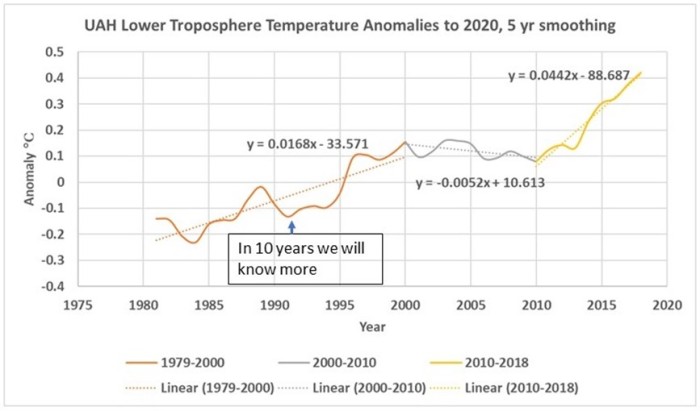
Figure 1. In 1990 and 1991, respectively, the IPCC and Roger Revelle and colleagues said it was too early to do anything about possible man-made climate change, they thought we would know more in 10 years. The plot is smoothed with a 5-year running average to reduce the effect of El Nino and La Nina events. This makes the longer term trends easier to see.
While Revelle was unsure if warming was a problem. Al Gore, who had little training in science, suffered no such doubts. He was sure that burning fossil fuels was causing carbon dioxide to rise to “dangerous” levels in the atmosphere and was convinced this was a problem for civilization through rising sea levels and extreme weather. There was no evidence to support these assumptions, but Al Gore didn’t need evidence, he could always rely on climate models and he did. Revelle distrusted the models.
Al Gore and Climate Change
In 1992, after Singer, Revelle and Starr published their Cosmos article, their statements caused Al Gore, who was running for Vice-President at the time, some problems. Gore had just published The Earth in the Balance (Gore, 1992) and in it he credited Revelle with discovering that human emissions of carbon dioxide were causing Earth to warm and this could be very dangerous. Yet, Singer, Revelle and Starr’s paper said:
“Drastic, precipitous—and, especially, unilateral—steps to delay the putative greenhouse impacts can cost jobs and prosperity and increase the human costs of global poverty, without being effective. Stringent economic controls [on CO2 emissions] now would be economically devastating particularly for developing countries…” (Singer, Revelle, & Starr, 1991)
They also quote Yale economist and Nobel Laureate William Nordhaus, who wrote:
“… those who argue for strong measures to slow greenhouse warming have reached their conclusion without any discernible analysis of the cost and benefits…” (Nordhaus W. , 1990)
Nordhaus had studied both the costs of reducing CO2 and the benefits of doing so. His analysis shows there is little to be gained, economically, from reducing emissions (Nordhaus W. , 2007, p. 236). While Nordhaus supports a “carbon tax,” he acknowledges that the “pace and extent of warming is highly uncertain.” Contrast this with how Al Gore characterizes Roger Revelle’s view in his book:
“Professor Revelle explained that higher levels of CO2 would create what he called the greenhouse effect, which would cause the earth to grow warmer. The implications of his words were startling; we were looking at only eight years of information, but if this trend continued, human civilization would be forcing a profound and disruptive change in the entire global climate.” (Gore, 1992, p. 5) italics added.
The differences between what Nordhaus and Revelle are saying and what Al Gore is saying are stark. All three believe human emissions of CO2 might cause Earth to warm. But Gore naively assumes that is a bad thing. Revelle and Nordhaus acknowledge it might be, but they recognize that we don’t know. Further, they understand destroying our fossil fuel-based economy may not alleviate the warming and may cause more harm than good. To quote Bertrand Russell:
“The whole problem with the world is that fools and fanatics are always so certain of themselves, and wiser people so full of doubts.” Bertrand Russell
To a scientist, like Roger Revelle, the uncertainty was obvious. Politicians, like Al Gore and most of the news media do not do uncertainty, everything must be black and white and false dichotomies are how they think. Notice Al Gore presumptively writes “would be forcing” when Revelle would clearly write “could be forcing.” The difference between a politician with an agenda and a scientist who understands uncertainty.
The incompatibility between Revelle’s true views and the way they are presented in Gore’s book was noticed by Gregg Easterbrook, a Newsweek editor, who wrote about it in the July 6, 1992 issue of New Republic (Easterbrook, 1992). This article angered Al Gore and his supporters. Walter Munk and Edward Frieman published a short note in Oceanography in 1992 objecting to Easterbrook’s article and claimed that the late Revelle had been worried about global warming, but probably did not want “drastic” action taken at this time (Munk & Frieman, 1992). Revelle’s views were clear and well known, nothing in Munk and Frieman’s article contradicts what Singer said or what Revelle said or wrote. The following is from a letter Revelle sent Senator Tim Wirth, an ally of Gore’s and a member of the Clinton/Gore administration in July 1988:
“we should be careful not to arouse too much alarm until the rate and amount of warming becomes clearer. It is not yet obvious that this summer’s hot weather and drought are the result of a global climatic change or simply an example of the uncertainties of climate variability. My own feeling is that we had better wait another 10 years before making confident predictions.” Written by Roger Revelle as reported by (Booker, 2013, p. 59).
Unlike Senators Al Gore and Tim Wirth, Revelle understood global warming computer models and did not trust them. He argued with Singer about this very issue and Singer convinced Revelle that the models were getting better (Singer, Revelle, & Starr, 1991). However, regardless of the accuracy of the models, Revelle was not convinced global warming was a problem and he knew the natural rate of warming and the additional amount expected from human greenhouse emissions were unknown. As shown in Figure 1, his caution was warranted, just ten years later it became apparent that warming was slowing down. The following reflects Revelle’s own views, it is from the “Look before you Leap” article:
“The models used to calculate future climate are not yet good enough because the climate balancing processes are not sufficiently understood, nor are they likely to be good enough until we gain more understanding through observations and experiments. As a consequence, we cannot be sure whether the next century will bring a warming that is negligible or a warming that is significant. Finally, even if there are a global warming and associated climate changes, it is debatable whether the consequences will be good or bad; likely some places on the planet would benefit, some would suffer.” (Singer, Revelle, & Starr, 1991)
Revelle’s views were clear and well documented, but Al Gore and his supporters were humiliated by Easterbrook’s article and follow up articles by George Will and others. Dr. Justin Lancaster was Revelle’s graduate student and teaching assistant at the Scripps Institution of Oceanography from 1981 until Revelle’s sudden death in July 1991. He was also an Al Gore supporter. Lancaster claimed that Revelle was “hoodwinked” by Singer into adding his name to the Cosmos article. He also claimed that Revelle was “intensely embarrassed that his name was associated” with it. Lancaster further claimed that Singer’s actions were “unethical” and specifically designed to undercut Senator Al Gore’s global warming policy position. Lancaster harassed Singer in 1992, accusing him of putting Revelle’s name on the article over his objections and demanding that Singer have it removed. He even demanded that the publisher of a volume that was to include the article (Geyer, 1993) remove it.
Professor Singer, the Cosmos publisher of the “Look before you Leap” article and the publisher (CRC Press) of Richard Geyer’s book, objected to these demands and charges. Then Singer sued Lancaster for libel with the help of the Center for Individual Rights in Washington, D.C. Professor Singer and the Center won the lawsuit and forced Lancaster to issue an apology.
The discovery process during the lawsuit revealed that Lancaster was working closely with Al Gore and his staff. In fact, Al Gore personally called Lancaster after the Easterbrook article appeared and ask him about Revelle’s mental capacity in the months before his death in July of 1991. Friends and family of Revelle recall that he was sharp and active right up to the moment when he passed away from a sudden heart attack. But this did not stop Al Gore and Lancaster from claiming Revelle was suffering from senility or dementia and that was why the account in Gore’s book was so different from what Revelle wrote elsewhere, including in the “Look before you leap” article. Even Lancaster wrote in a draft of a letter to Al Gore that Revelle was “mentally sharp to the end” and was “not casual about his integrity” (Singer, 2003).
During the discovery process, Singer and his lawyers found that Lancaster knew everything in the “Look before you leap” article was true and that Revelle agreed with everything in it. The article even included a lot of material that Revelle had previously presented to a 1990 AAAS (American Academy for the Advancement of Science) meeting. More details can be seen in Fred Singer’s deposition (Jones, 1993).
Roger Revelle’s daughter, Carolyn Revelle Hufbaurer, wrote that Revelle was concerned about global warming (Hufbauer, 1992). But his concern lessened later in life and he knew the problem, if there was a problem, was not urgent. He thought more study was required before anything was done. He was for modest changes, such as more nuclear power and substituting natural gas for some coal and oil, but not much else, other than a carbon tax. As usual, the news media and politicians have no sense of the complexity and uncertainty that surrounds the scientific debate about human-caused climate change. When Revelle argued against “drastic” action, he meant measures that would cost trillions of dollars and cripple the fossil fuel industry and developing countries. Up until his death, he thought extreme measures were premature. He clearly believed that we should look before we leap.
Al Gore tried to get Ted Koppel to trash Singer on his TV show and it failed spectacularly. He asked Koppel to investigate the “antienvironmental movement” and in particular “expose the fact” that Singer and other skeptical scientists were receiving financial support from the coal industry and the wacky Lyndon LaRouche organization. Rather than do Al Gore’s bidding Ted Koppel said the following on his Nightline television program, on February 24, 1994:
“There is some irony in the fact that Vice President Gore, one of the most scientifically literate men to sit in the White House in this century, [is] resorting to political means to achieve what should ultimately be resolved on a purely scientific basis. The measure of good science is neither the politics of the scientist nor the people with whom the scientist associates. It is the immersion of hypotheses into the acid of truth. That’s the hard way to do it, but it’s the only way that works.” Ted Koppel as reported in (Singer, 2003)
Calling Gore “scientifically literate” is debatable, but Koppel has the rest of it right. He has integrity that is lacking in journalism today, further he understands the scientific process. The attempt to use Koppel to tar Singer, brought a huge amount of well-deserved criticism down on Gore.
Given this, it is not surprising that Lancaster agreed to issue an apology only two months later, on April 29, 1994. Lancaster’s retraction was specific:
“I retract as being unwarranted any and all statements, oral or written, I have made which state or imply that Professor Revelle was not a true and voluntary coauthor of the Cosmos article, or which in any other way impugn or malign the conduct or motives of Professor Singer with regard to the Cosmos article (including but not limited to its drafting, editing, publication, republication, and circulation). I agree not to make any such statements in future. … I apologize to Professor Singer” (Singer, 2003)
So, in his court affidavit Lancaster admitted he lied about Singer. Then afterward, Lancaster withdrew his court-ordered retraction and reiterated his charges (Lancaster, 2006). He admits he lied under oath in a courtroom and in writing, then tells us he didn’t lie. He admits that Professor Revelle was a true coauthor of the paper, then he states “Revelle did not write it” and “Revelle cannot be an author.” What some people are willing do to their reputations, in the name of catastrophic climate change is hard to believe. He retracted his retraction despite documentary evidence in Revelle’s own handwriting, and numerous testimonials from others that Revelle did contribute to the article.
Some of Revelle’s other papers, letters and presentations have nearly identical language to that in the paper, for example compare the quote from his letter to Senator Tim Wirth above with the first page of the “Look before you Leap” paper. In the paper, they say we need to wait because “scientific understanding will be substantially improved within the next decade” (Singer, Revelle, & Starr, 1991). In the letter to Wirth, quoted above, he says “10 years,” but the meaning is the same. He, and many other climate scientists, did not feel we knew enough in the early nineties to do anything significant. He was right about this. Warming went negative from 2002 to 2010 as we see in Figure 1.
The issue was raised in the televised vice-presidential debate that year. Gore’s response was to protest that Revelle’s views in the article had been taken out of context. We can clearly see that it was Al Gore’s book that took Revelle’s comments out of context.
This post is condensed and modified from my new book, Politics and Climate Change: A History.
The bibliography can be downloaded here.
Mysterious Hillary Emailgate Whistleblower & FBI’s Apparent Decades-Long Cover-Up Ploy
By Ekaterina Blinova – Sputnik – 30.10.2020
The Hunter Biden scandal recently propelled by the Trump campaign has much in common with the controversy surrounding the Clintons, Wall Street analyst Charles Ortel says, shedding light on a story of a mysterious high-profile whistleblower who was apparently ignored by the FBI in 2016.
Days before The New York Post dropped a bomb on the Bidens alleging that the Democratic presidential contender and his son were involved into a “pay-to-play” scheme, former CIA analyst Larry Johnson and Wall Street analyst Charles Ortel published two separate stories about a neglected State Department whistleblower who informed the FBI about the potential harm to US national interests posed by Hillary Clinton’s mishandling of classified data in January 2016.
High-Profile Whistleblower’s Report Overlooked by Comey
The whistleblower’s letter dated 10 January 2016 was sent to then-FBI chief Jim Comey. It detailed how the ex-secretary of state used her unclassified server system to conduct government business, thus exposing US secret intelligence information, and suggested that her entourage and other government officials were aware of that the entire time.
In addition to this, the whistleblower, who, according to the document, had served in the Armed Forces and the Department of State for many years, provided specific recommendations as to who the bureau needed to interview in order to get further evidence and expressed willingness to testify before the agency officials having “certain TS/SCI clearances.”
After sending the letter on 10 January, the individual in question personally visited the FBI’s premises in Washington on 27 January 2016 to find out whether the exposé reached its destination and provided his credentials to intelligence officers.
An FBI report describing this visit was written only a month later, on 22 February 2016, with copies sent to FBI agents Jonathan Moffa and Peter Strzok. The rest is history: on 5 July 2016 then FBI Director James Comey announced that no reasonable prosecutor would bring a case against Hillary Clinton for the emails.
Judging from the whistleblower’s credentials, knowledge of the matter and the provided evidence, his letter was worth examination and required certain investigative activities, argued CIA veteran Johnson and Wall Street analyst Ortel in their op-eds.
“Failure by Comey to even interact with the whistleblower in January 2016 stands in stark contrast to anti Trump efforts launched by the FBI before, during and after the 2016 election”, says Charles Ortel. “Moreover, decisions to let Hillary Clinton and others off for mishandling classified information also appear deeply suspicious.”It appears strange that the bureau declined to learn more from the whistleblower given that it had started investigating the Clinton email server on 10 July 2015, according to the analyst.
“Then, when the determined whistleblower followed up by visiting the FBI Washington Field Office later in January 2016, why did it take so long to write an internal FBI report explaining what happened and what the concerns were?” asks Ortel. “More recently, did US Attorney John Huber examine the whistleblower materials? If not, why not? And, is John Durham evaluating all relevant records? I certainly hope so.”
Whistleblowers Apparently Ignored or Intimidated
Apart from investigating the Clinton email case, Jim Comey also started to look into the Clinton Foundation in January 2016, exactly when the whistleblower filed his complaint, the Wall Street analyst notes.
According to Ortel, who has been conducting a private investigation into the Clinton Foundation’s alleged fraud, the charity supposedly worked as a vehicle in the Clintons’ “pay-to-play” operations with foreign governments. Hillary’s unsecured email server potentially could be used to conduct this business while avoiding the Freedom of Information Act provisions since the FOIA requires the full or partial disclosure of the United States government’s documents upon request.
The FBI has an almost two-decade record of overlooking the Clintons’ questionable activities and their charity’s messy financial documentation under former FBI directors Robert Mueller (2001 – 2013) and Jim Comey (2013 – 2017) and later on, according to the analyst.
The aforementioned State Department whistleblower was not the only one who has stepped forward to report the Clintons to the US authorities.
In June 2018, FBI whistleblower Nate Cain delivered 450 pages of documents concerning Hillary Clinton’s supposed role in the Uranium One deal to Inspector General Michael E. Horowitz. In November 2018, 16 FBI agents stormed Cain’s Maryland home, ignoring his argument about whistleblower protection and accused him of possessing “stolen federal property”.
How High Political Offices Were ‘Monetised’
The FBI’s alleged cover-up of political power clans’ questionable activities has not been limited to the Clintons and apparently involved the Department of Justice as well, Ortel believes.
“Going all the way back to 1992, the Clintons and their backers seem to have monetised high political offices to enrich themselves”, he suggests. “Along the way, it seems likely that national security was compromised, and that other dynastic political families emulated the Clintons. The evolution of unregulated globalism and coordinated lowering of benchmark interest rates from 1988 forward created too many opportunities for oligarchs of all nationalities to exploit under-paid but powerful politicians, investigators, judges, and influence shapers.”
The recent scandal surrounding the Bidens’ alleged quid-pro-quo schemes involving foreign businessmen and officials has also triggered public debate over what some see as the FBI’s inaction. Bombshell emails released by The New York Post came from the so-called “hard drive from hell”, a copy of the one allegedly belonging to Hunter Biden’s laptop.
The FBI has acknowledged that it has had possession of Hunter Biden’s laptop for quite a while. It still remains unclear whether the “damning” messages, emails and photos circulated by The Post came from the original hard drive. If they did, the bureau’s silence appears suspicious, according to the analyst.
“If President Trump wins re-election – a strong likelihood at this moment – Durham’s major challenge will be to break the will of co-conspirators to fight at trials, rather than to negotiate guilty plea agreements”, Ortel deems. “The public record strongly suggests that many once-powerful politicians and bureaucrats committed serious crimes. Managing through this will require airing lots of “dirty laundry”. I hope President Trump and his team take the courageous decision to release information that implicates these traitors and details their crimes, little of which may shock thinking members of the electorate.”
NBC accused of putting up ‘smokescreen’ for Biden by ‘debunking’ document nobody’s heard of
RT | October 30, 2020
NBC News had its reporters debunk a damaging document about the Bidens that few have heard of, yet it won’t investigate emails potentially implicating Joe Biden in foreign deals. Conservatives smelled a distraction campaign.
An “intelligence” document purportedly linking Biden and his son Hunter to the Chinese Communist Party was the work of a computer-generated fake researcher, NBC News reported on Thursday. According to the news outlet, the report’s author, ‘Martin Aspen,’ is a fabricated identity and his photograph is a ‘deepfake’ composite generated by artificial intelligence.
The document, published by blogger and professor Christopher Balding at the beginning of October, claims that Hunter Biden made deals in China beyond the alleged deals laid out in a recent New York Post expose. Hunter, according to the document, courted Chinese state money, and Chinese officials and businessmen were eager to hand over cash for the chance to court his father, who was then the vice president of the United States.
According to NBC, the document “went viral on the right-wing internet” and “laid the groundwork” for the right to “baselessly accuse candidate Joe Biden of being beholden to the Chinese government.”
The only problem with that assertion is that few on the right have ever heard of this document, and it was never the basis of the ongoing Hunter Biden scandal in the first place.
Instead, the right has been focused on a tranche of Hunter Biden’s emails and texts released by the New York Post in mid-October. Allegedly sourced from Hunter’s own laptop by Trump’s lawyer, Rudy Giuliani, the messages show Hunter attempting to trade access to his father with Ukranian energy tycoons and trying to set up business ventures in China to benefit his family, all while planning to kick a share of his foreign profits up to “the big guy” – which a former business partner of Hunter, Tony Bobulinski, has attested is the former vice president.
A media ‘smokescreen’
According to NBC, the Aspen document is “part of a wider effort to smear Hunter Biden and weaken Joe Biden’s presidential campaign.” To paraphrase its report, if the document was faked, the entire Biden scandal is brought into disrepute.
Except the New York Post’s reporting is vouched for by Bobulinski and others who appeared to confirm the authenticity of the emails and texts, including pollster Frank Luntz, who didn’t deny that he had taken part in one of the email conversations. While it is unclear if any of the deals laid out in Hunter’s messages ever materialized, the Biden campaign has not denied the authenticity of the laptop contents, or accused Bobulinski of lying.
The media hasn’t pressed Biden on the emails, however. NBC did not report on Bobulinski’s claims, except to describe them as an effort to wrap Biden up in a “Pizzagate”-style conspiracy. The Washington Post first suggested the laptop leaks were a “Russian intelligence operation,” then told readers in a prominent op-ed to “treat the Hunter Biden leaks as if they were a foreign intelligence operation – even if they probably aren’t.”
The New York Times also tried to tie the laptop to Russia, and only changed its tack when the Director of National Intelligence last week said there was “no concrete evidence” of Russian involvement, a statement seconded by the FBI shortly afterwards. NPR went one further, flat out refusing to “waste the listeners’ and readers’ time” on the story, which the publicly-funded network called “pure distraction.”
Some conservatives speculated that with the “Russian disinformation” explanation failing, NBC was trying to deliberately conflate Aspen’s dodgy report with the New York Post’s leaks, in an effort to discredit the latter and protect Biden.
Alexa… what does political desperation look like?
— John Ziegler (@Zigmanfreud) October 30, 2020
NBC News is intentionally spreading disinformation to create a smokescreen around the verified information on Hunter Biden they want to ignore https://t.co/7SHxKihWu6
— Buck Sexton (@BuckSexton) October 30, 2020
Although NBC found out that the report’s supposed author was a fake – a discovery confirmed by Balding himself, who claims ‘Martin Aspen’ was invented to hide the true author from Chinese authorities, the network did not disprove any of its contents. They remain unconfirmed and unverified, with mainstream media seemingly uninterested in following them up.
Much of the research into Biden’s alleged corruption has been carried out by independent journalists, against the wishes of the media at large. Glenn Greenwald, who helped publicize Edward Snowden’s NSA leaks in 2013, resigned on Thursday from The Intercept after the outlet he co-founded refused to publish a story critical of Biden.
“Journalists are desperate not to know,” he said, accusing major news outlets of making “little secret of their eagerness to help Biden win.”
The Guardian can try rewriting the history of White Helmets’ James Le Mesurier, but the truth is there for all to see
By Kit Klarenberg | RT | October 30, 2020
A fetishistic Guardian article seeks to rehabilitate the life and death of the former British soldier turned ‘humanitarian’, but cannot explain away his lavish lifestyle, missing money, and all the other financial irregularities.
On the morning of November 11, 2019, James Le Mesurier, founder of Syria’s controversial White Helmets, was found dead in Istanbul. Since then, the Western establishment has struggled to get its story straight on the man, his professional history, the group he founded, and how he died.
The latest example of mainstream media narrative management in the ever-mysterious case came in the Guardian on October 27, in the form of a 6,000-word hagiography of Le Mesurier, authored by its veteran Middle East reporter Martin Chulov.
Many at this point will be familiar with the idolatrous portait it paints of its subject – a heroic humanitarian committed to benevolent causes who saved untold lives, tragically driven to suicide by a “disinformation campaign led by Russian and Syrian officials and peddled by pro-Assad bloggers, alt-right media figures and self-described anti-imperialists.” Nonetheless, it marks the first time the significant controversy surrounding his financial dealings has ever been explored, let alone mentioned, by a British news outlet.
In July this year, the Dutch newspaper De Volkskrant published a long-read of its own, explosively revealing how, three days prior to his death, Le Mesurier ‘confessed’ via email to the White Helmets’ many international donors, who’d funded the group to the tune of hundreds of millions over the years, that he’d committed fraud.
The disclosure was prompted by an internal audit by a Dutch accountant of the finances of Mayday, the foundation started by Le Mesurier to find, train, and support the White Helmets. The audit found, among other things, that he had been paying himself and his wife, long-time UK Foreign & Commonwealth Office (FCO) operative Emma Winberg, “excessive” salaries and supplementing the totals with unjustifiably vast cash bonuses; that his employment of his wife represented a potential conflict of interest; and that he might be guilty of tax evasion.
While claiming this malfeasance wasn’t intentional, Le Mesurier took full and sole responsibility, and expressed fears that further investigation could expose yet more “mistakes and internal failures.”
Monetary misconduct
Damning stuff indeed, but De Volkskrant’s seismic disclosures have been curiously ignored by all other Western media outlets until now. The Guardian’s article deals with the damning revelations, both directly and indirectly – Le Mesurier, whom Chulov knew personally, and with whom he clearly maintained an intense affinity, is acquitted on all charges. Indeed, the White Helmets founder is said to have simply “unravelled under the weight of claims that would later prove to be false.”
The author is at pains throughout to frame “disinformation” as fundamental to Le Mesurier’s untimely demise, in terms of causing him immense “stress,” which led to him “disintegrating” mentally, damaging his reputation and that of the White Helmets in the eyes of world opinion, and, in turn, stoking erroneous suspicions in donor countries that he and his company were engaged in various improper activities.
The question of how a battle-hardened military veteran could be so deleteriously impacted mentally and emotionally by “attacks on Russian television and social media,” particularly if they were entirely without substance, is unasked and unanswered.
There’s little doubt Le Mesurier wasn’t in a good state during his final weeks. It’s been widely reported he was taking sleeping pills and psychiatric medication. Less well amplified were Turkish news reports alleging he and his wife had “fought violently” while dining out together the day before his death.
Chulov alleges “a distressed Le Mesurier” told friends just before he died that claims of Mayday’s monetary misconduct “seemed to come from nowhere.” In fact, questions about what purpose the vast sums donated to the company were put to, and where they all ultimately ended up, had long circulated.
While his article states that donor countries maintained their support for the White Helmets “despite the disinformation surrounding the group’s work,” this isn’t true. In September 2018, the Dutch government ended its backing, after a damning Ministry of Foreign Affairs report outlined serious concerns about Mayday’s financial practices, including an almost total lack of oversight over, and even awareness of, how its money entered Syria, and precisely whose pockets it eventually lined.
However, Chulov feels confident dismissing any and all suggestions of embezzlement, for he’s in possession of a report by forensic auditors Grant Thornton, conducted at the request of Mayday’s donors, which concluded there was “no evidence of misappropriation of funds” by Le Mesurier and Winberg.
Except that he isn’t, because it hasn’t been made public, at donors’ express request. Instead, he relies on the claims of a nameless “source familiar” with the report – which could conceivably, of course, be Winberg herself.
Excessive salaries plus bonuses
It’s clear Grant Thornton’s report isn’t an unalloyed clean bill of health, either – the auditors found “significant gaps in the administrative organization and internal control environment of Mayday” and “identified significant cash transactions that have not been (fully) recorded in the cash books and/or general ledger.”
Moreover, due to Mayday’s “informal” working environment, many key discussions took place “orally and over WhatsApp,” meaning auditors “had to reconstruct a number of financial events and are unable to provide certainty in those cases.”
Chulov is quick to dismiss the significance of these failings as nothing more than “shoddy” bookkeeping, contending “auditors found nothing to support the far more serious allegations made” against Le Mesurier – despite apparently not having actually read the report himself.
Likewise, he concedes Mayday’s executive salaries had been “higher than industry standards”, although his anonymous source familiar with the report is on hand to reassure him, and readers, “they were not off-the-scale high.” In 2017, Le Mesurier informed the Netherlands’ Ministry of Foreign Affairs he was paying himself a salary of €24,000 per month, before bonuses – several orders of magnitude higher than the designated salary ceiling at other Dutch government-funded enterprises. And considerably more than the $150 a day the White Helmet rescuers on the ground received.
References to Le Mesurier founding three separate companies named ‘Mayday Rescue’ – Mayday Rescue FZ-LLC in Dubai, Mayday Search and Rescue Training and Consultancy Services Ltd in Turkey, and Stichting Mayday Rescue Foundation in the Netherlands – are predictably absent from the Guardian’s article.
Accounts aren’t publicly available for any of them – the Dutch entity, while not registered as a charitable organisation, is characterised as being ‘without commercial enterprise’, so doesn’t have to file accounts at all. Dutch ‘stichtings’, or foundations, are openly advertised by Dutch law firms as ideal ways for wealthy individuals and corporations to minimize tax liabilities and distribute funds internationally.
The company nonetheless complied with governance and transparency requirements, appointing a Secretary and Treasurer. As such, the UK government could plausibly claim that Mayday Rescue, to which London funneled £43 million between 2015 and 2018, was, to the best of its knowledge, fully above board.
Tax havens and tangled webs
Except the £43 million actually went to Mayday Rescue FZ-LLC in Dubai – something only begrudgingly admitted by the FCO in March 2019, in response to a Freedom of Information request, after much heel-dragging and obfuscation.
Dubai is a notorious tax haven, and FZ-LLCs – Free Zone Limited Liability Companies – aren’t subject to any taxes on dividends, so they can be used to easily and opaquely repatriate profits. The entities are required to maintain accounting records, which can be inspected by authorities, but aren’t required to file accounts of any kind.
It may be significant that one of Stichting Mayday Rescue Foundation’s three directors, alongside Le Mesurier and Winberg, was a British Army veteran, Rupert Davis, who, in April 2016, founded the company Chameleon Global. Dissolved in October 2020, it was categorised as dormant – that is, non-operational – for the duration of its existence. Le Mesurier also founded other companies, with indeterminate connections to his assorted Mayday entities. For instance, in April 2017 he established Sisu Global BV in the Netherlands. It has never filed accounts, in breach of Dutch law. Le Mesurier resigned in November 2018, but Winberg apparently remains a director.
In January 2019, Le Mesurier registered My Zahara Limited as a dormant company in northern England, at an address belonging to a company formation agent specializing in, among other things, compliance with money laundering regulations, suggesting he intended to use the firm to repatriate money from his overseas firms.
Davis was also, until April 2019, connected to Sisu Global BV, a company in the Netherlands founded by Le Mesurier in April 2017. It has never filed accounts, in breach of Dutch law. Le Mesurier himself resigned from it in November 2018. Winberg apparently remains a director.
Chulov also, again predictably, dismisses as “disinformation” allegations that the White Helmets were “created by governments determined to remove Assad from power”; that Le Mesurier was “an agent of western intelligence, using a rescue organisation as a Trojan horse for regime change”; and that the organization was in any way affiliated to violent extremist groups.
What are matters of public record, however, is that the White Helmets were funded by the very governments avowedly committed to ‘regime change’ in Syria via covert and overt means; that Le Mesurier’s professional history included spells as a military intelligence operative; and that the group has openly collaborated with the Al-Nusra Front, among other jihadist elements, and engaged in violent activity.
In a June 2015 speech discussing his founding of the White Helmets, Le Mesurier cited a market research agency study which found that, in fragile environments, security forces garner low levels of public trust while first responders have the highest as a key motivating factor in his decision to establish a “humanitarian aid group.”
Untold millions for propaganda
That the White Helmets’ benevolent image was very carefully constructed and promoted by a government attempting to achieve ‘regime change’ is amply underlined by FCO documents leaked by hacktivist collective Anonymous.
The documents reveal that ARK, a firm founded by FCO veteran Alistair Harris where Le Mesurier worked between 2011 and 2014, played a pivotal role in promoting the White Helmets, developing“an internationally focused communications campaign to raise global awareness” of the group to “keep Syria in the news.”
Along the way, ARK, among many other endeavors, produced a documentary on the White Helmets, and ran its various social media accounts, among them the Facebook page for Idlib City Council, at one time mooted as a potential interim government to replace Bashar Assad. When Al-Nusra took the city, the White Helmets were filmed celebrating the ‘victory’ with the group’s fighters in its main square.
ARK profited to the tune of untold millions of pounds from these and other information-warfare efforts. The same illicit file tranche also reveals InCoStrat, founded by none other than Emma Winberg, also reaped large bounties for manipulating public perceptions about Syria, within and without the country. In one file, the firm boasted of surreptitiously “initiating events to create media effect” and of “using media to create events.”
One example of the former strategy saw InCoStrat produce mock Syrian currency, in three denominations, imploring Syrians to “be on the right side of history.” It was intended to ensure that international opinion remained arrayed against Assad, at a time “media attention has shifted almost exclusively towards ISIS and some influential voices are calling for co-operation with the Syrian regime to combat ISIS.”
The file states: “The notes are due to be smuggled into regime-held parts of Syria once formal clearance has been authorized by HMG officials … We will engage the international media to create a story around the event … The message to the regime [is] covert but active resistance continues.”
Another document indicates that Winberg’s InCoStrat also established Basma – “a media platform providing human interest stories and campaigns that support [UK government] policy objectives” – and engaged in propaganda operations in the wake of the 2003 invasion of Iraq, training and maintaining a network of journalists who were “instrumental in reporting on events in Basra.”
On the subject of propaganda, establishment efforts to rehabilitate Le Mesurier are scheduled to continue apace in future.
Starting on November 9, the BBC will transmit a 15-part radio documentary on Mayday Rescue. Over the summer, Chloe Hadjimatheou, a reporter on the project, approached a number of journalists and researchers who’d publicly raised questions about the White Helmets, asking if they wished to contribute to the program.
Several of the individuals targeted subsequently published their correspondence with Hadjimatheou, showing that the program’s preordained agenda and objectives couldn’t be more blatant.
What is clear is that any suggestion Le Mesurier was a British intelligence operative surreptitiously attempting to foster regime change in Syria, or that the White Helmets weren’t an entirely benevolent, independent humanitarian organization will be rubbished, and all voices critical of the group will be smeared as witting or unwitting agents of the Russian and Syrian governments.
By Kit Klarenberg, an investigative journalist exploring the role of intelligence services in shaping politics and perceptions. Follow Kit on Twitter @KitKlarenberg
Article on Joe and Hunter Biden Censored By The Intercept
An attempt to assess the importance of the known evidence, and a critique of media lies to protect their favored candidate, could not be published at The Intercept
By Glen Greenwald | October 29, 2020
I am posting here the most recent draft of my article about Joe and Hunter Biden — the last one seen by Intercept editors before telling me that they refuse to publish it absent major structural changes involving the removal of all sections critical of Joe Biden, leaving only a narrow article critiquing media outlets. I will also, in a separate post, publish all communications I had with Intercept editors surrounding this article so you can see the censorship in action and, given the Intercept’s denials, decide for yourselves (this is the kind of transparency responsible journalists provide, and which the Intercept refuses to this day to provide regarding their conduct in the Reality Winner story). This draft obviously would have gone through one more round of proof-reading and editing by me — to shorten it, fix typos, etc — but it’s important for the integrity of the claims to publish the draft in unchanged form that Intercept editors last saw, and announced that they would not “edit” but completely gut as a condition to publication:
TITLE: THE REAL SCANDAL: U.S. MEDIA USES FALSEHOODS TO DEFEND JOE BIDEN FROM HUNTER’S EMAILS
Publication by the New York Post two weeks ago of emails from Hunter Biden’s laptop, relating to Vice President Joe Biden’s work in Ukraine, and subsequent articles from other outlets concerning the Biden family’s pursuit of business opportunities in China, provoked extraordinary efforts by a de facto union of media outlets, Silicon Valley giants and the intelligence community to suppress these stories.
One outcome is that the Biden campaign concluded, rationally, that there is no need for the front-running presidential candidate to address even the most basic and relevant questions raised by these materials. Rather than condemn Biden for ignoring these questions — the natural instinct of a healthy press when it comes to a presidential election — journalists have instead led the way in concocting excuses to justify his silence.
After the Post’s first article, both that newspaper and other news outlets have published numerous other emails and texts purportedly written to and from Hunter reflecting his efforts to induce his father to take actions as Vice President beneficial to the Ukrainian energy company Burisma, on whose board of directors Hunter sat for a monthly payment of $50,000, as well as proposals for lucrative business deals in China that traded on his influence with his father.
Individuals included in some of the email chains have confirmed the contents’ authenticity. One of Hunter’s former business partners, Tony Bubolinski, has stepped forward on the record to confirm the authenticity of many of the emails and to insist that Hunter along with Joe Biden’s brother Jim were planning on including the former Vice President in at least one deal in China. And GOP pollster Frank Luntz, who appeared in one of the published email chains, appeared to confirm the authenticity as well, though he refused to answer follow-up questions about it.
Thus far, no proof has been offered by Bubolinski that Biden ever consummated his participation in any of those discussed deals. The Wall Street Journal says that it found no corporate records reflecting that a deal was finalized and that “text messages and emails related to the venture that were provided to the Journal by Mr. Bobulinski, mainly from the spring and summer of 2017, don’t show either Hunter Biden or James Biden discussing a role for Joe Biden in the venture.”
But nobody claimed that any such deals had been consummated — so the conclusion that one had not been does not negate the story. Moreover, some texts and emails whose authenticity has not been disputed state that Hunter was adamant that any discussions about the involvement of the Vice President be held only verbally and never put in writing.
Beyond that, the Journal’s columnist Kimberly Strassel reviewed a stash of documents and “found correspondence corroborates and expands on emails recently published by the New York Post,” including ones where Hunter was insisting that it was his connection to his father that was the greatest asset sought by the Chinese conglomerate with whom they were negotiating. The New York Times on Sunday reached a similar conclusion: while no documents prove that such a deal was consummated, “records produced by Mr. Bobulinski show that in 2017, Hunter Biden and James Biden were involved in negotiations about a joint venture with a Chinese energy and finance company called CEFC China Energy,” and “make clear that Hunter Biden saw the family name as a valuable asset, angrily citing his ‘family’s brand’ as a reason he is valuable to the proposed venture.”
These documents also demonstrate, reported the Times, “that the countries that Hunter Biden, James Biden and their associates planned to target for deals overlapped with nations where Joe Biden had previously been involved as vice president.” Strassel noted that “a May 2017 ‘expectations’ document shows Hunter receiving 20% of the equity in the venture and holding another 10% for ‘the big guy’—who Mr. Bobulinski attests is Joe Biden.” And the independent journalist Matt Taibbi published an article on Sunday with ample documentation suggesting that Biden’s attempt to replace a Ukranian prosecutor in 2015 benefited Burisma.
All of these new materials, the authenticity of which has never been disputed by Hunter Biden or the Biden campaign, raise important questions about whether the former Vice President and current front-running presidential candidate was aware of efforts by his son to peddle influence with the Vice President for profit, and also whether the Vice President ever took actions in his official capacity with the intention, at least in part, of benefitting his son’s business associates. But in the two weeks since the Post published its initial story, a union of the nation’s most powerful entities, including its news media, have taken extraordinary steps to obscure and bury these questions rather than try to provide answers to them.
The initial documents, claimed the New York Post, were obtained when the laptops containing them were left at a Delaware repair shop with water damage and never picked up, allowing the owner to access its contents and then turn them over to both the FBI and a lawyer for Trump advisor Rudy Giuliani. The repair store owner confirmed this narrative in interviews with news outlets and then (under penalty of prosecution) to a Senate Committee; he also provided the receipt purportedly signed by Hunter. Neither Hunter nor the Biden campaign has denied these claims.
Publication of that initial New York Post story provoked a highly unusual censorship campaign by Facebook and Twitter. Facebook, through a long-time former Democratic Party operative, vowed to suppress the story pending its “fact-check,” one that has as of yet produced no public conclusions. And while Twitter CEO Jack Dorsey apologized for Twitter’s handling of the censorship and reversed the policy that led to the blocking of all links the story, the New York Post, the nation’s fourth-largest newspaper, continues to be locked out of its Twitter account, unable to post as the election approaches, for almost two weeks.
After that initial censorship burst from Silicon Valley, whose workforce and oligarchs have donated almost entirely to the Biden campaign, it was the nation’s media outlets and former CIA and other intelligence officials who took the lead in constructing reasons why the story should be dismissed, or at least treated with scorn. As usual for the Trump era, the theme that took center stage to accomplish this goal was an unsubstantiated claim about the Kremlin responsibility for the story.
Numerous news outlets, including the Intercept, quickly cited a public letter signed by former CIA officials and other agents of the security state claiming that the documents have the “classic trademarks” of a “Russian disinformation” plot. But, as media outlets and even intelligence agencies are now slowly admitting, no evidence has ever been presented to corroborate this assertion. On Friday, the New York Times reported that “no concrete evidence has emerged that the laptop contains Russian disinformation” and the paper said even the FBI has “acknowledged that it had not found any Russian disinformation on the laptop.”
The Washington Post on Sunday published an op-ed — by Thomas Rid, one of those centrists establishmentarian professors whom media outlets routinely use to provide the facade of expert approval for deranged conspiracy theories — that contained this extraordinary proclamation: “We must treat the Hunter Biden leaks as if they were a foreign intelligence operation — even if they probably aren’t.”
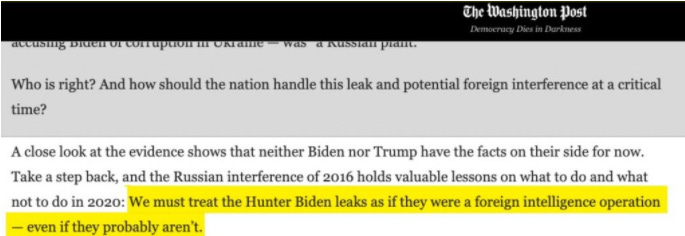
Even the letter from the former intelligence officials cited by The Intercept and other outlets to insinuate that this was all part of some “Russian disinformation” scheme explicitly admitted that “we do not have evidence of Russian involvement,” though many media outlets omitted that crucial acknowledgement when citing the letter in order to disparage the story as a Kremlin plot:
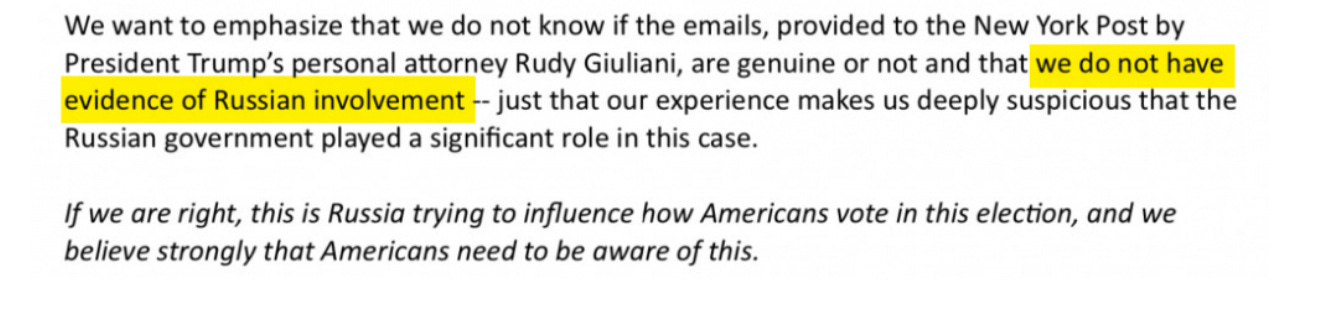
Despite this complete lack of evidence, the Biden campaign adopted this phrase used by intelligence officials and media outlets as its mantra for why the materials should not be discussed and why they would not answer basic questions about them. “I think we need to be very, very clear that what he’s doing here is amplifying Russian misinformation,” said Biden Deputy Campaign Manager Kate Bedingfield about the possibility that Trump would raise the Biden emails at Thursday night’s debate. Biden’s senior advisor Symone Sanders similarly warned on MSNBC: “if the president decides to amplify these latest smears against the vice president and his only living son, that is Russian disinformation.”
The few mainstream journalists who tried merely to discuss these materials have been vilified. For the crime of simply noting it on Twitter that first day, New York Times reporter Maggie Haberman had her name trend all morning along with the derogatory nickname “MAGA Haberman.” CBS News’ Bo Erickson was widely attacked even by his some in the media simply for asking Biden what his response to the story was. And Biden himself refused to answer, accusing Erickson of spreading a “smear.”
That it is irresponsible and even unethical to mention these documents became a pervasive view in mainstream journalism. The NPR Public Editor, in an anazing statement representative of much of the prevailing media mentality, explicitly justified NPR’s refusal to cover the story on the ground that “we do not want to waste our time on stories that are not really stories . . . [or] waste the readers’ and listeners’ time on stories that are just pure distractions.”

Why haven’t you seen any stories from NPR about the NY Post’s Hunter Biden story? Read more in this week’s newsletter➡️ tinyurl.com/y67vlzj2 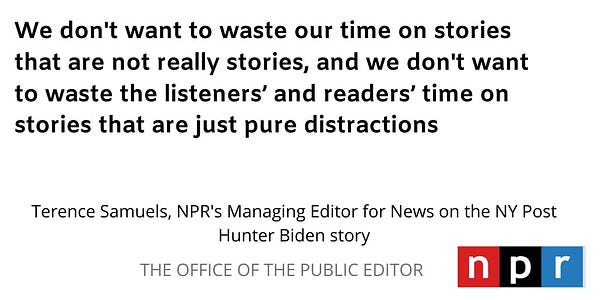
To justify her own show’s failure to cover the story, 60 Minutes’ Leslie Stahl resorted to an entirely different justification. “It can’t be verified,” the CBS reporter claimed when confronted by President Trump in an interview about her program’s failure to cover the Hunter Biden documents. When Trump insisted there were multiple ways to verify the materials on the laptop, Stahl simply repeated the same phrase: “it can’t be verified.”
After the final presidential debate on Thursday night, a CNN panel mocked the story as too complex and obscure for anyone to follow — a self-fulfilling prophecy given that, as the network’s media reporter Brian Stelter noted with pride, the story has barely been mentioned either on CNN or MSNBC. As the New York Times noted on Friday: “most viewers of CNN and MSNBC would not have heard much about the unconfirmed Hunter Biden emails…. CNN’s mentions of “Hunter” peaked at 20 seconds and MSNBC’s at 24 seconds one day last week.”
On Sunday, CNN’s Christiane Amanpour barely pretended to be interested in any journalism surrounding the story, scoffing during an interview at requests from the RNC’s Elizabeth Harrington to cover the story and verify the documents by telling her: “We’re not going to do your work for you.” Watch how the U.S.’s most mainstream journalists are openly announcing their refusal to even consider what these documents might reflect about the Democratic front-runner:
These journalists are desperate not to know. As Taibbi wrote on Sunday about this tawdry press spectacle: ” The least curious people in the country right now appear to be the credentialed news media, a situation normally unique to tinpot authoritarian societies.”
All of those excuses and pretexts — emanating largely from a national media that is all but explicit in their eagerness for Biden to win — served for the first week or more after the Post story to create a cone of silence around this story and, to this very day, a protective shield for Biden. As a result, the front-running presidential candidate knows that he does not have to answer even the most basic questions about these documents because most of the national press has already signaled that they will not press him to do so; to the contrary, they will concoct defenses on his behalf to avoid discussing it.
The relevant questions for Biden raised by this new reporting are as glaring as they are important. Yet Biden has had to answer very few of them yet because he has not been asked and, when he has, media outlets have justified his refusal to answer rather than demand that he do so. We submitted nine questions to his campaign about these documents that the public has the absolute right to know, including:
- whether he claims any the emails or texts are fabricated (and, if so, which specific ones);
- whether he knows if Hunter did indeed drop off laptops at the Delaware repair store;
- whether Hunter ever asked him to meet with Burisma executives or whether he in fact did so;
- whether Biden ever knew about business proposals in Ukraine or China being pursued by his son and brother in which Biden was a proposed participant and,
- how Biden could justify expending so much energy as Vice President demanding that the Ukrainian General Prosecutor be fired, and why the replacement — Yuriy Lutsenko, someone who had no experience in law; was a crony of Ukrainian President Petro Poroshenko; and himself had a history of corruption allegations — was acceptable if Biden’s goal really was to fight corruption in Ukraine rather than benefit Burisma or control Ukrainian internal affairs for some other objective.
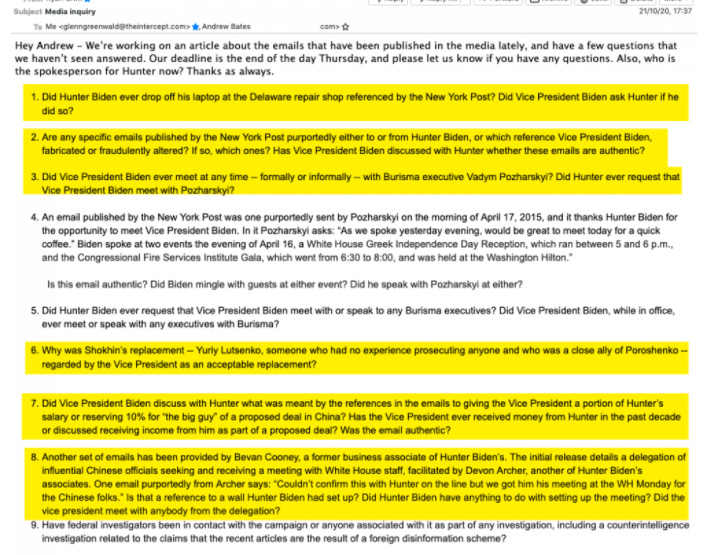
Though the Biden campaign indicated that they would respond to the Intercept’s questions, they have not done so. A statement they released to other outlets contains no answers to any of these questions except to claim that Biden “has never even considered being involved in business with his family, nor in any business overseas.” To date, even as the Biden campaign echoes the baseless claims of media outlets that anyone discussing this story is “amplifying Russian disinformation,” neither Hunter Biden nor the Biden campaign have even said whether they claim the emails and other documents — which they and the press continue to label “Russian disinformation” — are forgeries or whether they are authentic.
The Biden campaign clearly believes it has no need to answer any of these questions by virtue of a panoply of media excuses offered on its behalf that collapse upon the most minimal scrutiny:
First, the claim that the material is of suspect authenticity or cannot be verified — the excuse used on behalf of Biden by Leslie Stahl and Christiane Amanpour, among others — is blatantly false for numerous reasons. As someone who has reported similar large archives in partnership with numerous media outlets around the world (including the Snowden archive in 2014 and the Intercept’s Brazil Archive over the last year showing corruption by high-level Bolsonaro officials), and who also covered the reporting of similar archives by other outlets (the Panama Papers, the WikiLeaks war logs of 2010 and DNC/Podesta emails of 2016), it is clear to me that the trove of documents from Hunter Biden’s emails has been verified in ways quite similar to those.
With an archive of this size, one can never independently authenticate every word in every last document unless the subject of the reporting voluntarily confirms it in advance, which they rarely do. What has been done with similar archives is journalists obtain enough verification to create high levels of journalistic confidence in the materials. Some of the materials provided by the source can be independently confirmed, proving genuine access by the source to a hard drive, a telephone, or a database. Other parties in email chains can confirm the authenticity of the email or text conversations in which they participated. One investigates non-public facts contained in the documents to determine that they conform to what the documents reflect. Technology specialists can examine the materials to ensure no signs of forgeries are detected.
This is the process that enabled the largest and most established media outlets around the world to report similar large archives obtained without authorization. In those other cases, no media outlet was able to verify every word of every document prior to publication. There was no way to prove the negative that the source or someone else had not altered or forged some of the material. That level of verification is both unattainable and unnecessary. What is needed is substantial evidence to create high confidence in the authentication process.
The Hunter Biden documents have at least as much verification as those other archives that were widely reported. There are sources in the email chains who have verified that the published emails are accurate. The archive contains private photos and videos of Hunter whose authenticity is not in doubt. A former business partner of Hunter has stated, unequivocally and on the record, that not only are the emails authentic but they describe events accurately, including proposed participation by the former Vice President in at least one deal Hunter and Jim Biden were pursuing in China. And, most importantly of all, neither Hunter Biden nor the Biden campaign has even suggested, let alone claimed, that a single email or text is fake.
Why is the failure of the Bidens to claim that these emails are forged so significant? Because when journalists report on a massive archive, they know that the most important event in the reporting’s authentication process comes when the subjects of the reporting have an opportunity to deny that the materials are genuine. Of course that is what someone would do if major media outlets were preparing to publish, or in fact were publishing, fabricated or forged materials in their names; they would say so in order to sow doubt about the materials if not kill the credibility of the reporting.
The silence of the Bidens may not be dispositive on the question of the material’s authenticity, but when added to the mountain of other authentication evidence, it is quite convincing: at least equal to the authentication evidence in other reporting on similarly large archives.
Second, the oft-repeated claim from news outlets and CIA operatives that the published emails and texts were “Russian disinformation” was, from the start, obviously baseless and reckless. No evidence — literally none — has been presented to suggest involvement by any Russians in the dissemination of these materials, let alone that it was part of some official plot by Moscow. As always, anything is possible — when one does not know for certain what the provenance of materials is, nothing can be ruled out — but in journalism, evidence is required before news outlets can validly start blaming some foreign government for the release of information. And none has ever been presented. Yet the claim that this was “Russian disinformation” was published in countless news outlets, television broadcasts, and the social media accounts of journalists, typically by pointing to the evidence-free claims of ex-CIA officials.
Worse is the “disinformation” part of the media’s equation. How can these materials constitute “disinformation” if they are authentic emails and texts actually sent to and from Hunter Biden? The ease with which news outlets that are supposed to be skeptical of evidence-free pronouncements by the intelligence community instead printed their assertions about “Russian disinformation” is alarming in the extreme. But they did it because they instinctively wanted to find a reason to justify ignoring the contents of these emails, so claiming that Russia was behind it, and that the materials were “disinformation,” became their placeholder until they could figure out what else they should say to justify ignoring these documents.
Third, the media rush to exonerate Biden on the question of whether he engaged in corruption vis-a-vis Ukraine and Burisma rested on what are, at best, factually dubious defenses of the former Vice President. Much of this controversy centers on Biden’s aggressive efforts while Vice President in late 2015 to force the Ukrainian government to fire its Chief Prosecutor, Viktor Shokhin, and replace him with someone acceptable to the U.S., which turned out to be Yuriy Lutsenko. These events are undisputed by virtue of a video of Biden boasting in front of an audience of how he flew to Kiev and forced the Ukrainians to fire Shokhin, upon pain of losing $1 billion in aid.
But two towering questions have long been prompted by these events, and the recently published emails make them more urgent than ever: 1) was the firing of the Ukrainian General Prosecutor such a high priority for Biden as Vice President of the U.S. because of his son’s highly lucrative role on the board of Burisma, and 2) if that was not the motive, why was it so important for Biden to dictate who the chief prosecutor of Ukraine was?
The standard answer to the question about Biden’s motive — offered both by Biden and his media defenders — is that he, along with the IMF and EU, wanted Shokhin fired because the U.S. and its allies were eager to clean up Ukraine, and they viewed Shokhin as insufficiently vigilant in fighting corruption.
“Biden’s brief was to sweet-talk and jawbone Poroshenko into making reforms that Ukraine’s Western benefactors wanted to see as,” wrote the Washington Post’s Glenn Kessler in what the Post calls a “fact-check.” Kessler also endorsed the key defense of Biden: that the firing of Shokhin was bad for Burima, not good for it. “The United States viewed [Shokhin] as ineffective and beholden to Poroshenko and Ukraine’s corrupt oligarchs. In particular, Shokin had failed to pursue an investigation of the founder of Burisma, Mykola Zlochevsky,” Kessler claims.
But that claim does not even pass the laugh test. The U.S. and its European allies are not opposed to corruption by their puppet regimes. They are allies with the most corrupt regimes on the planet, from Riyadh to Cairo, and always have been. Since when does the U.S. devote itself to ensuring good government in the nations it is trying to control? If anything, allowing corruption to flourish has been a key tool in enabling the U.S. to exert power in other countries and to open up their markets to U.S. companies.
Beyond that, if increasing prosecutorial independence and strengthening anti-corruption vigilance were really Biden’s goal in working to demand the firing of the Ukrainian chief prosecutor, why would the successor to Shokhin, Yuriy Lutsenko, possibly be acceptable? Lutsenko, after all, had “no legal background as general prosecutor,” was principally known only as a lackey of Ukrainian President Petro Poroshenko, was forced in 2009 to “resign as interior minister after being detained by police at Frankfurt airport for being drunk and disorderly,” and “was subsequently jailed for embezzlement and abuse of office, though his defenders said the sentence was politically motivated.”
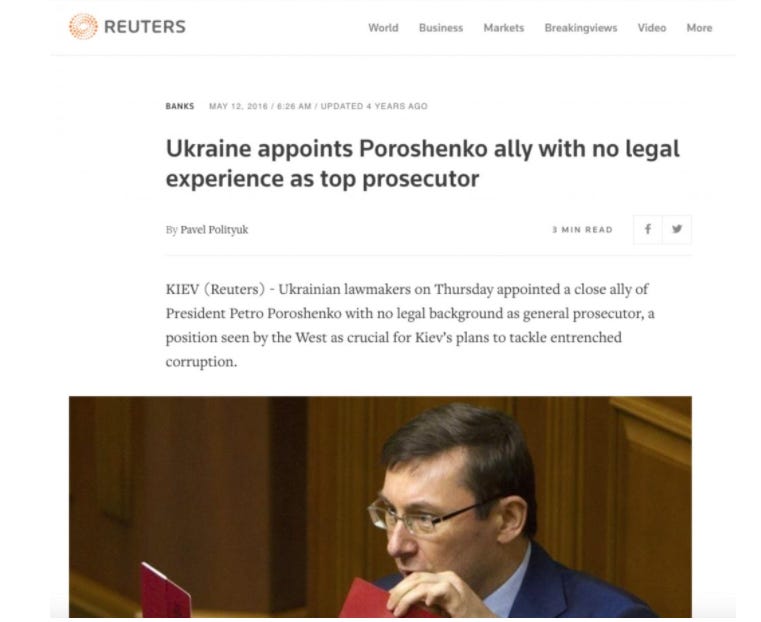
Is it remotely convincing to you that Biden would have accepted someone like Lutsenko if his motive really were to fortify anti-corruption prosecutions in Ukraine? Yet that’s exactly what Biden did: he personally told Poroshenko that Lutsenko was an acceptable alternative and promptly released the $1 billion after his appointment was announced. Whatever Biden’s motive was in using his power as U.S. Vice President to change the prosecutor in Ukraine, his acceptance of someone like Lutsenko strongly suggests that combatting Ukrainian corruption was not it.
As for the other claim on which Biden and his media allies have heavily relied — that firing Shokhin was not a favor for Burisma because Shokhin was not pursuing any investigations against Burisma — the evidence does not justify that assertion.
It is true that no evidence, including these new emails, constitute proof that Biden’s motive in demanding Shokhin’s termination was to benefit Burisma. But nothing demonstrates that Shokhin was impeding investigations into Burisma. Indeed, the New York Times in 2019 published one of the most comprehensive investigations to date of the claims made in defense of Biden when it comes to Ukraine and the firing of this prosecutor, and, while noting that “no evidence has surfaced that the former vice president intentionally tried to help his son by pressing for the prosecutor general’s dismissal,” this is what its reporters concluded about Shokhin and Burisma:
[Biden’s] pressure campaign eventually worked. The prosecutor general, long a target of criticism from other Western nations and international lenders, was voted out months later by the Ukrainian Parliament.
Among those who had a stake in the outcome was Hunter Biden, Mr. Biden’s younger son, who at the time was on the board of an energy company owned by a Ukrainian oligarch who had been in the sights of the fired prosecutor general.
The Times added: “Mr. Shokhin’s office had oversight of investigations into [Burisma’s billionaire founder] Zlochevsky and his businesses, including Burisma.” By contrast, they said, Lutsenko, the replacement approved by Vice President Biden, “initially continued investigating Mr. Zlochevsky and Burisma, but cleared him of all charges within 10 months of taking office.”
So whether or not it was Biden’s intention to confer benefits on Burisma by demanding Shokhin’s firing, it ended up quite favorable for Burisma given that the utterly inexperienced Lutesenko “cleared [Burisma’s founder] of all charges within 10 months of taking office.”
The new comprehensive report from journalist Taibbi on Sunday also strongly supports the view that there were clear antagonisms between Shokhin and Burisma, such that firing the Ukrainian prosecutor would have been beneficial for Burisma. Taibbi, who reported for many years while based in Russia and remains very well-sourced in the region, detailed:
For all the negative press about Shokhin, there’s no doubt that there were multiple active cases involving Zlochevsky/Burisma during his short tenure. This was even once admitted by American reporters, before it became taboo to describe such cases untethered to words like “dormant.” Here’s how Ken Vogel at the New York Times put it in May of 2019:
“When Mr. Shokhin became prosecutor general in February 2015, he inherited several investigations into the company and Mr. Zlochevsky, including for suspicion of tax evasion and money laundering. Mr. Shokin also opened an investigation into the granting of lucrative gas licenses to companies owned by Mr. Zlochevsky when he was the head of the Ukrainian Ministry of Ecology and Natural Resources.”
Ukrainian officials I reached this week confirmed that multiple cases were active during that time.
“There were different numbers, but from 7 to 14,” says Serhii Horbatiuk, former head of the special investigations department for the Prosecutor General’s Office, when asked how many Burisma cases there were.
“There may have been two to three episodes combined, and some have already been closed, so I don’t know the exact amount.” But, Horbatiuk insists, there were many cases, most of them technically started under Yarema, but at least active under Shokin.
The numbers quoted by Horbatiuk gibe with those offered by more recent General Prosecutor Rulsan Ryaboshapka, who last year said there were at one time or another “13 or 14” cases in existence involving Burisma or Zlochevsky.
Taibbi reviews real-time reporting in both Ukraine and the U.S. to document several other pending investigations against Burisma and Zlochevsky that was overseen by the prosecutor whose firing Biden demanded. He notes that Shokhin himself has repeatedly said he was pursuing several investigations against Zlochevsky at the time Biden demanded his firing. In sum, Taibbi concludes, “one can’t say there’s no evidence of active Burisma cases even during the last days of Shokin, who says that it was the February, 2016 seizure order [against Zlochevsky’s assets] that got him fired.”
And, Taibbi notes, “the story looks even odder when one wonders why the United States would exercise so much foreign policy muscle to get Shokin fired, only to allow in a replacement — Yuri Lutsenko — who by all accounts was a spectacularly bigger failure in the battle against corruption in general, and Zlochevsky in particular.” In sum: “it’s unquestionable that the cases against Burisma were all closed by Shokin’s successor, chosen in consultation with Joe Biden, whose son remained on the board of said company for three more years, earning upwards of $50,000 per month.”
The publicly known facts, augmented by the recent emails, texts and on-the-record accounts, suggest serious sleaze by Joe Biden’s son Hunter in trying to peddle his influence with the Vice President for profit. But they also raise real questions about whether Joe Biden knew about and even himself engaged in a form of legalized corruption. Specifically, these newly revealed information suggest Biden was using his power to benefit his son’s business Ukrainian associates, and allowing his name to be traded on while Vice President for his son and brother to pursue business opportunities in China. These are questions which a minimally healthy press would want answered, not buried — regardless of how many similar or worse scandals the Trump family has.
But the real scandal that has been proven is not the former Vice President’s misconduct but that of his supporters and allies in the U.S. media. As Taibbi’s headline put it: “With the Hunter Biden Exposé, Suppression is a Bigger Scandal Than the Actual Story.”
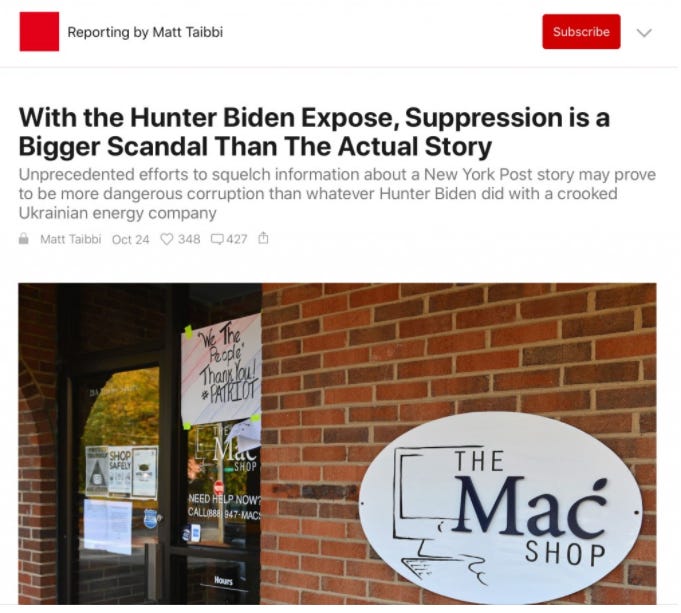
The reality is the U.S. press has been planning for this moment for four years — cooking up justifications for refusing to report on newsworthy material that might help Donald Trump get re-elected. One major factor is the undeniable truth that journalists with national outlets based in New York, Washington and West Coast cities overwhelmingly not just favor Joe Biden but are desperate to see Donald Trump defeated.
It takes an enormous amount of gullibility to believe that any humans are capable of separating such an intense partisan preference from their journalistic judgment. Many barely even bother to pretend: critiques of Joe Biden are often attacked first not by Biden campaign operatives but by political reporters at national news outlets who make little secret of their eagerness to help Biden win.
But much of this has to do with the fallout from the 2016 election. During that campaign, news outlets, including The Intercept, did their jobs as journalists by reporting on the contents of newsworthy, authentic documents: namely, the emails published by WikiLeaks from the John Podesta and DNC inboxes which, among other things, revealed corruption so severe that it forced the resignation of the top five officials of the DNC. That the materials were hacked, and that intelligence agencies were suggesting Russia was responsible, not negate the newsworthiness of the documents, which is why media outlets across the country repeatedly reported on their contents.
Nonetheless, journalists have spent four years being attacked as Trump enablers in their overwhelmingly Democratic and liberal cultural circles: the cities in which they live are overwhelmingly Democratic, and their demographic — large-city, college-educated professionals — has vanishingly little Trump support. A New York Times survey of campaign data from Monday tells just a part of this story of cultural insularity and homogeniety:
Joe Biden has outraised President Trump on the strength of some of the wealthiest and most educated ZIP codes in the United States, running up the fund-raising score in cities and suburbs so resoundingly that he collected more money than Mr. Trump on all but two days in the last two months….It is not just that much of Mr. Biden’s strongest support comes overwhelmingly from the two coasts, which it does…. [U]nder Mr. Trump, Republicans have hemorrhaged support from white voters with college degrees. In ZIP codes with a median household income of at least $100,000, Mr. Biden smashed Mr. Trump in fund-raising, $486 million to only $167 million — accounting for almost his entire financial edge….One Upper West Side ZIP code — 10024 — accounted for more than $8 million for Mr. Biden, and New York City in total delivered $85.6 million for him — more than he raised in every state other than California….
The median household in the United States was $68,703 in 2019. In ZIP codes above that level, Mr. Biden outraised Mr. Trump by $389.1 million. Below that level, Mr. Trump was actually ahead by $53.4 million.
Wanting to avoid a repeat of feeling scorn and shunning in their own extremely pro-Democratic, anti-Trump circles, national media outlets have spent four years inventing standards for election-year reporting on hacked materials that never previously existed and that are utterly anathema to the core journalistic function. The Washington Post’s Executive Editor Marty Baron, for instance, issued a memo full of cautions about how Post reporters should, or should not, discuss hacked materials even if their authenticity is not in doubt.
That a media outlet should even consider refraining from reporting on materials they know to be authentic and in the public interest because of questions about their provenance is the opposite of how journalism has been practiced. In the days before the 2016 election, for instance, the New York Times received by mail one year of Donald Trump’s tax returns and — despite having no idea who sent it to them or how that person obtained it: was is stolen or hacked by a foreign power? — the Times reported on its contents.
When asked by NPR why they would report on documents when they do not know the source let alone the source’s motives in providing them, two-time Pulitzer Prize winner David Barstow compellingly explained what had always been the core principle of journalism: namely, a journalist only cares about two questions — (1) are documents authentic and (2) are they in the public interest? — but does not care about what motives a source has in providing the documents or how they were obtained when deciding whether to reporting them:

Why NYT’s David Barstow does not care who leaked us Trump’s tax return, or what the motivation was. Listen: 
The U.S. media often laments that people have lost faith in its pronouncements, that they are increasingly viewed as untrustworthy and that many people view Fake News sites are more reliable than established news outlets. They are good at complaining about this, but very bad at asking whether any of their own conduct is responsible for it.
A media outlet that renounces its core function — pursuing answers to relevant questions about powerful people — is one that deserves to lose the public’s faith and confidence. And that is exactly what the U.S. media, with some exceptions, attempted to do with this story: they took the lead not in investigating these documents but in concocting excuses for why they should be ignored.
As my colleague Lee Fang put it on Sunday: “The partisan double standards in the media are mind boggling this year, and much of the supposedly left independent media is just as cowardly and conformist as the mainstream corporate media. Everyone is reading the room and acting out of fear.” Discussing his story from Sunday, Taibbi summed up the most important point this way: “The whole point is that the press loses its way when it cares more about who benefits from information than whether it’s true.”
Plutocrat Violence and Election-Night Horror: Marxian Analysis Shows That Antifa Is Fascist
By Joaquin Flores | Strategic Culture Foundation | October 29, 2020
“When fascism comes to America, it will be called antifascism” – Huey Long (misattributed)
Antifa’s fascist violence will return on election night. That’s why it’s important to understand their fraudulence and fascism, and reject the politics of plutocrat-contrived violence. Perhaps strangely, Marxian analysis itself is best suited to communicate this point to the radical left.
This is because at the root of Marxian analysis are not self-declarations, nor definitions based in superstructural manifestations, but rather the material relationship between base and superstructure.

In layman’s terms this boils down to two things in practice: ‘follow the money’, and ‘watch what they do and not what they say’.
The real existing financial motives and the socio-economic class behind those motives is what we will find driving the base, even while at the superstructural level we find an ideology which only nominally, only apparently, appears at odds with the real motives at the base. Antifa, at its class and financial base (i.e., its objective and material base) is a plutocrat supported and controlled operation against the republic.
“Unlike the old left, rooted in radically independent organized labor, Antifa’s leadership and activities, to the contrary, are financed through billionaire oligarchs both directly and indirectly, like George Soros and Michael Bloomberg.”
In the simplest possible terms, Antifa is fascist because while they use some of the talking points and imagery of the old left, they actually work towards a plutocratic coup (or counter-revolution) against the republic. This is not to say there is a system-wide fascist threat, for reasons we will explain in an upcoming installment. In short, the coming coup against republican norms will not establish ‘fascism’ as historically understood, but a new kind techno-industrial repressive society within the rubric of post-modernity, which has hitherto not been contemplated rigorously outside of small circles of futurists and science fiction authors.
Antifa and BLM protests have generally disappeared from the simulated reality of the controlled media lens, because these riots did not have the intended effect of delegitimizing the Trump administration, instead working against Joe Biden and Kamala Harris.
Antifa Explosion – What the Week of November 2nd Will Look Like
Once Trump declares victory at around 11:30 pm on November 3rd, right as social media bans, blocks, and censors Trump’s announcement of victory, we will see the start of mass Antifa violence in key cities in swing states. As the French Marxist Baudrillard would have explained, an entire media simulation will ensnare (within its simulacra) whole portions of the population, which will be encouraged to send in their late ballots, following a last minute strategic ballot harvesting ploy targeted at key locations.
The disastrous ruling of the Supreme Court allowing three-day late ballots to be counted, will encourage a whole post-election drive to harvest ballots precisely in those precincts where the known data is already in from election night. The push to throw the election for Biden post facto will focus largely on those precincts within particular communities, within swing states. The problem for Biden has been the lack of a ground campaign and any sort of excitement.
This means we should expect a very big controlled-media scandal to captivate headlines right after the election. Whether or not this will actually motivate post facto ‘voting’ is beside the point. It must only be a semi-credible narrative that will explain why hundreds of thousands of voters turned out starting November 4th to cast their late ballots organically, even as in fact these will have been the result of targeted ballot harvesting.
Why Antifa’s ‘Communists’ Are Actually Fascists
- It Doesn’t Matter What You Call Yourself
Many Antifa members, as well as the BLM leadership, call themselves Marxists, and because this self-declaration is also convenient for their conservative opponents, these self-descriptions go unchallenged.
Likewise in terms of its membership, fascist movements a hundred years ago were largely drawn from workers and small business owners who saw themselves as socialists and liberal-progressives. People do not fit into easy categories, and besides socialism and liberal-progressivism were a mix of both enlightenment and romantic ideas relating to both myth and utopia.
What defined them as fascists in Marxian terms was not the self-professed utopian, futurist, religious, socialist, or reactionary beliefs of this or that member of the movement, but by the objective material and financial reality of being backed by the plutocracy against the public, itself. All the while posing as guardians of the public.
Marxian analytic tools demonstrate that the same as true of Antifa in the U.S. today. The conservative right has long enjoyed throwing around the term ‘socialist’ and ‘Marxist’, especially ‘cultural Marxism’, to denounce their opponents within the Democrat Party, and this has the inverse effect of drawing elements of the populist and radical left who have no relation to the ruling plutocracy within the DNC, towards down-ballot DNC politics and Antifa protest-riots.
We cannot characterize a party or movement by the plurality socioeconomic class of its members in a vacuum. Otherwise both the Democrats and Republicans are ‘labor parties’.
- We Already Proved That Antifa Is Financed by the Plutocracy
Indeed, Antifa in the U.S. has become a plutocrat-financed fascistic movement if we are using any Marxian metric. This seems counter-intuitive, for after all they profess themselves to be antifascist, and the fascists they are opposed to are allegedly the ‘basket of deplorables’ that back Trump. This means we need to set aside the institutionally approved (Eco, Griffin, et al) definitions of fascism, ultimately liberal ones in service of the status quo, to arrive at any meaningful definition of any utility. The academic institutions themselves are compromised with regard to these matters.
This is why in our piece ‘How Can the Deep State’s Antifa Organization Be Stopped?’ we showed the plutocrat financed NGO industrial complex through organizations like Democracy Alliance, was the defining base of Antifa activism – what Marxian analysis has always held, far and above, as defining the objective nature of a movement, and not its self-professions nor characterizations by their opponents.
Marxian analysis requires that we assess a movement by a.) Its material base, meaning which class empowers it and makes it possible (finances it) and b.) In whose class interest they work to empower. The answer for both here is the plutocracy. Because they pose as ‘revolutionary left’ but are in fact plutocratic, means they are fascist.
Marxian analytic tools must be salvaged from today’s ‘Marxists’, as these are as prescient as they are timely. They go farther to explain the 4th Turning, the 4th Industrial Revolution, the declining rate of profit, the internet of things and 3D printing, and the potential for a future economy based on the natural right of liberty and human dignity, both in the world and of the soul. But it is vulgar misrepresentation as the ideology of Antifa and BLM serves the purpose, perhaps intentionally, of turning-off tens of millions of Americans who could otherwise see what is useful within the analytic framework of class and economic development through history.
- Their Tactics Are Taken From Fascism
Of course the fascism of Antifa is visible to many, because of its gang-stalking and arson, the mob intimidation of citizens and small businesses to support this nascent totalitarian movement. To force passersby to raise the fist just as eighty-five years ago, Germans and Italians were identically forced to give the Roman salute, is only a corroborating piece of anecdata, and not the root of the reasoning that Antifa is fascist in nature.
But insofar as the Antifa mob and BLM leadership situates itself ostensibly in Marxism, this is perhaps even more dangerous for the reasons we’ve explained. And yet it is Marxian analysis itself which is best suited to demonstrate that even at a theoretical level, Antifa is fascist.
The owning class weary of radical economic changes and a rising ‘right-wing’ populist movement which itself is fixated on economic issues historically associated with the left, deploys the very same ‘victims of modernity’ (war veterans, permanently unemployed of all ages, workers, vagabonds, indebted students, adventurers, petty thieves and released criminals) to bring its definition of order out of chaos by operationalizing the chaos and the chaotic tendencies of its minions.
Unlike the old left, rooted in radically independent organized labor, Antifa’s leadership and activities, to the contrary, are financed through billionaire oligarchs both directly and indirectly, like George Soros and Michael Bloomberg.
Likewise we cannot characterize something as ‘fascist’ by its explicit beliefs or by views that may be projected onto them, but rather by the class that operationalizes them, and towards what end. Race, nationality, ethnicity, religion – these are but superstructural permutations of the givens of a time and place. Here is, among many other places, where Umberto Eco and Roger Griffin and those in their image are critically errant in understanding fascism. Fascism is a matter of methods, of tactics, and of financing – not of symbols, explicit ideology, or specific positions on culture-war (wedge) issues.
That said, Griffin’s point that fascism no longer has the ability to mobilize a mass movement in the way it did prior to WWII, but that it can carry on as a smaller phenomenon that can inspire terrorism, is agreed. Many of his reasons for stating so are incorrect, even if this conclusion is apt.
- Antifa Punches Down, the Historic Labor Left Punches Up
Both the traditional radical left and fascist right were proponents of violence towards political goals, even if in self-defense, but the traditional radical left used to focus on ‘punching up’: Attacking capital, the ruling class, the banks, big land owners.
But historic fascism in its late-nascent stage is more similar to Maoism during the Cultural Revolution (there’s a strong New Left orientation to Maoism as well). It organizes and concentrates power by ‘punching down’.
This dangerous fascistic trend among what has come to be known as ‘the left’. At the level of universities, it began in the late 90’s when coastal university classrooms became ‘call-out sessions’. It moved into mass culture through venture-capital funded click-bait websites like Buzzfeed and Jezebel. Of course all of these antics would have been unrecognizably alien to militant rank-and-file labor union members in decades past.
That Antifa punches down and that mainstream media echoes their talking points, and that public service announcements are increasingly indistinguishable from Antifa propaganda, is a clear sign of its fascist essence. Punching down is always from a position of power, and its appropriation by the overt sections of power is a clear sign that their ideas have become what the French Marxist Althousser called the Ideological State Apparatus: That anything and everything outside of nebulous, ever-changing shibboleths (i.e. ‘community standards’) can potentially be called ‘fascist’ as a justification for ‘cancel culture’ and black-listing, is precisely that which the growing ‘illiberal liberalism’ of the plutocrats indeed flourishes on.
Pro-systemic propaganda punches down. Anti-systemic propaganda punches up. It’s an equation as simple as it is true.
- Like Fascists, Antifa Relies on Support from Local Law Enforcement, Local Business, and an Entrenched Local Political Class to Place Them ‘Above the Law’
Perhaps you’ve seen old film reel of Nazis in the 1920’s in paramilitary uniform, long before they had official power in the governmental sense, seemingly able to physically attack those they wanted at whim, without local authorities intervening. From a position of power, from local friendly police departments, business interests, and politicians who at the very least ‘look the other way’, Antifa – like its fascist counterpart – is able to get away with enforcing its power on a down vertical. Road-blocks, riots, home-burnings, against the general public – all with local official support. Their aim is to coerce from the public a fear-based passivity and conformity to the politics of their program.
It matters very little in this sense, that they call themselves Antifa. While history moves in one direction, and historical parallels are fraught with contradictions, Antifa today in the most simple terms is recruited and built from that disenfranchised and permanently unemployed hodgepodge of people of various socioeconomic backgrounds, along with thrill-seeking youth (in that age-old quest for meaning, purpose, and identity) which formed the bulk of fascist mobs in the teens and twenties a hundred years ago in Europe.
When we understand that, their ability to operate ‘above the law’ in many cases, find large groups of philanthropically minded lawyer’s groups (like the National Lawyers’ Guild) to work to have their charges dropped, district attorneys who are lenient, and the media industrial complex including monopoly social media, all work in coordinated fashion to enable the Antifa organization.
- Their Violence Has Not Once Been in Defense of Labor Strikes and Pickets
Their methods and tactics are entirely uninvolved in labor ‘general strike’ type strategies that would more correctly characterize them as traditionally leftist. As seen above, rather, their methods are taken solely from the rise of fascism. Their material financial base, as well as their methods and tactics are fascist, as we have shown. Legitimate left-wing movements arise from, and are materially (financially) rooted in organized labor at its base. The various superstuctural manifestations along the ideological plane, whether nationalist, fascist, social-democratic, communists, anarchist, etc., are not – in the final analysis – determinative of the class and socio-economic nature of its (conscious or not) ‘leftism’ in terms of its relation to organized labor.
- Their Cancel-Culture and Voter Disenfranchisement Campaign is Against Democracy
This is critical in separating Antifa from historical bourgeois-democratic movements. In Marxian terms, in the transition from feudal modes of production to capitalist modes of production, the plutocracy helped arm and organize workers and peasants, the poor and disenfranchised, to overthrow the feudal nobility and usher in an historical period characterized by bourgeois-democratic liberties and freedoms, which have come to characterize the ‘western tradition’ in modernity. Antifa is not a bourgeois-democratic movement because the U.S. is not a feudal, nor semi-feudal country, and also because their actions work against the existing rights to association and speech (cancel-culture), and work against enfranchisement as they have been operationalized towards a ballot harvesting scheme.
Concluding Commentary
The views of Griffin and Eco focus overwhelmingly upon the superstructural manifestations of the fascism of a century ago, so much so that Eco’s attempt to uncover an ‘Ur-fascism’, or generalized theory of identifying fascism, is an utter failure. Rather, Marxian analysis demonstrates that both historical fascism regardless of name as well as contemporary movements of the same essence are defined not by these superstructural manifestations (ideology, aesthetics, etc.) but rather by its driving base in terms of socio-economic class (economic foundation, private property, capital).
Election night and the weeks to follow will be met with a wave of violence larger than seen before. It will be difficult for those remaining on the left to understand that the Antifa foot soldiers are agents of capital, and not of labor. This is largely because of the gradual takeover of the left by new-left identity politics which crept slowly, and then rapidly, with May of 1968 and the Situationist moment being a key signifier.
We know that the FBI’s field offices which historically have infiltrated radical left-groups are also compromised, because we would otherwise see these FBI agents – whose work is often to act as agents provocateurs – to act as de-escalating agents urging calm from within the ranks of these fascistic Antifa outfits. We have not seen this, which is a key sign that the FBI at the very top is wrought with complicit activity, which incidentally is another piece of evidence in 5., above.
Perhaps it is ironic that Marxian analysis itself is best able to demonstrate that Antifa – whose members often describe themselves as Marxists (socialists, communists, etc.) – is in fact fascist.
The defense of the republic, of the bourgeois-democratic revolutionary gains of 1776-89 which were expanded in 1865, today rests upon election integrity, voter enfranchisement, and in a strange twist of fate, the Justice Department under AG Barr.
Featured Video

Dan Dicks with James Corbett on Solutions Watch
or go to
Aletho News Archives – Video-Images
From the Archives
MMR (Measles, Mumps and Rubella) – Vaccine Risk Statement
MMR Vaccine (Measles, Mumps, and Rubella) Is It Safer Than Measles, Mumps and Rubella?
Physicians for Informed Consent | December 2024
… It has not been proven that the MMR vaccine is safer than measles, mumps, and rubella. The vaccine package insert raises questions about safety testing for cancer, genetic mutations, and impaired fertility. Although VAERS tracks some adverse events, it is too inaccurate to measure against the risk of measles, mumps, and rubella. Clinical trials do not have the ability to detect less common adverse reactions, and epidemiological studies are limited by the effects of chance and possible confounders. Safety studies of the MMR vaccine are particularly lacking in statistical power. A review of more than 60 MMR vaccine studies conducted for the Cochrane Library states, “The design and reporting of safety outcomes in MMR vaccine studies, both pre- and post-marketing, are largely inadequate.”19 Because permanent sequelae (aftereffects) from measles, mumps, and rubella are so rare (especially in children with normal levels of vitamin A and infected after birth),6,15-17 the level of accuracy of the research studies available is insufficient to rule out the possibility that the MMR vaccine causes greater death or permanent disability than measles, mumps, and rubella. – Read full article
Blog Roll
 Aletho News
- Moscow issues warning to NATO over Russian exclave
- Yes, the Iran war has destroyed Trump’s presidency
- The fallacy of US delusions about Iran’s economic collapse
- Hezbollah denies Syria cell link, warns of Israeli plan to sow discord
- The legacy of US sanctions, war, and occupation in Iraq
- Iraqi resistance group rejects disarmament, vows to maintain support for Lebanon
- Sheikh al-Asadi warns of Iraqi government compliance with US demands
- How to MAKE THE CONSPIRATORS PAY for their crimes! Dan Dicks with James Corbett on Solutions Watch
- There’s a drought in academia: A drought in honest research on the subject of drought and other weather extremes
- Department of War Awards $20.7 Billion Contract to Raytheon for Air-to-Air Missiles
- If Americans Knew
- As settlers ravage West Bank, Israeli forces kill 10 in Gaza – Daily Update
- New Report: “Scholasticide and Genocide in Gaza: Assessment, Testimonies and Legal Analysis”
- Ex-Biden officials are desperate for a Gaza scapegoat
- Israeli “settlers” Invade Al-Aqsa; Pour Boiling Water on 75-Year-Old
- Israel Has Kidnapped Another American Teenager
- US arms sales to Israel worth $21.6 billion in 20 months
- Three Palestinians Killed in Israeli Attacks on Gaza
- Revealed: German “Anti-Semitism Expert” Driving Crackdown on Palestine Solidarity is Former Israeli Spy
- Egypt’s Warning to Israel Before Oct 7
- Israel’s siege signals another cruel winter for 1.8 million Gazans – Daily Update
- No Tricks Zone
- Two More Paleo Reconstructions Affirm Meters-Higher Sea Levels Across Ireland, Brazil 7000-6000 Years Ago
- New Study: Earth And Venus Surface Warmth Largely Explained By Convection And Lapse Rate, Not CO2 Or Radiation
- 2025 Nature Paper Claiming Worsening Global Drought Gets RETRACTED …Heavily Flawed
- New Study: ‘Global Drought Shows No Detectable Recent Acceleration Under Climate Warming’
- Economic Masterminds: German Socialists Suggest Taxing Productivity Gains Stemming From Using AI
- The South China Sea Has Not Been Cooperating With The Climate Change Narrative
- Energy Crisis: Germany Enters Heating Season With Historically Low Gas Reserve Fill Levels
- New Study: The Antarctic Ice Sheet Gained Mass From 2020-2024 Due To Staggering Snow And Ice Accumulation
- Study: Ocean Heating Rates From Thousands Of Years Ago ‘Dwarf’ Modern Ocean Heating Rates
- Climate Extremists Target, Attack Large-Scale Power Grid Infrastructure In Germany!

