Aletho News

ΑΛΗΘΩΣ

OPCW Confirm Leaked Report is Genuine

By Kit Knightly | OffGuardian | May 16, 2019

The leaked OPCW report appears to have been confirmed genuine.

The report, titled “Engineering Assessment of Two Cylinders Observed at Douma Incident”, came to public prominence a few days ago after The Working Group on Syria, Propaganda and Media released their analysis of the text.

Since then it has gotten a lot of play all across the alternate media (you can read our original report here, but there were many others too).

It has received virtually zero coverage in the mainstream media, of course. And that doesn’t appear likely to change any time soon.

The report spells out, in unambiguous language, that the two chlorine gas canisters were likely planted, rather than dropped from a helicopter.

In summary, observations at the scene of the two locations, together with subsequent analysis, suggest that there is a higher probability that both cylinders were manually placed at those two locations rather than being dropped.”

This finding adds to the pile of evidence which makes it appear very likely the whole event was staged.

The only question was whether or not the document could be confirmed genuine. And now it has been.

Peter Hitchens, for a long time the only mainstream voice to express any doubts about the “official narrative” on Douma, wrote to the OPCW to ask about the leaked report.

He wrote a column about it. We suggest you read it, but the most important passage, taken directly from an OPCW statement, is this:

Pursuant to its established policies and practices, the OPCW Technical Secretariat is conducting an internal investigation about the unauthorised release of the document in question.

Note the language. Nowhere is it disputing either the findings of the document, nor the veracity. Instead, they are “conducting an investigation” into its “unauthorised release”.

That is as close to an admission as makes no difference. For now, we can safely conclude the document is real, and the findings genuine.

That means, not only that the Douma “chemical attack” was likely staged, but that the OPCW knew this and chose to cover it up.

A very distressing series of events, and one that could easily have lead to an all-out war between Syria, Russia and NATO.

We welcome the OPCW’s admission that this document is genuine. However, we would suggest the question is not “How was it leaked?”, but rather “Why was it suppressed in the first place?”

Kit Knightly is co-editor of OffGuardian. The Guardian banned him from commenting. Twice. He used to write for fun, but now he’s forced to out of a near-permanent sense of outrage.

May 16, 2019 Posted by | Deception, False Flag Terrorism | , | Leave a comment

Israel firm meddled in Africa, Asia and Latin America elections

MEMO – May 16, 2019

An Israel-based campaign to meddle in the elections of several African, Asian and Latin American countries has been uncovered by social media giant Facebook.

Facebook announced today that it had deactivated dozens of accounts found to be spreading disinformation by posing as local journalists and influencers. The social media giant traced these accounts to Archimedes Group, a private company based near Tel Aviv which had engineered the campaign.

Facebook’s head of cybersecurity policy, Nathaniel Gleicher, told reporters that the platform had deleted 65 accounts, 161 pages and dozens of groups linked to the misinformation campaign, noting that this activity had garnered 2.8 million followers and hundreds of thousands of views. Gleicher also told reporters that Archimedes has now been banned from Facebook, Haaretz reported.

For its part, the Times of Israel quoted Gleicher as saying that “these are actors that were essentially facilitating deception, and they appear to be commercially engaged to do this”. He added: “That type of business does not have a place on our platforms so we are removing them from the platform and our teams will continue to investigate to look for other instances of this type of behaviour, [whether] for commercial or other strategic purposes.”

Archimedes’ operations are thought to have focused on Nigeria, Senegal, Togo, Angola, Niger and Tunisia, as well as a handful of Asian and Latin American countries. It is thought that the campaign has spent over $800,000 on Facebook adverts since 2012.

Relatively little is known about Archimedes Group. The Washington Post noted that the group presents itself as “a consulting firm involved in campaigns for presidential elections,” using the slogan “winning campaigns worldwide”. The website also features a vague description of the group’s “mass social media management” software, which it claims can enable the operation of an “unlimited” number of online accounts.

The Washington Post added that Archimedes is headed by Elinadav Heymann, citing Swiss negotiations consultancy Negotiations.CH. Heymann is also reported to have been Executive Director of the European Friends of Israel since 2012 and an “advisor to various parties [in] the Israeli Knesset for 3 terms”.

Facebook’s Gleicher said he could not speculate as to whether Archimedes’ motives were political, and as yet it is not known who solicited and paid for the group’s services. However, given the campaign’s focus on predominantly central and west African countries – a region in which the Israeli state has recently tried to increase its influence – questions to this effect are likely to be raised going forward.

In January, Israeli Prime Minister Benjamin Netanyahu visited Chad to restore diplomatic relations between the two countries, which were severed in 1972. Speaking at a press conference before his departure, Netanyahu said that the visit was “part of the revolution we are doing in the Arab and Muslim world,” claiming that such an initiative “greatly worries, even greatly angers” Palestinians and the wider Arab world.

Though Israel’s normalisation drive in Africa has material benefits – often including lucrative arms deals, memorandums for economic cooperation and the use of airspace which will significantly shorten flight paths for commercial Israeli airlines – the initiative is also pursued for its propaganda value. Netanyahu has long been keen to emphasise these diplomatic successes, particularly in the run up to Israel’s general election which took place last month.

May 16, 2019 Posted by | Deception | , , | Leave a comment

Why is the US always ‘stumbling’ or ‘sliding’ into war? How the media misleads with language

By Danielle Ryan | RT | May 15, 2019

The way the mainstream media tells it, the United States never, ever ends up embroiled in wars and military conflicts on purpose — only ever by mistake, or as a result of things like ‘bad planning’ or ‘strategic missteps’.

Very often when media coverage of war is analysed, there is a focus on how hawkish pundits cheerlead for conflict and journalists parrot official narratives while dissenting voices are drowned out. Mainstream networks, for example, have been heavily criticized by media watchdogs for almost exclusively inviting pro-war guests and ex-military hawks onto their news shows to convince Americans that war is the only reasonable course of action, while refusing to let anti-war commentators get a look in.

But there is another more subtle and unnoticeable way that the media deceives us. Even when they are not outright cheerleading for military action (as was the case in the lead up to the Iraq War), the language they use to describe events is designed to absolve Washington of blame.

Next time you read the news, notice how the US is always “stumbling into” war, or “drifting into” war or “sliding into” war — or even “sleepwalking into” war. To “stumble into” war seems to be a firm favorite among headline writers. The US has “stumbled” into war in Iraq and Syria and has been, at one time or another, at risk of “stumbling” into war with Russia, North Korea and most recently Iran.

According to these headlines, the US has also been “dragged into” (CNN) and “sucked into” (NI ) war in Syria and Afghanistan, twice (NI, The Times ). In recent weeks, the Trump administration has been “sliding into” (AP ) a potential “accidental” war with Iran — and back in 2017, it was “dragged into” (FP ) the disastrous Yemen conflict.

The examples of the US stumbling, blundering and bumbling its way into wars are endless — and it does raise a question that no one ever seems to ask: If it’s so easy to trip and fall into massive never-ending wars, why isn’t it happening to everyone else? Is Washington just especially clumsy?

With this narrative of the bumbling superpower, agency is always removed from the architects of war. Instead of enthusiastically banging the drums for war, we’re told the White House is always ‘reluctant’ to deploy its military, but is ‘forced’ into it . Then, once the war is in full-swing, when things are not panning out exactly as planned, the US can become the sacrificial hero, propelled into a deadly conflict not of its own making.

A recent headline in the Miami Herald framed recent US actions on Venezuela as the US being “pushed to act.” Pushed by who? The Trump administration voluntarily helped organize and instigate the attempted coups that worsened the country’s political crisis and proudly imposed the economic sanctions which have led directly to thousands of premature deaths. There was no “pushing” involved.

In April, Foreign Policy magazine even had Venezuela’s self-declared interim president Juan Guaido “stumbling toward a coup.” How do you stumble into a military coup? Surely that’s the kind of thing that requires careful, deliberate planning and execution? The Washington Post had Trump “fumbling” an uprising in Caracas, too.

It’s not just media pundits and journalists who employ this kind of misleading language, either. British Foreign Secretary Jeremy Hunt said this week that a US war with Iran could happen “by accident.” Did Hunt take a vacation from reality and miss US Secretary of State Mike Pompeo and National Security Advisor John Bolton ramping up war rhetoric against Iran for months? Maybe Trump abandoned the 2015 Iran nuclear deal by accident and sent an aircraft carrier and bomber task force into the Persian Gulf last week to “send a message” to Iran by mistake.

Such framing obscures basic facts about Washington’s motives and predilection toward military conflict over diplomacy. Washington doesn’t get into wars by mistake. Unless a country is directly attacked, threatened or occupied, wars are quite easy to avoid getting into if you really don’t want to be in them  — but the hawks in Washington, no matter how much they pretend to not want war, are always itching for more and they will stop at nothing to get what they want, even if that means fabricating evidence (as in Iraq) or pulling off false flag attacks to use as convenient pretexts for the US to ‘respond’ to.

US military actions are designed specifically to provoke the conflicts that they believe will be of benefit to their overall geopolitical strategy. Talk of freedom, democracy and human rights are just a convenient cover. Washington is never at risk, for example, of stumbling into war with Saudi Arabia, despite Riyadh’s laundry list of crimes against humanity.

Whether this propagandistic language is always employed in a totally conscious way or not, it’s difficult to tell. Either way, it’s a psychological trick which frames the most powerful, military-minded and trigger-happy country in the world as some kind of innocent victim of events beyond its control.

Also on rt.com:

US media’s love affair with war: Major outlets showed zero opposition to Syria strikes

May 16, 2019 Posted by | Deception, Mainstream Media, Warmongering | , , | Leave a comment

Who Really Gains from the Gulf Ship ‘Sabotage’

By Finian Cunningham | Strategic Culture Foundation | May 15, 2019

After dramatic and patently scripted warnings of “Iranian aggression” by bellicose US officials, there then follows – conveniently enough – an alleged sabotage incident in the Persian Gulf region implicating Iran.

Meanwhile, US Secretary of State Mike Pompeo poses with a straight face that his country doesn’t want war with Iran. His comments warp credulity given that American forces have suddenly escalated firepower in the Persian Gulf for the purpose of “responding” to alleged Iranian infractions.

Typically, Western news media are “reporting” (or rather, “echoing”) the purported sabotage incident as if it were fact, basing their source of information on Saudi and Emirati officials, sources which have a vested interest in creating a war pretext against Iran.

Given the grotesque, barefaced lies that have emanated from the Saudi regime over the past year with regard to the murder of journalist Jamal Khashoggi and also its barbaric, mass executions of political dissidents, it is nauseating how Western media can affect to be so credulous in citing Saudi claims as reliable over the latest alleged shipping incident.

“Two Saudi oil tankers have been sabotaged off the coast of the United Arab Emirates posing a potentially serious threat to world oil supplies,” reports [sic] Britain’s Guardian, attributing the source of this information to the “Saudi government”. What the Guardian omitted was the key word “alleged” before “sabotage”. Notice how the impression given is one of a factual incident of malicious intent. Most other Western news media adopted the same reliance on the official Saudi and Emirati claims.

Tellingly, however, Saudi and Emirati officials gave no details about the “significant damage” allegedly caused to a total of four tankers.

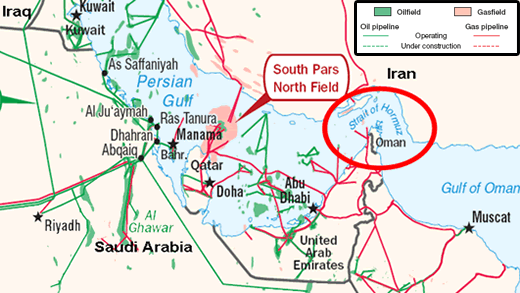
What we seem to know is that the four vessels were somehow disabled off the UAE port of Fujairah early on Sunday. The location at sea is in the Gulf of Oman, which lies outside the Persian Gulf, about 140 kilometers south from the Strait of Hormuz. The latter is the narrow passage from the Gulf of Oman into the Persian Gulf, through which up to 30 per cent of all globally shipped crude oil passes each day.

Last week, Iran once again threatened it would blockade its territorial waters in the Strait of Hormuz “if” the US carried out a military attack on it. Such a move by Iran would throw the global economy into chaos from the anticipated crisis in oil markets. It would also doubtless trigger an all-out war between the US and Iran, with American regional client regimes like Saudi Arabia and Israel piling in to facilitate attacks against Tehran.

So far, there have been no official accusations explicitly made against Iran over the latest shipping incident. But the implications are pointedly skewed to frame-up the Islamic Republic.

Saudi energy minister Khalid al Falih, whom Western media have quoted uncritically, claimed that one of the vessels allegedly attacked was on its way to load up on crude oil from the Saudi port of Ras Tanura, destined for the US market. The Saudi official did not give any substantiating details on the alleged sabotage, but emphasized that it was aimed “to undermine the freedom of navigation”. He called on international action to “protect security of oil tankers”. Wording that the American self-appointed global “policeman” (more accurately, “thug”) invokes all the time to cover for its imperialist missions anywhere on the planet.

When the US warned last week that it was sending a naval carrier strike armada to the Persian Gulf along with nuclear-capable B-52 bombers, it assumed the right to hit “Iran or its proxies” for any alleged attack on “American interests”. The wording out of Washington is so vague and subjective that it lends itself to any kind of perceived provocation.

An oil tanker on its way to collect crude from Saudi Arabia for the US market? That certainly could qualify as perceived Iranian aggression against American vital interests.

Last week, Washington issued hammed-up warnings that “Iran or its proxies” was set to “target commercial sea traffic”. Days later, as if on cue, the alleged sabotage of four ships appears to fit the theatrical bill.

Iran, for its part, has said it would not start a war with the US; that it will only act to defend itself from any American offensive. The foreign ministry in Tehran called the latest sabotage claims “highly alarming” and demanded more clarity from the Saudi and Emirati authorities as to what happened exactly. We can be sure that neither will come clean on that score, given their past record of calumny.

The clarifying question is, of course, who gains from the latest twist in tensions? Certainly, it fulfills American, Saudi and Israeli desires to intensify aggression towards Iran.

Another important question is the location of the alleged sabotage. If Iran wanted to carry out such an operation, it would be much more feasible to do it near the Iranian territorial waters in the Strait of Hormuz. Seriously: how feasible is it for several Iranian commando teams to strike four oil tankers in waters some 140 kms away? Waters that are forensically surveilled by the US Fifth Fleet based in the Persian Gulf.

Suspiciously, as already noted, there is no verifiable information about the alleged sabotage. All we’ve got are claims from Saudi and Emirati officials, the same kind of people who claim journalists disappear into thin air while in consular buildings, or that children in Yemen are slaughtered in air strikes by “mistake”, or that peaceful women protesters from Saudi’s oppressed Shia minority are “terrorists” to be executed by beheading with a sword.

And, shamefully, the Western media tamely go along doe-eyed and gullibly with this risible charade.

Sequencing, timing, sources, agenda and motives plus the dutiful Western media servility. The bets are this is a false-flag operation to incriminate Iran.

If it doesn’t result in a pretext for American military attack, at the very least Washington and its Saudi and Israeli clients are trying to make sure the European lackeys are bounced into toeing the line for increasing economic warfare on Iran over the floundering nuclear accord. An international treaty, by the way, which has been torpedoed – verifiably – by American political sabotage.

What’s really going on here is another brazen case of reality-inversion. Compare with contemporaneous US mendacity towards Venezuela, Syria, Cuba, Russia, China, North Korea, and so on. American criminal aggression is, incredibly, again being laundered with a moral license by lying corporate mass media which have the gall to call their blatant war propaganda a “news service”.

Indeed, the world is being lied into a potentially catastrophic war by a congenitally criminal US regime.

May 15, 2019 Posted by | Deception, False Flag Terrorism, Mainstream Media, Warmongering | , , | Leave a comment

Leaked Report: Douma “Chemical Attack” Likely Staged

By Kit Knightly | OffGuardian | May 14, 2019

An apparent classified internal report from OPCW suggests that the Douma chemical attack – which allegedly took place in April 2018 – was in fact staged.

The report, signed by Ian Henderson (an investigative team leader for the OPCW), is an analysis of the two key locations which were used as evidence of the Syrian government launching a chemical attack using chlorine gas in Douma, last year.

These locations, referred to as Location 2 and Location 4 respectively, were made famous by these photographs:

Location 2: “The Patio”

Location 4: “The Bed”

The photographs, “analysed” in depth by Bellingcat and other establishment mouthpieces, were claimed as the “smoking gun”, proof of Assad’s guilt. However, the OPCW fact-finding mission appears to see things rather differently.

The report is fifteen pages long, detailed and thorough, but the most important paragraph is saved for the end (emphasis ours):

In summary, observations at the scene of the two locations, together with subsequent analysis, suggest that there is a higher probability that both cylinders were manually placed at those two locations rather than being dropped.”

So there you have it, an apparently genuine OPCW report (kept from the public for as yet unclear reasons), which appears to support the prevailing view of the alt-news community: Douma was staged.

People like Vanessa Beeley and Piers Robinson et al, who have been relentlessly smeared in the mainstream media, have been shown to be right. Again.

This is not the first hole that has been blown in the Douma chemical bomb story (pun very much intended).

Firstly, initial reports from US-backed NGOs were that sarin had been used, not chlorine. This was dropped from the narrative after a preliminary OPCW report found “no evidence” of sarin being deployed.

Also, within days of the alleged attack, noted war reporter Robert Fisk was on the ground in Douma, talking to doctors who claimed no chemical attack had taken place at all.

Later, other witnesses came forward – including a young boy prominently featured in the “shocking footage”. They testified, at the OPCW meeting in The Hague, that no such attack had ever happened.

So, this report is but the latest piece of evidence which seriously undermines the establishment narrative of the so-called, “Douma chemical attack”.

You can read the full report here, or see the embedded version. We suggest you download it and share it widely. This is exactly the kind of document that could get memory-holed.

The Working Group on Syria, Propaganda and Media (WGSPM) have released their detailed analysis of the report, we suggest you all read it here. They are an excellent group, and have done sterling work on this topic.

Kit Knightly is co-editor of OffGuardian. The Guardian banned him from commenting. Twice. He used to write for fun, but now he’s forced to out of a near-permanent sense of outrage.

May 14, 2019 Posted by | Deception, False Flag Terrorism | | Leave a comment

History’s Dire Warning: Beware False-Flag Trigger for Long-Sought War with Iran

By Whitney Webb | MintPress News | May 14, 2019

With the beat of Washington’s war drums continuing to grow, particularly following the Monday revelation of a government plan to send as many as 120,000 troops to counter Iran, the threat of an “accidental” provocation or a “false flag” is also becoming increasingly likely. As MintPress recently reported, the possibility of an “accident” leading to open conflict between the U.S. and Iran is now being openly stated by top European officials — such as U.K. Foreign Minister Jeremy Hunt — following meetings with noted Iran hawk and current Secretary of State Mike Pompeo.

In Part I of this series, MintPress explored how current events — including seemingly unrelated regional events, such as the Israeli government’s bid to occupy the West Bank and the Syrian offensive against Al Qaeda-held Idlib — were converging to create a “now or never” scenario for those most eager for regime change in Iran and a U.S.-Iran military confrontation, particularly Israeli Prime Minister Benjamin Netanyahu and U.S. National Security Advisor John Bolton.

This installment will also reveal how Trump’s top political patron Sheldon Adelson — who is also the top donor to Netanyahu and a long-time confidant of Bolton, whom he helped install in his powerful post in the Trump administration — may be the deciding factor whether Trump authorizes the use of military force against Iran.

Yet, while the endgame for Bolton, Adelson and Netanyahu, as well as Pompeo, has long been a U.S.-led war with Iran, public justification for such hostilities must be given in order to manufacture American consent for a war against a country significantly larger than Iraq, complete with a more powerful army. Historically, the U.S. government has frequently planned and used false flags in order to justify the initiation or expansion of hostilities, with the best-known examples being Operation Northwoods and the Gulf of Tonkin incident.

However, given the current situation, it is essential to revisit two other incidents that reveal that the key players pushing for war in Iran — Israel’s government and neoconservatives of the Bush era (Bolton chief among them) — have planned and attempted to execute false flag attacks to push the U.S. into a major war that the American public would not normally support.

Remembering the U.S.S. Liberty

On June 8, 1967, one of the worst attacks on a U.S. naval vessel during peacetime took place, an attack that the U.S. government has kept shrouded in secrecy over 50 years later in what many have called a cover-up.

Around two in the afternoon on a cloudless, sunny day, unmarked aircraft and torpedo boats attacked the U.S.S. Liberty — a largely defenseless naval intelligence vessel flying visible American flags — without provocation. The attack saw the aggressors commit several war crimes, including attacking with unmarked aircraft and vessels; shooting survivor-bearing lifeboats out of the water with machine-gun fire; and the jamming of the Liberty’s ability to use international distress frequencies.

Thirty-four American sailors lost their lives and 173 were wounded, and the Liberty — which cost U.S. taxpayers $40 million to build — was so badly damaged it was subsequently sold for scrap metal for pennies on the dollar.

During the attack and in its immediate aftermath, Liberty survivors were puzzled as to why the U.S. Department of Defense ordered the recall of U.S. ships that were on route to aid the Liberty from the hostile attack, which many sailors had assumed at the time was being conducted by Egyptian or Arab forces in light of the ship’s proximity to the Sinai Peninsula.

Indeed, the attack on the Liberty took place during the Israeli-Arab Six Day War, a war that Israel claimed to have started as a preemptive means of self-defense but that was later revealed to have been the culmination of years of planning for a war of aggression. This fact was openly admitted by former Israeli Prime Minister Menachem Begin in the early 1980s. Israel, an American ally, was not suspected by Liberty crewmen at the time of the attack as being their potential assailants.

However, no Arab nation had attacked the Liberty that day, though that assumption by Liberty sailors was what their true assailants had hoped they and the American public would believe. Instead, it had been Israeli aircraft and torpedo boats that had fired on the clearly-marked American vessel with torpedoes, machine gun fire and even napalm. The Israelis “officially” maintain to this day, with little challenge from the U.S. government, that the attack was an accident, a fact that has been and continues to be heavily contested by the attack’s survivors.

Yet, beyond the testimony of survivors, the most compelling evidence that the attack on the Liberty was no accident comes from the Israelis themselves. Intercepted Israeli communications from the time of attack, made public only in recent years, reveal that the ship had been identified as American prior to the attack and, despite that, the plan was to sink the U.S.S. Liberty and ensure that there were no survivors. The goal of the attack was to place the blame on Egyptian forces, which necessitated there being no American survivors who could dispute the claim. If the Liberty had been sunk, it would have provided the United States legal cover and popular support for a more central role in the conflict and its crucial diplomatic aftermath. Indeed, the Israeli attack on the U.S.S. Liberty was a false flag, one that failed to achieve its intended goal of goading the U.S. into a major war.

Instead of responding with indignation, then-President Lyndon Johnson — whether it occurred before or during the attack is disputed — ordered that the Liberty not be rescued during the course of the attack, allegedly not wanting to harm relations with or “embarrass” an ally even if it meant consigning the 294-person crew of the Liberty to death.

Damage to the starboard side of the USS Liberty following Israeli attacks, June, 1967. Photo | NSA Archive

Those who survived the assault of the Liberty owe their lives to the then-23-year-old Terry Halbardier, who valiantly navigated the Liberty’s napalm-glazed deck and managed to rig an antenna and send out an SOS signal to the Navy’s Sixth Fleet. Upon intercepting that distress signal, the Israelis immediately broke off the attack. Halbardier’s heroism prevented the massacre of all 294 crewmen and allowed them to live to tell their stories, despite Johnson’s having left them for dead.

Yet many Liberty survivors were unable to tell their stories for decades, as the U.S. government issued gag orders and threatened them with being court-martialed for speaking to anyone, even their spouses, about the incident. The Navy’s Board of Inquiry, which abetted the cover-up, was headed by Admiral John S. McCain Jr., the father of the late Senator John McCain of Arizona.

To this day, the U.S. government has failed to conduct a full, public inquiry into the attack. Liberty survivors who have since spoken out have been accused of “anti-Semitism” and of slandering Israel for discussing their personal and traumatic experiences of the attack, significantly compounding their suffering and post-traumatic stress.

While the survivors of Israel’s assault on the Liberty have been denied closure, the U.S. government’s response has endangered the lives of American personnel by clearly signaling to Israel that they will suffer no consequences for such “false flag” attacks, regardless of whether American servicemen are wounded or killed. As former CIA intelligence analyst Ray McGovern has previously noted for Consortium News, “the U.S. cover-up [of the attack on the U.S.S. Liberty ] taught the Israelis that they could literally get away with murder.”

In a 2015 interview on the Real News Network, McGovern warned that the attack on the Liberty still holds “current relevance” and that he felt that “the Israelis are capable of doing this kind of thing when they see their supreme national interests at stake.” McGovern further stated that Israeli officials may well have considered a provocation, such as false flag, to throw a wrench in the Iran nuclear deal, which was being negotiated at the time.

McGovern — in an open letter to President Barack Obama, co-authored with former Deputy National Intelligence Officer for the Near East in the National Intelligence Council Elizabeth Murray — noted that Admiral Mike Mullen, former member of the Joint Chiefs of Staff in the Bush administration, had flown to Israel in 2003 and told the Israeli government emphatically “to disabuse themselves of the notion that U.S. military support would be knee-jerk automatic if they somehow provoked open hostilities with Iran. According to the Israeli press, Mullen went so far as to warn the Israelis not to even think about another incident at sea like the deliberate Israeli attack on the U.S.S. Liberty.”

McGovern and Murray cited Mullen’s statements to Israeli officials as the first time that “a senior U.S. official braced Israel so blatantly about the Liberty incident.” In an email to MintPress, McGovern stated that he was unsure whether current Chairman of the Joint Chiefs of Staff Gen. Joseph Dunford “can be counted upon to play a similar restraining role” in preventing hostilities with Iran. Notably, Dunford was in attendance along with Bolton at the recent CIA meeting to discuss “highly sensitive covert actions” in relation to Iran.

An “accident” waiting to happen

Since Bolton announced the movement of the Lincoln carrier strike group towards the Persian Gulf, some have pointed out that the vessels could well be destined for use in a “false flag” provocation, such as one planned by former Vice President Dick Cheney in 2008 (to be discussed shortly) and another conducted by Israel in 1967. Indeed, as MintPress noted the day after Bolton’s announcement, the carrier strike group’s deployment was actually announced a month prior and was a routine deployment.

The political analysis blog Moon of Alabama also noticed that Bolton had framed this routine deployment as something more dire for his own purposes, writing:

The carrier deployment to the Gulf is routine. It had been announced on April 8. The U.S. has bombers on rotation in the Middle East since 2001. Moreover – a carrier in the Persian Gulf is a sure sign that the U.S. will not attack Iran. Within the restricted waters of the Persian Gulf a carrier is a too easy target. The idea though may be to provide for an ‘accident’’ as Iran’s Foreign Minister [Javad Zarif] described it in a recent CBS interview.”

In an interview late last month with CBS’ Face the Nation, Zarif explicitly told journalist Margaret Brennan his concern about an imminent “false flag” to trigger war with Iran by John Bolton in collaboration with Israeli, Saudi and Emirati leadership:

Foreign Minister Zarif | I don’t think military confrontation will happen. I think people have more prudence than allowing a military confrontation to happen. But, I think the U.S. administration is putting things in place for accidents to happen. And there has to be extreme vigilance, so that people who are planning this type of accident would not have their way.

Margaret Brennan | What do you mean? What kind of accident are you talking about?

Zarif | I’m talking about people who have — who are designing confrontation, whose interest —

Brennan | Who’s doing that?

Zarif | My ‘B’ team. I call —

Brennan | What do you mean ‘B’ team?

Zarif | I call the group ‘B’ team who have always tried to create tension, whose continued existence depends on tension. Ambassador Bolton, one ‘B,’ Bibi Netanyahu, second ‘B,’ Bin Zayed, third ‘B,’ Bin Salman, fourth ‘B.’ And I’m not just making accusations.

With an aircraft carrier little more than a sitting duck in the area amid rising tensions between the U.S. and Iran, an “accident” may well occur. As was noted in Part I of this mini-series, such a possibility was directly stated by British Foreign Minister Jeremy Hunt on Monday.

Hunt told reporters “We are very worried about the risk of a [U.S.-Iran] conflict happening by accident, with an escalation that is unintended really on either side but ends with some kind of conflict.” Hunt notably made the statement after meeting with Pompeo, who is currently in Europe meeting with European heads of state to discuss Iran. The Associated Press noted that the Trump administration had warned European officials, Hunt included, that “Iran or its proxies could be targeting maritime traffic in the Persian Gulf region.”

The possibility of such an “accident” is further compounded by Bolton’s aforementioned and “highly unusual” meeting about Iran and “highly sensitive covert actions” at CIA headquarters last week. Declassified CIA documents show that the agency had previously planned to stage terror attacks on U.S. soil and murder Americans to blame on Cuba in order to justify invading the Caribbean nation in the 1960s. That plan, known as Operation Northwoods, further called for the destruction of U.S. military vessels to be blamed on Cuba and also the staging of fires and mortar attacks on U.S. military installations in Cuba (i.e., Guantanamo Bay) or nearby (i.e., in Florida). Though Operation Northwoods was never enacted, the agency has been accused of orchestrating numerous “false flags” in the decades since.

As was recently seen with the alleged “sabotage” of Saudi oil tankers near Iran, there are many potential targets for provocation. However, the incident that would most assuredly force U.S. involvement in a military conflict would be an attack on an American military target. While some have dismissed Bolton’s announcement of the carrier’s movements as a self-serving manipulation of the facts, it may have had the added purpose of framing the lead-up to an unfortunate “accident” targeting American vessels in the area, particularly the Lincoln carrier strike group or one of the other subsequent U.S. naval deployments to the Middle East.

The neocon plan for a Liberty-like attack

If any sort of provocation blamed on Iran should occur, it is important to consider that a powerful group of U.S. politicians — the neo-conservatives — have long sought to plan provocations that would drag the U.S. into war with Iran. One of the most recent examples took place during the George W. Bush administration when then-Vice President Dick Cheney held a meeting with other administration officials in 2008 aimed at provoking war with Iran.

The details of that meeting were revealed by Pulitzer Prize-winning journalist Seymour Hersh, who described some of the ideas considered in that Cheney-led meeting as follows:

There were a dozen ideas proffered about how to trigger a war. The one that interested me the most was why don’t we build in our shipyard four or five boats that look like Iranian PT boats. Put Navy seals on them with a lot of arms. And next time one of our boats goes to the Straits of Hormuz, start a shoot-up. Might cost some lives.

And it was rejected because you can’t have Americans killing Americans. That’s the kind of, that’s the level of stuff we’re talking about. Provocation.

Silly? Maybe. But potentially very lethal. Because … if you get the right incident, the American public will support bang-bang-kiss-kiss. You know, we’re into it.”

It is unknown if any Bush officials now in the Trump administration were present at that meeting where the use of a “false flag” pitting Americans against Americans disguised as Iranian was discussed. However, what is known is that John Bolton — who was a member of the neo-conservative Project for a New American Century, along with Cheney, and who also served in the Bush administration — has zealously sought war with Iran for nearly two decades. Indeed, the New York Times recently described Bolton as “one of the administration’s most virulent Iran hawks, whose push for confrontation with Tehran was ignored more than a decade ago by President George W. Bush.” It is also known that Bolton has a history of playing fast and loose with unconfirmed intelligence and also distorting intelligence to fit his pre-determined narrative.

As MintPress reported last year, former Israeli Ambassador to the UN Danny Gillerman has stated that Bolton, when serving in the Bush administration, was prone to “direct fire on his own forces,” — i.e., the U.S. government — in order to advance the goals of the Israeli government, especially with respect to Iran. For instance, in more than one instance while in the Bush administration, Bolton traveled to Israel in violation of State Department rules and negotiated privately with Israeli officials, including the then-head of the Mossad, Meir Dagan, to lay the groundwork for a war with Iran. As journalist Gareth Porter has noted, Bolton did this in an effort to directly undermine Colin Powell, Bolton’s superior, just as Powell “was saying administration policy was not to attack Iran.”

Worse still, Bolton has pressured Israeli officials to initiate a war with Iran, even when they didn’t support such a move. One such case was Shaul Mofaz, former Israeli defense minister, who told Israeli media last March that Bolton “tried to convince me that Israel needs to attack Iran,” even though Mofaz did not see such a war as “a smart move — not on the part of the Americans today or anyone else until the threat is real.”

Pompeo’s Holy war and rapture

Furthermore, Bolton is not the only top Trump administration official who has long promoted a war with Iran, as current Secretary of State Mike Pompeo had also called for the preemptive bombing of Iran long before he joined the Trump administration. Pompeo’s desire to push the U.S. towards war with Iran is based on his fervent adherence to Christian Zionism. As a result of the admitted influence his beliefs hold over his foreign policy, Pompeo sees an “apocalyptic” war between Israel and Iran as a necessary precursor to the Second Coming of Christ and the “rapture.”

Pompeo is on record speaking about the rapture on several occasions, particularly as CIA director when he spoke about the event — which holds that “true believers” will ascend to Heaven prior to the tribulations and trials of the “end times” — so often that he made veteran intelligence officers uncomfortable. As a result, some have asserted that Pompeo is “a man who appears to view American foreign policy as a vehicle for holy war.”

The fact that the actions of the current Secretary of State are influenced by his Christian Zionist faith was on display last month, when American Christian journalist Chris Mitchell of the Christian Broadcasting Network asked Pompeo: “Could it be that President Trump right now has been sort of raised for such a time as this … to help save the Jewish people from the Iranian menace?” Pompeo responded that this was definitely “possible.”

If Adelson has his way . . .

Yet, perhaps the most dangerous force driving the U.S. towards a war with Israel is not the public face of the Trump administration’s foreign policy but its private face. Sheldon Adelson — the top donor to Trump, the entire Republican Party, and also the top political donor to Israeli Prime Minister Netanyahu — has long sought war with Iran, and several of Adelson’s desired policies have already been enacted by Trump. These include recognizing Jerusalem as Israel’s capital, replacing H.R. McMaster with Bolton as National Security Advisor, and withdrawing from the Iran nuclear deal. Several reports have asserted that pressure from Adelson was a deciding factor in Trump’s fulfillment of these policies.

Adelson’s influence over Trump again takes on great significance, given recent events with respect to Iran, as Adelson has previously advocated for a U.S. nuclear attack on Iran without provocation, just so the U.S. could “impose its demands [on Iran] from a position of strength.”

Per Adelson’s plan, the U.S. would drop a nuclear bomb in the middle of the Iranian desert and then threaten that “the next one is in the middle of Tehran” to show that “we mean business.” Tehran, Iran’s capital, is home to nearly 9 million people with 15 million more in its suburbs. Were Tehran to be attacked with nuclear weapons, an estimated 7 million would die within moments, according to a 2013 study jointly conducted by researchers at the University of Georgia and Harvard.

Yet, any sort of diplomatic engagement with Iran, according to Adelson, is “the worst negotiating tactic I could ever imagine.”

In other words, Adelson has called for dropping nuclear weapons on a country, including its heavily populated capital city, for no reason other than to show that the U.S. “means business” and considers nuclear war a negotiating tactic.

While some media reports have suggested that Trump is unwilling to go to war with Iran and is uneasy with the hawkish policies of Bolton and Pompeo, he will have a hard time ignoring Adelson. Adelson, who poured $35 million into Trump’s 2016 campaign and spent $55 million on Republican primary campaigns last year, is the party’s most influential donor and angering him could well mean the end of Trump’s political career.

Would Trump resist a push for war from not just Netanyhu, Bolton and Pompeo but Adelson as well? It seems unlikely. Craig Holman of the watchdog group Public Citizen told ProPublica in 2018 that he “would put Adelson at the very top of the list of both access and influence in the Trump administration,” a sentiment that was also echoed by Alan Dershowitz, who has done legal work for Adelson and advised Trump. Dershowitz told ProPublica that Adelson “just calls the president all the time. Donald Trump takes Sheldon Adelson’s calls.” As MintPress has noted on several occasions, those calls often translate into policy decisions.

Unfortunately, Trump — even when he tries to follow a different path, as he attempted to do in Syria — often ends up conceding to the neo-conservatives and Zionist extremists who surround (and fund) him.

History issues a warning

The combination of current tensions and the documented history of both Israel and Bush-era neo-conservatives planning and even executing false flag attacks in order to justify U.S. military action against a desired target — should set off alarm bells. Instead, most corporate media outlets are playing up unfounded or baseless claims of the “Iranian threat” and Iran’s unproven role in recent acts of “sabotage” in Saudi Arabia and in the UAE in ways that are strikingly similar to the lead-up to the 2003 invasion of Iraq.

Furthermore, the history and mindset of both Bolton and Pompeo, in addition to the unprecedented influence of Sheldon Adelson in the Trump administration, add yet another layer to this increasingly complex yet undeniably troubling situation.

As a consequence, it is imperative for people around the world, particularly in the United States, to be skeptical of any act of violence blamed on Iran before a full investigation is completed, and to resist a rapid push to begin a conflict with Iran that could well follow such an act.

The time for resistance, ideally, would be before such an attack occurs, making critical the widespread dissemination of relevant information left unmentioned by the corporate media, such as that contained in Parts I and II of this series. The crucial context here is the well-documented willingness of both the Israeli and U.S. governments to sacrifice (i.e., kill) Americans in order to plunder the natural resources of “unfriendly” nations and pursue the objectives of the political and economic elite of both countries.

Whitney Webb is a MintPress News journalist based in Chile. She has contributed to several independent media outlets including Global Research, EcoWatch, the Ron Paul Institute and 21st Century Wire, among others. She has made several radio and television appearances and is the 2019 winner of the Serena Shim Award for Uncompromised Integrity in Journalism.

May 14, 2019 Posted by | Deception, Ethnic Cleansing, Racism, Zionism, False Flag Terrorism, Wars for Israel | , , , | Leave a comment

Forensic Experts: No Evidence Couple Shot at Police in Houston Botched Drug Raid

By Carlos Miller | Photography is Not a Crime | May 13, 2019

Despite claims by Houston police that they engaged in a fierce gunfight with a couple they raided in January, a team of forensic investigators who spent four days in the house say there is no evidence the couple ever shot at police.

That contradicts the claim by Houston police that four cops were shot as they entered the home in what turned out to be a botched raid based on fabricated information.

The couple were killed and the cops were not wearing body cameras, so police probably did not expect evidence to surface that would contradict their claims.

According to the Houston Chronicle :

A four-day independent forensics review at 7815 Harding Street found a cache of evidence left behind by the city’s crime scene teams after a botched drug raid at the home left dead a couple suspected of selling drugs

Hired by the relatives of Rhogena Nicholas and Dennis Tuttle, the new forensics team found no signs the pair fired shots at police — and plenty of signs that previous investigators overlooked dozens of pieces of potential evidence in what one expert called a “sloppy” investigation.

“It doesn’t appear that they took the basic steps to confirm and collect the physical evidence to know whether police were telling the truth,” said attorney Mike Doyle, who is representing the Nicholas family. “That’s the whole point of forensic scene documentation. That’s the basic check on people just making stuff up.”

And it does not appear as if Houston police are conducting any type of “robust investigation” as Houston Police Chief Art Acevedo promised back in February after previous attempts of spin and deception failed.

It appears that they are doing just what we expected them to do, which is to let this drag out in the hopes people will forget about it.

Already the cop who lied on the search warrant and has a history of lying on search warrants has retired, so he’ll be collecting a pension when he probably should be sitting in prison.

The forensic experts found more inconsistencies:

Though police said they started shooting when the dog lunged as they came through the door, Maloney’s forensics team found that the dog was shot and killed at the edge of the dining room, 15 feet from the front door. Authorities never picked up the shotgun shell when they collected evidence.

And police said that Tuttle started firing at them, but Maloney’s team did not find clear evidence of that.

“The initial bullet trajectories appear to be somewhat contradictory,” said Louisiana-based attorney Chuck Bourque, who is also representing the Nicholas family. “We see no evidence that anybody inside the house was firing toward the door.”

Some of the bullet holes outside the house appeared at least a foot from the door, a fact that Doyle flagged as troubling.

“You can’t see into the house from there,” he said, “you’re firing into the house through a wall.”

The four-day investigation was led by independent forensic expert Mike Maloney, a retired supervisory special agent with the Naval Criminal Investigative Service.

May 14, 2019 Posted by | Civil Liberties, Deception | , | Leave a comment

“Saving Syria’s Children”: Response to the HuffPo

Corrections and clarifications to “Keith Allen Thinks The BBC May Have Faked ‘Apocalyptic’ Attack In Syria”

Saving Syria’s Children: Did The BBC Lie? from Robert Stuart on Vimeo.

By Robert Stuart | OffGuardian | May 13, 2019

News and opinion website The Huffington Post has written about my campaign to crowdfund a documentary about the 2013 BBC Panorama programme Saving Syria’s Children.

Keith Allen Thinks The BBC May Have Faked ‘Apocalyptic’ Attack In Syria was published on May 4th 2019. Some notes in response follow.

Stuart says he has spent nearly six years compiling “a mountain of evidence” that shows the BBC’s footage was “faked”. He claims the national broadcaster worked “cheek by jowl with Isis” to produce the Panorama documentary, which was broadcast in September 2013.

Evidence that sequences in Saving Syria’s Children were fabricated is set out on my blog. Readers are free to make their own topographical analogies.

During the programme’s making BBC Panorama reporter Ian Pannell and cameraman Darren Conway were embedded with then ISIS partner group Ahrar al-Sham – a group described elsewhere by the BBC as “hard-line Islamist”. Less than three weeks earlier Ahrar al-Sham, ISIS and other groups together killed over 190 civilians, including women, children and elderly men, and kidnapped over 200 mostly women and children.

In the programme’s climactic scenes of the aftermath of an alleged incendiary attack the BBC crew filmed at close quarters an ambulance prominently bearing the ISIS emblem and its militarily attired occupants, at least one of whom was armed.

In an interview with TalkRadio on Friday, Stuart claimed “the only source of [this attack] is the BBC”. However, the strike was also reported by NBC News who interviewed doctors who described the “apocalyptic” attack in detail, documented in painstaking detail by the Violations Documentation Centre in Syria (VDCS), and confirmed by Human Rights Watch.

The NBC News article cited features an interview with a single volunteer doctor named “Roula”. This is clearly Dr Rola Hallam. Dr Hallam and Dr Saleyha Ahsan were being followed by the BBC Panorama team of reporter Ian Pannell and cameraman Darren Conway as they visited hospitals run by the UK charity Hand in Hand for Syria. As such Hallam was central to the BBC reports in question and cannot be considered an independent commentator. [1] [2] [3] [4]

The Violations Documentation Centre in Syria report cited gives the time of the alleged attack as follows:

On 26 Aug 2013, at 02:00 pm, the Syrian air forces shelled ‘Iqraa’ Institution in Orm Al Kubra in Aleppo, which had been under the Free Army’s control for several months then.

The VDCS report also quotes Mustapha Haid, “Head of ‘Doulati Organization/My State Organization’”:

At 3 in the afternoon, On 26 Aug 2013, I was in Al Atareb City and I heard rumours about a ‘chemical attack’ on Orm Al Kubra and that tens of casualties were brought to Al Atareb Hospital.

However the BBC has categorically stated in complaints correspondence that:

The attack happened on the 26th of August at around 5.30pm at the end of the school day.[5]

The VDCS report quotes a second witness, Issa Obeid, “Head of Nursing Department in Al Atareb Hospital”, who provides a first-hand account of his actions at Atareb Hospital:

We washed the casualties with water and serums after taking off their clothes. We used ‘Florasline’ liniment on the burnt areas and provided the casualties with fluids and some of them were given tranquilizers like Morphine.

However on 26 August 2013 Issa (or Iessa) Obied would appear not to have been present at Atareb but to have been attending a battle first aid training course in Antakia, Turkey. [6]

Iessa Obied has been photographed posing with an arsenal of weaponry including assault rifles, an anti-aircraft gun and a shoulder-launched surface-to-air missile. [7] [8]

The Huffington Post reports that the strike was “confirmed by Human Rights Watch”. However Mary Wareham, Advocacy Director of HRW’s Arms Division, stated in a contemporary (August 2013) article that Human Rights Watch has “not investigated this incident“. [9]

HuffPost UK asked a team of ex-military and medical professionals who teach hostile environment training to view the full Panorama footage to comment on its authenticity.

Questions about Hostile Environment Awareness Training, the company cited by the Huffington Post, are raised by journalist Kit Klarenberg. “With the predictability of Chinese water torture, York’s once again written a propagandistic ad hominem hatchet job on an independent researcher, in this case @cerumol. Leaving aside his puerile insults, the ‘experts’ he apparently consulted are worthy of close investigation…”

They described it as “legitimate” and “consistent with chemical exposure”, adding the select footage in Stuart and Allen’s promotional video had been “cleverly” edited in a way to manipulate the viewer.

The BBC has been at pains to assert “that this was an attack using an incendiary device, rather than a chemical weapon.”

As noted on my blog a GMC registered doctor with burns experience has concluded that the scenes of alleged incendiary bomb victims arriving at Atareb Hospital in Saving Syria’s Children were “an act”. Further sceptical comment by medical professionals, including former UK and US military personnel, plus observations by lay people with experience of burns victims, is collated here. [10]

None of the BBC footage used in the crowdfunding video has been altered in any way, save for basic editing techniques such as freeze frame and fade.

Stuart also takes issue with the fact the documentary makers – reporter Ian Pannell and cameraman Darren Conway – worked alongside the armed Islamist groups that controlled the Aleppo region where Atarib is situated.

When required, all major media organisations negotiate access with whoever controls the area in question. Numerous journalists have risked their lives to report on what is happening inside Taliban-controlled Afghanistan, Hamas-controlled Gaza or Boko Haram-controlled Nigeria, for example.

It is clearly in the public interest for BBC audiences to be made aware that a portion of their license fee revenue has apparently been paid to a jihadist group co-founded by “one of Osama bin Laden’s most trusted couriers”.

The BBC rebutted the claims made by Stuart and Allen in a statement to HuffPost UK, saying there is “absolutely no evidence that any part of the programme was fabricated”.

It added: “Any such suggestion is offensive to the victims, medics and reporters.”

This statement was published on Facebook by BBC Panorama editor Rachel Jupp over two years ago in response to challenges made by film, television and radio producer Victor Lewis-Smith.

An RT report based on Stuart’s work was found to be in breach of Ofcom broadcasting rules and described as “materially misleading”.

Some important caveats in Ofcom’s finding against the RT programme in question have been noted by OffGuardian :

To be clear, according to OfCom’s own description of its remit, in the dispute between RT and the BBC, OfCom did not look into the BBC’s accuracy or credibility. Nor did OfCom investigate whether RT’s allegations of fakery were true or false. In fact the Broadcast Bulletin makes it clear OfCom ruled in favour of the BBC based solely on two things:

A) a finding that RT had broken “Rule 7 of the Code”, which requires a broadcaster to allow sufficient right of reply to anyone accused.

B) a finding that RT had infringed “Rule 2.2 of the Code” which requires a broadcaster not to present facts in a way likely to “mislead the viewer” – based on the fact RT had referred to Robert Stuart’s ongoing investigation into the BBC’s Panorama program as a “massive public investigation”, when OfCom thought the size of his investigation did not merit such an epithet.

Anyone can visit Robert Stuart’s website and decide for themselves if his investigation can fairly be described as “massive”, but the extent to which OfCom’s findings are themselves factual inaccuracies I’ll leave for others to explore. The most significant point here is that OfCom has specifically not cleared the BBC of suspicion of wrongdoing, and is not claiming to have done so.

May 14, 2019 Posted by | Deception, Fake News, Mainstream Media, Warmongering | , , | Leave a comment

With the US-Iran War Ball Now Rolling, Could an “Accident” or “False Flag” Serve as Pretext?

By Whitney Webb | MintPress News | May 13, 2019

As tensions between the U.S. and Iran threaten to boil over, the probability of a provocation or “accident” that would provoke hostilities between the two countries is higher than ever. U.K. Foreign Minister Jeremy Hunt, after meeting with U.S. Secretary of State Mike Pompeo, openly stated as much on Monday, telling reporters in Brussels that the U.K. was worried of a conflict breaking out between the U.S. and Iran by “accident with an escalation that is unintended really on either side but ends with some kind of conflict.”

Yet, current and past events make it clear that such an “accidental” provocation is unlikely to be purely accidental in nature, as forces in the U.S. and Israel have been actively pushing for a U.S.-led war with Iran for years and have a track record that demonstrates little inhibition about using an “accident” or “false flag” to drag the country into a war with the Islamic Republic.

Notably, the state of Israel — in an event long since buried by the government and corporate media — has previously staged such a “false flag” by targeting an American naval vessel, killing 34 Americans, in order to blame the attack on Egypt and drag the U.S. into a war with several Middle Eastern nations in 1967. However, Israel is not alone in this, as the CIA as well as neo-conservatives serving in the Bush administration, led by then-Vice President Dick Cheney, have planned “false flags” that involved the murder of American servicemen and civilians in order to justify miltiary action against U.S. adversaries. 

In this two-part series, MintPress explores the troubling evidence that preparations for another such “false flag” are well underway. In this first installment, current events in relation to U.S.-Iran relations and the role of Israel in the ratcheting up of tensions will be examined, while the second installment will focus on Israel’s past of conducting “false flags” to goad the U.S. into wars on Israel’s behalf as well as efforts by former Vice President Dick Cheney to conduct a “false flag” pitting American sailors against American sailors disguised as Iranian naval forces to justify a conflict with Iran.

Bolton, taking a page from Iraq 2003 playbook, sets ball rolling

Since National Security Advisor John Bolton sent out a dramatic press release announcing the deployment of a U.S. carrier strike group as a warning to Iran on May 5, tensions between the U.S. and Iran have risen dramatically, a development that Bolton — who has long advocated regime change and a pre-emptive war against Iran — likely welcomes. As MintPress recently reported, that press release was intentionally vague, allowing justification for a military response to any number of incidents, whether committed by Iran or alleged “proxies” of Iran, including groups over which Iran’s government has no control.

Furthermore, it has since been revealed that the “intelligence” Bolton used to frame the deployment and the rationale for future U.S. military action against Iran was from the Israeli government — which has long pushed the U.S. towards war with Iran. In addition, several unnamed U.S. officials stated soon after that Bolton and other Trump administration officials had greatly exaggerated the nature of this intelligence and overreacted. MintPress has noted on several occasions Bolton’s history of distorting intelligence to conform with a specific narrative or in order to promote specific policy actions and this tendency of Bolton’s was also recently noted in a New Yorker profile on the current National Security Advisor.

It was subsequently revealed that a few days prior to Bolton’s press release, Bolton had made a “highly unusual” visit to CIA headquarters to discuss Iran. NBC News reported that the “extremely rare” choice to hold this meeting at the CIA instead of the White House’s Situation Room likely meant that the purpose of the meeting was “to brief top officials on highly sensitive covert actions, either the results of existing operations or options for new ones,” based on statements from five former CIA operations officers and military officials.

That meeting, as noted by the political and financial news site ZeroHedge, “hearkens back to the Bush-Cheney White House’s direct intervention over Iraq intelligence in the lead-up to the 2003 invasion, which involved the VP and his staff making multiple personal visits to CIA headquarters and the Pentagon to pressure the intel analysts into conforming to a preferred ‘narrative.’” Yet, the emphasis on “covert actions” in relation to Iran suggests that something much more sinister may be afoot.

Indeed, in the weeks since that press release and the “highly unusual” CIA meeting, the U.S. has deployed more military assets towards the Persian Gulf and Secretary of State Pompeo has made several abrupt schedule changes in order to discuss Iran with various countries. Notably, the Trump administration has also announced the end of waivers that have allowed some foreign companies to continue buying Iranian oil without facing U.S. sanctions.

The situation has forced Iran to respond, with Iran announcing that it would begin withdrawing from the Iran nuclear deal — which the U.S. unilaterally withdrew from over a year ago — as the U.S.’ economic war against Iran shoots to another level.

Perhaps most telling of all is the fact that Western media, particularly U.S. media, have been heavily promoting the Iranian “threat” since soon after Bolton’s Mary 5 press release, in yet another striking parallel to the lead-up to the 2003 invasion of Iraq. Yet, particularly notable in this case is that much of the “intelligence” that has been used to justify these recent moves by the Trump administration has come from Israel’s government, led by the recently re-elected Israeli Prime Minister Benjamin Netanyahu, whose desire to goad the U.S. into a war with Iran is an open secret.

One potential pretext already in play in the Persian Gulf

On Sunday, reports surfaced that several oil tankers were the victims of “sabotage” while sailing towards the Persian Gulf near Fujairah, one of the seven emirates that comprise the United Arab Emirates (UAE), which is located just outside the Strait of Hormuz. Fujairah’s government initially denied that any “sabotage” took place and maintained that its port facilities were operating normally after media reports from Iranian outlet PressTV and Lebanese outlet Mayadeen reported on a series of “explosions” on unidentified ships in the area.

The UAE’s foreign ministry later confirmed an incident in the area but said no casualties or spills occurred and notably did not provide details as to the number or nationalities of the ships involved nor the groups responsible for the alleged attack.

However, Saudi Arabia subsequently claimed that its tankers had been affected by this act of “sabotage” and that the targeted tankers had been approaching the Strait of Hormuz on route to load oil destined for the United States. Saudi Arabia, like the UAE, did not blame any country for the attack. A Norwegian-registered oil tanker experienced hull damage after striking “an unknown object,” potentially suggesting the attack was caused by an explosion of a sea mine or the result of a torpedo or other projectile launched underwater. Notably, the U.S., U.K. and France held a “mine warfare drill” in the Persian Gulf just last month and past Western media reports have characterized sea mines as “Iran’s favorite military asset.”

Iran rejected any responsibility for the attack and Iran’s Foreign Ministry spokesman Abbas Mousavi warned against a “conspiracy orchestrated by ill-wishers” and “adventurism by foreigners.”

However, the timing of the sabotage came right on the heels of statements made by the U.S. and Israeli governments that have led some to blame Iran or suggest Iranian responsibility for the attacks — despite the lack of evidence made public and the decision by both the Saudis and Emiratis, long-time adversaries of Iran, from blaming any country for the incident or describing any specifics about the attack.

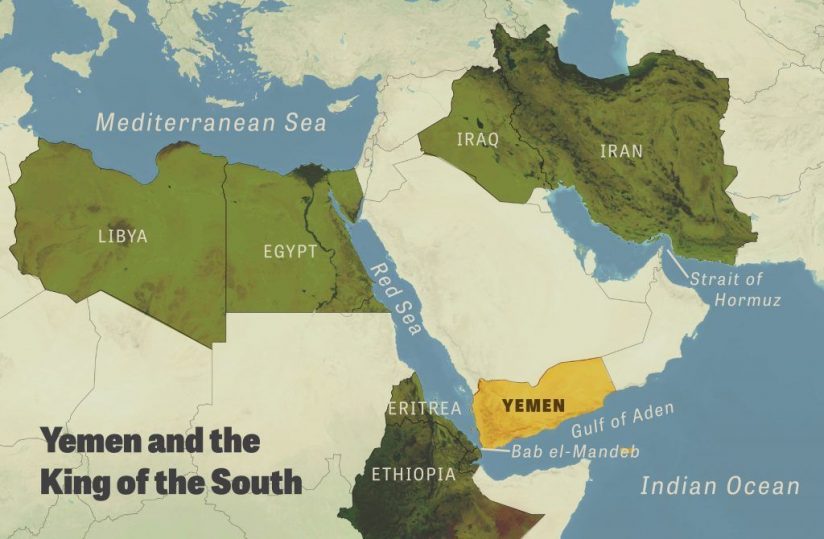
This past Thursday, the U.S. Maritime Administration — a division of the U.S. Department of Transportation — stated that “Iran or its proxies could respond by targeting commercial vessels, including oil tankers, or U.S. military vessels in the Red Sea, Bab-el-Mandeb Strait or the Persian Gulf.” The U.S. Department of Transportation is currently headed by Elaine Chao, who was paid $50,000 for a five-minute speech to the Iranian exile group, Mujahedeen-e-Khalq (MEK), known to actively seek regime change for Iran. Other top U.S. officials, such as Bolton, have also been paid hefty sums for appearances at MEK events, where they have openly advocated for the overthrow of the Iranian government.

In addition to warning from a U.S. department headed by an official with links to an Iranian opposition group actively seeking regime change, Israeli officials “leaked” information on Israel’s Channel 13 on Saturday that Iran was allegedly planning to target Saudi oil assets in the region. According to the unsourced report, as cited by the Times of Israel, the Iranians were “considering various aggressive acts” against American assets or those of its regional allies, such as Saudi Arabia and Israel. The report also claimed that Iran had considered targeting American bases in the Gulf, but rejected it as too drastic and instead had decided to target “Saudi oil production facilities.”

In light of recent events, as well as the corporate media’s willingness to suggest Iranian culpability despite little to no publicly available evidence, it appears that this recent attack — regardless of who was responsible — could be seized upon by officials in the U.S. or Israel eager to see tensions between the U.S. and Iran escalate.

Netanyahu: “America is easily moved”

It is an open secret that Israel’s government, particularly under Netanyahu, has been eager to see the U.S. engage in hostilities with Iran. The main driver for this is the fact that, while Israel has since forged alliances with several Arab-majority nations such as Saudi Arabia, Egypt and the United Arab Emirates, Iran and its regional allies — namely Lebanon’s Hezbollah and Syria — oppose Israeli objectives for the region and those of its allies. More crucially, Iran is arguably the country that is most supportive of Palestine and the major barrier to Netanyahu’s plans to annex Palestine’s occupied West Bank, a promise on which Netanyahu rode to reelection last month. Now more than ever, Netanyahu wants Iran’s government out of the way.

Netanyahu has openly stated that he views the U.S. government as a vehicle for fulfilling Israeli objectives and believes that Americans are easily manipulated, by Israel in particular. For instance, in a video recorded in the early 2000s — later broadcast on Israeli TV and subsequently reported on by Consortium News — Netanyahu “brags about how he deceived President Bill Clinton into believing he [Netanyahu] was helping implement the Oslo accords when he was actually destroying them. The tape displays a contemptuous attitude toward, and wonderment at, a malleable America so easily influenced by Israel.”

In the video, Netanyahu states:

America is something that can be easily moved. Moved in the right direction. They won’t get in our way; 80 percent of the Americans support us. It’s absurd.”

Israeli journalist Gideon Levy later asserted that the video reveals Netanyahu to be “a con artist who thinks that Washington is in his pocket and that he can pull the wool over its eyes” and that the current Israeli prime minister’s attitude is unlikely to “change over the years.”

Now, with the Trump administration having shown its willingness to favor Israeli interests in the Middle East, Netanyahu has apparently sensed that the hour has come to push the U.S. towards war with Iran. For instance, the Trump administration organized a summit aimed at securing “peace and security in the Middle East,” to which Iran was not invited. The New York Times described that summit as follows:

…Leaders of Israel and Arab states met publicly again, at an international conference in Warsaw staged by the Trump administration. But the goal of this meeting, drawing officials of some 60 nations, was not peacemaking. It was to rally support for economic and political war with Iran, for which the United States has found little enthusiasm among allies since withdrawing from the 2015 deal that restricts Iran’s nuclear program.”

Notably, during that meeting, Netanyahu wrote in a since deleted tweet that the summit was “an open meeting with representatives of leading Arab countries, that are sitting down together with Israel in order to advance the common interest of war with Iran.”

In the wake of the Warsaw summit, Netanyahu has since claimed that he was responsible for the Trump administration’s decision to label Iran’s Islamic Revolutionary Guard Corps (IRGC) a terror group, a move that dramatically increased the risk of a military confrontation between the U.S. and Iran, especially given that Iran subsequently responded by declaring the U.S. military’s Central Command a terrorist organization.

Now, with Netanyahu feeding Bolton “intelligence” that Bolton has greatly exaggerated in order to justify their common goal — a U.S. war with Iran — and also “predicting” dubious “sabotage” attacks near the Persian Gulf, Israel’s government has revealed itself to be a driving force behind the spiking tensions between the two countries.

Equally troubling is the fact that world leaders are now openly positing that an “accident” or “false flag” provocation will be used to provoke such hostilities.

For Netanyahu, it’s now or never for a U.S.-Iran war

With the Iran nuclear deal in tatters, one consequence of the Trump administration’s “maximum pressure” campaign against Iran has been to push Iran to renege on aspects of the deal, from which the U.S. has already long since withdrawn. The goal, by all appearances, is to use Iran’s plan to breach parts of the deal as justification for further aggressive actions against the country by claiming that such breaches, instead of a response to U.S.-led economic warfare, are a sign of an intention to develop nuclear weapons.

With waivers for the purchases of Iranian oil now ending and Iran’s president announcing that Iran will end compliance with some aspects of the deal if Europeans do not find a meaningful workaround for U.S. sanctions, the Trump administration — and the Iran hawks within — seem to have their ducks in a row.

While there has long been concern about a U.S.-Iran conflict, several situations have arisen that have made this push for a regime-change conflict with Iran of extreme importance to both U.S. and Israeli interests in the region.

For instance, Syria’s government is set to take the Idlib province, after which Syria will turn its attention towards the Israel-controlled Golan Heights and the U.S.-occupied area of northeastern Syria. Israel was revealed to be the “brains” behind the Syria conflict and has been actively preparing for hostilities with Syria and nearby Lebanon since last year, following the failure to overthrow Syria’s government. Syria holds a mutual defense pact with Iran, meaning that it will join a conflict with Iran if Iran is threatened, thus preventing Syria’s government from focusing its efforts on retaking areas occupied by the U.S. and Israel.

If the U.S. and Israel wait until Syria consolidates control over Idlib, they will be facing a much stronger adversary in Iran’s closest regional ally than one distracted by a pocket of Al Qaeda-dominated terrorist groups in its north.

Yet, the clearest indicator that the push for war is very much in earnest is the intention of Netanyahu to effectively destroy Palestine. Several analysts, including ex-CIA analyst Ray McGovern, have long maintained that Israel’s and Netanyahu’s main reason for wanting a war with Iran is to “have Iran bloodied the same way we did to Iraq” so that Iran “would no longer be able to support Hamas and Hezbollah in Gaza, Lebanon, and elsewhere.” In other words, Netanyahu wants Iran out of the picture so it can no longer provide material or financial support to groups that resist Israeli occupation.

Having won reelection in part because of his promise to annex the occupied West Bank, Netanyahu worries that Iran and its regional allies will strongly oppose that annexation and may even go to war over it, particularly if the fate of the Al-Aqsa mosque compound in Jerusalem is threatened. Now, with the Trump administration’s “Deal of the Century” also set to be made public in less than a month, that deal’s push to enable the annexation is also threatened by the regional bloc led by Iran that still supports Palestine. If Netanyahu is able to eliminate Iran as a regional power, he will have eliminated the greatest single threat to both his plans for complete annexation and the enactment of the Trump administration’s “Deal of the Century.”

With top officials in the U.S. government and much of the media failing to push back, Netanyahu finally has a window of opportunity — albeit one that is shrinking — to push the U.S. to war with Iran and it appears that he, along with his allies in the Trump administration, plans on taking it.

As Part II of this series will show, Israel’s government and Bush-era neo-conservatives have a track record of enacting and planning “false flag” attacks to embroil the U.S. in foreign wars and that playbook would include provoking the U.S. into a war with Iran.

Whitney Webb is a MintPress News journalist based in Chile. She has contributed to several independent media outlets including Global Research, EcoWatch, the Ron Paul Institute and 21st Century Wire, among others. She has made several radio and television appearances and is the 2019 winner of the Serena Shim Award for Uncompromised Integrity in Journalism.

May 13, 2019 Posted by | Deception, False Flag Terrorism, Wars for Israel | , , , | Leave a comment

Assessment by the engineering sub-team of the OPCW Fact-Finding Mission investigating the alleged chemical attack in Douma in April 2018

1 Introduction

In our Briefing note on the Final Report of the OPCW Fact-Finding Mission on the Douma incident, we noted that the FFM had sought assessments in October 2018 from unidentified engineering experts on the “the trajectory and damage to the cylinders found at Locations 2 and 4”. The Final Report provided no explanation for why the FFM had not sought engineering assessments in April 2018, when the experts could have inspected the sites with cylinders in position, rather than six months later when inspection of the sites with cylinders in position was no longer possible and the assessments had to rely on images and measurements obtained by others. We raised this as an obvious anomaly.

OPCW staff members have communicated with the Working Group. We have learned that an investigation was undertaken by an engineering sub-team of the FFM, beginning with on-site inspections in April-May 2018, followed by a detailed engineering analysis including collaboration on computer modelling studies with two European universities. The report of this investigation was excluded from the published Final Report of the Fact-Finding Mission, which referred only to assessments sought from unidentified “engineering experts” commissioned in October 2018 and obtained in December 2018.

A copy of a 15-page Executive Summary of this report with the title “Engineering Assessment of two cylinders observed at the Douma incident” has been passed to us and we have posted it here. Please download and share this document via your own server if you link to it, so as not to overload our server.

We are studying this document, and encourage others with relevant expertise to contribute. We provide some initial comments below:

2 Commentary on the Engineering Assessment

The report is signed by Ian Henderson, who is listed as one of the first P-5 level inspection team leaders trained at OPCW in a report dated 1998. We have confirmed that as the engineering expert on the FFM, Henderson was assigned to lead the investigation of the cylinders and alleged impact sites at Locations 2 and 4. We understand that “TM” in the handwritten annotation denotes Team Members of the FFM.

In response to an enquiry on 11 May 2019, the OPCW press office stated that “the individual mentioned in the document has never been a member of the FFM”. This statement is false. The engineering sub-team could not have been carrying out studies in Douma at Locations 2 and 4 unless they had been notified by OPCW to the Syrian National Authority (the body that oversees compliance with the Chemical Weapons Convention) as FFM inspectors: it is unlikely that Henderson arrived on a tourist visa.

The OPCW press office also attempted to suggest that the report of the engineering sub-team was not part of the FFM’s investigation. This statement also is false. The sub-team report refers to external collaborators and consultants: we understand that this included two European universities. This external collaboration on such a sensitive matter could not have gone ahead unless it had been authorised: otherwise Henderson would have been dismissed instantly for breach of confidentiality. We can therefore be confident that the preparation of the report had received the necessary authorisation within OPCW. What happened after the report was written is another matter.

2.1 Methodology

As we have repeatedly emphasized, evidence can be evaluated only by comparison of competing hypotheses. This is a corollary of the likelihood principle, which can be derived from simple rules of logical consistency.

We noted that a key weakness of the published Final Report was that no competing hypotheses were considered. Thus the Final Report stated that engineering experts were asked to provide assessments of the “trajectory” of each of the two cylinders found: implying that they were not asked to assess whether the holes in the roof and the positions of the cylinders could be accounted for by anything other than cylinders being dropped from the sky.

The FFM’s Engineering Assessment does not make this error: competing hypotheses are clearly set out in advance.

  • For Location 2 (cylinder on roof terrace lying over a hole), the alternative hypotheses are stated as:
    • (2-1) the cylinder containing liquid chlorine was dropped from an aircraft, pierced the roof to form the hole and the impact fractured the valve causing release of chlorine.
    • (2-2) the cylinder was placed on the terrace next to a pre-existing crater
  • For Location 4 (cylinder on bed), the alternative hypothesis are stated as:
    • (4-1) the cylinder fitted with frame and fins was dropped from an aircraft, pierced the roof to form the hole, fell through the hole and was deflected laterally to end up on the bed, while the valve remained intact
    • (4-2) the cylinder fitted with frame and fins pierced the roof as for hypothesis (1), landed on the floor below the hole and was placed on the bed
    • (4-3) the cylinder fitted with frame and fins was placed on the bed, and the hole in the roof was created (by unspecified means) either before or after the cylinder was placed on the bed

2.2 Results: Location 2

  • An impact angle of approximately 20 degrees from the vertical “was found to be required for results to bear any resemblance to observations”
  • A concrete slab could not have stopped a cylinder falling at such an angle from a height of at least 500 metres. The front of the cylinder showed no sign of interaction with the concrete slab.
  • If the cylinder had been stopped by the steel reinforcing bars (rebars), this would have left indents on the cylinder, but no such indents were observed.
  • Modelling the impact of a falling cylinder could not reproduce the bending of the rebars to an angle of more than 90 degrees to point away from the impact. This was more consistent with an explosive blast.

The results of the modelling studies were summarized with the following sentence:

All the elements listed above point to the conclusion that the alleged impact event or events leading to observed vessel deformation and concrete damage were not compatible.

A criss-cross pattern on the paintwork of the cylinder body, that had been attributed by some observers to the cylinder falling through the wire mesh, was inconsistent with the near-vertical angle of incidence that would have been required to create the crater.

Experts consulted to assess the appearance of the crater took the view that it was more consistent with a blast (from a mortar round or rocket artillery) than with an impact from the falling object. Similar craters were present in concrete slabs on top of nearby buildings.

The mangled remains of the steel frame and fins found on the terrace were not consistent with the appearance of the cylinder, which showed no signs of having been fitted with such a frame or of the frame having been stripped from the cylinder as a result of impact.

2.3 Results: Location 4

  • The analysis of Location 4, where a cylinder was found on a bed, showed that the cylinder with intact valve and fins attached could not have fitted through the hole in the roof:

it was not possible to establish a set of circumstances where the post-deformation cylinder could fit through the crater with the valve still intact (whether or not an end-cap was assumed to have been fitted at the front end of the cylinder), and the fins deformed in the manner observed.

2.4 Conclusions of the Engineering Assessment

In summary:

  • The analysis at Location 4 showed simply that the cylinder with fins and valve attached could not have fitted through the hole.
  • The analysis at Location 2, using finite element analysis and computer simulation, was more complicated. This showed that the concrete slab could not have stopped the cylinder, that if the cylinder had been stopped by the rebars there would have been indents on the cylinder, and that an impact could not have bent the rebars through more than 90 degrees to point away from the impact location.

We note that several of the anomalies reported by the Engineering Assessment have been identified independently from open source images by members of the Working Group: these include the inability to fit the cylinder through the hole at Location 4, the presence of similar craters on nearby buildings at Location 2, and the incompatibility of the criss-cross pattern on the paintwork of the cylinder with a fall through wire mesh.

The results from both locations are summarized in paragraph 32:

The dimensions, characteristics and appearance of the cylinders, and the surrounding scene of the incidents, were inconsistent with what would have been expected in the case of either cylinder being delivered from an aircraft. In each case the alternative hypothesis produced the only plausible explanation for observations at the scene.

3 Implications of the Engineering Assessment combined with other findings

The conclusion of the Engineering Assessment is unequivocal: the alternative hypothesis that the cylinders were manually placed in position is “the only plausible explanation for observations at the scene”.

Our last Briefing Note listed two other key findings:

  • It is no longer seriously disputed that the hospital scene was staged: there are multiple eyewitness reports supported by video evidence
  • The case fatality rate of 100%, with no attempt by the victims to escape, is unlike any recorded chlorine attack.

Taken together, these findings establish beyond reasonable doubt that the alleged chemical attack in Douma on 7 April 2018 was staged.

This raises the question of where and how did the 35 victims seen in the images recorded at location 2 die? The images show signs of acute inhalation injury with blood and mucus flowing from the nose and mouth of most victims. Even though faces had apparently been washed to remove most of the mucus, yellow staining of the skin remained.

A few weeks before the release of the Final Report, two journalists appeared to suggest that there had been an earlier chemical attack somewhere else in Douma, perhaps attempting to prepare a fallback position in case the Final Report were to indicate that the scenes at Location 2 and 4 had been staged. This is to say the least an implausible explanation of the staging at Locations 2 and 4 – why move the bodies of the victims to Location 2 for a staged scene, rather than show the real chemical attack scene if there was one?

As emphasized above, in a real chemical attack with chlorine or any other irritant gas, most victims would try to escape and non-fatal cases requiring prolonged hospital treatment would far outnumber fatal cases. The images of the victims seen at Location 2 show that they were evidently exposed to an irritant gas but were unable to escape. A careful examination of these images leaves little doubt that the victims were murdered as captives. The staining of the victims’ faces by mucus flowing from their noses and mouths shows in at least some cases the mucus flowed up their faces towards the eyes. This implies that they were hung upside down while exposed to the agent. Bizarrely, the eyes of most victims appear to have been masked so that the eyes were not affected by gas or mucus. In a few victims there are visible strap marks suggesting that the eyes were protected by something like swimming goggles. A possible motive for masking the eyes may have been to make it less obvious that the victims had suffered prolonged exposure to an irritant gas.

We conclude that the staging of the Douma incident entailed mass murder of at least 35 civilians to provide the bodies at Location 2. It follows from this that people dressed as White Helmets and endorsed by the leadership of that organization had a key role in this murder.

We note that the Douma incident was the first alleged chemical attack in Syria where OPCW investigators were able to carry out an unimpeded on-site inspection. Since 2014, OPCW Fact-Finding Missions investigating alleged chemical attacks in opposition-held territory have relied for evidence on witnesses and materials collected by opposition-linked NGOs of doubtful provenance, including the CBRN Task Force, the Chemical Violations Documentation Centre Syria, and the White Helmets. Even for the investigation of the Ghouta incident in 2013, the OPCW-WHO mission was able to visit the the alleged attack sites for only a few hours, and was under the close supervision of the armed opposition. For those who until now have been prepared to accept the findings of OPCW Fact-Finding Missions that did not include on-site inspections, the finding that the Douma incident was staged, based on a careful on-site inspection, should cast doubt on the findings of these earlier Missions.

4 The hijacking of OPCW

In our last Briefing Note, we concluded by asserting that “It is doubtful whether [OPCW’s] reputation as an impartial monitor of compliance with the Chemical Weapons Convention can be restored without radical reform of its governance and working practices”. The new information we have removes all doubt that the organization has been hijacked at the top by France, UK and the US. We have no doubt that most OPCW staff continue to do their jobs professionally, and that some who are uneasy about the direction that the organization has taken nevertheless wish to protect its reputation. However what is at stake here is more than the reputation of the organization: the staged incident in Douma provoked a missile attack by the US, UK and France on 14 April 2018 that could have led to all-out war.

The cover-up of evidence that the Douma incident was staged is not merely misconduct. As the staging of the Douma incident entailed mass murder of civilians, those in OPCW who have suppressed the evidence of staging are, unwittingly or otherwise, colluding with mass murder. We think that in most jurisdictions the legal duty to disclose the cover-up of such a crime would override any confidentiality agreement with an employer. We would welcome legal opinions on this, given publicly, by those with relevant expertise. OPCW employees have to sign a strict confidentiality agreement, and face instant dismissal and loss of pension rights if they breach this agreement. We would welcome any initiative to set up a legal defence fund for OPCW staff members who come forward publicly as whistleblowers.

5 Acknowledgements

We thank the OPCW staff members who have communicated with us at considerable personal risk. We undertake to protect the identities of any sources who communicate with us. Emails to our protonmail addresses, if sent from another protonmail account (free to set up), are secure. We thank also the other open-source investigators and journalists who publicly questioned the official line on the Douma incident and thus created the climate for OPCW staff members to come forward.

May 13, 2019 Posted by | Deception, False Flag Terrorism | , | Leave a comment

American Pravda: How Hitler Saved the Allies

By Ron Unz • Unz Review • May 13, 2019

A couple of years ago I happened to be reading the World War II memoirs of Sisley Huddleston, an American journalist living in France. Although long since forgotten, Huddleston had spent decades as one of our most prominent foreign correspondents, and dozens of his major articles had appeared in The Atlantic Monthly, The New Republic, and Harpers, while he had authored some nineteen books. Given such eminence, his personal relationships reached far into elite circles, with one of his oldest and closest friends being William Bullitt, the American ambassador to France, who had previously opened our first Soviet embassy under FDR.

Huddleston’s credibility seemed impeccable, which is why I was so shocked at his firsthand account of wartime Vichy, totally contrary to what I had absorbed from my introductory history textbooks. While I had always had the impression that Petain’s collaborationist regime possessed little legitimacy, this was not at all the case. Near unanimous majorities of both houses of the duly-elected French parliament had voted the elderly field marshal into office despite his own deep personal misgivings, regarding him as France’s only hope of a unifying national savior following the country’s crushing 1940 defeat at Hitler’s hands.

Although Huddleston’s sympathies were hardly with the Germans, he noted the scrupulous correctness they exhibited following their overwhelming victory, policies that continued throughout the early years of the Occupation. And although he had on a couple of occasions performed minor services for the nascent Resistance movement, when the 1944 Normandy landings and the subsequent German withdrawal suddenly opened the doors of power to the anti-Petain forces, they engaged in an orgy of ideological bloodletting probably without precedent in French history, far surpassing the infamous Reign of Terror of the French Revolution, with perhaps 100,000 or more civilians being summarily butchered on the basis of little or no evidence, often just to settle personal scores. Some of the worst of the bloodshed came at the hands of the Communist exiles of the Spanish Civil War, who had found shelter in France after their defeat and now eagerly took an opportunity to turn the tables and massacre the same sort of “bourgeois” class-enemies who had defeated them in that previous conflict just a few years earlier.

As I sought to weigh Huddleston’s testimony against the traditional narrative of wartime France I had always fully accepted, most of the factors seemed to point in his favor. After all, his journalistic credentials were impeccable and as a very well-connected direct observer of the events he reported, his statements surely counted for a great deal. Meanwhile, it appeared that most of the standard narrative dominating our history books had been constructed a generation or so later by writers living on the other side of the Atlantic ocean, whose conclusions may have been substantially influenced by the black-and-white ideological framework that had become rigidly enshrined at elite American universities.

However, I couldn’t help noticing one huge, gaping flaw in Huddleston’s account, an error so serious that it cast grave doubts upon his entire credibility as a journalist. Towards the beginning of his book, he devotes a page or so to casually mentioning that in the early months of 1940, the French and British were preparing to launch an attack against the neutral Soviet Union, using their bases in Syria and Iraq for a strategic bombing offensive meant to destroy Stalin’s Baku oil fields of the Caucasus, one of the world’s leading sources of that vital commodity.

Obviously, all military organizations produce a wealth of hypothetical contingency plans covering all possible situations and opponents, but Huddleston had somehow misunderstood such possibilities or rumors as outright fact. According to him, the Allied bombing of the Soviet Union had been scheduled to begin March 15th, but was initially delayed and rescheduled for various political reasons. Then a few weeks later, the German panzer divisions swept through the Ardennes forest, surrounded the French armies, and captured Paris, aborting the planned Allied bombardment of Russia.

Given that the USSR played the leading role in Germany’s eventual defeat, an early Allied attack upon the Soviet homeland would surely have changed the outcome of the war. Although Huddleston’s bizarre fantasies had somehow gotten the best of him, he was hardly incorrect in exclaiming “What a narrow escape!”

The notion that the Allies were preparing to launch a major bombing offensive against the Soviet Union just a few months after the outbreak of World War II was obviously absurd, so ridiculous a notion that not a hint of that long-debunked rumor had ever gotten into the standard history texts I had read on the European conflict. But for Huddleston to have still clung to such nonsensical beliefs even several years after the end of the war raised large questions about his gullibility or even his sanity. I wondered whether I could trust even a single word he said about anything else.

However, not long afterward I encountered quite a surprise in a 2017 article published in The National Interest, an eminently respectable periodical. The short piece carried the descriptive headline “In the Early Days of World War II, Britain and France Planned to Bomb Russia.” The contents absolutely flabbergasted me, and with Huddleston’s credibility now fully established—and the credibility of my standard history textbooks equally demolished—I went ahead and substantially drew upon his account for my long article “American Pravda: Post-War France and Post-War Germany.”

American Pravda: Post-War France and Post-War Germany
• July 9, 2018 • 6,600 Words

I hardly regard myself as a specialist on the history of World War II, but I initially felt deeply embarrassed to have spent my entire life completely ignorant of that crucial early turning-point in the huge conflict. However, once I had carefully read that National Interest article, my shame quickly dissipated, for it was obvious that the author, Michael Peck, along with his editors and readers had been equally unaware of those long-buried facts. Indeed, the article had originally run in 2015, but was republished a couple of years later due to enormous reader demand. As near as I can tell, that single 1100 word essay constituted the first and only time the momentous events described had received significant public attention in the seventy years since the end of the war.

Peck’s discussion greatly fleshed out Huddleston’s brief, offhand remarks. The French and British high commands had prepared their enormous bomber offensive, Operation Pike, in hopes of destroying Russia’s oil resources, and their unmarked reconnaissance flights had already overflown Baku, photographing the locations of the intended targets. The Allies were convinced that the best strategy for defeating Germany was to eliminate its sources of oil and other vital raw materials, and with Russia being Hitler’s leading supplier, they decided that destroying the Soviet oil fields seemed a logical strategy.

However, Peck emphasized the severe errors in this reasoning. In actual fact, only a small fraction of Hitler’s oil came from Russia, so the true impact of even an entirely successful campaign would have been low. And although the Allied commanders were convinced that weeks of continuous bombardment—apparently representing the world’s largest strategic-bombing campaign to that date—would quickly eliminate all Soviet oil production, later events in the war suggested that those projections were wildly optimistic, with vastly larger and more powerful aerial attacks generally inflicting far less permanent destruction than expected. So the damage to the Soviets would probably not have been great, and the resulting full military alliance between Hitler and Stalin would surely have reversed the outcome of the war. This was reflected in the original 2015 title of the same article “Operation Pike: How a Crazy Plan to Bomb Russia Almost Lost World War II.”

But although hindsight allows us to recognize the disastrous consequences of that ill-fated bombing plan, we should not be overly harsh upon the political leaders and strategists of the time. Military technology was in tremendous flux, and facts that seemed obvious by 1943 or 1944 were far less clear at the beginning of the conflict. Based upon their World War I experience, most analysts believed that neither the Germans nor the Allies had any hope of achieving an early breakthrough on the Western front, while the Soviets were suspected of being a feeble military power, perhaps constituting the “soft underbelly” of the German war machine.

Also, some of the most far-reaching political consequences of an Allied attack upon the Soviet Union would have been totally unknown to the French and British leaders then considering it. Although they were certainly aware of the powerful Communist movements in their own countries, all closely aligned with the USSR, only many years later did it become clear that the top leadership of the Roosevelt Administration was honeycombed by numerous agents fully loyal to Stalin, with the final proof awaiting the release of the Venona Decrypts in the 1990s. So if the Allied forces had suddenly gone to war against the Soviets, the total hostility of those influential individuals would have greatly reduced any future prospects of substantial American military assistance, let alone eventual intervention in the European conflict.

Thus, if the Germans had for any reason delayed their 1940 assault on France for a few weeks, the pending Allied attack would have brought the Soviets into the war on the other side, ensuring their defeat. It seems undeniable that Hitler’s fortuitous action inadvertently saved the Allies from the disastrous consequences of their foolish plans.


Although exploring the dramatic implications of the 1940 outbreak of an Allied-Soviet war may be an intriguing instance of alternative history, as an intellectual exercise it has little relevance to our present-day world. Far more important is what the account reveals about the reliability of the standard historical narrative that most of us have always accepted as real.

The first matter to explore was whether the evidence for the planned Allied attack on the Soviets was actually as strong as was suggested by the National Interest article. The underlying information came from Operation Pike, published in 2000 by Patrick R. Osborn in an academic series entitled Contributions in Military Studies, so I recently ordered the book and read it to evaluate the remarkable claims being made.

Although rather dry, the 300 page monograph meticulously documents its case, with the overwhelming bulk of the material being drawn from official archives and other government records. There seems not the slightest doubt about the reality of the events being described, and the Allied leaders even made extensive diplomatic efforts to enlist Turkey and Iran in their planned attack against the Soviet Union.

While the primary Allied motive was to eliminate the flow of necessary raw materials to Germany, there were broader goals as well. Forced collectivization of Soviet agriculture during the 1930s had led to the widespread slaughter of farm animals, which were then replaced by tractors requiring gasoline. The Allied leadership believed that if they succeeded in eliminating the Soviet oil supply, the resulting fuel shortage would lead to a collapse in agricultural production, probably producing a famine that might sweep the Communist regime from power. The Allies had always been intensely hostile to the Soviets, and the planned operation was actually named for a certain Col. Pike, a British officer who had died at Bolshevik hands in the Caucuses during a previous military intervention twenty years earlier.

This anti-Soviet planning rapidly accelerated after Stalin’s brutal attack upon tiny Finland in late 1939. The unexpectedly fierce Finnish resistance led the Western powers to expel the USSR from the League of Nations as a blatant aggressor, and inspired widespread demands for military intervention among both the political elites and the general public, with serious proposals being considered to send several Allied divisions to Scandinavia to fight the Russians on behalf of the Finns. Indeed, during much of this period Allied hostility seems to have been far greater towards the Soviets than towards Germany, despite the nominal state of war against the latter, with French sentiments being particularly strong. As one British elected official remarked, “One has the impression that France is at war with Russia and merely on very unfriendly terms with Germany.”

The Allies intended to use Polish exile forces in their ground combat against the Soviets, perhaps even sparking a Polish uprising against the hated Communist occupiers of their homeland. Osborn notes that if word of this plan had leaked to Stalin, that might explain why it was at this time that he signed the official orders directing the NKVD to immediately execute the 15,000 Polish officers and police whom he already held as POWs, an incident eventually known as the Katyn Forest Massacre, which ranks as one of the world’s worst wartime atrocities.

All of these military plans and internal discussions by the British and French were kept entirely secret at the time, and their archives remained sealed to historians for many decades. But in the opening of his fascinating account, Osborn explains that after the victorious German armies moved towards Paris in 1940, the French government attempted to destroy or evacuate all its secret diplomatic files, and a trainload of this very sensitive material was captured by German forces 100 miles from Paris, including the complete record of the plans to attack the USSR. In hopes of scoring an international propaganda coup, Germany soon published these crucial documents, providing both English translations and facsimile copies of the originals. Although it is unclear whether these disclosures received any significant Western media coverage at the time, Stalin surely became aware of this detailed confirmation of the information he had already gotten in bits and pieces from his network of well-placed Communist spies, and it must have deepened his distrust of the West. The story would also have quickly become known to all well-informed observers, explaining why Huddleston was so confident in casually mentioning the planned Allied attack in his 1952 memoirs.

After Hitler’s Barbarossa invasion of the USSR in June 1941 suddenly brought the Soviets into the war on the Allied side, these highly-embarrassing facts would have naturally dropped into obscurity. But it seems quite astonishing that such “politically correct” amnesia became so deeply entrenched within the academic research community that virtually all traces of the remarkable story disappeared for the six decades that preceded the publication of Osborn’s book. More English-language books may have been published on World War II during those years than on any other subject, yet it seems possible that those many tens of millions of pages contained not a single paragraph describing the momentous Allied plans to attack Russia in the early days of the war, perhaps even leaving Huddleston’s brief, offhand remarks in 1952 as the most comprehensive account. Osborn himself notes the “precious little attention” given this matter by scholars of the Second World War, citing a 1973 academic journal article as one of the very few notable exceptions. We should be seriously concerned that events of such monumental importance spent more than two generations almost totally excluded from our historical records.

Moreover, even the release of Osborn’s massively-documented academic study in 2000 seems to have been almost completely ignored by World War II historians. Consider, for example, Absolute War published in 2007 by acclaimed military historian Chris Bellamy, an 800 page work whose glowing cover-blurbs characterize it as the “authoritative” account of the role of Soviet Russia in the Second World War. The detailed 25 page index contains no listing for “Baku” and the only glancing reference to the indisputable Allied preparations to attack the USSR in early 1940 is a single obscure sentence appearing 15 months and 150 pages later in the aftermath of Barbarossa: “But on 23 June the NKGB reported that the Chief of the British Air Staff, Sir Charles Portal, had suggested cabling the commands in India and the Middle East ordering them to stop planning to bomb the Baku oilfields, which, it had been feared, might be used to supply the Germans.” Osborn’s revelations seem to have vanished without a trace until they were finally noticed and publicized 15 years later in The National Interest.

While it is quite easy to understand why historians avoided the subject for the first couple of decades following the end of the Second World War, once a generation or two had passed, one might reasonably expect to see some reassertion of scholarly objectivity. Operation Pike was of the greatest possible importance to the course of the war, so how could it have been almost totally ignored by virtually every writer on the subject? Allied preparations in early 1940 to unleash the largest strategic bombing offensive in world history against the Soviet Union hardly seems the sort of boring, obscure detail that would be quickly forgotten.

Even if the first generation of war chroniclers carefully excluded it from their narratives to avoid ideological embarrassment, they must surely have been aware of the facts given German publication of the documents. And although their younger successors had seen no mention of it in the books they studied, one would expect that their mentors had occasionally whispered to them about some of the “hidden wartime secrets” left out of the standard narrative. Moreover, Osborn notes that discussion of the facts did very occasionally appear in professional academic journals, and one might assume that a single such instance would have spread like wildfire within the entire academic community. Yet even after Osborn’s massively documented volume appeared in a respectable academic series, the silence remained absolutely deafening. The case of Operation Pike demonstrates that we must exercise extreme caution in accepting the accuracy and completeness of what we have been told.


Such conclusions have obvious consequences. My website tends to attract a large number of commenters, of widely varying quality. One of them, an immigrant from Soviet Armenia calling himself “Avery” seems quite knowledgeable and level-headed, though intensely hostile to Turks and Turkey. A couple of years ago, one of my articles on World War II provoked an intriguing comment from him:

During the Battle of Stalingrad, Turkey, which was officially neutral but was secretly cooperating with Nazi Germany, had assembled a huge invasion force at the border of USSR (Armenia SSR). If Germans had won at Stalingrad, Turks were going to invade, race to Baku and link up with the German forces there, coming down from Stalingrad to grab the oilfields.
When Paulus’s army was surrounded and annihilated, Turks quickly left the border for their barracks.

Stalin never forgot the Turk treachery and never forgave.

When Germany surrendered, Stalin assembled huge armies in Armenia SSR and Georgia SSR. The plan was to invade and throw the Turks out of East Turkey/West Armenia.

The detonation of two American atomic bombs convinced Stalin to stand down. Some believe US detonated the two bombs not to force Japan’s surrender, but as a message to Stalin.

When questioned, he admitted he was unaware of any reference in a Western source, but added:

It was common knowledge in Armenia SSR, where I am originally from.
WW2 war vets, old timers, discussed it all the time…..seeing more Red Army troops and military hardware assembling near the borders of Armenia SSR and Georgia SSR than they’d ever seen before. Then, they were all gone….

Under normal circumstances, weighing the universal silence of all Western historians against the informal claims of an anonymous commenter who was relying upon the stories he’d heard from old veterans would hardly be a difficult choice. But I wonder…

The official documents discussed by Osborn demonstrate that the British made considerable efforts to enlist Turkish forces in their planned attack upon the USSR, with the Turks going back and forth on the matter until Britain finally abandoned the project following the Fall of France. But if the Turks had strongly considered such a military adventure in 1940, it seems quite plausible that they would have been far more eager to do so 1942, given the huge losses the Soviets had already suffered at German hands, and with a very formidable German army approaching the Caucasus.

Soon after the war, Turkey became one of America’s most crucial Cold War allies against the Soviets, given a central role in the establishment of the Truman Doctrine and the creation of NATO. Any hint that the same Turkish government had come very close to joining Hitler’s Axis and attacking Russia as a Nazi ally just a few years earlier would have been extremely damaging to US interests. Such facts would have been scrupulously excluded from all our histories of the war.

Until a couple of weeks ago, I still probably would have leaned towards favoring the united front of all Western historians against the casual remarks of a single anonymous commenter on my website. But after reading Osborn’s book, I now think the anonymous commenter is more likely correct. This is a rather sad personal verdict upon the current credibility of our historical profession.


These important considerations become particularly relevant when we attempt to understand the circumstances surrounding Operation Barbarossa, Germany’s 1941 attack upon the Soviet Union, which constituted the central turning point of the war. Both at the time and during the half-century which followed, Western historians uniformly claimed that the surprise assault had caught an overly-trusting Stalin completely unaware, with Hitler’s motive being his dream of creating the huge German land-empire that he had hinted at in the pages of Mein Kampf, published sixteen years earlier.

But in 1990 a former Soviet military intelligence officer who had defected to the West and was living in Britain dropped a major bombshell. Writing under the pen-name Viktor Suvorov, he had already published a number of highly-regarded books on the armed forces of the USSR, but in Icebreaker he now claimed that his extensive past research in the Soviet archives had revealed that by 1941 Stalin had amassed enormous offensive military forces and positioned them all along the border, preparing to attack and easily overwhelm the greatly outnumbered and outgunned forces of the Wehrmacht, quickly conquering all of Europe.

As I summarized the Suvorov Hypothesis in an article last year:

And so, just as in our traditional narrative, we see that in the weeks and months leading up to Barbarossa, the most powerful offensive military force in the history of the world was quietly assembled in secret along the German-Russian border, preparing for the order that would unleash their surprise attack. The enemy’s unprepared airforce was to be destroyed on the ground in the first days of the battle, and enormous tank columns would begin deep penetration thrusts, surrounding and trapping the opposing forces, achieving a classic blitzkrieg victory, and ensuring the rapid occupation of vast territories. But the forces preparing this unprecedented war of conquest were Stalin’s, and his military juggernaut would surely have seized all of Europe, probably soon followed by the remainder of the Eurasian landmass.

Then at almost the last moment, Hitler suddenly realized the strategic trap into which he had fallen, and ordered his heavily outnumbered and outgunned troops into a desperate surprise attack of their own on the assembling Soviets, fortuitously catching them at the very point at which their own final preparations for sudden attack had left them most vulnerable, and thereby snatching a major initial victory from the jaws of certain defeat. Huge stockpiles of Soviet ammunition and weaponry had been positioned close to the border to supply the army of invasion into Germany, and these quickly fell into German hands, providing an important addition to their own woefully inadequate resources.

Although almost totally ignored in the English-language world, Suvorov’s seminal book soon became an unprecedented bestseller in Russia, Germany, and many other parts of the world, and together with several follow-up volumes, his five million copies in print established him as the most widely-read military historian in the history of the world. Meanwhile, the English-language media and academic communities scrupulously maintained their complete blackout of the ongoing worldwide debate, with no publishing house even willing to produce an English edition of Suvorov’s books until an editor at the prestigious Naval Academy Press finally broke the embargo nearly two decades later. Such near-total censorship of the massive planned Soviet attack in 1941 seems quite similar to the near-total censorship of the undeniable reality of the massive planned Allied attack on the Soviets in the preceding year.

Although the Suvorov Hypothesis has inspired decades of fierce academic debate and been the subject of international conferences, it has been scrupulously ignored by our Anglophone authors, who have made no serious attempt to defend their traditional narrative and refute the vast accumulation of persuasive evidence upon which it is based. This leads me to believe that Suvorov’s analysis is probably correct.

A decade ago, a solitary writer first drew my attention to Suvorov’s ground-breaking research, and as an emigrant Russian Slav living in the West, he was hardly favorable to the German dictator. But he closed his review with a remarkable statement:

Therefore, if any of us is free to write, publish, and read this today, it follows that in some not inconsequential part our gratitude for this must go to Hitler. And if someone wants to arrest me for saying what I have just said, I make no secret of where I live.

American Pravda: When Stalin Almost Conquered Europe
• June 4, 2018 • 4,200 Words

For almost thirty years, our English-language media has almost entirely suppressed any serious discussion of the Suvorov Hypothesis, and this is hardly the only important aspect of Soviet history that has remained hidden from public scrutiny. Indeed, on some crucial matters, the falsehoods and distortions have greatly increased rather than diminished over the decades. No example is more obvious than in the ongoing attempts to conceal the enormous role played by Jews in the Bolshevik Revolution and worldwide Communism generally. As I wrote last year:

In the early years of the Bolshevik Revolution, almost no one questioned the overwhelming role of Jews in that event, nor their similar preponderance in the ultimately unsuccessful Bolshevik takeovers in Hungary and parts of Germany. For example, former British Minister Winston Churchill in 1920 denounced the “terrorist Jews” who had seized control of Russia and other parts of Europe, noting that “the majority of the leading figures are Jews” and stating that “In the Soviet institutions the predominance of Jews is even more astonishing,” while lamenting the horrors these Jews had inflicted upon the suffering Germans and Hungarians.

Similarly, journalist Robert Wilton, former Russia correspondent of the Times of London, provided a very detailed summary of the enormous Jewish role in his 1918 book Russia’s Agony and 1920 book The Last Days of the Romanovs, although one of the most explicit chapters of the latter was apparently excluded from the English language edition. Not long afterward, the facts regarding the enormous financial support provided to the Bolsheviks by international Jewish bankers such as Schiff and Aschberg were widely reported in the mainstream media.

Jews and Communism were just as strongly tied together in America, and for years the largest circulation Communist newspaper in our country was published in Yiddish. When they were finally released, the Venona Decrypts demonstrated that even as late as the 1930s and 1940s, a remarkable fraction of America’s Communist spies came from that ethnic background.

A personal anecdote tends to confirm these dry historical records. During the early 2000s I once had lunch with an elderly and very eminent computer scientist, with whom I’d become a little friendly. While talking about this and that, he happened to mention that both his parents had been zealous Communists, and given his obvious Irish name, I expressed my surprise, saying that I’d thought almost all the Communists of that era were Jewish. He said that was indeed the case, but although his mother had such an ethnic background, his father did not, which made him a very rare exception in their political circles. As a consequence, the Party had always sought to place him in as prominent a public role as possible just to prove that not all Communists were Jews, and although he obeyed Party discipline, he was always irritated at being used as such a “token.”

However, once Communism sharply fell out of favor in 1950s America, nearly all of the leading “Red Baiters” such as Sen. Joseph McCarthy went to enormous lengths to obscure the ethnic dimension of the movement they were combatting. Indeed, many years later Richard Nixon casually spoke in private of the difficulty he and other anti-Communist investigators had faced in trying to focus on Gentile targets since nearly all of the suspected Soviet spies were Jewish, and when this tape became public, his alleged anti-Semitism provoked a media firestorm even though his remarks were obviously implying the exact opposite.

This last point is an important one, since once the historical record has been sufficiently whitewashed or rewritten, any lingering strands of the original reality that survive are often perceived as bizarre delusions or denounced as “conspiracy theories.” Indeed, even today the ever-amusing pages of Wikipedia provides an entire 3,500 word article attacking the notion of “Jewish Bolshevism” as an “antisemitic canard.”

In a subsequent article, I summarized several of the numerous sources describing this obvious reality:

Meanwhile, all historians know perfectly well that the Bolshevik leaders were overwhelmingly Jewish, with three of the five revolutionaries Lenin named as his plausible successors coming from that background. Although only around 4% of Russia’s population was Jewish, a few years ago Vladimir Putin stated that Jews constituted perhaps 80-85% of the early Soviet government, an estimate fully consistent with the contemporaneous claims of Winston Churchill, Times of London correspondent Robert Wilton, and the officers of American Military Intelligence. Recent books by Alexander Solzhenitsyn, Yuri Slezkine, and others have all painted a very similar picture. And prior to World War II, Jews remained enormously over-represented in the Communist leadership, especially dominating the Gulag administration and the top ranks of the dreaded NKVD.

Perhaps the most utterly explosive and totally suppressed aspect of the close relationship between Jews and Communism regards the claims that Jacob Schiff and other top international Jewish bankers were among the leading financial backers of the Bolshevik Revolution. I spent nearly all of my life regarding these vague rumors as such obvious absurdities that they merely demonstrated the lunatic anti-Semitism infesting the nether-regions of Far Right anti-Communist movements, thereby fully confirming the theme of Richard Hofstadter’s famous book The Paranoid Style in American Politics. Indeed, the Schiff accusations were so totally ridiculous that they were never even once mentioned in the hundred-odd books on the history of the Bolshevik Revolution and Soviet Communism that I read during the 1970s and 1980s.

Therefore, it came as an enormous shock when I discovered that the claims were not only probably correct, but had been almost universally accepted as true throughout the first half of the twentieth century.

For example, The “Jewish Threat” by Joseph W. Bendersky summarizes his years of archival research and he documents that Schiff’s financial support for the Bolsheviks was widely reported in the American Military Intelligence files of the period, with British Intelligence taking the same position. Kenneth D. Ackerman’s 2016 study Trotsky in New York, 1917 describes much the same material. In 1925, the British Guardian published this information and it was soon widely discussed and accepted throughout the 1920s and 1930s by numerous major international media outlets. Naomi W. Cohen’s 1991 hagiographic volume Jacob Schiff devotes several pages to summarizing the various stories of Schiff’s strong Bolshevik ties that had earlier been published in leading American periodicals.

Writing nearly a century after the events under discussion, these three Jewish authors casually dismiss all the numerous accounts they provide by highly-credible observers—American and British Intelligence officers and prominent international journalists—as merely demonstrating the delusional nature of the extreme anti-Semitism that had infected so much of the world in those bygone days. Yet most serious historians would surely place far greater weight upon contemporaneous evidence than upon the personal opinions of those writers who happen to gather together that material evidence generations afterward.

Henry Wickham Steed was one of the foremost journalists of his era, and he had served as editor of the Times of London, the world’s most authoritative newspaper. A couple of years after his retirement, he published his lengthy personal memoirs, now conveniently online, which contain the following very intriguing passages:

Potent international financial interests were at work in favour of the immediate recognition of the Bolshevists. Those influences had been largely responsible for the Anglo-American proposal in January to call Bolshevist representatives to Paris at the beginning of the Peace Conference — a proposal which had failed after having been transformed into a suggestion for a Conference with the Bolshevists at Prinkipo. The well-known American Jewish banker, Mr. Jacob Schiff, was known to be anxious to secure recognition for the Bolshevists…

… the prime movers were Jacob Schiff, Warburg, and other international financiers, who wished above all to bolster up the Jewish Bolshevists in order to secure a field for German and Jewish exploitation of Russia.

Schiff’s own family later confirmed this widely-accepted history. The February 3, 1949 Knickerbocker column of the New York Journal-American, then one of the city’s leading newspapers, reported the account: “Today it is estimated by Jacob’s grandson, John Schiff, that the old man sank about 20,000,000 dollars for the final triumph of Bolshevism in Russia.” The present-day value of the figure quoted is probably some $2 billion, a very substantial sum.

Despite this enormous volume of convincing evidence, for the next half-century or more, Schiff’s name almost entirely vanished from all mainstream texts on Soviet Communism. As I wrote last year:

In 1999, Harvard University published the English edition of The Black Book of Communism, whose six co-authors devoted 850 pages to documenting the horrors inflicted upon the world by that defunct system, which had produced a total death toll they reckoned at 100 million. I have never read that book and I have often heard that the alleged body-count has been widely disputed. But for me the most remarkable detail is that when I examine the 35 page index, I see a vast profusion of entries for totally obscure individuals whose names are surely unknown to all but the most erudite specialist. But there is no entry for Jacob Schiff, the world-famous Jewish banker who apparently financed the creation of the whole system in the first place. Nor one for Olaf Aschberg, the powerful Jewish banker in Sweden, who played such an important role in providing the Bolsheviks a financial life-line during the early years of their threatened regime, and even founded the first Soviet international bank.

American Pravda: The Bolshevik Revolution and Its Aftermath
• July 23, 2018 • 6,900 Words

Perhaps the extreme caution and timorous silence exhibited by nearly all Western historians on these sensitive elements of World War II and the Bolshevik Revolution should not entirely surprise us given the professional and personal risks they might face if they strayed from orthodoxy.

Consider the very telling example of David Irving. During the first half of his professional career, his string of widely-translated best-sellers and his millions of books in print probably established him as the most internationally successful British historian of the last one hundred years, with his remarkable archival research frequently revolutionizing our understanding of the European conflict and the political forces behind it. But as he repeatedly demonstrated his lack of regard for official orthodoxy, he attracted many powerful enemies, who eventually ruined his reputation, drove him into personal bankruptcy, and even arranged his imprisonment. Over the last quarter-century, he has increasingly become an un-person, with the few occasional mentions of his name in the media invoked in the same talismanic manner as references to Lucifer or Beelzebub.

If a historian of such towering stature and success could be brought so low, what ordinary academic scholar would dare risk a similar fate? Voltaire famously observed that shooting an admiral every now and then is an excellent way to encourage the others.

The Remarkable Historiography of David Irving
• June 4, 2018 • 1,700 Words

The destruction of Irving’s stellar career came at the hands of Jewish activists, who were outraged at his balanced treatment of Hitler and his ongoing commitment to investigating many of the widely-accepted wartime myths, which he hoped to replace with what he called “real history.” In the introduction to his new edition of Hitler’s War, he recounts how a journalist for Time magazine was having dinner with him in New York in 1988 and remarked “Before coming over I read the clippings files on you. Until Hitler’s War you couldn’t put a foot wrong, you were the darling of the media; after it, they heaped slime on you.”

As Irving was certainly aware, the unreasonably harsh vilification of enemy leaders during wartime is hardly an uncommon occurrence. Although it has largely been forgotten today, during much of the First World War and for years afterward, Germany’s reigning monarch, Kaiser Wilhelm, was widely portrayed in the Allied countries as a bloodthirsty monster, one of the most evil men who had ever lived. This vilification came despite Wilhelm having been the beloved eldest grandchild of Britain’s own Queen Victoria, who according to some accounts died in his arms.

Moreover, although Allied propaganda routinely portrayed Wilhelm as a relentless warmonger, he had actually avoided involving Germany in a single major military conflict during the first twenty-five years of his reign, while most of the other leading world powers had fought one or more wars during that same period. Indeed, I recently discovered that only a year before the Guns of August began firing, The New York Times had published a lengthy profile marking the first quarter-century of his reign and lauded him as one of the world’s foremost peacemakers:

Now … he is acclaimed everywhere as the greatest factor for peace that our time can show. It was he, we hear, who again and again threw the weight of his dominating personality, backed by the greatest military organisation in the world – an organisation built up by himself – into the balance for peace wherever war clouds gathered over Europe. ‘(‘William II, King of Prussia and German Emperor, Kaiser 25 years a ruler, hailed as chief peacemaker,’ New York Times, 8 June, 1913)

That brief excerpt from the Times encomium points to another matter than I have never seen mentioned. I devoted much of the 2000s to digitizing and making available the complete archives of hundreds of America’s leading publications of the last 150 years, and when I occasionally glanced at the contents, I gradually noticed something odd. Although the English-language world today invariably refers to Germany’s wartime ruler as “Kaiser Wilhelm,” that was only rarely the case prior to the outbreak of war, when he was generally known as “Emperor William.” The latter nomenclature is hardly surprising since we always speak of “Frederick the Great” rather than “Friedrich der Grosse.”

But it is obviously much easier to mobilize millions of citizens to die in muddy trenches to defeat a monstrously alien “Kaiser” than “Good Emperor William,” first cousin to the British and Russian monarchs. The NGram viewer in Google Books shows the timing of the change quite clearly, with the Anglophone practice shifting as Britain became increasingly hostile toward Germany, especially after the outbreak of war. But “Emperor William” was only permanently eclipsed by “Kaiser Wilhelm” after Germany once again became a likely enemy in the years immediately preceding World War II.

Actual publications of the period also reveal numerous discordant facts about the First World War, matters certainly known to academic specialists but which rarely receive much coverage in our standard textbooks, being relegated to a casual sentence or two if even that. For example, despite its considerable military successes, Germany launched a major peace effort in late 1916 to end the stalemated war by negotiations and thereby avert oceans of additional bloodshed. However, this proposal was fiercely rejected by the Allied powers and their advocates in the pages of the world’s leading periodicals since they remained firmly committed to an ultimate military victory.

War fever was certainly still very strong that same year in Britain, the leading Allied power. When prominent peace-advocates such as Bertrand Russell and Lord Loreborn urged a negotiated end to the fighting, and were strongly backed by the editor of the influential London Economist, they were harshly vilified and the latter was forced to resign his position. E.D. Morel, another committed peace advocate, was imprisoned for his activism under such harsh conditions that it permanently broke his health and led to his death at age 51 a few years after his release.

As an excellent antidote to our severely distorted understanding of both wartime sentiments and the domestic European politics that had produced the conflict, I would strongly recommend the text of Present Day Europe by Lothrop Stoddard, then one of America’s most influential public intellectuals. Written prior to America’s own entry into the conflict, the work provides the sort of remarkable scholarly detachment which would soon became almost impossible.

Present-Day Europe
Its National States of Mind
• 1917 • 74,000 Words

Although the demonic portrayal of the German Kaiser was already being replaced by a more balanced treatment within a few years of the Armistice and had disappeared after a generation, no such similar process has occurred in the case of his World War II successor. Indeed, Adolf Hitler and the Nazis seem to loom far larger in our cultural and ideological landscape today than they even did in the immediate aftermath of the war, with their visibility growing even as they become more distant in time, a strange violation of the normal laws of perspective. I suspect that the casual dinner-table conversations on World War II issues that I used to enjoy with my Harvard College classmates during the early 1980s would be completely impossible today.

To some extent, the transformation of “the Good War” into a secular religion, with its designated monsters and martyrs may be analogous to what occurred during the final decay of the Soviet Union, when the obvious failure of its economic system forced the government to increasingly turn to endless celebrations of its victory in the Great Patriotic War as the primary source of its legitimacy. The real wages of ordinary American workers have been stagnant for fifty years and most adults have less than $500 in available savings, so this widespread impoverishment may be forcing our own leaders into adopting a similar strategy.

But I think that a far greater factor has been the astonishing growth of Jewish power in America, which was already quite substantial even four or five decades ago but has now become absolutely overwhelming, whether in foreign policy, finance, or the media, with our 2% minority exercising unprecedented control over most aspects of our society and political system. Only a fraction of American Jews hold traditional religious beliefs, so the twin worship of the State of Israel and the Holocaust has served to fill that void, with the individuals and events of World War II constituting many of the central elements of the mythos that serves to unify the Jewish community. And as an obvious consequence, no historical figure ranks higher in the demonology of this secular religion than the storied Fuhrer and his Nazi regime.

However, beliefs based upon religious dogma often sharply diverge from empirical reality. Pagan Druids may worship a particular sacred oak tree and claim that it contains the soul of their tutelary dryad; but if an arborist taps the tree, its sap may seem like that of any other.

Our current official doctrine portrays Adolf Hitler’s Nazi Germany as one of the cruelest and most relentlessly aggressive regimes in the history of the world, but at the time these salient facts apparently escaped the leaders of the nations with which it was at war. Operation Pike provides an enormous wealth of archival material regarding the secret internal discussions of the British and French governmental and military leadership, and all of it tends to suggest that they regarded their German adversary as a perfectly normal country, and perhaps occasionally regretted that they had somehow gotten themselves involved a major war over what amounted to a small Polish border dispute.

Although our standard histories would never admit this, the actual path toward war appears to have been quite different than most Americans believe. Extensive documentary evidence from knowledgeable Polish, American, and British officials demonstrates that pressure from Washington was the key factor behind the outbreak of the European conflict. Indeed, leading American journalists and public intellectuals of the day such as John T. Flynn and Harry Elmer Barnes had publicly declared that they feared Franklin Roosevelt was seeking to foment a major European war in hopes that it would rescue him from the apparent economic failure of his New Deal reforms and perhaps even provide him an excuse to run for an unprecedented third term. Since this is exactly what ultimately transpired, such accusations would hardly seem totally unreasonable.

And in an ironic contrast with FDR’s domestic failures, Hitler’s own economic successes had been enormous, a striking comparison since the two leaders had come to power within a few weeks of each other in early 1933. As iconoclastic leftist Alexander Cockburn once noted in a 2004 Counterpunch column:

When [Hitler] came to power in 1933 unemployment stood at 40 per cent. Economic recovery came without the stimulus of arms spending…There were vast public works such as the autobahns. He paid little attention to the deficit or to the protests of the bankers about his policies. Interest rates were kept low and though wages were pegged, family income increased by reason of full employment. By 1936 unemployment had sunk to one per cent. German military spending remained low until 1939.

Not just Bush but Howard Dean and the Democrats could learn a few lessons in economic policy from that early, Keynesian Hitler.

By resurrecting a prosperous Germany while nearly all other countries remained mired in the worldwide Great Depression, Hitler drew glowing accolades from individuals all across the ideological spectrum. After an extended 1936 visit, David Lloyd George, Britain’s former wartime prime minister, fulsomely praised the chancellor as “the George Washington of Germany,” a national hero of the greatest stature. Over the years, I’ve seen plausible claims here and there that during the 1930s Hitler was widely acknowledged as the world’s most popular and successful national leader, and the fact that he was selected as Time Magazine’s Man of the Year for 1938 tends to support this belief.

Only International Jewry had remained intensely hostile to Hitler, outraged over his successful efforts to dislodge Germany’s 1% Jewish population from the stranglehold they had gained over German media and finance, and instead run the country in the best interests of the 99% German majority. A striking recent parallel has been the enormous hostility that Vladimir Putin incurred after he ousted the handful of Jewish Oligarchs who had seized control of Russian society and impoverished the bulk of the population. Putin has attempted to mitigate this difficulty by allying himself with certain Jewish elements, and Hitler seems to have done the same by endorsing the Nazi-Zionist economic partnership, which lay the basis for the creation of the State of Israel and thereby brought on board the small, but growing Jewish Zionist faction.

In the wake of the 9/11 Attacks, the Jewish Neocons stampeded America towards the disastrous Iraq War and the resulting destruction of the Middle East, with the talking heads on our television sets endlessly claiming that “Saddam Hussein is another Hitler.” Since then, we have regularly heard the same tag-line repeated in various modified versions, being told that “Muammar Gaddafi is another Hitler” or “Mahmoud Ahmadinejad is another Hitler” or “Vladimir Putin is another Hitler” or even “Hugo Chavez is another Hitler.” For the last couple of years, our American media has been relentlessly filled with the claim that “Donald Trump is another Hitler.”

During the early 2000s, I obviously recognized that Iraq’s ruler was a harsh tyrant, but snickered at the absurd media propaganda, knowing perfectly well that Saddam Hussein was no Adolf Hitler. But with the steady growth of the Internet and the availability of the millions of pages of periodicals provided by my digitization project, I’ve been quite surprised to gradually also discover that Adolf Hitler was no Adolf Hitler.

It might not be entirely correct to claim that the story of World War II was that Franklin Roosevelt sought to escape his domestic difficulties by orchestrating a major European war against the prosperous, peace-loving Nazi Germany of Adolf Hitler. But I do think that picture is probably somewhat closer to the actual historical reality than the inverted image more commonly found in our textbooks.

American Pravda: Our Great Purge of the 1940s
• June 11, 2018 • 5,400 Words

Related Reading:

May 12, 2019 Posted by | Deception, Full Spectrum Dominance, Timeless or most popular | Leave a comment

After initial denial, UAE confirms ships ‘sabotaged’ off its coast

Press TV – May 12, 2019

The United Arab Emirates (UAE) has confirmed, after initial denial, that a number of commercial ships have been targeted by “sabotage” attack near its territorial waters.

The Foreign Ministry of the United Arab Emirates issued a statement, saying that four commercial vessels have been targeted by “sabotage operations” near its territorial waters.

The statement added that there were no victims, but fell short of giving any details on possible damage to commercial vessels, their nationally and possible casualties.

The ministry statement was tweeted by the official news agency WAM.

According to the statement, the incident occurred near the UAE emirate of Fujairah, one of the world’s largest bunkering hubs that lies just outside the Strait of Hormuz, which is a vital oil and natural gas corridor for the global energy market.

“Subjecting commercial vessels to sabotage operations and threatening the lives of their crew is considered a dangerous development,” the statement added.

The statement claimed that despite the attack, routine port operations at Fujairah port were going on without interruption.

Earlier in the day, the Lebanon-based Al Mayadeen television channel reported that as many as seven tankers had been hit by a massive fire at the al-Fujairah oil tanker terminal.

The report stated that several powerful explosions were also heard at the port.

Later, the media office of the government of Fujairah denied the report of the explosions altogether, saying that transit and other activities at the port were underway as usual. Additionally, Brigadier Ali Obaid al-Taniji, the director of the department of civil defense in Fujairah, told the Emarat al-Youm daily that there had been no fire or explosion at the port.

Despite the UAE government’s denial, witnesses have emphasized that the blasts have taken place and some media sources have even went further, identifying a number of oil tankers hit by the explosions by their hull numbers as follows:

AMJAD tanker
No.: 9779800

Al Marzouqah tanker
No.: 9165762

Miraj oil tanker
No.: 9394741

A.MICHEL oil tanker
No.: 9177674

FNSA10 oil tanker
No.: 9432074

Earlier this week, a number of powerful explosions rocked Saudi Arabia’s port city of Yanbu’, an important petroleum shipping terminal for the kingdom. Reports, however, fell short of giving any reason for the blasts or possible casualties.

No further details have been made available up to this moment and no group or individual has assumed responsibility for the blasts.

Yanbu’ is an important petroleum shipping terminal for Saudi Arabia and home to three oil refineries, a plastics facility and several other petrochemical plants.

May 12, 2019 Posted by | Deception, Economics | | Leave a comment