‘We don’t have hate for anyone’: Nigerian brothers sue Jussie Smollett’s lawyers for defamation
RT | April 23, 2019
Two Nigerian brothers who say actor Jussie Smollett paid them to beat him up as part of an elaborate hoax are suing his lawyers for defamation over allegations made about them, including that one engaged in sex acts with Smollett.
In late January, Smollett claimed he had been attacked by two masked men who made racist and homophobic slurs during the assault, and tied a rope around his neck. He also claimed they had made reference to Donald Trump’s famous slogan, ‘Make America great again’.
The incident sparked a public outcry and was investigated as a hate crime. However, Chicago police found that Smollett himself had orchestrated the attack as an elaborate hoax and indicted him for disorderly conduct for allegedly paying two men to help him stage the entire thing. The charges were dropped by Chicago prosecutors, but the FBI and Department of Justice are reviewing that decision.
Brothers Abel and Ola Osundairo are now suing Smollett’s attorneys for making what they say are defamatory statements falsely claiming the two men launched a “criminally homophobic, racist and violent attack against Mr Smollett,” their suit says.
According to the lawsuit, the actor’s lawyers suggested that the reason he initially said his ‘attackers’ were white might have been because the two men wore white makeup. Earlier this month, one of the lawyers claimed in a podcast interview that the brothers were involved in illegal steroid trafficking, and that one had engaged briefly in homosexual acts with Smollett.
Speaking to reporters on Tuesday, the Osundairo’s lawyer Gloria Schmidt said her clients deserve to have their reputations restored, and have lost work as a result of the Smollett stunt. Schmidt also said that while the pair took part in the stunt, they cooperated with police and told the truth.
In a statement, the brothers said that comments from Smollett’s lawyers “are destroying our character and our reputation and our personal and professional lives,” Fox reports. “Those who know us personally know we don’t have hate for anyone… We will no longer sit back and allow these lies to continue.” They also denied the accusations of drug trafficking and homosexuality, saying such claims put their lives in danger in Nigeria where same sex activity is illegal.
Earlier this month, Smollett was sent a $130,000 city bill to reimburse the cost of the seven-day investigation into his assault claims. The actor refused to pay, and is now facing a lawsuit from the city to recoup the costs plus damages.
Also on rt.com:
Nigerian brothers paid to beat up Jussie Smollett ‘might have worn WHITEFACE,’ lawyer says
Why the US & Saudi Arabia fear Iran-Pakistan cooperation
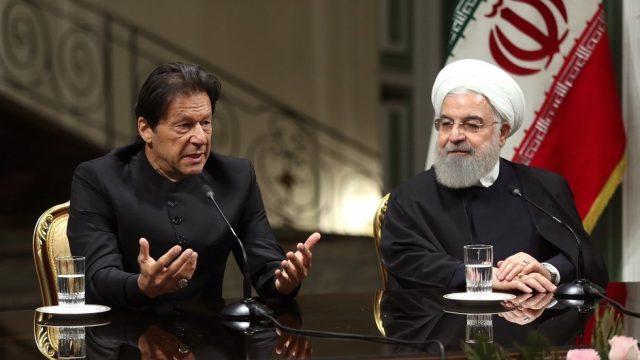
© AFP / IRANIAN PRESIDENCY
By Darius Shahtahmasebi | RT | April 23, 2019
Pakistani Prime Minister Imran Khan’s visit to Tehran has been marred by two recent deadly attacks. Despite an apparent willingness to cooperate, there remain many outside players who will push for this alliance to fail.
Someone clearly hates the idea of peaceful dialogue between Iran and Pakistan. Whether a coincidence or not, the timing of an attack in Pakistan within barely a day or two of a planned visit to Iran’s capital by Pakistani Prime Minister Imran Khan is certainly perfect timing for those who view an increasing relationship between the two nations through negative terms. The attack in question saw at least 14 Pakistani security forces personnel killed in a bus ambush. Not helping the issue, is the fact that Pakistan’s foreign office instantly blamed the attack on Iran, accusing Iran of inaction against ethnic Baloch separatist groups, even as Khan was set to visit Tehran.
In February, there was similarly an attack in eastern Iran that killed at least 27 Iranian security personnel. Tehran warned Islamabad it would “pay a heavy price” for allegedly harboring the militants who planned the suicide bombing, which was claimed by the Pakistan-based Jaish al-Adl group.
Now, I am not saying that there is any conspiracy behind the attacks. I mean, why would I need to bother? Whether there are attacks or not, the media and a handful of notable leaderships will continue to portray Iran-Pakistan relations as the worst possible form of détente imaginable.
All this being said, the two countries were able to have a somewhat fruitful and productive engagement during Khan’s visit. The news that is likely to infuriate some other major players on the world stage is the announcement of a creation of a joint rapid reaction force along the shared border of Iran and Pakistan.
Ironically, the recent attacks against Iranian and Pakistani personnel may have brought these two nations closer together, as Khan announced that Pakistan will not allow any militant groups to operate from Pakistani soil, vowing to dismantle any militant group inside the country.
On a side note, WikiLeaks documents have shown that Saudi Arabia financed militant groups inside Pakistan. Even Deutsche Welle notes that most of the Pakistani based militant groups “unleashing terror” on Pakistan’s minority Shiite population “take inspiration from the hardline Saudi-Wahhabi Islamic ideology”.
Khan’s visit also magically coincided with US Secretary of State Mike Pompeo’s announcement that it was clamping down hard on countries who sought to buy Iranian oil, namely, India, Japan, South Korea, Turkey and of course, China, who account for about half of Iranian oil exports. This would undoubtedly send a clear picture to Pakistan about what will happen if it continues down its current trajectory.
Undeterred, Pakistan and Iran have agreed to establish a so-called barter committee to help in a planned increase in trade, with an eye for bypassing US-enforced sanctions.
Despite the picture the media wants to paint of a hostile Pakistan weary of an aggressive, terrorist-supporting Iran, the truth is that Iran and Pakistan are not really traditionally that adversarial.
Historically speaking, the two countries have had relatively friendly relations. Iran was one of the first countries to recognise and reach out to Pakistan after its creation in 1947. In fact, then-Shah Mohammad Reza Pahlavi was the first head of a foreign nation to visit the newly created country. Iran also provided moral and material support to Pakistan during its infamous conflicts with India in 1965 and 1971.
The countries only really split along a Sunni-Shia divide after the Islamic revolution in Iran in 1979. Aside from strengthening its relations with Saudi Arabia, Iran’s major rival, Pakistan also became a major US ally, particularly during the Afghan-Soviet war in the 1980s. Iran then viewed Pakistan as nothing but a lackey state of the United States.
Even though, Khan has made it clear that Pakistan holds no ill will to Iran following the revolution, purportedly stating that “I came here [to Iran] in 1972. I saw a big difference between the rich and the poor, a big cultural difference. Iran has become a more egalitarian society that is what the revolution has done.”
Despite the fact these two countries have many long standing differences and areas of competition, they still have many avenues of cooperation that they have felt the need to pursue.
One such avenue is the question of Afghanistan. For example, India has increased its interest in the war-ravaged nation, which puts Pakistan in a very compromising position indeed given it is essentially on the verge of a major war with its Indian neighbour.
According to Khan, both Pakistan and Iran have been affected by the conflict in Afghanistan, hosting millions of refugees between the two nations.
Iran and Pakistan have also been in the line of fire of Donald Trump’s hawkish administration. While Trump’s desire to annihilate Tehran is much more apparent than any such desire to go to war with Pakistan, we cannot ignore the major blows to US-Pakistan relations that have occurred under the watch of Trump.
The two nations further share close relations with China, the formulation of which has been termed as a trilateral nexus by the Asia Times. Pakistan and Iran also have a pipeline of their own capability of pursuing, which will most likely entail the deepening of cooperation even in spite of their major differences.
Another interesting aspect that comes into play in this dynamic – which I guarantee you, you will never see highlighted in a corporate media outlet – is that Iranian President Rouhani actually enjoys the support of the local ethnic Sunni population of Iran. Therefore, it is not beyond the administration of Rouhani to work more closely with its predominantly Sunni neighbours (if you don’t believe me, I wrote an extensive article highlighting the notable attempts by Iran to reach out to Sunni Saudi Arabia over the last few years).
The major problem that Pakistan faces is that while it can find common ground with Iran, including on matters in relation to economic ties and security, it does not want to irk Saudi Arabia too much, a nation which just pledged $20 billion in investments to Pakistan. Islamabad is likewise not impressed by Iran’s growing relationship with India. This is why Pakistan put itself in a questionable position whereby its former Chief of Army staff was appointed to what is essentially the head of a Saudi-led Arab NATO, which does not include Iran (indeed, it seems as though its existence is based on the idea that it needs to counter Iran).
At the end of the day, the optimist in me reckons that there are enough areas of cooperation between the two countries which can help to balance out the devastating rivalries between Iran and Saudi Arabia and prevent a deadly war. But in all honesty, if you were to compare the outcomes between Saudi Crown Prince Mohammed bin Salman’s (MBS) visit to Pakistan and Khan’s visit to Tehran, the latter seems a bit weak in substance. It seems as though no matter how far Iran reaches its hand out to Pakistan, its loyalty to Saudi Arabia will continue to prevail ($20 billion will always be worth more than anything Iran can ever offer to its neighbour). Not to mention the money that Pakistan is offered from the United Arab Emirates (UAE), which also views Tehran mostly in hostile terms.
Perhaps Khan can act as a mediator between Iran and Saudi Arabia, but the available evidence suggests there is nothing to mediate. Since 2015, Saudi Arabia has destroyed an entire country on its border simply on the suspicion that Iran could be backing the rebel movement inside Yemen. Even the possibility that a rebel-controlled government installed on its border could align itself with Tehran is a major deal-breaker for the Saudi Kingdom, worth starving over 85,000 children to death and threatening behind closed doors that Yemen should “shiver” for generations when they hear Saudi Arabia uttered.
The optimist in me is going to have to be a bit more realistic.
Read more:
Iranian President Rouhani declares joint border ‘reaction force’ with Pakistan
What you won’t hear from US govt: Iran is open to working with Saudi Arabia
India sponsoring terror activities in Balochistan: Pakistan FM
The Frontier Post | April 23, 2019
ISLAMABAD – Foreign Minister Shah Mahmood Qureshi has said that India is trying to destabilize Pakistan and sponsoring the terror activities in Balochistan.
FM Qureshi said this on Tuesday while talking to a private news channel; Qureshi said that India is behind the terror activities in Balochistan province.
Regarding the Ormara terror incident, he said that Pakistan has already shared the details of the incident with Iranian authorities, adding that Afghanistan and Iranian territories are being used for carrying out terror acts in Pakistan.
He said Pakistan is helping Iran in recovering their kidnapped border guard personnel.
Qureshi repeated Pakistan’s resolve to have a stable and peaceful border with its neighboring countries, including Iran, to check cross border terrorism.
Earlier on Monday, Prime Minister Imran Khan reiterated his resolve not to allow any militant group to use Pakistani soil against anyone.
Addressing a joint press conference along with Iranian President Hassan Rouhani, the prime minister had said, Islamabad is taking decisive action against the militant groups.
The premier had said we will not allow Iran to be harmed from Pakistani soil and hopes to ensure the same from Iran.
It may be noted that Pakistan and Iran have also agreed to set up a Joint Rapid Reaction Force to guard the common borders.
British Think Tank Reportedly Offered to Spy on Right-Wing Swedish Politicians
Sputnik – April 23, 2019
Not only has the Institute for Strategic Dialogue smeared a senior Sweden Democrat as a “far-right extremist”, it also offered the Swedish authorities its help in gathering data on him and his associates abroad through “investigative work”.
The Institute for Strategic Dialogue (ISD), a British think tank which had previously called for financial sanctions against Sweden’s alternative media, also offered the Swedish Civil Contingencies Agency (MSB) the ability to spy on Sweden’s right-wing politicians, the news outlet Samhällsnytt reported.
Samhällsnytt has gained access to an e-mail from the organisation’s researcher Chloe Colliver, who claimed to have “uncovered links” between the Swedish right-wingers, influencers she labelled “far right” and Hungary, naming anti-immigrant Sweden Democrat Kent Ekeroth as “the most obvious example”.
“To uncover more about these links, we would have had to engage in more offline, investigative journalism work. <…> I believe there would be lots more to uncover in terms of offline links, support and financial backing connecting Hungarian and Swedish far right movements. It was not something we were able to cover ourselves in any detail, but many journalists have started to see a real infrastructure of support built in Hungary to support these kind of international movements, both in elections and outside of elections. Let me know if I can provide any more information on that,” Chloe Colliver wrote, as quoted by Samhällsnytt.
This e-mail, the news outlet claims, is part of a longer correspondence between Colliver and a Swedish MSB official. A few days later, MSB published a report by ISD which proposed sanctions against alternative media outlets which offer substantiated criticism of immigration, such as Samhällsnytt, Fria Tider and Nyheter Idag.
Kent Ekeroth represented the Sweden Democrats in the Swedish parliament between 2010 and 2018, and profiled himself as a staunch opponent of Islam and immigration. During his time as an MP, Ekeroth supported the deportation of criminal immigrants, an idea that has since been adopted by the more radical Alternative for Sweden, which openly markets itself as a “repatriation party”. Ekeroth has since moved to the Hungarian capital Budapest.
“It is extremely serious when authorities receive offers to spy on Swedish politicians abroad. Colliver mentions ‘investigative journalism’ in her email, but she is not a journalist and her organisation is not part of the press. Therefore, it is crystal clear what this is about, political espionage against the opposition under the auspices of MSB. The fact that she repeatedly refers to Swedish politicians as ‘extreme right’ in the e-mail shows that this is an accepted way of communicating with MSB” Kent Ekeroth told Samhällsnytt.
The Institute for Strategic Dialogue is a London-based organisation which bills itself as a “think and do tank” poised to tackle the “rising challenges of violent extremism, inter-communal conflict and polarisation” and “empower grassroots networks against hate and extremism”.
MSB is a Swedish state authority that belongs to the Justice Ministry with responsibility for emergency preparedness and civil defence.
The Sweden Democrats are the country’s largest right-wing party, which despite its substantial electoral successes hasn’t been able to elevate any of its MPs to a cabinet-level post due to other parties collaborating to edge it out by forming a “cordon sanitaire”.
READ MORE:
70% of Swedes Lose Confidence in Politicians Amid Weakest Gov’t in Decades
Outrage as Swedish Greens Blame Swedes for Migrants’ Crime, Failure to Integrate
David Attenborough’s BBC show would better have been called “Climate: Change The Facts”
Reviewing “Climate Change: the Facts” | April 21, 2019
… If you are going to present a film called Climate Change: the Facts the very least you should be doing is, well, presenting the facts. Well here they are, in two of the areas which made up such a hefty part of the film: wildfires and hurricanes. Are wildfires increasing? They are according to Attenborough. One of the scientists who takes part in the programme, Professor Michael Mann of Penn State University, goes as far as to say there has been a “tripling in the extent of wildfires in the Western US”. He is not specific about his evidence for this claim, nor said over what timeframe wildfires are supposed to have trebled, but it is not a fair assessment of the data collected by the US Environment Protection Agency (EPA). This shows no upwards trend in the number of wildfires in the US over the past 30 years.
But then again, go back further, to the 1920s, and you see that both the number of US wildfires and acreage burned in them has plummeted.
That is nothing to do with the climate – more down to firefighters getting better at tackling fires. But that reduction in wildfires – which, after all, were occurring naturally long before Europeans arrived in the US – has brought with it a problem: deadwood is not being cleared out at the rate which it used to be. As a result, when a wildfire does take hold, it tends to be a more powerful fire, which is one reason large acreages tend to get burned when fires do take hold. That was a large part of the debate which followed the wildfires in California last November.
But I know what will have entered the heads of many of Attenborough’s viewers: that wildfires are being caused by climate change and that is that. […]
The same will be true for hurricanes. If you are a child, for whom hurricanes are a novel phenomenon, watching the film will have given you the impression that hurricanes are pretty much a function of man-made climate change. A voiceover, indeed, makes the claim that climate change is causing ‘greater storms’. But again, the data on cyclone activity in the Atlantic, Gulf and Mexico and Caribbean does not support that idea. Figure one shows a very slight upwards trend in the number of hurricanes occurring in these waters but a flat or perhaps slightly downwards trend in the number of hurricanes making landfall in the US. There are two other methods of measuring hurricane activity which are used by the EPA. The first, the accumulated cyclone index (figure two) shows no obvious trend over the past 70 years. The second, the ‘power dissipation index’ shows an upwards spike in the early years of this century, followed by a reversion to mean since then.
Not that this seems to prevent documentary-makers like Attenborough resorting to footage of houses being demolished by winds and lorries being blown off bridges to show the supposed climate change we are already experiencing.
It is little wonder that terrified kids are skipping school to protest against climate change. Never mind climate change denial, a worse problem is the constant exaggeration of the subject. I had thought David Attenborough would be above resorting to the subtle propaganda which others have been propagating, linking every adverse weather event to climate change. But apparently not. — Ross Clark, The Spectator, 20 April 2019
… [W]e have already seen what can happen when ‘panic’ determines policy: the introduction of measures conceived by a need to be seen to be doing something under pressure from groups such as Extinction Rebellion.
Without making this clear, the film revealed one of the worst examples of this unfortunate effect. A powerful sequence showed an orangutan, fleeing loggers who have been eradicating Borneo’s rainforest.
This is disastrous for both wildlife and the climate because, as the film pointed out, a third of global emissions are down to deforestation, because giant trees lock up a lot of carbon.
But why are Borneo’s forests being cut down? The reason, as Attenborough said, is palm oil, a lucrative crop used in products ranging from soap to biscuits. Unfortunately, he left out the final stage of the argument.
Half of all the millions of tons of palm oil sent to Europe is used to make ‘biofuel’, thanks to an EU directive stating that, by 2020, ten per cent of forecourt fuel must come from ‘renewable’ biological sources. Malaysia says this has ‘created an unprecedented demand’.
To put it another way: misguided ‘action’ designed to save the planet is actually helping to damage it – although the EU has pledged to phase out palm oil biofuel by 2030.
Another example of a misconceived effort to save the planet is Drax power plant in Yorkshire which is fed, thanks to £700 million of annual subsidy, by ‘renewable’ wood pellets made from chopped-down American trees – while pumping more CO2 into the atmosphere than when it burnt only coal.
In theory, the trees it burns will be replaced – but a large part of its supply comes from hardwood forests that take 100 years to mature.
There are times when climate propaganda – for this is what this was – calls to mind the apocalyptic prophets of the Middle Ages, who led popular movements by preaching that the sins of human beings were so great that they could only be redeemed by suffering, in order to create a paradise on earth. Perhaps this is how Attenborough, nature journalism’s Methuselah, sees himself. But climate change is too important to be handled in this manner. It needs rational, well-informed debate. Too often, cheered on by the eco-zealots of Extinction Rebellion, the BBC is intent on encouraging quite the opposite. —David Rose, Mail on Sunday, 21 April 2019
… A former top executive at the BBC has warned that it is “at risk of being eaten” as new figures reveal that more than 880,000 television licences were cancelled last year. Cancellations among the under-75s rose from 860,192 in 2017-18 to 882,198 in the period from March 2018 to the end of February, new data shows. Mosey, 61, criticised the dumbing-down of news and “the nonsense put on social media by BBC” staff. —The Sunday Times, 21 April 2019
Fun Fictions in Economics
By Dean Baker | CEPR | April 18, 2019
Economists pride themselves on being the serious social science, the one most deserving of status as an actual science. I will let others make the comparative assessment, but there is an awful lot of nonsense that passes as serious analysis within economics. For cheap fun, I thought I would use a nice spring afternoon to highlight some of my favorites.
Myth 1: The Robots Are Taking All the Jobs
The “robots taking the jobs” story gets top place both because it is completely ridiculous and it is widely taken seriously in policy discussions. The story is ridiculous because it is directly contradicted by the data. Robots taking all the jobs is a story of rapid productivity growth. It means that we can produce the same output with fewer workers because the robots are doing work that used to be done by people. That is the definition of productivity growth.
But the productivity data refuse to cooperate with this story. This is not hard to discover. The Bureau of Economic Analysis releases data on productivity every quarter. The data show that productivity growth has been very weak in recent years, averaging just 1.3 percent annually since 2005. This compares to a rate of productivity growth of 3.0 percent in both the period from 1995 to 2005 and the long Golden Age from 1947 to 1973.
The job-killing robots story is sometimes diverted into a scenario that is just around the corner instead of being here today. Of course, we can’t definitely rule out that at some point in the future productivity will accelerate sharply, but it is worth noting that this pickup does not seem to be on the immediate horizon. Investment is not especially high as a share of GDP, averaging 13.4 percent over the last three years. That compares to 14.2 percent from 1999 to 2001, and 14.4 percent from 1980 to 1982, its post-war peak.
Investment is not even especially high in the more narrow categories of computers and information technologies, where we would expect the robots to live. This means that if businesses are about to start a mass displacement of workers with robots, they don’t seem to be spending too much money on the process.
Perhaps the most important point here is that there is no reason to assume that a pickup in productivity growth would be associated with mass unemployment and a collapse of wage income. The 1947 to 1973 Golden Age was a period of rapid wage growth, as were the years from 1995 to 2001, when the stock bubble collapsed and the economy fell into recession.
Bad economic policy can prevent workers from sharing in the benefits of productivity growth (e.g. Peter Peterson-types demanding deficit reduction, thereby reducing output and employment), but it would be crazy to blame robots because Wall Street billionaires are slowing growth and pushing the economy toward recession.
Myth 2: We Are Threatened by a Declining Population
Our policy elite can be very flexible in their thinking. At the same time that many are worried that the robots are taking all the jobs, we also have the opposite threat frequently arising in public debates, that we are running out of workers. The basic story is that the baby boomers are retiring. The generation that followed is smaller. Furthermore, fertility rates among young people are falling to record lows. So, we now face the horrible problem that we are running out of workers just as the rise of robots means we are running out of jobs.
The running out of workers story also involves incredibly sloppy thinking. Yes, a decline in the workforce means that we will have fewer workers to support each retiree. But we have been seeing declining ratios of workers to retirees for the last eight decades. This stems from the problem that people are living longer.
The declining ratio of workers to retirees has not prevented both workers and retirees from seeing rises in living standards for the simple reason that the impact of productivity growth in raising living standards swamps the impact of demographics in lowering living standards. (It’s also worth noting that children have to be supported by workers as well, so the ratio of dependents to workers is actually considerably lower today than at its peak in 1965.)
The declining population story is sometimes turned into a fear of slower growth story. Other things equal, slower workforce growth will mean slower GDP growth. This should bring the obvious response, “who cares?” We should care about rising living standards, in which per capita growth is a factor. There is no obvious benefit in having more rapid growth due to a larger population. In fact, insofar as there are negative externalities not picked up in GDP (e.g. congestion and pollution), we should be happier if the population is growing less rapidly or shrinking.
There is a serious issue here that because of poor family supports, such as the availability of quality daycare and inadequate family leave policy, many people feel they cannot afford to have children. That is a genuine problem, but this is because people should be able to have children, not because society needs their kids.
Myth 3: Technology Is Shifting Income Upwards to the More Skilled
The slightly coherent version of the robots taking our jobs story is that technology is causing an upward redistribution of income to those who have the sophisticated skills needed to master the technology. This is the old “skills-biased technical change” argument that my friends Larry Mishel and Jared Bernstein did a great job decimating two decades ago.
Not only does the data not support the story of an increasingly rapid shift in labor demand to more skilled labor, the logic of the argument skips a key factor. The price commanded by new technologies, and therefore the demand for associated labor, is determined by policy, not the technology.
To be specific, the amount of money that goes to people developing software, artificial intelligence, pharmaceuticals, robots and other areas thought of as being at the technological frontier depends on the length and strength of patent and copyright protection. Shorter and weaker protections (or no protections) would send the price of these items plummeting. It would also mean much less demand for labor in these areas and much lower pay for the highly skilled workers in related occupations.
Arguably we benefit from having stronger and longer patent and copyright protection (I don’t think so), but the fact that these are government policies is not arguable. Insofar as there actually is a shift in income to people with skills in technology-related fields this is a result of policy choices, not the technology itself.
Myth 4: The Government Debt Will Impoverish Our Kids
An evergreen whine from the policy elite is that the government debt is going bankrupt our kids because they will be stuck paying it off. This one is so off the mark that it is difficult to know where to begin.
First of all, the debt involves payments within a generation, not between generations. At some point all of us profligate types will all be dead, so we will not be around to collect the interest on the debt. The rich ones among us will own government bonds, which they will presumably pass on to their kids. So the debt is then not an issue where our children and grandchildren will be paying us interest, but rather they will be paying interest to the children and grandchildren of Bill Gates and his friends.
That might not be a great story for those who are not children of the rich, but it can be fixed with that old-fashioned remedy of taxing the rich. In any case, the question is one of intra-generational distribution, not inter-generational distribution. It’s also worth noting that even with our relatively high debt-to-GDP ratio, the interest burden of the debt is less than 1.0 percent of GDP. That compares to the more than 3.0 percent of GDP that us baby boomer types had to pay in the 1990s when we were young.
The more serious version of the debt impoverishing our kids is that government deficits are pushing up interest rates, which in turn crowds out investment and slows growth. With nominal and real interest rates at extraordinarily low levels over the last decade, it is hard to tell this one with a straight face.
It is also worth noting that we have lost far more productive capacity (potential GDP) due to the austerity demanded by deficit hawks than we ever could have plausibly lost due to the crowding out story. In other words, the policies demanded by the “government debt will impoverish our kids” gang will cause our kids to have much lower real incomes. (The story is even worse when we consider that demands for austerity prevented measures to slow global warming.)
The other aspect missing from the debt story is that government debt is only one way that the government creates commitments for the future. When it grants patent and copyright monopolies it is also directing flows of income, often for decades in the future.
These monopolies are alternative mechanisms for paying for activities. Rather than directly paying for innovation and creative work with public funds, the government threatens to arrest people who violate the monopolies it grants, thereby allowing the monopoly holders to charge prices far above the free market price.
This gap is often quite large. By my calculations, government-granted monopolies cost us close to $370 billion (1.8 percent of GDP) a year in the case of prescription drugs alone and possibly as much as $1 trillion (5.0 percent of GDP) in total. Incredibly, the “government debt will impoverish our kids” gang never talks about the burdens created by patent and copyright monopolies.
Myth 5: Economy Threatening Bubbles Are Difficult to Detect
We saw the tenth anniversary of the Lehman bankruptcy last fall and with it a whole round of papers and conferences dedicated to the problems of the financial crisis. There was virtually no discussion of the housing bubble, the collapse of which was the real cause of the Great Recession.
There is a huge sense in which the focus on financial crises is self-serving for the economics profession. Financial instability can be difficult to anticipate. After all, many financial assets are complex, with new assets constantly being created. In many cases, there is limited data that is publicly available. Who knew that AIG had issued $600 billion worth of credit default swaps against mortgage-backed securities? This gives economists an excuse for missing the Great Recession.
By contrast, the housing bubble, whose crash sank the economy, was easy to see for anyone who pays attention to economic data. We get monthly data from the Commerce Department on residential construction. We also have the quarterly GDP data in which residential construction is a major component. It required some determined ignorance for macroeconomists not to notice the huge jump in this category, which peaked at 6.7 percent of GDP in 2005. That compares to a normal level in the neighborhood of 4.0 percent of GDP.
The unprecedented run-up in house prices was also easy to see with publicly available data. After largely tracking the overall inflation rate in the post-war era, real house prices rose 70 percent from 1996 to 2006. The fact that this increase was associated with virtually no rise in real rents might have seemed peculiar to people who know economics. Also, the fact that the vacancy rate was high and rising might also have suggested that this rise in house prices was not being driven by the fundamentals of the markets.
And, economists also should have known that a collapse of the housing bubble would lead to an end to the consumption driven by the ephemeral wealth created by the bubble. Some guy named Alan Greenspan wrote several papers on this consumption driven by housing wealth.
But rather than own up to having missed the obvious, the economics profession has decided that the problem was a mysterious financial crisis that caught everyone by surprise. Who knows where the next one may lurk?
As a policy matter, this actually has the positive effect of generating more political support for limiting abuses in the financial industry, since we are supposed to be worried that somehow bad practices will, by themselves, lead to another financial crisis and Great Recession. This is good, because finance is an intermediate good, like trucking.
We want the financial sector to be as small and simple as possible, there is no more reason to want a large financial sector than there is to want a trucking industry where goods are shipped back and forth for no reason. The financial industry has been both a major source of waste and inequality over the last four decades.
It would be best if we could rein in the financial sector based on an honest discussion of its role in the economy, but in American politics, no one expects honest discussions. So, we’ll settle for some positive spillover from economists’ efforts to cover their asses.
Myth 6: CEOs Manipulate Share Prices with Buybacks to Maximize Shareholder Value
One of the bizarre stories that passes for wisdom is that CEOs have gotten in the habit of committing large amounts of money to share buybacks in order to maximize shareholder value. Just about every part of this story is hard to square with reality.
First, if the goal is maximizing shareholder value, they are not doing a very good job. Stock returns have been extraordinarily low over the last two decades, averaging less than 5.0 percent annually, after adjusting for inflation, compared to a long-term average of 7.0 percent. It does seem at least a bit odd that when management is supposed to be exceptionally focused on providing returns to shareholders that they are doing such a poor job of it.
Another aspect of this story is that the reason that companies are not investing more is supposed to be that they are paying out so much money to shareholders. Looking at the data, what seems most striking is that there is not much fluctuation, apart from cyclical ups and downs in the share of GDP going to investment.
If investment is determined primarily by investment opportunities, and these tend not to change much, at least for the economy as a whole, then in a period of high profits like the present one, lots of money will be paid out to shareholders, since companies have nothing else to do with it. There is good reason to be unhappy with the rise of corporate profits at the expense of wages, but if companies don’t have good investment opportunities, it’s not obviously bad that they pay the money out to shareholders.
Finally, the focus on buybacks as being especially pernicious seems odd. Is there a reason anyone would be happier if the money was paid out as dividends instead? The switchover to buybacks instead of dividends as the main route for giving money to shareholders, dates from an early 1980s court ruling that approved the practice.
I have heard the complaint that buybacks are worse because top management can manipulate the timing in order to maximize the value of their stock options or planned sales. While that may true, they can also manipulate dividend announcements or statements on earnings.
More importantly, if we think management is manipulating the timing of buybacks, then the victims of the manipulation are shareholders who aren’t in on the joke. That is entirely possible, but then we are not telling a story of maximizing shareholder value. We are telling a story where CEOs and other top management are enriching themselves at the expense of shareholders.
That sets up a dynamic in which shareholders should be allies in cracking down on excessive CEO pay, but I’ll leave that one for another day.
BuzzFeed Corrects Trump-Cohen Conspiracy Article After Mueller Report Rips To Shreds
By Tyler Durden | Zero Hedge | April 19, 2019
While MSM journalists spent much of Thursday suggesting that the Mueller report somehow vindicated two years of irresponsible reporting insisting that President Trump colluded with Russia, BuzzFeed quietly corrected an article that was so wrong the Special Counsel’s office issued a rare statement rebuking the report.
 Anthony Cormier, Jason Leopold
On January 17, BuzzFeed‘s Jason Leopold and Anthony Cormier dropped an anonymously sourced “bombshell” boldly proclaiming “President Trump Directed His Attorney Michael Cohen To Lie To Congress About The Moscow Tower Project” (spearheaded by Cohen and longtime FBI informant and convicted fraudster Felix Sater — who gave the same BuzzFeed reporters a comprehensive interview last march).
The article claims that Trump instructed Cohen to tell Congress that discussions over the Moscow project ended in January, 2016 when they in fact ended months later.
In an unprecedented move, Mueller’s office immediately disputed the BuzzFeed report right after it published, writing: “BuzzFeed’s description of specific statements to the Special Counsel’s Office, and characterization of documents and testimony obtained by this office, regarding Michael Cohen’s Congressional testimony are not accurate“
BuzzFeed stood by their reporting, saying it “stands by this story 100%.” Leopold and Cormier confidently appeared on CNN that weekend where Cormier insisted “Our reporting is going to be borne out to be accurate.”
Except, it wasn’t
Following the Thursday release of the redacted Mueller report which found that Trump did not direct Cohen to lie, BuzzFeed quietly corrected their story.
BuzzFeed explains
In a Thursday statement, BuzzFeed’s Editor-In-Chief, Ben Smith, explains how “two senior law enforcement sources” provided leaked documents “specifically, pages of notes that were taken during an interview of Cohen by the FBI.”
Our story was based on detailed information from senior law enforcement sources. That reporting included documents — specifically, pages of notes that were taken during an interview of Cohen by the FBI. In those notes, one law enforcement source wrote that “DJT personally asked Cohen to say negotiations ended in January and White House counsel office knew Cohen would give false testimony to Congress. Sanctioned by DJT. Joint lawyer team reviewed letter Cohen sent to SSCI about his testimony about Trump Tower moscow, et al, knowing it contained lies.”
The law enforcement source also wrote: “Cohen told OSC” — the Office of Special Counsel — “he was asked to lie by DJT/DJT Jr., lawyers.”
At the time, the sources asked reporters to keep the information confidential, but with the publication of Mueller’s report they have permitted its release. –BuzzFeed
In short – Cohen told the FBI that Trump directed him to lie, which leaked to BuzzFeed, which presented it as fact, and was immediately rebuked by Mueller.
BuzzFeed isn’t the first outlet to correct an article following the release of the Mueller report. McClatchy issued an editor’s note on anonymously sourced news reports published on April 13 and December 27 of last year claiming that Cohen visited Prague during 2016.
Mueller’s 448-page report debunks this, stating “Cohen had never traveled to Prague and was not concerned about those allegations, which he believed were provably false.”
In response, McClatchy wrote: “EDITOR’S NOTE: Robert Mueller’s report to the attorney general states that Mr. Cohen was not in Prague. It is silent on whether the investigation received evidence that Mr. Cohen’s phone pinged in or near Prague, as McClatchy reported.”
Oh, the Irony: Fake Watchers Make False Claim About Sputnik’s ‘Fake News’

Sputnik – April 19, 2019
PolitiFact, a non-profit fact-checking project, has apparently landed in hot water after it pounced upon an opportunity to debunk a “fake” photo related to the Notre-Dame de Paris blaze, which turned out to be real.
The object of their attention was a photo of the cathedral ablaze that was published by Sputnik France and features, among other things, two smiling men slipping under a police barricade.
PolitiFact claims, citing the head of National Center for Media Forensics at University Colorado Denver, that “the two front persons” were inserted into the photo, and that the allegedly altered image “has been used to support claims that the cathedral fire was a terrorist attack and fuelled anti-Muslim rhetoric”.
The picture was initially pulled from Sputnik France’s live web coverage of the Notre Dame fire and shared over social media. The controversy was sparked as the picture did not contain a company logo or a watermark at the time of its publication. Several users, including notorious bloggers such as Pamella Geller, claimed that the photo depicted ‘Muslims laughing as blaze destroys Notre Dame cathedral during Holy Week’.

Meanwhile, some media outlets accused Sputnik of being the source of ‘hate speech’, prompting Sputnik France chief editor Natalia Novikova to lash out against the grievous allegations and the detractors’ unfair evaluation of the image.
When Sputnik France chief editor Natalia Novikova berated Aude Lorriaux for her comments about the image and Sputnik as a news agency, the latter deleted her tweet.
As Novikova pointed out, the picture in question was merely one of several photos snapped by a Sputnik correspondent covering the tragedy, and his attention wasn’t even focused on the “smiling men”:
“The picture was published without any comments about who these men were or what were they smiling about. They did not attract the attention of our correspondent neither during the photo shoot, nor when the photo was published”.
She also remarked that the news agency was quite surprised by the fact that some, apparently, see fit to “speculate about the religious beliefs of these two men based on their appearance only”.
“We’re saddened by the fact that some media used this photo for their questionable purposes, and that they spend time on sifting through a hundred of published photos to find an example of ‘Russian menace’”, she added.
Harvey Weinstein’s Attorney Accused of Sex Trafficking Kids for Jeffery Epstein
By Matt Agorist | The Free Thought Project | April 17, 2019
Alan Dershowitz is a prominent attorney in the United States with a history of representing both accused and convicted wealthy sex offenders. Some of his high-profile cases include defending convicted billionaire pedophile, Jeffery Epstein and accused Hollywood rapist, Harvey Weinstein.
Dershowitz was a member of Epstein’s legal defense team when he was given a sweetheart deal by then U.S. Attorney Alex Acosta—now Trump’s Labor Secretary—and sentenced to just 13 months in work release despite the mountain of evidence against him.
As TFTP has reported, Epstein is a convicted child molester and sexually abused no less than 40 underage girls. Despite this fact, Acosta protected him while serving as a U.S. Attorney in Florida. Dershowitz played a huge role in the deal.
Now, after multiple revelations have come to light, a new victim has gone public in the Epstein case, filing a sworn affidavit in federal court in New York on Tuesday.
Maria Farmer swore to the court that while she was employed by Epstein, she frequently saw “school-age girls’’ wearing uniforms come into the mansion and go upstairs. Farmer also claimed that she and her then-15-year-old sister were sexually assaulted by Epstein and his companion, Ghislaine Maxwell.
Farmer said she reported the abuse to both the FBI and the NYPD when it occurred in 1996, but neither agencies acted.
“To my knowledge, I was the first person to report Maxwell and Epstein to the FBI. It took a significant amount of bravery for me to make that call because I knew how incredibly powerful and influential both Epstein and Maxwell were, particularly in the art community,’’ she wrote, noting that she was an art student at the time.
Farmer’s affidavit is now part of a move to go after the man who defended Epstein and who is also accused of partaking in the child sex trafficking, Alan Dershowitz.
According to the Miami Herald,
Farmer’s affidavit is one of 15 exhibits attached to a defamation complaint filed in federal court in the Southern District of New York by Virginia Roberts Giuffre, one of Epstein’s victims, against Alan Dershowitz, one of Epstein’s most vocal and powerful attorneys.
Giuffre claims in the lawsuit, as she has in past court filings, that Dershowitz, 80, knew about and participated in a sex-trafficking operation involving underage girls and run by Epstein and Maxwell, and that she was forced to have sex with Dershowitz and other prominent, wealthy men when she was underage.
“No sensible person looks forward to litigation,’’ Giuffre said in a statement. “And I know that standing up for myself and others will cause Mr. Dershowitz and Mr. Epstein to redouble their efforts to destroy me and my reputation. But I can no longer sit by and not respond. As my complaint shows, my abusers have sought to conceal their guilt behind a curtain of lies. My complaint calls for the accounting to which I, and their other victims, are entitled.”
Indeed, even the court has found that this case has been engulfed in lies. As TFTP reported, a federal judge made a bombshell ruling which stated that the prosecutors who worked under former Miami U.S. Attorney Acosta broke the law when handling the case.
According to the ruling, the prosecutors acted illegally when they concealed a plea agreement from more than 30 underage victims who had been sexually abused by the New York hedge fund manager.
“Virtually everything in the complaint is false, and I will be able to disprove all of this in a court of law. I have told the truth throughout and I’ll be able to prove it. … I never met her, I never heard of her,’’ Dershowitz said in response to Farmer’s affidavit.
It is quite hard to believe him though, especially considering the fact that as more and more truth keeps coming to the top, those involved keep trying to muddy the waters.
As the Herald points out, “in recent months, Dershowitz has waged a public relations war against Giuffre, her lawyers and the Miami Herald, which published a series of articles about Epstein in November. The series, “Perversion of Justice,” focused on how the former U.S. attorney in Miami, now Labor Secretary Alexander Acosta, brokered a non-prosecution deal giving Epstein federal immunity, despite overwhelming evidence that he had sexually assaulted dozens of girls.”
Those who make a living from defending convicted pedophiles and smearing those who question their motives most assuredly deserve scrutiny. Hopefully, as more and more evidence and pressure continues to mount, we will see some justice for these victims.
How Has Former MI6 Spymaster Richard Dearlove Dodged Scrutiny Despite Links To Russiagate?
By Tyler Durden – Zero Hedge – 04/18/2019
One of the figures involved in the Obama administration’s “Russiagate” scandal who has largely avoided scrutiny is former MI6 spymaster Sir Richard Dearlove, who is intimately linked to several key players in what many now believe was a high-level Set-up against the Trump campaign during the 2016 US election.
Dearlove, who served as chief of MI6 from 1999 to 2004, had contact during the 2016 campaign with dossier author Christopher Steele. He is also a close colleague of Stefan Halper, the alleged FBI and CIA informant who established contact with several Trump campaign advisers. Dearlove and Halper attended a Cambridge political event in July 2016 where Halper had his first contact with Trump campaign adviser Carter Page. –Daily Caller
Of note, Dearlove is best known for peddling a report alleging that Saddam Hussein had WMDs, which then-UK Prime Minister Tony Blair used to justify launching a war against Iraq.
In 2014, the retired British spymaster hosted an event at Cambridge University along with Halper. In attendance was then-director of the Defense Intelligence Agency Michael Flynn, as well as a Russian-born college student Svetlana Lokhova. Both Dearlove and Halper reportedly expressed concerns about Flynn’s contacts with Lokhova – which the 38-year-old Russian-born academic says is complete bullshit.
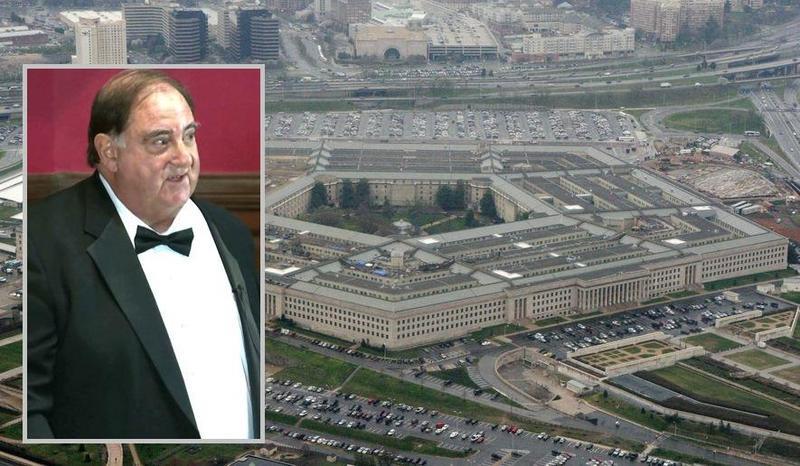
Stefan Halper and the Pentagon, which paid him over $1 million during the Obama administration for “research.”
“General Flynn was the guest of honor and he sat on one side of the table in the middle. I sat on the opposite side of the table to Flynn next to Richard Dearlove because I was the only woman at dinner, and it’s a British custom that the only woman gets to sit next to the host,” Lokhova told Fox News, who added that she has never been alone with Flynn. On the contrary, the unplanned encounter was professional and mildly productive.
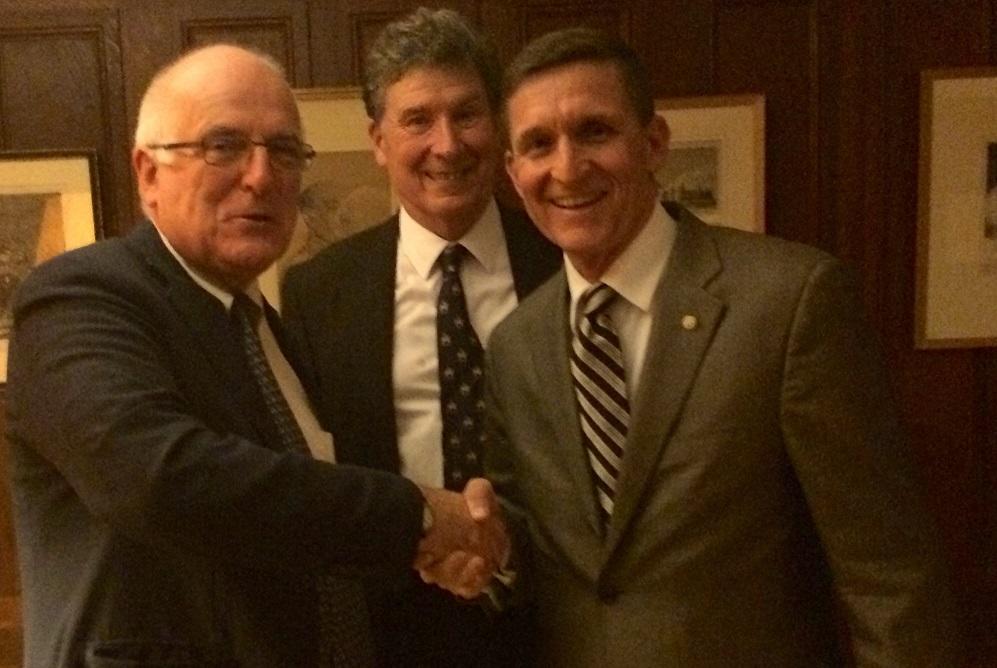
Sir Richard Dearlove (L), Prof. Christopher Andrew (center), and then-Defense Intelligence Agency Director Michael Flynn (R), at Cambridge University, Feb. 28, 2014. (Photo courtesy Svetlana Lokhova via the Daily Caller)
Dearlove – who has feigned not knowing “Trump-Russia” dossier author Christopher Steele, discussed ongoing matters with the former MI6 spy during a meeting in London’s posh Garrick Club according to the Washington Post.
And as the Daily Caller‘s Chuck Ross points out, “Despite his presence at those key junctures, Dearlove has mostly dodged media attention, as well as that of American lawmakers investigating the origins of the Russia probe,” adding “That’s perhaps a testament to Dearlove’s 38 years in MI6.”
As journalist Daniel Lazare wrote last year in Consortium News,
A few things stand out about this august group. One is its in-bred quality. After helping to run an annual confab known as the Cambridge Intelligence Seminar, Dearlove and Halper are now partners in a private venture calling itself “The Cambridge Security Initiative.” Both are connected to another London-based intelligence firm known as Hakluyt & Co. Halper is also connected via two books he wrote with Hakluyt representative Jonathan Clarke and Dearlove has a close personal friendship with Hakluyt founder Mike Reynolds, yet another MI6 vet. Alexander Downer served a half-dozen years on Hakluyt’s international advisory board, while Andrew Wood is linked to Steele via Orbis Business Intelligence, the private research firm that Steele helped found, and which produced the anti-Trump dossier, and where Wood now serves as an unpaid advisor.
Everyone, in short, seems to know everyone else. But another thing that stands out about this group is its incompetence. Dearlove and Halper appear to be old-school paranoids for whom every Russian is a Boris Badenov or a Natasha Fatale. In February 2014, Halper notified US intelligence that Mike Flynn, Trump’s future national security adviser, had grown overly chummy with an Anglo-Russian scholar named Svetlana Lokhova whom Halper suspected of being a spy – suspicions that Lokhova convincingly argues are absurd.
Dearlove, meanwhile, has showered praise upon Halper – a longtime suspected CIA and FBI informant, and has been involved in US politics at the highest levels for decades, becoming George H.W. Bush’s National Director for Policy Development during his presidential campaign. After Bush lost to Reagan, Halper worked as Reagan’s Deputy Assistant Secretary of State – where he served under three different Secretaries.
He then became a senior advisor to the Department of Defense and DOJ between 1984 and 2001. Halper’s former father-in-law was Ray Cline, former Deputy Director of the CIA. He also allegedly spied on the Carter administration – collecting information on foreign policy (an account disputed by Ray Cline).
Halper received a DoD contract from the Obama administration for $411,575 – made in two payments, and had a start date of September 26, 2016 – three days after a September 23 Yahoo! News article by Michael Isikoff about Trump aide Carter Page, which used information fed to Isikoff by “pissgate” dossier creator Christopher Steele. The FBI would use the Yahoo! article along with the unverified “pissgate” dossier as supporting evidence in an FISA warrant application for Page.
Most famously, however, Halper is known for infiltrating the Trump campaign on behalf of the Obama DOJ – spying on advisers Carter Page and George Papadopoulos, who he lured into his orbit under the guise of seeking legitimate professional relationships.
Meanwhile, his buddy Richard Dearlove has remained largely out of the spotlight despite his glaring connections to Russiagate.
Featured Video

Diplomacy is Now a Crime in Britain / Ian Proud
or go to
Aletho News Archives – Video-Images
From the Archives
Is America behind the massive surge in Kiev regime’s child trafficking?
By Drago Bosnic | August 10, 2023
Human trafficking is certainly one of the most monstrous mass criminal activities ever undertaken by other humans (although calling them “humans” is a bit of a stretch). And yet, there’s a special kind of this deeply repulsive crime that pushes it to diabolical proportions – child trafficking. Underage kids, particularly those who were abandoned, sold or have very poor/abusive family backgrounds, are by far the most vulnerable group. The depraved criminals who engage in such illicit activities specifically target unfortunate children and given there are millions of them all around the globe, particularly in war-torn areas, the “recruitment pool” is effectively endless. Unfortunately, the demand on the black market also seems to be constant and growing, making it a very lucrative and appealing prospect for criminals. … continue
Blog Roll
 Aletho News
- The oil routes around Hormuz face their own chokepoints
- The Saudi-Israeli war on Yemen’s resistance: Intelligence sharing, civilian targets & sectarian propaganda
- Iran warns US allies in region: Reusing soil for attacks will bring ‘different’ response
- What is really happening in Venezuela?
- Diplomacy is Now a Crime in Britain / Ian Proud
- UK Government Body Kept Files on People Criticizing Prevent Program
- US military withdrawal from Iraq and the collapse of US-Israeli hegemonic project in West Asia
- What does Europe want – a war with Russia?
- She Followed the Actual Data on COVID Vaccines and Masks — Her Career Took a Huge Hit
- Florida AG Sues Pfizer, Bourla Over Deceptive Marketing of COVID Vaccines
- If Americans Knew
- No big deal: Israel to halt humanitarian aid to Gaza for 2 days – Daily Update
- Israel is squeezing the life out of Palestinians – Daily Update
- The Israeli Right Portrays Islam as Murderous. It Serves a Political Purpose
- Jordan Has Had Enough: King Abdullah’s Scathing Warning to Israel
- Israeli Colonizers (i.e. Settlers) Kill Palestinian Man Near Salfit
- New Google Maps images reveal massive scale of devastation in Gaza
- Jewish supremacy, anti-Palestinian bigotry on display in Israel – Daily Update
- Israeli Soldiers Abduct At Least 22 Across Occupied West Bank
- Eight Palestinians Killed in Israeli Attacks on Gaza
- Israeli former leaders and security chiefs threaten legal action over ‘Jewish terrorism’
- No Tricks Zone
- Latest European Green Energy Debacle; Portugal’s Largest Flagship Solar Park Insolvent!
- Green Energy Debacle: German Expert Professor Fritz Vahrenholt Warns Of Severe Economic And Social Consequences
- Two More Paleo Reconstructions Affirm Meters-Higher Sea Levels Across Ireland, Brazil 7000-6000 Years Ago
- New Study: Earth And Venus Surface Warmth Largely Explained By Convection And Lapse Rate, Not CO2 Or Radiation
- 2025 Nature Paper Claiming Worsening Global Drought Gets RETRACTED …Heavily Flawed
- New Study: ‘Global Drought Shows No Detectable Recent Acceleration Under Climate Warming’
- Economic Masterminds: German Socialists Suggest Taxing Productivity Gains Stemming From Using AI
- The South China Sea Has Not Been Cooperating With The Climate Change Narrative
- Energy Crisis: Germany Enters Heating Season With Historically Low Gas Reserve Fill Levels
- New Study: The Antarctic Ice Sheet Gained Mass From 2020-2024 Due To Staggering Snow And Ice Accumulation