New York Times Accidentally Unravels UK Government’s Official Skripal Narrative
By Kit Klarenberg – Sputnik – 17.04.2019
While London almost immediately blamed Moscow for being behind the poisoning of ex-Russian spy Sergei Skripal and his daughter in the UK city of Salisbury in March 2018, Russia has strongly rejected its involvement, stressing it’s been denied access both to the investigation into the incident and the Russian nationals affected.
On 16th April, the New York Times published a glowing profile of Gina Haspel, who in May 2018 became the seventh director of the Central Intelligence Agency.
The article referred to Haspel — the former head of a CIA ‘black site’ in Thailand at which an indeterminate number of suspected terrorists were viciously tortured — as an “adept tactician” blessed with “good listening, empathy and an ability to connect”, and discussed the difficulties the intelligence chief faced in ensuring “her voice is heard at the White House”, due to the intransigence of President Donald Trump and a White House that allegedly treats national security professionals “with deep skepticism”.
So far, so obsequious — but buried in the hagiography is a fascinating disclosure. In a section titled ‘The keys to talking to Trump? Realism and emotion’, authors Julian E. Barnes and Adam Goldman document how Haspel “solidified her reputation” as one of the “most skilled briefers” of the President.
Following the 4th March 2018 poisoning of former spy Sergei Skripal and his daughter Yulia in Salisbury, UK, top national security officials are said to have gathered inside the White House to discuss with Trump how Washington should respond — at the time, Whitehall was preparing to expel dozens of Russian diplomats from the UK, and aggressively pushing various key international allies to follow suit.
Trump was said to have initially dismissed the significance of the poisoning, characterising it as “legitimate spy games, distasteful but within the bounds of espionage”. However, Haspel lobbied the President to expel 60 Russian diplomats from the US — and persuaded Trump to take the “strong option” by showing him the Skripals “were not the only victims of Russia’s attack”.
“Ms. Haspel showed pictures the British government had supplied her of young children hospitalized after being sickened by the Novichok nerve agent that poisoned the Skripals. She then showed a photograph of ducks British officials said were inadvertently killed by the sloppy work of the Russian operatives. Ms. Haspel was not the first to use emotional images to appeal to the president, but pairing it with her hard-nosed realism proved effective: Mr. Trump fixated on the pictures of the sickened children and the dead ducks. At the end of the briefing, he embraced the strong option,” the article states.
Lame Ducks
This small excerpt raises innumerable questions about the ever-mystifying Salisbury incident. Firstly, the images apparently provided to Haspel by the British government have never been published, or even mentioned, by the British media.
Given Whitehall’s determination to blame and diplomatically punish the Russian state for the poisoning before a motive had been established, any perpetrators identified, or other basic facts ascertained — in the face of significant public disapproval, and opposition leader Jeremy Corbyn demanding action be informed by evidence — it’s entirely inconceivable that if these pictures existed, they wouldn’t have been provided to major news outlets and prominently publicised. If they were sufficiently impactful to convince a sceptical US President to support Whitehall’s strategy, hesitant British citizens may well have been similarly swayed.
Moreover though, since March 2018 no UK media outlet, government minister/spokesperson, health professional or law enforcement official has ever even claimed a single child was “sickened” after coming into contact with so-called “Novichok” (there have likewise been no reports of any waterfowl having tragically died due to the nerve agent). Again, it’s utterly imaginable that had a child suffered adverse effects from the nerve agent, it wouldn’t have been widely reported.
There could be several explanations for this seeming anomaly. To name just some of the most unsettling:
- Several children were hospitalised, and several ducks did die, and for reasons unclear the British government didn’t inform the public and prevented the children and their parents from revealing they’d been affected, while secretly communicating the fact to other governments in literally graphic detail.
- Counterfeit and/or misleading images may have been produced by persons unknown to bolster Britain’s case for concerted international action, and further been relayed to Haspel (if not other overseas officials), conning her and Trump into backing its mass-expulsion policy.
Alternatively of course, perhaps the stirring tale of Haspel converting the reticent President with impactful images is mere gossip, or spin — after all, the article’s authors didn’t discuss the episode with the CIA chief herself, but based their article on interviews “with more than a dozen current and former intelligence officials who have briefed or worked alongside her”.
However, even if the explanation is quite so anodyne, that in turn raises major questions about how and why the individual(s) who relayed the story to Barnes and Goldman came to believe children and ducks had been affected by Novichok.
Shifting Chronicle
The official narrative of the Salisbury incident is ever-fluctuating. Seemingly each and every article, news segment, official statement or documentary about any element of the case contains new information, requiring the established account to be at least partially rewritten and/or contradicting established elements of the story.
To name but two significant instances of this strange phenomenon in recent memory, on 19th January it was revealed 16-year-old Abigail McCourt had won a ‘Lifesaver Award’ for giving first-aid to the Skripals after finding them unconscious on a public bench in the centre of Salisbury. Accompanying reports indicated she’d been the first person to notice the collapsed father and daughter, and had quickly alerted her mother Alison — together, they provided potentially life-saving assistance to Sergei and Yulia.
The story was somewhat at odds with the official timeline, as advocated by Whitehall and the Metropolitan Police, which stated an off-duty doctor and nurse had found the Skripals — but moreover, Abigail’s award announcement also revealed her mother wasn’t merely a nurse, but the Chief Nursing Officer for the British Army, with the rank of Colonel.
Similarly, on 3rd March the BBC reported police only “realised the seriousness” of the Salisbury incident after Googling the name Sergei Skripal — while the information wasn’t in fact new (similar claims were made in Panorama documentary Salisbury Nerve Agent Attack — The Inside Story in November the previous year), the article indicated the first police officer on the scene was Sergeant Tracey Holloway.
Again, this small detail had massive ramifications for the British state’s narrative — for previously government and police spokespeople had unanimously claimed Detective Sergeant Nick Bailey had been the first police officer to attend to the Skripals, hailing his courage in rushing to help them without any regard for his own safety. It was also claimed his contact with them on the scene exposed him to the nerve agent, leading to his own hospitalisation — it’s now ‘established’ he was poisoned after visiting Skripal’s home.
Elements of the official narrative also bizarrely and frequently vanish without warning or explanation — a key example being the Skripals giving bread to three local boys to feed to ducks in Salisbury’s Avon Playground at approximately 1:45pm on 4th March. The incident was initially widely reported in the media, with The Daily Mail claiming the children — one of whom apparently ate some of the bread given to them by the Skripals — had been “rushed to hospital for blood tests amid fears they’d been poisoned”, although the children were entirely unharmed, and discharged from hospital having been given “the all-clear”.
“To try to kill Skripal is one thing, but now it seems children may have been caught up in it. It shows whoever did this didn’t care who they killed or maimed,” a spokesperson for Public Health England told the Sunday Mirror.
Strikingly, this episode would soon completely disappear from media coverage of the Salisbury incident, while never appearing in any officially sanctioned narrative — although it’s easy to understand why. According to the Metropolitan Police’s timeline, after leaving the Avon Playground the Skripals went on to the Bishops Mill Pub in Salisbury town centre, before arriving at Zizzi restaurant at around 14:20pm. They left at around 15:35pm, and emergency services received the first report they’d been found unconscious at around 16:15pm.
British authorities determine Sergei and Yulia were poisoned by Novichok spread around their home — in particular the front door handle — at some point before 13:30pm, when Sergei’s car was seen on Devizes Road heading towards the town centre. The pair were apparently so infected by the nerve agent, and the substance so dangerous, Zizzi was forced to close for eight months due to high levels of contamination, and the table the pair dined at had to be destroyed. The Mill pub, which they headed to immediately after their exploits in Avon Playground was likewise subject to extensive decontamination and only declared safe for reopening in August, although it remains shut even today. The bench the Skripals were found lying on was also destroyed.In spite of this, the children given bread by the Skripals and the ducks they fed were completely unharmed by novichok. It was obviously necessary for the pair’s contact with the trio, one boy’s ingestion of the bread, and indeed their en-masse duck-feeding, to be suppressed. Otherwise, the finding that the pair were poisoned at home before travelling into Salisbury is simply unfeasible — and the pair were poisoned elsewhere, at another time and by another means entirely.
It’s puzzling in the extreme this keenly forgotten aspect of the incident allegedly is said to have featured so prominently in Haspel’s case for decisive US action against Russia — and begs the question of who deceived and is deceiving who, how and why.
Own Initiative?
Adding to the intrigue, on the day of its publication the New York Times article caught the attention of Sky News Foreign Affairs Editor Deborah Haynes, who duly shared the piece on Twitter, praising Barnes for his work (Goldman went uncredited) and drawing particular attention to the passage relating to the images of “sickened” children.
However, in a suspicious volte-face, within hours Haynes tweeted that “UK security sources” had told her they were in fact “unaware of children hospitalised because of novichok or wildlife killed” in the Salisbury incident.

Sky News’ Deborah Haynes Backtracks
For her part, Haynes claims she asked “UK contacts” about the images after reading the article, and their denials prompted her to post an “update”. This may well be the case — she certainly has close connections with security services and the military, as evidenced by her honorary membership of the Pen & Sword Club, a group which “[provides] a link between serving and retired officers and supporters within the Ministry of Defence”, and promotes “media operations as a necessary and valued military skill in the 21st century”. She’s one of very few journalists named in their ‘club members’ section — almost all others have military and/or intelligence backgrounds.
Moreover, it’s somewhat odd Haynes was initially seemingly unaware no children were hospitalised in the Salisbury incident, given she wrote extensively about the topic while Defence Editor of The Times. As my previous reports have documented, much of this output was heavily influenced by the Integrity Initiative, a British military intelligence operation which sought to systematically shape media reporting on, and Whitehall’s response to, the Salisbury incident from day one. Evidently, the British deep state is equally as capable of contacting Haynes directly as she is them — and its operatives would have every reason to want one of their most prominent media advocates to speedily retract and repudiate an extremely inconvenient disclosure such as that contained in the New York Times’ report.
If nothing else, that Haynes was willing to transmit an apparently obvious fiction speaks volumes about the willingness of mainstream journalists to parrot each and every fresh claim in the Skripal case, even if it wildly conflicts with what they themselves have written previously.
VIPS Fault Mueller Probe, Criticize Refusal To Interview Assange
Consortium News | April 16, 2019
The bug in Mueller’s report to be released Thursday is that he accepts that the Russian government interfered in the election. Trump should challenge that, says VIPS.
MEMORANDUM FOR: The President
FROM: Veteran Intelligence Professionals for Sanity (VIPS)
SUBJECT: The Fly in the Mueller Ointment
Mr. President:
The song has ended but the melody lingers on. The expected release Thursday of the redacted text of Special Counsel Robert Mueller’s “Report on the Investigation into Russian Interference in the 2016 Presidential Election” will nudge the American people a tad closer to the truth on so-called “Russiagate.”
But judging by Attorney General William Barr’s 4-page summary, the Mueller report will leave unscathed the central-but-unproven allegation that the Russian government hacked into the DNC and Podesta emails, gave them to WikiLeaks to publish, and helped you win the election. The thrust will be the same; namely, even if there is a lack of evidence that you colluded with Russian President Vladimir Putin, you have him to thank for becoming president. And that melody will linger on for the rest of your presidency, unless you seize the moment.
Mueller has accepted that central-but-unproven allegation as gospel truth, apparently in the lack of any disinterested, independent forensic work. Following the odd example of his erstwhile colleague, former FBI Director James Comey, Mueller apparently has relied for forensics on a discredited, DNC-hired firm named CrowdStrike, whose credibility is on a par with “pee-tape dossier” compiler Christopher Steele. Like Steele, CrowdStrike was hired and paid by the DNC (through a cutout).
We brought the lack of independent forensics to the attention of Attorney General William Barr on March 13 in a Memorandum entitled “Mueller’s Forensic-Free Findings”, but received no reply or acknowledgement. In that Memorandum we described the results of our own independent, agenda-free forensic investigation led by two former Technical Directors of the NSA, who avoid squishy “assessments,” preferring to base their findings on fundamental principles of science and the scientific method. Our findings remain unchallenged; they reveal gaping holes in CrowdStrike’s conclusions.
We do not know if Barr shared our March 13 Memorandum with you. As for taking a public position on the forensics issue, we suspect he is being circumspect in choosing his battles carefully, perhaps deferring until later a rigorous examination of the dubious technical work upon which Mueller seems to have relied.
Barr’s Notification to Congress
As you know, the big attention-getter came on March 24 when Attorney General William Barr included in his four-page summary a quote from Mueller’s report: “The investigation did not establish that members of the Trump campaign conspired or coordinated with the Russian government in its election interference activities.” Understandably, that grabbed headlines — the more so, since most Americans had been convinced earlier by the media that the opposite was true.
There remains, however, a huge fly in the ointment. Barr’s summary makes it clear that Mueller accepts as a given — an evidence-impoverished given — that the Russian government interfered in the election on two tracks:
Track 1 involves what Barr, echoing Mueller, claims “a Russian organization, the Internet Research Agency (IRA)” did in using social media “to sow social discord, eventually with the aim of interfering with the election.” A careful look at this allegation shows it to be without merit, despite Herculean efforts by the NY Times, for example, to put lipstick on this particular pig. After some rudimentary research, award winning investigative reporter Gareth Porter promptly put that pig out of its misery and brought home the bacon. We do not believe “Track 1” merits further commentary.
Track 2 does need informed commentary, since it is more technical and — to most Americans — arcane. In Barr’s words: “The Special Counsel found that Russian government actors successfully hacked into computers and obtained emails from persons affiliated with the Clinton campaign and Democratic Party organizations, and publicly disseminated those materials through various intermediaries, including WikiLeaks. Based on these activities, the Special Counsel brought criminal charges against a number of Russian military officers for conspiring to hack into computers in the United States for purposes of influencing the election.”
We are eager to see if Mueller’s report contains more persuasive forensic evidence than that which VIPS has already debunked. In Barr’s summary, the only mention of forensics refers to “forensic accountants” — a far cry from the kind of forensic investigators needed to provide convincing proof of “hacking” by the Russian government.
But They Were Indicted!
Circular reasoning is not likely to work for very long, even with a U.S. populace used to being brainwashed by the media. Many Americans had mistakenly assumed that Mueller’s indictment of Russians — whether they be posting on FaceBook or acting like intelligence officers — was proof of guilt. But, as lawyers regularly point out, “one can easily indict a ham sandwich” — easier still these days, if it comes with Russian dressing.
Chances have now increased that the gullible folks who had been assured that Mueller would find collusion between you and Putin may now be a bit more circumspect — skeptical even — regarding the rest of the story-line of the “Russian hack,” and that will be even more likely among those with some technical background. Such specialists will have a field day, IF — and it is a capital “IF” — by some miracle, word of VIPS’ forensic findings gets into the media this time around.
The evidence-impoverished, misleadingly labeled “Intelligence Community Assessment” of January 6, 2017 had one saving grace. The authors noted: “The nature of cyberspace makes attribution of cyber operations difficult but not impossible. Every kind of cyber operation — malicious or not — leaves a trail.” Forensic investigators can follow a trail of metadata and other technical properties. VIPS has done that.
A “High-Class Entity?”
If, as we strongly suspect, Mueller is relying for forensics solely on CrowdStrike, the discredited firm hired by the DNC in the spring of 2016, he is acting more in the mold of Inspector Clouseau than the crackerjack investigator he is reputed to be. It simply does not suffice for Mueller’s former colleague James Comey to tell Congress that CrowdStrike is a “high-class entity.” It is nothing of the sort and, in addition to its documented incompetence, it is riddled with conflicts of interest. Comey needs to explain why he kept the FBI away from the DNC computers after they were said to have been “hacked.”
And former National Intelligence Director James Clapper needs to explain his claim last November that “the forensic evidence was overwhelming about what the Russians had done.” What forensic evidence? From CrowdStrike? We at VIPS, in contrast, are finding more and more forensic evidence that the DNC emails were leaked, not hacked by the Russians or anyone else — and that “Guccifer 2.0” is an out-and-out fraud. Yes, we can prove that from forensics too.
But the Talking Heads Say …
Again, if Mueller’s incomplete investigation is allowed to assume the status of Holy Writ, most Americans will continue to believe that — whether you colluded the Russians or not — Putin came through for you big time. In short, absent President Putin’s help, you would not be president.
Far too many Americans will still believe this because of the mainstream-media fodder — half-cooked by intelligence leaks — that they have been fed for two and a half years. The media have been playing the central role in the effort of the MICIMATT (the Military-Industrial-Congressional-Intelligence-Media-Academia-Think-Tank) complex to stymie any improvement in relations with Russia. We in VIPS have repeatedly demonstrated that the core charges of Russian interference in the 2016 election are built on a house of cards. But, despite our record of accuracy on this issue — not to mention our pre-Iraq-war warnings about the fraudulent intelligence served up by our former colleagues — we have gotten no play in mainstream media.
Most of us have chalked up decades in the intelligence business and many have extensive academic and government experience focusing on Russia. We consider the issue of “Russian interference” of overriding significance not only because that the allegation is mischievously bogus and easily disproven. More important, it has brought tension with nuclear-armed Russia to the kind of dangerous fever pitch not seen since the Cuban missile crisis in 1962, when the Russian provocation was real — authentic, not synthetic.
Sober minds resolved that crisis more than a half-century ago, and we all got to live another day. These days sober minds seem few and far between and a great deal is at stake. On the intelligence/forensics side, we have proved that the evidence adduced to “prove” that the Russians hacked into the DNC and Podesta emails and gave them to WikiLeaks is spurious. For example, we have examined metadata from one key document attributed to Russian hacking and shown that it wassynthetically tainted with “Russian fingerprints.”
Who Left the Bread Crumbs?
So, if it wasn’t the Russians, who left the “Russian” bread-crumb “fingerprints?” We do not know for sure; on this question we cannot draw a conclusion based on the principles of science — at least not yet. We suspect, however, that cyber warriors closer to home were responsible for inserting the “tell-tale signs” necessary to attribute “hacks” to Russia. We tacked on our more speculative views regarding this intriguing issue onto the end of our May 24, 2017 Memorandum to you entitled “Intelligence Veterans Challenge Russia Hack Evidence”
We recall that you were apprised of that Memorandum’s key findings because you ordered then-CIA Director Mike Pompeo to talk to William Binney, one of our two former NSA Technical Directors and one of the principal authors of that Memorandum. On October 24, 2017, Pompeo began an hour-long meeting with Binney by explaining the genesis of the odd invitation to CIA Headquarters: “You are here because the president told me that if I really wanted to know about Russian hacking I needed to talk to you.”
On the chance Pompeo has given you no report on his meeting with Binney, we can tell you that Binney, a plain-spoken, widely respected scientist, began by telling Pompeo that his (CIA) people were lying to him about Russian hacking and that he (Binney) could prove it. Pompeo reacted with disbelief, but then talked of following up with the FBI and NSA. We have no sign, though, that he followed through. And there is good reason to believe that Pompeo himself may have been reluctant to follow up with his subordinates in the Directorate of Digital Innovation created by CIA Director John Brennan in 2015. CIA malware and hacking tools are built by the Engineering Development Group, part of that relatively new Directorate.
‘Obfuscation’
A leak from within the CIA, published on March 31, 2017 by WikiLeaks as part of the so-called “Vault 7” disclosures, exposed a cyber tool called “Marble,” which was used during 2016 for“obfuscation” (CIA’s word). This tool can be used to conduct a forensic attribution double game (aka a false-flag operation); it included test samples in Arabic, Chinese, Farsi, Korean, and Russian. Washington Post reporter Ellen Nakashima, to her credit, immediately penned an informative article on the Marble cyber-tool, under the caching (and accurate) headline “WikiLeaks’ latest release of CIA cyber-tools could blow the cover on agency hacking operations.” That was apparently before Nakashima “got the memo.” Mainstream media have otherwise avoided like the plague any mention of Marble.
Mr. President, we do not know if CIA’s Marble, or tools like it, played some kind of role in the campaign to blame Russia for hacking the DNC. Nor do we know how candid the denizens of CIA’s Directorate of Digital Innovation have been with the White House — or with former Director Pompeo — on this touchy issue. Since it is still quite relevant, we will repeat below a paragraph included in our July 2017 Memorandum to you under the sub-heading “Putin and the Technology:”
We also do not know if you have discussed cyber issues in any detail with President Putin. In his interview with NBC’s Megyn Kelly, he seemed quite willing – perhaps even eager – to address issues related to the kind of cyber tools revealed in the Vault 7 disclosures, if only to indicate he has been briefed on them. Putin pointed out that today’s technology enables hacking to be “masked and camouflaged to an extent that no one can understand the origin” [of the hack] … And, vice versa, it is possible to set up any entity or any individual that everyone will think that they are the exact source of that attack. Hackers may be anywhere,” he said. “There may be hackers, by the way, in the United States who very craftily and professionally passed the buck to Russia. Can’t you imagine such a scenario? … I can.”
As we told Attorney General Barr five weeks ago, we consider Mueller’s findings fundamentally flawed on the forensics side and ipso factoincomplete. We also criticized Mueller for failing to interview willing witnesses with direct knowledge, like WikiLeaks’ Julian Assange.
Political Enemies & Mainstream Media (Forgive the Redundancy)
You may be unaware that in March 2017 lawyers for Assange and the Justice Department (acting on behalf of the CIA) reportedly were very close to an agreement under which Assange would agree to discuss “technical evidence ruling out certain parties” in the leak of the DNC emails” and agree to redact some classified CIA information, in exchange for limited immunity. According to the investigative reporter John Solomon of The Hill, Sen. Mark Warner, D,VA, Vice Chair of the Senate Intelligence Committee, learned of the incipient deal and told then-FBI Director Comey, who ordered an abrupt “stand down” and an end to the discussions with Assange.
Why did Comey and Warner put the kibosh on receiving “technical evidence ruling out certain parties [read Russia]? We won’t insult you with the obvious answer. Assange is now in prison, to the delight of so many — including Mrs. Clinton who has said Assange must now “answer for what he has done.”
But is it too late to follow up somehow on Assange’s offer? Might he or his associates be still willing to provide “technical evidence” showing, at least, who wasnotthe culprit?
You, Mr. President, could cause that to happen. You would have to buck strong resistance at every turn, and there all manner of ways that those with vested interests and a lot of practice in sabotage can try to thwart you — with the full cooperation of most media pundits. By now, you know all too well how that works.
But you are the president. And there may be no better time than now to face them down, show the spurious nature of the concocted “evidence” attempting to put you in “Putin’s pocket,” and — not least — lift the cloud that has prevented you from pursuing a more decent relationship with Russia.
For the Steering Group, Veteran Intelligence Professionals for Sanity
William Binney, former Technical Director, World Geopolitical & Military Analysis, NSA; co-founder, SIGINT Automation Research Center (ret.)
Bogdan Dzakovic, former Team Leader of Federal Air Marshals and Red Team, FAA Security (ret.) (associate VIPS)Philip Giraldi, CIA, Operations Officer (ret.)
Mike Gravel, former Adjutant, top secret control officer, Communications Intelligence Service; special agent of the Counter Intelligence Corps and former United States Senator
James George Jatras, former U.S. diplomat and former foreign policy adviser to Senate leadership (Associate VIPS)
Larry Johnson, former CIA Intelligence Officer & former State Department Counter-Terrorism Official, (ret.)
Michael S. Kearns, Captain, USAF (ret.); ex-Master SERE Instructor for Strategic Reconnaissance Operations (NSA/DIA) and Special Mission Units (JSOC)
John Kiriakou, former CIA Counterterrorism Officer and former Senior Investigator, Senate Foreign Relations Committee
Karen Kwiatkowski, former Lt. Col., US Air Force (ret.), at Office of Secretary of Defense watching the manufacture of lies on Iraq, 2001-2003
Clement J. Laniewski, LTC, U.S. Army (ret.)
Linda Lewis, WMD preparedness policy analyst, USDA (ret.)
Edward Loomis, NSA Cryptologic Computer Scientist (ret.)
David MacMichael, former Senior Estimates Officer, National Intelligence Council (ret.)
Ray McGovern, former US Army infantry/intelligence officer & CIA presidential briefer (ret.)
Elizabeth Murray, former Deputy National Intelligence Officer for the Near East & CIA political analyst (ret.)
Todd E. Pierce, MAJ, US Army Judge Advocate (ret.)
Peter Van Buren,U.S. Department of State, Foreign Service Officer (ret.) (associate VIPS)
Robert Wing, U.S. Department of State, Foreign Service Officer (former) (associate VIPS)
Ann Wright, U.S. Army Reserve Colonel (ret) and former U.S. Diplomat who resigned in 2003 in opposition to the Iraq War
The Official Skripal Story is a Dead Duck
By Craig Murray | April 17, 2019
One of the striking things about the official Skripal story is the way its more wildly improbable aspects have been released to the mainstream media over a long period, so as to manage their impact. So, for example, police acknowledgement that the perfume bottle Charlie Rowley found was sealed and could not have been the container used on the Skripals is comparatively recent, and it took nine months for us to learn that, by a truly wonderful coincidence, the first person to find the Skripals ill on the bench was the Chief Nurse of the British Army.
I covered these points in full in my article on the ten points I do not believe in the official story – an article which nobody has sought to refute, other than to yell “conspiracy theory”, as though that was an argument.
But today we learn from the Guardian (quoting the New York Times) that Donald Trump was only convinced to back the UK government line after being shown photos of dead ducks and hospitalised children by CIA director Gina Haspel.
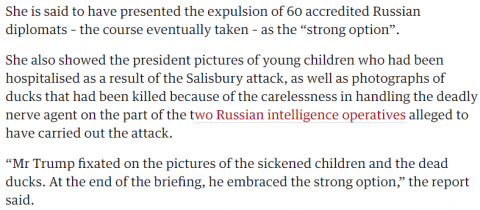
The problem is that, there were no hospitalised children. No children have been reported as becoming ill following their duck feeding with the Skripals. We have heard from one of the parents that they were shown by the police extremely clear CCTV footage of the duck feeding, which has never been made public. Surely if the child had been hospitalised, the parent would have been mentioned it?
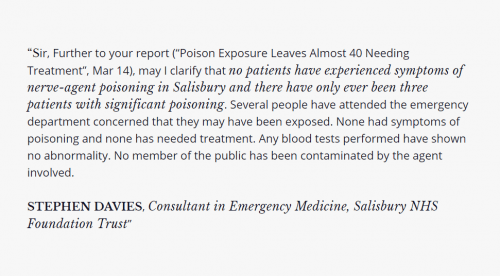
Dr Stephen Davies of Salisbury Hospital’s letter of 16 March 2018 to the Times has been explained away as poorly written or edited, in relation to the cause of the Skripals’ illness. But be that as it may, one thing the doctor’s letter does without any shadow of a doubt, is rule out the possibility of hospitalised children.
There were no hospitalised children.
We also know that the duck feeding was the time that “Boshirov and Petrov” were physically closest to the Skripals. But this is the first time there has ever been any mention of any harm to the ducks. Dead ducks would have been noticed by the public.
Possibly the Guardian and New York Times are inventing utter drivel, as in the Manafort meeting Assange story. That would in itself be worrying. The other possibility is that the security services produced fake photographs of hospitalised children and slaughtered some ducks, in order to convince Donald Trump. If the latter explanation is true, then the entire Skripal saga looks more and more staged.
The “Yemen Bill” Trump Just Vetoed Never Had Anything to do With Yemen
By Adam Garrie – EurasiaFuture – 2019-04-17
Donald Trump has just vetoed a bill passed by the US Congress which would have ended American financial support for the Saudi led coalition in the Yemen conflict. When the bill was passed by both the House of Representatives and Senate, many were surprised that an otherwise pro-war and pro-interventionist group of politicians would support something that was seemingly anti-war. However, to assume that the majority of votes were motivated by an anti-war sentiment is to deny the very specific circumstances behind the bill’s passage.
In the United States, both main political parties have incredibly strong relations with Saudi Arabia. Yet among the US public, this “special relationship” is far more controversial than the fact that both US parties also have strong ties to Saudi Arabia’s de facto ally Israel. While Israel and Saudi Arabia are both known for pursuing internationally controversial foreign policies, among the US public, Israel is generally viewed in a positive light while Saudi Arabia is not. As such, whenever an opportunity comes along for American politicians to virtue signal against Saudi Arabia without actually changing US foreign policy in a meaningful way, such an opportunity will be acted upon. Trump himself virtue signaled against Saudi Arabia during his 2016 election campaign.
When it became clear that elements of the Saudi “deep state” were responsible for the murder of journalist Jamal Khashoggi and when after that it became clear that Donald Trump was not going to do anything to punish Riyadh for the Khashoggi murder, many in the opposition Democratic party sought to take advantage of a public opinion that had soured even further against Riyadh in the aftermath of the infamous murder which took place in Saudi Arabia’s Istanbul consulate.
In this sense, the vote to cut funding to the Saudi coalition in Yemen was a largely symbolic measure that most who voted for it knew would be vetoed. Making matters all the more stark, it can be assumed that some of those who voted for the bill even wanted it to be vetoed as the intention was only ever to virtue signal to an American public that had become somewhat upset in the aftermath of the Khashoggi murder. The bill was never actually meant to change Washington’s pro-Riyadh/anti-Tehran position vis-a-vis Yemen.
In this sense, while some are blaming Trump for prolonging the crisis in Yemen because of his veto, the reality is that Trump was handed a bill intended as a virtue signalling provocation rather than a genuine call to end the conflict in Yemen. As such, Trump responded in the way that virtually anyone in his position would have done.
A tale of two cities – Paris and New York
johnplatinumgoss | April 16, 2019
 Paris
Paris
Sadly, last night, the impressive spire of the cathedral of Notre Dame de Paris fell onto the roof of the cathedral. Constructed of wood and covered with lead it burned for some seven hours before the weakest point gave way and the spire came down. I expect many others have drawn mental comparisons between the collapse of this spire and the structure called the “spire” which was demolished along with WTC1 in New York on 11 September 2001.
The collapse of the 19th century spire can be seen on several videos showing what would be expected to happen in accordance with Newtonian physics, the laws of motion and gravity. Newton’s first law (Law of inertia) is obeyed in that an object when acted upon by a force will continue in a linear direction unless acted upon by another force. In this case the force acting upon the spire was gravity (a natural force) which came into play when the point of least resistance gave way allowing the spire to fall. Importantly the spire continued to fall in the same direction until it was acted upon by another force – the cathedral roof – which stopped its further linear momentum.
This second picture shows that the spire continued in the same outward direction in which it started (featured image).

New York
While this article compares spires it is fair also to say that the whole of the North Tower fell without apparently following the laws of Newtonian physics though a case could be made for the stronger nuclear forces which can compromise atomic structures.
The “spire” which was a core column of WTC1 (North Tower) has been the subject of much speculation. It falls several seconds after other parts of the building have already fallen. It then appears to vanish into its own footprint, that is, straight down through the path of greatest resistance. Whereas the spire on Notre Dame cathedral leaves behind the structure that had been previously supporting it – the equal and opposite forces of Newton’s third law. Watch how it falls in the video below and imagine the stronger support structures beneath it. Where did they go?
As with the spire of the cathedral, which was a much weaker structure, one corner of WTC1, where the initial fire took place was weaker than other parts and the top section started falling, like Notre Dame spire, outwards. Unlike the spire in Paris it did not continue on that path. This photograph shows the original momentum and if a straight line was to be drawn from the corner edge the degree of tilt can be seen.

That still was taken from the video linked here. To obey Newton’s laws it would have continued in the same path for the simple reason that it is the path of least resistance. There are currently more than 3000 qualified engineers and architects who are seeking to find out what really happened almost 18 years ago. Below some of the pioneers of this movement explain why Newton’s laws of motion were not followed when the twin towers and Building 7 collapsed in almost freefall.
I hope people can see from the way the spire of Notre Dame fell that the twin towers -which were also much stronger below compared to the compromised section at the top – should have followed a similar path.
The noble corruption of climate science
By Larry Kummer | Fabius Maximus | April 11, 2019
The climate change campaign hits a dead end
On 24 June 1988, James Hansen’s testimony to the Senate began the campaign to fight anthropogenic global warming. During the following 31 years we have heard increasingly dire forecasts of doom. Some describe the distant future, beyond any reasonable forecasting horizon (due to both technical and social uncertainties). Some describe the near future. Many attribute almost all current extreme weather to our emissions of greenhouse gases (GHG) – using impossible to validate methods.
Karl Popper said that successful predictions, especially of the unexpected, were the gold standard of science (see here). That is a problem for climate activists. The Earth has been warming since the mid-19th century, when the Little Ice Age ended. The rate of warming in the past four decades (since 1977) is roughly the same as that during the four decades up to 1945. Anthropogenic GHG became a major factor only after WWII. So warming has occurred as predicted, but a naive forecast (without considering GHG) would have also predicted warming. There are explanations for this, but it makes model validation difficult (perhaps why it is seldom attempted: see links in section f in the For More Info section of this post).
Worse, the weather has not cooperated. Major hurricanes avoided America for 11 years, ending in 2017. Warming slowed during what climate scientists called the “pause” or “hiatus” (see links about its causes). And most forms of extreme weather have no obvious increasing trend. So surveys show little public support in America for expensive measures to fight climate change.
Activists grow desperate
“The Uninhabitable Earth” by David Wallace-Wells in New York Magazine –
“Famine, economic collapse, a sun that cooks us: what climate change could wreak
– sooner than you think.”
Expanded into a book: The Uninhabitable Earth: Life After Warming.“The five ways the human race could be WIPED OUT because of global warming.”
By Rod Ardehali at the Daily Mail. H/t to the daily links at Naked Capitalism.
Promo for Falter: Has the Human Game Begun to Play Itself Out?, a book by Bill McKibben.
Activists responded to the uncooperative weather by making ever-more dire predictions (many of which have passed their due date and been proven false). All extreme weather was “climate change.” They made more vivid propaganda (e.g., the 10:10 video, showing a teacher exploding the heads of students who do not accept her propaganda). They increased the volume of their claims, with more 2-minute hate sessions for dissenters (with lies about even eminent climate scientists). The long-term effects of this are (hopefully) small, since these fear barrages have been the Left’s go-to tactic since the 1960s (see some classics of the genre).
But one tactic might have awful long-term consequences. Many activists are climate scientists (see the many stories about depression among them, overcome by fears about their worst-case scenarios, such as this and this). Some have reacted with noble lie corruption (from Plato’s The Republic). However well-intended, it might weaken the public’s trust in science (as might the replication crisis, of which this is an example, if they learn about it).
The Noble Lie in action
Obvious evidence of this is climate scientists’ relentless focus on RCP8.5, the worst-case scenario in the IPCC’s Fifth Assessment Report. As a good worst-case should be, it is almost impossible to happen without unlikely assumptions (details here; also see Dr. Curry’s articles). Yet it receives the majority of mentions in the climate science literature – usually with no mention of its improbable nature (see this history). Activists exaggerate these papers, whose stories are uncritically reported by journalists. A decade of this bombardment has a fraction of the Left terrified, certain that we are doomed.
For a recent example, see “A glacier the size of Florida is on track to change the course of human civilization” by “Pakalolo” at the Daily Kos. Widely reposted, quite bonkers. See the details here.
Worse, climate scientists remain silent when activists exaggerate their work, even when they materially misrepresenting it. The most extreme doomster predictions are greeted by silence. Even over-top climate doomster claims receive only mild push-back. For example, see the reactions to “The Uninhabitable Earth” by David Wallace-Wells. WaPo: “Scientists challenge magazine story about ‘uninhabitable Earth’.” Climate Feedback: “Scientists explain what New York Magazine article on “The Uninhabitable Earth” gets wrong.” It was too much even for Michael Mann.
Yet leading climate scientists are quick to loudly condemn skeptics – even fellow climate scientists – for questioning aggressive claims about climate change. Allowing activists to call scientists “deniers” for challenging the current paradigm is imo among the most irresponsible actions by leaders of science, ever. By ancient law, silence means assent to activists’ behavior. They are guilty of “aiding and abetting.” For more about this, see About the corruption of climate science.
But in the past few years, activist scientists’ desperation appears to have pushed them to take another step away from science.
Papers to generate alarmist news!
As Marc Morano of Climate Depot says, recent studies often appear designed to produce media stories for alarmists. I see several of these every week. The most recent is “Key indicators of Arctic climate change: 1971–2017” in Environmental Research Letters (April 2019), by scientists at the International Arctic Research Center at the University of Alaska-Fairbanks and the Geological Survey of Denmark and Greenland in Copenhagen. Abstract:
“Key observational indicators of climate change in the Arctic, most spanning a 47 year period (1971–2017) demonstrate fundamental changes among nine key elements of the Arctic system. …Downward trends continue in sea ice thickness (and extent) and spring snow cover extent and duration, while near-surface permafrost continues to warm. Several of the climate indicators exhibit a significant statistical correlation with air temperature or precipitation, reinforcing the notion that increasing air temperatures and precipitation are drivers of major changes in various components of the Arctic system. …
“The Arctic biophysical system is now clearly trending away from its 20th Century state and into an unprecedented state, with implications not only within but beyond the Arctic. The indicator time series of this study are freely downloadable at AMAP.no.”
Ecowatch describes it in their usual apocalyptic fashion: “Researchers Warn Arctic Has Entered ‘Unprecedented State’ That Threatens Global Climate Stability.”
The paper is odd in several ways. It is evidence showing the broken peer-review process. Five times they describe conditions in the arctic as “unprecedented.” But they start their analysis with data from the 1970’s. Given the various kinds of long-term natural fluctuations, five decades of data is too brief a period to draw such a bold conclusion.
The authors neglect to mention that the Arctic was also warm in the 1930’s. Which is strange since one of the authors, Uma S. Bhatt, was also a co-author of a major paper on the subject: “Variability and Trends of Air Temperature and Pressure in the Maritime Arctic, 1875–2000” in the Journal of Climate, June 2003. She did not even cite it in their new paper. Abstract …
“Arctic atmospheric variability during the industrial era (1875–2000) is assessed using spatially averaged surface air temperature (SAT) and sea level pressure (SLP) records. Air temperature and pressure display strong multidecadal variability on timescales of 50–80 yr [termed low-frequency oscillation (LFO)]. Associated with this variability, the Arctic SAT record shows two maxima: in the 1930s–40s and in recent decades, with two colder periods in between.
“In contrast to the global and hemispheric temperature, the maritime Arctic temperature was higher in the late 1930s through the early 1940s than in the 1990s. … Thus, the large-amplitude multidecadal climate variability impacting the maritime Arctic may confound the detection of the true underlying climate trend over the past century. LFO-modulated trends for short records are not indicative of the long-term behavior of the Arctic climate system.
“The accelerated warming and a shift of the atmospheric pressure pattern from anticyclonic to cyclonic in recent decades can be attributed to a positive LFO phase. It is speculated that this LFO-driven shift was crucial to the recent reduction in Arctic ice cover. Joint examination of air temperature and pressure records suggests that peaks in temperature associated with the LFO follow pressure minima after 5–15 yr. Elucidating the mechanisms behind this relationship will be critical to understanding the complex nature of low-frequency variability.”
Starting their analysis in the 1970s is misleading without disclosing that was a cold spell. There was concern then about global cooling (but not a consensus). See here and here for details. Starting in the 1970’s makes current conditions look extraordinary. Since we are in the warming period following the Little Ice Age, robust comparisons should include previous warm periods, such as the Medieval Warm Period and the Holocene climatic optimum.
A later paper provides more detail, showing the temperature anomaly in 2008 was aprox. 1°C warmer than the ~1940 peak: “Role of Polar Amplification in Long-Term Surface Air Temperature Variations and Modern Arctic Warming” by Roman V. Bekryaev et al. in Journal of Climate, 15 July 2010. Is that a one standard deviation from the long-term mean? Three? Are temperatures a normal distribution? They do not say. Climate science papers often use arcane statistics, but usually ignore the basics. (Here is an as yet unpublished estimate of arctic sea ice back to the 1880s. Here is a 2017 paper with arctic temperatures and sea ice extent back to 1900)
Two comments from climate scientists on this paper.
“It is normalization of data cherry picking.”
— Dr. Judith Curry (bio). She her analysis of arctic sea ice trends here and here. She writes at Climate Etc.“Of course, if these changes are predominantly due to the Arctic Oscillation (AO) and/or the LFO, we should see a reversal. If not, the trend would continue. Time will eventually sort this out. But a proper literature summary should still be provided with papers that might disagree with the theme of a newer paper. All peer-reviewed perspectives on this subject should be given.”
— Dr. Roger Pielke Sr. (bio).
See other examples in the comments. These kind of stories are coming along like trolleys.
This is a follow-up to About the corruption of climate science.
Conclusions
Science has been politicized, distorting its results, before. It will be again. But climate science provides essential insights on several major public policy issues. Losing reliable guidance from it could have disastrous consequences. Worse, the high public profile of climate science means that a loss of public confidence in it might affect science as a whole.
Let’s hope that the leaders of climate science come to their senses soon, despite their personal, institutional, and ideological reasons to continue on this dark path.
For More Information
Hat tip on the ERL 2019 paper to Naked Capitalism’s daily links, who uncritically run climate alarmist articles, a one-side flow of information without context – terrifying their Leftist readers (other than that, their daily links are a valuable resource – which read every morning).
Why Attenborough’s Walrus Claims Are Fake
By Paul Homewood | Not A Lot Of People Know That | April 14, 2019

Our Planet has showcased hundreds of walruses falling off a 260ft cliff to a slow, agonising death in heartbreaking scenes
https://www.thesun.co.uk/tvandshowbiz/8800576/netflix-david-attenborough-our-planet-walrus-heartbreaking/
Last week, the new Netflix series, Our Planet, was launched with great fanfare. Narrated by David Attenborough, however, one segment made headlines around the world, showcasing hundreds of walruses falling off a 260ft cliff to a slow, agonising death in heartbreaking scenes.
Narrating the disturbing scene in the second episode, Attenborough began:
“They do so out of desperation not choice.
“Their natural home is out on the sea ice, but the ice has retreated away to the north and this is the closest place to their feeding grounds.
“Every square inch is occupied, climbing over the tightly packed bodies is the only way across the crowd – those beneath can get crushed to death.
“In a desperate bid to avoid the crush they try to head towards the cliffs.
“But walruses’ eyesight out of the water is poor, but they can sense the others down below, as they get hungry they need to return to the sea.
“In their desperation to do so, hundreds fall from heights they should never have scaled.”
But the story quickly began to unravel.
Zoologist, Dr Susan Crockford, suspected that the event was actually a well publicised incident in October 2017, at Ryrkaypiy in NE Russia, when a group of polar bears drove several hundred walruses over the cliffs to their deaths, before feasting on the corpses.
Then a couple of days later, Andrew Montford was able to positively identify Ryrkaypiy as the location in the Our Planet film. The Netflix producers denied seeing any polar bears, but this does not alter the fact that many bears were in the area at that time.
There is however another rather more sinister possible explanation for the stampede. According to the US Fish and Wildlife Service (FWS):
Walruses often flee haulouts en masse in response to the sight, sound, and especially odours from humans and machines.
So it is perfectly possible that it was the filmmakers themselves who caused the stampede up the cliffs.
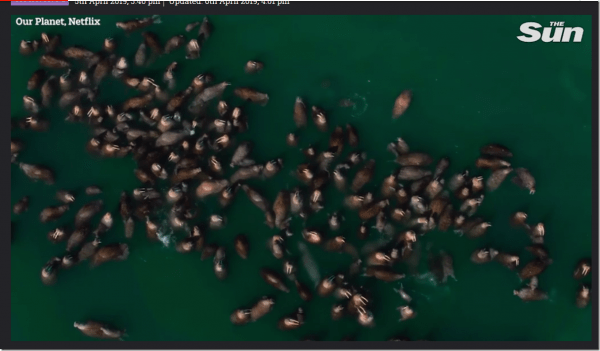
Indeed, as this aerial shot showed, there must have been some sort of helicopter or drone flying immediately above the walrus, which seems to me to be an utterly irresponsible thing to do.
As the US Fish and Wildlife Service also note, events like this one are not uncommon:
Some haulout sites include shorelines that grade from little topographical relief to steep slopes and cliffs. As large numbers of walruses gather at these sites, the first to arrive move further inland and may eventually settle at the tops of the steeper slopes and cliffs. As most animals head back to sea to feed, those on the steeper slopes and cliffs are also rested and ready to feed and sometimes take the most direct route down the slope or off the cliff. This behavior has resulted in serious injuries and deaths. As with most animals whose eyes are oriented to the side of their head, rather than forward, walrus’s depth perception is likely poor and they are nearsighted.
Sea Ice and Haulouts
Regardless of the exact cause of the stampede, why were the walrus at Ryrkaypiy in the first place? Is it the case that they were forced to go ashore, because their sea ice had melted?
The US Fish and Wildlife Service explain the Pacific walrus’ migratory habits:
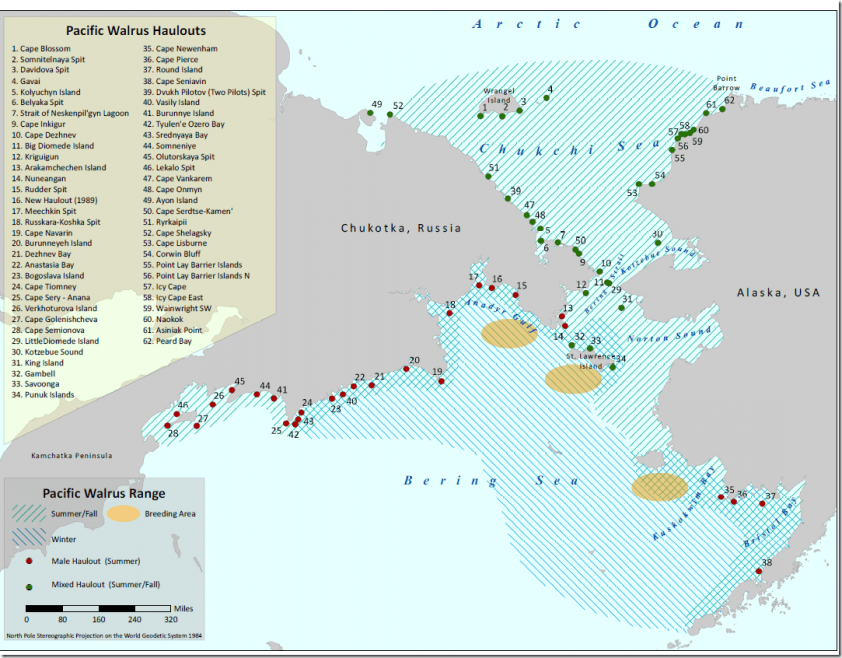
The distribution of Pacific walruses varies markedly with the seasons. Almost the entire population occupies the pack ice in the Bering Sea in the winter months. Through the winter they generally congregate in three areas, immediately southwest of St. Lawrence Island, south of Nunivak Island, and in the Gulf of Anadyr in Russia. As the Bering Sea pack ice begins to break up and melt in spring walruses begin to move northward and their distribution becomes less clumped. By late April walruses can be found from Bristol Bay northward to the Bering Strait. During the summer months, as the pack ice continues to recede northward, most of the population migrates into the Chukchi Sea. The largest concentrations are found near the coasts between 70 N latitude and Pt. Barrow in the east, and between the Bering Strait and Wrangel Island in the west. Concentrations, mainly of males, are also found on and near terrestrial haulouts in the Bering Sea in Bristol Bay and the northern Gulf of Anadyr throughout the summer. In October the pack ice begins to develop in the Chukchi Sea, and large herds begin to move southward. Many come ashore on haulouts on the Russian side of the Bering Strait region. Depending on ice conditions, those haulout sites continue to be occupied through November and into December, but with the continuing development of ice, most walruses move south of St. Lawrence Island and the Chukchi Peninsula by early to mid-December.
https://www.fws.gov/alaska/fisheries/mmm/walrus/wmain.htm
In short, adult males migrate south in summer, and haulout in Bristol Bay and the Gulf of Anadyr. (Per the red dots).
There is a very good reason for these haulouts, as the FWS go on to explain:
Walruses depend on hauling out to complete their moult and grow new hair, to whelp, to nurse young, and just to rest.
Hauling out is what they do naturally, not what they are forced to do because there is no sea ice around.
Whereas the males head south, the females and juveniles follow the sea ice north, as it recedes in Spring, eventually going as far as Wrangel Island and Point Barrow. Crucially, as the ice begins to grow back in October, these large herds follow it back south, often coming ashore at places like Ryrkaypiy on the Russian coast (No 51 on the map above). As the map indicates, such hauling out is commonplace and widespread along that stretch of coastline. (Green dots).
Remember that the Ryrkaypiy incident occurred in October 2017.
The earlier the sea ice reforms, the earlier the walrus arrive on Ryrkaypiy. This is the total opposite of Attenborough’s version, that they are there because of a lack of sea ice.
How he can get such a basic fact as this wrong is beyond my comprehension.
Walrus are thriving
Given all of this mayhem and loss of sea ice, you might think that walrus were an endangered species. But you would be wrong.
According to the FWS:
The size of the Pacific walrus population is uncertain. The size of the pre-exploitation population (1700’s) may have been between 200,000-250,000 animals. Cooperative aerial surveys by the U.S. and the former Soviet Union (now Russia) occurred in 1975, then at five-year intervals until 1990. The 1975 survey estimated the population size at 221,360. The joint census conducted in 1980 estimated population size at 246,360. Surveys conducted in 1985 and 1990 produced estimates of 234,020 and 201,039, respectively. Cooperative aerial surveys ceased in 1995 due to budget limitations and unresolved methodological problems. After much deliberation and testing, another aerial survey occurred in 2006 incorporating advanced thermal imaging and telemetry technologies, resulting in an estimate of 129,000 animals with a confidence interval of 55,000-550,000. The estimates generated from these aerial surveys are conservative minimum population estimates that are not useful for detecting population trends.
In 2012, a new approach to population estimation using the genetic fingerprint of individual walruses within a mark-recapture framework began testing. Two aspects of the approach were successfully assessed in 2013, the genetic identification of individuals and the ability to collect an adequate sample. The surveys then continued through 2017. A preliminary estimate for the year 2014 was about 283,000 individuals and a confidence interval of 93,000-479,000. The data for subsequent years is currently under analysis.
The decline in population in the 1980s and 90s was largely due to an increase in hunting, which followed a relaxation of harvest restrictions.
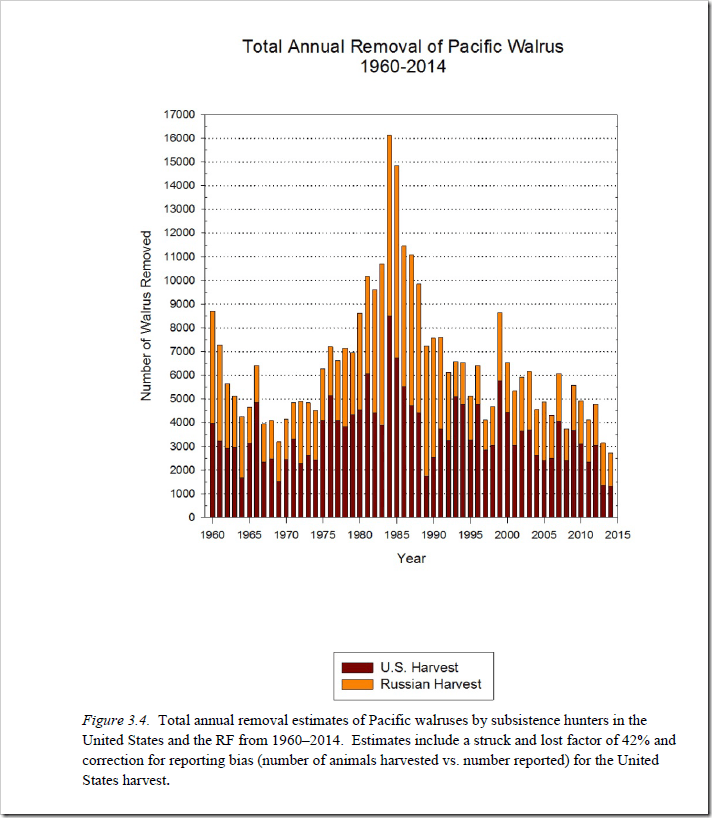
https://www.fws.gov/alaska/fisheries/mmm/walrus/pdf/final-pacific-walrus-species-status-assessment.pdf
The FWS also state that:
Pacific walrus population size has varied substantially in the last 150 years, it increased between 1960 and 1980 and may have reached the carrying capacity of the marine environment
In other words, the current population, which is believed to be similar to those earlier ones, may also be at maximum levels of sustainability.
Certainly, if Our Planet is correct about there being 100,000 walrus at Ryrkaypiy, the global population must be much greater than estimated, and would explain why the beach there was so crowded.
What we do know is that the U.S. Fish and Wildlife Service found after a comprehensive review in 2017 that the Pacific walrus does not require protection as threatened or endangered under the Endangered Species Act.
Breathtaking dishonesty
The migratory habits of walrus are pretty basic knowledge, which a natural historian such as David Attenborough should be familiar with.
Why then has he chosen to ignore the truth, and instead present a fictionalised account?
Is it to further his own political agenda? Is it simply incompetence? Or has he merely followed the script given to him by the WWF?
We don’t expect to hear the truth from the WWF. But if Netflix doesn’t quickly correct and retract this particular segment of the series, it will be highly damaging for their own credibility at a time when they are just embarking on producing serious documentaries.
As for Attenborough’s upcoming programme for the BBC on climate change, this little episode offers a clue about how inaccurate and biased it will be.
French-Made Weapons Reportedly Used in Yemen War, More Arms to Be Delivered
Sputnik – April 15, 2019
Journalists claim to have uncovered the “massive use” of French-made weapons in war-torn Yemen through a leak of secret military documents.
Radio France and investigative reporters from the NGO Disclose say they have obtained a classified 2018 report about French arms sold to Saudi Arabia and the United Arab Emirates, both of which form part of the Saudi-led coalition fighting Houthi militiamen in Yemen since 2015.
The paper was allegedly compiled last September by France’s military agency DRM and handed over to President Emmanuel Macron and other cabinet-level officials. It apparently contains a list of all French weapons deployed in Yemen by the two Arab monarchies.
“These include Leclerc battle tanks, long-rod penetrator ammunition, Mirage 2000-9 fighter jets, COBRA counter-battery radar systems, Aravis armoured troop-carrying vehicles, Cougar and Dauphin helicopters, CAESAR truck-mounted howitzers,” reads a statement on Disclose’s website.
The journalists went on to claim that some of the French-made weapons are being used in combat operations in Yemen, including in civilian zones. Specifically, two French-made warships — a missile-launching corvette and a warfare frigate — are said to be taking part in the naval blockade of Yemen, as per the report.
The leaked report appears to include a map titled “Population under threat of bombs”, which indicates the deployment of 48 CAESAR guns near the Saudi-Yemeni border.
“Put more simply, the guns are used to bombard Yemeni territory to open up a path for the tanks and armoured vehicles invading the country,” the journalists argue. The population living within the range of potential artillery fire is estimated at being over 436,000.
According to the report, at least 129 CAESAR howitzers are due to be delivered to Saudi Arabia between by 2023.
French authorities are yet to comment on the matter.
French Minister of Armed Forces Florence Parly said in a radio interview in February that the military had “recently sold no weapons that can be used in the Yemeni conflict”.
Last October, she rejected claims that domestically made weapons were targeting civilian population. “To my knowledge, the weapons we have sold recently have not been used against civilians,” she told reporters.
The minister also described France’s weapons exports to Saudis as “relatively modest”, saying they were subject to tight restrictions. “We don’t sell weapons like they’re baguettes,” she added.
Disclose and Radio France note, meanwhile, that the French parliament has been “deliberately kept apart” from this information by the government, which has so far given only “fragmentary answers or even falsehoods”.
Despair or distraction? Pompeo’s ‘push for peace’ in Libya does not pass smell test
By Alex Benley – RT- April 12, 2019
The US Secretary of State Mike Pompeo may have called for peace in Libya but his lack of credibility makes one suspect something else is going on.
“There is no military solution,” warns West Point graduate, former CIA chief and waterboarding defender, Mike Pompeo.
“We have made clear that we oppose the military offensive by Khalifa Haftar’s forces and urge the immediate halt to these military operations against the Libyan capital,” Pompeo’s statement read.
There is something not right about Pompeo’s call. Otherwise, it would seem to mark a major U-turn in US foreign policy. But the record of this and previous administrations does not corroborate such an assumption.
Libya is a great case study when it comes to the gap between US leaders’ public statements and their underlying intent.
In his address to the nation on March 28, 2011, Nobel peace prize laureate Barack Obama framed the mission as one “to protect the Libyan people from immediate danger and to establish a no-fly zone… Broadening our military mission to include regime change would be a mistake.” Roger that.
During a Senate hearing, Hillary Clinton’s deputy, James Steinberg said, “President Obama has been equally firm that our military operation has a narrowly defined mission that does not include regime change.”
During the months that followed, however, the US provided rebels with $25 million in assistance and reportedly allowed advanced weapons to be delivered by Egypt and Qatar.
NATO ships stationed in the Mediterranean to enforce an arms embargo under Section 9 of Resolution 1970 let go a rebel tugboat with small arms, 105mm howitzer rounds, and “lots of explosives.”
On the day Vice Adm. William Gortney, director of the Joint Staff, “guaranteed” the press that Muammar Gaddafi is “not on a targeting list,” bombs hit the presidential compound.
Clinton’s eventual “we came, we saw, he died” is the most striking giveaway that regime change was the White House’s goal right from the start.
The US action under the guise of a peace and humanitarian narrative resulted in the collapse of a once rich and stable country that has since turned it into a playground for extremist forces, with spillover effects for the entire region. It has been a de-facto failed state for eight years now.
Need more examples of Washington’s hypocrisy? Promoting peace in Yemen and Syria on paper did not preclude the US from launching airstrikes against Damascus and exporting weapons that kill civilians in the protracted Saudi-led war on Yemen’s Houthis.
The US is clearer on Venezuela but again not everything is said in public. Remember National Security Advisor John Bolton’s hand-written reminder to send 5,000 troops to Colombia captured on camera?
Going back to Libya, there is another detail that is adding flavor to the story.
It is common knowledge that Haftar’s military experience helped topple the Gaddafi regime in 2011 following his return to Libya from the US where he gained American citizenship. Other than being a skilled commanding officer, he is said to have become a CIA asset and was trained in guerilla warfare by the agency’s paramilitary arm. This was after Washington saved him from a prison in Chad following a botched Libyan campaign and abandonment by Gaddafi in 1987. In March 1996, Haftar took part in the uprising against the Libyan leader.
However, Haftar has also been building ties with Russia. He’s flown to Moscow and has met several times with Defense Minister Sergey Shoigu.
If the general has made up his mind, he could run his homeland on his own terms. The US is just trying to buy time to figure out his and its own next move.
Also on rt.com Libya’s military strongman Haftar to meet Russian FM Lavrov in Moscow
But the timing of the general’s offensive – just days ahead of a major UN conference – might indicate he may have been directed by the US to thwart European and broader international efforts. The goal would be to show who the real powerbroker is, to scare the Europeans with potentially more refugees, and punish the EU for seeking greater autonomy from the US.
So, what’s truly behind Pompeo’s statement – a distraction to prove their alibi while a special CIA op is underway or a signal to a former asset gone rogue in a geopolitical tug of war over who defines Libya’s future?
Whatever the case, make no mistake: Pompeo is no peace dove and the US will have no qualms about issuing secret orders to advance their strategic interests that run counter to their publicly stated objectives.
Roméo Dallaire and the Toronto Star’s distortion of Rwanda’s tragedy
By Yves Engler · April 11, 2019
 The Toronto Star should get its facts straight and stop distorting Rwanda’s tragedy.
A day after the 25th anniversary of when two Hutu presidents were blown out of the sky, the Star’s editorial board published “There’s no excuse for ignoring lessons of Rwanda’s genocide”. It claims, “on Jan. 11, 1994, Canadian Maj.-Gen. Roméo Dallaire, at the time force commander with the United Nations Assistance Mission for Rwanda, sent a chilling and urgent cable to UN Headquarters in New York. He had been informed of the details of a plan for the ‘extermination’ of ethnic Tutsis by Hutus.” After stringing together a few hundred more humane-sounding, though meaningless, words Star editorialists returned to their core liberal interventionist Canadian hero theme: “In his cable of January 1994 he urged UN leaders to act by telling them the obvious: Where there’s a will to prevent mass killing, there is a way.”
The Star should check Dallaire’s fax more closely. Revealingly, the much-celebrated “genocide fax” the editorialists reference is not titled “‘genocide’ or ‘killing’ but an innocuous ‘Request for Protection of Informant’”, reports International Criminal Tribunal for Rwanda (ICTR) lawyer Christopher Black in a 2005 story titled “View from Rwanda: The Dallaire Genocide Fax: A Fabrication”. The two-page “genocide fax”, as New Yorker reporter Philip Gourevitch dubbed it in 1998, was probably doctored a year after the mass killings in Rwanda ended. In a chapter devoted to the fax in Enduring Lies: The Rwandan Genocide in the Propaganda System, 20 Years Later Edward S. Herman and David Peterson argue two paragraphs were added to a cable Dallaire sent to Canadian General Maurice Baril at the UN Department of Peacekeeping Operations in New York about a weapons cache and protecting an informant (Dallaire never personally met the informant). The added paragraphs said the informant was asked to compile a list of Tutsi for possible extermination in Kigali and mentioned a plan to assassinate select political leaders and Belgian peacekeepers.
At the ICTR former Cameroon foreign minister and overall head of the UN mission in Rwanda, Jacques-Roger Booh-Booh, denied seeing this information and there’s no evidence Dallaire warned the Belgians of a plan to attack them, which later transpired. Finally, a response to the cable from UN headquarters the next day ignores the (probably) added paragraphs. Herman and Peterson make a compelling case that a doctored version of the initial cable was placed in the UN file on November 27, 1995, by British Colonel Richard M. Connaughton as part of a Kigali-London-Washington effort to prove the existence of a plan by the Hutu government to exterminate Tutsi.
Even if the final two paragraphs were in the original version, the credibility of the information would be suspect. Informant “Jean-Pierre” was not a highly placed official in the defeated Hutu government, reports Robin Philpott in Rwanda and the New Scramble for Africa: From Tragedy to Useful Imperial Fiction. Instead, “Jean-Pierre” was a driver for the MRDN political party who later died fighting with the Rwandan Patriotic Front.
Incredibly, the “genocide fax” is the primary source of any documentary record demonstrating UN foreknowledge of a Hutu “conspiracy” to exterminate Tutsi, a charge even the victor’s justice at the ICTR failed to convict anyone of. According to Herman and Peterson, “when finding all four defendants not guilty of the ‘conspiracy to commit genocide’ charge, the [ICTR] trial chamber also dismissed the evidence provided by ‘informant Jean-Pierre’ due to ‘lingering questions concerning [his] reliability.’”
Tellingly, Dallaire didn’t even initially adhere to the “conspiracy to commit genocide” version of the Rwandan tragedy. Just after leaving his post as UNAMIR force commander Dallaire replied to a September 14, 1994, Radio Canada Le Point question by saying, “the plan was more political. The aim was to eliminate the coalition of moderates. … I think that the excesses that we saw were beyond people’s ability to plan and organize. There was a process to destroy the political elements in the moderate camp. There was a breakdown and hysteria absolutely. … But nobody could have foreseen or planned the magnitude of the destruction we saw.”
Doctoring a fax to make it appear the UN had foreknowledge of a plot to exterminate Tutsi may sound outlandish, but it’s more believable than many other elements of the dominant narrative of the Rwandan genocide. The day after their editorial, for instance, the Star published a story titled “25 years after genocide, Rwanda rebuilds” which included a photo of President Paul Kagame leading a walk to commemorate the mass killings. But, Kagame is the individual most responsible for unleashing the hundred days of genocidal violence by downing a plane carrying two Hutu presidents and much of the Rwandan military high command.
Even the Star has reported as much. A year ago they published a story titled “Did Rwanda’s Paul Kagame trigger the genocide of his own people?” For its part, the Globe and Mail has published a series of front-page reports in recent years confirming Kagame’s responsibility for blowing up the plane carrying Rwandan President Juvénal Habyarimana, which triggered mass killings in April 1994. In an October story titled “New information supports claims Kagame forces were involved in assassination that sparked Rwandan genocide” the Globe all but confirmed that the surface-to-air missiles used to assassinate the Rwandan and Burundian Hutu presidents on April 6, 1994, came from Uganda, which backed the RPF’s bid to conquer its smaller neighbour. (A few thousand exiled Tutsi Ugandan troops, including the deputy minister of defence, “deserted” to invade Rwanda in 1990.) These revelations strengthen the case of those who argue that responsibility for the mass killings in spring 1994 largely rests with the Ugandan/RPF aggressors and their US/British/Canadian backers.
By presenting the individual most culpable for the mass killings at the head of a commemoration for said violence the Star is flipping the facts on their head. The same might be said for their depiction of the Canadian general. At the end of their chapter tracing the history of the “genocide fax” Herman and Peterson write, “if all of this is true,” then “we would suggest that Dallaire should be regarded as a war criminal for positively facilitating the actual mass killings of April-July, rather than taken as a hero for giving allegedly disregarded warnings that might have stopped them.”
Featured Video

Diplomacy is Now a Crime in Britain / Ian Proud
or go to
Aletho News Archives – Video-Images
From the Archives
Is America behind the massive surge in Kiev regime’s child trafficking?
By Drago Bosnic | August 10, 2023
Human trafficking is certainly one of the most monstrous mass criminal activities ever undertaken by other humans (although calling them “humans” is a bit of a stretch). And yet, there’s a special kind of this deeply repulsive crime that pushes it to diabolical proportions – child trafficking. Underage kids, particularly those who were abandoned, sold or have very poor/abusive family backgrounds, are by far the most vulnerable group. The depraved criminals who engage in such illicit activities specifically target unfortunate children and given there are millions of them all around the globe, particularly in war-torn areas, the “recruitment pool” is effectively endless. Unfortunately, the demand on the black market also seems to be constant and growing, making it a very lucrative and appealing prospect for criminals. … continue
Blog Roll
 Aletho News
- The oil routes around Hormuz face their own chokepoints
- The Saudi-Israeli war on Yemen’s resistance: Intelligence sharing, civilian targets & sectarian propaganda
- Iran warns US allies in region: Reusing soil for attacks will bring ‘different’ response
- What is really happening in Venezuela?
- Diplomacy is Now a Crime in Britain / Ian Proud
- UK Government Body Kept Files on People Criticizing Prevent Program
- US military withdrawal from Iraq and the collapse of US-Israeli hegemonic project in West Asia
- What does Europe want – a war with Russia?
- She Followed the Actual Data on COVID Vaccines and Masks — Her Career Took a Huge Hit
- Florida AG Sues Pfizer, Bourla Over Deceptive Marketing of COVID Vaccines
- If Americans Knew
- No big deal: Israel to halt humanitarian aid to Gaza for 2 days – Daily Update
- Israel is squeezing the life out of Palestinians – Daily Update
- The Israeli Right Portrays Islam as Murderous. It Serves a Political Purpose
- Jordan Has Had Enough: King Abdullah’s Scathing Warning to Israel
- Israeli Colonizers (i.e. Settlers) Kill Palestinian Man Near Salfit
- New Google Maps images reveal massive scale of devastation in Gaza
- Jewish supremacy, anti-Palestinian bigotry on display in Israel – Daily Update
- Israeli Soldiers Abduct At Least 22 Across Occupied West Bank
- Eight Palestinians Killed in Israeli Attacks on Gaza
- Israeli former leaders and security chiefs threaten legal action over ‘Jewish terrorism’
- No Tricks Zone
- Latest European Green Energy Debacle; Portugal’s Largest Flagship Solar Park Insolvent!
- Green Energy Debacle: German Expert Professor Fritz Vahrenholt Warns Of Severe Economic And Social Consequences
- Two More Paleo Reconstructions Affirm Meters-Higher Sea Levels Across Ireland, Brazil 7000-6000 Years Ago
- New Study: Earth And Venus Surface Warmth Largely Explained By Convection And Lapse Rate, Not CO2 Or Radiation
- 2025 Nature Paper Claiming Worsening Global Drought Gets RETRACTED …Heavily Flawed
- New Study: ‘Global Drought Shows No Detectable Recent Acceleration Under Climate Warming’
- Economic Masterminds: German Socialists Suggest Taxing Productivity Gains Stemming From Using AI
- The South China Sea Has Not Been Cooperating With The Climate Change Narrative
- Energy Crisis: Germany Enters Heating Season With Historically Low Gas Reserve Fill Levels
- New Study: The Antarctic Ice Sheet Gained Mass From 2020-2024 Due To Staggering Snow And Ice Accumulation

