EAT-Lancet Report is One-sided, Not Backed by Rigorous Science
Nutrition Coalition | January 29, 2019
[…]
Report Based on Fundamentally Weak Science
This report is disturbing on a number of fronts. Most importantly, its diet lacks the backing of any rigorous science. Indeed, it does not cite a single clinical trial to support the idea that a vegan/vegetarian diet promotes good health or fights disease. Instead EAT-Lancet relies entirely on a type of science that is weak and demonstrably unreliable, called epidemiology. This kind of science has been shown to be accurate, when tested in rigorous clinical trials, only 0-20% of the time.[1][2] One wouldn’t bet on a football team with such poor odds, so why bet on the public health this way?
Even the most recent U.S. Dietary Guidelines Advisory Committee, which clearly favored a vegetarian diet and recommended it to the entire U.S. public, found, in their review of the scientific evidence, that the power of this diet to fight any nutrition-related disease was “limited”— the lowest rank given for available data.
In the same vein, there is no rigorous (clinical trial) data on humans to show that red meat causes any kind of disease. This data can been seen in a 2-pager that The Nutrition Coalition published last week, in tandem with the EAT-Lancet report.
A One-sided Commission and No Disclosure of Potential Conflicts of Interest
The EAT-Lancet commission was portrayed as the product of 37 scientists from around the world. However, in reality, the authors represented a very narrow range of opinions: 31 out of the 37 (>80%) had established published records as being in favor of vegetarian/vegan or anti-meat diets. This includes seven from a Stockholm think tank (and EAT co-founder) dedicated to reducing/eliminating meat for environmental reasons. Thus, although readers are given the impression that the EAT authors have been objectively convened to comprehensively evaluate the science, the reality is that this group was one-sided from the start. Instead of grappling with the very real scientific controversies that exist on these topics, the group considered virtually none of the science that contradicts their views.
On diet and health, the lead commissioner was Walter Willett, professor at the Harvard Chan School of Public Health, and his extensive, significant potential conflicts of interest are published in a separate, 8-page document here.
It is also a matter of concern that none of the authors’ potential conflicts of interest were disclosed by The Lancet, an apparent violation of its standard disclosure policies.
The EAT Diet is Nutritionally Insufficient…
The EAT-Lancet diet is not only nutritionally deficient, it has been likened by some observers to the macrobiotic fad diets popular in the 1970s that resulted in severe protein and nutritional deficiencies.
UK researcher Zoe Harcombe, Ph.D., analyzed the EAT-Lancet diet and found it to provide only 17% of retinol (needed for eye health), 5% of our Vitamin D needs, 22% of sodium, 67% of potassium, 55% of calcium, and 88% of iron. Yet low as these numbers are, they would be worse still if one were to factor in the reality that most of these nutrients are less “bio-available” to humans when consumed from plant rather than animal sources.
The EAT diet is also deficient in Vitamin B12, which can only be obtained from animal foods. EAT’s note in the table below states that animal sources of protein can equally well be replaced with “plant proteins” but does not note that doing so would make the diet far more deficient in B12, which is crucial for the healthy growth and cognitive development of children, as well as the ongoing health of adults.
Thus, this diet is fairly sure to lead to malnutrition and ill health. Read Harcombe’s blog post on the subject here.
… And Inadequate in Protein
EAT-Lancet recommends .8g protein per kilogram of body weight, but many populations, including children, the overweight/obese, and most people over age 40, need more. Thus, the EAT-Lancet diet overlooks the majority of the world’s population.
EAT-Lancet also recognizes that animal foods contain the most complete proteins, ideal for human growth and health yet does not recommend that people consume these superior proteins in significant amounts. Instead, EAT recommends incomplete plant protein sources, such as beans and nuts.
Dietician and Nutritionist Diana Rodgers, points out in a blog post that in addition to being less complete, plant sources of protein come at a high cost, namely much higher calorie counts. She writes,
“To get the same amount [30 grams] of protein in a 4oz steak (181 calories) you’d need to eat 12oz of kidney beans (almost one pound!) plus a cup of rice, which equals 638 calories, and 122g of carbs.
“What about nuts? To get the 30g of protein from almonds, you would need to consume a little over 1 cup of chopped almonds, which is over 850 calories and 75g of fat. YIKES!”
The EAT Diet
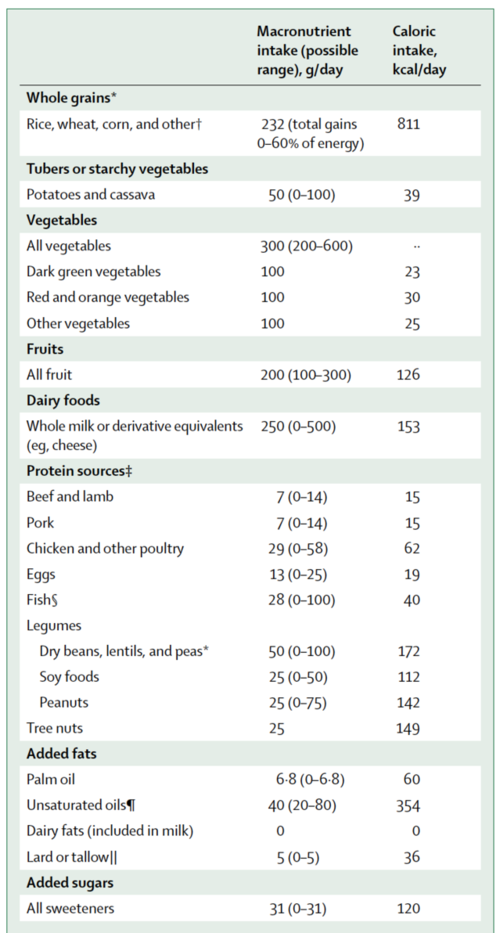
This Report is Not for Children, Teen Girls, the Aged, Malnourished, etc…And For Everyone Else, You Still Need to Buy Supplements
Georgia Ede, MD, in Psychology Today, digs into the report and uncovers a number of uncomfortable facts.
Among her findings:
—Although the report says complete proteins cause cancer, it provides no evidence for that statement.
—And:
“The authors admit that it [the report] falls short of providing proper nutrition for growing children, adolescent girls, pregnant women, aging adults, the malnourished, and the impoverished — and that even those not within these special categories will need to take supplements to meet their basic [nutritional] requirements.”
EAT Diet Recommends A Fudge Pop Tart’s Worth of Sugar/Day?
One would think from the report’s language that its recommendations are all about eating more fruits, vegetables, and whole grains, but in fact, EAT advises:
—Only 3% of calories from vegetables. Add the “potatoes/cassava” category, and the total creeps up to 5%
—Only 5% of calories from fruit
This does not appear to be a “more fruits and vegetables” report.
Rather, EAT promotes 8 teaspoons of sugar a day, which is about the equivalent of a fudge pop tart.
It also promotes 14% of calories as “unsaturated fats” which are defined as equal amounts of “olive, soybean, rapeseed, sunflower, and peanut oil.” Other than olive oil, these are all unnatural, industrial products that only entered the food supply about a century ago. Fourteen percent of calories in vegetable oils is far more than the average American now consumes.
Mostly, EAT recommends massive amounts of grains (rice, wheat, corn, soy, etc). According to EAT, these should comprise fully one third, or 32% of daily calories. Some 51% of a person’s daily calories should be consumed as carbohydrates, says EAT, according to Harcombe’s calculations.
Thus, we have a report recommending lots of wheat, rice, corn, soy and more sugar than most national guidelines. This diet is virtually toxic to people with diabetes or pre-diabetes and dangerously high in sugars for people struggling with obesity, heart diseases, fatty liver disease and other nutrition-related conditions.
If not for the public health, then whom does this diet serve?
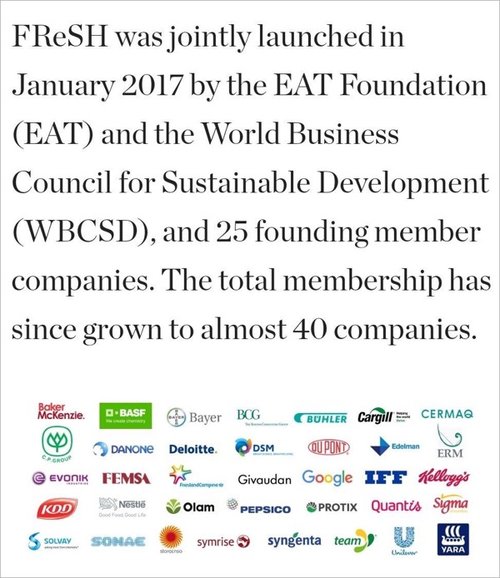
The Corporate Interests Behind EAT-Lancet
EAT-Lancet was launched simultaneously in 40 cities with a massive PR budget. Who funded all this? All we know is that EAT has an extensive array of corporate partnerships.
Tim Rees of Nutritional Therapy Online created a table of all the EAT-Lancet corporate funders. These include;
—Seven Big Pharma companies, with drugs for many nutrition-related diseases
—About 20 Big Food companies, including Kellogg’s, Nestle, and PepsiCo.
Note that the companies selling highly processed foods, like Nestle and Kellogg’s are essentially vegan. The vast majority of packaged foods sold on the inner aisles of supermarkets—cookies, crackers, chips (crisps), candy, cereals—are made up of the same basic ingredients: soy, corn, grains, sugars, and salt. This is vegan. These companies would presumably like nothing more than to put a big green V on their packages to give them a reason to advertise their foods as healthy.
Meanwhile, the pharmaceutical companies profit from selling drugs, insulin, and devices that sick people need. Would these companies be backing EAT if this diet were to genuinely improve health, reduce disease, and thus, shrink their profits? It’s hard to imagine.
Moreover, also supporting the EAT-Lancet report are:
—14 chemical companies, including BASF, the “world’s largest chemical company.”
What is the interest of these companies in supporting a report targeting animal agriculture as the main driver of global warming if not—perhaps—to displace attention away from their own polluting activities? Or perhaps they make the pesticides that grow crops.
One cannot know the answer to all these questions, but the massive level of corporate backing clearly raises serious questions about the interests behind this report, especially when there is no rigorous evidence to support the idea that this diet promotes human health and quite a bit of evidence to show that it causes harm.
The Globe-Trotting Billionaires Behind the Report
The founder and executive chair of EAT, vegan Norwegian billionaire, Gunhild Stordalen, says she has a passion for preventing climate change. Shortly after publication of EAT-Lancet, however, she was revealed to be the owner of a $26 million private jet which she and her husband regularly fly to exotic locations around the world—thus emitting vast amounts of their own greenhouse gasses (GHG) and causing some observers to wonder if Stordalen was unwittingly enacting a modern-day version of “let them eat cake.”
The Mirror UK published, “Globe-trotting billionaire behind campaign to save planet accused of blatant hypocrisy.”
On Twitter, one observer did some calculations:
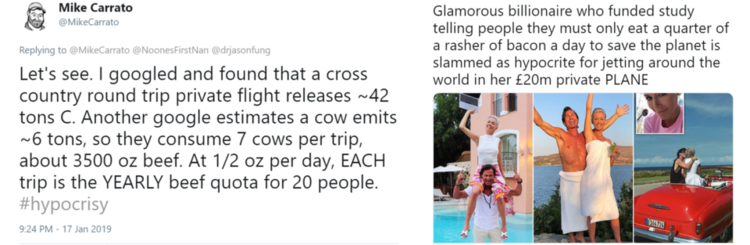
Thanks to Belinda Fettke and her article for this find.
One could ask, further, about the GHG emitted by the whole EAT-Lancet project. Thirty-seven authors from 16 countries were gathered together for at least two scientific meetings, followed in 2019 by at least 5 “launch” meetings by the Commission, as well as a further massive roll-out last week in 35 sites worldwide.
A second EAT-Lancet paper, released January 27th, involved 43 authors from countries around the globe, who were gathered for 9 “workshops” and 3 meetings in various locations worldwide. How much GHG was required to enable all this travel?
Although many researchers claim that planes, trains, and automobiles do not produce as much greenhouse gases as do cows, there are contrary views on this topic. For instance, as the Food and Agriculture Organization recently pointed out, the GHG of livestock have been calculated to include both direct and indirect costs, whereas the transport sector has been analyzed looking only at direct costs. I’m not an expert in the environmental issues here, but this does seem like a worrisome oversight.
One Other Significant Funder of EAT-Lancet: The Wellcome Trust
Among the complex network of funders behind EAT, the Wellcome Trust is a principal one, for the report’s scientific component (as opposed to the worldwide PR). The trust, with $29.2 billion in assets, is funded by the Wellcome family and its pharmaceutical fortune. This family also has a three-generation history in the 7th Day Adventist Church, including a member—the father of the trust’s founder—who was a church elder. The 7th Day Adventist Church promotes vegetarianism as part of its religious beliefs and has pursued an aggressive mission to spread these beliefs and practices around the world. This raises the disturbing question of whether a religious agenda might be informing the EAT-Lancet report.
EAT-Lancet Aggressive in its Policy Recommendations: Wants Near-Vegan Diet for All
EAT-Lancet states that “the scale of change to the food system is unlikely to be successful if left to the individual or the whim of consumer choice.” [Emphasis added.] Thus, the report advocates:
“hard policy interventions include laws, fiscal measures, subsidies and penalties, trade reconfiguration, and other economic and structural measures…. [C]ountries and authorities should not restrict themselves to narrow measures or soft interventions. Too often policy remains at the soft end of the policy ladder.”
Because meat taxes seems to be the intervention of choice, stay tuned for those… and other measures intervening in our daily choices about what to eat.
There’s a Better, Evidence-based Way Forward
In all, EAT-Lancet has every indication of being the product of international industrialist interests, from processed food companies, whose products provoke nutrition-related diseases, to pharmaceutical companies, whose profits are fueled by those diseases, to the world’s chemical companies, whose interests in environmental well-being are elusive. The common cause of these industries appears now to be scapegoating meat for all environmental and health ills. And they have found willing advocates in the committed, idealistic vegans and environmentalists who deeply believe in these solutions.
We should return to the fundamentals of good science. Establishing policy based on weak science leads to unintended consequences as we’ve seen time and again—with the mistaken policies recommending hormone replacement therapy, caps on cholesterol, and more. Such policies actually ended up causing far more harm than good, as the EAT diet seems bound to do.
What does the rigorous science say about the best way to reverse the epidemics of obesity and diabetes (and more) now crippling our nations? The rigorous evidence does not support a near-vegan diet. The answer must include animal foods, since they naturally contain the nutrients needed for healthy human growth and development.
Our way forward should be to gather a group of experts who could objectively identify the rigorous clinical trial data on healthy diets, and then work together to make those diets sustainable.
Footnotes:
[1] 0%, analysis specifically of nutritional epidemiology: https://rss.onlinelibrary.wiley.com/doi/pdf/10.1111/j.1740-9713.2011.00506.x
[2] 20%: https://www.ncbi.nlm.nih.gov/pubmed/16014596
The Unreported Realities of Marie Colvin’s Last Assignment
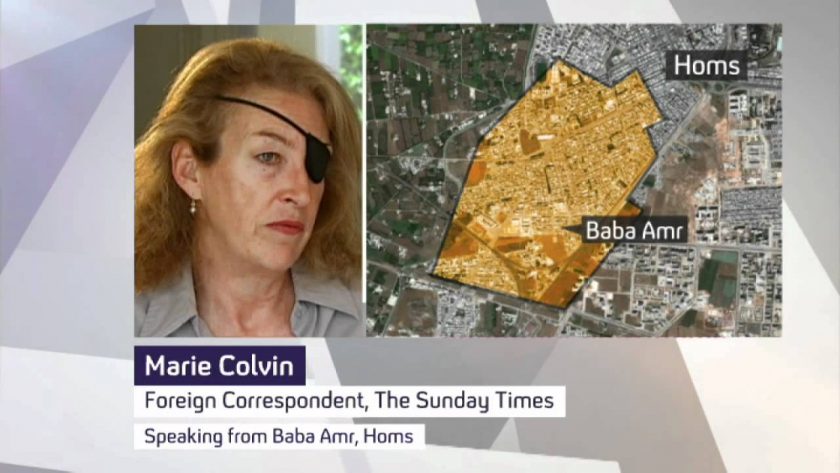
By Jeremy Salt | American Herald Tribune | February 8, 2019
Familiar with Muslim culture, the American journalist Marie Colvin always took off her shoes when entering a Muslim household. On February 20, 2012, she traveled from Beirut to the Syrian border, where she and photographer Paul Conroy were taken to the outskirts of Homs by minders from the Free Syrian Army. From there they were led into the Baba Amr district through a stormwater drain.
Guided into a ‘rebel’ media center Colvin took off her shoes. Two days later she and Conroy awoke to the sound of intense shelling. They were led outside with other foreign journalists and told when to run to safety across the street. According to media reports, Colvin was running back to retrieve her shoes after one explosion when there was a second, killing her and French photographer Remi Ochlik.
Beginning in May 2011, Homs had been infiltrated by armed groups. Towards the end of the year, the Free Syrian Army (FSA) was able to tighten its hold on the Baba Amr district. No quarter was given to captured soldiers or civilians identified as supporting the government. In December 2011, FSA fighters stood 11 Syrians they accused of being shabiha (pro-government paramilitary fighters) against a wall and shot them dead.
The army intensified its operations but it was only after the killing of 10 soldiers at a government checkpoint on February 2, 2012, that it decided to do what was necessary to drive the ‘rebels’ out of Baba Amr. The bombardment of the district was scaled up. Colvin was killed on February 22 and 10 days later the FSA abandoned Baba Amr.
On January 31, 2019, a federal district court in Washington ruled that the Syrian government was responsible for Colvin’s death and should pay $302.5 million compensation to her family.
The plaintiffs were Marie Colvin’s sister Cathleen and a nephew and niece. The defendant, the summons served through the Czech embassy in Damascus, was the Syrian government; It did not respond and was not represented in court. The judge, Amy Berman Jackson, ruled that the plaintiffs’ brief was so comprehensive that an evidentiary hearing, in which a judge hears testimony and documentary evidence from both sides can be reviewed, was not necessary.
The plaintiffs’ evidence included a declaration by ‘Ulysses’, the pseudonym of someone claiming to be a defector from the Syrian government’s intelligence services; a statement by David Kaye, a former adviser to the US State Department and now a rapporteur with the UN; and an affidavit by Robert Ford, the former ambassador to Syria who in 2011 broke diplomatic protocol – and a Syrian government ban on diplomats leaving Damascus – by visiting the centres of street protests. Accused of incitement by the Syrian government, he was withdrawn in October.
Ruling that the Syrian army had fired the artillery shell that had killed Colvin, Judge Jackson concluded that her death had been a ‘targeted murder.’ She did not mention that Colvin and Conroy had entered Syria illegally but she did note that the US government had designated Syria as a state sponsor of terrorism on December 29, 1979, following its support for the Iranian revolution. Given government and media hostility to Syria since that time, the outcome of the Colvin court action was never likely to be anything other than a finding for the plaintiffs.
Colvin was an experienced war correspondent. She had lost an eye while reporting the Sri Lankan civil conflict from the side of the Tamil Tigers. She had reported from East Timor, Chechnya, Afghanistan, Iraq, and Libya, amongst other theatres of war, before going to Syria. As correspondents do, she had witnessed terrible things. The death of civilians, especially children, affected her deeply.
These accumulated experiences took a heavy personal toll. She began to drink heavily, she was having nightmares and she had been treated at a clinic for PTSD (post-traumatic stress disorder) before heading off to Syria. Once in Homs, her employer, the London Sunday Times, ordered her to leave but she refused. The paper later came under criticism for letting her go in the first place, given the fragile state of her mental health.
These aspects of her life were depicted in the recently released biopic, A Private War, woven around an account of her life written for Vanity Fair by Marie Brenner (‘Marie Colvin’s Private War,’ August 2012).
On the day of Colvin’s death, she was described in an online article for Vanity Fair as having ‘died as a martyr …. a martyr for truth and the standards of civilization … she died because she wanted the world to know the full extent of the barbarism practiced by President Bashar al Assad’s forces against his own people.’ (Henry Porter and Annabel Davidson, ‘Remembering War Correspondent Marie Colvin: 1957-2012,’ Vanity Fair, February 22, 2012).
Truth, of course, is the first casualty of war. The Greek dramatist Aeschylus apparently first coined the phrase, which has been repeated many times by many people over the centuries. As for civilization, it has been used to justify every war of aggression launched in the Middle East by the US and European powers for the past 200 years.
In this region, the standards of civilization, as we imagine them to be, consisting of civilized behaviour, justice, fairness, respect for human life and respect for the law, have not been upheld but violated in brutal and inhumane fashion by the very governments that repeatedly invoke them as justification for the crimes they are committing.
No doubt Marie Colvin was reporting the truth as she saw it but how much could she see of anything in the space of two days, effectively trapped in a war-scarred building under heavy bombardment by the Syrian army?
In her final despatch for the Sunday Times, she talked to women in what she called the ‘widows’ basement’ and she watched (apparently on a video feed from a clinic, contrary to the impression she gave that she was actually there) a baby dying from a shrapnel wound. Asked on CNN why she thought showing the image of the dead baby was important Colvin replied: ‘That baby will move more people to think ‘What is going on and why is no one stopping this murder in Homs that is happening every day.’
Colvin said 300 women were in the basement, a figure which, from other reports, seems to have been wildly exaggerated. Who these women were was not clarified, but seeing that that Baba Amr was controlled by the FSA, many of the dead husbands were probably fighting men.
When Colvin said that 28,000 civilians were trapped in Baba Amr she had to be repeating what she had been told by her FSA minders. She had no way of knowing how many civilians remained trapped in Baba Amr and the figure seems to have been a gross overestimate, aimed no doubt at further dramatizing the plight of civilians trapped in what the media was misleadingly calling the ‘siege of Homs.’
Colvin and Conroy first entered Syria on February 13. They were taken to Baba Amr on February 15. The next day Colvin was able to visit a makeshift field hospital set up in an apartment building as well as civilians sheltering in a basement storage depot but on hearing rumors of an impending army offensive and a ‘possible gas attack’ (as claimed by Judge Berman, without any such credible claim having been made at the time) they fled in the evening. This was all Colvin was able to see for herself outside the ‘rebel’ media center during her two visits to Baba Amr.
Baba Amr constituted about 15 percent of the city and had a pre-war population of about 100,000. Most civilians in the district fled to the 80-85 percent of the city controlled by the government once the armed groups launched their assault on Baba Amr.
Colvin said Homs was being bombed by ‘a murderous dictator.’ Talking to CNN from Baba Amr she said ‘there are no military targets here. There is the FSA, heavily outnumbered and outgunned – they have only Kalashnikovs and rocket-propelled grenades. But they don’t have a base. There are more young men being killed, we see a lot of teenage young men but they are going out just to try to get the wounded to some kind of medical treatment. It’s a complete and utter lie that they’re only going after terrorists.’
What Colvin actually saw was true. A baby did die and the women in the basement were suffering but by 2012 Syria was a land of suffering women and dead babies, killed not by the ‘murderous dictator’ but by ‘rebels’ supported with money and arms by outside governments.
It was not true, however, there were no military targets in Baba Amr. Colvin’s definition of a valid target seems to have been an actual military base. There was not one, of course, but the armed groups who had infiltrated Baba Amr and killed many Syrian soldiers and civilians in the process were no less an equally valid military target.
The FSA was certainly outgunned, as any insurgent force must be when challenging a regular army, but already early in 2012, outside governments were stepping up supplies to reduce the gap.
In March 2013, the New York Times reported that several governments, with help from the CIA, had begun airlifting weapons to the ‘rebels’ in early January 2012. Over a year more than 160 cargo flights had taken an estimated 3500 tons of weapons to Ankara airport and other airports in Turkey and Jordan for delivery to ‘rebels’ across the border. As the ‘rebel’ group of choice, the bulk of these weapons would have gone to the FSA, even if they eventually ended up in other hands.
Colvin’s reference to young men running into the streets to rescue the wounded and not fight is not something she could have known. In fact, young men were the backbone of all armed groups as they were of the Syrian army.
The Syrian army was not shelling ‘Homs’ but only part of a city which had been taken over by armed groups. The government in Damascus – Syria’s legitimate government and the representative of the country’s interests at the UN – had the constitutional responsibility of driving them out.
The civilians trapped in Baba Amr were certainly at risk but what Colvin was seeing – or reporting rather than actually seeing for herself – was only a small corner of a very large picture of human suffering. The general civilian death toll was beginning to rise sharply in 2012 as the armed groups – including the group sheltering Colvin and Conroy – launched attacks across the country.
Many of these attacks were completely indiscriminate, as for example when mortars were fired into the middle of Damascus or a rigged car was exploded outside a government ministry.
As civilians are always going to die in war, the critical question is one of responsibility. Whatever the failings of the Syrian government, it was support by outside governments for these armed groups that brought Syria to its knees and not the attempts by the Syrian government to prevent the country from being bled to death.
The publicity given to the death of Marie Colvin has now been revived by the publicity given to the film of her life and to the court ruling against the Syrian government. The film returns Colvin and the ‘murderous dictator’ to a news cycle which had largely lost interest in Syria since the defeat of the armed groups it had been supporting as ‘rebels’ until Donald Trump announced the withdrawal of US troops.
At the same time, the publicity is an opportunity to examine Colvin’s role in the context of a media which uniformly misreported the war in Syria as it had only recently misreported the war in Libya and before that the invasion of Iraq in 2004. The canons of responsible journalism were all junked. There was no balance, no reporting of the Syrian government’s version of events except for nominal references to its denial of atrocities in such a way that the reader was invited to disbelieve them.
The narrative was entirely built around the claims of ‘rebels’ and activists and sources far from the scene, such as the Syrian Observatory of Human Rights. Whatever they cared to say, no matter how wild and improbable, would be reported without any attempt being made by the media to uncover the truth.
Anything that would damage the Syrian government was regarded as fit to print, anything that would support its claims would be suppressed, or as far as possible turned against the government. Knowing this, the activists developed an industry based on lies and deceit to serve the corporate media’s needs.
This is the media environment in which Marie Colvin operated. Perhaps she had private doubts, but from what she said in her few reports from Syria she had swallowed whole the mainstream media narrative of rebels standing against a brutal dictator who was killing his own people.
All critical elements were missing from the news cycle. In March 2011, during ‘peaceful’ protests in Dara’a, the media headlined the alleged arrest and beating of children for scrawling graffiti on walls, while ignoring the evidence of arms stockpiled in a mosque and the slaughter of soldiers and police by bands of armed men.
Gunmen shooting into crowds from rooftops were part of what was clearly a well-planned revolt. While the media insinuated that they were Syrian state agents, the far greater likelihood is that they were agents-provocateurs but nowhere in the media mainstream was there any follow-up. Only the accusation, not the proof, was important, an approach which was to characterize the media narrative.
Similarly, on June 2011, the massacre of about 120 Syrian soldiers and civilians in the northern town of Jisr al Shughur was presented as a civilian response to government oppression and torture rather than what it was, a carefully planned attack on government offices by well-armed takfiri groups. Video clips – never shown in the media mainstream – showed bodies being taken in a pickup truck to a high bridge over the Assi (Orontes) river and being pitched into the water over the railing to cries of ‘Allahu akbar.’ Later, mass graves were also uncovered.
Colvin’s role must begin with who brought her into Syria. She was not the only ‘western’ journalist funneled into Baba Amr from the Lebanese border. A pipeline had been set up, with the online activist network Avaaz liaising with FSA ‘rebels’ to smuggle western journalists into the city.
Avaaz had also been supplying the ‘rebels’ with medical supplies, satellite modems and cell phones with cameras. With the help of an ‘activist’ called Wael Fayez al Omar (a source for the plaintiffs in the court case against the Syrian government), it organized the transport of Colvin and her photographer, Paul Conroy, to the Syrian border. The FSA then took over and moved them to Baba Amr, first on February 13 and again when they decided to return on February 20.
Formally established in July 2011, the FSA quickly won the support of Turkey, which provided it with a camp from which it was soon organizing attacks across the Syrian border. Turkey also backed the FSA’s political arm, the Syrian National Council, an exile body which had no known support inside Syria, providing it with money and offices in Istanbul. The FSA itself was never a proper army but rather a brand name for a ‘rebel’ collective involving numerous armed groups who responded to their own leaders, rather than the injunctions of the FSA leadership in Turkey.
The early actions for which the FSA claimed responsibility included the explosion inside the Syrian national security headquarters in July 2011, which killed several senior military and government personnel, including the defense minister and two of his deputies.
By this time the FSA was already launching attacks in many parts of Syria. Insofar as Homs was concerned, ‘rebel’ groups, including the FSA, penetrated the city in May, 2011, and succeeded in taking control of the Baba Amr district by the end of the year after overrunning military checkpoints.
By 2012 the FSA was operating at peak strength across Syria. It was killing soldiers, police and civilians and sabotaging oil pipelines and other infrastructure. In May, several months after the FSA had been driven from Homs, the Houla district, about 30 kms northwest of Homs and largely under the control of the FSA, was the site of the massacre of 108 men, women and children.
While the Syrian government was automatically blamed by ‘western’ governments and the corporate media, accounts pieced together later by journalists on the scene indicated that villages in the Houla region had been attacked by a joint force of about 700 takfiris, including a contingent of about 250 FSA fighters.
Their targets were Sunni Muslims who supported the government or, reportedly, had converted to Shia Islam. The victims’ houses were hit by rocket-propelled grenades but most of the killing seems to have been done with small arms and knives.
In November, 2012, a mass grave of soldiers and civilians killed by FSA fighters was found at Ras al Ayn, just over the Turkish border. In August, 2013, an attack was launched on Alawi villages in Latakia province by the FSA, Jabhat al Nusra, Ahrar al Sham, the Islamic State and other takfiri groups. The FSA commander Salim Idris said the FSA had participated in the assault ‘to a great extent.’
Hundreds of those who took part in the assault were foreigners. This was a sectarian assault aimed at cleaning the landscape of the despised Alawis. Up to 190 men, women and children were killed and hundreds more women and children kidnapped. There are unconfirmed reports that some of the children were taken to Damascus to be used as props in the chemical weapons attack of August 21, 2013, blamed on the Syrian government but carried out by ‘rebels’ working in conjunction with foreign governments, with the aim of pushing Barack Obama across his self-declared chemical weapons ‘red line’ so that he would order an air attack on Syria.
On other occasions, the officially-sanctioned FSA ‘rebels’ cooperated with the officially-designated ‘terrorists’ in attacks on government positions. In October, 2014, the FSA joined forces with the Islamic State, and Jabhat al Nusra in an attack on Idlib city in which 70 Syrian army soldiers, including senior officers, were beheaded.
Many other FSA atrocities can be added to these episodes. Most of them had not happened when Marie Colvin was in Homs but FSA brutality had clearly been demonstrated in the year before she arrived.
The minders who moved Colvin and photographer Paul Conroy to Homs from the Lebanese border were not just FSA but armed members of one of its most brutal units, the Faruq Brigade. It had captured Baba Amr and held it in a ruthless grip.
The takfiri element was already strong in the ranks of the Faruq Brigade and only strengthened after its ejection from Homs. Interviewed by the French journalist Mani in September, 2012, members of the brigade spoke of relatives in Homs who they alleged were being butchered by Alawis and Shia. They were determined to take their revenge. As one of them remarked, ‘It’s not about the army any more or toppling the regime. It’s a sectarian conflict now.’
Clearly unknown to Colvin and Conroy, the brigade was taking its captives to a burial ground at night and cutting their throats. According to one of its members interviewed by a Der Spiegel reporter in March, 2012, nearly 150 men had been executed in this fashion since the previous summer. This period covered the two occasions Colvin was in Baba Amr.
One of the Faruq Brigade commanders in Baba Amr was Khalid al Hamad, nom de guerre Abu Saqqar. After fleeing Baba Amr, Abu Saqqar set up his own fighting force, the Omar al Faruq Brigade.
Variously described as a street vendor from Homs and a bedu with ‘a wild stare’ (Paul Wood of the BBC), Abu Saqqar was shown in a video released in May, 2013, but apparently filmed in March, calling on ‘the heroes of Baba Amr’ to slaughter the Alawis, remove their hearts and eat them.
He himself proceeded to cut open the body of a dead Syrian soldier, who he claimed had a mobile phone in his pocket showing the soldier raping a woman and her daughters. Abu Saqqar removed various organs before lifting the heart to his mouth and appearing to bite off a piece. Later joining Jabhat al Nusra, he was ambushed and killed in 2016 by members of a rival Takfiri group, reportedly Ahrar al Sham.
In conclusion, did Marie Colvin die as a ‘martyr to truth’ or did she die not just because she was in the wrong place at the wrong time but because she was keeping the wrong company? She was a well-known journalist for a leading British newspaper and therefore a prize catch for the ‘rebels.’ They were only going to tell her what they wanted her to believe, and feed into the corporate media news cycle. Trapped in a bombed-out building, she would not have the opportunity to investigate the truth for herself, especially in the two days she had before she was killed.
Colvin called for intervention to save the trapped civilians of Baba Amr. ‘Why is no-one stopping the murder in Homs?’, she asked. In fact, the US and its allies had already been laying the groundwork for military intervention.
An Arab League resolution tabled at the UN Security Council on February 4 called on the Syrian army to withdraw from the towns and cities it was defending from attack by armed groups. Russia and China supported the Syrian view that the resolution constituted a gross infringement of Syria’s sovereignty and vetoed it. Had the resolution been passed, non-fulfilment of the conditions laid down could have opened the way to military intervention, probably an air campaign far more devastating than the seven-month assault that destroyed Libya.
Thwarted at the UN, the US and its allies then formed a collective calling itself the ‘Friends of the Syrian People.’ Their intervention in the form of support for armed groups led to the deaths of hundreds of thousands of people and almost destroyed Syria.
The point of this article is not to denigrate Marie Colvin. She has been described as foolhardy because of the risks she took but she was a person of great courage. She was deeply affected by the death of civilians, especially children. Her insistence that the media show the images of the baby killed by shrapnel was justified but it was not just the alleged victims of the ‘murderous dictator’ her readers and television viewers needed to see but the victims of the armed groups.
They were being slaughtered across the country, soldiers who were fighting for their country (not the ‘regime’) and civilians who supported their government, but as any telling of their fate or the suffering of their families would have disrupted a narrative based on the crimes of the dictator and his ‘regime’ and perhaps prompted people to ask ‘what is going on? Why is no-one stopping this murder?’, as Colvin had asked in Baba Amr, their voices had to be suppressed.
The Syrian government accused Colvin of working with terrorists. Its own definition of the word would include not just the armed men but the ‘activists’ and ‘media centers’ that were their propaganda extensions. It was with these people that Marie Colvin was sheltering when she was killed.
There has never been any evidence that any of the armed groups commanded anything more than minuscule support in Syria, including genuine support from civilians who lived in fear under their rule. When the takfiris were driven out of Homs and Aleppo and the two cities were whole again, their citizens celebrated in the streets, not that corporate media consumers were likely to have seen such scenes.
Support for Bashar al Assad was strong at the start of the war and would be stronger now. Every election held in the past few years – held fairly and under the watch of outside observers – proves the point.
The renewed attention to Marie Colvin’s death is an occasion to cast an eye over the state of the corporate media. When Seymour Hersh cannot get published in his own country it is clear that journalism, as we knew it until it was fully corporatized, is in a parlous state. Far from defending the right of the citizen to know, the media has been complicit in enabling governments to deceive. Syria is only the latest in a chain of misreported wars, with the assault on Venezuela shaping up as the next one.
The corporate media had already made up its mind about Syria in 2011. Marie Colvin did not have the time to develop her own narrative about Baba Amr and what was happening in Syria generally but no-one ever gets everything right. Her role model, Martha Gellhorn, was good on Spain and Vietnam but terrible on the Middle East. In her article ‘The Arabs of Palestine’ (The Atlantic, October 1961) she extolled Israel and its kibbutzim, racist institutions by any measure, and put the Palestinians down in a manner that was itself bordering on racist.
In a better state of mental health and with more time to get behind the propaganda passed off as news about Syria, Marie Colvin might have seen through the deceits and exposed them. The bleak reality, however, is that she spent her last assignment under the protection of a violent armed group which despised the personal freedom and the values she was sure to have cherished.
*(Image courtesy of Channel 4 News/YouTube)
How Integrity Initiative’s ‘Counterfeit Expert’ Perpetuated Novichok Narrative
By Kit Klarenberg | Sputnik | 07.02.2019
In the days following the apparent poisoning of Sergei and Yulia Skripal on 4 March 2018, speculation abounded. What substance had rendered the double agent and his daughter comatose? How? Who was responsible? Why?
By 7 March, it’d been established the pair were struck by a nerve agent, confirmation merely triggering yet further frenzied theorizing — much of it unscientific — on what precise variety had struck the pair. Could it have been VX for instance, first synthesized in the 1950s at Porton Down, the UK’s secretive and controversial chemical and biological weapons testing centre situated a mere eight kilometres from Salisbury?
A day later, security consultant Dan Kaszeta offered an alternative explanation — writing for controversial website Bellingcat, he suggested the agent may have been ‘novichok’.
“The Soviet Union developed a new series of nerve agents in the 1970s and 1980s. The exact nature of these so-called novichok agents is still debated and the information on them varies a bit depending on what source you are looking at… some Novichok agents of interest include A230 and A232,” Kaszeta said.
It was seemingly the first time anyone anywhere had connected the substance with the Salisbury incident — but it would soon become a crucial feature in the UK government’s official narrative, helping lay blame for the attack squarely on the Russian state, before a motive had been established, any perpetrators identified, or other basic facts ascertained.
Own Initiative?
Due to Kaszeta’s amazingly fortuitous insight, he would become a central figure in media reporting on the Skripals, a go-to ‘independent chemical weapons expert’ quoted in a great many articles and reports.
At no point however did Kaszeta disclose his intimate relationship with the Integrity Initiative, a shadowy military intelligence outfit funded by the British state and NATO — and moreover, an organization that specifically sought to systematically shape media reporting on, and Whitehall’s response to, the Salisbury incident from day one.
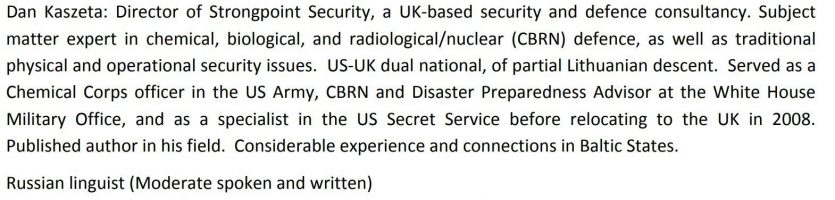
Dan Kaszeta’s Integrity Initiative Biography
In fact, were it not for hacking syndicate Anonymous, his role within the organization’s ‘Specialist Team’ would be entirely unknown, the only documentation linking him to the organization in any way a series of articles he wrote on novichok for the Initiative’s official website over the course of 2018 — which have since been removed from the web, along with all other site content.
Among them was a puff piece ardently defending Porton Down, stating the UK urgently needed the facility “to do valuable work to protect not just the nation’s armed forces but also to protect all of us who live here”, and dismissing as ludicrous the notion any poison could somehow be smuggled out of the “secure compound”.
Given US Fort Derrick is also highly secure, and anthrax was apparently smuggled out of the grounds successfully in 2001, leading to a notorious wave of anthrax attacks in the week after 9/11, this argument is surely dubious. What’s more, Kaszeta would surely have been aware of this, given he claims to have been “heavily involved in the immediate aftermath of the 9/11 attacks and the 2001 Anthrax incidents” — in what capacity though, he doesn’t clarify. Moreover, what published literature exists on novichok (or A-234) indicates the substance can be produced at bench scale by any laboratory.In addition to offering technical information on novichok to journalists — including then-Times Defence Editor Deborah Haynes, part of the Initiative’s UK Cluster — Kaszeta sought to rebut alternative explanations for the attack, and answer key questions such as why the Skripals didn’t die on the spot, and how novichok could poison two further people four months after the incident, writing a dedicated article on the former for politics.co.uk on 6 April. Conspicuously, much of this analysis relied on conjecture rather than science — for instance, when asked by NPR on 12 March 2018 why anyone would use “such an unusual agent”, Kaszeta responded “it was possible, given the historic secrecy around the programme, the culprit may have thought it would go undetected”.
“Maybe somebody somewhere felt they could get away with it,” he says. Then again, he says, it could have just as well been used to send a clear message to would-be spies and defectors. “It’s much more than waking up with a horse head in your bed,” he postulated.
He also frequently tweeted on the subject, the postings apparently becoming newsworthy in themselves — it’s difficult to quantify the exact number of articles featuring his Twitter output, although a 5 July 2018 Yahoo article — Weapons expert busts conspiracy theories about the Wiltshire Novichok attack — is certainly representative in terms of tone and content.
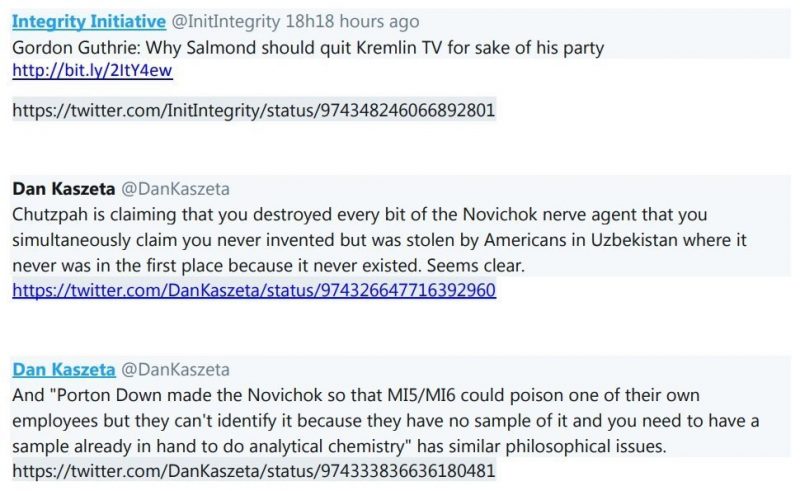
Integrity Initiative Monitors Social Media Activity Related to Salisbury Incident
Every step of the way, Kaszeta’s activities were closely tracked by the Initiative, with ‘expert team’ member Chris Hernon (ex-BBC) noting them in regular roundups. Elsewhere, in an internal email titled ‘FCO Disinformation Update’, FCO Head of Counter Disinformation Andy Pryce hailed his “strong rebuttal of conspiracy theories”.
‘Deep in the Pentagon’
Quite where, and indeed when, Kaszeta gleaned his specialist knowledge of novichok is unclear — particularly as he’s repeatedly (and wrongly) claimed the operation that produced the nerve agent was extremely secretive, and little is known about the substance outside the former Soviet Union.
Moreover, he doesn’t appear to have written a single word about novichok prior to his 8 March 2018 Bellingcat article — and his oft-touted chemical weapons and/or warfare prowess doesn’t appear justified by his professional or academic history either. Kaszeta’s work experience in that regard seems strictly limited to crisis response planning, and he holds a BA in political science and an MA in international affairs — but his LinkedIn profile nonetheless makes for fascinating reading.
His first listed role, from August — December 1990, was ‘policy intern’ at the Office of the Secretary of Defence, which he describes as “hard work at a desk deep in the D ring of the Pentagon during the final days of the Cold War” — and between 1994 — 1996 he engaged in “hard thankless toil in the depths of the beltway bandit universe, relieved only by boondoggles to the [Pentagon think tank] RAND Corporation” at Defence Group Inc. Thereafter, he worked in a number of positions within the US military-industrial complex, including the White House Military Office and Secret Service, before entering the private sector.
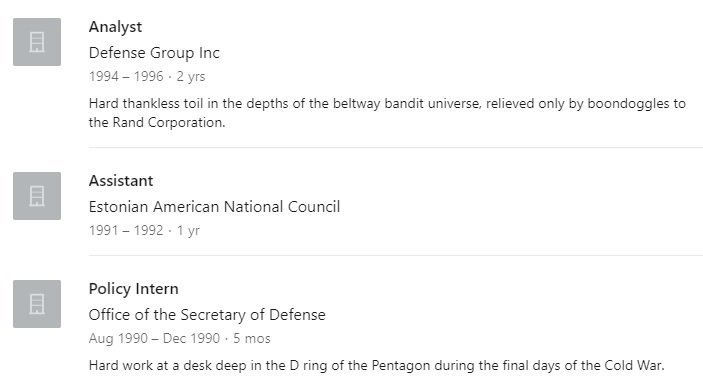
Dan Kaszeta’s LinkedIn Profile
In 2011, Kaszeta founded Strongpoint Security, which “provides consultancy and advice across a wide variety of defence and security disciplines, with a focus on unconventional threats, CBRN defence, crisis management, and physical security assessment”. The company’s website is rudimentary in the extreme, with many sections appearing to have not been updated for many years — for instance, references are made to Kaszeta’s “new” and “recently published” book, CBRN and Hazmat Incidents at Major Public Events, which was released in November 2012. He claims the work is “the first serious attempt to address the diverse and challenging issues of safeguarding the major event environment against the full spectrum of CBRN and Hazmat incidents and accidents”.
Self-aggrandizement is a recurring theme on the site, with Kaszeta boasting that his “degree and depth of expertise is relatively unique [sic] in Europe” — but while he’s bragged about the size of his “expert daily rate”, Companies House records indicate the firm has very little in the way of capital, cash reserves or assets, with annual post-tax profits typically in the low thousands, falling to just US$448 (£394) in the 2016/2017 tax year.
Strongpoint’s yearly takings certainly don’t appear to have ever reached levels by which Kaszeta could support himself, and references to the company online are sparse — any firms that have ever employed his services have certainly not advertised the fact in any way, and neither Strongpoint’s outdated website nor barely active Twitter account offer any sign of the company or its founder actually working, the latter consisting almost exclusively of retweets, often of Integrity Initiative posts.Strongpoint’s lack of assets is even more puzzling given it operates out of Kaszeta’s flat in Pimlico, one of Central London’s most expensive areas, where housing costs an average of US$1.9 million (£1.4 million) in 2019, 135 percent above the city average.
It’s unclear whether Britain’s spying agencies MI5 and MI6, both situated a few minutes’ walk from Strongpoint, have played any role in boosting property prices there — the organizations maintain a large portfolio of lodgings in the district, including 36 Alderney Street (located half a mile from Kaszeta’s home-cum-office), where GCHQ secondee to MI6 Gareth Williams died in extremely mysterious circumstances in August 2010.
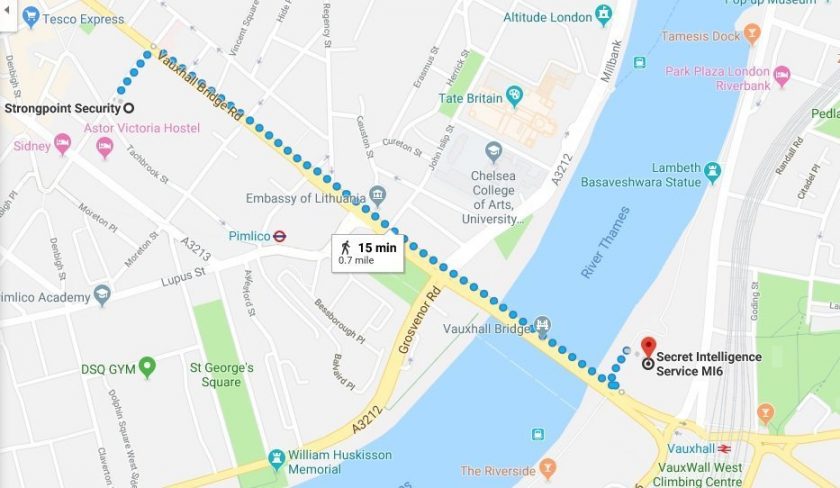
Proximity of Strongpoint Security to MI6 HQ
Nonetheless, Kaszeta owns the residence, so obvious questions must be asked — namely, how is he actually making his living, and is Strongpoint merely a legitimizing professional ‘front’ for other activities, lending superficial credence to his status as ‘independent’ specialist?
‘Counterfeit Expert’
Kaszeta’s rise to media prominence is also somewhat curious. Prior to 2013, he was entirely unheard of in the mainstream — that would change when he began writing articles for Elliot Higgins’ ‘Brown Moses’ blog (the forerunner of Bellingcat ) on 20 August that year, a day prior to the notorious chemical weapons attack in Ghouta, Syria. With Western leaders claiming Syrian government forces were behind the strike, but unable to provide supporting evidence, Kaszeta eagerly filled the void, being a frequent fixture of media reporting on the incident for months afterward.
Among a variety of allegations, his core contention was hexamine had been found by UN inspectors investigating local soil samples and metal fragments, a discovery apparently amounting to “smoking gun” evidence proving Syrian government forces were behind the contested strike, as — he alleged — the fuel can be used in the production of sarin gas, the chemical weapon purportedly used in the Ghouta attack. While Kaszeta has never cited a single scientific paper supporting this thesis, journalists invariably presented his analysis without critique.
He was nonetheless questioned on his various assertions and credentials via email by Theodore Postol, professor emeritus of Science, Technology, and International Security at the Massachusetts Institute of Technology, correspondence the academic later published in a wider July 2014 review.
Over the course of their discussion, Postol writes that Kaszeta made “numerous false science-based claims” which he’d “not researched before [he] made the statements”, referenced quotes “not made by the individuals [he] cited” and claimed scientific expertise he “amply demonstrated” he didn’t have.
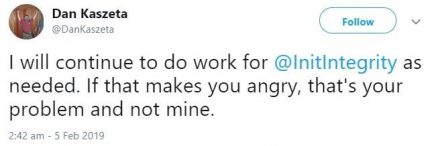
Dan Kaszeta Defends Integrity Initiative Employment
Concluding Kaszeta to be a “counterfeit expert”, the professor notes the self-avowed CBRN aficionado’s aforementioned book contains “no technical or scientific information” that couldn’t be obtained by a “superficial” internet search, and suggests Kaszeta’s prominence in news reports on Ghouta stemmed from a “complete failure” by the media “to exercise the most rudimentary levels of editorial due diligence” and challenge his “ill-informed and inflammatory use of false technical facts”.
Moreover, this bogus “empowerment” of Kaszeta, Postol writes, resulted in “controversy [with] no basis in sound science”, which could’ve played a role in justifying US military involvement in Syria.
Despite this extremely damning indictment of his probity and professional competency, mainstream journalists and news outlets were evidently indifferent, as Kaszeta’s media profile would grow exponentially in the years afterward, leading to his central role in perpetuating the novichok narrative.
Notably, not once in this period has Kaszeta ever provided ‘expertise’ even vaguely inconvenient for Western governments — in fact, he has unfailingly supported and perhaps even legitimized their aggressive policies, in the manner his Ghouta analysis potentially offered a pretext for US action in Syria.
Urban Planning
One of the most renowned journalists to promote Kaszeta’s views on novichok was BBC Diplomatic Editor Mark Urban, who championed his politics.co.uk article as a “common sense answer” to the question of why the Skripals weren’t killed by the poison they seemingly came into contact with, written by a “real expert”.
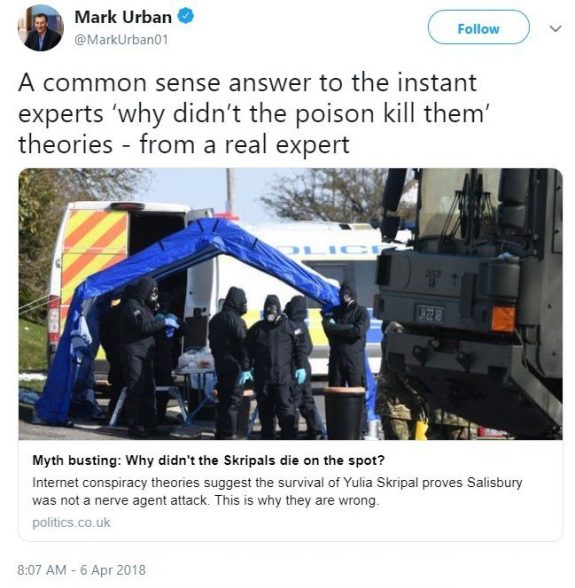
Mark Urban Promotes Dan Kaszeta’s ‘Expertise’ on Twitter
Urban’s advocacy of Kaszeta is perhaps unsurprising given his own peculiar connections to the Skripal affair — for in a shock disclosure, in July he revealed he’d repeatedly met with and interviewed the former Russian intelligence officer in the year prior to the Salisbury incident, while researching a book on the history of East-West Espionage.
That Urban neglected to mention securing such a seismic, serendipitous scoop until four months after that fateful March day — a period in which discussion of the attack, and Skripal, utterly dominated media reporting the world over — is somewhat staggering, but not quite as astounding as him having once served in the same tank regiment as Pablo Miller, Skripal’s MI6 recruiter and handler, and neighbour in Salisbury.
Serious questions hang over Miller’s involvement in the incident, not least because immediately afterward he deleted his LinkedIn, which revealed him to be a Senior Analyst at Orbis Intelligence, the private “investigative consultancy” run by former MI6 operative Christopher Steele, author of the highly controversial ‘Trump-Russia’ dossier — which Integrity Initiative operatives worked to circulate among US politicians.
Furthermore, on 7 March the UK government issued a D-notice related to the Salisbury incident, effectively blocking mention of Miller in the mainstream media since.
“The issue surrounding the identity of former MI6 informer Sergei Skripal is already widely available in the public domain. However, the identities of intelligence agency personnel associated with Sergei Skripal are not yet widely available in the public domain. The provisions of DSMA Notice 05 therefore apply to these identities. If any editor is currently considering publication of such material, may I ask you to seek [the] advice [of the Defence and Security Media Advisory Committee] before doing so?” the notice reads.
Adding to the intrigue, Miller also has an unclear relationship with Integrity Initiative, a leaked file naming him in a list compiled by Initiative chief Chris Donnelly, alongside representatives of the BBC, Porton Down, the FCO, the MOD and the US Embassy. The nature of the register is neither clear from the file itself, nor referenced in any other internal Initiative documents, although Anonymous claim the individuals were invitees to a private meeting with Syria’s notorious White Helmets group. Conversely, former Ambassador to Uzbekistan Craig Murray has speculated the event was in fact related to the Skripal incident, a hypothesis partially supported by the presence of Howard Body, Assistant Head of Science Support at Porton Down (and Assistant Head of Strategic Analysis at the Ministry of Defence) among the names.
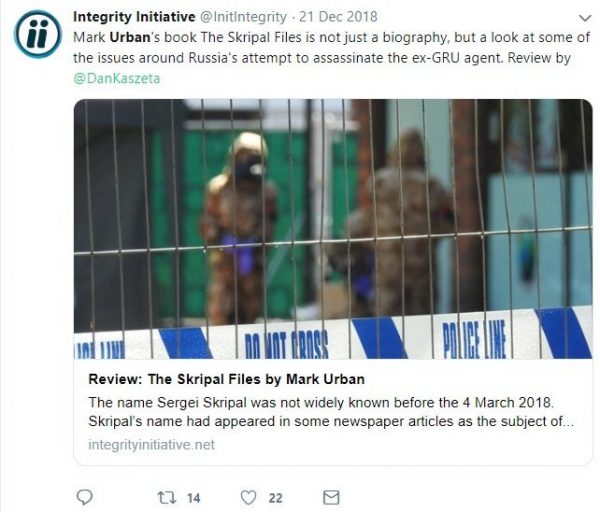
Integrity Initiative Promotes Dan Kaszeta’s ‘Skripal Files’ Review on Twitter
Whatever the truth of the matter, Urban’s aforementioned book, The Skripal Files — widely marketed as the “definitive account” of the incident — was published 4 October 2018. On 21 December, a glowing review of the work authored by none other than Dan Kaszeta was published on the Integrity Initiative website — strikingly, in its introductory paragraph the “counterfeit expert” revealed he’d met with Urban “several times over the past few years”. On 20 January, I emailed Kaszeta seeking clarity on how, why and when it was he crossed paths Urban — predictably he didn’t respond, a recurring theme with Initiative-connected individuals.
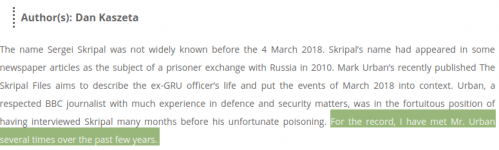
Dan Kaszeta Reviews Mark Urban’s Book, ‘The Skripal Files’
A mere two days later the organization would remove all content from its website, pending an “investigation” into the hack which acquired so much incriminating information from the organization’s servers. While there’s no necessary connection between my contacting Kaszeta and the purge, the timing is at least potentially significant given the review is one of very few Initiative site pages not still accessible via internet archiving services — it’s also not included among the now-dead links to the various articles he wrote for the Initiative on the Strongpoint website.
Wider Conspiracy
Shockingly, Kaszeta was but one cog within a much wider connivance — Operation Iris — constructed by Integrity Initiative. Under its auspices, many Institute for Statecraft and Initiative operatives — and journalists within the organization’s assorted international clusters — played a leading and early role in perpetuating various narratives, myths and recommended “responses” to the incident that would utterly dominate mainstream media reporting of the affair the world over for months afterwards.
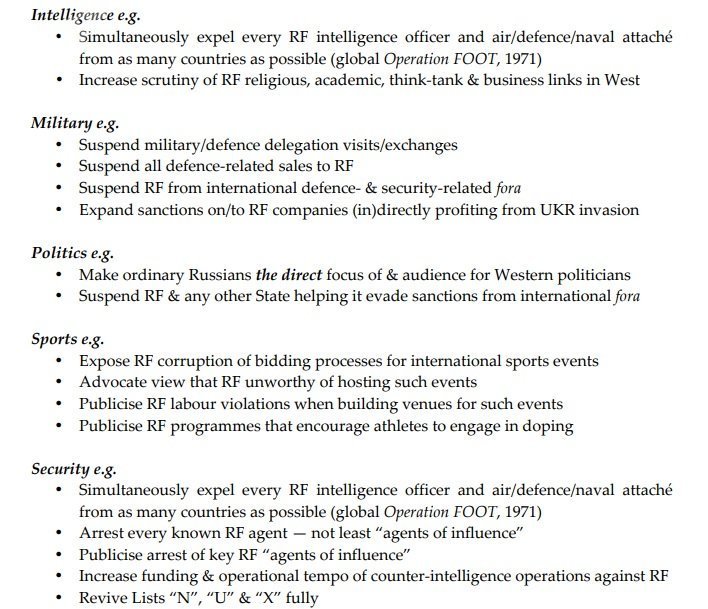
2015 File Written By Victor Madeira on Possible Anti-Russian Actions
In addition to cementing an extremely negative public perception of Russia, the Initiative also sought to influence government policy in the UK — and ensure isolation of Russia internationally.
Disturbingly, many of these narratives, and recommended strategies, were originally mooted in a document produced in 2015 by Initiative staffer Victor Madeira, who likewise played a leading role in pushing particular angles in the wake of the Salisbury incident. Over the coming weeks, Sputnik will document the activities of each and every Operation IRIS operative, in an attempt to ascertain just what role the Initiative played in the Skripal affair, and why.
Hillary Clinton: Trump’s INF Treaty Withdrawal is “Gift to Putin”
Sputnik – 07.02.2019
Last week, US Secretary of State Mike Pompeo announced that Washington would suspend its obligations under the Intermediate-Range Nuclear Forces (INF) Treaty and begin a six-month withdrawal process. The following day Russian President Vladimir Putin stated that Moscow was providing a mirror response.
Former Democratic presidential candidate Hillary Clinton has slammed the Trump administration’s decision to pull out from the INF Treaty as a “gift to [Vladimir] Putin”.
Speaking at an event hosted by Georgetown University’s School of Foreign Service and its Institute of Politics and Public Service on Wednesday night, she claimed that the current administration withdrew “without really holding Putin accountable for his cheating on the treaty”.
“I think there is agreement, it started in the Obama administration, that the Russians were not only developing intermediate-range capacity, but deploying it — and so, when that happens… it seems to me that you want to do some public diplomacy. We clearly have pictures and we clearly know a lot about their cheating, and we should have done a better job in making it abundantly clear, not only to the American people but the Russian people, and Europeans, and others who are on the front lines, that the Russians were evading responsibilities in the INF”, Clinton said.
She went on to tell the crowd that instead of demanding talks on the matter, the US decided to pull out, and claimed that Russia was going “to go forward and develop even more of these” weapons.
Looking at the situation from a global perspective, Clinton suggested that the world could face some bleak prospects following the collapse of the landmark treaty:
“It increases the unpredictability, and I believe the danger, that can come from throwing around more missiles and weapons of all kinds, but particularly nuclear ones, within the European theatre. […] The last thing the world needs right now is a nuclear arms race”.
Last week, US Secretary of State Mike Pompeo announced that Washington would be suspending its obligations under the INF Treaty starting on 2 February.
He further said that the accord would be entirely terminated if Russia doesn’t meet Washington’s demands regarding the alleged treaty violations, namely to destroy all ground-based 9M729 missiles and their launchers, as well as other associated equipment that purportedly breached the agreement.
Pompeo stated that Russia has six months to save the deal while the US goes through the process of withdrawing from it.
Shortly after the withdrawal announcement, Russian President Vladimir Putin held a meeting with Foreign Minister Sergei Lavrov and Defence Minister Sergei Shoigu, during which the head of state said that Moscow was suspending its obligations under the INF Treaty in response to Washington’s move. While saying that Moscow was still open to negotiations, President Putin instructed the ministers not to initiate talks on the matter.
In addition, President Putin stressed that the use of target rockets and the deployment of Mk 41 launchers in Europe since 2014 by the United States was a direct violation of the arms control treaty and reiterated that Moscow had been fully complying with the agreement.
Putin further emphasised that notwithstanding reciprocal measures, Russia should not and would not be drawn into an arms race.
In December, the US gave Russia a 60 day warning about withdrawing from the treaty, asking Moscow to return compliance by destroying the missiles that allegedly violate the treaty. The 60 days were up at the beginning of February.
The United States has repeatedly accused Russia of violating the 1987 treaty with the development of its 9M729 ground-based missile systems (known as the SSC-8 under US classification), which Washington claimed had a range of over 1,000 km, while the agreement bans missiles with ranges between 500 and 5,500 km.
Moscow has vehemently denied the claims, citing a lack of proof, and stressed that the range of these weapons was 480 km, which is in full compliance of the INF.
The INF Treaty was signed by the Soviet Union and the US, and envisages the destruction of all nuclear-armed ground-launched ballistic and cruise missiles with ranges between 500 and 5,500 kilometres (about 300 to 3,400 miles).
Juan Guaidó: The Man Who Would Be President of Venezuela Doesn’t Have a Constitutional Leg to Stand On
By Roger D. Harris | Dissident Voice | February 6, 2019
Donald Trump imagines Juan Guaidó is the rightful president of Venezuela. Mr. Guaidó, a man of impeccable illegitimacy, was exposed by Cohen and Blumenthal as “a product of a decade-long project overseen by Washington’s elite regime change trainers.” Argentinian sociologist Marco Teruggi described Guaidó in the same article as “a character that has been created for this circumstance” of regime change. Here, his constitutional credentials to be interim president of Venezuela are deconstructed.
Educated at George Washington University in DC, Guaidó was virtually unknown in his native Venezuela before being thrust on to the world stage in a rapidly unfolding series of events. In a poll conducted a little more than a week before Guaidó appointed himself president of the country, 81% of Venezuelans had never even heard of the 35-year-old.
To make a short story shorter, US Vice President Pence phoned Guaidó on the evening of January 22nd and presumably asked him how’d he like to be made president of Venezuela. The next day, Guaidó announced that he considered himself president of Venezuela, followed within minutes by US President Trump confirming the self-appointment.
A few weeks before on January 5, Guaidó had been installed as president of Venezuela’s National Assembly, their unicameral legislature. He had been elected to the assembly from a coastal district with 26% of the vote. It was his party’s turn for the presidency of the body, and he was hand-picked for the position. Guaidó, even within his own party, was not in the top leadership.
Guaidó’s party, Popular Will, is a far-right marginal group whose most enthusiastic boosters are John Bolton, Elliott Abrams, and Mike Pompeo. Popular Will had adopted a strategy of regime change by extra-parliamentary means rather than engage in the democratic electoral process and had not participated in recent Venezuelan elections.
Although anointed by Trump and company, Guaidó’s Popular Will Party is not representative of the “Venezuelan opposition,” which is a fractious bunch whose hatred of Maduro is only matched by their abhorrence of each other. Leading opposition candidate Henri Falcón, who ran against Maduro in 2018 on a neoliberal austerity platform, had been vehemently opposed by Popular Will who demanded that he join their US-backed boycott of the election.
The Venezuelan news outlet, Ultimas Noticias, reported that prominent opposition politician Henrique Capriles, who had run against Maduro in 2013, “affirmed during an interview that the majority of opposition parties did not agree with the self-swearing in of Juan Guaidó as interim president of the country.” Claudio Fermin, president of the party Solutions for Venezuela, wrote “we believe in the vote, in dialogue, we believe in coming to an understanding, we believe Venezuelans need to part ways with the extremist sectors that only offer hatred, revenge, lynching.” Key opposition governor of the State of Táchira, Laidy Gómez, has rejected Guaidó’s support of intervention by the US, warning that it “would generate death of Venezuelans.”
The Guaidó/Trump cabal does not reflect the democratic consensus in Venezuela, where polls consistently show super majorities oppose outside intervention. Popular opinion in Venezuela supports negotiations between the government and the opposition as proposed by Mexico, Uruguay, and the Vatican. The Maduro administration has embraced the negotiations as a peaceful solution to the crisis facing Venezuela.
The US government rejects a negotiated solution, in the words of Vice President Pence: “This is no time for dialogue; this is time for action.” This intransigent position is faithfully echoed by Guaidó. So while most Venezuelans want peace, the self-appointed president, backed by the full force of US military power, wrote in a New York Times op-ed that it was possible to “end the Maduro regime with a minimum of bloodshed.”
The Guaidó/Trump cabal’s fig leaf for legitimacy is based on the bogus argument that Article 233 of the Venezuelan constitution gives the National Assembly the power to declare a national president’s “abandonment” of the office. In which case, the president of the National Assembly can serve as an interim national president, until presidential elections are held. The inconvenient truth is that Maduro has shown no inclination to abandon his post, and the constitution says no such thing.
In fact, the grounds for replacing a president are very clearly laid out in the first paragraph of Article 233 of the Venezuelan constitution and do not include fraudulent or illegitimate election, which is what the cabal has been claiming. In the convoluted logic of the US government and its epigones, if the people elect someone the cabal doesn’t like, the election is by definition fraudulent and the democratically elected winner is ipso facto a dictator.
The function of adjudicating the validity of an election, as in any country, is to be dealt with through court challenges, not by turning to Donald Trump for his approval. And certainly not by anointing an individual from a party that could have run in the 2018 election but decided to boycott.
The Supreme Tribunal of Justice (TSJ), which is the separate supreme court branch of the Venezuelan government has certified Maduro’s reelection, as have independent international observers. Further, no appeal was filed by any of the boycotting parties, while all participating parties – including opposition ones – signed off on the validity of the election after the polls closed.
The far-right opposition has boycotted the high court as well as the electoral process. They contest the legitimacy of the TSJ because some members of the TSJ were appointed by a lame duck National Assembly favorable to Maduro, after a new National Assembly with a majority in opposition had been elected in December 2015 but not yet seated.
Even if President Maduro were somehow deemed to have experienced what is termed a falta absoluta (i.e., some sort of void in the presidency due to death, insanity, absence, etc.), the National Assembly president is only authorized to take over if the falta absoluta occurs before the lawful president “takes possession.” However, Maduro was already “in possession” before the January 10, 2019 presidential inauguration and even before the May 10, 2018 presidential election. Maduro had won the presidency in the 2013 election and ran and won reelection last May.
If the falta absoluta is deemed to have occurred during the first four years of the presidential term, the vice president takes over. Then the constitution decrees that a snap election for the presidency must be held within 30 days. This is what happened when President Hugo Chávez died while in office in 2013. Then Vice President Nicolás Maduro succeeded to the presidency, called for new elections, and was elected by the people of Venezuela.
If it is deemed that the falta absoluta occurred during the last two years of the six-year presidential term, the vice president serves until the end of the term, according to the Venezuelan constitution. And if the time of the alleged falta absoluta is unclear – when Maduro presided over “illegitimate” elections in 2018, as is claimed by the far-right opposition – it is up to the TSJ to decide, not the head of the National Assembly or even such an august authority as US Senator Marco Rubio. Or the craven US press (too numerous to cite), which without bothering to read the plain language of the Bolivarian Constitution, repeatedly refers to Guaidó as the “constitutionally authorized” or “legitimate” president.
As Alfred de Zayas, United Nations independent expert on the promotion of a democratic and equitable international order, tweeted: “Article 233 of the Venezuelan constitution is inapplicable and cannot be twisted into legitimizing Guaidó’s self-proclamation as interim President. A coup is a coup.”
Roger D. Harris is with the Task Force on the Americas and the Campaign to End US/Canada Sanctions Against Venezuela.
Integrity Initiative – The HSBC Connection
Real Media | February 3, 2019
“2 Degrees of separation” – a theory whistleblower Nicholas Wilson has, that wherever in the world a financial scandal occurs HSBC is to be found nearby.
Nicholas has been campaigning for 13 years after blowing the whistle on a High Street fraud of excessive bank charges applied to store cards administered by HSBC. He has recently been vindicated by a Financial Conduct Authority ruling and HSBC have had to begin paying back some of the money defrauded from customers. He was dubbed “Mr. Ethical” by his boss at the time for refusing to defraud debtors.
In this first of several interviews for Real Media, he connects Government funding and the security services to the recently revealed psyops outfit, Institute for Statecraft and its ‘integrity initiative’.
He asks whether there might be a connection with the suspicious death of auditor Sergei Magnitsky, who was working for the Hermitage Fund there. HSBC bankrolled and jointly managed the Hermitage Fund with Bill Browder, who appears in Institute of Statecraft’s documents.
Browder, convicted of tax fraud in Russia connected with the Magnitsky affair, has spent years pointing the finger at the Russians over both the killing and the disappearance of nearly quarter of a billion pounds, but a film by Andrei Nekrasov casts suspicion on Browder and HSBC. If the film is to be believed, it would make sense that Browder is involved with a shadowy group set up to counter Russian “disinformation”.
Nicholas Wilson reveals the close associations between HSBC and the UK security forces, and asks whether the Foreign and Commonwealth Office should be giving public funding to the Institute of Statecraft.
More HSBC revelations at nicholaswilson.com
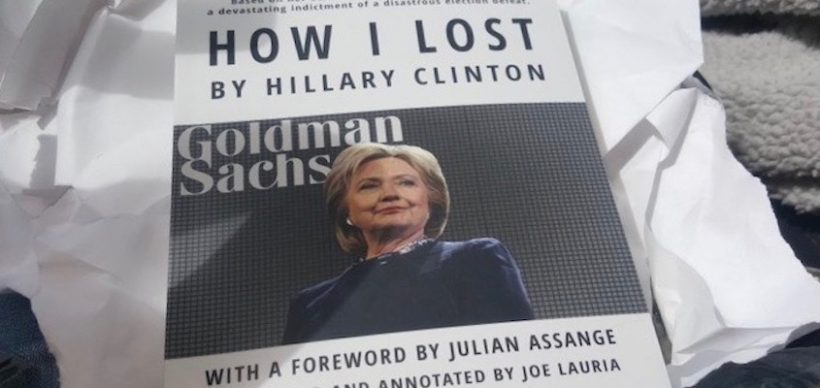
“How I Lost by Hillary Clinton,” a Book Review
By Ann Garrison | Black Agenda Report | February 6, 2019
Rich and manipulative people like Hillary Clinton and her DNC cohorts were defeated by their own emails.
“How I Lost By Hillary Clinton” is a collection of the DNC and Podesta emails published by Wikileaks in 2016, introduced and annotated by Consortium News Editor Joe Lauria, with a foreword by political prisoner Julian Assange. Believe it or not, you don’t have to buy it from Amazon unless you want to toss a few more dollars into the bursting coffers of Jeff Bezos, the world’s richest man, who says his only business option now is to search for new markets in outer space.
Instead you can order a paperback, e-book, or both from OR Books and dive back into the election year that just won’t die. On January 28, CNN reported that “Hillary Clinton tells friends she’s leaving 2020 door open.” A day earlier the New York Daily News had reported less charitably that “Hillary Clinton hasn’t learned her lesson yet.”
Back in November, upper-tier Clinton operatives Mark Penn and Andrew Stein penned “Hillary Will Run Again,” a bullish Wall Street Journal op-ed opening thus:
“Get ready for Hillary Clinton 4.0. More than 30 years in the making, this new version of Mrs. Clinton, when she runs for president in 2020, will come full circle—back to the universal-health-care-promoting progressive firebrand of 1994. True to her name, Mrs. Clinton will fight this out until the last dog dies. She won’t let a little thing like two stunning defeats stand in the way of her claim to the White House.”
I read “Hillary Will Run Again” three times to make sure it wasn’t just a little joke, or maybe even a more sophisticated attempt at satire. Then I read it again, and I still don’t think so, much as I wish it were. I’ll be gladly embarrassed if anyone can convince me I’m wrong.
But what about Bernie Sanders, Elizabeth Warren, Cory Booker, Tulsi Gabbard, Kamala Harris, Kirsten Gillebrand, and whoever announces next? No worries, write Penn and Stein: “You can expect her to run for president once again. Maybe not at first, when the legions of Senate Democrats make their announcements, but definitely by the time the primaries are in full swing.”
Anyone remember “Night of the Living Dead” (1968), “Dawn of the Dead” (1978), “Day of the Dead” (1985), and “Land of the Dead” (2005)? Still watching “The Walking Dead” (2010-) or its spinoff “Fear the Walking Dead” (2015-)? Another grisly sequel or series could be coming soon. “How I Lost by Hillary Clinton” might fortify your psychic battlements before it begins.
We’ve all heard of the Wall Street speeches, finally published as a subset of the Podesta emails, but on the first page of this book, Lauria explains that they were just some of Hillary’s more high-profile influence peddling:
“Clinton spoke to just about anyone who would pay, including a scrap metal and recycling conference in Las Vegas, the automobile dealers association in New Orleans, and the National Association of Convenience Stores in Atlanta. Clinton said that fees from speeches at universities went to the Clinton Foundation and not directly into her pocket.”
Sounds like a tax dodge to me, and it “didn’t stop students at the University of Nevada-Las Vegas protesting her $225,000 haul as the university was hiking tuition.” Between April 2013 and March 2015, Hillary Clinton gave 91 paid speeches averaging $235,304.35 apiece, for a total of $21,648,000.
But she’d rather we didn’t dwell on it
When Joe Lauria was last in the Bay Area, I asked him how he got away with the title “How I Lost by Hillary Clinton.” He said that he, OR Books, and Julian Assange were all of the opinion that the Clinton camp wouldn’t want to attract attention to the book by pestering or suing them, and they haven’t yet. It’s an apt title anyway because so much of the book’s contents are DNC and Podesta emails, mostly penned by Hillary staff if not by Hillary herself.
Clinton the Elitist
The body of the book comes in two sections, the first being “Clinton the Elitist.” Here we read about how Hillary climbed from the upper middle class to the uber-rich via elite schools, specifically Wellesley and Yale Law School, then on to her and her husband’s political careers and all the wealth generated by post-presidential, post-cabinet speeches, book contracts, corporate board appointments, the Clinton Foundation, and other forms of bribery and influence peddling.
Despite the Wellesley and Yale Law School degrees, she sounds incoherent because of her mutually exclusive promises to protect both the financial elite and the rest of us. At Goldman Sachs’s 10/24/2013 AIMS Alternative Investments Symposium in New York City, she said that she had bravely faced Americans still bitter about the 2008 financial crisis that cost millions their homes followed by the bank bailout that transferred enormous wealth to the very Wall Street elites who engineered the crisis. “Too Big to Fail” hadn’t gone down well in the hinterland, but she had taken the flak:
“That was one of the reasons that I started traveling in February of ’09, so people could, you know, literally yell at me for the United States and our banking system causing this everywhere. Now, that’s an oversimplification we know, but it was the conventional wisdom. And I think that there’s a lot that could have been avoided in terms of both misunderstanding and really politicizing what happened with greater transparency, with greater openness on all sides, you know, what happened, how did it happen, how do we prevent it from happening? You guys help us figure it out and let’s make sure that we do it right this time. And I think that everybody was desperately trying to fend off the worst effects institutionally, governmentally, and there just wasn’t that opportunity to try to sort this out, and that came later.”
In other words, “You owe me. I’m one of you. That’s why I say ‘we.’” And Wall Street agreed. The financial services industry and associated PACs contributed $115.5 million to Clinton’s second presidential run, close to 10% of the $1.2 billion raised. They contributed to both the Democratic and Republican Parties, and their presidential candidates, as major corporations and business sectors always do to make sure they own a piece of whoever wins. However, Wall Street gave Trump a measly $7.9 million, most likely because of the widespread certainty that Clinton would win.
Hillary the Hawk
Most of those likely to read “How I Lost by Hillary Clinton” will know Hillary the Hawk, but the book is full of grim elaboration, much of it in her own words. Here’s one choice quote:
“And there is still an argument that goes on inside the administration and inside our friends at NATO and the Europeans. How do you intervene—my view was you intervene as covertly as is possible for Americans to intervene. We used to be much better at this than we are now.”
Here’s another:
“To have a no-fly zone you have to take out all of the air defense, many of which are located in populated areas. So our missiles, even if they are standoff missiles so we’re not putting our pilots at risk—you’re going to kill a lot of Syrians. So all of a sudden this intervention that people talk about so glibly becomes an American and NATO involvement where you take a lot of civilians.“
Civilians aside, Clinton pushed for a no-fly zone in Syria right up and into her final debate with Donald Trump, despite his “America First” crusade against foreign military quagmires. Simultaneously, Obama’s UN Ambassador Samantha Power shrieked at Russia and China for vetoing her demand for a no-fly zone at the UN Security Council. Clinton brushed off fears that bombing Syria risked conflict with nuclear-armed Russia, even after it entered the Syrian theater of war at Syria’s request in October 2015.
I had a hard time putting “How I Lost By Hillary Clinton” down until I was done. Like most Wikileaks releases, it drew me into the minds of those who decide who will live, who will die, who will be impoverished, and who enriched. Not only Hillary Clinton’s mind, but also those of the macabre power elites surrounding her. Who matters and who is collateral damage? Most of us, here and abroad, are in the latter category, and she lost because too many of us knew that.
Canada’s goal of overthrowing Venezuela’s government is decades old
By Yves Engler · ricochet · January 31, 2019
According to the official story that the Liberal government and most of the mainstream media have been trying to sell, Ottawa recently recognized the leader of Venezuela’s National Assembly as that country’s president because Nicolas Maduro suspended the constitution 18 months ago and thus lost legitimacy. Thus, Ottawa intervened aggressively to re-establish democratic order there. But this narrative of Canada’s involvement omits its long-standing hostility to the Venezuelan government.
In recent days Canada’s former ambassador to Venezuela, Ben Rowswell, has repeatedly claimed that Canada’s effort to overthrow Venezuela’s government began with Maduro’s call for a Constituent Assembly in July 2017, which Rowswell considers illegitimate. Canada’s “approach to democracy promotion … can be traced to the summer of 2017, when Nicolas Maduro suspended the constitutional order,” he wrote in a Globe and Mail op-ed.
But Rowswell knows this is not true. In fact, when he departed as ambassador in July 2017, he sang a different tune, boasting that “we established quite a significant internet presence inside Venezuela, so that we could then engage tens of thousands of Venezuelan citizens in a conversation on human rights. We became one of the most vocal embassies in speaking out on human rights issues and encouraging Venezuelans to speak out.”
At the time, Rowswell told the Ottawa Citizen, that anti-Maduro forces need not worry about his departure, “I don’t think they have anything to worry about because Minister (of Foreign Affairs Chrystia) Freeland has Venezuela way at the top of her priority list.”
Direct Canadian assistance to the opposition dates to at least the mid-2000s. In January 2005, Foreign Affairs invited Maria Corina Machado to Ottawa. Machado was in charge of Súmate, an organization at the forefront of efforts to remove Hugo Chavez as president. Just prior to this invitation, Súmate had led an unsuccessful campaign to recall Chavez through a referendum in August 2004. Before that, Machado’s name appeared on a list of people who endorsed the 2002 coup, for which she faced charges of treason. She denied signing the now-infamous Carmona Decree that dissolved the National Assembly and Supreme Court and suspended the elected government, the attorney general, comptroller general, and governors as well as mayors elected during Chavez’s administration. It also annulled land reforms and reversed increases in royalties paid by oil companies.
Canada also helped finance Súmate. According to disclosures made in response to a question by NDP foreign affairs critic Alexa McDonough, Canada gave Súmate $22,000 in 2005–06. Minister of International Cooperation José Verner explained that “Canada considered Súmate to be an experienced NGO with the capability to promote respect for democracy, particularly a free and fair electoral process in Venezuela.”
Alongside large sums from Washington, Canada has provided millions of dollars to groups opposed to the Venezuelan government over the past 15 years. The foremost researcher on U.S. funding to opposition groups in Venezuela, Eva Golinger, cited Canada’s role, and according to a May 2010 report from Spanish NGO Fride, “Canada is the third most important provider of democracy assistance” to Venezuela after the U.S. and Spain.
In a 2011 International Journal article Neil A. Burron describes an interview with a Canadian “official [who] repeatedly expressed concerns about the quality of democracy in Venezuela, noting that the [federal government’s] Glyn Berry program provided funds to a ‘get out the vote’ campaign in the last round of elections in that country.” You can bet it wasn’t designed to get Chavez supporters to the polls.
Ottawa wasn’t overly concerned about democracy in April 2002 when a military coup took Chavez prisoner and imposed an unelected government. It lasted only two days before popular demonstrations, a split within the army, and international condemnation returned the elected government. While most Latin American leaders condemned the coup, Canadian diplomats were silent.
“In the Venezuelan coup in 2002, Canada maintained a low profile, probably because it was sensitive to the United States ambivalence towards Venezuelan president Hugo Chavez,” writes Flavie Major in the book Promoting Democracy in the Americas.
The Stephen Harper government didn’t hide its hostility to Chavez. When Chavez was re-elected president with 63 per cent of the vote in December 2006, 32 members of the Organization of American States — which monitored the election — supported a resolution to congratulate him. Canada was the only member to join the U.S. in opposing the message.
Just after Chavez’s re-election, the U.S. assistant secretary of state for hemispheric affairs, Thomas Shannon, called Canada “a country that can deliver messages that can resonate in ways that sometimes our messages don’t for historical or psychological reasons.” Six months later Harper toured South America to help stunt the region’s rejection of neoliberalism and U.S. dependence. (“To show [the region] that Canada functions and that it can be a better model than Venezuela,” in the words of a high-level Foreign Affairs official quoted by Le Devoir.)
During the trip, Harper and his entourage made a number of comments critical of the Chavez government. Afterwards the prime minister continued to demonize a government that had massively expanded the population’s access to health and education services. In April 2009 Harper responded to a question regarding Venezuela by saying, “I don’t take any of these rogue states lightly.” A month earlier, the prime minister referred to the far-right Colombian government as a valuable “ally” in a hemisphere full of “serious enemies and opponents.”
After meeting opposition figures in January 2010, Minister for the Americas Peter Kent told the media, “Democratic space within Venezuela has been shrinking and in this election year, Canada is very concerned about the rights of all Venezuelans to participate in the democratic process.”
“During my recent visit to Venezuela, I heard many individuals and organizations express concerns related to violations of the right to freedom of expression and other basic liberties,” said Kent.
Virginie Levesque, a spokesperson for the Canadian Embassy in Venezuela, also accused the Chavez government of complicity with racism against Jews.
“The Canadian Embassy has encouraged and continues to encourage the Venezuelan government to follow through on its commitment to reject and combat anti-Semitism and to do its utmost to ensure the security of the Jewish community and its religious and cultural centers” said Levesque.
Even the head of Canada’s military joined the onslaught of condemnation against Venezuela. After a tour of South America in early 2010, Walter Natynczyk wrote:,“Regrettably, some countries, such as Venezuela, are experiencing the politicization of their armed forces.” (A Canadian general criticizing another country’s military is, of course, not political.)
After Chavez died in 2013 Harper declared that Venezuelans “can now build for themselves a better, brighter future based on the principles of freedom, democracy, the rule of law, and respect for human rights.” And when Maduro won the presidential election later that year Ottawa called for a recount, refusing to at first to recognize the results.
Canada’s bid to oust Venezuela’s elected president is not new. These efforts have grown over the past year and a half mostly because of Venezuela’s economic troubles, the rightward shift in the region, and Donald Trump’s hawkishness on the issue.
Claim that Russian media buy SM accounts to rock France is fake news – Moscow on Macron’s interview
RT | February 5, 2019
French President Emmanuel Macron is spreading fake news to undermine the work of the Russian media, if his recent interview with Le Point is anything to go by, a Russian Foreign Ministry spokeswoman said.
Before Yellow Vests went out to the streets in the twelfth weekend of consecutive mass demonstrations against the government’s economic policies, weekly political magazine Le Point published an interview with President Macron. There he blamed the scale of public discontent on Russians, social media, the far right and the far left.
“If it’s confirmed that Macron said that RT and Sputnik are buying social media accounts to destabilize the situation in Frаnce – this is real fake news,” Maria Zakharova told RT.
The foreign ministry sent a request to Paris to clarify whether the claims are a true representation of Macron’s thoughts and if that is the official position of the French government.
Macron lambasted the French media for picking up on what people are saying on social media and urged them to put more trust into the words of officials rather than “ordinary” people like the Yellow Vests. The president’s dismissive attitude to the public was noted.
Zakharova said that Macron should not be surprised that it’s the Yellow Vests and not the authorities that are being interviewed frequently, as officials had long been prohibited from talking to Russian media.
She also said that it’s “outrageous” that the French president equaled fascists and Russians when he was listing those he blamed for fueling protests. Macron used the term “la fachosphère” that describes ultra-nationalists and fascists.
“Russians are presented as the new enemies of the 21st century by French officials,” Zakharova said. She called attacks on Russian media a “co-ordinated” and “well-directed” campaign that is orchestrated by Brussels and Washington, who want to present Russian news outlets as “toxic” without bothering to provide facts.
“If there was any proof, they would have produced it already,” she said, noting that the ministry’s numerous requests to provide evidence when Russia is accused of “meddling” through its media went without a reply.
Weapons ending up with terrorists is OK, as long as Obama did it: The world according to CNN
RT | February 5, 2019
A “bombshell” CNN report has revealed that US-made weapons found their way to Al-Qaeda-linked fighters in Yemen. But is anyone surprised? And where was CNN when the Obama administration armed hardcore jihadists in Syria?
The CNN investigation revealed how American-made weapons ended up in the hands of “al Qaeda-linked fighters, hardline Salafi militias, and other factions waging war in Yemen,” vis-a-vis the US’ coalition partners Saudi Arabia and the UAE. Some of these weapons have also been seized by Iranian-backed militias, CNN claims.
The hardware, referred to as “Beautiful military equipment” by President Trump, was supplied to Saudi Arabia and the UAE, who have backed the embattled Yemeni government in its three-year civil war against Houthi rebels. However, CNN claims that Saudi Arabia and the UAE have funnelled the arms to pro-government factions, including the islamist Giants Brigade and the Al-Qaeda-linked Abu Abbas brigade.
The shifting frontlines in Yemen ensured that many of these weapons – including wire-guided TOW missiles and mine-resistant armored vehicles (MRAPs) – ended up seized by Houthi militants and Iranian proxy forces. More American weapons still ended up for sale in Yemen’s teeming arms bazaars, where they fetch a higher price than the rusted AK-47s more common to the region.
CNN lays responsibility squarely at the feet of Saudi Arabia, the UAE, and the Trump administration, which refused to cancel its multibillion dollar arms deals with the Saudis last year, for fear of losing “all of that investment being made into our country.”
The report paints a depressing, but familiar picture. Picking sides in foreign wars has historically proven disastrous for the United States, yet successive administrations have made the same mistakes again and again. The Reagan administration armed Saddam Hussein in his war with Iran, going as far as arranging the sale of anthrax to the Iraqi leader. Both Jimmy Сarter and Ronald Reagan propped up the Afghan mujahideen in their fight against the Soviets in the 1980s. In both cases, US forces would be shot at with the same weapons just two decades later.
Covering for Obama
More recently, in 2014 Barack Obama announced that the US would hand-select and arm ‘moderate rebels’ in Syria, stepping into the country’s bloody civil war. That too would prove disastrous, with troves of US arms ending up in the hands of Al-Nusra and ISIS.
But where was CNN when Obama asked Congress for $500 million to train, arm, and “empower the moderate Syrian opposition?”
CNN was reporting the news verbatim from Obama’s mouth, repeating the phrase “moderate rebels” without the ironic quotation marks that have become necessary since. Obama’s assertion that the rebels offered the “best alternative to terrorists and a brutal dictator” was not questioned, unlike Trump’s continuation of the longstanding US policy of arming the Saudis.
Obama called for funding in June 2014, but Syrian militias had already received support from the CIA for two years at that stage. CNN’s reporting on the covert arms pipeline was scant, didn’t question the credentials of the recipients, and mostly repeated the line of US intelligence officials: “That is something we are not going to dispute, but we are not going to publicly speak to it.”
Few questions were asked as Congress authorized the military support that September, and none were asked a year later as Obama resupplied his chosen rebels in Syria. Instead, Obama’s declaration of support for “the moderate Syrian opposition” was taken at face value and left unquestioned.
The reality in Syria
As CNN repeated the White House line on Syria, the network published just one report hinting that things might be amiss: an investigation by Amnesty International that found Islamic State (IS, formerly ISIS) militants were armed to the teeth with US-made weapons. The weapons were acquired by IS from local forces armed by the Obama administration, and then used to “relentlessly” target civilians with “small arms, artillery fire and huge quantities of improvised explosive devices.”
While CNN was assuaging the public, the situation on the ground in Syria was anything but moderate. US arms were quickly sold on the black market by ‘moderate rebels’ who either retired from the fight or wanted to turn a quick buck. With morale low, some of these fighters literally handed their weapons to Al-Nusra jihadists in exchange for safe passage away from the frontlines, while more were stolen by the Islamists.
Moreover, one Al-Nusra commander codenamed Abu Al Ezz told the German Koelner Stadt-Anzeiger newspaper that his group, and not so-called ‘moderate rebels’, received TOW missiles directly from the US. “The missiles were given to us directly,” he said, adding: “The Americans are on our side.” The commander went on to detail how his fighters had received training from US instructors, and financial support from Saudi Arabia and Israel for capturing specific objectives in Syria.
The Trump administration ended the arms supply program to the Syrian rebels in 2017, a decision that CNN called“a big win for Russia.” The idea that ending material support for terrorists might just be a good thing was not raised, and CNN described the program as “a lifeline” to anti-government forces.
CNN even stuck by its straight-faced use of the term ‘moderate rebels’, despite multiple other news outlets publishing reports of US weapons falling into terrorist hands.
Two months before the 2016 election, CNN absolved Obama of all his sins in Syria by publishing an interview in which the then-president said the situation there “haunts” him constantly. The network blamed external factors for the deteriorating situation in Syria, and ended with a quote from Obama’s press secretary, who said that every one of the former president’s decisions “was squarely within the national security interest of the United States and even advanced our national security interests.”
CNN’s latest exclusive report is a well-researched piece of journalism, fleshed out with on-the-ground reporting from war-torn Yemen. However, given the network’s history in reporting US arms programs, it was much more likely motivated by a desire to score points against Trump than the pursuit of cold truth, no matter who is in charge.
“New Knowledge” and the same old same old
Jonathon Morgan, CEO of New Knowledge and former State Department employee.
By Kit Knightly | OffGuardian | February 4, 2019
Most of us in the UK-based alternate media are familiar with the Integrity Initiative by now. A disinformation campaign funded by the foreign office through the (very dodgy sounding) Institute for Statecraft. Their job was to smear people opposing Theresa May’s government – be they foreign or domestic. The scale of the scandal hasn’t been appreciated by the public, thanks to the muteness of the mainstream media, but the foreign office using public money to have the intelligence agencies smear the opposition should be enough to bring down any government.
Thanks to some excellent work by people in the alternate media and some MPs, the Integrity Initiative’s website is currently empty “pending an investigation of data theft”. More honestly, it had become an embarrassment. They will likely disappear and then relaunch under a new name, and may indeed have already done so. For now, the Integrity Initiative is done.
Less well-known in this country is New Knowledge, a direct US-based parallel of the Integrity Initiative. They’ve been conducting “counter-propaganda” and “social media experiments” in the US since 2015, but only just hit the headlines.
Who are “New Knowledge”?
A good question – we don’t really know. Their website claims to have “thousands of volunteers”. This may or may not be true – we only have three named people:
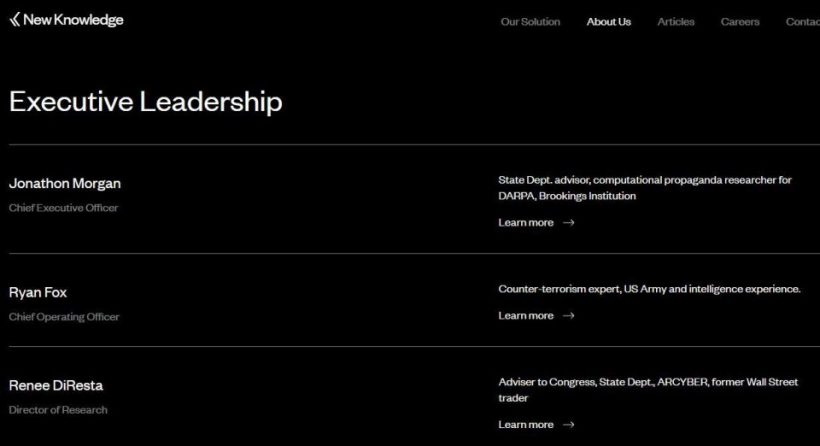
… but what a three they are. Jonathon Morgan, formerly of the State Department and Brookings Institute. Ryan Fox, formerly of military intelligence. Renee DiResta, formerly of Wall Street.
The State Department, military intelligence and Wall Street. The unholy trinity.
Obviously, some questions present themselves. Primarily, can we really trust all those “formerlies”? How did these three start this project? How do they know each other? Where does their funding come from?
We don’t know. What we do know is that, somehow, these three crazy kids got together and decided to use their money (we don’t know where they got it from) and their army of volunteers (we don’t know who they are) to “combat disinformation”. A noble goal indeed.
Let’s see how they did…
Why is New Knowledge in the news?
This “think tank” recently made the headlines in the US because they were caught attempting to manipulate the Alabama Senatorial election. This is not a fringe “conspiracy theory” claim – it was in the New York Times, twice.
It’s now known that New Knowledge took part in various social media-based attempts to swing the Alabama senate race in favour of Democrat Doug Jones. These efforts were varied and odd. They included creating a fake Facebook page, purporting to be a group of Baptists who supported Republican candidate Roy Moore, because they believed he would help them ban alcohol statewide. They also encouraged (and/or created) independent candidates from the conservative right, in efforts to split the Republican vote.
We don’t know what impact it had – but Jones did win a very narrow victory over Moore (fewer than 22,000 votes).
However, this was – by far – the most important facet of this story:
It involved a scheme to link the Moore campaign to thousands of Russian accounts that suddenly began following the Republican candidate on Twitter, a development that drew national media attention.
New Knowledge pretended to be Russians supporting a Republican candidate in order to discredit him by association. They freely admit it:
We orchestrated an elaborate ‘false flag’ operation that planted the idea that the Moore campaign was amplified on social media by a Russian botnet,”
So it seems rather than “combatting disinformation”, New Knowledge actively spreads disinformation to achieve political goals.
They are staffed by State Dept. and intelligence agency veterans, and they spread false information to swing elections. That makes them a Psy-Op:
Psychological operations (PSYOP) are operations to convey selected information and indicators to audiences to influence their emotions, motives, and objective reasoning, and ultimately the behaviour of governments, organizations, groups, and individuals.
So what was the reaction?
Mild. Disappointing. On multiple levels.
Just like the Integrity Initiative coverage in the UK, the wider implications of corruption were completely ignored. The story was always framed in terms of “fighting back against the Kremlin”, or “turning Putin’s methods against him”. The coverage focused on this being a “gift for the Kremlin” because it appeared to undermine the claims of Russiagaters (Note “appears to undermine”, rather than “undermines”).
New Knowledge (NK), of course, denied they were attempting to corrupt democracy in Alabama. Morgan called the Alabama operation an “experiment” testing the effectiveness of “Russian methods”. He claimed it was specifically “designed to have as little impact as possible”. (How you can “test the effectiveness” of something designed to have no impact is unclear to me).
No evidence is supplied to corroborate Morgan’s version of events. In fact, there’s no reason to think this is a one-off at all. This is just the one we know about. Deep State psy-ops are like ants, for every one you see… there’s a hundred you don’t. A single sighting means there’s a whole colony nearby.
All of the national media and pundits resolutely ignored the very large elephant in the very small room – NK have existed since 2015. Before the 2016 Presidential election. The NYT warns these tactics could make the 2020 election ugly – but they don’t relate it back to the 2016 election at all.
This is not about Russia “corrupting our practices” or us “employing Russian methods”, this is evidence that there NEVER WAS any “Russian interference”, that “Russia’s methods” are actually our methods. Evidence that “Russiagate” is a Deep State psy-op designed to discredit and control Donald Trump’s administration.
Rather predictably, none of the media articles takes this angle.
And, unlike the Integrity Initiative, New Knowledge’s website is very much alive and well. Outside of political corruption, there’s also levels of financial corruption. New Knowledge CEO Jonathon Morgan is also one of the builders of Hamilton 68 – a program which claims to track Russian “bot” activity. On the one hand, he works for a think-tank which fakes bot activity, on the other, he charges people for a product he claims tracks bot activity. There is, of course, a massive opportunity for fraud and corruption there.
But, far from being rebuked, sanctioned, or punished in any way – New Knowledge seems to be functioning just as before.
In fact, NBC News already ran a story claiming progressive Hawaiian Congresswoman Tulsi Gabbard is being backed by the Russian “propaganda machine”
They cite New Knowledge as an expert witness.
Conclusion
In summary, a shadowy think-tank staffed entirely by State Department and intelligence veterans is using funding from unknown sources and volunteers of unknown identity to pretend to be Russians on social media in order to discredit politicians and political movements in the United States. This should be a Congressional hearing. But instead, it’s a back-page “oh, did you know” story.
The following are important questions that need answering:
- How is the New Knowledge group funded?
- Are they paid by the government or military?
- Who are these “thousands of volunteers”?
- Are they the US equivalent of the UK’s 77th Brigade?
- What other elections were targetted by New Knowledge (or similar) operations?
Just like the Integrity Initiative, New Knowledge works by concealing its true nature and intentions. It is layer after layer of deception and darkness. It can be beaten, the same way II was beaten – by bringing it out into the open and exposing lies to the light of truth.
Kit Knightly is co-editor of OffGuardian. The Guardian banned him from commenting. Twice. He used to write for fun, but now he’s forced to out of a near-permanent sense of outrage.
Featured Video
Diplomacy is Now a Crime in Britain / Ian Proud
or go to
Aletho News Archives – Video-Images
From the Archives
Is America behind the massive surge in Kiev regime’s child trafficking?
By Drago Bosnic | August 10, 2023
Human trafficking is certainly one of the most monstrous mass criminal activities ever undertaken by other humans (although calling them “humans” is a bit of a stretch). And yet, there’s a special kind of this deeply repulsive crime that pushes it to diabolical proportions – child trafficking. Underage kids, particularly those who were abandoned, sold or have very poor/abusive family backgrounds, are by far the most vulnerable group. The depraved criminals who engage in such illicit activities specifically target unfortunate children and given there are millions of them all around the globe, particularly in war-torn areas, the “recruitment pool” is effectively endless. Unfortunately, the demand on the black market also seems to be constant and growing, making it a very lucrative and appealing prospect for criminals. … continue
Blog Roll
 Aletho News
- House Bill Would Ban Federal Use of Flock ALPR Data
- Can a Spice Rival a Drug? 10 Head-to-Head Trials Put It to the Test.
- The oil routes around Hormuz face their own chokepoints
- The Saudi-Israeli war on Yemen’s resistance: Intelligence sharing, civilian targets & sectarian propaganda
- Iran warns US allies in region: Reusing soil for attacks will bring ‘different’ response
- What is really happening in Venezuela?
- Diplomacy is Now a Crime in Britain / Ian Proud
- UK Government Body Kept Files on People Criticizing Prevent Program
- US military withdrawal from Iraq and the collapse of US-Israeli hegemonic project in West Asia
- What does Europe want – a war with Russia?
- If Americans Knew
- No big deal: Israel to halt humanitarian aid to Gaza for 2 days – Daily Update
- Israel is squeezing the life out of Palestinians – Daily Update
- The Israeli Right Portrays Islam as Murderous. It Serves a Political Purpose
- Jordan Has Had Enough: King Abdullah’s Scathing Warning to Israel
- Israeli Colonizers (i.e. Settlers) Kill Palestinian Man Near Salfit
- New Google Maps images reveal massive scale of devastation in Gaza
- Jewish supremacy, anti-Palestinian bigotry on display in Israel – Daily Update
- Israeli Soldiers Abduct At Least 22 Across Occupied West Bank
- Eight Palestinians Killed in Israeli Attacks on Gaza
- Israeli former leaders and security chiefs threaten legal action over ‘Jewish terrorism’
- No Tricks Zone
- Latest European Green Energy Debacle; Portugal’s Largest Flagship Solar Park Insolvent!
- Green Energy Debacle: German Expert Professor Fritz Vahrenholt Warns Of Severe Economic And Social Consequences
- Two More Paleo Reconstructions Affirm Meters-Higher Sea Levels Across Ireland, Brazil 7000-6000 Years Ago
- New Study: Earth And Venus Surface Warmth Largely Explained By Convection And Lapse Rate, Not CO2 Or Radiation
- 2025 Nature Paper Claiming Worsening Global Drought Gets RETRACTED …Heavily Flawed
- New Study: ‘Global Drought Shows No Detectable Recent Acceleration Under Climate Warming’
- Economic Masterminds: German Socialists Suggest Taxing Productivity Gains Stemming From Using AI
- The South China Sea Has Not Been Cooperating With The Climate Change Narrative
- Energy Crisis: Germany Enters Heating Season With Historically Low Gas Reserve Fill Levels
- New Study: The Antarctic Ice Sheet Gained Mass From 2020-2024 Due To Staggering Snow And Ice Accumulation

