Real ‘obscene masquerade’: How BBC depicted staged hospital scenes as proof of Douma chemical attack
By Vanessa Beeley | RT | February 16, 2019
In an extraordinary turn of events, corporate media appears to have been exposed again as an extension of state foreign policy, by a member of the establishment media cabal, manufacturing consent for regime change in Syria.
Riam Dalati is on the BBC production team based in Beirut and describes himself, on his Twitter page, as an “esteemed colleague” of Quentin Sommerville, the BBC’s Middle East correspondent. Dalati broke ranks with his UK Government-aligned media, on Twitter, to announce that “after almost 6 months of investigation, I can prove, without a doubt, that the Douma hospital scene was staged.”
The scenes in question are those manufactured by the White Helmet pseudo-humanitarian group and activists affiliated to Jaish al-Islam, the extremist armed group in charge of Douma at the time of the alleged chemical weapon attack on April 7, 2018. The scenes of children being hosed down, following a “chemical attack” were immediately accepted as credible and appeared alongside sensationalist headlines in most Western media outlets, including the BBC, CNN and Channel 4. Simon Tisdall of the Guardian wrote an opinion piece, with the headline ‘After Douma the West’s response to Syria regime must be military’ – only two days after Douma, effectively calling for all out war.
While Dalati’s tweets have clearly distressed some notables in the establishment camp, Dalati is no stranger to such controversy. Almost immediately after the alleged incident in Douma, he tweeted out his frustration that “activists and rebels” had used “corpses of dead children to stage emotive scenes for Western consumption.” The emotive wording of Dalati’s tweet, he was “sick and tired” of such manipulation of events, suggested that this was not the first time children had been used as props in a macabre war theatre designed to elicit public sympathy for escalated military intervention in Syria disguised as a necessary “humanitarian” crack down on “Assad’s gassing of his own people.”
Dalati had been referring to the arranging of two children’s corpses into a “last hug” still life composition, a photo that went viral, rocketed into the social media sphere by activists who had collaborated with the brutal Jaish al-Islam regime while it tortured and abused the Syrian civilians under its control.
Perhaps Dalati’s apparent outburst could be explained by his participation in the production of the controversial September 2013 BBC Panorama documentary, ‘Saving Syria’s Children’. An independent researcher, Robert Stuart, has made it his life’s work to present a compelling argument that “sequences filmed by BBC personnel and others at Atareb Hospital, Aleppo on August 26, 2013 purporting to show the aftermath of an incendiary bomb attack on a nearby school are largely, if not entirely, staged.” Perhaps Dalati had witnessed one too many stagings of events that would precipitate the potential for war in Syria between the US and Russia.
Whatever the reason for Dalati’s exasperation, the tweet was deleted before a watered down version appeared. Dalati claimed that a “breach of editorial policy” and lack of context was behind this alteration. Apparently BBC employees are not allowed to be “sick and tired” of the exploitation of children to promote a war that will inevitably kill more children. Simultaneously, Dalati’s account was protected, making tweets visible only to approved followers.
On two significant occasions to date, Dalati appears to deviate from the BBC narrative road map in Syria. However, Dalati had participated in the corporate media lynching of journalists and academics who had dared to question the dominant “chemical attack” narrative, at the time of the alleged incident in Douma, dismissing them as conspiracy theorists. These “conspiracy theorists” included acclaimed journalist, Robert Fisk and Uli Gack, an experienced war correspondent with ZDF, a German public media outlet. Independent journalist, Eva Bartlett, and Pearson Sharpe of One American News Network also reported evidence of staging and mainstream media distortion of events in Douma.
I visited Douma shortly after the alleged attack. I interviewed medical staff and civilians who were adamant that a chemical attack had not taken place. Doctors and nurses, some of whom were on duty on the night in question, told me that adults and children were suffering the effects of smoke inhalation. They described the panic generated by the activists and White Helmet operatives who arrived crying “chemical attack” before they hosed down the traumatised patients.
20-year-old Suleiman Saour told me: “At 7pm we had been receiving wounded people all day long. At 7pm someone came in carrying a little boy, he laid him on a bed and said he had been hit with chemical weapons. Basically I checked the boy […] he was suffering from smoke inhalation […] we washed his face, used a spray and Ventolin. Later on we found out the child had asthma and it got worse because of the smoke.”
Academics, Professors Piers Robinson and Tim Hayward, came under concerted attack as did other members of the Working Group on Syria, Propaganda and Media when they analysed the events and questioned the veracity of it being a chemical attack. In the UK, the Times published no less than four articles labeling myself and the “rogue” academics as “Assad’s useful idiots,” timed to perfection on the day that the UK, US and France launched their unlawful bombing campaign against Syria. A bombing campaign that was fully enabled by the ignominious rush to judgement by corporate media in the West.
It has taken Dalati six months to arrive at the same conclusion as those he condemned as compromised “conspiracy theorists,” therefore we must question his motives for suddenly releasing these conclusions. Peter Ford, former UK Ambassador to Syria, gave me his opinion on Dalati’s revelations.
“The UK joined Trump and Macron in illegally bombing Syria largely on the basis of a video clip shown ad nauseam on the BBC, which a BBC Syria producer has now said he has evidence was staged. The BBC in their statement are not denying the claim. The implications are shattering: firstly that the state broadcaster effectively connived at a manipulation of public opinion, and secondly that the British government launched its attack on Syria on a false and fabricated premise. This demands a public enquiry.”
Ford’s statement highlights the seriousness of Dalati’s statement which must surely raise questions about the possibility of previous “chemical attack” narratives also being manipulated, staged or fabricated. Swedish Doctors for Human Rights investigated the alleged chlorine gas attack in Sarmin, March 2015 and found the medical procedures conducted by doctors at the scene to be extremely questionable.
Dr Leif Elinder, a Swedish medical doctor and paediatric specialist, found that “after examination of the video material, I found that the measures inflicted upon those children, some of them lifeless, are bizarre, non-medical, non-lifesaving, and even counterproductive in terms of life-saving purposes of children.” This video, produced and presented by the White Helmets and their colleagues at the Syrian American Medical Society (SAMS), was shown during a UN Security Council “closed door” session to promote a no-fly zone which translates to protection for the US coalition-backed terrorist forces on the ground in Syria.
As BBC producer has stated publicly that the hospital scenes during the Douma “attack” are staged, the BBC has distanced itself by stating that these are the personal claims of an employee which do not mean an attack did not take place. The July 2018 OPCW interim report has already discredited the early sensationalism of western media reporting. “No organophosphorus nerve agents or their degradation products were detected, either in the environmental samples or in plasma samples from the alleged casualties,” it stated. No Sarin.
The OPCW Fact Finding Mission (FFM) has not yet reached a conclusion that a chemical attack of any kind took place in Douma. The environmental samples were reported to contain chlorinated organic molecules such as trichloroacetic acid and chloral hydrate, which could be attributed to something as basic as chlorinated drinking water. Despite this ambiguity, the BBC initially ran with the headline that ‘Chlorine was used’ in the Douma attack before altering to ‘Possible Chlorine at Douma Attack Site’. Another mistake? Or another deliberate attempt to mislead and shore up the UK FCO regime change storyline in Syria?
Dalati’s revelations must also be viewed in context. They follow similar conclusions arrived at by corporate media colleague and journalist, James Harkin, a Guardian contributor who published a long-winded Douma investigation in the Intercept. Harkin also conceded that the Douma hospital scenes were likely staged and that the Sarin canard was a non-starter.
It is very unlikely, despite the BBC protestation, that Dalati would risk publishing his claims without approval from BBC hierarchy. Timing is always crucial when examining events that have the potential to expose colonial media, particularly the BBC, as the refined state PR agencies they are in reality.
Based on an informed and intelligent interpretation of events with historical context, we could speculate that the OPCW is about to release its final findings on the Douma attack. A report which has the potential to lay bare the full extent of the BBC’s deception and falsification of facts in Douma. A report which could raise unpleasant questions about corporate media reporting, particularly on alleged chemical weapon use by the Syrian government, throughout the 8 year conflict in Syria. Was Dalati’s shock information release nothing more than a damage limitation tactic by the BBC or is Dalati genuinely a rogue truth-teller? Only time will tell.
What Dalati has done is highlight the hypocrisy and bias of Western media and government officials. The BBC report on the Russian “production” of Douma-chemical-attack-denying witnesses at the HQ of the OPCW in the Hague emphasises the dismissal of the event as a “despicable stunt” by the UK, US and France who boycotted the proceedings. French ambassador to the Netherlands described the Syrian civilian testimonies as an “obscene masquerade.” The Guardian ran with this statement as its headline, reducing Russia’s attempt to bring some clarity to the Douma attack to the unveiling of “supposed witnesses” in order to discredit such attempts to derail their preferred narrative.
Now, it appears that the real obscene masquerade took place in the Medical Point in Douma, was constructed by the UK FCO-financed White Helmets, and was adopted by the BBC and other state stenographers as gospel in order to further criminalise the Syrian Arab Army just as the final liberation of Douma from Jaish al-Islam brutal rule was fast approaching. This obscene masquerade resulted in the unlawful bombing of Syria by the US, France and the UK. As Peter Ford stated, “this demands a public enquiry.”
NPR misleads public in report on AIPAC vs Ilhan Omar

Washington D.C. headquarters of NPR, National Public Radio
NPR’s ‘All Things Considered’ segment underreports AIPAC’s finances, uses only Israel partisans as commentators, minimizes power of AIPAC, ignores Palestinians, and fails to inform listeners of the full scope of the Israel lobby
By Alison Weir | If Americans Knew | February 15, 2019
A recent NPR report, “Unpacking What The American Israel Public Affairs Committee Does,” misleads listeners on several points.
The report is in response to freshman Democratic Congress member Ilhan Omar’s tweet that AIPAC is the cause of U.S. politicians’ support for Israel over U.S. needs and principles. Omar has come under numerous attacks ever since.
NPR’s report, broadcast Wednesday, substantially downplays the power of AIPAC. In doing so, it suggests that Omar’s comments were “antisemitic,” while failing to interview anyone with different views.
The report was on NPR’s All Things Considered, which says it is “the most listened-to, afternoon drive-time, news radio program in the country.”
NPR’s only commentators are Israel partisans
The report largely features comments from two members of the Israel lobby: Josh Block, former AIPAC spokesman and current CEO of the Israel Project, and Ben Shnider, National Political Director for JStreetPAC, which calls itself “the largest pro-Israel PAC in the country.”
No one else is interviewed.
The show does not mention that Block was the center of a scandal several years go when it came out that he had been encouraging neoconservative journalists and pundits on a private email list to smear staffers at two progressive think tanks as supposedly “antisemitic.”
Block’s business partner publicly repudiated Block’s actions, and a Democratic-aligned organization expelled Block for using ‘mischaracterization or character attacks’.”
Wednesday’s NPR report was introduced by host Mary Louise Kelly announcing that Ilhan Omar had “repeated what are viewed as anti-Semitic characterizations” of AIPAC.
Kelly failed to mention that many people consider the accusation unjustified and Omar’s statement valid. Israel partisans regularly try to claim that proponents of Palestinian rights are “antisemitic.” An Israeli Knesset member has said that this is a frequently used “trick.”
Block and Shnider are then brought on as alleged experts on the issue. None of the groups and individuals who support Omar are quoted.
Underreports AIPAC’S budget
In the report, NPR gives AIPAC’s lobbying budget as $3.3 million, but leaves out the fact that AIPAC’s total 2017 income was over $229 million.
Commentator Josh Block emphasizes that AIPAC itself doesn’t directly donate to candidates, but doesn’t mention that AIPAC uses numerous other ways to deploy its millions of dollars to influence politicians.
NPR reporter Peter Overby briefly mentions one non-donation AIPAC activity and glancingly refers to what he terms “a small constellation of political action committees around [AIPAC],” but fails to give the full picture of AIPAC’s influence.
A fuller view of AIPAC’s power
Prominent international relations scholars John Mearsheimer and Stephen Walt provide a much fuller description of AIPAC’s importance in their 2008 book on the Israel lobby, and in a London Review of Books article on the subject.
Mearshimer and Walt state: “AIPAC itself… forms the core of the Lobby’s influence in Congress. Its success is due to its ability to reward legislators and congressional candidates who support its agenda, and to punish those who challenge it.”
They quote a former AIPAC staff member, who states: “It is common for members of Congress and their staffs to turn to AIPAC first when they need information, before calling the Library of Congress, the Congressional Research Service, committee staff or administration experts.” He says that AIPAC is “often called on to draft speeches, work on legislation, advise on tactics, perform research, collect co-sponsors and marshal votes.”

The authors, senior professors at the University of Chicago and Harvard, state:
“Money is critical to US elections…. AIPAC makes sure that its friends get strong financial support from the many pro-Israel political action committees. Anyone who is seen as hostile to Israel can be sure that AIPAC will direct campaign contributions to his or her political opponents. AIPAC also organises letter-writing campaigns and encourages newspaper editors to endorse pro-Israel candidates.
“There is no doubt about the efficacy of these tactics. Here is one example: in the 1984 elections, AIPAC helped defeat Senator Charles Percy from Illinois, who, according to a prominent Lobby figure, had ‘displayed insensitivity and even hostility to our concerns’. Thomas Dine, the head of AIPAC at the time, explained what happened: ‘All the Jews in America, from coast to coast, gathered to oust Percy. And the American politicians – those who hold public positions now, and those who aspire – got the message.’”
AIPAC, de facto agent for a foreign government
Mearsheimer and Walt state: “The bottom line is that AIPAC, a de facto agent for a foreign government, has a stranglehold on Congress, with the result that US policy towards Israel is not debated there, even though that policy has important consequences for the entire world…….. as Ariel Sharon once told an American audience, ‘when people ask me how they can help Israel, I tell them: ‘Help AIPAC. ”

While today some other pro-Israel organizations are vying with AIPAC for power, American politicians still consider AIPAC so powerful that every top 2016 presidential candidate spoke at its annual convention.
Israel as ally?
During the NPR report, Block refers to the alleged “value” of the “U.S.-Israel alliance,” and Overby fails to challenge Block’s claim.
In reality, the value is on one side only.
Israel receives over $10 million per day from hard pressed American taxpayers (likely to soon to go even higher), and is shielded by the U.S. from international actions to end Israel’s numerous violations of international law and human rights. It also receives numerous trade perks and other benefits, including U.S. legislation that requires NASA to work with Israel’s space agency, despite allegations of Israeli theft of classified U.S. research.
On the U.S. side, the alleged “value” is negative. U.S. support for Israel damages the U.S. in numerous ways: it drains money from the U.S. economy, subsidizes Israeli companies that compete with American companies, creates dangerous hostility to the U.S., pushes the U.S. into tragic and costly wars on behalf of Israel, and funds a foreign nation built on ethnic/religious discrimination that repeatedly spies on the U.S. and steals American technology.
As if that weren’t enough, Israel tried to sink a U.S. Navy ship, killing 34 Americans and injuring over 170, and then “compensated” the U.S. with a sum that was a small fraction of the destroyed ship’s worth.
What Palestinians?

Information about Palestinians and why anyone would oppose AIPAC’S support for Israel is missing from the NPR report. There is no mention of Palestinians’ forced expulsion to make way for a Jewish state, the ongoing Israeli violence against them, or the systemic discrimination inherent in Israel.
In fact, the word “Palestinian” is mentioned only once, when Shnider says that most Jewish Americans support “a Palestinian state alongside a secure Israel.” There is no mention about security for Palestinians, or that the “Palestinian state” being proposed consists of a tiny portion of Palestinians’ ancestral land.
AIPAC: tip of the iceberg
During the broadcast, Overby mentions pro-Israel billionaire Sheldon Adelson and a few other pro-Israel groups, implying these are largely the extent of the Israel lobby.
Overby and his guests fail to inform listeners of the full range and power of the Israel lobby in the United States: hundreds of organizations embedded in every state in the union and almost every campus, with a combined revenue of well over $6 billion.
Added to this are pro-Israel billionaire donors who regularly deploy their wealth on behalf of Israel, including Adelson and his Israeli wife Miriam, Israeli-American Haim Saban, Paul Singer, Norman Braman, and Larry Ellison, who have a combined net worth of close to $115 billion.
Wednesday’s report is not an isolated instance.
Analyses have shown that NPR has a long pattern of giving listeners Israel-centric reports that fail to give listeners the full, accurate picture of this profoundly important issue.
Alison Weir is executive director of If Americans Knew, president of the Council for the National Interest, and author of “Against Our Better Judgment: The Hidden History of How the U.S. Was Used to Create Israel.” Her articles have been published by MintPress News, The Link, Project Censored, Dissident Voice, Antiwar.com, CounterPunch, Z Magazine, the Washington Report on Middle East Affairs, and others, including several anthologies.
H/T to the Dissident Veteran for Peace blog, which alerted us to the NPR program and the Mearsheimer-Walt excerpts quoted above.
BBC “Trying to Limit Damage” After Fake News of Syrian Chemical Attack – Journo
Sputnik – February 14, 2019
BBC Syria producer Riam Dalati tweeted on Wednesday that the video of people treated after an alleged chemical weapons attack in the Syrian city of Douma had been fabricated. Sputnik has discussed the development with Vanessa Beeley, an independent investigative journalist who specialises in the Middle East and Syria in particular.
Sputnik: This doesn’t really look good though, does it, for Mr. Dalati. Why do you think he decided to speak up now? He is now contradicting himself basically.
Vanessa Beeley: Well, yeah, and effectively this is a damage limitation operation. One of their own, so to speak, James Harkin, who is a mainstream journalist, he writes in the Internet and he also writes for the Guardian, and the Guardian’s Simon Tisdall I believe it was, almost immediately after the alleged attack in Douma, which has, of course, been largely discredited by the OPCW report that has told us that no organic phosphates were used, there is still an element of doubt over whether chlorine was used. But the OPCW report itself has already negated the use of sarin in this attack.
But when Harkin himself is saying that this event was staged, then, of course, the BBC and Louisa Loveluck of Washington Post are immediately, in my opinion, trying to limit damage.
Sputnik: What do you think the BBC is going to do next? Do you think that they are going to have an official statement out on this? What can we expect?
Vanessa Beeley: I guess we should be waiting for Riam Dalati’s full investigation. He’s told us on Twitter that he’s been looking into this for six months and he’ll be providing further details soon. So we should be waiting to see whether the BBC will retract its previous statements; I mean it put out a very misleading report even on the use of chlorine after the release of the OPCW interim report. It basically stated on its leading report that chlorine had been used, it later changed that but it didn’t retract its storyline.
And I’ve just checked, for example, the Telegraph, on its timeline of chemical weapon attacks or alleged chemical weapon attacks inside Syria, it’s still stating that it is alleged that sarin was used in Douma. So, that is still standing on the Telegraph website.
So, fundamentally what these mainstream outlets do is put out a narrative which, as I’ve pointed out, effectively manufactured consent for the unlawful bombing of a sovereign nation, Syria, by the US, France and the UK post- the Douma alleged attack. But these storylines and these narratives are never retracted; so it remains to be seen whether the BBC will apologise to Syria for having manufactured the consent for the bombing, and whether Riam Dalati and the BBC will apologise to academics and to independent journalists that they smeared at the time for arriving at the same conclusion they’ve now arrived at.
Sputnik: If Mr. Dalati’s tweet is proven, what will it say about the White Helmets and their trustworthiness, not to mention their, perhaps, role in the whole event?
Vanessa Beeley: Of course, this raises huge questions. I mean, I’ve proven and I’ve written an open investigation based on testimony from civilians in Eastern Ghouta of the White Helmets staging at least one chemical weapon attack one month before Douma… which was actually derailed by the civilians themselves who exposed it on social media etc. The White Helmets have been proven time and time again to be staging events in order to serve the NATO member states’ regime change narrative inside Syria. This might start to raise questions over the veracity of the White Helmets reports, bearing in mind that the UK government document has publicly stated that Amnesty International and Human Rights Watch, for example, rely extensively on the evidence of the White Helmets to produce their reports that, again, largely criminalise the Syrian government.
Sputnik: This alleged attack was actually used to justify a response, the bombing of the area by the US, UK and France; it was quite a significant military strike that was perpetrated after that attack. What would this mean for evaluating the legality or the justification of that attack?
Vanessa Beeley: The very fact that France, the UK and the US went ahead and bombed Syria, and as you said it was an extensive bombing operation that targeted alleged chemical weapons manufacturing facilities that were proven afterwards and also reported by OPCW to not be chemical weapons manufacturing facilities, brings into question the legality of that attack. It brings into question the legality of the entire regime change war that has been waged against Syria since 2011, of course instigated by those same nations that bombed after Douma.
But the fact that that the bombing went ahead without any OPCW investigation having been able to take place and based entirely on what is now proven or thought to be spurious information from groups like the White Helmets, that are being funded by the nations that carried out the bombing attack, I mean, this is an extraordinary event; this basically means that the US, the UK and France have completely violated international law time and time again inside Syria and this must be brought into the light, it must be investigated. And the media’s role in enabling this unlawful act must also be investigated.
READ MORE:
Assad Calls Douma Chemical Attack ‘British PR Stunt’ Straight to UK Media’s Face
BBC Producer Says Footage of Alleged Gas Attack Victims in Syria’s Douma Staged
Militants Engaged in Chemical Attacks Are Under Western Patronage – Sec. Council
Fiction Plus Coercion Makes Reality: The Illegitimacy of the US-led Coup in Venezuela
By Maximilian C. Forte | Zero Anthropology | February 14, 2019
After considering the economic foundation of current US intervention, designed to erase Venezuela’s economic sovereignty, the purpose here is to focus more on the political side of the equation, not that we can neatly divide the politics from the economics of either the intervention or the defence of sovereignty. What we find is a situation where the anti-government opposition inside Venezuela is limited on three fronts:
(a) it has a narrow base of support among the public, and is thus incapable of producing a “popular uprising,” nor does it command the state machinery;
(b) it relies heavily on foreign support, in other words, the opposite of legitimacy in a democracy—having gone the route of seeking foreign intervention, their real foundation is coercion, not authority; and,
(c) in the absence of any real authority, the leadership is suspended in a web of fiction, which means that it spins fictions of its own power and authority.
Also undermining the legitimacy of the opposition is the US, imposing itself as a supreme tribunal that has arrogated to itself the right to decide on the course of Venezuela’s political future. Right now what we are witnessing is not so much an attempted coup (not yet at least), as much as an intended coup.
Since there is little movement on the ground that would seem to promise anything like an impending removal of the Maduro administration by local forces and by peaceful means, this heightens the possibility of both escalating local violence combined with foreign military intervention. This is especially true since, following the Americans, the opposition rejects dialogue with the government. When claims are exposed as fictions that lack substance, the only way to force them into the domain of reality is through violence.
“Maduro Must Go”: The US as the Ultimate Elector in Venezuela
On February 1 in Miami, in a brazen act of bellicosity that violated international law, US Vice President Mike Pence publicly declared that, “Nicolas Maduro must go,” smearing Maduro as “a dictator with no claim to power” (language oddly reminiscent of the domestic opponents of his own boss). More than that, Pence proceeded to directly threaten Venezuela’s government if it should continue to defy US wishes, in language redolent of classic imperialism:
“Let’s be clear: this is no time for dialogue. This is time for action. And the time has come to end the Maduro dictatorship once and for all…. The United States will continue to assert all diplomatic pressure to bring about a peaceful transition to democracy…. But those looking on should know this: All options are on the table…. And Nicolas Maduro would do well not to test the resolve of the United States”.
“The resolve of the United States”; a US Vice President deciding on whether a foreign leader has the right to stay in power, regardless of those who voted him into power—these examples clearly establish that the real line of conflict here is between the US and Venezuela, and not between Guaidó and Maduro.
Speaking as an official of a rogue state, John Bolton uttered a ridiculously crass threat against President Maduro, in a display of naked imperialism gone wild:
“I wish him [Maduro] a long, quiet retirement on a pretty beach far from Venezuela. And the sooner he takes advantage of that, the sooner he’s likely to have a nice, quiet retirement on a pretty beach rather than being in some other beach area like Guantanamo”.
Interestingly, this is precisely the language of dictatorship: commanding, threatening, abducting, disappearing opponents. The US has a history of not just deposing foreign leaders, but even kidnapping them, when not executing them outright. It is also the speech of a rogue state—no state that respects international law allows its officials to routinely and casually threaten others in this manner. After expressing desires to loot Venezuela’s wealth, they now publicly entertain fantasies of abducting Venezuela’s elected president.
These were not the only times that the Trump administration directly threatened the government of Venezuela with regime change. In July of 2017, then CIA director Mike Pompeo spoke at the Aspen Security Forum about working with Colombia, the Venezuelan opposition, and the CIA in developing “options” for regime change, just a month after Colombia joined NATO as a “Global Partner”. Then on August 5, 2018, an attempted assassination against Venezuelan President Nicolas Maduro took place. Soon after that, Nikki Haley, the US ambassador to the UN at the time, went on a tour to Colombia’s border with Venezuela, covered exclusively by Fox News, in which she advocated for the illegal overthrow of Venezuela’s government. Outside of the UN building in New York, US ambassador Nikki Haley chose to violate the UN Charter itself by openly advocating for the overthrow of a foreign government and hinting loudly that it would happen thanks to strong US intervention. On Thursday, September 27, 2018, Haley shouted into a megaphone in front of demonstrators: “We are going to fight for Venezuela and we are going to continue doing it until Maduro is gone!… We need your voices to be loud, and I will tell you, the US voice is going to be loud”.
“I will tell you, the US voice is going to be loud,” said Haley in reprising George W. Bush’s threat prior to invading Afghanistan (America’s 18-year tale of “success” in Central Asia). The fact of the matter is that the US never imagined that the removal of Maduro’s party from power could ever happen organically and thanks purely to local dynamics. It was always to be something artificial, a fiction brought to life through American violence. The threat of military intervention, which itself flouts international law, was made in the first months of the Trump administration.
From as early as August of 2017 Trump was already suggesting the possibility of a US military coup to overthrow Venezuela’s government. This was before the elections it would discount were even announced. Then Secretary of State Rex Tillerson repeated the suggestion in February 2018, and said Maduro should leave the country altogether and retire in Cuba, much like Bolton above would later do. (The suggestion that Tillerson was among those “pushing back” against Trump’s move to military conflict with Venezuela, is thus pure fantasy. It’s part of the liberal “resistance” veneration of transnationalist oligarchs like Tillerson as representing one of the “adults in the room”.) Again, even before elections had been called in Venezuela, Trump threatened Venezuela with US military intervention.
Venezuela’s government made it clear that one thing that would never be “discussed” with the US (which wants to discuss nothing) would be Venezuela’s sovereignty, and Maduro announced that the military was ready to fight back against US intervention. As for Trump’s repeated threat military options are “on the table,” Maduro simply replied: “There will be no war or military intervention”. In the meantime, however, Venezuela is preparing to make any US military escalation as costly as possible to the US—something which several forces in the world have successfully done, starting with Vietnam, and then especially since 2001. In addition, Maduro in a letter to Trump, asked if politicians in Washington were ready to send their country’s “sons and daughters to die in an absurd war” (unfortunately, we already know the answer to that question).
However, underlining the illegitimacy of the intended coup, the overwhelming majority of Venezuelans are very far from supporting either Guaidó or the US when it comes to US military intervention and economic sanctions. Even before Trump threw his support behind Guaidó, local polling data from Venezuela showed that 86% of Venezuelans were against any foreign military intervention, and 81% opposed the US’ sanctions. With respect to seeking US intervention, Guaidó represents the 14%. In addition, recently launched was a largely symbolic, political campaign to get 10 million signatures of Venezuelans denouncing US intervention; a large rally came out in support to start the process. Should foreign military intervention happen, done in the name of “helping Venezuelans,” it should be remembered that such intervention has virtually no support in Venezuela itself.
The “Early Elections” Ruse
Call new presidential elections—this has been one of the key commands coming from the Venezuelan opposition’s foreign backers. Before 2019 the command was call early elections. Yet when the US and their Venezuelan force multipliers previously pressed the Venezuelan government to hold early elections—just as their EU counterparts would do again in January 2019—they then turned around and condemned the announcement of early elections. Now once again the demand is for new, early elections: states like Spain instructed the Venezuelan government to declare, within eight days, that new elections would be held, or else Spain and others would recognize Guaidó—an ultimatum on how Venezuela should conduct its domestic politics. Venezuela’s government of course rejected this demand outright.
This then raises a key question: if these outside interests did not accept the last elections, why would they accept the results of the next ones? All previous elections had been widely recognized as free and fair, and it was the same system which produced the opposition’s victory in the now defunct National Assembly. Indeed, as recently as August of 2017, the opposition itself accepted the new Constituent Assembly’s call for gubernatorial elections. It was the same system in which Maduro won his re-election, and would be the same for any new elections. Yet the same governments that oppose Maduro, falsely claim that he “stole” the election—and if he had stolen it, it wasn’t from Guaidó, who did not run as a candidate. Clearly the ultimatum, unacceptable as it was shockingly arrogant, was meant as bait to trigger even further intervention: EU-supervised and EU-designed elections perhaps (and let’s not forget the Haitian elections that were rigged under UN auspices). Those EU states which then officially recognized Guaidó were rightly denounced by Russia for engaging in brazen intervention in a sovereign nation’s internal affairs.
In order to denounce past elections while calling for new ones, the US had to fabricate the myth of illegitimate elections in Venezuela. Thus the Trump administration directly threatened with targeted sanctions a leading opposition candidate, Henri Falcón, who was considering launching a presidential campaign, warning him not to do so. The US’ top diplomat in Venezuela even met with Falcón, to persuade him not to run. Widely reported polls showed that he had a good chance of winning the election too. The Venezuelan opposition was instructed by the US to boycott the election, in order to produce what could then be called a “sham”. Mike Pence thus decided in advance that the elections would be a sham, without a shred of evidence provided. The same argument was made by some of the opposition, that Maduro’s election was illegitimate—an election held using the very same system that won the opposition their own seats. There is no evidence to deny that Maduro’s election followed all of the proper legal procedures, and though the turnout was low, Maduro’s share of eligible voters was higher than that of Trump in 2016 and Obama in 2012.
Now here is where myth-making has taken a new turn. Those states which now recognize Guaidó as the president of Venezuela, cannot very well press the demand for new elections on Maduro. To do so would be to continue legitimizing Maduro as the President. So it is now up to Guaidó to call for early elections. Has he done so? After all, if he really believed he was the interim president, with all of the rights and duties of an interim president, then it was his job to call new elections in 30 days. Guaidó has not done so, and this violates the very Constitution which he claims to be defending. The defunct National Assembly has instead invented some new parts of the Constitution—because they simply do not exist in that document—about “technical conditions” that give Guaidó the right to be interim president not just for 30 days, but for a whole year now. Talk about dictatorship. The idea is to deny Maduro and his whole government any legitimacy, an argument that also fails, and it backfired on the opposition with all of its petty, selective, and inventive legalisms about “the Constitution” (which they themselves violate).
The legitimacy of Maduro’s government was rarely respected by his domestic opposition, and almost never by the more powerful extraterritorial opposition represented by US power. And as Maduro clearly pointed out, Venezuela has had no deficit of elections (six occurred in the past 18 months alone, at different levels of government)—so elections themselves are neither the root of the problem, nor can they be a solution.
The Venezuelan government repeated that it was open to holding talks with the opposition, which the opposition continues to publicly refuse. President Maduro also held out the offer of early elections for the legally constituted Constituent Assembly. That offer has also been rejected.
“No Dialogue” Means Violence, No Democracy
Imagine you claim to be interested in defending democracy. Then imagine you reject any dialogue whatsoever with fellow citizens who have views that differ from yours. Are you really interested in democracy then? Imagine you believe yourself to represent the majority, but still the opposing side represents a significant minority, and yet you refuse to deal with the other side. Does that advance democracy?
The US claims that it is seeking peaceful and diplomatic means of securing regime change in Venezuela, a goal which is neither peaceful nor diplomatic. Unable to reconcile this harebrained contradiction, the US inevitably rejects any dialogue with the government of Venezuela, dismissing an offer of mediation by Mexico and Uruguay. This underscores the perverse definition of “diplomacy” that the US has adopted. For successive US regimes, “diplomacy” is merely a default position—it means everything that is not outright “shock and awe”. Saying there can be no dialogue whatsoever, narrows the avenue of peaceful solutions. Moreover, whatever the US seeks, by seeking it in Venezuela its actions can only go against democracy—Venezuelans did not elect the US government, and did not elect to have it involved in their affairs, let alone usurp the authority of Venezuelans.
Guaidó has dutifully echoed the US line in consistently dismissing dialogue, while Maduro has been just as consistent in offering it. Meanwhile, other top opposition leaders in the country—for example, the two former presidential candidates of the two main traditional parties, Claudio Fermín and Eduardo Fernández—have instead favoured “electoral participation and recognition of the legitimacy of the Maduro government”. Not all of the opposition has chosen the avenue of treason that beckons violence.
One thing is certain, this time Venezuela has reached a turning point and there is no going back. The most tragic and extreme steps have been taken, precisely the kinds which should never have been taken. A number of actors are going to have to pay a very high price for their decisions. On the opposition’s side, those who actively involved a foreign imperial power in the domestic affairs of Venezuela, who behave as if it were natural and normal for the US to have a say in Venezuelan politics, and who proceed like they have the full support of US military power authorizing their actions—the price they will need to pay will have to be the maximum one. On the government’s side, those whose decisions and whose many errors of omission and commission have helped to fan the flames of crisis, may find their own future is not assured.
Temir Porras Ponceleón, who served as chief of staff to Nicolás Maduro from 2007 to 2013, and is now a visiting professor at Sciences Po in Paris, has shared a series of important observations and questions about the election issue and the civil war issue, in a hypothetical post-Maduro Venezuela. In a recent interview, he raised these questions:
“We can imagine the crisis getting deeper. Probably the government collapsing, but what about the day after? What about the military of Venezuela? What about the divisions within the military? What I am concerned is, to have a stable and democratic country the day after. And that requires not provoking each other, political dialogue and understanding”.
About the opposition, if it came to power, he asks:
“Do they have a plan to guarantee that this country remains stable and democratic? The day after, do they guarantee that they will not allow, for instance, the US government or the US troops to enter Venezuela? Do they have a plan to deal with the Venezuelan military?”
Then there is the real possibility of a civil war erupting if Maduro leaves or is forced from power:
“And what guarantees that the departure of Maduro doesn’t create a civil war, for instance? The reality of Venezuela is that it is a very polarized country. It is totally unrealistic or irresponsible to think or to assume that there are all the guarantees for Venezuela to be in a peaceful situation. In order to be an election, you have to agree on the terms of that election. When will the election be held? Who can be allowed to run for those elections? And that’s exactly the problem—saying there will be elections is assuming that the problem is solved before even addressing it”.
Ponceleón thinks that it is “highly likely” that the situation will escalate into a civil war in Venezuela. On one point at least, we can already address his question: the opposition cannot guarantee a democratic Venezuela, because it has chosen the most undemocratic means available to it: foreign military intervention. It would be useful to remember that one of the principal ways of conceiving democracy, that came out of many formerly colonized nations, was that democracy meant freedom from alien domination. Any time a foreign power exercises its might in determining the affairs of another people, no matter what those people produce cannot be democratic because the context in which they operate itself stands against democracy.
US intervention, by definition, cancels out self-determination and that means democracy is impossible under such circumstances.
Fictions: Delusions of Authority
There is a serious problem with the person who was appointed and announced himself as the “interim president” of Venezuela, Juán Guaidó. The problem might be diagnosed as megalomania—having serious delusions of authority. In just the last three weeks, Guaidó has gone on record with the following positions:
- Guaidó claimed to have won the support of the United Nations Security Council (UNSC);
- Guaidó acted as if he was in a position to issue orders to the military;
- Guaidó claimed to have obtained foreign aid, though no one knows how it entered the country; and, best of all,
- Guaidó presumed that he was the one to authorize US military intervention.
With the possible exception of the third point, there is a definite pattern here. It involves a realty-denial problem, that is prone to spin fictions. It is what one can expect from someone, unknown to the vast majority of Venezuelans and whose party controlled only 14 seats of the 167 in the defunct National Assembly. It is the posture of a person who was not elected to be president, claiming that the elected president is a sham. The only thing authorizing Guaidó’s fabrications is the power of the US standing behind him. From not having dialogue with Venezuelans, to not having a dialogue with reality, the program represented by Guaidó is that of a fiction waiting—wanting—to become reality. The only chance it has of becoming reality is that it has to be forced through, with massive violence. Why? Because it is artificial; because it is not a program that arises from its grounding in facts. It is pure ideology, at its worst; it is the kind of ideological stance that leads one to foolishly engage in comical stunts on the one hand, while begging for war on the other hand.
Fictions: Movement on the Ground
“What’s going on within Venezuela itself?” asks Paul Dobson—“The answer, however, is not much”. With all the media noise about governments backing the opposition’s claim to presidential authority (in a transparent violation of international law), there is little to show for the opposition making any headway inside Venezuela itself. In fact, most of the hum-drum of everyday life continues, with a few isolated protests, and no public disorder—“conspicuously absent are any of the tell-tale signs of a genuine power shift that might indicate that the government is about to fall”. As Dobson observes, “the man whose name 81 percent of Venezuelans didn’t even know one month ago has not managed to spur the country into the sort of popular action at all levels of society which he probably needs to make this attempted coup a reality”. Guaidó’s primary base of power is his foreign backing, primarily that of the US; his only claim to authority is acting as a gatekeeper of foreign aid allegedly smuggled into the country. As a real president, little would be different, having vowed to sell off Venezuela’s oil facilities to foreign private interests. Guaidó’s greatest achievement would be to become Venezuela’s version of Ashraf Ghani—a figurehead, propped up by foreign aid, overseeing a badly divided country. The only way for a fiction of authority to become a reality is through massive force (violence), and then it only becomes a farcical reality whose life will be short.
On Saturday, February 2, Guaidó’s loudly touted opposition protests occurred, passing without changing anything in the country and even receiving minimal international media coverage. Loudly denounced as a “brutal dictatorship,” the government did absolutely nothing to “repress” the demonstrations, and nobody was reported as hurt or killed. At the same time, a pro-government march countered the opposition protest, and according to some reports, was much larger. In fact, footage of the pro-government demonstration was dishonestly used by Fox News’ Neil Cavuto as he spoke of the opposition rally—when the screen behind him showed a huge mass of people wearing red, the governing party’s colour, along with members of militias. The BBC was at least able to tell the two apart. The opposition protesters were said to number in the “tens of thousands,” which falls far short of the millions who attended pro-government rallies in the past, or a number rivalling the opposition that turned out for Maduro on the same day. Guaidó clearly lacked faith in the possibility of a popular uprising materializing, and he thus continued to call for high-level military defections and for US intervention (though some of the so-called “defectors” were revealed to be fakers)—and the US was reportedly making direct contacts to persuade Venezuelan officers to “defect”. The Saturday protests followed from those held earlier, on Wednesday, January 30, which were reported to be very small and largely confined to the traditional opposition stronghold. Guaidó called for new opposition protests to be held on February 12, clearly not confident that any change would happen anytime soon. The protests came and went, without incident, and without any change. So now the opposition invented a new milestone: February 23, when they said they would push to unblock “aid” sent by the US, which would indeed be using such aid to provoke a violent confrontation, which is likely one of the US’ original objectives in sending the “aid” against the wishes of the legitimate government. (Meanwhile even Colombia’s International Red Cross views the “aid” as a US ploy and said it would have no part in distributing it.)
Indicative of Guaidó’s own lack of confidence, which stems from his lack of legitimacy and the opposition’s over-reliance on foreign support, he made the absurd declaration that he was not ruling out “authorizing” US military intervention. Apparently he was usurping power in the US too now. Responding appropriately, US Representative Ro Khanna stated: “Mr. Guaido, you can proclaim yourself leader of Venezuela but you don’t get to authorize US military interventions”. Khanna added that US legislators would authorize no such action. In a further attempt to pretend he has authority, Guaidó then “ordered” Venezuela’s military to let in “aid” sent by the US—with no sign whatsoever that the military intends to “obey” him.
The Question of International Recognition
In North America, most of the media instruct us on the names and/or numbers of countries that have called on Maduro to step down, and which have recognized Guaidó’s interim presidency. They say little or nothing about all of the countries which have not done so; instead, they occasionally select a certain few that have been the loudest in denouncing the intended coup. The fact of the matter, however, is that the overwhelming majority of the United Nations’ member states continue to acknowledge President Maduro as the legal and legitimate head of government and state in Venezuela—they have made no move whatsoever to withdraw that recognition.
Note that the US took its attempt to shore up support for its force multipliers—the opposition “led” by Guaidó—to the UN Security Council, and not the UN General Assembly which would have meant allowing all member states a vote. The proportion of those supporting the US is greater in the UNSC than in the UNGA. Americans, great tellers of tall tales and ardent fans of impression management, believe that “optics matter”—any performer of magic tricks would immediately agree.
The US failed in its effort to get the United Nations Security Council to support its coup initiative of delegitimizing Maduro and recognizing Guaidó. China, Russia, Equatorial Guinea, and South Africa were some of the countries that expressed support for the Maduro government at the UNSC on January 26, and blocked the US from passing its resolution. China was in fact one of the countries that sent an official delegation to Maduro’s inauguration earlier in the month. Venezuela’s foreign minister, also speaking at the UNSC, declared: “The United States is not behind the coup d’état, it is in the vanguard”. He also blasted a European ultimatum demanding new elections: “Nobody is going to give us deadlines or tell us if there are elections or not”. Russia’s position at the UNSC was not just correct, it was absolutely correct: Venezuela’s internal affairs should never have been brought to the Security Council for discussion in the first place. As Russia’s foreign minister explained, Venezuela “does not represent a threat to the international community, but Washington’s actions do”. This has apparently not stopped the US from returning to the UNSC with a proposed resolution asking it to intervene in Venezuela’s domestic politics, by demanding a new presidential election. Meanwhile, Guaidó’s imagination knows no limits when it comes time to assuming authority: he reportedly told RT that the UNSC has endorsed his side and its attempted coup, not the only “fake news” which he tried to manufacture in that interview.
The UN has since said it would support, not the “Lima Group,” but the Montevideo dialogue, of which Caribbean states have been a key source of momentum (also in opposition to the OAS’ head). The UN Secretary General, Antonio Guterres, also explicitly condemned any move toward foreign military intervention in Venezuela: “The time for an era of foreign intervention passed long ago”. As for the Lima Group, the main outcome of its Ottawa meeting to discuss ways to screw Venezuela, was essentially to call on the military to engage in a coup—so much for “liberal democracy”. Maduro has rejected all EU intervention and also affirmed his support for the Montevideo dialogue instead. That dialogue, however, had thus far only produced a European-backed resolution which Bolivia opposed. The first meeting thus ended with a non-unanimous statement—the obstacle being the Europeans pressing for new presidential elections.
While about 48 governments have recognized Guaidó (usually not in consultation with their electorates), 141 countries, that is, the vast majority of UN members did not heed the US’ call to recognize him. No wonder the US never took its case to the UN General Assembly, where its defeat would have been even more humiliating, and instructive, than it was at the Security Council. Yet, some of the propagandistic North American media, such as Bloomberg, essentially whited out most of the world in order to claim that “global leaders” have backed Guaidó. The rest simply do not exist on their map. They count as those opposing recognition of Guaidó only those that have openly said they would not do so—dismissing those who also have not offered recognition, but who have stayed quiet on Maduro (which is what actual non-intervention looks like). In addition, Bloomberg’s graphic is suitably small enough that we cannot see more than a dozen Caribbean states that have explicitly rejected foreign intervention and recognition of Guaidó. Bloomberg also fails to question the opposition’s fanciful imagining of Russia, China, and Turkey as being “neutral”—so even those countries’ opposition is rhetorically whitewashed. This is a reality-denial problem. Much better, though not perfect, are Venezuelanalysis’ accurate and up-to-date infographics which demonstrate one basic reality very starkly: the world is mostly divided between the “Global North,” made up mostly of former colonial and imperial powers, and the “Global South,” but even more than that it shows what an increasingly multipolar world looks like.
Among the countries that continue to recognize Maduro are the overwhelming majority of African states (with a single exception), Caribbean states (with a single exception), all of Asia, and the Middle East (with one exception).

“Is Venezuela yours?… How do you oust a person who came to office through elections? How do you hand over presidential [powers] to someone who did not even get elected? Do you know what democracy is?”
Earlier, Erdogan in a message to President Maduro exclaimed: “Maduro, brother, stand tall”. Turkey has developed close economic and political ties with Venezuela, and the two leaders have visited each other’s countries in recent years. As for any possible outreach to Russia, the Venezuelan opposition will find itself immediately blocked. Russia does not respect Guaidó as anything other than an instrument of a foreign power, and thus there is no point in holding talks directly with him.
The Venezuelan government promised to review its ties to states that recognized Guaidó, and also promised a symmetrical response to US sanctions and seizures of Venezuela’s assets. Nothing about Maduro suggested he was either intimidated or considered surrendering to US wishes. Maduro insisted he was still interested in good relations with the US, but explicitly not with its government, saying that relations in areas except diplomacy and politics were welcome. What else does one say to those who will not even speak to you?
Lastly, let’s consider those illustrious members of the US Congress: when interviewed on the subject of intervention in Venezuela, they displayed a remarkable degree of not just dishonesty and hypocrisy, but what could also be easily classed as gross intellectual incompetence and even cowardice. It is difficult to locate a better collection of buffoonery in which alcohol was ostensibly absent.
While on the right, figures like Senator Rand Paul stood out in their opposition to US foreign intervention, on the subject of Venezuela it is a small group of particularly bright and courageous young Democrats who have taken the right stand: Tulsi Gabbard, Ro Khanna, and the unflappable Ilhan Omar, who recently interrogated Elliot Abrams. Abrams, is the neoconservative Never Trumper whom Trump has appointed the US “special envoy” for Venezuela. Omar’s comments were not only accurate and on target, they were long overdue. Fox News could only express “shock” (eloquence usually has that effect on them), repeatedly calling the exchange between Omar and Abrams “stunning” (because facts are loathsome things)—but without ever offering a single substantive point to counter Omar’s presentation. They did, however, raise the issue of her identity.
BBC-staged footage on Syria’s Douma Western media’s ‘theater of absurd’: Russia
Press TV – February 14, 2019
Russia says the latest revelations by BBC that the footage of an April chemical attack near the Syrian capital was fabricated proves the “theater of absurd” in Western media’s coverage of events in the Arab country.
“Over the past few years, and not just in Syria, we have been witness to a travesty being staged by the West and its media agencies, which on [the one] hand brags about brilliant democratic goals and support for civilians of a sovereign state, but on the other does not … give a damn about … international law, various forms of freedom and rights of a nation or a certain minority,” the spokeswoman for the Russian Foreign Ministry, Maria Zakharova, told reporters in Moscow on Thursday.
The footage broadcast by BBC showed people being treated after a chemical attack in Douma.
BBC Syria producer Riam Dalati wrote on Twitter on Wednesday that the issue had been investigated for six months.
Zakharova added, “The culmination of this theater of absurd may be a statement by a BBC producer, who confirmed based on his own research that the footage [in Douma] had been staged with direct participation of [the so-called civil defense group] White Helmets.
She further pointed out that Russia wanted to listen to BBC’s explanation because it actively covered the events in favor of the US-led coalition purportedly fighting the Daesh Takfiri terrorist group.
The Western-backed White Helmets group, which has been repeatedly accused of cooperating with Takfiri terrorists and staging fictional chemical attacks, published a video in April 2018, alleging that Syrian government forces had launched a chemical assault in the city of Douma, located about 10 kilometers northeast of Damascus.
The US has warned it would respond to any possible chemical weapons attack by Syrian government forces with retaliatory strikes, stressing that the attacks would be stronger than those conducted by American, British and French forces last year.
On April 14, 2018, the US, Britain and France carried out a string of airstrikes against Syria over a suspected chemical weapons attack on the city of Douma.
Washington and its allies blamed Damascus for the Douma attack, an allegation rejected by the Syrian government.
On September 11 last year, Russian Deputy Foreign Minister Sergei Ryabkov censured the US threats to use military force against Syria as part of Washington’s blackmail policy.
“Unlike the United States, Britain and their allies, Russia provides particular facts on a daily basis through its Defense Ministry, the Foreign Ministry as well missions in New York, The Hague and Geneva. We particularly name geographical points, where preparations are underway for certain terrorist groups backed by the US and its allies to carry out provocations,” Ryabkov said.
BBC Says Its Producer Expressed ‘Personal Opinions’ on Douma Incident
Sputnik – February 14, 2019
BBC Syria producer Riam Dalati, who wrote on Twitter that he could prove the video of the victims of the alleged chemical attack in Douma being treated in hospital was staged, was expressing his own opinion and did not deny the fact of the attack itself, the broadcaster’s spokesperson told Sputnik on Thursday.
“The producer was expressing his personal opinions about some of the video footage that emerged after the attack but has not claimed that the attack did not happen”, the BBC spokesperson said.
On Wednesday, the journalist tweeted that he could “prove without a doubt” that the Douma hospital footage had been staged and no fatalities had occurred in the hospital. He said the attack did take place but without the use of sarin gas and that the nature of any chemical used would have to be verified by the Organisation for the Prohibition of Chemical Weapons.
Previously, the RT broadcaster reported that Dalati had already expressed his scepticism about the Douma hospital video in a Twitter post. However, the journalist subsequently deleted his tweet, citing a breach of editorial policy.
The same month, Hassan Diab, 11, who was featured in the White Helmets video, in an interview with a Russian media outlet alongside his father, gave a detailed description of how the footage of people treated in the hospital was filmed. Diab said, among other things, that children were given food for participating in the video.
Moreover, Douma residents, interviewed by Sputnik, were unable to confirm that the attack had taken place there. They said they knew nothing about it and were not aware of anybody having been affected by toxic chemicals.
The reports about the attack and the publication of the footage by the White Helmets were followed by missile strikes carried out by France, the United Kingdom and the United States targeting alleged chemical weapons production facilities in Damascus.
Western states have repeatedly accused the Syrian authorities of having carried out the Douma attack, while Damascus denied any involvement in the incident. The Russian Foreign Ministry has said that the claims about the alleged use of toxic chemicals by the Syrian government were aimed at justifying external military action.
READ MORE: German Journalist Federation Calls on Regulators to Deny Broadcast License to RT
US Air Freight Company that Smuggled Weapons Into Venezuela Linked to CIA “Black Site” Renditions
By Whitney Webb | MintPress News | February 13, 2019
GREENSBORO, NORTH CAROLINA – Two executives at the company that chartered the U.S. plane that was caught smuggling weapons into Venezuela last week have been tied to an air cargo company that aided the CIA in the rendition of alleged terrorists to “black site” centers for interrogation. The troubling revelation comes as Venezuelan President Nicolás Maduro has rejected a U.S. “humanitarian aid” convoy over concerns that it could contain weapons meant to arm the country’s U.S.-backed opposition.
Last Tuesday, Venezuelan authorities announced that 19 rifles, 118 ammo magazines, 90 radios and six iPhones had been smuggled into the country via a U.S. plane that had originated in Miami. The authorities blamed the United States government for the illicit cargo, accusing it of seeking to arm U.S.-funded opposition groups in the country in order to topple the current Maduro-led government.
A subsequent investigation into the plane responsible for the weapons caché conducted by McClatchyDC received very little media attention despite the fact that it uncovered information clearly showing that the plane responsible for the shipment had been making an unusually high number of trips to Venezuela and neighboring Colombia over the past few weeks.
Steffan Watkins, an Ottawa-based analyst, told McClatchy in a telephone interview that the plane, which is operated by U.S. air cargo company 21 Air, had been “flying between Philadelphia and Miami and all over the place, but all continental U.S.” during all of last year. However, Watkins noted that “all of a sudden in January, things changed” when the plane began making trips to Colombia and Venezuela on a daily basis, sometimes multiple times a day.
According to Watkins’ analysis, this single plane had conducted 40 round-trip flights from Miami International Airport to Caracas and Valencia — where the smuggled weapons had been discovered — in Venezuela, as well as to Bogota and Medellin in Colombia in just the past month.
Publicly available flight radar information shows that the plane, although it has not returned to Venezuela since the discovery of its illicit cargo, has continued to travel to Medellin, Colombia, as recently as this past Monday.
Multiple CIA ties
In addition to the dramatic and abrupt change in flight patterns that occurred just weeks before U.S. Vice President Mike Pence prompted Venezuelan opposition member Juan Guaidó to declare himself “interim president,” a subsequent McClatchy follow-up investigation also uncovered the fact that two top executives at the company that owns the plane in question had previously worked with a company connected to controversial CIA “black sites.”
Indeed, the chairman and majority owner of 21 Air, Adolfo Moreno, and 21 Air’s director of quality control, Michael Steinke, both have “either coincidental or direct ties” to Gemini Air Cargo, a company previously named by Amnesty International as one of the air charter services involved in a CIA rendition program. In this CIA program, individuals suspected of terrorism were abducted by the intelligence agency and then taken abroad to third-country secret “black sites” where torture, officially termed “enhanced interrogation,” was regularly performed.
Steinke worked for Gemini Air Cargo from 1996 to 1997, according to a 2016 Department of Transportation document cited by McClatchy. Moreno, although he did not work for Gemini, registered two separate businesses at a Miami address that was later registered to Gemini Air Cargo while the CIA rendition program was active. McClatchy noted that the first business Moreno registered at the location was incorporated in 1987 while the second was created in 2001. Gemini Cargo Logistics, a subsidiary of Gemini Air Cargo, was subsequently registered at that same location in 2005.
21 Air has denied any responsibility for the weapons shipment discovered onboard the plane it operates, instead blaming a contractor known as GPS-Air for the illicit cargo. A GPS-Air manager, Cesar Meneses, told McClatchy that the weapons shipment had been “fabricated” by the Maduro-led government to paint his government as the victim. Meneses also stated that “the cargo doesn’t belong to 21 Air and it doesn’t belong to GPS-Air” and that it had been provided by third parties, whose identities Meneses declined to disclose.
Contras redux?
The revelation that the company that operates the plane caught smuggling weapons into Venezuela has connections to past controversial CIA programs is unlikely to surprise many observers, given the CIA’s decades-long history of funneling weapons to U.S.-backed opposition fighters in Latin America, Southeast Asia and other conflict areas around the globe.
One of the best-known examples of the CIA using airliners to smuggle weapons to a U.S.-backed paramilitary group occurred during the 1980s in what became known as the Iran-Contra scandal, in which the Reagan administration delivered weapons to the Contra rebels in order to topple the left-leaning Sandinista movement. Many of those weapons had been hidden on flights claiming to be carrying “humanitarian aid” into Nicaragua.
The parallels between aspects of the Contra scandal and the current situation in Venezuela are striking, particularly given the recent “outrage” voiced by mainstream media and prominent U.S. politicians over Maduro’s refusal to allow U.S. “humanitarian aid” into the country. Maduro had explained his rejection of the aid as partially stemming from the concern that it could contain weapons or other supplies aimed at creating an armed opposition force, like the “rebel” force that was armed by the CIA in Syria in 2011.
Though the media has written off Maduro’s concern as unfounded, that is hardly the case in light of the fact that the Trump administration’s recently named special envoy in charge of the administration’s Venezuela policy, Elliott Abrams, had been instrumental in delivering weapons to the Nicaraguan Contras, including hiding those weapons in “humanitarian aid” shipments. In subsequent testimony after the scandal broke in the 1980s, Abrams himself admitted to funneling weapons to the Contras in exactly this way.
With the recently uncovered illicit weapons shipment from the U.S. to Venezuela now linked to companies that have previously worked with the CIA in covert operations, Maduro’s response to the “humanitarian aid” controversy is even more justified. Unfortunately for him, the U.S.-backed “interim president,” Juan Guaidó, announced on Monday that his parallel government had received the first “external” source of “humanitarian aid” into the country, but would not disclose its source, its specific contents, nor how it had entered the country.
YouTube Will Determine What ‘Conspiracy’ Is and Stop Recommending Such Videos

By Michael Krieger | Liberty BlitzKrieg | February 11, 2019
While the evolution of Google’s YouTube from a free expression platform into something entirely different has been underway for a while, it just took another step in a very short-sighted and restrictive direction. NBC News reports:
YouTube has announced that it will no longer recommend videos that “come close to” violating its community guidelines, such as conspiracy or medically inaccurate videos… Chaslot said that YouTube’s fix to its recommendations AI will have to include getting people to videos with truthful information and overhauling the current system it uses to recommend videos.
There’s a lot to unpack here so let’s get started. First, it appears YouTube has announced the creation of a new bucket when it comes to content uploaded to the site. It’s no longer just videos consistent with company guidelines and those that aren’t, but there’s now a category for “conspiracy or medically inaccurate videos.” This is a massive responsibility, which neither YouTube or anyone else seems fit to be judge and jury. In other words, YouTube is saying it’s comfortable deciding what is “conspiracy” and what isn’t. Which brings up a really important question.
So no videos of government officials lying the public into wars, or is that the Silicon Valley approved type conspiracy? https://t.co/mUEQGMlLyr
— Michael Krieger (@LibertyBlitz) February 11, 2019
“Conspiracy” and covering up conspiracies is a fundamental part of the human experience, and always has been. It demonstrates extreme hubris for a tech giant to claim it can differentiate between a legitimate conspiracy to explore, versus an illegitimate one. One person’s righteous investigation is another’s conspiracy theory, with Russiagate serving as an obvious contemporary example.
Going back to the early 21st century, we witnessed a major conspiracy to start a war in Iraq based on lies; lies which were endlessly repeated uncritically throughout the mass media. Even worse, General Wesley Clark described an even larger conspiracy which consisted of starting multiple additional wars in the aftermath of 9/11. This conspiracy is ongoing and has continued to move forward in the years since, through both Republican and Democratic administrations.
It’s pretty clear what will end up happening as a result of this tweaking to YouTube’s recommended videos AI. The “conspiracies” of your average person will be pushed aside and demoted, while government and mass media lies will remain unaffected. Google will assume mass media and government are honest, so government and billionaire approved propaganda will be increasingly promoted, while the perspectives of regular citizens will be pushed further to the margins. YouTube is simply not a platform anymore, but rather a self-proclaimed arbiter of what is ridiculous conspiracy and what is truth.
The most dangerous and consequential liars on planet earth are those in government, yet I guarantee YouTube will gladly recommend such liars and their lies.
— Michael Krieger (@LibertyBlitz) February 11, 2019
While YouTube says videos it deems conspiracy will still be available via search, it’s not a stretch to imagine this is just the first step and before you know it certain categories will be banned from the site entirely. Either way, I think there’s a silver lining to all of this.
As I outlined in a recent post, U.S. tech giants, particularly Facebook, Google and Amazon, aren’t simply private companies. They appear more akin to quasi-government entities that increasingly view themselves as instrumental gatekeepers for a discredited status quo. Moreover, their primary business models consist of mass surveillance and violating our privacy.
Ultimately, I think the increasingly nefarious and desperate behavior of these tech giants will lead to their demise. More and more of us have looked under the hood and seen the seedy and privacy-destroying nature of these entities. We’ve also seen what it’s like to have genuine free expression on the internet and we don’t want to turn the web into another cable news where Facebook, Google and Amazon become the new CBS, NBC and ABC. If we do, then the entire promise of the internet will have turned out to be a giant waste.
But I don’t think that’s going to happen. I think most of us have had a taste of what’s possible, and agree that free speech and expression on the internet, the good, the bad and the ugly, is better than an internet censored by tech companies and their billionaire executives, who will always be biased toward the status quo point of view. It’s still not clear which platforms will emerge to replace the tech giants, but it seems fairly clear to me the best days are over for these companies, and it cannot come a moment too soon.
The Broken Presidential Destiny of JFK, Jr.
Israel’s “Kennedy Curse”?

By Laurent Guyénot • Unz Review • February 11, 2019
On July 16, 1999, John Fitzgerald Kennedy Junior was flying his private Piper Saratoga II, with his wife Carolyn Bessette and his sister-in-law Lauren Bessette. He was to drop Lauren off at Martha’s Vineyard, then fly on with Carolyn to Hyannis Port for the wedding of his cousin, Rory Kennedy, the following day. At 9:39, as he was approaching Martha’s Vineyard airport, John radioed the control tower for landing instructions, giving no sign of difficulty. At 9:41 p.m., witnesses heard and saw an explosion in the sky, at the precise moment when John’s plane suddenly plummeted into the ocean at the radar-recorded speed of 4,700 feet per minute. The next day, pieces of luggage from the plane were found floating nearly two miles away from the point of last radar contact.
The search and recovery operations were conducted by the Air Force and the Navy under national security conditions, with news reporting controlled from the Pentagon. The National Transportation Safety Board (NTSB) concluded its investigation eleven months later, and announced as “probable cause” of the plane crash “the pilot’s failure to maintain control of the airplane”, with “haze and the dark night” being possible factors.[1] The corporate media amplified the implication that John was an inexperienced and reckless pilot who ignored the dangerous weather conditions and who is to blame for his own death and the death of his wife and sister-in-law.
But many facts and testimonies inconsistent with that story have been concealed, while some convenient ones seem to have been fabricated. Independent investigators have found enough omissions and contradictions in the official and mainstream narrative to ask the questions: Was JFK Jr., in fact, assassinated? Was he killed by the same cabal that had killed his father 36 years earlier, and for the same motive as his uncle Bobby 5 years later: his plans to conquer the White House and bring his father’s murderers to justice? (On JFK’s and RFK’s assassinations, read my article “Did Israel kill the Kennedys?” on unz.com ). I will examine the evidence of foul play and cover-up in JFK Jr.’s death in the second part of this two-part article. In this first part, let’s see if we can establish the following two things:
1) At age 39, John had made up his mind to launch his political career by seeking an electoral mandate in New York State, and he was about to announce it publicly. He had also expressed to his friends his ambition to ultimately reach for the presidency. Given his personality and his popularity, he had high chances to make it in less than 20 years. He might realistically have become U.S. president in 2008 or 2016.
2) Brought up in the worship of his father, John had taken a keen interest in “conspiracy theories” about his death at least since his late teens. His knowledge deepened in his thirties, made him aware of State and media cover-ups in other affairs, and motivated him to publish, eight months before his death, a cover article by Oliver Stone, director of the groundbreaking film JFK, titled “Our Counterfeit History”.
 If those two things can be proven — and they will — they must be connected. John’s quest for the truth about President Kennedy’s assassination cannot be separated from his political ambition to reclaim the White House, anymore than it could be in the case of his uncle Bobby, who, as David Talbot has shown (Brothers: The Hidden History of the Kennedy Years, Simon & Schuster, 2007), was planning to reopen the investigation on the Dallas coup as he was campaigning for the presidency in 1968. These are two sides of the same destiny. The heir and the avenger are one and the same person. Therefore, the deep power network that had decided to eliminate Bobby on the threshold of the White House had every reason to make the same decision about John Junior.
True, John Junior was probably not yet ready for the presidency — although some, like Pierre Salinger, believed he would have run for president in 2000. But on the other hand, for many reasons, he was a more natural candidate than RFK, with more potential. If he had to be stopped, didn’t it make sense to stop him before he made his political ambitions public? July 1999 was the right time; after that, the motive would be harder to conceal. Even for media-brainwashed Americans, a second heir to JFK killed on the road to the White House would be hard to swallow. Not to mention the fact that to let JFK Jr. live longer would be taking the risk of having a JFK III coming into this world: more trouble in perspective. Indeed, Carolyn may have been pregnant when she died with her husband.
PART I: THE HEIR AND WOULD-BE AVENGER
JFK Jr. and the Camelot legacy
John’s life and personality are movingly presented in the film I am JFK Jr. (2016)
John Junior was literally born with the Kennedy presidency, precisely 17 days after his dad won the election. From the minute he came into this world, he had been in the national spotlight. As Americans watched him grow up in the White House, they developed a strong affection for him, which did not displease his father. While Jackie was trying to keep the photographers away from her children, “JFK had another view,” recalls Pierre Salinger, President Kennedy’s Press Secretary. Whenever Jackie was away, “he was in touch with me and told me that now it was time for the media to get some wonderful pictures of John Jr. and Caroline in his office in the White House. I arranged for Jacques Lowe, who had been hired as the photographer of the Kennedys, to do those photos.”[2]
Little “John John” turned three the day of his father’s funeral, and he broke the world’s heart when he solemnly saluted his father’s coffin. That iconic image encapsulated a nation’s grief, and impressed on millions of Americans the dream of seeing him reclaim the Oval Office one day. For in the American collective psyche, the Kennedys represented royalty, and JFK Jr. was the legitimate heir to the throne. He was, wrote the New York Daily News the day after his death, the “charismatic crown prince of America’s royal family.”[3] “He was the closest thing we had to a crown prince,” says Chris Cuomo in I am JFK Jr.

Little “John John” saluting his father’s coffin, on his third birthday
 The Kennedys didn’t attain that royal status by just buying media coverage. It was conquered by the patriarch Joe Kennedy, whose philosophy Laurence Leamer has well captured in his great book Sons of Camelot: The Fate of an American Dynasty (2005). Joe Kennedy, he writes:
“believed that in each generation a few powerful men were the rightful leaders of their generation. He thought that he and his sons were part of this natural aristocracy. … Joseph P. Kennedy created one great thing in his life, and that was his family. With acumen as great as his wealth, and limitless purpose, he built a family of sons who sought to reach the peak of American political life. … Joe knew that he had achieved so much in America because of the liberty and opportunities. He believed that sons of privilege and wealth had an obligation to serve their country and to return something of the bounty that they had inherited. Joe taught that blood ruled and that they must trust each other and venture out into a dangerous world full of betrayals and uncertainty, always returning to the sanctuary of family. His sons took on part of Joe’s psychological makeup, the sense of lives without boundaries and ambitions without restrictions.”[4]
After their father’s death, their uncle Bobby played the role of surrogate father for John Jr. and his sister Caroline. When Bobby was assassinated in his turn in June 1968, Jackie said: “If they are killing Kennedys, my kids are the number one targets. I want to get out of this country.”[5] She married shipping magnate Aristotle Onassis, whose assets included a seventy-five-member, machine-gun-equipped security force.
Jackie wanted her son to grow up knowing who his father was. As early as 1967, writes biographer Christopher Andersen in The Good Son,
“Jackie made sure that John was constantly exposed to the people who knew John [President Kennedy] best — from longtime pals like Red Fay, Chuck Spalding, Oleg Cassini, Bill Walton, and his ubiquitous sidekick Dave Powers to such New Frontier stalwarts as Pierre Salinger, Theodore Sorensen, and Arthur Schlesinger Jr. These were the folks ‘who knew Jack well and the things Jack liked to do.’ As long as they were around, she reasoned, ‘each day John will be getting to know his father.’”[6]
And so, although John could hardly have kept real personal memories of his father, he was constantly, so to speak, steeped in the memory of him: “Whenever another child was visiting,” writes Andersen, “he would inevitably ask, ‘Would you like to hear my father?’ Then he turned to a small stack of records and selected one to play.”[7] In 1972, Jackie asked Pierre Salinger to join her and her children for a month: “I want you to spend an hour or an hour and a half a day with John Jr. and Caroline and explain everything about what their father did.” And so Salinger did.[8] John’s craving for information about his father was never quenched. His friend and French biographer Olivier Royant reports that, when running his magazine George, John hired Jacques Lowe, JFK’s official photographer, and kept questioning him about his father for hours.[9]
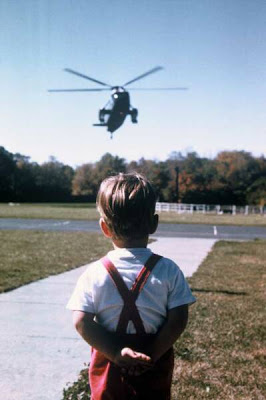
Even John’s irresistible yearning for flying, despite his mother’s plea not to do so, can possibly be traced back to his childhood, “when he and his mother watched as Daddy’s helicopter took off from the South Lawn in 1962,” or watched him reappear from the sky. When Nanny Shaw announced to little John in the morning of November 23, 1963, “John, your father has gone to heaven to take care of Patrick [JFK and Jackie’s third child, who did not survive his first month],” John asked, “Did Daddy take his big plane with him?” “Yes,” she answered. “I wonder,” John said, “when he’s coming back.”[10] Significantly, John gave his first private plane the registration number N529JK, a reference to his father’s May 29 birthday.
Did John intend to follow his father’s footsteps in politics? John Quinn, a pioneer researcher on his mysterious death, writes:
“Committed to the legacy of his compelling father, there was never any question about where John F. Kennedy Jr. was heading. Is there any doubt about the fact that it was only a matter of time before he claimed his father’s legacy? Anybody who claims that we will never really know, does not know anything about John F. Kennedy Jr.”[11]
We don’t know at what stage in his life John fully endorsed that responsibility. But the thought had certainly been in his mind for many years already when he introduced his uncle Teddy at the 1988 Democratic convention. Like millions of Americans, Salinger was “very excited about that speech”:
“I took John Jr. to meet alone with me for several hours. I was telling him that this speech showed strongly that he should start thinking about going into politics. He said he was interested, but he was still too young. He told me that he had an idea that he should go into politics in the next century.”[12]
Jackie, the guiding spirit in John’s life, definitely saw her son as Camelot’s standard-bearer. In her last letter to him before dying to lymphoma in 1994, she wrote: “You, especially, have a place in history.”[13] According to presidential historian Doug Wead, interviewed in the film I am JFK Jr., Jackie “knew in her heart that, some day, the stars are gonna line up, and he’s gonna be president.” “My mom sort of pressured me to get into politics,” John told Lloyd Howard in 1997. “She expected me to follow in my father’s footsteps, and of course I will. But I don’t think the time is right just yet.”[14]
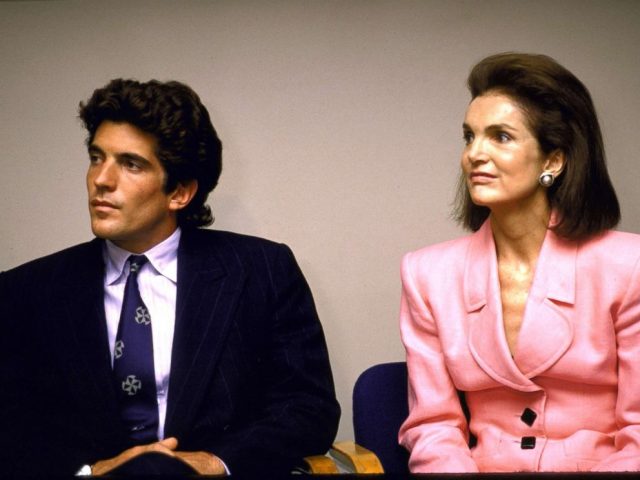
In 1995, John launched his political magazine George. Under the appearance of superficiality, it engaged in controversial issues of deep politics that reflected John’s interests. His longtime friend Robert Littell wrote, in The Men We Became: My Friendship with John F. Kennedy Jr. (St. Martin’s Press, 2004): “George was also an opportunity for John to build a platform from which he might possibly move into political life.” After all, his father had also pursued a career in journalism before entering politics. George was also a means for John to interact with political actors and thinkers.
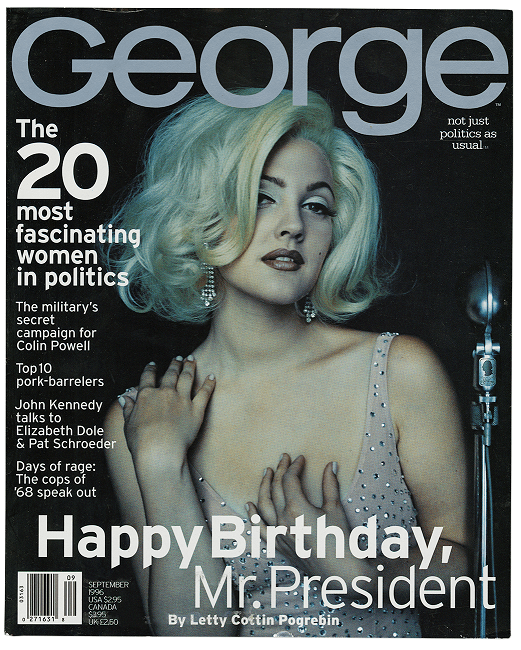
John didn’t avoid letting people know his interest for his father’s legacy. The September 1996 cover of George features Drew Barrymore grimed as Marilyn Monroe with the caption: “Happy Birthday, Mister President,” an obvious — and, to some, indecent — reference to Marilyn’ serenade in front of JFK at the Madison Square Garden in 1962. In October 1997, for the 35th anniversary of the Cuban Missile Crisis, John travelled to Cuba to meet Fidel Castro (the interview he had wished didn’t materialize, but Castro invited him for dinner and for a swim in the Bay of Pigs, and rumor has that Castro gave him his view on his father’s death).[15]
John’s interest for the presidency also transpired heavily in George, particularly in the recurrent section “If I were president,” in which various personalities were asked for suggestions. For the October 1998 issue, for example, Tony Brown, author of Empower the People: A 7-Step Plan to Overthrow the Conspiracy That Is Stealing Your Money and Freedom, declared that, if he were president, he would repeal the Federal Reserve Act of 1913.
In 1999, at age 39, John was trying to sell his magazine. He had new plans. According to Gary Ginsberg, a close collaborator who was with John the night before he died, “That last night he was very focused on two things: finding a buyer for George and his political future.”[16] Christopher Andersen writes in his biography The Good Son :
“There seemed little doubt in the minds of those who knew him that John was on the brink of a bright political future. ‘He was probably a more natural politician than any of the other Kennedys,’ David Halberstam said, ‘and that includes his father. John had all the makings of a political superstar — once he decided that’s what he wanted.’”
In July 1999, his decision was made. His closest friends have testified that he was preparing to enter an election contest. Pierre Salinger, who knew him well, declared on French radio Europe 1, on July 19, 1999:
“I felt that in the coming year John Junior would also become a politician. It’s my point of view. And with other people, we thought he was going to be a Democratic candidate for the next presidential election.”[17]

John Junior and Pierre Salinger in 1997
More plausibly, John Jr. would have started by seeking a political office in New York State, where he had lived since 1963. He loved New York, and New York loved him. A 1997 private poll ranked JFK Jr. as New York’s “most popular Democrat,” giving him 65 percent approval rating among fellow Democrats.[18] John had several options. One he excluded was mayor of New York City. His assistant at George, RoseMarie Terenzio, recounts that when New York Senator Al D’Amato suggested he should run for mayor, John laughed it off. When Terenzio asked him afterward if he would ever consider it,
“He said ‘Well, Rosie, how many mayors do you know that became President?’ I was so shocked I didn’t say anything. Then he smirked as if to say ‘That’s not the road you go down — we’ll see what happens.’”[19]
Terenzio also made the following comment to the news website TheWrap :
“I think he would’ve run for president. I thought he would’ve run in 2008. I had dinner with a friend from George last night who thought for some reason he would’ve waited for 2016. He would be 56.”[20]

Donald Trump and John Kennedy Jr. in 1999: Were they up to something?
According to Gary Ginsberg, JFK Jr.’s close collaborator at George,
“He had been thinking about running for the N.Y. Senate seat — he even had meetings about it that spring — but by July had concluded he would focus his attention on running for governor of N.Y. in 2003. By temperament and interest, John, I think, realized he was far more suited to being a governor than a legislator. He knew from running George that he could be an inspiring, strong chief executive of a state, setting the tone for government and successfully running a complex operation. That idea became very appealing to him at some point that summer. Had the stars aligned over the next couple of years, I’m pretty convinced that’s what he would have pursued.”[21]
Others around John believed he was about to enter the race for the Senate seat that Daniel Moynihan, a former assistant to President Kennedy, was going leave vacant in 2000. This is the seat that Bobby Kennedy had occupied from 1964 to 1968. On July 19, 1999, New York Daily News reporter Joel Siegel interviewed two unnamed friends of JFK Jr., who said “they believed he would have run for office some day. Earlier this year, in one of the best-kept secrets in state politics, Kennedy considered seeking the seat of retiring Sen. Daniel Moynihan (D-N.Y.) in 2000, friends confirmed yesterday.” Democratic Chairman John Marino, also quoted in Siegel’s article, did not believe he would have run for the Senate seat, but had little doubt that, if he did, “It would have been ‘Goodbye, anyone else. This is a guy who everybody recognized who would have had any nomination for the asking.’”[22]

Christopher Andersen supports the view that, after consulting with Democratic leaders, John had made up his mind for the Senate. It clashed with Hillary Clinton’s plan. The Clintons, who were to leave the White House in January 2001, were about to purchase a home in Chappaqua, N.Y., and Hillary was gearing up to run for the Senate as a stepping-stone to the presidency.
“In the end, John was still convinced his best shot was at running for Moynihan’s Senate seat. Hillary Clinton had hesitated to enter the race largely because she feared John, who was being touted behind the scenes as her principal rival for the nomination, would be a formidable foe. John was both heir to the Kennedy magic and People’s ‘Sexiest Man Alive,’ as well as the consummate New Yorker, a resident of the city since the age of three. Although New York had no residency requirements, Hillary, who had never spent more than a few days at a time in New York, would almost certainly be branded a carpetbagger. … As late as the summer of 1999, Hillary actively worried about JFK Jr. and sought assurances from state party officials that he would not be a last-minute entry into the race. … In early July, Hillary finally made her move and formally announced her candidacy. But she was still concerned about the possibility that John might decide to toss his hat into the ring. As it turned out, she was right. John was now more confident than ever that he could easily beat her at the polls. He believed Hillary was vulnerable not only because of the Monica Lewinsky affair, her husband’s subsequent impeachment, and a slew of brewing scandals in the Clinton White House, but mainly because she simply had no connection to the state he loved. As Hillary had feared, young Kennedy planned on making much of Hillary’s carpetbagger status. ‘Wait until she gets here,’ John told his friend Billy Noonan. ‘She’s gonna get her head handed to her.’ He was going to fill Noonan in on the details of his upcoming campaign for the U.S. Senate — how and when he intended to make the announcement, what advice he was getting from Uncle Teddy, the endorsements and backing he was already lining up — when they all got together on Nantucket to celebrate Noonan’s fifth wedding anniversary on July 16. Then they’d be off to attend his cousin Rory’s wedding in Hyannis Port. If, of course, all went according to plan.”[23]
Christopher Andersen’s interview on Eyewitness News:
Andersen relies on the testimony of John’s longtime friend Billy Noonan, who authored in 2006 Forever Young: My Friendship with John F. Kennedy, Jr. (Viking Press). Here is what Noonan writes precisely, referring to the last phone conversation he had with John, whom he was supposed to meet on July 16:
“He had been making vague references on the phone about shutting things down, and starting things up. During the week before our anniversary dinner, he told me that he had something pressing to talk about, but with curious ears in the office, John was cautious. ‘We’ll talk about it this weekend.’ … I asked him now what was up with that [1997] poll, to rib him about how the press was pushing for Hillary Clinton to replace Moynihan. ‘Wait until she gets here,’ John said. ‘She’s gonna get her head handed to her.’ He was in.”[24]
This is the only mention by Noonan of John’s intention to run for the Senate. On one hand, it is not much. On the other, it should be taken very seriously, coming from one of John’s most intimate friends. Given the importance of the issue, there can be no doubt that Noonan weighed every word he wrote. One gets the impression that he wanted to say what he knew for the record, yet felt restrained from saying it too clearly, even when hinting at John’s awareness that his telephone conversations were tapped the day before he died. In his 2009 article, Wayne Madsen quotes an unnamed “close friend of the late John F. Kennedy, Jr.” (who may be Billy Noonan), who said JFK Jr. “was about ready to announce his run for the U.S. Senate from New York. Kennedy was acutely aware of his vulnerability and hired on a personal security team just prior to his announcing for the Senate.”[25]
Noonan and Andersen are not the only ones to think that John was upsetting Hillary’s plans. Andrew Collins writes:
“Approaching the end of two terms in the White House, the Clintons began preparing for their political future. They focused their attention on developing Hillary as a politician (even though she had no actual experience), and selling influence while they had it — buy now, pay later — payable to what would become ‘The Clinton Foundation’. Hillary refused to return to Arkansas, and suggested the purchase of a home in New York which would allow her to run for the Senate in the upcoming election. There was just one obstacle…. JFK Jr. had entered the political scene. New York was electric with word of JFK Jr. reclaiming his father’s legacy! A piece of Camelot was still alive in America, and donors began to line up. She knew she could never defeat the son of JFK in New England.”[26]

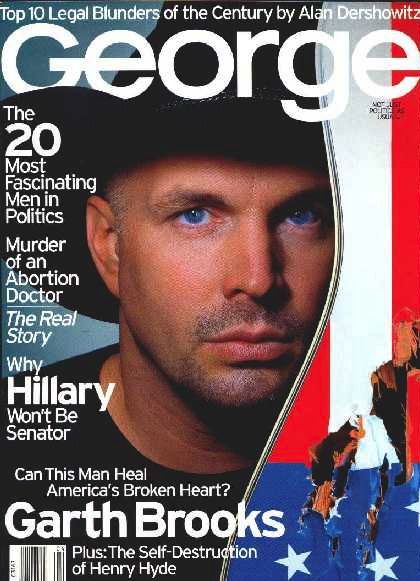
April 1999: “Why Hillary won’t be senator”

November 1999: “Hillary Comes Clean”
After reviewing all those testimonies, I feel that no certainty can be reached about John’s immediate plan, other that he was at the dawn of a bright political future and that he had several options in New York State. If we believe Noonan — and why shouldn’t we — then Laurence Leamer, author of Sons of Camelot: The Fate of an American Dynasty (HarperCollins, 2011) is right when writing that “John watched with growing dismay as Hillary subtly insinuated herself into what he considered his state.”[27] It is easy to guess that, in return, Hillary saw John as a serious rival, on the state level in the short term, and on the national level in the long term. She stood no chance if John ever stepped across her way, and that was sure to happen sooner or later.
It is true, as some authors object, that John never frontally attacked the Clintons in his magazine George, perhaps out of Democratic loyalty. But one of the very last issues of George that he oversaw himself (April 1999) was hostile to Hillary’s bid on the Senate seat, posting on the front-page: “Why Hillary won’t be senator.” In April 1996, the cover had: “Why Women Will Dump Hillary.” But with John out of the way, Hillary did win the seat and, disturbingly, the November 1999 issue of George contained an exclusive interview of her, together with — in tragic irony — an article on “How Bobby Kennedy Seduced New York.”
JFK Jr. as conspiracy theorist
Let’s move on to the next question: how dedicated was John to getting to the bottom of his father’s assassination?
According to testimonies from his friends, John Junior was haunted by the death of his father and quite knowledgeable about independant investigations contradicting the Warren Report. In 1999, he was not a newcomer to JFK conspiracy theories; his quest for truth had started as early as the late 1970s. His old high school girlfriend Meg Azzoni, in her self-published book, 11 Letters and a Poem: John F. Kennedy, Jr., and Meg Azzoni (2007), writes that as a teenager, JFK, Jr. was questioning the official version of his father’s death: “His heartfelt quest was to expose and bring to trial who killed his father, and covered it up.”[28] Don Jeffries, author of Hidden History, claimed that “another friend of JFK, Jr.’s adult inner circle, who very adamantly requested to remain anonymous, verified that he was indeed quite knowledgeable about the assassination and often spoke of it in private.”[29] JFK Jr., said Jeffries in a radio interview, was on “a Shakespearian quest,” “to avenge his father’s death,” like young Hamlet.[30]

October 1998 “Conspiracy Issue” with an article by Oliver Stone
John is the only Kennedy to have shown a serious determination to pursue this truth, besides his uncle Bobby. And he took the risk of making his interest public in October 1998, when he released a special “Conspiracy Issue” of George magazine, which included an article by Oliver Stone titled “Our Counterfeit History,” introduced on the cover as “Paranoid and Proud of It!”
In an article published in 2009, journalist Wayne Madsen claimed that, two weeks after John’s death, “I was scheduled to meet with Kennedy at his magazine’s offices in Washington, DC to discuss hiring on as one of a few investigative journalists Kennedy wanted to dig deep into a number of cases, but most importantly that of his father’s assassination.”[31] (There is no confirmation of Madsen’s claim.)
As many truth seekers who had started with the Kennedy assassination, John had developed an awareness that other events of great historical consequence were the subject of State-orchestrated lies and cover-ups, with corporate media complicity. And so the JFK assassination was not the only “conspiracy issue” explored by George. It is worth taking a look at two others, for they may inform us on the direction John Jr. was taking in his quest for truth.
In December 1996, George delved into the theory claiming that TWA Flight 800, which had exploded on July 17, 1996, soon after leaving JFK International, had been downed by a missile, rather than as the result of a short-circuit near the central fuel tank, as the National Transportation Safety Board concluded. The claim was based on the testimonies of 375 witnesses who saw one or two bright flare objects hit the plane, many of them believing it was a missile (read Ron Unz’s 2016 article on the subject, or watch on YouTube the 2001 documentary Silenced: TWA 800 and the Subversion of Justice). Although I have not been able to read the George article on TWA 800 (I will appreciate a comment from anyone who has), I assume it supported Pierre Salinger, who had been the most prominent journalist arguing that TWA 800 was shot down by a missile fired from a US Navy ship. Salinger was severely attacked by his peers, and his notoriety suffered permanent damage. But in May 27, 1999, he reaffirmed his belief and asked to be vindicated in a Georgetowner column, based on new research confirming his views. In this piece, Salinger mentions that “retired Navy commander William Donaldson has also come out with a new view: TWA 800 was shot down by a missile — fired not from a Navy ship but a terrorist group.”[32] That could explain the presence of a mysterious ship caught on radar while speeding away near where the plane exploded. Details can be read in a piece written by Philip Weiss for the New York Observer in July 1999 (days before JFK Jr.’s death), titled “Radar Shows ‘Getaway Boat’ Fleeing Flight 800 Crash”:
“‘Radar data collected during the last minute of the T.W.A. flight revealed the two closest objects to the plane, both between three and four miles away, as a Navy P-3 airplane and what the exhibit called simply a ‘30-knot target.’ Radar data for the next 20 minutes showed the mystery boat heading on a beeline out to sea, on a south-southwest course, even as other boats rushed to the crash to try to help out. It was nearly 9 o’clock at night, not the usual time for an excursion. … [FBI officer] Lewis Schiliro acknowledged the presence of the mystery boat, which he said was at least 25 to 30 feet long and reached speeds of 35 knots, close to 40 miles per hour. ‘Despite extensive efforts, the F.B.I. has been unable to identify this vessel,’ he said. / The response is somewhat alarming given the F.B.I.’s assurances that it had turned over every stone.”[33]
Alarming, but understandable if the mystery boat was in fact Israeli. Israel’s LAP (LohammaPsichologit, the Mossad’s department of psychological warfare) had been busy blaming Iran from the day of the crash, and “thousands of media stories perpetuated the fiction,” recounts Gordon Thomas in Gideon’s Spies: The Secret History of the Mossad (2009), with the London Times claiming that land-air Stinger missile systems had been smuggled across the Canadian border into the United States by Islamic terrorists. A year later, the FBI’s chief investigator, James K. Kallstrom, would tell his colleagues: “If there was a way to nail those bastards in Tel Aviv for time wasting, I sure would like to see it happen. We had to check every item they slipped into the media.”[34]
Some researchers into JFK Jr.’s plane crash have suggested a connection to the TWA 800 crash, which happened three years earlier almost to the day, and in the same vicinity. Jackie Jura, author of Orwell Today website, wrote:
“I remember when TWA 800 exploded and Salinger was going to give a press conference in Paris to expose the truth. But then he cancelled it. The rumour on the net at the time was that the powers-that-be told him that if he gave the press conference they’d kill John-John, and so he backed down.”

“TWA Conspiracy Theories” (December 1996)
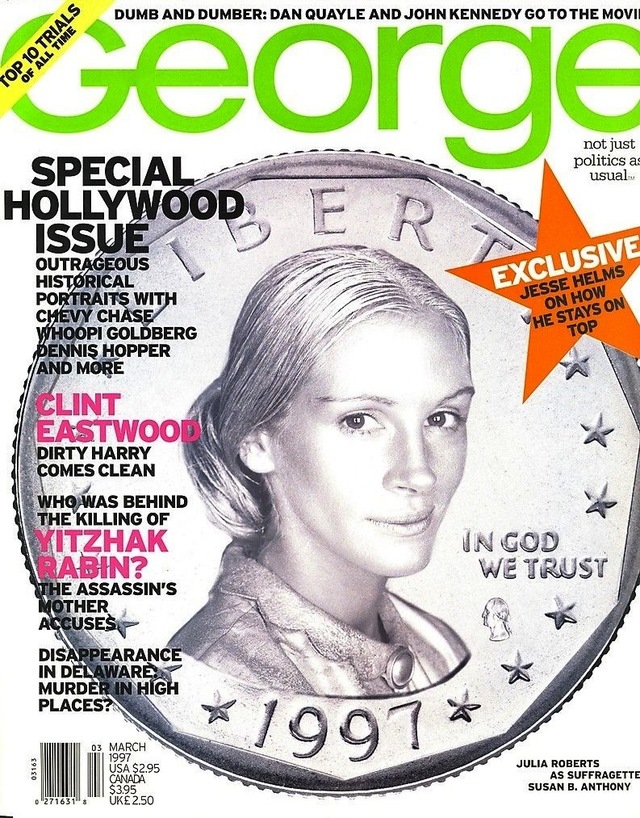
“Who was behind the killing of Yitzhak Rabin?” (March 1997)
Back down he did, but in May 27, 1999, he reiterated his claim, and John Jr. would die 50 days later. I don’t subscribe to that theory, but it is worth mentioning.
In March 1997, three months after the issue featuring the “TWA Conspiracy Theories” cover article, George magazine published a 13-page article by the mother of Yigal Amir, the man convicted of assassinating Israeli Prime Minister Yitzhak Rabin. Rabin had offended the Israeli far-right by wanting to trade land for peace. Amir’s mother revealed that her son had operated under the tutelage and training of a Shin Bet agent, Avishai Raviv, working for forces seeking to halt the peace process.[35] Canadian-Israeli journalist Barry Chamish, who investigated the Rabin assassination in his book Who Murdered Yitzhak Rabin? (1988), agrees. He also believes that JFK Jr. was determined to “get the full story on the Rabin assassination,” and finds support in several news releases following JFK Jr.’s death:
“Catherine Crier of Fox TV’s The Crier Report, announcing that JFK Jr. was about to meet high ranking Mossad officers. Then the German newspaper, Frankfurter Allgemeine Zeitung, reported that Kennedy had met with the deputy chief of the Mossad, Amiram Levine, to get the full story on the Rabin assassination two days before his plane went down. Then Maariv ran an interview with JFK’s chauffeur, who happens to be Israeli. Then people started noting that Ehud Barak was in Washington at the time of Kennedy’s finale in life.”[36]
Barak’s visit to the U.S. around July 16, 1999 — with a battalion of Intelligence and security agents — is a fact, but I have not been able to verify Chamish’ sources in the Crier Report, the Frankfurter Allgemeine or the Maariv. Chamish concluded:
“Yes, I’m sure he [John] was murdered. And yes, the Israeli political establishment had a motive for involvement. The latest Kennedy to die violently was the only American editor to expose (in the March 1997 issue of his magazine George ) the conspiracy behind Rabin’s assassination. And he had every intention of continuing his exposes until he got to the bottom of the matter. We don’t know what drove him to stand alone in seeking the truth, but it may have had much to do with the information contained within Final Judgment.”[37]
There is no confirmation that John Junior read Michael Piper’s book Final Judgment blaming Israel for the Kennedy assassination, and released in 1993. But it is in the realm of possibility, given his personal quest for the truth on his father’s death, and his consideration for the theory that Rabin was assassinated by the Israeli Deep State, rather than by a lone nut.
So, was JFK Jr. himself assassinated? Here is man whose road to the presidency seemed traced. No other man of his age had better chances to reach the White House one day. And no other man in the world had more reasons to want the 1963 Kennedy assassination reinvestigated. He was already trying to educate the public through his magazine, at the risk of exposing his own beliefs, something no other Kennedy had ever done (even RFK had kept his doubt on the Warren report private, and his plan to reopen the case secret). And this man, his best friend Noonan believes, was just about to announce his candidacy for a New York Senate seat, which everyone would have understood as the first step toward the White House. Pierre Salinger and others even believe he would have run for president in 2000. What are the odds that he would die at this precise moment by accident? How lucky for his enemies to be spared the trouble of eliminating him, as they had his uncle in 1968! If that was an accident, then that alone deserves to be called a “Kennedy curse,” doesn’t it! If it was an accident, then the Devil caused it. Or was it Yahweh?
As I have argued in “Did Israel kill the Kennedys?”, John’s uncle Bobby had been assassinated because he was, in his own eyes and in the eyes of most Americans—and therefore also in the eyes of his brother’s killers —, the continuation of his brother, his heir and avenger. Even before David Talbot, Laurence Leamer has shown how close Jack and Bobby had been. He writes in Sons of Camelot:
“Bobby had been the president’s alter ego and protector. He could finish his brother’s sentences and complete a task that Jack signaled with no more than a nod or a gesture. He had loved his brother so intensely and served him so well that within the administration it was hard to tell where one man ended and the other began.”[38]
A bond of blood and spirit of a comparable nature existed between John F. Kennedy and the son that bore his name. Although John Junior could not speak with his father, nor even remember speaking with him, his love and loyalty to his father, nurtured by his mother, was the driving force in his life. From the point of view of JFK’s murderers, JFK Jr. was JFK redivivus, and RFK redivivus at the same time. All three were like one man who had to be killed three times.
PART II: EVIDENCE OF ASSASSINATION AND COVER-UP
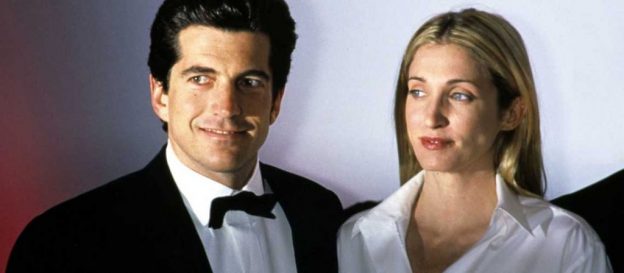
Was JFK Jr. assassinated? As we are going to see, the evidence may not be absolutely compelling, but what can be proven beyond a reasonable doubt is that federal authorities and corporate media engaged in a massive cover-up of any facts that contradicted the theory of the accident due to the pilot’s error. And that is enough, I think, to decide between accident and assassination. The transgenerational cabal who had the motive, means and opportunity to murder JFK and RFK (and the power to get away with it) had the same motive, means and opportunity to murder JFK Jr. (and the power to get away with it). We know for sure that, in 1968, RFK had both the ambition to win the White House and the determination to reopen the investigation on the death of his brother (read my article “Did Israel Kill the Kennedys?”). I have now shown that the same can be ascertained about JFK Jr. in 1999. Obviously, that made him a target, the next Kennedy on the list.
The 9:39 call and the explosion
According to Wayne Madsen, “JFK Jr.’s Plane Crash Was Originally Treated As Murder Investigation” (the title of his 2009 article):
“The FBI had discovered that there was ‘suspicious boating activity’ in an area of Martha’s Vineyard where Kennedy’s plane was descending to 2000 feet for its final approach to the airport. The ‘suspicious’ boaters claimed to be fishing for striped bass. … after the plane’s wreckage was discovered, investigators found, according to Kennedy’s friend, that every light bulb, including that in the emergency flashlight, had been blown out on the plane and every circuit board, including those in the engine sensors and other electronic equipment, had been literally ‘melted.’ FBI agents on the scene preliminarily concluded that a ‘massive electromagnetic event’ caused Kennedy’s plane to crash. … Before the FBI could begin examining the ocean floor for any ‘special equipment’ that may have been thrown overboard from the fishing boat, their ‘murder’ investigation was abruptly called off by FBI headquarters in Washington.”[39]
Unfortunately, I have found no source supporting Madsen’s claim about an aborted FBI investigation (that’s always the problem with Madsen). But the fact that no news of a criminal investigation ever reached the public is in itself very puzzling, given the history of Kennedy assassinations and the natural assumption that JFK Jr. could be a target. That JFK Jr. had powerful enemies was well-known to the whole world, and the lack of a criminal investigation may be taken as confirmation of their power.
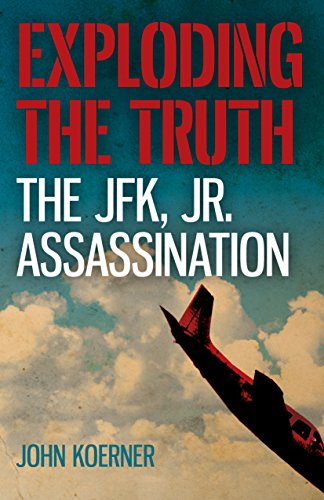
Independent investigators have gathered a fair amount of evidence that JFK Jr.’s death was a criminal act. I will summarize what I hold to be the most solid evidence, based on my reading of all the relevant articles I could find on the Net (including those by early researchers such as John Quinn), and of the following two books: first, chapter 7 of Donald Jeffries’s book Hidden History: An Expose of Modern Crimes, Conspiracies, and Cover-Ups in American Politics (Skyhorse publishing, 2016), which I recommend (you may also want to listen to Jeffries’s one-hour interview); second, John Koerner, Exploding the Truth: The JFK Jr., Assassination (Chronos Books, 2018), which adds little. In addition, John Hankey’s video “Dark Legacy II: the Assassination of JFK Jr” is very useful. However, I advise to skip Koerner’s Part I, meant to exonerate the Clintons and blame the Bushs; for the same reason, I recommend to start Hankey’s video at 15 minutes.
The basic fact that seems firmly established by radar data is that JFK Jr.’s plane suddenly nose-dived into the Ocean at 9:41. That cannot be explained simply by an engine failure, as the Boston Globe correctly asserted:
“Even if the engine died, a federal aviation source said, it is unlikely that the plane would reach such a high rate of descent, because the plane is designed to glide without power at a much slower rate for several miles. And if Kennedy had run out of fuel, it is likely he would have made a distress call.”[40]
The most likely explanation, apart from suicide, is that the plane suffered a structural damage, possibly by explosive, making it impossible to maintain in the air; blowing off a part of a wing or the tail would have been enough, and would have required only a very small device fixed to the plane.
The next element to consider is that, from the early hours of July 17, it was reported that JFK Jr. had made a call to Martha’s Vineyard airport at 9:39 pm, asking for landing instructions in a perfectly calm tone, less than two minutes before his plane suddenly dropped and disappeared from radar. That information was broadcast on Boston WCVB-TV and was relayed by ABC News. A United Press International article dated July 17 said:
“At 9:39 p.m. Friday, Kennedy radioed the airport and said he was 13 miles from the airport and 10 miles from the coast, according to WCVB-TV news in Boston. He reportedly said he was making his final approach. … In his final approach message, WCVB-TV said Kennedy told controllers at the airport that he planned to drop off his wife’s sister and then take off again between 11 p.m. and 11:30 p.m. for Hyannis Airport.”[41]
WCVB-TV repeated that information continuously during their first two days of reporting on the story. They broadcast, at 12:35 p.m. on July 17, a phone interview by anchor Susan Wornick of U.S. Coast Guard Petty Officer Todd Burgun, who confirmed the information. Here is a transcript of the footage, which Hankey has included in his valuable film (19:40):
Wornick: “We have been told by the Coast Guard that in fact there is now evidence of a last communication last night with JFK Jr.’s plane as he was making an approach to Martha’s Vineyard airport. Petty officer Todd Burgun joins us from the Coast Guard Base in Boston. He is a Petty officer, and a public information officer. Thank you for being with us, sir. What can you tell us about this last communication with JFK Jr.’s plane?”
Burgun: “All I really know at this time is that it was at 9:39 p.m. and it was with the FAA. And he was on his final approach to Martha’s Vineyard.”
Wornick: “So at 9:39, to the best of your information, JFK Jr. made a contact with the airport, with the flight controllers that he was on his final descent.”
Burgun: “That is correct.”

Todd Burgun’s interview on WCVB-TV Boston, from Hankey’s Dark Legacy (19:40)
That is all that remained of WCVB-TV’s report on the subject, when researchers later obtained archive copies; “hours of time on the tape archive of WCVB’s July 17 broadcast, during which information on Kennedy’s radio contact was continually reported, have been intentionally cut,” complained John Quinn.[42] According to Jeffries, the original interview of Burgun was much longer:
“On the uncut tape, Burgun went on to delineate all the points from the UPI’s article: Kennedy was calm, on approach to the airport, had provided his position and trajectory, and had even made a comment about dropping Lauren Bessette off at the airport. Some five hours of coverage was edited out.”[43]
This crucial information was reported by news services on Saturday July 17 and early Sunday, July 18. By Monday morning, the FAA claimed that there was never a communication from Kennedy to the tower. Todd Burgun became utterly unreachable. According to the Boston Globe, Martin Wyatt, a controller at the Martha’s Vineyard Airport tower the night of Kennedy’s flight “declined comment on whether he had radio contact with Kennedy’s plane.”[44] Simultaneously, on July 18, FAA and NTSB officials produced some “newly found” radar “evidence” which supposedly showed Kennedy’s flight exhibiting signs of difficulties and irregularities long before 9:39; obviously, Kennedy’s perfectly normal call at 9:39 did not fit with that new version of events.
Of course, it is not inconceivable that the crucial piece of information of JFK Jr.’s 9:39 radio call was mistaken, false, or fake. Yet it seems highly implausible that the Coast Guard would charge their spokesman Todd Burgun — whose identity is not in question — to release it to the public without double-checking it. The fact that the news was originally broadcast by a Boston TV station is perhaps significant, as is the fact that, among major newspapers, the Boston Globe was the most critical of the official story (I’ll mention other cases along the way). Since Boston is the Kennedys’ historical stronghold, we can conjecture that an information war of some sort was going on between Boston and Washington, Boston trying to resist the disinformation assault from federal agencies.

The only available photo believed to be of the wreckage of JFK Jr.’s plane
The second element to consider is the testimony of Victor Pribanic, a trial lawyer from White Oak, Pennsylvania, who was fishing for striped bass off Squibnocket Point that night. He gave an interview to The Martha’s Vineyard Times, cited in the New York Daily News, July 21, 1999: “I heard an explosion over my right shoulder. It sounded like an explosion. There was no shock wave, but it was a large bang.” He also said, according to the Daily News, “that just before hearing the noise, he noticed a small aircraft flying low over the water toward the island.”[45] Pribanic repeated his story to filmmaker Anthony Hilder of the Free World Alliance: “I heard a loud impact like a bomb.” The next day, when Pribanic heard the news of the Kennedy crash, he gave his information to Hank Myer of the West Tilsbury Police Department. Myer accompanied Pribanic to the site where he’d heard the explosion, which would turn out exactly where the plane went missing. Police, he was told, forwarded his information to the investigators.[46] Pribanic was apparently not the only witness of the explosion. The July 17 UPI article mentions:
“A reporter for the Vineyard Gazette newspaper told WCVB-TV in Boston that he was out walking Friday night about the time of the crash and saw ‘big white flash in the sky’ off Philbin Beach.”
When John DiNardo contacted the Vineyard Gazette in an attempt to talk with this reporter, a few days later, he was told that the “whole thing” was a mix-up due to some fireworks having been set off at “Falmouth”, and, when he insisted, he was told that the reporter was no longer employed by the paper.[47]
Like the 9:39 radio call, the ear- and eye-witnesses disappeared from news reports from July 18 on. The National Transportation Safety Board initial report, released on July 30, 1999 makes no mention of them. It states that there was no “in-flight break-up or fire, and no indication of pre-impact failure to the airframe,” which excludes an explosion damaging the plane. On June 7, 2000, eleven months after the plane crash, the NTSB released its final report. That report was announced to the press by a short official NTSB news release which included the following statement: “The probable cause of the accident, as stated in the accident report, is: ‘The pilot’s failure to maintain control of the airplane during a descent over water at night, which was a result of spatial disorientation. Factors in the accident were haze and the dark night.’” A first problem must be pointed out: that statement from the NTSB news release which is supposedly taken from the final report does not appear in the final report. In fact, as I will show, it is hard to see how the full report supports the conclusion of that news release. One gets the impression that the person who wrote the news release didn’t even read the full report.
For example, the sudden drop of altitude from 2,200 feet to 1,100 feet in 14 seconds, stated in the full report, is hard to reconcile with the news release statement. Disorientation implies that the pilot was not aware that he was flying straight into the ocean. But that is impossible, as the NTSB Investigator-in-Charge, Robert Pearce, had admitted as early as July 20, 1999: “They were aware they were going down. With that kind of descent rate, it is going to be noisier than hell in the cockpit.”[48]
Jeb Burnside, commercial pilot and editor-in-chief of Aviation Safety Magazine, did a careful analysis of the NTSB report and radar data and confirms that weather conditions and pilot experience (or lack of) fail to explain the crash:
“On paper, this accident shouldn’t have happened. Despite most of his time being in a training environment, a typical 310-hour instrument-rating student in a well-equipped airplane should have had no problem with this flight.”[49]
The mainstream media hardly paid attention to the full report, and focused on the short news release. But they even distorted it to make its hesitant conclusion (“probable cause”) more assertive and dramatic. “Haze and the dark night,” which are mentioned as “factors in the accident,” were exaggerated and declared totally unsafe for flying. “The pilot’s failure to maintain control … as a result of spatial disorientation,” became proof that JFK Jr. was incompetent to fly in such terrible weather at night. And the implication was that JFK Jr. was reckless and irresponsible to fly that night, especially with his wife and sister-in-law on board.
So, after the first step of crucial omissions in the NTSB report (JFK Jr.’s 9:39 call to the airport and Pribanic’s report of an explosion), the disinformation process continued in two more steps: first, a NTSB news release about the “probable cause” of the “accident” is falsely presented as “stated” in the NTSB final report, whereas it is in reality a far cry from the picture presented in the report; second, that relatively prudent statement is exaggerated and dramatized in mainstream news, while all contradictory details in the full report are ignored. Let’s see out that works for the two following crucial points: 1) weather conditions and visibility, 2) the pilot’s experience and cautiousness. My point is not so much to determine exactly the visibility and the level of JFK Jr.’s skill, but rather to demonstrate a concerted effort to distort credible reports on these matters, with the obvious intention to convince the public that the lack of visibility and John’s inexperience are sufficient explanations for his plane crash, although in fact, they are not.
Even the NTSB initial report (July 20, 1999) noted that there was no report of “significant meteorological conditions” along the flight. We also read
“At about 6:30 on the night of the accident, the pilot received an Internet weather forecast for flight from Teterboro, New Jersey, to Hyannis, Massachusetts. The report was for VFR (visual flight rules) weather, visibility 6 to 8 miles.”
So two hours before taking off, JFK Jr. received a forecast of very good flying conditions. The NTSB final report also quotes the Martha’s Vineyard tower manager as stating:
“The visibility, present weather, and sky condition at the approximate time of the accident was probably a little better than what was being reported. I say this because I remember aircraft on visual approaches saying they had the airport in sight between 10 and 12 miles out. I do recall being able to see those aircraft and I do remember seeing the stars out that night.”
This tower manager must be Marvin Wyatt, interviewed for the Boston Globe: “Marvin Wyatt, a controller at the Martha’s Vineyard Airport tower the night of Kennedy’s flight, said visibility was good at the airport at Kennedy’s expected arrival time.”[50] Wayne Madsen quotes an unnamed close friend of JFK Jr. (probably Billy Noonan, who was supposed to meet him that night) who said “that visibility around the Vineyard was clear at 9:41 p.m. when the plane disappeared from the sky.”[51]
Mainstream news outlet, however, repeated over and over again, in contradiction even to the NTSB report, that the weather was so bad, the fog so thick, that John should have cancelled his plan to fly, had he been a responsible man. FAA Flight Specialist Edward Meyer, who had prepared for the NTSB the FAA’s official report of weather conditions over Martha’s Vineyard on July 16, 1999, and had determined that they were “at least very good,” was disturbed by the way his conclusions were distorted, and released a public statement:
“Nothing of what I have heard on mainstream media makes any sense to me… The weather along his flight was just fine. A little haze over eastern Connecticut. … I don’t know why the airplane crashed, but what I heard on the media was nothing but garbage.”[52]
One of the most dubious witnesses brought forward by the corporate media to support their claim of fatal visibility was Kyle Bailey. Here is how the Washington Post introduced him on July 21st:
“Kyle Bailey, 25, a pilot with more than a decade of flying experience who also keeps his plane at Essex County Airport and who frequently flies the same route as Kennedy — Fairfield to the Vineyard — took special note of Kennedy that night because Bailey had just decided against making the flight. / Bailey said he feared the combination of darkness and haze could be treacherous, causing him to lose sight of the horizon, lose his bearings, maybe even lose control of his plane. Visibility was four to five miles in Fairfield due to haze, near the margin for flying by visual rules, as opposed to instruments.”[53]
According to the NY Daily News of the same day, Bailey said:
“I saw him taxi [drive the plane on ground to prepare for take off], and I saw him take off. I [later] told my family, ‘I can’t believe he’s going up in this weather.’ At night, you don’t know where the sky ends and the ocean begins. You have no sight of the horizon. It can give you a false sense of flying level.”
“Bailey,” commented the Daily News, “was staggered by what he feared was another ghastly Kennedy tragedy. ‘It never seems to end for this family,’ he said. ‘He’s so young, with a life full of promise.’”[54]
How moving! But who is Kyle Bailey, “the last man to see Kennedy alive at the Fairfield airport”? I had no difficulty to find the answer to that question: it happens that Kyle Bailey later became an aviation analyst regularly working for major network and cable televisions such as Fox News, CBS, ABC, NBC, BBC. Bailey even appeared in the documentary Curse on the Kennedys? and very recently in the ABC documentary The Last Days of JFK Jr., aired in January 2019, in which he repeats his story. Can you swallow that blue pill?

Kyle Bailey at work
In the same documentary The Last Days of JFK Jr. appears another private pilot by the name of Bob Arnot, who claims to have flown the same night along the same route as John. He declares there was no visibility, to the point that, when approaching Martha’s Vineyard, he could not see any lights at all. Unlike Bailey, who somehow escaped the attention of NTSB investigators, this Bob Arnot is most probably the unnamed pilot mentioned in the NTSB report as follows: “when his global positioning system (GPS) receiver indicated that he was over Martha’s Vineyard, he looked down and ‘… there was nothing to see. There was no horizon and no light. … I turned left toward Martha’s Vineyard to see if it was visible but could see no lights of any kind nor any evidence of the island. … I thought the island might [have] suffered a power failure.’” That testimony completely contradicts Martha’s Vineyard tower manager (Marvin Wyatt), who is quoted in the NTSB report as saying visibility was great. Which shows that the NTSB report is self-contradictory in some areas.
Now, it is a very small world. You can find on Wikipedia that “Dr. Bob Arnot is a journalist, author, former host of the Dr. Danger reality TV series, and previously medical and foreign correspondent for NBC and CBS.” Can you swallow that too? Or do you start to smell a media conspiracy?
What JFK Jr. inexperienced and reckless?
Let’s now talk about JFK Jr.’s flying experience and skill. Kyle Bailey’s testimony implies that JFK Jr.’s is solely to blame for his own death and for the deaths of his wife and her sister. That view was reinforced by hundreds of comments on air about how inexperienced JFK Jr. was. Just like on weather conditions, the mainstream media gave a grossly negative view of JFK Jr.’s flying experience and skill, unrelated to the NTSB report and to the real testimonies of flight instructors who knew him. The NTSB report reckoned that JFK Jr. had a flight experience of “about 310 hours, of which 55 hours were at night.” During the last fifteen months, he had made 35 flights between Fairfield airport, N.J., and Martha’s Vineyard, including five at night. Three certified flight instructors (CFI) quoted in the report describe John as an “excellent”, “methodical” and “very cautious” pilot. In the early days, some newspapers echoed that view with their own research. John McColgan, JFK Jr.’s federal licensing instructor from Vero Beach, Florida, was interviewed for the Orlando Sentinel, July 18, 1999, and said: “He was an excellent pilot. … In fact, by now he probably has enough hours to be a commercial pilot.”[55] One the same day, the New York Daily News quoted flight instructors Ralph and Chris describing John as a careful pilot, always checking meticulously “every nut and bolt on the airplane. … He was very safety oriented. … John was a natural in flying.”[56] On July 21, USA Today published an article titled “Pilot Kennedy was ‘conscientious guy,’” whose lead paragraph said: “John F. Kennedy Jr. attended the Harvard of flight schools, may have had far more flight experience than has been reported and was known at his New Jersey airport for prudence in the cockpit.” The article quoted other people who knew Kennedy as a good pilot.[57]
But as days passed, major TV channels and newspapers gave a more and more negative assessment of John’s flying skills and of the weather conditions. They emphasized that he didn’t have the proper license to fly with instruments only, as the absence of visibility would have required. It is true that John’s license was for visual flight only, meaning visibility of at least 4 miles. But although John had not yet obtained the license allowing him to fly by instruments only, he had passed the written test and completed the training for the inflight test. According to the flight instructor who trained him, as quoted in the NTSB report, “the pilot’s basic instrument flying skills and simulator work were excellent.” So even if the visibility had been very bad — which it was not — John could have guided his plane safety to the airport, using his autopilot if necessary. According to Scott Meyers, a foremost expert on the death of JFK Jr. who was interviewed for the program “Encounters with the Unexplained: The Kennedy Curse, JFK, Jr.’s, Death – Accident or Assassination?” aired February 15, 2002:
“The fact that Kennedy knew how to use his plane’s navigational instruments casts serious doubt on the official explanation for the crash, because even if he had gotten lost, his knowledge of the plane’s instruments would have allowed him to flip a switch and allow the autopilot to guide him to a short distance from his runway destination. A little haze should have never stopped him from landing safely.”[58]
One question has been the focus of much attention from independent researchers: was there a flight instructor as co-pilot in the plane? Officially, there wasn’t. No fourth body was recovered in the wreckage. But strangely enough, one seat was also missing, and conspiracy theorists such as John Hankey have speculated that it might have had a flight instructor’s body seat-belted on it, which might have been spirited away for the sake of building up the story of an incompetent and reckless John. For if John had flown with a flight instructor, then the whole argument of his recklessness falls. Again, I am mentioning this issue here, not to make any definite conclusion, but mainly to point out evidence of a concerted effort to close the case and satisfy the public that JFK Jr. died—and killed his wife and sister-in-law—by his own recklessness.
JFK Jr. had owned his Piper Saratoga for a little more than two months, and he had never flown it without a flight instructor. He had flown to Martha’s Vineyard 8 times in the previous month with that plane, always with a flight instructor. Since he had his wife and her sister on board, it doesn’t seem like him to fly without an instructor, especially at night. According to Donald Jeffries, “Early reports, such as the one that appeared in the New York Times on July 17, 1999, indicated that a flight instructor was on the plane. JFK Jr.’s George magazine coeditor Richard Blow recounted that Kennedy had told him he was taking a flight instructor with him during their last lunch together.”[59] Then, from the next day on, any mention of a flight instructor on board disappeared. Different explanations were offered for the fact that John flew without a flight instructor that particular night, for the first time on his new plane. His biographer Christopher Andersen writes:
“On today’s trip up from New Jersey, Jay Biederman, the flight instructor who had recently helped John pass his written instrument test and was preparing him for his instrument flight test, was scheduled to go along as he had several times before. But when Biederman canceled to join his parents on a hiking trip in Switzerland, John made the fateful decision not to find a replacement.”[60]
Curiously, that explanation contradicts a key testimony included in the NTSB final report, of which John Hankey provides a good critical analysis at the end of his film. I quote here the shorter presentation from Donald Jeffries:
“… one of Kennedy’s flight instructors, Robert Merena, told the NTSB, some six months after the crash, that JFK Jr. had turned down his request to fly with him by saying he wanted to “do it alone.” These dramatic, ironic words were reported widely in the establishment press and solidified the image of JFK Jr. as an irresponsible daredevil. Merena’s own lawyer would deny he’d ever made such a statement, and the memorandum produced by the NTSB regarding it was suspiciously irregular, with no date, location, or signature on it. Most crucially, Merena had been interviewed five days after the crash by the NTSB, and he never mentioned anything about this, which would certainly seem to have been a pertinent fact. Merena did tell the NTSB in this early interview, however, that he’d never seen JFK Jr. fly without an instructor.”
The damning story of John rejecting the offer of a flight instructor and stubbornly insisting to pilot alone was included in the NTSB’s final report and became widely quoted.[61] Here it is from ABC News on July 7, 2000: “John F. Kennedy Jr. turned down an offer by one of his flying instructors to accompany him the night of his fatal flight to Martha’s Vineyard, saying he ‘wanted to do it alone,’ federal investigators say.” The same could be read in the Los Angeles Times on the same day, and in The New York Times.[62]
I personally feel that the question of whether there was a co-pilot in the plane or not cannot be conclusively answered either way. But the important thing here is the strong probability that Robert Merena’s testimony was fabricated or forced, to hammer in the point that there was no co-pilot and that JFK Jr. acted irresponsibly.
In this whole affair, we cannot prove directly that JFK Jr. was murdered. What we can prove, however, is that federal agencies and mainstream media conspired in a massive fraud, including the concealment of key evidence (the 9:39 call and reports of an explosion), the distortion of facts (visibility and pilot’s ability) and false testimonies (Kyle Bailey and Bob Arnot being the most likely). That can be taken as indirect proof that JFK Jr. was murdered.

Eight hours of video footage taken by recovery divers might have helped to solve the mystery, but the Navy preferred to destroyed them (Sidney Morning Herald, February 13, 2001)
The National Security protocol
Truth seekers such as Donald Jeffries, John Koerner or John Hankey have raised important questions concerning the 10 hours (they say 15 hours) it took for a search to begin after the plane was reported missing by Bessette and Kennedy relatives, at 10 p.m. on July 16th, and for the 4 or 5 days it took to locate and retrieve the wreckage and the bodies. The plane was equipped with an Emergency Locator Transmitter (ELT), which sends out a beacon signal in the event of a crash. According to the original UPI article mentioned earlier, “the beacon was heard by the Coast Guard in Long Island, N.Y., at 3:40 a.m. But as the search went on, authorities seemed to discount the relevance of the beacon signal.”[63] Was the search intentionally directed away from the crash site during three days, in order for the perpetrators to secretly destroy the evidence from the cockpit voice recorder (the NTSB report says that “its backup battery was missing, and it had retained no data”), remove the log book which John kept in a waterproof box and, more importantly in Hankey’s view, remove the body of the co-pilot (together with the missing seat reported by the NTSB)? That is a possibility that finds support in the testimony of Lieutenant Colonel Richard Stanley of the Civil Air Patrol, who “would report seeing what he thought were Coast Guard helicopters around the crash site at about 7 a.m., hours before the Coast Guard or anyone else arrived.”[64] For lack of space, I will not dwell on those issues, which are thoroughly discussed by the above-mentioned researchers.
Rather, let’s focus on the tight military control of all procedures following the tragedy, from the search and rescue missions to the news reporting, all conducted under national security standards. The search was done by military planes and vessels. According to John Koerner, “the military immediately instituted in the hours after the crash a 17-nautical mile no-fly zone, and no entry zone, around the crash site. No civilians or media were allowed in this area until the bodies and wreckage were recovered.” On July 20, 1999, we read in the NTSB report, “the airplane wreckage was located by U.S. Navy divers from the recovery ship, USS Grasp.” Why was the Navy, rather than civilian rescue craft, tasked with the retrieval of JFK Jr.’s crashed airplane?[65] More disturbing still, why did the Pentagon take control of news reporting from July 18?

Pentagon Press conference, from Hankey’s Dark Legacy II (24:08)
There are issues also with the autopsies. Joanna Weiss and Matthew Brelis of the Boston Globe wrote on July 23, 1999, in an article headlined “JFK Autopsy Rushed”:
“the autopsies in the Kennedy case were performed especially quickly, pathologists said. The remains were taken to a Bourne hospital at about 7:15 p.m. Wednesday night and released to the victims’ families at 11 p.m., according to the medical examiner’s office and the Cape and Islands district attorney’s office. / Many jurisdictions refuse to perform autopsies at night, said Robert Kirschner, a former deputy chief medical examiner for Cook County, Ill. The haste in this case, he said, could lead to questions about the investigation’s thoroughness. … The timing of the Kennedy investigation, Kirschner said, makes it unlikely that pathologists performed autopsies on Carolyn Bessette Kennedy or Lauren Bessette. ‘You can’t possibly do three investigations in four hours,’ he said.”[66]
But, to me, the most suspicious thing of all is the way the bodies were disposed of after their rushed autopsies: they were cremated in Duxbury’s cemetery crematorium. Then their remains were taken aboard the Navy destroyer Briscoe, and scattered into the sea, near the place where they had found their death.
Why? “The burial for the 35th president’s son,” noted local Duxbury journalist Paula Maxwell, “was reportedly carried out in keeping with his expressed wishes.”[67] The Boston Globe reported on July 22 , “Kennedy’s family requested a burial at sea, and the Pentagon granted that request.”[68] But, the next day, the same newspaper expressed surprise:
“The cremated remains of John F. Kennedy Jr., his wife, and her sister were cast from a warship to the ocean currents in a manner not favored by the Catholic Church and in a ceremony that occurred only after the intercession of Pentagon brass. The Roman Catholic Church prefers the presence of a body at its funeral rites. And the Defense Department rarely accords the honor of burial at sea to civilians.”[69]
Moreover, no other Kennedy had ever been cremated. The reasons given for cremating JFK Jr. body do not make any sense and are contradictory. The New York Times wrote: “Kennedy family members, citing his wishes and hoping to avoid having a spectacle made of Mr. Kennedy’s final resting place, have decided to have his body cremated and his ashes scattered at sea in a Navy ceremony, a family adviser said.”[70] Can we believe that the Kennedy family, who had always showed respect for Catholic traditions, wanted no grave for JFK Jr., by fear that his grave might become a pilgrimage site? And can we believe that John, at age 39, had expressed “his wish” to be cremated? CNN added more bizarre explanations to that already incredible story:
“Sen. Kennedy, D-Massachusetts, had requested the burial at sea, saying it was his nephew’s wish to be cremated and his ashes spread on the waves. The request was approved by Defense Secretary William Cohen. / The family of the Bessette sisters requested that the two women be buried in the same ceremony, the Pentagon said. / John Jr., like his father, the late President John F. Kennedy, had a love of the sea. He spent many summers sailing and kayaking the waters where his plane crashed. / Pentagon officials tell CNN there are two grounds for granting permission for a naval burial at sea. First, there is a provision allowing for such burials for people providing “notable service or outstanding contributions to the United States. / Also, protocol allows sea burials for the children of decorated Navy veterans. President Kennedy was a naval officer wounded and cited for heroism in World War II.”[71]
How ridiculous! JFK was a decorated Navy veteran, and he surely loved sailing, yet he was buried in Arlington. It seems to me unconceivable that JFK Jr. would not have wished to be buried near his father. Even Pierre Salinger asked to be buried at Arlington Cemetery, not far from JFK. It is just as unbelievable that the Bessettes, who are said to hold John responsible for their daughters’ death, and to have received 10 million dollars in compensation from the Kennedys, would decide just the same. According to information found in RFK Jr.’s diary, published by the New York Post, Ann Freeman, Carolyn and Lauren Bessette’s mother, “began asking that her two daughters be buried near her home in Greenwich, Connecticut.” It was Edwin Schlossberg, Caroline Kennedy’s wife, who convinced her to have her two daughters cremated and their ashes spread in the ocean. “He bullied, bullied, bullied the shattered grieving mother,” writes RFK Jr., also commenting: “All the Bessette family knows that Ed hated Carolyn and did everything in his power to make her life miserable.” After Carole Radziwill, the wife of Anthony Radziwill, JFK Jr.’s cousin and close friend, complained to RFK Jr. about Schlossberg, RFK Jr. wrote in his diary: “She says she wants to start an ‘I hate Ed Club.’ There would be many, many members. John & Carolyn would have certainly applied.”[72] That surely makes us wonder about Edwin Schlossberg’s interest in the whole affair.
Navy destroyer USS Biscoe, where the funeral ceremony took place
So, have we proven without a reasonable doubt that JFK Jr. was assassinated? Admittedly, no. None of the elements analyzed above is entirely conclusive by itself. Perhaps, after all, Todd Burgun was mistaken about John’s radio call to Martha’s Vineyard airport at 9:39 (but why didn’t he come forward to retract his statement?). Perhaps Victor Pribanic lied, or mistook the sound of John’s plane crashing into the Ocean for an airborn explosion (but what about the other witnesses?). Perhaps, among the conflicting reports about the visibility, we should give the benefit of the doubt to the worst reports. Perhaps Kyle Bailey, the last man to see JFK Jr. alive, was really there, before becoming an aviation analyst expert regularly appearing on Fox News Channel, Fox Business Network, MSNBC, CNBC, The Weather Channel, CBS, ABC, NBC, BBC, CTV, I24 News, and HLN, as his LinkedIn account says. And perhaps we should trust Bob Arnot too. Perhaps flight instructor Robert Merena did suddenly remember in January 2000 that JFK Jr. had rejected his offer to fly with him because “he wanted to do it alone.” Perhaps John Junior, at age 39, did ask to be cremated and his ashes spread into the ocean he loved so much. And so on.
It is the accumulation of such doubtful elements that is hard to accept. It is also the military control over the operations, right down to news reporting from the Pentagon, which is odd. Add the fact that the regional director of the NTSB in charge of the investigation, Robert Pearce, according to his official profile, later “briefed State Department officials and the Egyptian Ambassador in the wake of the EgyptAir Flight 990 crash [the jet plane that crashed into the Atlantic Ocean after leaving JFK airport, with 33 high ranking Egyptian military officers on board, allegedly by the fault of a suicidal Egyptian co-pilot] as well as supported the FBI on scene at the World Trade Center in the aftermath of the events of September 11, 2001.” I sure wouldn’t trust Robert Pearce to investigate my own plane crash.
In the final analysis, it is the explanation of the crash that is strikingly implausible. As Anthony Hilder put it:
“A finely-tuned, well-kept first-class airplane doesn’t just drop out of the sky and head straight down into the ocean unless it’s blown out of the sky or the pilot deliberately sends it into a dive to kill himself and his passengers.”[73]
There is evidence of an accumulation of deliberate omissions, lies and false testimonies from the NTSB investigation to mainstream reporting, in order to blame the plane crash on the pilot alone, regardless of inconsistencies. And so, between accident and assassination, I lean strongly toward assassination.
Who orchestrated the plot, then? Behind every Kennedy assassination, John Hankey sees the Bushs, heirs to the Nazis, he insists. Hankey belongs to the category of half-truthers who would rather see the hands of Nazis than of the Mossad. He believes JFK Jr. named his magazine George as a way to “tell everyone who he thought killed his father, by hiding the answer in plain sight.” Hankey doesn’t suspect the Clintons at all. Neither does John Koerner, who starts his book Exploding the Truth by a chapter for “exonerating the Clintons”: the Clintons loved the Kennedys so much they would never have done them harm, he wants us to believe.[74]
Donald Jeffries is more rational when suggesting to add John F. Kennedy Jr. to the list of the notorious “Clinton Body Count”, which already includes quite many deaths by plane crash: Victor Raiser, the Clinton presidential campaign’s national finance cochairman (July 30, 1992), Dr. Stanley Heard, a member of Clinton’s health-care advisory committee (September 10, 1993), Hershel Friday, Clinton’s Finance Committee chairman (March 1, 1994). After all, the Navy takeover of the rescue and recovery missions, and the whole national security protocol around the case, can only have been ordered by President Clinton. Roger Stone, a longtime aide to President Richard Nixon and investigator into JFK’s death, believes the Clintons ordered the murder of JFK Jr.’s because he was planning to run for the Senate seat that Hillary coveted.[75]
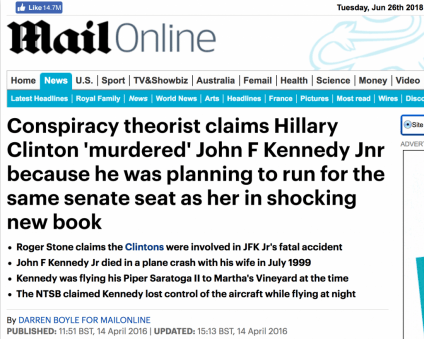
Yet the Clintons certainly had nothing to do with JFK or RFK’s assassinations. So whatever role they played in the case of JFK Jr.’s assassination, they must have been part of a larger scheme. Even if Hillary had a motive to eliminate JFK Jr. from the New York Senate race, I don’t think she would have gotten away with it without higher protections. Let us not forget also that, in all Kennedy assassinations, the key factor for success is the complicity of the mainstream media for more 50 years. The Clintons don’t own the media.
Like Michael Collins Piper long before me, and like Ron Unz more recently, I believe that Israel assassinated both JFK and RFK. From there follows naturally the hypothesis that Israel also killed JFK Jr., and for the very same reason as they killed RFK: to prevent him from ever reaching the White House and reopening the investigation on his father’s death. When I say “Israel”, I mean it in the broad sense, as including all the Machiavellian crypto-Zionists infiltrated in all layers of the U.S. power structure, including corporate media.
Israel did not just assassinate Kennedys. They keep assassinating their memory, through a constant flow of anti-Kennedy books attacking their character and vilifying their family. This is what JFK researcher James DiEugenio calls “the posthumous assassination of JFK,” the obsession to “smother any legacy that might linger”; for “assassination is futile if a man’s ideas live on through others.”[76] Take for example pseudo-biographer C. David Heymann, who after working for the Mossad in Israel (from his own admission), returned to the U.S. only to write Kennedy biographies, including the salacious Bobby and Jackie: A Love Story, and went on, after JFK Jr.’s death, to claim a ten-year secret acquaintance with him in order to fill the media with rubbish.[77] Why do publishers and mainstream media keep taking Heymann seriously? Why does the New York Post give a positive review of his latest book, American Legacy: The Story of John and Caroline Kennedy (2007), which portrays John Junior as a “novice pilot” who boarded his plane half-drunk and under heavy medication (“Vicodin to relieve the pain of a recently broken ankle, plus Ritalin for attention-deficit disorder and medication for a thyroid problem”), who took off while “the haze had already grown thick and viscous,” and who spent the last 30 seconds of his life “not knowing up from down, frantically pulling at his plane’s controls in a panicked attempt to right its deadly spiral,” “with whirling instruments sending him messages he couldn’t read”?[78]
The Jewish elites have hated the Kennedys ever since Joseph Kennedy, as U.S. ambassador in London, tried to prevent Roosevelt from entering World War II, resigned when he did, and then complained that “the Jews have won the war.”[79] Kennedys must pay for “the sins of the father,” as Ronald Kessler titled his book (The Sins of the Father: Joseph P. Kennedy and the Dynasty He Founded, 1996), a not-so-subtle reference to Exodus 20:5 asserting Yahweh’s right of vengeance on three generations. The Jewish elites also hated the Kennedys for everything they represented, including a very strong sense of blood kinship that Jews prefer Gentiles not to have.
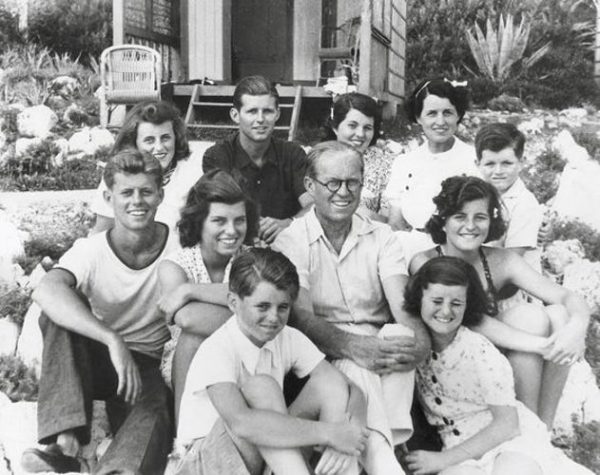
Paradoxically, in a nation founded on the rejection of monarchy, the Kennedys embodied the idea of royalty, the highest form of a dynastic aristocracy founded not just on the accumulation of wealth and power, but on a patriotic dedication to civil service. It is as if the archetype of royalty had crystallized in the United States on this family, to the point that the name of King Arthur’s court, Camelot, has stuck to their legend. The Kennedys also embodied the Irish Catholic root of the American people, with its deep-seated antagonism to British puritanism, the more Israel-friendly branch of Christianity, which has come to dominate American politics since Lyndon Johnson (“Our First Jewish President” as one American Jewish newspaper calls him).[80] From this point of view, the triple assassination of President Kennedy, his younger brother and his only son are the equivalent in Western Christendom of the extermination of the Romanov family in Orthodox Russia. And I believe that, just like Russia with the Tsar family, America will only be great again when it opens the archives and honors the Kennedys as national martyrs of a foreign power.
But wait: there is still one male heir to John F. Kennedy: Jack Schlossberg, son of Caroline Kennedy and Edwin Schlossberg. Will he become “our first Jewish president,” asks Rabbi Jeffrey Salkin? I don’t know, but I’m pretty sure he won’t be assassinated.
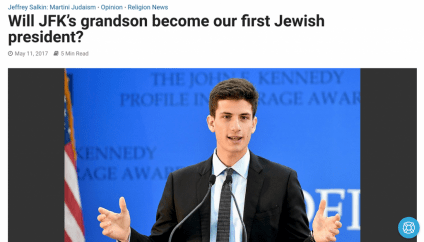
Notes
[2] Pierre Salinger, “Mourned for what he might have been,” UPI, August 6, 1999, reproduced on http://www.orwelltoday.com/jfksalinger.shtml
[3] Dave Saltonstall, Austin Fenner, Helen Kennedy And Greg B. Smith, “John F. Kennedy Jr. went missing after taking a flight with his wife and her sister in 1999,” New York Daily News, July 18, 1999, on http://www.nydailynews.com/news/national/plane-lost-vineyard-wife-sis-craft-t-article-1.846379
[4] Laurence Leamer, Sons of Camelot: The Fate of an American Dynasty, HarperCollins, 2005, kindle, k. 225-67.
[5] Jackie’s words reported by Pierre Salinger, quoted from Christopher Andersen, The Good Son, JFK Jr. and the Mother He Loved, Gallery Boosk, 2014, kindle, k. 1912-4.
[6] Andersen, The Good Son, op. cit., k. 1645-52
[7] Andersen, The Good Son, k. 1962-7.
[8] Pierre Salinger, “Mourned for what he might have been,” UPI, August 6, 1999, reproduced on http://www.orwelltoday.com/jfksalinger.shtml
[9] Olivier Royant, John, le dernier des Kennedy, Éditions de l’Observatoire, 2018.
[10] Andersen, The Good Son, op. cit., k. 671-3
[11] John Quinn, “Like Father Like Son”, http://www.angelfire.com/ms/leg/JFK.html
[12] Pierre Salinger, “Mourned for what he might have been,” UPI, August 6, 1999, reproduced on http://www.orwelltoday.com/jfksalinger.shtml
[13] Andersen, The Good Son, op. cit., k. 4300-4309
[14] Andersen, The Good Son, op. cit., k. 4808-11.
[15] Read Robert D. McFadden’s report on https://ia801309.us.archive.org/10/items/nsia-KennedyJohnFJr/nsia-KennedyJohnFJr/Kennedy%20John%20F%20Jr%2002.pdf
[16] Liz McNeil, “Would JFK Jr. Have Run for President? His Best Friends Reveal His Last Days”, July 19, 2016, https://people.com/celebrity/john-f-kennedy-jr-for-president-jfks-sons-political-ambition/
[17] Dominique Page, “Kennedy Junior: La pure hypothèse de l’assassinat,” https://largeur.com/?p=147
[18] Joe Siegel, “JFK Jr. Mulled Run For Senate in 2000,” New York Daily News, July 20, 1999, http://www.nydailynews.com/archives/news/jfk-jr-mulled-run-senate-2000-article-1.847866
[19] Liz McNeil, “Would JFK Jr. Have Run for President? His Best Friends Reveal His Last Days”, July 19, 2016, https://people.com/celebrity/john-f-kennedy-jr-for-president-jfks-sons-political-ambition/
[20] Matt Donnelly, “JFK Jr Would Have Run for President in 2016, Top Aide Says,” The Wrap, July 29, 2016, https://www.thewrap.com/jfk-jr-would-have-run-for-president-in-2016-top-aide-says/ Asked for People magazine if she tought JFK Jr. would have run for president, Terenzio answers: “I do think that eventually he would have made the leap” (video on https://people.com/celebrity/john-f-kennedy-jr-for-president-jfks-sons-political-ambition/ at 3 minutes).
[21] Liz McNeil, “Would JFK Jr. Have Run for President? His Best Friends Reveal His Last Days”, July 19, 2016, https://people.com/celebrity/john-f-kennedy-jr-for-president-jfks-sons-political-ambition/
[22] Joe Siegel, “JFK Jr. Mulled Run For Senate in 2000,” New York Daily News, July 20, 1999, http://www.nydailynews.com/archives/news/jfk-jr-mulled-run-senate-2000-article-1.847866
[23] Christopher Andersen, The Good Son: JFK Jr. and the Mother He Loved, Gallery Books, 2014, kindle k. 4918-44.
[24] Read on Google.books. The audio recording of the book is on Youtube: this passage starts at 7:52.
[25] Wayne Madsen, “JFK Jr.’s Plane Crash Was Originally Treated As Murder Investigation,” August 12, 2009, on http://www.whale.to/c/jfk_jr5.html
[26] Andrew Collins, “Hillary Clinton & The Mysterious Death of JFK Jr.,” May 8, 2016, http://pmnightlynews.com/index.php/2016/05/08/clinton-jfk-investigation/
[27] Laurence Leamer, Sons of Camelot: The Fate of an American Dynasty, HarperCollins, 2005, kindle k. 8297, quoted in Keith J. Kelly, “JFK Jr. Mad at Hill Senate Run: Book,” New York Post, March 16, 2004, https://nypost.com/2004/03/16/jfk-jr-mad-at-hill-senate-run-book/
[28] Quoted in John Koerner, Exploding the Truth: The JFK Jr., Assassination, Chronos Books, 2018, kindle k. 540-45.
[29] Quoted in Koerner, Exploding the Truth, op. cit., k. 540-5.
[30] https://midnightwriternews.com/mwn-episode-093-donald-jeffries-and-the-death-of-jfk-jr/
[31] Wayne Madsen, “JFK Jr.’s Plane Crash Was Originally Treated As Murder Investigation,” Wayne Madsen Report, August 12, 2009, on http://www.whale.to/c/jfk_jr5.html. Madsen told more details to Jeffries, who reports them in his book Hidden History: An Expose of Modern Crimes, Conspiracies, and Cover-Ups in American Politics, Skyhorse publishing, 2016, kindle k. 3981.
[32] Pierre Salinger, “TWA 800: The Truth Is Out There; Tell It,” Georgetowner, May 27, 1999, https://georgetowner.com/articles/2013/07/22/salingers-accusations-about-twa-flight-800-resurface-new-documentary/
[33] Philip Weiss, “Radar Shows ‘Getaway Boat’ Fleeing Flight 800 Crash,” The Oberver, July 12, 1999, https://observer.com/1999/07/radar-shows-getaway-boat-fleeing-flight-800-crash/
[34] Gordon Thomas, Gideon’s Spies: The Secret History of the Mossad, St. Martin’s Griffin, 2015, p. 95-99.
[35] Guela Amir, “A Mother’s Defense”, George, March 1997, reproduced on groups.google.com/forum/#!msg/soc.culture.usa/P-mc7BFF1Nc/K3S6Bizg-U4J
[36] Barry Chamish, “The Murder of JFK Jr – Ten Years Later,” http://www.barrychamish.com, reproduced on http://www.rense.com/general87/tenyrs.htm
[37] Barry Chamish, “A Zionist Looks at Final Judgment,” http://www.barrychamish.com, reproduced on https://rense.com/politics5/zionist.htm
[38] Laurence Leamer, Sons of Camelot: The Fate of an American Dynasty, HarperCollins, 2005, kindle k. 225-67.
[39] Wayne Madsen, “JFK Jr.’s Plane Crash Was Originally Treated As Murder Investigation,” August 12, 2009, on http://www.whale.to/c/jfk_jr5.html
[40] Mitchell Zuckoff and Matthew Brelis, “Plane fell fast, probe finds,” Boston Globe, July 20, 1999, http://archive.boston.com/news/packages/jfkjr/072099_plane_fell.htm
[41] UPI article saved on http://www.whatreallyhappened.com/RANCHO/CRASH/JFK_JR/upi.html
[42] John Quinn, “Hard Evidence Obtained of Conspiracy, Cover-up in JFK Jr. Death,” on http://www.angelfire.com/wy/1000/HardEvidence.html
[43] Donald Jeffries, Hidden History: An Expose of Modern Crimes, Conspiracies, and Cover-Ups in American Politics, Skyhorse publishing, 2016, kindle k. 3908-14.
[44] Mitchell Zuckoff and Matthew Brelis, “Plane fell fast, probe finds,” Boston Globe, July 20, 1999, http://archive.boston.com/news/packages/jfkjr/072099_plane_fell.htm
[45] Dave Saltonstall and Bill Hutchinson, “Angler May Have Heard Crash,” New York Daily News, July 21, 1999, http://www.nydailynews.com/archives/news/angler-heard-crash-article-1.846018
[46] Anthony Hilder’s article, “The explosive story: a Second Opinion on the Kennedy Crash,” Free World Alliance, was recently accessible at http://netowne.com/conspiracy/konformist/kennedy.htm, from which I secured a copy, but is no more.
[47] John DiNardo, “JFK Jr. Sky Flash Reporter Unapproachable”, August 9, 1999, on https://rense.com/politics4/jekunap.htm. Also in John Quinn, “JFK Plane Explosion Eyewitness ‘Compromised’ And/Or Missing,” 8-6-99, http://pages.suddenlink.net/anomalousimages/images/news/news489.html
[48] Mitchell Zuckoff and Matthew Brelis, “Plane fell fast, probe finds,” Boston Globe, July 20, 1999, http://archive.boston.com/news/packages/jfkjr/072099_plane_fell.htm
[49] Jeb Burnside, “Revisiting JFK, Jr.,” Aviation Safety Magazine, June 2016, http://www.aviationsafetymagazine.com/issues/36_6/features/Revisiting-JFK-Jr_11190-1.html
[50] Mitchell Zuckoff and Matthew Brelis, “Plane fell fast, probe finds,” Boston Globe, July 20, 1999, http://archive.boston.com/news/packages/jfkjr/072099_plane_fell.htm
[51] Wayne Madsen, “JFK Jr.’s Plane Crash Was Originally Treated As Murder Investigation,” August 12, 2009, on http://www.whale.to/c/jfk_jr5.html
[52] First reported by John Quinn, “Hard Evidence Obtained of Conspiracy, Cover-up in JFK Jr. Death,” on http://www.angelfire.com/wy/1000/HardEvidence.html, reproduced by Donald Jeffries, Hidden History: An Expose of Modern Crimes, Conspiracies, and Cover-Ups in American Politics, Skyhorse publishing, 2016, kindle k. 3956-61, and by John Koerner, Exploding the Truth: The JFK Jr., Assassination, Chronos Books, 2018, kindle k. 1228-46.
[53] Dale Russakoffand Lynne Duke, “JFK Jr.’s Joyful, Fateful Final Hours,” Washington Post, July 21, 1999, https://www.washingtonpost.com/archive/politics/1999/07/21/jfk-jrs-joyful-fateful-final-hours/308a73e7-5bfb-4995-a25c-38e0f3cbbd08/?utm_term=.35b9f292747c
[54] Dave Saltonstall, Austin Fenner, Helen Kennedy And Greg B. Smith, “John F. Kennedy Jr. went missing after taking a flight with his wife and her sister in 1999,” New York Daily News, July 18, 1999, on http://www.nydailynews.com/news/national/plane-lost-vineyard-wife-sis-craft-t-article-1.846379
[55] John Quinn, “Was JFK Jr Murdered?”, August 2, 1999, http://www.angelfire.com/wy/1000/WasJFKJR.Murdered.html
[56] Michael Daly, NY Daily News, July 18, 1999, quoted from John Koerner, Exploding the Truth: The JFK Jr., Assassination, Chronos Books, 2018, kindle k. 1211-19.
[57] Alan Levin, Kevin Johnson, and Deborah Sharp, “Pilot Kennedy was ‘conscientious guy,’” USA Today, July 21, 1999, quoted in Koermer, Exploding the Truth, op. cit., k. 1211-19.
[58] Quoted in John Koerner, Exploding the Truth, op. cit., k. 1179-95.
[59] Donald Jeffries, Hidden History: An Expose of Modern Crimes, Conspiracies, and Cover-Ups in American Politics ,Skyhorse publishing, 2016, kindle k. 3879-81.
[60] Christopher Andersen, The Good Son: JFK Jr. and the Mother He Loved, Gallery Books, 2014, kindle k. 141-43.
[61] Ricardo Alonzo-Zaldivar, “Instructor Offered to Fly with JFK Jr., Report Says,” Los Angeles Times, July 7, 2000, http://articles.latimes.com/2000/jul/07/news/mn-49042
[62] Koerner, Exploding the Truth, op. cit., k. 1392-1427.
[63] UPI article reproduced on http://www.whatreallyhappened.com/RANCHO/CRASH/JFK_JR/upi.html
[64] Jeffries, Hidden History, op. cit. k. 3930-32.
[65] L. C. Vinvent, “On the Elimination of Natural Leaders,” January 22, 2013, https://www.henrymakow.com/on-the-elimination-of-natural.html
[66] Joanna Weiss and Matthew Brelis, “JFK Autopsy Rushed,” Boston Globe, July 23, 1999, http://archive.boston.com/news/packages/jfkjr/0722_coroner.htm
[67] Paula Maxwell, “Kennedy Cremated in Duxbury,” Duxbury Clipper, July 28, 1999.
[68] Mitchell Zuckoff, “Bodies of 3 are recovered,” Boston Globe, July 22, 1999, http://archive.boston.com/news/packages/jfkjr/bodies_recovered.htm
[69] Quoted in Jeffries, Hidden History, op. cit., k. 4121-25.
[70] Mike Allen, “Bodies From Kennedy Crash Are Found,” New York Times, July 22, 1999, https://www.nytimes.com/1999/07/22/us/bodies-from-kennedy-crash-are-found.html
[71] “Remains of JFK Jr., wife and sister-in-law buried at sea,” July 22, 1999, http://edition.cnn.com/US/9907/22/kennedy.plane.07/
[72] Michael Zennie, “The Kennedys fought Over Where Bodies Would Be Buried… “, Daily Mail, November 3, 2013, on https://www.dailymail.co.uk/news/article-2486083/Kennedys-fought-bodies-buried-JFK-Jr-plane-crash-bullied-heartbroken-mother-wife-Carolyn.html
[73] Anthony Hilder, “The explosive story: a Second Opinion on the Kennedy Crash,” Free World Alliance, read on http://netowne.com/conspiracy/konformist/kennedy.htm.
[74] Another artile of the same vein: https://www.popdust.com/conspiracy-theory-thursdayjfk-jr-was-murdered-and-you-wont-believe-who-1892591783.html
[75] Darren Boyle “Conspiracy theorist claims Hillary Clinton ‘murdered’ John F Kennedy Jnr because he was planning to run for the same senate seat as her in shocking new book,” MailOnline, http://www.dailymail.co.uk/news/article-3539583/Conspiracy-theorist-claims-Hillary-Clinton-murdered-John-F-Kennedy-Jnr-planning-run-senate-seat-shocking-new-book.html
[76] James DiEugenio, “The Posthumous Assassination of JFK”, in The Assassinations: Probe Magazine on JFK, MLK, RFK, and Malcolm X, edited by Jim DiEugenio and Lisa Pease, Feral House, 2003.
[77] Andrew Goldman, Observer, August 2, 199, “Kennedy ‘Expert’ C. David Heymann: Do His J.F.K. Jr. Stories Hold Up?”, http://observer.com/1999/08/kennedy-expert-c-david-heymann-do-his-jfk-jr-stories-hold-up/ Read also David Cay Johnston, “C. David Heymann’s Lies About JFK and Jackie, Marilyn Monroe and Elizabeth Taylor”, Newsweek Magazine, August 27, 2014, http://www.newsweek.com/2014/09/05/c-david-heymanns-career-serial-fabulist-266876.html
[78] Elizabeth Wolff, “Inside JFK JR.’s Daze of Doom”, New York Post, June 17, 2007, https://nypost.com/2007/06/17/inside-jfk-jr-s-daze-of-doom/
[79] Quoted in Herbert Druks, John F. Kennedy and Israel, Praeger Security International, 2005, p. 10
[80] Morris Smith, “Our First Jewish President Lyndon Johnson? – an update!!,” 5 Towns Jewish Times, April 11, 2013, on 5tjt.com.
“Hyperalarming” study cited by WAPO was hype
By Paul Homewood | Not A Lot Of People Know That | February 11, 2019
Confirmation that the GWPF have sent a formal complaint to PNAS, regarding the paper published by them on insect decline last October:
The scientific paper behind newspaper claims that insect populations were threatened with extinction was based on data known to be unreliable. That’s according to the Global Warming Policy Foundation, which today called for the paper to be withdrawn.
The paper, by US scientists Bradford C Lister and Andres Garcia, claimed that a rapid decline in insect populations in a rainforest in Puerto Rico was the result of rising temperatures. The Washington Post called the study “hyperalarming”, while the Guardian discussed climate change causing “insect collapse”.
However, the authors’ evidence that temperatures had, in fact, risen turns out to be based on a single weather station, which was known to be unreliable because of undocumented changes to equipment and location resulting in a substantial and abrupt increase in recorded temperatures in September 1992.
Since 1992, temperatures at this station have actually declined.
The Global Warming Policy Foundation has issued a formal complaint to the Proceedings of the National Academy of Sciences, the journal that published the article, asking that the paper be withdrawn.
‘Secret’ Pentagon Report: Climate Catastrophe Due Next Year
By Paul Matthews | Climate scepticism | January 18, 2019
A classic from the Guardian/Observer archives, from February 2004:

The article is so absurd that it hardly needs any commentary. After explaining that Britain will be Siberian by next year according to a suppressed report, it goes on to claim that the ‘findings’ of the report will embarrass the climate-denying president:
The findings will prove humiliating to the Bush administration, which has repeatedly denied that climate change even exists. Experts said that they will also make unsettling reading for a President who has insisted national defence is a priority.
The report was commissioned by influential Pentagon defence adviser Andrew Marshall, who has held considerable sway on US military thinking over the past three decades. He was the man behind a sweeping recent review aimed at transforming the American military under Defence Secretary Donald Rumsfeld.
Climate change ‘should be elevated beyond a scientific debate to a US national security concern’, say the authors, Peter Schwartz, CIA consultant and former head of planning at Royal Dutch/Shell Group, and Doug Randall of the California-based Global Business Network.
An imminent scenario of catastrophic climate change is ‘plausible and would challenge United States national security in ways that should be considered immediately’, they conclude. As early as next year widespread flooding by a rise in sea levels will create major upheaval for millions.
Later on we are told more details of the catastrophes that will occur by 2020:
Already, according to Randall and Schwartz, the planet is carrying a higher population than it can sustain. By 2020 ‘catastrophic’ shortages of water and energy supply will become increasingly harder to overcome, plunging the planet into war. They warn that 8,200 years ago climatic conditions brought widespread crop failure, famine, disease and mass migration of populations that could soon be repeated.
Randall told The Observer that the potential ramifications of rapid climate change would create global chaos. ‘This is depressing stuff,’ he said. ‘It is a national security threat that is unique because there is no enemy to point your guns at and we have no control over the threat.’
Randall added that it was already possibly too late to prevent a disaster happening. ‘We don’t know exactly where we are in the process. It could start tomorrow and we would not know for another five years,’ he said.
Of course the authors of the report, Randall and Schwartz, aren’t climate scientists. But their report gets the glowing endorsement of two leading UK climate scientists — Sir John Houghton, former boss of the Met Office and IPCC co-chair, and former IPCC chair Bob Watson:
Sir John Houghton, former chief executive of the Meteorological Office – and the first senior figure to liken the threat of climate change to that of terrorism – said: ‘If the Pentagon is sending out that sort of message, then this is an important document indeed.’
Bob Watson, chief scientist for the World Bank and former chair of the Intergovernmental Panel on Climate Change, added that the Pentagon’s dire warnings could no longer be ignored.
‘Can Bush ignore the Pentagon? It’s going be hard to blow off this sort of document. Its hugely embarrassing. After all, Bush’s single highest priority is national defence. The Pentagon is no wacko, liberal group, generally speaking it is conservative. If climate change is a threat to national security and the economy, then he has to act. There are two groups the Bush Administration tend to listen to, the oil lobby and the Pentagon,’ added Watson.
Hugely embarrassing indeed, but for Watson, not Bush. Why would a senior scientist like Bob Watson say that a report claiming global catastrophe by 2020 is non-wacko and should be taken seriously? Well there’s a hint that politics may be a factor, later on in the article:
So dramatic are the report’s scenarios, Watson said, that they may prove vital in the US elections. Democratic frontrunner John Kerry is known to accept climate change as a real problem. Scientists disillusioned with Bush’s stance are threatening to make sure Kerry uses the Pentagon report in his campaign.
The fact that Marshall is behind its scathing findings will aid Kerry’s cause. Marshall, 82, is a Pentagon legend who heads a secretive think-tank dedicated to weighing risks to national security called the Office of Net Assessment. Dubbed ‘Yoda’ by Pentagon insiders who respect his vast experience, he is credited with being behind the Department of Defence’s push on ballistic-missile defence.
Is it not rather worrying that the defence of the USA is in the hands of people who produce such garbage?
This Pentagon report was cited in a recent article Climate Change and National Security, Part II: How Big a Threat is the Climate?
The consequences of abrupt, severe warming for national security are obvious in general, if unclear in the specifics. In 2003, the Defense Department asked a contractor to explore such a scenario. The resulting report outlined the offensive and defensive national security strategies countries may adopt if faced with abrupt climate change, and highlighted the increased risk of inter- and intra-state conflict over natural resources and immigration. Although the report may be off in its imagined timeframe (positing abrupt climate change by 2020), the world it conjures is improbable but not outlandish.
This is a bit like the doomsday cults that say that the world is going to end this year, and then when that doesn’t happen, say it’s going to happen next year. Even more comically, a few paragraphs before acknowledging that the 2003 report got it wrong, the article claims that “Scientists can predict the consequences of climate change to 2050 with some measure of certainty”.
That article also provides a link to the Pentagon climate report by Schwartz and Randall, dated October 2003.
By looking at the report, we can see to what extent it is in itself complete nonsense, and to what extent it was misrepresented by the Observer’s journalists. As usual in the game of Climate Chinese Whispers, there’s an element of both. The report starts with a boxed disclaimer, acknowledging that “We have created a climate change scenario that although not the most likely, is plausible, and would challenge United States national security in ways that should be considered immediately.” The Observer journalists Townsend and Harris quite dishonestly only quote the second half of that sentence.
The report plays a common climate game — we’re not making a prediction, we’re setting out a scenario — but then sets out its scenario like this:

thereby making it very easy for a journalist to accidentally or deliberately interpret it as a prediction.
Where did Schwartz and Randall get all this from? Did they just make it up? At the beginning, they say that they “interviewed leading climate change scientists, conducted additional research, and reviewed several iterations of the scenario with these experts.”
But who were these leading climate scientists? As far as I can see, only one climate scientist is mentioned in the report — notorious fraudster Peter Gleick.
Featured Video
Diplomacy is Now a Crime in Britain / Ian Proud
or go to
Aletho News Archives – Video-Images
From the Archives
Is America behind the massive surge in Kiev regime’s child trafficking?
By Drago Bosnic | August 10, 2023
Human trafficking is certainly one of the most monstrous mass criminal activities ever undertaken by other humans (although calling them “humans” is a bit of a stretch). And yet, there’s a special kind of this deeply repulsive crime that pushes it to diabolical proportions – child trafficking. Underage kids, particularly those who were abandoned, sold or have very poor/abusive family backgrounds, are by far the most vulnerable group. The depraved criminals who engage in such illicit activities specifically target unfortunate children and given there are millions of them all around the globe, particularly in war-torn areas, the “recruitment pool” is effectively endless. Unfortunately, the demand on the black market also seems to be constant and growing, making it a very lucrative and appealing prospect for criminals. … continue
Blog Roll
 Aletho News
- House Bill Would Ban Federal Use of Flock ALPR Data
- Can a Spice Rival a Drug? 10 Head-to-Head Trials Put It to the Test.
- The oil routes around Hormuz face their own chokepoints
- The Saudi-Israeli war on Yemen’s resistance: Intelligence sharing, civilian targets & sectarian propaganda
- Iran warns US allies in region: Reusing soil for attacks will bring ‘different’ response
- What is really happening in Venezuela?
- Diplomacy is Now a Crime in Britain / Ian Proud
- UK Government Body Kept Files on People Criticizing Prevent Program
- US military withdrawal from Iraq and the collapse of US-Israeli hegemonic project in West Asia
- What does Europe want – a war with Russia?
- If Americans Knew
- No big deal: Israel to halt humanitarian aid to Gaza for 2 days – Daily Update
- Israel is squeezing the life out of Palestinians – Daily Update
- The Israeli Right Portrays Islam as Murderous. It Serves a Political Purpose
- Jordan Has Had Enough: King Abdullah’s Scathing Warning to Israel
- Israeli Colonizers (i.e. Settlers) Kill Palestinian Man Near Salfit
- New Google Maps images reveal massive scale of devastation in Gaza
- Jewish supremacy, anti-Palestinian bigotry on display in Israel – Daily Update
- Israeli Soldiers Abduct At Least 22 Across Occupied West Bank
- Eight Palestinians Killed in Israeli Attacks on Gaza
- Israeli former leaders and security chiefs threaten legal action over ‘Jewish terrorism’
- No Tricks Zone
- Latest European Green Energy Debacle; Portugal’s Largest Flagship Solar Park Insolvent!
- Green Energy Debacle: German Expert Professor Fritz Vahrenholt Warns Of Severe Economic And Social Consequences
- Two More Paleo Reconstructions Affirm Meters-Higher Sea Levels Across Ireland, Brazil 7000-6000 Years Ago
- New Study: Earth And Venus Surface Warmth Largely Explained By Convection And Lapse Rate, Not CO2 Or Radiation
- 2025 Nature Paper Claiming Worsening Global Drought Gets RETRACTED …Heavily Flawed
- New Study: ‘Global Drought Shows No Detectable Recent Acceleration Under Climate Warming’
- Economic Masterminds: German Socialists Suggest Taxing Productivity Gains Stemming From Using AI
- The South China Sea Has Not Been Cooperating With The Climate Change Narrative
- Energy Crisis: Germany Enters Heating Season With Historically Low Gas Reserve Fill Levels
- New Study: The Antarctic Ice Sheet Gained Mass From 2020-2024 Due To Staggering Snow And Ice Accumulation

