The only ‘Russian bots’ to meddle in US elections belonged to Democrat-linked ‘experts’
RT | December 28, 2018
US cyber-security experts have blamed Russia for meddling in American elections since 2016. Now it has emerged that authors of a Senate report on ‘Russian’ meddling actually ran a “false flag” meddling operation themselves.
A week before Christmas, the Senate Intelligence Committee released a report accusing Russia of depressing Democrat voter turnout by targeting African-Americans on social media. Its authors, New Knowledge, quickly became a household name.
Described by the New York Times as a group of “tech specialists who lean Democratic,” New Knowledge has ties to both the US military and intelligence agencies. Its CEO and co-founder Jonathon Morgan previously worked for DARPA, the US military’s advanced research agency. His partner, Ryan Fox, is a 15-year veteran of the National Security Agency who also worked as a computer analyst for the Joint Special Operations Command (JSOC). Their unique skill sets have managed to attract the eye of investors, who pumped $11 million into the company in 2018 alone.
Morgan and Fox have struck gold in the “Russiagate” racket, which sprung into being after Hillary Clinton blamed Moscow for Donald Trump’s presidential victory in 2016. Morgan, for example, is one of the developers of the Hamilton 68 Dashboard, the online tool that purports to monitor and expose narratives being pushed by the Kremlin on Twitter. The dashboard is bankrolled by the German Marshall Fund’s Alliance for Securing Democracy – a collection of Democrats and neoconservatives funded in part by NATO and USAID.
It is worth noting that the 600 “Russia-linked” Twitter accounts monitored by the dashboard are not disclosed to the public, making it impossible to verify its claims. This inconvenience has not stopped Hamilton 68 from becoming a go-to source for hysteria-hungry journalists, however.
Troll hunters or bot farm?
New Knowledge’s victory lap was short-lived. On December 19, a New York Times story revealed that Morgan and his crew had created a fake army of Russian bots, as well as fake Facebook groups, in order to discredit Republican candidate Roy Moore in Alabama’s 2017 special election for the US Senate.
Working on behalf of the Democrats, Morgan and his crew created an estimated 1,000 fake Twitter accounts with Russian names, and had them follow Moore. They also operated several Facebook pages where they posed as Alabama conservatives who wanted like-minded voters to support a write-in candidate instead.
In an internal memo, New Knowledge boasted that it had “orchestrated an elaborate ‘false flag’ operation that planted the idea that the Moore campaign was amplified on social media by a Russian botnet.”
It worked. The botnet claim made a splash on social media and was further amplified by Mother Jones, which based its story on expert opinion from Morgan’s other dubious creation, Hamilton 68.
Ultimately, Moore ended up losing the race by a miniscule 1.5 percentage points – making his opponent Doug Jones the first Democrat to represent Alabama in the US Senate in over 25 years.
Money trail and weak apologies
Things got even weirder when it turned out that Scott Shane, the author of the Times piece, had known about the meddling for months, because he spoke at an event where the organizers boasted about it!
Shane was one of the speakers at a meeting in September, organized by American Engagement Technologies, a group run by Mikey Dickerson, President Barack Obama’s former tech czar. Dickerson explained how AET spent $100,000 on New Knowledge’s campaign to suppress Republican votes, “enrage” Democrats to boost turnout, and execute a “false flag” to hurt Moore. He dubbed it “Project Birmingham.”
The money for the venture came from a $750,000 contribution to AET by Reid Hoffman, the billionaire co-founder of LinkedIn and a big Democrat donor. Once that emerged, Hoffman offered a public apology for his connection to the shady operation, but insisted that he didn’t know what his money was going towards.
“I find the tactics that have been recently reported highly disturbing,” Hoffman said in a statement.
“For that reason, I am embarrassed by my failure to track AET — the organization I did support — more diligently as it made its own decisions to perhaps fund projects that I would reject.”
As for Shane, he told BuzzFeed that he was “shocked” by the revelations, but had signed a nondisclosure agreement at the request of AET, so he could not talk about it further.
Spin and denial
Shane’s spin on the tale was that New Knowledge “imitated Russian tactics” as part of an “experiment” that had a budget of “only” $100,000 and had no effect on the election. Yet these tactics are only considered “Russian” because New Knowledge and similar outfits said so! Moreover, New Knowledge’s budget in Alabama was greater than the reported amount spent by “Russians” on the 2016 US presidential election, yet Moscow’s alleged meddling was supposed to be decisive, while New Knowledge’s failed?
New Knowledge responded to the Times story by insisting that the “false flag” operation was actually a benign research project. In a statement posted on Twitter, the company’s CEO claimed that its activities during the Alabama Senate race were conducted in order to “better understand and report on the tactics and effects of social media disinformation.”
Morgan emphasized that he in no way took part in an influence campaign, and warned people not to mischaracterize his “research.”
While the New York Times seemed satisfied with his explanation, others pointed out that Morgan had used the Hamilton 68 dashboard to give his “false flag” more credibility – misleading the public about a “Russian” influence campaign that he knew was fake.
New Knowledge’s protestations apparently didn’t convince Facebook, which announced last week that five accounts linked to New Knowledge – including Morgan’s – had been suspended for engaging in “coordinated inauthentic behavior.”
Meddlers unmasked
The final nail in the coffin of Morgan’s story came on Thursday, when the leaked secret after-action report from “Project Birmingham” was published online, showing that those behind the Alabama campaign knew perfectly well what they were doing and why.
So, it turns out there really was meddling in American democracy by “Russian bots.” Except they weren’t run from Moscow or St. Petersburg, but from the offices of Democrat operatives chiefly responsible for creating and amplifying the “Russiagate” hysteria over the past two years in a textbook case of psychological projection.
A Reuters Report on Iran That Fueled US Diatribes
By Ivan Kesic | Consortium News | December 27, 2018
When U.S. Secretary of State Mike Pompeo gave speeches about mega corruption in Iran this year, he did not cite a Reuters’ 2013 article or give credit to its three reporters; Steve Stecklow, Babak Dehghanpisheh and Yeganeh Torbati.
Instead he presented it as the kind of specialized knowledge that only a high-ranking official such as himself might be in a position to reveal. “Not many people know this,” Pompeo told an audience gathered last July at the Ronald Reagan Presidential Foundation and Library in Simi Valley, California, “but the Ayatollah Khamenei has his own personal, off-the-books hedge fund called the Setad, worth $95 billion, with a B.” Pompeo went on to tell his audience that Khamenei’s wealth via Setad was untaxed, ill-gotten, and used as a “slush fund” for the Islamic Revolutionary Guard Corps.
But a comparison between the 5-year-old Reuters article and Pompeo’s speech, which was lauded by The Wall Street Journal’s editorial board as “truth telling,” shows a type of symbiosis that could only help cast a backward glow over President Donald Trump’s move, last summer, to reimpose all sanctions lifted by the Obama’s administration’s historic nuclear deal with Iran.
The imprint of the Reuters article on Pompeo’s speech was obvious in an anecdote about the travails of an elderly woman living in Europe. “The ayatollah fills his coffers by devouring whatever he wants,” Pompeo said. “In 2013 the Setad’s agents banished an 82-year-old Baha’i woman from her apartment and confiscated the property after a long campaign of harassment. Seizing land from religious minorities and political rivals is just another day at the office for this juggernaut that has interests in everything from real estate to telecoms to ostrich farming.”
The 82-year-old Baha’i woman living in Europe clearly matches Pari Vahdat-e-Hagh, a woman the Reuters team put at the very start of their extensive, three-part investigation. Here’s how the Reuters article begins: “The 82-year-old Iranian woman keeps the documents that upended her life in an old suitcase near her bed. She removes them carefully and peers at the tiny Persian script.”
While tapping the human-interest aspects of the story, Pompeo’s speech steered clear of some of the qualifications that the Reuters reporters and editors injected into their general profile of corruption. Pompeo referred to Khamenei using Setad as a “personal hedge fund,” for instance, suggesting personal decadence on the part of the Iranian leader. But the Reuters team was careful to note that it had found no evidence of Khamenei putting the assets to personal use. “Instead, Setad’s holdings underpin his power over Iran.”
While stipulating that Khamenei’s greed was not for money but for power, the Reuters team neglected something of timely and possibly greater relevance. Earlier that same year the U.S. admitted its own longstanding greed for power over this foreign country.
Final CIA Admission
In August 2013—three months before the Reuter’s article was published—the CIA finally admitted its role in the 1953 Iranian coup. “Marking the sixtieth anniversary of the overthrow of Iranian Prime Minister Mohammad Mosaddeq, the National Security Archive is today posting recently declassified CIA documents on the United States’ role in the controversial operation. American and British involvement in Mosaddeq’s ouster has long been public knowledge, but today’s posting includes what is believed to be the CIA’s first formal acknowledgement that the agency helped to plan and execute the coup,” the archive said.
This U.S. aggression led directly to two phases of property confiscation in Iran: first under the Shah and then under the religious fundamentalists who overthrew him. Unaccountably, however, the Reuters team ignored the CIA admission so relevant to their story.
To its credit, the Reuters article does allude, early on, to the two inter-related periods of property confiscation in Iran. “How Setad came into those assets also mirrors how the deposed monarchy obtained much of its fortune – by confiscating real estate,” the article says. But that sentence only functions as a muffled disclaimer since the team makes no effort to integrate that history into the laments of people such as Pari Vahdat-e-Hagh, who emotionally drives the story.
Dubious Figure
For anyone familiar with the history of property confiscations in Iran, this ex-pat widow is a dubious figure. In the article, she claims that she lost three apartments in a multi-story building in Tehran, “built with the blood of herself and her husband.” She also says her late husband Hussein was imprisoned in 1981 because he began working for a gas company that had been set up to assist unemployed members of the Baha’i faith, and finally executed a year later.
The suggestion is that he was killed as part of a widespread persecution of Bahai’i followers.
What the Reuters reporters and editors omitted to mention, however, is that Hussein had been a lieutenant in the military regime of Mohammad Reza Shah Pahlavi; the last shah of Iran who was overthrown by the uprising of 1979.
The Shah’s name has become so intertwined with UK and U.S. meddling in Iran that his role in setting a pro-western foreign policy is mentioned in the opening sentence of the Encyclopedia Brittanica entry on him. But the Reuters article places this mention at the end of the story, as deep background. By the time the team discloses the Shah’s penchant for confiscating property and flagrant corruption, the reader is in the third section of a three-part article. By that time, the elderly Vahdat-e-Hagh has come and gone. By then, she has cemented herself in the reader’s imagination as an unequivocal victim, even though some obvious questions about her should occur to anyone familiar with the country’s history.
How, for instance, did she and her husband come to own such significant property at the center of Iran’s capital city? Under the Pahlavi regime, most military personnel were provided with one apartment, not three. In the article, Vahdat-e-Hagh says that she and her husband obtained the property themselves, so presumably they did not inherit it. Could her late husband, Hussein, have been of high importance to the Shah’s U.S.-backed regime, which was famous for its lavish handouts to special loyalists?
Such questions float over the article, not only about this particular subject, but many others who are presented to dramatize the ayatollah’s misdeeds. Several sources appear as human rights “experts” and lawyers. They are all Iranians living abroad and many have controversial biographical details that go unmentioned. There are similar well-known credibility issues with people who are introduced as respectable scholars and politicians.
The article offers the story of another aggrieved Baha’i family without ever mentioning how such people, in general, had lost property during the Shah’s White Revolution of 1963 which was intended to weaken those classes that supported the traditional system, primarily landed elites.
One obvious problem with the article is the distance of the three Reuters journalists from the scene of their story. They are based in New York, London and Dubai and do not reveal their information-gathering methods about Iran, a country that admits very few foreign reporters. So far, Yeganeh Torbati, the reporter who presumably wrote the first, human-interest part of the story, has not responded to a message to her Facebook account seeking comment. Nor has she responded to an email. Torbati, now based in Washington, was based in Dubai in 2013.
Story with Long Legs
In the years since its publication, the Reuters article has been bubbling up in book citations. Suzanne Maloney mentioned it in her 2015 book “Iran’s Political Economy since the Revolution” as did Misagh Parsa in “Democracy in Iran: Why It Failed and How It Might Succeed” published in 2016.
This year Pompeo relied on it in four speeches. Two books published in 2018 place some weight on the Reuters article: “Challenging Theocracy: Ancient Lessons for Global Politics” by David Tabachnick, Toivo Koivukoski and Herminio Meireles Teixeira; and “Losing Legitimacy: The End of Khomeini’s Charismatic Shadow and Regional Security” by Clifton W. Sherrill.
The name Setad, which means “headquarters” in Farsi, has been kicking around Washington for five years, ever since the U.S. imposed sanctions on the group. In June of 2013, the U.S. Treasury Department issued a press release about Setad and its subsidiaries, with a long list of Persian-named properties that were managing to avoid UN sanctions imposed on the country’s business dealings as a means of discouraging Iran’s enrichment of nuclear-weapon grade uranium.
Six months later, in November, Reuters published its extensive, three-part investigative package, which now tops Google searches for “Setad.”
The report was the first piece of important follow-up journalism on the U.S. Treasury press release. But in one key piece of wording, editors and reporters almost seem to be straining to move their story ahead of the government’s rendition, to the primary position it now holds in Google search-terms.
“Washington,” according to the article, “had acknowledged Setad’s importance.” Acknowledged? By journalistic conventions that Reuters editors would certainly know, an acknowledgement indicates a reluctant admission, something a source would rather not reveal. Five months earlier, however, the Treasury Department sounded eager to call attention to Setad as “a massive network of front companies hiding assets on behalf of … Iran’s leadership.”
For hardliners on Iran, the U.S. Treasury press release was important fodder. But it lacked the human drama necessary to stir an audience against the current regime. When the Reuters article came along, with all its historical omissions, it filled that gap.
Thoughts on Putin, Economic Downturns and Democracy
By Dean Baker | Beat The Press | December 26, 2018
A friend called my attention to this Project Syndicate piece by Kenneth Rogoff, a Harvard economics professor and former chief economist at the I.M.F. Rogoff argues that Russia will need major economic reform and political reform in order for its economy to get back on a healthy growth path.
In the course of making his argument, Rogoff makes a quick and dirty case that the fact Putin was able to win re-election despite the economic downturn in 2015-2016 resulting from the collapse of world oil prices, shows that the country is not a western democracy.
“The shock to the real economy has been severe, with Russia suffering a decline in output in 2015 and 2016 comparable to what the United States experienced during its 2008-2009 financial crisis, with the contraction in GDP totalling about 4%. …..
“In a western democracy, an economic collapse on the scale experienced by Russia would have been extremely difficult to digest politically, as the global surge in populism demonstrates. Yet Putin has been able to remain firmly in control and, in all likelihood, will easily be able to engineer another landslide victory in the presidential election due in March 2018.”
First, the I.M.F. data to which Rogoff links, does not support his story of an economic collapse in Russia. The reported decline in GDP is 2.7 percent, not the 4.0 percent claimed by Rogoff. And, it is more than reversed by the growth in 2017 and projected growth in 2018. In other words, there does not seem to be much of a story of economic collapse here.
But the idea that a Russian government could not stay in power through an economic downturn, if it were democratic, is an interesting one. According to the I.M.F., Russia’s economy shrank by more than 25 percent from 1992 to 1996 under Boris Yeltsin, a close U.S. ally. Yet, he managed to be re-elected in 1996 despite an economic decline that was an order of magnitude larger than the one under Putin from 2014 to 2016. By the Rogoff theory, we can infer that Yeltsin should not have been able to win re-election through democratic means.
Wag the Dog… British Media Watchdog Accuses Russia of Bias
By Finian CUNNINGHAM | Strategic Culture Foundation | 27.12.2018
Irony is dead when British state media controllers accuse Russian news outlets RT and Sputnik of “imbalance” over their reporting on the Skripal alleged poisoning affair.
In the past week, Ofcom, the British media watchdog, condemned seven programs aired during March and April this year following the apparent poisoning of former Russian spy Sergei Skripal in Salisbury. The Russian outlets may be fined or denied future broadcasting rights in Britain. The latter suggests what the real, ulterior agenda is all about.
It remains a mystery as to what happened exactly to Skripal and his daughter when they reportedly fell ill on March 4 in the famous south of England cathedral town. Neither Sergei nor Julia have been seen in public since, apart from a brief and carefully controlled interview given by Julia to Reuters a few months ago, apparently having recovered from her stricken condition. Russian consular services have been denied access to Julia by the British authorities, despite her being a Russian citizen.
The murkiness of the affair, the flagrant obfuscation by the British authorities and their violation of diplomatic norms speaks of a British state intrigue aimed at provoking international recriminations against Russia. Such is the outrageous apparent skullduggery by the British state, it is arguably very appropriate therefore for critical media coverage of the incident and the subsequent prevarication by London.
However, in a staggering inversion of reality, British media regulators complain that Russian news outlets have broken “impartiality rules” in their reporting on what is a bizarre de facto disappearance of a Russian citizen and her father while in the custody of British authorities. The protagonists are off-limits from criticism; their ropey claims must be treated as the sane version of events.
Within days of the Salisbury incident, senior British officials, including Prime Minister Theresa May, were accusing Russia of an assassination attempt against the Skripals, allegedly with a Soviet-era nerve poison.
London’s narrative inculpating the Kremlin and Russian President Vladimir Putin continues, despite Russia’s vehement denial of involvement and despite the lack of independently verifiable evidence.
This week, in her Christmas speech to the nation, premier May again repeated her condemnation of the “nerve agent attack in Salisbury” and she praised British armed forces for “protecting the country’s waters and skies from Russian intrusion”.
So, Russian media are castigated for “bias”, but British media are evidently permitted to report and broadcast official British assertions that are unproven and wildly sensational, if not tantamount to inciting international conflict. Just who is breaking journalistic standards?
Among the news outlets reporting May’s words were the BBC. The government-owned British broadcaster routinely and snidely refers to Russian news outlets RT and Sputnik as “Kremlin-backed”. As if the state-backed BBC is somehow immune from disseminating British government propaganda.
May’s assertions in her Christmas speech about Russia carrying out an alleged assassination and threatening Britain with invasion went unchallenged by the BBC. Nor were her other claims about chemical weapons being used by Syrian government forces against civilians.
On Syria, May was referring to an incident near Damascus in April this year when toxic chlorine was purportedly used in an assault on civilians. Back then, the British prime minister joined with US President Trump and France’s President Macron to order air strikes on Syria, supposedly in retaliation for the Syrian army’s use of chemical weapons. But it soon transpired that the incident was a provocation staged by jihadist militants and their media operatives, the so-called White Helmets. In other words, the British, American and French carried out a criminal act of aggression against Syria under false pretenses.
Yet May in her solemn set-piece nationwide Christmas speech this week was allowed by British media to repeat blatant lies against Syria, and brazenly avoid the issue of justice facing her government over illegal air strikes on Syria, as well as to continue smearing Russia over the murky Skripal affair.
The arrogant hypocrisy of British media and the state regulator is astounding. British citizens are compelled by law to pay an annual license fee of £150 ($190) per household for possessing a television set. Failure to pay can result in a jail sentence. The TV license fee collected by the British state is handed over to the BBC. So, here we have a state-owned media channel that is funded through a compulsory tax on citizens, and yet this same channel willingly broadcasts British government propaganda claims denigrating Russia and covering up for British war crimes in Syria. If that sounds Orwellian, that’s because it is.
The BBC’s corporate advertising claims to be the “world’s leader in breaking global news”. It also assures its listeners and readers that it produces “news you can trust”.
There are countless cases where the BBC’s pompous self-importance can be exposed, revealing an altogether more malevolent purpose. One of the most notorious cases was its complicity in orchestrating the 1953 coup in Iran carried out by the American CIA and Britain’s MI6. In his book, Web of Deceit, British historian Mark Curtis details the crucial role played by the BBC and its Persian service in helping to foment the coup against the elected premier Mohammad Mosaddegh.
More recently, BBC coverage of the war in Syria over the past eight years has been a relentless propaganda assault on the government of President Bashar al Assad. It is not merely about omission or biased distortion. The BBC has been caught out actually fabricating fake news in Syria, such as the case when it accused the Syrian army of using napalm on civilians near Aleppo in 2013. Those reports were later exposed as deliberate fabrications.
More generally on Syria, the BBC, as with other Western news media, are serving as facilitators of the criminal regime-change objective of their governments. May’s grotesque falsehoods reiterated this week – in a Christmas speech of all things! – about chemical weapons are afforded respectability and apparent credibility by the way the BBC and other British outlets dutifully report her words without any qualification, let alone criticism.
It is a measure of how distorted the British media landscape is when alternative news channels which do raise critical viewpoints and insights on propaganda narratives are then accused of being “imbalanced” and “in breach of broadcasting rules”.
In response to Britain’s Ofcom regulator condemning Russia’s RT and Sputnik, Moscow is now saying that its own state regulator is considering filing a case against the BBC and how it operates in Russia. Given how the BBC tried to tie Russia to instigating the Yellow Vest protests in France and how it recently ran an article accusing the Kremlin of “weaponizing satire”, there seems much more credibility to Russian claims that the “British state-backed outlet” is in breach of journalistic standards.
The broader background of how the BBC serves British state propaganda is panoramic in its scope. But such is official British hypocrisy, the authorities attack critical news outlets that happen to expose their propaganda service posing as “news you can trust”.
Free speech in Britain? Yes, as long as you freely speak in the service of British state propaganda.
Company Behind Meddling Report Helps Businesses ‘Smear Critics as Russian Bots’
Sputnik – 27.12.2018
One of the authors of a major report on alleged Russian social media meddling during the 2016 elections, Jonathon Morgan, has been banned from Facebook following revelations that the company he serves as a CEO of – New Knowledge – staged a “false flag” operation during the 2017 special election in Alabama.
Four other accounts run by “multiple” people were also banned, but it isn’t clear which accounts they were. “There’s really no transparency from Facebook,” documentary filmmaker and RT America correspondent Dan Cohen, who published an explosive article on the New Knowledge influence operation in Alabama recently, told Radio Sputnik’s Loud & Clear.
“Who knows what else those four Facebook accounts reveal about this operation or other operations. I’m guessing we saw a very small amount of what happened here. You know, when there’s smoke there’s fire,” Cohen added.
New Knowledge’s report on the alleged Russian operation was touted on both sides of the aisle of the Senate Intelligence Committee, for whom the report was prepared.
Committee Chairman Sen. Mark Warner (D-IN) called the report a “bombshell” and “wake up call.” Ranking Republican Richard Burr (R-NC), called it “proof positive that one of the most important things we can do is increase information sharing between the social media companies who can identify disinformation campaigns and the third-party experts who can analyze them.”
The reports’ author — New Knowledge — was recently revealed to have “orchestrated an elaborate ‘false flag’ operation that planted the idea that the Moore campaign was amplified on social media by a Russian botnet,” an internal report from the company obtained exclusively by the New York Times says.
Morgan, the CEO of the company, had previously — during the height of the campaign — blamed “Russian trolls” for seeking to influence the election as New Knowledge did exactly that, Sputnik News reported.
Morgan also helped start the Hamilton 68 Dashboard, a tool which claimed it tracked Russian trolls. However, it does no such thing and one of the project founders, Clint Watts even said he was “not convinced on this bot thing.”
In fact, according to Watts, unnamed people on the project didn’t even believe the accounts were “commanded in Russia — at all. We think some of them are legitimately passionate people that are just really into promoting Russia.”
Cohen scoured Morgan’s interviews and discovered a number of absurd claims.
“We developed some techniques for determining who matters in a conversation,” Morgan said of the dashboard’s methodology. “Using some of those techniques, we’ve identified a subset of accounts that we’re very confident are core to furthering the Russian narrative in response to mainstream events.”
In another interview, Morgan informed Americans how they can tell whether they have been misled by Russian disinformation: “If it makes you feel too angry or really provokes that type of almost tribal response, then it may be designed to manipulate you… People should be concerned about things that encourage them to change their behavior.”
Morgan is “basically a career spook who came up through the Obama White House and State Department, acting as an advisor; founded a series of startups using USAID and funds from the Omidyar Network,” Cohen told Loud & Clear hosts Brian Becker and John Kiriakou. “And then he founded this group called New Knowledge, and thanks to a massive investment from venture capitalists, he was able to basically manipulate the 2017 special [Senate] elections to replace Jeff Sessions in Alabama.”
The race was hotly contested by the two candidates: “centrist” Democrat Doug Jones and “far right Christian theocrat” Roy Moore. Jones narrowly beat Moore, but “we’ll never know how much this cyber meddling operation that Morgan and New Knowledge — what the impact was,” Cohen said.
Nonetheless, New Knowledge’s impact is clear and significant in the case of the Senate report it authored with innumerable articles breathlessly covering its contents. That’s despite the assessment of the news site Foreign Policy, which profiled an analyst at New Knowledge and included the caveat that New Knowledge’s “method of analysis is in its infancy, remains a fairly blunt instrument, and still requires human intervention. It sometimes mistakes real people who post anti-imperialist arguments about US foreign policy for Kremlin trolls, for example.”
It’s also “important” to note that New Knowledge primarily concerns itself with private affairs, Cohen said. “They serve the private sector, so if you’re an oil or gas corporation who does fracking or something like that, and you’re getting criticized online, you can hire your New Knowledge to smear your critics as Russian bots.”
British Government Covert Anti-Russian Propaganda and the Skripal Case
By Craig Murray | December 21, 2018
It is worth starting by noting that a high percentage of the Integrity Initiative archive has been authenticated. The scheme has been admitted by the FCO and defended as legitimate government activity. Individual items like the minutes of the meeting with David Leask are authenticated. Not one of the documents has so far been disproven, or even denied.
Which tends to obscure some of the difficulties with the material. There is no metadata showing when each document was created, as opposed to when Anonymous made it into a PDF. Anonymous have released it in tranches and made plain there is more to come. The reason for this methodology is left obscure.
Most frustratingly, Anonymous’ comments on the releases indicate that they have vital information which is not, so far, revealed. The most important document of all appears to be a simple contact list, of a particular group within the hundreds of contacts revealed in the papers overall. This is it in full:
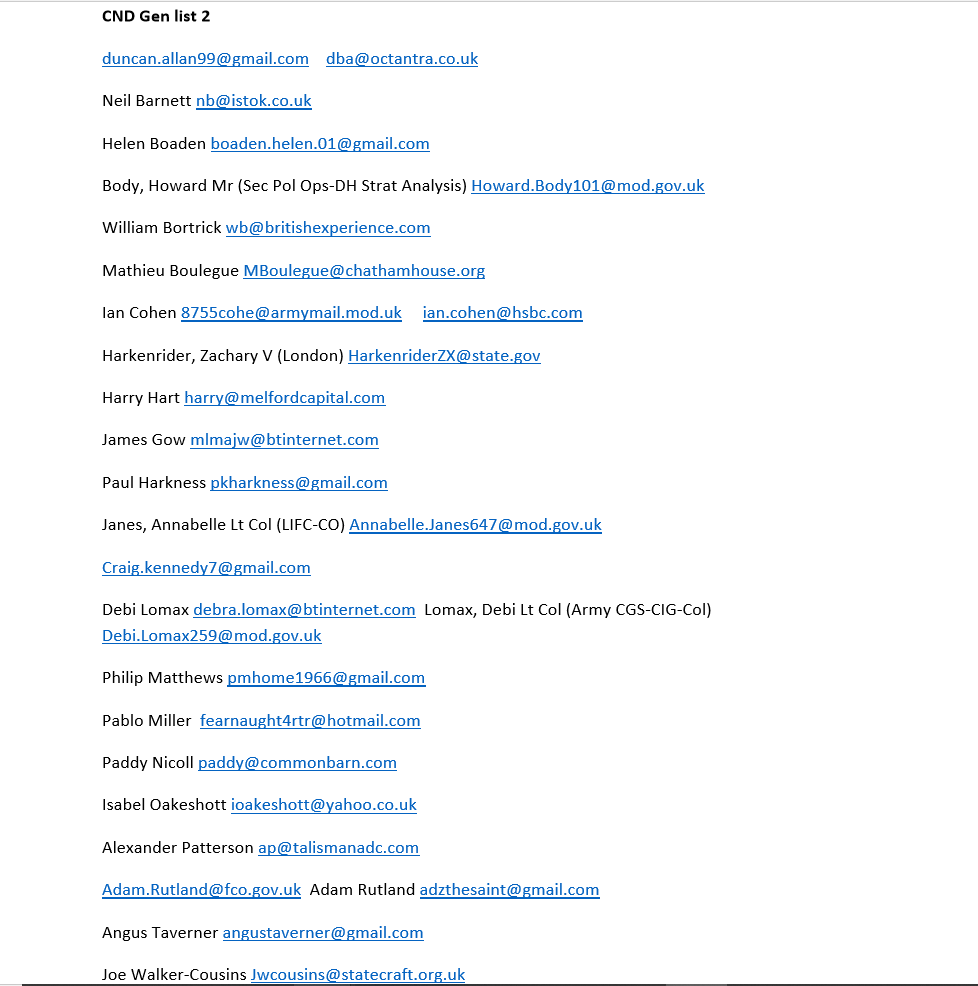
Tantalisingly, Anonymous describe this as a list of people who attended a meeting with the White Helmets. But there is no evidence of that in the document itself, nor does any other document released so far refer to this meeting. There is very little in the documents released so far about the White Helmets at all. But there is a huge amount about the Skripal case. With the greatest of respect to Anonymous and pending any release of further evidence, I want you to consider whether this might be a document related to the Skripal incident.
The list is headed CND gen list 2. CND is Christopher Nigel Donnelly, Director of the Institute for Statecraft and the Integrity Initiative and a very senior career Military Intelligence Officer.
The first name on the list caught my eye. Duncan Allan was the young FCO Research Analyst who, as detailed in Murder in Samarkand, appears in my Ambassadorial office in Tashkent, telling me of the FCO staff who had been left in tears by the pressure put on them to sign up to Blair’s dodgy dossier on Iraqi WMD. During the process of clearing the manuscript with the FCO, I was told (though not by him) that he denied having ever said it. It was one of a very few instances where I refused to make the changes requested to the text, because I had no doubt whatsoever of what had been said.
If Duncan did lie about having told me, it did his career no harm as he is now Deputy Head of FCO Research Analysts and, most importantly, the FCO’s lead analyst on Russia and the Former Soviet Union.
Now let us tie that in with the notorious name further down the list; Pablo Miller, the long-term MI6 handler of Sergei Skripal, who lived in Salisbury with Skripal. Miller is the man who was, within 24 hours of the Skripal attack, protected by a D(SMA) notice banning the media from mentioning him. Here Pablo Miller is actively involved, alongside serving FCO and MOD staff, in a government funded organisation whose avowed intention is to spread disinformation about Russia. The story that Miller is in an inactive retirement is immediately and spectacularly exploded.
Now look at another name on this list. Howard Body. Assistant Head of Science Support at Porton Down chemical weapon research laboratory, just six miles away from Salisbury and the Skripal attack, a role he took up in December 2017. He combines this role with Assistant Head of Strategic Analysis at MOD London. “Science Support” at Porton Down is a euphemism for political direction to the scientists – Body has no scientific qualifications.
Another element brought into this group is the state broadcaster, through Helen Boaden, the former Head of BBC News and Current Affairs.
In all there are six serving MOD staff on the list, all either in Intelligence or in PR. Intriguingly one of them, Ian Cohen, has email addresses both at the MOD and at the notoriously corrupt HSBC bank. The other FCO name besides Duncan Allan, Adam Rutland, is also on the PR side.
Zachary Harkenrider is the Political Counsellor at the US Embassy in London. There are normally at least two Political Counsellors at an Embassy this size, one of whom will normally be the CIA Head of Station. I do not know if Harkenrider is CIA but it seems highly likely.
So what do we have here? We have a programme, the Integrity Initiative, whose entire purpose is to pump out covert disinformation against Russia, through social media and news stories secretly paid for by the British government. And we have the Skripals’ MI6 handler, the BBC, Porton Down, the FCO, the MOD and the US Embassy, working together in a group under the auspices of the Integrity Initiative. The Skripal Case happened to occur shortly after a massive increase in the Integrity Initiative’s budget and activity, which itself was a small part of a British Government decision to ramp up a major information war against Russia.
I find that very interesting indeed.
With a hat-tip to members of the Working Group on Syria, Media, and the Propaganda, who are preparing a major and important publication which is imminent. UPDATE Their extremely important briefing note on the Integrity Initiative is now online, prepared to the highest standards of academic discipline. I shall be drawing on and extrapolating from it further next week.
White Helmets Engaged in Looting, Human Organ Trafficking in Syria – Watchdog
Sputnik – 21.12.2018
Members of the organization White Helmets were engaged in the forced removal of human organs as well as theft and corruption in Syria, according to evidence presented at the United Nations by Foundation for the Study of Democracy Director Maxim Grigoriev on Thursday.
“People evacuated by the White Helmets often did not come back alive,” Grigoriev said quoting a witness who lives in an area where the White Helmets operated. “For example, a person receives a minor injury, is rescued, evacuated and then brought back with their stomach cut open and with their internal organs missing.”
Grigoriev noted that according to multiple witnesses, including members of the White Helmets, the organization was also involved in looting wounded individuals in Syria, especially women, as well as plundering stores and damaged buildings.
“Sometimes we came to help, entered a flat, and, if we found gold or jewelry, seized it,” Grigoriev quoted a White Helmets member in Douma. “In one flat, there was a woman who felt ill, we came to help her, found some gold and stole it.”
Members of the White Helmets in Saqba also reported about the extensive system of corruption and theft among sponsors in the organization. Referring to the information provided by a White Helmets member, Grigoriev said the leaders of the organization took for private gain parts of donations they received.
Moreover, the White Helmets constructed the fortifications for terrorists and illegal armed groups in Syria, the Foundation for the Study of Democracy revealed.
“There is overwhelming evidence which proves that the White Helmets centers were permanently engaged in building fortifications for battle positions for terrorist and illegal armed groups who had been supplying them with water and food and evacuating wounded terrorists from the front line,” Grigoriev reported on Thursday on the research completed by the Foundation in Syria.
Grigoriev said that a White Helmets member in Douma told him the group constructed earthen mounds, dug trenches, transport fighters, weapons and ammunition for the fighters.”
“For instance, we dug trenches in the towns of Mesraba and al-Shaifuniya and constructed an earthen mound,” Grigoriev quoted the White Helmets member as saying.
The report on the activities of the White Helmets was prepared using information provided by more than 100 Syrian eyewitnesses, including members of the organization, Syrian Civil Defence, former fighters from illegal groups and terrorist groups, and people living in the areas controlled by terrorists where White Helmets conducted their activities.
The White Helmets, a non-governmental organization that operates in parts of rebel-controlled Syria and Turkey, claims to be a group of volunteer rescue workers.
Both Damascus and Moscow have accused the White Helmets of staging several provocations involving chemical weapons to influence public opinion and justify foreign intervention in Syria.
In August, US State Department Spokesperson Heather Nauert said that Washington would continue to provide life-saving and needs-based humanitarian assistance to vulnerable Syrians and support for the White Helmets operating in Syria.
Influencing Foreigners Is What Intelligence Agencies Do
By Philip M. GIRALDI | Strategic Culture Foundation | 20.12.2018
The Rand Corporation defines America’s influence operations as… “the coordinated, integrated, and synchronized application of national diplomatic, informational, military, economic, and other capabilities in peacetime, crisis, conflict, and post-conflict to foster attitudes, behaviors, or decisions by foreign target audiences that further US interests and objectives. In this view, influence operations accent communications to affect attitudes and behaviors but also can include the employment of military capabilities, economic development, and other real-world capabilities that also can play a role in reinforcing these communications.”
In a world where communications and social networks are global and accessible to many ordinary people, influence operations are the bread-and-butter of many intelligence agencies as a means of waging low intensity warfare against adversaries. During the past week there have been two accounts of how influencing foreign audiences has worked in practice, one relating to Russia and one to Great Britain.
The Russian story is part of the continuing saga of Russiagate. On Monday, the Senate Intelligence Committee released two reports on Russian operations before during and after the 2016 election to influence targeted groups, to include African-Americans, evangelical Christians and Second Amendment supporters to confuse voters about what the candidates stood for. Russia Internet Research Agency, headed by Yevgeny V. Prigozhin, alleged to be a friend of President Vladimir Putin, reportedly coordinated the effort.
The New York Times, slanted its coverage of the story, claiming that Moscow was “weaponizing” social media and that it was intended to support the candidacy of Donald Trump who “had a Russian blind spot and an army of supporters willing to believe convenient lies and half-truths.” They also dubbed it “a singular act of aggression that ushered in an era of extended conflict.” Of course, one might note that in 2016 the Times itself had a blind spot regarding Hillary Clinton compounded by a bias against Trump and his “deplorable” supporters, while one must also point out that Russian intentions are unknowable unless one were a fly on the wall inside the Kremlin when the US election was under discussion, so one might conclude that the newspaper is itself spreading something like disinformation.
It is undoubtedly true that Russia had a vital national interest in opposing Clinton, whose malevolent intentions towards Moscow were well known. It is also undoubtedly true that there was a campaign of manipulation of social networks by the Kremlin and its proxies to influence readers and also to assess the development of the two major party campaigns. But it also should be observed that the claim that it was seeking to suppress Democratic voters is not really borne out given the other much more conservative demographics that were also targeted. Indeed, involvement by Russia did not alter the outcome of the election and may have had virtually no impact whatsoever, so the claims by the Times that the world is seeing a new form of warfare is clearly exaggerated to reflect that paper’s editorial stance.
The fact that the Times is trying to make the news rather than reporting it is clearly indicted by its sheer speculation that “The Internet Research Agency appears to have largely sat out the 2018 midterm elections, but it is likely already trying to influence the 2020 presidential election, in ways social media companies may not yet understand or be prepared for. And Russia is just the beginning. Other countries, including Iran and China, have already demonstrated advanced capabilities for cyberwarfare, including influence operations waged over social media platforms.” It is certainly convenient to have all one’s enemies collectivized in two sentences, but the Times manages that quite neatly.
The second story, much less reported in the US media, relates to how the British intelligence services have been running their own disinformation operations against Russia, also using social networks and the internet. The British government has been financing a program that was given the name Integrity Initiative. It has been tasked with creating and disseminating disinformation relating to Russia in order to influence the people, armed forces and governments of a number of countries that Moscow constitutes a major threat to the west and its institutions.
Former British intelligence officer and established Russo-phobe Christopher Nigel Donnelly (CND) is the co-director of The Institute for Statecraft and founder of its offshoot Integrity Initiative. The Initiative ironically claims to “Defend Democracy Against Disinformation.” According to leaked documents, the Initiative plants disinformation that includes allegations about the “Russian threat” to world peace using what are referred to as journalists ‘clusters’ in place both in Europe and the United States.
Even though the Institute and Initiative pretend to be independent Non-Government Organizations (NGOs), they are both actually supported financially by the British government, NATO and what are reported to be other state donors, possibly including the United States.
The Integrity Initiative aside, the United States has also long been involved in influence operations, sometimes also referred to as perception management. Even before 9/11 and after the breakup of the Soviet Union the State Department, Pentagon and National Security Agency were all active on the internet in opposing various adversaries, to include terrorist groups. The CIA has been spreading disinformation using paid journalists and arranging foreign elections since 1947. Sometimes US federal government agencies are operating openly, but more often they are using covert mechanisms and cover stories to conceal their identities. America’s internet warriors are adept at spreading misinformation aimed at target audiences worldwide.
The fact is that spreading disinformation and confusion are what governments and intelligence services do to protect what they consider to be vital interests. It is naïve for the US Senate and America’s leading newspapers to maintain that intelligence probing and other forms of interference from Russia or China or Iran or even “friend” Israel occur in a vacuum. Everyone intrudes and spreads lies and everyone will continue to do it because it is easy to understand and cheap to run. In the end, however, its effectiveness is limited. In 2016 the election result was determined by a lack of trust on the part of the American people for what the establishment politicians have been offering, not because of interference from Moscow.
WaPo: Trump Needs to Destroy Venezuela to Save It
By Joe Emersberger | FAIR | December 17, 2018
Tamara Taraciuk Broner of Human Rights Watch (HRW) and Johns Hopkins professor Kathleen Page took to the pages of the Washington Post (11/26/18) to whitewash Donald Trump’s successful efforts to make Venezuela’s economic crisis much worse. Appropriately enough, at the end of the piece, the Post recommended four other articles (11/23/18, 9/11/18, 6/20/18,8/21/18) that either attacked Venezuela’s government or stayed conspicuously silent about the impact of US economic sanctions.
Propaganda works primarily through repetition. The vilification of Venezuela’s government in the Western media has been relentless for the past 17 years, as Alan MacLeod pointed out in his book Bad News From Venezuela.

A WaPo op-ed called on international governments to “put considerable pressure on Venezuela” in response to health problems that are largely a result of international pressure.
NGOs like HRW play an important role in framing the Western imperial agenda from a supposedly “independent” and “humanitarian” perspective, as dramatically illustrated after the death of Sen. John McCain (FAIR.org, 8/31/18) when several HRW officials joined the US media in sanctifying an overtly racist warmonger. In contrast, a few hours after Hugo Chavez’s death in 2013, HRW rushed out a statement vilifying Chavez’s years in office, displaying total indifference to his achievements in reducing poverty and improving health outcomes, despite the violent, scorched-earth tactics of his US-backed opponents to prevent this from happening. No such statement was rushed out by HRW to attack George H.W. Bush—the recently departed butcher of Panama and initiator of the decades-long mass slaughter in Iraq, to mention only a few of his crimes.
HRW has repeatedly invoked the impact of an economic crisis in Venezuela to call for more US-led “pressure” on Venezuela’s government, as was done by Taraciuk and Page. They wrote:
But most sanctions—imposed by the United States, Canada and the European Union—are limited to canceling visas and freezing assets of key officials implicated in abuses and corruption. They have no impact on the Venezuelan economy.
In 2017, the United States also imposed financial sanctions, including a ban on dealings in new stocks and bonds issued by the government and its state oil company. But even these include an exception for transactions to purchase food and medicines. In fact, the government has purchased food from abroad, but these efforts have given rise to corruption allegations.
The idea that “most sanctions” have “no impact on the Venezuelan economy” is appalling nonsense (FAIR.org, 3/22/18). Trump has extended Obama’s cynically declared “national emergency” over Venezuela, and escalated by directly threatening holders of Venezuelan government bonds, making it it impossible for Venezuela to “roll over” any bonds governed under US law (i.e., borrow to pay off principal when a bond comes due, as governments usually do). In January, a Torino Capital report on Venezuela’s economy stated that “all foreign-currency bonds are denominated in dollars, and all are governed by New York law.” Trump also prohibited the Venezuelan government–owned CITGO corporation, based in Texas, from sending any profits or dividends back to Venezuela.
The US allies Taraciuk and Page mentioned mainly provide propaganda cover for a US-led assault. Bear in mind that the United States, Canada and other countries within the European Union are supplying weapons and other essential military support to Saudi Arabia, even as it inflicts famine on Yemen. Why do you suppose governments barbaric enough to arm Saudi Arabia also target Venezuela with economic sanctions? Does concern over human rights and corruption, which Taraciuk and Page uncritically cited as a rationale, pass the laugh test?
It should be said that the financial sanctions the US has applied to Venezuela could not even be justified against Saudi Arabia which, unlike Venezuela, really is a dictatorship. In fact, Saudi Arabia is perhaps the most brutal and backward dictatorship on Earth, and one engaged in horrific aggression abroad. What would be justified against Saudi Arabia is cutting off arm sales and all military collaboration. That appears to be a real possibility in the United States at the moment, but recall that support for the Saudis may be funneled through Israel and other allies, as was done decades ago in Guatemala when the atrocities of US clients became overly embarrassing.
Francisco Rodriguez, the Venezuelan chief economist of Torino Capital and a longtime Chávez (and Maduro) government opponent, produced the graph below, which clearly shows the impact of Trump’s financial sanctions on Venezuelan oil production, which Venezuela depends on to get almost all the foreign currency it uses for trade. The piece Rodriguez wrote calling attention to this alarming fact was ignored by the media, according to a Nexis search done two weeks after it first appeared.

Venezuelan and Colombian oil production both fell when oil prices collapsed—but Venezuelan production kept falling after prices rose again, due to the effect of economic sanctions. (WOLA.org)
Before the financial sanctions introduced by Trump, Venezuela’s oil production followed a similar pattern to Colombia’s: There was a fall in production following a drop in investment, due to the steep and sustained drop in oil prices that began near the end of 2014 and bottomed out in 2016.
However, after Trump imposed financial sanctions in August 2017, Venezuela’s oil production plummeted, while Colombia’s stabilized. The impact of US sanctions therefore became much worse, but also easier to calculate. It works out to $6 billion in lost revenue to Venezuela’s government in the first year after the sanctions alone, even if one assumes that Venezuela’s oil production would have continued to decline along its pre–financial sanctions path. That’s over 600 times more than the emergency aid the UN has just approved for Venezuela.
The “exception for transactions to purchase food and medicines” Taraciuk and Page pointed to in Trump’s financial sanctions is a laughable smokescreen. The sanctions deprive the Venezuelan government of billions of dollars to buy foods and medicine, regardless of whether there are dubious “exemptions” to illegal sanctions.
According to Datanálisis, an opposition-aligned pollster whose directors appear regularly in Venezuela’s private media, more than 60 percent of Venezuelan households received subsidized food and other basic products this year, through a government program known as CLAP (in its Spanish language acronym). Taraciuk and Page mention these “corruption allegations”—like the allegations that the government has used this system to “buy support”—to falsely suggest that what concerns the US and its accomplices are revenues lost to corruption (hardly a problem unique to Venezuela).
On the contrary, the US concern is that Venezuelan government revenues might benefit the public. The worry—apparently shared by apologists like Taraciuk and Page—is that the Maduro government has been able to retain popular support by responding to the economic crisis. Sanctions take direct aim at Venezuela’s population by denying the government the revenues to do that—a depraved objective, but consistent with the behavior of the governments of the United States, Canada, France and UK, which continue to arm Saudi Arabia.
I’ve cited Venezuelan opposition sources above, not because I think they should be assumed the most reliable, but to show how extremist commentary on Venezuela has been in Western media. Even Venezuelan opposition sources are ignored when they can’t be used to support US belligerence.
In recent years, HRW officials have taken to calling Venezuela a dictatorship (CBC, 4/1/17). Pinning this label on Venezuela has been crucial to removing all legal and moral constraints on US policy. Taraciuk and Page refrained from using that label explicitly, but readers were clearly meant to get that idea:
Maduro’s government remains as opaque and repressive as ever. In January, the president called those who spoke out about the crisis “traitors to the fatherland.” His threat should be taken seriously in a country without judicial independence, where critics have been arbitrarily jailed and tortured, and hunger has been used for social and political control.
In fact, basic democratic freedoms in Venezuela remain at a level the US government would never tolerate were it faced with similar circumstances: a major economic crisis deliberately worsened by a foreign power that openly backs the most violent elements of the opposition. Just consider that, in far less dire circumstances, the liberal end of US opinion is either ignoring or viciously applauding the likelihood of Julian Assange being imprisoned in the United States for publishing government secrets.
Aggressive Maduro government critics appear constantly in Venezuela’s private media. Francisco Rodriguez traveled all over Venezuela in May, campaigning for opposition presidential candidate Henri Falcón, whom he advised on economic policy. Rodriguez made numerous appearances in Venezuela’s media during the campaign in which he lashed out at Maduro’s government (examples here, here and here).
Falcón (defying US threats) launched his presidential campaign with a 35-minute speech on Venezuelan state media. In that speech, Falcón repeatedly called Maduro the “hunger candidate,” and said that it is now common to see Venezuelans looking through trash for food. Falcón said democracy has been destroyed, and that all Venezuela’s institutions are “slaves” to the executive, that Maduro’s government has made Venezuela into a “hell,” that Venezuela faces the risk of civil war. Falcon pledged the release of all “political prisoners” and demanded that the election be held at a later date. The election was then moved back a month to May 20.
In an interview on a large private network during the campaign, Falcón said that Maduro’s government was an “unscrupulous monster,” but also “beatable” if voters turned out. Unfortunately for Falcón, much of the opposition leadership not only advocated abstention to discredit the election, but also hurled wild accusations at Falcon, saying he was in cahoots with Maduro.
About 23 minutes into the interview, Falcón advised government opponents that it’s foolish to wait for a “military invasion to save Venezuela.” The contradictions and absurdity of the opposition’s discourse, including the moderate faction, beggar belief. One shudders to think what would become of such opposition figures in Paris or Washington, but you will be shielded from such considerations reading Western media—and from understanding why Maduro easily prevailed in the 2018 election, despite an economic depression. Most importantly, you’ll be prevented from understanding how the Western media’s lies and distortions over the past 17 years have allowed the US to now pose a grave military threat to a democracy.
Albania fell prey to Israeli-US scenario by targeting Iran diplomats: Tehran
Press TV – December 20, 2018
Tehran has denounced Albania for expelling two Iranian diplomats, saying the Balkan country fell prey to a scenario fabricated by the US and Israel.
Albania’s Foreign Ministry said on Wednesday that it had expelled two Iranian diplomats suspected of “involvement in activities that harm the country’s security.”
A ministry spokesman told the Associated Press that the expulsions followed talks with others, including Israel.
Iran’s Foreign Ministry Spokesman Bahram Qassemi said on Thursday that Albania’s move was “in line with previous such scenarios meant to damage Iran-Europe relations at the current sensitive juncture.”
He said the expulsions come while Tehran has “always had appropriate relations with Albania and respected all of its domestic regulations in a move based on principles of the Islamic Republic of Iran’s foreign policy.”
US National Security Adviser John Bolton was quick to publicly support Albania’s decision.
“We stand with PM [Edi] Rama and the Albanian people as they stand up to Iran’s reckless behavior in Europe and across the globe,” he tweeted.
Qassemi said that Washington’s stance on the issue and Albania’s declaration that its move had been coordinated with foreign security services, prove that the US and the regime in Israel had been behind the expulsions.
Albania, he added, had fallen prey to a scenario fabricated by the US and the Israeli regime and certain terrorist groups.
The Iranian official further called on the Albanian government “to defend its sovereignty, independence and security” in the face of the US-Israeli scenario,” stressing that the country “must not allow others to affect and hamper its relations with Iran due to special political reasons.”
Albania hosts thousands of members of the Mujahedin Khalq Organization (MKO), a notorious anti-Iran terror group.
The MKO has carried out numerous attacks against Iranian civilians and government officials over the past three decades and is listed as a terrorist organization by much of the international community.
Out of the nearly 17,000 Iranians killed in terrorist assaults since the victory of Iran’s 1979 Islamic Revolution, about 12,000 have fallen victim to MKO’s acts of terror.
Albania is not the first European country to make such claims against Iran.
Back in June, Belgian authorities said that an Iranian diplomat had been arrested along with a 38-year-old man and a 33-year-old woman, suspected of plotting a bomb attack on an MKO meeting in Paris attended by US President Donald Trump’s lawyer, Rudy Giuliani, and several former European and Arab ministers.
Assadollah Assadi, 46, was arrested in Germany and later extradited to Belgium in defiance of Vienna Convention on Diplomatic Relations 1961.
Later on October 30, Danish intelligence chief Finn Borch Andersen claimed that an Iranian intelligence service had tried to carry out a plot to assassinate an Iranian Arab opposition figure on Denmark’s soil.
Swedish security police also said a Norwegian citizen of Iranian descent had been arrested on October 21 in connection with the alleged plot and extradited to Denmark.
Israeli media later revealed that the Israeli spy agency Mossad had provided Denmark with “intelligence” concerning the alleged plot by Tehran.
Israeli Prime Minister Benjamin Netanyahu has admitted that Tel Aviv is behind what Iranian Foreign Minister described as “false flags” in Europe.
Tehran said “invisible hands” were at work to damage Iran’s ties with Europe at the time when the two sides are closely cooperating to save the 2015 multilateral nuclear deal following the US’s pullout.
Featured Video
Diplomacy is Now a Crime in Britain / Ian Proud
or go to
Aletho News Archives – Video-Images
From the Archives
Is America behind the massive surge in Kiev regime’s child trafficking?
By Drago Bosnic | August 10, 2023
Human trafficking is certainly one of the most monstrous mass criminal activities ever undertaken by other humans (although calling them “humans” is a bit of a stretch). And yet, there’s a special kind of this deeply repulsive crime that pushes it to diabolical proportions – child trafficking. Underage kids, particularly those who were abandoned, sold or have very poor/abusive family backgrounds, are by far the most vulnerable group. The depraved criminals who engage in such illicit activities specifically target unfortunate children and given there are millions of them all around the globe, particularly in war-torn areas, the “recruitment pool” is effectively endless. Unfortunately, the demand on the black market also seems to be constant and growing, making it a very lucrative and appealing prospect for criminals. … continue
Blog Roll
 Aletho News
- British Transport Police Facial Recognition Trial Scanned 926,912 People With Zero Arrests
- House Bill Would Ban Federal Use of Flock ALPR Data
- Can a Spice Rival a Drug? 10 Head-to-Head Trials Put It to the Test.
- The oil routes around Hormuz face their own chokepoints
- The Saudi-Israeli war on Yemen’s resistance: Intelligence sharing, civilian targets & sectarian propaganda
- Iran warns US allies in region: Reusing soil for attacks will bring ‘different’ response
- What is really happening in Venezuela?
- Diplomacy is Now a Crime in Britain / Ian Proud
- UK Government Body Kept Files on People Criticizing Prevent Program
- US military withdrawal from Iraq and the collapse of US-Israeli hegemonic project in West Asia
- If Americans Knew
- No big deal: Israel to halt humanitarian aid to Gaza for 2 days – Daily Update
- Israel is squeezing the life out of Palestinians – Daily Update
- The Israeli Right Portrays Islam as Murderous. It Serves a Political Purpose
- Jordan Has Had Enough: King Abdullah’s Scathing Warning to Israel
- Israeli Colonizers (i.e. Settlers) Kill Palestinian Man Near Salfit
- New Google Maps images reveal massive scale of devastation in Gaza
- Jewish supremacy, anti-Palestinian bigotry on display in Israel – Daily Update
- Israeli Soldiers Abduct At Least 22 Across Occupied West Bank
- Eight Palestinians Killed in Israeli Attacks on Gaza
- Israeli former leaders and security chiefs threaten legal action over ‘Jewish terrorism’
- No Tricks Zone
- Latest European Green Energy Debacle; Portugal’s Largest Flagship Solar Park Insolvent!
- Green Energy Debacle: German Expert Professor Fritz Vahrenholt Warns Of Severe Economic And Social Consequences
- Two More Paleo Reconstructions Affirm Meters-Higher Sea Levels Across Ireland, Brazil 7000-6000 Years Ago
- New Study: Earth And Venus Surface Warmth Largely Explained By Convection And Lapse Rate, Not CO2 Or Radiation
- 2025 Nature Paper Claiming Worsening Global Drought Gets RETRACTED …Heavily Flawed
- New Study: ‘Global Drought Shows No Detectable Recent Acceleration Under Climate Warming’
- Economic Masterminds: German Socialists Suggest Taxing Productivity Gains Stemming From Using AI
- The South China Sea Has Not Been Cooperating With The Climate Change Narrative
- Energy Crisis: Germany Enters Heating Season With Historically Low Gas Reserve Fill Levels
- New Study: The Antarctic Ice Sheet Gained Mass From 2020-2024 Due To Staggering Snow And Ice Accumulation


